## Reward Reasoning Model
Jiaxin Guo ∗ 1 , 2 Zewen Chi ∗ 1 Li Dong ∗ 1
Qingxiu Dong 1 , 3
Xun Wu 1 Shaohan Huang 1 Furu Wei 1 ⋄
1 Microsoft Research
2 Tsinghua University https://aka.ms/GeneralAI
## Abstract
Reward models play a critical role in guiding large language models toward outputs that align with human expectations. However, an open challenge remains in effectively utilizing test-time compute to enhance reward model performance. In this work, we introduce Reward Reasoning Models (RRMs), which are specifically designed to execute a deliberate reasoning process before generating final rewards. Through chain-of-thought reasoning, RRMs leverage additional test-time compute for complex queries where appropriate rewards are not immediately apparent. To develop RRMs, we implement a reinforcement learning framework that fosters selfevolved reward reasoning capabilities without requiring explicit reasoning traces as training data. Experimental results demonstrate that RRMs achieve superior performance on reward modeling benchmarks across diverse domains. Notably, we show that RRMs can adaptively exploit test-time compute to further improve reward accuracy. The pretrained reward reasoning models are available at https: //huggingface.co/Reward-Reasoning .
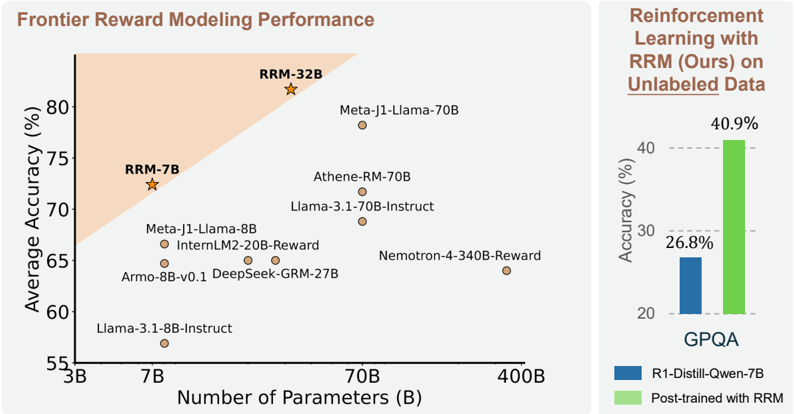
Figure 1: Average accuracy of various reward models on Preference Proxy Evaluations [18] over the MMLU-Pro, MATH, and GPQA subsets. The proposed reward reasoning model (RRM) outperforms previous reward models across model sizes. We also conduct reinforcement learning on unlabeled data, using RRM as the reward model. Even without ground-truth answers, reinforcement learning with RRM achieves significant improvements on GPQA, which evaluates general-domain reasoning.
<details>
<summary>Image 1 Details</summary>
### Visual Description
## Scatter Plot: Frontier Reward Modeling Performance
### Overview
The image presents a scatter plot comparing model performance (average accuracy %) against model size (number of parameters in billions). A secondary bar chart on the right compares accuracy metrics before and after reinforcement learning with RRM (Reinforcement Reward Modeling). The plot includes 10 labeled data points and a shaded "frontier" region.
### Components/Axes
**Main Chart:**
- **X-axis**: Number of Parameters (B) - Logarithmic scale from 3B to 400B
- **Y-axis**: Average Accuracy (%) - Linear scale from 55% to 80%
- **Legend**:
- Blue: "R1-Distill-Qwen-7B" (baseline)
- Green: "Post-trained with RRM" (enhanced)
- **Shaded Region**: Light orange triangle labeled "Frontier Reward Modeling Performance" in top-left quadrant
**Bar Chart (Right Panel):**
- **Title**: "Reinforcement Learning with RRM (Ours) on Unlabeled Data"
- **X-axis**: Two categories:
- "R1-Distill-Qwen-7B" (blue)
- "Post-trained with RRM" (green)
- **Y-axis**: Accuracy (%) - Linear scale from 20% to 40%
### Detailed Analysis
**Main Chart Data Points:**
1. **RRM-32B** (Star symbol): 80% accuracy at 32B parameters (top-right of shaded region)
2. **RRM-7B** (Star symbol): 72% accuracy at 7B parameters (left edge of shaded region)
3. **Meta-J1-Llama-70B**: 78% accuracy at 70B parameters
4. **Athene-RM-70B**: 70% accuracy at 70B parameters
5. **Llama-3.1-70B-Instruct**: 68% accuracy at 70B parameters
6. **Meta-J1-Llama-8B**: 65% accuracy at 8B parameters
7. **InternLM2-20B-Reward**: 65% accuracy at 20B parameters
8. **DeepSeek-GRM-27B**: 65% accuracy at 27B parameters
9. **Armo-8B-v0.1**: 63% accuracy at 8B parameters
10. **Llama-3.1-8B-Instruct**: 58% accuracy at 8B parameters
**Bar Chart Values:**
- Baseline (R1-Distill-Qwen-7B): 26.8% accuracy
- Post-trained with RRM: 40.9% accuracy
### Key Observations
1. **Frontier Region**: The shaded orange triangle contains the highest-performing models (RRM-32B and RRM-7B), suggesting this region represents optimal parameter-accuracy tradeoffs.
2. **Parameter Efficiency**: RRM-7B (7B parameters) achieves 72% accuracy, outperforming larger models like Llama-3.1-70B-Instruct (68% at 70B parameters).
3. **RRM Impact**: The bar chart shows a 14.1% absolute improvement (26.8% → 40.9%) when using RRM post-training.
4. **Model Clustering**: Models with 70B parameters cluster between 68-78% accuracy, while smaller models (8B) range from 58-65%.
### Interpretation
The data demonstrates that:
1. **RRM Enhances Performance**: Post-training with RRM significantly improves accuracy across all model sizes, with the most dramatic gains in smaller models (e.g., 8B → 65% vs 58%).
2. **Efficiency Frontier**: The shaded region identifies models achieving high accuracy with relatively few parameters, suggesting RRM enables better sample efficiency.
3. **Scaling Law**: While larger models generally perform better, the frontier models (RRM-7B/32B) break this trend by achieving competitive accuracy with fewer parameters.
4. **Instruction Tuning Tradeoff**: Llama-3.1-8B-Instruct (58%) underperforms its reward-trained counterpart (Meta-J1-Llama-8B at 65%), indicating instruction tuning alone may not suffice for optimal performance.
The visualization suggests RRM provides a dual benefit: improving accuracy while maintaining parameter efficiency, making it particularly valuable for deployment in resource-constrained environments.
</details>
∗ Equal contribution. ⋄ Corresponding author.
3 Peking University
## 1 Introduction
Large language models (LLMs) such as GPTs [9, 1] have significantly transformed the field of artificial intelligence. In recent years, the development paradigm of LLMs has evolved from primarily scaling pre-training resources to emphasizing post-training techniques, driven by the dual imperatives of aligning models with human preferences [45] and enhancing specific capabilities like reasoning [6, 56]. This shift reflects a growing recognition that model performance depends not only on scale but also on sophisticated methods to refine model behavior after initial training.
Reinforcement learning has emerged as a fundamental approach in LLM post-training, leveraging supervision signals from either human feedback (RLHF) or verifiable rewards (RLVR) [45, 15, 19, 33, 22]. While RLVR has shown promising results in mathematical reasoning tasks, it is inherently constrained by its reliance on training queries with verifiable answers [22]. This requirement substantially limits RLVR's application to large-scale training on general-domain queries where verification is often intractable [16, 29, 58]. In contrast, RLHF typically employs a reward model as a proxy for human preference, enabling more extensive application across diverse domains [7, 44]. Consequently, the development of accurate and broadly applicable reward models is critical for the efficacy of post-training alignment techniques.
Recent work on reward models can be categorized into scalar reward models [45, 39] and generative reward models [12, 54, 60, 80]. Scalar reward models typically replace the decoding layer with a linear head to predict a single scalar value. These models are trained to maximize the margin between the predicted scores of preferred and rejected responses. Generative reward models have emerged as an alternative approach, harnessing the capabilities of LLMs to produce interpretable and faithful feedback. These models offer enhanced flexibility, enabling them to follow adaptive evaluation instructions to construct synthetic training data, thereby facilitating self-improvement through iterative refinement [21, 78].
Despite the widespread application of current reward models, it remains an open challenge to effectively scale test-time compute for reward estimation. To serve as general-purpose evaluators, reward models should be capable of adapting to a diverse spectrum of queries, ranging from immediately obvious questions to complex tasks that require extensive reasoning [20, 50]. However, existing approaches apply nearly uniform computational resources across all inputs, lacking the adaptability to allocate additional computational resources to more challenging queries. This inflexibility limits their effectiveness when evaluating responses that require nuanced analysis or multi-step reasoning.
To address the aforementioned challenge, we propose Reward Reasoning Models (RRMs). Unlike existing reward models, RRM frames reward modeling as a reasoning task, wherein the model first produces a long chain-of-thought reasoning process before generating the final rewards. Since supervised data providing reward reasoning traces are not readily available, we develop a training framework called Reward Reasoning via Reinforcement Learning, which encourages RRMs to selfevolve their reward reasoning capabilities within a rule-based reward environment. Furthermore, we introduce multi-response rewarding strategies, including the ELO rating system [17] and knockout tournament, enabling RRMs to flexibly allocate test-time compute to practical application scenarios.
Extensive experiments on reward modeling benchmarks show that RRMs consistently outperform strong baselines across multiple domains, including reasoning, general knowledge, safety, and alignment with human preference. Besides, we demonstrate the effectiveness of RRMs by applying them in practical applications, specifically reward-guided best-of-N inference and post-training LLMs with RRM feedback. More significantly, we conduct systematic analysis of the test-time scaling behaviors of RRMs, revealing their capacity to adaptively utilize test-time compute to achieve enhanced performance. Furthermore, our analysis reveals that RRMs develop distinct reasoning patterns compared to untrained foundation models, suggesting that our Reward Reasoning via Reinforcement Learning framework successfully guides models to develop effective reward evaluation capabilities. These insights provide deeper understanding of reward reasoning processes and will likely inspire the development of future reward reasoning models within the research community.
Our main contributions are as follows:
- We propose Reward Reasoning Models (RRMs), which perform explicit reasoning before producing final rewards. This reasoning phase enables RRMs to adaptively allocate additional computational resources when evaluating responses to complex tasks. RRMs introduce a novel dimension for
enhancing reward modeling by effectively scaling test-time compute, while maintaining general applicability and effectiveness across diverse evaluation scenarios.
- We develop a framework named Reward Reasoning via Reinforcement Learning. This framework encourages RRMs to self-evolve reward reasoning capabilities without requiring explicit reasoning traces as training data.
- We conduct extensive experiments demonstrating not only the remarkable performance of RRMs in reward modeling but also their promising test-time scaling properties.
## 2 Related Work
Reward Models Reward models can be characterized along two dimensions: reward formulation and scoring scheme [44, 79]. Formulation strategies include numeric only, which assigns scalar scores to query-response pairs [45, 39, 62, 63], and generative, which produces natural language feedback from which rewards may be extracted [3, 5, 11, 12, 41, 57, 71, 75]. Scoring schemes typically follow either absolute approaches, evaluating individual query-response pairs independently [16, 20, 23, 66, 73, 74], or discriminative methods that compare candidate responses to express relative preferences [28, 35, 40, 47, 54, 59, 80].
Generative Reward Models Generative reward models (GRMs), conceptually aligned with the LLM-as-a-Judge paradigm [67, 77], offer nuanced, interpretable feedback with flexibility for both single-instance evaluation and multi-response comparison [32, 43]. This approach addresses limitations of traditional evaluation methods like ROUGE [38] and BLEU [46], which struggle with open-ended tasks requiring sophisticated judgment [51]. GRMs can support judgment across diverse tasks, including multimodal inputs [31, 35, 80], and contemporaneous work on GRMs demonstrates promising scalability in both model capacity and inference-time compute [14, 41]. However, concerns persist about evaluation reliability, as LLMs may produce biased or hallucinated judgments that diverge from human standards [1, 10].
Inference-Time Scaling Inference-time scaling dynamically adjusts computational resources during model inference based on input complexity, inspired by human adaptive reasoning [30, 55, 68]. Recent approaches include parallel scaling strategies such as multi-sampling [8] and reward modelguided aggregation [37, 55, 76], which combine multiple outputs to enhance quality. Alternative methods utilize horizon-based scaling to extend reasoning traces [64]. Advanced systems like OpenAI's o1 and DeepSeek's R1 series demonstrate spontaneous computational allocation that adjusts 'thinking horizons' in response to task complexity [22, 27]. These approaches collectively underscore the importance of inference-time adaptability in improving model performance, particularly on complex reasoning tasks.
## 3 Reward Reasoning Model
## 3.1 Input Representation
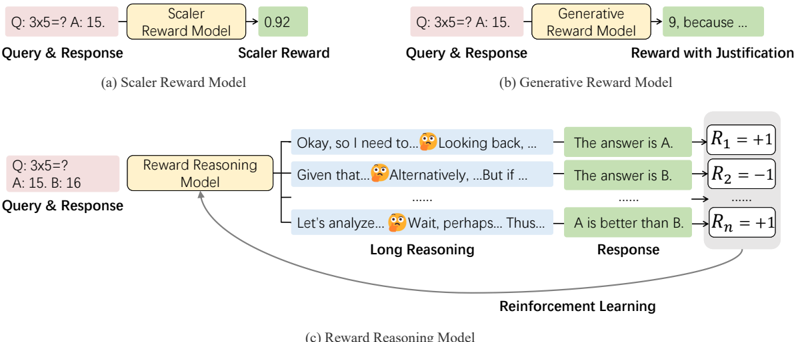
Figure 2 provides an overview of reward reasoning models (RRMs). RRMs utilize the Qwen2 [69] model architecture with a Transformer-decoder as backbone. We formulate the reward modeling task as a text completion problem, wherein RRMs take queries and corresponding responses as input, and autoregressively generate output text consisting of a thinking process followed by a final judgment. Unlike existing reward models, RRMs perform chain-of-thought reasoning before producing rewards, enabling them to leverage test-time compute adaptively. We refer to this process as reward reasoning.
Each input of RRMs contains a query and two corresponding responses. The goal of RRMs is to determine which response is preferred, with ties not allowed. We employ the system prompt from the RewardBench repository 2 , which guides the model to perform a systematic analysis of the two responses according to several evaluation criteria, including instruction fidelity, helpfulness, accuracy, harmlessness, and level of detail. The model is also explicitly instructed to avoid common biases (such as response order or length) and must justify its judgment through structured reasoning before
2 https://github.com/allenai/reward-bench
<details>
<summary>Image 2 Details</summary>
### Visual Description
## Diagram: Reinforcement Learning Reward Models
### Overview
The diagram illustrates three distinct reward modeling approaches in reinforcement learning: (1) Scaler Reward Model, (2) Generative Reward Model, and (3) Reward Reasoning Model. Each model processes query-response pairs through different architectures to produce rewards, with varying levels of complexity and justification.
### Components/Axes
1. **Scaler Reward Model**
- Input: Query & Response (e.g., "Q: 3x5=? A: 15.")
- Process: Single-step evaluation through "Scaler Reward Model"
- Output: Scalar reward value (0.92)
2. **Generative Reward Model**
- Input: Query & Response (e.g., "Q: 3x5=? A: 15.")
- Process: Single-step evaluation through "Generative Reward Model"
- Output: Reward with justification (e.g., "9, because...")
3. **Reward Reasoning Model**
- Input: Query & Response (e.g., "Q: 3x5=? A: 15. B: 16")
- Process:
- Long Reasoning phase with multiple cognitive steps:
- "Okay, so I need to..."
- "Given that..."
- "Alternatively..."
- "Let's analyze..."
- Reinforcement Learning outputs:
- R₁ = +1 (for "The answer is A.")
- R₂ = -1 (for "The answer is B.")
- Rₙ = +1 (for "A is better than B.")
- Output: Final response with cumulative reward
### Detailed Analysis
- **Scaler Model**: Direct numerical evaluation with high confidence (0.92) but no reasoning trace.
- **Generative Model**: Combines numerical output with natural language justification, suggesting intermediate reasoning steps.
- **Reward Reasoning Model**:
- Explicitly models multi-step reasoning with cognitive uncertainty indicators (🤔 emojis)
- Implements reinforcement learning through sequential reward assignments (R₁, R₂, Rₙ)
- Demonstrates iterative refinement of responses through conflicting hypotheses
### Key Observations
1. **Complexity Gradient**: Models progress from simple scalar evaluation (0.92) to multi-step reasoning with explicit reinforcement learning components.
2. **Justification Mechanisms**:
- Generative Model provides post-hoc justification
- Reward Reasoning Model embeds justification within the reasoning process
3. **Uncertainty Representation**:
- Scaler Model shows high confidence (0.92)
- Reward Reasoning Model uses emojis and conflicting hypotheses to represent cognitive uncertainty
4. **Reinforcement Learning Integration**: Only the Reward Reasoning Model explicitly incorporates RL components (R₁, R₂, Rₙ)
### Interpretation
This diagram reveals a progression in reward modeling sophistication:
1. **Baseline Evaluation**: Scaler Model represents traditional, confidence-weighted scoring
2. **Interpretability Layer**: Generative Model adds natural language explanations to black-box evaluations
3. **Cognitive Architecture**: Reward Reasoning Model formalizes human-like reasoning through:
- Explicit hypothesis generation ("Alternatively...")
- Conflict resolution ("A is better than B.")
- Sequential reinforcement learning updates
The inclusion of emojis (🤔) in the Reward Reasoning Model suggests an attempt to model cognitive states during reasoning. The reinforcement learning components (R₁, R₂, Rₙ) indicate a dynamic adjustment mechanism where multiple reasoning paths are evaluated and rewarded independently before converging on a final response. This architecture appears designed to handle complex, multi-faceted decision-making tasks where simple scalar rewards are insufficient.
</details>
(c) Reward Reasoning Model
Figure 2: An overview of reward reasoning model (RRM). RRM adaptively leverages test-time compute through chain-of-though reasoning before producing rewards.
outputting its final decision in the format '\boxed{Assistant 1}' or '\boxed{Assistant 2}'. The detailed prompt template is provided in Appendix A.1.
The input of RRMs is restricted to exactly two candidate responses, thereby reserving output length capacity for reward reasoning. Section 3.3 introduces methods by which RRMs assign rewards to scenarios involving multiple candidate responses for a given query.
## 3.2 Model Training with Reinforcement Learning
We develop a training framework called Reward Reasoning via Reinforcement Learning to train RRMs. Unlike conventional supervised fine-tuning approaches, which relies on existing reasoning traces, our framework encourages RRMs to self-evolve their reasoning capacities within a rule-based reward environment. The reward function is defined as follows:
$$\mathcal { R } = \begin{cases} + 1 , & R M e c t s \, c o r r e c t \, r e s p o n s e & ( 1 ) \\ - 1 , & o t h e r w i s e \end{cases}$$
Note that the reward R evaluates whether RRM correctly prefers the ground-truth response, rather than scoring its own outputs. Despite the simplicity of the reward signals, such rule-based rewards can effectively supervise the policy models to develop reasoning patterns that lead to correct final judgments.
Weuse Deepseek-R1 distilled models [22] as base models, applying group relative policy optimization (GRPO) [70] for training, implemented with the verl library [53]. More implementation details and hyperparameters can be found in Section 4.1 and Appendix A.2.
## 3.3 Multi-Response Rewarding Strategies
Although the input structure of RRMs strictly accepts two candidate responses, RRMs can adaptively reward multiple responses of a specific query. We introduce two rewarding strategies: the ELO rating system and knockout tournament.
ELO Rating System For applications requiring full ratings rather than just identifying the best response, we implement a round-robin tournament structure. In this approach, each candidate is compared with all others pairwise. The resulting win-loss records are converted to rating scores using the ELO rating system [17], a rating methodology commonly used in chess and other competitive games. While this strategy can process ( n 2 ) = O ( n 2 ) pairwise comparison results, computational cost can be reduced by sampling a subset of the pairwise matchups. The resulting ratings can serve as rewards in reinforcement learning from human feedback (RLHF). Experiments demonstrate that we successfully post-train an LLM using these ratings as rewards in RLHF (See Section 4).
Knockout Tournament Inspired by the knockout tournament structure [40], we design a knockout tournament strategy for RRMs that organizes multiple candidates into a competition bracket. Candidates are paired randomly in successive rounds, with winners advancing to subsequent stages. In each pairwise comparison, RRMs determine a preferred response that will participate in the tournament in the next round. Given n candidates, this requires n -1 pairwise comparisons with O ( n ) complexity and O ( log ( n )) sequential rounds. Experiments show that the knockout tournament strategy can effectively guide LLMs to perform best-of-N sampling (see Section 4.3 and Appendix B.2).
Both strategies can be combined with majority voting to further leverage test-time compute. To integrate majority voting with the aforementioned strategies, we sample RRMs multiple times for each pairwise comparison. Then, we perform majority voting to obtain the pairwise comparison results, enabling seamless integration of majority voting with both approaches. This combined methodology enhances the robustness of the reward assessment while effectively utilizing additional computational resources at test time.
## 4 Experiments
We design our experiments that evaluate RRMs on both reward modeling benchmarks and practical applications, including reward-guided inference and LLM post-training. Additionally, we analyze how RRMs utilize additional test-time compute to achieve better performance and examine the reasoning patterns exhibited by RRM across multiple domains.
## 4.1 Training Details
Training Data Training RRMs require diverse pairwise preference data that covers various capabilities and aligns with human preference. In addition to preference pairs from Skywork-Reward [39], we further synthesize preference pairs from diverse data sources. We randomly sample 80K queries from the Tülu 3 prompt dataset [33], generate two responses for each using Deepseek-R1-Distill-Qwen1.5B [22], and annotate preference labels with GPT-4o [26]. Besides, we synthesize preferences pairs using verifiable question-answer pairs from WebInstruct-verified [42], Skywork-OR1 [24], Big-Math-RL [2], and DAPO-Math [72]. We prompt Deepseek-R1 distilled 1.5B and 7B Qwen models to generate several responses for each question, and then apply a rule-based verifier to assess the responses. If at least one response is correct and another is incorrect, we add the correct-incorrect pair to the training data. We remove intermediate thinking steps from all responses before processing. The final training dataset comprises approximately 420K preferences pairs: 80K each from SkyworkReward, Tülu 3, and our-synthesized data using Tülu 3 prompts, and 180K synthesized from other sources.
RRM Training We use DeepSeek-R1-Distill-Qwen models as the base models for RRMs in all the experiments. The training hyperparameters are detailed in Appendix A.2. The RRM training framework is implemented using the verl library [53], and we train both RRM-7B and RRM-32B models on AMD Instinct MI300X Accelerators. For RRM-32B, we employ a weighted mixture of datasets with a sampling ratio of 5:1:1:1 across Skywork-Reward, Tülu-80K, our GPT-4o-labeled preference pairs, and the other synthetic data. The RRM-7B model is trained on a similar dataset mixture using a 5:1:1 ratio of Skywork-Reward, Tülu-80K, and GPT-4o-labeled preference data.
## 4.2 Evaluating Agreement with Human Preference
## 4.2.1 Setup
Benchmarks We evaluate RRMs on widely-used benchmarks for reward modeling, namely RewardBench [34] and PandaLM Test [60]. (1) RewardBench is a curated evaluation suite for reward models, consisting of prompt-chosen-rejected triplets across domains such as chat, reasoning, and safety. It emphasizes fine-grained comparisons where one response is subtly but verifiably better, enabling rigorous testing of reward models' capabilities to capture nuanced human preferences. (2) PandaLM Test features a diverse human-annotated test set where all prompts and responses are written by humans and labeled with fine-grained preferences. Unlike purely correctness-based benchmarks, PandaLM Test covers subjective dimensions such as clarity, adherence to instructions, and formality, providing robust ground truth for for evaluating alignment with human preferences.
Table 1: Evaluation results on RewardBench benchmark and PandaLM Test. Bold numbers indicate the best performance, Underlined numbers indicate the second best.
| Models | RewardBench | RewardBench | RewardBench | RewardBench | RewardBench | PandaLM Test | PandaLM Test |
|----------------------------------------|---------------|---------------|---------------|---------------|---------------|----------------|----------------|
| | Chat | Chat Hard | Safety | Reasoning | Overall | Agreement | F1 |
| Skywork-Reward-Gemma-2-27B-v0.2 [34] | 96.1 | 89.9 | 93.0 | 98.1 | 94.3 | 76.6 | 76.4 |
| JudgeLM-7B [80] | 87.3 | 43.6 | 74.5 | 48.7 | 63.5 | 65.1 | 61.9 |
| JudgeLM-33B [80] | 92.7 | 54.2 | 85.8 | 58.3 | 72.3 | 75.2 | 69.7 |
| Claude-3.5-Sonnet-20240620 [34] | 96.4 | 74.0 | 81.6 | 84.7 | 84.2 | - | - |
| DeepSeek-R1 [41, 12] | 97.1 | 73,7 | 73.3 | 95.6 | 84.9 | 78.7 | 72.5 |
| DeepSeek-GRM-27B [41] | 94.1 | 78.3 | 88.0 | 83.8 | 86.0 | - | - |
| GPT-4-0125-preview [34] | 95.3 | 74.3 | 87.6 | 86.9 | 86.0 | 66.5 | 61.8 |
| GPT-4o-0806 [34] | 96.1 | 76.1 | 86.6 | 88.1 | 86.7 | - | - |
| RM-R1-DeepSeek-Distilled-Qwen-7B [14] | 88.9 | 66.2 | 78.4 | 87.0 | 80.1 | - | - |
| RM-R1-DeepSeek-Distilled-Qwen-14B [41] | 91.3 | 91.3 | 79.4 | 95.5 | 88.9 | - | - |
| RM-R1-DeepSeek-Distilled-Qwen-32B [41] | 95.3 | 80.3 | 91.1 | 96.8 | 90.9 | - | - |
| DirectJudge-7B | 86.0 | 69.7 | 85.5 | 79.5 | 80.2 | 70.3 | 70.2 |
| DirectJudge-32B | 96.1 | 85.1 | 89.5 | 90.9 | 90.4 | 76.7 | 77.4 |
| RRM-7B | 87.7 | 70.4 | 80.7 | 90.0 | 82.2 | 72.9 | 71.1 |
| RRM-7B (voting@16) | 92.1 | 71.5 | 81.3 | 93.8 | 84.8 | 75.9 | 77.8 |
| RRM-32B | 94.7 | 81.1 | 90.7 | 98.3 | 91.2 | 78.8 | 79.0 |
| RRM-32B (voting@16) | 96.1 | 81.4 | 91.6 | 98.6 | 91.9 | 80.2 | 81.9 |
Baselines We compare RRMs with the following baselines: (1) Skywork-Reward [39], a scalar reward model that uses a regression head to output numerical preference scores without explanations or reasoning traces, (2) Production-grade LLMs , including GPT-4o [26] and Claude 3.5 Sonnet [4], which are prompted in an LLM-as-a-judge [78] manner to determine the preferred response, (3) JudgeLM [80], which is trained to generate fine-grained reward scores along with explanations, using synthetic training data generated by GPT-4 [1], (4) DeepSeek-GRM [41] and RM-R1 [14], two concurrent approaches that also incorporate a reasoning phase prior to producing rewards.
In addition to these existing baselines, we introduce (5) DirectJudge , a pairwise judging model implemented using the same training data and base models as RRMs. DirectJudge models receive the same inputs as RRMs but are trained to directly generate judgment without explicit reasoning.
## 4.2.2 Results
Table 1 presents the evaluation results of baseline reward models and RRMs on the RewardBench benchmark and the PandaLM Test. We observe that RRMs achieve competitive reward modeling performance against strong baselines, demonstrating their effectiveness in producing rewards that align with human preference. Notably, RRM-32B attains an accuracy of 98.6 in the reasoning category of RewardBench. Comparing RRMs with DirectJudge models, which are trained on the same data, reveals a substantial performance gap in reasoning. This difference indicates that RRMs effectively leverage test-time compute, thereby enhancing performance on complex queries that benefit from deliberate reasoning processes.
## 4.3 Evaluating Reward-Guided Best-of-N Inference
## 4.3.1 Setup
Preference Proxy Evaluations Preference Proxy Evaluations (PPE) [18] is a benchmark designed to evaluate reward models through proxy tasks. Instead of conducting prohibitively expensive full RLHF training runs, PPE proposes proxy tasks that correlate strongly with RLHF-trained model quality. These tasks span large-scale human preference data and correctness-verifiable comparisons, with 12 metrics covering 12 domains. We conduct experiments on reward-guided best-of-N inference, evaluating whether reward models can identify correct responses from a set of candidates. Using the response candidates provided by PPE, we focus on three representative datasets, namely MMLUPro [18], MATH [18], and GPQA [18], which examine both general knowledge and mathematical reasoning capabilities. Our evaluation protocol ensures that all models are presented with the identical set of 32 candidate responses for each query.
Table 2: Evaluation results on reward-guided best-of-N inference. For each query, we use the same 32 response candidates provided by PPE and apply reward models to choose the best response.
| Models | MMLU-Pro | MATH | GPQA | Overall |
|---------------------------------|------------|--------|--------|-----------|
| Skywork-Reward-Gemma-2-27B-v0.2 | 67 | 56.3 | 44 | 55.8 |
| GPT-4o-0806 | 64.8 | 56.9 | 46.3 | 56 |
| RRM-7B | 69.1 | 82 | 49.2 | 66.8 |
| RRM-7B (voting@5) | 69.4 | 86.1 | 49 | 68.2 |
| RRM-32B | 81.3 | 89.8 | 61.1 | 77.4 |
| RRM-32B (voting@5) | 83 | 91.8 | 64.3 | 79.7 |
Table 3: Evaluation results on binary preference classification following the protocol from Frick et al. [18]. For each benchmark, we report accuracy over a single random permutation of paired responses.
| Models | MMLU-Pro | MATH | GPQA | Overall |
|--------------------------------------------|------------|--------|--------|-----------|
| Skywork-Reward-Gemma-2-27B [65] | 55 | 46.2 | 44.7 | 48.6 |
| Gemma-2-27B [41] | 66.2 | 66.4 | 51.9 | 61.5 |
| DeepSeek-GRM-27B (voting@32) [41] | 65.5 | 69.4 | 56 | 63.6 |
| DeepSeek-GRM-27B (MetaRM) (voting@32) [41] | 68.1 | 70 | 56.9 | 65 |
| Llama-3.1-8B-Instruct [65] | 56.3 | 62.9 | 51.4 | 56.9 |
| Llama-3.1-70B-Instruct [65] | 72.1 | 73.1 | 61.2 | 68.8 |
| J1-Llama-8B (SC@32) [65] | 67.5 | 76.6 | 55.7 | 66.7 |
| J1-Llama-70B (SC@32) [65] | 79.9 | 88.1 | 66.5 | 78.2 |
| RRM-7B | 66.5 | 88 | 57.9 | 70.3 |
| RRM-7B (voting@5) | 68.3 | 90.5 | 58.3 | 72.4 |
| RRM-32B | 80.5 | 94.3 | 67.4 | 80.7 |
| RRM-32B (voting@5) | 81.3 | 95.4 | 68.4 | 81.7 |
Baselines For the first experiment, we employ the knockout tournament rewarding strategy to identify the best-of-N responses. We compare our method against several strong baselines, including Skywork-Reward-Gemma-2 [54] and GPT-4o [26]. The prompt template for GPT-4o is detailed in Appendix A.1.
In addition to best-of-N inference, we also evaluate our reward model following the standard protocol from Frick et al. [18]. For this evaluation, we compare established baselines including J1-Llama [65], DeepSeek-GRM [41], Skywork-Reward-Gemma-2 [39], and various representative reward models from recent literature. Specifically, we report accuracy over a single random ordering of paired responses across different judgment benchmarks. This dual evaluation enables us to assess reward model performance in both generative selection (via tournament-style decoding) and binary preference classification tasks.
## 4.3.2 Results
Table 2 presents the evaluation results on reward-guided best-of-N inference. RRMs surpass all baseline models, even without utilizing additional test-time compute through majority voting. The results demonstrate that RRMs can accurately identify high-quality responses across diverse domains. Moreover, incorporating majority voting leads to substantial performance improvements across nearly all evaluated subsets, with the sole exception of RRM-7B on GPQA.
To further analyze the capabilities of RRMs across different domains, we provide detailed results on each subset of the MMLU-Pro and GPQA benchmarks. As illustrated in Appendix B.1, we compare RRMs against Skywork-Reward-Gemma-2-27B-v0.2 on each individual domain. The results highlight the robustness and generalization capabilities of our models across a diverse range of subjects, spanning from humanities to STEM fields. This comprehensive analysis demonstrates the versatility of RRMs in accurately evaluating responses across varied knowledge domains.
Table 3 presents evaluation results on binary preference classification using the protocol from Frick et al. [18]. RRMs maintain strong performance across all three benchmarks, consistently outperforming baseline reward models and instruction-tuned LLMs. Notably, RRM-32B achieves state-of-the-art
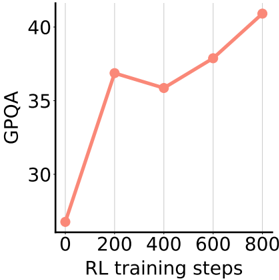
Figure 3: GPQA accuracy of using RRM for RL post-training.
<details>
<summary>Image 3 Details</summary>
### Visual Description
## Line Graph: GPQA vs. RL Training Steps
### Overview
The image depicts a line graph illustrating the relationship between GPQA (General Purpose Question Answering) performance and RL (Reinforcement Learning) training steps. The graph shows a generally upward trend with fluctuations, starting at approximately 25 GPQA at 0 training steps and reaching ~41 GPQA at 800 steps.
### Components/Axes
- **Y-Axis (Left)**: Labeled "GPQA" with a scale from 30 to 40 in increments of 5.
- **X-Axis (Bottom)**: Labeled "RL training steps" with markers at 0, 200, 400, 600, and 800.
- **Grid Lines**: Vertical and horizontal grid lines at 200-step intervals and GPQA increments of 5.
- **Data Line**: A single red line with circular data points (red dots) at each training step marker.
- **Legend**: No explicit legend is present in the image.
### Detailed Analysis
- **Data Points**:
- **0 steps**: ~25 GPQA (lowest point).
- **200 steps**: ~37 GPQA (first peak).
- **400 steps**: ~36 GPQA (slight dip).
- **600 steps**: ~38 GPQA (moderate increase).
- **800 steps**: ~41 GPQA (highest point).
- **Line Behavior**:
- The line starts at the bottom-left corner (0, 25) and ascends sharply to 37 at 200 steps.
- A minor decline occurs between 200 and 400 steps, followed by a gradual rise to 38 at 600 steps.
- A steep upward trajectory dominates the final segment, reaching 41 at 800 steps.
### Key Observations
1. **Initial Rapid Improvement**: The steepest increase occurs between 0 and 200 steps, suggesting early training efficiency.
2. **Plateau and Dip**: A slight decline at 400 steps may indicate a temporary setback or optimization challenge.
3. **Final Surge**: The sharp rise after 600 steps implies accelerated progress, potentially due to model refinement or data saturation.
4. **Consistency**: Despite fluctuations, the overall trend is upward, indicating a positive correlation between training steps and GPQA performance.
### Interpretation
The graph demonstrates that RL training steps significantly impact GPQA performance, with the most substantial gains occurring in the final phase. The initial dip at 400 steps could reflect challenges in balancing exploration and exploitation during training. The final surge suggests that extended training leads to breakthroughs, possibly due to improved policy optimization or data utilization. The absence of a legend simplifies interpretation but limits contextual understanding of multiple metrics. The grid lines enhance readability, emphasizing the stepwise progression of training.
</details>
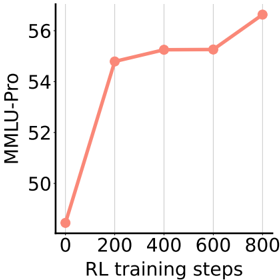
Figure 4: MMLU-Pro accuracy of using RRM for RL post-training.
<details>
<summary>Image 4 Details</summary>
### Visual Description
## Line Chart: MLU-Pro vs RL Training Steps
### Overview
The chart illustrates the relationship between RL (Reinforcement Learning) training steps and MLU-Pro performance metrics. A single red line represents the progression of MLU-Pro values across increasing training steps, showing a non-linear trend with distinct phases of growth and plateau.
### Components/Axes
- **X-axis**: "RL training steps" (0 to 800), marked at intervals of 200.
- **Y-axis**: "MLU-Pro" (48 to 56), with increments of 2.
- **Legend**: Located in the top-right corner, associating the red line with "MLU-Pro."
- **Line**: Red, solid, with circular markers at data points.
### Detailed Analysis
- **Data Points**:
- (0, 48.0 ± 0.5)
- (200, 54.5 ± 0.5)
- (400, 55.0 ± 0.5)
- (600, 55.0 ± 0.5)
- (800, 56.5 ± 0.5)
- **Trend**:
- Initial sharp increase from 48 to 54.5 between 0 and 200 steps.
- Plateau from 200 to 600 steps (54.5 to 55.0).
- Final rise from 55.0 to 56.5 between 600 and 800 steps.
### Key Observations
- The plateau between 200–600 steps suggests diminishing returns during mid-training.
- The final upward trend indicates renewed improvement at higher step counts.
- No anomalies or outliers; all data points align with the red line.
### Interpretation
The chart demonstrates that MLU-Pro performance improves significantly in early training phases, stabilizes during mid-training, and then accelerates again toward the end. This pattern may reflect:
1. **Initial Learning**: Rapid adaptation to basic tasks.
2. **Stabilization**: Convergence toward optimal strategies.
3. **Advanced Optimization**: Fine-tuning or discovery of novel solutions at higher step counts.
The red line’s consistent upward trajectory overall suggests a positive correlation between training duration and performance, though the plateau phase highlights potential inefficiencies in mid-stage training. Further analysis could explore whether the final rise correlates with specific algorithmic adjustments or data exposure.
</details>
accuracy on MMLU-Pro, MATH, and GPQA, even when compared against significantly larger models such as J1-Llama-70B. Furthermore, incorporating majority voting (voting@5) further boosts performance, with RRM-32B (voting@5) reaching peak results across all benchmarks. These findings further validate the effectiveness of RRMs in classifying reason quality under diverse and challenging evaluation settings.
## 4.4 Post-Training with RRM Feedback
In addition to directly evaluating RRMs on reward model benchmarks, we further assess RRMs by post-training LLMs with reinforcement learning or direct preference optimization, supervised by the RRM-generated rewards. This approach allows the downstream performance of the post-trained LLMs to reflect the quality of the reward signals. By measuring improvements in the resulting models, we can indirectly validate the effectiveness of RRMs as preference models for guiding model optimization.
## 4.4.1 Reinforcement Learning with Unlabeled Data
We train Deepseek-R1-Distill-Qwen-7B on WebInstruct [42] queries using group relative policy optimization (GRPO) [52]. Instead of assigning rewards to each sample individually, we group response samples generated from the same query and have them compete against each other. In each group containing 8 responses, we construct 4 × 8 pairwise matches by randomly selecting 4 competitors for each response, and then obtain the pairwise preference results using RRM-32B. Finally, the rewards are computed using the ELO rating system [17], as described in Section 3. Notably, this approach utilizes only unlabeled queries without requiring any answers or reference responses.
Following the evaluation protocols established by Ma et al. [42], we evaluate the post-trained models on MMLU-Pro and GPQA using greedy decoding with a maximum response length of 8K tokens. As shown in Figure 3 and Figure 4, the downstream performance of the post-traineded models improves steadily throughout the training process. These results demonstrate that RRMs can effectively guide post-training with reinforcement learning, despite most prior work relying exclusively on scalar reward models. This underscores the practical viability of RRMs as a compelling alternative to traditional scalar reward models in post-training pipelines.
## 4.4.2 Direct Preference Optimization
To further explore the utility of RRMs in post-training pipelines, we apply Direct Preference Optimization (DPO) [49] on Qwen2.5-7B [48] using preference labels annotated by different reward models. Specifically, we construct preference datasets from Tülu [34] with 80K queries and responses, and obtain preference annotations from three different verifiers: RRM-7B, RRM-32B, and GPT-4o. Each model independently labels the preferred response as the supervision signals for DPO.
The trained models are evaluated on the Arena-Hard benchmark [36], which contains challenging instructions designed to test comprehensive model capabilities. As shown in Table 4, all post-trained models outperform the original Qwen2.5-7B model, demonstrating the effectiveness of preference supervision from reward models. Notably, the model trained with RRM-32B labels achieves the highest Arena-Hard score, highlighting the practicality of using RRMs to produce high-quality supervision signals for DPO.
Table 4: Performance of DPO post-trained Qwen2.5-7B models on Arena-Hard.
| Arena-Hard Score | Arena-Hard Score | CI |
|-----------------------------------------------------|-----------------------------------------------------|-----------------------------------------------------|
| Before Post-Training | Before Post-Training | |
| Base Model | 18.3 | (-1.61, +1.66) |
| DPO with Preference Data Annotated by Reward Models | DPO with Preference Data Annotated by Reward Models | DPO with Preference Data Annotated by Reward Models |
| GPT-4o | 51.9 | (-2.96, +2.93) |
| RRM-7B | 53.8 | (-1.72, +1.85) |
| RRM-32B | 55.4 | (-2.60, +2.67) |
## 4.5 Scaling Test-Time Compute
## 4.5.1 Parallel Scaling
We conduct parallel test-time compute scaling experiments on MATH [25] reasoning candidate responses. We use Qwen2.5-Math-7B-Instruct [70] to generate 8 candidate responses for each question, and then employ RRMs to perform reward-guided best-of-N inference. This experimental setup allows us to systematically study the scaling behaviors of RRMs under increased test-time computational resources.
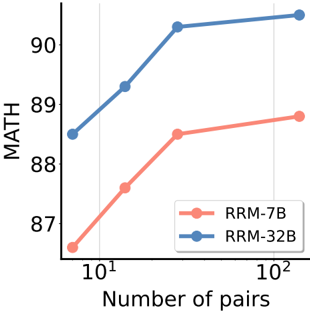
Scaling Properties As illustrated in Figure 5, increasing the number of pairwise comparisons steadily improves best-of-N performance on MATH for both RRM-7B and RRM-32B. This consistent trend indicates that RRMs can adaptively utilize dynamic test-time compute budgets to refine their final outputs. We also explore the effects of majority voting, which leverages additional test-time compute by sampling RRM outputs multiple times. Table 5 compares the performance on MATH, where RRMs are prompted on each comparison pair either a single time or eight times, with the latter followed by majority voting. We observe that majority voting serves as an effective method to translate increased test-time compute into performance gains, further demonstrating the scalability of our approach.
Figure 5: MATH accuracy with varying number of pairwise comparisons.
<details>
<summary>Image 5 Details</summary>
### Visual Description
## Line Graph: MATH Scores vs. Number of Pairs
### Overview
The image depicts a line graph comparing the performance of two models (RRM-7B and RRM-32B) on a MATH benchmark as the number of data pairs increases. The x-axis uses a logarithmic scale (10¹ to 10²), while the y-axis represents MATH scores from 87 to 90. Two distinct trends are observed: RRM-7B (red) shows a steeper improvement curve compared to RRM-32B (blue).
### Components/Axes
- **X-axis**: "Number of pairs" (logarithmic scale: 10¹, 10²)
- **Y-axis**: "MATH" (scores from 87 to 90)
- **Legend**: Located in the bottom-right corner, with:
- Red circle: RRM-7B
- Blue circle: RRM-32B
- **Data Points**:
- RRM-7B (red):
- 10¹: ~87.5
- 10¹.⁵ (≈31.6): ~88.5
- 10²: ~89.0
- RRM-32B (blue):
- 10¹: ~88.5
- 10¹.⁵ (≈31.6): ~89.5
- 10²: ~90.0
### Detailed Analysis
- **RRM-7B (Red Line)**:
- Starts at ~87.5 for 10¹ pairs.
- Increases sharply to ~88.5 at 10¹.⁵ pairs.
- Reaches ~89.0 at 10² pairs.
- **Trend**: Steep upward slope, indicating rapid improvement with more pairs.
- **RRM-32B (Blue Line)**:
- Starts higher at ~88.5 for 10¹ pairs.
- Gains ~1.0 point to ~89.5 at 10¹.⁵ pairs.
- Reaches ~90.0 at 10² pairs.
- **Trend**: Gradual upward slope, showing slower but consistent improvement.
### Key Observations
1. **Performance Gap**: RRM-32B begins with a ~1-point advantage at 10¹ pairs but is overtaken by RRM-7B at 10² pairs.
2. **Efficiency**: RRM-7B demonstrates a 15% greater improvement (from 87.5 to 89.0) compared to RRM-32B’s 1.5-point gain (88.5 to 90.0) over the same range.
3. **Logarithmic Scale Impact**: The x-axis compression emphasizes performance differences at higher pair counts (10²), where RRM-7B’s gains become significant.
### Interpretation
The data suggests that **RRM-7B scales more effectively with larger datasets** than RRM-32B. While RRM-32B starts with higher baseline performance, RRM-7B’s steeper improvement curve implies better utilization of increased data volume. This could indicate architectural or training advantages in RRM-7B for handling complex MATH tasks. The logarithmic x-axis highlights that performance gains are non-linear, with RRM-7B’s efficiency becoming pronounced at scale. No anomalies are observed; both models show monotonic improvement, but RRM-7B’s trajectory is more aggressive.
</details>
Comparing Rewarding Strategies Table 5 compares the scoring strategies, specifically using RRMs to evaluate candidates through either knockout tournament or ELO rating systems. Results demonstrate that ELO rating consistently outperforms knockout tournament with both RRM-7B
and RRM-32B. Nonetheless, the knockout tournament yields only slightly lower performance while requiring fewer computational resources-only O ( n ) comparisons. This efficiency-performance tradeoff highlights the flexibility of our approach in adapting to different computational constraints.
Table 5: Comparison of scoring strategies using RRM verifiers. ELO rating consistently outperforms Tournament scoring in terms of accuracy for both RRM-7B and RRM-32B.
| | RRM-7B | RRM-7B | RRM-32B | RRM-32B |
|-----------------|----------|----------|-----------|-----------|
| Majority Voting | No | Yes | No | Yes |
| Tournament | 88.2 | 88.7 | 90.0 | 90.4 |
| ELO rating | 88.5 | 88.8 | 90.3 | 90.5 |
## 4.5.2 Sequential Scaling
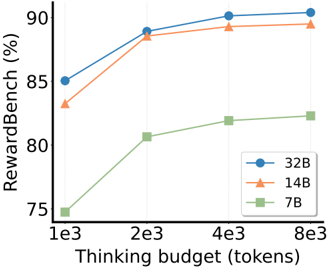
We study the impact of enabling longer chains of thought [64] before finalizing an answer. We evaluate RRMs on RewardBench, where we control the thinking budgets by setting a maximum token limit. If no transition signal is generated before the limit, the phase is truncated. We also set a small post-thinking budget to prevent compute hacking, i.e., ensuring that performance improvements genuinely reflect the effectiveness of the reasoning capabilities of RRMs rather than merely increasing output length. The detailed design of the post-thinking budget can be found in Appendix C.
Results Experiments on 7B, 14B, and 32B RRMs show that longer thinking horizons consistently improve output accuracy across all model sizes (Figure 6). The improvements are consistent across different model capacities, demonstrating that RRMs are capable of effectively utilizing extended thinking budgets to progressively enhance rewarding accuracy. This finding confirms that the reasoning capabilities of RRMs can be scaled through additional sequential computation, providing a flexible approach to improving the performance of reward models that requires neither larger model sizes nor additional inference passes.
## 4.6 Scaling RRM Training Compute
We investigate how model size and training duration affect the performance of RRMs, exploring the scaling properties of our reward reasoning approach across different compute dimensions. Figure 6 compares RRMs with model sizes of 7B, 14B, and 32B on RewardBench, showing consistent performance gains with increased model size.
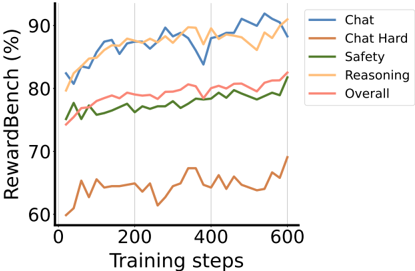
We further analyze how training duration affects model performance by tracking RRM-7B on RewardBench throughout the training process. Figure 7 illustrates the performance trajectory across different evaluation domains. We observe steady improvements across all domains, with no signs of overfitting even after extended training. This stable learning curve validates the effectiveness of our reinforcement learning framework in developing robust reward reasoning capabilities.
Figure 6: Results on RewardBench varying thinking budgets.
<details>
<summary>Image 6 Details</summary>
### Visual Description
## Line Chart: RewardBench Performance vs. Thinking Budget
### Overview
The chart illustrates the relationship between "Thinking budget (tokens)" and "RewardBench (%)" for three model sizes (32B, 14B, 7B). It shows how performance improves as the thinking budget increases, with distinct trends for each model size.
### Components/Axes
- **X-axis**: Thinking budget (tokens) in scientific notation (1e3, 2e3, 4e3, 8e3).
- **Y-axis**: RewardBench (%) ranging from 75% to 90%.
- **Legend**: Located in the bottom-right corner, mapping colors to model sizes:
- Blue (circle markers): 32B
- Orange (triangle markers): 14B
- Green (square markers): 7B
### Detailed Analysis
1. **32B Model (Blue Line)**:
- Data points: 85% (1e3), 89% (2e3), 90% (4e3), 90% (8e3).
- Trend: Steady upward slope, plateauing near 90% after 4e3 tokens.
2. **14B Model (Orange Line)**:
- Data points: 83% (1e3), 89% (2e3), 89.5% (4e3), 89.8% (8e3).
- Trend: Sharp initial increase, then gradual flattening.
3. **7B Model (Green Line)**:
- Data points: 75% (1e3), 81% (2e3), 82% (4e3), 82.5% (8e3).
- Trend: Steep early growth, followed by minimal improvement.
### Key Observations
- The 32B model consistently outperforms others across all token budgets.
- The 7B model shows the largest relative improvement (from 75% to 82.5%) but remains below the 14B and 32B models.
- All models exhibit diminishing returns as the token budget increases beyond 4e3.
### Interpretation
The data suggests that larger models (e.g., 32B) achieve higher RewardBench scores with greater computational resources (tokens). The 7B model demonstrates significant efficiency gains at lower budgets but cannot match the performance of larger models even with increased resources. This highlights a trade-off between model size and scalability, where bigger models leverage additional tokens more effectively. The plateauing trends at higher token budgets imply diminishing marginal returns for all models beyond a certain point.
</details>
Figure 7: Results on RewardBench throughout RRM7B training.
<details>
<summary>Image 7 Details</summary>
### Visual Description
## Line Graph: RewardBench Performance Across Training Steps
### Overview
The image depicts a line graph tracking the performance of different AI model capabilities (Chat, Chat Hard, Safety, Reasoning, and Overall) over training steps. The y-axis represents RewardBench percentage (%), while the x-axis shows training steps from 0 to 600. Five distinct data series are plotted with unique colors, showing varying trends in performance metrics.
### Components/Axes
- **X-axis (Training Steps)**: Labeled "Training steps" with markers at 0, 200, 400, and 600.
- **Y-axis (RewardBench %)**: Labeled "RewardBench (%)" with increments from 60% to 90%.
- **Legend**: Located in the top-right corner, mapping colors to categories:
- Blue: Chat
- Brown: Chat Hard
- Green: Safety
- Orange: Reasoning
- Red: Overall
### Detailed Analysis
1. **Chat (Blue Line)**:
- Starts at ~80% at 0 steps.
- Peaks at ~90% near 400 steps.
- Ends at ~88% at 600 steps.
- Shows volatility with sharp dips (e.g., ~85% at 300 steps).
2. **Chat Hard (Brown Line)**:
- Remains the lowest-performing series.
- Fluctuates between 60% and 70%.
- No clear upward trend; ends at ~68% at 600 steps.
3. **Safety (Green Line)**:
- Begins at ~75%.
- Dips to ~70% at 200 steps.
- Rises steadily to ~80% by 600 steps.
- Most stable after 400 steps.
4. **Reasoning (Orange Line)**:
- Starts at ~80%.
- Peaks at ~90% near 400 steps.
- Declines slightly to ~85% at 600 steps.
- High volatility in early steps (e.g., 85% at 100 steps).
5. **Overall (Red Line)**:
- Starts at ~75%.
- Maintains a relatively flat trajectory (~78-82%).
- Ends at ~82% at 600 steps.
- Acts as a composite metric, showing moderate improvement.
### Key Observations
- **Highest Performance**: Chat and Reasoning categories achieve the highest peaks (~90%), suggesting these capabilities improve most with training.
- **Lowest Performance**: Chat Hard remains stagnant (~60-70%), indicating persistent challenges in this domain.
- **Stability**: Safety and Overall metrics show the least volatility, with Safety demonstrating consistent growth.
- **Anomalies**: Chat Hard’s erratic fluctuations (e.g., sharp drops to 60% at 200 steps) contrast with its otherwise flat trend.
### Interpretation
The data suggests that Chat and Reasoning capabilities benefit most from extended training, achieving near-peak performance by 400 steps. Chat Hard’s poor performance may reflect inherent complexity or insufficient training focus. The Safety metric’s steady improvement highlights its robustness, while the Overall line’s moderate gains imply a balanced but cautious progression. The divergence between high-performing categories (Chat/Reasoning) and low-performing ones (Chat Hard) underscores potential trade-offs in model optimization. The Overall metric’s stability suggests it may prioritize consistency over peak performance, possibly serving as a conservative evaluation benchmark.
</details>
## 4.7 Reward Reasoning Pattern Analysis
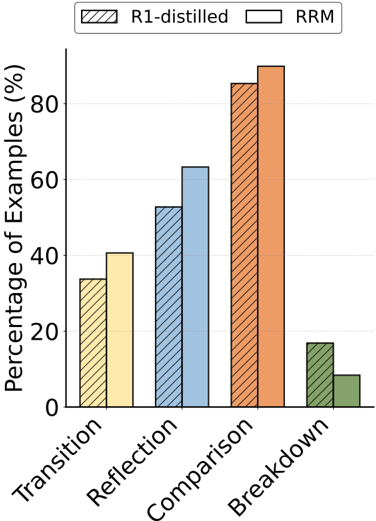
Following Wang et al. [61] and Chen et al. [13], we analyze the reasoning patterns of RRM-32B by statistically measuring the proportion of model responses containing keywords such as 'wait' and 'alternatively'. We categorize the reasoning patterns into four categories: transition (switching perspectives or strategies), reflection (self-checking or revisiting earlier steps), comparison (evaluating multiple options), and breakdown (decomposing the problem).
As illustrated in Figure 8, compared to the Deepseek-R1-Distill-Qwen-32B model, RRM-32B demonstrates a greater overall utilization of reasoning patterns when judging the superiority of two answers, particularly in analyzing from different perspectives and conducting in-depth comparisons. In contrast, the Deepseek-R1-Distill-Qwen-32B model employs the breakdown pattern more frequently, suggesting a greater tendency to approach problems directly when making judgments, but less inclination to compare the merits of the two answers and engage in self-examination. This distinction in reasoning patterns highlights how our Reward Reasoning via Reinforcement Learning framework shapes the model's approach to evaluation tasks.
Figure 8: Reward reasoning pattern analysis results. Compared to DeepSeek-R1-Distilled-Qwen-32B, RRM-32B exhibits more transition patterns (40.63% vs. 33.73%), reflection patterns (63.28% vs. 52.75%), and comparison patterns (89.84% vs. 85.29%), but fewer direct problem decomposition (8.40% vs. 16.86%).
<details>
<summary>Image 8 Details</summary>
### Visual Description
## Bar Chart: Performance Comparison of R1-distilled and RRM Models
### Overview
The image is a grouped bar chart comparing the performance of two models, **R1-distilled** (striped pattern) and **RRM** (solid color), across four categories: **Transition**, **Reflection**, **Comparison**, and **Breakdown**. The y-axis represents the **Percentage of Examples (%)**, ranging from 0% to 100%. Each category contains two bars, one for each model, with approximate values extracted from the chart.
### Components/Axes
- **X-axis (Categories)**:
- Transition
- Reflection
- Comparison
- Breakdown
- **Y-axis (Values)**:
- Percentage of Examples (%) from 0% to 100% in 20% increments.
- **Legend**:
- **R1-distilled**: Striped pattern (orange).
- **RRM**: Solid color (blue).
- **Legend Position**: Top-right corner of the chart.
### Detailed Analysis
1. **Transition**:
- R1-distilled: ~35% (striped orange bar).
- RRM: ~40% (solid blue bar).
2. **Reflection**:
- R1-distilled: ~50% (striped orange bar).
- RRM: ~60% (solid blue bar).
3. **Comparison**:
- R1-distilled: ~85% (striped orange bar).
- RRM: ~90% (solid blue bar).
4. **Breakdown**:
- R1-distilled: ~15% (striped orange bar).
- RRM: ~10% (solid blue bar).
### Key Observations
- **RRM outperforms R1-distilled** in **Reflection** (+10%) and **Comparison** (+5%).
- **R1-distilled** has a slight edge in **Breakdown** (+5%).
- **Comparison** is the highest-performing category for both models, with RRM achieving ~90%.
- **Breakdown** is the lowest-performing category for both models, with RRM at ~10%.
### Interpretation
The data suggests that **RRM** is more effective in **Reflection** and **Comparison** tasks, likely due to its ability to handle complex reasoning or contextual analysis. **R1-distilled** performs better in **Breakdown** scenarios, possibly indicating a focus on simpler or more structured tasks. The stark contrast in **Comparison** (85% vs. 90%) highlights RRM's superior capability in synthesizing or evaluating information. The **Breakdown** anomaly may reflect differences in training data or model architecture, warranting further investigation into why R1-distilled excels here. Overall, RRM demonstrates broader utility across most categories, while R1-distilled has niche strengths.
</details>
Table 6 presents case studies by comparing the outputs of Deepseek-R1-Distill-Qwen-32B and RRM-32B. Within the responses to a single example, RRM-32B exhibits a stronger propensity to iteratively apply reasoning patterns for more thorough and in-depth comparisons. The reasoning process of the Deepseek-R1-Distill-Qwen-32B model tends to be simple and monolithic-involving separate analyses of the two answers followed by a summary. Conversely, the thinking process of RRM-32B involves multiple iterations of self-reflection, comparative analysis, and consideration of various perspectives, incorporating more detailed analysis and interpretation of the instructions. Consequently, RRM-32B demonstrates an enhanced ability to follow instructions and provide more accurate comparative judgments. This iterative approach to reasoning appears to be a key factor in the superior performance of RRMs across diverse evaluation tasks.
Table 6: Case study of reasoning patterns of RRM-32B and DeepSeek-R1-Distilled-Qwen-32B.
| DeepSeek-R1-Distilled-Qwen-32B | RRM-32B |
|---------------------------------------------------------------------------------------------------------------------------------------------------------------------------------------------------------------------------------------------------------------------------------------------------------------------------------------------------------------------------------------------------------------------------------------------------------------------------------------------------------------------------------------------------------------------------------------|---------------------------------------------------------------------------------------------------------------------------------------------------------------------------------------------------------------------------------------------------------------------------------------------------------------------------------------------------------------------------------------------------------------------------------------------------------------------------------------------------------------------------------------------------------------------------------------------------------------------------------------------------------------------------------------------------------------------------------------------------------------------------------------------------------------------------------------------------------------------------------------------------------------------------------------------------------------------------------------------------------------------------------------------------------------------------------------------------------------------------------------------------------------------------------------------|
| Okay, I need to evaluate which assistant provided a bet- ter response to the given problem...Looking at the two responses: Assistant 1's code starts by... Assistant 2's solution uses a bitwise AND approach.... In conclusion, while Assistant 1's code has some issues, Assistant 2's solution is fundamentally incorrect because the bitwise approach doesn't apply to powers of three. Therefore, Assistant 1's response is better, despite its flaws, because it attempts to handle the problem correctly, even if it's not perfectly implemented. </think> \boxed{Assistant 1} | Okay, so I need to figure out which assistant is better for the given problem... Looking at Assistant 1's response... Now, looking at Assistant 2's response... Wait, that's a problem.... But then, what about the code from Assistant 1?... Let me test it with some examples... Wait, perhaps... But neither assistant provided that solution. So, given the two options, which is better?... Alternatively, perhaps I'm missing something. Let me think again. Wait, the problem requires a solution without loops or recursion... Alternatively... Looking back, Assistant 1's code is ... Assistant 2's code is ... Alternatively, perhaps I'm missing something. Let me think again. Wait, ... Wait, the user's instruction says: "Do NOT say both / neither are good." So I have to choose between Assistant 1 or 2. Given that, I think Assistant 2's code is better because ... </think> The better response is... |
| Alright, let's evaluate the problem step by step... First, I look at Assistant 1's response... Now, Assistant 2's response is much simpler... Therefore, Assistant 1 correctly addressed the exponentia- tion but made a minor error in the final subtraction... </think> The correct evaluation requires...\boxed{Assistant 1} | Okay, so I need to figure out which assistant is better for the given query. ... Assistant 1 starts by ... Assistant 2, on the other hand, ... Looking at the instruction, the user wrote... However, the problem is that the instruction might be am- biguous. If ..., then Assistant 2 is correct. But if ..., then Assistant 1 is correct. Since the instruction is...So I think the intended operation is exponentiation. Therefore, Assistant 1's approach is more accurate for the likely intended problem. However, if the problem was meant to be multiplication, then Assistant 2 is correct. But given the notation, exponentiation is more probable. So blue Assistant 1's answer is better in that context. But wait, the user's instruction is... Hmm, this is a bit confusing. I need to decide based on the instruction. ... But if ... Given that, Assistant 2's interpretation is more likely cor- rect... So, considering the instruction's ambiguity, but leaning towards multiplication, Assistant 2 is better. </think> The instruction is ambiguous, but Assistant 2 correctly interpreted it as multiplication, providing the accurate re- sult. \boxed{Assistant 2} |
## 5 Conclusion
In this paper, we introduced Reward Reasoning Models (RRMs), incorporating explicit reasoning processes prior to reward assignment. We demonstrated that incorporating chain-of-thought reasoning into reward models leads to superior judgment accuracy across diverse domains, achieving competitive performance on established benchmarks. Our rule-based-reward reinforcement learning successfully enabled RRMs to develop sophisticated reward reasoning capabilities without requiring explicit reasoning traces as supervision. Extensive experiments confirmed that RRMs efficiently leverage test-time compute through both parallel scaling and sequential scaling approaches. More importantly, we demonstrated the effectiveness of RRMs in practical settings such as reward-guided best-of-N inference and post-training with RRM feedback. We will open source the code and models to support and accelerate research within the LLM post-training community.
## References
- [1] Josh Achiam, Steven Adler, Sandhini Agarwal, Lama Ahmad, Ilge Akkaya, Florencia Leoni Aleman, Diogo Almeida, Janko Altenschmidt, Sam Altman, Shyamal Anadkat, et al. GPT-4 technical report. arXiv preprint arXiv:2303.08774 , 2023.
- [2] Alon Albalak, Duy Phung, Nathan Lile, Rafael Rafailov, Kanishk Gandhi, Louis Castricato, Anikait Singh, Chase Blagden, Violet Xiang, Dakota Mahan, and Nick Haber. Big-math: A large-scale, high-quality math dataset for reinforcement learning in language models, 2025. URL https://arxiv.org/abs/2502.17387 .
- [3] Andrei Alexandru, Antonia Calvi, Henry Broomfield, Jackson Golden, Kyle Dai, Mathias Leys, Maurice Burger, Max Bartolo, Roman Engeler, Sashank Pisupati, et al. Atla selene mini: A general purpose evaluation model. arXiv preprint arXiv:2501.17195 , 2025.
- [4] AI Anthropic. The claude 3 model family: Opus, sonnet, haiku. Claude-3 Model Card , 1:1, 2024.
- [5] Negar Arabzadeh, Siqing Huo, Nikhil Mehta, Qingyun Wu, Chi Wang, Ahmed Hassan Awadallah, Charles L. A. Clarke, and Julia Kiseleva. Assessing and verifying task utility in LLM-powered applications. In Yaser Al-Onaizan, Mohit Bansal, and Yun-Nung Chen, editors, Proceedings of the 2024 Conference on Empirical Methods in Natural Language Processing , pages 21868-21888, Miami, Florida, USA, November 2024. Association for Computational Linguistics. doi: 10.18653/v1/2024.emnlp-main.1219. URL https: //aclanthology.org/2024.emnlp-main.1219/ .
- [6] Yuntao Bai, Andy Jones, Kamal Ndousse, Amanda Askell, Anna Chen, Nova DasSarma, Dawn Drain, Stanislav Fort, Deep Ganguli, Tom Henighan, et al. Training a helpful and harmless assistant with reinforcement learning from human feedback. arXiv preprint arXiv:2204.05862 , 2022.
- [7] Yuntao Bai, Saurav Kadavath, Sandipan Kundu, Amanda Askell, Jackson Kernion, Andy Jones, Anna Chen, Anna Goldie, Azalia Mirhoseini, Cameron McKinnon, et al. Constitutional ai: Harmlessness from ai feedback. arXiv preprint arXiv:2212.08073 , 2022.
- [8] Bradley Brown, Jordan Juravsky, Ryan Ehrlich, Ronald Clark, Quoc V Le, Christopher Ré, and Azalia Mirhoseini. Large language monkeys: Scaling inference compute with repeated sampling. arXiv preprint arXiv:2407.21787 , 2024.
- [9] Tom Brown, Benjamin Mann, Nick Ryder, Melanie Subbiah, Jared D Kaplan, Prafulla Dhariwal, Arvind Neelakantan, Pranav Shyam, Girish Sastry, Amanda Askell, et al. Language models are few-shot learners. Advances in neural information processing systems , 33:1877-1901, 2020.
- [10] Sébastien Bubeck, Varun Chadrasekaran, Ronen Eldan, Johannes Gehrke, Eric Horvitz, Ece Kamar, Peter Lee, Yin Tat Lee, Yuanzhi Li, Scott Lundberg, et al. Sparks of artificial general intelligence: Early experiments with GPT-4, 2023.
- [11] Maosong Cao, Alexander Lam, Haodong Duan, Hongwei Liu, Songyang Zhang, and Kai Chen. Compassjudger-1: All-in-one judge model helps model evaluation and evolution. arXiv preprint arXiv:2410.16256 , 2024.
- [12] Nuo Chen, Zhiyuan Hu, Qingyun Zou, Jiaying Wu, Qian Wang, Bryan Hooi, and Bingsheng He. Judgelrm: Large reasoning models as a judge. arXiv preprint arXiv:2504.00050 , 2025.
- [13] Runjin Chen, Zhenyu (Allen) Zhang, Junyuan Hong, Souvik Kundu, and Zhangyang Wang. Seal: Steerable reasoning calibration of large language models for free. 2025. URL https: //api.semanticscholar.org/CorpusID:277741244 .
- [14] Xiusi Chen, Gaotang Li, Ziqi Wang, Bowen Jin, Cheng Qian, Yu Wang, Hongru Wang, Yu Zhang, Denghui Zhang, Tong Zhang, et al. Rm-r1: Reward modeling as reasoning. arXiv preprint arXiv:2505.02387 , 2025.
- [15] Paul F. Christiano, Jan Leike, Tom B. Brown, Miljan Martic, Shane Legg, and Dario Amodei. Deep reinforcement learning from human preferences. In Proceedings of the 31st International Conference on Neural Information Processing Systems , NIPS'17, page 4302-4310, Red Hook, NY, USA, 2017. Curran Associates Inc. ISBN 9781510860964.
- [16] Karl Cobbe, Vineet Kosaraju, Mohammad Bavarian, Mark Chen, Heewoo Jun, Lukasz Kaiser, Matthias Plappert, Jerry Tworek, Jacob Hilton, Reiichiro Nakano, et al. Training verifiers to solve math word problems. arXiv preprint arXiv:2110.14168 , 2021.
- [17] Arpad E. Elo. The Rating of Chessplayers, Past and Present . Arco Pub., New York, 1978. ISBN 0668047216. URL http://www.amazon.com/Rating-Chess-Players-Past-Present/ dp/0668047216 .
- [18] Evan Frick, Tianle Li, Connor Chen, Wei-Lin Chiang, Anastasios Nikolas Angelopoulos, Jiantao Jiao, Banghua Zhu, Joseph E. Gonzalez, and Ion Stoica. How to evaluate reward models for RLHF. In The Thirteenth International Conference on Learning Representations , 2025. URL https://openreview.net/forum?id=cbttLtO94Q .
- [19] Jiaxuan Gao, Shusheng Xu, Wenjie Ye, Weilin Liu, Chuyi He, Wei Fu, Zhiyu Mei, Guangju Wang, and Yi Wu. On designing effective rl reward at training time for llm reasoning. arXiv preprint arXiv:2410.15115 , 2024.
- [20] Leo Gao, John Schulman, and Jacob Hilton. Scaling laws for reward model overoptimization. In Proceedings of the 40th International Conference on Machine Learning , ICML'23. JMLR.org, 2023.
- [21] Jiawei Gu, Xuhui Jiang, Zhichao Shi, Hexiang Tan, Xuehao Zhai, Chengjin Xu, Wei Li, Yinghan Shen, Shengjie Ma, Honghao Liu, et al. A survey on llm-as-a-judge. arXiv preprint arXiv:2411.15594 , 2024.
- [22] Daya Guo, Dejian Yang, Haowei Zhang, Junxiao Song, Ruoyu Zhang, Runxin Xu, Qihao Zhu, Shirong Ma, Peiyi Wang, Xiao Bi, et al. Deepseek-r1: Incentivizing reasoning capability in llms via reinforcement learning. arXiv preprint arXiv:2501.12948 , 2025.
- [23] Fang Guo, Wenyu Li, Honglei Zhuang, Yun Luo, Yafu Li, Le Yan, Qi Zhu, and Yue Zhang. Mcranker: Generating diverse criteria on-the-fly to improve pointwise llm rankers. In Proceedings of the Eighteenth ACM International Conference on Web Search and Data Mining , WSDM '25, page 944-953, New York, NY, USA, 2025. Association for Computing Machinery. ISBN 9798400713293. doi: 10.1145/3701551.3703583. URL https: //doi.org/10.1145/3701551.3703583 .
- [24] Jujie He, Jiacai Liu, Chris Yuhao Liu, Rui Yan, Chaojie Wang, Peng Cheng, Xiaoyu Zhang, Fuxiang Zhang, Jiacheng Xu, Wei Shen, Siyuan Li, Liang Zeng, Tianwen Wei, Cheng Cheng, Yang Liu, and Yahui Zhou. Skywork open reasoner series. https://capricious-hydrogen-41c.notion.site/ Skywork-Open-Reaonser-Series-1d0bc9ae823a80459b46c149e4f51680 , 2025. Notion Blog.
- [25] Dan Hendrycks, Collin Burns, Saurav Kadavath, Akul Arora, Steven Basart, Eric Tang, Dawn Song, and Jacob Steinhardt. Measuring mathematical problem solving with the MATH dataset. In Thirty-fifth Conference on Neural Information Processing Systems Datasets and Benchmarks Track (Round 2) , 2021. URL https://openreview.net/forum?id=7Bywt2mQsCe .
- [26] Aaron Hurst, Adam Lerer, Adam P Goucher, Adam Perelman, Aditya Ramesh, Aidan Clark, AJ Ostrow, Akila Welihinda, Alan Hayes, Alec Radford, et al. Gpt-4o system card. arXiv preprint arXiv:2410.21276 , 2024.
- [27] Aaron Jaech, Adam Kalai, Adam Lerer, Adam Richardson, Ahmed El-Kishky, Aiden Low, Alec Helyar, Aleksander Madry, Alex Beutel, Alex Carney, et al. Openai o1 system card. arXiv preprint arXiv:2412.16720 , 2024.
- [28] Dongfu Jiang, Xiang Ren, and Bill Yuchen Lin. LLM-blender: Ensembling large language models with pairwise ranking and generative fusion. In Anna Rogers, Jordan Boyd-Graber, and Naoaki Okazaki, editors, Proceedings of the 61st Annual Meeting of the Association for Computational Linguistics (Volume 1: Long Papers) , pages 14165-14178, Toronto, Canada, July 2023. Association for Computational Linguistics. doi: 10.18653/v1/2023.acl-long.792. URL https://aclanthology.org/2023.acl-long.792/ .
- [29] Carlos E Jimenez, John Yang, Alexander Wettig, Shunyu Yao, Kexin Pei, Ofir Press, and Karthik R Narasimhan. SWE-bench: Can language models resolve real-world github issues? In The Twelfth International Conference on Learning Representations , 2024. URL https: //openreview.net/forum?id=VTF8yNQM66 .
- [30] Jared Kaplan, Sam McCandlish, Tom Henighan, Tom B Brown, Benjamin Chess, Rewon Child, Scott Gray, Alec Radford, Jeffrey Wu, and Dario Amodei. Scaling laws for neural language models. arXiv preprint arXiv:2001.08361 , 2020.
- [31] Muhammad Uzair Khattak, Hanoona Rasheed, Muhammad Maaz, Salman Khan, and Fahad Shahbaz Khan. Maple: Multi-modal prompt learning. In 2023 IEEE/CVF Conference on Computer Vision and Pattern Recognition (CVPR) , pages 19113-19122, 2023. doi: 10.1109/CVPR52729.2023.01832.
- [32] Seungone Kim, Juyoung Suk, Shayne Longpre, Bill Yuchen Lin, Jamin Shin, Sean Welleck, Graham Neubig, Moontae Lee, Kyungjae Lee, and Minjoon Seo. Prometheus 2: An open source language model specialized in evaluating other language models. In Yaser Al-Onaizan, Mohit Bansal, and Yun-Nung Chen, editors, Proceedings of the 2024 Conference on Empirical Methods in Natural Language Processing , pages 4334-4353, Miami, Florida, USA, November 2024. Association for Computational Linguistics. doi: 10.18653/v1/2024.emnlp-main.248. URL https://aclanthology.org/2024.emnlp-main.248/ .
- [33] Nathan Lambert, Jacob Morrison, Valentina Pyatkin, Shengyi Huang, Hamish Ivison, Faeze Brahman, Lester James V Miranda, Alisa Liu, Nouha Dziri, Shane Lyu, et al. T \ " ulu 3: Pushing frontiers in open language model post-training. arXiv preprint arXiv:2411.15124 , 2024.
- [34] Nathan Lambert, Valentina Pyatkin, Jacob Morrison, LJ Miranda, Bill Yuchen Lin, Khyathi Chandu, Nouha Dziri, Sachin Kumar, Tom Zick, Yejin Choi, et al. Rewardbench: Evaluating reward models for language modeling. arXiv preprint arXiv:2403.13787 , 2024.
- [35] Junlong Li, Shichao Sun, Weizhe Yuan, Run-Ze Fan, hai zhao, and Pengfei Liu. Generative judge for evaluating alignment. In The Twelfth International Conference on Learning Representations , 2024. URL https://openreview.net/forum?id=gtkFw6sZGS .
- [36] Tianle Li, Wei-Lin Chiang, Evan Frick, Lisa Dunlap, Tianhao Wu, Banghua Zhu, Joseph E. Gonzalez, and Ion Stoica. From crowdsourced data to high-quality benchmarks: Arena-hard and benchbuilder pipeline, 2024. URL https://arxiv.org/abs/2406.11939 .
- [37] Hunter Lightman, Vineet Kosaraju, Yuri Burda, Harrison Edwards, Bowen Baker, Teddy Lee, Jan Leike, John Schulman, Ilya Sutskever, and Karl Cobbe. Let's verify step by step. In The Twelfth International Conference on Learning Representations , 2024. URL https: //openreview.net/forum?id=v8L0pN6EOi .
- [38] Chin-Yew Lin. Rouge: A package for automatic evaluation of summaries. In Text summarization branches out , pages 74-81, 2004.
- [39] Chris Yuhao Liu, Liang Zeng, Jiacai Liu, Rui Yan, Jujie He, Chaojie Wang, Shuicheng Yan, Yang Liu, and Yahui Zhou. Skywork-reward: Bag of tricks for reward modeling in llms. arXiv preprint arXiv:2410.18451 , 2024.
- [40] Yantao Liu, Zijun Yao, Rui Min, Yixin Cao, Lei Hou, and Juanzi Li. Pairwise rm: Perform best-of-n sampling with knockout tournament. arXiv preprint arXiv:2501.13007 , 2025.
- [41] Zijun Liu, Peiyi Wang, Runxin Xu, Shirong Ma, Chong Ruan, Peng Li, Yang Liu, and Yu Wu. Inference-time scaling for generalist reward modeling. arXiv preprint arXiv:2504.02495 , 2025.
- [42] Xueguang Ma, Qian Liu, Dongfu Jiang, Ge Zhang, Zejun Ma, and Wenhu Chen. General-reasoner: Advancing llm reasoning across all domains. https://github.com/ TIGER-AI-Lab/General-Reasoner/blob/main/General\_Reasoner.pdf , 2025.
- [43] Dakota Mahan, Duy Van Phung, Rafael Rafailov, Chase Blagden, Nathan Lile, Louis Castricato, Jan-Philipp Fränken, Chelsea Finn, and Alon Albalak. Generative reward models. arXiv preprint arXiv:2410.12832 , 2024.
- [44] Long Ouyang, Jeffrey Wu, Xu Jiang, Diogo Almeida, Carroll Wainwright, Pamela Mishkin, Chong Zhang, Sandhini Agarwal, Katarina Slama, Alex Gray, John Schulman, Jacob Hilton, Fraser Kelton, Luke Miller, Maddie Simens, Amanda Askell, Peter Welinder, Paul Christiano, Jan Leike, and Ryan Lowe. Training language models to follow instructions with human feedback. In Alice H. Oh, Alekh Agarwal, Danielle Belgrave, and Kyunghyun Cho, editors, Advances in Neural Information Processing Systems , 2022. URL https://openreview.net/ forum?id=TG8KACxEON .
- [45] Long Ouyang, Jeffrey Wu, Xu Jiang, Diogo Almeida, Carroll Wainwright, Pamela Mishkin, Chong Zhang, Sandhini Agarwal, Katarina Slama, Alex Ray, et al. Training language models to follow instructions with human feedback. Advances in neural information processing systems , 35:27730-27744, 2022.
- [46] Kishore Papineni, Salim Roukos, Todd Ward, and Wei-Jing Zhu. Bleu: a method for automatic evaluation of machine translation. In Proceedings of the 40th annual meeting of the Association for Computational Linguistics , pages 311-318, 2002.
- [47] Junsoo Park, Seungyeon Jwa, Ren Meiying, Daeyoung Kim, and Sanghyuk Choi. OffsetBias: Leveraging debiased data for tuning evaluators. In Yaser Al-Onaizan, Mohit Bansal, and Yun-Nung Chen, editors, Findings of the Association for Computational Linguistics: EMNLP 2024 , pages 1043-1067, Miami, Florida, USA, November 2024. Association for Computational Linguistics. doi: 10.18653/v1/2024.findings-emnlp.57. URL https://aclanthology.org/ 2024.findings-emnlp.57/ .
- [48] Qwen, :, An Yang, Baosong Yang, Beichen Zhang, Binyuan Hui, Bo Zheng, Bowen Yu, Chengyuan Li, Dayiheng Liu, Fei Huang, Haoran Wei, Huan Lin, Jian Yang, Jianhong Tu, Jianwei Zhang, Jianxin Yang, Jiaxi Yang, Jingren Zhou, Junyang Lin, Kai Dang, Keming Lu, Keqin Bao, Kexin Yang, Le Yu, Mei Li, Mingfeng Xue, Pei Zhang, Qin Zhu, Rui Men, Runji Lin, Tianhao Li, Tianyi Tang, Tingyu Xia, Xingzhang Ren, Xuancheng Ren, Yang Fan, Yang Su, Yichang Zhang, Yu Wan, Yuqiong Liu, Zeyu Cui, Zhenru Zhang, and Zihan Qiu. Qwen2.5 technical report, 2025. URL https://arxiv.org/abs/2412.15115 .
- [49] Rafael Rafailov, Archit Sharma, Eric Mitchell, Christopher D Manning, Stefano Ermon, and Chelsea Finn. Direct preference optimization: Your language model is secretly a reward model. In Thirty-seventh Conference on Neural Information Processing Systems , 2023. URL https://openreview.net/forum?id=HPuSIXJaa9 .
- [50] Rafael Rafailov, Yaswanth Chittepu, Ryan Park, Harshit Sikchi, Joey Hejna, W. Bradley Knox, Chelsea Finn, and Scott Niekum. Scaling laws for reward model overoptimization in direct alignment algorithms. In The Thirty-eighth Annual Conference on Neural Information Processing Systems , 2024. URL https://openreview.net/forum?id=pf4OuJyn4Q .
- [51] Natalie Schluter. The limits of automatic summarisation according to rouge. In Proceedings of the 15th Conference of the European Chapter of the Association for Computational Linguistics , pages 41-45. Association for Computational Linguistics, 2017.
- [52] Zhihong Shao, Peiyi Wang, Qihao Zhu, Runxin Xu, Junxiao Song, Xiao Bi, Haowei Zhang, Mingchuan Zhang, Y. K. Li, Y. Wu, and Daya Guo. Deepseekmath: Pushing the limits of mathematical reasoning in open language models, 2024. URL https://arxiv.org/abs/ 2402.03300 .
- [53] Guangming Sheng, Chi Zhang, Zilingfeng Ye, Xibin Wu, Wang Zhang, Ru Zhang, Yanghua Peng, Haibin Lin, and Chuan Wu. HybridFlow: A flexible and efficient RLHF framework. arXiv preprint arXiv: 2409.19256 , 2024.
- [54] Tu Shiwen, Zhao Liang, Chris Yuhao Liu, Liang Zeng, and Yang Liu. Skywork critic model series. https://huggingface.co/Skywork , September 2024. URL https://huggingface. co/Skywork .
- [55] Charlie Victor Snell, Jaehoon Lee, Kelvin Xu, and Aviral Kumar. Scaling LLM testtime compute optimally can be more effective than scaling parameters for reasoning. In The Thirteenth International Conference on Learning Representations , 2025. URL https: //openreview.net/forum?id=4FWAwZtd2n .
- [56] Hugo Touvron, Thibaut Lavril, Gautier Izacard, Xavier Martinet, Marie-Anne Lachaux, Timothée Lacroix, Baptiste Rozière, Naman Goyal, Eric Hambro, Faisal Azhar, et al. Llama: Open and efficient foundation language models. arXiv preprint arXiv:2302.13971 , 2023.
- [57] Tu Vu, Kalpesh Krishna, Salaheddin Alzubi, Chris Tar, Manaal Faruqui, and Yun-Hsuan Sung. Foundational autoraters: Taming large language models for better automatic evaluation. In Yaser Al-Onaizan, Mohit Bansal, and Yun-Nung Chen, editors, Proceedings of the 2024 Conference on Empirical Methods in Natural Language Processing , pages 17086-17105, Miami, Florida, USA, November 2024. Association for Computational Linguistics. doi: 10.18653/v1/2024. emnlp-main.949. URL https://aclanthology.org/2024.emnlp-main.949/ .
- [58] Binghai Wang, Rui Zheng, Lu Chen, Yan Liu, Shihan Dou, Caishuang Huang, Wei Shen, Senjie Jin, Enyu Zhou, Chenyu Shi, et al. Secrets of rlhf in large language models part ii: Reward modeling. arXiv preprint arXiv:2401.06080 , 2024.
- [59] Tianlu Wang, Ilia Kulikov, Olga Golovneva, Ping Yu, Weizhe Yuan, Jane Dwivedi-Yu, Richard Yuanzhe Pang, Maryam Fazel-Zarandi, Jason Weston, and Xian Li. Self-taught evaluators. arXiv preprint arXiv:2408.02666 , 2024.
- [60] Yidong Wang, Zhuohao Yu, Wenjin Yao, Zhengran Zeng, Linyi Yang, Cunxiang Wang, Hao Chen, Chaoya Jiang, Rui Xie, Jindong Wang, Xing Xie, Wei Ye, Shikun Zhang, and Yue Zhang. Pandalm: An automatic evaluation benchmark for llm instruction tuning optimization. In ICLR , 2024. URL https://openreview.net/forum?id=5Nn2BLV7SB .
- [61] Yiping Wang, Qing Yang, Zhiyuan Zeng, Liliang Ren, Lucas Liu, Baolin Peng, Hao Cheng, Xuehai He, Kuan Wang, Jianfeng Gao, Weizhu Chen, Shuohang Wang, Simon Shaolei Du, and Yelong Shen. Reinforcement learning for reasoning in large language models with one training example. 2025. URL https://api.semanticscholar.org/CorpusID:278171513 .
- [62] Zhilin Wang, Yi Dong, Jiaqi Zeng, Virginia Adams, Makesh Narsimhan Sreedhar, Daniel Egert, Olivier Delalleau, Jane Polak Scowcroft, Neel Kant, Aidan Swope, et al. Helpsteer: Multi-attribute helpfulness dataset for steerlm. arXiv preprint arXiv:2311.09528 , 2023.
- [63] Zhilin Wang, Yi Dong, Olivier Delalleau, Jiaqi Zeng, Gerald Shen, Daniel Egert, Jimmy J. Zhang, Makesh Narsimhan Sreedhar, and Oleksii Kuchaiev. Helpsteer 2: Open-source dataset for training top-performing reward models. In The Thirty-eight Conference on Neural Information Processing Systems Datasets and Benchmarks Track , 2024. URL https: //openreview.net/forum?id=PvVKUFhaNy .
- [64] Jason Wei, Xuezhi Wang, Dale Schuurmans, Maarten Bosma, brian ichter, Fei Xia, Ed H. Chi, Quoc V Le, and Denny Zhou. Chain of thought prompting elicits reasoning in large language models. In Alice H. Oh, Alekh Agarwal, Danielle Belgrave, and Kyunghyun Cho, editors, Advances in Neural Information Processing Systems , 2022. URL https://openreview.net/ forum?id=\_VjQlMeSB\_J .
- [65] Chenxi Whitehouse, Tianlu Wang, Ping Yu, Xian Li, Jason Weston, Ilia Kulikov, and Swarnadeep Saha. J1: Incentivizing thinking in llm-as-a-judge via reinforcement learning. arXiv preprint arXiv:2505.10320 , 2025.
- [66] Genta Indra Winata, David Anugraha, Lucky Susanto, Garry Kuwanto, and Derry Tanti Wijaya. Metametrics: Calibrating metrics for generation tasks using human preferences. In The Thirteenth International Conference on Learning Representations , 2025. URL https://openreview.net/forum?id=slO3xTt4CG .
- [67] Tianhao Wu, Weizhe Yuan, Olga Golovneva, Jing Xu, Yuandong Tian, Jiantao Jiao, Jason Weston, and Sainbayar Sukhbaatar. Meta-rewarding language models: Self-improving alignment with llm-as-a-meta-judge. arXiv preprint arXiv:2407.19594 , 2024.
- [68] Yangzhen Wu, Zhiqing Sun, Shanda Li, Sean Welleck, and Yiming Yang. Inference scaling laws: An empirical analysis of compute-optimal inference for LLM problem-solving. In The Thirteenth International Conference on Learning Representations , 2025. URL https: //openreview.net/forum?id=VNckp7JEHn .
- [69] An Yang, Baosong Yang, Binyuan Hui, Bo Zheng, Bowen Yu, Chang Zhou, Chengpeng Li, Chengyuan Li, Dayiheng Liu, Fei Huang, Guanting Dong, Haoran Wei, Huan Lin, Jialong Tang, Jialin Wang, Jian Yang, Jianhong Tu, Jianwei Zhang, Jianxin Ma, Jin Xu, Jingren Zhou, Jinze Bai, Jinzheng He, Junyang Lin, Kai Dang, Keming Lu, Keqin Chen, Kexin Yang, Mei Li, Mingfeng Xue, Na Ni, Pei Zhang, Peng Wang, Ru Peng, Rui Men, Ruize Gao, Runji Lin, Shijie Wang, Shuai Bai, Sinan Tan, Tianhang Zhu, Tianhao Li, Tianyu Liu, Wenbin Ge, Xiaodong Deng, Xiaohuan Zhou, Xingzhang Ren, Xinyu Zhang, Xipin Wei, Xuancheng Ren, Yang Fan, Yang Yao, Yichang Zhang, Yu Wan, Yunfei Chu, Yuqiong Liu, Zeyu Cui, Zhenru Zhang, and Zhihao Fan. Qwen2 technical report. arXiv preprint arXiv:2407.10671 , 2024.
- [70] An Yang, Beichen Zhang, Binyuan Hui, Bofei Gao, Bowen Yu, Chengpeng Li, Dayiheng Liu, Jianhong Tu, Jingren Zhou, Junyang Lin, Keming Lu, Mingfeng Xue, Runji Lin, Tianyu Liu, Xingzhang Ren, and Zhenru Zhang. Qwen2.5-math technical report: Toward mathematical expert model via self-improvement. arXiv preprint arXiv:2409.12122 , 2024.
- [71] Ziyi Ye, Xiangsheng Li, Qiuchi Li, Qingyao Ai, Yujia Zhou, Wei Shen, Dong Yan, and Yiqun LIU. Learning LLM-as-a-judge for preference alignment. In The Thirteenth International Conference on Learning Representations , 2025. URL https://openreview.net/forum? id=HZVIQE1MsJ .
- [72] Qiying Yu, Zheng Zhang, Ruofei Zhu, Yufeng Yuan, Xiaochen Zuo, Yu Yue, Tiantian Fan, Gaohong Liu, Lingjun Liu, Xin Liu, Haibin Lin, Zhiqi Lin, Bole Ma, Guangming Sheng, Yuxuan Tong, Chi Zhang, Mofan Zhang, Wang Zhang, Hang Zhu, Jinhua Zhu, Jiaze Chen, Jiangjie Chen, Chengyi Wang, Hongli Yu, Weinan Dai, Yuxuan Song, Xiangpeng Wei, Hao Zhou, Jingjing Liu, Wei-Ying Ma, Ya-Qin Zhang, Lin Yan, Mu Qiao, Yonghui Wu, and Mingxuan Wang. Dapo: An open-source llm reinforcement learning system at scale, 2025. URL https://arxiv.org/abs/2503.14476 .
- [73] Yue Yu, Zhengxing Chen, Aston Zhang, Liang Tan, Chenguang Zhu, Richard Yuanzhe Pang, Yundi Qian, Xuewei Wang, Suchin Gururangan, Chao Zhang, Melanie Kambadur, Dhruv Mahajan, and Rui Hou. Self-generated critiques boost reward modeling for language models. In Luis Chiruzzo, Alan Ritter, and Lu Wang, editors, Proceedings of the 2025 Conference of the Nations of the Americas Chapter of the Association for Computational Linguistics: Human Language Technologies (Volume 1: Long Papers) , pages 11499-11514, Albuquerque, New Mexico, April 2025. Association for Computational Linguistics. ISBN 979-8-89176-189-6. URL https://aclanthology.org/2025.naacl-long.573/ .
- [74] Weizhe Yuan, Richard Yuanzhe Pang, Kyunghyun Cho, Xian Li, Sainbayar Sukhbaatar, Jing Xu, and Jason Weston. Self-rewarding language models. In Proceedings of the 41st International Conference on Machine Learning , ICML'24. JMLR.org, 2024.
- [75] Lunjun Zhang, Arian Hosseini, Hritik Bansal, Mehran Kazemi, Aviral Kumar, and Rishabh Agarwal. Generative verifiers: Reward modeling as next-token prediction. In The 4th Workshop on Mathematical Reasoning and AI at NeurIPS'24 , 2024. URL https://openreview.net/ forum?id=CxHRoTLmPX .
- [76] Zhenru Zhang, Chujie Zheng, Yangzhen Wu, Beichen Zhang, Runji Lin, Bowen Yu, Dayiheng Liu, Jingren Zhou, and Junyang Lin. The lessons of developing process reward models in mathematical reasoning. arXiv preprint arXiv:2501.07301 , 2025.
- [77] Lianmin Zheng, Wei-Lin Chiang, Ying Sheng, Siyuan Zhuang, Zhanghao Wu, Yonghao Zhuang, Zi Lin, Zhuohan Li, Dacheng Li, Eric Xing, Hao Zhang, Joseph E. Gonzalez, and Ion Stoica. Judging LLM-as-a-judge with MT-bench and chatbot arena. In Thirty-seventh Conference on Neural Information Processing Systems Datasets and Benchmarks Track , 2023. URL https://openreview.net/forum?id=uccHPGDlao .
- [78] Lianmin Zheng, Wei-Lin Chiang, Ying Sheng, Siyuan Zhuang, Zhanghao Wu, Yonghao Zhuang, Zi Lin, Zhuohan Li, Dacheng Li, Eric Xing, et al. Judging llm-as-a-judge with mt-bench and chatbot arena. Advances in Neural Information Processing Systems , 36:46595-46623, 2023.
- [79] Jialun Zhong, Wei Shen, Yanzeng Li, Songyang Gao, Hua Lu, Yicheng Chen, Yang Zhang, Wei Zhou, Jinjie Gu, and Lei Zou. A comprehensive survey of reward models: Taxonomy, applications, challenges, and future. arXiv preprint arXiv:2504.12328 , 2025.
- [80] Lianghui Zhu, Xinggang Wang, and Xinlong Wang. JudgeLM: Fine-tuned large language models are scalable judges. In The Thirteenth International Conference on Learning Representations , 2025. URL https://openreview.net/forum?id=xsELpEPn4A .
## A RRM Implementation Details
## A.1 Prompt Template
Here we provide the detailed prompt template used to guide our Reward Reasoning Models (RRMs) in performing systematic comparative analysis between two responses. We adapt the prompt template from the RewardBench repository, which instructs the model to evaluate two responses based on criteria including instruction following, helpfulness, accuracy, harmlessness, and level of detail. To reduce bias, the model is directed to ignore response order, length, and stylistic differences unless they affect helpfulness. The model must output its final verdict in the format '\boxed{Assistant 1}' or '\boxed{Assistant 2}', with no ties allowed.
<details>
<summary>Image 9 Details</summary>
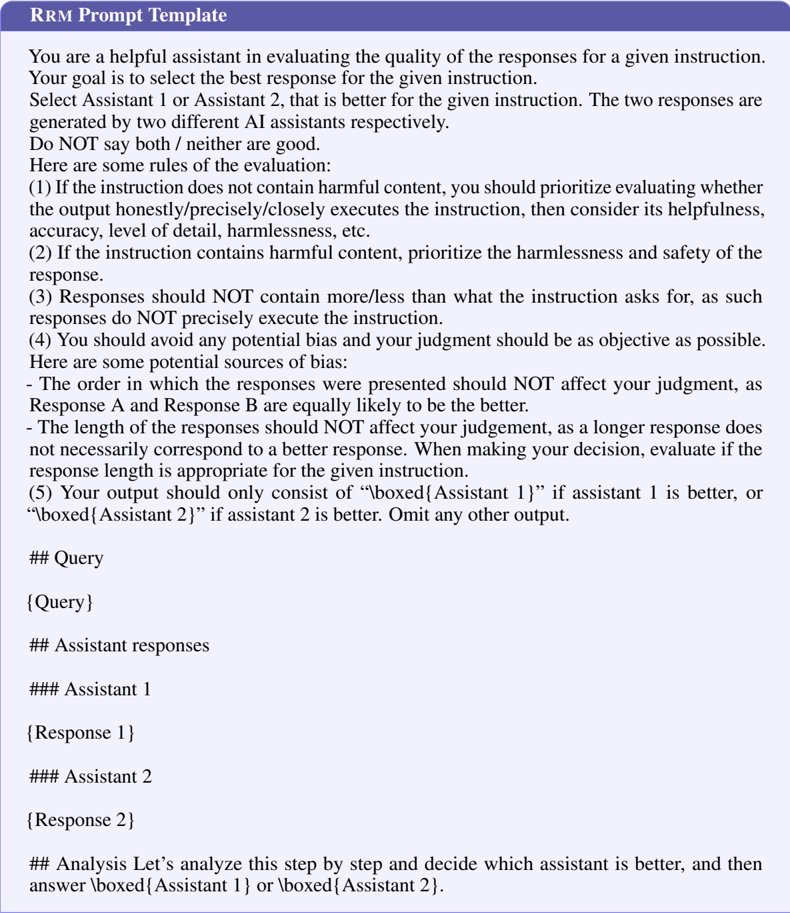
### Visual Description
## Text-Based Template: RRM Prompt Template for AI Response Evaluation
### Overview
The image depicts a structured template for evaluating and comparing responses from two AI assistants. It provides explicit instructions, evaluation criteria, and formatting rules for a "Response Ranking Model" (RRM) task. The template emphasizes objectivity, safety, and precision in assessing AI-generated outputs.
### Components/Axes
- **Header**:
- Title: "RRM Prompt Template" (bold, centered, dark blue background).
- Subtitle: "You are a helpful assistant in evaluating the quality of the responses for a given instruction."
- **Main Body**:
- **Instructions**:
- Goal: Select the better response (Assistant 1 or Assistant 2) for a given instruction.
- Rules:
1. Prioritize harmlessness/safety if the instruction contains harmful content.
2. Evaluate helpfulness, accuracy, detail, and precision if the instruction is safe.
3. Responses must not exceed the instruction’s requirements.
4. Avoid bias; responses are equally likely to be better regardless of order or length.
- **Bias Sources**:
- Response order, length, and presentation timing.
- **Output Format**:
- Only output `\boxed{Assistant 1}` or `\boxed{Assistant 2}` based on evaluation.
- **Placeholders**:
- `## Query` (input instruction).
- `### Assistant responses` (two responses labeled `### Assistant 1` and `### Assistant 2`).
- `### Analysis` (step-by-step reasoning section).
### Detailed Analysis
- **Textual Content**:
- The template enforces strict evaluation criteria, such as:
- Harmful content prioritization (Rule 1).
- Precision in response length (Rule 3).
- Objectivity in bias avoidance (Rule 4).
- Placeholders use hierarchical headings (`##`, `###`) for structured input.
- Output is restricted to a single boxed assistant identifier.
- **Formatting**:
- Dark blue header with white text.
- Body text in black on a light gray background.
- Placeholders use bold labels (e.g., `## Query`).
### Key Observations
- No numerical data, charts, or diagrams are present.
- The template is purely textual, focusing on procedural guidelines.
- Emphasis on safety and objectivity aligns with ethical AI evaluation practices.
### Interpretation
This template standardizes the evaluation of AI responses by:
1. **Defining Clear Priorities**: Safety first, then accuracy/helpfulness.
2. **Mitigating Bias**: Explicitly addressing response order and length as potential confounders.
3. **Enforcing Precision**: Responses must match the instruction’s scope.
4. **Structured Output**: The `\boxed{}` format ensures unambiguous results.
The absence of numerical data suggests this is a procedural framework rather than an analytical tool. Its design reflects a focus on reproducibility and fairness in AI assessment, critical for red-teaming or quality assurance workflows.
</details>
In addition to the training prompt used for RRM models, we also include the evaluation prompt used for querying GPT-4o on the PPE benchmark. We follow the prompt format from Liu et al. [41], which instructs GPT-4o to select the best response from a set of candidates based on several criteria. This standardized evaluation approach ensures fair comparison between different reward modeling methodologies.
## LLM-as-a-Judge Prompt Template
You are a skilled little expert at scoring responses. You should evaluate given responses based on the given judging criteria.\nGiven the context of the conversation (the last round is the User's query) and multiple responses from the Assistant, you need to refer to the [General Evaluation Criteria] to score the responses. Based on the general evaluation criteria, state potential other specific criteria to the query, the weights of different criteria, and then select the best response among all candidates.\nBefore judging, please analyze step by step. Your judgement needs to be as strict as possible.
## #### Evaluation Criteria ####
1. Instruction Adherence:\n - Fully Adhered: The response fully complies with all instructions and requirements of the question.\n - Partially Adhered: The response meets most of the instructions but has some omissions or misunderstandings.\n - Basically Adhered: The response meets some instructions, but the main requirements are not fulfilled.\n - Not Adhered: The response does not meet any instructions.\n Example: If the question requires three examples and the response provides only one, it falls under 'Partially Adhered.' 2. Usefulness:\n - Highly Useful: The response provides comprehensive and accurate information, fully addressing the issue.\n - Useful but Incomplete: The response provides some useful information, but lacks details or accuracy.\n - Limited Usefulness: The response offers little useful information, with most content being irrelevant or incorrect.\n - Useless or Incorrect: The response is completely irrelevant or incorrect.\n Example: If there are factual errors in the response but the overall direction is correct, it falls under 'Useful but Incomplete.' 3. Level of Detail:\n - Very Detailed: The response includes ample details covering all aspects of the issue.\n - Detailed but Slightly Lacking: The response is fairly detailed but misses some important details.\n - Basically Detailed: The response provides some details but is not thorough enough overall.\n - Not Detailed: The response is very brief and lacks necessary details.\n Example: If the response provides only a simple conclusion without an explanation, it falls under 'Not Detailed.' 4. Relevance:\n - Highly Relevant: The response is highly relevant to the question, with information closely aligned with the topic.\n - Generally Relevant: The response is generally relevant but includes some unnecessary information.\n Partially Relevant: The response has a lot of content that deviates from the topic.\n - Not Relevant: The response is completely irrelevant.\n Example: If the response strays from the topic but still provides some relevant information, it falls under 'Partially Relevant.'
#### Conversation Context #### {conversation context & query}
#### Responses to be Scored #### [The Begin of Response] {the response} [The End of Response]
#### Output Format Requirements ####
## Output with three lines
Specific Criteria: <Other potential criteria specific to the query and the context, and the weights of each criteria>.
Analysis: <Compare different responses based on given Criteria>.
Scores: <the index of the best response based on the judgement, in the format of <\boxed{x}>.
## A.2 Hyperparameters for Training RRM
Table 7 presents the key hyperparameters used for training RRMs. These parameters were carefully selected to optimize the reinforcement learning process and ensure effective development of reasoning capabilities in our models.
Table 7: Hyperparameters used for training RRMs.
| Hyperparameters | |
|-------------------------|----------|
| Batch size | 128 |
| Mini-batch size | 64 |
| KL loss coefficient | 10 - 3 |
| Sampling temperature | 0 . 6 |
| Maximum prompt length | 4096 |
| Maximum response length | 8192 |
| GRPO group size | 16 |
| Learning rate (RRM-32B) | × 10 - 7 |
| Learning rate (RRM-7B) | 10 - 6 |
## B Reward-Guided Best-of-N Inference
## B.1 Detailed Results on Subsets of MMLU-Pro and GPQA
We present detailed results on the constituent subsets of MMLU-Pro and GPQA benchmarks. Figure 9 illustrates the performance comparison among our RRM-7B, RRM-32B models and Skywork-RewardGemma-2-27B-v0.2 across the 14 subsets of MMLU-Pro. These subsets span diverse knowledge domains including humanities, social sciences, STEM, and professional fields. The results reveal interesting patterns in model performance. Notably, RRM-7B outperforms Skywork-Reward-Gemma2-27B-v0.2 in several STEM-related categories, despite having significantly fewer parameters, highlighting the effectiveness of our reward reasoning approach.
Figure 9: Performance comparison of Skywork-Reward-Gemma-2-27B-v0.2, RRM-7B, and RRM32B on the 14 subsets of MMLU-Pro.
<details>
<summary>Image 10 Details</summary>
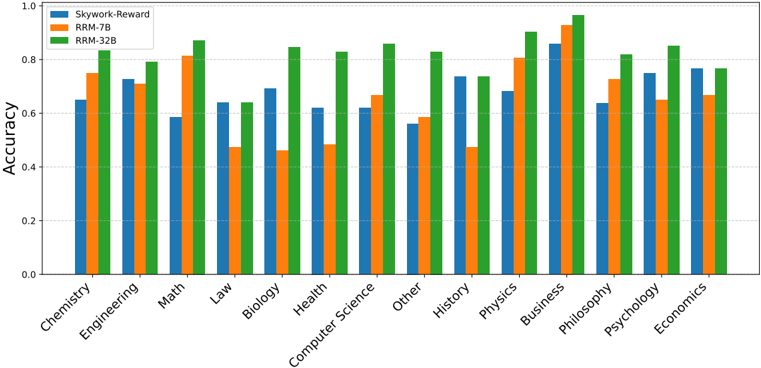
### Visual Description
## Bar Chart: Model Accuracy Across Academic Disciplines
### Overview
The chart compares the accuracy of three AI models (Skywork-Reward, RRM-7B, RRM-32B) across 15 academic disciplines. Accuracy is measured on a scale from 0.0 to 1.0, with higher values indicating better performance. The chart uses grouped bars to visualize performance differences between models within each discipline.
### Components/Axes
- **X-axis**: Academic disciplines (Chemistry, Engineering, Math, Law, Biology, Health, Computer Science, Other, History, Physics, Business, Philosophy, Psychology, Economics)
- **Y-axis**: Accuracy (0.0 to 1.0 in increments of 0.2)
- **Legend**:
- Blue: Skywork-Reward
- Orange: RRM-7B
- Green: RRM-32B
- **Bar Structure**: Three bars per discipline, grouped by model
### Detailed Analysis
1. **Chemistry**:
- Skywork-Reward (blue): ~0.65
- RRM-7B (orange): ~0.75
- RRM-32B (green): ~0.85
2. **Engineering**:
- Skywork-Reward: ~0.72
- RRM-7B: ~0.70
- RRM-32B: ~0.80
3. **Math**:
- Skywork-Reward: ~0.58
- RRM-7B: ~0.82
- RRM-32B: ~0.88
4. **Law**:
- Skywork-Reward: ~0.64
- RRM-7B: ~0.48
- RRM-32B: ~0.65
5. **Biology**:
- Skywork-Reward: ~0.68
- RRM-7B: ~0.46
- RRM-32B: ~0.85
6. **Health**:
- Skywork-Reward: ~0.62
- RRM-7B: ~0.49
- RRM-32B: ~0.83
7. **Computer Science**:
- Skywork-Reward: ~0.62
- RRM-7B: ~0.67
- RRM-32B: ~0.84
8. **Other**:
- Skywork-Reward: ~0.56
- RRM-7B: ~0.59
- RRM-32B: ~0.83
9. **History**:
- Skywork-Reward: ~0.74
- RRM-7B: ~0.47
- RRM-32B: ~0.74
10. **Physics**:
- Skywork-Reward: ~0.68
- RRM-7B: ~0.80
- RRM-32B: ~0.90
11. **Business**:
- Skywork-Reward: ~0.85
- RRM-7B: ~0.92
- RRM-32B: ~0.95
12. **Philosophy**:
- Skywork-Reward: ~0.64
- RRM-7B: ~0.73
- RRM-32B: ~0.82
13. **Psychology**:
- Skywork-Reward: ~0.75
- RRM-7B: ~0.66
- RRM-32B: ~0.83
14. **Economics**:
- Skywork-Reward: ~0.77
- RRM-7B: ~0.68
- RRM-32B: ~0.77
### Key Observations
- **RRM-32B (green)** consistently outperforms other models in most disciplines, with particularly strong performance in Math (+0.88), Biology (+0.85), and Physics (+0.90).
- **RRM-7B (orange)** shows significant weaknesses in Law (-0.16 vs. Skywork-Reward), Health (-0.13), and History (-0.27), but excels in Business (+0.07 over Skywork-Reward).
- **Skywork-Reward (blue)** demonstrates mid-range performance across disciplines, with notable strength in Business (+0.85) and Psychology (+0.75).
- **Economics** is an outlier where all models show similar performance (~0.77 for Skywork-Reward/RRM-32B vs. 0.68 for RRM-7B).
### Interpretation
The data suggests RRM-32B is the most robust model across academic domains, particularly in quantitative fields (Math, Physics) and interdisciplinary areas (Business). RRM-7B's performance varies dramatically by discipline, indicating potential specialization gaps. Skywork-Reward maintains consistent mid-tier performance, suggesting balanced but less specialized capabilities. The Business discipline shows exceptional performance across all models, possibly reflecting the availability of high-quality training data in this field. The Economics outlier may indicate unique challenges or data characteristics in that domain.
</details>
More impressively, our RRM-32B model demonstrates consistently superior or comparable performance across all subsets compared to Skywork-Reward-Gemma-2-27B-v0.2. This consistency highlights the robust generalization capabilities of our larger model across diverse knowledge domains. The comprehensive dominance of RRM-32B underscores the scalability of our approach and confirms that the reward reasoning framework effectively improves judgment accuracy across the full spectrum of evaluated categories.
Similarly, Figure 10 presents the performance breakdown across the GPQA subsets. The pattern remains consistent, with RRM-7B showing stronger performance in certain technical categories while occasionally lagging behind Skywork-Reward-Gemma-2-27B-v0.2 in more general knowledge areas. Meanwhile, RRM-32B maintains excellent performance across all subsets. This comprehensive
analysis further validates the effectiveness of our reward reasoning approach in handling complex scientific and technical queries that require sophisticated judgment capabilities.
Figure 10: Performance comparison of Skywork-Reward-Gemma-2-27B-v0.2, RRM-7B, and RRM32B on the 16 subsets of GPQA.
<details>
<summary>Image 11 Details</summary>
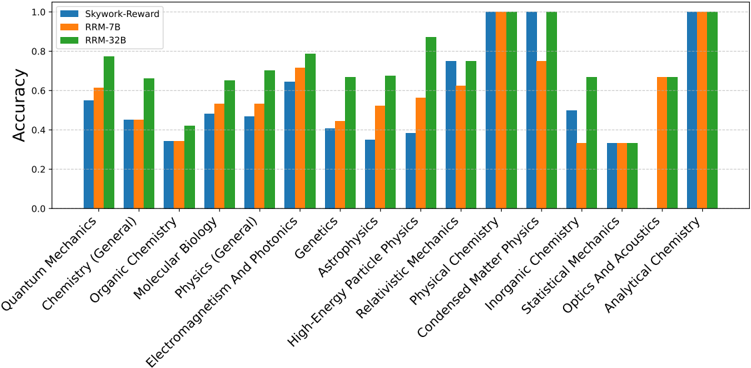
### Visual Description
## Bar Chart: Model Accuracy Across Scientific Disciplines
### Overview
The chart compares the accuracy of three AI models (Skywork-Reward, RRM-7B, RRM-32B) across 15 scientific disciplines. Each discipline has three grouped bars representing the models' performance, with accuracy measured on a 0-1 scale.
### Components/Axes
- **X-axis**: Scientific disciplines (e.g., Quantum Mechanics, Chemistry, Genetics)
- **Y-axis**: Accuracy (0.0 to 1.0)
- **Legend**:
- Blue: Skywork-Reward
- Orange: RRM-7B
- Green: RRM-32B
- **Bar Groups**: Each discipline has three bars (one per model)
### Detailed Analysis
1. **Quantum Mechanics**:
- Skywork-Reward: ~0.55
- RRM-7B: ~0.60
- RRM-32B: ~0.78
2. **Chemistry (General)**:
- Skywork-Reward: ~0.45
- RRM-7B: ~0.45
- RRM-32B: ~0.65
3. **Organic Chemistry**:
- Skywork-Reward: ~0.35
- RRM-7B: ~0.35
- RRM-32B: ~0.42
4. **Molecular Biology**:
- Skywork-Reward: ~0.48
- RRM-7B: ~0.53
- RRM-32B: ~0.63
5. **Physics (General)**:
- Skywork-Reward: ~0.46
- RRM-7B: ~0.52
- RRM-32B: ~0.65
6. **Electromagnetism And Photonics**:
- Skywork-Reward: ~0.63
- RRM-7B: ~0.70
- RRM-32B: ~0.78
7. **Genetics**:
- Skywork-Reward: ~0.40
- RRM-7B: ~0.43
- RRM-32B: ~0.65
8. **Astrophysics**:
- Skywork-Reward: ~0.35
- RRM-7B: ~0.50
- RRM-32B: ~0.67
9. **High-Energy Particle Physics**:
- Skywork-Reward: ~0.40
- RRM-7B: ~0.55
- RRM-32B: ~0.70
10. **Relativistic Mechanics**:
- Skywork-Reward: ~0.55
- RRM-7B: ~0.60
- RRM-32B: ~0.75
11. **Physical Chemistry**:
- Skywork-Reward: ~0.75
- RRM-7B: ~0.75
- RRM-32B: ~0.75
12. **Condensed Matter Physics**:
- Skywork-Reward: ~0.75
- RRM-7B: ~0.75
- RRM-32B: ~0.75
13. **Inorganic Chemistry**:
- Skywork-Reward: ~0.50
- RRM-7B: ~0.30
- RRM-32B: ~0.65
14. **Statistical Mechanics**:
- Skywork-Reward: ~0.30
- RRM-7B: ~0.30
- RRM-32B: ~0.30
15. **Optics And Acoustics**:
- Skywork-Reward: ~0.65
- RRM-7B: ~0.65
- RRM-32B: ~0.65
16. **Analytical Chemistry**:
- Skywork-Reward: ~0.65
- RRM-7B: ~0.65
- RRM-32B: ~0.65
### Key Observations
- **RRM-32B Dominance**: Consistently outperforms other models in most disciplines (e.g., Genetics: 0.65 vs. 0.40 for Skywork-Reward).
- **Skywork-Reward Weaknesses**: Struggles in Organic Chemistry (0.35) and Statistical Mechanics (0.30).
- **RRM-7B Mid-Range Performance**: Often bridges the gap between Skywork-Reward and RRM-32B (e.g., Molecular Biology: 0.53 vs. 0.48 and 0.63).
- **Statistical Mechanics Anomaly**: All models perform equally poorly (~0.30), suggesting a universal challenge in this field.
### Interpretation
The data demonstrates that **RRM-32B** is the most robust model across disciplines, particularly excelling in complex fields like Genetics and Condensed Matter Physics. Skywork-Reward's lower accuracy in Organic Chemistry and Statistical Mechanics may indicate limitations in handling specialized terminology or probabilistic reasoning. RRM-7B's consistent mid-range performance suggests it could serve as a reliable alternative when RRM-32B's higher computational demands are prohibitive. The uniform low performance in Statistical Mechanics highlights a potential gap in current models' ability to handle statistical thermodynamics concepts.
</details>
## B.2 Go Further into Knockout Tournament
To gain a deeper understanding of the knockout tournament strategy described in Section 3, we conduct additional experiments following the setup in Section 4.5.1. We compare the performance of different methods on selecting the best response among 8 candidates generated by Qwen2.5-Math7B-Instruct for each MATH question. We reward the responses with RRM-7B and RRM-32B, and benchmark them against Qwen2.5-Math-PRM-7B and Qwen2.5-Math-PRM-72B [76]. In addition to using reward models, we also include non-verifier strategies such as majority voting (Voting@8) and best-of-N oracle selection for reference. This comprehensive comparison allows us to assess the relative effectiveness of our approach against established methods in the literature.
The numerical results are summarized in Table 8. When compared with baselines, RRM-7B surpasses all comparison methods, including voting@8 and PRM judges. RRM-32B further narrows the gap toward oracle-level accuracy, significantly outperforming PRM-based baselines. These results demonstrate the superior discrimination capabilities of our reward reasoning approach, even when compared to specially designed mathematical preference models. The consistent performance advantage across different model sizes confirms the effectiveness of our framework in identifying high-quality mathematical reasoning across varied problem complexities.
Table 8: Comparison between RRM and Qwen2.5-Math-PRM models on MATH.
| Models | Accuracy |
|----------------------|------------|
| Voting@8 | 86.8 |
| Best-of-8 Oracle | 91.7 |
| Qwen2.5-Math-PRM-7B | 87.8 |
| Qwen2.5-Math-PRM-72B | 88.5 |
| RRM-7B | 88.7 |
| RRM-32B | 90.4 |
As shown in Figure 11, as the knockout tournament progresses through successive elimination rounds, we observe a consistent improvement in accuracy, demonstrating the benefits of iterative comparison. Notably, the knockout tournament achieves this consistent accuracy improvement with only O ( n ) pairwise comparisons. This efficient scaling behavior highlights the practical advantage of our
approach in scenarios where computational resources may be constrained, providing an effective balance between performance gains and computational requirements.
Figure 11: Accuracy progression of the knockout tournament strategy on MATH as elimination rounds proceed.
<details>
<summary>Image 12 Details</summary>
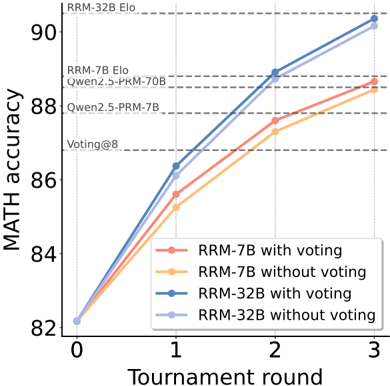
### Visual Description
## Line Chart: MATH Accuracy Across Tournament Rounds
### Overview
The chart compares the MATH accuracy of four AI models across four tournament rounds (0-3). Models are differentiated by size (7B vs 32B parameters) and whether voting mechanisms were used. All lines show upward trends, with larger models and voting mechanisms achieving higher accuracy.
### Components/Axes
- **X-axis**: Tournament round (0, 1, 2, 3)
- **Y-axis**: MATH accuracy (82-90%)
- **Legend**:
- Red: RRM-7B with voting
- Orange: RRM-7B without voting
- Blue: RRM-32B with voting
- Purple: RRM-32B without voting
- **Gridlines**: Horizontal at 82, 84, 86, 88, 90
### Detailed Analysis
1. **RRM-32B with voting** (blue):
- Starts at 82.2 (round 0)
- Reaches 90.5 (round 3)
- Steepest slope (≈2.1% per round)
2. **RRM-32B without voting** (purple):
- Starts at 82.5 (round 0)
- Reaches 89.8 (round 3)
- Slope ≈1.8% per round
3. **RRM-7B with voting** (red):
- Starts at 82.3 (round 0)
- Reaches 88.8 (round 3)
- Slope ≈1.6% per round
4. **RRM-7B without voting** (orange):
- Starts at 82.4 (round 0)
- Reaches 88.2 (round 3)
- Slope ≈1.5% per round
### Key Observations
- All models show consistent improvement across rounds
- Larger models (32B) outperform smaller models (7B) by 1.3-2.3% at round 3
- Voting mechanisms improve accuracy by 0.7-1.3% across all models
- RRM-32B with voting achieves 90.5% accuracy (highest value)
- RRM-7B without voting has lowest performance (88.2% at round 3)
### Interpretation
The data demonstrates that:
1. Model size significantly impacts performance (32B models outperform 7B by ~2% at final round)
2. Voting mechanisms provide measurable accuracy improvements (0.7-1.3% boost)
3. Performance gains accelerate over time (slopes increase in later rounds)
4. The combination of large model size and voting yields optimal results
The consistent upward trends suggest that both model capacity and ensemble methods (voting) are critical factors in mathematical reasoning performance. The 32B models with voting achieve near-perfect accuracy (90.5%) by round 3, indicating potential saturation of performance gains in this domain.
</details>
## C Post-thinking Token Length Distribution
To evaluate the impact of thinking budget on model performance, we need to establish an appropriate token budget for the response phase that follows the thinking phase. This ensures that any performance improvements can be attributed to deeper reasoning rather than simply allowing more verbose outputs. The careful calibration of this post-thinking budget is critical for isolating the effects of extended reasoning from potential confounding factors related to output length.
We analyze the token length distribution of responses generated by RRM-32B on the RewardBench dataset after the thinking phase concluded. Figure 12 shows the distribution of post-thinking token length across various samples. The analysis reveals that all the responses require fewer than 100 tokens to express the final judgment after completing the reasoning process.
Figure 12: Post-thinking token length distribution of RRM-32B.
<details>
<summary>Image 13 Details</summary>
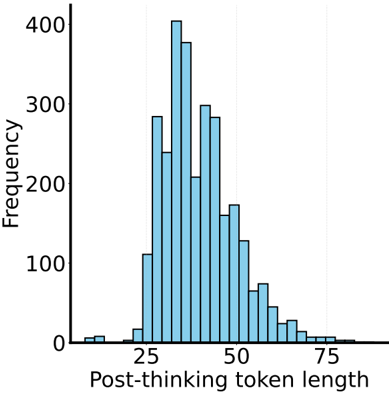
### Visual Description
```markdown
## Bar Chart: Post-thinking token length distribution
### Overview
The chart displays a frequency distribution of post-thinking token lengths, showing a bell-shaped curve with the highest frequency at token length 30. Frequencies decrease symmetrically on both sides of the peak, with minimal values at the extremes (25 and 75).
### Components/Axes
- **X-axis**: "Post-thinking token length" (integer values from 25 to 75 in increments of 5)
- **Y-axis**: "Frequency" (linear scale from 0 to 400)
- **Bars**: Blue vertical bars representing frequency counts
- **Title**: "Post-thinking token length distribution" (top center)
- **Gridlines**: Vertical dashed lines at each x-axis tick
### Detailed Analysis
- **Peak frequency**: ~400 occurrences at token length 30
- **Secondary peaks**:
- 35: ~380
- 40: ~300
- 45: ~250
- **Decline pattern**:
- 50: ~180
- 55: ~120
- 60: ~80
- 65: ~40
- 70: ~20
- **Extreme values**:
- 25: ~5
- 75: ~3
### Key Observations
1. **Symmetrical distribution**: Frequencies mirror each other around the 30-40 range
2. **Rapid decline**: 70% of frequencies occur between token lengths 25-50
3. **Long tail**: Frequencies drop below 20 for lengths >70
4. **Modality**: Single dominant peak at 30 with no secondary modes
### Interpretation
The data suggests an optimal post-thinking token length cluster around 30-40 characters, with system performance or user preference sharply decreasing for both shorter and longer lengths. The symmetrical decline implies a potential normal distribution pattern, possibly indicating:
- Cognitive load
</details>
Based on this observation, we set a fixed post-thinking budget of 100 tokens for all our sequential scaling experiments. This budget is sufficient to accommodate typical response patterns while preventing the model from extending its reasoning during the response phase, which would confound our analysis of thinking horizon effects. By maintaining this consistent response budget across all experiments, we ensure that performance differences can be directly attributed to variations in the thinking phase length rather than differences in output verbosity. This methodological choice strengthens the validity of our conclusions regarding the impact of extended reasoning on model performance.
## D Reasoning Pattern Analysis
Table 9 presents the pattern groups and keywords applied in reasoning pattern analysis.
Table 9: Pattern groups and keywords applied in reasoning pattern analysis.
| Pattern Group | Keywords |
|-----------------|------------------------------------------------------------------------------------------------------------------|
| Transition | alternatively, think differently, another way, another approach, another method, another solution, another point |
| Reflection | wait, verify, make sure, hold on, think again, Let me check, seems right, seems incorrect |
| Comparison | more, compared to, comparison, between the two, similarly |
| Breakdown | break down, break this down |