# Soft Thinking: Unlocking the Reasoning Potential of LLMs in Continuous Concept Space
> Equal contribution
Abstract
Human cognition typically involves thinking through abstract, fluid concepts rather than strictly using discrete linguistic tokens. Current reasoning models, however, are constrained to reasoning within the boundaries of human language, processing discrete token embeddings that represent fixed points in the semantic space. This discrete constraint restricts the expressive power and upper potential of such reasoning models, often causing incomplete exploration of reasoning paths, as standard Chain-of-Thought (CoT) methods rely on sampling one token per step. In this work, we introduce Soft Thinking, a training-free method that emulates human-like “soft” reasoning by generating soft, abstract concept tokens in a continuous concept space. These concept tokens are created by the probability-weighted mixture of token embeddings, which form the continuous concept space, enabling smooth transitions and richer representations that transcend traditional discrete boundaries. In essence, each generated concept token encapsulates multiple meanings from related discrete tokens, implicitly exploring various reasoning paths to converge effectively toward the correct answer. Empirical evaluations on diverse mathematical and coding benchmarks consistently demonstrate the effectiveness and efficiency of Soft Thinking, improving pass@1 accuracy by up to 2.48 points while simultaneously reducing token usage by up to 22.4% compared to standard CoT. Qualitative analysis further reveals that Soft Thinking outputs remain highly interpretable and readable, highlighting the potential of Soft Thinking to break the inherent bottleneck of discrete language-based reasoning. Code is available at this https URL.
<details>
<summary>x1.png Details</summary>
### Visual Description
## Bar Charts: Model Performance on Math and Coding Tasks
### Overview
The image presents four bar charts comparing the performance of different language models (QWQ-32B, DeepSeek-R1-Distill-Qwen-32B, and DeepSeek-R1-Distill-Llama-70B) on math and coding tasks. The charts display both the average accuracy and the average generation length (in tokens) for each model, using two different prompting strategies: "CoT Thinking" (Chain-of-Thought) and "Soft Thinking."
### Components/Axes
**Chart 1: Average Accuracy (Math) ↑**
* **Title:** Average Accuracy (Math) ↑
* **Y-axis:** Accuracy (%)
* Scale: 70 to 100
* **X-axis:** Model
* Categories: QWQ-32B, DeepSeek-R1-Distill-Qwen-32B, DeepSeek-R1-Distill-Llama-70B
* **Legend:** Located at the top-right of the chart.
* CoT Thinking (light green)
* Soft Thinking (light blue)
**Chart 2: Average Generation Length (Math) ↓**
* **Title:** Average Generation Length (Math) ↓
* **Y-axis:** Generation Length (tokens)
* Scale: 2000 to 7000
* **X-axis:** Model
* Categories: QWQ-32B, DeepSeek-R1-Distill-Qwen-32B, DeepSeek-R1-Distill-Llama-70B
* **Legend:** Located at the top-right of the chart.
* CoT Thinking (light red)
* Soft Thinking (gray)
* Percentage difference annotations above the "Soft Thinking" bars, with downward arrows.
**Chart 3: Average Accuracy (Coding) ↑**
* **Title:** Average Accuracy (Coding) ↑
* **Y-axis:** Accuracy (%)
* Scale: 70 to 100
* **X-axis:** Model
* Categories: QWQ-32B, DeepSeek-R1-Distill-Qwen-32B, DeepSeek-R1-Distill-Llama-70B
* **Legend:** Located at the top-right of the chart.
* CoT Thinking (light green)
* Soft Thinking (light blue)
**Chart 4: Average Generation Length (Coding) ↓**
* **Title:** Average Generation Length (Coding) ↓
* **Y-axis:** Generation Length (tokens)
* Scale: 2000 to 7000
* **X-axis:** Model
* Categories: QWQ-32B, DeepSeek-R1-Distill-Qwen-32B, DeepSeek-R1-Distill-Llama-70B
* **Legend:** Located at the top-right of the chart.
* CoT Thinking (light red)
* Soft Thinking (gray)
* Percentage difference annotations above the "Soft Thinking" bars, with downward arrows.
### Detailed Analysis
**Chart 1: Average Accuracy (Math) ↑**
* **QWQ-32B:**
* CoT Thinking (light green): 83.84%
* Soft Thinking (light blue): 86.32%
* **DeepSeek-R1-Distill-Qwen-32B:**
* CoT Thinking (light green): 81.32%
* Soft Thinking (light blue): 83.03%
* **DeepSeek-R1-Distill-Llama-70B:**
* CoT Thinking (light green): 81.31%
* Soft Thinking (light blue): 82.42%
**Chart 2: Average Generation Length (Math) ↓**
* **QWQ-32B:**
* CoT Thinking (light red): 6472 tokens
* Soft Thinking (gray): 5719 tokens
* Percentage Difference: 11.6%
* **DeepSeek-R1-Distill-Qwen-32B:**
* CoT Thinking (light red): 4995 tokens
* Soft Thinking (gray): 3875 tokens
* Percentage Difference: 22.4%
* **DeepSeek-R1-Distill-Llama-70B:**
* CoT Thinking (light red): 4486 tokens
* Soft Thinking (gray): 3683 tokens
* Percentage Difference: 17.9%
**Chart 3: Average Accuracy (Coding) ↑**
* **QWQ-32B:**
* CoT Thinking (light green): 85.70%
* Soft Thinking (light blue): 86.18%
* **DeepSeek-R1-Distill-Qwen-32B:**
* CoT Thinking (light green): 83.23%
* Soft Thinking (light blue): 84.13%
* **DeepSeek-R1-Distill-Llama-70B:**
* CoT Thinking (light green): 83.14%
* Soft Thinking (light blue): 83.84%
**Chart 4: Average Generation Length (Coding) ↓**
* **QWQ-32B:**
* CoT Thinking (light red): 4899 tokens
* Soft Thinking (gray): 4110 tokens
* Percentage Difference: 16.1%
* **DeepSeek-R1-Distill-Qwen-32B:**
* CoT Thinking (light red): 4744 tokens
* Soft Thinking (gray): 3834 tokens
* Percentage Difference: 19.1%
* **DeepSeek-R1-Distill-Llama-70B:**
* CoT Thinking (light red): 4472 tokens
* Soft Thinking (gray): 3741 tokens
* Percentage Difference: 16.3%
### Key Observations
* **Accuracy:** For both Math and Coding tasks, the "Soft Thinking" approach generally yields slightly higher average accuracy compared to "CoT Thinking" across all models.
* **Generation Length:** The "CoT Thinking" approach consistently results in longer generation lengths (more tokens) compared to "Soft Thinking" for both Math and Coding tasks.
* **Percentage Difference:** The percentage reduction in generation length when using "Soft Thinking" compared to "CoT Thinking" is provided above each "Soft Thinking" bar in the generation length charts.
* **Model Performance:** QWQ-32B generally shows the highest accuracy, while DeepSeek-R1-Distill-Llama-70B tends to have the shortest generation lengths.
### Interpretation
The data suggests that while "Soft Thinking" may lead to slightly improved accuracy, it comes at the cost of shorter, potentially less detailed, responses. "CoT Thinking," on the other hand, produces longer and more elaborate responses, which might be beneficial in scenarios where detailed reasoning is crucial, even if it doesn't always translate to higher accuracy. The choice between these two prompting strategies depends on the specific requirements of the task and the desired trade-off between accuracy and response length. The percentage difference in generation length highlights the efficiency gains achieved by using "Soft Thinking," indicating a more concise approach to problem-solving.
</details>
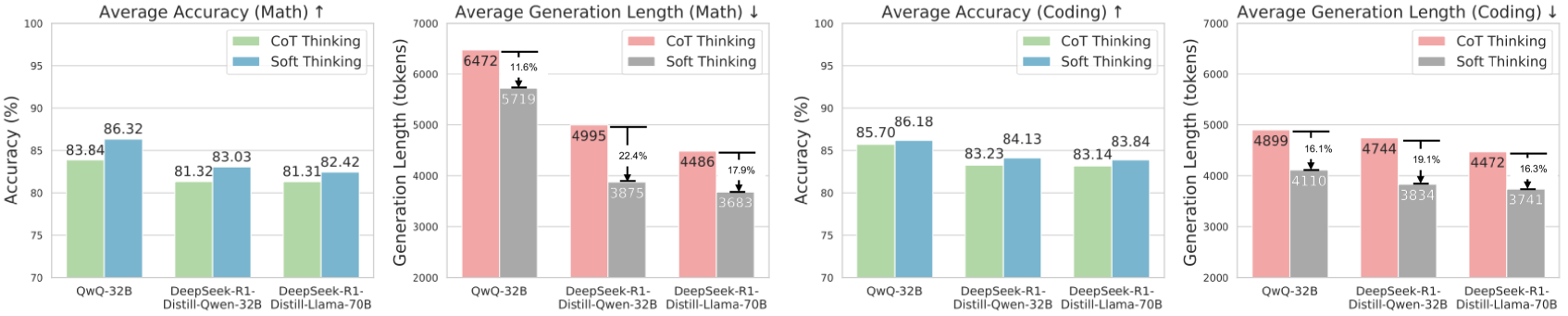
Figure 1: Soft Thinking vs. Chain-of-Thought thinking on mathematical and coding datasets. Soft Thinking consistently improves both accuracy (with improvements of up to 2.48% on pass@1 accuracy) and generation efficiency (achieving up to 22.4% reduction in generation length) across both tasks, without any training.
The limits of my language mean the limits of my world.
—Ludwig Wittgenstein
1 Introduction
Large Language Models (LLMs) have achieved impressive results across a wide range of complex reasoning tasks. A key technique contributing to this success is Chain-of-Thought (CoT) reasoning [1, 2, 3, 4], which enables models to solve problems step-by-step by generating intermediate reasoning steps in natural language. Despite its effectiveness, standard CoT reasoning restricts the model’s outputs to sequences of discrete, predefined tokens, inherently bounded by the expressive limits of human language. Confining LLM reasoning to the discrete natural language tokens may fundamentally restrict their potential to represent and manipulate abstract concepts. Moreover, neuroscientific evidence shows that the human brain represents and stores information at the level of abstract concepts, not merely words, and that reasoning is based on non-verbal conceptual processing independent of the language network [5, 6, 7, 8].
Another fundamental limitation of standard CoT reasoning is its inherently unidirectional and sequential nature: at each step, the model samples a single token, committing to one specific branch of the reasoning path. In tasks with high uncertainty or multiple plausible trajectories, this approach can easily lead the model down an incorrect path, resulting in suboptimal answers or wasted tokens on the wrong path, thus reducing both performance and token efficiency [9, 10]. In contrast, humans do not rely solely on sequentially producing explicit linguistic tokens. Instead, they can simultaneously consider multiple possibilities, integrate abstract concepts, and only later verbalize their thoughts. This allows for more flexible, parallel, and comprehensive reasoning, enabling humans to navigate complex problems more effectively.
In this work, we propose a new perspective: instead of constraining LLMs to reason within the discrete, sequential space of language tokens, we aim to enable LLMs to reason with soft, abstract concepts, which encompass more general and fine-grained semantics and retain information about multiple possible paths. To achieve this, we introduce Soft Thinking, a training-free method that unlocks the reasoning potential of LLMs in a continuous concept space. Specifically, Soft Thinking replaces the discrete token selection in standard CoT with probabilistic soft aggregation over the entire vocabulary, which we refer to as a concept token. This retains the original distribution of the next step. At each step, we construct a new embedding from a concept token by probability-weighting all token embeddings, which form the continuous concept token. This approach allows the model to represent and process abstract concepts, endowing each output token with more nuanced and fine-grained semantics, and enabling the processing of multiple paths conceptually.
Unlike standard CoT that forces the model to commit to a single next token at each step by collapsing the probability distribution, our method naturally preserves a “superposition” which retains the entire information in each step. As a result, we introduce a Cold Stop mechanism to further boost efficiency and address the challenge of generation collapse (e.g., repetition) caused by out-of-distribution (OOD) [11] inputs, where certain concept tokens may be unseen during training. To be specific, Cold Stop monitors the entropy of the model’s output distribution at each step and terminates the reasoning process early when the model demonstrates high confidence (i.e., low entropy) over several consecutive steps. This mechanism prevents unnecessary computation and mitigates the risk of model collapse when dealing with OOD inputs, ensuring more robust and efficient reasoning.
Soft Thinking offers two major advances. First, by operating in the continuous concept space formed as a convex combination of all token embeddings, the model can capture and manipulate abstract concepts and detailed semantic information; Second, because each concept token keeps a probability distribution from all possible next tokens, the model can implicitly and efficiently explore multiple reasoning paths in parallel, rather than being limited to a single trajectory. Therefore, Soft Thinking not only improves the comprehensiveness of reasoning but also accelerates convergence toward correct answers.
Empirical evaluations conducted on mathematical and coding benchmarks using mainstream LLM architectures, including Llama [12] and Qwen [13] with large model sizes 32B and 70B parameters, consistently demonstrate the effectiveness and efficiency of Soft Thinking. The method improves pass@1 accuracy by up to 2.48 points while simultaneously reducing token usage by up to 22.4% compared to standard CoT. Furthermore, qualitative assessments reveal that intermediate reasoning steps generated by Soft Thinking are highly readable, interpretable, and informative. Overall, Soft Thinking presents an alternative reasoning paradigm that breaks the bottleneck of discrete token-based reasoning.
2 Related Work
Chain-of-Thought (CoT) Reasoning.
CoT reasoning enhances the multi-step reasoning capabilities of large language models by introducing explicit intermediate steps. Existing approaches primarily include prompt-based learning methods [1, 2, 3], supervised fine-tuning [14, 15], and reinforcement learning optimization [16, 17, 18, 19]. Moreover, according to inference-time scaling laws [20], model performance continues to improve as the length of reasoning chains increases. However, as the chain grows longer, the computational cost also rises, making efficiency a growing concern. To address this challenge, we propose to shift CoT reasoning from the discrete natural language token to a continuous concept space, which is formed as a convex combination of all token embeddings. In this space, the model can select and integrate multiple potential reasoning trajectories at the token level.
Continuous Space Reasoning.
[21] constructed datasets for two-hop reasoning tasks and showed that intermediate reasoning variables could be decoded from hidden representations. Building on this, [22] introduced interventions on hidden states to manipulate reasoning outcomes. Parallel latent reasoning paths have also been observed [23]. [24] introduced latent planning steps: proposed predicting discrete planning tokens before generating reasoning steps. [25] proposes to do reasoning at an abstract language level beyond tokens and explores an explicit hierarchical structure. [26] proposes extracting text embeddings from the last token of LLMs fine-tuned with instructions on contrastive data. COCONUT [27] uses the last hidden state of the model’s final layer as the next-step embedding. However, this method still face critical challenges. In language models with fewer than 7B parameters, the input embedding layer and the output language model head are typically weight-tied, enabling continuous-space reasoning by aligning the input and output spaces after extensive training. In contrast, for models with more than 7 billion parameters, these components are typically decoupled, meaning that the hidden states and input embeddings reside in different spaces. Directly using hidden states as input embeddings leads to significant representational mismatch, which is difficult to bridge even with extensive retraining. Such retraining often leads to overfitting, catastrophic forgetting, or ineffective performance in practice [28]. To address these limitations, we propose a training-free approach that utilizes the distribution over the vocabulary at each step as a bridge. This method effectively aligns the hidden state output space with the input embedding space, enabling seamless representation alignment during continuous-space reasoning.
3 Methodology
<details>
<summary>x2.png Details</summary>
### Visual Description
## Diagram: Soft Thinking in Large Language Models
### Overview
The image illustrates the concept of "Soft Thinking" within a Large Language Model (LLM). It depicts the flow of information from input tokens through intermediate thinking stages to the final output, highlighting the role of concept tokens and probability distributions.
### Components/Axes
* **Title:** Soft Thinking
* **Input:** Represented by a series of green rounded rectangles labeled "Input" and denoted as X1 ... XL.
* **Large Language Model:** A grey rounded rectangle labeled "Large Language Model" represents the core processing unit.
* **Intermediate Thinking:** A bracket above two sets of elements indicates this stage.
* **Output:** A bracket above a set of elements indicates the output stage.
* **Concept Tokens (ct):** Represented as ct1 and ctm, with associated numerical values.
* **Original Dist.:** Label associated with the concept tokens.
* **Probability Dist.:** Label associated with bar graphs.
* **Embedding:** Label associated with the green rounded rectangles.
* **Weighted Sum:** Label associated with the summation operation and arrows.
* **y1:** Represents the output tokens.
### Detailed Analysis
* **Input Stage:**
* A series of green rounded rectangles represent the input tokens (X1 ... XL).
* The number of input tokens is not explicitly defined but implied to be variable.
* **Large Language Model:**
* The grey rounded rectangle signifies the LLM's processing.
* **Intermediate Thinking Stage:**
* Two sets of elements are shown: one labeled ct1 and the other ctm.
* Each set includes:
* A green rounded rectangle representing an embedding.
* A summation symbol (⊕).
* A grey rectangle containing numerical values: ".3 .4 .1 .2" for ct1 and ".4 .3 .1 .2" for ctm.
* A bar graph representing a probability distribution.
* An arrow pointing from the bar graph to the grey rectangle.
* Dashed yellow arrows connect the embedding to the summation symbol and then to the numerical values in the grey rectangle, indicating a weighted sum operation.
* **Output Stage:**
* A set of elements labeled y1.
* Includes:
* A grey rectangle containing numerical values: "0 0 0 1".
* A bar graph representing a probability distribution.
* An arrow pointing from the bar graph to the grey rectangle.
* **Concept Tokens (ct):**
* Represented by ct1 and ctm.
* Associated with numerical values that appear to represent probabilities or weights.
* **Probability Distributions:**
* Represented by bar graphs.
* The height of each bar corresponds to a probability value.
* For ct1, the approximate heights of the bars are: 0.3, 0.4, 0.1, 0.2.
* For ctm, the approximate heights of the bars are: 0.4, 0.3, 0.1, 0.2.
* For y1, the approximate heights of the bars are: 0, 0, 0, 1.
* **Weighted Sum:**
* The dashed yellow arrows indicate that the embeddings are combined using a weighted sum operation to produce the concept tokens.
### Key Observations
* The diagram illustrates a simplified view of how an LLM processes input tokens to generate an output.
* The concept of "Soft Thinking" is represented by the intermediate thinking stages, where embeddings are combined and transformed into concept tokens.
* The probability distributions provide a visual representation of the uncertainty associated with each token.
* The output y1 shows a clear preference for the last token, as indicated by the value "1".
### Interpretation
The diagram suggests that "Soft Thinking" in LLMs involves a process of transforming input embeddings into concept tokens through weighted sums and probability distributions. This allows the model to represent uncertainty and make more nuanced predictions. The intermediate thinking stages (ct1 and ctm) represent key steps in this process, where the model refines its understanding of the input before generating the final output. The diagram highlights the importance of probability distributions in capturing the uncertainty associated with each token, which is a crucial aspect of soft thinking. The final output y1 demonstrates how the model uses these probabilities to make a decision, in this case, favoring the last token.
</details>
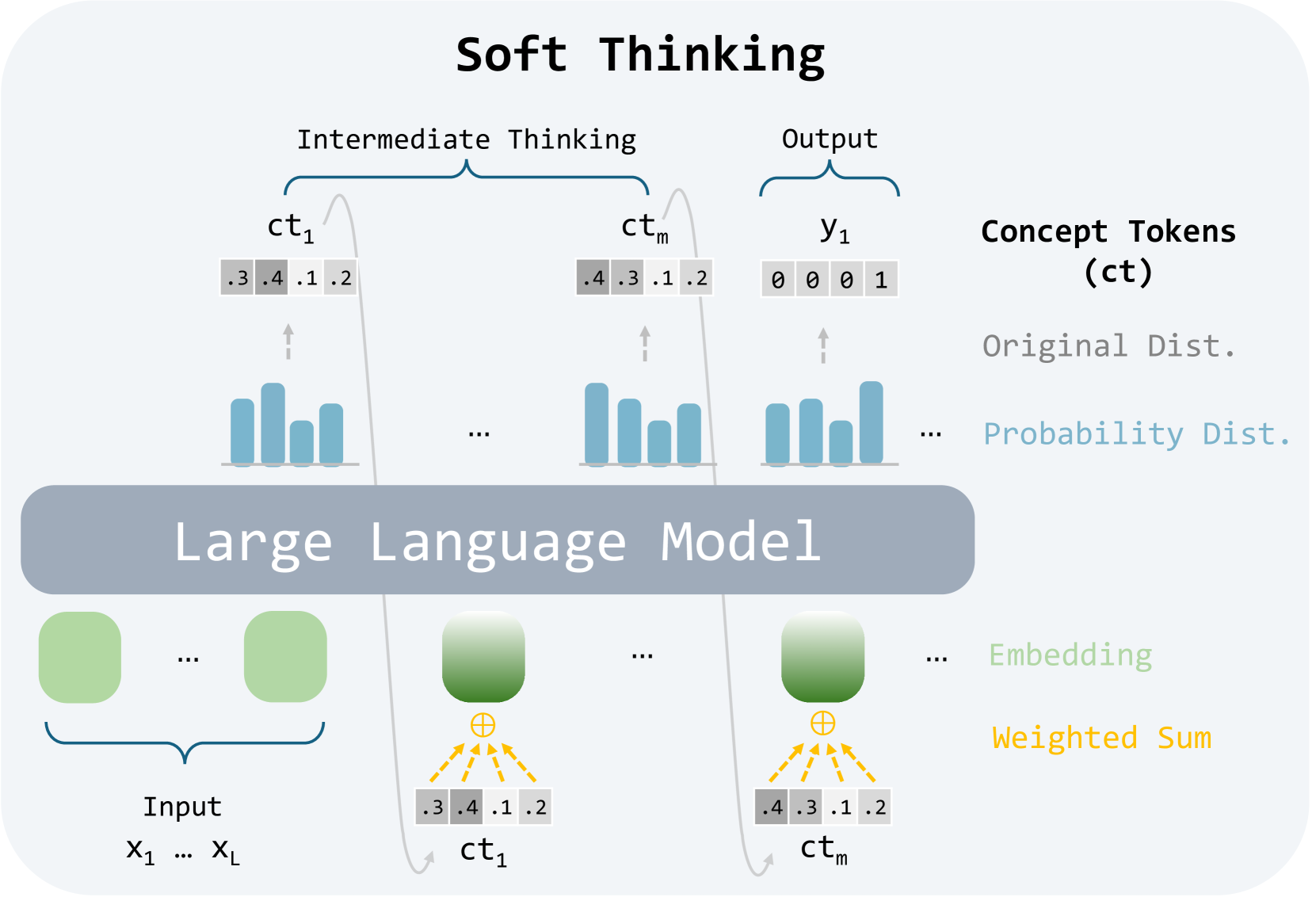
Figure 2: Soft Thinking replaces discrete tokens with soft, abstract concept tokens, enabling reasoning in continuous concept space.
In this section, we introduce Soft Thinking, a method that generalizes standard Chain-of-Thought (CoT) reasoning by replacing discrete one-hot tokens with concept tokens and keeping the entire original probability distribution. As shown in Figure 2, the new embeddings are computed using probability-weighted interpolation across all embeddings based on the preceding concept token, facilitating reasoning within a continuous concept space. Furthermore, we propose the Cold Stop mechanism, which halts intermediate reasoning steps when overconfident, enhancing inference efficiency and preventing generation collapse.
3.1 Preliminary: Standard Chain - of - Thought Decoding
Let $V$ be the vocabulary of size | $V$ |, and let $E∈\mathbb{R}^{|V|× d}$ be the token embedding matrix. For any token index $k$ , we denote its embedding by $e(k)=E[k]∈\mathbb{R}^{d}$ . Given an input context: $x_{1:L}=(x_{1},x_{2},...,x_{L})$ , the model first generates an intermediate reasoning trace (the Chain - of - Thought) of length $m$ : $t_{1:m}=(t_{1},t_{2},...,t_{m})$ , and then produces a final answer of length $n$ : $y_{1:n}=(y_{1},y_{2},...,y_{n})$ .
At each intermediate thinking step $i$ , the LLM consumes the embeddings of all previously generated tokens and the input, and the next token is then sampled discretely:
$$
t_{i}\sim p_{i}=\text{LLM}\bigl{(}e(x_{1:l}),\,e(t_{1:i-1})\bigr{)}\in\Delta^{%
|V|-1}, \tag{1}
$$
Here, $\Delta^{|V|-1}$ denotes the $(|V|-1)$ -dimensional probability simplex, representing the set of all valid probability distributions over the vocabulary. Decoding continues until the special end - of - thinking token $\langle/\mathrm{think}\rangle$ is generated, i.e. $t_{m}=\text{encode}(\langle/\mathrm{think}\rangle)$ .
After reasoning, the model switches to answer mode. For each answer position $j$ , it computes the probability $q_{j}$ and then sample one token $y_{j}$ :
$$
y_{j}\sim q_{j}=\text{LLM}\bigl{(}e(x_{1:l}),\,e(t_{1:m}),\,e(y_{1:j-1})\bigr{%
)}\in\Delta^{|V|-1}, \tag{2}
$$
All tokens in both stages are drawn from their respective discrete distributions, committing to a discrete token id at each step. In the next section, we introduce Soft Thinking, which replaces this discrete sampling with continuous concept tokens, preserving the full distributional information throughout multi - step reasoning.
3.2 Soft Thinking: Reasoning in a Continuous Concept Space
**Definition 1 (Concept Token)**
*At any intermediate thinking step, let $p∈\Delta^{|V|-1}$ be the LLM-produced probability distribution over the vocabulary. We call this probability vector a concept token, denoted by
$$
ct:=p. \tag{3}
$$
Unlike a traditional step that collapses the distribution to a single token id, the concept token preserves the full distribution of every possible next step.*
**Definition 2 (Continuous Concept Space)**
*Let $E∈\mathbb{R}^{|V|× d}$ be the embedding matrix and $e(k)=E[k]$ the embedding of the $k$ -th vocabulary item. The continuous concept space is the convex combination of all embedding vectors.
$$
\mathcal{C}\;=\;\Bigl{\{}\,\sum\nolimits_{k=1}^{|V|}\alpha_{k}\,e(k)\;:\;%
\alpha\in\Delta^{|V|-1}\Bigr{\}}\subset\mathbb{R}^{d}, \tag{4}
$$
i.e. the set of all probability-weighted mixtures of token embeddings. Note that this is different from the usual semantic space, which is modeled as a $d$ -dimensional real vector space.*
Reasoning Process.
Soft Thinking only replaces the intermediate thinking step of the standard CoT. At each step of soft thinking, the model generates a concept token defined by Definition 1. Then, in the next step, the concept token $ct$ is injected back into the LLM by the embedding of concept token:
$$
\tilde{e}_{\mathrm{next}}=\sum_{k=1}^{|V|}ct[k]\,e(k)=\sum_{k=1}^{|V|}p[k]\,e(%
k)\in\mathcal{C}. \tag{5}
$$
When the most probable token for a certain concept token is the end-of-thinking, the intermediate reasoning process stops, and the model switches to generating the output. All output stage tokens $y_{j}$ are sampled in the usual discrete manner; only the intermediate thinking phase flows through the continuous concept space defined above.
Why Soft Thinking Helps.
Using concept tokens allows the model to avoid making hard decisions too early. Instead of selecting a single token at each step, the model keeps the full probability distribution over vocabulary. This gives it the flexibility to explore different reasoning paths, especially when it’s unsure. By working in this continuous concept space, the model can represent more abstract concepts that don’t map cleanly to a single word. These abstract concepts can later evolve into more concrete thoughts as reasoning continues (see Figure 4). This flexibility helps the model think more clearly, avoid early mistakes, and better handle complex multi-step problems.
Cold Stop
While concept tokens enable more abstract reasoning, feeding in continuous concept tokens during inference places the model in an out-of-distribution (OOD) regime. This can lead to model collapse if the reasoning process continues for too long without correction. To mitigate this, we propose a Cold Stop mechanism that dynamically stops intermediate reasoning when the model becomes overconfident. At each step, we compute the entropy of the concept token :
$$
H(p)=-\sum_{k=1}^{|V|}p[k]\,\log p[k]. \tag{6}
$$
Since Soft Thinking preserves the entire probability distribution at each step, the entropy serves as a natural signal for uncertainty, which is often used in LLMs to evaluate the quality of generation [29]. Low entropy, typically represents “cold” in physics, indicates that the model is confident in its prediction [30], and thus can conclude soon. Given an entropy threshold $\tau$ and a required number of consecutive confident steps $k$ , we apply the following rule:
- If $H(p)<\tau$ , increment a low-entropy step counter; otherwise, reset the counter.
- When the counter reaches $k$ , we insert an end-of-thinking token $\langle/\mathrm{think}\rangle$ to conclude reasoning and begin final answer generation.
This strategy avoids unnecessary computation and prevents the model collapse under OOD conditions, while preserving the benefits of soft thinking through an entropy-based confidence measure.
Complexity Analysis.
Soft Thinking incurs only two lightweight additions to standard CoT. When computing each concept token embedding, we first apply a top - $k$ top - $p$ filter to the token distribution to remove low - probability noise, select top- $n$ tokens with hightest probability, renormalize, and then perform a single dense matrix–vector multiplication over the filtered subset, resulting in $O(n· d)$ computational cost per reasoning step (where $d$ the embedding dimension). Calculating the entropy for Cold Stop requires $O(|V|)$ time, but adds negligible overhead compared to a model forward pass.
3.3 Theoretical Analysis
In this section, we provide a theoretical analysis showing how Soft Thinking approximates the full path-summation of standard Chain - of - Thought (CoT) by iteratively constructing linear surrogate representations via concept tokens. We begin by rewriting the exact expansion of the marginal likelihood and then derive a sequence of linearization steps that culminate in the continuous concept token approximation.
Exact Path-Summation.
Let $x=x_{1:l}$ denote the input context and $t_{1:j}$ be the first $j$ intermediate reasoning tokens. The true probability of a final answer $y=y_{1:n}$ is obtained by marginalizing over all possible reasoning trajectories of length $m$ :
$$
p(y\mid x)=\sum_{t_{1}}\,p(t_{1}\mid x)\;\sum_{t_{2}}\,p(t_{2}\mid x,t_{1})\;%
\cdots\;\sum_{t_{m}}\,p(t_{m}\mid x,t_{1:m-1})\;p(y\mid x,t_{1:m})\,. \tag{7}
$$
This expansion entails an exponential number of paths, since each summation runs over the full vocabulary $V$ .
First-Order Linearization.
Focusing on the outermost summation,
$$
p(y\mid x)=\sum_{t_{1}}p(t_{1}\mid x),p\bigl{(}y\mid x,t_{1}\bigr{)}. \tag{8}
$$
Viewing the sampled token $t_{1}$ as an one-hot vector $t_{1}∈\{0,1\}^{|V|}$ with $\sum_{k}t_{1}^{k}=1$ , its expectation under the multinomial distribution is the first concept token:
$$
ct_{1}=\mathbb{E}[t_{1}]=\sum_{t_{1}}p(t_{1}\mid x)\,t_{1}=p(\cdot\mid x)\in%
\Delta^{|V|-1}, \tag{9}
$$
which aligns the concept token in Definition 1.
By a linear approximation of $p(y\mid x,·)$ around the mean, we obtain
$$
p(y\mid x)=\sum_{t_{1}}p(t_{1}\mid x)\,p(y\mid x,t_{1})\approx p\bigl{(}y\mid x%
,\sum_{t_{1}}p(t_{1}\mid x)\,t_{1}\bigr{)}=p\bigl{(}y\mid x,ct_{1}\bigr{)}. \tag{10}
$$
Thus, the full outer summation is replaced by a single evaluation at the concept token $ct_{1}$ .
Recursive Approximation.
We now apply the same linearization recursively. Given $ct_{1}$ , the conditional probability expands as
$$
p(y\mid x,ct_{1})=\sum_{t_{2}}p(t_{2}\mid x,ct_{1})\,p\bigl{(}y\mid x,ct_{1},t%
_{2}\bigr{)}\approx p\bigl{(}y\mid x,ct_{1},ct_{2}\bigr{)}, \tag{11}
$$
where $ct_{2}=\sum_{t_{2}}p(t_{2}\mid x,ct_{1})\,t_{2}$ .
Repeating this process for all $m$ steps yields the continuous expansion:
$$
p(y\mid x)\approx p\bigl{(}y\mid x,ct_{1},ct_{2},\dots,ct_{m}\bigr{)}. \tag{12}
$$
Comparison to Standard CoT.
In contrast, discrete CoT replaces each summation $\sum_{t_{j}}p(t_{j}\mid·)$ with sampling a single token, thereby discarding mass from all other paths. Soft Thinking preserves the full probability distribution at each step through concept tokens, collapsing the exponential path-summation in Eq. 7 into a single forward pass under a sequence of linear approximations.
4 Experiments & Results
4.1 Experiment Setup
Benchmarks.
We conduct a comprehensive evaluation of our method on eight benchmark tasks, including Math500 [31], AIME 2024 [32], GSM8K [33], and GPQA-Diamond [34] in the mathematics domain, as well as HumanEval [35], MBPPMBPP [36], and LiveCodeBench [37] in the programming domain. Detailed descriptions of these benchmarks are provided in Appendix A.2.
Models.
We select three widely used open-source LLMs: QwQ-32B [13], DeepSeek-R1-Distill-Qwen-32B [38], and DeepSeek-R1-Distill-Llama-70B [38]. This diverse selection is designed to demonstrate the effectiveness and generalizability of the Soft Thinking approach across different model scales (32B and 70B), model architectures (Qwen and LLaMA), and training paradigms (QwQ-32B is trained with reinforcement learning, while the DeepSeek models are trained via supervised distillation).
Baseline Methods.
We evaluate the performance of Soft Thinking by comparing it with two representative baselines. These baselines include Standard CoT Thinking, which employs explicit step-by-step reasoning, and Standard Greedy CoT Thinking, which utilizes greedy decoding at each step of the reasoning process.
Metrics.
We use the Pass@1 metric to evaluate the accuracy of the model’s generated answers. The formula for computing Pass@k is as follows:
$$
\text{Pass@k}=1-\frac{\binom{n-c}{k}}{\binom{n}{k}} \tag{13}
$$
where $n$ is the total number of samples (e.g., 16), $c$ is the number of correct samples, and $k$ is the number of samples selected (we set $k=1$ ). Therefore, $\text{Pass@1}=\frac{c}{n}$ . Besides, we evaluate the model’s reasoning efficiency by reporting the number of tokens generated specifically for correct solutions. These two metrics allow us to comprehensively evaluate the trade-off between computational cost and performance across different methods.
Implementation Details.
We reuse the model’s existing embedding matrix without any extra parameters or layers as concept tokens, and the Cold Stop controller monitors decoder entropy and emits an end - of - thinking marker when triggered. No model weights update, architecture change, or additional training procedures, Soft Thinking can be plugged into the CoT pipeline of any LLM with minimal engineering effort. We implement our Soft Thinking on SGLang [39], enabling fast inference (see Appendix A.3 for implementation details). We evaluate our method on a server equipped with eight NVIDIA H100 80GB GPUs.
4.2 Hyper-parameter Settings
For all experiments, the maximum generation length was set to $32,768$ , the temperature to $0.6$ , top- $k$ to $30$ , and top- $p$ to $0.95$ , unless specified otherwise. The Standard CoT baseline was evaluated using 16 samples per problem to calculate Pass@1 accuracy, whereas the greedy CoT approach utilized a temperature of 0 with a single sample.
For Soft Thinking, the concept token was determined using the top- $n$ tokens, where $n∈{5,10,15,20,30}$ , along with an entropy threshold $\tau$ chosen from ${0.01,0.05,0.1,0.2}$ and a length threshold $k$ selected from ${128,256,512,1024}$ . All other settings were kept consistent. We find that $n=15$ yields the best performance for QwQ-32B [13], while $n=10$ is optimal for DeepSeek-R1 models [38]. Results are reported based on the best-performing combinations of $\tau$ and $k$ .
4.3 Results and Analysis
We present the quantitative evaluation results of Soft Thinking and other baseline methods on mathematical and coding datasets in Table 1 and Table 2, respectively.
| | Accuracy $\uparrow$ | Generation Length $\downarrow$ | | | | | | | | |
| --- | --- | --- | --- | --- | --- | --- | --- | --- | --- | --- |
| MATH 500 | AIME 2024 | GSM8K | GPQA Diamond | Avg. | MATH 500 | AIME 2024 | GSM8K | GPQA Diamond | Avg. | |
| QwQ-32B [13] | | | | | | | | | | |
| CoT Thinking | 97.66 | 76.88 | 96.67 | 64.17 | 83.84 | 4156 | 12080 | 1556 | 8095 | 6472 |
| CoT Thinking (Greedy) | 97.00 | 80.00 | 96.57 | 65.15 | 84.68 ( $\uparrow$ 0.84) | 3827 | 11086 | 1536 | 7417 | 5967 ( $\downarrow$ 7.8%) |
| Soft Thinking | 98.00 | 83.33 | 96.81 | 67.17 | 86.32 ( $\uparrow$ 2.48) | 3644 | 10627 | 1391 | 7213 | 5719 ( $\downarrow$ 11.6%) |
| DeepSeek-R1-Distill-Qwen-32B [38] | | | | | | | | | | |
| CoT Thinking | 94.50 | 72.08 | 95.61 | 63.10 | 81.32 | 3543 | 9347 | 875 | 6218 | 4995 |
| CoT Thinking (Greedy) | 93.00 | 63.33 | 95.30 | 59.09 | 77.68 ( $\downarrow$ 3.64) | 3651 | 8050 | 1048 | 8395 | 5286 ( $\uparrow$ 5.8%) |
| Soft Thinking | 95.00 | 76.66 | 95.83 | 64.64 | 83.03 ( $\uparrow$ 1.71) | 3373 | 6620 | 785 | 4722 | 3875 ( $\downarrow$ 22.4%) |
| DeepSeek-R1-Distill-Llama-70B [38] | | | | | | | | | | |
| CoT Thinking | 94.70 | 70.40 | 94.82 | 65.34 | 81.31 | 3141 | 8684 | 620 | 5500 | 4486 |
| CoT Thinking (Greedy) | 94.61 | 73.33 | 93.60 | 66.16 | 81.92 ( $\uparrow$ 0.61) | 2877 | 9457 | 606 | 4443 | 4345 ( $\downarrow$ 3.1%) |
| Soft Thinking | 94.80 | 73.33 | 94.90 | 66.66 | 82.42 ( $\uparrow 1.11$ ) | 3021 | 6644 | 597 | 4470 | 3683 ( $\downarrow 17.9\%$ ) |
Table 1: Comparison of Soft Thinking and various baseline methods on accuracy and generation length across mathematical datasets. Best results are highlighted in bold.
| | Accuracy $\uparrow$ | Generation Length $\downarrow$ | | | | | | |
| --- | --- | --- | --- | --- | --- | --- | --- | --- |
| HumanEval | MBPP | LiveCodeBench | Avg. | HumanEval | MBPP | LiveCodeBench | Avg. | |
| QwQ-32B [13] | | | | | | | | |
| CoT Thinking | 97.63 | 97.49 | 62.00 | 85.70 | 2557 | 2154 | 9986 | 4899 |
| CoT Thinking (Greedy) | 95.73 | 96.50 | 57.35 | 83.19 ( $\downarrow$ 2.51) | 2396 | 2069 | 7034 | 3833 ( $\downarrow$ 21.8%) |
| Soft Thinking | 98.17 | 97.66 | 62.72 | 86.18 ( $\uparrow$ 0.48) | 2638 | 2157 | 7535 | 4110 ( $\downarrow$ 16.1%) |
| DeepSeek-R1-Distill-Qwen-32B [38] | | | | | | | | |
| CoT Thinking | 97.25 | 95.13 | 57.33 | 83.23 | 3095 | 2761 | 8376 | 4744 |
| CoT Thinking (Greedy) | 87.19 | 87.54 | 43.36 | 72.70 ( $\downarrow$ 10.53) | 2294 | 1703 | 4702 | 2900 ( $\downarrow$ 38.9%) |
| Soft Thinking | 97.56 | 95.33 | 59.50 | 84.13 ( $\uparrow$ 0.90) | 2713 | 2534 | 6255 | 3834 ( $\downarrow$ 19.1%) |
| DeepSeek-R1-Distill-Llama-70B [38] | | | | | | | | |
| CoT Thinking | 97.71 | 94.77 | 56.94 | 83.14 | 2711 | 2386 | 8319 | 4472 |
| CoT Thinking (Greedy) | 92.07 | 91.82 | 48.02 | 77.30 ( $\downarrow$ 5.84) | 2192 | 1979 | 5438 | 3203 ( $\downarrow$ 28.3%) |
| Soft Thinking | 98.17 | 94.94 | 58.42 | 83.84 ( $\uparrow$ 0.70) | 2498 | 2214 | 6512 | 3741 ( $\downarrow$ 16.3%) |
Table 2: Comparison of Soft Thinking and various baseline methods on accuracy and generation length across two coding datasets. Best results are highlighted in bold.
Improved Pass@1 Accuracy.
Our proposed Soft Thinking consistently enhances Pass@1 accuracy across all evaluated math and coding benchmarks, demonstrating its broad effectiveness and generalization ability. For instance, on mathematical reasoning tasks, the QwQ-32B model’s average Pass@1 improves from 83.84% (CoT Thinking) to 86.32% (Soft Thinking), representing a notable gain of 2.48% points. On the challenging AIME2024 dataset, the improvement reaches 6.45% points. Similarly, for DeepSeek-R1-Distill-Qwen-32B and DeepSeek-R1-Distill-Llama-70B, Pass@1 increases by 1.71% and 1.11% points, respectively. On coding benchmarks, Soft Thinking also achieves consistent improvements: QwQ-32B sees a 0.48-point increase in average Pass@1, while DeepSeek-R1-Distill-Qwen-32B and DeepSeek-R1-Distill-Llama-70B improve by 0.90% and 0.70% points, respectively. These results demonstrate that Soft Thinking provides robust accuracy gains across both math and code domains.
Token Efficiency.
A key advantage of Soft Thinking is its significant reduction in generation length, leading to improved token efficiency. On mathematical reasoning benchmarks, Soft Thinking reduces token usage for QwQ-32B by 11.6%, DeepSeek-R1-Distill-Qwen-32B by 22.4%, and DeepSeek-R1-Distill-Llama-70B by 17.9% compared to standard CoT thinking. Similar trends are observed in coding tasks: for QwQ-32B, DeepSeek-R1-Distill-Qwen-32B, and DeepSeek-R1-Distill-Llama-70B, token usage is reduced by 16.1%, 19.1%, and 16.3%, respectively. This substantial reduction in token usage not only translates to lower computational and inference costs, but also indicates that the model can reach correct answers through more concise and efficient reasoning. Such token efficiency is particularly valuable for real-world applications, where cost, speed, and scalability are crucial.
Analysis.
Our experimental results demonstrate that Soft Thinking achieves simultaneous improvements in both reasoning performance and token efficiency across a diverse set of mathematical and coding benchmarks. This dual gain highlights a key advantage of our approach: by leveraging concept tokens that encode richer semantic information at each reasoning step, the model is able to represent and process more abstract or composite ideas within a single token. As a result, fewer reasoning steps are required to reach the correct solution, directly translating to reduced token usage. Results also stand in stark contrast to the greedy decoding baseline, which, while also reducing token usage, suffers from substantial drops in accuracy, particularly on complex code generation tasks where the loss of diversity in reasoning paths leads to premature convergence on suboptimal solutions.
These findings suggest that the superior efficiency of Soft Thinking is not simply a result of more aggressive pruning or shortcutting, but rather reflects a fundamental enhancement in the model’s reasoning process. By maintaining the full probability distribution over possible next tokens at each step, our method allows for a “soft” aggregation of multiple reasoning trajectories, effectively broadening the model’s exploration space without incurring the combinatorial explosion of explicit enumeration. This enables the model to make more informed and confident decisions earlier in the reasoning chain, reducing unnecessary detours and redundant steps.
Overall, the results provide strong evidence that Soft Thinking breaks the traditional trade-off between performance and efficiency in large language model reasoning. Instead of sacrificing one for the other, our approach inherently boosts both, offering a more powerful and concise reasoning framework that is readily applicable to a wide range of tasks and model architectures.
<details>
<summary>x3.png Details</summary>
### Visual Description
## Text Analysis: Mathematical Problem Solving Approaches
### Overview
The image presents two different approaches to solving the multiplication problem 43 * 34. The first approach is labeled "CoT Thinking" (Chain-of-Thought), and the second is labeled "Soft Thinking." Both methods break down the problem into smaller, more manageable steps, ultimately arriving at the same answer.
### Components/Axes
* **Question:** The initial problem presented: 43 * 34 = ?
* **CoT Thinking (157 tokens):** A method that decomposes 34 into 30 and 4, then multiplies 43 by each part separately before summing the results.
* **Soft Thinking (96 tokens):** A method that breaks down the numbers into their place values, multiplies 43 by 4 and 43 by 30, then sums the results.
### Detailed Analysis or ### Content Details
**CoT Thinking (157 tokens):**
* "First, I recognize that multiplying 43 by 34 can be simplified by breaking down the numbers into more manageable parts. I'll decompose 34 into 30 and 4.\n\nNext, I'll multiply 43 by 30. Since 30 is three times 10, I can first multiply 43 by 3 to get 129, and then add a zero to account for the 10, resulting in 1,290.\n\nThen, I'll multiply 43 by 4, which equals 172.\n\nFinally, I'll add the two results together: 1,290 plus 172 gives me the final answer of 1,462."
**Soft Thinking (96 tokens):**
* "To solve 43 multiplied by 34, I'll start by breaking down the numbers into their place values. \n\nFirst, I'll multiply 43 by 4, which gives me 172.\n\nNext, I'll multiply 43 by 30, resulting in 1,290.\n\nFinally, I'll add these two products together: 172 plus 1,290 equals 1,462."
### Key Observations
* Both methods correctly solve the problem 43 * 34 = 1462.
* The "CoT Thinking" method explicitly states the reasoning behind multiplying 43 by 3 and adding a zero, while "Soft Thinking" directly calculates 43 * 30.
* The "CoT Thinking" method uses 157 tokens, while the "Soft Thinking" method uses 96 tokens.
### Interpretation
The image demonstrates two different approaches to solving a multiplication problem, highlighting the flexibility in problem-solving strategies. Both methods are valid and lead to the correct answer, but they differ in their level of detail and the number of tokens used. The "CoT Thinking" method provides a more detailed explanation of the steps involved, while the "Soft Thinking" method is more concise. The token count may be related to the complexity or verbosity of the explanation.
</details>
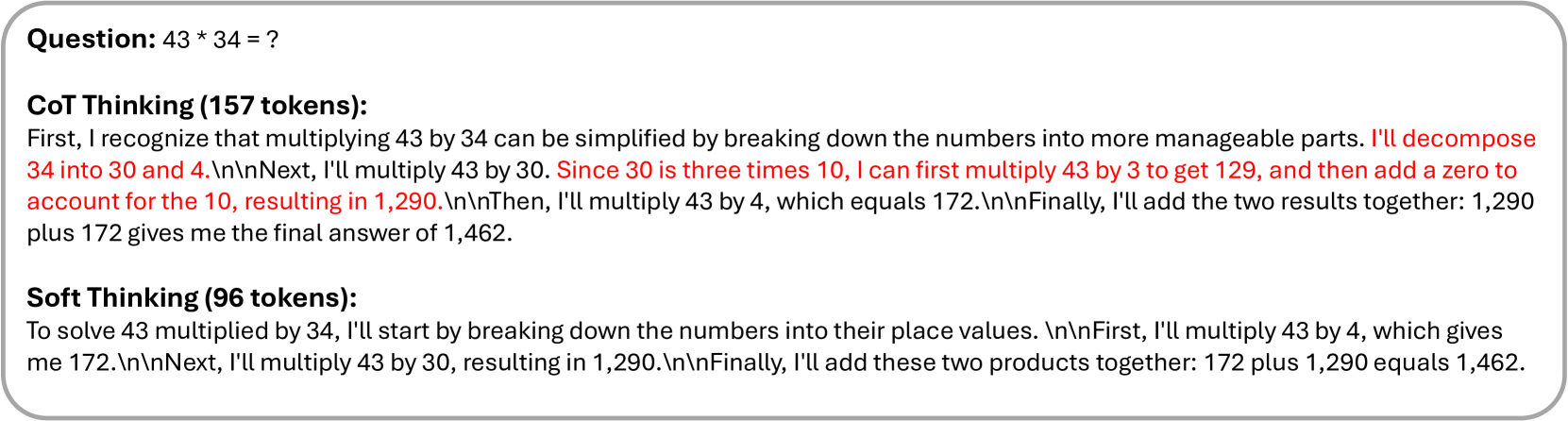
Figure 3: A comparison between standard CoT and Soft Thinking on a multiplication problem. We select the token with the highest probability at each step of Soft Thinking for readability and interpretability. Full distribution is visualized in Figure 4. Red text denotes repetitive, useless words.
4.4 Qualitative Results
Visualization of Shorted Examples.
Figure 3 demonstrates the comparison between Standard CoT and Soft Thinking. We select the token with the highest probability at each step of Soft Thinking for visualization. It can be seen that Soft Thinking has high readability and interpretability. While both methods arrive at the correct answer ( $1,462$ ), Soft Thinking produces a significantly more concise explanation ( $96$ tokens vs. $157$ tokens). This demonstrates Soft Thinking’s ability to preserve logical structure while improving token efficiency.
<details>
<summary>x4.png Details</summary>
### Visual Description
## Heatmap: Probability of Words in a Sequence
### Overview
The image is a heatmap displaying the probability of different words appearing in a sequence. The heatmap is arranged in rows, with each row representing a step in the sequence. The color intensity represents the probability, ranging from 0.0 (dark green) to 1.0 (light green). The x-axis is numbered from 1 to 97, representing the position in the sequence.
### Components/Axes
* **X-axis:** Numbers 1 to 97, representing the position of the word in the sequence.
* **Y-axis:** Implicitly defined by the rows of words. Each row represents a different set of word choices at a particular step in the sequence.
* **Color Scale (Probability):** A vertical color bar on the right side of the image indicates the probability scale. Dark green corresponds to a probability of 0.0, and light green corresponds to a probability of 1.0.
### Detailed Analysis or ### Content Details
Here's a breakdown of the words and their probabilities at different positions:
* **Row 1 (Positions 1-7):**
* "To": 0.39
* "solve": 0.88
* "'": 0.91
* "4": 1.00
* "3": 1.00
* "multiplied": 1.00
* "by": 1.00
* **Row 2 (Positions 1-3, 14-17):**
* "First": 0.39
* "calculate": 0.07
* "the": 0.09
* "I": 1.00
* "start": 0.60
* "by": 0.53
* "breaking": 1.00
* "down": 1.00
* **Row 3 (Positions 1, 13, 18-20):**
* "I": 0.21
* "multiply": 0.05
* "''": 0.60
* "can": 0.40
* "break": 0.28
* "the": 0.84
* "numbers": 0.60
* "into": 0.50
* **Row 4 (Positions 13, 18-20):**
* "use": 0.19
* "''": 0.16
* "multiplication": 0.40
* "to": 0.50
* **Row 5 (Positions 1-7):**
* "their": 0.38
* "place": 0.92
* "values": 1.00
* ".\n\n": 0.70
* "'\\n\\n'": 0.60
* "First": 0.91
* "'": 1.00
* **Row 6 (Positions 1-4, 29-31):**
* "smaller": 0.16
* "tens": 0.08
* ".\\n\\n": 0.30
* "This": 0.17
* "4": 0.09
* "''": 1.00
* "decom": 0.20
* "separate": 0.16
* **Row 7 (Positions 1, 36-40):**
* "make": 0.16
* "I": 0.17
* "3": 0.45
* "0": 0.13
* "which": 1.00
* "gives": 0.50
* "me": 0.55
* **Row 8 (Positions 39-40):**
* "equals": 0.41
* "''": 0.45
* **Row 9 (Positions 39-40):**
* "is": 0.09
* **Row 10 (Positions 21-27):**
* "'": 1.00
* "1": 1.00
* "7": 1.00
* "2": 1.00
* ".\\n\\n": 0.60
* "Next": 1.00
* "'": 1.00
* **Row 11 (Position 25):**
* ".": 0.40
* **Row 12 (Positions 38-40):**
* "resulting": 1.00
* "in": 1.00
* **Row 13 (Positions 41-47):**
* "'": 1.00
* "1": 1.00
* "2": 0.60
* "9": 1.00
* "0": 1.00
* ".\\n\\n": 1.00
* "Finally": 1.00
* **Row 14 (Positions 43):**
* "2": 0.40
* **Row 15 (Positions 51-57):**
* "''": 1.00
* "add": 1.00
* "these": 0.65
* "two": 1.00
* "products": 0.91
* "together": 1.00
* ":": 0.87
* **Row 16 (Positions 53-54, 59-60):**
* "the": 0.35
* "results": 0.09
* "to": 0.13
* "1": 1.00
* "7": 0.95
* **Row 17 (Positions 61-63):**
* "2": 1.00
* "plus": 1.00
* "'": 1.00
* **Row 18 (Positions 73-77):**
* "1": 1.00
* "2": 1.00
* "9": 1.00
* "0": 1.00
* "equals": 1.00
* "'": 1.00
* **Row 19 (Positions 71-72, 79-80):**
* "1": 1.00
* "4": 1.00
* "6": 1.00
* "2": 0.50
* ".\\n": 0.50
* "</think>": 1.00
* **Row 20 (Position 96):**
* ".\\n\\n": 0.50
### Key Observations
* Many words have a probability of 1.0, indicating a high certainty of their occurrence at those positions.
* Some words have very low probabilities (close to 0.0), suggesting they are unlikely to appear in those positions.
* The heatmap provides a visual representation of the likelihood of different words in a sequence, which could be useful for language modeling or sequence prediction tasks.
### Interpretation
The heatmap visualizes the probability distribution of words in a sequence, likely generated by a language model or a similar predictive algorithm. The high probabilities (close to 1.0) indicate strong predictions for those words at specific positions, while low probabilities suggest unlikely word choices. This type of visualization is useful for understanding the model's confidence and potential errors in sequence generation. The presence of ".\\n" and other special characters suggests that the sequence might be related to code or structured text. The "\<think>" tag suggests a potential end-of-thought marker.
</details>
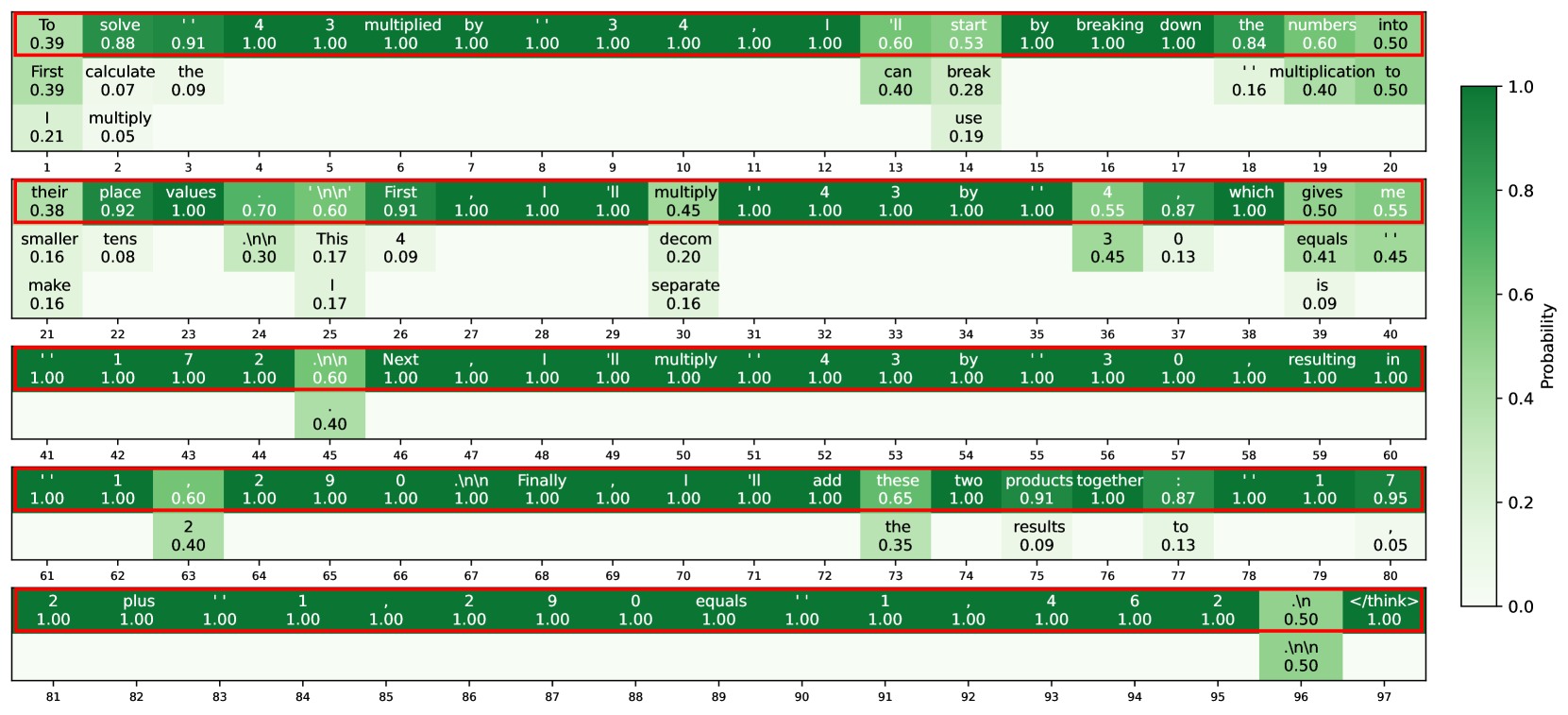
Figure 4: An example illustrating the probability distribution of our proposed Soft Thinking method. At each step, top- $k$ token candidates and their probabilities are shown. Red boxes indicate the selected tokens that form the final generated sequence for readability and interpretability.
Visualization of Embedding Weights.
In Figure 4, we present the token probability distributions at each intermediate reasoning step of Soft Thinking. For demonstration, we highlight the top three tokens. During exploratory reasoning phases, such as steps $1-3$ , $13-14$ , and $18-20$ , the token distribution appears more uniform, reflecting the presence of multiple viable paths. In contrast, during precise calculations, the token distribution becomes nearly one-hot, indicating that textual elements facilitate path exploration, while numerical components handle exact computations. Notably, at steps 36-37, the model evaluates whether to multiply by 4 or 30, ultimately assigning a higher probability to 4. As a result, at step 42, the model selects multiplication by 4. This demonstrates how Soft Thinking integrates path exploration across consecutive concept tokens, thereby enhancing both reasoning flexibility and depth.
4.5 Ablation Study
| | Accuracy | Generation Length All | Generation Length Correct | | | |
| --- | --- | --- | --- | --- | --- | --- |
| AIME 2024 $\uparrow$ | LiveCodeBench $\uparrow$ | AIME 2024 $\downarrow$ | LiveCodeBench $\downarrow$ | AIME 2024 $\downarrow$ | LiveCodeBench $\downarrow$ | |
| COCONUT-TF | 0.0 | 0.0 | 32,768 | 32,768 | – | – |
| Average Embedding | 6.66 | 7.49 | 30,802 | 30,474 | 6,556 | 2,141 |
| Soft Thinking w/o Cold Stop | 73.33 | 56.98 | 12,991 | 13,705 | 9,457 | 6,877 |
| Soft Thinking w/ Cold Stop | 83.33 | 62.72 | 11,445 | 12,537 | 10,627 | 7,535 |
Table 3: Ablation study of Soft Thinking with QwQ-32B on the AIME 2024 and LiveCodeBench. COCONUT-TF represents training-free COCONUT [27].
To comprehensively assess the effectiveness of Soft Thinking, we conducted ablation studies focusing on different strategies for concept token and the impact of the Cold Stop mechanism.
Different strategies for concept token.
Specifically, we compared (1) the training-free COCONUT approach [27], which directly feeds the previous hidden state as the next input embedding; (2) a simple average embedding strategy that takes the mean of the top- $n$ token embeddings (we use 5 for ablation); and (3) our Soft Thinking, which computes a probability-weighted over embeddings. As shown in Table 3, we observe that the training-free COCONUT fails entirely, producing no correct answers and always reaching the maximum generation length. The average embedding method performs marginally better, yielding a small number of correct solutions but still suffering from extremely long output. In contrast, our Soft Thinking substantially improves both accuracy and token efficiency.
Impact of Cold Stop.
We further analyze the Cold Stop by comparing Soft Thinking with and without it. Without Cold Stop, the model is prone to generation collapse, especially due to out-of-distribution (OOD) issues because models have never been trained on concept tokens. It will begin to repeat until it hits the maximum generation length. This OOD-induced collapse significantly increases the average generation length across all problems. However, for problems that are solved correctly (typically those requiring shorter reasoning chains), the average length remains relatively low, as these cases are less likely to trigger collapse. When Cold Stop is activated, generation collapse is effectively mitigated, and the model avoids unnecessary exploration along overconfident paths, resulting in a significant reduction in average generation length for all problems. Interestingly, as Cold Stop allows the model to correctly solve more challenging problems that require longer reasoning chains, the average length for correct solutions increase. Nevertheless, as demonstrated in Tables 1 and 2, Soft Thinking with Cold Stop not only solves more problems than standard CoT but also achieves greater overall efficiency, confirming the effectiveness of our approach.
5 Conclusion
In this work, we present Soft Thinking, a novel, training-free framework that enables large language models to reason in a continuous concept space by leveraging probabilistically weighted concept tokens instead of traditional discrete tokens. By aggregating information across the entire vocabulary at each reasoning step, our method allows the model to implicitly explore multiple reasoning paths in parallel, leading to both higher accuracy and greater token efficiency. Experiments on mathematical and coding benchmarks demonstrate that Soft Thinking consistently improves pass@1 accuracy and reduces generation length, all without any additional training or architectural modifications. Qualitative analyses further show that the reasoning process remains interpretable and concise. Future work may explore integrating training-based approaches to adapt the concept token, with the goal of further improving performance and stability when faced with out-of-distribution inputs.
6 Acknowledgments
We would like to express our sincere gratitude to Yue Fan, Saaket Agashe, Liliang Ren, Hao Cheng, Baolin Peng, and Yiping Wang for their valuable feedback and constructive discussions. We thank Orby AI for generously providing the computational resources. Additionally, we appreciate the SGLang Team’s assistance during development.
References
- [1] Jason Wei, Xuezhi Wang, Dale Schuurmans, Maarten Bosma, Fei Xia, Ed Chi, Quoc V Le, Denny Zhou, et al. Chain-of-thought prompting elicits reasoning in large language models. Advances in neural information processing systems, 35:24824–24837, 2022.
- [2] Tushar Khot, Harsh Trivedi, Matthew Finlayson, Yao Fu, Kyle Richardson, Peter Clark, and Ashish Sabharwal. Decomposed prompting: A modular approach for solving complex tasks. arXiv preprint arXiv:2210.02406, 2022.
- [3] Denny Zhou, Nathanael Schärli, Le Hou, Jason Wei, Nathan Scales, Xuezhi Wang, Dale Schuurmans, Claire Cui, Olivier Bousquet, Quoc Le, et al. Least-to-most prompting enables complex reasoning in large language models. arXiv preprint arXiv:2205.10625, 2022.
- [4] Guhao Feng, Bohang Zhang, Yuntian Gu, Haotian Ye, Di He, and Liwei Wang. Towards revealing the mystery behind chain of thought: a theoretical perspective. Advances in Neural Information Processing Systems, 36:70757–70798, 2023.
- [5] R Quian Quiroga, Leila Reddy, Gabriel Kreiman, Christof Koch, and Itzhak Fried. Invariant visual representation by single neurons in the human brain. Nature, 435(7045):1102–1107, 2005.
- [6] Evelina Fedorenko and Rosemary Varley. Language and thought are not the same thing: evidence from neuroimaging and neurological patients. Annals of the New York Academy of Sciences, 1369(1):132–153, 2016.
- [7] AA Ivanova, Z Mineroff, V Zimmerer, N Kanwisher, R Varley, and E Fedorenko. The language network is recruited but not required for non-verbal semantic processing. biorxiv, 696484, 2019.
- [8] Yael Benn, Anna A Ivanova, Oliver Clark, Zachary Mineroff, Chloe Seikus, Jack Santos Silva, Rosemary Varley, and Evelina Fedorenko. The language network is not engaged in object categorization. Cerebral Cortex, 33(19):10380–10400, 2023.
- [9] Shunyu Yao, Dian Yu, Jeffrey Zhao, Izhak Shafran, Tom Griffiths, Yuan Cao, and Karthik Narasimhan. Tree of thoughts: Deliberate problem solving with large language models. Advances in neural information processing systems, 36:11809–11822, 2023.
- [10] Xuezhi Wang, Jason Wei, Dale Schuurmans, Quoc Le, Ed Chi, Sharan Narang, Aakanksha Chowdhery, and Denny Zhou. Self-consistency improves chain of thought reasoning in language models. arXiv preprint arXiv:2203.11171, 2022.
- [11] Lifan Yuan, Yangyi Chen, Ganqu Cui, Hongcheng Gao, Fangyuan Zou, Xingyi Cheng, Heng Ji, Zhiyuan Liu, and Maosong Sun. Revisiting out-of-distribution robustness in nlp: Benchmark, analysis, and llms evaluations. arXiv preprint arXiv:2306.04618, 2023.
- [12] Abhimanyu Dubey, Abhinav Jauhri, Abhinav Pandey, Abhishek Kadian, Ahmad Al-Dahle, Aiesha Letman, Akhil Mathur, Alan Schelten, Amy Yang, Angela Fan, et al. The llama 3 herd of models. arXiv preprint arXiv:2407.21783, 2024.
- [13] Qwen Team. Qwq-32b: Embracing the power of reinforcement learning, March 2025.
- [14] Xiang Yue, Xingwei Qu, Ge Zhang, Yao Fu, Wenhao Huang, Huan Sun, Yu Su, and Wenhu Chen. Mammoth: Building math generalist models through hybrid instruction tuning. arXiv preprint arXiv:2309.05653, 2023.
- [15] Longhui Yu, Weisen Jiang, Han Shi, Jincheng Yu, Zhengying Liu, Yu Zhang, James T Kwok, Zhenguo Li, Adrian Weller, and Weiyang Liu. Metamath: Bootstrap your own mathematical questions for large language models. arXiv preprint arXiv:2309.12284, 2023.
- [16] Peiyi Wang, Lei Li, Zhihong Shao, Runxin Xu, Damai Dai, Yifei Li, Deli Chen, Yu Wu, and Zhifang Sui. Math-shepherd: Verify and reinforce llms step-by-step without human annotations. In Proceedings of the 62nd Annual Meeting of the Association for Computational Linguistics (Volume 1: Long Papers), pages 9426–9439, 2024.
- [17] Alex Havrilla, Yuqing Du, Sharath Chandra Raparthy, Christoforos Nalmpantis, Jane Dwivedi-Yu, Maksym Zhuravinskyi, Eric Hambro, Sainbayar Sukhbaatar, and Roberta Raileanu. Teaching large language models to reason with reinforcement learning. arXiv preprint arXiv:2403.04642, 2024.
- [18] Zhihong Shao, Peiyi Wang, Qihao Zhu, Runxin Xu, Junxiao Song, Mingchuan Zhang, YK Li, Yu Wu, and Daya Guo. Deepseekmath: Pushing the limits of mathematical reasoning in open language models. arXiv preprint arXiv:2402.03300, 2024.
- [19] Fangxu Yu, Lai Jiang, Haoqiang Kang, Shibo Hao, and Lianhui Qin. Flow of reasoning: Efficient training of llm policy with divergent thinking. arXiv preprint arXiv:2406.05673, 2024.
- [20] Yangzhen Wu, Zhiqing Sun, Shanda Li, Sean Welleck, and Yiming Yang. Inference scaling laws: An empirical analysis of compute-optimal inference for problem-solving with language models. arXiv preprint arXiv:2408.00724, 2024.
- [21] Sohee Yang, Elena Gribovskaya, Nora Kassner, Mor Geva, and Sebastian Riedel. Do large language models latently perform multi-hop reasoning? arXiv preprint arXiv:2402.16837, 2024.
- [22] Eden Biran, Daniela Gottesman, Sohee Yang, Mor Geva, and Amir Globerson. Hopping too late: Exploring the limitations of large language models on multi-hop queries. arXiv preprint arXiv:2406.12775, 2024.
- [23] Yuval Shalev, Amir Feder, and Ariel Goldstein. Distributional reasoning in llms: Parallel reasoning processes in multi-hop reasoning. arXiv preprint arXiv:2406.13858, 2024.
- [24] Xinyi Wang, Lucas Caccia, Oleksiy Ostapenko, Xingdi Yuan, William Yang Wang, and Alessandro Sordoni. Guiding language model reasoning with planning tokens. arXiv preprint arXiv:2310.05707, 2023.
- [25] Loïc Barrault, Paul-Ambroise Duquenne, Maha Elbayad, Artyom Kozhevnikov, Belen Alastruey, Pierre Andrews, Mariano Coria, Guillaume Couairon, Marta R Costa-jussà, David Dale, et al. Large concept models: Language modeling in a sentence representation space. arXiv preprint arXiv:2412.08821, 2024.
- [26] Liang Wang, Nan Yang, Xiaolong Huang, Linjun Yang, Rangan Majumder, and Furu Wei. Improving text embeddings with large language models. arXiv preprint arXiv:2401.00368, 2023.
- [27] Shibo Hao, Sainbayar Sukhbaatar, DiJia Su, Xian Li, Zhiting Hu, Jason Weston, and Yuandong Tian. Training large language models to reason in a continuous latent space. arXiv preprint arXiv:2412.06769, 2024.
- [28] Yige Xu, Xu Guo, Zhiwei Zeng, and Chunyan Miao. Softcot: Soft chain-of-thought for efficient reasoning with llms. arXiv preprint arXiv:2502.12134, 2025.
- [29] Mengting Hu, Zhen Zhang, Shiwan Zhao, Minlie Huang, and Bingzhe Wu. Uncertainty in natural language processing: Sources, quantification, and applications. arXiv preprint arXiv:2306.04459, 2023.
- [30] Alfréd Rényi. On measures of entropy and information. In Proceedings of the fourth Berkeley symposium on mathematical statistics and probability, volume 1: contributions to the theory of statistics, volume 4, pages 547–562. University of California Press, 1961.
- [31] Dan Hendrycks, Collin Burns, Saurav Kadavath, Akul Arora, Steven Basart, Eric Tang, Dawn Song, and Jacob Steinhardt. Measuring mathematical problem solving with the math dataset. arXiv preprint arXiv:2103.03874, 2021.
- [32] AMC. American invitational mathematics examination. https://artofproblemsolving.com/wiki/index.php/American_Invitational_Mathematics_Examination, 2025.
- [33] Karl Cobbe, Vineet Kosaraju, Mohammad Bavarian, Mark Chen, Heewoo Jun, Lukasz Kaiser, Matthias Plappert, Jerry Tworek, Jacob Hilton, Reiichiro Nakano, et al. Training verifiers to solve math word problems. arXiv preprint arXiv:2110.14168, 2021.
- [34] David Rein, Betty Li Hou, Asa Cooper Stickland, Jackson Petty, Richard Yuanzhe Pang, Julien Dirani, Julian Michael, and Samuel R Bowman. Gpqa: A graduate-level google-proof q&a benchmark. In First Conference on Language Modeling, 2024.
- [35] Mark Chen, Jerry Tworek, Heewoo Jun, Qiming Yuan, Henrique Ponde de Oliveira Pinto, Jared Kaplan, Harri Edwards, Yuri Burda, Nicholas Joseph, Greg Brockman, Alex Ray, Raul Puri, Gretchen Krueger, Michael Petrov, Heidy Khlaaf, Girish Sastry, Pamela Mishkin, Brooke Chan, Scott Gray, Nick Ryder, Mikhail Pavlov, Alethea Power, Lukasz Kaiser, Mohammad Bavarian, Clemens Winter, Philippe Tillet, Felipe Petroski Such, Dave Cummings, Matthias Plappert, Fotios Chantzis, Elizabeth Barnes, Ariel Herbert-Voss, William Hebgen Guss, Alex Nichol, Alex Paino, Nikolas Tezak, Jie Tang, Igor Babuschkin, Suchir Balaji, Shantanu Jain, William Saunders, Christopher Hesse, Andrew N. Carr, Jan Leike, Josh Achiam, Vedant Misra, Evan Morikawa, Alec Radford, Matthew Knight, Miles Brundage, Mira Murati, Katie Mayer, Peter Welinder, Bob McGrew, Dario Amodei, Sam McCandlish, Ilya Sutskever, and Wojciech Zaremba. Evaluating large language models trained on code. 2021.
- [36] Jacob Austin, Augustus Odena, Maxwell Nye, Maarten Bosma, Henryk Michalewski, David Dohan, Ellen Jiang, Carrie Cai, Michael Terry, Quoc Le, et al. Program synthesis with large language models. arXiv preprint arXiv:2108.07732, 2021.
- [37] Naman Jain, King Han, Alex Gu, Wen-Ding Li, Fanjia Yan, Tianjun Zhang, Sida Wang, Armando Solar-Lezama, Koushik Sen, and Ion Stoica. Livecodebench: Holistic and contamination free evaluation of large language models for code. arXiv preprint arXiv:2403.07974, 2024.
- [38] Daya Guo, Dejian Yang, Haowei Zhang, Junxiao Song, Ruoyu Zhang, Runxin Xu, Qihao Zhu, Shirong Ma, Peiyi Wang, Xiao Bi, et al. Deepseek-r1: Incentivizing reasoning capability in llms via reinforcement learning. arXiv preprint arXiv:2501.12948, 2025.
- [39] Lianmin Zheng, Liangsheng Yin, Zhiqiang Xie, Chuyue Livia Sun, Jeff Huang, Cody Hao Yu, Shiyi Cao, Christos Kozyrakis, Ion Stoica, Joseph E Gonzalez, et al. Sglang: Efficient execution of structured language model programs. Advances in Neural Information Processing Systems, 37:62557–62583, 2024.
- [40] Hunter Lightman, Vineet Kosaraju, Yura Burda, Harri Edwards, Bowen Baker, Teddy Lee, Jan Leike, John Schulman, Ilya Sutskever, and Karl Cobbe. Let’s verify step by step. arXiv preprint arXiv:2305.20050, 2023.
Appendix A Appendix
A.1 Limitation
While Soft Thinking demonstrates significant improvements in both reasoning accuracy and token efficiency without requiring any additional training, its training-free nature also introduces certain limitations. Specifically, since current large language models are trained exclusively on discrete token sequences, they have never encountered concept tokens, the probability-weighted mixtures of token embeddings, during pre-training or fine-tuning. As a result, feeding such continuous concept tokens into the model during inference places it in an out-of-distribution (OOD) regime. This can lead to instability or generation collapse, especially when the reasoning chain becomes long or the input distribution diverges from the model’s training data. Although our Cold Stop mechanism helps mitigate these issues by terminating reasoning when the model is sufficiently confident, it does not fundamentally resolve the OOD problem. Future work should explore training strategies that explicitly expose the model to concept tokens, thereby aligning its internal representations with the continuous concept space and improving robustness and generalization under soft thinking paradigms.
A.2 Benchmarks
The evaluation covers four mathematical benchmark tasks and three programming benchmark tasks.
- Mathematical Benchmarks: Math500 [40] is a diverse subset of 500 problems selected from the MATH dataset [31], covering seven mathematical disciplines. AIME 2024 [32] is drawn from the American Invitational Mathematics Examination, this dataset features challenging problems that serve as a rigorous benchmark for both accuracy and token efficiency. GSM8K [33] is a benchmark comprising 1,319 grade-school-level math word problems designed to assess multi-step arithmetic reasoning. GPQA-Diamond [34] is a subset focusing on high-difficulty problems requiring deep, multi-step reasoning.
- Coding Benchmarks: HumanEval [35] is a widely used benchmark for evaluating functional correctness in code generation. Each problem consists of a Python function signature and a natural language description, with correctness measured by executing unit tests. MBPP [36] contains introductory-level coding tasks paired with simple specifications and measures a model’s ability to understand and execute basic programming logic. LiveCodeBench [37] is a dynamic, contamination-free code generation benchmark. For our study, we select 279 problems released between August 2024 and January 2025 to ensure evaluation on unseen tasks.
A.3 Implementation of Soft Thinking on SGLang
In this appendix, we describe the engineering modifications made to the SGLang inference engine (v0.4.6.post1) to support our proposed Soft Thinking method. We highlight the core code changes, affected files, and provide high-level code snippets to clarify the new reasoning flow.
A.3.1 Overview of Modifications
Our implementation introduces a new inference mode, soft thinking, in which intermediate reasoning steps use “concept tokens” (i.e., full token probability distributions) rather than discrete token ids. This required changes to the input/output interface, sampling, embedding, and state management in SGLang. The main modifications are summarized as follows:
- Configuration: New flags and parameters to enable soft thinking and control its behavior.
- Sampler: Modified to output top- $k$ probability distributions (concept tokens) instead of a single sampled token.
- Embedding Layer: Added support for probability-weighted interpolation of token embeddings.
- Forward Pipeline: Adapted to accept and propagate concept tokens through the model.
- Cold Stop: Entropy-based early stopping logic for intermediate reasoning steps.
A.3.2 Key Files and Logic Changes
1. model_config.py & server_args.py
- Purpose: Add configuration options for soft thinking.
- Key additions:
⬇
1 enable_soft_thinking: bool
2 max_topk: int
3 # Command-line flags: --enable-soft-thinking, --max-topk, --think-end-str
2. sampler.py (Sampling Logic)
- Purpose: Output concept tokens (top- $k$ probabilities and indices) instead of only discrete token ids.
- Key changes:
⬇
1 if enable_soft_thinking:
2 # Compute top-k probabilities and indices
3 topk_probs, topk_indices = torch. topk (probs, k = max_topk, dim =-1)
4 # Normalize
5 topk_probs = topk_probs / topk_probs. sum (dim =-1, keepdim = True)
6 logits_output. topk_probs = topk_probs
7 logits_output. topk_indices = topk_indices
8 # For next token id, use argmax or sample from topk as needed
9 batch_next_token_ids = topk_indices [:, 0]
10 else:
11 # Standard discrete sampling
12 batch_next_token_ids = torch. argmax (probs, -1)
13
14 # Entropy calculation for Cold Stop
15 entropy = - torch. sum (probs * torch. log (probs. clamp (min =1 e -12)), dim =-1)
16 logits_output. entropy = entropy
3. vocab_parallel_embedding.py (Embedding Layer)
- Purpose: Support probability-weighted embedding computation.
- Key changes:
⬇
1 def weighted_forward (self, topk_probs, topk_indices):
2 # Compute weighted sum of embeddings
3 topk_embeddings = self. quant_method. embedding (self, topk_indices. long ()) # [B, K, D]
4 # Normalize probabilities
5 topk_probs = topk_probs / topk_probs. sum (dim =-1, keepdim = True)
6 new_embedding = torch. sum (topk_probs. unsqueeze (-1) * topk_embeddings, dim =1)
7 return new_embedding
4. models/llama.py, models/qwen2.py (Model Forward Pass)
- Purpose: Accept and process concept tokens as input.
- Key changes:
⬇
1 # In model.forward:
2 if forward_batch. topk_probs is not None and forward_batch. topk_indices is not None:
3 if self. tp_size > 1:
4 hidden_states = self. embed_tokens. weighted_forward_tp (forward_batch. topk_probs, forward_batch. topk_indices)
5 else:
6 hidden_states = self. embed_tokens. weighted_forward (forward_batch. topk_probs, forward_batch. topk_indices)
7 elif input_embeds is None:
8 hidden_states = self. embed_tokens (input_ids)
5. schedule_batch.py, scheduler.py, scheduler_output_processor_mixin.py
- Purpose: State management and output tracking for soft thinking.
- Key changes:
⬇
1 # Pseudocode for Cold Stop
2 if entropy < entropy_threshold:
3 low_entropy_steps += 1
4 else:
5 low_entropy_steps = 0
6 if low_entropy_steps >= length_threshold:
7 # Insert end-of-thinking token, switch to answer mode
8 self. output_ids [-1] = self. sampling_params. think_end_str_id
6. sampling_params.py, sampling_batch_info.py
- Purpose: Add soft thinking-specific parameters and per-batch flags.
- Key changes:
⬇
1 # Parameters for after-thinking sampling, entropy thresholds, etc.
2 early_stopping_entropy_threshold: float
3 early_stopping_length_threshold: int
4 soft_thinking_mode: Optional [torch. Tensor]
A.3.3 High-Level Soft Thinking Inference Flow
1. Initialization: If enable_soft_thinking is set, the model enters soft thinking mode for reasoning steps.
1. At Each Reasoning Step:
- The sampler outputs a concept token: top- $k$ probabilities and indices (not just a single token id).
- The embedding layer computes the next input embedding as a weighted sum over token embeddings, using these probabilities.
- The model forward pass consumes this weighted embedding.
1. Cold Stop (Early Termination):
- At each step, compute the entropy of the concept token.
- If entropy is below a threshold for several consecutive steps, insert the end-of-thinking token to terminate reasoning.
1. Answer Generation: After reasoning, the model switches back to standard discrete decoding for the answer.
The above changes enable SGLang to support soft thinking as described in our paper, allowing for continuous, distributional reasoning and entropy-based early stopping, all with minimal overhead to the standard inference pipeline.