# Un-considering Contextual Information: Assessing LLMs’ Understanding of Indexical Elements
## Abstract
Large Language Models (LLMs) have demonstrated impressive performances in tasks related to coreference resolution. However, previous studies mostly assessed LLM performance on coreference resolution with nouns and third person pronouns. This study evaluates LLM performance on coreference resolution with indexicals like I, you, here and tomorrow, which come with unique challenges due to their linguistic properties. We present the first study examining how LLMs interpret indexicals in English, releasing the English Indexical Dataset with 1600 multiple-choice questions. We evaluate pioneering LLMs, including GPT-4o, Claude 3.5 Sonnet, Gemini 1.5 Pro, and DeepSeek V3. Our results reveal that LLMs exhibit an impressive performance with some indexicals (I), while struggling with others (you, here, tomorrow), and that syntactic cues (e.g. quotation) contribute to LLM performance with some indexicals, while they reduce performance with others. Code and data are available at: https://github.com/metehanoguzz/LLMs-Indexicals-English
Un-considering Contextual Information: Assessing LLMs’ Understanding of Indexical Elements
Metehan Oğuz Yavuz Bakman Duygu Nur Yaldiz University of Southern California {moguz, ybakman, yaldiz}@usc.edu
## 1 Introduction
Large Language Models (LLMs) have demonstrated remarkable capabilities in zero-shot and few-shot learning, excelling across a wide array of tasks such as machine translation, text summarization, and question answering OpenAI (2024); Ye et al. (2023); Bakman et al. (2024); Yaldiz et al. (2024). Their versatility has led to widespread applications in diverse domains, including education, law, and medicine.
<details>
<summary>extracted/6501068/main.png Details</summary>

### Visual Description
## Diagram: AI Contextual Reasoning Interaction
### Overview
The image depicts a stylized, meme-style dialogue between a human user (represented by the "Chad" meme character) and an AI assistant (represented by a robot character). The interaction illustrates a scenario involving natural language processing, specifically the resolution of ambiguous references ("here") within a conversational context. The image is decorated with various technology logos in the bottom-left corner.
### Components
* **Right Side:** A "Chad" meme character (blonde hair, beard) positioned in front of a stylized graphic of the Hollywood sign and a city skyline.
* **Left Side:** A robot character (white, round, with headphones/antenna).
* **Dialogue Bubbles:** Two speech bubbles connecting the characters.
* **Logos (Bottom-Left):** A cluster of four distinct technology icons.
### Content Details
#### Dialogue Transcription
* **Top Bubble (from "Chad"):** "When <u>I was in NY with John</u>, he said he wanted to explore around **here**. Make a list of places to see with him."
* *Note:* The phrase "I was in NY with John" is underlined. The word "here" is bolded.
* **Bottom Bubble (from Robot):** "Of course! You should go to Central Park and Statue of Liberty. I am sure he will love them!"
#### Technology Logos (Bottom-Left Cluster)
* **Top-Left:** Docker logo (blue whale).
* **Top-Right:** Google Gemini/Bard logo (four-pointed star/sparkle).
* **Bottom-Left:** A brown/orange starburst or flower-like icon.
* **Bottom-Right:** OpenAI/ChatGPT logo (green).
### Key Observations
* **Referential Ambiguity:** The user's prompt contains a classic linguistic ambiguity. The user says "I was in NY" (past tense) but asks to explore "here." The AI successfully resolves "here" to mean "New York" rather than the user's current physical location, demonstrating context-aware reasoning.
* **Visual Contrast:** The "Chad" character, often associated with internet meme culture, is juxtaposed against the helpful, polite, and literal-minded robot character.
* **Logo Placement:** The logos are grouped in the bottom-left corner, likely representing the ecosystem of AI tools or platforms (Docker, Gemini, ChatGPT) that might be involved in processing such queries.
### Interpretation
This image serves as a commentary on the capabilities of Large Language Models (LLMs) regarding **context window management** and **anaphora resolution**.
* **The "Here" Problem:** In natural language, "here" is a deictic expression that usually refers to the speaker's current location. However, the user provides a conflicting context: "When I was in NY... explore around here." A less sophisticated model might fail to resolve the ambiguity or ask for clarification. The AI's response ("Central Park and Statue of Liberty") indicates it has correctly inferred that "here" refers to the location mentioned in the previous clause ("NY"), effectively ignoring the literal definition of "here" in favor of the conversational intent.
* **Peircean/Semiotic Analysis:** The image uses the "Chad" character as a signifier for a casual, perhaps slightly demanding user, while the robot signifies the "helpful assistant." The Hollywood background behind the "Chad" character is ironic, as the conversation is about New York, creating a visual dissonance that emphasizes the meme format.
* **Technical Context:** The inclusion of logos like Docker, Gemini, and ChatGPT suggests this image is likely used in a technical or developer-focused context (e.g., a blog post, tutorial, or social media post) discussing how different AI models handle prompt engineering or context-aware tasks. The image validates the AI's ability to "read between the lines" of human speech.
</details>
Figure 1: An example for LLM misinterpreting indexical element ‘here’, uttered by a speaker in Los Angeles.
As the use of LLMs continues to expand, understanding their underlying behaviors has become increasingly important. Recent studies have evaluated the performance of large language models on linguistic tasks such as coreference resolution Gan et al. (2024); Le and Ritter (2023); Brown et al. (2020); Yang et al. (2022); Agrawal et al. (2022).
Previous work on coreference resolution mostly focused on how coreference is established between two third person entities such as proper names (e.g. Andy, the mechanic) and third person pronouns (e.g. he, him, himself) in English and other languages (e.g. Yang et al., 2022; Yang, 2025). In this study, we investigate how LLMs establish coreference with indexical elements (e.g. I, you, here), which differ from third person nouns/pronouns in substantial ways and bring unique challenges for LLMs (see Figure 1 as an example). We investigate how state-of-the-art LLMs interpret the indexical elements I, you, here and tomorrow in English sentences, and whether context or grammatical constraints influence their decisions. To the best of our knowledge, this is the first study examining LLMs’ handling of indexical elements in English. Our key contributions are as follows:
- We introduce the English Indexical Dataset, comprising 400 interpretation samples for each indexical element, I, you, here, tomorrow, totaling 1,600 instances.
- We evaluate the performance of four frontier LLMs, GPT-4o, Claude 3.5 Sonnet, Gemini 1.5 Pro, and DeepSeek-V3, on the interpretation of indexical elements in English.
- We show that LLM performances are not uniform across different types of indexical elements: indexical I is successfully interpreted by most LLMs, other indexicals like you, here and tomorrow lead to poor performances.
- We show that quotation affects LLMs performances differently: quotation reduces LLMs’ accuracies with tomorrow, but it increases accuracies with here.
## 2 Indexical elements
Indexical pronominals like I, you, here and now are used to refer to referents of the speech-act coordinates (e.g. Kaplan, 1977; Schlenker, 2003). For instance, I refers to author (speaker) of the utterance, while here refers to the location where the utterance was made. Thus, a sentence like 2 means different things if uttered by different people and/or in different places. If John utters 2 in Los Angeles, it means that John was born in Los Angeles, but if Mary utters the same sentence in New York it means that Mary was born in New York.
. . I was born here. .̱ Andrew said that I went to Buckhead.
Indexicals are interpreted inside the context of utterance, referring to the actual speech-act coordinates like the author or the location of the actual utterance. As a result, if 2 is uttered by John, the indexical I can only be interpreted as referring to John as the speaker, leading to a reading like ‘Andrew said that John went to Buckhead’. Crucially, even though Andrew’s speech/claim is reported in 2, the indexical I cannot refer to Andrew.
Direct quotation is an exception to this generalization, where reported material is interpreted as verbatim utterance/thoughts of its owner. Thus, when indexicals appear inside direct quotation, they are interpreted inside the reported context, rather than the actual context of utterance. In other words, direct quotation ‘shifts’ the interpretations of indexicals into the reported context. For example, I and here in 2 appear inside direct quotation, where Andrew’s speech is reported.
. While we were in Atlanta, Andrew said “ I was born here.”
Regardless of who utters 2, the sentence means that Andrew was born in Atlanta, so both I and here are ‘shifted’ into the reported context, where Andrew is the speaker and Atlanta is the location Some languages (not English) allow indexical elements to ‘shift’ without quotation. See Deal (2020) for an overview.
Indexicals differ from other pronominals in substantial ways. First, though syntactic and semantic factors can affect how a pronoun is interpreted (e.g. subject bias), pronouns are typically ambiguous regarding what/who they refer to. For example, the third person pronoun he in 2 is most naturally interpreted as referring to the subject John (for syntactic or contextual reasons), but the object Bill is still a possible antecedent, causing ambiguity between two different readings (e.g. Crawley et al., 1990; Stewart and Pickering, 1998; Pickering and Majid, 2007). In addition, he can refer to any contextually salient person that is not mentioned in the sentence (e.g. Peter), which makes pronouns even more ambiguous and context-dependent. . John hit Bill and he ran away.
As a result, semantic/contextual information plays a crucial role in how pronouns are interpreted, and speakers use those cues to establish coreference with pronouns. For instance, if 2 is uttered in a context where John is a supportive and humble coworker, the most natural interpretation is that John suggests that Bill should get promoted (he = Bill). However, if John is arrogant and jealous, the most natural interpretation is that John suggests that John should get promoted (he = John). . John told Bill that he should get promoted.
Indexicals, on the other hand, unambiguously refer to the referents of the speech-act coordinates. For example, I in 2 refers to the speaker regardless of what we know about John or Bill. I refers to the speaker even if John and/or Bill are arrogant and jealous, so contextual information like this should be disregarded while interpreteting indexicals.
. John told Bill that I should get a promotion.
In summary, indexicals are restricted by different syntactic factors than pronouns (e.g. quotation vs non-quotation) and are typically unambiguous, while pronouns are free to refer to a wide range of entities. Thus, indexical elements create a unique challenge for LLMs, requiring to ‘disregard’ semantic/contextual cues that might prime interpretations through other antecedents (unlike pronouns).
## 3 Experimental design
### 3.1 Dataset Curation
We curated a dataset specifically designed to test how LLMs interpret indexical elements like I, you, here, and tomorrow in different contexts of utterance. Specifically, we assess how these models interpret indexicals in ‘shifted’ context prime, where context more naturally requires the indexical should be interpreted inside reported context (e.g. Peter is one of the most arrogant students in my classroom. … Peter says that I am smart.) vs ’non-shifted’ context prime, where context more naturally requires the indexical should be interpreted inside actual speech context (e.g. Peter is very kind and supportive. … Peter says that I am smart.). We also included direct quotations in both contexts (e.g., Peter says, “I am smart”) to examine if LLMs can successfully consider syntactic factors (quotation vs regular sentences) while ignoring misleading information from the context during coreference resolution with indexical elements.
For each type of indexical, we design 100 sentences and for each sentence we apply the four different transformations explained above. Overall, we have 400 samples per indexical, compromising a total dataset of size 1600.
We utilize GPT-4o to curate the dataset, by giving a detailed description of the task along with some in-context examples. Then it is asked to generate scenarios with a stimulus sentence in two different contexts (See Appendix A.1 for the prompts used), along with specific questions addressing the referent of the indexical in each sentence. To ensure the quality of the dataset, 25% of the dataset (400 trials = 100 sentences in four conditions) was randomly selected for evaluation, and the evaluation process consisted of three steps.
In the first step, we confirmed that all sentences were grammatically correct. In the second step, we confirmed that all quotation condition sentences had quoted embedded clauses, and all non-quotation condition sentences had regular (non-quoted) embedded clauses. We also made sure that the two sentence conditions were maximally similar, except for the quotation vs non-quotation status (i.e. the only difference between two sentence conditions was the quotation). In the third step, we checked the context prime texts for each condition in each sentence, making sure that the correct readings (shifted vs non-shifted) were primed by the context description. For example, for an item condition where here was supposed to be shifted, we confirmed that the context description would be most naturally followed by a sentence where here would be shifted.
100 trials from each indexical item (25% for each indexical), 400 trials in total, were randomly selected to make sure that the evaluation/confirmation was representative of all indexical item conditions (i.e. items with I, you, here and tomorrow).
To eliminate potential gender bias, each dataset sample exclusively uses either male or female names, alternating to ensure a balanced distribution with 50% of the samples containing female names and 50% male names. This method promotes gender neutrality across the dataset. Sample details are in Appendix A.2, and the complete dataset is available in the supplementary materials.
### 3.2 Models
In our evaluation, we utilize four recent state-of-the-art LLMs: GPT-4o OpenAI (2024), Claude 3.5 Sonnet Anthropic , Gemini 1.5 Pro Team (2024), and DeepSeek-V3 DeepSeek-AI (2024). This selection of diverse models provides a comprehensive evaluation of LLM performance with indexicals.
### 3.3 Evaluation Strategy
To assess the performance of the model, we specifically prompt it to answer questions designed to test its capabilities as described in Section 3.1. Additionally, to ensure focused responses, we restrict the model’s answers to one of two predefined options: the ‘shifted’ option and the ‘non-shifted’ option. We provide the prompt in Appendix B.1.
### 3.4 Metrics.
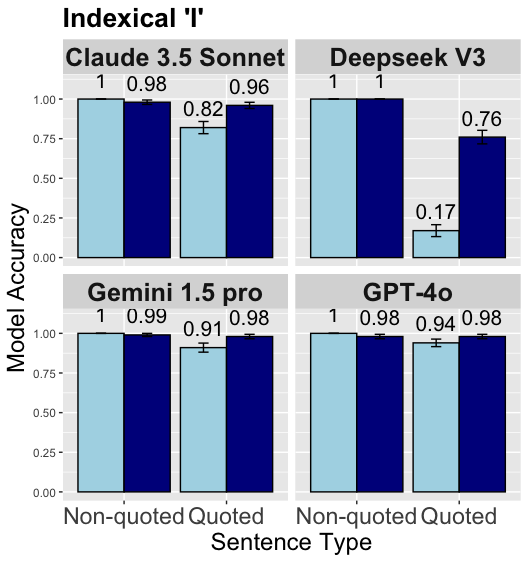
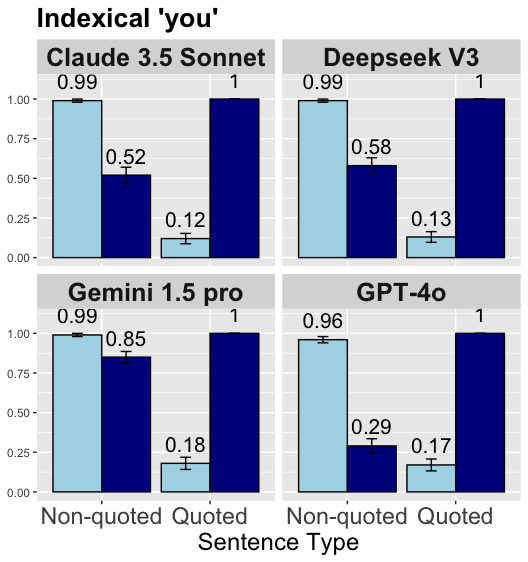
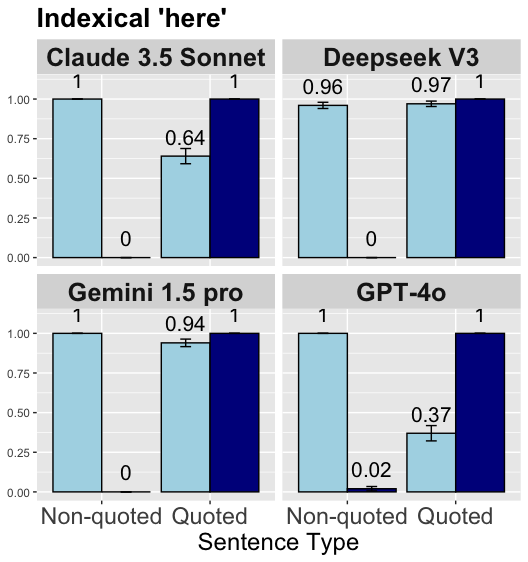
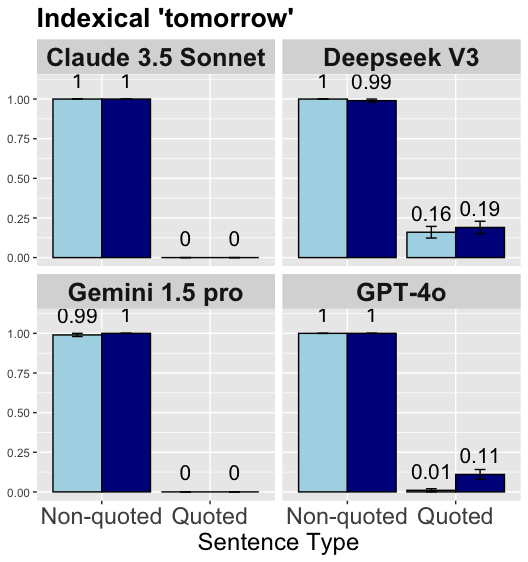
We assess model accuracy across four cases for each indexical: (i) Non-quoted sentences with shifted context prime, (ii) Non-quoted with non-shifted prime, (iii) Quoted with shifted prime, and (iv) Quoted with non-shifted prime. Optimal performance would be achieved by always selecting the ‘shifted’ option in quoted conditions and selecting the ‘non-shifted’ option in non-quoted conditions.
<details>
<summary>extracted/6501068/I_plot_acc.png Details</summary>
### Visual Description
## Bar Chart: Indexical 'I'
### Overview
This image displays a 2x2 grid of bar charts evaluating the "Model Accuracy" of four different Large Language Models (LLMs) regarding the linguistic concept of the "Indexical 'I'". The models evaluated are Claude 3.5 Sonnet, Deepseek V3, Gemini 1.5 pro, and GPT-4o. The accuracy is measured across two sentence types: "Non-quoted" and "Quoted". Each category contains two bars (Light Blue and Dark Blue) with associated error bars, indicating performance variance.
### Components/Axes
* **Y-Axis:** "Model Accuracy", scaled from 0.00 to 1.00. This axis is shared across the left-hand charts (Claude 3.5 Sonnet and Gemini 1.5 pro).
* **X-Axis:** "Sentence Type", categorized into "Non-quoted" and "Quoted". This axis is shared across the bottom charts (Gemini 1.5 pro and GPT-4o).
* **Data Series:** Two distinct bar types are used in each category:
* **Light Blue Bar:** Positioned on the left within each category.
* **Dark Blue Bar:** Positioned on the right within each category.
* **Error Bars:** Vertical black lines with horizontal caps are present on all bars, representing uncertainty or standard deviation.
* **Grid Layout:**
* **Top-Left:** Claude 3.5 Sonnet
* **Top-Right:** Deepseek V3
* **Bottom-Left:** Gemini 1.5 pro
* **Bottom-Right:** GPT-4o
### Detailed Analysis
#### 1. Claude 3.5 Sonnet (Top-Left)
* **Non-quoted:** Light Blue bar at 1.00; Dark Blue bar at 0.98.
* **Quoted:** Light Blue bar at 0.82; Dark Blue bar at 0.96.
* **Trend:** High accuracy across all conditions, with a slight dip in the Light Blue bar for "Quoted" sentences.
#### 2. Deepseek V3 (Top-Right)
* **Non-quoted:** Light Blue bar at 1.00; Dark Blue bar at 1.00.
* **Quoted:** Light Blue bar at 0.17; Dark Blue bar at 0.76.
* **Trend:** This model shows a drastic performance drop in the "Quoted" category, particularly for the Light Blue bar, which falls to 0.17.
#### 3. Gemini 1.5 pro (Bottom-Left)
* **Non-quoted:** Light Blue bar at 1.00; Dark Blue bar at 0.99.
* **Quoted:** Light Blue bar at 0.91; Dark Blue bar at 0.98.
* **Trend:** Very high consistency. There is a minor decrease in the Light Blue bar for "Quoted" sentences, but it remains above 0.90.
#### 4. GPT-4o (Bottom-Right)
* **Non-quoted:** Light Blue bar at 1.00; Dark Blue bar at 0.98.
* **Quoted:** Light Blue bar at 0.94; Dark Blue bar at 0.98.
* **Trend:** Extremely stable performance. The model maintains high accuracy across all conditions, with the Dark Blue bar remaining perfectly flat at 0.98.
### Key Observations
* **Universal Baseline:** All four models achieve near-perfect accuracy (1.00) on "Non-quoted" sentences for the Light Blue bar condition.
* **The "Quoted" Challenge:** The "Quoted" condition introduces complexity that causes performance degradation in all models, though the severity varies significantly.
* **Deepseek V3 Anomaly:** Deepseek V3 is a significant outlier. While it performs perfectly on "Non-quoted" sentences, its ability to handle the Light Blue condition in "Quoted" sentences collapses (0.17 accuracy).
* **Dark Blue Robustness:** In almost every instance where the Light Blue bar performance drops (Claude, Deepseek, Gemini), the Dark Blue bar maintains a higher accuracy, suggesting the Dark Blue condition represents a more robust or "smarter" reasoning path for the models.
### Interpretation
The data demonstrates how LLMs handle "Indexical 'I'"—a linguistic challenge where the word "I" must be resolved to the correct speaker. In "Non-quoted" sentences, the reference is straightforward. In "Quoted" sentences, the models must perform a "Theory of Mind" shift, recognizing that "I" refers to the person being quoted, not the current speaker.
The consistent high performance of the Dark Blue bars suggests that whatever method or prompt structure they represent is highly effective at maintaining reference tracking even in complex quoted speech. Conversely, the Light Blue bars likely represent a more literal or "surface-level" processing method that is prone to failure when the context requires shifting the referent of "I". Deepseek V3's failure in the Light Blue/Quoted condition (0.17) suggests a specific, brittle failure mode in its reasoning architecture when dealing with reported speech.
</details>
<details>
<summary>extracted/6501068/you_plot_acc.png Details</summary>
### Visual Description
## Bar Chart: Indexical 'you'
### Overview
The image displays a 2x2 grid of bar charts comparing the performance of four Large Language Models (LLMs)—Claude 3.5 Sonnet, Deepseek V3, Gemini 1.5 pro, and GPT-4o—on a linguistic task involving the indexical "you." The charts compare performance across two sentence types: "Non-quoted" and "Quoted."
### Components/Axes
* **Layout:** A 2x2 grid of sub-charts, each dedicated to a specific model.
* **Y-axis:** Represents a numerical value ranging from 0.00 to 1.00 (likely representing accuracy, probability, or a classification score).
* **X-axis:** Labeled "Sentence Type," with two categories: "Non-quoted" and "Quoted."
* **Legend/Series:** There are two data series represented by color:
* **Light Blue:** Represents the first metric (consistently high in "Non-quoted," low in "Quoted").
* **Dark Blue:** Represents the second metric (consistently low/mid in "Non-quoted," high in "Quoted").
* **Error Bars:** Small black vertical lines atop each bar indicate uncertainty or variance in the data.
### Detailed Analysis
The data is segmented by model. Below are the extracted values for each:
| Model | Category | Light Blue | Dark Blue |
| :--- | :--- | :--- | :--- |
| **Claude 3.5 Sonnet** | Non-quoted | 0.99 | 0.52 |
| | Quoted | 0.12 | 1.00 |
| **Deepseek V3** | Non-quoted | 0.99 | 0.58 |
| | Quoted | 0.13 | 1.00 |
| **Gemini 1.5 pro** | Non-quoted | 0.99 | 0.85 |
| | Quoted | 0.18 | 1.00 |
| **GPT-4o** | Non-quoted | 0.96 | 0.29 |
| | Quoted | 0.17 | 1.00 |
### Key Observations
* **Consistent Performance on "Quoted" (Dark Blue):** All four models achieve a perfect score of 1.00 for the Dark Blue metric in the "Quoted" category.
* **Consistent Performance on "Non-quoted" (Light Blue):** All four models achieve very high scores (0.96–0.99) for the Light Blue metric in the "Non-quoted" category.
* **Variable Performance on Secondary Metrics:**
* In the "Non-quoted" category, the Dark Blue metric varies significantly between models: Gemini 1.5 pro is the highest (0.85), while GPT-4o is the lowest (0.29).
* In the "Quoted" category, the Light Blue metric is consistently low across all models (0.12–0.18).
### Interpretation
The data suggests a clear distinction in how these models handle the indexical "you" depending on whether it appears in a quoted or non-quoted context.
* **Task Definition:** The "Light Blue" metric appears to measure the model's ability to correctly identify or process "you" in a direct (non-quoted) context, while the "Dark Blue" metric appears to measure the ability to process "you" in a quoted (reported speech) context.
* **Model Specialization:** The models are highly optimized for their respective primary contexts (Light Blue for Non-quoted, Dark Blue for Quoted).
* **The "Non-quoted" Discrepancy:** The most significant variance occurs in the Dark Blue metric within the "Non-quoted" category. Gemini 1.5 pro shows a much higher score (0.85) compared to GPT-4o (0.29). This implies that Gemini 1.5 pro is more likely to "misidentify" or "over-process" the indexical "you" even when it is not in a quoted context, whereas GPT-4o is much more conservative or precise in distinguishing the two contexts.
* **Conclusion:** While all models are near-perfect at identifying the indexical "you" in its primary context, they differ in their "false positive" rates (or secondary metric performance) when the context is switched. GPT-4o demonstrates the highest level of discrimination between the two sentence types, as evidenced by its low Dark Blue score in the Non-quoted category.
</details>
<details>
<summary>extracted/6501068/here_plot_acc.png Details</summary>
### Visual Description
## Bar Chart Grid: Indexical 'here' Performance
### Overview
The image displays a 2x2 grid of bar charts comparing the performance of four Large Language Models (LLMs)—Claude 3.5 Sonnet, Deepseek V3, Gemini 1.5 pro, and GPT-4o—on a task involving the resolution of the indexical "here" in two different sentence types: "Non-quoted" and "Quoted". Each chart plots the performance (likely accuracy or probability) on a scale from 0.00 to 1.00.
### Components/Axes
* **Grid Layout:**
* **Top-Left:** Claude 3.5 Sonnet
* **Top-Right:** Deepseek V3
* **Bottom-Left:** Gemini 1.5 pro
* **Bottom-Right:** GPT-4o
* **Axes:**
* **Y-Axis:** Numerical scale from 0.00 to 1.00, representing performance/accuracy.
* **X-Axis:** Categorical labels "Non-quoted" and "Quoted".
* **Data Series:** There are two bars per category, distinguished by color:
* **Light Blue:** Represents one interpretation of "here" (likely the speaker's location).
* **Dark Blue:** Represents the alternative interpretation of "here" (likely the location mentioned within the quote).
* *Note: There is no explicit legend provided in the image; these interpretations are inferred from the data patterns.*
### Detailed Analysis
The following data points are extracted from the charts. Error bars are visible on all bars.
#### 1. Claude 3.5 Sonnet (Top-Left)
* **Non-quoted:**
* Light Blue: 1.00
* Dark Blue: 0
* **Quoted:**
* Light Blue: 0.64
* Dark Blue: 1.00
#### 2. Deepseek V3 (Top-Right)
* **Non-quoted:**
* Light Blue: 0.96
* Dark Blue: 0
* **Quoted:**
* Light Blue: 0.97
* Dark Blue: 1.00
#### 3. Gemini 1.5 pro (Bottom-Left)
* **Non-quoted:**
* Light Blue: 1.00
* Dark Blue: 0
* **Quoted:**
* Light Blue: 0.94
* Dark Blue: 1.00
#### 4. GPT-4o (Bottom-Right)
* **Non-quoted:**
* Light Blue: 1.00
* Dark Blue: 0.02
* **Quoted:**
* Light Blue: 0.37
* Dark Blue: 1.00
### Key Observations
* **Consistency in "Dark Blue" (Quoted Location):** Across all four models, the Dark Blue bar is consistently 1.00 for "Quoted" sentences and near 0 for "Non-quoted" sentences. This indicates all models are highly capable of identifying the location mentioned *inside* a quote when required.
* **Variation in "Light Blue" (Speaker's Location):**
* In "Non-quoted" sentences, all models perform near-perfectly (0.96–1.00) in identifying the speaker's location.
* In "Quoted" sentences, the models diverge significantly in their ability to maintain the speaker's location as the referent.
* **High Performance:** Deepseek V3 (0.97) and Gemini 1.5 pro (0.94) maintain high accuracy.
* **Low Performance:** Claude 3.5 Sonnet (0.64) and GPT-4o (0.37) show a significant drop in accuracy, suggesting they are "distracted" by the quoted location.
### Interpretation
This data demonstrates the models' ability to handle **indexical reference resolution** in the presence of conflicting context (a quote).
* **The Task:** The "Non-quoted" vs. "Quoted" distinction tests whether the model can correctly anchor the indexical "here" to the speaker's actual location versus the location mentioned within a quoted string.
* **The "Distraction" Effect:** When a quote is introduced, the model must decide whether "here" refers to the speaker or the quoted entity.
* The Dark Blue bars (consistently 1.00 for "Quoted") suggest that when the models are prompted to identify the location *inside* the quote, they succeed universally.
* The Light Blue bars (the speaker's location) reveal a vulnerability. Claude 3.5 Sonnet and GPT-4o struggle to maintain the speaker's location as the referent when a quote is present, with GPT-4o showing the most significant interference (dropping to 0.37).
* **Model Robustness:** Deepseek V3 and Gemini 1.5 pro demonstrate superior "contextual grounding," meaning they are better at distinguishing between the speaker's frame of reference and the quoted frame of reference, regardless of the sentence structure. GPT-4o and Claude 3.5 Sonnet appear more susceptible to the "quoted" context overriding the speaker's context.
</details>
<details>
<summary>extracted/6501068/tmr_plot_acc.png Details</summary>
### Visual Description
## Bar Chart: Indexical 'tomorrow' Performance
### Overview
The image is a faceted bar chart comparing the performance of four Large Language Models (LLMs) on the task of interpreting the indexical term "tomorrow." The chart is organized into a 2x2 grid, with each quadrant representing a specific model: Claude 3.5 Sonnet, Deepseek V3, Gemini 1.5 pro, and GPT-4o. The data is categorized by "Sentence Type" (Non-quoted vs. Quoted) on the x-axis, with a numerical performance metric (likely accuracy or success rate) on the y-axis.
### Components/Axes
* **Title:** "Indexical 'tomorrow'" (Top-left of the entire figure).
* **Y-Axis:** A continuous scale ranging from 0.00 to 1.00, representing the performance metric.
* **X-Axis:** Categorical labels "Non-quoted" and "Quoted" at the bottom of the chart.
* **Facets (Models):**
* **Top-Left:** Claude 3.5 Sonnet
* **Top-Right:** Deepseek V3
* **Bottom-Left:** Gemini 1.5 pro
* **Bottom-Right:** GPT-4o
* **Data Series:** Each category contains two bars:
* **Light Blue:** Left bar in each pair.
* **Dark Blue:** Right bar in each pair.
* **Annotations:** Numerical values are placed directly above each bar to indicate the exact data point. Small black error bars are visible atop each bar.
### Detailed Analysis
The data shows a consistent pattern across all models: high performance on "Non-quoted" sentences and a sharp decline in performance on "Quoted" sentences.
| Model | Category | Light Blue Bar | Dark Blue Bar |
| :--- | :--- | :--- | :--- |
| **Claude 3.5 Sonnet** | Non-quoted | 1 | 1 |
| **Claude 3.5 Sonnet** | Quoted | 0 | 0 |
| **Deepseek V3** | Non-quoted | 1 | 0.99 |
| **Deepseek V3** | Quoted | 0.16 | 0.19 |
| **Gemini 1.5 pro** | Non-quoted | 0.99 | 1 |
| **Gemini 1.5 pro** | Quoted | 0 | 0 |
| **GPT-4o** | Non-quoted | 1 | 1 |
| **GPT-4o** | Quoted | 0.01 | 0.11 |
**Trend Verification:**
* **Non-quoted:** All models show a flat, high-performance trend, with values consistently at or near 1.00.
* **Quoted:** All models show a dramatic downward trend, dropping to near-zero performance.
### Key Observations
* **Near-Perfect Baseline:** All four models demonstrate near-perfect accuracy (0.99–1.00) when processing "Non-quoted" sentences.
* **The "Quoted" Failure:** There is a catastrophic drop in performance for all models when the sentence type is "Quoted."
* **Deepseek V3 Outlier:** Deepseek V3 is the only model that maintains a non-zero performance level in the "Quoted" category (0.16 and 0.19). While still low, it is significantly higher than the other models, which effectively drop to 0 (or near 0 in the case of GPT-4o).
* **Consistency:** The two bars (Light Blue and Dark Blue) are nearly identical in value for every model, suggesting high consistency between the two test runs or conditions represented by the colors.
### Interpretation
This data demonstrates a specific failure mode in LLM reasoning regarding indexicality (words like "tomorrow" that depend on context).
* **Contextual Sensitivity:** The models are highly capable of resolving "tomorrow" when it is used in a standard, direct context ("Non-quoted").
* **Quotation Blindness:** When "tomorrow" is placed inside quotes, the models struggle significantly. This suggests the models may be over-relying on the literal token "tomorrow" to trigger a date-resolution process, or they are failing to distinguish between the model's own temporal context and the temporal context embedded within a quoted string.
* **Deepseek V3's Resilience:** The fact that Deepseek V3 retains some performance (0.16–0.19) on "Quoted" sentences suggests it may have a slightly different architectural approach or training bias that allows it to occasionally correctly identify that the indexical inside the quote should not be resolved relative to the model's current date, or perhaps it is simply guessing more effectively than the others. The other models (Claude, Gemini, GPT-4o) appear to fail completely in this specific linguistic scenario.
</details>
Figure 2: From left to right: Performance analysis plot of for the indexical ‘I’, Performance analysis plot of for the indexical ‘you’, Performance analysis plot of for the indexical ‘here’, Performance analysis plot of for the indexical ‘tomorrow’. Dark blue bars = Shifted context prime, Light blue bars = Non-shifted context prime.
## 4 Experimental Results
We present the experimental results in Figure 2 and we discuss them in detail for each indexical type:
#### Indexical I .
The results show that all four models perform near optimum in sentences without quotation with an average accuracy of 99% (always correctly selecting the non-shifted option). For the quoted sentences GPT-4o and Gemini 1.5 pro again perform almost optimum with a mean accuracy larger than 94%, followed by Claude 3.5 Sonnet with 89% mean accuracy (correctly selecting the shifted option). However, DeepSeek V3 fails to always select the shifted option on quoted sentences. Especially, the model performance drops significantly to 17% when context primes non-shifted readings, suggesting that inclusion of quotation makes the model more sensitive to the linguistically irrelevant effects of context prime. Moreover, considering that the model performance only reaches 78% accuracy in quotation conditions seems to imply that the model might have a bias towards the non-shifted reading overall, reducing model performance in quotation conditions.
#### Indexical you .
The results indicate that LLMs generally perform worse with the indexical you than with I. We see similar patterns across models, suggesting they perform mostly at similar levels. All models are sensitive to the effects of context prime, performing lower when the context primes the incorrect option (i.e. shifted reading in non-quotation and non-shifted reading in quotation). Moreover, quotation consistently results in lower performance across models. Notably, Gemini 1.5 Pro excels in non-quotation accuracy (92%), though its performance drops significantly under quotation conditions to the levels of other models. Overall, the results suggest that models interpret you based on the linguistically irrelevant context prime rather than the sentence type, which indeed determines the correct readings of the indexicals.
#### Indexical here .
The results show that LLMs, similar to you, struggle to interpret the indexical here, especially when context primes the incorrect option, leading to poor performance. However, different from you, quotation leads to higher performance with here. In non-quotation conditions, all LLMs make their selections almost exclusively based on context prime, with shifted primes showing over 96% accuracy and non-shifted primes less than 2%, where context prime ideally should not have any effects on the selection. In contrast, under quotation conditions, the influence of context prime diminishes, leading to higher performances. Particularly, DeepSeek V3 and Gemini 1.5 Pro exhibit impressive performance with accuracies above 97% and 94%, respectively, followed by Gemini 1.5 Pro and GPT-4o, with accuracies above 64% and 37%.
#### Indexical tomorrow .
The results indicate that LLMs have a strong bias towards the non-shifted interpretations of tomorrow. We see that the models almost always select the non-shifted option for trials with tomorrow, regardless of context prime or sentence type. While Claude 3.5 Sonnet and Gemini 1.5 Pro selects the non-shifted options 100% of the time, GPT-4o and DeepSeek V3 select the non-shifted option 94% and 83% of the time, respectively. This strong bias leads to illusory high accuracies in non-quotation conditions, while causes extremely low performance in quotation conditions.
## 5 Related Work
Coreference resolution has been extensively studied in prior research Gan et al. (2024); Le and Ritter (2023); Brown et al. (2020); Yang et al. (2022); Agrawal et al. (2022). However, indexical elements exhibit distinct syntactic properties compared to other (non-indexical) pronominals, as discussed in Section 2. Previous work by Oğuz et al. (2024) explored how LLMs interpret indexicals in Turkish, where indexicals possess different grammatical properties than in English and can shift without quotation. To the best of our knowledge, this study is the first to evaluate the performance of LLMs in interpreting indexicals in English.
## 6 Discussion and Conclusion
Our results show that LLM performances are not uniform across different types of indexical elements and sentence types. While most LLMs perform at impressive levels interpreting the indexical I, their performances drop significantly in other indexicals, particularly in here and tomorrow. Moreover, though sentence type (quotation vs non-quotation) affects LLMs performances in general, the effects are not similar across different indexical types and models. While quotation increases LLMs’ performance with here, it decreases their performance with you and tomorrow. In addition, tomorrow seems to be affected by quotation in a greater magnitude than you. In conclusion, we find that different types of indexicals show unique patterns regarding how they are interpreted by the LLMs.
Our results diverge from those reported in Oğuz et al. (2024), who tested how first person indexical in Turkish ben ‘I’ was interpreted by different LLMs, including GPT-4o and show that LLMs exhibit very poor performance interpreting ben ‘I’. Here, we report that LLMs perform at an almost human-like level with interpreting the English indexical I. This might be due to lower amounts of available resources to train the models in Turkish, compared to English. Another reason for low performance in Turkish could be due to the fact that Turkish is a pro -drop language, meaning that the subject pronouns can be dropped (silent). Oğuz et al. (2024) used sentences where the first person indexical ben ‘I’ was dropped, which might have made the task more challenging for the LLMs considering that dropped indexicals can show different properties than overt ones Oğuz et al. (2020). This linguistic difference between Turkish and English might have caused different results between the Turkish and English tests.
## 7 Limitations
Our work explores how LLMs interpret indexical elements in a black-box setting but does not provide experimental analyses that investigate the underlying reasons for these behaviors by examining the models’ internals or training data. Future research could adopt a white-box approach to analyze these behaviors in greater depth, offering valuable insights into the mechanisms driving LLMs’ interpretation of indexicals.
## References
- Agrawal et al. (2022) Monica Agrawal, Stefan Hegselmann, Hunter Lang, Yoon Kim, and David A. Sontag. 2022. Large language models are few-shot clinical information extractors. In Conference on Empirical Methods in Natural Language Processing.
- (2) Anthropic. The claude 3 model family: Opus, sonnet, haiku.
- Bakman et al. (2024) Yavuz Faruk Bakman, Duygu Nur Yaldiz, Baturalp Buyukates, Chenyang Tao, Dimitrios Dimitriadis, and Salman Avestimehr. 2024. MARS: Meaning-aware response scoring for uncertainty estimation in generative LLMs. In Proceedings of the 62nd Annual Meeting of the Association for Computational Linguistics (Volume 1: Long Papers), pages 7752–7767, Bangkok, Thailand. Association for Computational Linguistics.
- Brown et al. (2020) Tom B. Brown, Benjamin Mann, Nick Ryder, Melanie Subbiah, Jared Kaplan, Prafulla Dhariwal, Arvind Neelakantan, Pranav Shyam, Girish Sastry, Amanda Askell, Sandhini Agarwal, Ariel Herbert-Voss, Gretchen Krueger, Tom Henighan, Rewon Child, Aditya Ramesh, Daniel M. Ziegler, Jeff Wu, Clemens Winter, Christopher Hesse, Mark Chen, Eric Sigler, Mateusz Litwin, Scott Gray, Benjamin Chess, Jack Clark, Christopher Berner, Sam McCandlish, Alec Radford, Ilya Sutskever, and Dario Amodei. 2020. Language models are few-shot learners. ArXiv, abs/2005.14165.
- Crawley et al. (1990) Rosalind A. Crawley, Rosemary J. Stevenson, and David Kleinman. 1990. The use of heuristic strategies in the interpretation of pronouns. Journal of Psycholinguistic Research, 14.
- Deal (2020) Amy Rose Deal. 2020. A theory of indexical shift: meaning, grammar, and crosslinguistic variation. MIT Press, Boston, MA.
- DeepSeek-AI (2024) DeepSeek-AI. 2024. Deepseek-v3 technical report. Preprint, arXiv:2412.19437.
- Gan et al. (2024) Yujian Gan, Massimo Poesio, and Juntao Yu. 2024. Assessing the capabilities of large language models in coreference: An evaluation. In International Conference on Language Resources and Evaluation.
- Kaplan (1977) David Kaplan. 1977. Demonstratives: An essay on the semantics, logic, metaphysics, and epistemology of demonstratives and other indexicals. Themes from Kaplan, pages 565–614.
- Le and Ritter (2023) Nghia T. Le and Alan Ritter. 2023. Are large language models robust coreference resolvers?
- Oğuz et al. (2024) Metehan Oğuz, Yusuf Ciftci, and Yavuz Faruk Bakman. 2024. Do LLMs recognize me, when I is not me: Assessment of LLMs understanding of Turkish indexical pronouns in indexical shift contexts. In Proceedings of the First Workshop on Natural Language Processing for Turkic Languages (SIGTURK 2024), pages 53–61, Bangkok, Thailand and Online. Association for Computational Linguistics.
- OpenAI (2024) OpenAI. 2024. Gpt-4 technical report. Preprint, arXiv:2303.08774.
- Oğuz et al. (2020) Metehan Oğuz, Burak Öney, and Dennis Ryan Storoshenko. 2020. Obligatory indexical shift in Turkish. In Proceedings of Canadian Linguistic Association (CLA), Western University, London, ON, Canada.
- Pickering and Majid (2007) Martin Pickering and Asifa Majid. 2007. What are implicit causality and consequentiality? Language & Cognitive Processes, 22.
- Schlenker (2003) Philippe Schlenker. 2003. A plea for monsters. Linguistics and Philosophy, 26:29–120.
- Stewart and Pickering (1998) Andrew J. Stewart and Martin Pickering. 1998. Implicit consequentiality. In Proceedings of the 20th Annual Conference of the Cognitive Science Society.
- Team (2024) Gemini Team. 2024. Gemini 1.5: Unlocking multimodal understanding across millions of tokens of context. Preprint, arXiv:2403.05530.
- Yaldiz et al. (2024) Duygu Nur Yaldiz, Yavuz Faruk Bakman, Baturalp Buyukates, Chenyang Tao, Anil Ramakrishna, Dimitrios Dimitriadis, Jieyu Zhao, and Salman Avestimehr. 2024. Do not design, learn: A trainable scoring function for uncertainty estimation in generative llms. Preprint, arXiv:2406.11278.
- Yang et al. (2022) Xiaohan Yang, Eduardo Peynetti, Vasco Meerman, and Christy Tanner. 2022. What gpt knows about who is who. In First Workshop on Insights from Negative Results in NLP.
- Yang (2025) Xiulin Yang. 2025. Language models at the syntax-semantics interface: A case study of the long-distance binding of Chinese reflexive ziji. In Proceedings of the 31st International Conference on Computational Linguistics, pages 3808–3824, Abu Dhabi, UAE. Association for Computational Linguistics.
- Ye et al. (2023) Junjie Ye, Xuanting Chen, Nuo Xu, Can Zu, Zekai Shao, Shichun Liu, Yuhan Cui, Zeyang Zhou, Chao Gong, Yang Shen, Jie Zhou, Siming Chen, Tao Gui, Qi Zhang, and Xuanjing Huang. 2023. A comprehensive capability analysis of GPT-3 and GPT-3.5 series models. Preprint, arXiv:2303.10420.
## Appendix A Dataset Details
### A.1 Dataset Generation Prompts
We provide the prompts used for data generation in Tables 1, 2, 3, and 4. The prompts used for question generation per scenario is presented in Tables 5, 6, 7, and 8.
| I would like you to help me create a stimulus for my project. The stimuli will be English sentences. For each sentence, there will be two types of context description. One context description will prime the actual meaning of the sentence, but the other description will prime an incorrect reading of the sentence (like a misinterpretation). I want you to follow a structure while creating sentences and contexts. You can find more details below: |
| --- |
| Details for stimulus sentences: Each stimulus sentence will have a structure like "While John was speaking to Travis, he said that Chris appreciates you a lot." Please make sure to use the names John, Travis, and Chris. Make sure that Chris is the subject of the embedded clause, and make sure that the sentence begins as “While John was speaking to Travis…” Please use different embedded verbs. For example, rather than appreciates you a lot, you can use saw you at the market, etc. But the action should be done by Chris, and the object should be "you". |
| Details about the context descriptions: The contexts will prime how "you" in the stimulus is interpreted. To manipulate this, I will give contexts in which "you" would refer to my addressee, which is you. But, to prime the incorrect interpretation, I will give contexts that would naturally follow if "you" referred to John’s addressee. However, since “you” means the current addressee, this will be a misinterpretation. For example, a correct reading prime would be like "Hi! I am Andrew. I will call you Donald. I am a graduate student and I live in Los Angeles. I have two friends named John and Chris. Chris asked for help from you a few times in the past, and you always helped him." This context makes it sound like Chris would appreciate you for all your help, and thus it would not be surprising if Chris appreciated you (Donald). However, in the incorrect interpretation prime, I will use a context like "Hi! I am Andrew. I will call you Donald. I am a graduate student and I live in Los Angeles. I have two friends named John and Chris. Chris asked for help from Travis a few times in the past, and Travis always helped him." In this context, it would be more natural if Chris appreciated Travis, who helped him, instead of you (Donald), and thus would be natural if "you" in the sentence was interpreted as referring to Travis (though “you” should refer to my addressee, which is you (Donald)). This would create the incorrect misinterpretation. Please make sure to keep the person names constant. Also, make sure that the context starts exactly as “Hi! I am Andrew. I will call you Donald. I am a graduate student and I live in Los Angeles.” |
| These are some examples you generated before: {previous_generations}. Use these examples as inspiration to spark creativity. Provide one new stimulus sentence, along with a corresponding correct prime context and an incorrect prime context, in the following format: stimulus_sentence: stimulus stimulus sentence correct_context: correct prime context sentence wrong_context: incorrect prime context sentence |
Table 1: Prompt used to generate dataset samples for indexical ‘you’.
| I would like you to help me create a stimulus for my project. The stimuli will be English sentences. For each sentence, there will be two types of context description. One context description will prime the actual meaning of the sentence, but the other description will prime an incorrect reading of the sentence (like a misinterpretation). I want you to follow a structure while creating sentences and contexts. You can find more details below: |
| --- |
| Details for stimulus sentences: Each stimulus sentence will have a structure like "When we spoke last summer, John said that Chris was going to go to Greece tomorrow." Please make sure to use the names John, and Chris. Make sure that Chris is the subject of the embedded clause. Please use different embedded verbs. For instance, rather than go to Greece, you can use have a visa appointment, etc. But the action should be done "tomorrow". |
| Details about the context descriptions: The contexts will prime how "tomorrow" in the stimulus is interpreted. To manipulate this, I will give contexts in which "tomorrow" would refer to the day after the actual (matrix) sentence is uttered. But, to prime the incorrect interpretation, I will give contexts that would naturally follow if "tomorrow" referred to the day after John spoke. However, since “tomorrow” means the day after the current day, this will be a misinterpretation. For example, a correct reading prime would be like "Hi! I am Andrew. I am a graduate student and I live in Los Angeles. I have two friends named John and Chris. Chris is very careful about planning everything, and always plans his stuff ahead of time." This context makes it sound like Chris would plan his trip to Greece ahead of time, and thus it would not be surprising if John said last summer that Chris was going to have a trip tomorrow. However, in the incorrect interpretation prime, I will use a context like "Hi! I am Andrew. I am a graduate student and I live in Los Angeles. I have two friends named John and Chris. Chris is very lazy and never plans his stuff until the last moment." In this context, it would be more natural if Chris was going to go to Greece last summer, the day after John spoke to me, instead of the day after today, and thus would be natural if "tomorrow" in the sentence was interpreted as the day after John spoke to me (though “tomorrow” should refer to the day after today). This would create the incorrect misinterpretation. Please make sure to keep the person names constant. Also, make sure that the context starts exactly as “Hi! I am Andrew. I am a graduate student and I live in Los Angeles.” |
| These are some examples you generated before: {previous_generations}. Use these examples as inspiration to spark creativity. Provide one new stimulus sentence, along with a corresponding correct prime context and an incorrect prime context, in the following format: stimulus_sentence: stimulus stimulus sentence correct_context: correct prime context sentence wrong_context: incorrect prime context sentence |
Table 2: Prompt used to generate dataset samples for indexical ‘tomorrow’.
| I would like you to help me create a stimulus for my project. The stimuli will be English sentences. For each sentence, there will be two types of context description. One context description will prime the actual meaning of the sentence, but the other description will prime an incorrect reading of the sentence (like a misinterpretation). I want you to follow a structure while creating sentences and contexts. You can find more details below: |
| --- |
| Details for stimulus sentences: Each stimulus sentence will have a structure like "Chris thinks that I will win the race." Please make sure to use the name Chris as the matrix subject, and “I” as the embedded subject subject. Please use different embedded verbs. For example, rather than win the race, you can use study hard, etc. But the action should be done by "I". |
| Details about the context descriptions: The contexts will prime who "I" in the stimulus refers to. To manipulate this, I will give contexts in which "I" would refer to the speaker. But, to prime the incorrect interpretation, I will give contexts that would naturally follow if "I" referred to Chris. However, since Chris is not the speaker, this will lead to an incorrect interpretation. For example, a correct reading prime would be like "Hi! I am Andrew. I am a graduate student and I live in Los Angeles. I have a friend named Chris. Chris is a supportive friend, and has always trusted in my abilities. There is a race next week." This context makes it sound like Chris would support the speaker in a race, and predict that the speaker would win the race. However, in the incorrect interpretation prime, I will use a context like "Hi! I am Andrew. I am a graduate student and I live in Los Angeles. I have a friend named Chris. Chris is usually very competitive, and has bullied other people in front of me. There is a race next week.." In this context, it would be more natural if Chris thought that he would win the race, instead of the speaker Andrew, and thus would be natural if "I" in the sentence referred to Chris (though “I” should refer to the speaker Andrew). This would create the incorrect misinterpretation. Please make sure to keep the person names constant. Also, make sure that the context starts exactly as “Hi! I am Andrew. I am a graduate student and I live in Los Angeles." |
| These are some examples you generated before: {previous_generations}. Use these examples as inspiration to spark creativity. Provide one new stimulus sentence, along with a corresponding correct prime context and an incorrect prime context, in the following format: stimulus_sentence: stimulus stimulus sentence correct_context: correct prime context sentence wrong_context: incorrect prime context sentence |
Table 3: Prompt used to generate dataset samples for indexical ‘I’.
| I would like you to help me create a stimulus for my project. The stimuli will be English sentences. For each sentence, there will be two types of context description. One context description will prime the actual meaning of the sentence, but the other description will prime an incorrect reading of the sentence (like a misinterpretation). I want you to follow a structure while creating sentences and contexts. You can find more details below: |
| --- |
| Details for stimulus sentences: Each stimulus sentence will have a structure like "When I was in New York with John, he said that Chris wanted to explore here." Please make sure to use the city name New York for the sentence, and the names John and Chris. John will always be the person who says something that Chris will do. In each sentence, Chris will be the person who is doing something "here". Please use different verbs. For example, rather than explore here, you can use attend a conference here, etc.. Use various verbs. But the action should be done "here". |
| Details about the context descriptions: The contexts will prime where "here" in the stimulus refers to. To manipulate this, I will give contexts in which "here" would refer to Los Angeles, where the author/speaker of the sentence is located. But, to prime the incorrect interpretation, I will give contexts that would naturally follow if "here" referred to New York. However, since the speaker is not in New York, this will lead to an incorrect interpretation. For example, a correct reading prime would be like "Hi! I am Andrew. I am a graduate student and I am studying in a cafe in Los Angeles. I have two friends named John and Chris. They love exploring new cities, and surprisingly they did not spend much time in Los Angeles." This context makes it sound like John and Chris would like to come to Los Angeles to explore around, and thus the "explore around here" in the stimulus sentence would be naturally understood as Los Angeles. However, in the incorrect interpretation prime, I will use a context like "Hi! I am Andrew. I am a graduate student and I am studying in a cafe in Los Angeles. I have two friends named John and Chris. They love exploring new cities, and surprisingly they did not spend much time in New York." In this context, it would be more natural if John and Chris would like to go to New York, and thus would be natural if "explore around here" would be exploring around New York (though here should refer to the place where the speaker Andrew is, which is Los Angeles). This would create the incorrect misinterpretation. Please make sure to keep the person names and city names constant. Also, make sure that the context starts exactly as “Hi! I am Andrew. I am a graduate student and I am studying in a cafe in Los Angeles.”. |
| These are some examples you generated before: {previous_generations}. Use these examples as inspiration to spark creativity. Provide one new stimulus sentence, along with a corresponding correct prime context and an incorrect prime context, in the following format: stimulus_sentence: stimulus stimulus sentence correct_context: correct prime context sentence wrong_context: incorrect prime context sentence |
Table 4: Prompt used to generate dataset samples for indexical ‘here’.
| I would like you to help me create questions to the sentences I will give you for my project. The question will be English sentences. The goal is to create a question that will prime the correct interpretation of the indexical in the sentence. |
| --- |
| Here are examples: |
| Sentences: Hi! I am Andrew. I am a graduate student and I live in Los Angeles. I have a friend named Chris. Chris knows how dedicated I am to my studies and always encourages me to do my best. The final exams are coming up next week. Chris thinks that I will get good grades on the final exams. Hi! I am Andrew. I am a graduate student and I live in Los Angeles. I have a friend named Chris. Chris usually outperforms everyone in our classes and often brags about it. The final exams are coming up next week. Chris thinks that I will get good grades on the final exams. |
| Question: According to the last sencence, who will get good grades on the final exams? |
| Sentences: Hi! I am Andrew. I am a graduate student and I live in Los Angeles. I have a friend named Chris. Chris believes in my ability to communicate effectively and often praises my public speaking skills. There is an important conference coming up soon. Chris thinks that I will give a great presentation at the conference. Hi! I am Andrew. I am a graduate student and I live in Los Angeles. I have a friend named Chris. Chris is known for his exceptional presentation skills and often receives awards for them. There is an important conference coming up soon. Chris thinks that I will give a great presentation at the conference. |
| Question: According to the last sencence, who will give a great presentation at the conference? |
| Now, for the following sentences, you should create a question whose answer can only be either Chris or Andrew. The question should be designed to prime the correct interpretation of the indexical in the sentence. Provide only the question and always start with "According to the last sentence, who" |
| Sentences: {sentences} |
| Question: |
Table 5: Prompt used to generate question for samples containing indexical ‘I’.
| I would like you to help me create questions to the sentences I will give you for my project. The question will be English sentences. The goal is to create a question that will prime the correct interpretation of the indexical in the sentence. |
| --- |
| Here are examples: |
| Sentences: Hi! I am Andrew. I will call you Donald. I am a graduate student and I live in Los Angeles. I have two friends named John and Chris. You and Chris attended the same conference last month, and you even had a conversation there. While John was speaking to Travis, he said that Chris saw you at the conference. Hi! I am Andrew. I will call you Donald. I am a graduate student and I live in Los Angeles. I have two friends named John and Chris. Travis and Chris attended the same conference last month, and they even had a conversation there. While John was speaking to Travis, he said that Chris saw you at the conference. |
| Question: According to the last sentence, who did John say that Chris saw at the conference? |
| Sentences: Hi! I am Andrew. I will call you Donald. I am a graduate student and I live in Los Angeles. I have two friends named John and Chris. You and Chris are both art enthusiasts and attended the same art gallery event last weekend, where you ran into each other. While John was speaking to Travis, he said that Chris noticed you at the art gallery. Hi! I am Andrew. I will call you Donald. I am a graduate student and I live in Los Angeles. I have two friends named John and Chris. Travis and Chris are both art enthusiasts and attended the same art gallery event last weekend, where they ran into each other. While John was speaking to Travis, he said that Chris noticed you at the art gallery. |
| Question: According to the last sentence, who did John say that Chris noticed at the art gallery? |
| Now, for the following sentences, you should create a question whose answer can only be either Travis or Donald. The question should be designed to prime the correct interpretation of the indexical in the sentence. Provide only the question and always start with "According to the last sentence, who did John say that Chris" |
| Sentences: {sentences} |
| Question: |
Table 6: Prompt used to generate question for samples containing indexical ‘you’.
| I would like you to help me create questions to the sentences I will give you for my project. The question will be English sentences. The goal is to create a question that will prime the correct interpretation of the indexical in the sentence. |
| --- |
| Here are examples: |
| Sentences: Hi! I am Andrew. I am a graduate student and I am studying in a cafe in Los Angeles. I have two friends named John and Chris. They are both academics who love to participate in international conferences. Recently, I’ve been telling them about the exciting academic events happening right here in Los Angeles. When I was in New York with John, he said that Chris wanted to attend a conference here. Hi! I am Andrew. I am a graduate student and I am studying in a cafe in Los Angeles. I have two friends named John and Chris. They are both academics who love to participate in international conferences. Recently, they realized they haven’t attended many conferences in New York, which is quite surprising given their love for the city. When I was in New York with John, he said that Chris wanted to attend a conference here. |
| Question: According to the last sentence, where does Chris want to attend a conference? |
| Sentences: Hi! I am Andrew. I am a graduate student and I am studying in a cafe in Los Angeles. I have two friends named John and Chris. They both have a deep appreciation for art, and recently I’ve been telling them about the vibrant art scene here in Los Angeles that offers great opportunities for new gallery openings. When I was in New York with John, he said that Chris wanted to open an art gallery here. Hi! I am Andrew. I am a graduate student and I am studying in a cafe in Los Angeles. I have two friends named John and Chris. They both have a deep appreciation for art, and recently they realized they haven’t opened a gallery in New York yet, despite its renowned art scene, which is surprising given their passion. When I was in New York with John, he said that Chris wanted to open an art gallery here. |
| Question: According to the last sentence, where does Chris want to open an art gallery? |
| Now, for the following sentences, you should create a question whose answer can only be either Los Angeles or New York. The question should be designed to prime the correct interpretation of the indexical in the sentence. Provide only the question and always start with "According to the last sentence, where does Chris want to". |
| Sentences: {sentences} |
| Question: |
Table 7: Prompt used to generate question for samples containing indexical ‘here’.
| I would like you to help me create questions to the sentences I will give you for my project. The question will be English sentences. The goal is to create a question that will prime the correct interpretation of the indexical in the sentence. |
| --- |
| Here are examples: |
| Sentences: Hi! I am Andrew. I am a graduate student and I live in Los Angeles. I have two friends named John and Chris. Chris is meticulous about arranging all his necessary documentation well in advance and likes having everything sorted before deadlines approach. When we spoke last summer, John mentioned that Chris would be having his visa appointment tomorrow. Hi! I am Andrew. I am a graduate student and I live in Los Angeles. I have two friends named John and Chris. Chris is quite disorganized and often waits until the last possible moment to schedule important tasks such as visa appointments. When we spoke last summer, John mentioned that Chris would be having his visa appointment tomorrow. |
| Question: According to the last sentence, did Chris already have his visa appointment, or is he going to do so in the future? |
| Sentences: Hi! I am Andrew. I am a graduate student and I live in Los Angeles. I have two friends named John and Chris. Chris is very disciplined and likes to plan his activities ahead of time. When we spoke last summer, John told me that Chris was planning go to the bungee jumping event tomorrow. Hi! I am Andrew. I am a graduate student and I live in Los Angeles. I have two friends named John and Chris. Chris likes trying different activities but he is very bad at planning and he usually plans his stuff at the very last moment. When we spoke last summer, John told me that Chris was planning go to the bungee jumping event tomorrow. |
| Question: According to the last sentence, did Chris already go to the bungee jumping event, or is he going to do so in the future? |
| Now, for the following sentences, you should create a question in the given format. The question should be designed to prime the correct interpretation of the indexical in the sentence. Provide only the question and always structure the sentence as "According to the last sentence, did Chris already … or is he going to do so in the future?". |
| Sentences: {sentences} |
| Question: |
Table 8: Prompt used to generate question for samples containing indexical ‘tomorrow’.
### A.2 Samples From the Dataset
We provide samples from the dataset for each indexical element we investigate in Tables 9, 10, 11, and 12.
| Context+Stimuli and Question | Shifted Option | Non-shifted Option | Ground Truth |
| --- | --- | --- | --- |
| Hi! I am Stephen. I am a graduate student and I live in Los Angeles. I have a friend named Adam. Adam knows how dedicated I am to my studies and always encourages me to do my best. The final exams are coming up next week. Adam thinks that I will get good grades on the final exams. Question: According to the last sentence, who will get good grades on the final exams? | Adam | Stephen | Non-shifted |
| Hi! I am Stephen. I am a graduate student and I live in Los Angeles. I have a friend named Adam. Adam usually outperforms everyone in our classes and often brags about it. The final exams are coming up next week. Adam says that I will get good grades on the final exams. Question: According to the last sentence, who will get good grades on the final exams? | Adam | Stephen | Non-shifted |
| Hi! I am Stephen. I am a graduate student and I live in Los Angeles. I have a friend named Adam. Adam knows how dedicated I am to my studies and always encourages me to do my best. The final exams are coming up next week. Adam says "I will get good grades on the final exams". Question: According to the last sentence, who will get good grades on the final exams? | Adam | Stephen | Shifted |
| Hi! I am Stephen. I am a graduate student and I live in Los Angeles. I have a friend named Adam. Adam usually outperforms everyone in our classes and often brags about it. The final exams are coming up next week. Adam says "I will get good grades on the final exams". Question: According to the last sentence, who will get good grades on the final exams? | Adam | Stephen | Shifted |
Table 9: Dataset Samples for Indexical "I"
| Context+Stimuli and Question | Shifted Option | Non-shifted Option | Ground Truth |
| --- | --- | --- | --- |
| Hi! I am Jerry. I will call you Ryan. I am a graduate student and I live in Los Angeles. I have two friends named Dylan and Gregory. You and Gregory attended the same conference last month, and you even had a conversation there. While Dylan was speaking to Samuel, he said that Gregory saw you at the conference. Question: According to the last sentence, who did Dylan say that Gregory saw at the conference? | Ryan | Samuel | Non-shifted |
| Hi! I am Jerry. I will call you Ryan. I am a graduate student and I live in Los Angeles. I have two friends named Dylan and Gregory. Samuel and Gregory attended the same conference last month, and they even had a conversation there. While Dylan was speaking to Samuel, he said that Gregory saw you at the conference. Question: According to the last sentence, who did Dylan say that Gregory saw at the conference? | Ryan | Samuel | Non-shifted |
| Hi! I am Jerry. I will call you Ryan. I am a graduate student and I live in Los Angeles. I have two friends named Dylan and Gregory. You and Gregory attended the same conference last month, and you even had a conversation there. While Dylan was speaking to Samuel, he said "Gregory saw you at the conference". Question: According to the last sentence, who did Dylan say that Gregory saw at the conference? | Ryan | Samuel | Shifted |
| Hi! I am Jerry. I will call you Ryan. I am a graduate student and I live in Los Angeles. I have two friends named Dylan and Gregory. Samuel and Gregory attended the same conference last month, and they even had a conversation there. While Dylan was speaking to Samuel, he said "Gregory saw you at the conference". Question: According to the last sentence, who did Dylan say that Gregory saw at the conference? | Ryan | Samuel | Shifted |
Table 10: Dataset Samples for Indexical "You"
| Context+Stimuli and Question | Shifted Option | Non-shifted Option | Ground Truth |
| --- | --- | --- | --- |
| Hi! I am Lisa. I am a graduate student and I am studying in a cafe in Denver. I have two friends named Deborah and Jennifer. They are both academics who love to participate in international conferences. Recently, I’ve been telling them about the exciting academic events happening right here in Denver. When I was in Milwaukee with Deborah, she said that Jennifer wanted to attend a conference here. Question: According to the last sentence, where does Jennifer want to attend a conference? | Milwaukee | Denver | Non-shifted |
| Hi! I am Lisa. I am a graduate student and I am studying in a cafe in Denver. I have two friends named Deborah and Jennifer. They are both academics who love to participate in international conferences. Recently, they realized they haven’t attended many conferences in Milwaukee, which is quite surprising given their love for the city. When I was in Milwaukee with Deborah, she said that Jennifer wanted to attend a conference here. Question: According to the last sentence, where does Jennifer want to attend a conference? | Milwaukee | Denver | Non-shifted |
| Hi! I am Lisa. I am a graduate student and I am studying in a cafe in Denver. I have two friends named Deborah and Jennifer. They are both academics who love to participate in international conferences. Recently, I’ve been telling them about the exciting academic events happening right here in Denver. When I was in Milwaukee with Deborah, she said "Jennifer wants to attend a conference here". Question: According to the last sentence, where does Jennifer want to attend a conference? | Milwaukee | Denver | Shifted |
| Hi! I am Lisa. I am a graduate student and I am studying in a cafe in Denver. I have two friends named Deborah and Jennifer. They are both academics who love to participate in international conferences. Recently, they realized they haven’t attended many conferences in Milwaukee, which is quite surprising given their love for the city. When I was in Milwaukee with Deborah, she said "Jennifer wants to attend a conference here". Question: According to the last sentence, where does Jennifer want to attend a conference? | Milwaukee | Denver | Shifted |
Table 11: Dataset Samples for Indexical "Here"
| Context+Stimuli and Question | Shifted Option | Non-shifted Option | Ground Truth |
| --- | --- | --- | --- |
| Hi! I am Albert. I am a graduate student and I live in Los Angeles. I have two friends named Donald and Carl. Carl is meticulous about arranging all his necessary documentation well in advance and likes having everything sorted before deadlines approach. When we spoke last summer, Donald mentioned that Carl would be having his visa appointment tomorrow. Question: According to the last sentence, did Carl already have his visa appointment, or is he going to do so in the future? | will do it in the future | did it in the past | Non-shifted |
| Hi! I am Albert. I am a graduate student and I live in Los Angeles. I have two friends named Donald and Carl. Carl is quite disorganized and often waits until the last possible moment to schedule important tasks such as visa appointments. When we spoke last summer, Donald mentioned that Carl would be having his visa appointment tomorrow. Question: According to the last sentence, did Carl already have his visa appointment, or is he going to do so in the future? | will do it in the future | did it in the past | Non-shifted |
| Hi! I am Albert. I am a graduate student and I live in Los Angeles. I have two friends named Donald and Carl. Carl is meticulous about arranging all his necessary documentation well in advance and likes having everything sorted before deadlines approach. When we spoke last summer, Donald said "Carl will be having his visa appointment tomorrow". Question: According to the last sentence, did Carl already have his visa appointment, or is he going to do so in the future? | will do it in the future | did it in the past | Shifted |
| Hi! I am Albert. I am a graduate student and I live in Los Angeles. I have two friends named Donald and Carl. Carl is quite disorganized and often waits until the last possible moment to schedule important tasks such as visa appointments. When we spoke last summer, Donald said "Carl will be having his visa appointment tomorrow". Question: According to the last sentence, did Carl already have his visa appointment, or is he going to do so in the future? | will do it in the future | did it in the past | Shifted |
Table 12: Dataset Samples for Indexical "Tomorrow"
## Appendix B Experimental Details
### B.1 Prompt Used in Evaluation
The prompt we employ for the evaluation is as follows: Read the following passage carefully and answer the question at the end: {stimuli} {question} Please provide your answer as: either {option1} or {option2}. Do not include any additional explanation or text.