## Rethinking Competition as a Non-Beneficial Mechanism in Economic Systems
## Abstract
Persistent economic competition is often justified as a mechanism of innovation, efficiency, and welfare maximization. Yet empirical evidence across disciplines reveals that competition systematically generates fragility, inequality, and ecological degradation, emergent outcomes not of isolated failures but of underlying systemic dynamics. This work reconceptualizes economic ecosystems as real complex adaptive systems, structurally isomorphic with biological and social ecosystems. Integrating complexity science, evolutionary biology, ecology, and economic and business theory, we classify economic interactions according to their systemic effects and propose a theoretical model of ecosystemic equilibrium based on the predominance of beneficial versus non-beneficial relationships. Recognizing economies as ecologically embedded and structurally interdependent systems provides a novel framework for analyzing systemic resilience, reframing competition as a non-beneficial mechanism.
Marcelo S. Tedesco
Gonzalo Marquez
## Affiliation:
Buenos Aires Institute of Technology (ITBA), Buenos Aires, Argentina. Massachusetts Institute of Technology (MIT), MIT LIFT Lab, Cambridge, MA, United States. Corresponding Author: tedesco@itba.edu.ar; tedesco@mit.edu
## Affiliation:
National University of La Plata (UNLP), Faculty of Natural Sciences and Museum; La Plata, B1900; Argentina.
## Introduction
The organization of human economic behaviour has long been guided by the assumption that competition drives progress, innovation, and collective welfare. Since the publication of The Wealth of Nations (1), mainstream economic theory has positioned competition as the central mechanism aligning individual selfinterest with societal benefit, framing markets as self-regulating systems capable of achieving equilibrium through decentralized action (2-7).
Yet in practice, sustained competitive dynamics across modern economies increasingly produce emergent patterns of systemic fragility, inequality, and environmental depletion. These outcomes are not incidental anomalies but consistent expressions of how interdependent agents behave within complex adaptive systems-where non-linearity, feedback loops, and structural dependencies amplify destabilizing interactions over time (8-15). This Perspective proposes a transdisciplinary framework grounded in complexity science, evolutionary biology, and ecological systems theory to re-examine the systemic role of competition, reconceptualizing it as a structurally non-beneficial interaction that undermines long-term resilience within nested economic, social, and biological ecosystems.
However, this competitive paradigm has proven inadequate for balancing economic development with social equity and environmental sustainability. Empirical research over the past decades confirms that modern capitalism, driven by competitive dynamics, fails to operate within the planet's biophysical boundaries while simultaneously exacerbating social and economic asymmetries ( 16-18 ).
Even studies that defend competition recognize the need for compensatory mechanisms to prevent overexploitation and inequality ( 19-21 ). Piketty ( 18 ) explicitly shows that competitive capitalism-left unchecked-tends toward structural concentration of wealth and political power. A recent study shows that 'superstar firms' emerge not solely through innovation, but through feedback loops that reinforce inequality and limit diffusion of benefits-hallmarks of systemic disequilibrium ( 20 ).
Although some defenders of market competition argue that externalities and inequality are correctable anomalies, this paper takes a different view. We argue that these are not anomalies but emergent properties-the natural and recurrent result of structurally non-beneficial interactions in economic ecosystems. Pollution, financial crises, monopolies, and social polarization are not deviations from a healthy system, but outcomes of an architecture based on persistent competition, parasitism, and predation. In this sense, what mainstream economics refers to as 'market failures' or 'externalities' are better understood as signals of systemic disequilibrium emerging from the interactional structure of complex adaptive systems ( 22-27 ).
This critique aligns with a growing body of literature advocating for a shift from reductionist economic models to frameworks grounded in complexity science ( 28-30 ). These approaches conceptualize the economy not as a closed, equilibrium-seeking mechanism, but as a real complex adaptive system, embedded in social and ecological networks, and defined by emergent and interdependent dynamics ( 2833 ).
Despite these advances, economic and business theory has historically imported concepts from biology and systems science only selectively and metaphorically-failing to adopt their full epistemological implications ( 24 , 34-38 ). While the term 'ecosystem' has gained traction in business and policy discourse since Moore's ( 39 ) introduction and subsequent elaborations by Cohen ( 40 ), Autio & Thomas ( 41 ), and other scholars ( 42, 43 ), it is most often treated as a metaphor or borrowed label, devoid of systemic rigor ( 44 ).
This paradox is rarely acknowledged: foundational biological concepts-such as competition, mutualism, and cooperation-emerged from sociological inquiry rather than from empirical observation alone ( 45-47 ). While biology matured into an empirical science grounded in systems thinking, economic theory remained anchored in doctrinal models derived from its dominant schools of thought ( 34-37) .
However, ecosystems-biological, social, and economic-share near-identical systemic properties, including emergence, feedback, non-linearity, and dynamic equilibrium ( 8 , 31, 48-52 ). These shared characteristics support a more precise conclusion: economic ecosystems are not analogous to biological ones-they are structurally isomorphic.
This paper embraces a transdisciplinary approach, integrating insights from complexity science, ecology, evolutionary biology, and philosophy of science, to reconceptualize economic ecosystems as structurally real, not metaphorical.
## A transdisciplinary review of ecosystems and complexity in economics
This study integrates insights from four disciplinary domains: evolutionary biology and ecology, economic and business sciences, complexity science, and philosophy of science. Biology and ecology provide empirical and theoretical foundations for interdependence and interaction types; economics and business capture institutional and agent-level dynamics. Complexity science explains systemic behaviors such as feedback and emergence, while philosophy of science supports integration across paradigms and ensures conceptual coherence.
To establish a robust theoretical foundation, we reviewed 168 publications drawn primarily from Science, Nature, Web of Science, JSTOR, SpringerLink, and ScienceDirect. The corpus includes 75 references from economics and business sciences, 46 from biological and ecological sciences, 37 from complexity science-with particular emphasis on applications in economics and biology-and 10 from philosophy of science.
Selection prioritized widely cited, conceptually innovative, and recent works, with particular emphasis on publications from the last three years (2022-2025) to meet current advances across disciplines. Additional recent studies from 2019 to 2021 were incorporated to capture the latest conceptual developments. Landmark works from 2001 to 2018 and foundational contributions prior to 2000 were further included to support theoretical integration, epistemological grounding, and cross-disciplinary clarification.
A methodological breakdown of the reviewed works is presented in Table 1.
Table 1. Methodological Composition of the Reviewed Literature
| Disciplinary Domain | Total Works | Foundational Works | Last Works 2022-2025 | Recent Works 2019-2021 | Landmark Works 2001-2018 | Selection Criteria |
|-------------------------------|---------------|----------------------|------------------------|--------------------------|----------------------------|----------------------------------------------------------------------|
| Biology and Ecology | 46 | 5 | 12 | 6 | 23 | Influence in the Field, Theoretical or Empirical Support, Citations. |
| Economic and Business Science | 75 | 17 | 15 | 18 | 25 | Influence in the Field, Theoretical or Empirical Support, Citations. |
| Complexity Sciences | 37 | 7 | 7 | 10 | 13 | Influence in the Field, Theoretical or Empirical Support, Citations. |
| Philosophy of Science | 10 | 5 | 2 | 1 | 2 | Influence in the Field, Theoretical or Empirical Support, Citations. |
Source: Own elaboration
A fewer in number, contributions from the philosophy of science play a critical role by challenging the internal assumptions of dominant economic paradigms and supporting epistemological integration. Their inclusion reflects the premise that economic ecosystems are not just empirical objects, but theoretical constructs requiring cross-disciplinary coherence.
Our review applied critical, comparative, and integrative methods to identify both theoretical advances and gaps in how ecosystems are conceptualized across biology, economics, and systems theory. The findings underscore that integrating ecosystem theory into economics requires moving beyond metaphor and adopting a complexity-based systems perspective.
These insights provide the conceptual foundation for the next section, where we formalize the structural properties of complex systems and apply them directly to economic ecosystems.
## Complex systems theory as a framework for economic analysis
Complex systems theory emerged to explain phenomena that defy reductionist analysis, emphasizing how interdependent components produce emergent behaviors not attributable to individual elements (53-56 ). General Systems Theory, introduced by Bertalanffy ( 57 ), laid the foundation by showing that biological and social complexity arises from the organization of interacting subsystems ( 58, 59 ).
Across fields-from chaos theory in physics to network dynamics in biology-complexity science has developed a coherent framework for understanding how feedback, adaptation, and structural organization shape system behavior ( 60-62 ). In ecology, these models explain population dynamics, trophic interactions, and resilience, highlighting how small perturbations can trigger large-scale transformations through feedback amplification ( 63-66 ).
In economics, Arthur ( 67 ) showed how positive feedback can entrench dominance by specific technologies or firms, even when initial advantages are marginal. Later studies confirmed that such mechanisms contribute to market concentration, wage polarization, and reduced diffusion of innovation (20, 68). Similar dynamics affect inter-firm connectivity, supply chain fragility, and financial contagion, underscoring the systemic relevance of network structures ( 15, 69 ).
Recent applications of complexity theory in developmental economics ( 70 ) and innovation ecosystems ( 71 ) show that decentralized agency and diversity enhance adaptive capacity. These findings align with ecological research linking diversity and interaction quality to systemic resilience ( 72, 73 ).
Social sciences have also incorporated complexity theory. The 'small-world' network model ( 74 ) showed how clustered yet globally connected social structures facilitate rapid diffusion of ideas and power consolidation-insights now central to political science, sociology, and innovation studies ( 75 ).
Meadows ( 31 ) describes complex systems by three core features: elements, relationships, and function or purpose. Cities, forests, and economies all embody this structure ( 8, 76-79 ). Multiple studies confirm that biological, social, and economic systems share near-exact structural properties-non-linearity, emergence, feedback, and interdependence-qualifying them as structurally isomorphic ( 48-51 ).
In contrast, neoclassical and mainstream economic models-such as general equilibrium (80) and DSGE frameworks ( 81 )-assume linearity, rational expectations, and representative agents. These approaches refine micro-level assumptions, but largely overlook emergent systemic behavior ( 82-85 ).
While some orthodox economists argue that significant progress has been made in responding to earlier criticisms (86), and that these models still offer value in various applied settings ( 87, 88 ), emerging works contest this view-portraying them as fundamentally irredeemable due to their failure to reflect the complex, adaptive nature of economic systems ( 89-91 ).
We argue that a systems-based perspective-grounded in structural interdependence, feedback loops, and adaptation-is necessary for analyzing economic ecosystems. These systems operate through diverse interaction types, including mutualistic, cooperative, parasitic, and competitive, each exerting distinct effects on systemic equilibrium.
Understanding these dynamics requires a transdisciplinary lens-one that integrates methods and knowledge across fields to construct frameworks capable of addressing complex problems ( 92, 93 ). Given their shared systemic architecture with biological and social systems, economic ecosystems demand this kind of conceptual synthesis.
## Ecological mechanisms as structural foundations
The concept of 'ecosystem' entered the business and economic literature through Moore ( 39 ), who used it to describe the co-evolution of firms in dynamic environments, invoking biological terminology to emphasize interdependence and adaptive change. Although initially metaphorical, the notion was rapidly adopted across studies of entrepreneurship and innovation systems ( 40- 43 ). Despite its increasing presence, most applications remain loosely defined, often framed in terms of 'biological inspiration,' 'ecological metaphors,' or models 'derived from biology' ( 94-97 ). Even studies employing the language of complexity frequently stop short of grounding the concept in formal systems theory ( 43, 98-100 ).
This ambiguity has created a conceptual bottleneck. Reviews of the most-cited publications confirm that 'ecosystem' is overwhelmingly treated as adapted from biology, not as a rigorously defined analytical construct ( 44 ). This lack of epistemological clarity has hindered comparative research, theoretical coherence, and the development of robust models for understanding interdependence and systemic behavior ( 101, 102 ).
Clarifying the concept requires moving beyond metaphor. The prefix 'eco' itself derives not from biology but from the Greek οἶκος ( oikos ), meaning 'house' or 'dwelling,' a root shared by economy and ecology ( 103 ). This common origin suggests that the application of 'ecosystem' to economics is not merely metaphorical but potentially structurally valid-if analytically grounded.
Biological ecosystems offer a rich foundation for such grounding. Defined as systems of living organisms interacting with their physical environment, they are widely recognized as archetypes of complex adaptive systems ( 48, 104, 105 ). These systems exhibit emergent behavior, non-linearity, and feedback loopsproperties also observed in economic networks ( 31, 33, 106-107 ). Their ability to maintain dynamic stability, or ecosystemic equilibrium, underpins their resilience and adaptability ( 49, 73, 108 ).
Ecosystemic equilibrium-also referred to in biology as ecological homeostasis -describes the dynamic stability that emerges from continuous interactions among organisms and their environment. This property allows ecosystems to persist despite internal perturbations or external shocks ( 104, 109-111 ). It reflects a system's capacity to absorb disturbances while maintaining its functional integrity over time.
The ability of an ecosystem-or any complex system-to shift between equilibrium states in response to such disturbances defines its resilience ( 112, 113 ). This resilience is reinforced by structural robustness , which emerges from strong and diverse interactions among agents. Such configurations enhance the system's long-term stability and its capacity to sustain life over time ( 72, 73, 114-117 ).
The nature of interactions among agents-whether mutually beneficial or harmful-is a primary driver of ecosystemic equilibrium. In ecological theory, such interactions are systematically categorized by their long-term systemic effects:
Table 2. Typology of Ecosystem Interactions and Their Long-Term Effects
| Type of Interaction and Long-Term Effect | Type of Interaction | Interaction Sign (Effect-Based) | Description of the Effect on the Participants |
|--------------------------------------------|-----------------------|-----------------------------------|--------------------------------------------------------------------------------------------------------------------------------------------------------------|
| Beneficial | Mutualism | +/+ | All participating organisms benefit from the interaction, and none are harmed. It occurs between different species and involves a degree of interdependence. |
| | Cooperation | +/+ | All participating organisms benefit from the interaction, and none are harmed. It can occur within or between species and does not imply interdependence. |
| | Commensalism | +/0 | One or more organisms benefit from the interaction without negatively affecting any other. |
| | Facilitation | +/+/0 | One or more organisms modify the environment in ways that benefit others. |
| Non-Beneficial | Predation | +/- | One or more organisms benefit from the interaction while the others are harmed. |
| | Parasitism | +/- | One or more organisms benefit at the expense of others, which are harmed by the interaction. |
| | Amensalism | 0/- | One or more organisms are unaffected by the interaction, while others are harmed. |
| | Competition | -/- | All participants are negatively affected as they compete for limited resources. |
Source: Adapted by the authors from ecological interaction mechanisms (118-122).
The abundance and quality of beneficial relationships among diverse participants strengthen ecosystems' ability to absorb abrupt changes and maintain equilibrium ( 73, 123, 124 ). Mechanisms such as cooperation and mutualism are structurally central to both stability and adaptability ( 26, 120, 125 ).
Empirical studies confirm that resilient ecosystems are dominated by beneficial interactions. Mutualism, cooperation, and facilitation frequently account for over 70% of all observed relationships ( 126, 127 ), enhancing adaptability and buffering against external shocks ( 123, 124 ). In contrast, ecosystems where competition, predation, or parasitism prevail tend to exhibit reduced diversity and increased instability (121, 128-130 ).
Although innovation theorists like Schumpeter ( 2 ) praised competition for its role in creative destruction, ecological evidence suggests that intense and exclusionary competition degrades resilience (121, 131-133 ). It is diversity and the quality of interactions-not competition itself-that underpin equilibrium. These insights map directly onto economic systems, which also display path dependence, non-linear propagation, and feedback amplification ( 19, 76, 134 ).
Economic crises-including the Great Depression and the 2008 collapse-did not arise from isolated failures but from self-reinforcing feedback among agents and institutions ( 14, 135 ). As with ecological regime shifts, these collapses occurred when resilience thresholds were breached ( 136 ). In both ecosystems and economies, emergent phenomena stem from agent interdependence and structural topology-not from individual optimization alone ( 32, 137 ). Recognizing this, complexity economists have begun to model economies as adaptive systems ( 8, 19, 28, 79, 134, 138 ).
Ecological resilience theory offers corrective insight. Just as diversity reinforces robustness in biological systems ( 115, 121 ), distributed agency and network complexity increase the resilience of economic systems ( 70 ). Conversely, competitive exclusion and resource concentration-exemplified by the rise of 'superstar firms'-replicate ecological patterns of systemic fragility ( 20 ). This is not a metaphorical resemblance but a manifestation of shared systemic properties: adaptive complexity, feedback amplification, and structural vulnerability.
A systems-based framework-grounded in the structural classification of interactions-offers a more coherent way to analyze the dynamics of real economic ecosystems. Beneficial relationships foster systemic equilibrium, while non-beneficial ones, particularly sustained competition, generate fragility. In modern capitalism, the prevalence of the latter undermines resilience and exacerbates both inequality and ecological degradation. Recognizing economies as real complex adaptive systems-subject to the same structural constraints as biological and social ecosystems-provides a stronger foundation for theoretical analysis and policy response in the face of mounting systemic risk.
## Grounding economic ecosystems in complex systems theory
Building on the previously mentioned conceptual ambiguity, economic ecosystems-whether entrepreneurial, business-oriented, or innovation-driven-have often been described as 'inspired by' or 'metaphorically derived from' biology (33, 44, 139). While such early framing contributed to their initial diffusion, it simultaneously limited theoretical coherence and empirical applicability by failing to establish formal systemic foundations (101, 102, 140).
However, a growing body of research points to structural similarities that go beyond metaphor. Studies across economics and complexity science identify core features of economic systems-such as emergent properties, adaptive feedback, interdependence, and non-linearity-not as superficial analogies, but as indicators of shared systemic architecture ( 43, 71, 98, 100, ). Economic agents-firms, individuals, institutions-operate within environments shaped by natural and social constraints, exchanging resources in ways that generate systemic dynamics (8, 28, 30, 32, 33, 49, 67, 77, 141)
The systemic embeddedness of economic activity has long been highlighted by scholars who argue that economic dynamics cannot be fully understood without recognizing their integration into social systems. In this view, every economic system operates as a sub-system of the social system, which itself is embedded within the broader biological system ( 23, 36, 141-144 ).
Building on this research, we contend that economic ecosystems should not be seen as analogies, but as real complex adaptive systems-structurally isomorphic with biological and social ecosystems.
We propose the following definition:
An economic ecosystem is a community of interdependent agents who interact dynamically with one another and with their environment, within a region bounded by social and natural constraints, where resources are continuously exchanged with the function and/or purpose of generating economic value in various forms.
This definition builds upon prior conceptualizations ( 33, 43, 145 ) by integrating key components from systems theory-agents, environment, resources, function or purpose, and interactions ( 31 ). It also incorporates human agency, feedback loops, and biophysical flows, aligning economic systems with ecological ecosystems and reinforcing their status as non-metaphorical, structurally grounded systems.
This alignment is not only theoretical. It is empirically observable through the material metabolism of economic systems. Economy-wide material flow accounting offers a dynamic lens to examine how resources, stocks, and waste circulate within the socioeconomic domain ( 141, 146 ). Ultimately, all inputs sustaining economic activity originate in-and return to-the biosphere, as demonstrated by ecological research on system functioning and service provision ( 141, 147, 148 ).
Economic behavior and policy decisions also feed back into the social system, shaping well-being and the distribution of resources. Research on austerity and development models illustrates how economic structures both transform and are conditioned by the social fabric (14, 149 ), highlighting the system's recursive and adaptive nature.
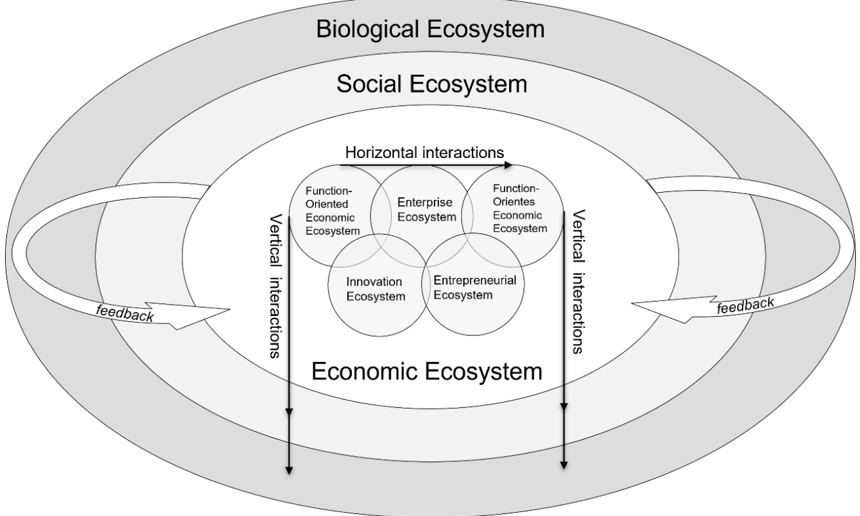
Framing economic systems as panarchically nested within social and biological ecosystems reveals their multilevel interdependencies ( 49, 142, 141, 150, 151 ). As illustrated in Fig. 1, these nested structures interact through cross-scale feedback loops and structural couplings. The economy depends not only on continuous biophysical throughput ( 144-154 ), but also co-produces social configurations that shape systemic resilience and influence long-term sustainability ( 149 ).
Figure 1 | Panarchic Integration Framework of Economic, Social, and Biological Ecosystems. Source: Author's own elaboration.
<details>
<summary>Image 1 Details</summary>
### Visual Description
## Ecosystem Diagram: Nested Ecosystems
### Overview
The image is a diagram illustrating nested ecosystems, with the economic ecosystem at the core, surrounded by social and biological ecosystems. The diagram shows interactions between these ecosystems, including horizontal, vertical, and feedback loops.
### Components/Axes
* **Ecosystem Layers (from outermost to innermost):**
* Biological Ecosystem
* Social Ecosystem
* Economic Ecosystem
* **Inner Ecosystem Components (within the Economic Ecosystem):**
* Function-Oriented Economic Ecosystem
* Enterprise Ecosystem
* Function-Oriented Economic Ecosystem (appears twice, mirrored)
* Innovation Ecosystem
* Entrepreneurial Ecosystem
* **Interactions:**
* Horizontal interactions (between the inner ecosystem components)
* Vertical interactions (between the Economic Ecosystem and the outer layers)
* Feedback (loops connecting the outer layers back to the Economic Ecosystem)
### Detailed Analysis or ### Content Details
* **Biological Ecosystem:** The outermost layer, representing the natural environment.
* **Social Ecosystem:** The middle layer, representing societal structures and relationships.
* **Economic Ecosystem:** The innermost layer, representing economic activities and interactions.
* **Inner Ecosystem Components:**
* **Function-Oriented Economic Ecosystem:** Located on the top-left and top-right, partially overlapping with the Enterprise Ecosystem.
* **Enterprise Ecosystem:** Located at the top-center, overlapping with both Function-Oriented Economic Ecosystems, Innovation Ecosystem, and Entrepreneurial Ecosystem.
* **Innovation Ecosystem:** Located on the bottom-left, overlapping with the Enterprise Ecosystem and Entrepreneurial Ecosystem.
* **Entrepreneurial Ecosystem:** Located on the bottom-right, overlapping with the Enterprise Ecosystem and Innovation Ecosystem.
* **Interactions:**
* **Horizontal interactions:** Represented by a double-headed arrow above the inner ecosystem components, indicating interactions between them.
* **Vertical interactions:** Represented by downward arrows on the left and right sides, indicating the influence of the Economic Ecosystem on the outer layers.
* **Feedback:** Represented by curved arrows on the left and right sides, indicating the influence of the outer layers back on the Economic Ecosystem.
### Key Observations
* The diagram emphasizes the interconnectedness of the biological, social, and economic ecosystems.
* The Economic Ecosystem is further broken down into several components, highlighting the complexity of economic activity.
* The diagram illustrates the flow of influence between the different ecosystems, with both vertical and feedback loops.
### Interpretation
The diagram illustrates a systems-thinking approach to understanding ecosystems. It suggests that economic activity is embedded within social and biological contexts, and that these contexts influence and are influenced by economic activity. The horizontal interactions within the Economic Ecosystem highlight the importance of collaboration and competition between different economic actors. The vertical interactions and feedback loops emphasize the need for sustainable economic practices that take into account the impact on the social and biological environments. The diagram suggests that a healthy and sustainable economy requires a holistic approach that considers the interconnectedness of all these ecosystems.
</details>
The diagram illustrates the hierarchical embedding of economic ecosystems within broader social and biological ecosystems, reflecting a panarchic structure. Vertical interactions represent cross-level dependencies, while horizontal interactions capture dynamic feedbacks across economic sub-ecosystems (enterprise, innovation, entrepreneurial, and function-oriented ecosystems). The framework emphasizes the systemic interdependence underlying economic dynamics as embedded real subsystems within adaptive complex systems.
Traditional economic theory frames externalities as market failures-anomalies external to the price mechanism ( 155-157 ). Yet from a complexity perspective-and when viewed through a panarchic lensthese are not anomalies but emergent phenomena arising from dynamic interactions within and across nested systems. Environmental degradation, for instance, is not merely an unpriced cost but a cumulative effect of non-beneficial systemic interactions ( 158-160 ). Likewise, market concentration and inequality are not deviations from ideal structures, but structural symptoms of competitive dynamics that erode diversity and disrupt systemic equilibrium ( 18, 20, 161 ).
## Unmasking the Illusion of Mutualism
One reason such failures persist is the enduring belief that market exchange inherently produces mutual benefit. Early classical economists framed voluntary exchange as a cooperative mechanism aligned with the public good ( 1, 162, 163 ), and this assumption became foundational in mainstream economic thought. Friedman ( 3 ) later reinforced this logic, claiming that unrestricted individual gain would naturally translate into social welfare. A similar notion emerged in evolutionary theory through the concept of Evolutionarily Stable Strategies (ESS) ( 164, 165 ), which posits that under certain conditions, self-interested behavior can generate system-level equilibrium.
However, such conditions are rarely met in real-world economies. Mainstream capitalism, increasingly equating competition with mutual benefit ( 3, 5 ), institutionalizes structurally non-beneficial interactionsfrom financialization and rent extraction ( 164 ) to platform monopolies ( 20 ) and systemic power concentration ( 14 ). What is framed as mutualism, in structural terms, often manifests as predation, parasitism, or destructive competition.
## A formula for ecosystemic equilibrium
As presented earlier, empirical studies show that beneficial interactions account for the majority of relationships in resilient biological systems-often exceeding 70% (118, 120, 121, 126, 127). In contrast, the dominance of non-beneficial interactions-particularly sustained competition-leads to reduced diversity, monopolization, and the collapse of ecosystemic equilibrium (121, 130-133). These patterns are mirrored in economic systems, where non-beneficial behaviors increasingly shape market dynamics (18, 20, 166, 167).
We propose a theoretical model to assess the ecosystemic equilibrium of an economic system:
Where:
$$E = \frac { \alpha _ { B } \cdot R _ { B } \cdot D } { \alpha _ { N } \cdot R _ { N } }$$
- RB : Sum of beneficial relationships.
- RN : Sum of non-beneficial relationships.
- αB : Intensity coefficient of beneficial relationships.
- αN : Intensity coefficient of non-beneficial relationships.
- D : Diversity index of the ecosystem.
E > 1 indicates systemic equilibrium; E < 1 indicates fragility. This framework builds on ecological models where stability emerges from the predominance of beneficial interactions and diversity ( 72, 73, 114-117, 168 ). It enables diagnostic use in policy, market assessment, and organizational strategy.
Parameter estimation can leverage network mapping, agent-based modeling, and survey-based indices of cooperation or conflict ( 15 , 70 ). Future work may simulate thresholds under different RB/RN dynamics using computational ecosystems.
This model is not intended to predict system behavior but to describe structural conditions that favor ecosystemic equilibrium. It offers a diagnostic tool for assessing the balance of beneficial and nonbeneficial interactions within a given system, rather than a deterministic equation of outcomes.
## Conclusion: from competitive collapse to ecosystemic equilubrium
This work extends ecological interaction typologies into the realm of economics, demonstrating that economic ecosystems are not metaphorical constructs but real complex adaptive systems-structurally isomorphic with biological and social ecosystems. This structural equivalence enables a reconceptualization of systemic dynamics often overlooked in conventional economic models, especially those involving feedback, resilience, and emergence.
As shown throughout this study, economic systems function as nested subsystems within broader social and biological ecosystems. Within this panarchic architecture, and by theoretical extension, competition must be reclassified-not as a beneficial force, but as a non-beneficial interaction due to its long-term effects. Empirical evidence confirms that competitive dynamics lead to exclusion, concentration, and depletion-undermining ecosystemic equilibrium, social cohesion, and environmental resilience. While competition may persist as a natural interaction, its role in economic, business, and policy frameworks must be constrained and subordinated to systemic resilience.
This is not a normative stance, but a systemic one: resilient ecosystems are dominated by beneficial interactions such as mutualism, cooperation, and facilitation. These interactions enhance adaptability and robustness, while competitive dominance correlates with fragility and collapse.
Reframing economies as ecologically embedded systems clarifies the origins of many so-called 'market failures.' From a complexity perspective, these are not anomalies but emergent consequences of structurally unbalanced interaction patterns propagating across nested ecosystems.
To support this reconceptualization, we have proposed a theoretical model of ecosystemic equilibrium. By assessing the ratio and intensity of beneficial versus non-beneficial interactions, along with system diversity, this framework enables structural diagnostics of resilience and fragility. While preliminary, the model offers a foundation for future empirical research-ranging from agent-based simulations to network mapping and firm-level assessments.
The implications extend beyond theory. Institutional design and public policy must shift away from fostering competition for short-term performance under equilibrium assumptions, and instead promote conditions that enable beneficial mechanisms, distributed agency, and long-term systemic resilience. Where competition persists, it should be strictly bounded and subordinated to the preservation of ecosystemic equilibrium.
Ultimately, this framework challenges the foundations of competition-centered economic thought. It redefines economic systems as ecologically embedded, socially interdependent, and structurally adaptive ecosystems-where sustainability is not an externality, but a function of design. In doing so, it opens a pathway toward economic models capable of supporting resilience, equity, and ecosystemic equilibrium.
## Reference
1. Smith, A. An Inquiry into the Nature and Causes of the Wealth of Nations: Volume One. (W. Strahan and T. Cadell, London, 1776). http://hdl.handle.net/1842/1455
2. Schumpeter, A. Capitalism, Socialism, and Democracy. (Univ. of Illinois at Urbana-Champaign, Academy for Entrepreneurial Leadership, Historical Research Reference in Entrepreneurship, 1942). https://ssrn.com/abstract=1496200
3. Friedman, M. Capitalism and Freedom. (University of Chicago Press, 1962).
4. Becker, G. S. The Economic Approach to Human Behavior. (University of Chicago Press, 1976).
5. Porter, M. E. Competitive Advantage: Creating and Sustaining Superior Performance. (Simon and Schuster, 2008).
6. Cowen, T. Creative Destruction: How Globalization Is Changing the World's Cultures. (Princeton Univ. Press, 2002). https://doi.org/10.1515/9781400825189
7. Mankiw, N. G. & Taylor, M. P. Economics. (Cengage Learning EMEA, 2020).
8. Arthur, W. B. Foundations of complexity economics. Nat. Rev. Phys. 3 , 136-145 (2021). https://doi.org/10.1038/s42254-020-00273-3
9. Barro, R. J. Economic growth in a cross section of countries. Q. J. Econ. 106 , 407-443 (1991). https://doi.org/10.2307/2937943
10. Brandtner, C. & Bromley, P. Neoliberal governance, evaluations, and the rise of win-win ideology in corporate responsibility discourse, 1960-2010. Socio-Econ. Rev. 20 , 1933-1960 (2022). https://doi.org/10.1093/ser/mwab001
11. Jelinek, M. & Porter, M. E. The competitive advantage of nations. Adm. Sci. Q. 37 , 507 (1990). https://doi.org/10.2307/2393460
12. Harvey, D. A Brief History of Neoliberalism. (Oxford Univ. Press, 2007).
13. Kettunen, K., Alajoutsijärvi, K., Hunnes, J. A. & Pinheiro, R. Emergence and early institutionalization of competition in higher education: Evidence from Finnish business schools. Tert. Educ. Manag. 29 , 365-389 (2023). https://doi.org/10.1007/s11233-022-09104-9
14. Stern, N. & Stiglitz, J. E. Climate change and growth. Ind. Corp. Change 32 , 277-303 (2023). https://doi.org/10.1093/icc/dtad008
15. Battiston, J. D. Farmer, A. Flache, D. Garlaschelli, A. G. Haldane, H. Heesterbeek, C. H. Hommes, C. C. Jaeger, R. M. May, M. Scheffer, Complexity theory and financial regulation. Science 351 , 818-819 (2016). https://doi.org/10.1126/science.aad0299
16. Kenter, J. O., Martino, S., Buckton, S. J., Waddock, S., Agarwal, B., Anger-Kraavi, A. et al. Ten principles for transforming economics in a time of global crises. Nat. Sustain. (2025). https://doi.org/10.1038/s41893-025-01562-4
17. Hickel, J., Kallis, G., Jackson, T., O'Neill, D. W. & Schor, J. B. Degrowth can work - here's how science can help. Nature 612 , 400-403 (2022). https://doi.org/10.1038/d41586-022-04412-x
18. Piketty, T., Yang, L. & Zucman, G. Capital accumulation, private property, and rising inequality in China, 1978-2015. Am. Econ. Rev. 109 , 2469-2496 (2019). https://doi.org/10.1257/aer.20170973
19. Furman, J. & Orszag, P. A firm-level perspective on the role of rents in the rise in inequality. In Toward a Just Society: Joseph Stiglitz and Twenty-First Century Economics (ed. Guzman, M.) 19-47 (Columbia Univ. Press, 2018).
20. Autor, D., Dorn, D., Katz, L. F., Patterson, C. & Van Reenen, J. The fall of the labor share and the rise of superstar firms. Q. J. Econ. 135 , 645-709 (2020). https://doi.org/10.1093/qje/qjaa004
21. Case, A. & Deaton, A. Deaths of Despair and the Future of Capitalism. (Princeton Univ. Press, 2021).
22. von Foerster, H. Observing Systems. (Intersystems Publications, 1981).
23. Bunge, M. Treatise on Basic Philosophy: Ontology II -A World of Systems. Vol. 4 (Springer, 2012).
24. Cartwright, N. & Hardie, J. Evidence-Based Policy: A Practical Guide to Doing It Better. (Oxford Univ. Press, 2012). https://doi.org/10.1093/acprof:osobl/9780199841608.001.0001
25. De Loecker, J., Eeckhout, J. & Unger, G. The rise of market power and the macroeconomic implications. Q. J. Econ. 135 , 561 -644 (2020). https://doi.org/10.1093/qje/qjz041
26. Hale, K. R., Valdovinos, F. S. & Martinez, N. D. Mutualism increases diversity, stability, and function of multiplex networks that integrate pollinators into food webs. Nat. Commun. 11 , 2182 (2020). https://doi.org/10.1038/s41467-020-15688-w
27. Dosi, G., Freeman, R. B., Pereira, M. C., Roventini, A., Virgillito, M. E. et al. The impact of deunionization on the growth and dispersion of productivity and pay. Ind. Corp. Change 30 , 377408 (2021). https://doi.org/10.1093/icc/dtaa025
28. Foster, J. From simplistic to complex systems in economics. Camb. J. Econ. 29 , 873-892 (2005). https://doi.org/10.1093/CJE/BEI083
29. Stojkoski, V., Koch, P. & Hidalgo, C. A. Multidimensional economic complexity and inclusive green growth. Commun. Earth Environ. 4 , 130 (2023). https://doi.org/10.1038/s43247-023-007700
30. Arthur, W. B., Beinhocker, E. D. & Stranger, A. Complexity economics: An introduction. In Complexity Economics: Proceedings of the Santa Fe Institute Fall Symposium 2020 (ed. SFI Press) 13-25 (SFI Press, 2020)
31. Meadows, D. H. Thinking in Systems: A Primer. (Chelsea Green Publishing, 2008)
32. Farmer, J. D. & Foley, D. The economy needs agent-based modelling. Nature 460 , 685-686 (2009). https://doi.org/10.1038/460685a
33. Gallegati, M. & Gallegati, S. Why does economics need complexity? Soft Comput. 29 , 30633072 (2025). https://doi.org/10.1007/s00500-025-10548-5
34. Bunge, M. Science, Its Method and Its Philosophy. (Siglo XXI, 1978).
35. Popper, K. The poverty of historicism, I. Economica 11 , 86-103 (1944). https://doi.org/10.2307/2549642
36. Bunge, M. Development and the environment. In Philosophy of Science and the Environment (ed. Andersson, S.) 285-304 (Springer Netherlands, 1989). https://doi.org/10.1007/978-94-009-2597-7\_19
37. Mahner, M. Mario Bunge (1919-2020): Conjoining philosophy of science and scientific philosophy. J. Gen. Philos. Sci. 52 , 3-23 (2021). https://doi.org/10.1007/s10838-021-09553-7
38. Sanchis i Marco, M. The Poverty of Economics: The Philosophical Anatomy of an Empty Rationality. (Springer, 2024).
39. Moore, J. F. Predators and prey: A new ecology of competition. Harv. Bus. Rev. 71 , 75 -86 (1993).
40. Cohen, B. Sustainable valley entrepreneurial ecosystems. Bus. Strateg. Environ. 15 , 1-14 (2006). https://doi.org/10.1002/bse.428
41. Autio, E. & Thomas, L. Innovation ecosystems. In The Oxford Handbook of Innovation Management (eds. Dodgson, M., Gann, D. M. & Phillips, N.) 204-288 (Oxford Univ. Press, 2014). https://doi.org/10.1093/oxfordhb/9780199694945.013.012
42. Hoffecker, E. Understanding Innovation Ecosystems: A Model for Joint Analysis and Action. (MIT D-Lab, 2019).
43. Fernandes, A. J. & Ferreira, J. J. Entrepreneurial ecosystems and networks: A literature review and research agenda. Rev. Manag. Sci. 16 , 189-247 (2022). https://doi.org/10.1007/s11846-02000437-6
44. Ghasempour, D., Feyzbakhsh, S. A. & Arabshahi, S. Metaphors and entrepreneurship: Points of view, goals and future research questions. Entrepreneursh. Reg. Dev. 37 , 521-548 (2024). https://doi.org/10.1080/08985626.2024.2430464
45. Kropotkin, P. A. Mutual Aid: A Factor of Evolution. (McClure Phillips and Company, 1902).
46. Henrich, J. & Muthukrishna, M. The origins and psychology of human cooperation. Annu. Rev. Psychol. 72 , 207-240 (2021). https://doi.org/10.1146/annurev-psych-081920-042106
47. Fewell, J. H. & Bronstein, J. L. Mutualism and division of labour: A mutual expansion of concepts. Philos. Trans. R. Soc. B 380 , 20230266 (2025). https://doi.org/10.1098/rstb.2023.0266
48. Levin, S. Ecosystems and the biosphere as complex adaptive systems. Ecosystems 1 , 431-436 (1998). https://doi.org/10.1007/s100219900037
49. Holling, C. S. Understanding the complexity of economic, ecological, and social systems. Ecosystems 4 , 390-405 (2001). https://doi.org/10.1007/s10021-001-0101-5
50. Rybski, D. & González, M. C. Cities as complex systems-Collection overview. PLoS One 17 , e0262964 (2022). https://doi.org/10.1371/journal.pone.0262964.
51. Dentoni, D., Pinkse, J. & Lubberink, R. Linking sustainable business models to socio-ecological resilience through cross-sector partnerships: A complex adaptive systems view. Bus. Soc. 60 , 1216 -1252 (2020). https://doi.org/10.1177/0007650320935015
52. Liu, G. & Wu, M. Thermodynamic-based ecological scaling theory in urban metabolic framework: A review. Front. Environ. Sci. Eng. 19 , 4 (2025). https://doi.org/10.1007/s11783025-1924-8
53. Torres, L., Blevins, A. S., Bassett, D. & Eliassi-Rad, T. The why, how, and when of representations for complex systems. SIAM Rev. 63 , 435-485 (2021). https://doi.org/10.1137/20M1355896
54. Johnson, C. W. What are emergent properties and how do they affect the engineering of complex systems? Reliab. Eng. Syst. Saf. 91 , 1475-1481 (2006). https://doi.org/10.1016/j.ress.2006.01.008
55. Meena, C., Hens, C., Acharyya, S., Haber, S., Boccaletti, S. & Barzel, B. Emergent stability in complex network dynamics. Nature Phys. 19 , 1033-1042 (2023). https://doi.org/10.1038/s41567-023-02020-8
56. Estrada, E. What is a complex system, after all? Found. Sci. 29 , 1143-1170 (2024). https://doi.org/10.1007/s10699-023-09917-w
57. von Bertalanffy, L. General System Theory: Foundations, Development, Applications. (Braziller, 1973).
58. Wolf, Y., Katsnelson, M. & Koonin, E. Physical foundations of biological complexity. Proc. Natl. Acad. Sci. U.S.A. 115 , E8678-E8687 (2018). https://doi.org/10.1073/pnas.1807890115
59. Grewatsch, S., Kennedy, S. & Bansal, P. Tackling wicked problems in strategic management with systems thinking. Strategic Organ. 21 , 721-732 (2021). https://doi.org/10.1177/14761270211038635
60. Lorenz, E. N. Deterministic nonperiodic flow. J. Atmos. Sci. 20 , 130 -141 (1963). https://doi.org/10.1175/1520-0469(1963)020<0130:DNF>2.0.CO;2
61. Eckmann, J.-P. & Ruelle, D. Ergodic theory of chaos and strange attractors. Rev. Mod. Phys. 57 , 617-656 (1985). https://doi.org/10.1103/REVMODPHYS.57.617
62. Battiston, F., Amico, E., Barrat, A., Bianconi, G., Ferraz de Arruda, G., Franceschiello, B. et al. The physics of higher-order interactions in complex systems. Nat. Phys. 17 , 1093-1098 (2021). https://doi.org/10.1038/s41567-021-01371-4
63. May, R. M. Simple mathematical models with very complicated dynamics. Nature 261 , 459 -467 (1976). https://doi.org/10.1038/261459a0
64. Kauffman, S. A. The Origins of Order: Self-Organization and Selection in Evolution. (Oxford Univ. Press, 1993). https://doi.org/10.1142/9789814415743\_0003
65. Van Dorp, C. H., Simard, S. W. & Durall, D. M. Resilience of Rhizopogon-Douglas-fir mycorrhizal networks 25 years after selective logging. Mycorrhiza 30 , 467-474 (2020). https://doi.org/10.1007/s00572-020-00968-6
66. Morozov, A., Abbott, K. C., Petrovskii, S. & Rogers, T. Reactivity of complex communities can be more important than stability. Nat. Commun. 14 , 1234 (2023). https://doi.org/10.1038/s41467023-42580-0
67. Arthur, W. B. Increasing Returns and Path Dependence in the Economy. (University of Michigan Press, 2009). https://muse.jhu.edu/book/6343
68. Acemoglu, D., Aghion, P., Lelarge, C., Van Reenen, J. & Zilibotti, F. Technology, information, and the decentralization of the firm. Q. J. Econ. 122 , 1759-1799 (2007). https://doi.org/10.1162/qjec.2007.122.4.1759
69. Acemoglu, D., Ozdaglar, A. & Tahbaz-Salehi, A. Systemic risk and stability in financial networks. Am. Econ. Rev. 105 , 564-608 (2015). https://doi.org/10.1257/aer.20130456
70. Hidalgo, C. A. Economic complexity theory and applications. Nat. Rev. Phys. 3 , 92-113 (2021). https://doi.org/10.1038/s42254-020-00275-1
71. Hoffecker, E., Ramos, F., Adomdza, G. & Frey, D. Strengthening local innovation and entrepreneurial ecosystems. J. Entrep. 32 (2\_suppl), S89-S116 (2023). https://doi.org/10.1177/09713557231201179
72. Thorogood, R., Mustonen, V., Aleixo, A., Aphalo, P. J., Asiegbu, F. O., Cabeza, M. et al. Understanding and applying biological resilience, from genes to ecosystems. npj Biodivers. 2 , 16 (2023). https://doi.org/10.1038/s44185-023-00022-6
73. Hisano, M., Ghazoul, J., Chen, X. & Chen, H. Y. Functional diversity enhances dryland forest productivity under long-term climate change. Sci. Adv. 10 , eadn4152 (2024). https://doi.org/10.1126/sciadv.adn4152
74. Watts, D. J. & Strogatz, S. H. Collective dynamics of 'small-world' networks. Nature 393 , 440442 (1998). https://doi.org/10.1038/30918
75. Siegenfeld, A. F. & Bar-Yam, Y. An introduction to complex systems science and its applications. Complexity 2020 , 6105872 (2020). https://doi.org/10.1155/2020/6105872
76. Rosser, J. On the complexities of complex economic dynamics. J. Econ. Perspect. 13 , 169-192 (1999). https://doi.org/10.1257/JEP.13.4.169
77. Foster, J. Why is economics not a complex systems science? J. Econ. Issues 40 , 1069-1091 (2006). https://doi.org/10.1080/00213624.2006.11506975
78. Kirman, A. The economy as a complex system. In The Economy as a Complex System (eds. Wang, X., Di, Z. & Allen, P. M.) 1-16 (Springer, 2017). https://doi.org/10.1007/978-981-105705-2\_1
79. Hommes, C. Behavioral and experimental macroeconomics and policy analysis: A complex systems approach. J. Econ. Lit. 59 , 149-219 (2021). https://doi.org/10.1257/jel.20191434
80. Arrow, K. J. & Debreu, G. Existence of an equilibrium for a competitive economy. In The Foundations of Price Theory , V ol. 5, 289-316 (Routledge, 1954). https://doi.org/10.2307/1907353
81. Smets, F. & Wouters, R. Shocks and frictions in US business cycles: A Bayesian DSGE approach. Am. Econ. Rev. 97 , 586-606 (2007). https://doi.org/10.1257/aer.97.3.586
82. Kahneman, D. Maps of bounded rationality: Psychology for behavioral economics. Am. Econ. Rev. 93 , 1449-1475 (2003). https://doi.org/10.1257/000282803322655392
83. Osborne, M. J. & Rubinstein, A. A Course in Game Theory. (MIT Press, 1994).
84. Hodson, N., Powell, B. J., Nilsen, P. & Beidas, R. S. How can a behavioral economics lens contribute to implementation science? Implement. Sci. 19 , 33 (2024). https://doi.org/10.1186/s13012-024-01362-y
85. Galla, T. & Farmer, J. D. Complex dynamics in learning complicated games. Proc. Natl. Acad. Sci. U.S.A. 110 , 1232-1236 (2013). https://doi.org/10.1073/pnas.1109672110
86. Brzoza-Brzezina, M. & Suda, J. Are DSGE models irreparably flawed? Bank i Kredyt 52 , 227252 (2021).
87. Kaplan, G., Moll, B. & Violante, G. L. Monetary policy according to HANK. Am. Econ. Rev. 108 , 697-743 (2018). https://doi.org/10.1257/aer.20160042
88. Eggertsson, G. B., Mehrotra, N. R. & Robbins, J. A. A model of secular stagnation: theory and quantitative evaluation. Am. Econ. J. Macroecon. 11 , 1-48 (2019). https://doi.org/10.1257/mac.20170367
89. Podkaminer, L. Dynamic stochastic general equilibrium: macroeconomics at a dead end. Bank i Kredyt 52 , 97-122 (2021).
90. Storm, S. Cordon of conformity: why DSGE models are not the future of macroeconomics. Int. J. Polit. Econ. 50 , 77-98 (2021). https://doi.org/10.1080/08911916.2021.1929582
91. Wren-Lewis, S. Ending the microfoundations hegemony. Oxf. Rev. Econ. Policy 34 , 55-69 (2018). https://doi.org/10.1093/oxrep/grx054
92. Nicolescu, B. Manifesto of Transdisciplinarity. (Suny Press, 2002).
93. Pohl, C. & Hadorn, G. H. Principles for Designing Transdisciplinary Research. (Oekom Verlag, 2007).
94. Moore, J. F. Business ecosystems and the view from the firm. Antitrust Bull. 51 , 31 -75 (2006). https://doi.org/10.1177/0003603X0605100103
95. Isenberg, D. J. How to start an entrepreneurial revolution. Harv. Bus. Rev. 88 , 40-50 (2010).
96. Schmutzler, J., Pugh, R. & Tsvetkova, A. Introduction to Entrepreneurial Ecosystems Meet Innovation Systems: Synergies, policy lessons and overlooked dimensions. In Entrepreneurial Ecosystems Meet Innovation Systems (2020). https://doi.org/10.4337/9781789901184.00010
97. Ghazinoory, S., Phillips, F., Afshari-Mofrad, M. & Bigdelou, N. Innovation lives in ecotones, not ecosystems. J. Bus. Res. 135 , 572-580 (2021). https://doi.org/10.1016/J.JBUSRES.2021.06.067
98. Adner, R. Ecosystem as structure: An actionable construct for strategy. J. Manag. 43 , 39-58 (2017). https://doi.org/10.1177/014920631667
99. Fredin, S. & Lidén, A. Entrepreneurial ecosystems: towards a systemic approach to entrepreneurship? Geogr. Tidsskr. 120 , 87-97 (2020). https://doi.org/10.1080/00167223.2020.1769491
100. Daniel, L. J., de Villiers Scheepers, M. J., Miles, M. P. & de Klerk, S. Understanding entrepreneurial ecosystems using complex adaptive systems theory: Getting the big picture for economic development, practice, and policy. Entrep. Reg. Dev. 34 , 911-934 (2022). https://doi.org/10.1080/08985626.2022.2083691
101. Alvedalen, J. & Boschma, R. A critical review of entrepreneurial ecosystems research: towards a future research agenda. Eur. Plan. Stud. 25 , 887-903 (2017). https://doi.org/10.1080/09654313.2017.1299694
102. Stam, E. & Ven, A. Entrepreneurial ecosystem elements. Small Bus. Econ. 56 , 809-832 (2019). https://doi.org/10.1007/s11187-019-00270-6
103. Harper, D. Economy. Online Etymology Dictionary (2023). https://www.etymonline.com/search?q=economy
104. Odum, E. P. Fundamentals of Ecology. (W.B. Saunders Company, 1971).
105. F. S. Chapin III, Principles of Terrestrial Ecosystem Ecology , 2nd ed. (Springer, New York, 2011).
106. F. Jordán, I. Scheuring, Network ecology: topological constraints on ecosystem dynamics. Phys. Life Rev. 1 , 139-172 (2004). https://doi.org/10.1016/j.plrev.2004.08.001
107. É. Filotas, L. Parrott, P. Burton, R. Chazdon, K. Coates, L. Coll, S. Haeussler, K. Martin, S. Nocentini, K. Puettmann, F. Putz, S. Simard, C. Messier, Viewing forests through the lens of complex systems science. Ecosphere 5 , 1-23 (2014). https://doi.org/10.1890/ES13-00182.1
108. I. Donohue, H. Hillebrand, J. M. Montoya, O. L. Petchey, S. L. Pimm, M. S. Fowler, et al. , Navigating the complexity of ecological stability. Ecol. Lett. 19 , 1172-1185 (2016). https://doi.org/10.1111/ele.12648
109. Odum, E. P. Fundamentals of Ecology. (W.B. Saunders Company, 1971).
110. Barbier, M., Arnoldi, J., Bunin, G. & Loreau, M. Generic assembly patterns in complex ecological communities. Proc. Natl. Acad. Sci. U.S.A. 115 , 2156-2161 (2018). https://doi.org/10.1073/pnas.1710352115
111. Dakos, V. & Kéfi, S. Ecological resilience: what to measure and how. Environ. Res. Lett. 17 , 043003 (2022). https://doi.org/10.1088/1748-9326/ac5767
112. Arani, B. M., Carpenter, S. R., Lahti, L., Van Nes, E. H. & Scheffer, M. Exit time as a measure of ecological resilience. Science 372 , eaay4895 (2021). https://doi.org/10.1126/science.aay4895
113. Smith, T., Traxl, D. & Boers, N. Empirical evidence for recent global shifts in vegetation resilience. Nat. Clim. Chang. 12 , 477-484 (2022). https://doi.org/10.1038/s41558-022-01352-2
114. Mumby, P., Chollett, I., Bozec, Y. & Wolff, N. Ecological resilience, robustness and vulnerability: how do these concepts benefit ecosystem management? Curr. Opin. Environ. Sustain. 7 , 22-27 (2014). https://doi.org/10.1016/J.COSUST.2013.11.021
115. Oliver, T. H., Heard, M. S., Isaac, N. J., Roy, D. B., Procter, D., Eigenbrod, F. et al. Biodiversity and resilience of ecosystem functions. Trends Ecol. Evol. 30 , 673-684 (2015). https://doi.org/10.1016/j.tree.2015.08.009
116. Seidl, R., Spies, T., Peterson, D., Stephens, S. & Hicke, J. Searching for resilience: addressing the impacts of changing disturbance regimes on forest ecosystem services. J. Appl. Ecol. 53 , 120-129 (2016). https://doi.org/10.1111/1365-2664.12511
117. Mori, A., Lertzman, K. & Gustafsson, L. Biodiversity and ecosystem services in forest ecosystems: a research agenda for applied forest ecology. J. Appl. Ecol. 54 , 12-27 (2017). https://doi.org/10.1111/1365-2664.12669
118. Bruno, B., Faggini, M. & Parziale, A. Complexity modelling in economics: the state of the art. Econ. Thought 5 , 29-43 (2016). https://doi.org/10.1016/s0169-5347(02)00045-9
119. Callaway, R. M. Positive Interactions and Interdependence in Plant Communities. (Springer, Dordrecht, 2007). https://doi.org/10.1007/978-1-4020-6224-7
120. Nowak, M. A. Five rules for the evolution of cooperation. Science 314 , 1560-1563 (2006). https://doi.org/10.1126/science.1133755
121. Zeng, Y. & Wiens, J. J. Species interactions have predictable impacts on diversification. Ecol. Lett. 24 , 239-248 (2021). https://doi.org/10.1111/ele.13635
122. Sher, A. & Molles, M. Ecology: Concepts and Applications. 9th ed. (McGraw-Hill Education, 2024).
123. Hector, A., Joshi, J., Scherer-Lorenzen, M., Schmid, B., Spehn, E. M., Wacker, L. et al. Biodiversity and ecosystem functioning: reconciling the results of experimental and observational studies. Funct. Ecol. 998-1002 (2007). http://www.jstor.org/stable/4540110
124. Timpane-Padgham, B., Beechie, T. & Klinger, T. A systematic review of ecological attributes that confer resilience to climate change in environmental restoration. PLoS ONE 12 , e0173812 (2017). https://doi.org/10.1371/journal.pone.0173812
125. Elmqvist, T., Maltby, E., Barker, T., Mortimer, M., Perrings, C., Aronson, J. et al. Biodiversity, ecosystems and ecosystem services. In The Economics of Ecosystems and Biodiversity: Ecological and Economic Foundations , 41-111 (Routledge, 2011). https://doi.org/10.4324/9781849775489
126. Bascompte, J. & Jordano, P. Plant-animal mutualistic networks: the architecture of biodiversity. Annu. Rev. Ecol. Evol. Syst. 38 , 567-593 (2007). https://doi.org/10.1146/annurev.ecolsys.38.091206.095818
127. Mougi, A. & Kondoh, M. Diversity of interaction types and ecological community stability. Science 337 , 349-351 (2012). https://doi.org/10.1126/science.1220529
128. Paine, R. T. Food web complexity and species diversity. Am. Nat. 100 , 65-75 (1966). https://doi.org/10.1186/s40793-025-00688-4
129. Estes, J. A., Terborgh, J., Brashares, J. S., Power, M. E., Berger, J., Bond, W. J. et al. Trophic downgrading of planet Earth. Science 333 , 301-306 (2011). https://doi.org/10.1126/science.1205106
130. Thébault, E. & Fontaine, C. Stability of ecological communities and the architecture of mutualistic and trophic networks. Science 329 , 853 -856 (2010). https://doi.org/10.1126/science.1188321
131. May, R. M. Stability and Complexity in Model Ecosystems. (Princeton Univ. Press, 2001). https://doi.org/10.1515/9780691206912
132. Landi, P., Minoarivelo, H. O., Brännström, Å., Hui, C. & Dieckmann, U. Complexity and stability of ecological networks: a review of the theory. Popul. Ecol. 60 , 319-345 (2018). https://doi.org/10.1007/s10144-018-0628-3
133. Yonatan, Y., Amit, G., Friedman, J. & Bashan, A. Complexity-stability trade-off in empirical microbial ecosystems. Nat. Ecol. Evol. 6 , 693-700 (2022). https://doi.org/10.1038/s41559-02201745-8
134. Arthur, W. B. Complexity and the economy. In Handbook of Research on Complexity (Edward Elgar Publishing, Cheltenham, UK, 2009), chap. 2. https://doi.org/10.4337/9781781952665.00007
135. Martin, R. The local geographies of the financial crisis: from the housing bubble to economic recession and beyond. J. Econ. Geogr. 11 , 587-618 (2011). https://doi.org/10.1093/jeg/lbq024
136. Song, S. & Li, H. Early warning signals for stock market crashes: Empirical and analytical insights utilizing nonlinear methods. EPJ Data Sci. 13 , 16 (2024). https://doi.org/10.1140/epjds/s13688-024-00457-2
137. Tesfatsion, L. & Judd, K. L., Eds. Handbook of Computational Economics: Agent-Based Computational Economics. Vol. 2 (Elsevier, 2006). https://www.sciencedirect.com/handbook/handbook-of-computational-economics/vol/2/suppl/C
138. Gomes, O. & Gubareva, M. Complex systems in economics and where to find them. J. Syst. Sci. Complex. 34 , 314-338 (2021). https://doi.org/10.1007/s11424-020-9149-1
139. Ritala, P. & Almpanopoulou, A. In defense of 'eco' in innovation ecosystem. Technovation 60 , 39 -42 (2017). https://doi.org/10.1016/j.technovation.2017.01.004
140. Spigel, B. The relational organization of entrepreneurial ecosystems. Entrepreneurship Theory and Practice 41 , 49-72 (2017). https://doi.org/10.1111/etap.12167
141. Hall, C. A. S. & Klitgaard, K. A. Energy and the Wealth of Nations: An Introduction to Biophysical Economics. 2nd ed. (Springer, 2018). https://doi.org/10.1007/978-3-319-66219-0
142. Spash, C. L. A tale of three paradigms: Realising the revolutionary potential of ecological economics. Ecol. Econ. 169 , 106518 (2020). https://doi.org/10.1016/j.ecolecon.2019.106518
143. Mobus, G. E. The human social system economy as subsystem: A preliminary analysis. In Systems Science: Theory, Analysis, Modeling, and Design (Springer, Cham, 2022). https://doi.org/10.1007/978-3-030-93482-8\_9
144. Moore, F. C., Lacasse, K., Mach, K. J., Shin, Y. A., Gross, L. J., Beckage, B. et al. Determinants of emissions pathways in the coupled climate-social system. Nature 603 , 103-111 (2022). https://doi.org/10.1038/s41586-022-04423-8
145. Auerswald, P. E. & Dani, L. Economic ecosystems. In The New Oxford Handbook of Economic Geography (eds. Clark, G. L., Feldman, M. P., Gertler, M. S. & Wójcik, D.) chap. 13 (Oxford Univ. Press, 2017). https://ssrn.com/abstract=3494495
146. Wiedenhofer, D., Fishman, T., Lauk, C., Haas, W. & Krausmann, F. Integrating material stock dynamics into economy-wide material flow accounting: concepts, modelling, and global application for 1900-2050. Ecol. Econ. 156 , 121-133 (2019). https://doi.org/10.1016/j.ecolecon.2018.09.010
147. Kremen, C. Managing ecosystem services: what do we need to know about their ecology? Ecol. Lett. 8 , 468-479 (2005). https://doi.org/10.1111/j.1461-0248.2005.00751.x
148. Wainaina, S., Awasthi, M., Sarsaiya, S., Chen, H., Singh, E. & Taherzadeh, M. Resource recovery and circular economy from organic solid waste using aerobic and anaerobic digestion technologies. Bioresour. Technol. 122778 (2020). https://doi.org/10.1016/j.biortech.2020.122778
149. Stiglitz, J. E. Inequality and economic growth. Polit. Q. 86 , 134-155 (2015). https://doi.org/10.1111/1467-923X.12237
150. Folke, C. Social-ecological systems and adaptive governance of the commons. Ecol. Res. 22 , 14-15 (2007). https://doi.org/10.1007/s11284-006-0074-0
151. Sundstrom, S. M., Angeler, D. G., Bell, J., Hayes, M., Hodbod, J., Jalalzadeh-Fard, B. et al. Panarchy theory for convergence. Sustain. Sci. 18 , 1667-1682 (2023). https://doi.org/10.1007/s11625-023-01299-z
152. Georgescu-Roegen, N. The entropy law and the economic process in retrospect. East. Econ. J. 12 , 3-25 (1986). http://www.jstor.org/stable/40357380
153. Daly, H. E. & Farley, J. Ecological Economics: Principles and Applications. (Island Press, 2011).
154. Haberl, H., Wiedenhofer, D., Pauliuk, S., Krausmann, F., Müller, D. B. & Fischer-Kowalski, M. Contributions of sociometabolic research to sustainability science. Nat. Sustain. 2 , 173-184 (2019). https://doi.org/10.1038/s41893-019-0225-2
155. Samuelson, P. A. & Nordhaus, W. D. Economics. 19th ed. (McGraw-Hill Education, 2010).
156. Mankiw, N. G., Kneebone, R. D. & McKenzie, K. J. Principles of Economics. 9th ed. (Cengage Learning, 2023).
157. Varian, H. R. & Melitz, M. Intermediate Microeconomics with Calculus: A Modern Approach. 2nd ed. (W. W. Norton & Company, 2024).
158. Coase, R. H. The problem of social cost. J. Law Econ. 56 , 837-877 (2013). https://doi.org/10.1086/674872
159. Nordhaus, W. D. Revisiting the social cost of carbon. Proc. Natl. Acad. Sci. U.S.A. 114 , 15181523 (2017). https://doi.org/10.1073/pnas.1609244114
160. Stern, N., Stiglitz, J. & Taylor, C. The economics of immense risk, urgent action and radical change: Towards new approaches to the economics of climate change. J. Econ. Methodol. 29 , 181-216 (2022). https://doi.org/10.1080/1350178X.2022.2040740
161. Stiglitz, J. E. Markets, market failures, and development. Am. Econ. Rev. 79 , 197-203 (1989). http://www.jstor.org/stable/1827756
162. Ricardo, D. On the Principles of Political Economy. (J. Murray, London, 1821).
163. Bastiat, F. Propriété et loi: justice et fraternité. (Guillaumin, 1848).
164. Smith, J. M. & Price, G. R. The logic of animal conflict. Nature 246 , 15-18 (1973). https://doi.org/10.1038/246015a0
165. Dawkins, R. In defence of selfish genes. Philosophy 56 , 556-573 (1981). https://doi.org/10.1017/S0031819100050580
166. Kuehnlenz, S., Andreoni, V. & Meyenburg, I. Capitalism and crises: A comparative analysis of mainstream and heterodox perceptions and related ethical considerations. Bus. Ethics Environ. Responsib. 32 (S1), 52-64 (2023). https://doi.org/10.1111/beer.12420
167. Clark, T. P. Degrowth or secular stagnation? The political economy of monopoly finance capital and the stagnation-accumulation treadmill. J. Environ. Stud. Sci. 15 , 19-34 (2025). https://doi.org/10.1007/s13412-024-00931-3
168. Liang, M., Yang, Q., Chase, J. M., Isbell, F., Loreau, M., Schmid, B. et al. Unifying spatial scaling laws of biodiversity and ecosystem stability. Science 387 , eadl2373 (2025). https://doi.org/10.1126/science.adl2373
Table 1. Methodological Composition of the Reviewed Literature
| Disciplinary Domain | Total Works | Foundational Works | Recent Articles | Landmark Works 2001-2018 | Selection Criteria |
|-------------------------------|---------------|----------------------|-------------------|----------------------------|----------------------------------------------------------------------|
| Biology and Ecology | 46 | 5 | 18 | 23 | Influence in the Field, Theoretical or Empirical Support, Citations. |
| Economic and Business Science | 75 | 16 | 36 | 23 | Influence in the Field, Theoretical or Empirical Support, Citations. |
| Complexity Sciences | 37 | 5 | 19 | 13 | Influence in the Field, Theoretical or Empirical Support, Citations. |
| Philosophy of Science | 10 | 5 | 3 | 2 | Influence in the Field, Theoretical or Empirical Support, Citations. |
Source: Own elaboration
Table 2. Typology of Ecosystem Interactions and Their Long-Term Effects
| Type of Interaction and Long-Term Effect | Type of Interaction | Interaction Sign (Effect-Based) | Description of the Effect on the Participants |
|--------------------------------------------|-----------------------|-----------------------------------|--------------------------------------------------------------------------------------------------------------------------------------------------------------|
| Beneficial | Mutualism | +/+ | All participating organisms benefit from the interaction, and none are harmed. It occurs between different species and involves a degree of interdependence. |
| | Cooperation | +/+ | All participating organisms benefit from the interaction, and none are harmed. It can occur within or between species and does not imply interdependence. |
| | Commensalism | +/0 | One or more organisms benefit from the interaction without negatively affecting any other. |
| | Facilitation | +/+/0 | One or more organisms modify the environment in ways that benefit others. |
| Non-Beneficial | Predation | +/- | One or more organisms benefit from the interaction while the others are harmed. |
| | Parasitism | +/- | One or more organisms benefit at the expense of others, which are harmed by the interaction. |
| | Amensalism | 0/- | One or more organisms are unaffected by the interaction, while others are harmed. |
| | Competition | -/- | All participants are negatively affected as they compete for limited resources. |
Source: Adapted by the authors from ecological interaction mechanisms (118-122).
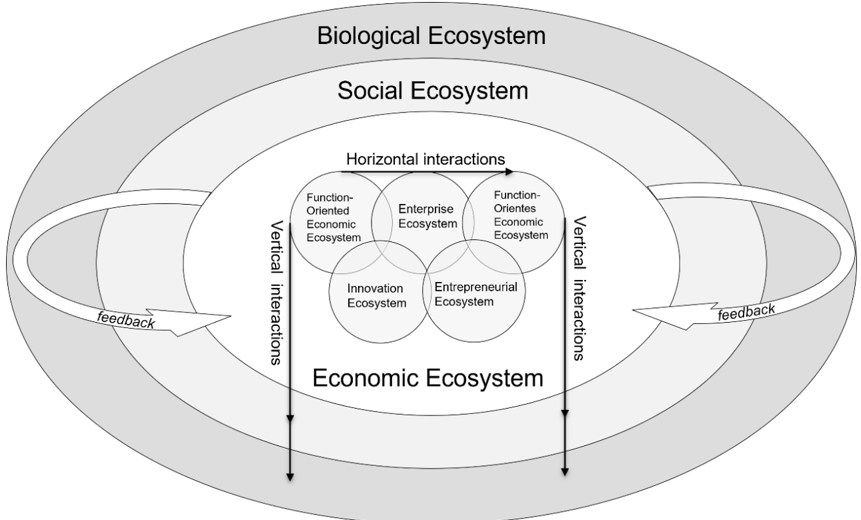
Figure 1 | Panarchic Integration Framework of Economic, Social, and Biological Ecosystems. Source: Author's own elaboration .
<details>
<summary>Image 2 Details</summary>
### Visual Description
## Ecosystem Interaction Diagram
### Overview
The image is a diagram illustrating the interactions within and between different types of ecosystems: Biological, Social, and Economic. The diagram uses concentric ovals to represent these ecosystems, with arrows indicating the flow of interactions and feedback loops.
### Components/Axes
* **Ecosystem Layers (from outermost to innermost):**
* Biological Ecosystem
* Social Ecosystem
* Economic Ecosystem
* **Inner Ecosystem Components (within the Economic Ecosystem):**
* Function-Oriented Economic Ecosystem (top-left)
* Enterprise Ecosystem (top-center)
* Function-Oriented Economic Ecosystem (top-right)
* Innovation Ecosystem (bottom-left)
* Entrepreneurial Ecosystem (bottom-right)
* **Interactions:**
* Horizontal interactions (between the inner ecosystem components)
* Vertical interactions (between the Economic Ecosystem and the outer layers)
* Feedback loops (connecting the outer layers back to the inner layers)
### Detailed Analysis
* **Ecosystem Layers:** The diagram depicts three nested ecosystems. The Biological Ecosystem is the outermost layer, followed by the Social Ecosystem, and finally the Economic Ecosystem at the center.
* **Inner Ecosystem Components:** Within the Economic Ecosystem, five interconnected components are shown. These components are arranged in a circular fashion, suggesting a network of relationships.
* **Function-Oriented Economic Ecosystem (top-left):** Located in the top-left quadrant.
* **Enterprise Ecosystem (top-center):** Positioned at the top-center, connecting the two Function-Oriented Ecosystems.
* **Function-Oriented Economic Ecosystem (top-right):** Located in the top-right quadrant.
* **Innovation Ecosystem (bottom-left):** Situated in the bottom-left quadrant.
* **Entrepreneurial Ecosystem (bottom-right):** Located in the bottom-right quadrant.
* **Interactions:**
* **Horizontal Interactions:** A double-headed arrow labeled "Horizontal interactions" connects the inner ecosystem components, indicating interactions and relationships between them.
* **Vertical Interactions:** Arrows labeled "Vertical interactions" point downwards from the inner ecosystem components to the Economic Ecosystem layer, suggesting a flow of influence or resources.
* **Feedback Loops:** Curved arrows labeled "feedback" originate from the outer layers (Biological and Social Ecosystems) and loop back towards the inner ecosystem components, indicating a feedback mechanism.
### Key Observations
* The diagram emphasizes the interconnectedness of different ecosystems and their components.
* The feedback loops suggest that the outer ecosystems influence the inner ecosystems, and vice versa.
* The horizontal interactions highlight the relationships between the different components within the Economic Ecosystem.
### Interpretation
The diagram illustrates a hierarchical and interconnected view of ecosystems, emphasizing the relationships between biological, social, and economic systems. The central Economic Ecosystem is composed of several interacting components (Function-Oriented, Enterprise, Innovation, and Entrepreneurial Ecosystems), which are influenced by the outer Social and Biological Ecosystems through vertical interactions and feedback loops. This suggests that economic activities are embedded within and dependent on broader social and biological contexts. The feedback loops indicate a dynamic system where changes in one ecosystem can affect the others, highlighting the importance of considering the broader context when analyzing or intervening in any specific ecosystem. The diagram suggests that a holistic approach is necessary for understanding and managing complex systems, considering the interactions and feedback loops between different components and layers.
</details>
The diagram illustrates the hierarchical embedding of economic ecosystems within broader social and biological ecosystems, reflecting a panarchic structure. Vertical interactions represent cross-level dependencies, while horizontal interactions capture dynamic feedbacks across economic sub-ecosystems (enterprise, innovation, entrepreneurial, and function-oriented ecosystems). The framework emphasizes the systemic interdependence underlying economic dynamics as embedded real subsystems within adaptive complex systems.