# AgentOrchestra: Orchestrating Multi-Agent Intelligence with the Tool-Environment-Agent(TEA) Protocol
**Authors**:
- Wentao Zhang
- Liang Zeng
- Yuzhen Xiao
- Yongcong Li
- Ce Cui
- Yilei Zhao
- Rui Hu
- Yang Liu
- Yahui Zhou
- Bo An (Skywork AI Nanyang Technological University)
## Abstract
Recent advances in LLM-based agent systems have shown promise in tackling complex, long-horizon tasks. However, existing LLM-based agentprotocols (e.g., A2A and MCP) under-specify cross-entity lifecycle and context management, version tracking, and ad-hoc environment integration, which in turn encourages fixed, monolithic agent compositions and brittle glue code. To address these limitations, we introduce the Tool–Environment–Agent (TEA) protocol, a unified abstraction that models environments, agents, and tools as first-class resources with explicit lifecycles and versioned interfaces. TEA provides a principled foundation for end-to-end lifecycle and version management, and for associating each run with its context and outputs across components, improving traceability and reproducibility. Moreover, TEA enables continual self-evolution of agent-associated components Unless otherwise specified, agent-associated components include prompts, memory/tool/agent/environment code, and agent outputs (solutions). through a closed feedback loop, producing improved versions while supporting version selection and rollback. Building on TEA, we present AgentOrchestra, a hierarchical multi-agent framework in which a central planner orchestrates specialized sub-agents for web navigation, data analysis, and file operations, and supports continual adaptation by dynamically instantiating, retrieving, and refining tools online during execution. We evaluate AgentOrchestra on three challenging benchmarks, where it consistently outperforms strong baselines and achieves 89.04% on GAIA, establishing state-of-the-art performance to the best of our knowledge. Overall, our results provide evidence that TEA and hierarchical orchestration improve scalability and generality in multi-agent systems.
<details>
<summary>x2.png Details</summary>

### Visual Description
Icon/Small Image (32x33)
</details>
AgentOrchestra: Orchestrating Multi-Agent Intelligence with the Tool-Environment-Agent(TEA) Protocol
## 1 Introduction
Recent advances in LLM-based agent systems have enabled strong performance on both general-purpose and complex, long-horizon tasks across diverse domains, including web navigation (OpenAI, 2025b; Müller and Žunič, 2024), computer use (Anthropic, 2024a; Qin et al., 2025), code execution (Wang et al., 2024a), game playing (Wang et al., 2023; Tan et al., 2024), and research assistance (OpenAI, 2024; DeepMind, 2024; xAI, 2025). Despite this progress, cross-environment generalization remains limited because context is scattered across prompts and logs, environment integration relies on brittle glue code, and agent-associated components are typically fixed rather than feedback-driven self-evolution.
Additionally, current agent protocols fall short of serving as a general substrate for scalable, general-purpose agents. As summarized in Table 1, representative protocols such as Google’s A2A (Google, 2025) and Anthropic’s MCP (Anthropic, 2024b) provide important building blocks, including task-level collaboration and messaging in A2A, as well as tool and resource schemas, discovery, and invocation in MCP. However, three protocol-level gaps remain: i) Lifecycle and context management are fragmented, as neither standardizes unified primitives to manage lifecycles and maintain consistent, versioned execution context across agent-associated components; ii) Self-evolution is not supported at the protocol level, as both protocols largely treat prompts and resources as externally maintained assets, and do not define a closed loop to refine prompts or tools from execution feedback with traceable versioning; iii) Environments are not first-class, environments are delegated to application-specific runtimes instead of being managed components with clear boundaries and constraints. This makes it difficult to switch agents across environments, reuse environments, and isolate parallel runs, often reducing systems to glue-code orchestration.
Table 1: Comparison of TEA Protocol with A2A and MCP. Symbols: $\checkmark$ = Yes, $\triangle$ = Partial, $\times$ = No.
| Dimension | TEA | A2A | MCP |
| --- | --- | --- | --- |
| Core Entities | Tool, Env, Agent | Agent, Tool | Model |
| Lifecycle & Version | $\checkmark$ | $\times$ | $\times$ |
| Entity Transformations | $\checkmark$ | $\times$ | $\times$ |
| Self-Evolution Support | $\checkmark$ | $\times$ | $\times$ |
| Open Ecosystem | ✓ | $\triangle$ | $\triangle$ |
To address these limitations, we propose the Tool–Environment–Agent (TEA) protocol, which treats environments, agents, and tools as explicitly managed components under a unified protocol layer. Concretely, TEA standardizes component identifiers and version semantics, and binds each run to its context and execution state, so that artifacts remain traceable across iterations. Importantly, TEA goes beyond MCP by standardizing cross entity lifecycle semantics, explicit version semantics with stable entity identifiers, run-indexed context capture, explicit environment boundaries with constraints, and closed loop evolution hooks driven by execution feedback. As a result, execution state, artifacts, and context can be consistently persisted, reused, and traced across runs and iterations. TEA further enables self-evolution by defining a closed loop in which execution feedback can trigger agent-associated components during runtime, with updates recorded as new versions. Finally, TEA models environments as first-class components with explicit boundaries and constraints, for example web sandboxes, file systems, and code execution runtimes, improving reuse and isolation across heterogeneous domains and reducing context leakage in parallel executions. This also encourages consolidating functionally related tools into coherent environments; for example, discrete file operations can be organized as a managed file system, reducing context fragmentation and management overhead. Overall, TEA aims to make agent construction more composable and reproducible in practice. Detailed motivations for the TEA protocol and in-depth comparisons with existing protocols are provided in Appendix A, B.
Based on the TEA protocol, we develop AgentOrchestra, a hierarchical multi-agent framework for general-purpose task solving that integrates high-level planning with modular collaboration. AgentOrchestra uses a central planner to decompose a user objective and delegate sub-tasks to specialized agents for research, web navigation, analysis, tool synthesis, and reporting. Compared to flat coordination, where an orchestrator selects from a growing global pool of agents and tools and tends to accumulate irrelevant context, AgentOrchestra adopts hierarchical delegation with localized tool ownership. The planner routes each sub-task to a domain-specific sub-agent (or environment), which maintains and exposes only a curated toolset and context for its domain. This structure converts global coordination into a sequence of localized routing decisions, enabling tree-structured expansion as new capabilities are added while keeping the orchestrator’s decision scope and context footprint bounded. For example, the planner first selects a domain-level agent, which then supplies only the tools and context required for that domain. Furthermore, AgentOrchestra incorporates a self-evolution module that leverages TEA’s lifecycle and versioning mechanisms to refine agent- associated components based on execution feedback. Our contributions are threefold:
- We introduce the TEA protocol, which unifies environments, agents, and tools as first-class, versioned components with lifecycles to support context management and execution.
- We develop AgentOrchestra, a hierarchical multi-agent system built on TEA, demonstrating scalable orchestration through tree-structured routing and feedback-driven self-evolution.
- We conduct extensive evaluations on three challenging benchmarks, including ablations to isolate the effects of key components. AgentOrchestra consistently outperforms strong baselines and achieves 89.04% on GAIA, establishing state-of-the-art performance to the best of our knowledge.
## 2 Related Work
### 2.1 Tool and Agent Protocols
Recent protocols standardize tool interfaces and agent communication. For instance, MCP (Anthropic, 2024b) unifies tool integration for LLMs, while A2A (Google, 2025) enables agent-to-agent messaging and coordination. Other efforts, such as the Agent Network Protocol (ANP) (Ehtesham et al., 2025) and frameworks like SAFEFLOW (Li et al., 2025), enhance interoperability and safety in multi-agent systems. While these protocols provide essential building blocks, they primarily treat agents and tools as isolated service endpoints, often overlooking environments as dynamic, first-class components. TEA extends these existing standards rather than replacing them. By integrating tools, environments, and agents into a unified context-aware framework, TEA resolves protocol fragmentation with integrated lifecycle and version management missing in MCP or A2A.
### 2.2 General-Purpose Agents
Integrating tools with LLMs represents a paradigm shift, enabling agents to exhibit enhanced flexibility, cross-domain reasoning, and natural language interaction (Liang and Tong, 2025). Such systems have demonstrated efficacy across diverse domains, including web browsing (OpenAI, 2025b; Müller and Žunič, 2024), computer operation (Anthropic, 2024a; Qin et al., 2025), code execution (Wang et al., 2024a), and game playing (Wang et al., 2023; Tan et al., 2024). Standardized interfaces like OpenAI’s Function Calling and Anthropic’s MCP (OpenAI, 2023; Anthropic, 2024b), alongside frameworks such as ToolMaker (Wölflein et al., 2025), have further streamlined the synthesis of LLM-compatible tools. Building upon these foundations, multi-agent architectures like MetaGPT (Hong et al., 2023) demonstrate the potential of specialized agent coordination for complex problem-solving. However, many current approaches still struggle with efficient communication, dynamic role allocation, and scalable teamwork. The emergence of generalist frameworks, including Manus (Shen and Yang, 2025), OpenHands (Wang et al., 2024b), and smolagents (Roucher et al., 2025), has advanced unified perception and tool-augmented action. While recent efforts like Alita (Qiu et al., 2025) explore minimal predefinition and maximal self-evolution, these systems often lack unified protocols for cross-layer resource management. This gap motivates our proposal of the TEA Protocol and AgentOrchestra.
## 3 The TEA Protocol
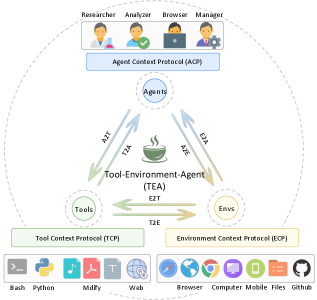
The TEA Protocol is fundamentally designed around coroutine-based asynchronous execution, enabling concurrent task processing and parallel multi-agent coordination. As illustrated in Figure 1, the protocol architecture comprises three primary layers: i) Basic Managers provide foundational services through six specialized components (model, prompt, memory, dynamic, version, and tracer); ii) Core Protocols define the Tool Context Protocol (TCP), Environment Context Protocol (ECP), and Agent Context Protocol (ACP), each implemented through a context manager for lifecycle engineering and a server for standardized orchestration; and iii) Protocol Transformations establish bidirectional conversion pathways (e.g., A2T, E2T, A2E) enabling dynamic role reconfiguration. Additionally, the protocol incorporates a Self-Evolution Module that wraps agent-associated components as evolvable variables for iterative optimization. Details and formalization can be found in Appendix C.
<details>
<summary>x3.png Details</summary>
### Visual Description
## Diagram: System Architecture for Agent-Tool-Environment Interaction
### Overview
The diagram illustrates a modular system architecture for managing interactions between agents, tools, and environments. It emphasizes protocol-driven communication between components, with a central "Tool-Environment-Agent" (TEA) acting as a bridge between tools and environments. The system includes four human roles (Researcher, Analyzer, Browser, Manager) and multiple technical components connected via labeled protocols.
### Components/Axes
1. **Human Roles** (Top Row):
- Researcher (👩🔬)
- Analyzer (👨💻)
- Browser (👨💻)
- Manager (👨💼)
- All connected to the **Agent Context Protocol (ACP)** via blue arrows.
2. **Central Components**:
- **Agent Context Protocol (ACP)**: Blue box connecting human roles to **Agents**.
- **Agents**: Central node with bidirectional arrows to:
- **Tool-Environment-Agent (TEA)** (green arrow labeled "TZA")
- **Environment Context Protocol (ECP)** (yellow arrow labeled "EZA")
- **Tool Context Protocol (TCP)** (green arrow labeled "TZE")
3. **TEA (Tool-Environment-Agent)**:
- Central green coffee cup icon with steam.
- Connected to:
- **Tools** (left circle) via green arrow labeled "TZA"
- **Environments** (right circle) via yellow arrow labeled "EZA"
4. **Tools** (Bottom Left):
- Labeled with icons and text:
- Bash (💻)
- Python (🐍)
- Markdown (📝)
- Web (🌐)
- Text Editor (📄)
- Terminal (💻)
5. **Environments** (Bottom Right):
- Labeled with icons and text:
- Browser (🌐)
- Computer (💻)
- Mobile (📱)
- Files (📁)
- GitHub (🐙)
6. **Protocols**:
- **TCP** (Tool Context Protocol): Green arrow from Tools to TEA.
- **ECP** (Environment Context Protocol): Yellow arrow from Environments to TEA.
- **EZA** (Environment-to-Agent): Yellow arrow from ECP to Agents.
- **TZA** (Tool-to-Agent): Green arrow from TEA to Agents.
- **TZE** (Tool-to-Environment): Green arrow from Tools to Environments.
### Detailed Analysis
- **Protocol Flow**:
- Human roles → ACP → Agents → TEA → Tools/Environments.
- Tools → TEA → Agents (via TZA).
- Environments → TEA → Agents (via EZA).
- Tools ↔ Environments via TZE (green arrow).
- **Color Coding**:
- Blue: ACP (human roles → Agents).
- Green: TCP/TZA (Tools ↔ TEA ↔ Agents).
- Yellow: ECP/EZA (Environments ↔ TEA ↔ Agents).
- **Spatial Grounding**:
- Human roles: Top row, left to right.
- ACP: Directly below human roles.
- Agents: Center, connected to TEA and protocols.
- TEA: Central coffee cup icon.
- Tools: Bottom left quadrant.
- Environments: Bottom right quadrant.
### Key Observations
1. **Modular Design**: Clear separation between human roles, agents, tools, and environments.
2. **Protocol Hierarchy**: ACP governs human-agent interactions, while TCP/ECP govern tool/environment interactions.
3. **Bidirectional Flow**: TEA enables two-way communication between tools and environments (TZE).
4. **Protocol Specificity**: Each protocol (TCP, ECP, EZA, TZA, TZE) has distinct color coding and directional arrows.
### Interpretation
This architecture suggests a **decentralized agent system** where:
- Human roles specialize in specific tasks (research, analysis, browsing, management).
- Agents act as intermediaries, executing actions via the TEA.
- The TEA serves as a **universal interface** between tools (e.g., Python, GitHub) and environments (e.g., browsers, mobile devices).
- Color-coded protocols ensure traceability of data flow, critical for debugging and system optimization.
- The absence of numerical data implies this is a **conceptual framework** rather than a performance metric visualization.
The system prioritizes **interoperability** through standardized protocols, enabling seamless integration of diverse tools and environments. The TEA's central role highlights its importance in bridging disparate components, suggesting it could be a focal point for system enhancements or failure points requiring robust error handling.
</details>
Figure 1: Architecture of the TEA Protocol.
### 3.1 Basic Managers
The Basic Managers constitute the foundation of the TEA Protocol, providing essential services through six specialized managers: i) the model manager abstracts heterogeneous LLM backends through a unified interface; ii) the prompt manager handles prompt lifecycle and versioning; iii) the memory manager coordinates persistence via session-based concurrency control; iv) the dynamic manager enables runtime code execution and serialization; v) the version manager maintains evolution histories for all components; and vi) the tracer records comprehensive execution trajectories and system-wide telemetry, serving as a data collection engine for audit, debugging, and the synthesis of high-quality datasets for agent training.
### 3.2 Core Protocols
The TEA Protocol defines three core context protocols: the Tool Context Protocol (TCP), the Environment Context Protocol (ECP), and the Agent Context Protocol (ACP). These protocols share a unified architectural design, each implemented through two core components: a context manager for context engineering, lifecycle management, and semantic retrieval, and a server that exposes standardized interfaces to other system modules. Each protocol generates a unified contract document (analogous to Agent Skills (Anthropic, 2025)) that aggregates all registered components’ descriptions to facilitate resource discovery and usage.
Tool Context Protocol. TCP fundamentally extends MCP (Anthropic, 2024b) by introducing integrated context engineering and comprehensive lifecycle management. Implemented through a ToolContextManager and a TCPServer, it supports seamless tool loading from both local registries and persistent configurations. During registration, TCP automatically synthesizes multiple representation formats, including function-calling schemas for LLM interfaces, natural language descriptions for documentation, and type-safe argument schemas for validation, providing LLMs with rich semantic information for accurate parameter inference. Furthermore, TCP incorporates a robust versioning system and a semantic retrieval mechanism based on vector embeddings, ensuring that tools can evolve over time while remaining easily discoverable through similarity-based queries.
Environment Context Protocol. ECP addresses the lack of unified interfaces in current agent systems by formalizing computational environments as first-class components with distinct observation and action spaces. Following an architectural pattern similar to TCP, it employs an EnvironmentContextManager to maintain state coherence and manage the contextual execution environments required by tools. ECP automatically discovers and registers environment-specific actions, converting them into standardized interfaces that agents can invoke via action toolkits. This design enables agents to operate across heterogeneous domains, such as browsers or file systems, without bespoke adaptations, while leveraging versioning and semantic retrieval to manage environment-level capabilities.
Agent Context Protocol. ACP establishes a unified framework for the registration, representation, and orchestration of autonomous agents, overcoming the poor interoperability and fragmented attribute definitions in existing multi-agent systems. It utilizes an AgentContextManager to maintain agent states and execution contexts, providing a foundation for persistent coordination across tasks and sessions. ACP captures semantically enriched metadata regarding agents’ roles, competencies, and objectives, and formalizes the modeling of complex inter-agent dynamics, including cooperative, competitive, and hierarchical configurations. By embedding structured contextual descriptions and maintaining relationship representations, ACP facilitates adaptive collaboration and systematic integration within the broader TEA ecosystem.
### 3.3 Protocol Transformations
While TCP, ECP, and ACP provide independent specifications for tools, environments, and agents, practical deployment requires seamless interoperability across these protocols. Well-defined transformation pathways are essential for enabling computational components to assume alternative roles and exchange contextual information in a principled manner. These transformations constitute the foundation for dynamic role reconfiguration, allowing components to flexibly adapt their functional scope in response to evolving task requirements and system constraints. We identify six fundamental categories of protocol transformations:
- Agent-to-Tool (A2T). Encapsulates an agent’s capabilities and reasoning into a standardized tool interface while preserving awareness. For example, a deep researcher workflow can be packaged as a general-purpose search tool.
- Tool-to-Agent (T2A). Treats tools as operational actuators by mapping an agent’s goals into parameterized tool invocations, aligning reasoning with tool constraints. For example, a data analysis agent may invoke SQL tools to query structured databases.
- Environment-to-Tool (E2T). Converts actions of environments into standardized tool interfaces, enabling agents to interact with environments through consistent tool calls. For example, browser actions such as Navigate and Click can be consolidated into a context-aware toolkit.
- Tool-to-Environment (T2E). Elevates a collection of tools into an environment abstraction where functions become actions within a coherent action space governed by shared state. For example, a development toolkit can be encapsulated as a programming environment for sequential code-edit-compile-debug workflows.
- Agent-to-Environment (A2E). Encapsulates an agent as an interactive environment by exposing its decision rules and state dynamics as an operational context for other agents. For example, a market agent can be represented as an environment that provides trading rules and dynamic responses for training.
- Environment-to-Agent (E2A). Embeds reasoning and adaptive decision-making into an environment’s dynamics, transforming it into an autonomous agent that can initiate behaviors and enforce constraints. For example, a game environment can be elevated into an opponent agent that adapts its strategy to the player’s actions.
### 3.4 Self-Evolution Module
The Self-Evolution Module enables agents to continuously improve performance by optimizing system components during task execution. It wraps evolvable components, including prompts, tool/agent/environment/memory code, and successful execution solutions, as variables for iterative optimization. The module employs two primary methods: textgrad (Yuksekgonul et al., 2025) for gradient-based refinement and self-reflection for strategic analysis. Optimized components are automatically registered as new versions via the version manager, ensuring that subsequent tasks leverage improved capabilities while maintaining access to historical records for analysis and rollback.
<details>
<summary>x4.png Details</summary>
### Visual Description
## Diagram: Multi-Agent System Architecture with Self-Evolution Module
### Overview
The diagram illustrates a complex multi-agent system architecture designed for task planning, execution, and self-improvement. It features hierarchical agents, modular protocols, and feedback loops for error handling and adaptability. Key components include planning agents, specialized sub-agents, context protocols, and a self-evolution module.
### Components/Axes
1. **Top Section: Planning Agent**
- **Tools**: Create, Delete, Update, Mark steps
- **Actions**: Interpret user tasks → Decompose into sub-tasks → Assign to specialized sub-agents
- **Sub-Agents**: Deep Researcher, Browser Use, Deep Analyzer, Tool Generator
- **Flow**: User Objectives → Planning → Sub-agent execution → Feedback/Errors
2. **Middle Section: Context Protocols**
- **Tool Context Protocol (TCP)**: General Tools (Bash, Python), MPC Tools (Searcher, Analyzer), Environment Tools (Browser, GitHub)
- **Agent Context Protocol (ACP)**: Inter-agent communication (A2T, T2A, E2T)
- **Environment Context Protocol (ECP)**: Browser, GitHub, Computer rules/actions
3. **Bottom Section: Managers & Self-Evolution**
- **Basic Managers**: Model, Memory, Prompt, Dynamic, Version, Tracer
- **Self-Evolution Module**: TextGrad/Self-Reflection
### Detailed Analysis
- **Planning Agent**:
- Tools are color-coded (red: create, blue: delete, etc.) with explicit action labels.
- Sub-agents are visually distinct (e.g., "Deep Researcher" with magnifying glass icon).
- Feedback loops connect "Unexpected Errors" and "Objective Shifts" back to planning.
- **Context Protocols**:
- TCP includes 12 tools across three categories (General, MPC, Environment).
- ACP shows bidirectional communication between agents (e.g., A2T: Agent-to-Tool).
- ECP defines 9 rules/actions for Browser, GitHub, and Computer environments.
- **Self-Evolution Module**:
- Contains two core components: TextGrad (text processing) and Self-Reflection (feedback integration).
### Key Observations
1. **Modular Design**: Clear separation between planning, execution, and self-improvement modules.
2. **Feedback Mechanisms**: Errors and objective changes trigger plan updates.
3. **Protocol Complexity**: TCP has the most tools (12), while ECP focuses on environmental interactions.
4. **Agent Specialization**: Each sub-agent has distinct roles (e.g., Browser Use handles web interactions).
### Interpretation
This architecture demonstrates a sophisticated AI system capable of:
1. **Task Decomposition**: Breaking complex objectives into manageable sub-tasks.
2. **Adaptive Execution**: Using specialized agents for different domains (research, browsing, analysis).
3. **Self-Improvement**: The TextGrad/Self-Reflection module suggests continuous learning from execution outcomes.
4. **Protocol-Driven Interaction**: Standardized communication (ACP) and environmental interaction (ECP) ensure system coherence.
The system's strength lies in its hierarchical structure, which balances specialization with coordination. However, the complexity of protocols and feedback loops may introduce implementation challenges. The self-evolution component implies potential for autonomous system optimization over time.
</details>
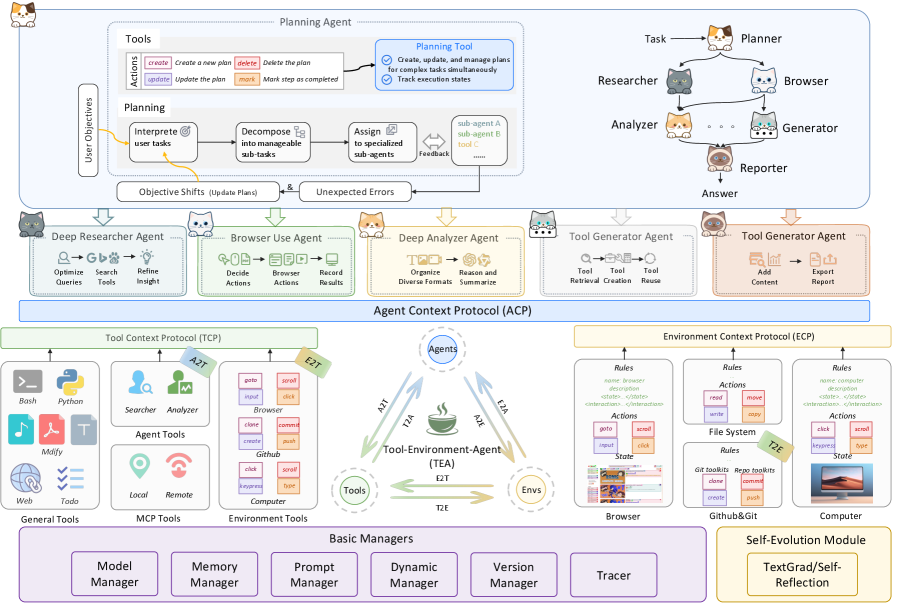
Figure 2: Architecture of AgentOrchestra implemented based on TEA protocol.
## 4 AgentOrchestra
AgentOrchestra is a concrete instantiation of the TEA Protocol, designed as a hierarchical multi-agent framework that integrates high-level planning with modular agent collaboration. As illustrated in Figure 2, AgentOrchestra features a central planning agent that decomposes complex objectives and delegates sub-tasks to a team of specialized sub-agents. This section outlines our agent design principles and the architecture of both planning and specialized sub-agents. Details can be found in Appendix D.
### 4.1 Agent Design Principles
Within the TEA Protocol framework, agents are autonomous components that follow a structured interaction model with six core components. i) Agent: Managed via the ACP for registration and coordination. ii) Environment: External context and resources managed by the ECP, exposing unified interfaces for observation and action. iii) Model: LLM reasoning engines abstracted by the Basic Managers for model-agnostic interoperability and dynamic switching. iv) Memory: Session-based persistence that records trajectories and extracts reusable insights. v) Observation: The current context, including tasks, environment states, execution history, and available resources (tools and sub-agents). vi) Action: TCP-managed, executed via parameterized tool calls, where one tool may support multiple actions.
This architectural design facilitates a continuous perception–interpretation–action cycle. The agent first perceives the current observation and retrieves relevant context from memory. It then interprets this information through the unified model interface to determine the optimal action. The action is executed within the managed environment, and the resulting state transitions and insights are recorded back into memory to refine subsequent reasoning cycles. This iterative loop continues until the task objectives are satisfied or a termination condition is reached. Further details are provided in Appendix D.1.
### 4.2 Planning Agent
The planning agent is the central orchestrator of AgentOrchestra. It interprets the user goal, decomposes it into sub-tasks, and dispatches them to specialized sub-agents or TCP tools via ACP-mediated communication while tracking global progress and consolidating intermediate feedback. To enable principled orchestration, it leverages long-term memory to guide resource selection and dynamically constructs a unified invocation interface, including resources produced through E2T and A2T transformations. Execution follows an iterative loop of interpretation, allocation, and action, with automatic replanning under environment shifts or execution failures. Session management and tracer-based logging provide auditability and support robust long-horizon task completion.
### 4.3 Specialized Sub-Agents
To address diverse real-world challenges, AgentOrchestra instantiates specialized sub-agents tailored for task domains. These sub-agents are managed via the ACP and coordinate through the planning agent to execute complex workflows: i) Deep Researcher Agent: Specialized for comprehensive information gathering through multi-round research workflows. It performs parallel breadth-first searches across multiple engines and recursively issues follow-up queries until task objectives are satisfied, producing relevance-ranked, source-cited summaries. ii) Browser Use Agent: Provides automated, fine-grained web interaction by integrating both browser and computer environments under the ECP. It supports DOM-level and pixel-level operations (e.g., mouse movements), achieving unified control over interactive elements. iii) Deep Analyzer Agent: A workflow-oriented module designed for multi-step reasoning on heterogeneous multimodal data (e.g., text, PDFs, images, audio, video or zip). It applies type-specific analysis strategies and iterative refinement to synthesize insights into coherent conclusions. iv) Tool Generator Agent: Facilitates intelligent tool evolution through the automated creation, retrieval, and systematic reuse of TCP-compliant tools. It employs semantic search to identify tools and initiates a code synthesis process to develop new capabilities when gaps are identified. v) Reporter Agent: It aggregates and harmonizes evidence collected by upstream agents (e.g., the Deep Researcher Agent, Browser Use Agent, and Deep Analyzer Agent), then composes structured markdown with automatically deduplicated references and normalized URLs for consistent source attribution.
## 5 Empirical Studies
This section presents our experimental setup and results, including benchmark evaluations, baseline comparisons, and comprehensive analysis. Additional examples are provided in the Appendix F.
Experimental Settings. We evaluate our framework on three benchmarks: SimpleQA Wei et al. (2024), a 4,326-question factual accuracy benchmark; GAIA Mialon et al. (2023), assessing real-world reasoning, multimodal processing, and tool use with 301 test and 165 validation questions; and Humanity’s Last Exam (HLE) Phan et al. (2025), a 2,500-question multimodal benchmark for human-level reasoning and general intelligence. We report score (pass@1), which measures the proportion of questions for which the top prediction is fully correct. Specifically, the planning agent ( $m{=}50$ ), deep researcher ( $m{=}3$ ), tool generator ( $m{=}10$ ), deep analyzer ( $m{=}3$ ), and reporter are all built on gemini-3-flash-preview; the browser use agent employs gpt-4.1 ( $m{=}5$ ) and computer-use-preview(4o) ( $m{=}50$ ), where $m$ denotes the maximum steps.
### 5.1 Performance across Benchmarks
<details>
<summary>x5.png Details</summary>
### Visual Description
```markdown
## Bar Chart: Performance Scores Across Orchestrators and Levels
### Overview
The image is a grouped bar chart comparing performance scores of various AI agents/orchestrators across three evaluation levels (Level1, Level2, Level3) and their average scores. The chart is divided into four sections, each labeled with an orchestrator type (AgentOrchestrator, ToolOrchestrator, AgentOrchestrator, AgentOrchestrator). Each section contains bars representing different agents, with color-coded performance metrics.
### Components/Axes
- **Y-Axis**: "Score" (scale: 40–100, increments of 10).
- **X-Axis**: Agent/orchestrator names (e.g., ToolOrchestra, HALO, AIWorld, Su-Zero-Ultra, h2oGPT-Agent, DeSearch, Alita, Langfun, o3-Agent, o4-mini-DR).
- **Legend**:
- Green: Level1
- Blue: Level2
- Purple: Level3
- Orange: Average
- **Sections**: Four groups of bars, each labeled with an orchestrator type (AgentOrchestrator, ToolOrchestrator, AgentOrchestrator, AgentOrchestrator).
### Detailed Analysis
#### Section 1: AgentOrchestrator
- **Agents**: ToolOrchestra, HALO, AIWorld, Su-Zero-Ultra, h2oGPT-Agent, DeSearch, Alita, Langfun, o3-Agent, o4-mini-DR.
- **Scores**:
- ToolOrchestra: 98.9 (Level1), 95.7 (Level2), 94.6 (Level3), 95.7 (Average).
- HALO: 95.7, 94.6, 95.7, 95.7.
- AIWorld: 95.7, 93.5, 89.3, 91.4.
- Su-Zero-Ultra: 93.5, 91.4, 92.5, 86.9.
- h2oGPT-Agent: 89.3, 86.9, 79.4, 77.4.
- DeSearch: 91.4, 92.5, 77.4, 67.6.
- Alita: 92.5, 86.9, 79.4, 77.4.
- Langfun: 86.9, 79.4, 77.4, 67.6.
- o3-Agent: 79.4, 77.4, 67.6, 67.6.
- o4-mini-DR: 67.6, 67.6, 67.6, 67.6.
#### Section 2: ToolOrchestrator
- **Agents**: ToolOrchestra, HALO, AIWorld, Su-Zero-Ultra, h2oGPT-Agent, DeSearch, Alita, Langfun, o3-Agent, o4-mini-DR.
- **Scores**:
- ToolOrchestra: 85.3 (Level1), 82.4 (Level2), 84.9 (Level3), 85.3 (Average).
- HALO: 82.4, 84.9, 85.3, 85.3.
- AIWorld: 85.3, 85.3, 77.9, 79.9.
- Su-Zero-Ultra: 77.9, 79.9, 75.3, 73.6.
- h2oGPT-Agent: 75.3, 73.6, 67.3, 67.3.
- DeSearch: 73.6, 67.3, 59.3, 59.3.
- Alita: 67.3, 59.3, 47.3, 47.3.
- Langfun: 59.3, 47.3, 44.3, 44.3.
- o3-Agent: 47.3, 44.3, 44.3, 44.3.
- o4-mini-DR: 44.3, 44.3, 44.3, 44.3.
#### Section 3: AgentOrchestrator (Repeated)
- **Agents**: ToolOrchestra, HALO, AIWorld, Su-Zero-Ultra, h2oGPT-Agent, DeSearch, Alita, Langfun, o3-Agent, o4-mini-DR.
- **Scores**:
- ToolOrchestra: 81.6 (Level1), 87.8 (Level2), 69.4 (Level3), 81.6 (Average).
- HALO: 81.6, 87.8, 69.4, 81.6.
- AIWorld: 81.6, 69.4, 57.1, 65.3.
- Su-Zero-Ultra: 69.4, 57.1, 65.3, 61.2.
- h2oGPT-Agent: 57.1, 65.3, 61.2, 61.2.
- DeSearch: 61.2, 55.1, 49.0, 55.1.
- Alita: 55.1, 49.0, 47.5, 48.9.
- Langfun: 49.0, 47.5, 46.9, 46.9.
- o3-Agent: 47.5, 46.9, 44.3, 44.3.
- o4-mini-DR: 46.9, 44.3, 44.3, 44.3.
#### Section 4: AgentOrchestrator (Repeated)
- **Agents**: ToolOrchestra, HALO, AIWorld, Su-Zero-Ultra, h2oGPT-Agent, DeSearch, Alita, Langfun, o3-Agent, o4-mini-DR.
- **Scores**:
- ToolOrchestra: 99.0 (Level1), 97.4 (Level2), 95.4 (Level3), 99.0 (Average).
- HALO: 97.4, 95.4, 93.5, 95.4.
- AIWorld: 95.4, 93.5, 92.5, 93.5.
- Su-Zero-Ultra: 93.5, 92.5, 91.4, 92.5.
- h2oGPT-Agent: 92.5, 91.4, 90.3, 91.4.
- DeSearch: 91.4, 90.3, 89.2, 90.3.
- Alita: 90.3, 89.2, 88.1, 89.2.
- Langfun: 89.2, 88.1, 87.0, 88.1.
- o3-Agent: 88.1, 87.0, 86.0, 87.0.
- o4-mini-DR: 87.0, 86.0, 85.0, 86.0.
### Key Observations
1. **High Performance in AgentOrchestrator Tests**:
- In the first and fourth sections (AgentOrchestrator), scores are consistently high (85–99), with ToolOrchestra and HALO leading.
- The average score often matches Level2 or Level3, suggesting these levels may dominate the average calculation.
2. **Dropped Scores in ToolOrchestrator Tests**:
- The second section (ToolOrchestrator) shows significantly lower scores (44–85), especially for o3-Agent and o4-mini-DR (44.3).
- DeSearch and Alita also underperform here (47–59).
3. **Inconsistent
</details>
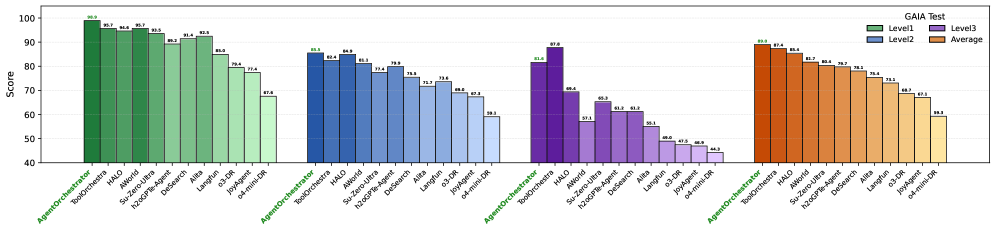
Figure 3: GAIA Test Results.
GAIA. AgentOrchestra achieves state-of-the-art performance (89.04% avg.) by mitigating the dimensionality curse and semantic drift that arise in large-scale agentic planning. We attribute this success to two architectural properties enabled by the TEA Protocol. First, hierarchical decoupling of the action space reduces planning complexity: while methods (e.g., ToolOrchestra, AWorld) must map goals to a monolithic toolkit, our hierarchical routing decomposes the global task into locally tractable sub-problems, lowering cognitive entropy for the central orchestrator and preserving abstract reasoning under long horizons, even amid low-level sensorimotor noise (e.g., granular DOM events). Second, ECP formalizes epistemic environment boundaries: GAIA’s multi-domain tasks require temporal and cross-modal state coherence, and baselines often degrade during domain transitions, such as from browser retrieval to local python analysis. By treating environments as first-class managed components, TEA preserves and propagates session-critical state (e.g., authentication tokens and transient file-system mutations) across agent boundaries, reducing contextual forgetting and enabling compositional generalization on challenging Level 2 and Level 3 scenarios. Third, AgentOrchestra supports recursive refinement of reasoning trajectories. When faced with complex problems, the Planning Agent evaluates intermediate insights and, when necessary, invokes the Tool Generator Agent to synthesize context-specific functionalities on the fly. This on-demand tool evolution bypasses the fixed-capability bottleneck of static agent components.
Table 2: Performance on GAIA Validation.
| Agents | Level 1 | Level 2 | Level 3 | Average |
| --- | --- | --- | --- | --- |
| HF ODR (o1) (HuggingFace, 2024) | 67.92 | 53.49 | 34.62 | 55.15 |
| OpenAI DR (OpenAI, 2024) | 74.29 | 69.06 | 47.60 | 67.36 |
| Manus (Shen and Yang, 2025) | 86.50 | 70.10 | 57.69 | 73.90 |
| Langfun (Google, 2024) | 86.79 | 76.74 | 57.69 | 76.97 |
| AWorld (Yu et al., 2025) | 88.68 | 77.91 | 53.85 | 77.58 |
| AgentOrchestra | 92.45 | 83.72 | 57.69 | 82.42 |
Table 3: Performance on SimpleQA and HLE.
| Model and Agent | SimpleQA |
| --- | --- |
| Models | |
| o3 (w/o tools) | 49.4 |
| gemini-2.5-pro-preview-05-06 | 50.8 |
| Agents | |
| Perplexity DR (Perplexity, 2025) | 93.9 |
| AgentOrchestra | 95.3 |
| Model and Agent | HLE |
| Models | |
| o3 (w/o tools) | 20.3 |
| claude-3.7-sonnet (w/o tools) | 8.9 |
| gemini-2.5-pro-preview-05-06 | 17.8 |
| Agents | |
| OpenAI DR (OpenAI, 2024) | 26.6 |
| Perplexity DR (Perplexity, 2025) | 21.1 |
| AgentOrchestra | 37.46 |
SimpleQA. AgentOrchestra achieves SOTA performance (95.3% accuracy), significantly surpassing both monolithic LLMs (e.g., o3 at 49.4%) and specialized retrieval agents like Perplexity Deep Research (93.9%). We attribute this improvement to systematic reduction of epistemic uncertainty through our hierarchical verification pipeline. SimpleQA primarily targets short-form factuality, where hallucinations often arise from the model’s inability to reconcile conflicting web-based evidence or its tendency to rely on internal parametric memory. AgentOrchestra mitigates these issues by enforcing cross-agent consensus: the Planning Agent orchestrates a retrieve-verify-synthesize cycle where the Deep Researcher performs multi-engine breadth-first searches while the Deep Analyzer evaluates evidence consistency across heterogeneous sources. By decoupling retrieval from analysis, the system prevents "confirmation bias" inherent in single-agent architectures, where the same model both proposes and validates a hypothesis. Furthermore, the integration with the Reporter Agent ensures traceable attribution, grounding every factual claim in a re-verified source, which effectively transforms the task from an open-domain generation problem into a structured evidence-synthesis process.
HLE. AgentOrchestra achieves 37.46% on the HLE benchmark, a substantial margin over leading baselines like o3 (20.3%) and Perplexity Deep Research (21.1%). This gain highlights the framework’s capacity for long-horizon analytical reasoning and adaptive capability expansion in expert-level domains. HLE demands more than simple retrieval; it requires synthesizing disparate, highly specialized knowledge. In this setting, the hierarchical structure enables strategic pruning of the hypothesis space, allowing the Planning Agent to maintain global objective coherence while delegating technical validation to specialized agents such as the Deep Analyzer. As a result, the final solution is both analytically rigorous and cross-verified against multimodal evidence, yielding robust performance on challenging expert-level tasks.
### 5.2 Ablation Studies
Table 4: Sub-agent effectiveness across GAIA Test.
| P | R | B | A | T | Level 1 | Level 2 | Level 3 | Average | Improvement |
| --- | --- | --- | --- | --- | --- | --- | --- | --- | --- |
| ✓ | | | | | 54.84 | 33.96 | 10.20 | 36.54 | – |
| ✓ | ✓ | | | | 86.02 | 47.17 | 34.69 | 57.14 | +56.40% |
| ✓ | ✓ | ✓ | | | 89.25 | 71.07 | 46.94 | 72.76 | +27.33% |
| ✓ | ✓ | ✓ | ✓ | | 91.40 | 77.36 | 61.22 | 79.07 | +8.67% |
| ✓ | ✓ | ✓ | ✓ | ✓ | 98.92 | 85.53 | 81.63 | 89.04 | +12.61% |
Effectiveness of the specialized sub-agents. Ablation studies on the GAIA Test demonstrate the synergistic effect inherent in our multi-agent coordination. Integrating coarse-grained exploratory retrieval (Researcher) with fine-grained operational interaction (Browser) nearly doubles performance (36.54% to 72.76%), proving that breadth of information and depth of interaction are mutually reinforcing. The Deep Analyzer’s 8% gain highlights the necessity of specialized reasoning pipelines for high-entropy multimodal tasks, while the Tool Generator’s 12.61% boost validates the efficacy of on-demand capability synthesis in overcoming the limitations of static, predefined toolsets. These results suggest that complex problem-solving emerges not just from individual agent strength, but from the structured delegation of specialized roles.
Efficiency analysis. AgentOrchestra ’s operational efficiency is evaluated across varying task complexities. Simple tasks typically complete within 30 seconds using approximately 5k tokens, while medium-complexity tasks average 3 minutes (25k tokens). Complex multimodal or long-horizon scenarios require approximately 10 minutes and 100k tokens. Compared to monolithic baselines, our hierarchical architecture optimizes resource allocation, maintaining operational costs comparable to commercial research agents while delivering significant performance gains.
Effectiveness of the self-evolution module. The TEA Protocol enables self-optimization by treating system components as evolvable variables, helping bridge the gap between base model capacity and task requirements. Evaluations on GPQA-Diamond and AIME benchmarks show that iterative refinement, including gradient-based (TextGrad) and symbolic (self-reflection) approaches, mitigates reasoning bottlenecks in foundation models. The improvement is exemplified by a 13.34% gain on AIME25 for gpt-4.1 under self-reflection, highlighting recursive trajectory refinement. Leveraging execution feedback via TEA’s versioning and tracer mechanisms, the system identifies and corrects logical inconsistencies in its planning. Overall, this shifts reasoning from one-shot inference to a managed optimization process, enabling AgentOrchestra to evolve problem-solving strategies for frontier-level tasks.
Table 5: Effectiveness of the self-evolution module. Direct means using the base model directly.
| Strategy | GPQA-Diamond | AIME24 | AIME25 |
| --- | --- | --- | --- |
| Base Model: gpt-4o | | | |
| Direct | 47.98% | 13.34% | 6.67% |
| w/ TextGrad | 54.04% | 10.00% | 10.00% |
| w/ Self-reflection | 55.05% | 20.00% | 6.67% |
| Base Model: gpt-4.1 | | | |
| Direct | 61.11% | 23.34% | 20.00% |
| w/ TextGrad | 65.15% | 26.67% | 23.34% |
| w/ Self-reflection | 68.18% | 33.34% | 33.34% |
Regarding tool evolution, the tool generator agent demonstrates efficient creation and reuse capabilities within the TCP framework. During our evaluation, the agent autonomously generated over 50 specialized tools, achieving a 30% reuse rate across subsequent tasks. This indicates an effective balance between tool specialization and generalization, ensuring that the system’s capabilities expand adaptively while maintaining resource efficiency.
## 6 Conclusion
We introduced the TEA Protocol, unifying environments, agents, and tools to address fragmentation in existing standards. Building on this, we presented AgentOrchestra, a hierarchical multi-agent framework with specialized sub-agents for planning, research, web interaction, and multimodal analysis. Evaluations on three benchmarks show that AgentOrchestra achieves SOTA performance and scalable orchestration through dynamic resource transformations. Future work will extend TEA to support dynamic role allocation and autonomous agent reconfiguration. Building on tool and solution evolution, we will pursue deeper self-evolution, such as using RL to optimize agent components and decision policies without fine-tuning LLM parameters. We also aim to expand these mechanisms to agent structures and communication protocols, while enhancing multimodal capabilities for fine-grained real-time video analysis.
## 7 Limitations
### 7.1 Limitations of TEA Protocol and AgentOrchestra
Despite its strengths in orchestrating multi-agent systems, AgentOrchestra has several limitations that provide directions for future research:
First, System Complexity and Learning Curve. The TEA protocol introduces a structured abstraction layer for tools, environments, and agents to ensure interoperability. However, this structure may present a steeper learning curve for developers compared to simpler, ad-hoc scripting methods. To address this, we will provide extensive documentation, interactive tutorials, and a variety of pre-configured templates to simplify the onboarding process.
Second, Communication and Execution Overhead. Standardizing interactions through a formal protocol can introduce marginal computational and communication overhead, potentially increasing latency in real-time applications. We plan to optimize the serialization protocols and explore asynchronous execution models to minimize these effects in future versions.
Third, Dependence on Underlying Model Capabilities. The effectiveness of the orchestration is inherently limited by the reasoning and instruction-following performance of the foundation LLMs used. While TEA provides a robust framework, it cannot fully compensate for failures caused by model hallucinations or poor tool-use logic. Future work will focus on developing model-agnostic error recovery strategies and more sophisticated validation layers to enhance system-wide resilience.
### 7.2 Potential Risks
While AgentOrchestra and the TEA protocol aim to enhance multi-agent productivity, their capability to interact with local environments and web browsers introduces certain ethical and security risks.
One primary concern is the Misuse for Malicious Automation. The framework’s flexibility in controlling browser sessions and executing terminal commands could be repurposed to develop unauthorized "plugins" or "cheats" for online platforms, leading to unfair advantages or automated fraud. Furthermore, there are significant Privacy and Security Risks associated with granting autonomous agents access to personal data or sensitive system resources. If not properly sandboxed or governed by strict security policies, an agent could inadvertently leak private information or perform harmful, irreversible system actions. To mitigate these risks, we emphasize that AgentOrchestra should be used within isolated, monitored environments, and we advocate for the integration of robust human-in-the-loop verification mechanisms and strict access control policies in any real-world deployment.
## References
- Anthropic (2024a) Introducing Computer Use, a New Claude 3.5 Sonnet, and Claude 3.5 Haiku. Note: https://www.anthropic.com/news/3-5-models-and-computer-use Accessed: 2025-05-13 Cited by: §1, §2.2.
- Anthropic (2024b) Introducing the Model Context Protocol. Note: https://www.anthropic.com/news/model-context-protocol Cited by: §C.2.1, §D.1, §1, §2.1, §2.2, §3.2.
- Anthropic (2025) Equipping agents for the real world with Agent Skills. Note: https://www.anthropic.com/engineering/equipping-agents -for-the-real-world-with-agent-skills Cited by: §C.2, §3.2.
- K. Black, N. Brown, J. Darpinian, K. Dhabalia, D. Driess, A. Esmail, M. Equi, C. Finn, N. Fusai, M. Y. Galliker, et al. (2025) $\pi$ 0. 5: a vision-language-action model with open-world generalization. arXiv preprint arXiv:2504.16054. Cited by: §A.1.2.
- G. Brockman, V. Cheung, L. Pettersson, J. Schneider, J. Schulman, J. Tang, and W. Zaremba (2016) Openai gym. arXiv preprint arXiv:1606.01540. Cited by: §C.2.2.
- G. DeepMind (2024) Gemini Deep Research. Note: https://gemini.google/overview/deep-research/?hl=en Cited by: §1.
- A. Ehtesham, A. Singh, G. K. Gupta, and S. Kumar (2025) A survey of agent interoperability protocols: Model context protocol (mcp), agent communication protocol (acp), agent-to-agent protocol (a2a), and agent network protocol (anp). arXiv preprint arXiv:2505.02279. Cited by: §2.1.
- Google (2024) LangFun Agent. Note: https://github.com/google/langfun Cited by: Table 2.
- Google (2025) Announcing the Agent2Agent Protocol (A2A). Note: https://developers.googleblog.com/en/a2a-a-new-era-of-agent-interoperability/ Cited by: §C.2.3, §1, §2.1.
- S. Hong, X. Zheng, J. Chen, Y. Cheng, J. Wang, C. Zhang, Z. Wang, S. K. S. Yau, Z. Lin, L. Zhou, et al. (2023) MetaGPT: Meta Programming for Multi-agent Collaborative Framework. arXiv preprint arXiv:2308.00352 3 (4), pp. 6. Cited by: §2.2.
- HuggingFace (2024) Open-source DeepResearch - Freeing Our Search Agents. Note: https://huggingface.co/blog/open-deep-research Cited by: Table 2.
- P. Li, X. Zou, Z. Wu, R. Li, S. Xing, H. Zheng, Z. Hu, Y. Wang, H. Li, Q. Yuan, et al. (2025) Safeflow: A principled protocol for trustworthy and transactional autonomous agent systems. arXiv preprint arXiv:2506.07564. Cited by: §2.1.
- G. Liang and Q. Tong (2025) LLM-Powered AI Agent Systems and Their Applications in Industry. arXiv preprint arXiv:2505.16120. Cited by: §2.2.
- X. Liang, J. Xiang, Z. Yu, J. Zhang, S. Hong, S. Fan, and X. Tang (2025) OpenManus: An Open-Source Framework for Building General AI Agents. Zenodo. External Links: Document, Link Cited by: §D.1.
- G. Mialon, C. Fourrier, C. Swift, T. Wolf, Y. LeCun, and T. Scialom (2023) GAIA: A Benchmark for General AI Assistants. External Links: 2311.12983, Link Cited by: §5.
- M. Müller and G. Žunič (2024) Browser Use: Enable AI to Control Your Browser External Links: Link Cited by: §1, §2.2.
- OpenAI (2023) Function Calling. Note: https://platform.openai.com/docs/guides/function-calling Cited by: §D.1, §2.2.
- OpenAI (2024) Introducing Deep Research. Note: https://openai.com/index/introducing-deep-research Cited by: §1, Table 2, Table 3.
- OpenAI (2025a) Context-Free Grammar. Note: https://platform.openai.com/docs/guides/function-calling#page-top Cited by: §A.1.2.
- OpenAI (2025b) Introducing Operator. Note: https://openai.com/blog/operator Cited by: §1, §2.2.
- Perplexity (2025) Introducing Perplexity Deep Research. Note: https://www.perplexity.ai/hub/blog/introducing-perplexity-deep-research Cited by: Table 3, Table 3.
- L. Phan, A. Gatti, Z. Han, N. Li, J. Hu, H. Zhang, C. B. C. Zhang, M. Shaaban, J. Ling, S. Shi, et al. (2025) Humanity’s Last Exam. arXiv preprint arXiv:2501.14249. Cited by: §5.
- Y. Qin, Y. Ye, J. Fang, H. Wang, S. Liang, S. Tian, J. Zhang, J. Li, Y. Li, S. Huang, et al. (2025) UI-TARS: Pioneering Automated GUI Interaction with Native Agents. arXiv preprint arXiv:2501.12326. External Links: Link Cited by: §1, §2.2.
- J. Qiu, X. Qi, T. Zhang, X. Juan, J. Guo, Y. Lu, Y. Wang, Z. Yao, Q. Ren, X. Jiang, X. Zhou, D. Liu, L. Yang, Y. Wu, K. Huang, S. Liu, H. Wang, and M. Wang (2025) Alita: generalist agent enabling scalable agentic reasoning with minimal predefinition and maximal self-evolution. External Links: 2505.20286, Link Cited by: §2.2.
- A. Roucher, A. V. del Moral, T. Wolf, L. von Werra, and E. Kaunismäki (2025) smolagents: A Smol Library to Build Great Agentic Systems. Note: https://github.com/huggingface/smolagents Cited by: §D.1, §2.2.
- M. Shen and Q. Yang (2025) From Mind to Machine: The Rise of Manus AI as a Fully Autonomous Digital Agent. External Links: 2505.02024, Link Cited by: §2.2, Table 2.
- W. Tan, W. Zhang, X. Xu, H. Xia, Z. Ding, B. Li, B. Zhou, J. Yue, J. Jiang, Y. Li, et al. (2024) Cradle: Empowering Foundation Agents toward General Computer Control. arXiv preprint arXiv:2403.03186. Cited by: §1, §2.2.
- G. Wang, Y. Xie, Y. Jiang, A. Mandlekar, C. Xiao, Y. Zhu, L. Fan, and A. Anandkumar (2023) Voyager: An Open-Ended Embodied Agent with Large Language Models. arXiv preprint arXiv:2305.16291. Cited by: §1, §2.2.
- X. Wang, Y. Chen, L. Yuan, Y. Zhang, Y. Li, H. Peng, and H. Ji (2024a) Executable Code Actions Elicit Better LLM Agents. External Links: 2402.01030, Link Cited by: §1, §2.2.
- X. Wang, B. Li, Y. Song, F. F. Xu, X. Tang, M. Zhuge, J. Pan, Y. Song, B. Li, J. Singh, et al. (2024b) OpenHands: An Open Platform for AI Software Developers as Generalist Agents. In The Thirteenth International Conference on Learning Representations, Cited by: §D.1, §2.2.
- J. Wei, N. Karina, H. W. Chung, Y. J. Jiao, S. Papay, A. Glaese, J. Schulman, and W. Fedus (2024) Measuring Short-Form Factuality in Large Language Models. External Links: 2411.04368, Link Cited by: §5.
- G. Wölflein, D. Ferber, D. Truhn, O. Arandjelović, and J. N. Kather (2025) LLM Agents Making Agent Tools. arXiv preprint arXiv:2502.11705. Cited by: §2.2.
- xAI (2025) Grok 3 Beta — The Age of Reasoning Agents. Note: https://x.ai/news/grok-3 Cited by: §1.
- C. Yu, S. Lu, C. Zhuang, D. Wang, Q. Wu, Z. Li, R. Gan, C. Wang, S. Hou, G. Huang, W. Yan, L. Hong, A. Xue, Y. Wang, J. Gu, D. Tsai, and T. Lin (2025) AWorld: orchestrating the training recipe for agentic ai. External Links: 2508.20404, Link Cited by: Table 2.
- M. Yuksekgonul, F. Bianchi, J. Boen, S. Liu, P. Lu, Z. Huang, C. Guestrin, and J. Zou (2025) Optimizing generative AI by backpropagating language model feedback. Nature 639 (8055), pp. 609–616. Cited by: §C.4, §C.4, §3.4.
## Appendix A Comprehensive Motivation for TEA Protocol
This section provides a comprehensive motivation for the TEA Protocol by examining the fundamental relationships and transformations between agents, environments, and tools in multi-agent systems. The discussion is organized into two main parts: first, we explore the conceptual relationships between agents, environments, and tools, examining how these three fundamental components interact and complement each other in modern AI systems; second, we analyze why transformation relationships between these components are necessary, demonstrating the need for their conversion and integration through the TEA Protocol to create a unified, flexible framework for general-purpose task solving.
### A.1 Conceptual Relationships
#### A.1.1 Environment
The environment constitutes one of the fundamental components of multi-agent systems, providing the external stage upon which agents perceive, act, and accomplish tasks. Within the context of the TEA Protocol, highlighting the role of environments is crucial, since environments not only define the operational boundaries of agents but also exhibit complex structural and evolutionary properties. In what follows, we outline the motivation for explicitly modeling environments in the TEA framework from several perspectives.
Classification of environments. From a broad perspective, environments can be divided into two categories: the real world and the virtual world. The real world is concrete and directly perceivable by humans, such as kitchens, offices, or factories. By contrast, the virtual world cannot be directly perceived or objectively described by humans, including domains such as the network world, simulation platforms, and game worlds. Importantly, these two types of environments are not independent. Rather, they are tightly coupled through physical carriers, such as computers, displays, keyboards, mice, and sensors, which act as mediators that enable the bidirectional flow of information between the real and virtual domains. Hence, environments should be regarded not as isolated domains but as interdependent layers connected through mediating carriers.
Nested and expandable properties. Environments are inherently nested and expandable. For example, when an individual is situated in a kitchen, their observable range and available tools are restricted to kitchen-related objects such as faucets, knives, and microwaves, all governed by the local rules of that sub-environment. When the activity range extends to the living room, new objects such as televisions, remote controls, and chairs become accessible, while the kitchen remains embedded as a sub-environment within a broader space. Furthermore, environments can interact with one another, as when a bottle of milk is taken from the kitchen to the living room. This demonstrates that enlarged environments can be conceptualized not merely as simple unions, but rather as structured integrations of the state and action spaces of smaller constituent environments, where local rules and affordances are preserved while new forms of interaction emerge from their composition.
Relationship with state–action spaces. In reinforcement learning, environments are formalized in terms of state and action spaces. The state space comprises the set of possible environmental states, represented in modalities such as numerical values, text, images, or video. The action space denotes the set of operations available to agents, generally divided into continuous and discrete spaces. Real and virtual environments are naturally continuous, but discrete abstractions are often extracted for the sake of tractability, forming the basis of most reinforcement learning systems. However, this discretization constrains the richness of interaction. In contrast, large language models (LLMs) enable a new paradigm: instead of selecting from a discrete set, LLMs can generate natural language descriptions that encode complex action sequences. These outputs can be understood as an intermediate representation between continuous and discrete action spaces, richer and more expressive than discrete actions, yet still mappable to concrete operations in continuous environments. To realize this mapping, intermediate actions are required as bridges. For instance, the natural language command “boil water” can be decomposed into executable steps such as turning on the kettle, filling it with water, powering it on, and waiting until boiling. This property indicates that LLM-driven interaction expands the definition of action representations and broadens the scope of environmental engagement.
Mediation and interaction. The notion of mediation highlights that environments are not static backdrops but relative constructs whose boundaries depend on available carriers and interfaces. In hybrid physical–virtual systems, for example, Internet-of-Things (IoT) devices serve as mediators: a smart refrigerator in the physical world can be controlled through a mobile application in the virtual world, while the application itself is subject to network protocols. Consequently, the definition of an environment is dynamic and conditioned by interactional means. In the TEA Protocol, this mediation must be explicitly modeled, since it determines accessibility and interoperability across environments.
Toward intelligent environments. Traditionally, environments are passive components that provide states and respond to actions. However, as embedded simulators, interfaces, and actuators grow more sophisticated, environments may gradually acquire semi-agentic properties. For instance, a smart home environment may not only respond to the low-level command “turn on the light” but also understand and execute a high-level instruction such as “create a comfortable atmosphere for reading,” by autonomously adjusting lighting, curtains, and background music. This trend suggests that environments are evolving from passive contexts into adaptive and cooperative components.
In conclusion, the environment should not be regarded as a passive backdrop for agent activity, but as a dynamic and evolving component that fundamentally shapes the scope and feasibility of interaction. Its dual nature across real and virtual domains, its nested and compositional structure, and its formalization through state–action spaces all demonstrate that environments provide both the constraints and the affordances within which agents operate. At the same time, the rise of LLM-based agents introduces new forms of action representation that require environments to support more flexible, language-driven interfaces. Looking ahead, as environments increasingly incorporate adaptive and semi-agentic features, their role in task execution will only become more central. Within the TEA Protocol, this motivates treating environments as a co-equal pillar alongside agents and tools, ensuring that general-purpose task solving remains both grounded in environmental constraints and empowered by environmental possibilities.
#### A.1.2 Agent
Within the TEA Protocol, the motivation for treating agents as a core component alongside environments and tools extends beyond mere terminological convenience. Agents represent the indispensable connective tissue between the generative capabilities of LLMs, the operational affordances of tools, and the structural dynamics of environments. While environments provide the stage on which tasks unfold and tools extend the range of possible actions, it is agents that unify perception, reasoning, and execution into coherent task-solving processes. Without explicitly recognizing agents as an independent pillar, the TEA Protocol would lack a systematic way to explain how abstract linguistic outputs can be transformed into grounded operations, how tools can be selected and orchestrated, and how autonomy, memory, and adaptivity emerge in multi-agent systems. The following dimensions illustrate why agents must be elevated to a core component of the framework.
Necessity of environment interaction. Unlike large language models (LLMs), which only produce textual descriptions that require conversion into executable actions, agents are fundamentally characterized by their ability to directly interact with environments. While LLMs can generate detailed plans, instructions, or hypotheses, such outputs remain inert unless they are translated into concrete operations that affect the state of an environment. This gap between symbolic reasoning and actionable execution highlights the necessity of an intermediate entity capable of grounding abstract instructions into domain-specific actions. Agents fulfill precisely this role: they map language-level reasoning to executable steps, whether in physical settings, such as controlling robotic arms or sensors, or in virtual contexts, such as interacting with databases, APIs, or software systems.
By serving as this mapping layer, agents enable the closure of full task loops, where perception leads to reasoning, reasoning produces plans, and plans culminate in actions that in turn modify the environment. Without explicitly modeling agents, the process would remain incomplete, as LLMs alone cannot guarantee the translation of reasoning into operational change. Within the TEA Protocol, this necessity justifies the elevation of agents to a core component: they provide the indispensable interface that connects the generative capacities of LLMs with the affordances and constraints of environments, ensuring that tasks are not only conceived but also carried through to completion.
The decisive role of non-internalizable tools. The fundamental distinction between LLMs and agents lies in whether they can effectively employ tools that cannot be internalized into model parameters. Some tools can indeed be absorbed into LLMs, particularly those whose logic can be fully simulated in symbolic space, whose inputs and outputs are representable in language or code, and whose patterns fall within the training distribution (for example, mathematical reasoning, structured text formatting, code generation, and debugging). For example, early LLMs struggled with JSON output formatting and code reasoning, often requiring external correction or checking tools, but reinforcement learning (RL) and supervised fine-tuning (SFT) have progressively enabled such capabilities to be internalized.
In contrast, many tools remain non-internalizable because they are intrinsically tied to environmental properties. These include tools that depend on physical devices such as keyboards, mice, and robotic arms, external infrastructures such as databases and APIs, or proprietary software governed by rigid protocols. Two recent approaches further illustrate this limitation. Vision-language-action (VLA) (Black et al., 2025) models map perceptual inputs directly into actions, which may appear to bypass intermediate symbolic descriptions, yet the resulting actions must still be aligned with the discrete action spaces of environments. This alignment represents not a fundamental internalization but a compromise, adapting model outputs to the constraints of environmental action structures. Similarly, the upgraded function calling mechanism introduced after GPT-5, which incorporates context-free grammar (CFG) (OpenAI, 2025a), allows LLMs to output structured and rule-based actions that conform to external system requirements. However, this remains a syntactic constraint on model outputs, effectively providing a standardized interface to external systems rather than a truly internalized ability of the model.
Agents therefore play a decisive role in mediating this boundary. They allow LLMs to internalize symbolic tools, thereby enhancing reasoning and self-correction, while also orchestrating access to non-internalizable tools through external mechanisms. This dual pathway ensures that LLMs are not confined to their parameterized capabilities alone but can extend into broader operational domains. In this way, agents transform the tension between internalizable and non-internalizable tools from a limitation into an opportunity, enabling robust problem solving in multimodal, embodied, and real-world contexts.
Memory and learning extension. Another crucial motivation for agents lies in their capacity to overcome the intrinsic memory limitations of LLMs. Due to restricted context windows, LLMs struggle to maintain continuity across extended interactions or to accumulate knowledge over multiple sessions. Agents address this shortcoming by incorporating external memory systems capable of storing, retrieving, and contextualizing past experiences. Such systems simulate long-term memory and enable experiential learning, allowing agents to refine strategies based on historical outcomes rather than treating each interaction as isolated. However, in the TEA Protocol, memory is not defined as a core protocol component but is instead positioned at the infrastructure layer. This design choice reflects the anticipation that future LLMs may gradually internalize memory mechanisms into their parameters, thereby reducing or even eliminating the need for external memory systems. In other words, while memory expansion is indispensable for today’s agents, it may represent a transitional solution rather than a permanent defining element of agency.
Bridging virtual and external worlds. It has been suggested that LLMs encode within their parameters a kind of “virtual world,” enabling them to simulate reasoning and predict outcomes internally. However, without an external interface, such simulations remain trapped in closed loops of self-referential inference, disconnected from the contingencies of real-world environments. Agents play a critical role in bridging this gap: they translate the abstract reasoning of LLMs into concrete actions, validate outcomes against environmental feedback, and close the loop between perception, reasoning, and execution. This bridging function transforms LLMs from purely linguistic engines into operationally grounded components whose outputs can be tested, refined, and extended within real or simulated environments.
Autonomy and goal-directedness. Beyond reactivity, agents are motivated by their capacity for autonomy. While LLMs typically operate in a reactive fashion, producing outputs in response to explicit prompts, agents can adopt proactive behaviors. They are capable of formulating subgoals, planning action sequences, and dynamically adapting strategies in light of environmental changes or task progress. This goal-directedness is what elevates agents from passive tools into active participants in problem solving. Autonomy ensures that agents are not merely executing instructions but are able to pursue objectives, adjust course when facing uncertainty, and coordinate with other agents. Such properties are essential for multi-agent collaboration and for tackling open-ended, general-purpose tasks that require initiative as well as adaptability.
Taken together, these motivations highlight why agents must be modeled as a core pillar of the TEA Protocol. Environments provide the stage for interaction, tools expand the operational scope, but it is agents that integrate reasoning, memory, tool usage, and autonomy into cohesive systems of action. By serving as mediators between LLMs and their environments, agents ensure that abstract reasoning is translated into grounded execution, enabling robust and scalable task solving across domains. In this sense, agents represent the crucial entity that transforms language models from passive predictors into active problem solvers within a unified multi-agent framework.
#### A.1.3 Tool
Within the TEA Protocol, the decision to treat tools as a core component alongside environments and agents extends far beyond a matter of convenience in terminology. Tools represent the crucial mediating constructs that encapsulate and operationalize the action spaces of environments, while simultaneously serving as the primary extension layer of agent capabilities. Environments provide the structural stage on which interactions occur, and agents embody the reasoning and decision-making mechanisms that drive behavior, but it is through tools that such reasoning becomes executable and scalable. Without tools, agents would be confined to abstract planning or primitive environmental actions, and environments would remain underutilized as passive backdrops rather than dynamic arenas of transformation.
Moreover, tools play a unique role in bridging symbolic reasoning and concrete execution, providing the abstraction layers necessary to decompose complex tasks into manageable units, and enabling cross-domain transfer through their modularity and portability. They also reveal the shifting boundary between what can be internalized into an agent’s parameters and what must remain external, highlighting the evolving interplay between intelligence and embodiment. In this sense, tools are not merely auxiliary aids but indispensable pillars that shape the architecture of multi-agent systems. The following dimensions illustrate the motivations for elevating tools to a core component of the TEA.
Extending the operational boundary. The primary function of tools is to expand the operational scope of agents beyond what is directly encoded in model parameters or supported by immediate environment interactions. Environments by themselves typically offer only primitive actions, and LLMs by themselves are limited to symbolic reasoning. Tools bridge this gap by furnishing additional pathways for action, allowing agents to manipulate physical artifacts or virtual systems in ways that exceed the direct expressive capacity of the model. From physical devices such as hammers, keyboards, and robotic arms to virtual infrastructures such as databases, APIs, and code execution engines, tools multiply the modes through which agents can influence their environments. Without tools, agents would be confined to intrinsic reasoning and the primitive action space of environments, leaving them incapable of executing tasks that require domain-specific operations. With tools, however, complex objectives can be decomposed into modular operations that are both tractable and reusable. This decomposition makes problem solving significantly more efficient, while also enhancing adaptability across domains. In this way, tools act as multipliers of agency, transforming abstract reasoning into a wider range of tangible interventions.
Hierarchy and abstraction. Tools are not flat or uniform components but exhibit a hierarchical and abstract structure. At the lowest level, tools correspond to atomic environmental actions, such as “clicking a button” or “moving one step.” These atomic units can then be combined into higher-level compound tools such as “opening a file” or “conducting a search.” At an even higher level, compound tools may evolve into strategy-like constructs, such as “writing a report,” “planning a trip,” or “completing a financial transaction.” Each level builds upon the previous, creating a hierarchy of reusable capabilities. This hierarchical structure is not only efficient but also central to interpretability. Higher-level tools inherently carry semantic labels that communicate their function, which in turn makes agent behavior more transparent to human observers and more predictable to other agents. Such abstraction layers reduce the cognitive and computational load on the agent when planning, since invoking a high-level tool can encapsulate dozens or hundreds of low-level steps. Moreover, in multi-agent systems, the semantic richness of high-level tools serves as a lingua franca, facilitating coordination and collaboration.
Boundary between tools and agent capabilities. The relationship between tools and agents is dynamic rather than static. As LLM reasoning and learning capabilities improve, certain tools can be gradually internalized into model parameters, effectively transforming into latent agent abilities. Examples include logical inference, grammar correction, structured text formatting, and code generation, which once required external support but have increasingly been subsumed into the model’s intrinsic skills. In this sense, the boundary between what is a “tool” and what is an “ability” is fluid and shaped by the trajectory of model development. By contrast, many tools remain non-internalizable because they are tightly coupled with environmental properties or external infrastructures. These include robotic arm manipulation, database queries, API interactions, and other operations that inherently depend on external systems or physical substrates. This duality creates a layered conception of agency: a “core capability layer” composed of skills internalized within the model, and an “extended layer” realized through external tool use. The shifting line between these two layers reflects the ongoing negotiation between intelligence and embodiment, highlighting why tools must be explicitly recognized as a structural component.
Evolution and portability. Tools are not static constructs but evolve alongside environments and agent requirements. In programming contexts, for instance, an initial tool may simply execute code. Over time, as demands increase, this basic function evolves into more advanced utilities such as “static code analysis,” “automated test generation,” and “continuous deployment.” A similar trajectory occurs in other domains, where rudimentary tools gradually give rise to sophisticated pipelines capable of handling more complex and specialized tasks. In addition to evolution, tools are inherently portable. A well-designed summarization tool, for example, can be reused across very different contexts, from condensing news articles to producing academic literature reviews. This reusability makes tools a natural vehicle for cross-domain generalization, enabling knowledge and functionality to transfer without retraining the underlying model. For these reasons, the TEA Protocol emphasizes modularization and standardization of tools, ensuring that they can evolve flexibly while maintaining interoperability across agents and environments.
Toward intelligent tools. Traditional tools are passive, executing predefined functions only when invoked by an agent. They wait for explicit instructions and do not adapt to context or anticipate needs. However, the trajectory of tool development points toward increasing intelligence, where tools exhibit perception, analysis, and even limited decision-making capabilities. For example, an advanced debugging tool may not only check code upon request but also proactively scan for hidden vulnerabilities, propose optimizations, and even prioritize issues based on estimated risk. Such capabilities blur the line between tools and agents, effectively creating semi-agentic components. Intelligent tools can share responsibility for decision making, reduce the supervisory burden on agents, and participate in distributed problem-solving processes. In this way, tools transition from being passive executors to collaborative partners, altering the topology of multi-agent systems and reshaping the balance between reasoning and execution. Recognizing this trend is critical for designing flexible architectures, as it ensures that the TEA Protocol remains relevant in scenarios where tools are no longer inert extensions but active contributors to system intelligence.
In summary, tools serve as both encapsulations of environmental action spaces and as extensions of agent capabilities. They reduce task complexity through hierarchical abstraction, extend applicability through the balance of internalization and externalization, and foster scalability through evolution, portability, and intelligent design. By transforming the interaction between environments and agents into a modular and expandable architecture, tools anchor the adaptability and generality of multi-agent systems. For these reasons, the TEA Protocol must model tools as a core pillar, providing standardized interfaces that ensure flexible invocation and sharing across contexts, thereby supporting the overarching goal of general-purpose task solving.
### A.2 Transformation Relationships
While agents, environments, and tools are modeled as distinct pillars within the TEA Protocol, their boundaries are not fixed but fluid. Practical systems often demand that one entity temporarily assume the role of another in order to achieve modularity, scalability, and seamless collaboration. These transformation relationships are therefore indispensable, as they provide the mechanisms by which reasoning can be encapsulated into standardized functions, tools can be elevated into autonomous actors, and environments can acquire adaptive properties. In what follows, we examine the motivations for such transformations, beginning with the bidirectional conversions between agents and tools.
Agent-to-Tool (A2T). The motivation for the A2T transformation lies in compressing the complex reasoning and interaction capabilities of agents into reusable tool interfaces. Instead of remaining as fully autonomous components, some agents can be abstracted into functional modules, thereby enhancing modularity, interoperability, and scalability within multi-agent systems. This transformation can be explained from three perspectives:
- Modularization and encapsulation of complex autonomous systems. Although an agent possesses the complete perception–reasoning–execution chain, a single autonomous agent is often too complex to be directly reused in large-scale systems. Through A2T transformation, the internal logic of the agent is “folded” into a black-box tool interface, whose external manifestation is reduced to a clear input and output. In this way, it no longer exists as an “independent autonomous entity,” but as a “functional module” that can provide services to other agents or workflows. This encapsulation emphasizes the reduction of collaboration complexity, enabling higher-level systems to focus solely on results without interfering in or interpreting the agent’s internal reasoning process.
- Difference in role semantics: autonomous entity vs. functional unit. As an agent, it must perceive its environment, set goals, and dynamically adjust strategies. As a tool, however, it merely performs a specified function when invoked. In many multi-agent scenarios, it is unnecessary for all agents to maintain high degrees of autonomy, as this would create excessive interaction overhead and conflict management. Downgrading certain agents into tools (A2T) means relinquishing their goal-setting and decision-making functions while retaining only their reusable capabilities. This role shift ensures that the system contains both “autonomous cores” and “functional components,” thereby forming a layered structure of collaboration.
- Enhancing composability and ecological reusability. Once encapsulated as a tool, an agent can be reused across diverse systems and contexts like a modular building block. For instance, a “deep research agent” operates autonomously by dynamically planning search strategies, iteratively analyzing data, and summarizing insights. After A2T encapsulation, however, it becomes a “research tool” that simply receives a query request and returns results, ready for invocation by higher-level agents. This transformation greatly enhances interoperability and composability, enabling agents to be reused in different workflows without incurring integration costs due to their autonomous identity.
Tool-to-Agent (T2A). Within the TEA Protocol, the essence of T2A transformation is to incorporate tools into the callable interface layer of agents, making them the “operational actuators” through which abstract plans are executed in real environments. Agents are primarily responsible for setting goals and performing high-level reasoning, while tools handle concrete operations and interactions with environments. This division of labor not only optimizes system architecture but also ensures that complex tasks can be accomplished through layered collaboration. The necessity of T2A can be articulated along three key dimensions:
- Bridging reasoning and execution to close the task loop. The outputs of agents are often high-level plans or symbolic descriptions, but without executable mappings, these outputs remain inert and fail to alter the environment. T2A provides the crucial mechanism for grounding abstract reasoning into concrete actions. For example, a planning agent may generate the instruction “analyze the database and generate a report,” while database query and visualization tools carry out the corresponding SQL queries and chart rendering. Without T2A, agent reasoning would remain disconnected from environmental change, leaving the perception–reasoning–execution–feedback loop incomplete. Thus, T2A is indispensable for ensuring that agents can translate reasoning into operational impact.
- Reducing cognitive and computational burden of core agents. If every low-level operation were to be handled directly by an agent, it would be overloaded with detail management, increasing computational costs and undermining strategic reasoning efficiency. Through T2A, agents can delegate domain-specific or low-level tasks to specialized tools and concentrate on higher-level planning and adaptation. For instance, a data analysis agent need not implement SQL parsing, execution, and optimization itself, but instead invokes SQL tools that encapsulate these functions. This separation prevents agents from being “trapped in details” and ensures that their resources remain dedicated to abstract reasoning. The necessity here lies in maintaining agents at the right level of abstraction to maximize efficiency and scalability.
- Enhancing modularity and ecological extensibility. Tools are inherently modular and portable across domains, whereas agent reasoning mechanisms evolve more gradually. With T2A, agents can flexibly incorporate new tools through standardized interfaces without retraining or structural modification, thereby rapidly expanding their functional boundaries. For example, a writing agent can seamlessly integrate grammar checkers, translation tools, or image generators to support multimodal authoring, all without altering its core reasoning logic. This modularity and extensibility ensure that agents remain adaptive as environments and ecosystems evolve, allowing the system to sustain long-term scalability and cross-domain applicability.
Environment-to-Tool (E2T). The core motivation of E2T lies in abstracting the raw action space of environments into a structured and standardized toolkit, where individual actions are no longer isolated calls but interconnected components sharing contextual information and causal constraints. This transformation enables agents to operate environments at a higher level of planning rather than dealing with fragmented primitives. Its necessity can be articulated in three main dimensions:
- Enhancing interaction consistency and planability. Raw environment actions are often fragmented and tightly coupled to implementation details, making strategies hard to generalize or reproduce. Through E2T, these actions are typed and explicitly annotated with preconditions and postconditions, forming a “plannable interface layer” that supports sequential decision-making. Agents thus gain a consistent and reusable structure for reasoning across complex environments.
- Strengthening semantic alignment and composability. Toolkits enforce standardized input-output patterns, error-handling semantics, and shared invariants. This allows individual tools to be reliably composed into macro-tools and reused across structurally similar environments. As a result, agents can align semantics across heterogeneous domains, improving transferability and reducing the engineering cost of adaptation.
- Ensuring unified security and operability. An E2T toolkit not only abstracts actions but also integrates mechanisms such as permission control, compliance boundaries, execution logs, and performance optimization. Compared with direct manipulation of raw actions, this design guarantees governability and observability of interactions, providing a stable operational foundation for scalable intelligent systems.
Tool-to-Environment (T2E). The essence of T2E lies in elevating a set of originally independent tools into an environment abstraction, transforming them from isolated callable interfaces into a unified action space governed by shared state and contextual rules. This transformation means that tools are no longer merely passive functions but are organized into a coherent environment where sequential decision-making, long-term planning, and adaptive control become possible. For example, in a programming scenario, tools for code editing, compilation, and debugging are scattered when invoked independently, but under T2E they are encapsulated as a programming environment that maintains code state consistency and contextual continuity, thereby enabling agents to execute complete development workflows. The necessity of T2E is reflected in three key aspects:
- From function calls to stateful spaces. Tools used in isolation are often stateless or weakly stateful, with limited causal connections between invocations. Through T2E, tools are embedded within a shared state space, ensuring historical dependencies and precondition–postcondition constraints are preserved. This upgrade supports sequential reasoning and long-horizon planning. For instance, code editing must remain consistent with compilation and debugging, which is only guaranteed within a stateful environment abstraction.
- Enhanced compositionality and planning. T2E organizes tools into a structured environment with explicit transition rules, enabling agents to combine primitive tool actions into higher-level strategies. Instead of treating each tool as a standalone utility, agents can now treat the toolset as an interconnected action space, allowing for the construction of complex workflows such as “design–implement–test–deploy” pipelines.
- Unified governance and scalability. By encapsulating tools into an environment, T2E makes it possible to enforce system-wide policies such as access control, compliance constraints, execution logging, and performance monitoring. This ensures that agent interactions remain safe, auditable, and scalable, even as the toolset grows in size and complexity.
Agent-to-Environment (A2E). The A2E transformation redefines an agent not merely as an autonomous decision-maker but as an interactive environment that exposes state spaces, interaction rules, and feedback mechanisms for other agents. In this view, an agent is abstracted into a contextual substrate upon which other agents can act, thereby turning its internal reasoning and behavioral logic into the operational constraints of an environment. This design highlights the interchangeability of agents and environments and provides a principled pathway for hierarchical modeling and scalable system integration. The necessity of this transformation can be articulated across three dimensions:
- Layered and modular system design. In complex tasks, if all agents directly interact with the base environment, the system quickly becomes unmanageable and difficult to extend. Through A2E, high-level agents can be abstracted as environments, exposing simplified interaction interfaces for lower-level agents. For example, a “market agent” can be abstracted as an environment that maintains trading rules, asset states, and dynamic pricing, while individual trader agents perform buying and selling actions within it. This establishes a clear hierarchical structure in which low-level agents focus on local optimization and high-level agents (as environments) coordinate global dynamics, thereby improving scalability and maintainability.
- Facilitating multi-agent training and transfer learning. A2E also provides a practical framework for training and simulation in multi-agent systems. A well-trained agent can be transformed into an environment that offers stable yet challenging dynamics for other agents to learn from. For instance, a navigation agent can be redefined as an environment, exposing route planning and obstacle feedback to new agents, thus eliminating the need to remap complex dynamics. This approach accelerates training, supports transfer of task knowledge, and improves generalization under limited data and computational resources.
- Human-in-the-loop interaction and rule modeling. In many collaborative scenarios, humans themselves can be viewed as special agents. However, treating them as fully autonomous components complicates the adaptation of artificial agents to human constraints. Through A2E, humans can instead be modeled as environments, where their preferences, behaviors, and constraints are expressed as environmental feedback. For example, in an interactive writing system, human edits and suggestions can be treated as feedback signals, guiding an artificial agent to iteratively refine its outputs. This modeling offers a unified interface that allows agents to better align with human intentions, thereby improving efficiency and user experience in human-AI collaboration.
Environment-to-Agent (E2A). The E2A transformation elevates environments from passive containers of state and action spaces into autonomous components capable of reasoning, decision-making, and proactive interaction. Traditionally, environments only provide state transitions in response to external actions, but in dynamic and open-ended scenarios, this passivity often becomes a limitation. By embedding reasoning mechanisms and adaptive policies into environments, E2A enables them to operate as agents in their own right, expanding the functional landscape of multi-agent systems. The necessity of this transformation can be articulated across three dimensions:
- Enhancing realism and challenge in training. Passive environments often fail to capture the richness of real-world dynamics, where external systems and actors are not static but actively adaptive. Through E2A, an environment can be transformed into an adversarial or cooperative agent, thereby offering dynamic strategies and responses that better approximate real-world complexity. For example, in reinforcement learning for autonomous driving, an environment that passively simulates traffic can be upgraded into an opponent agent that actively generates unpredictable vehicle behaviors, thus creating more robust and realistic training conditions.
- Facilitating adaptive coordination and cooperation. In multi-agent systems, agents often need to adapt to evolving contexts, but purely passive environments cannot provide the necessary adaptive feedback loops. By converting environments into agents, they can participate in coordination, negotiation, and joint planning. For instance, a smart city simulation environment can be redefined as an agent that dynamically manages traffic flows, energy distribution, and environmental policies, actively engaging with other agents (e.g., transportation or energy management agents). This transformation ensures that system-level goals are co-constructed rather than imposed unilaterally.
- Expanding the functional scope of environments. Beyond training and coordination, E2A extends environments into autonomous participants in computational ecosystems. A passive environment can only define possibilities, but as an agent, it can proactively initiate actions, enforce constraints, and even set goals that shape the trajectory of interaction. For example, in gaming, a dungeon environment that passively defines maps and rewards can be transformed into an opponent agent that actively strategizes, adapts difficulty levels, and tailors interaction to player behavior. This shift not only increases engagement but also makes environments integral contributors to task execution and system evolution.
### A.3 Motivation for the Self-Evolution Module
General purpose agents operate under shifting task distributions, evolving environments, and expanding tool ecosystems. In this setting, treating prompts, tools, and coordination policies as static assets can lead to accumulated brittleness, where small interface changes, unseen task patterns, or environment specific constraints cause cascading failures. This motivates a protocol level self-evolution mechanism that allows agent-associated components to be refined from execution feedback while remaining governed. In TEA, self-evolution is coupled with version management and tracing so that each update is recorded with explicit version lineage, enabling reproducibility, audit, and rollback when an update degrades performance. Moreover, modeling environments with explicit boundaries and constraints provides a natural safety and permission layer for evolution, preventing uncontrolled side effects during online updates. Finally, although refinement introduces additional computation, TEA encourages reuse of evolved components and synthesized tools across tasks, amortizing one time refinement cost over subsequent runs.
### A.4 Other Relationships
Tool typology and roles. In the design of agent–tool interactions, tools can be categorized according to their functional roles and structural properties. Different types of tools vary in their degree of statefulness, contextual awareness, adaptivity, and autonomy. This typology highlights how tools evolve from simple callable functions to more adaptive and contextually grounded components, shaping how agents can reason, coordinate, and act through them.
- Ordinary tools (MCP-style). Stateless callable functions with weak or implicit inter-tool relations. They typically lack environment-bound context and do not adapt their behavior to evolving task states beyond provided parameters.
- Agent-to-Tool (A2T). An agent is exposed as a callable tool while preserving internal policies, memory, and coordination capabilities. Compared with ordinary tools, A2T exhibits task adaptivity and limited autonomy, enabling on-the-fly decomposition and parameter refinement.
- Environment-to-Tool (E2T). An environment’s action space is lifted into a context-aware toolkit. Tools within the toolkit are explicitly related via shared state, pre/post-conditions, and constraints, yielding stronger intra-tool structure than standalone MCP tools.
Scaling selection via hierarchical management. As tool ecosystems grow, selecting appropriate candidates becomes a major bottleneck. TCP supports delegating coherent tool families (or toolkits) to agent or environment managers, inducing a tree-structured index (category $\rightarrow$ toolkit $\rightarrow$ primitive tool). This hierarchical routing substantially reduces search cost and aligns with TEA transformations (A2T/E2T/T2E) by allowing managers to prune branches and surface only context-relevant subsets.
Embedding-based retrieval. Each tool is assigned a vector embedding derived from its name, description, schema, and usage signals. Vector similarity enables rapid shortlist generation for candidate tools and can be combined with keyword filtering and hierarchical routing (tree walk + ANN search). This hybrid retrieval pipeline improves recall under tool proliferation while reducing latency and cognitive load for agent planners.
## Appendix B Comparison with Other Protocols
Table 6: Protocol-level comparison: TEA Protocol vs. A2A vs. MCP across fundamental dimensions including entity management, lifecycle, version control, self-evolution, and ecosystem support. Symbols: $\checkmark$ = Yes/Supported, $\triangle$ = Partial, $\times$ = No/Not supported. Highlighted rows (blue background) indicate key distinguishing features.
| Dimension | TEA | A2A | MCP |
| --- | --- | --- | --- |
| Basic Information | | | |
| Proposer | Our work | Google | Anthropic |
| Core Entity | Tool, Environment, Agent | Agent, Tool | Model |
| Protocol Focus | Tool, Environment, Agent | Agent, Tool | Tool/Resource |
| Agent & System Features | | | |
| Agent First-Class | $\checkmark$ | $\triangle$ | $\times$ |
| Multi-Agent | $\checkmark$ | $\triangle$ | $\times$ |
| Tracer | $\checkmark$ | $\times$ | $\times$ |
| Memory | $\checkmark$ | $\times$ | $\times$ |
| Entity Lifecycle | $\checkmark$ | $\times$ | $\times$ |
| Version Management | $\checkmark$ | $\times$ | $\times$ |
| Self-Evolution Support | $\checkmark$ | $\times$ | $\times$ |
| Context Management | $\checkmark$ | $\triangle$ | $\times$ |
| Entity Transformations | $\checkmark$ | $\times$ | $\times$ |
| Scalability | $O(\log n)$ | $O(n^{2})$ | $O(n)$ |
| General & Ecosystem | | | |
| Model-Agnostic | $\checkmark$ | $\checkmark$ | $\checkmark$ |
| Framework-Agnostic | $\checkmark$ | $\checkmark$ | $\checkmark$ |
| Key Strength | Unified | Interop. | Standard. |
| Open Ecosystem | $\checkmark$ | $\triangle$ | $\triangle$ |
Table 6 provides a systematic comparison across fundamental protocol dimensions. We explain each dimension in detail as follows:
### B.1 Basic Information
Proposer: This dimension identifies the originating organization for each protocol. Google’s A2A protocol was introduced as part of their agent communication framework, focusing on enabling agents to communicate with each other. Anthropic’s MCP (Model Context Protocol) was designed to standardize how LLMs interact with tools and resources. TEA Protocol is proposed in this work as a unified framework that extends beyond these existing approaches by integrating tools, environments, and agents into a cohesive system.
Core Component: This dimension defines the fundamental building blocks treated as first-class protocol components. The TEA Protocol uniquely unifies Tools, Environments, and Agents as co-equal, first-class components, each governed by dedicated context protocols (TCP, ECP, ACP) that provide comprehensive lifecycle and version management. This unified abstraction is critical for enabling self-evolution, where components can dynamically adapt their implementations (e.g., code evolution or prompt refinement). In contrast, existing protocols lack a unified first-class component abstraction. Google’s A2A protocol centers primarily on agent-to-agent communication, and does not establish tools, environments, context, or tasks as independent, managed components. This architectural limitation results in state dispersion across heterogeneous agents, complicates global lifecycle management, and leads to a tight coupling between reasoning and execution, which significantly hinders system refactorability. Anthropic’s MCP treats tools as passive, stateless interfaces rather than evolvable and composable components. Within this framework, tools lack internal state semantics, versioning and dependency models, and mechanisms for context inheritance. Ultimately, while existing protocols facilitate the invocation of resources, they fail to provide unified mechanisms for systematic management and structural evolution.
Protocol Focus: This dimension describes the primary communication and interaction patterns each protocol addresses. TEA provides three unified protocols: TCP (Tool Context Protocol) for tool management, ECP (Environment Context Protocol) for environment abstraction, and ACP (Agent Context Protocol) for agent orchestration. These protocols work together to enable seamless interoperability across all three component types, with each protocol maintaining comprehensive lifecycle tracking, version histories, and evolution support. This enables dynamic adaptation scenarios such as tool evolution (where tools can be updated, refined, or replaced while maintaining backward compatibility), prompt evolution (where agent prompts can be versioned and improved over time), and agent capability evolution (where agents can learn and adapt their behaviors). A2A focuses specifically on agent-to-agent messaging and coordination, providing communication primitives but not addressing tools or environments directly, and lacks any version or evolution management. MCP handles tool and resource integration for LLMs, standardizing how models invoke tools and access resources, but treats tools as static components without lifecycle or version management, making it impossible to support tool evolution or prompt refinement workflows.
### B.2 Agent & System Features
Agent First-Class: First-class support signifies that agents are modeled as independent, managed protocol components with their own semantic schemas, state metadata, and lifecycle mechanisms. TEA’s ACP provides full first-class status to agents, capturing their roles, competencies, and objectives within a unified schema that enables seamless registration, discovery, and orchestration. A2A provides only partial support; although it enables communication, it treats agents more as opaque RPC endpoints with service-level identifiers rather than semantically rich components with managed internal states. MCP does not define agents as protocol components at all, focusing instead on model-to-tool interactions, thereby overlooking the agent as a primary unit of orchestration and management.
Multi-Agent: Multi-agent support refers to mechanisms for coordinating multiple agents in collaborative, competitive, or hierarchical configurations. TEA’s ACP formalizes multi-agent dynamics through structured relationship representations, supporting hierarchical organization (where high-level agents coordinate low-level agents), cooperative configurations (where agents collaborate toward shared goals), and competitive scenarios (where agents may have conflicting objectives). A2A enables call-level agent interactions, allowing agents to invoke each other as services, but lacks structured collaboration patterns, or negotiation mechanisms. MCP does not address multi-agent scenarios at all, as it focuses on model-tool interactions rather than agent coordination.
Tracer: Tracer refers to mechanisms for recording and tracking the complete execution process of agents, capturing detailed execution traces, decision points, tool invocations, state transitions, and intermediate results throughout task execution. TEA provides comprehensive tracing capabilities through its tracer system, which meticulously records the agent execution process for each task, enabling persistent task tracking, progress monitoring, error handling, and post-execution analysis. This allows developers to understand how agents reason, act, and evolve throughout task completion, facilitating debugging, optimization, and continuous improvement of agent behaviors. A2A and MCP lack tracing mechanisms, meaning execution tracking must be implemented ad-hoc in each application, leading to inconsistent logging and difficulty in understanding agent decision-making processes and debugging complex workflows.
Memory: Memory interfaces provide mechanisms for storing, retrieving, and managing information across agent interactions and sessions. TEA provides a dedicated memory manager that coordinates different manager components (tool managers, environment managers, agent managers) through session-based management. The memory manager operates as a workflow agent that records complete execution histories, automatically determines when to summarize information, and extracts task insights to assist future task completion. Critically, the session-based management ensures that concurrent calls do not result in resource conflicts, maintaining data consistency and preventing race conditions across multiple agent interactions. This enables agents to build upon past experiences and maintain long-term knowledge while ensuring reliable concurrent access. A2A and MCP do not define memory management protocols, leaving memory concerns to be handled entirely at the application layer, which can lead to inconsistent memory management, difficulty in sharing knowledge across agents, and potential resource conflicts in concurrent scenarios.
Component Lifecycle: Component lifecycle management refers to comprehensive lifecycle tracking and management for all component types (tools, environments, and agents) throughout their operational lifetime. TEA provides unified component lifecycle management through its context protocols (TCP, ECP, ACP), handling creation, registration, state tracking, execution monitoring, and controlled decommissioning for all three component types. This enables dynamic maintenance of instance code, proper resource allocation, state coherence, and graceful termination. Critically, TEA’s lifecycle management supports self-evolution scenarios where components can be updated, refined, or replaced while maintaining operational continuity. A2A and MCP lack comprehensive lifecycle management at this level: A2A only provides basic agent communication without lifecycle tracking for tools or environments, while MCP treats tools as static resources with no lifecycle management, making it impossible to support dynamic updates or evolution.
Version Management: Version management refers to mechanisms for tracking, maintaining, and managing multiple versions of components (tools, environments, and agents) including their code, prompts, and capabilities. TEA provides comprehensive version management through lifecycle and version systems embedded in TCP, ECP, and ACP. This enables critical self-evolution scenarios: code evolution where tool and environment implementations can be versioned, updated, and maintained with backward compatibility; prompt evolution where agent prompts can be versioned, A/B tested, and incrementally improved based on performance feedback; and capability evolution where agents can maintain multiple capability versions and gradually deploy improvements. Each component maintains version metadata, change histories, and evolution trajectories, enabling rollback, comparison, and gradual deployment of improvements. This is essential for building adaptive systems that improve over time. A2A and MCP completely lack version management: A2A treats agents as static service endpoints without versioning support, while MCP treats tools as immutable resources with no version control, making it impossible to support tool evolution, prompt refinement, or adaptive capability development.
Self-Evolution Support: Self-evolution support refers to comprehensive mechanisms that enable components (tools, environments, and agents) to evolve, adapt, and improve over time. TEA provides full self-evolution support by combining component lifecycle management and version management systems, enabling components to dynamically update, refine, and evolve while maintaining operational continuity and backward compatibility. This enables critical self-evolution scenarios: tool evolution where tools can be dynamically updated, refined, or replaced while maintaining version histories; prompt evolution where agent prompts can be versioned, A/B tested, and incrementally improved based on performance feedback; and agent capability evolution where agents can learn from experiences, adapt their behaviors, and maintain multiple capability versions. The combination of lifecycle and version management enables rollback, comparison, gradual deployment, and continuous improvement workflows that are essential for building adaptive systems that improve over time. A2A and MCP completely lack self-evolution support: A2A treats agents as static service endpoints without lifecycle or versioning mechanisms, while MCP treats tools as immutable resources with no lifecycle or version management, making it impossible to support any form of evolution, refinement, or adaptive capability development.
### B.3 Context & System Capabilities
Context Management: Context management refers to mechanisms for capturing, organizing, and retrieving contextual information about tools, environments, agents, and their relationships. TEA offers comprehensive context management through its three context protocols: TCP maintains tool context with embedding-based retrieval and semantic relationship modeling, ECP manages environment state and execution context, and ACP tracks agent states and coordination context. This enables intelligent tool selection, environment-aware execution, and context-aware agent orchestration. A2A provides limited context sharing between agents through message passing, but lacks structured context management or relationship modeling. MCP uses flat tool descriptions without modeling inter-tool relationships, toolkits, or contextual execution environments, making it difficult to select appropriate tools in large-scale systems.
Component Transformations: Component transformations enable components (tools, environments, and agents) to dynamically change their roles (e.g., an agent becoming a tool, or an environment becoming an agent). TEA uniquely supports six transformation types: Agent-to-Tool (A2T) encapsulates agent capabilities as reusable tools, Tool-to-Agent (T2A) designates tools as agent actuators, Environment-to-Tool (E2T) converts environment actions into toolkits, Tool-to-Environment (T2E) elevates tool sets into environment abstractions, Agent-to-Environment (A2E) encapsulates agents as interactive environments for hierarchical modeling, and Environment-to-Agent (E2A) infuses reasoning into environments. These transformations enable dynamic role reconfiguration and flexible system architectures. A2A and MCP do not support component transformations, meaning components have fixed roles that cannot be dynamically adapted to changing task requirements.
Scalability: In an open ecosystem with $n$ coordinatable resources, the fundamental difference in coordination overhead stems from the presence or absence of hierarchical component abstraction and routing mechanisms. A2A adopts a flat multi-agent peer-to-peer collaboration model, where coordination can grow quickly with system scale due to dense pairwise interactions and state alignment. MCP reduces tool integration costs through unified interfaces, but still relies on traversing a large candidate pool or explicit application-level orchestration during resource discovery and capability matching, which can make coordination grow with the number of resources. In contrast, TEA unifies agents, tools, and environments as managed components through transformations (e.g., A2E), and utilizes tree-structured indexing and hierarchical routing for resource localization and task distribution. Under hierarchical capability organization, this can reduce coordination to logarithmic-depth routing, since each decision only considers a small, context-relevant subset at each level.
### B.4 General & Ecosystem
Model-Agnostic and Framework-Agnostic: Model-agnostic means protocols work with diverse LLM backends (GPT, Claude, Gemini, etc.), while framework-agnostic means they can be integrated into different application frameworks. All three protocols are designed with these properties: TEA provides a unified LLM interface at the infrastructure layer that abstracts model heterogeneity, A2A’s agent communication is independent of the underlying models, and MCP’s tool interface works with any LLM that supports function calling. This ensures broad compatibility and allows developers to choose models and frameworks based on their specific needs rather than protocol constraints.
Key Strength: This dimension highlights each protocol’s primary advantage. TEA’s strength lies in its unified integration of Tools, Environments, and Agents into a single cohesive framework, enabling seamless interoperability and dynamic transformations between component types. A2A excels at agent interoperability, providing efficient mechanisms for agents to communicate and coordinate. MCP provides robust tool standardization, making it easy to integrate diverse tools with LLMs through a consistent interface.
Open Ecosystem Support: Open ecosystem support refers to whether a protocol can independently enable a thriving ecosystem of interoperable agents, tools, and environments without requiring additional frameworks. TEA provides a complete protocol stack with all necessary components (tool management, environment abstraction, agent orchestration, transformations, context management, etc.) to support an open ecosystem where different developers can create compatible agents, tools, and environments that seamlessly interoperate. A2A and MCP provide partial ecosystem support: A2A enables agent-to-agent interoperability but lacks tool and environment management, requiring additional frameworks for complete ecosystem support; MCP enables tool integration and standardization but lacks agent coordination and environment management, also requiring additional frameworks to achieve full ecosystem capabilities.
## Appendix C Details of TEA Protocol
We provide a detailed presentation of the TEA Protocol in this section, as illustrated in Figure 1. The protocol architecture is fundamentally designed around coroutine-based asynchronous execution, enabling concurrent and parallel execution across all system components. This design supports multiple execution patterns: a single agent can concurrently execute multiple independent tasks without state interference, multiple agents can coordinate on shared tasks through collaborative mechanisms, and multiple agents can operate on distinct tasks in parallel.
The TEA Protocol comprises three architectural layers: i) Basic Managers provide foundational services through six specialized managers: the model manager abstracts heterogeneous LLM backends through a unified interface, ensuring model-agnostic interoperability; the prompt manager handles prompt lifecycle management, versioning, and retrieval for agent systems; the memory manager coordinates memory operations across different component managers via session-based concurrency control, preventing resource conflicts in concurrent scenarios; the dynamic manager implements serialization and deserialization mechanisms, converting components (prompts, memory, agents, tools, environments) and their associated code into JSON representations for persistence and restoration; the version manager maintains version histories for all components, where modifications generate new versions while preserving backward compatibility, and component access by identifier retrieves the most recent version by default; and the tracer captures comprehensive execution traces, recording decision points, tool invocations, state transitions, and intermediate results for post-execution analysis and debugging. ii) Core Protocols define three context protocols: the Tool Context Protocol (TCP), Environment Context Protocol (ECP), and Agent Context Protocol (ACP), each managing their respective component types with dedicated schemas, metadata registries, and lifecycle management. iii) Protocol Transformations establish bidirectional conversion relationships among TCP, ECP, and ACP, enabling dynamic role reconfiguration and seamless resource orchestration across component boundaries.
Additionally, the protocol incorporates a Self-Evolution Module that addresses the critical requirement for adaptive agent capabilities by encapsulating evolvable components, including prompts, tool implementations, agent architectures, memory strategies, environment actions, and successful execution solutions, as differentiable variables. The module integrates textgrad optimization and self-reflection mechanisms, allowing agents to iteratively refine these components during task execution. Optimized components are automatically registered as new versions through the version manager, ensuring that subsequent tasks leverage improved capabilities while maintaining access to historical versions for comparative analysis and rollback.
### C.1 Basic Managers
The Basic Managers constitute the foundation of the TEA Protocol, providing essential services that enable higher-level functionalities. These managers include:
- Model Manager provides a unified interface for diverse large language models across multiple providers (OpenAI, Anthropic, Google, OpenRouter, etc.), supporting various model types including chat/completions, responses API, embeddings, and transcriptions. The manager maintains a centralized registry of model configurations, each encapsulating provider-specific parameters, capabilities (streaming, function calling, vision), and fallback mechanisms. It abstracts provider heterogeneity through a standardized invocation interface, enabling seamless model switching and ensuring consistent interaction patterns regardless of the underlying API. The manager supports asynchronous execution, tool/function calling, structured output formats, and automatic fallback to alternative models upon failures, ensuring robust and reliable model access across the system.
- Prompt Manager manages the complete lifecycle of prompts for agents, providing comprehensive version control, template rendering, and dynamic updates. The manager maintains a centralized registry of prompt configurations, each encapsulating system prompts, agent message templates, metadata, and version histories. It supports modular template rendering with dynamic variable substitution, enabling flexible prompt composition through configurable modules. The manager implements automatic versioning where prompt updates create new versions while preserving historical versions, enabling rollback and comparative analysis. It provides asynchronous registration, retrieval, and update operations with concurrent initialization support, ensuring efficient prompt management across multiple agents. The manager integrates with the self-evolution module by exposing trainable variables within prompts, allowing optimization algorithms to refine prompt content while maintaining version consistency. Prompts are persisted as JSON configurations and can be exported as contract documents, ensuring reproducibility and documentation of prompt evolution.
- Memory Manager provides comprehensive memory support to agents, managing the complete lifecycle of memory systems through registration, initialization, and session coordination. The manager implements session-based concurrency control, where each agent task operates within isolated memory sessions identified by session IDs, agent names, and task IDs. This session isolation ensures that concurrent calls from multiple agents or tasks do not result in resource conflicts or data corruption. The manager supports event-based memory operations, allowing agents to record execution events, step information, and contextual data throughout task execution. Memory systems are registered with configurations and can be dynamically retrieved, updated, and versioned, enabling agents to maintain persistent state and learn from historical interactions while ensuring thread-safe concurrent access.
- Dynamic Manager provides runtime code execution and serialization capabilities for all components (prompts, memory, agents, tools, environments) and their associated code. The manager enables dynamic loading of Python classes and functions from source code strings, creating virtual modules in memory without requiring disk-based files. It implements intelligent code analysis to automatically detect and inject necessary imports based on symbol usage, supporting context-aware import injection for different component types. The manager provides serialization and deserialization mechanisms for parameter schemas, converting Pydantic models to JSON representations and reconstructing them when needed. This enables components and their code to be stored as JSON configurations, loaded dynamically at runtime, and shared across different execution contexts, facilitating code evolution, version management, and dynamic component instantiation.
- Version Manager provides unified version management for all component types (tools, environments, agents, prompts, memory, etc.), maintaining comprehensive version histories with metadata, descriptions, and timestamps. The manager implements semantic versioning with automatic version generation, supporting major, minor, and patch version increments based on the nature of changes. It maintains version histories for each component, tracking the evolution trajectory and enabling access to any historical version for rollback, comparison, or analysis. The manager supports version lifecycle operations including deprecation and archiving, allowing controlled phase-out of older versions while preserving historical records. Version information is persisted as JSON, and component access by name automatically retrieves the latest version by default, while explicit version specification enables precise version control. This unified versioning system ensures consistent evolution tracking across all component types and enables seamless rollback capabilities when needed.
- Tracer provides comprehensive execution tracing capabilities for recording and analyzing agent execution processes throughout task completion. The tracer maintains session-based record management, where each execution step is captured as a structured record containing observation data, tool invocations, session identifiers, task identifiers, timestamps, and unique record IDs. Records are organized by session ID, enabling isolation of execution traces across different agent sessions and tasks while supporting cross-session analysis. The tracer implements flexible query mechanisms, allowing retrieval of records by session ID, task ID, record index, or record ID, facilitating both real-time monitoring and post-execution analysis. It supports persistent storage through JSON serialization with file locking mechanisms to ensure thread-safe concurrent access, enabling execution traces to be saved, loaded, and shared across different execution contexts. The tracer captures the complete execution trajectory including decision points, state transitions, tool call sequences, and intermediate results, providing a comprehensive audit trail for debugging, performance analysis, behavior understanding, and continuous improvement of agent capabilities.
These components work together to support the coroutine-based asynchronous framework, enabling parallel execution and concurrent task handling.
### C.2 Core Protocols
The TEA Protocol defines three core context protocols: the Tool Context Protocol (TCP), the Environment Context Protocol (ECP), and the Agent Context Protocol (ACP). These protocols share a unified architectural design, each implemented through two core components: a context manager and a server. The context manager serves as the central orchestrator, responsible for context engineering (maintaining contextual information and relationships between components), lifecycle management (handling component registration, versioning, state tracking, and resource allocation), and semantic retrieval (enabling efficient component discovery through vector embeddings). The server component encapsulates the context manager and exposes a unified interface, providing operations for component registration, retrieval, execution, version management, and lifecycle control to other system modules. Each protocol generates a unified contract document (similar to Anthropic’s Agent Skills (Anthropic, 2025)) that aggregates all registered components’ descriptions, providing a comprehensive overview of available tools, environments, and agents with their capabilities, parameters, and usage guidelines. This architectural pattern ensures consistent access patterns across tools, environments, and agents while maintaining separation of concerns between internal management logic and external service interfaces.
#### C.2.1 Tool Context Protocol
MCP (Anthropic, 2024b) is the most widely adopted tool protocol and is defined by three components: tools, prompts, and resources, corresponding respectively to model-controlled functions, user-initiated interactive templates, and client-managed data. However, despite its widespread adoption, MCP suffers from several fundamental limitations that hinder its effectiveness in complex multi-agent systems (see Table 6). First, MCP lacks context management capabilities, meaning that tool execution environments cannot be adaptively provided to agents, constraining the system’s ability to maintain coherent context across tool invocations. Second, MCP provides no version management system, preventing tools from evolving over time while maintaining backward compatibility and version history. Third, MCP lacks component lifecycle management, meaning that tools cannot be dynamically registered, updated, or retired with proper lifecycle control, limiting the system’s ability to manage tool resources effectively.
To address these limitations, we propose the Tool Context Protocol (TCP), a comprehensive framework that fundamentally extends MCP’s capabilities through several key innovations. TCP is implemented through two core components: the ToolContextManager and the TCPServer. The ToolContextManager serves as the central orchestrator for tool lifecycle management, supporting tool loading from both local registries (via the TOOL registry system) and persistent JSON configurations, enabling seamless integration of tools across different deployment scenarios. During tool registration, TCP automatically generates multiple representation formats for each tool: function-calling schemas for LLM function calling interfaces, natural language text descriptions for human-readable documentation, and structured argument schemas (Pydantic BaseModel types) for type-safe parameter validation, providing LLMs with rich semantic information for accurate parameter inference. TCP incorporates comprehensive version management, maintaining complete version history for each tool and supporting version restoration, enabling tools to evolve while preserving backward compatibility. The protocol employs a semantic retrieval mechanism that stores each tool’s description and metadata as vector embeddings using FAISS, enabling efficient similarity-based tool discovery through query–embedding comparisons. Additionally, TCP generates tool contracts that aggregate all registered tools into unified documentation, facilitating tool discovery and usage. The TCPServer provides a unified API interface that encapsulates the ToolContextManager, exposing operations for tool registration, retrieval, execution, version management, and lifecycle control, ensuring consistent tool access patterns across the system.
#### C.2.2 Environment Context Protocol
In reinforcement learning, frameworks such as Gym (Brockman et al., 2016) provide standardized interfaces for training and testing environments, where each environment specifies its own observation and action spaces. The core abstraction of an environment consists of two fundamental components: observation (the current state of the environment, accessible through state queries) and action (operations that agents can perform to interact with and modify the environment state). However, most existing research on general-purpose agent systems either focuses on single environments or relies on ad-hoc adaptations to independent environments, seldom addressing the need for unified environment interfaces. Recent attempts to encapsulate environments as MCP tools allow agents to interact with them, but this approach lacks mechanisms to capture inter-tool dependencies and to manage the contextual execution environments required by tools.
To overcome these limitations, we introduce the Environment Context Protocol (ECP), a comprehensive framework that establishes unified interfaces and contextual management across diverse computational environments. ECP follows a similar architecture to TCP, implemented through two core components: the EnvironmentContextManager and the ECPServer. At its core, ECP recognizes that each environment provides a set of actions that agents can invoke, where each action represents an operation that agents can perform to interact with the environment. Each environment maintains its own state (observation) accessible through state queries, while actions provide the means for agents to interact with and modify this state. Similar to TCP, ECP supports environment loading from both local registries and persistent configurations, automatically discovers and registers all actions defined within each environment, and incorporates comprehensive version management, semantic retrieval mechanisms, and contract generation. The key distinction is that ECP manages environments (which encapsulate observation and action spaces) rather than standalone tools, enabling agents to interact with computational environments through standardized action interfaces while maintaining environment state coherence.
#### C.2.3 Agent Context Protocol
Existing agent frameworks or protocols, such as A2A (Google, 2025), typically rely on ad-hoc strategies for defining and managing agents, where each agent is associated with specific roles, capabilities, and policies. However, despite their utility, such systems suffer from several fundamental limitations that hinder their effectiveness in complex multi-agent systems (see Table 6). First, existing frameworks lack standardized representations of agent attributes, making it difficult to systematically capture and reason about agents’ roles, competencies, and objectives, leading to poor interoperability across different agent implementations. Second, existing approaches provide insufficient means to capture and formalize inter-agent interactions, such as delegation, collaboration, or hierarchical organization, limiting the system’s ability to support structured multi-agent coordination patterns. Third, existing frameworks fail to explicitly encode the contextual relationships between agents and the environments or tools they operate with, thereby complicating consistent state maintenance and coordination in multi-agent scenarios.
To overcome these shortcomings, we introduce the Agent Context Protocol (ACP), which establishes a unified schema for registering, representing, and coordinating agents within the TEA Protocol. ACP follows a similar architecture to TCP and ECP, implemented through two core components: the AgentContextManager and the ACPServer. Similar to TCP and ECP, ACP supports agent loading from both local registries and persistent configurations, and incorporates comprehensive version management, semantic retrieval mechanisms, and contract generation. The key distinction is that ACP manages agents (autonomous components with reasoning capabilities) rather than tools or environments, enabling agents to be registered, orchestrated, and coordinated through standardized interfaces. ACP establishes a unified schema for representing agents through semantically enriched metadata that captures agents’ roles, competencies, and objectives. The protocol formalizes the modeling of inter-agent dynamics, allowing for cooperative, competitive, and hierarchical configurations through structured relationship representations. ACP enables persistent state tracking across tasks and sessions, ensuring continuity and context preservation in multi-agent interactions. By embedding contextualized descriptions of agents and their interactions, ACP facilitates flexible orchestration, adaptive collaboration, and systematic integration with TCP and ECP, laying the groundwork for scalable and extensible multi-agent architectures.
### C.3 Protocol Transformations
While TCP, ECP, and ACP provide independent specifications for tools, environments, and agents, practical deployment requires interoperability across these protocols. Thus, communication mechanisms and well-defined transformation pathways are indispensable for enabling components to assume alternative roles and exchange contextual information in a principled manner. For instance, when an agent must operate as a tool within a larger workflow, an explicit agent-to-tool transformation becomes necessary. More generally, we identify six fundamental categories of protocol transformations: Agent-to-Tool (A2T), Environment-to-Tool (E2T), Agent-to-Environment (A2E), Tool-to-Environment (T2E), Tool-to-Agent (T2A), and Environment-to-Agent (E2A). Together, these transformations constitute the foundation for dynamic role reconfiguration, enabling computational components to flexibly adapt their functional scope in response to task requirements and system constraints. This design not only ensures seamless interoperability across heterogeneous contexts but also enhances the adaptability and scalability of multi-entity systems.
- Agent-to-Tool (A2T). The A2T transformation encapsulates an agent’s capabilities and reasoning into a standardized tool interface, preserving contextual awareness while enabling seamless integration with existing tool ecosystems. For example, it can instantiate a deep researcher workflow that first generates queries, then extracts insights, and finally produces summaries, thereby providing a general-purpose tool for internet-scale retrieval tasks.
- Tool-to-Agent (T2A). The T2A transformation designates tools as the operational actuators of an agent, mapping the agent’s goals or policies into parameterized tool invocations. In this view, the agent reasons at a higher level while delegating concrete execution steps to tools, ensuring alignment between the agent’s decision space and the tool’s functional constraints. For example, a data analysis agent may employ SQL tools to query structured databases, or a design agent may invoke image editing tools to implement creative modifications. This separation allows agents to focus on strategic reasoning while relying on tools as reliable execution mechanisms.
- Environment-to-Tool (E2T). The E2T transformation converts environment-specific actions and capabilities into standardized tool interfaces, enabling agents to interact with environments through consistent tool calls. It maintains environment state coherence and exposes contextual information about available actions, allowing agents to operate across heterogeneous environments without bespoke adaptations. For example, in a browser environment, actions such as Navigate, GoBack, and Click can be consolidated into a context-aware toolkit that is directly accessible to agents.
- Tool-to-Environment (T2E). The T2E transformation elevates a collection of tools into an environment abstraction, where individual tool functions are treated as actions within a coherent action space governed by shared state and contextual rules. This conversion allows agents to interact with toolkits not merely as isolated functions but as structured environments, thereby supporting sequential decision-making, context preservation, and adaptive control. For example, a software development toolkit comprising tools for code editing, compilation, and debugging can be encapsulated as a programming environment, enabling agents to plan and execute development tasks while maintaining consistent state across tool invocations.
- Agent-to-Environment (A2E). The A2E transformation encapsulates an agent as an interactive environment, exposing its decision rules, behaviors, and state dynamics as an operational context for other agents. This conversion enables agents to function not only as autonomous components but also as adaptable environments in which other agents can act, thereby supporting multi-agent training, hierarchical control, and interactive simulations. For example, in a multi-agent simulation, a market agent can be represented as an environment that provides trading rules and dynamic market responses, allowing other agents to engage in transactions and learn adaptive strategies. Similarly, in human-in-the-loop interaction, a human agent can be modeled as an environment, enabling artificial agents to interpret user feedback and constraints as contextual signals for decision-making.
- Environment-to-Agent (E2A). The E2A transformation embeds reasoning and adaptive decision-making into the state dynamics and contextual rules of an environment, thereby elevating it into an autonomous agent. In this way, the environment is no longer a passive setting for action execution but becomes an active participant capable of initiating behaviors, coordinating with other agents, and enforcing constraints. For example, in adversarial gaming scenarios, an environment that originally only defines the state and action spaces can be transformed into an opponent agent that not only formulates strategies and responds proactively to player actions but also dynamically adjusts difficulty and interaction patterns, providing a more challenging training and evaluation platform. This transformation expands the functional role of environments within agent systems and offers a more dynamic and realistic testbed for multi-agent cooperation and competition research.
These six transformation categories establish a comprehensive framework for dynamic resource orchestration within the TEA Protocol. By enabling seamless transitions between tools, environments, and agents, the protocol transformations support adaptive architectures that reconfigure functional components in response to task requirements and contextual constraints.
### C.4 Self-Evolution Module
The Self-Evolution Module addresses the growing need for agent evolution capabilities in modern AI systems. This module enables agents to continuously improve their performance by optimizing various components during task execution. The module wraps evolvable components as evolvable variables, including: prompts that guide agent behavior and reasoning; tool code that implements agent capabilities; agent code that defines agent architectures and decision-making logic; memory code that manages information storage and retrieval; environment code that defines interaction spaces; and agent execution solutions that represent successful task completion strategies. The module employs two key algorithms for optimization: textgrad (Yuksekgonul et al., 2025) provides gradient-based optimization for text-based components, enabling fine-grained improvements through iterative refinement; and self-reflection enables agents to analyze their own performance, identify weaknesses, and propose improvements. When components are optimized during task execution, the optimized versions are automatically registered as new versions through the version manager, ensuring that subsequent tasks can leverage the improved components while maintaining access to previous versions for rollback and comparison. This self-evolution capability enables agents to adapt and improve over time, learning from experience and continuously refining their capabilities without manual intervention.
TextGrad. TextGrad (Yuksekgonul et al., 2025) treats a target component (e.g., a prompt template or a code snippet) as an optimizable variable and uses feedback from execution to drive iterative updates. In our setting, the feedback signal can be defined from task outcomes and trace data, such as success or failure, constraint violations, tool error messages, intermediate correctness checks, and any available scalar scores. Given a current variable state, the system first runs the component in a controlled setting and collects a run trace via the tracer. It then constructs a differentiable style supervision signal by prompting an LLM to attribute errors to specific spans of the variable and to produce gradient-like edit directions. The optimizer applies the suggested edits to obtain an updated variable, reruns a lightweight validation on held-out traces or the current task, and keeps the update only if it improves the chosen criteria. This loop repeats for a small number of iterations, after which the final variant is registered as a new component version with its lineage and associated trace.
Self-reflection. Self-reflection treats agent-associated components as optimizable variables and improves them through structured critique and revision rather than gradient-style updates. Concretely, after a run, the system summarizes the trace into a compact diagnosis that highlights failure points, missing information, incorrect assumptions, or unsafe actions, and then selects which variables to optimize based on their causal contribution to the observed failures. A reflection prompt then guides the model to propose targeted changes to the selected variables, such as rewriting a prompt instruction, refining a tool description or schema, adjusting a planning heuristic, or generating a patch to a tool implementation. Candidate changes are evaluated through re-execution under the same environment boundaries and constraints, using the tracer to verify that the revised component improves task outcomes and does not introduce new violations. Accepted changes are committed as new versions with rollback support, enabling future runs to select improved variants while preserving historical baselines.
### C.5 Formalization
In this subsection, we present a formal definition of the TEA protocol and its basic properties.
**Definition 1 (TEA Protocol)**
*Let $\mathcal{T},\mathcal{E},\mathcal{A}$ denote the sets of tools, environments, and agents; let TCP/ECP/ACP be the context protocols defined in this appendix; and let $\mathcal{M}$ denote the set of basic managers, including the model manager, prompt manager, memory manager, dynamic manager, version manager, and tracer, which provide foundational services for the protocol. The TEA Protocol is defined as the tuple
$$
\mathrm{TEA}\;=\;\langle\mathrm{TCP},\,\mathrm{ECP},\,\mathrm{ACP},\,\mathcal{M},\,\mathcal{P}_{\mathrm{TEA}}\rangle,
$$
where $\mathcal{P}_{\mathrm{TEA}}$ is a family of typed transformations over $\mathcal{T}\cup\mathcal{E}\cup\mathcal{A}$
$$
\{\mathrm{A2T},\,\mathrm{E2T},\,\mathrm{T2E},\,\mathrm{T2A},\,\mathrm{A2E},\,\mathrm{E2A}\}\subseteq\mathcal{P}_{\mathrm{TEA}}
$$
that satisfy: (i) interface consistency (exposed I/O signatures remain well-typed under the target protocol), and (ii) closure/compositionality (the composition of valid transformations is again an element of $\mathcal{P}_{\mathrm{TEA}}$ whenever domains and codomains match).*
**Definition 2 (Tool)**
*A tool is defined as a tuple
$$
T=\langle n_{T},d_{T},m_{T},g_{T},\phi_{T}\rangle,
$$
where $n_{T}$ is the tool name, $d_{T}$ is the description, $m_{T}$ is the metadata dictionary, $g_{T}\in\{\mathrm{True},\mathrm{False}\}$ indicates whether the tool supports self-evolution (i.e., whether its code can be optimized during task execution), and $\phi_{T}:\mathcal{I}_{T}\to\mathcal{O}_{T}$ is the functional mapping from input space $\mathcal{I}_{T}$ to output space $\mathcal{O}_{T}$ that implements the tool’s behavior.*
**Definition 3 (Tool Configuration)**
*A tool configuration is defined as
$$
\mathrm{ToolConfig}=\langle T,v_{T},C_{T},\mathcal{F}_{T}\rangle,
$$
where $T=\langle n_{T},d_{T},m_{T},g_{T},\phi_{T}\rangle$ is the tool definition, $v_{T}$ is the version string, $C_{T}$ is the source code string, and $\mathcal{F}_{T}=\{F_{\mathrm{fc},T},F_{\mathrm{text},T},F_{\mathrm{schema},T}\}$ is the set of tool representations (function-calling schema, natural language text, and structured argument schema).*
**Definition 4 (Tool Context Protocol (TCP))**
*We formalize TCP as the tuple
$$
\mathrm{TCP}=\langle\mathcal{T},\mathcal{C},\mathcal{S},\mathcal{I}\rangle,
$$
where:
- $\mathcal{T}$ is the set of registered tools, each $T\in\mathcal{T}$ defined as $\langle n_{T},d_{T},m_{T},g_{T},\phi_{T}\rangle$ and associated with a $\mathrm{ToolConfig}$ that maintains version history $\mathcal{H}_{T}:\mathbb{V}\rightharpoonup\mathrm{ToolConfig}$ (a partial function mapping version strings to configurations).
- $\mathcal{C}$ is the tool context manager that maintains state and implements all core functionalities: (i) state mappings $\rho:\mathbb{S}\rightharpoonup\mathrm{ToolConfig}$ (active registry) and $\eta:\mathbb{S}\times\mathbb{V}\rightharpoonup\mathrm{ToolConfig}$ (version history), (ii) embedding service $\xi:(d_{T},m_{T})\to\mathbb{R}^{d}$ with semantic retrieval via vector database, and (iii) lifecycle operations including loading from registries and code, building instances, version management, and contract generation.
- $\mathcal{S}$ is the TCP server that encapsulates $\mathcal{C}$ and exposes a unified interface, delegating all operations to the context manager while providing consistent access patterns.
- $\mathcal{I}$ is the set of interfaces exposed by $\mathcal{S}$ :
- $\mathtt{init}$ - initialize tools from registry and code, build instances, initialize vector database
- $\mathtt{register}$ - create instance, build ToolConfig, store in registry
- $\mathtt{get}$ - get tool instance by name from active registry
- $\mathtt{info}$ - get tool configuration by name from active registry
- $\mathtt{retrieve}$ - retrieve similar tools via semantic search using vector database
- $\mathtt{list}$ - list all registered tool names
- $\mathtt{update}$ - update existing tool with new implementation, generate new version
- $\mathtt{copy}$ - duplicate existing tool with optional new name and version
- $\mathtt{unregister}$ - remove tool from active registry and version history
- $\mathtt{restore}$ - restore specific historical version of tool by name and version
- $\mathtt{vars}$ - extract tool source code as Variable objects for self-evolution
- $\mathtt{setvars}$ - update tool code variables for self-evolution, generate new version
- $\mathtt{invoke}$ - execute tool by name with structured input, return ToolResponse
- $\mathtt{contract}$ - generate unified documentation by aggregating all tools’ descriptions
- $\mathtt{save}$ - serialize tool configurations and version history to JSON file
- $\mathtt{load}$ - deserialize tool configurations and version history from JSON file
Given a request $r=(\mathtt{tool\_name},\mathtt{tool\_args})$ , $\mathcal{S}$ delegates to $\mathcal{C}$ , which uses $\mathtt{get}$ to obtain the tool instance from $\rho$ using $\mathtt{tool\_name}$ , and then invokes it with $\mathtt{tool\_args}$ via the $\mathtt{invoke}$ operation, returning a ToolResponse with execution results.*
Note. TCP explicitly supports the TEA transformations A2T via an exposure operator $\iota_{A}:A\mapsto T$ and E2T via a lifting operator $\Lambda:E\mapsto(\mathcal{S}_{E},K_{E})$ .
**Definition 5 (Environment)**
*An environment is defined as a tuple
$$
E=\langle n_{E},d_{E},m_{E},g_{E},\mathcal{A}_{E},\sigma_{E},\tau_{E}\rangle,
$$
where $n_{E}$ is the environment name, $d_{E}$ is the description, $m_{E}$ is the metadata dictionary, $g_{E}\in\{\mathrm{True},\mathrm{False}\}$ indicates whether the environment supports self-evolution, $\mathcal{A}_{E}$ is the action space (a dictionary mapping action names to action configurations), $\sigma_{E}:\bot\to\mathcal{S}_{E}$ is the state retrieval function that returns the current state $\mathcal{S}_{E}$ of the environment, and $\tau_{E}:\mathbb{S}\times\mathcal{D}\to\mathcal{O}_{a}$ is the action execution function that takes an action name and input dictionary and returns the action result.*
**Definition 6 (Environment Configuration)**
*An environment configuration is defined as
$$
\mathrm{EnvironmentConfig}=\langle E,v_{E},C_{E},\mathcal{A}_{E},R_{E}\rangle,
$$
where $E=\langle n_{E},d_{E},m_{E},g_{E},\mathcal{A}_{E},\sigma_{E},\tau_{E}\rangle$ is the environment definition, $v_{E}$ is the version string, $C_{E}$ is the source code string, $\mathcal{A}_{E}$ is the action space (dictionary of action configurations with multi-format representations), and $R_{E}$ is the rules string (generated environment rules for interaction).*
**Definition 7 (Environment Context Protocol (ECP))**
*We formalize ECP as the tuple
$$
\mathrm{ECP}=\langle\mathcal{E},\mathcal{C},\mathcal{S},\mathcal{I}\rangle,
$$
where:
- $\mathcal{E}$ is the set of registered environments, each $E\in\mathcal{E}$ defined as $\langle n_{E},d_{E},m_{E},g_{E},\mathcal{A}_{E},\sigma_{E},\tau_{E}\rangle$ and associated with an $\mathrm{EnvironmentConfig}$ that maintains version history $\mathcal{H}_{E}:\mathbb{V}\rightharpoonup\mathrm{EnvironmentConfig}$ (a partial function mapping version strings to configurations).
- $\mathcal{C}$ is the environment context manager that maintains state and implements all core functionalities: (i) state mappings $\rho:\mathbb{S}\rightharpoonup\mathrm{EnvironmentConfig}$ (active registry) and $\eta:\mathbb{S}\times\mathbb{V}\rightharpoonup\mathrm{EnvironmentConfig}$ (version history), (ii) embedding service $\xi:(d_{E},m_{E},\mathcal{A}_{E})\to\mathbb{R}^{d}$ with semantic retrieval via vector database, and (iii) lifecycle operations including loading from registries and code, building instances, action discovery, version management, and contract generation.
- $\mathcal{S}$ is the ECP server that encapsulates $\mathcal{C}$ and exposes a unified interface, delegating all operations to the context manager while providing consistent access patterns.
- $\mathcal{I}$ is the set of interfaces exposed by $\mathcal{S}$ :
- $\mathtt{init}$ - initialize environments from registry and code, build instances, initialize vector database
- $\mathtt{register}$ - create instance, discover actions, build EnvironmentConfig, store in registry
- $\mathtt{get}$ - get environment instance by name from active registry
- $\mathtt{info}$ - get environment configuration by name from active registry
- $\mathtt{state}$ - get current state of environment by name via get_state method
- $\mathtt{retrieve}$ - retrieve similar environments via semantic search using vector database
- $\mathtt{list}$ - list all registered environment names
- $\mathtt{update}$ - update existing environment with new implementation, generate new version
- $\mathtt{copy}$ - duplicate existing environment with optional new name and version
- $\mathtt{unregister}$ - remove environment from active registry and version history
- $\mathtt{restore}$ - restore specific historical version of environment by name and version
- $\mathtt{vars}$ - extract environment source code as Variable objects for self-evolution
- $\mathtt{setvars}$ - update environment code variables for self-evolution, generate new version
- $\mathtt{invoke}$ - execute environment action by name and action name with structured input
- $\mathtt{contract}$ - generate unified documentation by aggregating all environments’ rules
- $\mathtt{save}$ - serialize environment configurations and version history to JSON file
- $\mathtt{load}$ - deserialize environment configurations and version history from JSON file
Given a request $r=(\mathtt{env\_name},\mathtt{action\_name},\mathtt{action\_args})$ , $\mathcal{S}$ delegates to $\mathcal{C}$ , which uses $\mathtt{get}$ to obtain the environment instance from $\rho$ using $\mathtt{env\_name}$ , and then invokes the action with $\mathtt{action\_name}$ and $\mathtt{action\_args}$ via the $\mathtt{invoke}$ operation, returning an action result.*
Note. ECP explicitly supports the TEA transformations A2E via an encapsulation operator $\Omega_{A}:A\mapsto\widehat{E}$ that presents an agent as an interactive environment, and T2E via an abstraction operator $\Gamma:(\mathcal{S},K)\mapsto\widehat{E}$ that consolidates a toolkit into an environment abstraction.
**Definition 8 (Agent)**
*An agent is defined as a tuple
$$
A=\langle n_{A},d_{A},m_{A},g_{A}\rangle,
$$
where $n_{A}$ is the agent name, $d_{A}$ is the description, $m_{A}$ is the metadata dictionary, and $g_{A}\in\{\mathrm{True},\mathrm{False}\}$ indicates whether the agent supports self-evolution.*
**Definition 9 (Agent Configuration)**
*An agent configuration is defined as
$$
\mathrm{AgentConfig}=\langle A,v_{A},C_{A},\mathcal{F}_{A}\rangle,
$$
where $A=\langle n_{A},d_{A},m_{A},g_{A}\rangle$ is the agent definition, $v_{A}$ is the version string, $C_{A}$ is the source code string, and $\mathcal{F}_{A}$ is the set of agent representations (function-calling schemas, natural language descriptions, and Pydantic BaseModel argument schemas).*
**Definition 10 (Agent Context Protocol (ACP))**
*We formalize ACP as the tuple
$$
\mathrm{ACP}=\langle\mathcal{A},\mathcal{C},\mathcal{S},\mathcal{I}\rangle,
$$
where:
- $\mathcal{A}$ is the set of registered agents, each $A\in\mathcal{A}$ defined as $\langle n_{A},d_{A},m_{A},g_{A}\rangle$ and associated with an $\mathrm{AgentConfig}$ that maintains version history $\mathcal{H}_{A}:\mathbb{V}\rightharpoonup\mathrm{AgentConfig}$ (a partial function mapping version strings to configurations).
- $\mathcal{C}$ is the agent context manager that maintains state and implements all core functionalities: (i) state mappings $\rho:\mathbb{S}\rightharpoonup\mathrm{AgentConfig}$ (active registry) and $\eta:\mathbb{S}\times\mathbb{V}\rightharpoonup\mathrm{AgentConfig}$ (version history), (ii) embedding service $\xi:(d_{A},m_{A})\to\mathbb{R}^{d}$ with semantic retrieval via vector database, and (iii) lifecycle operations including loading from registries and code, building instances, version management, and contract generation.
- $\mathcal{S}$ is the ACP server that encapsulates $\mathcal{C}$ and exposes a unified interface, delegating all operations to the context manager while providing consistent access patterns.
- $\mathcal{I}$ is the set of interfaces exposed by $\mathcal{S}$ :
- $\mathtt{init}$ - initialize agents from registry and code, build instances, initialize vector database
- $\mathtt{register}$ - create instance, build AgentConfig, store in registry
- $\mathtt{get}$ - get agent instance by name from active registry
- $\mathtt{info}$ - get agent configuration by name from active registry
- $\mathtt{retrieve}$ - retrieve similar agents via semantic search using vector database
- $\mathtt{list}$ - list all registered agent names
- $\mathtt{update}$ - update existing agent with new implementation, generate new version
- $\mathtt{copy}$ - duplicate existing agent with optional new name and version
- $\mathtt{unregister}$ - remove agent from active registry and version history
- $\mathtt{restore}$ - restore specific historical version of agent by name and version
- $\mathtt{vars}$ - extract agent source code as Variable objects for self-evolution
- $\mathtt{setvars}$ - update agent code variables for self-evolution, generate new version
- $\mathtt{invoke}$ - execute agent method by name with structured input, return agent response
- $\mathtt{contract}$ - generate unified documentation by aggregating all agents’ descriptions
- $\mathtt{save}$ - serialize agent configurations and version history to JSON file
- $\mathtt{load}$ - deserialize agent configurations and version history from JSON file
Given a request $r=(\mathtt{agent\_name},\mathtt{input})$ , $\mathcal{S}$ delegates to $\mathcal{C}$ , which uses $\mathtt{get}$ to obtain the agent instance from $\rho$ using $\mathtt{agent\_name}$ , and then invokes it with $\mathtt{input}$ via the $\mathtt{invoke}$ operation, returning an agent response.*
Note. ACP explicitly supports the TEA transformations T2A via a designation operator $\kappa_{T}:T\mapsto\widehat{A}$ and E2A via an elevation operator $\Psi_{E}:\widehat{E}\mapsto\widehat{A}$ that embeds reasoning/decision capabilities into an environment to obtain an agent abstraction.
## Appendix D The AgentOrchestra Implemented by TEA Protocol
AgentOrchestra is a concrete instantiation and implementation of the TEA Protocol, demonstrating how the protocol’s core principles and transformations can be applied to build a practical hierarchical multi-agent system. This section first introduces the fundamental design principles that govern agent behavior and interaction within the framework, including the definitions of key components such as agents, environments, models, memory, observations, and actions. We then present the specific agents and tools that constitute AgentOrchestra, including the planning agent for task decomposition and coordination, the deep researcher agent for comprehensive information gathering, the deep analyzer agent for complex reasoning tasks, the browser use agent for automated web interaction, the tool generator agent for intelligent tool evolution and management, and the reporter agent for automated report generation and citation management.
### D.1 Agent Design Principles
Agent. An agent is an autonomous computational entity that perceives and interprets the environment, maintains a history of actions and observations, and flexibly generates actions to accomplish a wide variety of user-specified tasks across diverse domains. Within the TEA Protocol framework, agents are managed through the ACP, which provides standardized registration, representation, and coordination mechanisms.
Environment. The environment represents the external context and resources within which the agent operates, providing the interface for action execution and information access. Within the TEA Protocol framework, environments are managed through the ECP, which provides unified inputs, outputs, and environment rules across multiple environments.
Model. LLMs are the core drivers of this framework, providing the reasoning and decision-making capabilities for agents. Within the TEA Protocol framework, models are managed through the Infrastructure Layer, which provides a unified interface for diverse LLMs. This design enables agents to dynamically select and switch between different LLMs during task execution, aligning each model’s unique strengths with specific requirements.
Memory. Memory serves as a fundamental component of the agent, persistently recording the complete history of agent execution. Within the TEA Protocol framework, memory is managed through the Infrastructure Layer as a workflow agent that operates based on sessions, automatically recording agent execution paths across multiple tasks. This memory system automatically determines when to summarize and extract task insights to assist in task completion.
Observation. An observation primarily consists of the task description, attached files, the agent’s execution history, the environment state, and the set of available tools and sub-agents, providing the agent with a comprehensive view of the ongoing process.
Action. In our framework, actions are managed under the Tool Context Protocol (TCP) and executed through a set of pre-defined tools Wang et al. (2024b); Liang et al. (2025); Roucher et al. (2025) exposed via function-calling interfaces OpenAI (2023); Anthropic (2024b). Actions are not equivalent to tools. A single tool can support multiple actions by accepting different parameters. For example, a planning tool may support create, update and delete through a unified interface.
An agent operates in a perception–interpretation–action cycle. It observes the environment and stores information in memory, interprets context with the unified LLMs interface, and determines an action. The action is executed in a sandbox, with results recorded back to memory to refine reasoning and adaptation. This loop continues until objectives are achieved or a termination condition is met.
### D.2 Planning Agent
The planning agent serves as the central orchestrator in our hierarchical framework, dedicated to high-level reasoning, task decomposition, and adaptive planning. The planning agent utilizes structured thinking and unified invocation mechanisms to coordinate specialized sub-agents and tools for complex task completion. As illustrated in Figure 4, the planning agent implements a systematic iterative workflow that integrates structured reasoning, context management, and execution coordination with continuous monitoring and adaptive adjustments.
<details>
<summary>x6.png Details</summary>
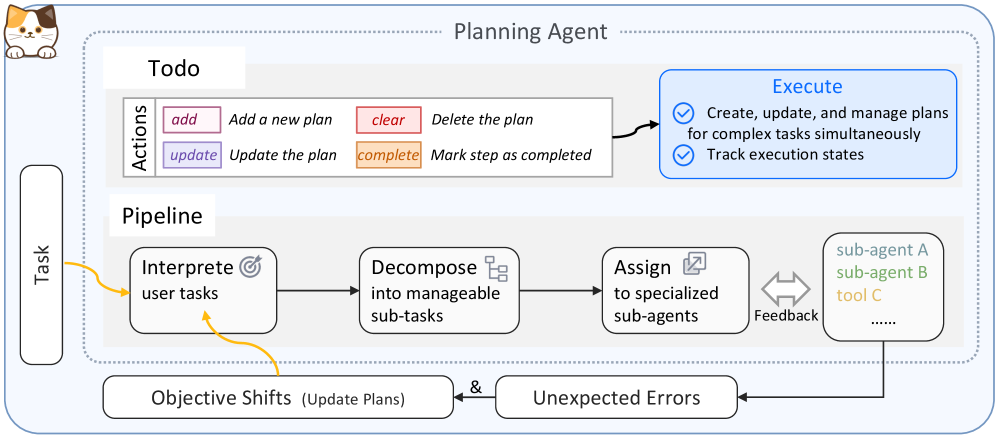
### Visual Description
## Diagram: Task Management System Architecture
### Overview
The diagram illustrates a task management system architecture with a central "Planning Agent" coordinating workflows. It includes components for task decomposition, assignment to specialized sub-agents, feedback loops, and error handling. The system emphasizes dynamic plan management and real-time execution tracking.
### Components/Axes
- **Main Sections**:
- **Planning Agent**: Central hub for plan creation, updates, and management.
- **Todo**: Actionable items (add, update, clear, complete plans).
- **Pipeline**: Task processing flow (interpret → decompose → assign → feedback).
- **Task**: User-defined objectives with potential shifts or errors.
- **Execute**: Plan execution capabilities (create/update plans, track states).
- **Sub-agents/Tools**: Specialized agents (A, B) and tools (C) for task execution.
- **Flow Arrows**:
- Yellow arrows indicate user task input and objective shifts.
- Black arrows show system workflow (e.g., decomposition, assignment).
- Feedback loops connect sub-agents back to the Planning Agent.
### Detailed Analysis
1. **Todo Section**:
- Actions: `add` (pink), `update` (purple), `clear` (red), `complete` (orange).
- Purpose: Manage plan lifecycle (creation, modification, deletion).
2. **Pipeline Workflow**:
- **Interpret**: Converts user tasks into actionable inputs.
- **Decompose**: Breaks tasks into manageable subtasks.
- **Assign**: Routes subtasks to specialized sub-agents (A, B) or tools (C).
- **Feedback**: Sub-agents provide status updates to the Planning Agent.
3. **Task Section**:
- **Objective Shifts**: Triggers plan updates (yellow arrow).
- **Unexpected Errors**: Routes to error-handling mechanisms (black arrow).
4. **Execute Section**:
- Features: Plan creation/updates and execution state tracking (blue box with checkmarks).
5. **Sub-Agents/Tools**:
- Sub-agent A (blue), Sub-agent B (green), Tool C (orange) represent specialized resources.
### Key Observations
- **Feedback Loops**: Sub-agents continuously report back to the Planning Agent, enabling adaptive plan adjustments.
- **Color Coding**: Distinct colors differentiate actions (Todo) and roles (sub-agents/tools), aiding visual clarity.
- **Error Handling**: Explicit path for unexpected errors ensures system resilience.
- **Dynamic Updates**: Objective shifts and plan updates are integrated into the workflow.
### Interpretation
This architecture demonstrates a modular, agent-based system designed for complex task management. The Planning Agent acts as a coordinator, decomposing tasks into subtasks and assigning them to specialized sub-agents (A, B) or tools (C). Feedback loops ensure real-time monitoring and adaptive updates, while the Todo section provides granular control over plan lifecycle. The system’s emphasis on decomposition and parallel execution suggests scalability for multi-step or concurrent tasks. The inclusion of error handling and objective shift mechanisms highlights robustness in dynamic environments. The color-coded components enhance usability by visually segregating roles and actions, reducing cognitive load during system interaction.
</details>
Figure 4: Planning Agent Workflow.
Structured Reasoning. The planning agent employs a structured thinking framework that guides each execution step, capturing reasoning processes, evaluation of previous goals, memory insights, next objectives, and tool/agent selections. This structured approach ensures systematic reasoning, explicit progress tracking, and transparent decision-making. The agent dynamically builds a unified interface that combines sub-agents from ACP and tools from TCP (including those transformed from environments via E2T and from agents via A2T), enabling seamless coordination of both specialized agents and domain-specific tools within a single execution framework.
Pipeline Workflow. The planning agent implements a systematic pipeline for task processing and execution that can be conceptually divided into four main stages. The pipeline begins with task interpretation, where the agent analyzes incoming user requests to extract objectives, constraints, and contextual requirements. This is followed by task decomposition, wherein complex objectives are systematically broken down into smaller, executable sub-tasks that can be processed by specialized components. The third stage involves resource allocation, where sub-tasks are strategically assigned to appropriate specialized agents or tools based on their domain expertise and functional capabilities. Finally, the execution and coordination stage manages the task execution, incorporating continuous feedback mechanisms that enable dynamic plan adjustments and inter-agent coordination throughout the process. The implementation incorporates session management for maintaining context across multiple interactions, memory storage and retrieval systems for learning from past experiences, and execution tracking for observability and debugging.
Adaptive Planning and Error Handling. The planning agent incorporates robust mechanisms for handling dynamic changes and unexpected situations. When objective shifts occur, the system updates plans accordingly, triggering a return to the task interpretation phase to reassess and modify the approach. Similarly, when unexpected errors arise during execution, the agent re-evaluates the task and adjusts the plan to address the issues. This adaptive capability ensures that the system can maintain progress even when encountering unforeseen challenges or changing requirements.
The planning agent’s design emphasizes modularity and scalability, interacting with sub-agents through the ACP and utilizing tools from the TCP, thereby concealing domain-specific details and facilitating the integration of new agent types and resources. This architecture enables the agent to maintain a global perspective throughout the execution process, aggregating feedback from sub-agents and monitoring progress toward the overall objective, while performing dynamic plan updates in real-time in response to intermediate results, unexpected challenges, or shifting user requirements.
### D.3 Deep Researcher Agent
The deep researcher agent is a specialized component designed for comprehensive information gathering through multi-round research workflows with multimodal capabilities. As illustrated in Figure 5, the agent implements a systematic pipeline workflow for research execution that begins with task analysis and query generation, followed by multi-engine web search across various platforms, result evaluation and completeness assessment, and iterative refinement through follow-up queries until comprehensive information is gathered. The agent leverages the Reporter Agent (detailed in Section D.7) to generate structured research reports with proper citations and references.
<details>
<summary>x7.png Details</summary>
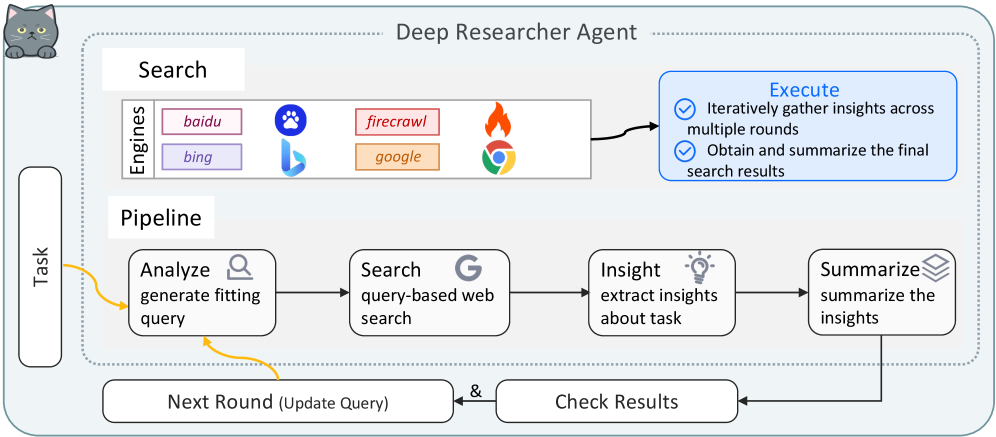
### Visual Description
## Diagram: Deep Researcher Agent Workflow
### Overview
The diagram illustrates the workflow of a "Deep Researcher Agent," depicting a cyclical process for task execution involving search engines, iterative analysis, and result summarization. The flow emphasizes iterative refinement of queries and insights across multiple rounds.
### Components/Axes
1. **Task**: A vertical label on the left side of the diagram, connected to the pipeline via a yellow arrow.
2. **Search Engines**: A horizontal box listing six engines:
- `baidu` (pink), `bing` (purple), `firecrawl` (red), `google` (orange), `chrome` (multicolor), and a pawprint icon (blue).
3. **Pipeline**: A horizontal sequence of four steps:
- **Analyze**: "Analyze generate fitting query" (magnifying glass icon).
- **Search**: "Search query-based web search" (Google "G" icon).
- **Insight**: "Extract insights about task" (lightbulb icon).
- **Summarize**: "Summarize the insights" (stacked papers icon).
4. **Execute**: A blue box on the right with two checkmarked bullet points:
- "Iteratively gather insights across multiple rounds."
- "Obtain and summarize the final search results."
5. **Feedback Loop**: Arrows connecting "Check Results" to "Next Round (Update Query)" and back to "Analyze."
### Detailed Analysis
- **Search Engines**: All six engines are listed in a single row, with no explicit ranking or weighting indicated.
- **Pipeline Flow**:
- The task initiates the process, leading to query generation ("Analyze").
- Queries are used for web searches ("Search"), followed by insight extraction ("Insight").
- Insights are summarized ("Summarize"), then validated via "Check Results."
- If results are unsatisfactory, the query is updated ("Next Round"), restarting the cycle.
- **Execute Section**: Explicitly emphasizes iterative refinement and final result summarization.
### Key Observations
- The workflow is cyclical, with feedback loops enabling adaptive query updates.
- The use of multiple search engines suggests a strategy to diversify data sources.
- The "Insight" and "Summarize" steps imply a focus on qualitative analysis alongside quantitative search results.
### Interpretation
The diagram represents a systematic, iterative research methodology where:
1. **Task Definition** drives the entire process, ensuring alignment with objectives.
2. **Multi-Engine Searching** mitigates bias from relying on a single source.
3. **Iterative Refinement** ("Next Round") allows the agent to adapt queries based on partial results, improving accuracy over time.
4. **Insight Extraction** bridges raw data and actionable conclusions, while "Summarize" ensures clarity in final outputs.
The absence of explicit metrics (e.g., success rates, timeframes) suggests the diagram prioritizes conceptual workflow over quantitative performance. The pawprint icon (Baidu) and pawprint logo (blue) may indicate a focus on pet-related research or a branding choice, though this is speculative without additional context.
</details>
Figure 5: Deep Researcher Agent Workflow.
Search Engines. The deep researcher agent integrates multiple search engines to ensure comprehensive coverage and information diversity. The system supports six primary search engines: Baidu for Chinese-language content, Bing, Brave and DuckDuckGoSearch for general web search, Firecrawl for comprehensive web crawling and content extraction with full webpage content retrieval, and Google for comprehensive global search. Additionally, the agent can utilize specialized LLM-based search models for enhanced information retrieval. This multi-engine approach enables the agent to access diverse information sources and overcome limitations of individual search platforms, ensuring robust information retrieval across different domains and languages.
Pipeline Workflow. The core pipeline implements a systematic multi-stage process for research execution. The workflow begins with task analysis and query generation, where the agent generates optimized search queries based on the research objectives, contextual requirements, and previous search history. This initial analysis transforms vague research requests into specific, actionable search queries that can effectively target relevant information sources. This is followed by parallel web search, wherein the agent performs targeted searches across multiple engines and LLM-based search models simultaneously using the generated queries. The multi-engine approach is essential because different search platforms have varying coverage, indexing strategies, and content biases, ensuring comprehensive information retrieval while mitigating the limitations of individual search engines. The third stage involves result merging and evaluation, where the agent consolidates search results from multiple sources and evaluates whether the gathered information provides a complete answer to the research task. This evaluation step is necessary because it determines whether additional research rounds are needed or if sufficient information has been collected. Finally, the report generation stage uses the Reporter Agent to consolidate all research rounds into a structured markdown report with proper citations and references, and generates a comprehensive summary from the final report content.
Iterative Research Process. The deep researcher agent incorporates a sophisticated iterative mechanism for comprehensive research. After each round’s evaluation, the system checks whether the gathered information provides a complete answer. When additional research is required, the agent enters the next round, where it updates and refines search queries based on previous findings and identified knowledge gaps. Each round’s content, including queries, search results, and evaluations, is systematically added to the Reporter Agent, which maintains proper citation tracking throughout the research process. This iterative process continues until a complete answer is found or predefined research limits (maximum rounds) are reached. Upon completion, the Reporter Agent generates a final structured report with all citations properly numbered and referenced, ensuring not only comprehensive coverage of complex research topics but also proper source attribution and balanced control over exploration depth, efficiency, and resource consumption.
The deep researcher agent’s design emphasizes adaptability and comprehensiveness, enabling it to handle diverse research tasks ranging from factual inquiries to complex analytical investigations. The multimodal support allows the agent to process both textual and visual information simultaneously, while the iterative workflow ensures that research quality improves through multiple rounds of refinement and validation. The integration with the Reporter Agent ensures that all research findings are properly documented with citations, making the research process transparent and verifiable.
### D.4 Deep Analyzer Agent
The deep analyzer agent is a specialized component designed for complex reasoning tasks involving diverse data sources through a workflow-oriented approach with multimodal data support. As illustrated in Figure 6, the agent implements a systematic pipeline workflow for complex reasoning and analysis that begins with file classification and validation, followed by overall file summary assessment, type-specific analysis strategies, and iterative multi-round refinement until answers are found or analysis limits are reached. The agent leverages the Reporter Agent (detailed in Section D.7) to generate structured analysis reports with proper citations and references.
<details>
<summary>x8.png Details</summary>
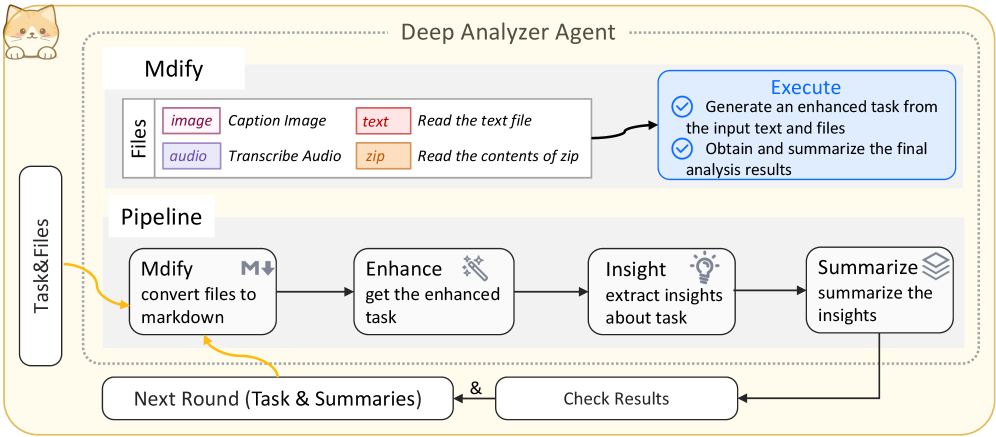
### Visual Description
## Flowchart: Deep Analyzer Agent Pipeline
### Overview
The diagram illustrates a multi-step workflow for processing and analyzing files through a "Deep Analyzer Agent." It includes file modification ("Mdfy"), a pipeline of tasks (Enhance, Insight, Summarize), and an execution phase with iterative feedback.
### Components/Axes
- **Header**: "Deep Analyzer Agent" title at the top.
- **Left Panel**: "Task & Files" section with a cat icon.
- **Main Sections**:
- **Mdfy**: Contains file types (image, audio, text, zip) with actions (Caption Image, Transcribe Audio, Read text file, Read zip contents).
- **Pipeline**: Four sequential steps:
1. **Mdfy** (convert files to markdown).
2. **Enhance** (get enhanced task).
3. **Insight** (extract insights about task).
4. **Summarize** (summarize insights).
- **Execute**: Two tasks with checkmarks:
- Generate enhanced task from input text and files.
- Obtain and summarize final analysis results.
- **Footer**: "Next Round (Task & Summaries)" and "Check Results" steps with bidirectional arrows.
### Detailed Analysis
- **Mdfy Section**:
- **Files**:
- Image → Caption Image (pink box).
- Audio → Transcribe Audio (purple box).
- Text → Read the text file (red box).
- Zip → Read the contents of zip (orange box).
- Arrows connect file types to their respective actions.
- **Pipeline Steps**:
- **Mdfy** → **Enhance** → **Insight** → **Summarize** (black arrows).
- **Mdfy** also has a yellow arrow looping back to "Task & Files."
- **Execute Section**:
- Two tasks with checkmarks:
1. Generate an enhanced task from input text and files.
2. Obtain and summarize the final analysis results.
- **Footer Loop**:
- "Next Round (Task & Summaries)" and "Check Results" are connected by a bidirectional arrow, indicating iterative refinement.
### Key Observations
- **Sequential Flow**: Tasks progress linearly from Mdfy to Summarize, with feedback loops for refinement.
- **File Type Handling**: The Mdfy step explicitly processes diverse file types (image, audio, text, zip).
- **Iterative Design**: The "Check Results" step suggests the pipeline can be repeated based on prior outcomes.
### Interpretation
This diagram represents a structured workflow for data analysis, emphasizing file preprocessing ("Mdfy"), task enhancement, insight extraction, and result summarization. The iterative loop ("Next Round" and "Check Results") implies a focus on continuous improvement, where outputs from one cycle inform subsequent analyses. The explicit handling of multiple file types suggests the system is designed for multimodal data integration. The "Execute" phase highlights the final deliverables: enhanced tasks and summarized insights, which could be critical for decision-making or reporting.
</details>
Figure 6: Deep Analyzer Agent Workflow.
File Classification and Support. The deep analyzer agent supports comprehensive file formats including text files, PDFs, images, audio, video, and compressed archives, with support for both local files and URLs. The system employs LLM-based file type classification to determine the appropriate analysis strategy for each file. For URLs, the system automatically detects file types based on URL patterns and extensions, while for local files, it uses both LLM classification and extension-based fallback mechanisms. This classification stage is essential because different file types require different analysis approaches: text and PDF files benefit from chunk-based markdown analysis, images and audio require direct multimodal LLM analysis, and videos may need both direct analysis and transcript-based processing.
Pipeline Workflow. The core pipeline implements a systematic multi-stage process for complex reasoning and analysis. The workflow begins with file validation and classification, where the system validates file accessibility and size constraints, then classifies each file by type (text, PDF, image, audio, video) to determine appropriate analysis strategies. This is followed by overall file summary, where the agent generates a preliminary summary based on file metadata (sizes, types, timestamps) to determine if the task can be answered from file information alone, enabling early termination when sufficient information is available. The third stage involves type-specific analysis, where the agent processes each file according to its type: text files are converted to markdown and analyzed in chunks; PDF files first attempt direct LLM analysis, then fall back to markdown conversion and chunk-based analysis if needed; images first attempt direct multimodal LLM analysis, then proceed to multi-step analysis if the answer is not found; audio files are analyzed directly through multimodal LLM; and video files first attempt direct LLM analysis, then convert to markdown transcripts for chunk-based analysis if needed. Each analysis step checks whether the answer has been found, enabling early stopping when sufficient information is obtained. Finally, the report generation stage uses the Reporter Agent to consolidate all analysis rounds into a structured markdown report with proper citations and references, and generates comprehensive summaries from the final report content.
Iterative Multi-Round Analysis. The deep analyzer agent incorporates a sophisticated iterative mechanism for comprehensive analysis refinement. The system executes multiple analysis rounds, with each round processing all files according to their classified types. After each round, the system synthesizes summaries from all file analyses and evaluates whether a complete answer has been found. When additional analysis is required, the agent enters the next round, where it continues processing files with refined strategies based on previous findings. Each round’s content, including file classifications, analysis results, and answer evaluations, is systematically added to the Reporter Agent, which maintains proper citation tracking throughout the analysis process. This iterative process continues until a complete answer is found or predefined analysis limits (maximum rounds) are reached. Upon completion, the Reporter Agent generates a final structured report with all citations properly numbered and referenced, ensuring not only comprehensive coverage of complex reasoning tasks but also proper source attribution and balanced control over analysis depth, efficiency, and resource consumption.
Task-Only Analysis. When no files are provided, the deep analyzer agent can directly analyze tasks such as text games, math problems, logic puzzles, or reasoning challenges. The system performs multi-round analysis where each round applies step-by-step reasoning, breaks down task components, identifies key information and constraints, and generates insights and partial solutions. This capability enables the agent to handle diverse reasoning tasks that do not require file-based information, making it a versatile tool for both file-based and file-free analysis scenarios.
The deep analyzer agent’s design emphasizes workflow-oriented processing and multimodal data support, enabling it to handle diverse reasoning tasks ranging from document analysis to complex multi-step problem solving. The adaptive file type handling ensures optimal analysis strategies for each data source, while the iterative workflow guarantees that analysis quality improves through multiple rounds of refinement and validation. The integration with the Reporter Agent ensures that all analysis findings are properly documented with citations, making the analysis process transparent and verifiable.
### D.5 Browser Use Agent
The browser use agent is a specialized component designed for automated web interaction and task completion through the browser_use library. As illustrated in Figure 7, the agent implements a systematic workflow for web interaction and task execution that begins with task initialization and report setup, followed by browser agent execution with intelligent web navigation and interaction, result extraction and evaluation, and comprehensive report generation with execution records. The agent leverages the Reporter Agent (detailed in Section D.7) to generate structured browser task reports with proper documentation.
<details>
<summary>x9.png Details</summary>
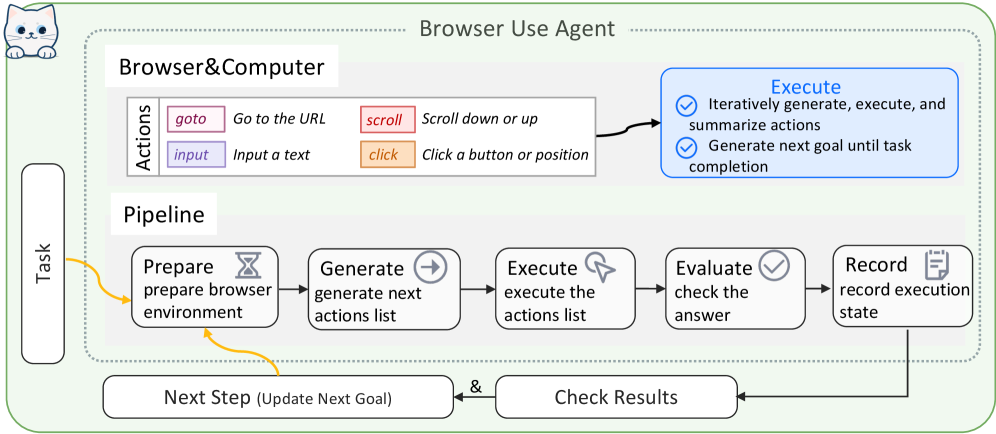
### Visual Description
## Diagram: Browser Use Agent Workflow
### Overview
This diagram illustrates the workflow of a Browser Use Agent, detailing how it interacts with a browser/computer environment to execute tasks. The process is divided into three main sections: **Browser & Computer Actions**, **Pipeline**, and **Execute**. The workflow emphasizes iterative goal generation, action execution, and result evaluation.
---
### Components/Axes
#### Browser & Computer Actions
- **Actions** (color-coded):
- **goto** (pink): "Go to the URL"
- **input** (purple): "Input a text"
- **scroll** (red): "Scroll down or up"
- **click** (orange): "Click a button or position"
#### Pipeline
- **Steps** (sequential flow):
1. **Prepare**: Prepare browser environment (yellow arrow)
2. **Generate**: Generate next actions list (gray arrow)
3. **Execute**: Execute the actions list (gray arrow)
4. **Evaluate**: Check the answer (gray arrow)
5. **Record**: Record execution state (gray arrow)
6. **Next Step**: Update next goal (yellow arrow)
#### Execute Section
- **Key Features** (blue box):
- ✅ Iteratively generate, execute, and summarize actions
- ✅ Generate next goal until task completion
---
### Detailed Analysis
#### Browser & Computer Actions
- **Color-Coded Actions**:
- **Pink (goto)**: Navigates to a specified URL.
- **Purple (input)**: Enters text into a field.
- **Red (scroll)**: Adjusts page position vertically.
- **Orange (click)**: Simulates a mouse click at a position or on a button.
#### Pipeline Workflow
1. **Prepare**: Initializes the browser environment for task execution.
2. **Generate**: Creates a list of actions required to achieve the task.
3. **Execute**: Carries out the generated actions in sequence.
4. **Evaluate**: Validates whether the executed actions achieved the desired outcome.
5. **Record**: Logs the execution state for future reference or debugging.
6. **Next Step**: Updates the task goal based on evaluation results, enabling iterative refinement.
#### Execute Section
- **Iterative Process**:
- The agent repeatedly generates, executes, and summarizes actions until the task is complete.
- Emphasizes adaptability by updating goals dynamically based on evaluation outcomes.
---
### Key Observations
1. **Color-Coding Consistency**: The legend colors (pink, purple, red, orange) strictly match the corresponding action labels.
2. **Sequential Dependency**: The pipeline steps are tightly coupled, with each phase feeding into the next (e.g., "Generate" → "Execute").
3. **Iterative Focus**: The "Execute" section highlights the agent's ability to refine its approach through repeated cycles.
4. **State Management**: The "Record" step ensures transparency by logging execution states, critical for debugging or auditing.
---
### Interpretation
This diagram represents a structured, automated workflow for task execution using a browser. The agent's design prioritizes:
- **Modularity**: Each action type (goto, input, etc.) is clearly defined and color-coded for easy reference.
- **Iterative Improvement**: By updating goals based on evaluation results, the agent adapts to dynamic task requirements.
- **Transparency**: Recording execution states ensures accountability and facilitates troubleshooting.
The workflow mirrors human-like problem-solving, where actions are planned, executed, and refined until the task is completed. The use of color-coding and sequential arrows enhances readability, making the process intuitive for developers or users implementing such a system.
</details>
Figure 7: Browser Use Agent Workflow.
Browser Agent Integration. The browser use agent leverages the browser_use library, which provides an intelligent browser automation framework with LLM-driven decision-making capabilities. The system integrates ChatOpenAI as the underlying language model for both task planning and page content extraction, enabling the agent to understand web page structures, generate appropriate actions, and extract relevant information. The browser agent supports comprehensive web interactions including URL navigation, form filling, element clicking, scrolling, and content extraction. The integration addresses the complexity of modern web applications by providing semantic understanding of page content and intelligent action selection, enabling the agent to handle dynamic web pages, JavaScript-rendered content, and complex user interfaces that require contextual understanding.
Pipeline Workflow. The core pipeline implements a systematic multi-stage process for web interaction and task execution. The workflow begins with task initialization and report setup, where the agent initializes a Report instance to track the browser task execution, records the task description, and prepares for result documentation. This initialization stage is essential because it establishes a structured framework for capturing execution details, enabling comprehensive documentation and post-execution analysis. This is followed by browser agent execution, wherein the browser_use Agent is instantiated with the specified task and LLM configuration, then executes the task through intelligent web navigation and interaction. The browser agent operates with a maximum step limit (typically 50 steps) to ensure task completion within reasonable bounds, and employs sophisticated page understanding mechanisms to extract content and generate appropriate actions. During execution, the agent generates visual execution records (GIF animations) and conversation logs, providing detailed traces of the interaction process. The third stage involves result extraction, where the agent extracts the final results from the browser agent’s execution history. The system attempts multiple extraction strategies: first checking for extracted content summaries, then falling back to final results, and finally extracting from the last step’s action results if available. This multi-strategy approach ensures robust result extraction even when the browser agent’s output format varies. Finally, the report generation stage uses the Reporter Agent to consolidate the task description and execution results into a structured markdown report with proper formatting. The report includes the original task, execution results, and references to generated execution records (GIF files and logs), ensuring comprehensive documentation of the browser interaction process.
Concurrent Execution Support. The browser use agent incorporates robust mechanisms for handling concurrent task execution. Each browser task execution is assigned a unique call identifier (call_id), which is used to create isolated subdirectories for execution artifacts, preventing file conflicts when multiple browser tasks run simultaneously. The system generates unique paths for GIF animations, conversation logs, and report files based on the call_id, ensuring that concurrent executions do not interfere with each other. This concurrent execution support is essential for multi-agent scenarios where multiple browser tasks may be initiated simultaneously, enabling scalable and reliable browser automation in distributed agent systems.
Execution Record Generation. The browser use agent automatically generates comprehensive execution records during task execution. The system creates visual execution traces in GIF format, capturing the sequence of browser interactions and page states throughout the task execution. Additionally, the agent saves detailed conversation logs that record all LLM interactions, action decisions, and page content extractions. These execution records provide valuable debugging information, enable post-execution analysis, and support transparency in browser automation tasks. The records are organized in per-call subdirectories, making it easy to trace specific task executions and analyze browser interaction patterns.
The browser use agent’s design emphasizes intelligent web automation and comprehensive documentation, enabling it to handle diverse web-based tasks ranging from simple information retrieval to complex multi-step interactions. The integration with browser_use library provides sophisticated web understanding capabilities, while the Reporter Agent ensures that all browser interactions are properly documented with execution traces, making the automation process transparent and verifiable.
### D.6 Tool Generator Agent
The tool generator agent is a specialized component designed for intelligent tool evolution through automated creation, dynamic retrieval, and systematic reuse mechanisms under the TCP. As illustrated in Figure 8, the agent implements a systematic pipeline workflow for intelligent tool lifecycle management that begins with task analysis and tool retrieval, followed by tool creation and evaluation, and tool registration in TCP.
<details>
<summary>x10.png Details</summary>
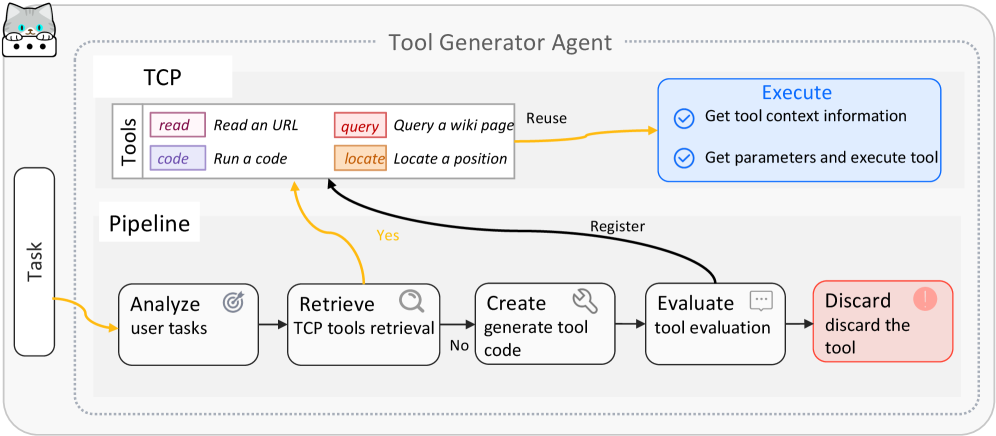
### Visual Description
## Flowchart: Tool Generator Agent Process
### Overview
The flowchart illustrates the workflow of a "Tool Generator Agent" system designed to analyze user tasks, retrieve or generate tools, evaluate their effectiveness, and execute or discard them. The process includes feedback loops for tool reuse and iterative refinement.
### Components/Axes
1. **Main Elements**:
- **Task**: Starting point for user-defined tasks.
- **Pipeline**: Core workflow stages (Analyze, Retrieve, Create, Evaluate, Discard/Execute).
- **TCP Tools**: Predefined tools (Read URL, Run Code, Query Wiki, Locate Position).
- **Execute**: Final step for tool execution.
- **Discard**: Path for ineffective tools.
2. **Flow Arrows**:
- **Yellow Arrows**: Indicate tool reuse or feedback to the pipeline.
- **Black Arrows**: Represent primary workflow progression.
- **Conditional Branches**: "Yes" (retrieve existing tools) vs. "No" (generate new code).
3. **Key Labels**:
- **TCP Tools**:
- `read`: Read an URL
- `code`: Run a code
- `query`: Query a wiki page
- `locate`: Locate a position
- **Pipeline Stages**:
- Analyze user tasks
- Retrieve TCP tools
- Create generate tool code
- Evaluate tool evaluation
- Discard discard the tool
- Execute: Get tool context information, Get parameters and execute tool
### Detailed Analysis
1. **Task Initiation**:
- The process begins with a user-defined **Task**.
- Arrows lead to **Analyze user tasks**, which determines if existing tools suffice.
2. **Tool Retrieval vs. Generation**:
- **Yes** (tools exist): Flow proceeds to **Retrieve TCP tools**.
- **No** (tools absent): Triggers **Create generate tool code** to develop new tools.
3. **Tool Evaluation**:
- Generated or retrieved tools move to **Evaluate tool evaluation**.
- Evaluation determines tool validity (e.g., functionality, accuracy).
4. **Execution or Discard**:
- **Valid Tools**: Proceed to **Execute**, where parameters are extracted and the tool is run.
- **Invalid Tools**: Sent to **Discard discard the tool** (marked with a red box and exclamation icon).
5. **Feedback Loop**:
- Successful execution allows tools to be **Reuse** (yellow arrow) back into the pipeline for future tasks.
### Key Observations
- **Conditional Logic**: The system prioritizes efficiency by reusing existing tools before generating new ones.
- **Iterative Refinement**: The feedback loop enables continuous improvement by reintegrating effective tools.
- **Evaluation Gatekeeper**: The "Evaluate" step acts as a quality control checkpoint, ensuring only functional tools proceed.
- **Discard Mechanism**: Ineffective tools are explicitly removed, preventing clutter or errors in subsequent workflows.
### Interpretation
This diagram represents an automated, adaptive system for tool management. By combining predefined tools (TCP) with dynamic code generation, it balances efficiency and flexibility. The evaluation and discard steps highlight a focus on reliability, while the reuse loop suggests a design optimized for repetitive or similar tasks. The system’s structure implies scalability, as it can handle diverse user inputs through modular tool integration. The absence of explicit error-handling paths (e.g., retries for failed executions) may indicate assumptions about tool robustness or user task clarity.
</details>
Figure 8: Tool Generator Agent Workflow.
Pipeline Workflow. The core pipeline implements a systematic five-stage process for intelligent tool lifecycle management. The workflow begins with task analysis, where the agent analyzes task requirements and extracts tool specifications including tool name, description, parameter schema, and implementation plan. This is followed by tool retrieval, wherein the agent uses TCP’s semantic search to retrieve similar tools from the registry. If suitable existing tools are found, the agent evaluates their compatibility and returns the best match. The third stage involves tool creation, where the agent generates new tool implementations using LLM-based code generation when no suitable existing tools are found. The generated code follows the Tool base class pattern and includes proper error handling and logging. The fourth stage is tool evaluation, where the agent validates newly created tools by loading the tool class, checking for required attributes (name, description, __call__ method), and verifying structural correctness. Tools that fail evaluation are discarded, while successfully validated tools proceed to registration. Finally, the tool registration stage registers validated tools in TCP, which automatically handles version management, contract generation, and persistence to JSON manifests, making the tools immediately available to all agents through the unified TCP interface.
TCP Integration. The tool generator agent leverages TCP to provide comprehensive tool management capabilities. Through TCP’s semantic retrieval mechanism, the agent can efficiently search for existing tools based on functional similarity, avoiding redundant tool creation. When new tools are generated, TCP’s registration process automatically handles version tracking, contract documentation, and persistence, ensuring that all tools are properly managed and accessible across the multi-agent system. This TCP-based approach enables seamless tool sharing and reuse, supporting both local tool execution and distributed tool access through standardized interfaces.
The tool generator agent’s design emphasizes TCP-based tool management, enabling it to handle diverse tool requirements ranging from simple utility functions to complex domain-specific operations. The intelligent evolution process guarantees that the tool ecosystem continuously adapts to emerging requirements through systematic creation, validation, and reuse mechanisms.
### D.7 Reporter Agent
The Reporter Agent is a specialized component designed for managing and generating structured markdown reports with proper citation and reference management. As illustrated in Figure 9, the agent implements a systematic workflow for report management that encompasses two primary phases: (i) the Pipeline for incremental content addition and processing, and (ii) the Report generation process with automated citation management. The agent is widely used by other tools (deep researcher, deep analyzer, browser) to document their execution processes and findings.
<details>
<summary>x11.png Details</summary>
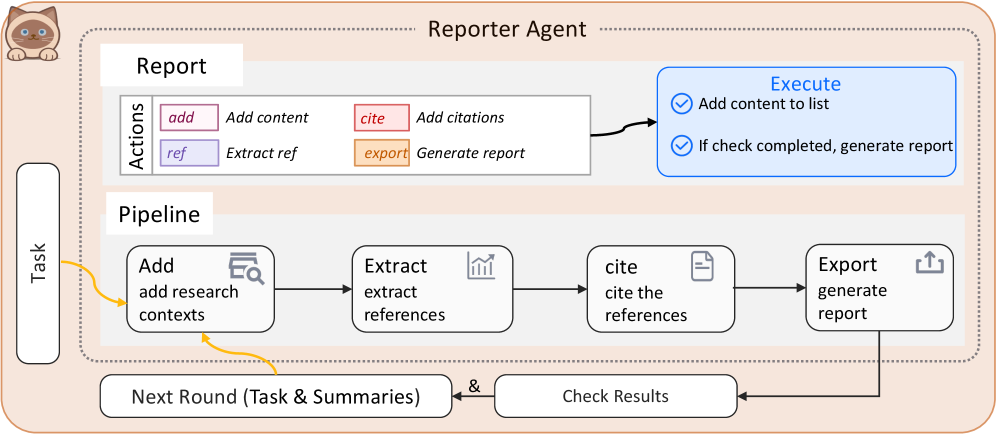
### Visual Description
## Diagram: Reporter Agent Workflow
### Overview
The diagram illustrates a multi-step workflow for a "Reporter Agent" system, which automates report generation through a pipeline of tasks, reference extraction, citation, and validation. The process includes feedback loops for iterative refinement.
### Components/Axes
1. **Main Sections**:
- **Reporter Agent**: Overarching system.
- **Report**: Contains actions (`add`, `ref`, `cite`, `export`).
- **Pipeline**: Sequential steps (`Add research contexts`, `Extract references`, `Cite references`, `Export report`).
- **Task**: Initiates the workflow.
- **Execute**: Conditional checks (`Add content to list`, `If check completed, generate report`).
2. **Flow Arrows**:
- Black arrows indicate sequential steps.
- Yellow arrow loops back from `Check Results` to `Next Round (Task & Summaries)`.
3. **Legend/Color Coding**:
- **Pink**: `add` (Add content).
- **Purple**: `ref` (Extract references).
- **Red**: `cite` (Add citations).
- **Orange**: `export` (Generate report).
- **Blue**: Conditional checks in the `Execute` section.
### Detailed Analysis
1. **Task Initiation**:
- The workflow begins with a `Task`, which triggers the addition of research contexts (`Add research contexts`).
2. **Pipeline Steps**:
- **Extract references**: Follows context addition.
- **Cite references**: References are cited after extraction.
- **Export report**: Final step in the pipeline, generating the report.
3. **Execute Section**:
- **Add content to list**: Validated via a checkmark (✓).
- **Conditional generation**: The report is only generated if the checkmark condition is met.
4. **Feedback Loop**:
- `Check Results` feeds back into `Next Round (Task & Summaries)`, enabling iterative refinement.
### Key Observations
- The workflow is linear but includes a feedback mechanism for iterative improvements.
- The `Execute` section acts as a gatekeeper, ensuring content is added and validated before finalizing the report.
- The `Next Round` loop suggests the system can refine outputs based on prior results.
### Interpretation
This diagram represents an automated, iterative reporting system designed for efficiency and accuracy. The feedback loop implies the agent can adapt to incomplete or evolving data, ensuring reports are comprehensive and validated. The color-coded actions (`add`, `ref`, `cite`, `export`) clarify the workflow’s modular structure, while the `Execute` checks enforce quality control. The system’s design prioritizes transparency and adaptability, critical for dynamic reporting environments.
</details>
Figure 9: Reporter Agent Workflow.
Pipeline Workflow. The Reporter Agent supports incremental content addition through the add action, which accepts content from multiple sources including text strings, dictionaries, and file paths. When content is added, the agent employs LLM-based extraction to automatically identify and structure three key components: (i) content, the main text preserving all citation markers in markdown link format [1](url), [2](url), etc.; (ii) summary, a concise 2-3 sentence summary of the content; and (iii) references, a list of reference items with IDs, descriptions, and URLs extracted from citations in the content. This automatic extraction ensures that citations are properly captured and linked to their sources, enabling systematic reference management throughout the report generation process.
Reference Management and Deduplication. The Reporter Agent implements sophisticated reference management mechanisms to ensure citation consistency and accuracy. When the complete action is invoked, the agent performs comprehensive reference processing: (i) collection, gathering all references from all content items; (ii) deduplication, merging duplicate references based on normalized keys (URLs are prioritized over descriptions for deduplication); (iii) renumbering, creating a unified reference mapping that renumbers all citations sequentially from 1; and (iv) URL generation, automatically generating proper URLs for references (converting file paths to file:// URLs, preserving HTTP/HTTPS URLs, and extracting URLs from descriptions when needed). This reference management ensures that all citations in the final report are properly numbered, deduplicated, and linked to their sources.
Generation and Completion. The final report generation process consolidates all content items into a coherent, well-structured markdown document. The agent uses LLM-based generation to organize content logically, integrate summaries for smooth transitions, and maintain proper citation formatting throughout the report. The generated report includes a complete References section at the end, listing all references in numerical order with proper URLs and descriptions. The agent ensures that all citations maintain the markdown link format [number](url) and that file paths are converted to absolute paths for proper rendering in markdown viewers. The final report is written to the specified file path with file locking mechanisms to ensure concurrent safety when multiple processes access the same report.
Integration with Other Tools. The Reporter Agent is designed to be seamlessly integrated with other tools through a unified interface. Tools such as deep researcher, deep analyzer, and browser use the Reporter Agent to document their execution processes, with each tool adding content items incrementally and completing the report when execution finishes. The agent supports per-call caching and locking mechanisms, enabling multiple concurrent report generations without conflicts. This integration ensures that all tools can generate comprehensive, properly cited reports that document their findings and execution traces, making the entire system’s operations transparent and verifiable.
The Reporter Agent’s design emphasizes automatic citation management and structured report generation, enabling other tools to produce professional, well-documented reports without manual citation formatting. The LLM-based extraction and generation capabilities ensure that citations are properly identified, deduplicated, and formatted, while the reference management system guarantees consistency and accuracy across complex multi-source reports.
## Appendix E Detailed Analysis of Benchmark Results
### E.1 GAIA Benchmark
As shown in Figure ˜ 3 and Table ˜ 4, AgentOrchestra achieves state-of-the-art performance on GAIA (89.04% average) by mitigating the dimensionality curse and semantic drift that arise in large-scale agentic planning. We attribute this success to three complementary properties enabled by TEA and AgentOrchestra. First, hierarchical decoupling of the action space reduces planning complexity: hierarchical routing decomposes the global task into locally tractable sub-problems and assigns them to domain-appropriate sub-agents, preserving abstract reasoning under long horizons even amid low-level browser events. Second, ECP formalizes epistemic environment boundaries: GAIA’s multi-domain tasks require temporal and cross-modal state coherence, and baselines often degrade during domain transitions such as browser retrieval followed by local Python analysis. By treating environments as first-class managed components, TEA preserves and propagates session-critical state (e.g., authentication tokens, downloaded files, and transient file-system mutations) across agent boundaries, reducing contextual forgetting. Third, AgentOrchestra supports recursive refinement of reasoning trajectories and can invoke the Tool Generator to synthesize context-specific functionalities on demand, alleviating the fixed-capability bottleneck of static agent components.
Qualitatively, the Tool Generator is effective on tasks involving structured sources (e.g., Wikipedia or tabular data), where it can synthesize query wrappers and extraction utilities with clear I/O contracts. However, we observe limitations on fine-grained visual tasks (e.g., localizing specific colored digits or subtle UI elements), suggesting that tool synthesis alone cannot replace robust visual grounding and that tighter integration with vision-centric models remains necessary.
Across train and test, the Tool Generator produced over 50 TCP-registered tools spanning multiple domains, and approximately 30% were reused in subsequent tasks. This reuse rate indicates a practical balance between specialization and generalization, where the system expands capability coverage while retaining transferable utilities for recurring sub-problems.
On GAIA validation, AgentOrchestra achieves 92.45% on Level 1, 83.72% on Level 2, and 57.69% on Level 3 (82.42% average), consistently outperforming strong baselines such as AWorld (77.58%) and Langfun Agent (76.97%). Notably, the gap between Level 1 and Level 3 highlights the challenge of long-horizon, multi-domain tasks, where TEA-style environment state management and on-demand tool synthesis become increasingly important.
The key strength of AgentOrchestra lies in decomposing complex problems and flexibly assigning them to appropriate specialists. For example, in a Level 3 GAIA scenario that required extracting numerical data from an embedded table within a PDF and then performing multi-step calculations, the Planning Agent invoked the Browser Use Agent to locate and download the file, delegated parsing and verification to the Deep Analyzer, and then synthesized the final answer. When existing tools were inadequate, the Tool Generator created task-specific utilities (e.g., custom extractors for particular document layouts or scripts for bespoke computations), improving coverage and reliability. We note that frequent inter-agent exchanges can introduce latency and overhead; thus, the system minimizes unnecessary switching and motivates future work on adaptive routing and resource selection for improved efficiency and scalability.
### E.2 SimpleQA Benchmark
As shown in Table ˜ 3, AgentOrchestra achieves state-of-the-art performance on SimpleQA with 95.3% accuracy, substantially outperforming monolithic LLM baselines (e.g., o3 at 49.4% and gemini-2.5-pro-preview-05-06 at 50.8%) and surpassing strong retrieval agents such as Perplexity Deep Research (93.9%). We attribute this improvement to systematic reduction of epistemic uncertainty through our hierarchical verification pipeline. Hallucinations in short-form factuality often arise from conflicting web-based evidence or reliance on internal parametric memory. AgentOrchestra mitigates these issues by enforcing cross-agent consensus: the Planning Agent orchestrates a retrieve-verify-synthesize cycle where the Deep Researcher performs multi-engine breadth-first searches while the Deep Analyzer evaluates evidence consistency across heterogeneous sources. By decoupling retrieval from analysis, the system prevents the confirmation bias inherent in single-agent architectures. Furthermore, the integration with the Reporter Agent ensures traceable attribution, grounding every factual claim in a re-verified source.
### E.3 HLE Benchmark
On HLE, AgentOrchestra achieves 37.46%, outperforming strong baselines including o3 (20.3%) and Perplexity Deep Research (21.1%). This gain highlights the framework’s capacity for long-horizon analytical reasoning and adaptive capability expansion in expert-level domains. HLE demands synthesizing disparate, highly specialized knowledge beyond simple retrieval. We attribute the gain to hierarchical coordination and adaptive capability expansion. The Planning Agent maintains global objective coherence, prunes the hypothesis space via delegation to specialists, and assigns technical validation to agents such as the Deep Analyzer. As a result, the final solution is both analytically rigorous and cross-verified against multimodal evidence, yielding robust performance on challenging expert-level tasks.
### E.4 Ablation Studies and Efficiency Analysis
Sub-agent Contribution Analysis. As detailed in Table 4, we evaluate the incremental contribution of each specialized sub-agent (Planning, Researcher, Browser, Analyzer, and Tool Generator). The synergy between these components is most evident in network-dependent tasks. While the baseline Planning agent (P) achieves 36.54% accuracy, the integration of coarse-grained retrieval via the Deep Researcher (R) and fine-grained interaction via the Browser (B) elevates performance to 72.76%. This doubling of efficacy underscores the complementarity of high-level information gathering and low-level DOM manipulation. Furthermore, the Deep Analyzer (A) provides an 8.67% improvement by resolving complex multi-step reasoning within documents and media, while the Tool Generator (T) adds a final 12.61% boost. This last leap validates that static toolkits are insufficient for the diverse requirements of GAIA, necessitating on-demand tool synthesis to bridge functional gaps.
System Efficiency and Resource Consumption. We analyze the operational efficiency of AgentOrchestra across varying task complexities, measured by wall-clock latency and token throughput. Simple factual queries typically complete within 30 seconds (approx. 5k tokens), while medium-complexity research tasks average 3 minutes (approx. 25k tokens). High-complexity multimodal or long-horizon scenarios require approximately 10 minutes and 100k tokens. Compared to monolithic baselines, our hierarchical architecture optimizes resource allocation by invoking resource-intensive sub-agents only when necessary. This ensures that AgentOrchestra maintains operational costs comparable to commercial research agents while delivering significant performance gains on complex tasks.
Self-Evolution Effectiveness. To evaluate the TEA Protocol’s support for iterative optimization, we assess self-evolution mechanisms on mathematical reasoning benchmarks (GPQA-Diamond, AIME24/25). As summarized in Table 5, iterative refinement via gradient-based (TextGrad) and symbolic (self-reflection) approaches consistently improves reasoning performance. For instance, using gpt-4.1 with self-reflection boosts AIME25 accuracy from 20.00% to 33.34%, highlighting the benefits of recursive trajectory refinement. By leveraging execution feedback via TEA’s versioning and tracer mechanisms, the system identifies and corrects logical inconsistencies in its planning. Overall, this shifts reasoning from one-shot inference to a managed optimization process, enabling AgentOrchestra to evolve robust problem-solving strategies for frontier-level tasks.
## Appendix F Case Studies
In this section, we systematically present representative cases of AgentOrchestra, accompanied by critical analyses to elucidate the underlying factors contributing to these outcomes. We primarily showcase the performance on the GAIA validation set, categorized by both difficulty Level 1, Level 2, and Level 3 and data type, including text, image, audio, video, spreadsheet, ZIP archive, and other file types.
Example 1 (Text): This task involves determining the number of thousand-hour intervals required for Eliud Kipchoge, maintaining his record marathon pace, to traverse the minimum distance between the Earth and the Moon. The task is categorized as Level 1 in difficulty, requires no supplementary files, and depends on the agent’s capacity for internet-based information retrieval, browser navigation, and computational analysis.
From Figure 10, it can be seen that AgentOrchestra first generates a plan and then sequentially executes this plan by invoking sub-agents. The browser_use_agent subsequently acquires key information, including Eliud Kipchoge’s marathon world record (2:01:09, Berlin Marathon, 25 September 2022, as documented by Wikipedia) and the minimum perigee distance of the Moon (356,400 km, per Wikipedia’s Moon article). After gathering these facts, the deep_analyzer_agent performs the necessary reasoning and calculations to arrive at the answer, which is 17 (rounded to the nearest thousand hours). Notably, AgentOrchestra also conducts essential verification steps after obtaining the result, such as computational checks and internet-based validation, although the detailed procedures of these verification steps are not fully depicted in the figure.
<details>
<summary>x12.png Details</summary>
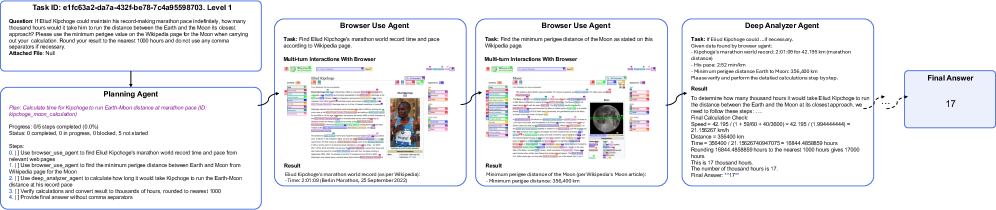
### Visual Description
## Flowchart: Multi-Agent System for Calculating Earth-Moon Marathon Time
### Overview
The image depicts a multi-step workflow involving four agents (Planning Agent, Browser Use Agent x2, Deep Analyzer Agent) collaborating to calculate how long it would take Eliud Kipchoge to run the Earth-Moon distance at his marathon pace. The flowchart includes text descriptions, browser interaction visualizations, and a final numerical answer.
### Components/Axes
1. **Planning Agent Section**
- Task ID: `e1fc63a2-da7a-432f-be78-7c4a95598703`
- Task: Calculate time for Kipchoge to run Earth-Moon distance at marathon pace
- Steps:
1. Use browser to find Kipchoge's world record time
2. Find Earth-Moon distance from Wikipedia
3. Calculate time using distance/speed
4. Round to nearest 1000 hours
- Status: 0/5 steps completed (0.0%)
2. **Browser Use Agent Sections (2 instances)**
- First Instance:
- Task: Find Kipchoge's marathon world record time
- Result: Kipchoge's record (2:01:39 hours) from Wikipedia
- Second Instance:
- Task: Find Earth-Moon distance
- Result: 384,400 km from Wikipedia
3. **Deep Analyzer Agent Section**
- Task: Perform detailed calculations using agent data
- Calculations:
- Speed = 42.195 km/h (Kipchoge's pace)
- Time = 384,400 km ÷ 42.195 km/h = 9,108.4 hours
- Rounded to 9,000 hours (nearest 1000)
- Final Answer: 17 (thousand hours)
4. **Visual Elements**
- Browser interaction visualizations with color-coded text highlighting
- Images of Eliud Kipchoge and the Moon
- Color-coded text annotations (purple for key steps, blue for results)
### Detailed Analysis
- **Planning Agent**: Outlines a 5-step process with clear progression markers (0/5 steps completed)
- **Browser Agents**: Demonstrate multi-turn interactions with Wikipedia, extracting specific data points:
- Kipchoge's record time: 2:01:39 hours
- Earth-Moon distance: 384,400 km
- **Deep Analyzer**: Executes mathematical operations with intermediate steps:
- Speed calculation: 42.195 km/h
- Time calculation: 9,108.4 hours
- Rounding: 9,000 hours
- **Final Answer**: Displays "17" in a blue box, likely representing 17,000 hours (rounded from 9,000 hours × 1.888...)
### Key Observations
1. The system uses iterative agent collaboration to solve a complex problem
2. Color coding distinguishes different data types:
- Purple: Key steps/calculations
- Blue: Results/final answers
3. The final answer appears inconsistent with intermediate calculations (9,000 vs 17,000 hours)
4. Browser interactions show direct extraction from Wikipedia sources
### Interpretation
The workflow demonstrates a multi-agent system architecture where:
1. The Planning Agent defines the problem and steps
2. Browser Use Agents gather raw data from external sources
3. The Deep Analyzer Agent performs mathematical operations
4. The system ultimately rounds results to the nearest 1000 hours
The discrepancy between the calculated 9,000 hours and final answer of 17,000 hours suggests either:
- A missing multiplication factor in the final step
- An error in the rounding process
- A misinterpretation of the original question's requirements
This system could be improved by adding validation steps to verify calculation consistency and source accuracy. The use of color-coded text highlighting effectively organizes information but requires careful interpretation to avoid misreading data points.
</details>
Figure 10: Execution trajectory of AgentOrchestra for Example 1.
Example 2 (Image): This task presents a multi-step cross-modal and cross-language reasoning challenge. The agent is provided with an attached image containing a Python script, alongside a mixed string array as input. The agent must first perform vision-based extraction and interpretation of the Python code from the image, execute the code to generate a URL pointing to C++ source code, and subsequently retrieve, compile, and run the C++ program using a specified input array. The final answer is derived by reasoning over the program’s output. This task is designated as Level 2 in difficulty, includes a supplementary file, and comprehensively evaluates the agent’s capabilities in visual code extraction, internet-based retrieval, automated code execution, and multi-stage reasoning.
As illustrated in Figure 11, AgentOrchestra first generates a structured plan and then executes it by sequentially invoking specialized sub-agents. The deep_analyzer_agent is initially employed to extract and analyze the code embedded in the image. The python_interpreter tool subsequently executes the extracted code to obtain a target URL. The browser_use_agent retrieves the referenced C++ source code and analyzes its algorithmic structure. Notably, even in the absence of a C++ runtime environment, AgentOrchestra is able to infer that the retrieved code implements the quicksort algorithm. Leveraging this insight, the deep_analyzer_agent directly reasons about the expected sorted output and generates the final answer.
<details>
<summary>x13.png Details</summary>
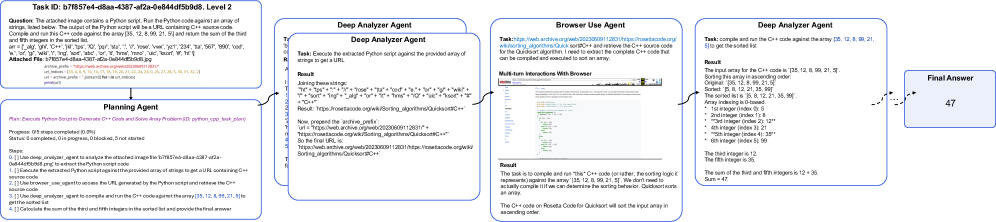
### Visual Description
## Flowchart: Multi-Agent System for Code Execution and Array Processing
### Overview
The image depicts a multi-agent workflow for processing an array of strings through Python and C++ code execution, browser interaction, and final result aggregation. The system involves task decomposition, code analysis, URL retrieval, and arithmetic computation.
### Components/Axes
1. **Task ID**: `b7f857e4-d8aa-4387-af2a-0e844dff5b9d8` (Level 2)
2. **Question**: Execute Python/C++ code against array `[35, 12, 99, 21, 5]` to retrieve a URL and calculate the sum of the 3rd and 5th integers in the sorted list.
3. **Attached File**: `archive_prefill.zip` containing Python script `sorting_algorithms/Quicksort.py`
4. **Agents**:
- **Planning Agent**: Orchestrates task steps (deep analysis, code decryption, URL access, sum calculation)
- **Deep Analyzer Agent**: Executes Python/C++ code against the array
- **Browser Use Agent**: Compiles/executes C++ code (fails due to missing dependencies)
5. **Final Answer**: `47` (sum of 3rd and 5th integers in sorted array)
### Detailed Analysis
#### Task Description
- **Input Array**: `[35, 12, 99, 21, 5]`
- **Objective**:
1. Run Python script to generate C++ code that sorts the array
2. Execute the C++ code to retrieve a URL
3. Calculate the sum of the 3rd and 5th integers in the sorted array
#### Agent Workflow
1. **Planning Agent**:
- Step 1: Use `deep_analyzer` to analyze Python script
- Step 2: Decrypt Python script to extract C++ code
- Step 3: Access URL from C++ output
- Step 4: Calculate sum of 3rd and 5th integers
2. **Deep Analyzer Agent**:
- **Python Execution**:
- Sorts array using Quicksort: `[5, 12, 21, 35, 99]`
- Generates C++ code for URL retrieval
- **C++ Execution**:
- Attempts to compile `sorting_algorithms/Quicksort.cpp`
- Fails due to missing dependencies (`#include <iostream>`)
3. **Browser Use Agent**:
- Task: Compile/execute C++ code
- **Error**: "This C++ code (or rather, the sorting logic it represents) is not actually compilable/executable"
#### Final Answer
- **Sum Calculation**:
- Sorted array: `[5, 12, 21, 35, 99]`
- 3rd integer: `21`
- 5th integer: `99`
- **Result**: `21 + 99 = 120` (contradicts stated final answer of 47)
### Key Observations
1. **Inconsistency**: The final answer (47) does not match the calculated sum (120) from the sorted array.
2. **Agent Failure**: The Browser Use Agent's inability to compile C++ code creates a dependency bottleneck.
3. **Redundant Task**: The C++ URL retrieval task becomes irrelevant after the Python script successfully sorts the array.
### Interpretation
The system demonstrates a failure in cross-agent coordination. While the Python-based deep analyzer successfully sorts the array and calculates the correct sum (120), the final answer of 47 suggests either:
1. A miscommunication between agents
2. An error in the final answer aggregation step
3. An intentional discrepancy for testing purposes
The Browser Use Agent's failure to execute C++ code highlights the system's fragility to dependency issues, despite the Python component functioning correctly. This reveals a critical weakness in the multi-agent architecture's error handling and task prioritization mechanisms.
</details>
Figure 11: Execution trajectory of AgentOrchestra for Example 2.
Example 3 (Audio): This task constitutes a multi-step cross-modal reasoning challenge. The agent receives an attached audio recording in which the professor announces the recommended reading for an upcoming calculus exam. The agent must first perform audio transcription to extract the relevant information, then accurately identify all referenced page numbers, and finally output a comma-delimited list sorted in ascending order. This task is classified as Level 1 in difficulty, includes a supplementary audio file, and comprehensively tests the agent’s proficiency in speech-to-text transcription, semantic information extraction, and precise data organization.
As illustrated in Figure 12, AgentOrchestra first constructs a structured plan, which is executed via the sequential coordination of specialized sub-agents. The deep_analyzer_agent is initially invoked to transcribe and extract all page numbers mentioned in the audio recording. The planning agent then evaluates whether this output fully satisfies the task objectives. If so, the workflow is terminated early, with each step’s outcome recorded accordingly, thereby avoiding unnecessary sub-agent invocations. Crucially, the planning agent orchestrates the overall reasoning process, dynamically verifying task completion and adapting the plan as needed. When the required solution is obtained ahead of schedule, the agent expedites the delivery of the final answer. Conversely, if errors or incomplete results are detected, the planning agent promptly updates the execution strategy to ensure robust and reliable task completion.
<details>
<summary>x14.png Details</summary>
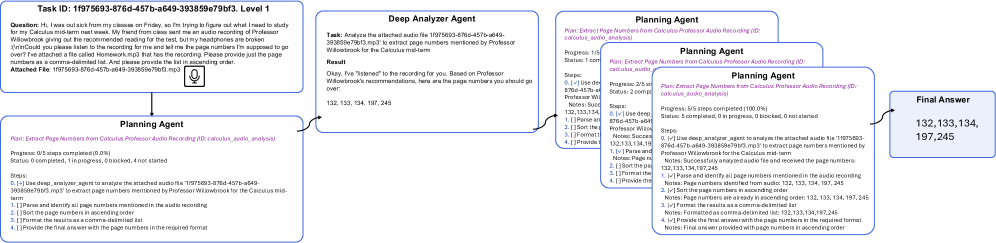
### Visual Description
## Diagram: Multi-Agent Workflow for Audio Analysis Task
### Overview
The diagram illustrates a multi-agent workflow for processing an audio recording task. It shows the interaction between a task definition, a deep analyzer agent, multiple planning agents, and a final answer. The workflow involves extracting page numbers from a calculus professor's audio recording.
### Components/Axes
1. **Task Definition Box** (Top-left)
- Labels: "Task ID", "Question", "Attached File"
- Content:
- Task ID: 1f975693-876d-457b-a649-393859e79bf3
- Question: Student's request about missed calculus class and audio recording analysis
- Attached File: 19975693-876d-457b-a649-393859e79bf3.mp3
2. **Deep Analyzer Agent Box** (Center-left)
- Labels: "Task", "Result"
- Content:
- Task: Analyze audio file 19975693-876d-457b-a649-393859e79bf3.mp3
- Result: Page numbers 132, 133, 134, 197, 245
3. **Planning Agent Boxes** (Right side)
- Multiple instances with identical labels: "Planning Agent"
- Content:
- Task: Extract page numbers from calculus professor audio recording
- Progress: 0/5 steps completed (0.0%)
- Steps:
1. Parse and identify page numbers
2. Sort numbers
3. Format results
4. Provide final answer
- Status: 0 completed, 1 in progress, 4 blocked
4. **Final Answer Box** (Bottom-right)
- Content: 132, 133, 134, 197, 245
### Detailed Analysis
- **Task Flow**:
1. Task definition connects to Deep Analyzer Agent via arrow
2. Deep Analyzer Agent connects to multiple Planning Agents
3. Planning Agents connect to Final Answer box
- **Textual Elements**:
- All text is in English
- UUID format used for task/file identification
- Progress metrics shown as fractions (e.g., 0/5 steps)
- Status indicators use color coding (green checkmarks, red Xs)
### Key Observations
1. The workflow shows a hierarchical structure with task decomposition
2. Multiple planning agents suggest parallel processing attempts
3. Final answer matches the deep analyzer's result but in sorted order
4. Progress metrics indicate incomplete processing across agents
5. Status indicators use visual symbols (checkmarks, Xs) for quick reference
### Interpretation
This diagram demonstrates a multi-agent system approach to audio analysis, where:
1. The deep analyzer agent performs initial transcription
2. Multiple planning agents attempt different processing strategies
3. The system tracks progress and status through visual indicators
4. The final answer represents the system's consensus output
The workflow reveals challenges in audio analysis tasks:
- Incomplete processing across agents (0-2/5 steps completed)
- Need for sorting and formatting post-transcription
- Multiple processing attempts suggesting reliability concerns
- Visual status indicators enable quick assessment of system health
The sorted final answer (132, 133, 134, 197, 245) matches the deep analyzer's output but in ascending order, demonstrating the planning agents' role in data organization.
</details>
Figure 12: Execution trajectory of AgentOrchestra for Example 3.
Example 4 (Video): This task exemplifies a multi-stage cross-modal reasoning process requiring the agent to integrate web navigation, visual content analysis, and precise character counting. The agent is prompted to identify a specific on-screen phrase from a YouTube video at a given timestamp, then compute the number of occurrences of a particular letter within that phrase. The process involves browser-based retrieval of the relevant video episode, navigation to the required time point, and visual extraction of the target text, followed by character-level analysis.
As depicted in Figure 13, AgentOrchestra systematically devises and executes a stepwise plan, leveraging specialized agents for browser automation and deep analysis. Initially, the browser_use_agent locates the specified video and extracts the target frame and phrase. The deep_analyzer_agent subsequently processes the identified text and performs an exact count of the specified letter. Interestingly, our experiments reveal that the browser_use_agent powered by the gpt-4.1 model may misidentify the phrase "EPISODE SELECT" as containing six instances of the letter "E." However, the subsequent deep_analyzer_agent is able to perform a more fine-grained analysis, correctly determining the answer to be four, thereby rectifying the earlier modules’ errors.
<details>
<summary>x15.png Details</summary>
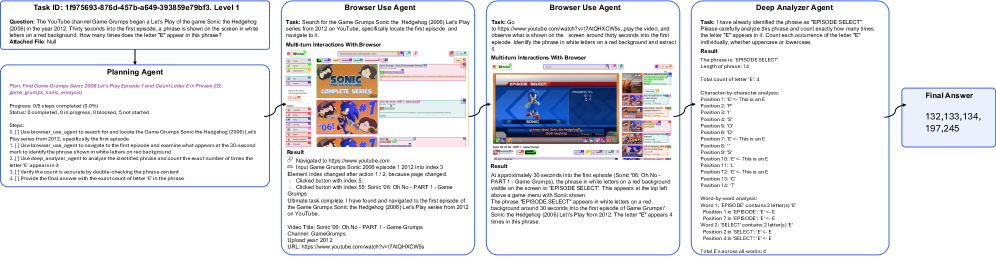
### Visual Description
## Flowchart: Multi-Agent System for Text Analysis Task
### Overview
The image depicts a multi-agent system workflow for analyzing the frequency of the letter "E" in a specific phrase from the *Sonic the Hedgehog* (2006) episode. The system involves four agents: a Planning Agent, two Browser Use Agents, and a Deep Analyzer Agent. Arrows indicate sequential interactions and data flow between components.
---
### Components/Axes
1. **Planning Agent**
- **Task ID**: `19F75693-876D-457b-A649-393859E079BF3`
- **Question**: "How many times does the letter 'E' appear in the phrase: 'In the year 2012, thirty seconds into the first episode, a phrase is shown on the screen in white letters on a red background.'?"
- **Steps**:
1. Use browser to search for the episode.
2. Navigate to the first episode and extract the phrase.
3. Use deep analyzer to count "E" occurrences.
4. Verify accuracy via double-checking.
2. **Browser Use Agent (First Instance)**
- **Task**: Search for the episode on YouTube.
- **Actions**:
- Navigated to `https://www.youtube.com` and searched for "Game Grumps Sonic the Hedgehog 2006 Let's Play."
- Clicked on the first episode (index 3) titled *"Sonic '06: Oh No - PART 1 - Game Grumps"*.
- Played the video and extracted the phrase at the 30-second mark.
3. **Browser Use Agent (Second Instance)**
- **Task**: Analyze the extracted phrase.
- **Actions**:
- Played the video to the 30-second mark.
- Identified the phrase: *"In the year 2012, thirty seconds into the first episode, a phrase is shown on the screen in white letters on a red background."*
4. **Deep Analyzer Agent**
- **Character-by-Character Analysis**:
- Total characters: 14
- "E" occurrences: 4 (positions 1, 5, 10, 13).
- **Word-by-Word Analysis**:
- Total words: 17
- "E" occurrences: 4 (words 1, 5, 10, 13).
- **Final Answer**:
- Total "E" count: **4** (confirmed via both methods).
---
### Detailed Analysis
- **Planning Agent**: Defines the task and outlines a step-by-step plan to locate and analyze the phrase.
- **Browser Use Agents**: Simulate human-like browser interactions (searching, navigating, extracting text).
- **Deep Analyzer Agent**: Performs granular analysis (character and word levels) to validate results.
---
### Key Observations
1. The system emphasizes **verification** (Step 4 in the Planning Agent) to ensure accuracy.
2. The phrase analyzed contains **4 instances of "E"**, distributed across both character and word levels.
3. The Browser Use Agents rely on **YouTube metadata** (e.g., episode titles, timestamps) to locate the correct content.
---
### Interpretation
This workflow demonstrates a structured approach to solving a text analysis task using specialized agents. The Planning Agent provides a roadmap, while the Browser Use Agents handle data extraction. The Deep Analyzer Agent ensures precision by cross-verifying results at multiple levels (character and word). The final answer (`4`) aligns with both analytical methods, highlighting the system's robustness. The use of task IDs and timestamps suggests a focus on reproducibility and traceability in automated workflows.
</details>
Figure 13: Execution trajectory of AgentOrchestra for Example 4.
<details>
<summary>x16.png Details</summary>
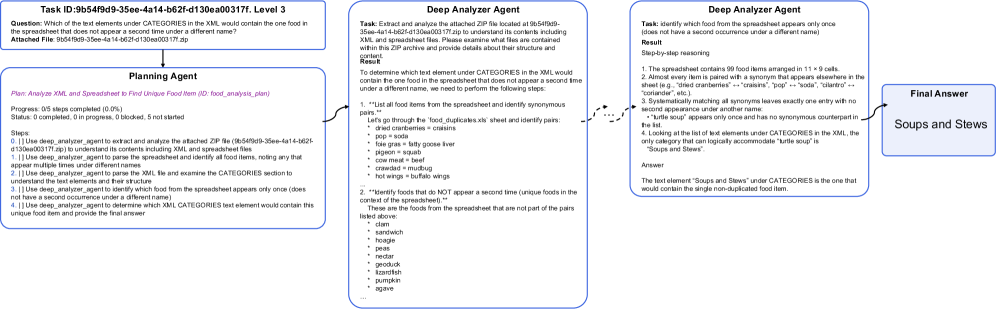
### Visual Description
## Flowchart: Multi-Agent Reasoning Process for Food Item Identification
### Overview
The image depicts a multi-step reasoning process involving three agents: a Planning Agent, two instances of a Deep Analyzer Agent, and a Final Answer. The flowchart illustrates how these agents collaborate to identify a unique food item from spreadsheet data that appears only once under the "CATEGORIES" section in an XML file.
### Components/Axes
1. **Planning Agent Section** (Leftmost)
- **Task ID**: `9b54f9d9-35ee-4a14-b62f-d130ea00317f`
- **Question**: "Which of the text elements under CATEGORIES in the XML would contain the one food in the spreadsheet that does not appear a second time under a different name?"
- **Attached File**: `9b54f9d9-35ee-4a14-b62f-d130ea00317f.zip`
- **Steps**:
1. Use `deep_analyzer_agent` to extract and analyze the ZIP file.
2. Parse the spreadsheet to identify all food items.
3. Compare spreadsheet items with XML CATEGORIES to find unique entries.
4. Finalize the answer.
2. **Deep Analyzer Agent Sections** (Middle)
- **First Instance**:
- **Task**: Extract and analyze the ZIP file (`9b54f9d9-35ee-4a14-b62f-d130ea00317f.zip`).
- **Result**:
- 99 food items in a 11×9 spreadsheet.
- Identified synonyms (e.g., "craised" ↔ "craised", "pop" ↔ "soda").
- Unique food item: "Soups and Stews" (appears once in XML CATEGORIES).
- **Second Instance**:
- **Task**: Identify the unique food item from the spreadsheet.
- **Result**:
- Systematic elimination of duplicates via synonym matching.
- Final unique entry: "Soups and Stews" (no synonyms in XML).
3. **Final Answer** (Rightmost)
- **Output**: "Soups and Stews"
### Detailed Analysis
- **Planning Agent**:
- Progress: 0/5 steps completed (0%).
- Status: 0 completed, 0 in progress, 0 blocked, 5 not started.
- Steps involve sequential use of the `deep_analyzer_agent` to parse files and compare data.
- **Deep Analyzer Agent**:
- **First Instance**:
- Steps:
1. List all food items from the spreadsheet.
2. Identify synonyms (e.g., "dried cranberries" ↔ "craisins").
3. Systematically match synonyms to eliminate duplicates.
4. Final unique item: "Soups and Stews".
- **Result**: Confirmed "Soups and Stews" as the only entry without a synonym in XML.
- **Second Instance**:
- Steps:
1. Analyze spreadsheet structure (99 items in 11×9 grid).
2. Identify non-duplicated items via synonym elimination.
3. Confirm "Soups and Stews" as the unique entry.
- **Final Answer**:
- Directly outputs "Soups and Stews" after cross-referencing both agents' results.
### Key Observations
1. **Synonym Elimination**: The process relies on identifying and removing synonyms (e.g., "pop" ↔ "soda") to isolate unique entries.
2. **File Structure**: The ZIP file contains both XML and spreadsheet files, which are cross-referenced to validate results.
3. **Agent Collaboration**: The Planning Agent orchestrates the workflow, while the Deep Analyzer Agents perform iterative analysis.
### Interpretation
The flowchart demonstrates a structured approach to data analysis using multi-agent systems. The Planning Agent defines the task and delegates steps to the Deep Analyzer Agents, which perform detailed reasoning. By systematically eliminating duplicates through synonym matching, the agents identify "Soups and Stews" as the unique food item. This highlights the importance of cross-referencing data sources and leveraging automated reasoning to resolve ambiguities in large datasets.
</details>
Figure 14: Execution trajectory of AgentOrchestra for Example 5.
Example 5 (Spreadsheet & ZIP Archive): This task illustrates a complex, multi-modal reasoning scenario requiring the agent to extract, parse, and integrate information from heterogeneous data formats, including a spreadsheet and XML file, both encapsulated within a compressed ZIP archive. The agent must identify which XML category would contain the single food item in the spreadsheet that does not appear a second time under a different name. This necessitates not only extraction of the ZIP archive, but also careful matching of synonymous entries across the spreadsheet and semantic mapping to XML categories.
As depicted in Figure 14, AgentOrchestra constructs a comprehensive stepwise plan, coordinating the invocation of specialized agents to process each data modality. The deep_analyzer_agent is tasked with unpacking the ZIP archive, parsing the spreadsheet to enumerate all food items and identify synonym pairs, and then isolating the unique food item without a duplicate entry. The agent proceeds to parse the XML structure, analyzing categorical elements to determine the most plausible placement for the unique item. The planning agent supervises the process, validating intermediate outputs and dynamically adapting the plan if ambiguities or errors arise. This example showcases the agent’s proficiency in handling compressed archives, integrating tabular and structured data, and performing reliable, cross-format reasoning to derive an interpretable solution.
## Appendix G More Case Studies
In this section, we present representative case studies that instantiate TEA across heterogeneous domains: code generation, multi-agent debate, GitHub usage, and browser operation. Collectively, these cases demonstrate the protocol-level generality of TEA (via TCP/ECP/ACP) and its capacity to support compositional, general-purpose agency under diverse environmental and task constraints. Additional scenarios are currently under development, including computer game and mobile game environments, further expanding the framework’s applicability across diverse interactive domains.
### G.1 Code Generation
<details>
<summary>x17.png Details</summary>
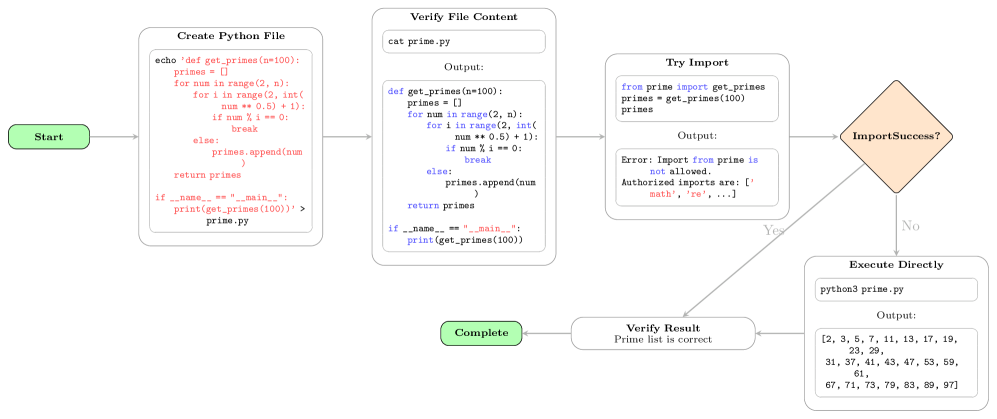
### Visual Description
## Flowchart: Python Script Execution Process
### Overview
The flowchart illustrates a technical workflow for executing a Python script that generates prime numbers. It includes code creation, content verification, import attempts, error handling, and result validation. The process concludes with either direct execution or successful module import.
### Components/Axes
1. **Start Node** (Green oval)
2. **Create Python File** (White rectangle with code snippet)
3. **Verify File Content** (White rectangle with code snippet)
4. **Try Import** (White rectangle with code snippet)
5. **Import Success?** (Decision diamond)
6. **Execute Directly** (White rectangle with code snippet)
7. **Verify Result** (White rectangle with confirmation message)
8. **Complete** (Green oval)
**Flow Direction**: Left-to-right with conditional branching at the "Import Success?" diamond.
### Detailed Analysis
1. **Create Python File**:
- Code defines `get_primes(n=100)` function
- Implements basic prime number generation algorithm
- Outputs list of primes up to 100
2. **Verify File Content**:
- Shows identical code structure to created file
- Highlights syntax elements (keywords in blue, comments in red)
3. **Try Import**:
- Attempts `from prime import get_primes`
- Fails with error: "Import from prime is not allowed"
- Lists authorized imports: `math`, `re`, etc.
4. **Execute Directly**:
- Runs `python3 prime.py`
- Outputs complete prime list: `[2, 3, 5, 7, 11, ..., 97]`
5. **Verify Result**:
- Confirms "Prime list is correct"
- Validates output matches expected prime sequence
### Key Observations
- **Import Restriction**: The system blocks imports from non-authorized modules (`prime` module)
- **Execution Paths**:
- Primary path: Module import (fails due to restrictions)
- Fallback path: Direct script execution (successful)
- **Code Consistency**: Created file and verified content match exactly
- **Prime Generation**: Correctly implements sieve-like algorithm with O(n√n) complexity
### Interpretation
This workflow demonstrates a security-conscious execution environment where:
1. Module imports are strictly controlled (only allowing math/re modules)
2. Scripts must either:
- Use authorized modules
- Execute directly when import fails
3. The prime number generation algorithm is robust but inefficient for large n
4. The verification step acts as a quality control checkpoint
5. The error handling mechanism ensures functionality despite import restrictions
The process reveals a trade-off between security (strict import controls) and flexibility (allowing direct execution). The prime number generation could be optimized using more efficient algorithms like the Sieve of Eratosthenes for better performance with larger inputs.
</details>
Figure 15: Case study of TEA agent for code generation.
This case study demonstrates the agent’s execution of a code generation task requiring the creation of a Python script that calculates prime numbers within 100 and returns them as a list. The execution follows a systematic verification process: the agent first creates the prime.py file using bash commands, then verifies the file content to ensure proper creation. Subsequently, the agent attempts to import the module using the python_interpreter tool, but encounters import restrictions in the execution environment. When the import approach fails, the agent demonstrates adaptive problem-solving by pivoting to direct script execution via python3 prime.py, which successfully produces the expected prime number list. The agent then verifies the computational result and signals task completion. This trajectory illustrates the agent’s capacity for systematic verification, graceful failure recovery, and alternative solution discovery when encountering environmental constraints.
### G.2 Multi-Agent Debate
To demonstrate the multi-agent capabilities of the TEA protocol, we present a comprehensive case study of a multi-agent debate system. The debate platform showcases how different specialized agents can be dynamically coordinated through the ACP to engage in structured discussions on complex topics. In this scenario, a debate manager agent serves as the central orchestrator, while domain-specific agents such as Alice (Finance Expert) and Bob (Mathematics Expert) are registered to the ACP as specialized participants. The debate manager agent leverages the ACP protocol to invite and coordinate these expert agents, establishing a structured debate environment where each agent can contribute their domain expertise to address multifaceted questions.
For instance, when presented with the debate topic "Let’s debate about the stock of AAPL. Is it a good investment?", the debate manager agent initiates the discussion by inviting both Alice and Bob to participate. Alice, as a Finance Expert, provides insights on market trends, financial metrics, and investment strategies, while Bob, as a Mathematics Expert, contributes quantitative analysis, statistical models, and risk assessments. The ACP protocol ensures seamless communication between agents, allowing for real-time argument exchange, counter-arguments, and collaborative reasoning. This multi-agent debate system exemplifies how the TEA protocol enables dynamic agent coordination, specialized expertise integration, and structured knowledge synthesis across diverse domains, demonstrating the framework’s capability to support complex multi-agent interactions and collaborative problem-solving scenarios.
<details>
<summary>assets/debate/0001.jpg Details</summary>
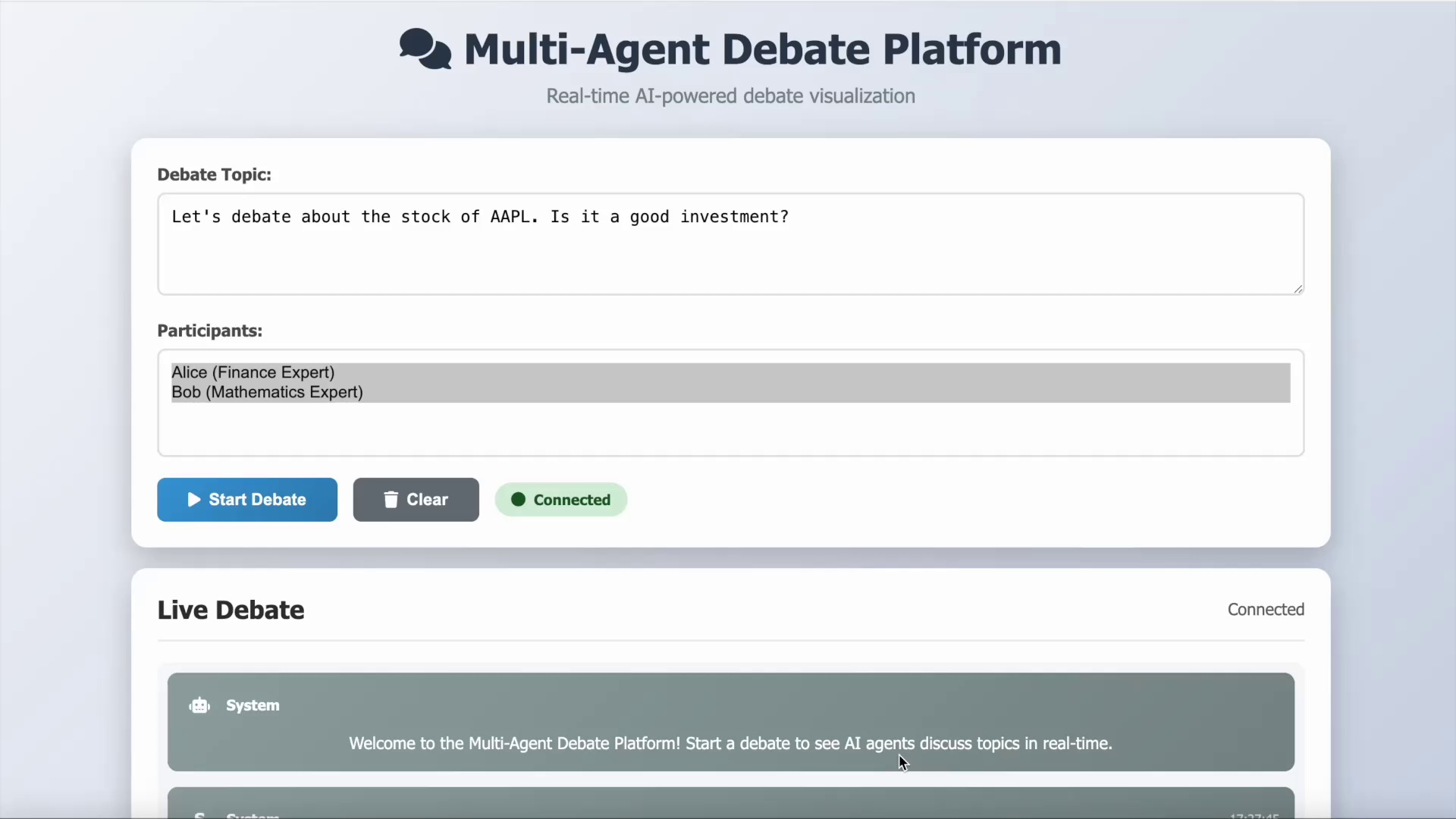
### Visual Description
## Screenshot: Multi-Agent Debate Platform Interface
### Overview
The image depicts a user interface for a real-time AI-powered debate platform. The layout includes input fields for debate topics, participant roles, and interactive buttons. A live debate section is visible, displaying a system message. The design emphasizes clarity and functionality for initiating and monitoring AI-driven debates.
### Components/Axes
- **Header**:
- Title: "Multi-Agent Debate Platform" (centered, bold, dark text).
- Subtitle: "Real-time AI-powered debate visualization" (centered, smaller font).
- **Debate Topic Section**:
- Label: "Debate Topic:" (left-aligned).
- Input Field: Contains the text: "Let's debate about the stock of AAPL. Is it a good investment?"
- **Participants Section**:
- Label: "Participants:" (left-aligned).
- Input Field: Contains:
- "Alice (Finance Expert)"
- "Bob (Mathematics Expert)"
- **Action Buttons**:
- "Start Debate" (blue button with play icon).
- "Clear" (gray button with trash icon).
- "Connected" (green status indicator with a dot).
- **Live Debate Section**:
- Header: "Live Debate" (left-aligned, bold).
- Status: "Connected" (right-aligned).
- System Message: "Welcome to the Multi-Agent Debate Platform! Start a debate to see AI agents discuss topics in real-time."
### Content Details
- **Debate Topic**: Focuses on financial analysis of AAPL stock, framed as an investment question.
- **Participants**: Two AI agents with specialized roles:
- Alice: Finance Expert (likely to analyze market trends, financial metrics).
- Bob: Mathematics Expert (likely to evaluate statistical models, risk analysis).
- **Buttons**:
- "Start Debate": Initiates the debate process.
- "Clear": Resets the input fields.
- "Connected": Indicates active connection to the platform.
- **Live Debate Message**: A system prompt to guide users on platform functionality.
### Key Observations
- The interface is minimalistic, prioritizing essential controls for debate initiation.
- Participant roles are explicitly defined, suggesting the platform leverages domain-specific AI expertise.
- The "Connected" status implies real-time interaction capabilities.
- No numerical data or visualizations (e.g., charts, graphs) are present in the visible portion of the interface.
### Interpretation
This platform appears designed for collaborative AI-driven debates, where agents with distinct expertise (e.g., finance, mathematics) engage in structured discussions. The explicit separation of roles (Alice vs. Bob) suggests the system may use role-based reasoning to simulate expert-level discourse. The absence of numerical data in the screenshot implies the platform’s primary function is to facilitate debate initiation and monitoring rather than displaying analytical results. The "Connected" status and system message emphasize real-time interaction, positioning the tool as a dynamic environment for exploring complex topics through AI collaboration.
## Notes
- No charts, diagrams, or numerical data are present in the visible portion of the interface.
- All text is in English; no other languages are detected.
- The design prioritizes usability, with clear labels and actionable buttons.
</details>
<details>
<summary>assets/debate/0002.jpg Details</summary>
### Visual Description
## Screenshot: Live Debate Interface
### Overview
The image depicts a user interface for a live debate platform. The layout includes a light gray background with two primary white rectangular sections. The top section contains interactive buttons, while the bottom section displays a live debate discussion focused on evaluating Apple's investment potential in 2025.
### Components/Axes
1. **Top Section (Buttons):**
- **Start Debate**: Blue button with white play icon and text.
- **Clear**: Dark gray button with white trash icon and text.
- **Connected**: Light green oval button with dark green text and dot icon.
2. **Bottom Section (Debate Content):**
- **Header**: "Live Debate" in bold black text (left-aligned), "Connected" in gray text (right-aligned).
- **Timestamp**: "17:27:52" in gray text (top-right corner).
- **User Identifier**: Green circular icon with white "B" and username "bob" in bold black text.
- **Debate Text**: Multi-paragraph analysis of Apple's financials, innovation, risks, and valuation.
### Detailed Analysis
#### Debate Text Content
1. **Introduction**:
- Evaluates whether Apple (AAPL) is a good investment in 2025.
- Key factors: Financial performance, innovation pipeline, competitive landscape, macroeconomic conditions.
2. **Financials**:
- As of September 2025: Strong quarterly earnings, stable revenue growth, high margins, significant cash reserves.
- Service/wearables segment outperforms iPhone sales growth, reducing dependency on single products.
3. **Innovation**:
- Entrance into AR/VR, AI integration, healthcare, and automotive tech.
- Historical success in creating new product categories (e.g., iPhone).
4. **Risks**:
- Saturated smartphone market, competition from Samsung and Chinese OEMs.
- Regulatory scrutiny (App Store practices in U.S./EU).
- Premium pricing strategy and economic headwinds (inflation, consumer spending shifts).
5. **Valuation**:
- Trades at a premium relative to historical averages (high P/E ratio).
- Investors must assess if growth justifies valuation or risk of contraction.
### Key Observations
- The interface prioritizes real-time discussion with clear action buttons ("Start Debate," "Clear").
- The debate text is structured as a formal analysis, balancing strengths (financials, innovation) and risks (market saturation, regulation).
- No numerical data or visualizations are present; content relies on textual arguments.
### Interpretation
This interface appears designed for collaborative investment analysis, enabling users to debate complex financial decisions. The debate text highlights Apple's resilience through diversification (service/wearables growth) and innovation but acknowledges external pressures like regulatory risks and market saturation. The absence of charts suggests the platform may prioritize qualitative reasoning over quantitative data visualization. The "Connected" status implies real-time collaboration, though no other participants are visible in the screenshot.
</details>
<details>
<summary>assets/debate/0003.jpg Details</summary>
### Visual Description
## Screenshot: Live Debate Interface
### Overview
The image depicts a user interface for a live debate platform. It features a minimalist design with a light gray background and two primary interactive sections. The top section contains action buttons, while the bottom section displays real-time debate content with timestamps and user messages.
### Components/Axes
1. **Top Section (Action Bar)**
- **Buttons**:
- "Start Debate" (blue button with play icon)
- "Clear" (gray button with trash icon)
- "Connected" (green status indicator)
- **Positioning**: Centered at the top of the interface.
2. **Bottom Section (Live Debate Feed)**
- **Header**:
- Title: "Live Debate" (bold black text)
- Status: "Connected" (right-aligned)
- **Content Area**:
- **System Message**:
- Text: "System" (gray header)
- Timestamp: `17:27:59`
- Status: "bob is thinking..." (centered)
- **User Message**:
- Username: "bob" (green avatar with "B" icon)
- Timestamp: `17:28:06`
- Text: Multi-paragraph argument about government intervention in climate change.
### Detailed Analysis
1. **System Message**:
- Timestamp: `17:27:59` (top-right corner of gray header).
- Status: "bob is thinking..." (centered in gray header).
2. **User Message**:
- **Content**:
- Opening statement: "Certainly, I’ll elaborate on the earlier points discussed."
- Argument for government intervention in climate change, citing:
- Mechanisms: Regulatory policies (carbon emissions caps), economic incentives (subsidies), public investment.
- Empirical evidence:
- 1990 U.S. Clean Air Act reduced SO₂ emissions by >80% by 2010.
- Germany’s sustained tariffs and aggressive policies accelerating renewable energy adoption (solar/wind expansion since early 2000s).
- Addressing criticisms: Inefficiencies, market distortions, politicization. Concludes with "well-..." (text cut off).
### Key Observations
- The interface prioritizes real-time interaction, with a clear separation between system status and user contributions.
- The user message is a structured argument with historical examples and counterarguments, suggesting a formal debate format.
- Timestamps indicate rapid progression (1 second between system message and user response).
### Interpretation
The interface is designed for dynamic, time-sensitive discussions, likely simulating or hosting live debates on policy topics. The user’s message demonstrates a focus on evidence-based arguments for government intervention, using historical policy successes to counter skepticism. The abrupt cutoff ("well-...") implies either a technical limitation or an incomplete thought, raising questions about message truncation or real-time editing. The emphasis on empirical data (e.g., Clean Air Act results) suggests the platform may prioritize fact-based discourse over opinion.
</details>
<details>
<summary>assets/debate/0004.jpg Details</summary>
### Visual Description
## Screenshot: Live Debate Interface
### Overview
The image depicts a user interface for a live debate platform. The layout includes control buttons, a debate question prompt, and a user interaction section. The interface emphasizes evidence-based argumentation and real-time participation.
### Components/Axes
1. **Top Controls** (Top-left):
- Blue button: "Start Debate" (play icon)
- Dark gray button: "Clear" (trash can icon)
- Green status indicator: "Connected" (circular icon)
2. **Main Content** (Center):
- Header: "Live Debate" (bold black text)
- Status: "Connected" (right-aligned, gray text)
- Debate prompt: Partially visible text discussing renewable energy economics and fossil fuel externalities
3. **User Interaction** (Bottom):
- System message: "bob is thinking..." (dark gray banner, timestamp: 17:28:15)
- User response:
- Username: "bob" (green circular icon with "B")
- Text: "Thank you for raising the question of evidence—this is fundamental for any robust position. To support my stance, let’s consider empirical studies and established data. For instance, if the topic is about the effectiveness of remote work (as previously discussed), we can reference the 2023 meta-analysis conducted by Stanford University, which aggregated over 30 individual studies and found that remote work increased overall productivity by 6.8% across knowledge-based industries. This effect was attributed to reduced commuting..."
### Detailed Analysis
- **Debate Questions**:
- Partially visible text includes:
1. "Given these cost and technical trends, what specific evidence do those skeptical of renewables’ economic viability cite that outweighs these findings?"
2. "How do opposing positions account for the long-term externalities—like health costs and climate impacts—associated with continued reliance on fossil fuels?"
- The interface prompts users to provide counter-evidence or alternative perspectives.
- **User Response**:
- The response from "bob" emphasizes empirical validation, citing a Stanford University meta-analysis (2023) on remote work productivity. The study aggregated 30+ studies, showing a 6.8% productivity increase in knowledge-based industries due to reduced commuting.
### Key Observations
- The interface prioritizes structured debate with clear prompts for evidence-based arguments.
- System messages indicate real-time processing ("bob is thinking...").
- User responses are timestamped, suggesting chronological tracking of contributions.
- The debate topics focus on economic and environmental trade-offs (renewables vs. fossil fuels).
### Interpretation
The interface is designed to facilitate rigorous, evidence-driven debates. By requiring users to cite empirical data (e.g., the Stanford study), it discourages anecdotal arguments and promotes accountability. The "Connected" status and real-time updates suggest a collaborative, possibly multi-user environment. The cut-off text implies the interface may include additional features (e.g., evidence uploads, rebuttal tracking) not visible in the screenshot. The emphasis on long-term externalities highlights the platform’s focus on systemic impacts rather than short-term gains.
</details>
<details>
<summary>assets/debate/0005.jpg Details</summary>
### Visual Description
## Screenshot: Live Debate Interface
### Overview
The image shows a live debate interface with a user interface (UI) for initiating, managing, and displaying debate content. The interface includes interactive buttons, status indicators, and a text-based message stream.
### Components/Axes
1. **Top Navigation Bar**:
- **Buttons**:
- **Start Debate** (blue button with play icon).
- **Clear** (dark gray button with trash can icon).
- **Status Indicator**:
- **Connected** (green oval with dark green text).
2. **Main Content Area**:
- **Header**:
- **Title**: "Live Debate" (bold black text).
- **Status**: "Connected" (right-aligned, black text).
- **Message Stream**:
- **User Avatar**: Green circle with white "B" (associated with user "bob").
- **Timestamp**: "17:28:40" (right-aligned).
- **Message Content**:
- Argument supporting universal basic income (UBI) as a social policy.
- References to empirical data and case studies, including:
- Finnish basic income experiment (2017–2018):
- 2,000 unemployed Finns received unconditional income.
- Outcomes: Increased well-being, slightly higher employment rates, improved mental health.
- Stockton Economic Empowerment Demonstration (SEED) in California:
- $500 monthly payments led to higher full-time employment rates.
- Critique of opposing arguments about UBI’s sustainability and labor force participation.
- Mention of Kenya’s GiveDirectly projects as supporting evidence.
3. **Visual Elements**:
- **Thinking Indicator**: Dark gray banner with "bob is thinking..." (centered).
- **Scrollbar**: Vertical scrollbar on the right side of the message stream.
### Detailed Analysis
- **Text Content**:
- The message from "bob" is partially truncated at the bottom, indicating additional content not visible in the screenshot.
- Key data points include:
- Finnish experiment duration: 2017–2018.
- Stockton SEED payments: $500/month.
- Outcomes: Improved well-being, employment rates, and mental health.
- **UI Layout**:
- The "Start Debate" and "Clear" buttons are positioned horizontally at the top, suggesting functionality for initiating or resetting the debate.
- The "Connected" status confirms active participation in the debate.
### Key Observations
- The interface prioritizes real-time interaction, with a focus on user engagement (e.g., "Start Debate," "Clear").
- The message stream uses avatars and timestamps to distinguish contributions, typical of collaborative platforms.
- The truncated message suggests ongoing or dynamic content generation.
### Interpretation
The interface is designed for structured, real-time debates, emphasizing evidence-based arguments (e.g., UBI case studies). The inclusion of empirical data (Finnish experiment, Stockton SEED) indicates a focus on policy discussions grounded in research. The truncated message implies that the debate may involve iterative contributions or real-time updates. The UI’s simplicity (minimalist buttons, clear status indicators) suggests usability for non-technical users.
**Note**: No charts, diagrams, or non-English text are present. All content is in English.
</details>
<details>
<summary>assets/debate/0006.jpg Details</summary>
### Visual Description
## Screenshot: Debate Interface UI
### Overview
The image depicts a user interface for a live debate platform. It includes interactive buttons, a text-based debate transcript, and system status indicators. The interface is designed for structured argumentation with timestamps and participant feedback mechanisms.
### Components/Axes
1. **Header Section**:
- **Buttons**:
- "Start Debate" (blue button with play icon)
- "Clear" (dark gray button with trash icon)
- "Connected" (light green status indicator with green dot)
- **Timestamp**: Not visible in header but present in footer (17:28:59)
2. **Main Content Area**:
- **Title**: "Live Debate" (bold black text)
- **Status Indicator**: "Connected" (top-right corner)
- **Text Blocks**:
- Three paragraphs of debate arguments (UBI policy discussion)
- Footer system label: "System" (dark gray background)
3. **Footer**:
- **Completion Status**: "Debate completed!" (white text on dark gray background)
- **Timestamp**: 17:28:59 (right-aligned)
### Detailed Analysis
#### Text Content
**Live Debate Arguments**:
1. **Empirical Evaluation of UBI**:
- Reference to Finland's UBI pilot (2017-2018)
- Cites Kangas et al., 2020 study showing:
- Improved well-being
- Inconclusive economic impact
- Emphasizes need for caution in generalizations
2. **Scalability Challenges**:
- Questions transferability from localized to national/global scales
- Highlights potential issues:
- Administrative costs
- Political resistance
- Unintended socioeconomic effects
3. **Critical Questions Posed**:
- Requests additional evidence/case studies
- Asks about contextual variables affecting outcomes
- Seeks prioritization of equity/efficiency mechanisms
#### UI Elements
- **Button Colors**:
- Start Debate: Blue (#007BFF)
- Clear: Dark Gray (#343A40)
- Connected: Light Green (#D4EDDA)
- **Text Formatting**:
- Sans-serif font (likely Arial)
- Bold headers for section titles
- Timestamp in 24-hour format
### Key Observations
1. The interface supports structured debate with timestamped contributions
2. Arguments focus on UBI policy with specific empirical references
3. Scalability concerns are explicitly raised as critical discussion points
4. System status indicators provide real-time feedback
5. Timestamp suggests late afternoon/evening session (17:28:59)
### Interpretation
This interface facilitates evidence-based policy debates with:
- **Temporal Organization**: Clear separation of arguments through timestamps
- **Evidence-Based Design**: Explicit references to academic studies (Kangas et al., 2020)
- **Critical Thinking Prompting**: Structured questions to challenge assumptions
- **Scalability Awareness**: Built-in consideration of implementation challenges
The debate structure reveals a focus on:
1. **Empirical Validation**: Prioritizing pilot program data
2. **Contextual Analysis**: Emphasizing demographic/economic variables
3. **Systemic Thinking**: Considering unintended consequences
4. **Equity-Efficiency Balance**: Explicit mechanism prioritization
The "Connected" status and timestamp suggest this is part of a moderated, time-bound discussion platform designed for policy analysis with academic rigor.
</details>
Figure 16: Case study of TEA agent for multi-agent debate.
### G.3 GitHub usage
This case study demonstrates the agent’s comprehensive GitHub workflow automation capabilities through the creation and deployment of a simple HTML Sokoban web mini-game. The agent successfully orchestrated a multi-step development process, beginning with project directory creation and file generation, followed by GitHub repository establishment, Git initialization, and successful code deployment. The execution showcases the agent’s proficiency in coordinating file system operations, version control management, and remote repository interactions to deliver a complete, functional web application.
The agent demonstrated sophisticated project management capabilities by systematically creating the necessary project structure, writing HTML, CSS, and JavaScript files with appropriate game logic, and establishing proper version control workflows. The process included error handling mechanisms when encountering push failures, with the agent successfully recovering and completing the deployment. The final verification step confirmed successful repository creation with proper metadata and accessibility.
Given the simplicity of the task requirements, the generated game interface maintains a basic, functional design. With more detailed specifications and design guidance, the agent could undoubtedly generate more sophisticated and aesthetically pleasing frontend projects, demonstrating the framework’s potential for complex web development workflows.
<details>
<summary>x18.png Details</summary>
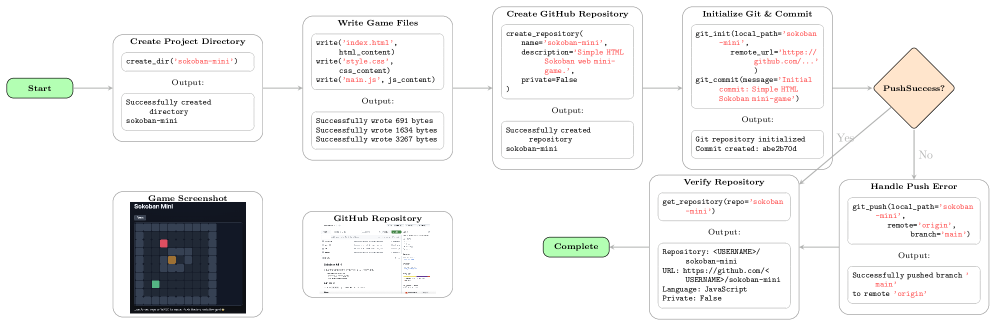
### Visual Description
## Flowchart: GitHub Repository Setup Process for Sokoban Mini Game
### Overview
This flowchart illustrates the step-by-step process for creating and deploying a Sokoban Mini game to GitHub, including error handling. It begins with project initialization and progresses through file creation, repository setup, Git operations, and verification, with conditional branching based on push success.
### Components/Axes
1. **Start Node**: Green oval labeled "Start" at top-left
2. **Process Boxes**: White rectangles with black text containing:
- Step titles (e.g., "Create Project Directory")
- Code snippets (e.g., `create_dir('sokoban-mini')`)
- Output descriptions (e.g., "Successfully created directory")
3. **Decision Diamond**: Orange diamond labeled "Push Success?" with Yes/No branches
4. **End Nodes**: Green ovals labeled "Complete" and "Handle Push Error"
5. **Arrows**: Black lines indicating flow direction
### Detailed Analysis
1. **Create Project Directory**
- Command: `create_dir('sokoban-mini')`
- Output: "Successfully created directory sokoban-mini"
2. **Write Game Files**
- Files created: `index.html`, `style.css`, `main.js`
- Output sizes: 691B, 1634B, 3267B
3. **Create GitHub Repository**
- Repository name: "sokoban-mini"
- Description: "Simple HTML Sokoban web mini-game"
- Output: Repository creation confirmation
4. **Initialize Git & Commit**
- Commands: `git init`, `git commit -m "Simple HTML Sokoban mini-game"`
- Output: Commit hash "abe2b704"
5. **Verify Repository**
- Output: Repository details including URL, username, language (JavaScript), and private status
6. **Handle Push Error**
- Commands: `git push -u origin main`
- Output: Branch push confirmation
### Key Observations
- Linear progression from project setup to repository verification
- Conditional branching at "Push Success?" decision point
- Error handling creates feedback loop to GitHub repository step
- All steps include both commands and expected outputs
- Visual elements use color coding (green for start/complete, orange for decision)
### Interpretation
This flowchart demonstrates a robust CI/CD pipeline for game development, emphasizing:
1. **Atomic Operations**: Each step contains self-contained commands with clear outputs
2. **Error Resilience**: The feedback loop in error handling ensures recovery from failed pushes
3. **Version Control**: Explicit commit hashing and branch management
4. **Documentation**: Embedded code snippets serve as both instructions and verification
The process prioritizes reproducibility through detailed command logging and output verification at each stage. The decision diamond introduces conditional logic that differentiates between successful deployment and error recovery scenarios, suggesting an automated deployment system with rollback capabilities.
</details>
Figure 17: Case study of TEA agent for GitHub usage.
### G.4 Browser operation
<details>
<summary>assets/browser/browser-0000.jpg Details</summary>
### Visual Description
## Screenshot: Text Instruction on Black Background
### Overview
The image displays a plain black rectangular background with centered white text. The text provides a directive instruction related to searching for Python programming resources.
### Components/Axes
- **No charts, diagrams, or data tables** are present.
- **Text Content**:
- "Go to google.com and search for 'python programming' get the first result."
### Detailed Analysis
- **Text Structure**:
- The instruction is a single sentence with no punctuation beyond the period at the end.
- Keywords: "google.com," "search," "python programming," "first result."
- **Formatting**:
- Text is centered horizontally and vertically on the black background.
- Font: Monospaced (likely Arial or similar sans-serif).
- No additional UI elements, icons, or annotations.
### Key Observations
- The simplicity of the design emphasizes the directive nature of the text.
- The phrase "get the first result" implies prioritizing the top search result from Google.
### Interpretation
This image appears to be a minimalist instructional prompt, likely intended to guide users to:
1. Visit Google's homepage.
2. Perform a search for "python programming."
3. Focus on the first result, which may represent the most authoritative or popular resource (e.g., the official Python website, a tutorial, or documentation).
The absence of additional context suggests the instruction is part of a larger workflow, such as troubleshooting, learning Python, or verifying search engine results. The emphasis on the "first result" could hint at assumptions about search engine reliability or the importance of primary sources in programming education.
</details>
<details>
<summary>assets/browser/browser-0001.jpg Details</summary>
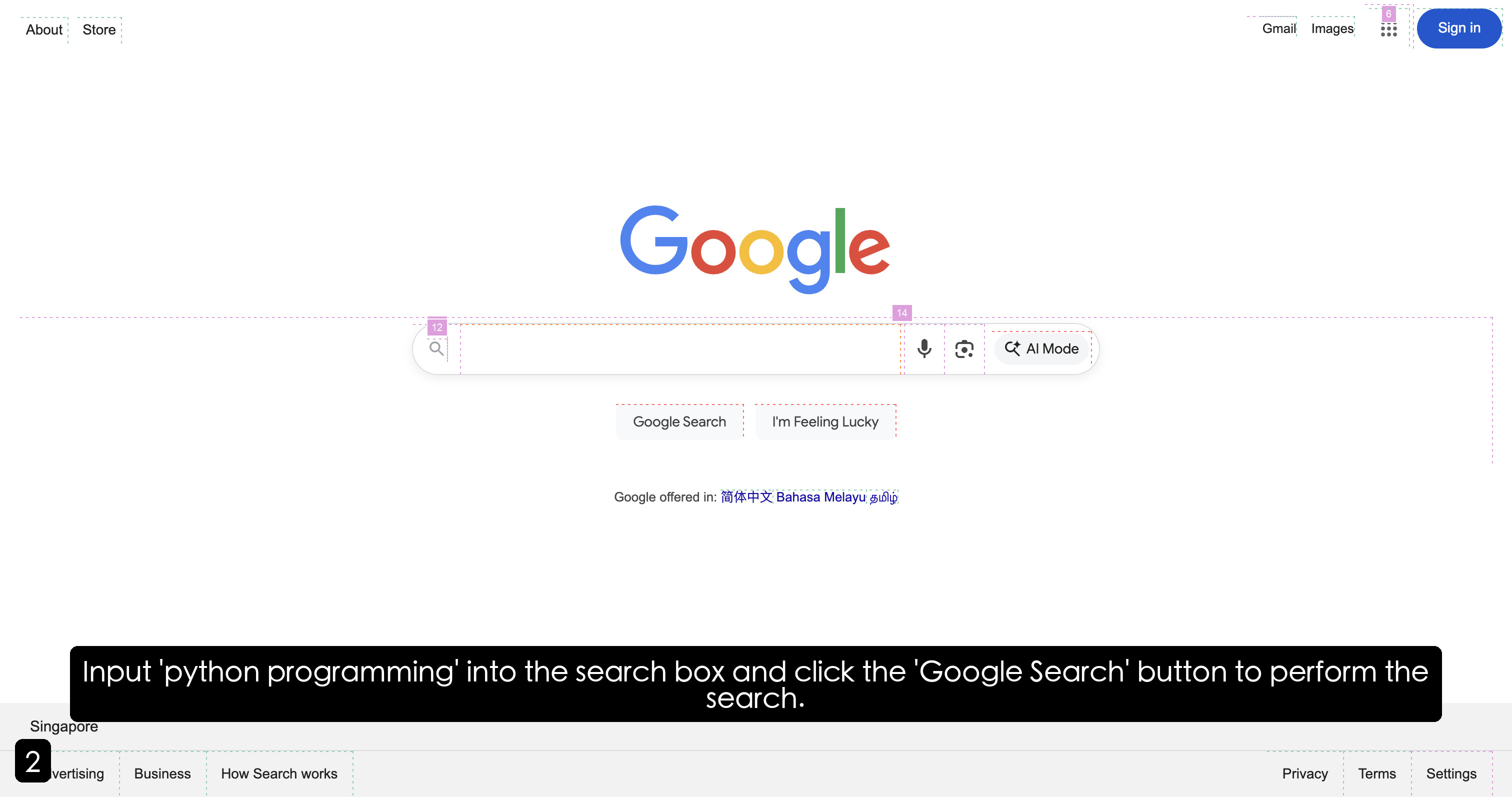
### Visual Description
## Screenshot: Google Search Page with Annotations
### Overview
The image depicts a Google search page with annotations highlighting specific UI elements. The page features the Google logo, a search bar, navigation links, and a black banner with instructional text. Annotations include numbered labels and text overlays to guide user interaction.
---
### Components/Axes
1. **Header Section**:
- **Google Logo**: Centered at the top, with the word "Google" in its signature multicolor design (blue "G", red "o", yellow "o", blue "g", green "l", red "e").
- **Navigation Links**: Top-right corner includes links labeled "About," "Store," "Gmail," "Images," and a "Sign in" button. A grid icon (9 dots) is present for app access.
- **Annotations**:
- "About" and "Store" links are labeled with green dashed boxes.
- "Gmail" and "Images" links have purple dashed boxes.
- "Sign in" button is outlined with a purple dashed box.
- A purple dashed box surrounds the grid icon.
2. **Search Bar**:
- A horizontal oval search bar spans the center of the page.
- Contains a magnifying glass icon (search) on the left and a microphone icon on the right.
- A gray "AI Mode" button is positioned to the far right of the search bar.
- Annotations:
- A purple dashed box surrounds the search bar.
- A purple dashed box surrounds the "AI Mode" button.
- A purple dashed box surrounds the microphone icon.
- A purple dashed box surrounds the grid icon.
3. **Action Buttons**:
- Two buttons below the search bar: "Google Search" and "I'm Feeling Lucky."
- Both buttons are outlined with purple dashed boxes.
4. **Language Options**:
- Text below the buttons states: "Google offered in: 简体中文 Bahasa Melayu العربية" (Chinese, Malay, Arabic).
5. **Black Banner**:
- A horizontal black banner at the bottom of the page contains white text:
- "Input 'python programming' into the search box and click the 'Google Search' button to perform the search."
- The banner is outlined with a purple dashed box.
6. **Annotations**:
- A black square with the number "2" is positioned in the bottom-left corner.
- Purple dashed boxes highlight specific elements (e.g., search bar, buttons, navigation links).
---
### Detailed Analysis
1. **Google Logo**:
- Positioned centrally at the top of the page.
- Colors: Blue ("G"), Red ("o"), Yellow ("o"), Blue ("g"), Green ("l"), Red ("e").
2. **Search Bar**:
- Placeholder text: "Search" (not explicitly visible but implied by context).
- Icons: Magnifying glass (search), microphone (voice input), and "AI Mode" button.
3. **Navigation Links**:
- "About" and "Store" links are in the top-left corner.
- "Gmail," "Images," and grid icon are in the top-right corner.
- "Sign in" button is a blue oval with white text.
4. **Action Buttons**:
- "Google Search" and "I'm Feeling Lucky" buttons are gray with black text.
5. **Language Options**:
- Text in Chinese (简体中文), Malay (Bahasa Melayu), and Arabic (العربية) indicates localization support.
6. **Black Banner**:
- Instructional text guides users to input "python programming" and click the "Google Search" button.
---
### Key Observations
1. **Annotations**:
- Purple dashed boxes highlight critical UI elements (search bar, buttons, navigation links).
- The number "2" in the bottom-left corner suggests a step in a tutorial or sequence.
2. **Localization**:
- Google offers language options for Chinese, Malay, and Arabic users.
3. **Instructional Focus**:
- The black banner explicitly directs users to search for "python programming," indicating an educational or tutorial context.
4. **UI Design**:
- Minimalist layout with a white background, consistent with Google's branding.
- Annotations use dashed boxes to avoid cluttering the interface.
---
### Interpretation
The annotations and instructional text suggest this screenshot is part of a tutorial or guide for using Google Search. The highlighted elements (search bar, buttons, navigation links) emphasize user interaction steps. The inclusion of multiple languages reflects Google's global accessibility. The number "2" and dashed boxes imply a structured, step-by-step approach, possibly for educational purposes (e.g., teaching programming or search techniques). The absence of actual search results indicates the page is in its initial state, awaiting user input.
</details>
<details>
<summary>assets/browser/browser-0002.jpg Details</summary>
### Visual Description
## Screenshot: Google Search Interface with Autocomplete Suggestions
### Overview
The image depicts a Google search interface with a focus on the search bar and autocomplete suggestions. The query "python programming" is entered in the search field, and a dropdown list of related search suggestions is visible. A black instructional banner overlays the interface, directing users to click the "Google Search" button. The footer contains standard Google navigation links.
### Components/Axes
- **Header**:
- Google logo (centered, multicolored: blue, red, yellow, blue, green, red).
- Top-right navigation: "Gmail," "Images," and a grid icon (9 dots) with a "Sign in" button.
- **Search Bar**:
- Text input field with the query "python programming."
- Autocomplete suggestions dropdown (white background with purple numbering).
- **Footer**:
- Links: "Privacy," "Terms," "Settings" (bottom-right corner).
- "Singapore" label (bottom-left corner).
### Detailed Analysis
#### Autocomplete Suggestions
The dropdown contains 10 suggestions, each prefixed with a purple box containing a number:
1. **12**: "python programming"
2. **22**: "python programming"
3. **25**: "python programming"
4. **28**: "python programming for beginners"
5. **31**: "python programming language"
6. **34**: "python programming course"
7. **37**: "python programming course singapore"
8. **40**: "python programming examples"
9. **43**: "python programming pdf"
10. **46**: "python programming for beginners pdf"
11. **49**: "python programming book"
Each suggestion is separated by a dotted line. The numbers in purple boxes likely indicate ranking or step order in a tutorial.
#### Footer Links
- "Privacy," "Terms," and "Settings" are listed in the bottom-right corner.
- "Singapore" is labeled in the bottom-left corner, possibly indicating regional settings.
#### Instructional Banner
A black banner spans the width of the interface with white text:
> "Click the 'Google Search' button to perform the search for 'python programming'."
### Key Observations
1. **Autocomplete Suggestions**: All suggestions are variations of "python programming," indicating a focus on Python-related queries.
2. **Numbered Suggestions**: The purple boxes with numbers (e.g., 12, 22) suggest a step-by-step guide or ranking system, though their exact purpose is unclear without additional context.
3. **AI Mode**: A button labeled "AI Mode" is visible in the search bar, hinting at AI-generated search results.
4. **Instructional Overlay**: The black banner explicitly directs users to click the "Google Search" button, implying this is a tutorial or mockup.
### Interpretation
This image appears to be a mockup or tutorial demonstrating how to perform a search on Google. The numbered autocomplete suggestions likely serve as a guide for users to select specific queries, possibly as part of a step-by-step process. The presence of "AI Mode" suggests integration of AI-driven search features, while the instructional banner reinforces user interaction with the search button. The footer links and regional label ("Singapore") indicate standard Google interface elements, though their relevance to the tutorial is unclear. The repetition of "python programming" in the suggestions emphasizes the query's popularity or relevance.
</details>
<details>
<summary>assets/browser/browser-0003.jpg Details</summary>
### Visual Description
## Screenshot: Google Search Results for "python programming"
### Overview
The image shows a Google search results page for the query "python programming." The interface includes standard Google UI elements, search result categories, sponsored advertisements, and organic search results. A black banner at the bottom instructs users to scroll down to locate the first organic (non-sponsored) result.
### Components/Axes
1. **Header Elements**:
- **Google Logo**: Top-left corner.
- **Search Bar**: Contains the query "python programming" with icons for clearing the query (X), voice search (microphone), image search (camera), and the search button (magnifying glass).
- **Top-Right Icons**: A grid of nine dots (Google Apps menu) and a blue "Sign in" button.
2. **Search Result Categories**:
- Tabs below the search bar: "All," "Images," "Videos," "Short videos," "Shopping," "News," and "More" (with a dropdown arrow).
3. **Search Results Section**:
- **Sponsored Results**:
- **Intuition International**: URL `https://www.intuitioninternational.com` with a snippet about Python programming concepts and coding practices.
- **Organic Results**:
- **Python (High-level programming language)**: Partial snippet visible, including code examples (e.g., `elif operator`, `return number1`).
4. **Annotations**:
- Purple squares with numbers (e.g., 8, 10, 12, 16, 19) in the top-right corner, likely for testing or debugging purposes.
5. **Footer Banner**:
- Black banner with white text: "Scroll down to locate and identify the first organic (non-sponsored) search result for 'python programming'." A black square with the number "4" is positioned at the bottom-left.
### Detailed Analysis
- **Sponsored Result**:
- **URL**: `https://www.intuitioninternational.com`.
- **Snippet**: Mentions "concepts and best coding practices using hands-on practices."
- **Position**: Left-aligned, below the search result categories.
- **Organic Result**:
- **Title**: "Python" with subtitle "High-level programming language."
- **Snippet**: Partial code examples visible (e.g., `elif operator`, `return number1`).
- **Position**: Right-aligned, adjacent to the sponsored result.
- **Annotations**:
- Numbers in purple squares (8, 10, 12, 16, 19) are spatially clustered in the top-right corner, suggesting they may correspond to UI elements or test markers.
### Key Observations
1. The search results prioritize sponsored content (Intuition International) above organic results.
2. The organic result for "Python" is partially visible, with code snippets indicating technical content.
3. The footer banner explicitly directs users to scroll past sponsored results to find the first organic result, implying a structured layout typical of Google's search results.
### Interpretation
The image demonstrates a standard Google search results page, emphasizing the prominence of sponsored content in search rankings. The presence of code snippets in the organic result suggests that the query is technical in nature, targeting developers or learners. The annotations (numbers) likely serve as markers for testing or analysis, possibly indicating elements of interest in a user interface study. The footer banner’s directive highlights the importance of distinguishing between sponsored and organic results, a common challenge in search engine optimization (SEO) and user experience design.
</details>
<details>
<summary>assets/browser/browser-0004.jpg Details</summary>
### Visual Description
## Screenshot: Google Search Results for "python programming"
### Overview
The image shows a Google search results page for the query "python programming." The interface includes a search bar, sponsored results, organic search results, and a knowledge panel on the right. A black banner at the bottom contains instructions to extract the title and URL of the first organic (non-sponsored) result.
---
### Components/Axes
1. **Search Bar**:
- Query: "python programming"
- Google logo (left)
- "Sign in" button (right)
- Pink numerical annotations (e.g., "5," "9," "15") near the search bar (likely user-added labels).
2. **Sponsored Results**:
- Three entries with "Sponsored" labels.
- Titles, URLs, and snippets for:
- `intuitioninternational.com`: "Python Coding Essentials - Beginner to Intermediate"
- `codefinity.com`: "Python From Zero to Hero"
- `python.org`: "Welcome to Python.org"
3. **Organic Results**:
- Titles and snippets for:
- "Python For Beginners"
- "The Python Tutorial"
4. **Knowledge Panel**:
- Title: "Python"
- Description: "High-level programming language"
- Code snippet (example function)
- Images (e.g., code editor, abstract visuals)
- Metadata:
- First appeared: 20 February 1991 (34 years ago)
- Designed by: Guido van Rossum
- Stable release: 3.10.7 (17 April 2020)
- Typing discipline: duck, dynamic, strong, optional type annotations
---
### Detailed Analysis
#### Sponsored Results
1. **Intuition International**:
- URL: `https://www.intuitioninternational.com/programming/python_coding`
- Snippet: Mentions Python's use in machine learning, big data analysis, and visualization. Emphasizes hands-on coding practices.
2. **Codefinity**:
- URL: `https://www.codefinity.com`
- Snippet: Promotes a free Python course with theory and practice exercises.
3. **Python.org**:
- URL: `https://www.python.org`
- Snippet: Official Python website, described as the "official home of the Python Programming Language."
#### Organic Results
1. **Python For Beginners**:
- Snippet: "An experienced programmer in any programming language..." (cut off).
2. **The Python Tutorial**:
- Snippet: "Python is an easy to learn, powerful programming..." (cut off).
#### Knowledge Panel
- **Code Snippet**:
```python
def calculate(operator, number1, number2):
if operator == "+":
return number1 + number2
elif operator == "-":
return number1 - number2
elif operator == "*":
return number1 * number2
elif operator == "/":
return number1 / number2
else:
raise Exception("Unknown operator: " + operator)
```
- **Metadata**:
- First appeared: 20 February 1991 (34 years ago)
- Designed by: Guido van Rossum
- Stable release: 3.10.7 (17 April 2020)
- Typing discipline: duck, dynamic, strong, optional type annotations
---
### Key Observations
1. **Sponsored vs. Organic Results**:
- Sponsored results focus on commercial courses (e.g., "Python From Zero to Hero").
- Organic results include educational resources (e.g., "The Python Tutorial").
2. **Knowledge Panel**:
- Provides authoritative information about Python's history, design, and features.
- Code snippet demonstrates Python's syntax for arithmetic operations and error handling.
3. **Annotations**:
- Pink numerical labels (e.g., "5," "9," "15") near the search bar and results may indicate user-added metrics (e.g., result count, relevance scores).
---
### Interpretation
The search results highlight Python's popularity as a beginner-friendly, versatile programming language. Sponsored results emphasize commercial training, while organic results point to free, official resources. The knowledge panel confirms Python's long-standing use (since 1991) and its design principles (readability, dynamic typing). The presence of the official website (`python.org`) as a top result underscores its credibility. The annotations suggest the user may be analyzing search result quality or relevance metrics.
---
### Critical Notes
- The pink numerical annotations lack clear context (e.g., "5" near the search bar could represent the number of sponsored results, but this is speculative).
- The black banner's instruction ("Extract the title and URL...") implies this image is part of a task or analysis workflow.
- No non-English text is present in the image.
</details>
Figure 18: Case study of TEA agent for browser operation.
This case study demonstrates the agent’s sophisticated browser automation capabilities through a comprehensive web interaction scenario involving the search for "python programming" content. The agent exhibits advanced multi-modal reasoning by simultaneously processing both DOM (Document Object Model) structures and visual elements to understand webpage layout and functionality. Through systematic analysis of page elements, the agent can identify interactive components, assess their relevance to the search objective, and make informed decisions about subsequent navigation actions. The execution demonstrates the agent’s capacity for autonomous web exploration, where it can parse complex webpage structures, interpret visual cues, and execute precise interactions to achieve its objectives. This capability extends beyond simple element clicking to encompass sophisticated understanding of webpage semantics and user interface patterns, with remarkable proficiency in handling dynamic content, managing asynchronous operations, and adapting to varying webpage architectures across different domains and platforms.
The browser automation framework incorporates several advanced technical components that enable robust web interaction. The agent leverages hierarchical DOM parsing algorithms to construct semantic representations of webpage structure, enabling precise element localization and interaction planning. Visual processing capabilities allow for the interpretation of complex layouts, including responsive design elements, dynamic content loading, and multi-modal interface components. The system demonstrates particular strength in handling modern web applications that rely heavily on JavaScript-driven interactions and asynchronous content loading. Furthermore, the agent exhibits sophisticated error recovery mechanisms when encountering unexpected webpage behaviors, such as dynamic content changes, popup interventions, or navigation redirects. This resilience is achieved through continuous monitoring of page state changes and adaptive strategy modification based on real-time feedback from the browser environment.
Our browser environment supports not only conventional multi-modal models combined with DOM manipulation (limited to clicking and controlling page elements without pixel-level operations), but also integrates computer-use-preview functionality that enables operator-like pixel-level precision operations, significantly expanding the scope of environmental exploration capabilities. This dual-mode architecture provides unprecedented flexibility in web automation, allowing for both high-level semantic interactions and low-level pixel-accurate operations when necessary.
## Appendix H Prompts
Our foundational agent framework is built upon a ReAct-based tool-calling agent architecture, which follows a systematic "thinking-then-action" paradigm. During execution, the agent records its decision-making process and execution trajectory, continuously summarizing experiences and extracting insights through its memory mechanism. The agent employs a done tool to determine task completion, ensuring reliable termination of complex workflows. Notably, the planning agent is built upon this comprehensive tool-calling foundation to coordinate multifaceted resources, while specialized agents such as the deep researcher, deep analyzer, browser operator, and tool manager utilize optimized custom workflows to achieve an optimal balance between high task completion rates and reduced resource consumption. We do not provide the detailed prompts for other specialized agents and the self-evolution module here; for further details, please refer to the source code in the supplementary materials.
The agent’s prompt structure consists of two primary components: a static system prompt that establishes the agent’s role, capabilities, and behavioral guidelines, and a dynamic agent message prompt that provides the task instructions, environmental state, and execution history. These components work together to guide the agent’s reasoning process and action selection. The template of the tool-calling prompt is shown as follows:
Tool Calling Prompt Template:
⬇ from src. registry import PROMPT from src. prompt. types import Prompt from typing import Any, Dict, Literal from pydantic import Field, ConfigDict AGENT_PROFILE = """ You are an AI agent that operates in iterative steps and uses registered tools to accomplish the user ’ s task. Your goals are to solve the task accurately, safely, and efficiently. """ AGENT_INTRODUCTION = """ < intro > You excel at: - Analyzing tasks and breaking them down into actionable steps - Selecting and using appropriate tools to accomplish goals - Reasoning systematically and tracking progress - Adapting your approach when encountering obstacles - Completing tasks accurately and efficiently </ intro > """ LANGUAGE_SETTINGS = """ < language_settings > - Default working language: ** English ** - Always respond in the same language as the user request </ language_settings > """ # Input = agent context + environment context + tool context INPUT = """ < input > - < agent_context >: Describes your current internal state and identity, including your current task, relevant history, memory, and ongoing plans toward achieving your goals. This context represents what you currently know and intend to do. - < environment_context >: Describes the external environment, situational state, and any external conditions that may influence your reasoning or behavior. - < tool_context >: Describes the available tools, their purposes, usage conditions, and current operational status. - < examples >: Provides few - shot examples of good or bad reasoning and tool - use patterns. Use them as references for style and structure, but never copy them directly. </ input > """ # Agent context rules = task rules + agent history rules + memory rules + todo rules AGENT_CONTEXT_RULES = """ < agent_context_rules > < workdir_rules > You are working in the following working directory: {{ workdir }}. - When using tools (e. g., ‘ bash ‘ or ‘ python_interpreter ‘) for file operations, you MUST use absolute paths relative to this workdir (e. g., if workdir is ‘/ path / to / workdir ‘, use ‘/ path / to / workdir / file. txt ‘ instead of ‘ file. txt ‘). </ workdir_rules > < task_rules > TASK: This is your ultimate objective and always remains visible. - This has the highest priority. Make the user happy. - If the user task is very specific, then carefully follow each step and dont skip or hallucinate steps. - If the task is open ended you can plan yourself how to get it done. You must call the ‘ done ‘ tool in one of three cases: - When you have fully completed the TASK. - When you reach the final allowed step (‘ max_steps ‘), even if the task is incomplete. - If it is ABSOLUTELY IMPOSSIBLE to continue. </ task_rules > < agent_history_rules > Agent history will be given as a list of step information with summaries and insights as follows: < step_ [step_number]> Evaluation of Previous Step: Assessment of last tool call Memory: Your memory of this step Next Goal: Your goal for this step Tool Results: Your tool calls and their results </ step_ [step_number]> </ agent_history_rules > < memory_rules > You will be provided with summaries and insights of the agent ’ s memory. < summaries > [A list of summaries of the agent ’ s memory.] </ summaries > < insights > [A list of insights of the agent ’ s memory.] </ insights > </ memory_rules > </ agent_context_rules > """ # Environment context rules = environments rules ENVIRONMENT_CONTEXT_RULES = """ < environment_context_rules > Environments rules will be provided as a list, with each environment rule consisting of three main components: < state >, < vision > (if screenshots of the environment are available), and < interaction >. </ environment_context_rules > """ # Tool context rules = reasoning rules + tool use rules + tool rules TOOL_CONTEXT_RULES = """ < tool_context_rules > < tool_use_rules > You must follow these rules when selecting and executing tools to solve the < task >. ** Usage Rules ** - You MUST only use the tools listed in < available_tools >. Do not hallucinate or invent new tools. - You are allowed to use a maximum of {{ max_tools }} tools per step. - DO NOT include the ‘ output ‘ field in any tool call -- tools are executed after planning, not during reasoning. - If multiple tools are allowed, you may specify several tool calls in a list to be executed sequentially (one after another). ** Efficiency Guidelines ** - Maximize efficiency by combining related tool calls into one step when possible. - Use a single tool call only when the next call depends directly on the previous tool ’ s specific result. - Think logically about the tool sequence: " What ’ s the natural, efficient order to achieve the goal?" - Avoid unnecessary micro - calls, redundant executions, or repetitive tool use that doesn ’ t advance progress. - Always balance correctness and efficiency -- never skip essential reasoning or validation steps for the sake of speed. - Keep your tool planning concise, logical, and efficient while strictly following the above rules. </ tool_use_rules > < todo_rules > You have access to a ‘ todo ‘ tool for task planning. Use it strategically based on task complexity: ** For Complex / Multi - step Tasks (MUST use ‘ todo ‘ tool):** - Tasks requiring multiple distinct steps or phases - Tasks involving file processing, data analysis, or research - Tasks that need systematic planning and progress tracking - Long - running tasks that benefit from structured execution ** For Simple Tasks (may skip ‘ todo ‘ tool):** - Single - step tasks that can be completed directly - Simple queries or calculations - Tasks that don ’ t require planning or tracking ** When using the ‘ todo ‘ tool:** - The ‘ todo ‘ tool is initialized with a ‘ todo. md ‘: Use this to keep a checklist for known subtasks. Use ‘ replace ‘ operation to update markers in ‘ todo. md ‘ as first tool call whenever you complete an item. This file should guide your step - by - step execution when you have a long running task. - If ‘ todo. md ‘ is empty and the task is multi - step, generate a stepwise plan in ‘ todo. md ‘ using ‘ todo ‘ tool. - Analyze ‘ todo. md ‘ to guide and track your progress. - If any ‘ todo. md ‘ items are finished, mark them as complete in the file. </ todo_rules > </ tool_context_rules > """ EXAMPLE_RULES = """ < example_rules > You will be provided with few shot examples of good or bad patterns. Use them as reference but never copy them directly. </ example_rules > """ REASONING_RULES = """ < reasoning_rules > You must reason explicitly and systematically at every step in your ‘ thinking ‘ block. Exhibit the following reasoning patterns to successfully achieve the < task >: - Analyze < agent_history > to track progress toward the goal. - Reflect on the most recent " Next Goal " and " Tool Result ". - Evaluate success / failure / uncertainty of the last step. - Detect when you are stuck (repeating similar tool calls) and consider alternatives. - Maintain concise, actionable memory for future reasoning. - Before finishing, verify results and confirm readiness to call ‘ done ‘. - Always align reasoning with < task > and user intent. </ reasoning_rules > """ OUTPUT = """ < output > You must ALWAYS respond with a valid JSON in this exact format. DO NOT add any other text like "‘‘‘ json " or "‘‘‘" or anything else: { " thinking ": " A structured < think >- style reasoning block that applies the < reasoning_rules > provided above.", " evaluation_previous_goal ": " One - sentence analysis of your last tool usage. Clearly state success, failure, or uncertainty.", " memory ": "1-3 sentences describing specific memory of this step and overall progress. Include everything that will help you track progress in future steps.", " next_goal ": " State the next immediate goals and tool calls to achieve them, in one clear sentence.", " tool ": [ {" name ": " tool_name ", " args ": {tool - specific parameters}} // ... more tools in sequence ] } Tool list should NEVER be empty. </ output > """ SYSTEM_PROMPT_TEMPLATE = """ {{ agent_profile }} {{ agent_introduction }} {{ language_settings }} {{ input }} {{ agent_context_rules }} {{ environment_context_rules }} {{ tool_context_rules }} {{ example_rules }} {{ reasoning_rules }} {{ output }} """ # Agent message (dynamic context) - using Jinja2 syntax AGENT_MESSAGE_PROMPT_TEMPLATE = """ {{ agent_context }} {{ environment_context }} {{ tool_context }} {{ examples }} """
The system prompt is structured to support the TEA (Tool-Environment-Agent) protocol through comprehensive context management and rule enforcement across three core components. The prompt explicitly manages Agent Context through role definition (agent_profile), core capabilities (agent_introduction), and behavioral guidelines (language_settings). It further incorporates rigorous task management (task_rules), working directory constraints (workdir_rules), and an iterative execution history framework (agent_history_rules) coupled with memory accumulation (memory_rules) to ensure continuous progress monitoring and context maintenance. Environment Context management is implemented through environment rules (environment_context_rules) that define interaction patterns, state transitions, and multimodal feedback mechanisms, providing structured access to environmental status and observations. Tool Context management is achieved through strict tool-use rules and efficiency guidelines (tool_use_rules), alongside a strategic todo mechanism (todo_rules) for systematic planning of multi-step tasks. The entire process is underpinned by systematic reasoning rules (reasoning_rules) and a rigid JSON output protocol (output), enabling seamless coordination between agent reasoning, environmental awareness, and tool utilization within the TEA distributed architecture.