# Agent-as-Tool: A Study on the Hierarchical Decision Making with Reinforcement Learning
**Authors**:
- Yanfei Zhang (Independent Researcher)
## Abstract
Large Language Models (LLMs) have emerged as one of the most significant technological advancements in artificial intelligence in recent years. Their ability to understand, generate, and reason with natural language has transformed how we interact with AI systems. With the development of LLM-based agents and reinforcement-learning-based reasoning models, the study of applying reinforcement learning in agent frameworks has become a new research focus. However, all previous studies face the challenge of deciding the tool calling process and the reasoning process simultaneously, and the chain of reasoning was solely relied on the unprocessed raw result with redundant information and symbols unrelated to the task from the tool, which impose a heavy burden on the model’s capability to reason. Therefore, in our research, we proposed a hierarchical framework Agent-as-tool that detach the tool calling process and the reasoning process, which enables the model to focus on the verbally reasoning process while the tool calling process is handled by another agent. Our work had achieved comparable results with only a slight reinforcement fine-tuning on 180 samples, and had achieved exceptionally well performance in Bamboogle (Brown et al., 2020) with 63.2% of exact match and 75.2% in cover exact match, exceeding Search-R1 by 4.8% in exact match and 3.2% in cover exact match.
## 1 Introduction
Large Language Models (LLMs) have achieved remarkable progress in a wide range of natural language understanding and generation tasks (Liu et al., 2025; Zhang et al., 2024). As the complexity of tasks increases, a common approach is to augment LLMs with access to external tools, such as web search engines, calculators, or code interpreters. This tool-augmented paradigm enables agents to interact with the environment and perform planning, reasoning, and execution steps beyond the model’s pretraining distribution.
Recent advancements have explored integrating reinforcement learning (RL) into these agent frameworks, aiming to improve decision-making over tool usage and multi-hop reasoning steps (Guo et al., 2025; Jin et al., 2025). However, a major limitation remains: existing RL-enhanced agents conflate the tool invocation process with the verbal reasoning process. This tight coupling leads to several challenges: (1) The agent must learn tool selection, input construction, and reasoning jointly, which increases training difficulty and noise; (2) Reasoning often proceeds over noisy, unstructured outputs returned directly from external tools, which degrades answer quality.
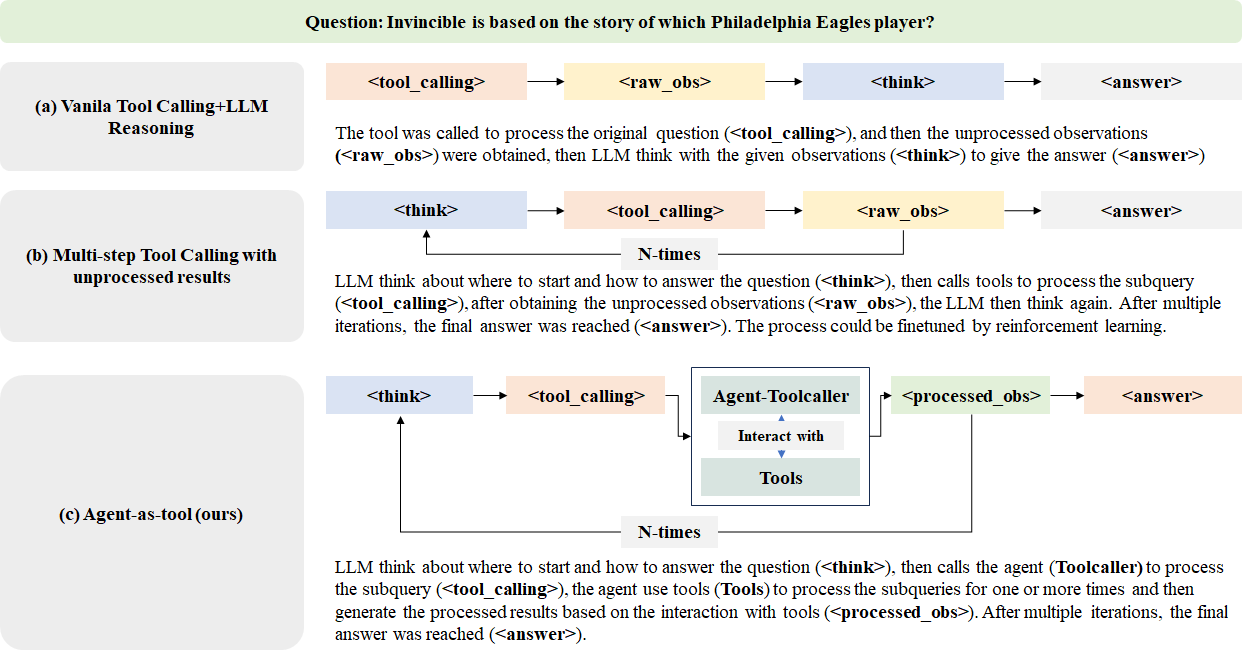
To address these challenges, we propose Agent-as-tool, a hierarchical reasoning architecture in which reasoning and tool execution are explicitly decoupled as shown in Figure 1. The framework introduces a Planner and a Toolcaller as two separate agent components. The Planner focuses on natural language reasoning and high-level decision-making, while the Toolcaller is responsible for managing the tool interface (e.g., invoking web search) and returning structured observations.
The advantages of this design are twofold: (1) It simplifies the RL optimization process by assigning each sub-agent a focused objective; (2) It improves reasoning accuracy by allowing the Planner to operate on cleaner, more structured inputs. Furthermore, we apply a lightweight reinforcement fine-tuning procedure using GRPO on just 180 samples to demonstrate the efficiency of our framework.
This paper makes the following contributions:
- We propose Agent-as-tool, a hierarchical agent framework that separates reasoning and tool usage via a Planner and a Toolcaller.
- We introduce a reinforcement learning protocol that enhances Planner behavior while masking Toolcaller outputs to preserve credit assignment integrity.
- We empirically validate our framework on multiple multi-hop QA datasets and achieve state-of-the-art performance on Bamboogle.
- We provide qualitative insights showing that hierarchical decoupling improves reasoning clarity and decomposition over existing baselines like Search-R1.
<details>
<summary>extracted/6585337/model_graph.png Details</summary>
### Visual Description
## Diagram: Comparison of LLM Tool Calling Workflows
### Overview
The image presents a comparative diagram illustrating three distinct methodologies for how Large Language Models (LLMs) utilize external tools to answer questions. It uses a specific example question—"Invincible is based on the story of which Philadelphia Eagles player?"—to demonstrate the evolution from simple, linear tool calling to complex, iterative, agent-based interactions.
### Components/Axes
The diagram is divided into three horizontal sections, labeled (a), (b), and (c), each representing a different architectural approach.
**Color-Coded Legend (Inferred from diagram elements):**
* **Light Orange:** `<tool_calling>` (Action of invoking a tool)
* **Light Yellow:** `<raw_obs>` (Unprocessed data returned from tools)
* **Light Blue:** `<think>` (LLM reasoning/processing step)
* **Light Red/Pink:** `<answer>` (Final output generation)
* **Light Green:** `<processed_obs>` (Refined/summarized data)
* **Light Grey:** "Agent-Toolcaller" and "Tools" (Intermediate processing components)
### Detailed Analysis
#### Top Header
* **Question:** "Invincible is based on the story of which Philadelphia Eagles player?"
* *Note:* This serves as the shared input for all three workflows.
#### (a) Vanila Tool Calling+LLM Reasoning
* **Flow:** `<tool_calling>` $\rightarrow$ `<raw_obs>` $\rightarrow$ `<think>` $\rightarrow$ `<answer>`
* **Description:** This is a linear, single-pass process. The LLM invokes a tool, receives raw observations, performs reasoning, and generates an answer.
* **Text:** "The tool was called to process the original question (<tool_calling>), and then the unprocessed observations (<raw_obs>) were obtained, then LLM think with the given observations (<think>) to give the answer (<answer>)"
#### (b) Multi-step Tool Calling with unprocessed results
* **Flow:** `<think>` $\rightarrow$ `<tool_calling>` $\rightarrow$ `<raw_obs>` $\rightarrow$ `<answer>`
* **Loop:** An arrow returns from `<answer>` back to the start of the `<think>` block, labeled "N-times".
* **Description:** This is an iterative process. The LLM thinks about the subquery, calls a tool, receives raw observations, and attempts an answer. This cycle repeats N times.
* **Text:** "LLM think about where to start and how to answer the question (<think>), then calls tools to process the subquery (<tool_calling>), after obtaining the unprocessed observations (<raw_obs>), the LLM then think again. After multiple iterations, the final answer was reached (<answer>). The process could be finetuned by reinforcement learning."
#### (c) Agent-as-tool (ours)
* **Flow:** `<think>` $\rightarrow$ `<tool_calling>` $\rightarrow$ [**Agent-Toolcaller** $\rightarrow$ Interact with $\rightarrow$ **Tools**] $\rightarrow$ `<processed_obs>` $\rightarrow$ `<answer>`
* **Loop:** An arrow returns from `<processed_obs>` back to the start of the `<think>` block, labeled "N-times".
* **Description:** This approach introduces an intermediate "Agent-Toolcaller" layer. The LLM calls this agent, which interacts with tools to produce *processed* observations, which are then fed back to the LLM.
* **Text:** "LLM think about where to start and how to answer the question (<think>), then calls the agent (Toolcaller) to process the subquery (<tool_calling>), the agent use tools (Tools) to process the subqueries for one or more times and then generate the processed results based on the interaction with tools (<processed_obs>). After multiple iterations, the final answer was reached (<answer>)."
### Key Observations
* **Evolution of Complexity:** The diagram shows a clear progression from simple linear execution (a) to iterative execution (b), and finally to agent-mediated execution (c).
* **Data Quality:** A critical distinction is the transition from `<raw_obs>` in (a) and (b) to `<processed_obs>` in (c). This implies that the "Agent-as-tool" method is designed to handle noisy or unstructured data by refining it before the LLM performs its reasoning.
* **Iterative Loops:** Both (b) and (c) utilize an "N-times" loop, indicating that complex queries require multiple turns of reasoning and tool interaction, rather than a single "one-shot" attempt.
### Interpretation
The data demonstrates the architectural shift in modern AI agent design.
* **The Problem:** Methods (a) and (b) rely on the LLM to interpret "raw" data directly from tools. This can be problematic if the tool output is verbose, unstructured, or contains irrelevant information, which increases the cognitive load on the LLM and increases the likelihood of hallucination or error.
* **The Solution:** Method (c), labeled "ours," introduces an abstraction layer (the "Agent-Toolcaller"). By having a specialized agent interact with tools and return "processed" observations, the system effectively filters and summarizes information before the main LLM processes it.
* **Strategic Advantage:** This architecture likely improves performance on complex, multi-step reasoning tasks by ensuring the LLM receives high-quality, relevant context rather than raw, potentially overwhelming data. The inclusion of reinforcement learning in (b) and the agentic structure in (c) suggests a focus on optimizing the *process* of reasoning, not just the final output.
</details>
Figure 1: The trajectory of a single sample from a batch of questions processed in different research configurations. In our Agent-as-tool method, we employed the agent as a tool instead of calling the tool directly. The Planner is responsible for the tool calling process and the reasoning process, and the Toolcaller is responsible for the tool calling process to provide sufficient processed observations.
## 2 Literature Review
### 2.1 Agent Frameworks based on Pre-defined Reasoning Steps
There are several agent researches that are designed to perform tasks with pre-trained LLMs and with pre-defined reasoning steps, including the CAMEL (Li et al., 2023a), OpenManus (Liang et al., 2025) and MetaGPT (Hong et al., 2023). These works tend to extend the capabilities of the pre-trained LLM with additional rule-based reasoning steps to ’stimulate’ the internal reasoning capabilities of the LLM to achieve better performances.
Specifically, considering the search and information retrieval for task completion scenario, there are also considerable works, including the Search-o1 (Li et al., 2025a), OpenResearcher (Zheng et al., 2024) (majorly focusing on the scientific research scenario).
### 2.2 RL Reasoning Agents
With the development of RL training frameworks and the Deepseek-R1 (Guo et al., 2025) setting, there are also considerable works to implement R1-style training paradigms on the LLM-based agents. The searching and information retrieval tasks were the first to be considered in this scenario, including the R1-searcher (Song et al., 2025) and DeepResearcher (Zheng et al., 2025).
There are also several works that integrate other external tools under the framework to complete different tasks, including the ToRL (Li et al., 2025b) that integrate the python interpreter tool, ToolRL (Qian et al., 2025) that flexibly integrate different toolkits with different pre-defined datasets (e.g. API-Bank (Li et al., 2023b)), SWiRL (Goldie et al., 2025) that control the tool selection process with different labels (<calculator> for calculator tool, and <search_query> for web search tool).
The generic process of calling an agent in these researches can be concluded as a sequence of thinking <think>, followed by a tool calling query enclosed with <tool_query>, then the tool returns observations <obs>. With the reasoning on each step, the final answer could be reached whenever the agent think the ground truths are sufficient enough to give the final answer. It is a much simpler configuration with a ReAct-like tool calling process (Yao et al., 2023), then reinforcement learning are applied to explore whether the model could exhibit the capabilities beyond simple reasoning to reach the next hop, as shown in Figure 1 as Multi-step Tool Calling with Unprocessed Results.
## 3 Methodology
We propose the Agent-as-tool framework as a hierarchical design for multi-hop reasoning tasks. It separates the planning and tool usage responsibilities between two agent components: a high-level Planner and a subordinate Toolcaller. The Planner manages reasoning and task decomposition, while the Toolcaller executes external actions such as web search. This section outlines the design of both components and the reinforcement learning procedure employed to optimize the Planner.
### 3.1 Agent Architecture
#### 3.1.1 Planner
The Planner is a language model agent responsible for high-level reasoning and tool invocation decisions. It reasons about the current task state and emits tool usage instructions in natural language.
Reasoning: The Planner conducts internal reasoning enclosed in <think>...</think> tags, in line with DeepSeek-R1 conventions (Guo et al., 2025). It uses previous observations and the original query to plan the next subtask.
Tool Invocation: Tool calls are expressed as sub-queries wrapped in <tool_calling>...</tool_calling> tags. These queries are interpreted by the Toolcaller, and the results are returned to the Planner as <obs>...</obs> blocks for further reasoning.
#### 3.1.2 Toolcaller
The Toolcaller is a dedicated LLM-based agent designed to interface with external tools. In our implementation, it wraps a web search tool and processes queries issued by the Planner.
We implement the Toolcaller using a CAMEL-style chat agent (Li et al., 2023a), powered by GPT-4o-mini (Hurst et al., 2024). It could retrieve top- k search results multiple times and returns structured summaries to the Planner. Although our current prototype uses only web search, the architecture supports extension to tools like calculators or code interpreters, also including MCP-based tool servers.
### 3.2 Reinforcement Learning with GRPO
#### 3.2.1 Training Objective
We employ Generalized Reinforcement Policy Optimization (GRPO) (Shao et al., 2024) to fine-tune the Planner. The objective is:
$$
\begin{split}\mathcal{J}(\Theta)&=\mathbb{E}_{x\sim\mathcal{D},\{y_{i}\}_{i=1}
^{G}\sim\pi_{\text{old}}(\cdot|x)}\Bigg{[}\frac{1}{G}\sum_{i=1}^{G}\Big{[}\\
&\min\left(\frac{\pi_{\Theta}(y_{i}|x)}{\pi_{\text{old}}(y_{i}|x)}A_{i},\text{
clip}\left(\frac{\pi_{\Theta}(y_{i}|x)}{\pi_{\text{old}}(y_{i}|x)},1-
\varepsilon,1+\varepsilon\right)A_{i}\right)\\
&-\beta D_{\text{KL}}(\pi_{\Theta}||\pi_{\text{ref}})\Big{]}\Bigg{]}\end{split} \tag{1}
$$
where $x$ is sampled from dataset $\mathcal{D}$ , $y_{i}$ is a rollout, $A_{i}$ is the advantage, $\varepsilon$ is the clipping threshold, and $\beta$ regulates KL penalty.
#### 3.2.2 Observation Masking
To prevent reward leakage through Toolcaller-generated outputs, we mask the <obs> blocks during reward modeling and training. These segments are replaced with special token <fim_pad>, which is trained to embed close to zero.
#### 3.2.3 Reward Function
Our reward function balances correctness and formatting constraints:
$$
\text{Reward}=\begin{cases}\text{F1 score}&\text{if answer is correctly
formatted}\\
-2&\text{otherwise}\end{cases} \tag{2}
$$
The model receives a high reward when generating a valid and correct response, and a penalty when output is malformed.
## 4 Experiments
### 4.1 Experiment Settings
#### 4.1.1 Model and Hyperparameters
We use Qwen-2.5-7B-Instruct (Qwen et al., 2025) as our base model. The training is conducted by an customized implementation of rollout and a customized implementation of GRPO on trl (von Werra et al., 2020). At each training step, we sample a batch of training data from the training set and calculate the reward for each rollout. Then, we update the policy by maximizing the reward.
The batch size is set to 3 for each training step and each sample contains 12 rollouts for each prompt. Each rollout contains at most 10 rounds of tool calling.
#### 4.1.2 Training Settings
We conducted quite a small scale of training for the Agent-as-tool. We trained the Agent-as-tool for 60 steps with each step containing 3 training samples, and each training sample contains 12 rollouts, with total size of only 180 samples and 2160 rollouts. The training data entries were selected from the HotpotQA (Yang et al., 2018) and 2WikiMultiHopQA (Ho et al., 2020) datasets with the same ratio as the R1-searcher (Song et al., 2025).
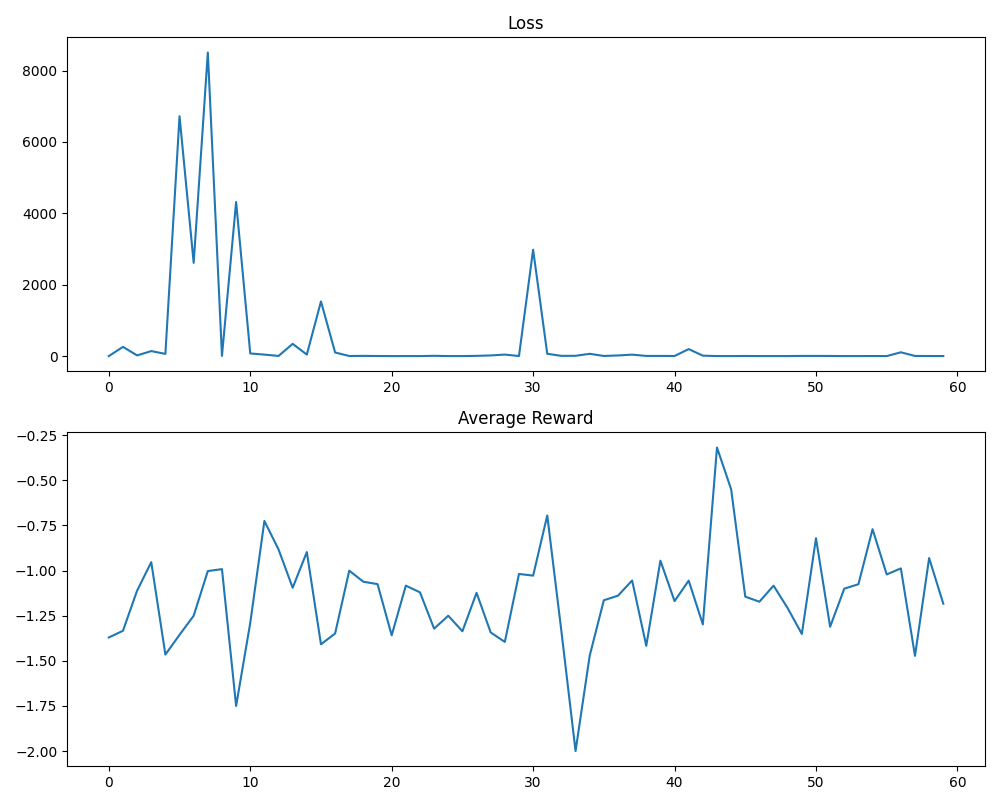
During the training process, we observed that the loss of the Agent-as-tool is not stable for the first 30 steps, which is likely due to the small training data, but after 30 steps, the loss is stable and close to 0 and the performance of the Agent-as-tool also stabilized.
<details>
<summary>extracted/6585337/training_graph.png Details</summary>
### Visual Description
## Line Charts: Loss and Average Reward
### Overview
The image displays two vertically stacked line charts representing performance metrics over a training period of 60 steps (x-axis). The top chart tracks "Loss," while the bottom chart tracks "Average Reward." These charts are characteristic of monitoring logs for a machine learning model, likely a Reinforcement Learning (RL) agent.
### Components/Axes
* **Shared X-Axis:** Represents training steps or epochs, ranging from 0 to 60.
* **Top Chart (Loss):**
* **Title:** "Loss"
* **Y-Axis:** Represents the loss value, ranging from 0 to over 8000.
* **Bottom Chart (Average Reward):**
* **Title:** "Average Reward"
* **Y-Axis:** Represents the average reward value, ranging from -2.00 to -0.25.
### Detailed Analysis
#### Top Chart: Loss
* **Trend:** The line is characterized by extreme volatility in the early stages (steps 0–15), followed by a period of relative stability near zero, interrupted by a single significant spike at step 30.
* **Data Points (Approximate):**
* **Steps 0–4:** The loss is low, hovering near 0.
* **Step 5:** A sharp upward spike to approximately 6,700.
* **Step 7:** The global maximum, reaching approximately 8,500.
* **Step 9:** A secondary spike to approximately 4,300.
* **Step 15:** A smaller spike to approximately 1,500.
* **Step 30:** A distinct, isolated spike to approximately 3,000.
* **Steps 31–60:** The loss remains consistently near 0, with minor fluctuations.
#### Bottom Chart: Average Reward
* **Trend:** The line exhibits high-frequency oscillation throughout the entire 60-step duration. There is no discernible upward trend, indicating the agent is not consistently improving its performance.
* **Data Points (Approximate):**
* **Start (Step 0):** Approximately -1.35.
* **Step 9:** A local minimum of approximately -1.75.
* **Step 33:** The global minimum of approximately -2.00.
* **Step 43:** The global maximum (best performance) of approximately -0.30.
* **General Range:** The majority of the data points fluctuate between -1.5 and -0.75.
### Key Observations
* **Initial Instability:** The "Loss" chart shows massive instability in the first 10 steps, suggesting the model may have had a high learning rate or encountered difficult initial states.
* **Lack of Convergence:** The "Average Reward" chart does not show a clear trend toward a higher (less negative) value. The agent appears to be exploring or failing to learn a stable policy, as the reward remains highly volatile.
* **Anomalous Spike:** The spike in "Loss" at step 30 does not appear to have a corresponding, immediate, or obvious impact on the "Average Reward" at that exact step, suggesting a potential decoupling between the loss function and the actual performance metric in this specific training run.
### Interpretation
This data suggests a **failed or struggling training process**.
In a successful Reinforcement Learning scenario, one would expect the "Loss" to decrease and stabilize, and the "Average Reward" to trend upward over time. Here, the "Average Reward" remains trapped in a noisy, oscillating state between -2.0 and -0.3, indicating the agent has not learned an optimal policy. The extreme spikes in "Loss" early on suggest the model was likely struggling to optimize its parameters, possibly due to an unstable environment, an inappropriate learning rate, or a poorly defined reward function. The lack of correlation between the loss spikes and reward fluctuations further implies that the loss function being minimized may not be effectively guiding the agent toward higher rewards.
</details>
Figure 2: Training progress of the Agent-as-tool model showing loss convergence over training steps. The loss becomes stable after approximately 30 training steps.
The training curve illustrated in Figure 2 shows the convergence behavior of our model during the reinforcement learning process.
#### 4.1.3 Benchmark Settings
In order to evaluate the performance of the Agent-as-tool, we conducted experiments on the open-domain question-answering task. We selected multiple multi-hop reasoning tasks to evaluate the performance of the Agent-as-tool, including the HotpotQA (Yang et al., 2018), 2WikiMultiHopQA (Ho et al., 2020), MuSiQue (Trivedi et al., 2022), and bamboogle (Press et al., 2023).
#### 4.1.4 Baseline Settings
We have 1 information retrival tool: web search.
We then compare the performance of the Agent-as-tool with the following baselines:
- direct IO: This baseline employs the direct output of the Qwen-2.5-7B-Instruct (Qwen et al., 2025) as the answer without any external tool calling.
- direct IO with web search: This baseline employs the direct output of the Qwen-2.5-7B-Instruct (Qwen et al., 2025), but enables the web search to process the original question and return the top-k results as additional observations.
- CAMEL Agent: This baseline employs the CAMEL (Li et al., 2023a) chat agent driven by the GPT-4o-mini (Hurst et al., 2024).
- CAMEL Agent with web search: This baseline employs the CAMEL (Li et al., 2023a) chat agent driven by the GPT-4o-mini (Hurst et al., 2024) and the same tool setting as the Agent-as-tool with web search tool only. This baseline is used as the reference for multi-hop reasoning tasks conducted with the rule-based agent framework.
- Search-R1: We directly compare the performance of the Agent-as-tool with the Search-R1 (Jin et al., 2025) in our configurations with web search tool for a fair comparison. As Search-R1 cannot be directly integrated with the CAMEL (Li et al., 2023a) chat agent, we would directly returns the search results as the answer instead of using another Toolcaller.
We conducted experiments with Agent-as-tool with pre-finetuned and post-finetuned models.
In align with the Deepseek-R1 setting (Guo et al., 2025), we adopted the same prompt setting for all the baselines and the Agent-as-tool except Search-R1 (Jin et al., 2025) that is equipped with its orignal prompt setting, and we also modified the tool calling process to enable Search-R1 to accesss the unprocessed web search results.
#### 4.1.5 Evaluation Metrics
In this paper, we focus on the performance of the Agent-as-tool in terms of the correctness of the answer, therefore, we employed the exact match metric (EM), the cover exact match metric (CEM) to evaluate the performance of the Agent-as-tool.
### 4.2 Quantitative Experiment Results
The qualitative results are shown in LABEL:tab:all_datasets_complete. Based on the results, we can see that the Agent-as-tool outperforms most of the baselines except for the EM metric in the HotpotQA, 2WikiMultiHopQA, and MuSiQue datasets, where Search-R1 still has the best performance. However, in terms of the CEM metric, our model has a substantial improvement over all the baselines, except in HotpotQA where Search-R1 still has the best performance (64.2% vs 57.4%). And in the Bamboogle dataset (Press et al., 2023), the Agent-as-tool with web search tool integrated to the Toolcaller (CAMEL (Li et al., 2023a) agent) achieves the best performance with EM of 63.2% and CEM of 75.2%.
Table 1: Performance Comparison Across Different Datasets
| Bamboogle | Direct IO | 17.6 | 26.4 |
| --- | --- | --- | --- |
| Direct IO + Web Search | 29.6 | 42.4 | |
| CAMEL | 36.8 | 47.2 | |
| CAMEL + Web Search | 51.2 | 62.4 | |
| Search-R1 + Web Search | 58.4 | 72.0 | |
| Agent-as-tool-Base + Web Search | 60.0 | 71.2 | |
| Agent-as-tool-Instruct + Web Search | 63.2 | 75.2 | |
| HotpotQA | Direct IO | 20.0 | 27.2 |
| Direct IO + Web Search | 32.6 | 52.8 | |
| CAMEL | 23.2 | 44.2 | |
| CAMEL + Web Search | 32.4 | 59.4 | |
| Search-R1 + Web Search | 47.2 | 64.2 | |
| Agent-as-tool-Base + Web Search | 35.0 | 55.2 | |
| Agent-as-tool-Instruct + Web Search | 37.2 | 57.4 | |
| 2WikiMultiHopQA | Direct IO | 22.6 | 25.4 |
| Direct IO + Web Search | 27.2 | 40.2 | |
| CAMEL | 20.8 | 34.6 | |
| CAMEL + Web Search | 35.0 | 69.4 | |
| Search-R1 + Web Search | 52.4 | 68.0 | |
| Agent-as-tool-Base + Web Search | 42.8 | 68.0 | |
| Agent-as-tool-Instruct + Web Search | 44.6 | 70.0 | |
| MuSiQue | Direct IO | 4.8 | 9.0 |
| Direct IO + Web Search | 14.0 | 18.0 | |
| CAMEL | 9.2 | 18.8 | |
| CAMEL + Web Search | 16.0 | 29.4 | |
| Search-R1 + Web Search | 20.8 | 28.6 | |
| Agent-as-tool-Base + Web Search | 15.6 | 28.8 | |
| Agent-as-tool-Instruct + Web Search | 18.4 | 29.8 | |
We compared the performance of the Agent-as-tool before and after the reinforcement fine-tuning process. The table is shown in 2. Based on the results, we can see that the Reinforcement fine-tuning based on GRPO (Shao et al., 2024) substantially improves the performance of the Agent-as-tool in all datasets with an average improvement of 2.5% in EM and 2.3% in CEM.
Table 2: Performance improvements after reinforcement fine-tuning
| Dataset | Pre-finetuned | Post-finetuned | Improvement | | | |
| --- | --- | --- | --- | --- | --- | --- |
| EM | CEM | EM | CEM | EM | CEM | |
| (%) | (%) | (%) | (%) | (%) | (%) | |
| Bamboogle | 60.0 | 71.2 | 63.2 | 75.2 | +3.2 | +4.0 |
| HotpotQA | 35.0 | 55.2 | 37.2 | 57.4 | +2.2 | +2.2 |
| 2WikiMultiHopQA | 42.8 | 68.0 | 44.6 | 70.0 | +1.8 | +2.0 |
| MuSiQue | 15.6 | 28.8 | 18.4 | 29.8 | +2.8 | +1.0 |
| Average | 38.4 | 55.8 | 40.9 | 58.1 | +2.5 | +2.3 |
Comparing with the CAMEL baseline with web search tool integrated (CAMEL + Web Search), the Agent-as-tool pre-finetuned and post-finetuned achieved a substantial improvement in EM and CEM, stating the necessity that the Agent-as-tool that enables the model to control when and what to be called in a tool calling is a more effective framework for multi-hop reasoning tasks.
Comparing with the Search-R1 baseline (Search-R1 + Web Search), which is the current best performing research of its kind, the Agent-as-tool-Instruct has substantial improvements over the Bamboogle dataset, which improves the EM by 4.8% and CEM by 3.2%, stating the effectiveness of the Agent-as-tool in multi-hop reasoning tasks. Besides, the Agent-as-tool conducted fine-tuning with 180 samples, which indicates the efficiency of the fine-tuning process.
### 4.3 Qualitative Results Inspection and Analysis
#### 4.3.1 Comparison of the Agent-as-tool and the Search-R1
Comparing with Search-R1 baseline (Search-R1 + Web Search), the Agent-as-tool-Instruct had several advantages qualitatively:
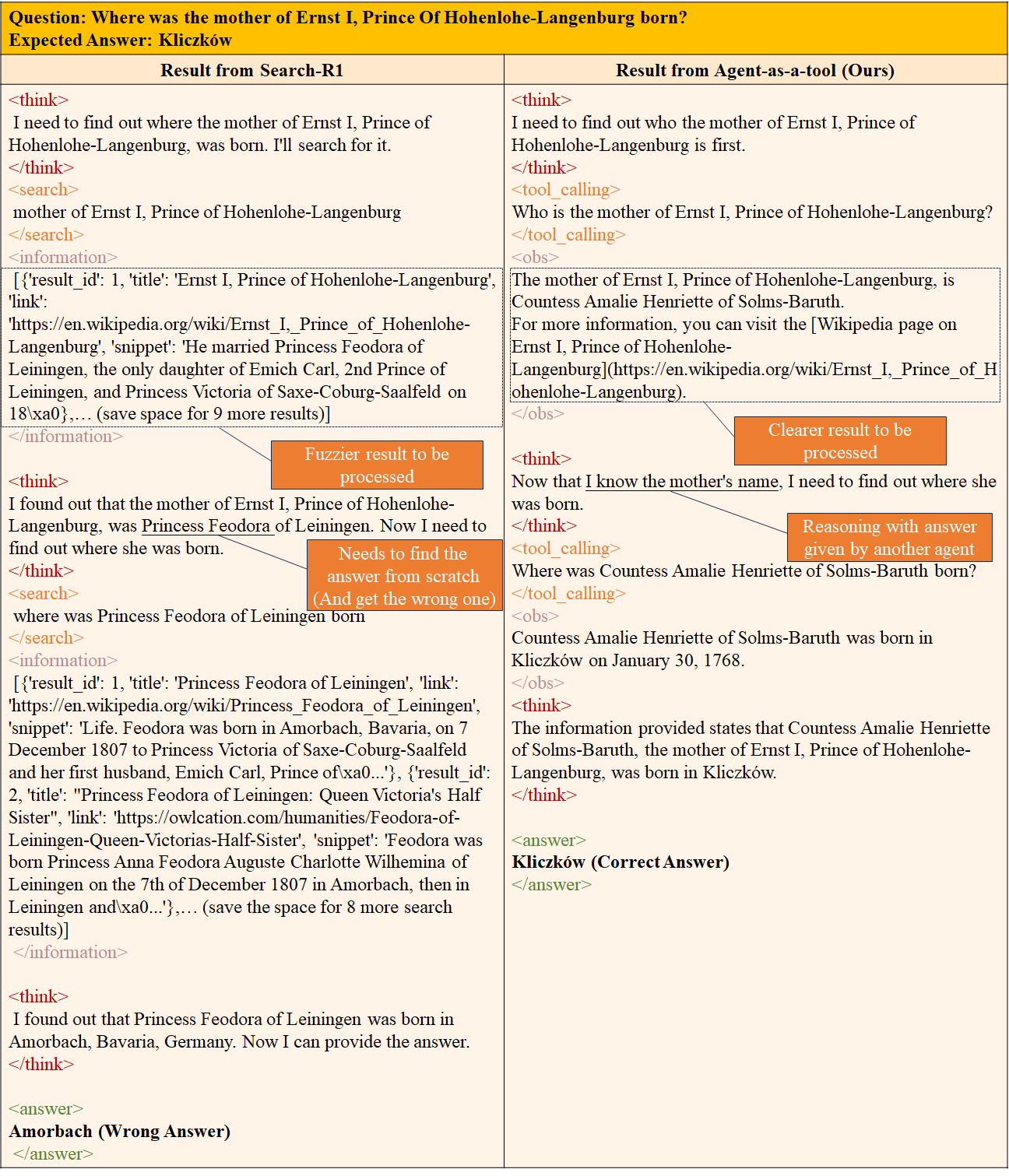
- The Agent-as-tool-Instruct could reason with less fuzzy and more structured observations, comparing with the Search-R1 + Web Search which would need to reason with the unprocessed web search results with fuzzy and unstructured symbols or other unrelated details.
- As the Agent-as-tool-Instruct adopt a hierarchical reasoning process which segragate the reasoning process and the tool calling process, the agent could have a better linearly text-based reasoning process comparing with the Search-R1 + Web Search.
The qualitative comparison as a example is shown in Figure 3 (in Appendix). The Agent-as-tool-Instruct could reason with less fuzzy and more structured observations, comparing with the Search-R1 + Web Search which would need to reason with the unprocessed web search results with fuzzy and unstructured symbols or other unrelated details.
#### 4.3.2 Comparison of the Results before and after the Reinforcement Fine-tuning
Comparing with Agent-as-tool-Base, the Agent-as-tool-Instruct had several advantages qualitatively:
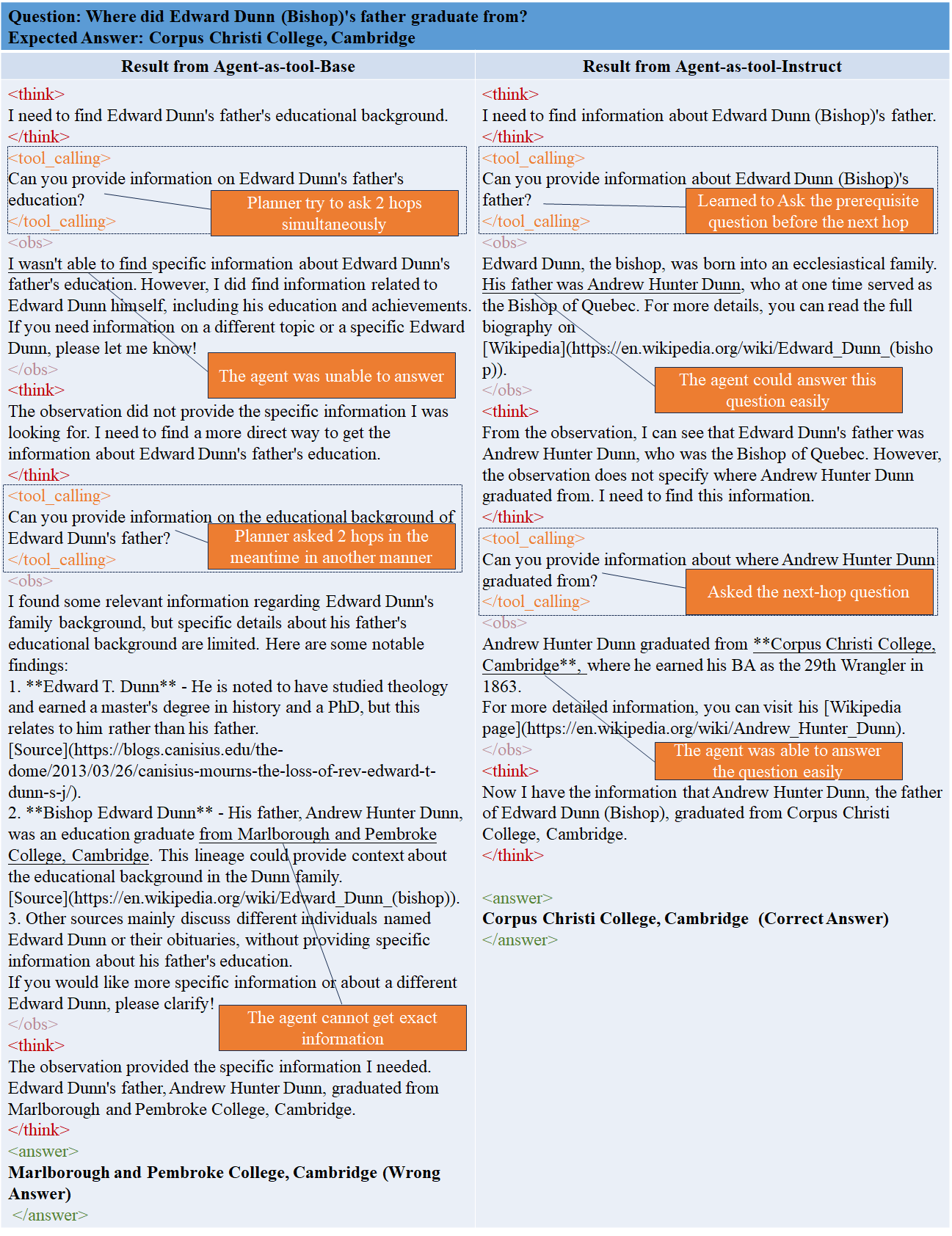
- The Agent-as-tool-Instruct identify the correct decomposition of the question to identify the first hop and the second hop to be solved by the agent, comparing with the Agent-as-tool-Base which would not be able to decompose the multi-hop question correctly so it directly feed the agent with the whole question (only a sightly change from the original manner). If the agent is not capable of reasoning the multi-hop question correctly, the Agent-as-tool-Base would not be able to answer the question correctly.
- As the Agent-as-tool-Instruct was instructed to reason with the agent powered by the pretrained model, the fine-tuned model could give a more structured and reasonable question to be answered by the agent comparing with the Agent-as-tool-Base.
The qualitative comparison as a example is shown in Figure 4 (in Appendix). The Agent-as-tool-Instruct could correctly decompose the question to identify the first hop and the second hop, comparing with the Agent-as-tool-Base which would not be able to decompose the multi-hop question correctly so it directly feed the agent with the whole question.
## 5 Conclusions and Future Work
### 5.1 Conclusions
In this paper, we majorly studied the multi-hop reasoning tasks with the Agent-as-tool framework. We found that the Agent-as-tool could achieve a substantial improvement in the performance of the multi-hop reasoning tasks, especially in the Bamboogle dataset (Press et al., 2023). We also found that the Agent-as-tool could reason with less fuzzy and more structured observations, comparing with the Search-R1 + Web Search which would need to reason with the unprocessed web search results with fuzzy and unstructured symbols or other unrelated details.
### 5.2 Limitations and Future Work
This paper only assigns the search tool to the agent (or in another word, the search agent) so the scope is limited to the open-domain multi-hop search tasks. While because only 1 model was provided, the dynamic assignment of the tool to the agent is not considered. Therefore in our future work more tools would be considered to be assigned to the agent, while we would also explore the dynamic assignment of the tool to the agent, in another word, make the Planner as a Tool Orchestrator.
## References
- Brown et al. [2020] T. Brown, B. Mann, N. Ryder, M. Subbiah, J. D. Kaplan, P. Dhariwal, A. Neelakantan, P. Shyam, G. Sastry, A. Askell, et al. Language models are few-shot learners. Advances in neural information processing systems, 33:1877–1901, 2020.
- Goldie et al. [2025] A. Goldie, A. Mirhoseini, H. Zhou, I. Cai, and C. D. Manning. Synthetic data generation and multi-step rl for reasoning and tool use, 2025. URL https://arxiv.org/abs/2504.04736.
- Guo et al. [2025] D. Guo, D. Yang, H. Zhang, J. Song, R. Zhang, R. Xu, Q. Zhu, S. Ma, P. Wang, X. Bi, et al. Deepseek-r1: Incentivizing reasoning capability in llms via reinforcement learning. arXiv preprint arXiv:2501.12948, 2025.
- Ho et al. [2020] X. Ho, A.-K. D. Nguyen, S. Sugawara, and A. Aizawa. Constructing a multi-hop qa dataset for comprehensive evaluation of reasoning steps. arXiv preprint arXiv:2011.01060, 2020.
- Hong et al. [2023] S. Hong, X. Zheng, J. Chen, Y. Cheng, J. Wang, C. Zhang, Z. Wang, S. K. S. Yau, Z. Lin, L. Zhou, et al. Metagpt: Meta programming for multi-agent collaborative framework. arXiv preprint arXiv:2308.00352, 3(4):6, 2023.
- Hurst et al. [2024] A. Hurst, A. Lerer, A. P. Goucher, A. Perelman, A. Ramesh, A. Clark, A. Ostrow, A. Welihinda, A. Hayes, A. Radford, et al. Gpt-4o system card. arXiv preprint arXiv:2410.21276, 2024.
- Jin et al. [2025] B. Jin, H. Zeng, Z. Yue, J. Yoon, S. Arik, D. Wang, H. Zamani, and J. Han. Search-r1: Training llms to reason and leverage search engines with reinforcement learning, 2025. URL https://arxiv.org/abs/2503.09516.
- Li et al. [2023a] G. Li, H. Hammoud, H. Itani, D. Khizbullin, and B. Ghanem. Camel: Communicative agents for” mind” exploration of large language model society. Advances in Neural Information Processing Systems, 36:51991–52008, 2023a.
- Li et al. [2023b] M. Li, Y. Zhao, B. Yu, F. Song, H. Li, H. Yu, Z. Li, F. Huang, and Y. Li. Api-bank: A comprehensive benchmark for tool-augmented llms, 2023b. URL https://arxiv.org/abs/2304.08244.
- Li et al. [2025a] X. Li, G. Dong, J. Jin, Y. Zhang, Y. Zhou, Y. Zhu, P. Zhang, and Z. Dou. Search-o1: Agentic search-enhanced large reasoning models, 2025a. URL https://arxiv.org/abs/2501.05366.
- Li et al. [2025b] X. Li, H. Zou, and P. Liu. Torl: Scaling tool-integrated rl. arXiv preprint arXiv:2503.23383, 2025b.
- Liang et al. [2025] X. Liang, J. Xiang, Z. Yu, J. Zhang, S. Hong, S. Fan, and X. Tang. Openmanus: An open-source framework for building general ai agents, 2025. URL https://doi.org/10.5281/zenodo.15186407.
- Liu et al. [2025] B. Liu, X. Li, J. Zhang, J. Wang, T. He, S. Hong, H. Liu, S. Zhang, K. Song, K. Zhu, et al. Advances and challenges in foundation agents: From brain-inspired intelligence to evolutionary, collaborative, and safe systems. arXiv preprint arXiv:2504.01990, 2025.
- Press et al. [2023] O. Press, M. Zhang, S. Min, L. Schmidt, N. A. Smith, and M. Lewis. Measuring and narrowing the compositionality gap in language models, 2023. URL https://arxiv.org/abs/2210.03350.
- Qian et al. [2025] C. Qian, E. C. Acikgoz, Q. He, H. Wang, X. Chen, D. Hakkani-Tür, G. Tur, and H. Ji. Toolrl: Reward is all tool learning needs. arXiv preprint arXiv:2504.13958, 2025.
- Qwen et al. [2025] Qwen, :, A. Yang, B. Yang, B. Zhang, B. Hui, B. Zheng, B. Yu, C. Li, D. Liu, F. Huang, H. Wei, H. Lin, J. Yang, J. Tu, J. Zhang, J. Yang, J. Yang, J. Zhou, J. Lin, K. Dang, K. Lu, K. Bao, K. Yang, L. Yu, M. Li, M. Xue, P. Zhang, Q. Zhu, R. Men, R. Lin, T. Li, T. Tang, T. Xia, X. Ren, X. Ren, Y. Fan, Y. Su, Y. Zhang, Y. Wan, Y. Liu, Z. Cui, Z. Zhang, and Z. Qiu. Qwen2.5 technical report, 2025. URL https://arxiv.org/abs/2412.15115.
- Shao et al. [2024] Z. Shao, P. Wang, Q. Zhu, R. Xu, J. Song, X. Bi, H. Zhang, M. Zhang, Y. Li, Y. Wu, et al. Deepseekmath: Pushing the limits of mathematical reasoning in open language models. arXiv preprint arXiv:2402.03300, 2024.
- Song et al. [2025] H. Song, J. Jiang, Y. Min, J. Chen, Z. Chen, W. X. Zhao, L. Fang, and J.-R. Wen. R1-searcher: Incentivizing the search capability in llms via reinforcement learning. arXiv preprint arXiv:2503.05592, 2025.
- Trivedi et al. [2022] H. Trivedi, N. Balasubramanian, T. Khot, and A. Sabharwal. Musique: Multihop questions via single-hop question composition, 2022. URL https://arxiv.org/abs/2108.00573.
- von Werra et al. [2020] L. von Werra, Y. Belkada, L. Tunstall, E. Beeching, T. Thrush, N. Lambert, S. Huang, K. Rasul, and Q. Gallouédec. Trl: Transformer reinforcement learning. https://github.com/huggingface/trl, 2020.
- Yang et al. [2018] Z. Yang, P. Qi, S. Zhang, Y. Bengio, W. W. Cohen, R. Salakhutdinov, and C. D. Manning. Hotpotqa: A dataset for diverse, explainable multi-hop question answering. arXiv preprint arXiv:1809.09600, 2018.
- Yao et al. [2023] S. Yao, J. Zhao, D. Yu, N. Du, I. Shafran, K. Narasimhan, and Y. Cao. React: Synergizing reasoning and acting in language models, 2023. URL https://arxiv.org/abs/2210.03629.
- Zhang et al. [2024] J. Zhang, J. Xiang, Z. Yu, F. Teng, X. Chen, J. Chen, M. Zhuge, X. Cheng, S. Hong, J. Wang, et al. Aflow: Automating agentic workflow generation. arXiv preprint arXiv:2410.10762, 2024.
- Zheng et al. [2024] Y. Zheng, S. Sun, L. Qiu, D. Ru, C. Jiayang, X. Li, J. Lin, B. Wang, Y. Luo, R. Pan, et al. Openresearcher: Unleashing ai for accelerated scientific research. arXiv preprint arXiv:2408.06941, 2024.
- Zheng et al. [2025] Y. Zheng, D. Fu, X. Hu, X. Cai, L. Ye, P. Lu, and P. Liu. Deepresearcher: Scaling deep research via reinforcement learning in real-world environments. arXiv preprint arXiv:2504.03160, 2025.
## Appendix A The qualitative Results inspection
### A.1 The qualitative results inspection of the Agent-as-tool-Instruct + Web Search and the Search-R1 + Web Search
<details>
<summary>extracted/6585337/comparisonSearchR1andOurs.png Details</summary>
### Visual Description
## Comparison Table: AI Agent Reasoning Processes
### Overview
The image displays a comparative analysis of two different AI agent reasoning workflows attempting to answer the historical question: "Where was the mother of Ernst I, Prince Of Hohenlohe-Langenburg born?" The table contrasts a "Search-R1" agent (left column), which fails due to an incorrect entity identification, against an "Agent-as-a-tool" agent (right column), which succeeds by decomposing the problem into distinct, verifiable steps.
### Components/Axes
* **Header:** Contains the primary question and the expected answer ("Kliczków").
* **Table Structure:** A two-column layout.
* **Left Column:** "Result from Search-R1" (The failing process).
* **Right Column:** "Result from Agent-as-a-tool (Ours)" (The successful process).
* **Annotations:** Three orange text boxes with arrows pointing to specific sections of the reasoning process, providing meta-commentary on the agent's performance.
### Detailed Analysis
#### Left Column: Result from Search-R1 (Failure)
* **Initial Step:** The agent searches for "mother of Ernst I, Prince of Hohenlohe-Langenburg".
* **Information Retrieval:** The search returns a snippet about Ernst I marrying Princess Feodora of Leiningen.
* **Annotation:** An orange box labeled "Fuzzier result to be processed" points to the search result.
* **Reasoning Error:** The agent incorrectly assumes Princess Feodora of Leiningen is the mother.
* **Annotation:** An orange box labeled "Needs to find the answer from scratch (And get the wrong one)" points to the reasoning step where the agent pivots to searching for Feodora's birthplace.
* **Secondary Search:** The agent searches for "where was Princess Feodora of Leiningen born".
* **Result:** The agent retrieves information about Feodora being born in Amorbach, Bavaria.
* **Conclusion:** The agent incorrectly concludes that Amorbach is the answer.
* **Final Answer:** "Amorbach (Wrong Answer)"
#### Right Column: Result from Agent-as-a-tool (Success)
* **Initial Step:** The agent identifies the need to first determine the identity of the mother.
* **Tool Call:** "Who is the mother of Ernst I, Prince of Hohenlohe-Langenburg?"
* **Observation:** The agent correctly identifies the mother as "Countess Amalie Henriette of Solms-Baruth."
* **Annotation:** An orange box labeled "Clearer result to be processed" points to this observation.
* **Secondary Step:** Now knowing the mother's name, the agent proceeds to find her birthplace.
* **Annotation:** An orange box labeled "Reasoning with answer given by another agent" points to the transition between identifying the mother and searching for her birthplace.
* **Tool Call:** "Where was Countess Amalie Henriette of Solms-Baruth born?"
* **Observation:** The agent retrieves the correct data: "Countess Amalie Henriette of Solms-Baruth was born in Kliczków on January 30, 1768."
* **Final Answer:** "Kliczków (Correct Answer)"
### Key Observations
* **Entity Conflation:** The "Search-R1" agent suffers from a common retrieval error: it conflates the wife of the subject (Princess Feodora) with the mother of the subject.
* **Decomposition:** The "Agent-as-a-tool" workflow succeeds because it treats the query as a multi-hop reasoning problem, ensuring the subject (the mother) is correctly identified *before* attempting to answer the location question.
* **Annotation Logic:** The annotations serve as a critique of the "Search-R1" process, highlighting exactly where the logic diverges from the correct path.
### Interpretation
This image serves as a technical demonstration of the superiority of "Agentic" or "Tool-use" workflows over standard "Search-and-Generate" workflows for complex, multi-step queries.
* **The Failure Mode:** The "Search-R1" agent demonstrates a "greedy" failure. It retrieves a search result that contains the subject's name and immediately assumes the context of that result (the wife) is the answer to the user's query. It lacks the verification step to confirm if the entity found is actually the entity requested.
* **The Success Mode:** The "Agent-as-a-tool" approach demonstrates "Chain of Thought" reasoning. By forcing the agent to explicitly call a tool to identify the mother first, it creates a "ground truth" anchor. Once the mother is correctly identified as Countess Amalie Henriette of Solms-Baruth, the second search query becomes highly specific, leaving little room for the ambiguity that caused the failure in the left column.
* **Implication:** This highlights that for AI systems, the *process* of reasoning (decomposing the problem) is often more important than the raw search capability. Even with access to the same information, the agent that structures its inquiry logically will outperform the agent that relies on a single, potentially misleading search result.
</details>
Figure 3: The Agent-as-tool-Instruct could reason with less fuzzy and more structured observations, comparing with the Search-R1 + Web Search which would need to reason with the unprocessed web search results with other unrelated details. Search-R1 was misled by the unprocessed web search results to reason with the wrong answer for the second hop (Princess Feodora of Leiningen), while the Agent-as-tool-Instruct has applied the agent to preprocess the web search results and return the correct answer (Countess Amalie Henriette of Solms-Baruth) for the second hop.
### A.2 The qualitative results inspection of the Agent-as-tool-Instruct + Web Search and the Agent-as-tool-Base + Web Search
<details>
<summary>extracted/6585337/comparisonBeforeAfter1.png Details</summary>
### Visual Description
This image is a comparative analysis table illustrating the performance of two different AI agent architectures—"Agent-as-tool-Base" and "Agent-as-tool-Instruct"—in answering a specific biographical query. The image uses a structured log format (resembling XML tags) to show the reasoning process of each agent, supplemented by orange text boxes that provide meta-commentary on the agents' decision-making strategies.
## Table: AI Agent Performance Comparison
### Overview
The image presents a side-by-side comparison of two AI agents attempting to answer the question: *"Where did Edward Dunn (Bishop)'s father graduate from?"* The expected answer is "Corpus Christi College, Cambridge." The left column shows the "Base" agent failing to retrieve the correct information, while the right column shows the "Instruct" agent successfully navigating the query through sequential reasoning.
### Components/Axes
* **Header:** Contains the target question and the ground-truth answer.
* **Left Column (Agent-as-tool-Base):** Documents the failure path of the base model.
* **Right Column (Agent-as-tool-Instruct):** Documents the success path of the instructed model.
* **Annotations:** Orange text boxes overlaid on the content provide qualitative assessments of the agents' actions (e.g., "Planner try to ask 2 hops simultaneously").
* **Syntax:** The content uses pseudo-code tags: `<think>` (internal reasoning), `<tool_calling>` (external search queries), `<obs>` (search results/observations), and `<answer>` (final output).
### Detailed Analysis
#### Header
* **Question:** Where did Edward Dunn (Bishop)'s father graduate from?
* **Expected Answer:** Corpus Christi College, Cambridge
#### Left Column: Result from Agent-as-tool-Base
1. **Initial Step:** The agent attempts to find the father's education.
* *Annotation:* "Planner try to ask 2 hops simultaneously"
2. **Observation:** The agent fails to find specific info on the father, finding info on Edward Dunn himself instead.
* *Annotation:* "The agent was unable to answer"
3. **Second Step:** The agent tries a different search query.
* *Annotation:* "Planner asked 2 hops in the meantime in another manner"
4. **Observation:** The agent retrieves a list of findings, including a mention of "Marlborough and Pembroke College, Cambridge" for Andrew Hunter Dunn.
* *Annotation:* "The agent cannot get exact information"
5. **Final Answer:** The agent concludes with "Marlborough and Pembroke College, Cambridge (Wrong Answer)."
#### Right Column: Result from Agent-as-tool-Instruct
1. **Initial Step:** The agent identifies the need to find information about the father.
* *Annotation:* "Learned to Ask the prerequisite question before the next hop"
2. **Observation:** The agent identifies the father as Andrew Hunter Dunn, Bishop of Quebec.
* *Annotation:* "The agent could answer this question easily"
3. **Second Step:** The agent recognizes the missing information (where the father graduated) and formulates a specific follow-up query.
* *Annotation:* "Asked the next-hop question"
4. **Observation:** The agent successfully retrieves the correct data: "Andrew Hunter Dunn graduated from **Corpus Christi College, Cambridge**, where he earned his BA as the 29th Wrangler in 1863."
* *Annotation:* "The agent was able to answer the question easily"
5. **Final Answer:** The agent concludes with "Corpus Christi College, Cambridge (Correct Answer)."
### Key Observations
* **Strategy Divergence:** The "Base" agent attempts to solve the problem in a non-linear or overly complex manner ("2 hops simultaneously"), leading to confusion and incorrect data retrieval.
* **Sequential Logic:** The "Instruct" agent demonstrates superior performance by breaking the task into a prerequisite step (identifying the father) followed by a specific follow-up step (identifying the graduation college).
* **Hallucination/Error:** The "Base" agent provides an incorrect answer ("Marlborough and Pembroke College"), suggesting that when an agent lacks a structured reasoning path, it is more prone to retrieving or synthesizing incorrect information.
### Interpretation
This image serves as a technical demonstration of **Chain-of-Thought (CoT) prompting** or **Instruction Tuning**. It highlights that the architecture of an AI agent—specifically its ability to decompose complex queries into sequential, manageable sub-tasks—is the primary determinant of accuracy.
The "Base" agent fails because it lacks the "instruction" to prioritize logical sequencing, causing it to conflate information or fail to isolate the specific variable required. The "Instruct" agent succeeds because it mimics a human research process: verify the subject first, then verify the specific attribute. This visual comparison is likely used to advocate for training methodologies that enforce step-by-step reasoning in AI agents.
</details>
Figure 4: The Agent-as-tool-Instruct + Web Search could correctly decompose the question to identify the first hop and the second hop, comparing with the Agent-as-tool-Base + Web Search which barely decompose the question and try to ask about the whole question in another manner, i.e. the Agent-as-tool-Base + Web Search was not able to reason the whole multi-hop question correctly, while the Agent-as-tool-Instruct + Web Search could decompose the question to identify the first hop of the question to be answered by the agent then proceed to the second hop.