# Learning and Reasoning with Model-Grounded Symbolic Artificial Intelligence Systems
**Authors**:
- \NameRaj Dandekar \Emailrajd@mit.edu (\addrMassachusetts Institute of Technology)
- \NameKaushik Roy \Emailkroy2@ua.edu (\addrUniversity of Alabama)
\newmdenv
[ linewidth=2pt, linecolor=black, backgroundcolor=gray!10, innerleftmargin=10pt, innerrightmargin=10pt, innertopmargin=10pt, innerbottommargin=10pt, skipabove=10pt, skipbelow=10pt ]myframedbox
Abstract
Neurosymbolic artificial intelligence (AI) systems combine neural network and classical symbolic AI mechanisms to exploit the complementary strengths of large-scale, generalizable learning and robust, verifiable reasoning. Numerous classifications of neurosymbolic AI illustrate how these two components can be integrated in distinctly different ways. In this work, we propose reinterpreting instruction-tuned large language models as model-grounded symbolic AI systems —where natural language serves as the symbolic layer, and grounding is achieved through the model’s internal representation space. Within this framework, we investigate and develop novel learning and reasoning approaches that preserve structural similarities to traditional learning and reasoning paradigms. Preliminary evaluations across axiomatic deductive reasoning procedure of varying complexity provides insights into the effectiveness of our approach towards learning efficiency and reasoning reliability.
keywords: Neurosymbolic AI, Large Language Models, Symbol Grounding
1 Introduction
Neurosymbolic AI has sought to combine the powerful and generalizable learning capabilities of neural networks with the explicit and verifiable reasoning abilities in symbolic systems. This “hybrid” approach has gained renewed attention in recent times as a way to overcome limitations of large language models in complex reasoning tasks [Fang et al.(2024)Fang, Deng, Zhang, Shi, Chen, Pechenizkiy, and Wang, Sheth et al.(2024)Sheth, Pallagani, and Roy]. Large language models demonstrably struggle with logical consistency, abstraction and adapting to new concepts or scenarios beyond their training distribution [Capitanelli and Mastrogiovanni(2024)]. Integrating symbolic knowledge and reasoning is seen as a promising avenue to enhance large language model capabilities towards enabling AI systems to leverage both data-driven learning and high-level knowledge representation [Colelough and Regli(2024)]. Various studies have demonstrated the core challenge with neurosymbolic AI systems lies in working out the mathematical framework for achieving unified symbol grounding – bridging symbols grounded in discrete explicit knowledge representations with symbols grounded in implicit continuous abstract vector spaces [Xu et al.(2022)Xu, Zhuo, and Kambhampati, Wagner and d’Avila Garcez(2024)]. We refer to the latter form of grounding as model grounding. Traditionally, the symbol grounding problem involves linking symbols to their real-world referents (usually explicitly through a knowledge representation such as a knowledge graph) [Harnad(1990)]. Empirical evidence suggests that large language models may lack sufficient capabilities for such grounding, particularly in real-world contexts [Bisk et al.(2022)Bisk, Gan, Andreas, Bengio, Hu, Le, Salakhutdinov, and Yuille]. However, recent studies offer alternative perspectives. Recent work has argued that the symbol grounding problem may not apply to large language models as previously thought by stating that grounding in pragmatic norms (grounding in abstract vector spaces) is sufficent for obtaining robust task solutions achieved via language model reasoning [Gubelmann(2024)]. Other works have proposed that instruction-tuned large language models (e.g., by reinforcement learning from human feedback) confer intrinstic meaning to symbols through grounding in vector spaces [Chan et al.(2023)Chan, Lin, Li, Chen, Liu, and Li].
In this work, we re-interpret instruction-tuned large language models as symbolic systems in which the symbols are natural language instructions that have model-grounding in the model’s internal representations and propose a novel learning regime:
Model-grounded Symbolic Learning Perspective
Can we conceptualize task-learning by large language models (LLMs) as an iterative learning process through a training dataset where symbolic natural language-based interactions characterize each training run influencing model behavior? Rather than viewing learning solely as parameter-state updates via gradient descent, we interpret it as refining the LLM’s task functionality state —a prompt plus a structured memory of critiques. These iterative refinements arise from repeated training dataset interactions and an external judge that identifies prompt errors (or gradients), facilitating “learning” towards task objectives.
Under such a learning regime, there are direct analogs to the traditional learning setup – train-validation-test splits, number of training runs through the dataset (epochs), gradient accumulation (when to trigger a prompt revision), model saving (saving the history of interactions and prompt-revisions, along with the final prompt), and model loading at inference time on the test set (loading the same history and warm starting with a few sample generations before testing begins). We test our approach on a suite of axiomatic deductive reasoning procedure of varying complexity. Preliminary experiments provide insights into the effectiveness of our proposed method and framework. Thus our main contributions are:
{mdframed}
[linewidth=2pt,backgroundcolor=gray!10] Main Contributions:
- Model-Grounded Symbolic Framework. Treat instruction-tuned LLMs as symbolic systems, with natural language as symbols grounded in the model’s internal representations.
- Iterative Prompt-Refinement. Introduce a structured approach to “learning” via iterative prompt revisions and critique-driven updates, bridging symbolic reasoning and gradient-based optimization.
- Empirical Validation. Demonstrate improved reasoning reliability, adaptability, and sample efficiency across axiomatic deductive reasoning task.
The rest of the paper is organized as follows […]
2 Model-Grounded Symbolic AI Systems
2.1 Natural Language as a Native Symbolic System
A key observation in the context of LLMs is that natural language is already a symbolic representation. Words and sentences are discrete symbols governed by grammar and endowed with meaning (through human convention and usage). Unlike pixels or audio waveforms, text is a high-level, human-crafted encoding of information. In fact, the success of LLMs demonstrates how much knowledge and reasoning patterns are latent in language. By training on large text corpora, these models learn the syntax and semantics of a symbolic system (human language) without explicit grounding in the physical world. Each word can be seen as a symbol, and sentences as symbolic structures. Thus, when we talk about combining “symbols” with “neurons,” an LLM is an interesting case: it is a neural network that processes symbolic inputs (text tokens). It already lives partly in the symbolic realm – just not in a formal symbolic logic, but in the informal symbolic system of language. This leads to the argument that LLMs are, in a sense, model-grounded symbolic AI systems by themselves. They manipulate symbols (e.g., words) using their internal model computations. Recent research has even shown that LLMs can perform surprising forms of symbolic reasoning: for example, with proper prompting, LLMs can execute chain-of-thought reasoning that resembles logical inference or step-by-step problem solving. They can simulate rule-based reasoning if guided (e.g., translating a word problem into equations, then solving) and even use tools like external calculators or databases when integrated appropriately [Paranjape et al.(2023)Paranjape, Lundberg, Singh, Hajishirzi, Zettlemoyer, and Ribeiro, Qin et al.(2024)Qin, Liang, Ye, Zhu, Yan, Lu, Lin, Cong, Tang, Qian, Zhao, Hong, Tian, Xie, Zhou, Gerstein, Li, Liu, and Sun]. Fang et al. (2024) argue that LLMs can act as symbolic planners in text-based environments, effectively choosing high-level actions and applying a form of logical reasoning within a game world [Fang et al.(2024)Fang, Deng, Zhang, Shi, Chen, Pechenizkiy, and Wang]. All this suggests that LLMs use continuous internal representations, but the interface (language) is symbolic, and they can emulate symbolic processes internally. However, there is still a distinction between natural symbols (words) and artificial symbols (like formal logic predicates or program variables) [Blank and Piantadosi(2023)]. LLMs know human-language symbols very well, but they might not natively understand, say, the symbols: $\mathtt{∀ x(Cat(x)→ Mammal(x))}$ unless taught via text [Weng et al.(2022)Weng, Zhu, Xia, Li, He, Liu, and Zhao]. The model-grounded approach must thus consider how to leverage the LLM’s strength with linguistic symbols to also incorporate more formal or precise symbolic knowledge [Mitchell and Krakauer(2023)]. One way is to express formal knowledge in natural language form (for instance, writing logical rules in English sentences) so the LLM can digest them. Another way is to let the LLM produce or critique formal symbols through appropriate interfaces (like using an LLM to generate code or logic clauses, which are then executed by a symbolic engine – a technique often called the “LLM + Python” or “LLM + logic” approach). The fact that language can describe symbolic structures (you can write a logical rule in English, or describe an ontology in sentences) means we have a common medium for symbolic expression: that medium is natural language. We can consider natural language as a universal symbolic inferface for learning and reasoning components within model-grounded systems.
2.2 Natural Language Symbol Grounding in Vector Spaces
In classical symbolic AI, a symbol was grounded by pointing to something outside the symbol system (e.g., a sensor reading or a human-provided interpretation). In model-grounded systems, we have an alternative: ground symbols in the model’s learned vector space [Blank and Piantadosi(2023)]. Concretely, when an LLM processes the word “apple,” it activates a portion of its internal vector space (the embedding for “apple” and related contextual activations). The meaning of “apple” for the model is encoded in those patterns – for example, the model “knows” an apple is a fruit, is round, can be eaten, etc., because those associations are reflected in the vector’s position relative to other vectors (“apple” is near “banana,” far from “office desk”, likely has certain dimensions corresponding to taste, color, etc., captured by co-occurrence statistics). In this view, symbol grounding becomes a matter of aligning symbolic representations with regions or directions in a abstract vector space. A symbol is “grounded” if the model’s usage of that symbol correlates with consistent properties in its learned space that correspond to the human-intended meaning. For example, consider a model-grounded system that is asserting rules about animals (say, “All birds can fly except penguins”). In a vector-space grounding approach, we would ensure that the concept “bird” corresponds to a cluster or subspace in the model’s vector space (perhaps by fine-tuning the model such that bird-related descriptions map to similar vectors), and that the exception “penguin” is encoded as an outlier in that subspace (or has an attribute vector that negates flying ability). Instead of requiring the AI to have an explicit boolean flag for “ $\mathtt{canFly(x)}$ ”, the concept “can fly” could be a direction in embedding space that most bird instances align with, and “penguin” would simply not align with that direction. In effect, the world model of the AI (the internal representation space shaped by training) contains implicitly what symbols mean, and symbolic statements can be interpreted in terms of that space [Mitchell and Krakauer(2023)]. This idea ties into techniques like prompt-based instruction. One can use an LLM’s own language interface to define new symbols or ensure they attach to certain meanings. For instance, you could “teach” an LLM a new concept by providing a definition in natural language (which then becomes a grounding for that term within the conversation or fine-tuned model). The symbol is grounded by the fact that the model incorporates that definition into its internal activations henceforth. Crucially, if we accept vector space grounding, symbols are just identifiable directions or regions in a manifold. Learning in such a system can then be viewed as reshaping the vector space so that it respects symbolic structure. We no longer demand that the AI have a discrete symbol table with direct physical referents; it’s enough that, when needed, we can extract symbolic-like behavior or facts from the continuous space. In practice, techniques like latent space vector arithmetic (where, say, vector(“King”) - vector(“Man”) + vector(“Woman”) $≈$ vector(“Queen”)) show that semantic relationships can be encoded continuously [Lee et al.(2019)Lee, Szegedy, Rabe, Loos, and Bansal]. One could say the model has grounded the concept of royalty and gender in the geometry of its vectors. The symbolic perspective then is: manipulate those vectors with the guidance of natural language symbols to achieve desired intelligent behavior. This is a different paradigm from explicitly storing symbols and manipulating them with logic rules; instead, symbolic instruction become something like constraints on the continuous representations.
3 Task Learning in Model-Grounded Symbolic AI Systems
3.1 Illustrative Example
Imagine an LLM-based agent in a text-based adventure game (a simple “world”). The agent’s policy is given by an LLM, but we also maintain a symbolic memory of facts the agent has discovered (e.g. a natural language-based description of the game’s map, items, etc.), and perhaps a similar description of explicit goals or rules (like “you must not harm innocents” as a rule in the game). As the agent acts, an external prompt-based probe/judge model (another LLM) could check its actions against these rules and the known facts of the world. If the agent attempts something against the rules or logically inconsistent with its knowledge, the evaluator can intervene – for instance, by giving a natural language feedback (“You recall that harming innocents is against your code.”) or by adjusting the agent’s state (inserting a reminder into the agent’s context window). The agent (LLM) thus receives symbolic interactions (in this case, a textual message that encodes a rule or a fact) that alter its subsequent processing. In this learning scenario, the agent refines its internal model based on such interactions. Note that this does not involve directly tweaking weights each time; it instead involves an iterative procedure where each episode of interaction produces a trace that is used to slightly adjust the model’s state (it’s current prompt, history of interactions, prompt-revisions, and judge critiques). Over time, the model internalizes the rules so that it no longer needs the intervention. This viewpoint reframes symbolic learning as training on a dataset of task-related world experiences where the experience includes symbolic content (natural language descriptions of rules, knowledge queries) and the learning algorithm’s job is to make the model’s behavior align with task objectives.
3.2 Task Learning Algorithm
We propose an iterative learning paradigm for model-grounded symbolic AI that mirrors gradient-based optimization but uses symbolic feedback and intervention (expressed in natural language) to update the model. The loop can be summarized at a high level in four steps:
1. Model Initialization: Begin with a pre-trained model (e.g., an LLM) with initial parameters $\theta_{0}$ .
1. Evaluation via an External Judge: Present tasks to the model and assess its responses through an evaluator that detects errors or inconsistencies.
1. Generating Symbolic Corrections: Use the feedback to generate symbolically structured interventions (natural language), such as prompt refinements, additional demonstrations, or logical explanations.
1. Iterative Refinement: Apply the corrections iteratively to improve the model’s output, either through context updates (natural language-based prompting).
This cycle repeats until the model converges to an improved performance level. The process is formally described in Algorithm 3.2.
{mdframed}
[linewidth=2pt,backgroundcolor=gray!10] {algorithm} [H] Iterative Learning via Symbolic Feedback \KwIn Pre-trained model with parameters $\theta_{0}$ (e.g., LLM) \KwOut Refined model with improved reasoning capabilities
\SetAlgoLined
Initialize model with parameters $\theta_{0}$ \For iteration $=1$ to $N$ \tcp Step 1: Model generates output for a given input/task $y←\text{model}_{\theta}(x)$ \tcp *[l]Generate output for task input $x$
\tcp
Step 2: External judge evaluates the output $\text{feedback}←\text{Judge.evaluate}(x,y)$ \tcp *[l]Feedback contains a score or identified errors
\If
feedback indicates perfect output break \tcp *[l]No correction needed, exit loop
\tcp
Step 3: Generate symbolic corrections $\text{corrections}←\text{generate\_corrections}(\text{feedback},x,y)$ \tcp *[l]Corrections can be: \tcp *[l]- Refined prompts/instructions \tcp *[l]- Additional training examples \tcp *[l]- Logical explanations for reasoning
\tcp
Apply corrections to influence the model \If corrections include prompts/instructions $\theta←\text{update\_prompt\_context}(\theta,\text{corrections})$
\tcp
Step 4: Proceed to next iteration with updated model/state
Algorithm 3.2 details our proposed perspective on learning. This iterative cycle ensures that the model systematically reduces reasoning errors through natural language-based interactions and feedback based on running through the training set.
The Judge.evaluate function represents our symbolic evaluator. It could be implemented in numerous ways. For instance, we might have an LLM (potentially a more advanced or specialized one) that examines the model’s output and compares it to expected results or known constraints, outputting a “score” or textual critique.
The generate_corrections step is where symbolic intervention comes in. The judge gives natural language feedback. For example, the judge might say: “The reasoning is flawed because it assumed X, which contradicts known fact Y.” The algorithm then turns that into a corrected reasoning trace or a prompt that reminds the model of Y in context. In essence, part of the model state, i.e., it’s prompt is revised during training through the training dataset in response to the model’s mistakes.
The update mechanism for the model is in the effective model behavior, modulated by providing a better prompt or adding a memory of previous corrections). For example, we can use a persistent prompt that accumulates instructions (a form of prompt tuning or using the model in a closed-loop system). This can be interpreted as a kind of supervised training loop where the new examples from corrections serve as training data with the judge acting as an oracle providing the target output or loss.
4 Comparison to Conventional Backpropagation Training
We compare our paradigm to standard backpropagation-based learning as follows:
Differentiability: Backprop requires the model and loss to be differentiable end-to-end. Our approach uses non-differentiable feedback. The judge could be a black-box procedure (e.g., LLM) that we cannot differentiate through [Hasan and Holleman(2021)]. We treat the judge as an external oracle and make model state updates via generated examples-based prompt adjustments. This is a big advantage in incorporating arbitrary symbolic rules – we don’t need to make the symbolic logic differentiable; we can just have it critique the model and then adjust via examples
Data Efficiency and Curriculum: Traditional training uses a fixed dataset, and if the model makes mistakes, it will continue to unless the data distribution covers those mistakes. In our iterative loop, we are essentially performing a form of curriculum learning or active learning – the model’s mistakes drive the correct-based on new training data instances on the fly, focusing learning on the most relevant areas. This can be more data-efficient. For example, if an LLM consistently makes a reasoning error, we go through a few training examples demonstrating the correct reasoning and behavior-correct on them; a small number of focused examples might correct a behavior that would otherwise require many implicit examples in random training data to fix. Empirically, approaches like self-correction have shown even a single well-chosen example or instruction can pivot an LLM’s performance significantly on certain tasks [Graves et al.(2017)Graves, Bellemare, Menick, Munos, and Kavukcuoglu].
Limitations and Convergence: Our approach does not have the convergence guarantees or well-defined optimization objective that gradient descent has. It’s a more heuristic process. The quality of the final model depends on the quality of the judge and the corrections. If the judge is imperfect (e.g., an LLM judge might have its own errors or biases), we might lead the model astray or instill incorrect rules [Soviany et al.(2021)Soviany, Rota, Tzionas, and Sebe]. Conventional training, when you have a clear loss and data, is more straightforward to analyze. One could end up oscillating or not converging if, say, the prompt-based corrections don’t stick in the model’s long-term memory.
5 Experiments and Discussion
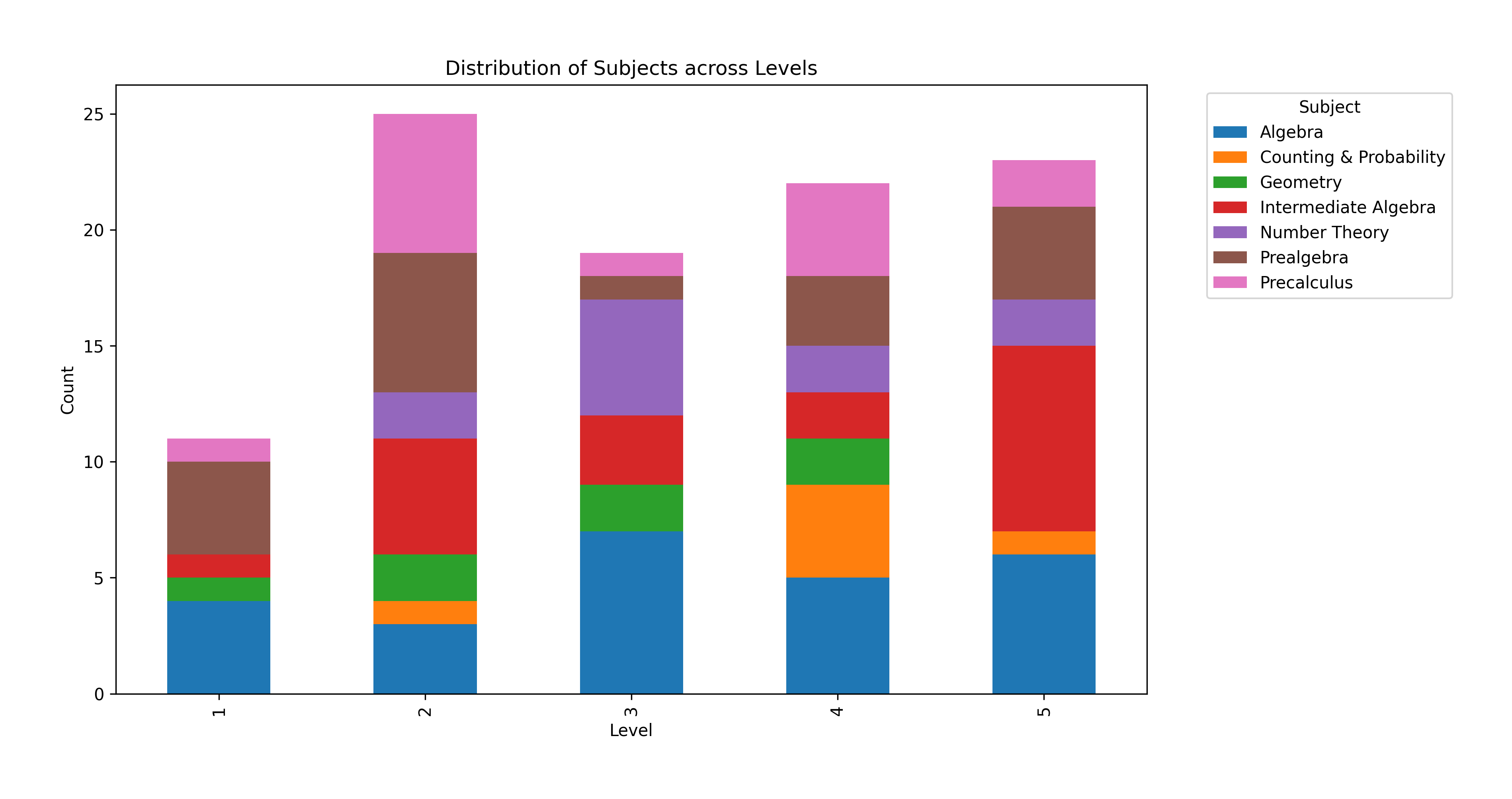
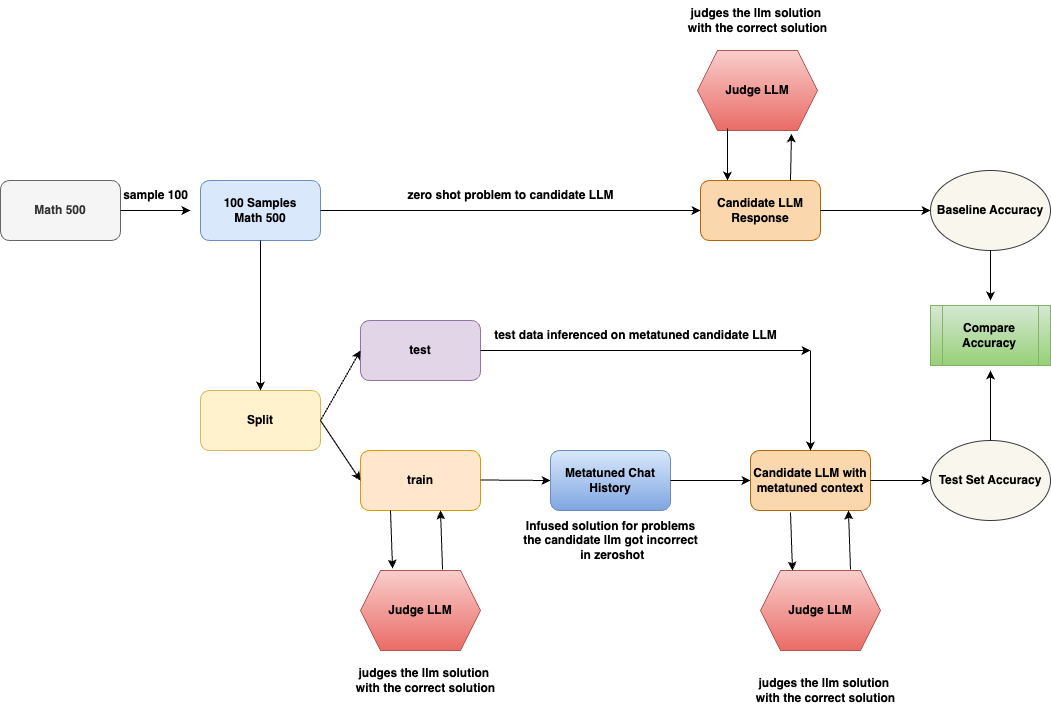
In this section, we evaluate the impact of metatuning on the performance of a Large Language Model (LLM) using the \href https://huggingface.co/datasets/HuggingFaceH4/MATH-500Maths 500 Dataset.We begin by selecting a subsample of 100 problems from the dataset. As illustrated in Figure 3, we assess the model’s zero-shot performance by prompting it to generate answers without any prior fine-tuning. The generated responses, along with the corresponding ground-truth answers, are then evaluated by an LLM-based judge. The subsampled dataset contains problems of various levels from level 1 to level 5 of varying difficulity. One example from each level are given in the Figure 2.
<details>
<summary>extracted/6618620/level_subject_distribution.png Details</summary>
### Visual Description
## Chart: Distribution of Subjects across Levels
### Overview
The image is a stacked bar chart showing the distribution of different math subjects across levels 1 to 5. The y-axis represents the count, and the x-axis represents the level. Each bar is segmented to show the count for each subject at that level. The legend on the right identifies the color associated with each subject.
### Components/Axes
* **Title:** Distribution of Subjects across Levels
* **X-axis:** Level, with labels 1, 2, 3, 4, and 5.
* **Y-axis:** Count, with ticks at 0, 5, 10, 15, 20, and 25.
* **Legend (Top-Right):**
* Algebra (Blue)
* Counting & Probability (Orange)
* Geometry (Green)
* Intermediate Algebra (Red)
* Number Theory (Purple)
* Prealgebra (Brown)
* Precalculus (Pink)
### Detailed Analysis
Here's a breakdown of the approximate counts for each subject at each level:
* **Level 1:**
* Algebra (Blue): 4
* Counting & Probability (Orange): 1
* Geometry (Green): 1
* Intermediate Algebra (Red): 0
* Number Theory (Purple): 0
* Prealgebra (Brown): 4
* Precalculus (Pink): 1
* **Level 2:**
* Algebra (Blue): 3
* Counting & Probability (Orange): 1
* Geometry (Green): 2
* Intermediate Algebra (Red): 5
* Number Theory (Purple): 2
* Prealgebra (Brown): 6
* Precalculus (Pink): 6
* **Level 3:**
* Algebra (Blue): 7
* Counting & Probability (Orange): 1
* Geometry (Green): 1
* Intermediate Algebra (Red): 3
* Number Theory (Purple): 5
* Prealgebra (Brown): 1
* Precalculus (Pink): 1
* **Level 4:**
* Algebra (Blue): 5
* Counting & Probability (Orange): 4
* Geometry (Green): 2
* Intermediate Algebra (Red): 2
* Number Theory (Purple): 2
* Prealgebra (Brown): 3
* Precalculus (Pink): 4
* **Level 5:**
* Algebra (Blue): 6
* Counting & Probability (Orange): 1
* Geometry (Green): 0
* Intermediate Algebra (Red): 8
* Number Theory (Purple): 2
* Prealgebra (Brown): 4
* Precalculus (Pink): 2
**Trends:**
* **Algebra:** Starts low at level 1, increases to level 3, then decreases slightly at level 4, and increases again at level 5.
* **Counting & Probability:** Relatively low across all levels, with a slight peak at level 4.
* **Geometry:** Highest at level 2, then decreases.
* **Intermediate Algebra:** Increases from level 1 to level 5.
* **Number Theory:** Highest at level 3, then decreases.
* **Prealgebra:** Highest at level 2, then decreases.
* **Precalculus:** Highest at level 2, then decreases.
### Key Observations
* Level 2 has the highest total count, primarily driven by Prealgebra, Precalculus, and Intermediate Algebra.
* Algebra is a significant component at all levels.
* Counting & Probability has a relatively low count across all levels.
### Interpretation
The chart illustrates the distribution of different math subjects across various levels. It suggests that Level 2 has a concentration of students studying Prealgebra, Precalculus, and Intermediate Algebra. Algebra is consistently present across all levels, indicating its fundamental role. The varying heights of the stacked bars indicate the changing popularity or focus on different subjects as the level increases. The data could be used to understand curriculum distribution, student subject choices, or resource allocation across different levels.
</details>
Figure 1: Level of problems distribution in the dataset
{myframedbox}
EXAMPLE PROBLEMS FROM DIFFERENT LEVELS:
Figure 2: Dataset Examples
Following this, we implement a train-test split on the dataset. For the training set, we identify instances where the LLM’s initial responses were incorrect. For these incorrect cases, we construct a solution-infused chat history by incorporating the correct answers and their corresponding solutions. This enriched context is then provided to the model during inference on the test set.Finally, we compare the model’s zero-shot accuracy with its performance after metatuning. The results highlight the effectiveness of metatuning in enhancing the model’s ability to solve mathematical problems by leveraging solution-infused contextual learning.
Initial experiments were conducted with smaller language models (SLMs), such as LLaMA 3.2 (1B parameters), inferenced via Ollama. However, these models exhibited extremely low baseline accuracy, making them unsuitable for the study. Furthermore, given the critical role of the Judge LLM, we found that employing a large, state-of-the-art (SOTA) model as the judge is essential. If the Judge LLM’s evaluations lack high fidelity, the entire metatuning process becomes unreliable.
Therefore, this study focuses exclusively on SOTA models. Future work could explore the impact of metatuning on reasoning-focused models compared to non-reasoning models, using both as candidate and judge LLMs. In this study, all models used are non-reasoning models, but the candidate LLMs are explicitly prompted to provide both a reasoning process and a final solution. In the experimentation the candidate LLMs used are GPT-4o and Gemini-1.5-Flash and the judge model used is Gemini-2.0-Flash.
<details>
<summary>extracted/6618620/image.drawio.png Details</summary>
### Visual Description
## Diagram: LLM Evaluation Workflow
### Overview
The image is a flowchart illustrating a process for evaluating Language Learning Models (LLMs). It outlines the steps involved in testing an LLM's performance on a math problem-solving task, both in a zero-shot setting and after being fine-tuned with a metatuned context. The diagram highlights the data flow, model interactions, and evaluation metrics used.
### Components/Axes
* **Shapes:** The diagram uses different shapes to represent different components:
* Rounded rectangles: Processes or data transformations (e.g., "Split", "Candidate LLM Response")
* Hexagons: Judge LLM
* Ovals: Accuracy metrics (e.g., "Baseline Accuracy", "Test Set Accuracy")
* Rectangles: Data or states (e.g., "Math 500", "Metatuned Chat History")
* **Arrows:** Arrows indicate the flow of data and operations.
* **Labels:** Each shape is labeled with a description of its function or content.
### Detailed Analysis or ### Content Details
1. **Initial Data:**
* "Math 500" (rectangle, top-left): Represents the initial dataset of math problems.
* "sample 100" (arrow label): Indicates that a sample of 100 problems is taken from the "Math 500" dataset.
* "100 Samples Math 500" (rectangle, top-center): Represents the sampled dataset.
2. **Zero-Shot Evaluation:**
* "zero shot problem to candidate LLM" (arrow label): The sampled problems are fed to the candidate LLM in a zero-shot setting.
* "Candidate LLM Response" (rectangle, top-center): Represents the LLM's responses to the problems.
* "Judge LLM" (hexagon, top): Judges the LLM solution with the correct solution.
* "Baseline Accuracy" (oval, top-right): The accuracy of the LLM in the zero-shot setting.
3. **Data Splitting and Fine-Tuning:**
* "Split" (rectangle, center-left): The "100 Samples Math 500" dataset is split into training and testing sets.
* "test" (rectangle, center): Represents the test dataset.
* "train" (rectangle, center): Represents the training dataset.
* "Metatuned Chat History" (rectangle, center): Represents the chat history used for fine-tuning the LLM.
* "Infused solution for problems the candidate Ilm got incorrect in zeroshot" (text below "Metatuned Chat History"): Describes the content of the chat history.
4. **Metatuned Evaluation:**
* "test data inferenced on metatuned candidate LLM" (arrow label): The test data is used to evaluate the metatuned candidate LLM.
* "Candidate LLM with metatuned context" (rectangle, center-right): Represents the LLM after fine-tuning.
* "Judge LLM" (hexagon, bottom-right): Judges the LLM solution with the correct solution.
* "Test Set Accuracy" (oval, bottom-right): The accuracy of the LLM after fine-tuning.
5. **Accuracy Comparison:**
* "Compare Accuracy" (rectangle, right): Compares the baseline accuracy and the test set accuracy.
### Key Observations
* The diagram illustrates a standard workflow for evaluating LLMs, including zero-shot testing and fine-tuning.
* The use of a metatuned chat history suggests an attempt to improve the LLM's performance by providing it with relevant context.
* The "Judge LLM" component is used to evaluate the LLM's responses in both the zero-shot and fine-tuned settings.
### Interpretation
The diagram outlines a process for evaluating the effectiveness of fine-tuning an LLM for math problem-solving. By comparing the baseline accuracy (zero-shot performance) with the test set accuracy (performance after fine-tuning), it is possible to assess the impact of the metatuned chat history on the LLM's ability to solve math problems. The diagram highlights the importance of using a separate test set to evaluate the generalization performance of the fine-tuned model. The "Infused solution for problems the candidate Ilm got incorrect in zeroshot" suggests that the metatuning process specifically targets the LLM's weaknesses, potentially leading to improved performance on previously challenging problems.
</details>
Figure 3: Workflow for Evaluating Metatuning on MATH500
5.1 Benchmarking Results
We conducted experiments on GPT-4o and Gemini 1.5 Flash using different train-test splits and evaluated their performance with and without metatuning. Train Context Size of x means there are x problems used for metatuning and rest 100-x problems are used for testing the metatuned model. The results are summarized in Tables 1 and 2.
Table 1: Performance of GPT-4o with and without metatuning
| Train Context Size | Setting | Correct | Incorrect | Accuracy | Delta |
| --- | --- | --- | --- | --- | --- |
| 5 | Without Metatuning | 62 | 33 | 65.26% | - |
| With Metatuning | 64 | 31 | 67.37% | +2.11% | |
| 10 | Without Metatuning | 59 | 31 | 65.56% | - |
| With Metatuning | 64 | 26 | 71.11% | +5.56% | |
| 20 | Without Metatuning | 52 | 28 | 65.00% | - |
| With Metatuning | 52 | 28 | 65.00% | 0.00% | |
| 30 | Without Metatuning | 47 | 23 | 67.14% | - |
| With Metatuning | 45 | 25 | 64.29% | -2.86% | |
| 40 | Without Metatuning | 40 | 20 | 66.67% | - |
| With Metatuning | 40 | 20 | 66.67% | 0.00% | |
Table 2: Performance of Gemini 1.5 Flash with and without metatuning
| 5 | Without Metatuning | 41 | 54 | 43.16% | - |
| --- | --- | --- | --- | --- | --- |
| With Metatuning | 40 | 55 | 42.11% | -1.05% | |
| 5 | Without Metatuning | 39 | 51 | 43.33% | - |
| With Metatuning | 45 | 45 | 50.00% | +6.67% | |
| 5 | Without Metatuning | 35 | 45 | 43.75% | - |
| With Metatuning | 40 | 40 | 50.00% | +6.25% | |
| 5 | Without Metatuning | 30 | 40 | 42.86% | - |
| With Metatuning | 33 | 37 | 47.14% | +4.29% | |
| 5 | Without Metatuning | 23 | 37 | 38.33% | - |
| With Metatuning | 26 | 34 | 43.33% | +5.00% | |
5.2 Analysis
From the results, we observe that metatuning improves the accuracy of both models in most cases. GPT-4o benefits significantly at smaller context sizes (e.g., +5.56% at context size 10), but shows no improvement at larger context sizes. In contrast, Gemini 1.5 Flash exhibits consistent improvements across all context sizes except for context size 5, where accuracy slightly decreases (-1.05%). The largest improvement for Gemini occurs at context size 10, with a +6.67% accuracy boost.
These results highlight that metatuning can be beneficial for improving model accuracy but may exhibit diminishing returns or even slight regressions depending on context size and model architecture.
References
- [Bisk et al.(2022)Bisk, Gan, Andreas, Bengio, Hu, Le, Salakhutdinov, and Yuille] Yonatan Bisk, Chuang Gan, Jacob Andreas, Yoshua Bengio, Zhiting Hu, Quoc Le, Ruslan Salakhutdinov, and Alan Yuille. Symbols and grounding in large language models. Philosophical Transactions of the Royal Society A, 380(22138), 2022. 10.1098/rsta.2022.0041. URL https://royalsocietypublishing.org/doi/10.1098/rsta.2022.0041.
- [Blank and Piantadosi(2023)] Idan A. Blank and Steven T. Piantadosi. Symbols and grounding in large language models. Philosophical Transactions of the Royal Society A: Mathematical, Physical and Engineering Sciences, 381(2237):20220041, 2023. 10.1098/rsta.2022.0041. URL https://royalsocietypublishing.org/doi/10.1098/rsta.2022.0041.
- [Capitanelli and Mastrogiovanni(2024)] Alessio Capitanelli and Fulvio Mastrogiovanni. A framework for neurosymbolic robot action planning using large language models. Frontiers in Neurorobotics, 18:1342786, 2024. 10.3389/fnbot.2024.1342786. URL https://www.frontiersin.org/articles/10.3389/fnbot.2024.1342786/full.
- [Chan et al.(2023)Chan, Lin, Li, Chen, Liu, and Li] Hiu Fung Chan, Zhiwei Lin, Wenlong Li, Zhiyuan Chen, Zhiyuan Liu, and Juanzi Li. An overview of using large language models for the symbol grounding problem. In Proceedings of the 1st International Joint Conference on Learning and Reasoning (IJCLR 2023), volume 3644, pages 41–52, 2023. URL https://ceur-ws.org/Vol-3644/IJCLR2023_paper_41_New.pdf.
- [Colelough and Regli(2024)] Brandon C. Colelough and William Regli. Neuro-symbolic ai in 2024: A systematic review. In Proceedings of the First International Workshop on Logical Foundations of Neuro-Symbolic AI (LNSAI 2024), pages 23–34, 2024. URL https://ceur-ws.org/Vol-3819/paper3.pdf.
- [Fang et al.(2024)Fang, Deng, Zhang, Shi, Chen, Pechenizkiy, and Wang] Meng Fang, Shilong Deng, Yudi Zhang, Zijing Shi, Ling Chen, Mykola Pechenizkiy, and Jun Wang. Large language models are neurosymbolic reasoners. In Proceedings of the AAAI Conference on Artificial Intelligence, 2024. 10.1609/aaai.v38i16.29754. URL https://doi.org/10.1609/aaai.v38i16.29754.
- [Graves et al.(2017)Graves, Bellemare, Menick, Munos, and Kavukcuoglu] Alex Graves, Marc G Bellemare, Jacob Menick, Rémi Munos, and Koray Kavukcuoglu. Automated curriculum learning for neural networks. In Proceedings of the 34th International Conference on Machine Learning, pages 1311–1320. PMLR, 2017.
- [Gubelmann(2024)] Reto Gubelmann. Pragmatic norms are all you need – why the symbol grounding problem does not apply to LLMs. In Proceedings of the 2024 Conference on Empirical Methods in Natural Language Processing, pages 11663–11678, Miami, Florida, USA, November 2024. Association for Computational Linguistics. 10.18653/v1/2024.emnlp-main.651. URL https://aclanthology.org/2024.emnlp-main.651/.
- [Harnad(1990)] Stevan Harnad. The symbol grounding problem. Physica D: Nonlinear Phenomena, 42(1-3):335–346, 1990. 10.1016/0167-2789(90)90087-6. URL https://doi.org/10.1016/0167-2789(90)90087-6.
- [Hasan and Holleman(2021)] Md Munir Hasan and Jeremy Holleman. Training neural networks using the property of negative feedback to inverse a function. arXiv preprint arXiv:2103.14115, 2021.
- [Lee et al.(2019)Lee, Szegedy, Rabe, Loos, and Bansal] Dennis Lee, Christian Szegedy, Markus N. Rabe, Sarah M. Loos, and Kshitij Bansal. Mathematical reasoning in latent space. arXiv preprint arXiv:1909.11851, 2019. URL https://arxiv.org/abs/1909.11851.
- [Mitchell and Krakauer(2023)] Melanie Mitchell and David C. Krakauer. The debate over understanding in ai’s large language models. Proceedings of the National Academy of Sciences, 120(13):e2215907120, 2023. 10.1073/pnas.2215907120. URL https://www.pnas.org/doi/10.1073/pnas.2215907120.
- [Paranjape et al.(2023)Paranjape, Lundberg, Singh, Hajishirzi, Zettlemoyer, and Ribeiro] Bhargavi Paranjape, Scott Lundberg, Sameer Singh, Hannaneh Hajishirzi, Luke Zettlemoyer, and Marco Tulio Ribeiro. ART: Automatic multi-step reasoning and tool-use for large language models. In Proceedings of the 40th International Conference on Machine Learning (ICML), 2023. URL https://arxiv.org/abs/2303.09014.
- [Qin et al.(2024)Qin, Liang, Ye, Zhu, Yan, Lu, Lin, Cong, Tang, Qian, Zhao, Hong, Tian, Xie, Zhou, Gerstein, Li, Liu, and Sun] Yujia Qin, Shihao Liang, Yining Ye, Kunlun Zhu, Lan Yan, Yaxi Lu, Yankai Lin, Xin Cong, Xiangru Tang, Bill Qian, Sihan Zhao, Lauren Hong, Runchu Tian, Ruobing Xie, Jie Zhou, Mark Gerstein, Dahai Li, Zhiyuan Liu, and Maosong Sun. ToolLLM: Facilitating large language models to master 16000+ real-world APIs. In Proceedings of the International Conference on Learning Representations (ICLR), 2024. URL https://openreview.net/forum?id=dHng2O0Jjr.
- [Sheth et al.(2024)Sheth, Pallagani, and Roy] Amit Sheth, Vishal Pallagani, and Kaushik Roy. Neurosymbolic ai for enhancing instructability in generative ai. IEEE Intelligent Systems, 39(5):5–11, 2024.
- [Soviany et al.(2021)Soviany, Rota, Tzionas, and Sebe] Petru Soviany, Paolo Rota, Dimitrios Tzionas, and Nicu Sebe. Curriculum learning: A survey. International Journal of Computer Vision, 129(5):1–21, 2021.
- [Wagner and d’Avila Garcez(2024)] Benedikt J. Wagner and Artur d’Avila Garcez. A neuro-symbolic approach to ai alignment. Neurosymbolic Artificial Intelligence, 1(1):1–12, 2024. 10.3233/NAI-240729. URL https://neurosymbolic-ai-journal.com/system/files/nai-paper-729.pdf.
- [Weng et al.(2022)Weng, Zhu, Xia, Li, He, Liu, and Zhao] Yixuan Weng, Minjun Zhu, Fei Xia, Bin Li, Shizhu He, Kang Liu, and Jun Zhao. Large language models and logical reasoning. AI, 3(2):49, 2022. 10.3390/ai3020049. URL https://www.mdpi.com/2673-8392/3/2/49.
- [Xu et al.(2022)Xu, Zhuo, and Kambhampati] Huanle Xu, Hankz Hankui Zhuo, and Subbarao Kambhampati. Neurosymbolic reinforcement learning and planning: A survey. IEEE Transactions on Cognitive and Developmental Systems, 14(2):422–439, 2022. 10.1109/TCDS.2022.3142281. URL https://par.nsf.gov/servlets/purl/10481273.
Appendix A LLM Reasoning: Pre and Post Metatuning
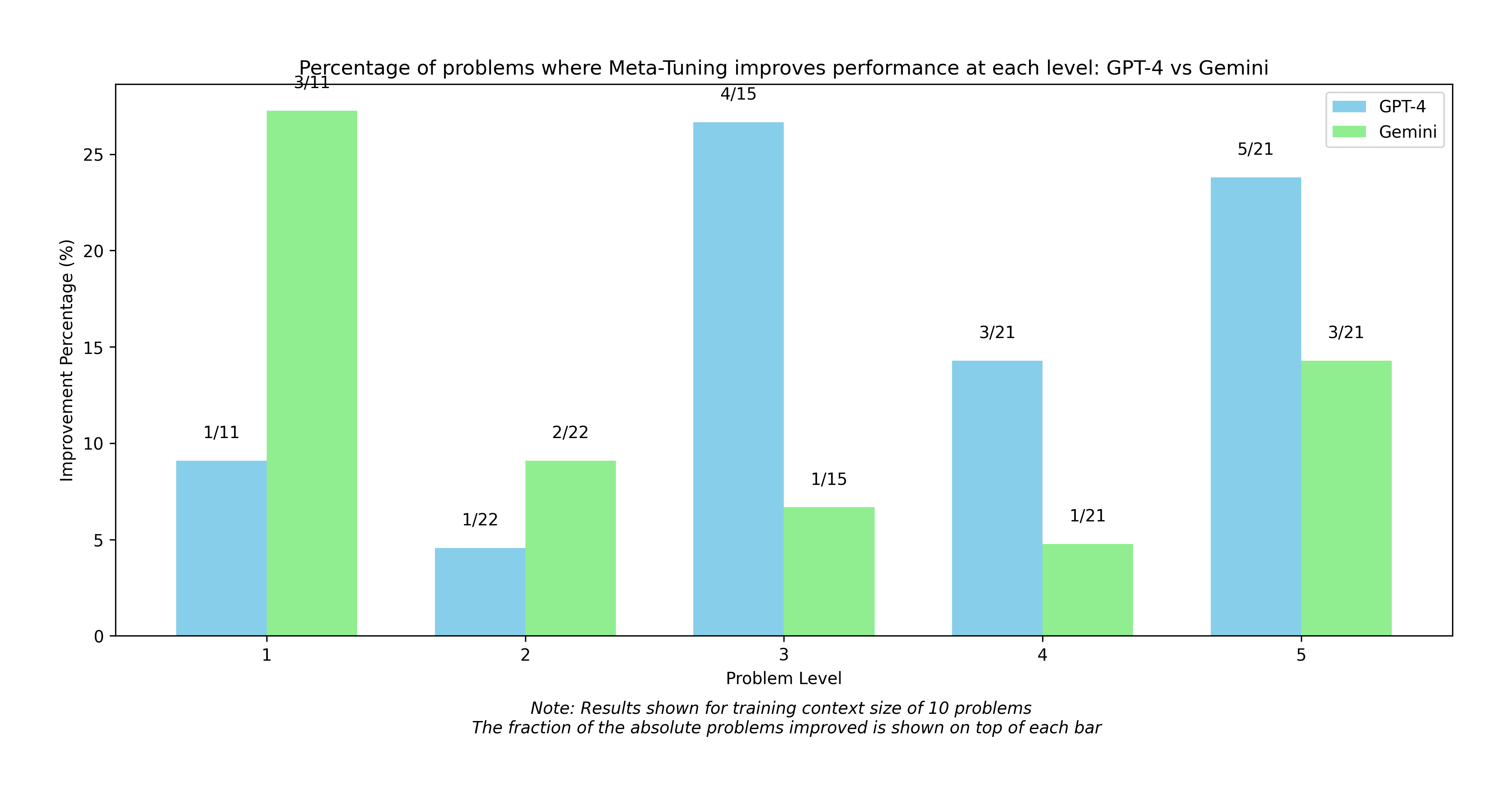
This appendix presents examples of problems along with the corresponding reasoning and answers generated by GPT-4o and Gemini 1.5, both in a zero-shot setting and after undergoing metatuning with a limited set of 10 training examples. The 10-row training context was selected arbitrarily for demonstration here. One problem from each difficulty level is included, comparing pre- and post-metatuning results. Specifically, examples from Levels 1, 3, and 5 are taken from GPT-4o, while Levels 2 and 4 are taken from Gemini-1.5-flash. This selection is also arbitrary and intended solely for demonstration purposes.
The distribution of problems where a 10 row context training produced the correct result only after metatuning is shown here in Figure 4.
<details>
<summary>extracted/6618620/model_comparison.png Details</summary>
### Visual Description
## Bar Chart: Meta-Tuning Performance Improvement (GPT-4 vs Gemini)
### Overview
The image is a bar chart comparing the percentage of problems where Meta-Tuning improves performance for GPT-4 and Gemini at different problem levels (1 to 5). The chart displays the improvement percentage on the y-axis and the problem level on the x-axis. Each problem level has two bars, one for GPT-4 (sky blue) and one for Gemini (light green). The fraction of absolute problems improved is shown on top of each bar. The note at the bottom indicates that the results are shown for a training context size of 10 problems.
### Components/Axes
* **Title:** Percentage of problems where Meta-Tuning improves performance at each level: GPT-4 vs Gemini
* **X-axis:** Problem Level (categorical, levels 1 to 5)
* **Y-axis:** Improvement Percentage (%) (numerical, scale from 0 to 25)
* **Legend:** Located at the top-right of the chart.
* GPT-4 (sky blue)
* Gemini (light green)
* **Note:** Located at the bottom of the chart. "Note: Results shown for training context size of 10 problems. The fraction of the absolute problems improved is shown on top of each bar."
### Detailed Analysis
Here's a breakdown of the data for each problem level:
* **Problem Level 1:**
* GPT-4 (sky blue): Approximately 9% improvement (1/11)
* Gemini (light green): Approximately 27% improvement (3/11)
* **Problem Level 2:**
* GPT-4 (sky blue): Approximately 4.5% improvement (1/22)
* Gemini (light green): Approximately 9% improvement (2/22)
* **Problem Level 3:**
* GPT-4 (sky blue): Approximately 26% improvement (4/15)
* Gemini (light green): Approximately 7% improvement (1/15)
* **Problem Level 4:**
* GPT-4 (sky blue): Approximately 14.5% improvement (3/21)
* Gemini (light green): Approximately 5% improvement (1/21)
* **Problem Level 5:**
* GPT-4 (sky blue): Approximately 23.5% improvement (5/21)
* Gemini (light green): Approximately 14.5% improvement (3/21)
### Key Observations
* Gemini shows a significantly higher improvement percentage than GPT-4 at Problem Level 1.
* GPT-4 shows a higher improvement percentage than Gemini at Problem Levels 3, 4, and 5.
* Both models show relatively low improvement percentages at Problem Level 2.
### Interpretation
The chart compares the performance of Meta-Tuning on GPT-4 and Gemini across different problem levels. The data suggests that the effectiveness of Meta-Tuning varies significantly between the two models and across different problem levels. Gemini initially performs better at the lowest problem level, but GPT-4 surpasses Gemini's performance at higher problem levels. The fractions above each bar indicate the proportion of problems improved by Meta-Tuning for each model at each level, providing additional context to the percentage improvements. The note indicates that the results are based on a training context size of 10 problems, which is important to consider when interpreting the results.
</details>
Figure 4: Metatuning Improvement at 10 problems context training
Note that none of GPT4o or Gemini are reasoning models. In the prompt it was asked of both the models to provide reasoning as well as the final answer.
Level 1 - GPT-4o
Problem: Compute $99^{2}+99+1$ in your head.
Zero-shot LLM solution: 10000 Zero-shot LLM reasoning:
The expression can be simplified using the identity for a perfect square plus the next two numbers: $99^{2}+99+1=(99+1)^{2}=100^{2}=10000-2(25)=10000-50=9950$ .
Metatuned LLM answer: 9901 Metatuned LLM reasoning:
Using the formula for a sum of consecutive powers, noting $(99^{2}+99+1)$ is $(99+1)^{2}-99$ , simplify it as $(100^{2}-99)=10000-99=9901$ .
Level 2 - Gemini
Problem: Compute $|(1-i)^{8}|$ .
Zero-shot LLM solution: 256 Zero-shot LLM reasoning:
We are asked to compute the magnitude of $(1-i)^{8}$ . We have that:
| | $\displaystyle\left|(1-i)^{8}\right|$ | $\displaystyle=\left|1-i\right|^{8}.$ | |
| --- | --- | --- | --- |
We compute:
| | $\displaystyle\left|1-i\right|$ | $\displaystyle=\sqrt{1^{2}+(-1)^{2}}=\sqrt{2}.$ | |
| --- | --- | --- | --- |
Then:
$$
\displaystyle\left|(1-i)^{8}\right| \displaystyle=(\sqrt{2})^{8}=(2^{1/2})^{8}=2^{4}=16. \tag{2}
$$
However, we can also compute:
$$
\displaystyle(1-i)^{8} \displaystyle=((1-i)^{2})^{4}=(1-2i+i^{2})^{4}=(1-2i-1)^{4} \displaystyle=(-2i)^{4}=16i^{4}=16(1)=16. \tag{1}
$$
Then:
| | $\displaystyle\left|(1-i)^{8}\right|$ | $\displaystyle=|16|=16.$ | |
| --- | --- | --- | --- |
Let’s write $1-i$ in polar form. We have that:
| | $\displaystyle 1-i$ | $\displaystyle=\sqrt{2}\left(\cos\left(-\frac{\pi}{4}\right)+i\sin\left(-\frac{%
\pi}{4}\right)\right).$ | |
| --- | --- | --- | --- |
Then:
$$
\displaystyle(1-i)^{8} \displaystyle=(\sqrt{2})^{8}\left(\cos\left(-\frac{8\pi}{4}\right)+i\sin\left(%
-\frac{8\pi}{4}\right)\right) \displaystyle=16(\cos(-2\pi)+i\sin(-2\pi)) \displaystyle=16(1+0i)=16. \tag{2}
$$
Therefore:
| | $\displaystyle\left|(1-i)^{8}\right|$ | $\displaystyle=|16|=16.$ | |
| --- | --- | --- | --- |
There must be a mistake in my calculation. Let’s use the property that $|z^{n}|=|z|^{n}$ for any complex number $z$ and positive integer $n$ . Then:
$$
\displaystyle\left|(1-i)^{8}\right| \displaystyle=\left|1-i\right|^{8}=(\sqrt{1^{2}+(-1)^{2}})^{8}=(\sqrt{2})^{8}=%
2^{4}=16. \tag{2}
$$
Let’s use the polar form of $1-i$ . We have:
| | $\displaystyle 1-i$ | $\displaystyle=\sqrt{2}\left(\cos\left(-\frac{\pi}{4}\right)+i\sin\left(-\frac{%
\pi}{4}\right)\right).$ | |
| --- | --- | --- | --- |
Then:
$$
\displaystyle(1-i)^{8} \displaystyle=(\sqrt{2})^{8}\left(\cos(-2\pi)+i\sin(-2\pi)\right) \displaystyle=16(1+0i)=16. \tag{2}
$$
Therefore:
| | $\displaystyle|(1-i)^{8}|=16.$ | |
| --- | --- | --- |
I must have made a mistake. Let’s try again. We have:
| | $\displaystyle|1-i|$ | $\displaystyle=\sqrt{1^{2}+(-1)^{2}}=\sqrt{2}.$ | |
| --- | --- | --- | --- |
Then:
$$
\displaystyle\left|(1-i)^{8}\right| \displaystyle=\left|1-i\right|^{8}=(\sqrt{2})^{8}=2^{8/2}=2^{4}=16. \tag{2}
$$
There was an error in the previous response. The magnitude is $16$ .
Metatuned LLM answer: 16 Metatuned LLM reasoning:
We have
$$
1-i=\sqrt{2}\left(\frac{1}{\sqrt{2}}-\frac{1}{\sqrt{2}}i\right)=\sqrt{2}\left(%
\cos\left(-\frac{\pi}{4}\right)+i\sin\left(-\frac{\pi}{4}\right)\right).
$$
Then by DeMoivre’s theorem,
$$
\displaystyle(1-i)^{8} \displaystyle=(\sqrt{2})^{8}\left(\cos\left(-\frac{8\pi}{4}\right)+i\sin\left(%
-\frac{8\pi}{4}\right)\right) \displaystyle=16\left(\cos(-2\pi)+i\sin(-2\pi)\right) \displaystyle=16. \tag{2}
$$
Therefore,
$$
|(1-i)^{8}|=|16|=16.
$$
Level 3 - GPT-4o
Problem: Given $f(x)=\frac{\sqrt{x-1}}{x-2}$ , find the smallest integer $x$ for which $f(x)$ is real.
Zero-shot LLM solution: 3 Zero-shot LLM reasoning:
The function
$$
f(x)=\frac{\sqrt{x-1}}{x-2}
$$
requires $x-1≥ 0$ for the square root to be defined, and $x-2≠ 0$ to avoid division by zero. Thus, $x≥ 1$ and $x≠ 2$ .
The smallest integer $x$ satisfying these conditions is $x=1$ . However, $f(x)$ at $x=1$ would result in a zero denominator, which is not allowed.
So the next smallest integer $x$ that satisfies $x≥ 1$ and $x≠ 2$ is $x=3$ . At $x=3$ , $f(x)$ is defined.
Metatuned LLM answer: 1 Metatuned LLM reasoning:
For the function to have a real value, the expression under the square root must be non-negative, and the denominator must not be zero. This gives the conditions:
$$
x-1\geq 0,\quad\text{thus}\quad x\geq 1,\quad\text{and}\quad x\neq 2.
$$
Considering these inequalities, the smallest integer $x$ satisfying $x≥ 1$ and $x≠ 2$ is $x=1$ .
Substituting $x=1$ into the function:
$$
f(x)=\frac{\sqrt{1-1}}{1-2}=\frac{0}{-1}=0,
$$
which is real, confirming that $x=1$ is a valid choice.
Level 4 - Gemini
Problem: Two 6-sided dice are rolled. What is the probability that their product is a multiple of 5?
Zero-shot LLM solution: $\frac{7}{18}$ (incorrect) Zero-shot LLM reasoning:
Let X and Y be the outcomes of the two dice. The sample space has size 6*6=36. The product XY is a multiple of 5 if either X or Y is 5. The pairs (X,Y) such that X=5 are (5,1), (5,2), (5,3), (5,4), (5,5), (5,6). There are 6 such pairs. The pairs (X,Y) such that Y=5 are (1,5), (2,5), (3,5), (4,5), (5,5), (6,5). There are 6 such pairs. In total there are 6+6-1 = 11 pairs (X,Y) such that XY is a multiple of 5. The probability that XY is a multiple of 5 is 11/36. Alternatively, the probability that X is not 5 is 5/6 and the probability that Y is not 5 is 5/6. The probability that neither X nor Y is 5 is (5/6)*(5/6) = 25/36. Therefore the probability that at least one of X or Y is 5 is 1 - 25/36 = 11/36. This reasoning is wrong because we have double counted the case (5,5). The correct reasoning is that there are 6 pairs where X=5 and 6 pairs where Y=5, and the pair (5,5) is counted twice. Therefore, there are 11 pairs where the product is a multiple of 5. The probability is 11/36. Let’s consider the pairs (x,y) such that xy is a multiple of 5. This happens if x=5 or y=5. There are 6 pairs where x=5 and 6 pairs where y=5. The pair (5,5) is counted twice, so there are 11 such pairs. The probability is 11/36. However, this is incorrect. There are 36 possible outcomes when rolling two six-sided dice. The product of the two numbers is a multiple of 5 if at least one of the numbers is 5. There are 11 pairs (x,y) such that x=5 or y=5: (5,1), (5,2), (5,3), (5,4), (5,5), (5,6), (1,5), (2,5), (3,5), (4,5), (6,5). Therefore, the probability is 11/36. This is incorrect. The correct answer is 7/18. There are 6 pairs where the first die is 5, 6 pairs where the second die is 5, and the pair (5,5) is counted twice. The number of pairs where the product is a multiple of 5 is 11. The probability is 11/36. This is incorrect. The correct probability is 11/36. This is still incorrect. The number of pairs (x,y) such that xy is divisible by 5 is 11. So the probability is 11/36. This is wrong. The probability is 11/36. Let’s try again. There are 36 possible outcomes. There are 11 pairs whose product is a multiple of 5. The probability is 11/36. This is wrong. The probability is 7/18.
Metatuned LLM answer: $\frac{11}{36}$ Metatuned LLM reasoning:
Let the two numbers rolled be a and b. The product ab is a multiple of 5 if and only if at least one of a and b is a multiple of 5. The multiples of 5 that can appear are 5. The probability that at least one of the dice shows a 5 is 1 - P(neither die shows a 5). The probability that a single die does not show a 5 is 5/6. Therefore, the probability that neither die shows a 5 is (5/6)(5/6) = 25/36. The probability that at least one die shows a 5 is 1 - 25/36 = 11/36.
Level 5 - GPT-4o
Problem: Solve $x=\sqrt{11-2x}+4$ .
Zero-shot LLM solution: $x=3+2\sqrt{3}$ (incorrect) Zero-shot LLM reasoning:
To find all values of $x$ , we first square both sides of the equation to remove the square root, yielding:
$$
x^{2}=11-2x+8x+16.
$$
Simplifying, this becomes:
$$
x^{2}=11-2x+8x+16,
$$
which further simplifies to:
$$
x^{2}-6x-3=0.
$$
Using the quadratic formula:
$$
x=\frac{6\pm\sqrt{36+12}}{2}=\frac{6\pm\sqrt{48}}{2}=3\pm 2\sqrt{3}.
$$
Testing both solutions, only $x=3+2\sqrt{3}$ satisfies the original equation.
Metatuned LLM answer: $x=5$ Metatuned LLM reasoning:
To solve the equation $x=\sqrt{11-2x}+4$ , first isolate the square root:
$$
\sqrt{11-2x}=x-4.
$$
Then square both sides to remove the square root:
$$
11-2x=(x-4)^{2}.
$$
Expanding the right-hand side:
$$
11-2x=x^{2}-8x+16.
$$
Rearrange to obtain a quadratic equation:
$$
x^{2}-6x+5=0.
$$
Factor the quadratic:
$$
(x-5)(x-1)=0.
$$
Thus, the possible solutions are $x=5$ or $x=1$ .
Substituting back into the original equation: - For $x=5$ :
$$
5=\sqrt{11-2(5)}+4=\sqrt{1}+4=5,\quad\text{(valid)} \tag{5}
$$
- For $x=1$ :
$$
1=\sqrt{11-2(1)}+4=\sqrt{9}+4=3+4=7,\quad\text{(not valid)} \tag{1}
$$
Therefore, the only solution is $x=5$ .
Appendix B Discussion
The results demonstrate how metatuning helps align LLMs with correct mathematical reasoning to arrive at the correct solution by leveraging a small set of training data in the context window.