# Advancing the Foundation Model for Music Understanding
> Correspondence to:
## Abstract
The field of Music Information Retrieval (MIR) is fragmented, with specialized models excelling at isolated tasks. In this work, we challenge this paradigm by introducing a unified foundation model named MuFun for holistic music understanding. Our model features a novel architecture that jointly processes instrumental and lyrical content, and is trained on a large-scale dataset covering diverse tasks such as genre classification, music tagging, and question answering. To facilitate robust evaluation, we also propose a new benchmark for multi-faceted music understanding called MuCUE (Music Comprehensive Understanding Evaluation). Experiments show our model significantly outperforms existing audio large language models across the MuCUE tasks, demonstrating its state-of-the-art effectiveness and generalization ability.
## 1 Introduction
Music, a universal and multifaceted form of human expression, presents a formidable challenge for computational understanding. The field of Music Information Retrieval (MIR) has made significant strides in decoding its complex structures. However, progress has historically been characterized by a paradigm of fragmentation. Models are typically engineered as highly specialized experts, excelling at isolated tasks such as genre classification, beat tracking, or instrument recognition. While effective in their narrow domains, this specialization comes at a cost: a lack of holistic, integrative understanding that mirrors human cognition.
This fragmentation engenders significant limitations. Expert models struggle to generalize across tasks and often fail when confronted with complex, multi-faceted queries that require synergistic reasoning. For instance, answering ”Why does this song evoke a sense of melancholy?” necessitates a concurrent analysis of its harmony, tempo, instrumentation, and lyrical content—a capability beyond the scope of single-task models. While recent general-purpose audio-language models possess impressive cross-modal capabilities, they are not intrinsically optimized for the unique structural and semantic nuances of music, often lacking the domain-specific acuity for fine-grained MIR tasks.
To bridge this gap and break the prevailing paradigm, we introduce a unified foundation model for holistic music understanding. Our model features an architecture capable of concurrently processing both instrumental audio and lyrical content, and is trained on a vast and diverse corpus of data spanning a multitude of MIR tasks. Instead of cultivating a collection of disparate specialists, our objective is to build a single, versatile generalist model that learns a shared, rich representation of music, enabling it to perform a wide array of tasks from a single set of weights.
A parallel challenge in the pursuit of holistic music understanding lies in its evaluation. The absence of a unified, comprehensive benchmark makes it difficult to compare models systematically or to measure true progress towards general musical intelligence. To address this critical need, we propose the Music Comprehensive Understanding Evaluation (MuCUE) benchmark. MuCUE’s core innovation is its standardized format, framing a wide spectrum of tasks—from low-level perception (e.g., pitch and chord recognition) to high-level cognition (e.g., mood and structural analysis)—as multiple-choice questions (MCQs). This approach not only facilitates objective and scalable evaluation but also provides a rigorous tool for probing the emergent reasoning abilities of foundation models, thereby guiding future research.
To summarize, our main contributions are as follows:
- A Unified Foundation Model for Music: We introduce a novel, end-to-end trainable foundation model that holistically understands music by jointly processing instrumental audio and lyrical content. Its architecture and a specialized long-context (390s) training regimen enable it to move beyond single-task limitations and achieve state-of-the-art performance on a wide array of MIR tasks.
- The MuCUE Benchmark: We propose the Music Comprehensive Understanding Evaluation (MuCUE), a new and extensive benchmark designed to systematically assess music AI capabilities. By framing diverse tasks from low-level perception to high-level cognition as multiple-choice questions, MuCUE provides a standardized and rigorous tool for measuring true progress in the field.
## 2 Related Work
Recent advancements in music-language understanding leverage frozen audio encoders (often MERT (Li et al. 2023)) integrated with large language models (LLMs) via lightweight adapters to overcome music-text data scarcity. MU-LLaMA (Liu et al. 2023b) (built on LLaMA (Touvron et al. 2023)) pioneered this approach using audio-adapted LLaMA layers and the MusicQA dataset (synthesized from captions and tags), demonstrating strong QA and captioning performance. MusiLingo (Deng et al. 2024) refined this paradigm by aligning frozen MERT embeddings with LLMs like Vicuna (Chiang et al. 2023) through a simple linear projector; its key contribution is the high-quality MusicInstruct (MI) dataset for instruction-tuning, enabling robust open-ended QA and outperforming MU-LLaMA. Similarly, LLARK (Gardner et al. 2023) employs an adapter-based architecture trained on augmented data to excel at instruction-following tasks, including detailed captioning and musical reasoning. Expanding beyond understanding, M2UGen (Liu et al. 2023a) introduces a unified LLaMA 2-based framework combining comprehension (music QA, captioning) with cross-modal generation (text/image/video-to-music, editing), utilizing large synthetic instruction datasets (MUCaps, MUEdit etc.) and LoRA fine-tuning to achieve SOTA across both understanding and creative tasks.
While these adapter-based models advance music-text alignment, significant limitations in understanding persist. Crucially, reliance on synthetic or limited datasets (e.g., MusicQA, MI derived primarily from MusicCaps (Agostinelli et al. 2023), MagnaTagATune (Law et al. 2009)) restricts scope and depth, potentially perpetuating biases and superficial connections. Scaling QA to complex, subjective musical concepts (emotion, structure, cultural context) remains challenging, as most datasets focus on factual tags or short descriptive captions. Evaluation inadequacies are pronounced: reliance on NLP metrics like BLEU or ROUGE poorly captures musical nuance, subjective meaning, or aesthetic relevance, especially for open-ended QA and long-form captioning.
There are also much breakthroughs of general audio large language models recently (Chu et al. 2024; Abouelenin et al. 2025; Xu et al. 2025; KimiTeam et al. 2025; Huang et al. 2025; Zeng et al. 2024; Fu et al. 2025; Li et al. 2025). For instance, Qwen2-Audio (Chu et al. 2024) establishes a high standard as an audio-language model by integrating a Whisper-large-v3 (Radford et al. 2023) encoder with a Qwen-7B (Bai et al. 2023) LLM through a refined three-stage training pipeline (pre-training, SFT, DPO) to achieve state-of-the-art performance. Expanding the scope beyond audio-language pairs, Qwen2.5-Omni (Xu et al. 2025) operates as a truly end-to-end multimodal system processing text, image, audio, and video, distinguished by a ”Thinker-Talker” framework for real-time streaming speech generation and a novel positional embedding (TMRoPE) for synchronizing audio-visual inputs. Concurrently, Kimi-Audio (KimiTeam et al. 2025) proposes a universal audio foundation model, built on a hybrid architecture and pre-trained on over 13 million hours of diverse audio, aiming to unify perception, reasoning, and generation within a single, open-source framework. Although these models are not explicitly trained for Music Information Retrieval (MIR), their state-of-the-art speech recognition capabilities provide a strong foundation for interpreting lyrical music. Consequently, their proficiency in processing lyrical content enables them to effectively perform ancillary MIR tasks such as lyrics transcription and, by extension, music genre classification or mood detection where lyrical themes are indicative.
A significant research gap emerges from this dichotomy, defining two distinct frontiers in music-language modeling. On one hand, adapter-based models are purpose-built for music but are often constrained by their architectural design, such as frozen audio backbones and shallow adapters, limiting their capacity for deep semantic representation. They can be characterized as specialized yet brittle. On the other hand, general-purpose multi-modal systems possess powerful, end-to-end trained architectures but lack the domain-specific optimization required to interpret the complex, non-linguistic syntax of music, such as harmony, structure, and expressive nuance. These models are powerful yet unspecialized for nuanced MIR tasks. Our work is strategically positioned at the confluence of these two paradigms, aiming to synergize the architectural power of modern multi-modal systems with the deep, domain-specific focus essential for MIR. The key differentiators of our approach are summarized in Table 1. Notably, our model benefits from full-parameter tuning across all components and, more critically, is trained on an extended audio context of up to 390 seconds—an order of magnitude greater than that of prior models. This strategic combination of a state-of-the-art foundation, comprehensive fine-tuning, and a novel long-context training regimen is designed to create a model that is both broadly capable and musically astute.
| | MU-LLaMA | MusiLingo | LLARK | M2UGen | Qwen2-Audio | Kimi-Audio | ours |
| --- | --- | --- | --- | --- | --- | --- | --- |
| LLM | LLaMA-2 7B | Vicuna-7B | Llama2-7b | Llama2-7b | Qwen-7B | Qwen2.5-7B | Qwen3-8B |
| audio encoder | MERT | MERT | Jukebox | MERT | whisper | whisper | whisper |
| audio token frequency(Hz) | fixed embedding | 0.17 | 10 | fixed embedding | 25 | 12.5 | 10 |
| max train duration(s) | 29 | 30 | 25 | 10 | 30(likely) | 30(likely) | 390 |
| tune modules | adapter | adapter | projection, LLM | adapters, LLM(lora) | unknown | all | all |
Table 1: Comparison of some Audio Language Models(ALMs)
<details>
<summary>x1.png Details</summary>
### Visual Description
## Diagram: MuFun System Architecture for Multimodal Music-Language Processing
### Overview
The diagram illustrates a multimodal system called MuFun that processes music and language inputs to enable downstream tasks like lyric generation, music score creation, and music analysis. The system integrates audio and text data through a series of encoders, transformers, and specialized modules.
### Components/Axes
1. **Left Section (Input Processing):**
- **Music Input**: Represented by a waveform icon labeled "Music."
- **Audio Encoder**: Converts raw audio into embeddings.
- **Average Pooling**: Reduces dimensionality of audio embeddings.
- **Connector**: A 2-layer MLP (Multilayer Perceptron) that merges audio and text tokens.
- **Text Token**: Represents language input (e.g., lyrics or instructions).
2. **Middle Section (MuFun Core):**
- **LLM's Tokenizer**: Tokenizes text input.
- **LLM's Embedding Layer**: Maps tokens to vector space.
- **LLM Layers**: Stacked transformer layers processing combined audio/text tokens.
3. **Right Section (Downstream Tasks):**
- **Music Prompt Generator**: Generates prompts for music-related tasks.
- **Lyrics Transcription**: Converts audio to text (lyrics).
- **Diverse Music Tasks**: Includes classification (e.g., melodic/flowing vs. percussive/rhythmic).
- **Music Score Generation**: Converts ABC notation to MIDI files.
### Detailed Analysis
- **Input Flow**:
- Music is encoded into embeddings, pooled, and combined with text tokens via the Connector.
- Text tokens are tokenized and embedded before being fed into LLM Layers.
- **MuFun Integration**:
- The system acts as a bridge between raw inputs and task-specific outputs, using LLM layers for contextual understanding.
- **Output Modules**:
- **Detokenizer**: Converts processed tokens back to human-readable formats (e.g., lyrics, MIDI).
- **LLM's Head**: Final processing layer for task-specific outputs.
### Key Observations
- **Multimodal Fusion**: The Connector explicitly merges audio and text tokens, enabling cross-modal understanding.
- **Task Specialization**: Downstream tasks leverage MuFun's outputs for domain-specific processing (e.g., lyric generation, music classification).
- **No Numerical Data**: The diagram focuses on architectural components rather than quantitative metrics.
### Interpretation
The MuFun system demonstrates a modular approach to multimodal AI, combining audio and text processing with large language models (LLMs) to enable complex tasks. By integrating a dedicated Connector and LLM layers, the system can handle tasks requiring both musical and linguistic understanding, such as generating lyrics that match a song's rhythm or classifying music based on textual descriptions. The absence of numerical data suggests the diagram emphasizes architectural design over performance metrics, highlighting the system's flexibility for diverse applications.
</details>
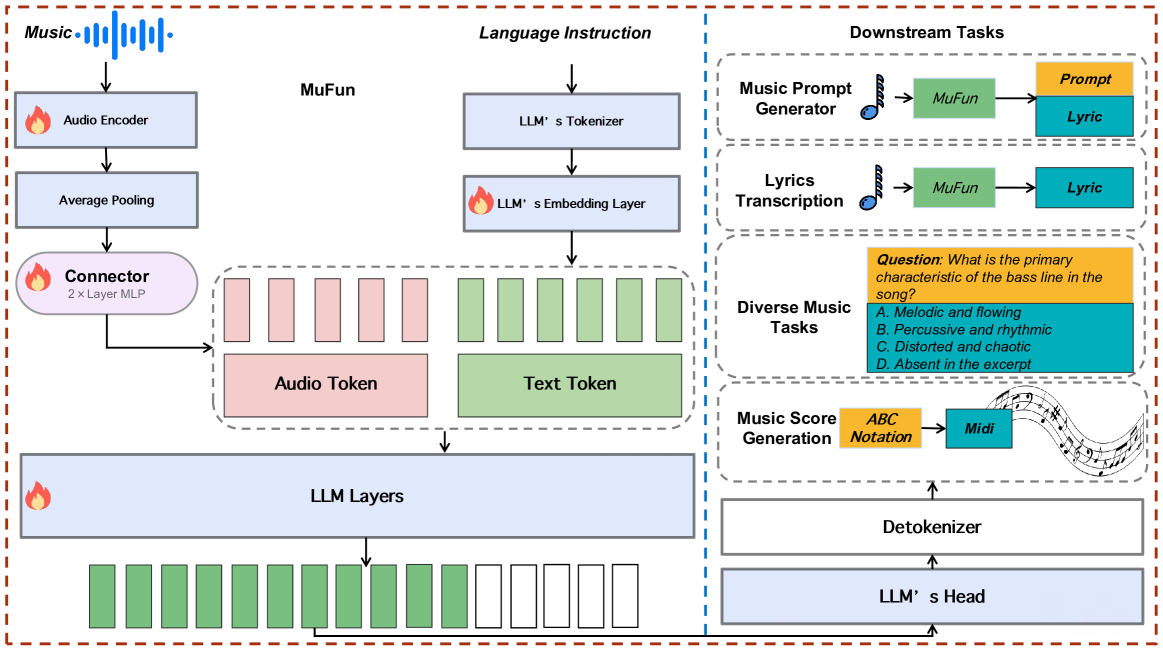
Figure 1: Overview of the MuFun model architecture
## 3 Model Architecture
The architecture of our model is grounded in the effective and scalable designs of recent multimodal large language models. This paradigm, which couples a powerful pre-trained audio encoder with a large language model backbone, provides a robust foundation for complex reasoning tasks. Our model is designed to accept an interleaved sequence of audio and text inputs and generate a coherent text output. Formally, for any input sequence of the form $[A_1,T_1,A_2,T_2,…,A_n,T_n]$ , where $A_i$ represents an audio file and $T_i$ a text segment, each modality is first transformed into a sequence of embedding vectors. These embedding sequences are then concatenated and fed into the language model to produce the final output. The overall architecture, depicted in Figure 1, comprises three core components: a language model backbone, an audio encoder, and a connector module to bridge the two modalities.
### Language Model Backbone
Our language model backbone is initialized from Qwen3-8B-Base (Yang et al. 2025). We selected this model for its state-of-the-art performance in language understanding and multilingual capabilities. Its strong foundational skills are crucial for interpreting the complex, often abstract, relationships within music and for generating nuanced, descriptive text. By leveraging such a powerful pre-trained LLM, we can focus our efforts on effectively translating musical information into a ”language” that the LLM can comprehend.
Table 2: Training Configuration across Different Stages of Model Development
| | Pretraining | Finetuning | | | | |
| --- | --- | --- | --- | --- | --- | --- |
| Sub-stages | Warmup | Align1 | Align2 | Context Extending | Short Music | Long Music |
| Training steps | 400 | 2500 | 3500 | 540 | 1000 | 700 |
| Batch size | 384 | 384 | 384 | 144 | 384 | 144 |
| Tune modules | connector | all | all | all | all | all |
| Tasks | speech transcription; music score transcription | speech transcription; music score transcription | speech transcription; music score transcription; lyrics transcription; pitch, instrument identification | music score transcription; lyrics transcription | various MIR tasks (short audio or segments) | various MIR tasks (mainly song level) |
| Max audio duration (s) | 30 | 30 | 30 | 390 | 30 | 390 |
| GPU hours | 10 | 180 | 244 | 175 | 68 | 180 |
<details>
<summary>x2.png Details</summary>
### Visual Description
## Diagram: Audio Processing Pipeline Architecture
### Overview
The diagram illustrates a four-stage pipeline for processing audio input into a format compatible with the Qwen3 language model. Each stage includes technical specifications, dimensionality transformations, and architectural components.
### Components/Axes
1. **Audio Input**
- Label: "30-Second Audio Clip"
- Description: Raw audio waveform input (no numerical axes)
- Spatial Position: Top-left quadrant
2. **Audio Encoder & Fusion**
- Label: "Whisper-large-v3"
- Sequence Length: 1500
- Feature Dimension: 5120
- Color-Coded Layers:
- L0 (Red)
- L7 (Orange)
- L15 (Green)
- L32 (Purple)
- Process: Hidden states from 4 layers concatenated per token
- Spatial Position: Top-center quadrant
3. **Temporal Downsampling**
- Label: "1D Mean Pooling"
- Sequence Length: 300 (downsampled from 1500)
- Feature Dimension: 5120 (unchanged)
- Process: Mean pooling with kernel=5, stride=5
- Spatial Position: Top-right quadrant
4. **Connector Module**
- Label: "2-layer MLP"
- Sequence Length: 300 (unchanged)
- Feature Dimension: 4096 (projected from 5120)
- Process: Trains to map audio tokens to Qwen3's language model space
- Spatial Position: Bottom-right quadrant
### Detailed Analysis
- **Sequence Length Reduction**:
- Audio Encoder: 1500 → Temporal Downsampling: 300 (5x reduction)
- Maintained feature dimension (5120) until Connector Module
- **Dimensionality Transformation**:
- 5120 → 4096 in Connector Module (25% reduction)
- **Color Legend Consistency**:
- Red (L0) → Orange (L7) → Green (L15) → Purple (L32) matches layer progression
- **Architectural Flow**:
- Left-to-right progression with explicit arrows
- Vertical stacking of layers in Encoder/Fusion stage
### Key Observations
1. **Feature Preservation**: Feature dimension remains 5120 until final stage
2. **Temporal Compression**: 1500 → 300 tokens via mean pooling
3. **Model-Specific Adaptation**: Final MLP projects to Qwen3's 4096-dim space
4. **Layer-Specific Processing**: Four distinct layers (L0, L7, L15, L32) contribute to fused representations
### Interpretation
This pipeline demonstrates a systematic approach to audio-language model integration:
1. **Stage 1-2**: Audio encoding with multi-layer feature extraction (Whisper-large-v3)
2. **Stage 3**: Temporal compression while maintaining feature dimensionality
3. **Stage 4**: Domain-specific adaptation for language model compatibility
The architecture suggests a trade-off between temporal resolution (1500 → 300 tokens) and feature efficiency (5120 → 4096 dimensions). The use of mean pooling indicates prioritization of temporal invariance over precise timing information. The final MLP's projection to 4096 dimensions aligns with Qwen3's requirements, implying this pipeline serves as a preprocessing stage for multimodal audio-language tasks.
</details>
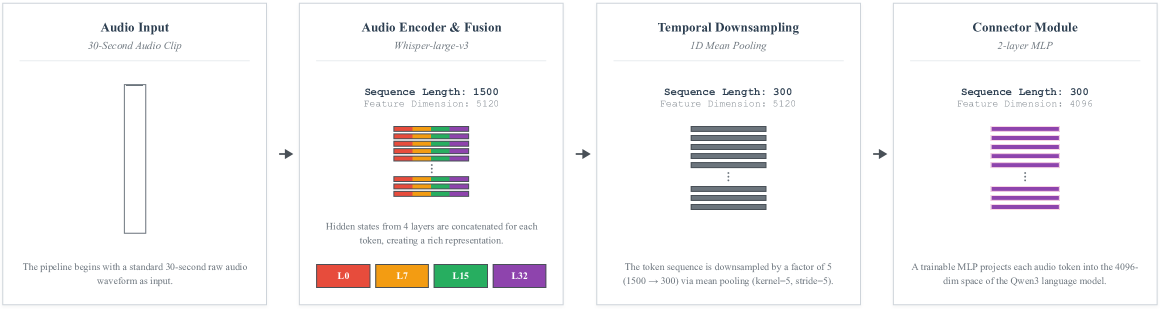
Figure 2: Pipeline of the Audio processing Module
### Audio Encoding and Multi-Layer Feature Fusion
The audio processing module is responsible for converting raw audio waveforms into meaningful feature representations. For this, we initialize the encoder from Whisper-large-v3 (Radford et al. 2023) as our audio backbone. The motivation for this choice is twofold: Whisper is pre-trained on an enormous and diverse dataset of audio, enabling it to learn a highly robust and general-purpose representation of acoustic phenomena that is transferable to music. Furthermore, its transformer-based architecture is well-suited for capturing temporal dependencies.
To create a comprehensive representation of the audio, we do not rely solely on the final output layer of the Whisper encoder. Instead, we adopt a multi-layer feature fusion strategy. Specifically, we extract the hidden states from four distinct layers of the encoder—layers 0, 7, 15, and 32—and concatenate them. This results in a rich feature vector with a dimension of $5120$ ( $1280× 4$ ). The rationale behind this approach is that different layers of a deep network capture different levels of abstraction. Early layers (e.g., layer 0) tend to preserve low-level acoustic details like timbre and pitch, while deeper layers (e.g., layer 32) capture more abstract, semantic information like melodic contours and rhythmic patterns. By providing the model with this multi-resolution view, we empower it to access both fine-grained textural details and high-level structural information simultaneously, a critical requirement for holistic music understanding.
### Temporal Downsampling and Long-Context Handling
The Whisper encoder processes a 30-second audio clip into a sequence of 1500 embedding vectors, corresponding to a temporal frequency of 50 Hz. This high density of tokens can be computationally burdensome for the LLM and may not align well with the typical information density of text. To address this, we apply a temporal downsampling step. We use a 1D mean pooling layer with a kernel size and stride of 5 along the time dimension. This operation reduces the audio token frequency to a more manageable 10 Hz, achieving two goals: 1) it significantly reduces the sequence length, improving computational efficiency, and 2) it smooths the representation, encouraging the model to focus on more salient temporal events.
A key ability of our model is to process long-form, song-level audio. To handle inputs exceeding the 30-second window of the Whisper encoder, we employ a straightforward yet effective chunking strategy. The long audio stream is first segmented into 30-second non-overlapping chunks. Each chunk is processed independently by the audio encoder and pooling layer. The resulting embedding sequences are then concatenated in their original order to form a single, continuous sequence representing the entire audio piece. This mechanism extends the model’s effective receptive field to any audio duration, enabling true song-level analysis.
### The Connector Module
The final architectural component is the connector, which serves as a bridge between the audio and language modalities. Its purpose is to project the 5120-dimensional audio embeddings into the 4096-dimensional space of the Qwen3 language model. For this, we use a 2-layer Multilayer Perceptron (MLP). The MLP first expands the input dimension by a factor of two, applies a GELU non-linear activation function, and then projects it down to the target dimension of the LLM. Using a non-linear MLP instead of a simple linear projection affords greater expressive power (Liu et al. 2024), allowing for a more complex and nuanced alignment between the learned representations of music and language. This trainable ”translator” is vital for harmonizing the two modalities effectively.
## 4 Training
The development of our model’s comprehensive musical understanding is facilitated by a meticulously designed, multi-stage training regimen. This protocol is not a monolithic process but rather a strategic curriculum designed to progressively build capabilities. We employ a curriculum learning approach, systematically advancing from foundational audio-text alignment to sophisticated, long-context musical reasoning. The complexity of the tasks and the length of the audio context are gradually increased, ensuring a stable and efficient learning trajectory. The entire training protocol, summarized in Table 2, is divided into two primary phases: a four-stage pre-training phase to build a robust foundation, and a dual-track fine-tuning phase to specialize the model for diverse MIR applications.
We construct our training data (primarily from public available datasets) in a straight-forward way, unlike many prior works which mostly utilize instruction format. We tend to put as many text labels as possible in a single sample for better efficiency, for which details and some samples are provided in the appendix. Experiments are conducted using NVIDIA A100 40 GB GPUs, at most 16 ones across two nodes.
<details>
<summary>x3.png Details</summary>

### Visual Description
## Diagram: Audio Processing Pipeline
### Overview
The diagram illustrates a sequential audio processing workflow that transforms raw audio into structured embeddings. It begins with a full audio input, divides it into fixed-duration chunks, processes these chunks, and finally concatenates them into high-dimensional audio embeddings.
### Components/Axes
1. **Input**:
- **Full Audio**: The starting point of the pipeline.
2. **Processing Stages**:
- **Chunk 1 (0-30s)**: First 30-second segment of the audio.
- **Chunk 2 (30-60s)**: Second 30-second segment.
- **...**: Intermediate chunks (implied continuation).
- **Chunk N**: Final chunk, with duration unspecified but following the 30-second pattern.
3. **Output**:
- **Concatenated Audio Embeddings**: Final output with dimensions `(N × 300 tokens) × 4096d`, where:
- `N`: Number of 30-second chunks.
- `300 tokens`: Tokenized representation per chunk.
- `4096d`: 4096-dimensional embedding space.
### Detailed Analysis
- **Flow Direction**: Left-to-right progression from raw audio to embeddings.
- **Chunk Structure**: Each chunk represents a 30-second interval, ensuring temporal segmentation of the audio.
- **Embedding Dimensions**: The final output combines all chunks into a matrix where each row corresponds to a tokenized chunk, and each column represents a 4096-dimensional embedding vector.
### Key Observations
1. **Temporal Segmentation**: Audio is divided into non-overlapping 30-second chunks for modular processing.
2. **Scalability**: The pipeline accommodates variable-length audio via the variable `N` (number of chunks).
3. **High-Dimensional Output**: The 4096-dimensional embeddings suggest a dense, feature-rich representation, likely for machine learning applications (e.g., speech recognition, audio classification).
### Interpretation
This pipeline reflects a common approach in audio signal processing and natural language processing (NLP), where long-form audio is segmented into manageable chunks for parallel or sequential analysis. The concatenation of embeddings implies a focus on preserving temporal relationships across chunks while maintaining computational efficiency. The 4096-dimensional space indicates a sophisticated embedding model (e.g., transformer-based architectures), which balances detail retention and computational feasibility. The use of tokens (300 per chunk) suggests integration with NLP frameworks, where audio segments are converted into discrete units for joint audio-text modeling.
</details>
Figure 3: Handing for Full Song Length Audio
<details>
<summary>x4.png Details</summary>
### Visual Description
## Pie Chart: Music Tasks - 16K
### Overview
A circular pie chart displaying the distribution of music-related tasks across 16,000 instances. Each slice represents a task type with a percentage and color-coded legend.
### Components/Axes
- **Legend**: Positioned on the right of the pie chart. Colors map to task types:
- Blue: Comprehensive
- Light Blue: Structure Analysis
- Sky Blue: Genre Classification
- Light Blue: Instrument Classification
- Red: Rhythm Identification
- Orange: Pitch Identification
- Light Orange: Chord Identification
- Peach: Mood Identification
- Green: Key Identification
- Dark Green: Lyrical Reasoning
- **Slices**: Labeled with percentages (e.g., "20.1%", "12.7%") and task names.
### Detailed Analysis
- **Comprehensive**: 20.1% (blue)
- **Structure Analysis**: 12.7% (light blue)
- **Genre Classification**: 21.2% (sky blue)
- **Instrument Classification**: 8.6% (light blue)
- **Rhythm Identification**: 9.7% (red)
- **Pitch Identification**: 7.9% (orange)
- **Chord Identification**: 4.0% (light orange)
- **Mood Identification**: 8.0% (peach)
- **Key Identification**: 11.1% (green)
- **Lyrical Reasoning**: 2.9% (dark green)
### Key Observations
- **Genre Classification** is the most frequent task (21.2%).
- **Lyrical Reasoning** is the least frequent (2.9%).
- **Comprehensive** and **Structure Analysis** are the second and third most common tasks.
### Interpretation
The pie chart highlights that **Genre Classification** dominates task frequency, while **Lyrical Reasoning** is rare. The distribution suggests a focus on foundational music analysis tasks, with complex tasks like **Comprehensive** and **Lyrical Reasoning** being less common but potentially more time-intensive.
---
## Bar Chart: Tasks Average Duration
### Overview
A horizontal bar chart showing the average duration (in seconds) for each music task. Colors align with the pie chart legend.
### Components/Axes
- **Y-Axis**: Task types (e.g., "Comprehensive", "Lyrical Reasoning").
- **X-Axis**: Average duration in seconds (0–275 range).
- **Legend**: Matches pie chart colors for task types.
### Detailed Analysis
- **Comprehensive**: 263.9s (blue)
- **Lyrical Reasoning**: 206.0s (dark green)
- **Mood Identification**: 91.0s (peach)
- **Structure Analysis**: 75.6s (light blue)
- **Instrument Classification**: 67.3s (light blue)
- **Genre Classification**: 61.7s (sky blue)
- **Key Identification**: 57.9s (green)
- **Rhythm Identification**: 30.0s (red)
- **Pitch Identification**: 4.0s (orange)
- **Chord Identification**: 2.5s (light orange)
### Key Observations
- **Comprehensive** has the longest average duration (263.9s).
- **Chord Identification** is the shortest (2.5s).
- **Lyrical Reasoning** (206.0s) is the second-longest despite low frequency.
### Interpretation
The bar chart reveals a stark contrast between task frequency and duration. While **Genre Classification** is the most common, **Comprehensive** and **Lyrical Reasoning** consume the most time. This suggests that rare, complex tasks disproportionately impact workflow efficiency. Optimizing these high-duration tasks could yield significant time savings.
---
## Cross-Chart Correlation
- **Color Consistency**: Both charts use identical color coding for task types, ensuring alignment.
- **Discrepancy**: **Lyrical Reasoning** is rare (2.9%) but has the second-longest duration (206.0s), indicating it is resource-intensive when performed.
- **Outlier**: **Comprehensive** (20.1% frequency, 263.9s duration) is both common and time-consuming, highlighting its critical role in workflows.
## Final Notes
The data underscores the need to balance task frequency and duration in music analysis workflows. Prioritizing efficiency for high-duration tasks like **Comprehensive** and **Lyrical Reasoning** could improve overall productivity.
</details>
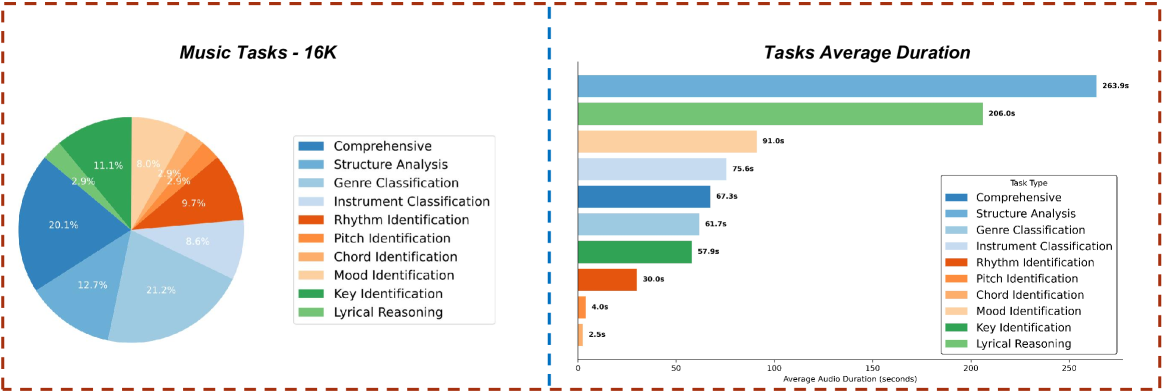
Figure 4: Dataset distribution of MuCUE. MuCUE contains a total of 16,463 samples. The left side shows the distribution of sample quantities across 10 task categories, while the right side displays the distribution of audio durations among the 10 task categories.
### Pre-training
The objective of the pre-training phase is to establish a strong, fundamental alignment between the audio and language modalities and to imbue the model with core perceptual abilities. This is accomplished over four distinct stages:
#### Stage 1: Warmup (Connector Initialization)
The training begins with a brief 400-step warmup stage. In this initial step, we freeze the parameters of both the audio encoder and the LLM, training only the connector module. The rationale is to establish a stable bridge between the two powerful, pre-trained backbones without the risk of destabilizing their well-formed representations with large, chaotic gradients from a randomly initialized component. The tasks are limited to basic speech and music score transcription on 30-second clips, providing a clean, direct signal for the connector to learn the initial modality mapping.
#### Stage 2: Initial Full-Parameter Alignment (Align1)
Once the connector is stabilized, we unfreeze all model parameters and begin end-to-end training for 2500 steps. By co-adapting the entire model on the same foundational transcription tasks, we allow the audio encoder and the LLM to gently adjust to one another, deepening the cross-modal alignment beyond the connector. This stage encourages the model to learn a shared representational space more profoundly.
#### Stage 3: Capability Enrichment (Align2)
With the model architecture fully aligned, we broaden its musical knowledge base over 3500 steps. The task set is expanded to include more complex and musically salient objectives: lyrics transcription, pitch identification, and instrument identification. This strategic shift moves the model’s learning from simple acoustic-to-text mapping towards genuine musical concept recognition. It is at this stage that the model learns the specific acoustic signatures corresponding to textual concepts like ”guitar,” ”C4 pitch,” or lyrical content.
#### Stage 4: Long-Context Extension
A pivotal and defining stage of our pre-training is the extension to long-form audio. In these 540 steps, the training audio duration is dramatically increased from 30 seconds to a max of 390 seconds. To accommodate the significant memory demands of these long sequences, the batch size is necessarily reduced from 384 to 144. The tasks are focused on music score and lyrics transcription over these extended contexts. The purpose of this stage is to force the model to learn long-range temporal dependencies that are invisible in short clips, such as the verse-chorus structure of a song or the development of a melodic theme. This endows our model with the capacity for true song-level analysis, a critical differentiator from prior work.
### Fine-tuning
Following the comprehensive pre-training phase, the model has developed a robust and general understanding of musical concepts. The fine-tuning phase aims to adapt this generalist foundation into a highly proficient expert for a wide array of MIR applications. This is accomplished through a sequential, two-stage fine-tuning curriculum that further refines the model’s capabilities, first by mastering diverse tasks on short audio segments and then by applying this knowledge to the complexity of full-length musical pieces.
#### Stage 1: Short Music Fine-tuning
The first stage of fine-tuning involves training the model for 1000 steps on a diverse mixture of MIR tasks using 30-second audio segments. The objective here is to expose the model to the rich variety of music understanding tasks found in the wild—from genre and mood classification to more technical analyses like key and tempo detection. By focusing on short, information-dense clips, we can efficiently train the model across this wide task distribution, sharpening its ability to perform fine-grained, segment-level analysis. This stage solidifies the model’s grasp of specific musical attributes before it is asked to integrate them over longer time horizons.
#### Stage 2: Long Music Fine-tuning
Building directly upon the refined capabilities from the previous stage, the model then undergoes a final 700 steps of fine-tuning, this time using the full 390-second audio context. The purpose of this stage is to transfer the task-specific knowledge learned on short clips to scenarios requiring holistic, song-level reasoning. The model learns to apply its understanding of genre, mood, and structure to entire musical narratives, tracking their evolution and interplay throughout a complete song. This sequential process—first mastering the concepts, then applying them at scale—ensures that the model develops a cohesive and hierarchical understanding, making it adept at both microscopic precision and macroscopic interpretation. This final step is crucial for equipping the model with the comprehensive analytical skills evaluated in our MuCUE benchmark.
## 5 Evaluation
### The MuCUE Benchmark
Table 3: Evaluation Results on various music understanding tasks. We group the datasets by their task category for better readability. The highest score in each row is highlighted in bold.
| Task | Dataset | Gemini-2.0-flash | Qwen2.5-Omni | Kimi-Audio | Qwen2-Audio | ours |
| --- | --- | --- | --- | --- | --- | --- |
| Key Identification | gs_key_30s (Knees et al. 2015) | 33.6 | 23.8 | 26.0 | 18.2 | 50.4 |
| gtzan_key (Tzanetakis and Cook 2002) | 33.7 | 28.7 | 28.3 | 22.0 | 34.1 | |
| Pitch Identification | nsyn_pitch (Engel et al. 2017) | 30.8 | 36.8 | 31.8 | 31.2 | 77.2 |
| Chord Identification | guitarset (Xi et al. 2018) | 25.2 | 13.2 | 27.2 | 19.2 | 58.8 |
| Rhythm Identification | ballroom_tempo (Gouyon et al. 2006) | 31.7 | 28.9 | 24.4 | 31.1 | 29.4 |
| gtzan_tempo (Tzanetakis and Cook 2002) | 41.3 | 32.4 | 22.9 | 27.1 | 40.7 | |
| Instrument Classification | ins_cls (Abdulvahap 2024) | 26.0 | 66.8 | 79.4 | 39.8 | 91.2 |
| nsyn_ins (Engel et al. 2017) | 32.4 | 40.6 | 44.4 | 22.4 | 74.0 | |
| mtg_ins (Bogdanov et al. 2019) | 19.8 | 55.8 | 51.2 | 24.0 | 68.6 | |
| Genre Classification | gtzan (Tzanetakis and Cook 2002) | 72.2 | 88.6 | 77.8 | 83.9 | 81.3 |
| fma-small (Defferrard et al. 2017) | 63.4 | 66.2 | 55.8 | 65.6 | 72.4 | |
| fma-medium (Defferrard et al. 2017) | 62.8 | 78.0 | 59.8 | 77.0 | 85.2 | |
| mtg_genre (Bogdanov et al. 2019) | 57.2 | 61.6 | 55.8 | 46.4 | 81.4 | |
| ballroom_genres (Gouyon et al. 2006) | 57.0 | 45.8 | 44.0 | 35.2 | 52.4 | |
| Mood Identification | mtg_mood (Bogdanov et al. 2019) | 38.2 | 43.4 | 39.4 | 29.2 | 52.8 |
| md4q (Panda, Malheiro, and Paiva 2018) | 71.9 | 47.6 | 61.3 | 57.8 | 65.9 | |
| Structure Analysis | salami_segd (Smith et al. 2011) | 40.6 | 18.6 | 27.2 | 19.4 | 64.8 |
| salami_pred (Smith et al. 2011) | 37.6 | 32.2 | 34.6 | 31.2 | 64.8 | |
| salami_cnt (Smith et al. 2011) | 49.8 | 36.8 | 37.8 | 30.2 | 43.2 | |
| salami_overall (Smith et al. 2011) | 62.1 | 55.8 | 45.3 | 42.6 | 48.7 | |
| Lyrical Reasoning | lyr (internal testset for lyrical reasoning) | 88.2 | 87.4 | 87.0 | 60.0 | 90.8 |
| Comprehensive | mmau-music (Sakshi et al. 2024) | 67.1 | 63.8 | 66.2 | 57.8 | 66.5 |
| tat (Law et al. 2009) | 61.2 | 59.4 | 54.0 | 61.4 | 80.6 | |
| mucho (Weck et al. 2024) | 69.6 | 66.5 | 69.7 | 66.7 | 63.9 | |
| mcaps (Agostinelli et al. 2023) | 62.2 | 65.6 | 68.0 | 74.0 | 80.0 | |
| mqa (internal testset for music QA) | 58.0 | 76.0 | 79.0 | 60.8 | 88.4 | |
| Average | 49.8 | 50.8 | 49.9 | 43.6 | 65.7 | |
The evaluation of large audio models’ deep musical intelligence remains a significant challenge, largely due to the lack of a unified and multi-faceted benchmark. To bridge this critical gap, we present MuCUE (Music Comprehensive Understanding Evaluation), a novel benchmark that systematically assesses a wide array of music perception and cognition tasks. Its core innovation lies in framing all evaluation tasks—from low-level pitch and chord recognition to high-level genre, mood, and structural analysis—as multiple-choice questions (MCQs). This standardized format facilitates straightforward, scalable evaluation and is particularly suited for probing the emergent reasoning abilities of generative and foundation models. MuCUE thereby provides the research community with a holistic and rigorous tool to measure the true progress of music AI, identify model weaknesses, and guide future innovations in the field.
The construction process of evaluation data are detailed in appendix. For datasets in large quantity we hold out a portion for evaluation in the first place and leave the rest for training, so there is no possibility of contamination at least for our model.
### Main Results and Analysis
The comprehensive evaluation results on the MuCUE benchmark are presented in Table 3. We evaluate some open-weighted models (Chu et al. 2024; Xu et al. 2025; KimiTeam et al. 2025) as well as a proprietary model. Upon tests, some other audio language models like MU-LLaMA (Liu et al. 2023b) have difficulty in doing this kind of MCQs, it becomes unfair to compare in this way, so we exclude them here. The results unequivocally demonstrate the superior performance of our proposed model. Achieving an average score of 65.7, our model establishes a new state-of-the-art, outperforming the next-best model, Qwen2.5-Omni, by a significant margin of over 15 points in average accuracy. This substantial improvement across a diverse set of 26 tasks underscores the efficacy of our unified architecture and targeted training strategy.
Our model’s strength is particularly evident in low-level perceptual tasks that require fine-grained audio analysis. For instance, it achieves remarkable scores of 77.2 on pitch identification (nsyn_pitch), 58.8 on chord recognition (guitarset), and a commanding 91.2 on instrument classification (ins_cls). We attribute this success to our architectural design, specifically the fusion of features from multiple encoder layers (0, 7, 15, and 32), which provides the model with a rich, multi-resolution representation of the audio signal. Furthermore, the inclusion of similar tasks during the pre-training alignment phase directly cultivated these foundational capabilities, enabling the model to excel where others falter.
Beyond granular perception, our model excels at high-level cognitive tasks that depend on understanding long-range temporal dependencies. Its exceptional performance on music structure analysis, such as segment boundary detection (salami_segd at 64.8), and lyrical reasoning (lyr at 90.8), highlights this capability. This proficiency is a direct outcome of our novel context-extending training stage, where the model was explicitly trained on audio contexts of up to 390 seconds. This stage enabled the model to learn the hierarchical and narrative structures inherent in complete musical pieces, a feat unattainable by models limited to short 30-second clips.
A nuanced analysis also reveals areas for further investigation. While dominant in most tasks, our model’s performance on overall structural summary (salami_overall at 48.7) is surpassed by Gemini. This may suggest that tasks requiring high-level abstract summarization are more heavily influenced by the raw reasoning power of the underlying LLM, where proprietary, larger-scale models may hold an advantage. Conversely, on the popular GTZAN genre classification task, our model (81.3) is competitive but behind Qwen2.5-Omni (88.6). This could be attributed to differences in pre-training data composition, as GTZAN is a ubiquitous benchmark that may feature more prominently in the training of other general-purpose models. These results highlight the intricate interplay between model architecture, training data, and task-specific requirements, providing valuable insights for future work.
### Downstream Applications
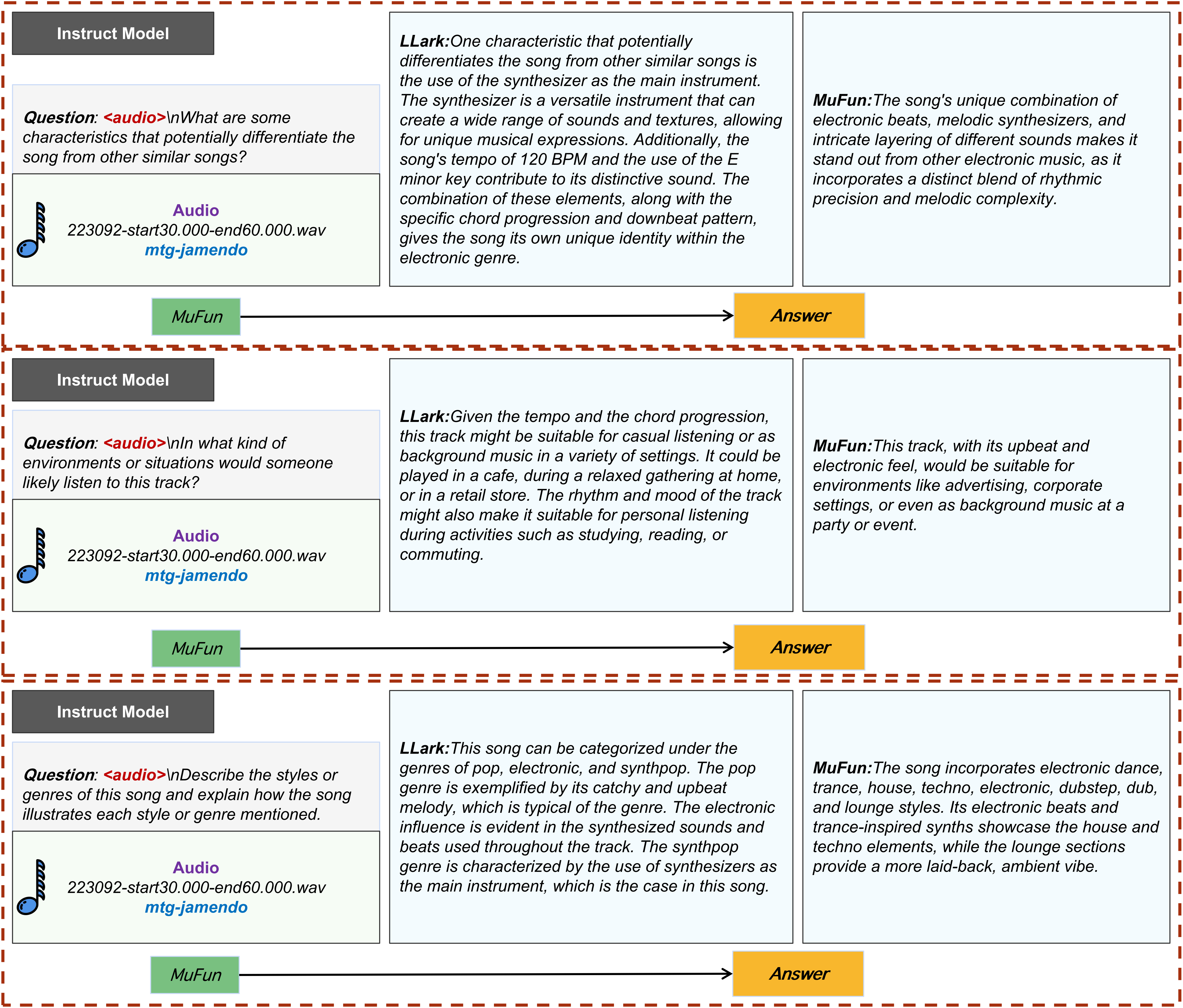
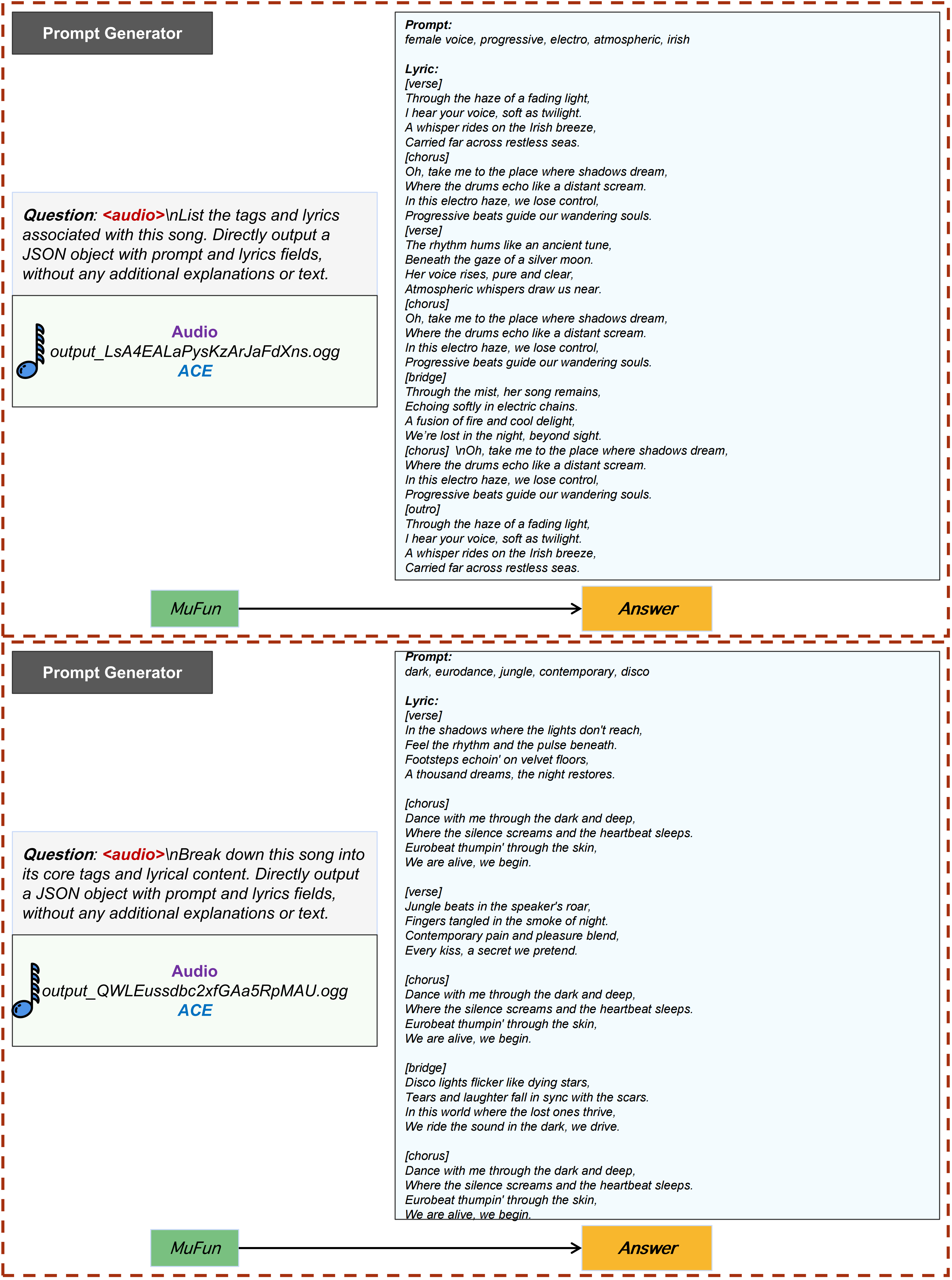
Our trained model is more like a base model, which can be further finetuned to adapt to more specific downstream tasks. For instance, we further train an instruct version and try out reinforcement learning like GRPO((Shao et al. 2024)) afterwards. We also make a prompt generator for a music generation model ACE-Step (Guo 2025) which takes in a song and output some prompts and lyrics for generation. More examples are shown in appendix. This demonstrates the model’s strong generalization ability and flexibility.
### Ablation Study
| variants | instruct | combined finetuning | last hidden |
| --- | --- | --- | --- |
| Avgerage on MuCUE(compared with base) | +0.078 | -0.143 | -1.250 |
Table 4: Ablation Study Results
To validate our key design choices, we conducted several ablation experiments (see Table 4). First, we assess our multi-layer feature fusion by training a variant using only the last hidden layer of the audio encoder with the same data. This resulted in a performance degradation, confirming that a rich, multi-resolution audio representation is critical for our model’s success. Next, we test our sequential fine-tuning curriculum by combining the short and long-context data into a single stage. This led to a small performance drop, suggesting our staged approach provides a more effective learning path. Finally, adding a post-hoc instruction-tuning stage yielded a marginal gain, indicating that our core training regimen already aligns the model effectively for question-answering tasks within the music domain. Collectively, these results underscore the importance of our proposed feature fusion and sequential training strategies.
## 6 Conclusion and Future Work
In this work, we introduced a unified foundation model called MuFun that significantly advances the state-of-the-art in holistic music understanding. By leveraging a multi-layer feature fusion architecture and a novel, long-context (390s) training curriculum, our model successfully overcomes the task fragmentation common in Music Information Retrieval. Its superior performance is demonstrated on MuCUE, a comprehensive new benchmark we developed to systematically evaluate a wide spectrum of musical abilities via a standardized multiple-choice question format. Our results validate that a single, strategically trained model can achieve both fine-grained perceptual accuracy and high-level cognitive reasoning, setting a new standard for the field.
While our model demonstrates powerful capabilities, future work can address its current limitations. Our immediate goals are to enhance data efficiency through semi-supervised and self-supervised learning to reduce reliance on large annotated corpora. We also plan to extend the model from a pure understanding system into a unified framework for both music analysis and generation. Further research will focus on developing evaluation methods that capture the subjective and creative aspects of music, and on exploring cross-modal applications that connect music with other domains like video and dance, paving the way for more sophisticated computational creativity.
## References
- Abdulvahap (2024) Abdulvahap. 2024. Music Instrument Sounds for Classification.
- Abouelenin et al. (2025) Abouelenin, A.; Ashfaq, A.; Atkinson, A.; Awadalla, H.; Bach, N.; Bao, J.; Benhaim, A.; Cai, M.; Chaudhary, V.; Chen, C.; et al. 2025. Phi-4-mini technical report: Compact yet powerful multimodal language models via mixture-of-loras. arXiv preprint arXiv:2503.01743.
- Agostinelli et al. (2023) Agostinelli, A.; Denk, T. I.; Borsos, Z.; Engel, J.; Verzetti, M.; Caillon, A.; Huang, Q.; Jansen, A.; Roberts, A.; Tagliasacchi, M.; et al. 2023. Musiclm: Generating music from text. arXiv preprint arXiv:2301.11325.
- Ardila et al. (2020) Ardila, R.; Branson, M.; Davis, K.; Henretty, M.; Kohler, M.; Meyer, J.; Morais, R.; Saunders, L.; Tyers, F. M.; and Weber, G. 2020. Common Voice: A Massively-Multilingual Speech Corpus. In Proceedings of the 12th Conference on Language Resources and Evaluation (LREC 2020), 4211–4215.
- Bai et al. (2023) Bai, J.; Bai, S.; Chu, Y.; Cui, Z.; Dang, K.; Deng, X.; Fan, Y.; Ge, W.; Han, Y.; Huang, F.; Hui, B.; Ji, L.; Li, M.; Lin, J.; Lin, R.; Liu, D.; Liu, G.; Lu, C.; Lu, K.; Ma, J.; Men, R.; Ren, X.; Ren, X.; Tan, C.; Tan, S.; Tu, J.; Wang, P.; Wang, S.; Wang, W.; Wu, S.; Xu, B.; Xu, J.; Yang, A.; Yang, H.; Yang, J.; Yang, S.; Yao, Y.; Yu, B.; Yuan, H.; Yuan, Z.; Zhang, J.; Zhang, X.; Zhang, Y.; Zhang, Z.; Zhou, C.; Zhou, J.; Zhou, X.; and Zhu, T. 2023. Qwen Technical Report. arXiv preprint arXiv:2309.16609.
- Bogdanov et al. (2019) Bogdanov, D.; Won, M.; Tovstogan, P.; Porter, A.; and Serra, X. 2019. The MTG-Jamendo Dataset for Automatic Music Tagging. In Machine Learning for Music Discovery Workshop, International Conference on Machine Learning (ICML 2019). Long Beach, CA, United States.
- Chiang et al. (2023) Chiang, W.-L.; Li, Z.; Lin, Z.; Sheng, Y.; Wu, Z.; Zhang, H.; Zheng, L.; Zhuang, S.; Zhuang, Y.; Gonzalez, J. E.; Stoica, I.; and Xing, E. P. 2023. Vicuna: An Open-Source Chatbot Impressing GPT-4 with 90%* ChatGPT Quality.
- Chu et al. (2024) Chu, Y.; Xu, J.; Yang, Q.; Wei, H.; Wei, X.; Guo, Z.; Leng, Y.; Lv, Y.; He, J.; Lin, J.; Zhou, C.; and Zhou, J. 2024. Qwen2-Audio Technical Report. arXiv preprint arXiv:2407.10759.
- Defferrard et al. (2017) Defferrard, M.; Benzi, K.; Vandergheynst, P.; and Bresson, X. 2017. FMA: A Dataset for Music Analysis. In 18th International Society for Music Information Retrieval Conference (ISMIR).
- Deng et al. (2024) Deng, Z.; Ma, Y.; Liu, Y.; Guo, R.; Zhang, G.; Chen, W.; Huang, W.; and Benetos, E. 2024. MusiLingo: Bridging Music and Text with Pre-trained Language Models for Music Captioning and Query Response. In Proceedings of the 2024 Annual Conference of the North American Chapter of the Association for Computational Linguistics (NAACL 2024). Association for Computational Linguistics.
- Engel et al. (2017) Engel, J.; Resnick, C.; Roberts, A.; Dieleman, S.; Norouzi, M.; Eck, D.; and Simonyan, K. 2017. Neural audio synthesis of musical notes with wavenet autoencoders. In International conference on machine learning, 1068–1077. PMLR.
- Fu et al. (2025) Fu, C.; Lin, H.; Wang, X.; Zhang, Y.-F.; Shen, Y.; Liu, X.; Li, Y.; Long, Z.; Gao, H.; Li, K.; et al. 2025. VITA-1.5: Towards GPT-4o Level Real-Time Vision and Speech Interaction. arXiv preprint arXiv:2501.01957.
- Galvez et al. (2021) Galvez, D.; Diamos, G.; Ciro, J.; Cerón, J. F.; Achorn, K.; Gopi, A.; Kanter, D.; Lam, M.; Mazumder, M.; and Reddi, V. J. 2021. The People’s Speech: A Large-Scale Diverse English Speech Recognition Dataset for Commercial Usage. CoRR, abs/2111.09344.
- Gardner et al. (2023) Gardner, J.; Durand, S.; Stoller, D.; and Bittner, R. M. 2023. Llark: A multimodal instruction-following language model for music. arXiv preprint arXiv:2310.07160.
- Gouyon et al. (2006) Gouyon, F.; Klapuri, A.; Dixon, S.; Alonso, M.; Tzanetakis, G.; Uhle, C.; and Cano, P. 2006. An experimental comparison of audio tempo induction algorithms. IEEE Transactions on Audio Speech and Language Processing, 14(5): 1832–1844. ISSN 1558-7916¡br/¿Contribution: organisation=sgn,FACT1=1.
- Guo (2025) Guo, J. G. W. Z. S. W. S. X. J. 2025. ACE-Step: A Step Towards Music Generation Foundation Model. https://github.com/ace-step/ACE-Step. GitHub repository.
- Huang et al. (2025) Huang, A.; Wu, B.; Wang, B.; Yan, C.; Hu, C.; Feng, C.; Tian, F.; Shen, F.; Li, J.; Chen, M.; Liu, P.; Miao, R.; You, W.; Chen, X.; Yang, X.; Huang, Y.; Zhang, Y.; Gong, Z.; Zhang, Z.; Li, B.; Wan, C.; Hu, H.; Ming, R.; Yuan, S.; Zhang, X.; Zhou, Y.; Li, B.; Ma, B.; An, K.; Ji, W.; Li, W.; Wen, X.; Ma, Y.; Liang, Y.; Mou, Y.; Ahmidi, B.; Wang, B.; Li, B.; Miao, C.; Xu, C.; Feng, C.; Wang, C.; Shi, D.; Sun, D.; Hu, D.; Sai, D.; Liu, E.; Huang, G.; Yan, G.; Wang, H.; Jia, H.; Zhang, H.; Gong, J.; Wu, J.; Liu, J.; Sun, J.; Zhen, J.; Feng, J.; Wu, J.; Wu, J.; Yang, J.; Wang, J.; Zhang, J.; Lin, J.; Li, K.; Xia, L.; Zhou, L.; Gu, L.; Chen, M.; Wu, M.; Li, M.; Li, M.; Liang, M.; Wang, N.; Hao, N.; Wu, Q.; Tan, Q.; Pang, S.; Yang, S.; Gao, S.; Liu, S.; Liu, S.; Cao, T.; Wang, T.; Deng, W.; He, W.; Sun, W.; Han, X.; Deng, X.; Liu, X.; Zhao, X.; Wei, Y.; Yu, Y.; Cao, Y.; Li, Y.; Ma, Y.; Xu, Y.; Shi, Y.; Wang, Y.; Zhong, Y.; Luo, Y.; Lu, Y.; Yin, Y.; Yan, Y.; Yang, Y.; Xie, Z.; Ge, Z.; Sun, Z.; Huang, Z.; Chang, Z.; Yang, Z.; Zhang, Z.; Jiao, B.; Jiang, D.; Shum, H.-Y.; Chen, J.; Li, J.; Zhou, S.; Zhang, X.; Zhang, X.; and Zhu, Y. 2025. Step-Audio: Unified Understanding and Generation in Intelligent Speech Interaction. arXiv:2502.11946.
- KimiTeam et al. (2025) KimiTeam; Ding, D.; Ju, Z.; Leng, Y.; Liu, S.; Liu, T.; Shang, Z.; Shen, K.; Song, W.; Tan, X.; Tang, H.; Wang, Z.; Wei, C.; Xin, Y.; Xu, X.; Yu, J.; Zhang, Y.; Zhou, X.; Charles, Y.; Chen, J.; Chen, Y.; Du, Y.; He, W.; Hu, Z.; Lai, G.; Li, Q.; Liu, Y.; Sun, W.; Wang, J.; Wang, Y.; Wu, Y.; Wu, Y.; Yang, D.; Yang, H.; Yang, Y.; Yang, Z.; Yin, A.; Yuan, R.; Zhang, Y.; and Zhou, Z. 2025. Kimi-Audio Technical Report. arXiv:2504.18425.
- Knees et al. (2015) Knees, P.; Faraldo, Á.; Herrera, P.; Vogl, R.; Böck, S.; Hörschläger, F.; and Goff, M. L. 2015. Two Data Sets for Tempo Estimation and Key Detection in Electronic Dance Music Annotated from User Corrections. In International Society for Music Information Retrieval Conference.
- Law et al. (2009) Law, E.; West, K.; Mandel, M. I.; Bay, M.; and Downie, J. S. 2009. Evaluation of algorithms using games: The case of music tagging. In ISMIR, 387–392.
- Li et al. (2025) Li, T.; Liu, J.; Zhang, T.; Fang, Y.; Pan, D.; Wang, M.; Liang, Z.; Li, Z.; Lin, M.; Dong, G.; et al. 2025. Baichuan-audio: A unified framework for end-to-end speech interaction. arXiv preprint arXiv:2502.17239.
- Li et al. (2023) Li, Y.; Yuan, R.; Zhang, G.; Ma, Y.; Chen, X.; Yin, H.; Lin, C.; Ragni, A.; Benetos, E.; Gyenge, N.; Dannenberg, R.; Liu, R.; Chen, W.; Xia, G.; Shi, Y.; Huang, W.; Guo, Y.; and Fu, J. 2023. MERT: Acoustic Music Understanding Model with Large-Scale Self-supervised Training. arXiv:2306.00107.
- Liu et al. (2024) Liu, H.; Li, C.; Li, Y.; and Lee, Y. J. 2024. Improved baselines with visual instruction tuning. In Proceedings of the IEEE/CVF conference on computer vision and pattern recognition, 26296–26306.
- Liu et al. (2023a) Liu, S.; Hussain, A. S.; Sun, C.; and Shan, Y. 2023a. M2UGen: Multi-modal Music Understanding and Generation with the Power of Large Language Models. arXiv preprint arXiv:2311.11255.
- Liu et al. (2023b) Liu, S.; Hussain, A. S.; Sun, C.; and Shan, Y. 2023b. Music Understanding LLaMA: Advancing Text-to-Music Generation with Question Answering and Captioning. arXiv preprint arXiv:2308.11276.
- McKee et al. (2023) McKee, D.; Salamon, J.; Sivic, J.; and Russell, B. 2023. Language-Guided Music Recommendation for Video via Prompt Analogies. In Proceedings of the IEEE/CVF Conference on Computer Vision and Pattern Recognition (CVPR).
- Mitton (2025) Mitton, M. 2025. bread-midi-dataset (Revision 95c2155).
- Panda, Malheiro, and Paiva (2018) Panda, R.; Malheiro, R.; and Paiva, R. P. 2018. Musical texture and expressivity features for music emotion recognition. In 19th International Society for Music Information Retrieval Conference (ISMIR 2018), 383–391.
- Pegoraro Santana et al. (2020) Pegoraro Santana, I. A.; Pinhelli, F.; Donini, J.; Catharin, L.; Mangolin, R. B.; da Costa, Y. M. e. G.; Delisandra Feltrim, V.; and Domingues, M. A. 2020. Music4All: A New Music Database and Its Applications. In 2020 International Conference on Systems, Signals and Image Processing (IWSSIP), 399–404.
- Radford et al. (2023) Radford, A.; Kim, J. W.; Xu, T.; Brockman, G.; McLeavey, C.; and Sutskever, I. 2023. Robust speech recognition via large-scale weak supervision. In International conference on machine learning, 28492–28518. PMLR.
- Sakshi et al. (2024) Sakshi, S.; Tyagi, U.; Kumar, S.; Seth, A.; Selvakumar, R.; Nieto, O.; Duraiswami, R.; Ghosh, S.; and Manocha, D. 2024. MMAU: A Massive Multi-Task Audio Understanding and Reasoning Benchmark. arXiv:2410.19168.
- Shao et al. (2024) Shao, Z.; Wang, P.; Zhu, Q.; Xu, R.; Song, J.; Bi, X.; Zhang, H.; Zhang, M.; Li, Y.; Wu, Y.; et al. 2024. Deepseekmath: Pushing the limits of mathematical reasoning in open language models. arXiv preprint arXiv:2402.03300.
- Smith et al. (2011) Smith, J. B. L.; Burgoyne, J. A.; Fujinaga, I.; De Roure, D.; and Downie, J. S. 2011. Design and creation of a large-scale database of structural annotations. In ISMIR, volume 11, 555–560. Miami, FL.
- Touvron et al. (2023) Touvron, H.; Martin, L.; Stone, K.; Albert, P.; Almahairi, A.; Babaei, Y.; Bashlykov, N.; Batra, S.; Bhargava, P.; Bhosale, S.; et al. 2023. Llama 2: Open foundation and fine-tuned chat models. arXiv preprint arXiv:2307.09288.
- Tzanetakis and Cook (2002) Tzanetakis, G.; and Cook, P. 2002. Musical genre classification of audio signals. IEEE Transactions on Speech and Audio Processing, 10(5): 293–302.
- von Werra et al. (2020) von Werra, L.; Belkada, Y.; Tunstall, L.; Beeching, E.; Thrush, T.; Lambert, N.; Huang, S.; Rasul, K.; and Gallouédec, Q. 2020. TRL: Transformer Reinforcement Learning. https://github.com/huggingface/trl.
- Weck et al. (2024) Weck, B.; Manco, I.; Benetos, E.; Quinton, E.; Fazekas, G.; and Bogdanov, D. 2024. MuChoMusic: Evaluating Music Understanding in Multimodal Audio-Language Models. In Proceedings of the 25th International Society for Music Information Retrieval Conference (ISMIR).
- Xi et al. (2018) Xi, Q.; Bittner, R. M.; Pauwels, J.; Ye, X.; and Bello, J. P. 2018. GuitarSet: A Dataset for Guitar Transcription. In International Society for Music Information Retrieval Conference.
- Xu et al. (2025) Xu, J.; Guo, Z.; He, J.; Hu, H.; He, T.; Bai, S.; Chen, K.; Wang, J.; Fan, Y.; Dang, K.; et al. 2025. Qwen2. 5-omni technical report. arXiv preprint arXiv:2503.20215.
- Yang (2020) Yang. 2020. zhvoice.
- Yang et al. (2025) Yang, A.; Li, A.; Yang, B.; Zhang, B.; Hui, B.; Zheng, B.; Yu, B.; Gao, C.; Huang, C.; Lv, C.; et al. 2025. Qwen3 technical report. arXiv preprint arXiv:2505.09388.
- Zeng et al. (2024) Zeng, A.; Du, Z.; Liu, M.; Wang, K.; Jiang, S.; Zhao, L.; Dong, Y.; and Tang, J. 2024. GLM-4-Voice: Towards Intelligent and Human-Like End-to-End Spoken Chatbot. arXiv:2412.02612.
- Zhou et al. (2024) Zhou, B.; Hu, Y.; Weng, X.; Jia, J.; Luo, J.; Liu, X.; Wu, J.; and Huang, L. 2024. Tinyllava: A framework of small-scale large multimodal models. arXiv preprint arXiv:2402.14289.
## Appendix A Model Output Examples
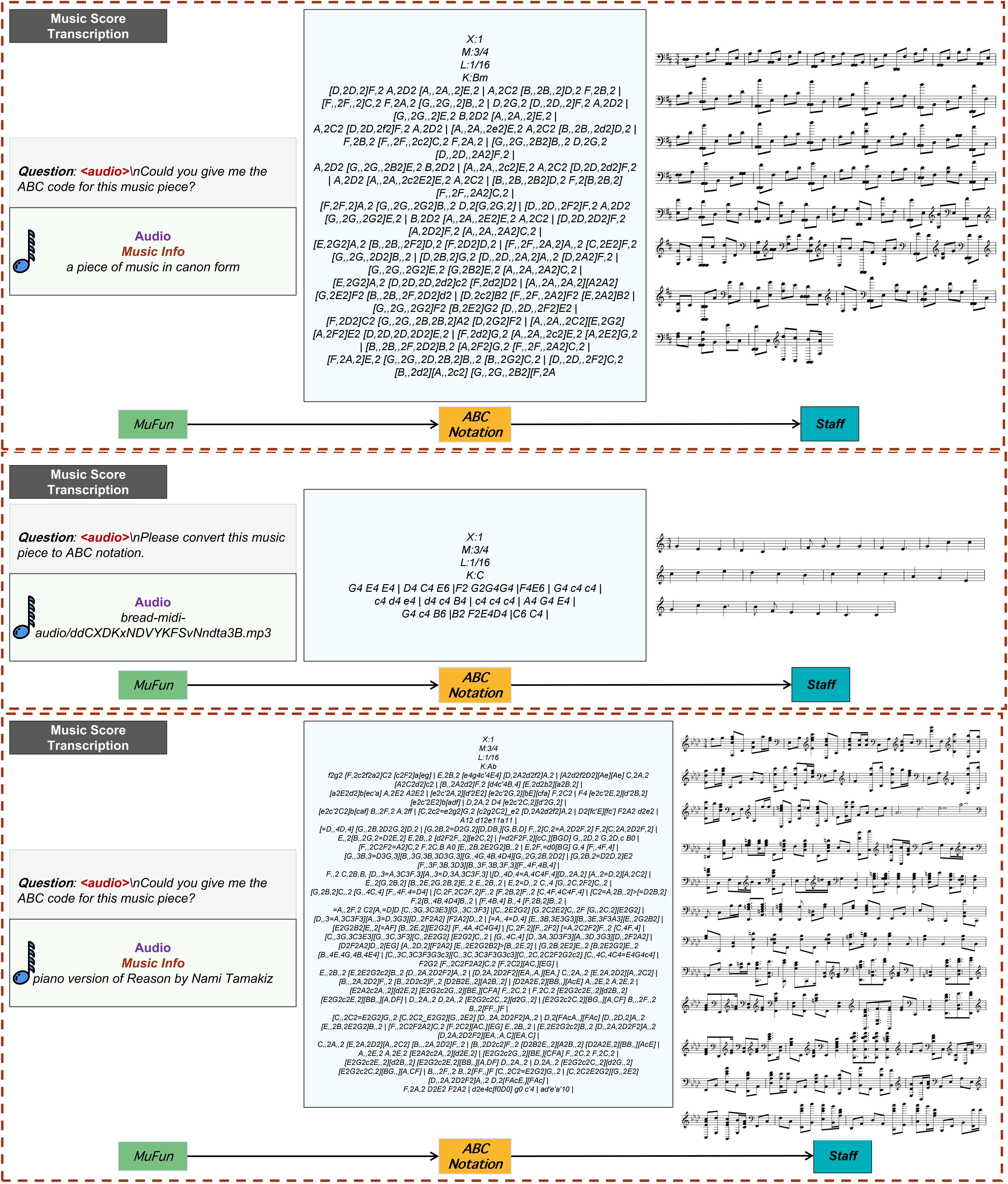
Here we show some outputs of fintunes of our base model, refer to Figs. 7, 8, 6 and 5.
## Appendix B Training Details
Our main training code is adapted from TinyLLaVA Factory (Zhou et al. 2024) to support audio input. As for reinforcement learning, we modify the HuggingFace TRL library (von Werra et al. 2020).
| Dataset | Count | Audio Length | Labels |
| --- | --- | --- | --- |
| Giantsteps-key (Knees et al. 2015) | 604 | 120s | Key |
| Free Music Archive (Defferrard et al. 2017) | 100k | 30s | Similar to website API |
| MagnaTagATune (Law et al. 2009) | 25k | 29s | 188 simple binary tags |
| MTG-Jamendo (Bogdanov et al. 2019) | 55k | song | 195 tags (genre, instrument, mood/theme) |
| MusicCaps (Agostinelli et al. 2023) | 5.5k | 10s | Expert-written text descriptions and some tags |
| YouTube8M-MusicTextClips (McKee et al. 2023) | 4k | 10s | Text descriptions |
| bread-midi-dataset (Mitton 2025) | 851k | various | midi |
| Music Instrument Sounds (Abdulvahap 2024) | 42.3k | 3s | Instrument |
| NSynth (Engel et al. 2017) | 306k | 4s | Note, instrument |
| GuitarSet (Xi et al. 2018) | 360 | 30s | Pitch, beat, tempo, chord |
| Music4All (Pegoraro Santana et al. 2020) | 109k | 30s | tags, lyrics |
| SALAMI (Smith et al. 2011) | 1447 | song | structure |
Table 5: open music datasets used in training
For distributed training, we use the DeepSpeed ZeRO Stage 3 optimization strategy. In each sub-stage, the model is initialized from previous one and trained with a learning rate of 2e-5 and cosine scheduler. To manage memory and enhance performance, the training utilizes bfloat16 mixed-precision, Flash Attention 2, and gradient checkpointing.
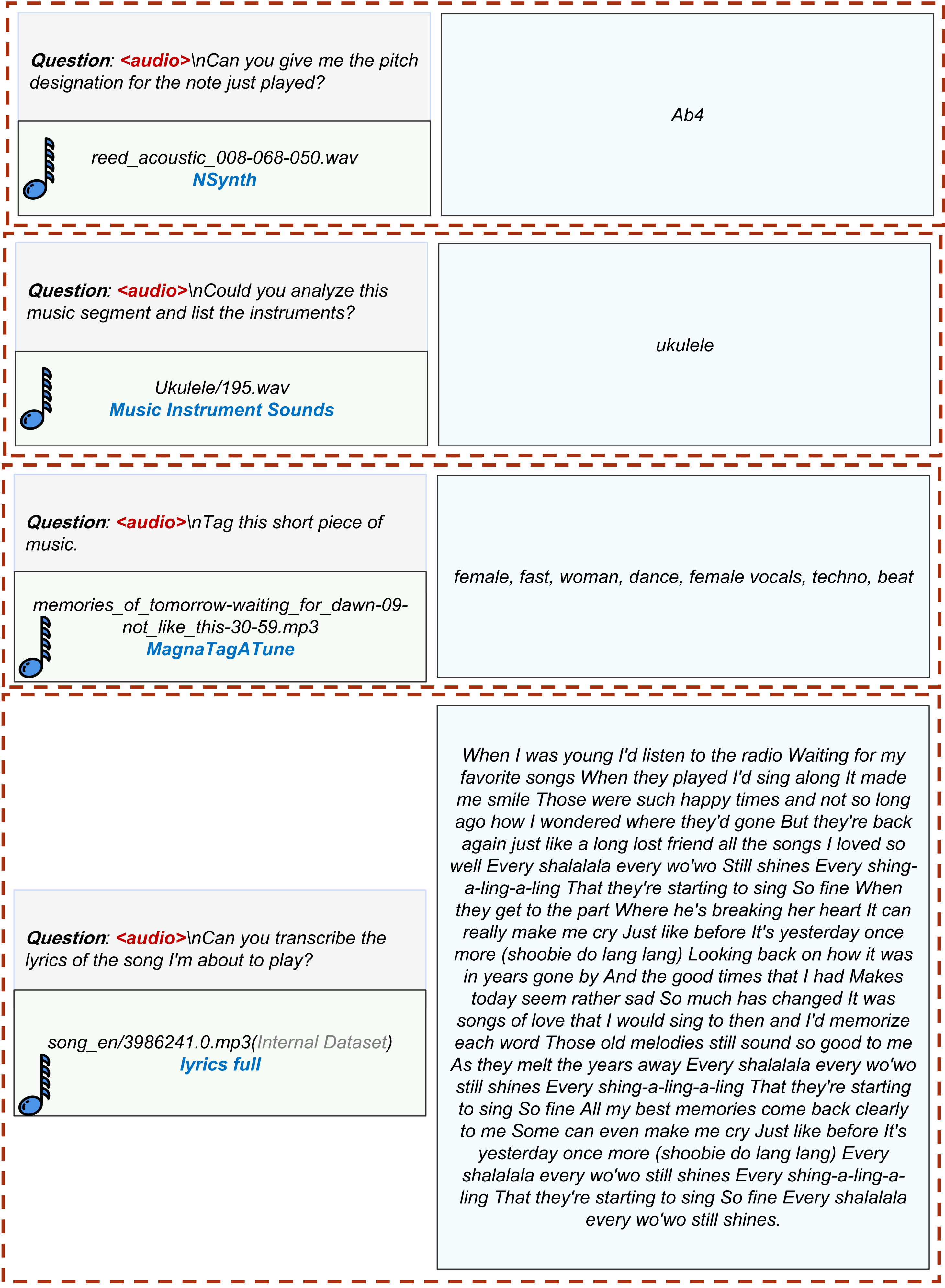
The training data is constructed in a straight-forward way, unlike many prior works which mostly utilize instruction format. We tend to put as many text labels as possible in a single sample for better efficiency. Some open music datasets used in training are listed in Table 5, examples shown in Figs. 9 and 10. We also provide the specific data recipes for each training stage, see Tables 6, 7, 8, 9, 10 and 11.
| dataset | nums |
| --- | --- |
| CommonVoice (Ardila et al. 2020) | 100k |
| bread-midi-dataset (Mitton 2025) | 38k |
Table 6: warmup
| dataset | nums |
| --- | --- |
| CommonVoice (Ardila et al. 2020) | 1014k |
| bread-midi-dataset (Mitton 2025) | 115k |
Table 7: align-1
| dataset | nums |
| --- | --- |
| CommonVoice (Ardila et al. 2020) | 100k |
| lyrics seg(internal trainset) | 400k |
| NSynth (Engel et al. 2017) | 200k |
| Music Instrument Sounds (Abdulvahap 2024) | 42k |
| People’s Speech (Galvez et al. 2021) | 310k |
| zhvoice (Yang 2020) | 300k |
Table 8: align-2
| dataset | nums |
| --- | --- |
| bread-midi-dataset (Mitton 2025) | 10k |
| lyrics full(internal trainset) | 100k |
Table 9: context-extending
| dataset | nums |
| --- | --- |
| lyrics seg(internal trainset) | 4k |
| MagnaTagATune (Law et al. 2009) | 71k |
| NSynth (Engel et al. 2017) | 88k |
| MusicCaps (Agostinelli et al. 2023) | 10k |
| Music Instrument Sounds (Abdulvahap 2024) | 52k |
| GuitarSet (Xi et al. 2018) | 4k |
| Giantsteps-key (Knees et al. 2015) | 3k |
| FMA-medium (Defferrard et al. 2017) | 24k |
| FMA-small (Defferrard et al. 2017) | 7k |
| Music4All (Pegoraro Santana et al. 2020) | 109k |
Table 10: finetuning-short
| dataset | nums |
| --- | --- |
| lyrics full(internal trainset) | 6k |
| finetuning-short | 10k |
| MTG-Jamendo (Bogdanov et al. 2019) | 59k |
| music general QA (internal trainset) | 10k |
| lyrical reasoning (internal trainset) | 9k |
| SALAMI (Smith et al. 2011) | 5k |
Table 11: finetuning-long
## Appendix C Evaluation Details
### Data Construction
We collect 10+ open datasets as well as some in-house data. Since these datasets have audio and text label pairs, multiple-choice questions can be easily generated for evaluation. The correct choice can be inferred from the text label pair, while the incorrect choices can be randomly selected from the text label in other pairs. For example, the fma-small dataset has 8 genre labels, we can randomly select 3 incorrect choices from the other 7 genres. The exception is the MusicCaps, for which we directly prompt gpt-4o to generate the multiple-choice questions based on the corresponding text descriptions. For MMAU (Sakshi et al. 2024), the music part of test-mini v05.15.25 version is used.
### Experiments
The input text prompt is ’Choose the correct option for the question based on the audio.’, followed by the question and choices. For open-weighted model and our model, we all use BF16 precision for inference and temperature zero during sampling. The gemini model is accessed via Vertex AI Platform with default request parameters.
## Appendix D Downstream Applications
### Instruction-tuning
The instruction-tuning data for full song understanding are scarce, so we prompt various LLMs to generate some QA pairs based on some text information related to a song. This dataset has around 30k samples with all song-level audios, on which the base model is further trained. Afterwards, we also try methods of reinforcement learning like GRPO((Shao et al. 2024)) on it.
### Prompt Generator
We make a prompt generator for a music generation model ACE-Step (Guo 2025) which takes in a song and output some prompts and lyrics for generation, by training on around 20k text song pairs. On a held-out test set of 100 songs, our finetuned model achieves a similarity score of 0.98 (using MERT (Li et al. 2023) model’s embedding) compared with original generated song.
### Music Score Transcription
The model is trained on more instrumental piece ABC code pairs to have better performance on music score transcription task. ABC code can be used to synthesized back the music. On a held-out test set of size 256, our finetuned model achieves a similarity score of 0.92 (using MERT’s embedding) compared with original piece.
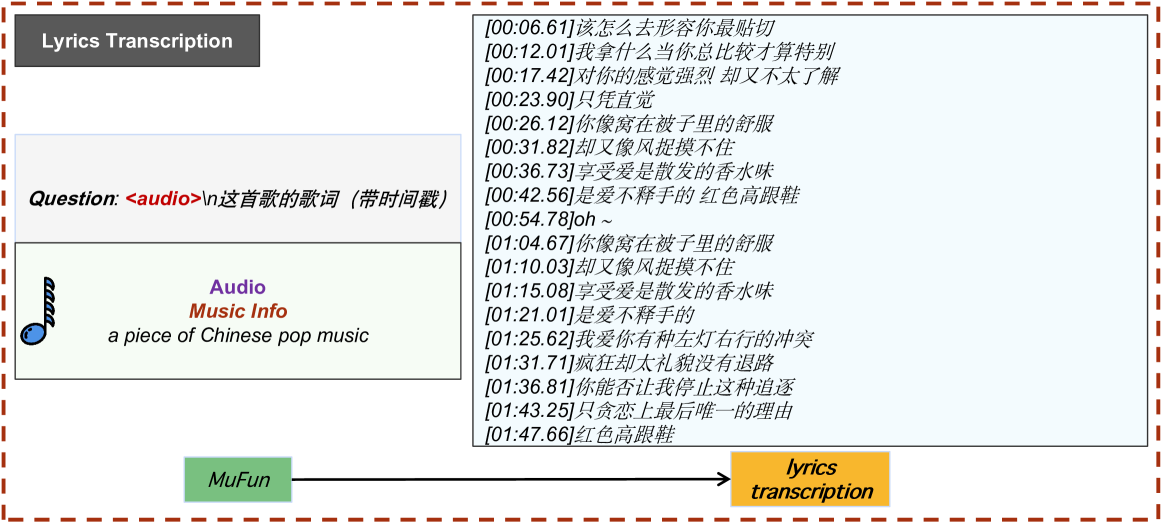
### Lyrics Transcription with Timestamps
We also try to train a model that could output both lyrics and timestamps given a song.
<details>
<summary>fig/demo_9.png Details</summary>
### Visual Description
## Flowchart: Music Transcription Process
### Overview
The image depicts a three-section flowchart illustrating the conversion of audio files into musical notation using ABC notation. Each section demonstrates a distinct audio input (canon form piece, bread midi file, piano version of "Reason by Nami Tamakiz") processed through MuFun software to generate ABC notation, which is then translated into standard musical staff notation.
### Components/Axes
1. **Question Box**: Contains user queries about ABC code generation for specific audio files.
2. **Audio Box**: Provides metadata about input files (e.g., "a piece of music in canon form," file paths like `audio/ddCXDxkNDVYKFSvNndta3B.mp3`).
3. **MuFun**: Central processing component (green box) that converts audio to ABC notation.
4. **ABC Notation**: Intermediate output (orange box) containing musical symbols and letter-based notation.
5. **Staff**: Final output (blue box) showing standard musical notation.
6. **Legend**: Color-coded elements (green=MuFun, orange=ABC Notation, blue=Staff).
### Detailed Analysis
#### Section 1: Canon Form Piece
- **Audio Info**: "a piece of music in canon form"
- **ABC Notation**: Contains complex letter-number combinations (e.g., `[D,2D]2[F,2,A,2D2]`, `[F,2F]2[F,2,A,2D2]`).
- **Staff Notation**: Five-line staff with notes like `D2`, `F2`, and `G2`.
#### Section 2: Bread Midi File
- **Audio Info**: File path `audio/ddCXDxkNDVYKFSvNndta3B.mp3`
- **ABC Notation**: Simplified notation (e.g., `G4 E4 E4 | D4 C4 E6 | F2 G2G4G4 | F4E6`).
- **Staff Notation**: Five-line staff with notes like `G4`, `E4`, and `D4`.
#### Section 3: Piano Version of "Reason"
- **Audio Info**: "piano version of Reason by Nami Tamakiz"
- **ABC Notation**: Dense letter-number sequences (e.g., `[F,2E2]2[F,2,A,2D2]`, `[E,2E2]2[E,2,A,2D2]`).
- **Staff Notation**: Five-line staff with notes like `F2`, `E2`, and `D2`.
### Key Observations
1. **Process Flow**: All sections follow the same structure: user question → MuFun processing → ABC notation → Staff notation.
2. **Notation Complexity**: Canon form transcription shows the most complex ABC notation, while the piano version has dense, repetitive patterns.
3. **File Formats**: Audio files vary between descriptive labels ("canon form") and technical paths (e.g., `.mp3`).
### Interpretation
This flowchart demonstrates a music transcription pipeline where MuFun acts as a bridge between raw audio and symbolic notation. The ABC notation serves as an intermediate step, translating audio patterns into a compact, text-based format that can then be rendered into standard staff notation. The examples highlight the software's ability to handle diverse musical styles (canon, midi, piano) and its output consistency across different audio types. The lack of numerical data suggests this is a conceptual diagram rather than a quantitative analysis.
</details>
Figure 5: Music Score Transcription Demo
<details>
<summary>fig/demo_5.png Details</summary>
### Visual Description
## Flowchart Diagram: Comparative Analysis of Music Analysis Models
### Overview
The diagram presents a comparative analysis framework for evaluating music analysis models (LLark and MuFun) across three distinct query types. Each section contains a question, audio metadata, and side-by-side model responses. The structure emphasizes comparative reasoning through parallel processing of identical inputs.
### Components/Axes
1. **Header Elements**:
- Gray box labeled "Instruct Model" at top of each section
- Red dashed border framing entire diagram
- Yellow "Answer" box at bottom right of each section
2. **Main Content**:
- Three vertically stacked sections (Q1-Q3)
- Each section contains:
- Bold question text (audio analysis queries)
- Audio metadata box (purple "Audio" label + waveform code)
- Two answer boxes (blue for LLark, yellow for MuFun)
3. **Textual Elements**:
- Questions focus on:
1. Song differentiation characteristics
2. Suitable listening environments
3. Genre/style classification
- Audio metadata: "223092-start30.000-end60.000.wav" with "mtg-jamendo" tag
- Model responses compare technical analysis approaches
### Detailed Analysis
#### Section 1: Song Differentiation
- **LLark Response**: Focuses on synthesizer use (versatile instrument), tempo (120 BPM), and chord progression (E minor key)
- **MuFun Response**: Emphasizes electronic beats, melodic layering, and rhythmic/melodic complexity
#### Section 2: Listening Environments
- **LLark Response**: Suggests casual settings (cafes, home gatherings) and personal activities (studying, commuting)
- **MuFun Response**: Highlights advertising, corporate events, and party environments
#### Section 3: Genre Classification
- **LLark Response**: Categorizes as pop/electronic/synthpop with emphasis on synthesized sounds
- **MuFun Response**: Identifies multiple electronic subgenres (trance, house, techno) with stylistic variations
### Key Observations
1. Both models consistently analyze the same audio segment (30-60s waveform)
2. LLark emphasizes technical musical elements (tempo, chord progression)
3. MuFun focuses on stylistic blending and mood-based categorization
4. Answers demonstrate complementary approaches to music analysis
### Interpretation
The diagram illustrates a comparative evaluation framework for music analysis models. LLark demonstrates strength in technical music theory analysis (tempo, chord structure), while MuFun excels in contextual and stylistic interpretation. The parallel processing structure suggests a methodology for benchmarking different analytical approaches to the same audio input. The consistent use of the same audio segment across queries allows for direct comparison of model capabilities in different analytical domains.
</details>
Figure 6: Instruct Model Demo
<details>
<summary>x5.png Details</summary>
### Visual Description
## Screenshot: Lyrics Transcription Interface
### Overview
The image depicts a user interface for extracting and displaying lyrics transcription from an audio file. The interface includes a question prompt, audio/music metadata, a timestamped lyrics transcription, and a MuFun logo. The text is primarily in Chinese, with English labels for interface elements.
### Components/Axes
1. **Question Section**:
- Text: `Question: <audio>这首歌的歌词 (带时间戳)`
- Translation: "Question: What are the lyrics of this song (with timestamps)?"
- Position: Top-left quadrant, enclosed in a gray box.
2. **Audio/Music Info**:
- Text: `Audio Music Info` (English) and `a piece of Chinese pop music` (description).
- Position: Below the question section, in a light gray box.
3. **Lyrics Transcription**:
- Format: Timestamps (e.g., `[00:06.61]`) followed by Chinese lyrics.
- Example:
```
[00:06.61]该怎么去形容你最贴切
[00:12.01]我拿什么当你总比较才算特别
...
[01:47.66]红色高跟鞋
```
- Position: Right side of the interface, occupying ~70% of the vertical space.
4. **MuFun Logo**:
- Text: `MuFun` (English) with a green background.
- Position: Bottom-left corner, adjacent to the lyrics transcription.
### Detailed Analysis
- **Timestamps**:
- Range: `00:06.61` to `01:47.66` (total duration: ~1 minute 41 seconds).
- Format: `[HH:MM.SS]` with millisecond precision.
- **Lyrics Content**:
- Themes: Emotional reflection, longing, and metaphorical imagery (e.g., "红色高跟鞋" / "red high heels").
- Structure: Lyrics are segmented into phrases, each aligned with a timestamp.
### Key Observations
1. The interface is designed for precise synchronization between audio and lyrics.
2. The question explicitly requests timestamped lyrics, indicating a focus on temporal alignment.
3. The MuFun logo suggests the platform specializes in music-related tools.
### Interpretation
This interface likely serves as a tool for music analysis, karaoke, or language learning. The inclusion of timestamps implies functionality for syncing lyrics with audio playback, which is critical for applications like subtitling or rhythm-based games. The lyrics’ emotional tone and metaphors (e.g., "红色高跟鞋") suggest the song explores themes of love, identity, or personal struggle. The MuFun branding positions this as a specialized tool within a broader ecosystem of music technology.
**Note**: No numerical data or trends are present beyond the timestamps and lyrical content. The image focuses on textual and structural elements rather than quantitative analysis.
</details>
Figure 7: Lyrics Transcription Demo
<details>
<summary>fig/demo_6.png Details</summary>
### Visual Description
## Screenshot: Prompt Generator Interface
### Overview
The image shows a dual-section interface for a "Prompt Generator" tool. Each section contains:
1. A **question** instructing the user to extract tags and lyrics from an audio file.
2. An **audio file** with a filename and label ("ACE").
3. A **prompt** with genre tags and structured lyrics (verses, choruses, bridges).
### Components/Axes
#### UI Elements
- **Header**: "Prompt Generator" label in a dark gray box.
- **Question Boxes**:
- Top: *"List the tags and lyrics associated with this song. Directly output a JSON object..."*
- Bottom: *"Break down this song into its core tags and lyrical content..."*
- **Audio Files**:
- Top: `output_LsA4EALaPysKzArJaFdXns.ogg` (labeled "ACE").
- Bottom: `output_QWLEussdbc2xfGAa5RpMAU.ogg` (labeled "ACE").
- **Prompt Sections**:
- **Genre Tags**:
- Top: `female voice, progressive, electro, atmospheric, irish`
- Bottom: `dark, eurodance, jungle, contemporary, disco`
- **Lyrics**: Structured into `[verse]`, `[chorus]`, `[bridge]`, and `[outro]` blocks.
#### Lyrics Structure
Both prompts follow a consistent format:
1. **Verse**: Narrative or descriptive lines.
2. **Chorus**: Repetitive, thematic lines.
3. **Bridge**: Transitional or contrasting section.
4. **Outro**: Optional closing lines (only in the top prompt).
### Detailed Analysis
#### Top Prompt
- **Genre Tags**: Focus on atmospheric and Irish themes.
- **Lyrics**:
- **Verse**: Describes a "fading light" and "Irish breeze."
- **Chorus**: Repeats *"Oh, take me to the place where shadows dream."*
- **Bridge**: Mentions "electric chains" and "fusion of fire and cool delight."
- **Outro**: Repeats the opening verse lines.
#### Bottom Prompt
- **Genre Tags**: Emphasizes dark, energetic, and contemporary styles.
- **Lyrics**:
- **Verse**: References "jungle beats" and "smoke of night."
- **Chorus**: Repeats *"Dance with me through the dark and deep."*
- **Bridge**: Describes "disco lights" and "lost ones thrive."
### Key Observations
1. **Repetition**: Both prompts use a `[chorus]` section with repeated lines.
2. **Genre Alignment**: Tags match lyrical themes (e.g., "progressive" with "wandering souls," "jungle" with "jungle beats").
3. **Structural Consistency**: Lyrics follow a verse-chorus-bridge-outro pattern.
4. **Audio Files**: Both use the "ACE" label, suggesting a shared dataset or test case.
### Interpretation
This interface appears designed for **music generation or analysis**, where users input audio files and receive structured prompts with genre tags and lyrics. The dual sections suggest:
- **Top Section**: Focus on atmospheric/emotional themes (e.g., "shadows dream," "Irish breeze").
- **Bottom Section**: Focus on high-energy, contemporary styles (e.g., "eurobeat," "disco lights").
The "MuFun" button likely triggers the generation process, while "Answer" displays the output. The JSON format requirement ensures machine-readable outputs, critical for automated systems.
**Notable Anomalies**:
- The top prompt includes an `[outro]` section, while the bottom does not.
- Both audio files share the "ACE" label despite differing genres, implying a possible placeholder or test case.
</details>
Figure 8: Prompt Generator Demo
<details>
<summary>fig/train_1.png Details</summary>
### Visual Description
## Screenshot: Music Analysis Interface
### Overview
The image depicts a music analysis interface with four distinct sections, each containing a question, an audio file reference, and a response. The sections are separated by dashed red lines and include interactive elements like audio playback and file metadata.
### Components/Axes
1. **Section 1**
- **Question**: "Can you give me the pitch designation for the note just played?"
- **Audio File**: `reed_acoustic_008-068-050.wav` (NSynth)
- **Response**: `Ab4`
2. **Section 2**
- **Question**: "Could you analyze this music segment and list the instruments?"
- **Audio File**: `Ukulele/195.wav` (Music Instrument Sounds)
- **Response**: `ukulele`
3. **Section 3**
- **Question**: "Tag this short piece of music."
- **Audio File**: `memories_of_tomorrow-waiting_for_dawn-09-not_like_this-30-59.mp3` (MagnaTagATune)
- **Response**: `female, fast, woman, dance, female vocals, techno, beat`
4. **Section 4**
- **Question**: "Can you transcribe the lyrics of the song I'm about to play?"
- **Audio File**: `song_en/3986241.0.mp3` (lyrics full)
- **Response**: Full lyrics transcribed (see below).
### Content Details
#### Section 4 Lyrics Transcription
```
When I was young I'd listen to the radio Waiting for my favorite songs When they played I'd sing along It made me smile Those were such happy times and not so long ago how I wondered where they'd gone But they're back again just like a long lost friend all the songs I loved so well Every shalalala every wo'wo Still shines Every shing-a-ling-a-ling That they're starting to sing So fine When they get to the part Where he's breaking her heart It can really make me cry Just like before It's yesterday once more (shoobie do lang lang) Looking back on how it was in years gone by And the good times that I had Makes today seem rather sad So much has changed It was songs of love that I would sing to then and I'd memorize each word Those old melodies still sound so good to me As they melted the years away Every shalalala every wo'wo still shines Every shing-a-ling-a-ling That they're starting to sing So fine All my best memories come back clearly to me Some can even make me cry Just like before It's yesterday once more (shoobie do lang lang) Every shalalala every wo'wo still shines Every shing-a-ling-a-ling That they're starting to sing So fine Every shalalala every wo'wo still shines.
```
### Key Observations
- **Task Variety**: The interface handles diverse tasks: pitch detection, instrument identification, tagging, and lyric transcription.
- **Audio Sources**: Files are sourced from platforms like NSynth, Music Instrument Sounds, MagnaTagATune, and a lyrics database.
- **Response Formats**: Responses range from single-note designations (`Ab4`) to categorical tags and full-text transcriptions.
### Interpretation
This interface appears to be a tool for music metadata extraction and analysis, supporting tasks like:
1. **Pitch Identification**: Detecting specific notes (e.g., `Ab4`).
2. **Instrument Recognition**: Classifying instruments (e.g., `ukulele`).
3. **Tagging**: Generating descriptive tags for mood, genre, and instrumentation.
4. **Lyric Transcription**: Converting audio to text, preserving lyrical content and emotional context.
The inclusion of diverse audio sources (e.g., NSynth for synthetic instruments, MagnaTagATune for tagging) suggests integration with multiple datasets. The lyric transcription example highlights the system's ability to handle complex, emotionally resonant content, though potential errors in transcription (e.g., "shing-a-ling-a-ling" vs. "shing-a-ling") may require validation.
No numerical data or trends are present, as the interface focuses on categorical and textual outputs.
</details>
Figure 9: Training Data Overview
<details>
<summary>fig/train_2.png Details</summary>
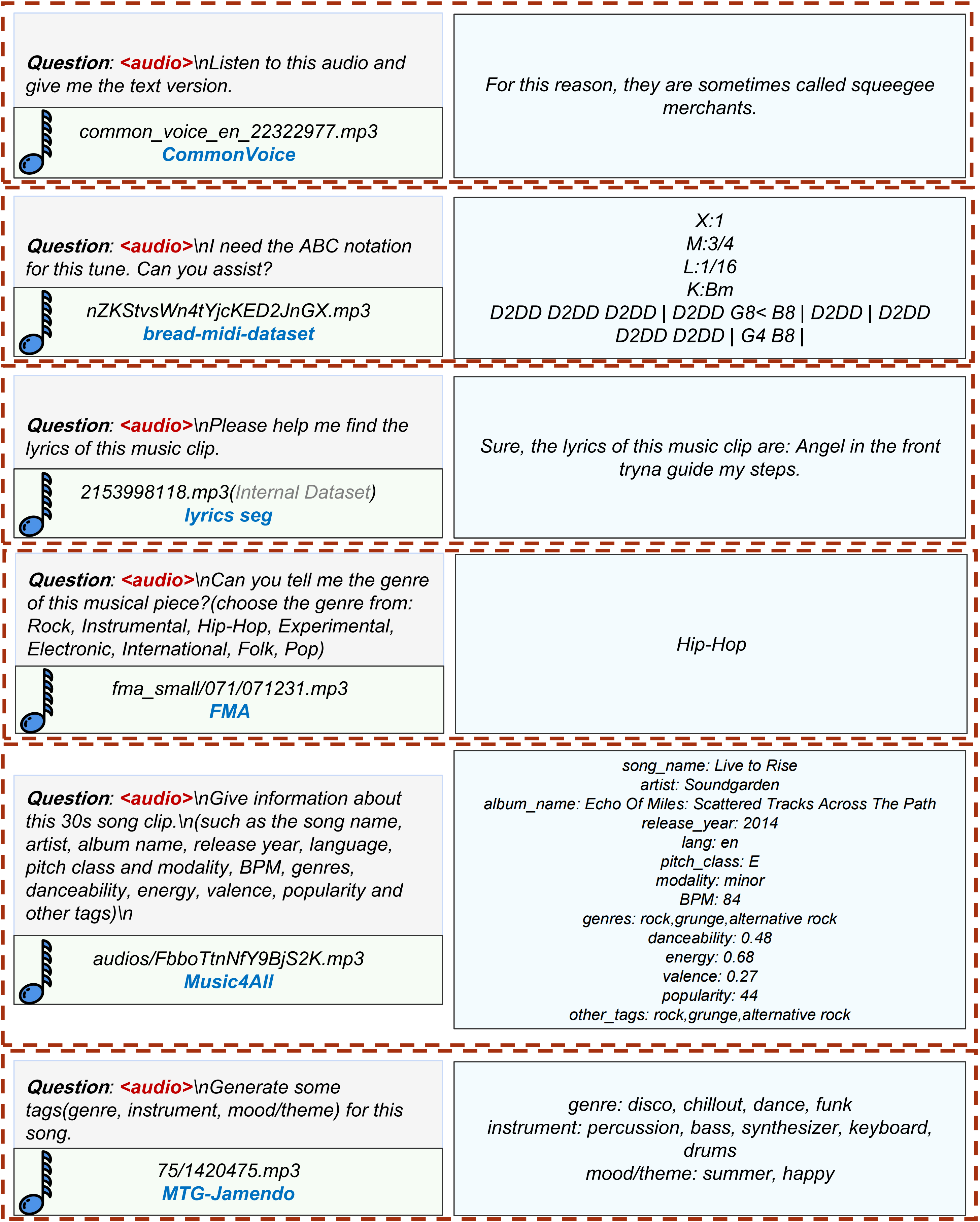
### Visual Description
## Table: Audio Analysis and Response Dataset
### Overview
This image depicts a structured dataset containing six entries, each pairing an audio analysis question with a corresponding response. The dataset appears to focus on music-related queries, including transcription, genre classification, lyrical analysis, and metadata extraction. Responses vary from short textual answers to structured data formats.
### Components/Axes
1. **Question Section**:
- Contains audio analysis prompts prefixed with `<audio>` tags.
- Includes file paths/identifiers (e.g., `common_voice_en_22322977.mp3`, `nZKStvsWn4tYjcKED2JnGX.mp3`).
- Sources are labeled (e.g., `CommonVoice`, `bread-midi-dataset`, `lyrics seg`, `FMA`, `Music4All`, `MTG-Jamendo`).
2. **Response Section**:
- Contains answers in varied formats:
- Free-text responses (e.g., "squeegee merchants").
- Structured data (e.g., ABC notation, genre lists, song metadata).
- Key-value pairs (e.g., `song_name: Live to Rise`, `BPM: 84`).
### Detailed Analysis
#### Entry 1
- **Question**: Request for text transcription of audio.
- **Audio File**: `common_voice_en_22322977.mp3` (CommonVoice).
- **Response**: "For this reason, they are sometimes called squeegee merchants."
#### Entry 2
- **Question**: Request for ABC notation of a tune.
- **Audio File**: `nZKStvsWn4tYjcKED2JnGX.mp3` (bread-midi-dataset).
- **Response**:
```
X:1
M:3/4
L:1/16
K:Bm
D2DD D2DD D2DD | D2DD G8< B8 | D2DD | D2DD
D2DD D2DD | G4 B8 |
```
#### Entry 3
- **Question**: Request for lyrics of a music clip.
- **Audio File**: `2153998118.mp3` (Internal Dataset, labeled "lyrics seg").
- **Response**: "Angel in the front tryna guide my steps."
#### Entry 4
- **Question**: Request for genre classification.
- **Audio File**: `fma_small/071/071231.mp3` (FMA).
- **Response**:
```
Hip-Hop
genres: rock,grunge,alternative rock
other_tags: rock,grunge,alternative rock
```
#### Entry 5
- **Question**: Request for detailed song metadata.
- **Audio File**: `audios/FbboTtnNfY9BjS2K.mp3` (Music4All).
- **Response**:
```
song_name: Live to Rise
artist: Soundgarden
album_name: Echo Of Miles: Scattered Tracks Across The Path
release_year: 2014
lang: en
pitch_class: E
modality: minor
BPM: 84
genres: rock,grunge,alternative rock
danceability: 0.48
energy: 0.68
valence: 0.27
popularity: 44
```
#### Entry 6
- **Question**: Request for genre, instrument, and mood tags.
- **Audio File**: `75/1420475.mp3` (MTG-Jamendo).
- **Response**:
```
genre: disco,chillout,dance,funk
instrument: percussion,bass,synthesizer,keyboard,drums
mood/theme: summer,happy
```
### Key Observations
1. **Diverse Response Formats**: Responses range from simple sentences to structured metadata, indicating the dataset's versatility in handling different query types.
2. **Genre and Instrument Tags**: Entries include explicit genre classifications (e.g., Hip-Hop, Rock) and instrument lists (e.g., percussion, synthesizer), suggesting a focus on music analysis.
3. **Metadata Richness**: Entry 5 provides granular details like BPM, release year, and emotional tags (valence, energy), highlighting the dataset's utility for music information retrieval.
4. **Structured Data**: Use of key-value pairs (e.g., `song_name`, `BPM`) and lists (e.g., genres, instruments) implies machine-readable output for automated processing.
### Interpretation
This dataset likely serves as a training resource for AI models to interpret audio content and generate contextually relevant textual responses. The inclusion of diverse music genres, structured metadata, and lyrical analysis suggests applications in music recommendation systems, lyrical transcription tools, or music metadata extraction pipelines. The structured responses (e.g., ABC notation, key-value pairs) indicate a design for interoperability with music databases or NLP systems. The dataset's multilingual sources (e.g., CommonVoice) also hint at cross-lingual capabilities.
</details>
Figure 10: Training Data Overview