# Evaluating Podcast Recommendations with Profile-Aware LLM-as-a-Judge
**Authors**: Francesco Fabbri, Gustavo Penha, Edoardo D’Amico, Alice Wang, Marco De Nadai, Jackie Doremus, Paul Gigioli, Andreas Damianou, Oskar Stål, Mounia Lalmas
> Corresponding author: Spotify Spain
> Spotify Netherlands
> Spotify Spain
> Spotify United States
> Spotify Denmark
> Spotify United Kingdom
> Spotify Sweden
(2025)
## Abstract
Evaluating personalized recommendations remains a central challenge, especially in long-form audio domains like podcasts, where traditional offline metrics suffer from exposure bias and online methods such as A/B testing are costly and operationally constrained. In this paper, we propose a novel framework that leverages Large Language Models (LLMs) as offline judges to assess the quality of podcast recommendations in a scalable and interpretable manner. Our two-stage profile-aware approach first constructs natural-language user profiles distilled from 90 days of listening history. These profiles summarize both topical interests and behavioral patterns, serving as compact, interpretable representations of user preferences. Rather than prompting the LLM with raw data, we use these profiles to provide high-level, semantically rich context—enabling the LLM to reason more effectively about alignment between a user’s interests and recommended episodes. This reduces input complexity and improves interpretability. The LLM is then prompted to deliver fine-grained pointwise and pairwise judgments based on the profile-episode match. In a controlled study with 47 participants, our profile-aware judge matched human judgments with high fidelity and outperformed or matched a variant using raw listening histories. The framework enables efficient, profile-aware evaluation for iterative testing and model selection in recommender systems.
journalyear: 2025 copyright: rightsretained conference: Proceedings of the Nineteenth ACM Conference on Recommender Systems; September 22–26, 2025; Prague, Czech Republic booktitle: Proceedings of the Nineteenth ACM Conference on Recommender Systems (RecSys ’25), September 22–26, 2025, Prague, Czech Republic doi: 10.1145/3705328.3759305 isbn: 979-8-4007-1364-4/2025/09 ccs: Information systems Language models ccs: Information systems Personalization
## 1. Introduction
Evaluating personalized recommender systems remains a fundamental challenge, largely due to the limitations of offline evaluations methods and metrics (Thomas et al., 2024). Standard metrics like hit rate and recall are based on historical interaction data, which introduces exposure bias: models are evaluated only on items users have previously seen, not the full space of potential recommendations. This makes it difficult to accurately assess a model’s true effectiveness.
These shortcomings are especially pronounced in cold-start scenarios, such as the introduction of new features (e.g., a new podcast shelf), where no historical interaction data exists. In such cases, offline metrics fail, and practitioners must rely on qualitative assessments to estimate alignment with the intended user experience before launch. At the other extreme, A/B testing and user studies, while grounded in real behavior, are costly, slow, and operationally constrained, limiting the number of models that can be practically tested. As a result, practitioners face a dilemma: fast but limited offline evaluation, or rigorous but slow experimentation. This reveals a critical gap: the lack of a scalable, reliable middle ground for pre-deployment model selection.
Traditional evaluation methods, whether quantitative or qualitative, also fall short in capturing true user satisfaction or explaining why a recommendation is relevant. Crucially, they fail to determine whether a recommendation meaningfully reflects a user’s underlying preferences. This challenge is especially acute in the podcast domain, where the cost of a poor recommendation is high (Jones et al., 2021); unlike short-form content, podcasts require considerable attention. Implicit feedback, such as stopping after ten minutes, can signal strong disinterest, mild curiosity, or simple distraction, making interpretation highly ambiguous.
Unlike search, where evaluation checks whether retrieved results satisfy an explicit user query, recommendation must infer intent entirely from behavioral traces. In search, the query serves as a content hypothesis, a direct expression of the user’s information need. In verticals like “music from the 80s,” the scope is often predefined by the domain or interface. But in personalized recommendation, especially for long-form content, no such explicit formulation of user intent exists. This challenge is particularly acute in podcast recommendation, where user preferences span multiple dimensions—including topic, tone, format, and host style—and are difficult to infer from sparse interaction data. The core evaluation task, therefore, becomes one of constructing a content hypothesis: an interpretable approximation of what the user prefers, inferred from past listening behavior.
We propose that this missing hypothesis can be explicitly constructed in the form of a natural-language user profile: a structured summary of topical interests, stylistic preferences, and behavioral patterns distilled from listening history. These profiles provide high-level, interpretable context that allows Large Language Models (LLMs) to reason more effectively about whether a recommendation aligns with inferred user intent.
LLMs offer a promising path forward for scalable, human-aligned evaluation (Gu et al., 2025). Models like GPT-4 (Vaswani et al., 2017; Brown et al., 2020) show high agreement with human judgments across diverse tasks (Xu et al., 2025), and the “LLM-as-a-Judge” paradigm is emerging as a general evaluation strategy (Ye et al., 2025). LLMs can assess relevance in relation to user preferences (Wang et al., 2024b, a). However, prior work often feeds raw interaction data to the LLM or assumes structured ground-truth signals, limiting interpretability.
Recent work on personalized judges (Dong et al., 2024) highlights the limitations of generic LLM-based evaluation when user context is under-specified. This underscores the need for profile-aware prompting strategies that encode nuanced, personalized context. We argue that structured, profile-based representations enable more faithful alignment evaluation, and unlock the full potential of LLMs as offline judges for personalized systems, especially for pre-deployment settings, where traditional online experimentation is too costly, slow, or operationally infeasible.
### Our Approach
To address this challenge, we introduce a profile-aware LLM-as-a-Judge framework (Judge throughout the paper) for evaluating personalized podcast episode recommendations. Central to our framework is a natural-language profile automatically distilled from each user’s listening history, which serves as an explicit content hypothesis representing the user’s inferred preferences. The LLM is prompted with this profile and candidate episode metadata to reason about alignment along multiple dimensions, such as topic, tone, and format. The framework supports two complementary evaluation modes:
1. Pointwise evaluation: the Judge assesses whether an individual episode aligns with the user’s inferred preferences.
1. Pairwise evaluation: in a setup analogous to A/B testing, the Judge compares two ranked episode lists, each from a different model, and select the one better aligned with the profile.
Together, these evaluation modes offer a scalable, interpretable mechanism for judging recommendation quality, bridging the gap between coarse offline metrics and more subjective, human-aligned assessments of user satisfaction.
## 2. Related Work
Recent work has formalized the use of LLMs as evaluators of system outputs, a methodology widely referred to as LLM-as-a-Judge. Originally developed for dialogue evaluation and instruction following (Zheng et al., 2023; Fu et al., 2024), this paradigm has since expanded across domains, leading to structured evaluation toolkits and taxonomies (Gu et al., 2025; Xu et al., 2025; Huang et al., 2024; Lin et al., 2025).
For instance, Zheng et al. (2023) proposed large-scale preference datasets that surface biases related to response position and verbosity. Fu et al. (2024) demonstrated that instruction-tuned LLMs can act as flexible, robust scorers of generation quality. More recently, Gu et al. (2025) surveyed key tasks, prompting strategies, and open challenges, while Xu et al. (2025) emphasized the importance of supplying relevant user context for reliable judgment.
Concerns about bias and misalignment have also been raised. Ye et al. (2025) cataloged systematic biases in LLM judgments, and Sahoo et al. (2025) propose post-hoc regression calibration techniques. Thakur et al. (2025) highlighted gaps in alignment and prompt sensitivity across judge models. While our work focuses on profile-based alignment, we do not explicitly address these issues. Investigating bias mitigation and prompt robustness is an important direction for future work.
In information retrieval, Thomas et al. (2024) showed that GPT-4 can predict document relevance with near-human accuracy. However, applying LLMs to recommendation introduces additional challenges: user preferences must be inferred from behavior over time, and recommendations lack an explicit query to ground evaluation. Our framework addresses this by constructing natural-language profiles that act as explicit content hypotheses: structured representations of inferred user intent, enabling LLMs to evaluate alignment in personalized, dynamic settings.
Related work by Dong et al. (2024) found that persona-conditioned prompting improves evaluation in dialogue tasks. Our approach differs in two ways: $(i)$ we apply LLM-based judgment to ranking in personalized recommendation rather than conversation quality, and $(ii)$ our user profiles are automatically distilled from behavioral traces, not manually crafted.
Finally, Jones et al. (2021) highlighted a lack of scalable offline evaluation methods for podcast recommendations. Our work directly addresses this gap by introducing a profile-aware LLM-as-a-Judge framework, along with open tools to support evaluation in long-form, preference-driven media domains.
## 3. LLM-as-a-Judge for Offline Testing
Evaluating podcast recommendations poses unique challenges due to the nuanced, multi-dimensional nature of user satisfaction. Traditional methods typically rely on observable behavior, but in long-form audio contexts, such signals are difficult to interpret. Implicit feedback is sparse and often ambiguous, and standard metrics fail to capture the richness of listener preferences. Irregular consumption patterns and the high time cost of engagement further limit the reliability of behavioral signals, creating significant evaluation gaps. Although prior work has called for richer evaluation frameworks, few offer scalable solutions for detecting recommendation misalignment (Jones et al., 2021).
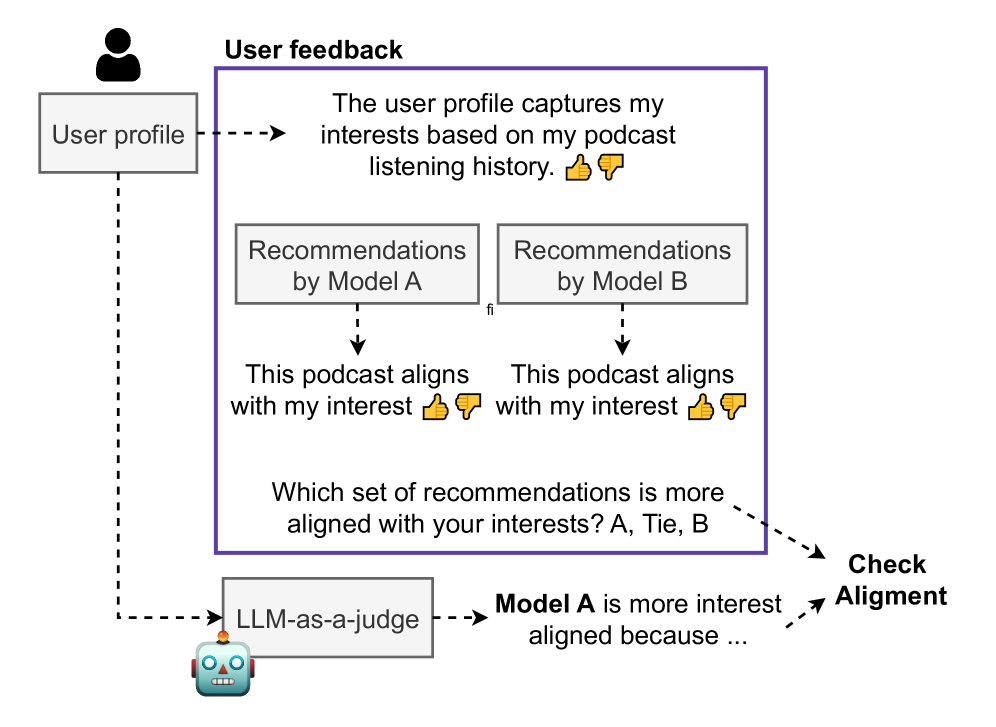
To address this, we introduce a profile-aware evaluation framework that leverages LLMs as interpretable, domain-adaptive offline judges. Rather than relying on item-level engagement signals (e.g., clicks or listens), our approach uses structured natural-language profiles distilled from listening history to assess how well a recommended episode aligns with a user’s topical interests and behavioral patterns. This bridges the gap between nuanced relevance criteria and the scalability needs of offline evaluation, offering a practical alternative to coarse numerical proxies.
<details>
<summary>x1.png Details</summary>
### Visual Description
## Flowchart: User Feedback and Model Alignment System
### Overview
The diagram illustrates a recommendation system workflow that evaluates podcast alignment with user interests through two models (A and B), user feedback, and an LLM-as-a-judge. The system captures user preferences via podcast listening history and uses thumbs-up/thumbs-down feedback to assess model performance.
### Components/Axes
1. **User Profile** (top-left)
- Captures interests based on podcast listening history
- Includes thumbs-up/thumbs-down emojis for feedback
2. **Recommendations by Model A** (left-center)
- Output: "This podcast aligns with my interest" with thumbs-up/thumbs-down
3. **Recommendations by Model B** (right-center)
- Output: "This podcast aligns with my interest" with thumbs-up/thumbs-down
4. **LLM-as-a-judge** (bottom-left)
- Evaluates which model's recommendations are more aligned with user interests
- Output: "Model A is more interest aligned because..."
5. **Check Alignment** (right-center)
- Decision point: "Which set of recommendations is more aligned with your interests? A, Tie, B"
### Detailed Analysis
- **User Profile** → **Recommendations by Model A/B**: Dotted arrows indicate parallel processing of recommendations
- **Feedback Loop**: Thumbs-up/thumbs-down emojis appear in both recommendation paths
- **LLM-as-a-judge** receives input from both models and outputs a comparative analysis
- **Check Alignment** box contains a decision question with three possible outcomes (A, Tie, B)
### Key Observations
1. **Parallel Processing**: Both models generate recommendations simultaneously
2. **Feedback Integration**: User feedback is embedded in both recommendation paths
3. **LLM Evaluation**: The LLM-as-a-judge acts as a meta-evaluator comparing model performance
4. **Decision Tree**: The system includes a structured decision point for alignment verification
### Interpretation
This system demonstrates a hybrid approach to recommendation validation:
1. **Model Diversity**: Using two distinct models (A and B) prevents over-reliance on a single algorithm
2. **User-Centric Feedback**: Direct user input (thumbs-up/down) grounds model performance in real-world relevance
3. **LLM Reasoning**: The LLM-as-a-judge adds explainability by providing rationale for its alignment judgment
4. **Decision Transparency**: The explicit "Check Alignment" step creates an audit trail for recommendation quality
The architecture suggests a focus on explainable AI in recommendation systems, where model outputs are not just evaluated for accuracy but also for their alignment with user intent through multiple validation layers.
</details>
Figure 1. LLM-as-a-Judge evaluation pipeline. The system takes as input a user profile synthesized from listening history and two sets of recommended episodes, and outputs rationales and binary judgments for episode-level fit and model-level comparison.
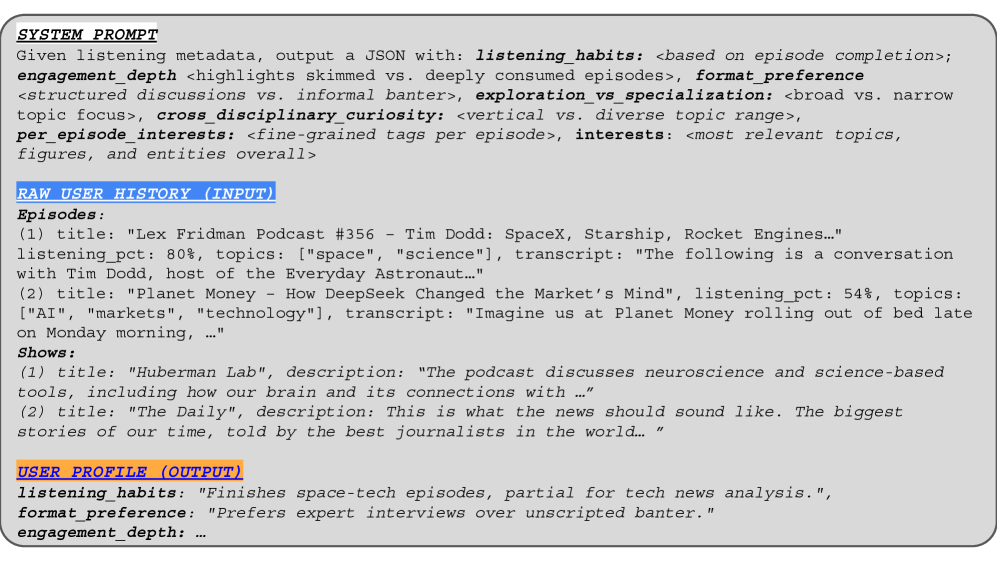
The framework operates in two key stages: user profiling and episode assessment. In the first stage, we generate a structured profile for each user based on their most recent three months of listening activity. This profile is derived from podcast metadata (including titles, descriptions, transcripts, and topical tags) associated with episodes and shows the user has engaged with most. The profile captures two main dimensions:
- Content preferences: topical and named-entity focus, cross-domain curiosity, and tendencies toward exploration or specialization
- Listening patterns: habits, engagement depth, and format preferences.
These six attributes form a comprehensive user representation, which is then used for evaluating alignment with candidate episodes (Fig. 2).
<details>
<summary>x2.png Details</summary>
### Visual Description
## JSON Structure: System Prompt and User Profile Generation
### Overview
The image displays a JSON structure containing a system prompt for generating user profiles based on listening metadata, followed by raw user history input and a generated user profile output. The system prompt defines output fields, while the user history provides episode-specific data.
### Components/Axes
#### SYSTEM PROMPT
- **Fields**:
- `listening_habits`: Based on episode completion
- `engagement_depth`: Highlights skimmed vs. deeply consumed episodes
- `format_preference`: Structured discussions vs. informal banter
- `topic_focus`: Broad vs. narrow topic focus
- `cross_disciplinary_curiosity`: Vertical vs. diverse topic range
- `per_episode_interests`: Fine-grained tags per episode
- `interests`: Most relevant topics overall
#### RAW USER HISTORY (INPUT)
- **Episodes**:
1. **Title**: "Lex Fridman Podcast #356 – Tim Dodd: SpaceX, Starship, Rocket Engines..."
- Listening_pct: 80%
- Topics: ["space", "science"]
- Transcript: "The following is a conversation with Tim Dodd, host of the Everyday Astronaut..."
2. **Title**: "Planet Money – How DeepSeek Changed the Market’s Mind"
- Listening_pct: 54%
- Topics: ["markets", "technology"]
- Transcript: "Imagine us at Planet Money rolling out of bed late on Monday morning..."
#### USER PROFILE (OUTPUT)
- **Fields**:
- `listening_habits`: "Finishes space-tech episodes, partial for tech news analysis."
- `format_preference`: "Prefers expert interviews over unscripted banter."
- `engagement_depth`: ""
### Detailed Analysis
#### SYSTEM PROMPT
- All fields are defined with comparative descriptors (e.g., "skimmed vs. deeply consumed episodes").
- No numerical values or structured data formats are specified beyond categorical distinctions.
#### RAW USER HISTORY
- **Episode 1**:
- High engagement (80% listening_pct) with space/science topics.
- Transcript excerpt confirms focus on aerospace engineering.
- **Episode 2**:
- Moderate engagement (54% listening_pct) with markets/technology topics.
- Transcript excerpt suggests casual, informal tone ("rolling out of bed late").
#### USER PROFILE
- **listening_habits**: Explicitly ties to space-tech and partial tech news analysis.
- **format_preference**: Prioritizes expert interviews (aligned with Tim Dodd's technical background).
- **engagement_depth**: Empty string suggests either missing data or intentional omission.
### Key Observations
1. **Topic Alignment**: User history episodes (space, markets, technology) directly inform the output profile's focus on space-tech and tech news.
2. **Format Preference**: The output's preference for expert interviews matches the structured format of the Tim Dodd episode.
3. **Missing Data**: The empty `engagement_depth` field may indicate incomplete metadata or a placeholder for future analysis.
### Interpretation
The system prompt acts as a template for inferring user preferences from listening behavior. The input history demonstrates how episode completion rates, topic tags, and transcript content are used to derive:
- **listening_habits**: Focus on niche technical content (space-tech).
- **format_preference**: Preference for authoritative, expert-driven discussions.
- **engagement_depth**: Likely requires additional metrics (e.g., rewinds, pauses) not present in the input.
The empty `engagement_depth` field highlights a potential gap in the metadata collection process. The output's specificity to space-tech suggests the system effectively prioritizes high-engagement, topic-relevant content. This profile could inform personalized recommendations for similar technical podcasts or in-depth analysis segments.
</details>
Figure 2. Profile generation prompt. The LLM receives structured listening metadata and is prompted to produce a natural-language user profile with interpretable dimensions (e.g., listening habits, format preference). This profile is later used as input for evaluating recommendation relevance.
In the second stage the Judge, an off-the-shelf LLM queried in zero-shot mode (i.e., no fine-tuning or calibration), is prompted with both the user profile and the metadata of a recommended episode. Using a Chain-of-Thought reasoning style, the Judge produces a rationale and a binary judgment indicating whether the episode is a good fit; this constitutes the pointwise evaluation (Wei et al., 2022). While we also tested a multiclass version (including neutral feedback), it yielded no substantial improvement and is omitted for brevity.
For model-level evaluation, the Judge performs pairwise comparisons between two ranked lists of episodes, each generated by a different recommendation model, and selects the list that better matches the user profile. This setup is designed to compare models with different architectures but similar optimization goals. For each comparison, the Judge provides: (1) dimension-wise qualitative rationale outlining the strengths and weaknesses of each list; and (2) a final verdict, either preferring one model or indicating a tie when neither shows clear superiority. To mitigate position bias, the identity tags of Model A and Model B are randomly shuffled before each evaluation, ensuring an unbiased and reliable comparison.
## 4. Experiments
### Setup
To evaluate the validity of our framework, referred to throughout this section as LaaJ (LLM-as-a-Judge), we conduct a controlled experiment with real users to assess whether it can serve as a reliable offline judge on recommendation quality. The experiment involved two anonymized models (Model A and Model B), 47 participants, and a two-stage evaluation comparing LLM-generated judgments with human feedback per user. Each participant first receives a personalized profile, automatically generated from their podcast listening history.
Then, two sets of episode recommendations are generated, one for each model, and displayed side-by-side. Each set includes 3 episodes per model, with each episode shown alongside its show name, description, cover image, and a playable audio segment. Through the survey interface, users can provided structured feedback on: (1) the accuracy of their profile; (2) how well each episode aligns with their interests; (3) which model better matches their preferences overall.
Participants rated each item using a 5-point Likert scale: Strongly Disagree, Disagree, Neutral, Agree, and Strongly Agree. To ensure unbiased feedback, all participants were blinded to the identity of the models. The LLM Judge was prompted using static templates, with no fine-tuning or post-hoc calibration applied (Zhang et al., 2025).
The compared models differ in architecture: (1) Model A, which was primarily content-based, with less sensitivity to consumption patterns, and (2) Model B, which relied heavily on collaborative filtering signals, with limited content-based integration. For all experiments we used GPT-4.1 (Achiam et al., 2023) for both the user profile generator and the judging model. We chose it for its reported strong alignment with human preferences, consistent performance across evaluation tasks, and better correlation with human judgments than other LLMs (Zheng et al., 2023; Liu et al., 2023).
### LLM Agreement & Judgment Behavior
We present a comparison between the output of the Judge and the human-annotated data. From 47 users included in the study, we collect in total 277 pointwise human evaluations and 47 model-level comparisons (one per user). The dataset covers 227 unique recommended episodes, with an average of 5.89 episode annotations per user.
In our evaluation we test three different judges, including two LaaJ variants, and a non-LLM one:
- LaaJ-Profile (our profile-aware judge): uses a structured, natural-language summary of each user’s listening history, distilled from their top shows and episodes. Profiles serve as an interpretable content hypothesis, capturing topical preferences, stylistic traits, and behavioral patterns, to guide the LLM’s reasoning about alignment, without requiring access to raw interaction data.
- LaaJ-History: a variant that provides the LLM with the full set of shows and episodes from the user’s listening history, rather than a distilled profile. This approach tests whether reasoning directly over raw behavioral traces leads to better alignment judgments, and serves as a baseline for evaluating the benefits of compressing user preferences into a structured, interpretable profile.
- sBERT-Sim: a non-LLM baseline that computes cosine similarity between Sentence-BERT embeddings of the user profile and episode metadata. Episodes are marked aligned if similarity exceeds a fixed threshold (0.5), and model-level alignment is determined by aggregating episode-level scores. This serves as a simple, interpretable proxy for content-level user-item relevance.
| LaaJ-Profile LaaJ-History sBERT-Sim | 0.6442 0.6476 0.4871 | 0.6596 (30/1/16) 0.6170 (28/1/18) 0.5106 (21/3/23) | 0.6667 0.6667 0.5000 |
| --- | --- | --- | --- |
Table 1. Performance on both episode and model evaluations of different judges on the human-labeled dataset. “W/T/L” counts wins, ties, and losses against the human label.
Table 1 presents results from both episode-level and model-level evaluations. The pointwise evaluation is conducted on 277 annotated episodes. We report the following metrics: ROC-AUC measures the accuracy of the judges on user-episode predictions; Model Selection Agreement (MSA) is the fraction of cases where the judge’s model preference matches annotators’ choices; Outcome Distribution is the number of Wins, Ties, and Losses for the judge compared to ground-truth human annotations; and Recall of Strong Misalignment (RSM) is the proportion of strongly misaligned recommendations flagged by the judges also identified by annotators as clearly misaligned with user preferences.
As shown Table 1, LaaJ-Profile achieves comparable ROC-AUC to LaaJ-History, despite relying solely on a natural-language profile rather than the user history. This demonstrates that a concise, interpretable representation of user preferences can serve as an effective content hypothesis that captures the essence of user intent. In model-level comparisons, the profile-based variant outperforms the history-based, underscoring the value of summarizing multi-faceted user interests for reliable comparative judgments between recommendation models. Additionally, both LLM-based judges correctly identify 66% of strongly misaligned episodes (per the RSM metric), indicating sensitivity to recommendations that conflict with user preferences.
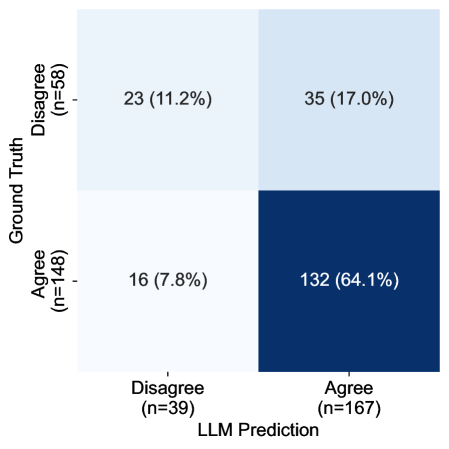
Continuing our analysis of LaaJ-Profile, we examine its confusion matrices against human annotations (Fig. 3). In episode-level evaluation, the matrix (left) shows alignment in 75% of the cases. However, 17% of the episodes were judged as aligned by the LLM but not by users (representing false positives). This discrepancy reflects a known tendency of LLMs to produce positively skewed responses (Zhu et al., [n. d.]; Gallegos et al., 2024).
|
<details>
<summary>x3.png Details</summary>
### Visual Description
## Confusion Matrix: LLM Prediction vs. Ground Truth
### Overview
The image presents a 2x2 confusion matrix comparing LLM predictions against ground truth labels. The matrix evaluates agreement/disagreement classifications, with counts and percentages provided for each cell. The total sample size is 206 (n=58 for Disagree ground truth, n=148 for Agree ground truth).
### Components/Axes
- **Vertical Axis (Ground Truth):**
- "Disagree" (n=58)
- "Agree" (n=148)
- **Horizontal Axis (LLM Prediction):**
- "Disagree" (n=39)
- "Agree" (n=167)
- **Legend:** Located in the bottom-right corner. Light blue represents "Disagree," dark blue represents "Agree."
### Detailed Analysis
- **Top-Left Cell (Disagree GT vs. Disagree Pred):** 23 (11.2% of total sample)
- **Top-Right Cell (Disagree GT vs. Agree Pred):** 35 (17.0% of total sample)
- **Bottom-Left Cell (Agree GT vs. Disagree Pred):** 16 (7.8% of total sample)
- **Bottom-Right Cell (Agree GT vs. Agree Pred):** 132 (64.1% of total sample)
### Key Observations
1. **Prediction Bias:** The model shows a strong bias toward "Agree" predictions (64.1% of total predictions are Agree), despite the ground truth having a near-equal split (58 Disagree vs. 148 Agree).
2. **Accuracy Disparity:**
- For "Disagree" ground truth, the model correctly predicts 35/58 (60.3%) but misclassifies 23/58 (39.7%).
- For "Agree" ground truth, the model achieves 132/148 (89.2%) correct predictions but misclassifies 16/148 (10.8%).
3. **False Positives/Negatives:**
- 35 instances where the model incorrectly predicts "Agree" for "Disagree" ground truth.
- 16 instances where the model incorrectly predicts "Disagree" for "Agree" ground truth.
### Interpretation
The confusion matrix reveals a model with **high accuracy for "Agree" predictions** (89.2%) but **lower reliability for "Disagree" classifications** (60.3%). This suggests potential class imbalance issues, as the ground truth has more "Agree" instances (148 vs. 58). The model's tendency to favor "Agree" predictions could lead to overconfidence in positive outcomes, while underperforming on negative/neutral cases. The false positives (35) and false negatives (16) indicate areas for improvement in balancing precision and recall. The spatial distribution of errors (e.g., 17.0% of total predictions being incorrect "Agree" labels for "Disagree" ground truth) highlights the need for calibration to reduce over-optimism in predictions.
</details>
|
<details>
<summary>x4.png Details</summary>
### Visual Description
## Confusion Matrix: LLM Prediction vs Ground Truth
### Overview
The image displays a 3x3 confusion matrix comparing LLM predictions against ground truth labels. Rows represent ground truth categories (A, B, Tie), and columns represent LLM predictions (A, B, Tie). Each cell contains absolute counts and their percentage contribution to the total dataset (n=47).
### Components/Axes
- **Y-Axis (Ground Truth)**: Categories A (n=24), B (n=14), Tie (n=9)
- **X-Axis (LLM Prediction)**: Categories A (n=31), B (n=15), Tie (n=1)
- **Cells**: Absolute counts and percentages (relative to total n=47)
- **Color Gradient**: Darker blue indicates higher counts/percentages
### Detailed Analysis
| Ground Truth \ Prediction | A (31) | B (15) | Tie (1) |
|---------------------------|--------------|--------------|--------------|
| **A (24)** | 20 (42.6%) | 4 (8.5%) | 0 (0.0%) |
| **B (14)** | 4 (8.5%) | 10 (21.3%) | 0 (0.0%) |
| **Tie (9)** | 7 (14.9%) | 1 (2.1%) | 1 (2.1%) |
**Key Data Points**:
- **Correct Predictions**:
- A: 20/24 (83.3% of ground truth A)
- B: 10/14 (71.4% of ground truth B)
- Tie: 1/9 (11.1% of ground truth Tie)
- **Misclassifications**:
- A→B: 4/24 (16.7% of ground truth A)
- B→A: 4/14 (28.6% of ground truth B)
- Tie→A: 7/9 (77.8% of ground truth Tie)
- Tie→B: 1/9 (11.1% of ground truth Tie)
### Key Observations
1. **Dominant Correct Predictions**:
- A and B categories show strong diagonal dominance (67.2% of total correct predictions)
- Tie category has minimal correct predictions (only 11.1% accuracy)
2. **Cross-Category Confusion**:
- Symmetric misclassification between A and B (4 instances each way)
- Tie predictions overwhelmingly mapped to A (7 instances)
3. **Data Imbalance**:
- A category dominates predictions (63.8% of all predictions)
- Tie category underrepresented in predictions (2.1%)
### Interpretation
The matrix reveals a model with moderate accuracy (55.3% overall: (20+10+1)/47) but significant class imbalance issues. While A and B predictions show reasonable accuracy (83.3% and 71.4% respectively), the Tie category suffers from severe underrepresentation in both ground truth and predictions. The symmetric A↔B confusion suggests potential semantic similarity challenges in the model's understanding. The overwhelming majority of Tie predictions being mapped to A (77.8%) indicates possible bias toward the more frequent A category. This pattern suggests the need for:
1. Balanced training data augmentation for Tie cases
2. Improved semantic differentiation between A and B
3. Threshold adjustment for low-frequency categories
</details>
|
| --- | --- |
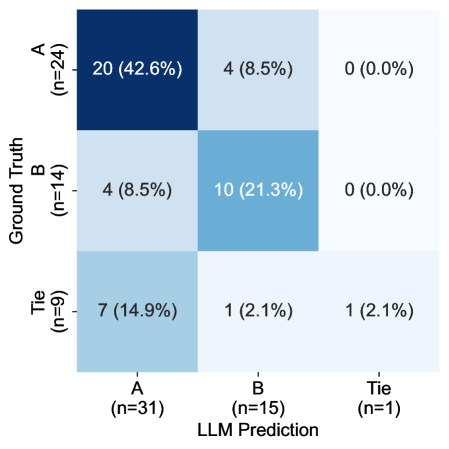
Figure 3. Confusion matrices comparing the profile-aware LaaJ-Profile with human annotations. Columns represent LLM decisions; rows show human relevance labels. Left: episode-level (pointwise) comparison. Right: model-level (pairwise) comparison.
In the model-level (pairwise) evaluation, the confusion matrix (right) reveals strong agreement between the Judge and human annotators in preferring Model A over Model B, with 20 true positives out of 24 comparisons. However, the LLM tends to be more decisive: it registers only one tie, in contrast to the eight ties recorded by human annotators. This tendency may be addressed through more adaptive in-context learning strategies or by model fine-tuning (Wang et al., 2025).
Qualitative feedback from human annotators revealed their judgments were influenced by factors beyond standard evaluation metrics, such as familiarity with the show, the identity of the host, stylistic tone, and the diversity of the recommendations. While some users preferred narrowly focused and familiar recommendation lists, others placed higher value on variety and novelty. These findings highlight the complex, multi-dimensional, and inherently subjective nature of podcast preferences in real-world settings.
### Impact of User Profiles
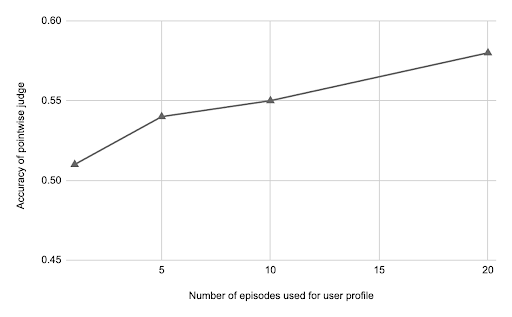
Fig. 4 shows that increasing the number of shows and episodes used to generate user profiles in LaaJ-Profile improves judgment accuracy, raising alignment with human preferences by +8% from 0.51 with 5 episodes to 0.59 with 20 episodes. This emphasizes the critical role of context richness and profile coverage in enabling the LLM to make accurate evaluations.
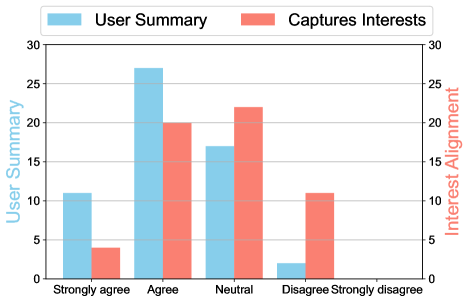
Participants were asked to review their automatically generated profiles in LaaJ-Profile and evaluate how well they reflected their listening preferences. As shown in Fig. 4, most agreed the profiles offered a reasonable high-level summary, but views were more divided on how accurately the profiles captured their deeper interests. Quantitative ratings indicated the profiles were broadly representative, yet qualitative feedback added nuance. While many users recognized that key aspects of their listening behavior were captured, some expressed concerns about the depth and specificity of representation. Some users pointed to missing personal elements such as favorite hosts, limited coverage of stylistic tone, and a narrow topical focus—often shaped by recent listening activity.
These observations reflect the difficulty of inferring subjective preferences from short or sparse interaction histories, as well as the trade-off between recency and long-term interest modeling. Several participants noted that short-term data windows sometimes failed to reflect enduring tastes. These insights point to opportunities for enhancing profiles by incorporating long-term behavioral signals and more nuanced metadata.
| Col1 |
| --- |
|
<details>
<summary>user_prof_len.png Details</summary>
### Visual Description
## Line Graph: Accuracy of Pointwise Judge vs. Number of Episodes Used for User Profile
### Overview
The image depicts a line graph illustrating the relationship between the accuracy of a pointwise judge and the number of episodes used to construct a user profile. The graph shows a positive trend, with accuracy increasing as more episodes are utilized. The data points are marked with black triangles, and the line is a solid black curve.
### Components/Axes
- **X-axis (Horizontal)**: "Number of episodes used for user profile" with discrete markers at 5, 10, 15, and 20.
- **Y-axis (Vertical)**: "Accuracy of pointwise judge" scaled from 0.45 to 0.60 in increments of 0.01.
- **Legend**: A single black line with a triangle marker, positioned in the top-right corner of the graph.
### Detailed Analysis
- **Data Points**:
- At 5 episodes: Accuracy ≈ 0.51
- At 10 episodes: Accuracy ≈ 0.55
- At 15 episodes: Accuracy ≈ 0.57
- At 20 episodes: Accuracy ≈ 0.58
- **Trend**: The line slopes upward consistently, indicating a positive correlation between the number of episodes and accuracy. The rate of increase slows slightly after 10 episodes, suggesting diminishing returns.
### Key Observations
1. **Positive Correlation**: Accuracy improves as more episodes are used, with a clear upward trajectory.
2. **Diminishing Returns**: The slope of the line flattens after 10 episodes, indicating that additional episodes yield smaller improvements in accuracy.
3. **Maximum Accuracy**: The highest recorded accuracy (0.58) is achieved at 20 episodes.
### Interpretation
The graph demonstrates that increasing the number of episodes used for user profile construction enhances the accuracy of the pointwise judge. However, the diminishing returns after 10 episodes suggest that there may be an optimal point (around 10–15 episodes) where further data collection provides minimal benefits. This could inform resource allocation strategies, balancing data quantity with computational or operational costs. The trend aligns with common machine learning principles, where more data generally improves model performance but with diminishing marginal gains.
</details>
<details>
<summary>x5.png Details</summary>
### Visual Description
## Bar Chart: User Summary vs Captures Interests
### Overview
The chart compares two metrics—**User Summary** (blue bars) and **Captures Interests** (orange bars)—across five response categories: "Strongly agree," "Agree," "Neutral," "Disagree," and "Strongly disagree." The y-axes represent the frequency of responses, with the left axis labeled "User Summary" (scale: 0–30) and the right axis labeled "Interest Alignment" (scale: 0–30). The legend is positioned at the top, with blue representing "User Summary" and orange representing "Captures Interests."
### Components/Axes
- **X-axis**: Response categories ("Strongly agree," "Agree," "Neutral," "Disagree," "Strongly disagree").
- **Y-axes**:
- Left: "User Summary" (blue bars, scale: 0–30).
- Right: "Interest Alignment" (orange bars, scale: 0–30).
- **Legend**: Top of the chart, with blue for "User Summary" and orange for "Captures Interests."
### Detailed Analysis
- **Strongly agree**:
- User Summary: ~11 (blue bar).
- Captures Interests: ~4 (orange bar).
- **Agree**:
- User Summary: ~27 (blue bar).
- Captures Interests: ~20 (orange bar).
- **Neutral**:
- User Summary: ~17 (blue bar).
- Captures Interests: ~22 (orange bar).
- **Disagree**:
- User Summary: ~2 (blue bar).
- Captures Interests: ~11 (orange bar).
- **Strongly disagree**:
- User Summary: 0 (blue bar).
- Captures Interests: 0 (orange bar).
### Key Observations
1. **User Summary** (blue) shows a clear peak at "Agree" (~27), followed by a sharp decline in "Neutral" (~17) and near-zero values in "Disagree" (~2) and "Strongly disagree" (0).
2. **Captures Interests** (orange) peaks at "Neutral" (~22), with a gradual decline in "Agree" (~20) and "Disagree" (~11). No responses in "Strongly agree" or "Strongly disagree."
3. The two metrics diverge significantly: "Agree" dominates for User Summary, while "Neutral" dominates for Captures Interests.
### Interpretation
- **User Perception vs. System Performance**: Users report higher agreement with the system ("User Summary") when they "Agree," but the system's ability to "Capture Interests" is strongest when users are "Neutral." This suggests a potential disconnect between user satisfaction and the system's effectiveness in aligning with user interests.
- **Outliers**: The near-zero values for "Strongly disagree" in both metrics indicate rare extreme dissatisfaction, but the system fails to capture interests in this category.
- **Trend Implications**: The divergence between the two metrics raises questions about whether user-reported satisfaction ("User Summary") correlates with the system's actual performance in capturing interests ("Interest Alignment"). The peak at "Neutral" for Captures Interests might indicate that neutral feedback is more actionable for improving interest alignment.
### Spatial Grounding & Verification
- Legend colors match bar colors exactly (blue = User Summary, orange = Captures Interests).
- Y-axis scales are consistent (0–30) but labeled differently to reflect distinct metrics.
- No embedded text or additional annotations beyond the legend and axis labels.
</details>
|
Figure 4. Left: Impact of user profile length on LaaJ -human alignment. On x-axis the number of episodes used to generate the profile; on y-axis the LaaJ -human accuracy. Right: Human agreement on profile quality and interest alignment. Bar chart includes two frequency distributions: $(i)$ alignment with user preferences (blue); $(ii)$ alignment with users’ interests (red).
## 5. Conclusions & Future Work
This paper presents a scalable framework for using LLMs as offline judges to evaluate personalized podcast recommendations through the lens of user preference alignment. At the core of our approach are structured, natural-language profiles that act as explicit content hypotheses: interpretable summaries of likely user preferences distilled from listening history. Prompting LLMs with these profiles, rather than raw behavioral data, enables more accurate and interpretable alignment judgments at both episode and model levels. Our experiments show that this profile-aware evaluation matches or exceeds the performance of history-based alternatives.
Looking ahead, we aim to improve profile fidelity by incorporating long-term behavior and explicit feedback (Su et al., 2025), and to explore adaptive prompting (e.g., few-shot or in-context learning) to enhance robustness and reduce decisiveness bias. We also plan to extend the approach across domains and user groups to assess its generalizability and impact at scale.
## References
- (1)
- Achiam et al. (2023) Josh Achiam, Steven Adler, Sandhini Agarwal, Lama Ahmad, Ilge Akkaya, Florencia Leoni Aleman, Diogo Almeida, Janko Altenschmidt, Sam Altman, Shyamal Anadkat, et al. 2023. Gpt-4 technical report. arXiv preprint arXiv:2303.08774 (2023).
- Brown et al. (2020) Tom Brown, Benjamin Mann, Nick Ryder, Melanie Subbiah, Jared D Kaplan, Prafulla Dhariwal, Arvind Neelakantan, Pranav Shyam, Girish Sastry, Amanda Askell, et al. 2020. Language models are few-shot learners. Advances in neural information processing systems 33 (2020), 1877–1901.
- Dong et al. (2024) Yijiang River Dong, Tiancheng Hu, and Nigel Collier. 2024. Can LLM be a Personalized Judge?. In Findings of the Association for Computational Linguistics: EMNLP 2024. Association for Computational Linguistics, Miami, Florida, USA, 10126–10141. doi: 10.18653/v1/2024.findings-emnlp.592
- Fu et al. (2024) Jinlan Fu, See-Kiong Ng, Zhengbao Jiang, and Pengfei Liu. 2024. GPTScore: Evaluate as You Desire. In Proceedings of the 2024 Conference of the North American Chapter of the Association for Computational Linguistics: HLT (Long Papers). Association for Computational Linguistics, Mexico City, Mexico, 6556–6576. doi: 10.18653/v1/2024.naacl-long.365
- Gallegos et al. (2024) Isabel O Gallegos, Ryan A Rossi, Joe Barrow, Md Mehrab Tanjim, Sungchul Kim, Franck Dernoncourt, Tong Yu, Ruiyi Zhang, and Nesreen K Ahmed. 2024. Bias and fairness in large language models: A survey. Computational Linguistics 50, 3 (2024), 1097–1179.
- Gu et al. (2025) Jiawei Gu, Xuhui Jiang, Zhichao Shi, Hexiang Tan, Xuehao Zhai, Chengjin Xu, Wei Li, Yinghan Shen, Shengjie Ma, Honghao Liu, Saizhuo Wang, Kun Zhang, Yuanzhuo Wang, Wen Gao, Lionel Ni, and Jian Guo. 2025. A Survey on LLM-as-a-Judge. arXiv preprint arXiv:2411.15594 (2025). https://arxiv.org/abs/2411.15594
- Huang et al. (2024) Chengkai Huang, Tong Yu, Kaige Xie, Shuai Zhang, Lina Yao, and Julian McAuley. 2024. Foundation models for recommender systems: A survey and new perspectives. arXiv preprint arXiv:2402.11143 (2024).
- Jones et al. (2021) Rosie Jones, Hamed Zamani, Markus Schedl, Ching-Wei Chen, Sravana Reddy, Ann Clifton, Jussi Karlgren, Helia Hashemi, Aasish Pappu, Zahra Nazari, Longqi Yang, Oguz Semerci, Hugues Bouchard, and Ben Carterette. 2021. Current Challenges and Future Directions in Podcast Information Access. In Proceedings of the 44th International ACM SIGIR Conference on Research and Development in Information Retrieval. ACM, Virtual Event, Canada, 1554–1565. https://dblp.org/rec/conf/sigir/JonesZSC+21
- Lin et al. (2025) Jianghao Lin, Xinyi Dai, Yunjia Xi, Weiwen Liu, Bo Chen, Hao Zhang, Yong Liu, Chuhan Wu, Xiangyang Li, Chenxu Zhu, et al. 2025. How can recommender systems benefit from large language models: A survey. ACM Transactions on Information Systems 43, 2 (2025), 1–47.
- Liu et al. (2023) Yang Liu, Dan Iter, Yichong Xu, Shuohang Wang, Ruochen Xu, and Chenguang Zhu. 2023. G-Eval: NLG Evaluation using Gpt-4 with Better Human Alignment. In Proceedings of the 2023 Conference on Empirical Methods in Natural Language Processing, Houda Bouamor, Juan Pino, and Kalika Bali (Eds.). Association for Computational Linguistics, Singapore, 2511–2522. doi: 10.18653/v1/2023.emnlp-main.153
- Sahoo et al. (2025) Aishwarya Sahoo, Jeevana Kruthi Karnuthala, Tushar Parmanand Budhwani, Pranchal Agarwal, Sankaran Vaidyanathan, Alexa Siu, Franck Dernoncourt, Jennifer Healey, Nedim Lipka, Ryan Rossi, Uttaran Bhattacharya, and Branislav Kveton. 2025. Quantitative LLM Judges. In Proceedings of the 42nd International Conference on Machine Learning (ICML 2025). https://arxiv.org/abs/2506.02945 Spotlight, to appear.
- Su et al. (2025) Kun Su, Krishna Sayana, Hubert Pham, James Pine, Yuri Vasilevski, Raghavendra Vasudeva, Marialena Kyriakidi, Liam Hebert, Ambarish Jash, Anushya Subbiah, et al. 2025. REGEN: A Dataset and Benchmarks with Natural Language Critiques and Narratives. arXiv preprint arXiv:2503.11924 (2025).
- Thakur et al. (2025) Aman Singh Thakur, Kartik Choudhary, Venkat Srinik Ramayapally, Sankaran Vaidyanathan, and Dieuwke Hupkes. 2025. Judging the Judges: Evaluating Alignment and Vulnerabilities in LLMs-as-Judges. arXiv preprint arXiv:2406.12624 (2025). https://arxiv.org/abs/2406.12624
- Thomas et al. (2024) Paul Thomas, Seth Spielman, Nick Craswell, and Bhaskar Mitra. 2024. Large Language Models Can Accurately Predict Searcher Preferences. In Proceedings of the 47th International ACM SIGIR Conference on Research and Development in Information Retrieval. ACM, Washington DC, USA, 1930–1940. doi: 10.1145/3626772.3657707
- Vaswani et al. (2017) Ashish Vaswani, Noam Shazeer, Niki Parmar, Jakob Uszkoreit, Llion Jones, Aidan N Gomez, Łukasz Kaiser, and Illia Polosukhin. 2017. Attention is all you need. Advances in neural information processing systems 30 (2017).
- Wang et al. (2025) Jianling Wang, Yifan Liu, Yinghao Sun, Xuejian Ma, Yueqi Wang, He Ma, Zhengyang Su, Minmin Chen, Mingyan Gao, Onkar Dalal, et al. 2025. User Feedback Alignment for LLM-powered Exploration in Large-scale Recommendation Systems. arXiv preprint arXiv:2504.05522 (2025).
- Wang et al. (2024a) Jianling Wang, Haokai Lu, James Caverlee, Ed H Chi, and Minmin Chen. 2024a. Large language models as data augmenters for cold-start item recommendation. In Companion Proceedings of the ACM Web Conference 2024. 726–729.
- Wang et al. (2024b) Jianling Wang, Haokai Lu, Yifan Liu, He Ma, Yueqi Wang, Yang Gu, Shuzhou Zhang, Ningren Han, Shuchao Bi, Lexi Baugher, et al. 2024b. Llms for user interest exploration in large-scale recommendation systems. In Proceedings of the 18th ACM Conference on Recommender Systems. 872–877.
- Wei et al. (2022) Jason Wei, Xuezhi Wang, Dale Schuurmans, Maarten Bosma, Fei Xia, Ed Chi, Quoc V Le, Denny Zhou, et al. 2022. Chain-of-thought prompting elicits reasoning in large language models. Advances in neural information processing systems 35 (2022), 24824–24837.
- Xu et al. (2025) Austin Xu, Srijan Bansal, Yifei Ming, Semih Yavuz, and Shafiq Joty. 2025. Does Context Matter? ContextualJudgeBench for Evaluating LLM-based Judges in Contextual Settings. In Proceedings of the 63rd Annual Meeting of the Association for Computational Linguistics (ACL 2025). https://arxiv.org/abs/2503.15620 To appear.
- Ye et al. (2025) Jiayi Ye, Yanbo Wang, Yue Huang, Dongping Chen, Qihui Zhang, Nuno Moniz, Tian Gao, Werner Geyer, Chao Huang, Pin-Yu Chen, Nitesh V. Chawla, and Xiangliang Zhang. 2025. Justice or Prejudice? Quantifying Biases in LLM-as-a-Judge. In Proceedings of the International Conference on Learning Representations (ICLR 2025). https://openreview.net/forum?id=3GTtZFiajM Poster.
- Zhang et al. (2025) Weizhi Zhang, Yuanchen Bei, Liangwei Yang, Henry Peng Zou, Peilin Zhou, Aiwei Liu, Yinghui Li, Hao Chen, Jianling Wang, Yu Wang, et al. 2025. Cold-Start Recommendation towards the Era of Large Language Models (LLMs): A Comprehensive Survey and Roadmap. arXiv preprint arXiv:2501.01945 (2025).
- Zheng et al. (2023) Lianmin Zheng, Wei-Lin Chiang, Ying Sheng, Siyuan Zhuang, Zhanghao Wu, Yonghao Zhuang, Zi Lin, Zhuohan Li, Dacheng Li, Eric P. Xing, Hao Zhang, Joseph E. Gonzalez, and Ion Stoica. 2023. Judging LLM-as-a-Judge with MT‐Bench and Chatbot Arena. In Advances in Neural Information Processing Systems 36 (NeurIPS 2023), Datasets and Benchmarks Track. https://proceedings.neurips.cc/paper/91f18a1287b398d378ef22505bf41832
- Zhu et al. ([n. d.]) Lianghui Zhu, Xinggang Wang, and Xinlong Wang. [n. d.]. JudgeLM: Fine-tuned Large Language Models are Scalable Judges. In The Thirteenth International Conference on Learning Representations.