# Do Retrieval Augmented Language Models Know When They Don’t Know?
**Authors**: Youchao Zhou111This work was done during an internship at SMU, Heyan Huang222Corresponding Author, Yicheng Liu, Rui Dai, Xinglin Wang, Xingchen Zhang, Shumin Shi, Yang Deng
Abstract
Existing large language models (LLMs) occasionally generate plausible yet factually incorrect responses, known as hallucinations. Two main approaches have been proposed to mitigate hallucinations: retrieval-augmented language models (RALMs) and refusal post-training. However, current research predominantly focuses on their individual effectiveness while overlooking the evaluation of the refusal capability of RALMs. Ideally, if RALMs know when they do not know, they should refuse to answer. In this study, we ask the fundamental question: Do RALMs know when they don’t know? Specifically, we investigate three questions. First, are RALMs well calibrated with respect to different internal and external knowledge states? We examine the influence of various factors. Contrary to expectations, when all retrieved documents are irrelevant, RALMs still tend to refuse questions they could have answered correctly. Next, given the model’s pronounced over-refusal behavior, we raise a second question: How does a RALM’s refusal ability align with its calibration quality? Our results show that the over-refusal problem can be mitigated through in-context fine-tuning. However, we observe that improved refusal behavior does not necessarily imply better calibration or higher overall accuracy. Finally, we ask: Can we combine refusal-aware RALMs with uncertainty-based answer abstention to mitigate over-refusal? We develop a simple yet effective refusal mechanism for refusal-post-trained RALMs that improves their overall answer quality by balancing refusal and correct answers. Our study provides a more comprehensive understanding of the factors influencing RALM behavior. Meanwhile, we emphasize that uncertainty estimation for RALMs remains an open problem deserving deeper investigation.
Code — https://github.com/zuochao912/refusal-ability-of-retrieval-augmented-LLMs
Extended version — https://arxiv.org/abs/2509.01476
Introduction
Existing large language models (LLMs) have demonstrated remarkable performance across a wide range of challenging tasks. However, they occasionally generate plausible yet factually incorrect responses—a phenomenon commonly known as hallucinations (Lewis et al. 2020; Huang et al. 2025). Prior research has primarily addressed this issue through two approaches: retrieval-augmented generation (RAG) (Lewis et al. 2020; Ram et al. 2023) and refusal post-training (Zhang et al. 2024; Zhu et al. 2025). RAG leverages external knowledge sources to provide contextual grounding, enabling retrieval-augmented language models (RALMs) to answer queries beyond their internal (parametric) knowledge. In contrast, refusal post-training aims to enhance a model’s ability to proactively abstain from answering when uncertain.
<details>
<summary>x1.png Details</summary>
### Visual Description
## Quadrant Diagram: RALMs Knowledge Category Quadrant
### Overview
The image presents a quadrant diagram titled "RALMs Knowledge Category Quadrant," divided into four regions by two axes:
- **Vertical Axis**: "Context Known" (top) to "Context Unknown" (bottom)
- **Horizontal Axis**: "LLMs Known" (right) to "LLMs Unknown" (left)
Each quadrant contains a colored data point with a label, and examples of question-answer pairs are provided below to illustrate proper vs. over refusal scenarios.
---
### Components/Axes
1. **Axes**:
- **Vertical (Y-axis)**: "Context Known" (top) → "Context Unknown" (bottom)
- **Horizontal (X-axis)**: "LLMs Known" (right) → "LLMs Unknown" (left)
2. **Legend**:
- **Green**: RALMs Known, Context Known
- **Yellow**: RALMs Known, Context Unknown
- **Blue**: RALMs Unknown, Context Known
- **Gray**: RALMs Unknown, Context Unknown
3. **Data Points**:
- **Top-Right (Green)**: RALMs Known, Context Known
- **Top-Left (Yellow)**: RALMs Known, Context Unknown
- **Bottom-Left (Gray)**: RALMs Unknown, Context Unknown
- **Bottom-Right (Blue)**: RALMs Unknown, Context Known
---
### Detailed Analysis
#### Quadrant Labels and Data Points
- **Top-Right (Green)**:
- Label: "RALMs Known, Context Known"
- Position: Intersection of "Context Known" (top) and "LLMs Known" (right).
- **Top-Left (Yellow)**:
- Label: "RALMs Known, Context Unknown"
- Position: Intersection of "Context Unknown" (bottom) and "LLMs Known" (right).
- **Bottom-Left (Gray)**:
- Label: "RALMs Unknown, Context Unknown"
- Position: Intersection of "Context Unknown" (bottom) and "LLMs Unknown" (left).
- **Bottom-Right (Blue)**:
- Label: "RALMs Unknown, Context Known"
- Position: Intersection of "Context Known" (top) and "LLMs Unknown" (left).
#### Question-Answer Examples
1. **Question**: "Who won the 2022 Citrus Bowl?"
- **RAG Context**: Kentucky secured its fourth straight bowl victory...
- **Answer**: "Kentucky" (✅ Checkmark, green data point).
2. **Question**: "When does the 2022 Olympic Winter Games end?"
- **RAG Context**: The closing ceremony... was held on 20 February 2022.
- **Answer**: "February 20" (✅ Checkmark, yellow data point).
3. **Question**: "RAG context: Buffalo beat Georgia Southern..."
- **Answer**: "I don’t know" (✅ Checkmark, gray data point).
4. **Question**: "RAG context: February 14, 2022..."
- **Answer**: "I don’t know" (❌ Red X, blue data point).
---
### Key Observations
1. **Quadrant Distribution**:
- Two quadrants (green, yellow) represent scenarios where RALMs have knowledge ("RALMs Known").
- Two quadrants (gray, blue) represent scenarios where RALMs lack knowledge ("RALMs Unknown").
2. **Refusal Logic**:
- **Proper Refusal**: Gray data point ("RALMs Unknown, Context Unknown") with a checkmark.
- **Over Refusal**: Blue data point ("RALMs Unknown, Context Known") with a red X, indicating refusal despite known context.
3. **Color Consistency**:
- All data points match the legend colors (green, yellow, gray, blue).
---
### Interpretation
The quadrant diagram categorizes RALMs (Retrieval-Augmented Language Models) based on their knowledge of **context** and **LLMs** (Large Language Models). The examples illustrate how RALMs should respond:
- **Proper Refusal**: When neither context nor LLM knowledge is available (gray quadrant).
- **Over Refusal**: When context is known but the model still refuses (blue quadrant), which is flagged as incorrect.
The diagram emphasizes the importance of leveraging available context to avoid unnecessary refusals, ensuring RALMs provide accurate answers when possible. The red X in the blue quadrant highlights a critical failure mode where models withhold answers despite having sufficient context.
</details>
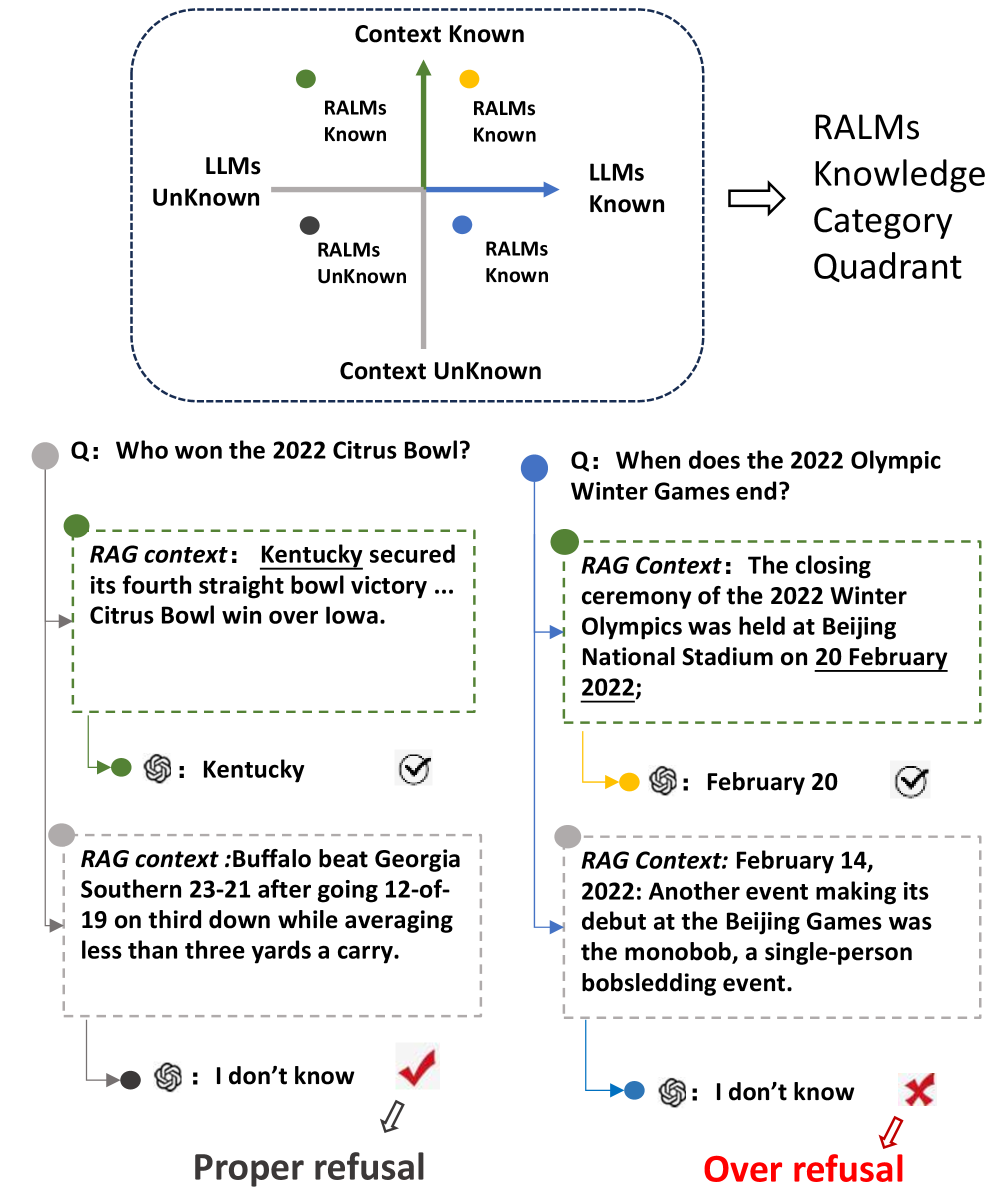
Figure 1: An illustration of the knowledge boundary of a RALM and the corresponding answer correctness. We divide the knowledge state into four quadrants based on the model’s internal knowledge and the knowledge provided by external context. The question at the gray dot lies outside the model’s knowledge boundary, whereas the question at the blue dot lies within it. However, given irrelevant context, the model may still refuse to answer the blue-dot question.
Although both methods are widely adopted, prior work has predominantly emphasized their individual effectiveness while overlooking systematic evaluation of the refusal capabilities of RALMs. Given that LLMs are sensitive to the quality and relevance of retrieval contexts (Park and Lee 2024; Cuconasu et al. 2024), a refusal-trained model might mishandle unreliable external information and become uncertain even when it internally possesses correct knowledge. As shown in Figure 1, RALMs may over-refuse questions that they would otherwise answer correctly when confronted with irrelevant documents. To address this gap, we pose the fundamental question: Do RALMs know when they do not know?
Specifically, in this work, we study three critical research questions (RQs). First, are RALMs well calibrated with respect to different internal and external knowledge states? (RQ1) Ideally, if RALMs are well calibrated (know when they don’t know), they can refuse to answer, or users can post-hoc reject their answers based on model uncertainty. We categorize knowledge states as shown in Figure 1 and quantify the knowledge state of RALMs using uncertainty estimates. We also explicitly consider refusal behavior, which has been overlooked in prior work on uncertainty estimation. While models demonstrate improved calibration when a supportive document exists within otherwise irrelevant contexts, we find that RALMs exhibit significant over-refusal behavior, particularly when confronted with exclusively irrelevant contexts; that is, LLMs still tend to refuse questions they could have answered correctly.
Second, given the over-refusal tendency observed in RALMs, we pose our second research question: How does a RALM’s refusal ability align with its calibration quality? (RQ2) We modify the refusal behavior of RALMs using two instruction-tuning-based methods: Refusal-Aware Instruction Tuning (R-tuning) (Zhang et al. 2024) and In-Context Fine-Tuning (ICFT) (Lee, Lin, and Tan 2025; Zhu, Panigrahi, and Arora 2025). Our results show that the over-refusal problem is mitigated by ICFT but exacerbated by R-tuning. However, we observe that improved refusal performance does not necessarily imply better calibration or higher answer accuracy. We attribute these discrepancies to changes in robustness and contextual faithfulness.
Lastly, given the difficulty of balancing refusal and response competence based solely on the behavior of LLMs themselves, we investigate our third research question: Can we combine refusal-aware RALMs with uncertainty-based answer abstention to mitigate over-refusal? (RQ3) Building on our previous findings, we leverage uncertainty and its variation to infer the knowledge state of RALMs, and then decide whether to answer a question with or without retrieved context, or to abstain altogether.
Our contributions are threefold: 1) We investigate the uncertainty calibration of RALMs and conduct a comprehensive analysis of key factors, including context variation and different knowledge states (internal vs. external knowledge). 2) We identify and characterize the over-refusal problem, and then examine the relationship between refusal behavior and calibration. In particular, we study whether existing refusal tuning exacerbates over-refusal in LLMs and provide further explanations. 3) We design a simple yet effective refusal method for RALMs, informed by the above findings.
Related Works
Knowledge Boundary of LLMs. Identifying the knowledge boundary of an LLM helps delineate the limits of its knowledge (Deng et al. 2025). This notion is also described as “knowing what you don’t know” (Yin et al. 2023; Deng et al. 2024), which is crucial for assessing the practical applicability of LLMs. Li et al. (2025) formally categorizes the knowledge boundary with respect to prompt and model sensitivity. However, these works mainly focus on the LLMs’ internal knowledge. Hallucinations typically occur when users’ requests fall outside the LLM knowledge boundary (Huang et al. 2025). The primary approach to mitigating hallucinations is retrieval-augmented generation (RAG). RAG (Lewis et al. 2020) is a convenient approach at inference time, where the retrieved context fills the knowledge gap. More advanced RAG variants leverage LLM self-generated rationales (Wei, Chen, and Meng 2024), perform post-retrieval knowledge selection (Xu, Shi, and Choi 2024; Li et al. 2024), or adopt dynamic retrieval strategies (Jeong et al. 2024). Recent dynamic RAG methods (Asai et al. 2024; Su et al. 2024) still rely on uncertainty estimates and manually chosen thresholds to decide when retrieval is necessary; even though the system’s knowledge may evolve dynamically, these thresholds remain static. This implicitly assumes that the model is always well calibrated. To the best of our knowledge, no prior work has systematically analyzed the factors that influence the uncertainty of RALMs, and our study fills this gap.
Refusal Method of LLMs. Refusal behavior has predominantly been studied at the post-training stage (Wen et al. 2025). Existing work mainly focuses on instruction tuning (Zhang et al. 2024; Zhu et al. 2025; Kapoor et al. 2024) and refusal-alignment training (Cheng et al. 2024; Sun et al. 2025). In these setups, instances where the model is uncertain or produces incorrect answers are typically labeled as “should-refuse” examples. Another line of work controls refusal at inference time (Feng et al. 2024), where uncertainty estimates are used to abstain from answering by thresholds.
Uncertainty Estimation. It is crucial for LLMs to recognize their limitations and to express calibrated confidence when responding to users (Yin et al. 2023). Current research typically treats uncertainty and confidence as opposite quantities (Lin, Trivedi, and Sun 2024); that is, the higher the uncertainty of an LLM, the lower its confidence. Geng et al. (2024) divide uncertainty estimation (UE) methods for LLMs into white-box and black-box approaches. White-box methods are suitable for open-source LLMs, where internal states are accessible (Kadavath et al. 2022). By contrast, black-box methods rely solely on model responses for UE and therefore have broader applicability. Recent work discusses the UE of RALMs (Moskvoretskii et al. 2025) and Language Reasoning Models (Mei et al. 2025; Soudani, Zamani, and Hasibi 2025). However, these studies do not construct controlled experimental settings to analyze the influence of specific factors, and they neglect the model’s refusal behavior.
Preliminary
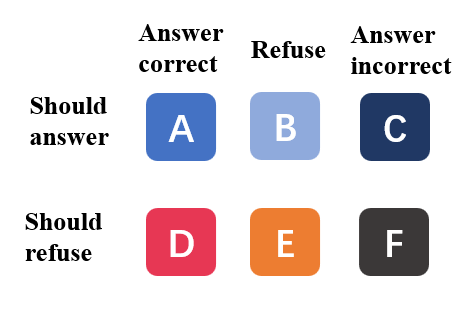
We briefly describe the concept of proper refusal and over-refusal. We illustrate the refusal and answer and their correctness situation as in Figure 2. According to (Feng et al. 2024), the questions could be divided into ”should refuse” and ”should answer”. If LLMs tend to give false answers, which means that LLMs do not entail knowledge, then they should refuse the question. Thus the proper refusal rate is $\frac{E}{D+E+F}$ and the over-refusal rate is $\frac{B}{A+B+C}$ . Notice that the “C” and “D” parts exist in our settings. This arises from the threshold used under repeated sampling and the model’s prompt sensitivity.
<details>
<summary>pics/prelim.png Details</summary>
### Visual Description
## Matrix: Response Decision Framework
### Overview
The image depicts a 2x3 categorical matrix organizing response strategies based on two dimensions:
1. **Vertical Axis**: "Should answer" (top row) vs "Should refuse" (bottom row)
2. **Horizontal Axis**: "Answer correct" (left column) vs "Refuse" (middle column) vs "Answer incorrect" (right column)
Each cell contains a letter (A-F) and a distinct color, representing specific decision outcomes.
### Components/Axes
- **Rows**:
- Top: "Should answer"
- Bottom: "Should refuse"
- **Columns**:
- Left: "Answer correct"
- Middle: "Refuse"
- Right: "Answer incorrect"
- **Cells**:
- **A**: Blue square with "A" (top-left)
- **B**: Light blue square with "B" (top-middle)
- **C**: Dark blue square with "C" (top-right)
- **D**: Red square with "D" (bottom-left)
- **E**: Orange square with "E" (bottom-middle)
- **F**: Black square with "F" (bottom-right)
### Detailed Analysis
- **Top Row ("Should answer")**:
- **A**: Correct answers trigger a response (blue).
- **B**: Refuse scenarios under "Should answer" (light blue).
- **C**: Incorrect answers under "Should answer" (dark blue).
- **Bottom Row ("Should refuse")**:
- **D**: Correct answers under "Should refuse" (red).
- **E**: Refuse scenarios under "Should refuse" (orange).
- **F**: Incorrect answers under "Should refuse" (black).
### Key Observations
1. **Color Coding**:
- Blue shades (A-C) dominate the "Should answer" row, suggesting prioritization of responsiveness.
- Warmer colors (D-F) in the "Should refuse" row may indicate higher stakes or error states.
2. **Diagonal Pattern**:
- Correct answers ("A") and refusals ("E") align with their respective rows, while mismatches (B, C, D, F) highlight decision conflicts.
3. **Ambiguity in Middle Column**:
- The "Refuse" column spans both rows, creating potential overlap in decision logic.
### Interpretation
This matrix appears to model a **decision-making system** for handling responses, likely in an AI or automated workflow context. Key insights:
- **Optimal Decisions**:
- Correct answers (A) and appropriate refusals (E) are clearly defined.
- **Error States**:
- **B** and **C** (top row) represent failures to refuse when incorrect answers should be withheld.
- **D** and **F** (bottom row) suggest incorrect refusals or responses to correct answers.
- **Design Implications**:
- The system may require refinement to reduce mismatches (e.g., improving accuracy to minimize **C** and **F**).
- The "Refuse" column’s dual presence in both rows indicates a need for clearer criteria to distinguish when refusal is appropriate.
This framework highlights trade-offs between responsiveness and caution, with color and position serving as visual cues for decision quality.
</details>
Figure 2: Refusal and answer confusion matrix. “Should answer/refuse” is the ground truth label while “answer correct/incorrect”, refuse is the response situation.
Methodology
Uncertainty Estimation Methods
We primarily adopt black-box UE methods to quantify the confidence of LLM responses, as they are more broadly applicable. Following (Moskvoretskii et al. 2025), we select three categories of well-performing UE methods.
Verbalization-based UE
This class of methods leverages the LLM’s self-awareness and expressive ability by eliciting explicit confidence estimates for its answers via prompting. We design four different prompts following (Tian et al. 2023). These prompt variants mainly differ in (i) whether the answer and its uncertainty estimate are produced within the same conversation turn, and (ii) the number of generations elicited. Detailed prompt descriptions are provided in Appendix A.
Consistency-based UE
This class of methods is based on the assumption that more consistent answers indicate higher model confidence. Lyu et al. (2025a) propose an alternative approach to quantifying the uncertainty of LLMs and apply it to decoding strategies such as self-consistency. We formalize three types of consistency-based measures as follows. For a given input $x$ and an LLM $M(·)$ , we generate $m$ responses $\{r_{1},r_{2},...,r_{m}\}$ and decide the final answer via majority voting:
$$
\bar{r}=\arg\max_{r}\sum\nolimits_{i=1}^{m}\mathds{1}{I}(r_{i}=r),
$$
where $\mathds{1}{I}(·)$ is the indicator function.
The first measurement $Agree(·)$ is based on agreement among answers:
$$
Agree(\bar{r})=\frac{1}{m}\sum\nolimits^{m}_{i=1}\mathds{1}{(}{r_{i}=\bar{r}}), \tag{1}
$$
where the agreement indicator could be implemented as semantic or lexical agreement, or LLM-as-judge.
The second measurement $Ent(·)$ is entropy-based and rescales the weights of each answer. It is computed as:
$$
Ent(r)=1-(-\frac{1}{log|\bar{r}|}\sum\nolimits^{|\hat{r}|}_{i=1}p_{i}log(p_{i})), \tag{2}
$$
where $\hat{r}$ is the set of duplicated answers, $p_{i}$ is the probability of the unique answer ${r_{i}}$ .
The final measurement $FSD(·)$ balances the two ways, which is based on the top two most-voted responses $\bar{r}$ and $\bar{\bar{r}}$ :
$$
FSD(r)=Agree(\bar{r})-Agree(\bar{\bar{r}})). \tag{3}
$$
Similarity Matrix based UE
This kind of methods consider the similarity of all responses. We use two features,including degree and eigenvalue of the similarity matrix following (Lin, Trivedi, and Sun 2024). The formulations are in the Appendix A.
Refusal Post-Training Methods
We aim to adjust the proactive refusal behavior of RALMs. We adopt two refusal instruction tuning (RIFT) methods, namely R-tuning and in-context fine-tuning (ICFT), due to their broad adoption. Further implementation details are provided in Appendix A.
R-tuning. R-tuning (Zhang et al. 2024) is a simple yet effective method for teaching LLMs to issue appropriate refusals. Its workflow typically consists of two stages. In the first stage, the questions that the LLM cannot answer correctly are detected. In the second stage, training data are constructed and instruction tuning is performed. For questions outside the model’s knowledge boundary, we assign refusal targets such as “I don’t know”.
In-Context Fine-Tuning. Zhu, Panigrahi, and Arora (2025); Lee, Lin, and Tan (2025) find that inserting positive context into prompts during instruction tuning improves LLM accuracy. However, they generally append only positive context and train the model to generate correct answers. Fang et al. (2024); Yoran et al. (2024) adopt a similar strategy but optimize a corresponding training objective to enhance robustness and faithfulness. In our work, we extend this framework to the refusal setting. For each training example, we insert not only positive context but also negative context. We set the training targets to either a correct answer or a refusal expression according to the knowledge-state quadrant of the RALM, as illustrated in Figure 1. When the knowledge is unknown to the RALM, we set the answer to a refusal expression.
Experiments
| UE type | UE name | $RGB_{en}$ | $RGB_{zh}$ | | | | | | | | |
| --- | --- | --- | --- | --- | --- | --- | --- | --- | --- | --- | --- |
| no context | 0p10n | 1p9n | 5p5n | 1p19n | no context | 0p10n | 1p9n | 5p5n | 1p19n | | |
| Verbalize | Verb-1s-1 | 0.445 | 0.139 | 0.208 | 0.023 | 0.042 | 0.477 | 0.441 | 0.119 | 0.242 | 0.124 |
| Verb-1s-5 | 0.253 | 0.186 | 0.182 | 0.160 | 0.179 | 0.173 | 0.170 | 0.182 | 0.170 | 0.198 | |
| Verb-2s-1 | 0.339 | 0.190 | 0.183 | 0.013 | 0.040 | 0.448 | 0.338 | 0.122 | 0.210 | 0.125 | |
| Verb-2s-5 | 0.225 | 0.190 | 0.176 | 0.124 | 0.178 | 0.204 | 0.165 | 0.412 | 0.240 | 0.442 | |
| Consistency | Ent | 0.126 | 0.305 | 0.030 | 0.009 | 0.033 | 0.253 | 0.256 | 0.093 | 0.148 | 0.082 |
| Agree | 0.127 | 0.192 | 0.026 | 0.010 | 0.028 | 0.250 | 0.261 | 0.078 | 0.150 | 0.075 | |
| FSD | 0.104 | 0.162 | 0.041 | 0.014 | 0.048 | 0.201 | 0.182 | 0.083 | 0.122 | 0.086 | |
| Similarity Matrix-based | Eigv | 0.202 | 0.232 | 0.289 | 0.271 | 0.260 | 0.247 | 0.282 | 0.299 | 0.271 | 0.284 |
| Deg | 0.200 | 0.229 | 0.292 | 0.275 | 0.262 | 0.236 | 0.277 | 0.297 | 0.268 | 0.283 | |
Table 1: The Brier score (lower score indicates better calibration) of different UE methods on different RAG settings and datasets.The “ApBn” means A positive chunks and B negative chunks for RAG context settings.
Experimental Setup
To focus on the model’s knowledge capacity while minimizing the influence of reasoning, we primarily consider simple factual questions with short answers. These questions typically require only a single evidence document to be answered correctly, for which single-step retrieval is sufficient. Additional details are described in Appendix B.
RALM Models
We adopt two prevalent families of open-source LLMs, Qwen and LLaMA. Although modern LLMs are multilingual, We find that Qwen has stronger knowledge in Chinese, whereas LLaMA performs better on English knowledge. To better exploit the knowledge of each model family, we evaluate Qwen https://huggingface.co/Qwen on Chinese datasets and LLaMA https://github.com/meta-llama/llama3 on English datasets. In the main text, we mainly report results for models with approximately 7B parameters. For the retrieval component, document chunks and positive ground-truth passages are provided by the original datasets. We perform hybrid search and re-ranking using Milvus https://milvus.io to construct high-quality negative examples, taking both semantic and lexical similarity into account to provide sufficient difficulty.
Hyper-Parameters
The generation temperature is set to 0.5, and the number of sampled generations is set to 16, following (Lyu et al. 2025a). Other generation hyper-parameters are kept at the default values for the corresponding LLMs.
Datasets
We explore the RALMs’ performance in open-domain QA tasks, using three prevalent fact-oriented single-hop question datasets to evaluate the performance of LLMs, including two RAG datasets, CRUD (Lyu et al. 2025b) and RGB (Chen et al. 2024), and an QA dataset, NQ (Kwiatkowski et al. 2019). Covering both Chinese and English, the datasets are well-suited for testing Qwen and LLaMA series. NQ and CRUD are large scale QA/RAG datasets suitable for both training and test. RGB is a dataset particular developed for test, including refusal ability of RALMs.
<details>
<summary>x2.png Details</summary>
### Visual Description
## Reliability Diagrams: Qwen-2.5-7B Model Performance Across Context Settings
### Overview
The image presents three reliability diagrams comparing the Qwen-2.5-7B language model's performance under three context RAG settings: (a) no context, (b) 0p10n context, and (c) 1p9n context. Each diagram evaluates calibration across four knowledge categories: highly known, maybe known, weakly known, and unknown knowledge. Bars represent accuracy (blue), gap between accuracy and perfect calibration (pink), and dashed lines indicate perfect calibration thresholds.
### Components/Axes
- **X-axis**: Confidence (0.0–1.0 in 0.2 increments)
- **Y-axis**: Accuracy (0.0–1.0)
- **Legend**:
- Dashed line: Perfect calibration (ideal accuracy = confidence)
- Blue bars: Accuracy
- Pink bars: Gap (perfect calibration - accuracy)
- **Subcategories**: Four knowledge categories per diagram
### Detailed Analysis
#### (a) No Context RAG Setting
- **Highly Known Knowledge**:
- Accuracy peaks at ~0.8 (confidence 0.8–1.0), closely matching perfect calibration.
- Gap minimal (~0.1–0.2) in high-confidence ranges.
- **Maybe Known Knowledge**:
- Accuracy drops to ~0.4–0.6 (confidence 0.4–0.8), with gaps widening to ~0.3–0.5.
- **Weakly Known Knowledge**:
- Accuracy ~0.2–0.4 (confidence 0.2–0.6), gaps ~0.4–0.6.
- **Unknown Knowledge**:
- Accuracy ~0.6–0.8 (confidence 0.6–1.0), gaps ~0.2–0.4.
#### (b) 0p10n Context RAG Setting
- **Highly Known Knowledge**:
- Accuracy declines to ~0.6–0.8 (confidence 0.6–1.0), gaps increase to ~0.2–0.4.
- **Maybe Known Knowledge**:
- Accuracy ~0.2–0.4 (confidence 0.2–0.6), gaps ~0.4–0.6.
- **Weakly Known Knowledge**:
- Accuracy ~0.1–0.3 (confidence 0.1–0.5), gaps ~0.5–0.7.
- **Unknown Knowledge**:
- Accuracy ~0.4–0.6 (confidence 0.4–0.8), gaps ~0.4–0.6.
#### (c) 1p9n Context RAG Setting
- **Highly Known Knowledge**:
- Accuracy ~0.7–0.9 (confidence 0.7–1.0), gaps ~0.1–0.3.
- **Maybe Known Knowledge**:
- Accuracy ~0.5–0.7 (confidence 0.5–0.9), gaps ~0.3–0.5.
- **Weakly Known Knowledge**:
- Accuracy ~0.4–0.6 (confidence 0.4–0.8), gaps ~0.4–0.6.
- **Unknown Knowledge**:
- Accuracy ~0.6–0.8 (confidence 0.6–1.0), gaps ~0.2–0.4.
### Key Observations
1. **Calibration Trends**:
- No context (a): Best calibration for highly known knowledge, overconfidence in unknown.
- 0p10n context (b): Worst calibration across all categories, largest gaps in weakly known.
- 1p9n context (c): Improved calibration, especially in unknown knowledge (gap reduced by ~50% vs. no context).
2. **Outliers**:
- In (b), weakly known knowledge shows extreme overconfidence (gap >0.5 at confidence 0.4–0.6).
- In (c), unknown knowledge achieves near-perfect calibration (gap <0.3 at confidence 0.8–1.0).
### Interpretation
The diagrams reveal that context augmentation significantly impacts calibration:
- **No context**: The model is well-calibrated for highly known knowledge but overconfident in unknown domains.
- **0p10n context**: Introduces noise, degrading calibration for maybe/weakly known knowledge.
- **1p9n context**: Optimal balance, improving calibration across all categories, particularly for unknown knowledge. This suggests that larger context windows (1p9n) help the model better align confidence with accuracy, reducing overconfidence in uncertain scenarios.
The gap metric highlights the model's reliability: smaller gaps indicate trustworthy confidence estimates. The 1p9n context setting demonstrates the most robust performance, aligning with expectations that richer context improves model reasoning.
</details>
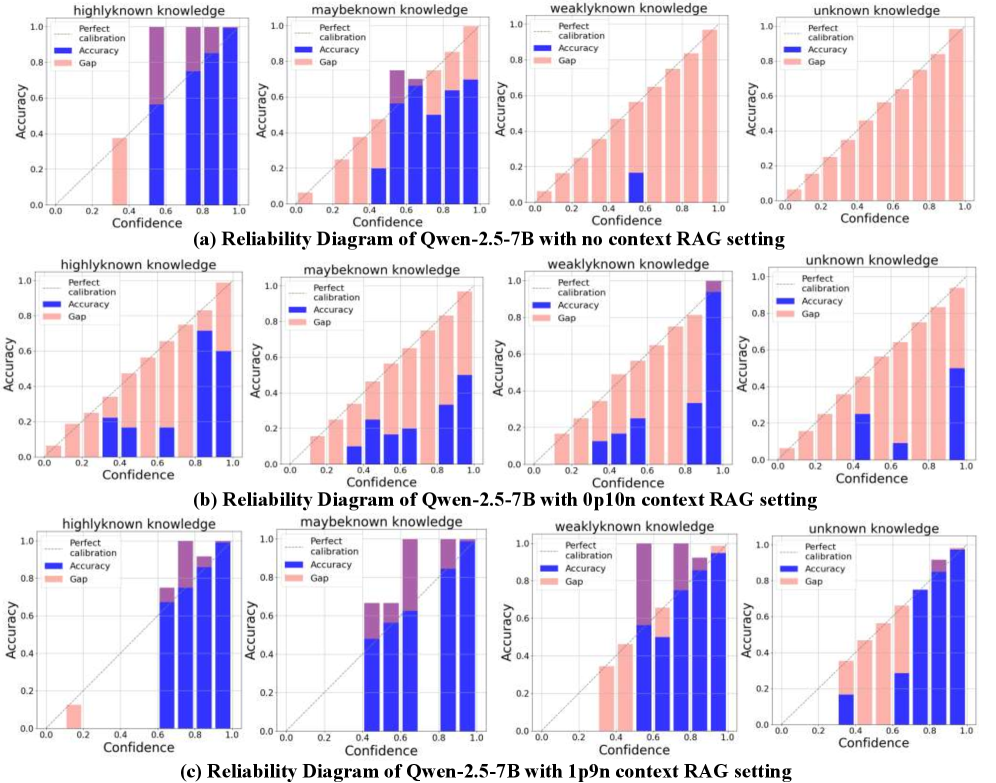
Figure 3: The reliability diagram under different internal and external knowledge states. The blue bar is the precision questions. The pink bar indicates the over-confident gap, and the purple bar indicates the under-confident gap.
Answer Judgment
We first assign a knowledge state to each question based on both temperature-sampled and greedy-decoding results, following (Gekhman et al. 2024). This yields four categories: ”highlyknown”, ”maybeknown”, ”weaklyknown”, and ”unknown”. We treat the former two categories as ”should-answer” and the latter two as ”should-refuse” according to the precision analysis in Section of RQ1. Following (Sun et al. 2025), we then apply a strict answer-decision workflow to determine whether a model output should be regarded as a refusal or a correct answer, including an LLM-as-a-judge step, exact-match checking, and a refusal-word filter.
Evaluation Metrics
Evaluation metrics include accuracy-based and confidence-calibration measures (Feng et al. 2024; Sun et al. 2025). The formal definitions of all metrics are given in Appendix B, and we briefly summarize them as follows:
- Accuracy-based metrics: The answering ability of RALMs is multi-dimensional, reflecting both answer quality and refusal quality.
- Answer Quality (AQ): We report answer precision (Pre), recall (Rec), and F1 for correct answers.
- Refusal Quality (RQ): We measure the refusal rate(RR), refusal precision (RPrec), recall (RRec) and F1(RF1).
- Overall Quality (OQ): We report overall accuracy (OAcc), defined as the proportion of outputs that are either correct answers or proper refusals.
- Confidence calibration metrics: We mainly use Brier Score to measure whether the answer confidence measure the answer precision.
Do RALMs Know When They Don’t Know? (RQ1)
We systematically investigate how prompt variants, positive context position, context quality, and quantity affect the model performance. Detailed discussions are in Appendix C We heuristically varied the numbers of positive and negative examples and examined their impact on the results. In this section, we first examine the calibration error with different UE methods to choose the best one for the following analysis. We then analyze confidence and accuracy in turn as they contribute to the calibration results.
Calibration error of RALMs.
We exclude refusals for UE, since they are outcome-level decisions co-equal with answering, not comparable to specific answer content. Results are in Table 1. The calibration error varies under different RAG settings, and no single method performs best across all scenarios. This aligns with (Moskvoretskii et al. 2025). However, the RALMs become extremely well-calibrated when positive documents exist, especially for verbalize and consistency-based UE methods. This indicates that the UE methods are also acceptable for RALMs. As the consistency-based methods perform best generally, we take their results for further explanation. We contrast the presence versus the absence of context. We find that when no positive context exists (0p10n), the calibration error becomes worse. And when we insert a single positive context (1p9n), the model becomes extremely calibrated. If we insert more positive context (5p5n), the trend of calibration error vary, become better on $RGB_{en}$ and worser on $RGB_{zh}$ . And if we insert more negative context (1p19n), the calibration error does not significantly change. This means that RALMs can sensitively perceive the availability of knowledge. As we find the key factor is the positive context existence, the following settings use 10 context chunks as the default.
<details>
<summary>x3.png Details</summary>
### Visual Description
## Bar Charts: Answer Accuracy and Refusal Rate of Qwen-2.5-7B and LLaMA-3.1-8B on RGB Datasets
### Overview
The image contains four grouped bar charts comparing the performance of two language models (Qwen-2.5-7B and LLaMA-3.1-8B) on two datasets (RGB_zh and RGB_en). Each model is evaluated across two metrics: **Answer Accuracy** (y-axis: 0–1.0) and **Refusal Rate** (y-axis: 0–0.30), with context provided in 10-chunk increments. Categories include "no context," "0 pos," "1 pos," and "5 pos" context chunks. A legend maps colors to knowledge levels: **unknown** (blue), **weakly known** (orange), **maybe known** (green), and **highly known** (red).
---
### Components/Axes
1. **X-Axis (Context Chunks)**:
- Categories: "no context," "0 pos," "1 pos," "5 pos"
- Position: Bottom of both charts
2. **Y-Axes**:
- **Answer Accuracy**: 0–1.0 (left side of both charts)
- **Refusal Rate**: 0–0.30 (right side of both charts)
3. **Legends**:
- Colors: Blue (unknown), Orange (weakly known), Green (maybe known), Red (highly known)
- Position: Right side of both charts
4. **Models/Datasets**:
- Top-left: Qwen-2.5-7B on RGB_zh
- Bottom-left: LLaMA-3.1-8B on RGB_en
---
### Detailed Analysis
#### Answer Accuracy (Left Charts)
- **Qwen-2.5-7B (RGB_zh)**:
- **No context**: Highest accuracy for "highly known" (red, ~0.95), lowest for "unknown" (blue, ~0.05).
- **0 pos**: Accuracy drops for "unknown" (~0.15) and "weakly known" (~0.25), but "highly known" remains high (~0.85).
- **1 pos**: "Unknown" accuracy rises sharply (~0.7), "weakly known" (~0.8), and "highly known" (~0.9).
- **5 pos**: All categories converge near 0.9–1.0, with "unknown" (~0.9) and "weakly known" (~0.95) showing the most improvement.
- **LLaMA-3.1-8B (RGB_en)**:
- **No context**: "Highly known" accuracy peaks (~0.95), "unknown" lowest (~0.1).
- **0 pos**: "Unknown" accuracy drops to ~0.2, "weakly known" (~0.3), "highly known" (~0.85).
- **1 pos**: "Unknown" jumps to ~0.8, "weakly known" (~0.9), "highly known" (~0.95).
- **5 pos**: All categories reach ~0.9–1.0, with "unknown" (~0.95) and "weakly known" (~0.98) leading.
#### Refusal Rate (Right Charts)
- **Qwen-2.5-7B (RGB_zh)**:
- **No context**: Highest refusal rate for "highly known" (~0.25), lowest for "unknown" (~0.05).
- **0 pos**: "Highly known" refusal rate drops to ~0.15, "unknown" rises to ~0.1.
- **1 pos**: "Highly known" refusal rate plummets to ~0.05, "unknown" remains ~0.1.
- **5 pos**: All categories below 0.05, with "highly known" near 0.
- **LLaMA-3.1-8B (RGB_en)**:
- **No context**: "Highly known" refusal rate peaks (~0.2), "unknown" lowest (~0.05).
- **0 pos**: "Highly known" refusal rate drops to ~0.1, "unknown" rises to ~0.07.
- **1 pos**: "Highly known" refusal rate falls to ~0.03, "unknown" remains ~0.07.
- **5 pos**: All categories below 0.05, with "highly known" near 0.
---
### Key Observations
1. **Context Improves Accuracy**:
- Both models show significant accuracy gains with increasing context chunks, especially for "unknown" and "weakly known" categories.
- Qwen-2.5-7B demonstrates sharper improvements in "unknown" accuracy (e.g., ~0.15 → ~0.9 with 5 pos context).
2. **Refusal Rates Decrease with Context**:
- Refusal rates for "highly known" categories drop sharply as context increases (e.g., Qwen: ~0.25 → ~0.05 with 5 pos context).
- LLaMA-3.1-8B maintains lower refusal rates overall but follows the same trend.
3. **Model Performance Differences**:
- Qwen-2.5-7B generally achieves higher accuracy for "unknown" categories with context.
- LLaMA-3.1-8B has slightly lower refusal rates for "highly known" categories without context.
---
### Interpretation
The data suggests that **contextual augmentation** significantly enhances model performance across knowledge levels. For both models:
- **Answer Accuracy**: Providing context (even minimal) reduces performance gaps between knowledge levels. "Unknown" categories benefit most from context, closing the gap with "highly known" categories.
- **Refusal Rate**: Models are less likely to refuse answers when given context, particularly for "highly known" categories. This implies that context helps models avoid overconfidence in uncertain scenarios.
- **Model-Specific Behavior**: Qwen-2.5-7B shows stronger improvements in "unknown" accuracy, while LLaMA-3.1-8B maintains lower refusal rates for "highly known" categories. These differences may stem from architectural design or training data biases.
The charts highlight the importance of context in balancing accuracy and refusal behavior, with implications for deploying models in low-resource or ambiguous scenarios.
</details>
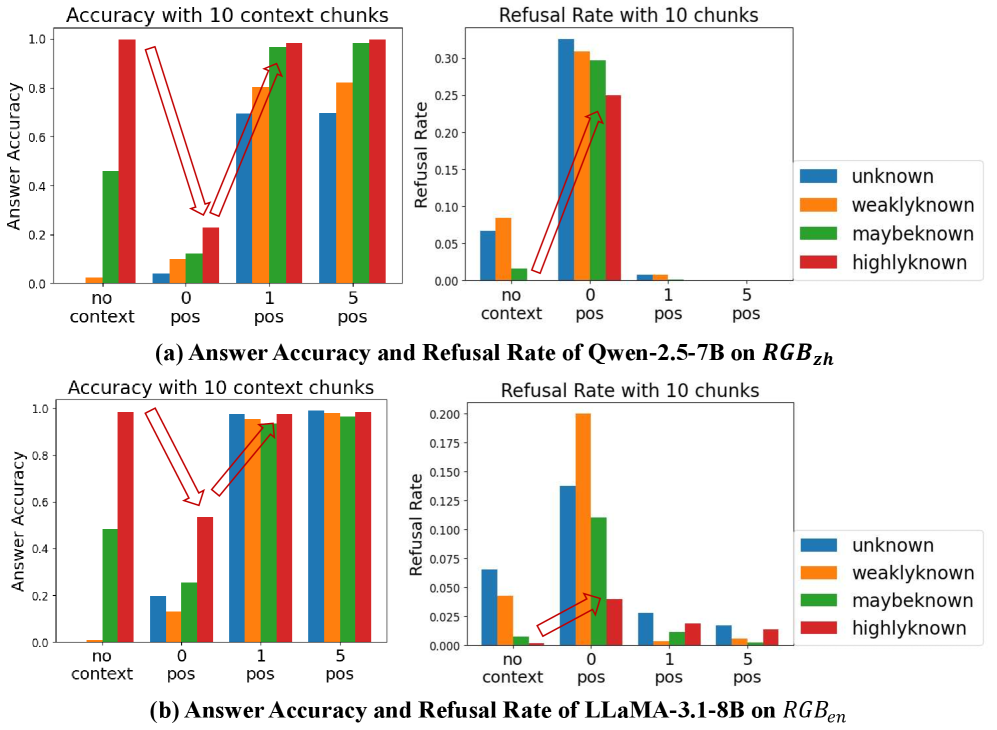
Figure 4: The answer precision (denoted as ”accuracy”) and refusal rate vary according to the internal/external knowledge states. The whole negative context (0 pos) leads to significant decrease of accuracy and increase of refusal on “highlyknown” questions.
Over-confident or under-confident.
In this section, we examine how confidence scores vary, given that base LLMs are known to be over-confident (Li et al. 2025) as shown in Figure 3. In the no-context setting, the “highlyknown” type is slightly under-confident, whereas the other types are over-confident. The “highlyknown” questions attain relatively high confidence values, while the confidence of the other types is more dispersed. However, in the all-negative-context setting, the RALMs become strongly over-confident and the confidence scores for all types become highly dispersed. For “highlyknown” questions, the LLM could answer correctly without retrieval, yet the observed accuracy is noticeably worse. This indicates that both accuracy and confidence are substantially affected by noisy contexts. Interestingly, “weaklyknown” questions achieve higher accuracy under negative contexts, suggesting that the injected noise can have unexpected effects. This finding is consistent with Cuconasu et al. (2024), while we further delineate how this effect depends on specific knowledge categories. Finally, even when one positive context is provided, RALMs tend to be under-confident for most knowledge types, except for the “unknown” category. Across knowledge types, the model attains high accuracy and more concentrated confidence distributions, indicating that RALMs can effectively detect and exploit helpful information. In summary, these observations explain the calibration trends in Table 1: with all-negative context, accuracy generally decreases and confidence becomes more diffuse, whereas with positive context, accuracy improves and confidence becomes more concentrated.
| RALMs test setting | Method name | CalErr | OQ | AQ | RQ | | | | | | | |
| --- | --- | --- | --- | --- | --- | --- | --- | --- | --- | --- | --- | --- |
| OaBs $(\downarrow)$ | OAcc $(\uparrow)$ | Pre $(\uparrow)$ | Rec $(\uparrow)$ | F1 $(\uparrow)$ | MA $(\downarrow)$ | RR | OR $(\downarrow)$ | RPre $(\uparrow)$ | RRec $(\uparrow)$ | RF1 $(\uparrow)$ | | |
| Qwen-2.5-7B | | | | | | | | | | | | |
| no context | Vanilla | 0.245 | 0.427 | 0.411 | 1.000 | 0.583 | 0.217 | 0.027 | 0.000 | 1.000 | 0.044 | 0.085 |
| R-tuning | 0.191 | 0.457 | 0.395 | 0.857 | 0.541 | 0.336 | 0.190 | 0.105 | 0.719 | 0.218 | 0.335 | |
| ICFT (n) | 0.226 | 0.487 | 0.450 | 0.953 | 0.611 | 0.250 | 0.103 | 0.039 | 0.806 | 0.145 | 0.245 | |
| ICFT (p) | 0.169 | 0.443 | 0.443 | 1.000 | 0.614 | 0.250 | 0.000 | 0.000 | 0.000 | 0.000 | 0.000 | |
| ICFT (pn) | 0.167 | 0.440 | 0.440 | 1.000 | 0.611 | 0.243 | 0.000 | 0.000 | 0.000 | 0.000 | 0.000 | |
| ICFT (w) | 0.181 | 0.423 | 0.414 | 1.000 | 0.585 | 0.296 | 0.017 | 0.000 | 1.000 | 0.028 | 0.055 | |
| 0p10n | Vanilla | 0.325 | 0.290 | 0.168 | 0.372 | 0.231 | 0.500 | 0.363 | 0.355 | 0.505 | 0.257 | 0.341 |
| R-tuning | 0.408 | 0.457 | 0.294 | 0.195 | 0.235 | 0.184 | 0.717 | 0.678 | 0.521 | 0.651 | 0.579 | |
| ICFT (n) | 0.216 | 0.620 | 0.578 | 0.709 | 0.637 | 0.158 | 0.423 | 0.270 | 0.677 | 0.541 | 0.601 | |
| ICFT (p) | 0.204 | 0.400 | 0.400 | 1.000 | 0.571 | 0.342 | 0.000 | 0.000 | 0.000 | 0.000 | 0.000 | |
| ICFT (pn) | 0.189 | 0.430 | 0.430 | 1.000 | 0.601 | 0.309 | 0.000 | 0.000 | 0.000 | 0.000 | 0.000 | |
| ICFT (w) | 0.217 | 0.460 | 0.436 | 0.976 | 0.603 | 0.296 | 0.060 | 0.020 | 0.833 | 0.086 | 0.156 | |
| 1p9n | Vanilla | 0.079 | 0.863 | 0.863 | 1.000 | 0.927 | 0.013 | 0.000 | 0.000 | 0.000 | 0.000 | 0.000 |
| R-tuning | 0.127 | 0.830 | 0.853 | 0.960 | 0.903 | 0.033 | 0.070 | 0.066 | 0.524 | 0.212 | 0.301 | |
| ICFT (n) | 0.164 | 0.787 | 0.835 | 0.881 | 0.858 | 0.033 | 0.230 | 0.171 | 0.623 | 0.531 | 0.573 | |
| ICFT (p) | 0.068 | 0.827 | 0.827 | 1.000 | 0.905 | 0.072 | 0.000 | 0.000 | 0.000 | 0.000 | 0.000 | |
| ICFT (pn) | 0.085 | 0.820 | 0.820 | 1.000 | 0.901 | 0.059 | 0.000 | 0.000 | 0.000 | 0.000 | 0.000 | |
| ICFT (w) | 0.094 | 0.827 | 0.827 | 1.000 | 0.905 | 0.053 | 0.000 | 0.000 | 0.000 | 0.000 | 0.000 | |
Table 2: Evaluation of refusal trained models under different settings. $(\uparrow)$ indicates a higher score is better, and $(\downarrow)$ vice versa. If no arrow is marked, then the score have no directionality. The best result under a RALMs test settings is marked bold and we do not mark those “1.000” scores. The over-refusal score (OR) which is marked in red indicates the worst case.
Precision and refusal rate.
We begin by analyzing how answer correctness varies. In the all-negative(0 pos) setting, we observe a decline on “highlyknown” and “maybeknown” questions and a gain on “weaklyknown” and “unknown” ones compared to the no-context setting. When a positive context exists, the precision significantly increases, especially for unknown and weakly known knowledge. Increasing the count of positives yields no significant gains in precision. This indicates that LLMs are sensitive to both harmful and supportive contexts. While increasing the number of positive and negative examples does not significantly alter the model’s response for fact-oriented questions in this kind of shorter context. Then we analyze refusal rate. In the all-negative (0 pos) setting, we observe an significant increase on all the knowledge types. Considering the LLMs can correctly answer ”highlyknown” questions on their own, refusal on those questions are not correct. We identify this phenomenon as over-refusal, which are not observed in previously research. Likewise, the presence of positive chunk markedly reduces refusal. This is consistent with the pattern of accuracy changes.
Summary.
In this section, we empirically show that RALMs generally “know they don’t know” under no-context and positive-context settings. However, they become over-confident when confronted with negative context and may over-refuse questions whose answers they actually know.
How does RALMs’ refusal ability align with its calibration quality? (RQ2)
| Method name | DR | CU | | |
| --- | --- | --- | --- | --- |
| no context | 0p10n | 10p0n | 1p9n | |
| Vanilla | 0.579 | 0.191 | 0.759 | 0.738 |
| R-tuning | 0.444 | 0.138 | 0.750 | 0.682 |
| ICFT (n) | 0.734 | 0.632 | 0.750 | 0.591 |
| ICFT (p) | 0.750 | 0.658 | 0.824 | 0.723 |
| ICFT (pn) | 0.757 | 0.691 | 0.777 | 0.696 |
| ICFT (w) | 0.704 | 0.684 | 0.770 | 0.703 |
Table 3: Results of denoise rate and positive context utilization.
We adjust refusal ability though the R-tuning and In-context Fine-tuning variants. Considering the knowledge quadrants of Figure 1, we set four ICFT variants as follows:
- ICFT(n) : We append only negative contexts for LLMs, thus the answer of training samples depend on the internal state of LLMs. If internal knowledge entail the question, the answer is original ground truth; else the answer is ”I don’t known”.
- ICFT(p) : We append only positive contexts for LLMs. The answers are all set to original ground truth.
- ICFT(pn): We append both positive and negative contexts for LLMs and the answers are all set to original ground truth. This is because the LLMs can distinguish the positive context and we want to enhance this ability.
- ICFT(w): We include both the ICFT(n) and ICFT(pn) training samples.
We use the training query, only different context and answers to ensure the training fairness. Training and model selection details are in Appendix D We also test RL-based refusal-aware methods.
Response quality of RIFT models
The response quality of refusal-trained RALMs is multi-dimensional. As shown in Table 2, model performance varies across different RALM settings. In the no-context setting, ICFT(n) achieves the best overall accuracy (OAcc, OQ), while ICFT(p) performs best in terms of F1 (AQ). The R-tuning model obtains the highest RF1 (RQ), with ICFT(n) ranking second. This may be because the R-tuning training scenario closely matches the test setting, leading to a higher refusal rate (RR) and moderate refusal precision (RPrec). However, the over-refusal rate (OR) also increases, suggesting that R-tuning may harm the model’s self-awareness. The decrease in answer precision (Pre) and the increase in mis-answer rate (MR) support this finding. We will further examine the corresponding change in confidence calibration in the following subsection. In the all-negative (0p10n) setting, ICFT(n) performs substantially better than the other models in terms of OAcc (OQ), F1 (OQ), and RF1 (RQ). Although the over-refusal rate (OR) of R-tuning is the worst, ICFT(n) alleviates this issue and performs better than the vanilla RALMs. Moreover, we find that ICFT variants with positive context substantially reduce over-refusal while maintaining competitive overall accuracy (OAcc, OQ). Surprisingly, when positive context is available, the vanilla RALMs achieve the best OAcc (OQ) and F1 (AQ). From the perspective of RQ, ICFT(n) actually appears to perform the best. However, we emphasize that RQ in this positive-context setting should be interpreted with caution, as we do not relabel the “should-answer” set in order to remain consistent with the previous two settings.
Refusal Confidence of RIFT models
In RQ1 we do not consider the refusal part, we check the overall brier score (OaBs) as in Table 2. We notice that the performance of calibration error do not align with overall,answer, or refusal quality. Surprisingly, ICFT with positive context(p/pn) get best calibration performance, though their refusal performance is not good as ICFT(n). This provides support for jointly considering active and passive refusals. We provide confidence distribution illustration Appendix D.
Retrieval handling of RIFT models
Because a single calibration-error metric cannot fully reflect refusal quality, we introduce retrieval-handling metrics to further explain the results. Intuitively, a model that is more robust to noise is more likely to rely on its internal knowledge. While some methods (Zhang et al. 2025; Bi et al. 2025) explicitly emphasize the context faithfulness of RALMs. We evaluate these abilities using the denoising rate (DR) and the context utilization rate (CU), as reported in Table 3. In terms of denoising ability, all ICFT models perform better than the vanilla models, whereas the R-tuning models perform worse than the vanilla baseline. Although the R-tuning methods outperform the vanilla models in OAcc (OQ) and RF1 (RQ), this suggests that R-tuning primarily encourages models to refuse based on their internal states rather than to resist noisy context. However, the R-tuning approach appears to sacrifice the model’s underlying knowledge competence in exchange for a stronger ability to articulate refusals, according to its worse DR performance in no context settings. In terms of context utilization, we find that ICFT(p) yields better results, while including negative context leads to worse performance in the all-positive (10p) setting. Surprisingly, however, all refusal fine-tuned models perform worse than the vanilla RALMs. This explains why these models perform poorly in scenarios with positive evidence: they tend to refuse internally unknown questions while ignoring the positive context.
Summary
In this section, our results show that the over-refusal problem is mitigated by In-context fine-tuning, but magnified by R-tuning. The system’s performance should be assessed by jointly considering the model’s confidence, robustness, and context faithfulness. However, we also find that the refusal ability may conflict with the quality of the answer.
Mitigating the Over-refusal Issue in RALMs (RQ3)
Although some refusal-aware RALM models do not support appropriate abstention by themselves, their confidence profiles can still distinguish correct refusals from incorrect ones. To validate whether we can distinguish different knowledge states and enable more appropriate refusals, we first study a simple threshold-based post-refusal technique. Concretely, we follow the thresholds-based refusal at inference stage.
To reduce the negative effects introduced by noisy contexts, we further develop a two-stage refusal technique. In the first stage, we apply a threshold $T_{s}$ to $U_{\text{LLM}}$ (the uncertainty of the base LLM) to detect whether the answer can be supported by internal knowledge, and a threshold on $\Delta U=U_{\text{RALM}}-U_{\text{LLM}}$ (where $U_{\text{RALM}}$ is the uncertainty of the RALM, which incorporates context) to infer the knowledge state. In the second stage, we apply a refusal threshold in the same way as the baseline, but only when the RALM is classified as “unknown”. All threshold values are selected via grid search on the development set. To better isolate the effect of knowledge on refusal, we compare these methods under an idealized but challenging (0p10n) context configuration. The results are summarized in Table 4. The post-refusal methods achieve higher overall accuracy than their counterparts in Table 2, but they also exhibit a substantially higher over-refusal rate. By first determining the knowledge state of the LLM itself, the model can choose when to rely on its own knowledge, yielding more calibrated confidence estimates and enabling further refusals without overusing harmful negative contexts, especially for ICFT(p) which show better calibration but less tendency to refuse on its own. Finally, we note that Wang et al. (2025) adopts similar information-gain-based method to detect context utility. This further supports our findings, while we provide a more explicit analysis of how knowledge states influence refusal behavior. Additional details for real RAG experiments are provided in Appendix E.
| Refusal method | Method Name | OQ | AQ | RQ | | |
| --- | --- | --- | --- | --- | --- | --- |
| OAcc | MA | AF1 | OR | RF1 | | |
| 0p10n | | | | | | |
| Post refusal | Vanilla | 0.437 | 0.145 | 0.167 | 0.770 | 0.570 |
| ICFT(n) | 0.673 | 0.098 | 0.655 | 0.462 | 0.690 | |
| ICFT(p) | 0.683 | 0.240 | 0.672 | 0.243 | 0.682 | |
| Ours | Vanilla | 0.523 | 0.104 | 0.240 | 0.282 | 0.590 |
| ICFT(n) | 0.729 | 0.059 | 0.707 | 0.176 | 0.731 | |
| ICFT(p) | 0.697 | 0.178 | 0.691 | 0.106 | 0.698 | |
Table 4: RALMs knowledge state aware refusal technique.
Conclusions
In this work, we investigate whether RALMs “know when they don’t know”. We find that the calibration state of RALMs is greatly influenced by external contexts. In particular, we identify that purely negative contexts severely harm calibration and induce an over-refusal problem. We further study how the refusal quality of RALMs aligns with their calibration and observe that refusal-aware RALMs struggle to handle different RAG settings, due to entangled internal knowledge states and reduced context utilization. Finally, we combine the refusal ability of LLMs with post-refusal methods to balance overall response quality while mitigating over-refusal. Our study offers insights that underscore the need for improved calibration methods and the explicit modeling of dynamically evolving knowledge.
Acknowledgments
The authors thank all the reviewers for their suggestions and comments. This work is supported by National Natural Science Foundation of China (No.U21B2009). It is also supported by scholarship under the State Scholarship Fund and a visiting to Singapore Management University organized by the China Scholarship Council (CSC). The authors also acknowledge the material support by Boston Meditech Group and Hangzhou Kangyi Health Management Limited Partnership.
References
- Asai et al. (2024) Asai, A.; Wu, Z.; Wang, Y.; Sil, A.; and Hajishirzi, H. 2024. Self-RAG: Learning to Retrieve, Generate, and Critique through Self-Reflection. In The Twelfth International Conference on Learning Representations.
- Bi et al. (2025) Bi, B.; Huang, S.; Wang, Y.; Yang, T.; Zhang, Z.; Huang, H.; Mei, L.; Fang, J.; Li, Z.; Wei, F.; et al. 2025. Context-dpo: Aligning language models for context-faithfulness. In Findings of the Association for Computational Linguistics: ACL 2025, 10280–10300.
- Chen et al. (2024) Chen, J.; Lin, H.; Han, X.; and Sun, L. 2024. Benchmarking large language models in retrieval-augmented generation. In Proceedings of the AAAI Conference on Artificial Intelligence, 17754–17762.
- Cheng et al. (2024) Cheng, Q.; Sun, T.; Liu, X.; Zhang, W.; Yin, Z.; Li, S.; Li, L.; He, Z.; Chen, K.; and Qiu, X. 2024. Can AI Assistants Know What They Don’t Know? In International Conference on Machine Learning, 8184–8202. PMLR.
- Cuconasu et al. (2024) Cuconasu, F.; Trappolini, G.; Siciliano, F.; Filice, S.; Campagnano, C.; Maarek, Y.; Tonellotto, N.; and Silvestri, F. 2024. The power of noise: Redefining retrieval for rag systems. In Proceedings of the 47th International ACM SIGIR Conference on Research and Development in Information Retrieval, 719–729.
- Deng et al. (2025) Deng, Y.; Li, M.; Pang, L.; Zhang, W.; and Lam, W. 2025. Unveiling Knowledge Boundary of Large Language Models for Trustworthy Information Access. In SIGIR 2025, 4086–4089. ACM.
- Deng et al. (2024) Deng, Y.; Zhao, Y.; Li, M.; Ng, S. K.; and Chua, T.-S. 2024. Don’t Just Say “I don’t know”! Self-aligning Large Language Models for Responding to Unknown Questions with Explanations. In Proceedings of the 2024 Conference on Empirical Methods in Natural Language Processing, 13652–13673.
- Fang et al. (2024) Fang, F.; Bai, Y.; Ni, S.; Yang, M.; Chen, X.; and Xu, R. 2024. Enhancing Noise Robustness of Retrieval-Augmented Language Models with Adaptive Adversarial Training. In ACL (1).
- Feng et al. (2024) Feng, S.; Shi, W.; Wang, Y.; Ding, W.; Balachandran, V.; and Tsvetkov, Y. 2024. Don’t Hallucinate, Abstain: Identifying LLM Knowledge Gaps via Multi-LLM Collaboration. In Proceedings of the 62nd Annual Meeting of the Association for Computational Linguistics (Volume 1: Long Papers), 14664–14690.
- Gekhman et al. (2024) Gekhman, Z.; Yona, G.; Aharoni, R.; Eyal, M.; Feder, A.; Reichart, R.; and Herzig, J. 2024. Does Fine-Tuning LLMs on New Knowledge Encourage Hallucinations? In Proceedings of the 2024 Conference on Empirical Methods in Natural Language Processing, 7765–7784.
- Geng et al. (2024) Geng, J.; Cai, F.; Wang, Y.; Koeppl, H.; Nakov, P.; and Gurevych, I. 2024. A Survey of Confidence Estimation and Calibration in Large Language Models. In Duh, K.; Gómez-Adorno, H.; and Bethard, S., eds., Proceedings of the 2024 Conference of the North American Chapter of the Association for Computational Linguistics: Human Language Technologies (Volume 1: Long Papers), NAACL 2024, Mexico City, Mexico, June 16-21, 2024, 6577–6595. Association for Computational Linguistics.
- Huang et al. (2025) Huang, L.; Yu, W.; Ma, W.; Zhong, W.; Feng, Z.; Wang, H.; Chen, Q.; Peng, W.; Feng, X.; Qin, B.; and Liu, T. 2025. A Survey on Hallucination in Large Language Models: Principles, Taxonomy, Challenges, and Open Questions. ACM Trans. Inf. Syst., 43(2): 42:1–42:55.
- Jeong et al. (2024) Jeong, S.; Baek, J.; Cho, S.; Hwang, S. J.; and Park, J. C. 2024. Adaptive-RAG: Learning to Adapt Retrieval-Augmented Large Language Models through Question Complexity. In Proceedings of the 2024 Conference of the North American Chapter of the Association for Computational Linguistics: Human Language Technologies (Volume 1: Long Papers), 7029–7043.
- Kadavath et al. (2022) Kadavath, S.; Conerly, T.; Askell, A.; Henighan, T.; Drain, D.; Perez, E.; Schiefer, N.; Hatfield-Dodds, Z.; DasSarma, N.; Tran-Johnson, E.; Johnston, S.; Showk, S. E.; Jones, A.; Elhage, N.; Hume, T.; Chen, A.; Bai, Y.; Bowman, S.; Fort, S.; Ganguli, D.; Hernandez, D.; Jacobson, J.; Kernion, J.; Kravec, S.; Lovitt, L.; Ndousse, K.; Olsson, C.; Ringer, S.; Amodei, D.; Brown, T.; Clark, J.; Joseph, N.; Mann, B.; McCandlish, S.; Olah, C.; and Kaplan, J. 2022. Language Models (Mostly) Know What They Know. CoRR, abs/2207.05221.
- Kapoor et al. (2024) Kapoor, S.; Gruver, N.; Roberts, M.; Collins, K.; Pal, A.; Bhatt, U.; Weller, A.; Dooley, S.; Goldblum, M.; and Wilson, A. G. 2024. Large language models must be taught to know what they don’t know. Advances in Neural Information Processing Systems, 37: 85932–85972.
- Kwiatkowski et al. (2019) Kwiatkowski, T.; Palomaki, J.; Redfield, O.; Collins, M.; Parikh, A.; Alberti, C.; Epstein, D.; Polosukhin, I.; Devlin, J.; Lee, K.; et al. 2019. Natural questions: a benchmark for question answering research. Transactions of the Association for Computational Linguistics, 7: 453–466.
- Lee, Lin, and Tan (2025) Lee, Z. P.; Lin, A.; and Tan, C. 2025. Finetune-RAG: Fine-Tuning Language Models to Resist Hallucination in Retrieval-Augmented Generation. arXiv preprint arXiv:2505.10792.
- Lewis et al. (2020) Lewis, P.; Perez, E.; Piktus, A.; Petroni, F.; Karpukhin, V.; Goyal, N.; Küttler, H.; Lewis, M.; Yih, W.; Rocktäschel, T.; Riedel, S.; and Kiela, D. 2020. Retrieval-Augmented Generation for Knowledge-Intensive NLP Tasks. In Larochelle, H.; Ranzato, M.; Hadsell, R.; Balcan, M.; and Lin, H., eds., Advances in Neural Information Processing Systems 33: Annual Conference on Neural Information Processing Systems 2020, NeurIPS 2020, December 6-12, 2020, virtual.
- Li et al. (2025) Li, M.; Zhao, Y.; Zhang, W.; Li, S.; Xie, W.; Ng, S.; Chua, T.; and Deng, Y. 2025. Knowledge Boundary of Large Language Models: A Survey. In ACL 2025.
- Li et al. (2024) Li, Z.; Hu, X.; Liu, A.; Zheng, K.; Huang, S.; and Xiong, H. 2024. Refiner: Restructure Retrieved Content Efficiently to Advance Question-Answering Capabilities. In Findings of the Association for Computational Linguistics: EMNLP 2024, 8548–8572.
- Lin, Trivedi, and Sun (2024) Lin, Z.; Trivedi, S.; and Sun, J. 2024. Generating with Confidence: Uncertainty Quantification for Black-box Large Language Models. Trans. Mach. Learn. Res., 2024.
- Lyu et al. (2025a) Lyu, Q.; Shridhar, K.; Malaviya, C.; Zhang, L.; Elazar, Y.; Tandon, N.; Apidianaki, M.; Sachan, M.; and Callison-Burch, C. 2025a. Calibrating large language models with sample consistency. In Proceedings of the AAAI Conference on Artificial Intelligence, 19260–19268.
- Lyu et al. (2025b) Lyu, Y.; Li, Z.; Niu, S.; Xiong, F.; Tang, B.; Wang, W.; Wu, H.; Liu, H.; Xu, T.; and Chen, E. 2025b. Crud-rag: A comprehensive chinese benchmark for retrieval-augmented generation of large language models. ACM Transactions on Information Systems, 43(2): 1–32.
- Mei et al. (2025) Mei, Z.; Zhang, C.; Yin, T.; Lidard, J.; Shorinwa, O.; and Majumdar, A. 2025. Reasoning about Uncertainty: Do Reasoning Models Know When They Don’t Know? arXiv preprint arXiv:2506.18183.
- Moskvoretskii et al. (2025) Moskvoretskii, V.; Marina, M.; Salnikov, M.; Ivanov, N.; Pletenev, S.; Galimzianova, D.; Krayko, N.; Konovalov, V.; Nikishina, I.; and Panchenko, A. 2025. Adaptive retrieval without self-knowledge? bringing uncertainty back home. In Proceedings of the 63rd Annual Meeting of the Association for Computational Linguistics (Volume 1: Long Papers), 6355–6384.
- Park and Lee (2024) Park, S.-I.; and Lee, J.-Y. 2024. Toward robust ralms: Revealing the impact of imperfect retrieval on retrieval-augmented language models. Transactions of the Association for Computational Linguistics, 12: 1686–1702.
- Ram et al. (2023) Ram, O.; Levine, Y.; Dalmedigos, I.; Muhlgay, D.; Shashua, A.; Leyton-Brown, K.; and Shoham, Y. 2023. In-context retrieval-augmented language models. Transactions of the Association for Computational Linguistics, 11: 1316–1331.
- Soudani, Zamani, and Hasibi (2025) Soudani, H.; Zamani, H.; and Hasibi, F. 2025. Uncertainty Quantification for Retrieval-Augmented Reasoning. arXiv preprint arXiv:2510.11483.
- Su et al. (2024) Su, W.; Tang, Y.; Ai, Q.; Wu, Z.; and Liu, Y. 2024. DRAGIN: Dynamic Retrieval Augmented Generation based on the Real-time Information Needs of Large Language Models. In Proceedings of the 62nd Annual Meeting of the Association for Computational Linguistics (Volume 1: Long Papers), 12991–13013.
- Sun et al. (2025) Sun, X.; Xie, J.; Chen, Z.; Liu, Q.; Wu, S.; Chen, Y.; Song, B.; Wang, Z.; Wang, W.; and Wang, L. 2025. Divide-then-align: Honest alignment based on the knowledge boundary of rag. In Proceedings of the 63rd Annual Meeting of the Association for Computational Linguistics (Volume 1: Long Papers), 11461–11480.
- Tian et al. (2023) Tian, K.; Mitchell, E.; Zhou, A.; Sharma, A.; Rafailov, R.; Yao, H.; Finn, C.; and Manning, C. D. 2023. Just Ask for Calibration: Strategies for Eliciting Calibrated Confidence Scores from Language Models Fine-Tuned with Human Feedback. In Proceedings of the 2023 Conference on Empirical Methods in Natural Language Processing, 5433–5442.
- Wang et al. (2025) Wang, Z.; Liang, Z.; Shao, Z.; Ma, Y.; Dai, H.; Chen, B.; Mao, L.; Lei, C.; Ding, Y.; and Li, H. 2025. InfoGain-RAG: Boosting Retrieval-Augmented Generation through Document Information Gain-based Reranking and Filtering. In Proceedings of the 2025 Conference on Empirical Methods in Natural Language Processing, 7201–7215.
- Wei, Chen, and Meng (2024) Wei, Z.; Chen, W.-L.; and Meng, Y. 2024. Instructrag: Instructing retrieval-augmented generation via self-synthesized rationales. arXiv preprint arXiv:2406.13629.
- Wen et al. (2025) Wen, B.; Yao, J.; Feng, S.; Xu, C.; Tsvetkov, Y.; Howe, B.; and Wang, L. L. 2025. Know your limits: A survey of abstention in large language models. Transactions of the Association for Computational Linguistics, 13: 529–556.
- Xu, Shi, and Choi (2024) Xu, F.; Shi, W.; and Choi, E. 2024. RECOMP: Improving Retrieval-Augmented LMs with Context Compression and Selective Augmentation. In The Twelfth International Conference on Learning Representations, ICLR 2024, Vienna, Austria, May 7-11, 2024. OpenReview.net.
- Yin et al. (2023) Yin, Z.; Sun, Q.; Guo, Q.; Wu, J.; Qiu, X.; and Huang, X.-J. 2023. Do Large Language Models Know What They Don’t Know? In Findings of the Association for Computational Linguistics: ACL 2023, 8653–8665.
- Yoran et al. (2024) Yoran, O.; Wolfson, T.; Ram, O.; and Berant, J. 2024. Making Retrieval-Augmented Language Models Robust to Irrelevant Context. In The Twelfth International Conference on Learning Representations.
- Zhang et al. (2024) Zhang, H.; Diao, S.; Lin, Y.; Fung, Y.; Lian, Q.; Wang, X.; Chen, Y.; Ji, H.; and Zhang, T. 2024. R-tuning: Instructing large language models to say ‘i don’t know’. In Proceedings of the 2024 Conference of the North American Chapter of the Association for Computational Linguistics: Human Language Technologies (Volume 1: Long Papers), 7106–7132.
- Zhang et al. (2025) Zhang, Q.; Xiang, Z.; Xiao, Y.; Wang, L.; Li, J.; Wang, X.; and Su, J. 2025. FaithfulRAG: Fact-Level Conflict Modeling for Context-Faithful Retrieval-Augmented Generation. In Che, W.; Nabende, J.; Shutova, E.; and Pilehvar, M. T., eds., Proceedings of the 63rd Annual Meeting of the Association for Computational Linguistics (Volume 1: Long Papers), 21863–21882. Vienna, Austria: Association for Computational Linguistics. ISBN 979-8-89176-251-0.
- Zhu et al. (2025) Zhu, R.; Ma, Z.; Wu, J.; Gao, J.; Wang, J.; Lin, D.; and He, C. 2025. Utilize the flow before stepping into the same river twice: Certainty represented knowledge flow for refusal-aware instruction tuning. In Proceedings of the AAAI Conference on Artificial Intelligence, 26157–26165.
- Zhu, Panigrahi, and Arora (2025) Zhu, X.; Panigrahi, A.; and Arora, S. 2025. On the power of context-enhanced learning in llms. arXiv preprint arXiv:2503.01821.