# G-reasoner: Foundation Models for Unified Reasoning over Graph-structured Knowledge
**Authors**:
- Shirui Pan (Monash University, Nanjing University of Science and Technology, Griffith University,)
- Project page: https://rmanluo.github.io/gfm-rag/
> Corresponding author.
Abstract
Large language models (LLMs) excel at complex reasoning but remain limited by static and incomplete parametric knowledge. Retrieval-augmented generation (RAG) mitigates this by incorporating external knowledge, yet existing RAGs struggle with knowledge-intensive tasks due to fragmented information and weak modeling of knowledge structure. Graphs offer a natural way to model relationships within knowledge, but LLMs are inherently unstructured and cannot effectively reason over graph-structured data. Recent graph-enhanced RAG (GraphRAG) attempts to bridge this gap by constructing tailored graphs and enabling LLMs to reason on them. However, these methods often depend on ad-hoc graph designs, heuristic search, or costly agent pipelines, which hinder scalability and generalization. To address these challenges, we present G-reasoner, a unified framework that integrates graph and language foundation models for reasoning over diverse graph-structured knowledge. Central to our approach is QuadGraph, a standardized four-layer abstraction that unifies heterogeneous knowledge sources into a common graph representation. Building on this, we introduce a 34M-parameter graph foundation model (GFM) that jointly captures graph topology and textual semantics, and is integrated with LLMs to enhance reasoning in downstream applications. To ensure scalability and efficiency, mixed-precision training and distributed message-passing are implemented to scale GFM with more GPUs. Extensive experiments on six benchmarks show that G-reasoner consistently outperforms state-of-the-art baselines, significantly enhances LLM reasoning, and achieves strong efficiency and cross-graph generalization.
1 Introduction
Large language models (LLMs) have demonstrated remarkable reasoning capabilities and serve as the foundation model to solve complex tasks across diverse domains (Achiam et al., 2023; Yang et al., 2025; Liu et al., 2024). However, their effectiveness is often constrained by limitations in accessing up-to-date and domain-specific knowledge (Mousavi et al., 2024; Song et al., 2025). Recently, retrieval-augmented generation (RAG) (Gao et al., 2023) addresses this challenge by enabling LLMs to reason over external knowledge sources, thereby enhancing their applicability in real-world applications, such as legal judgment (Kang et al., 2024) and medical diagnoses (Jin et al., 2019). While RAG improves the access to external knowledge, current RAG approaches struggle with knowledge-intensive reasoning due to the scattered nature of related information (Li et al., 2025b). This requires not only retrieving relevant information but also effectively capturing the association and structure among knowledge to facilitate reasoning (Jiang et al., 2025).
Graphs provide a natural and flexible representation for modeling the structure and relationships within knowledge (Hogan et al., 2021; Safavi & Koutra, 2021), making them particularly well-suited for capturing complex knowledge associations to enhance reasoning. However, due to the unstructured nature of LLMs, they struggle to handle graph data (Guo et al., 2023; Jin et al., 2024). This motivates the need for approaches that enhance LLMs to effectively reason over graph-structured knowledge with graph-enhanced retrieval augmented generation (GraphRAG) (Peng et al., 2024; Han et al., 2024).
Existing works in GraphRAG have primarily focused on two components. (1) Graph construction focuses on designing a graph structure to effectively organize and capture relationships within the knowledge, such as document graphs (Wang et al., 2024), knowledge graphs (Jimenez Gutierrez et al., 2024), and hierarchical graphs (Edge et al., 2024; Dong et al., 2025). The well-designed graph structure could enhance the retrieval process by providing more context and relationships among knowledge. (2) Graph-enhanced reasoning explores to enhance LLMs’ ability to reason over these graph structures. For example, HippoRAG (Jimenez Gutierrez et al., 2024) adopts the PageRank algorithm to search over knowledge graphs, ToG (Sun et al., 2024) employs an agent-based approach with tool calling to interact with the graph for reasoning, GNN-RAG (Mavromatis & Karypis, 2025b) leverages graph neural networks (GNNs) to facilitate complex reasoning over graphs.
Despite the effectiveness, existing methods face several limitations. First, they often rely on specific graph structures, which may not generalize well to diverse domains or tasks (Edge et al., 2024; Jimenez Gutierrez et al., 2024). This limits their adaptability and generalizability in real-world applications. Second, intuitive graph search-based methods (Jimenez Gutierrez et al., 2024) may not fully leverage the power of foundation models for reasoning, while agent-based methods (Sun et al., 2024) can be computationally expensive and suffer from high latency. Although GFM-RAG (Luo et al., 2025) proposes a GNN-powered graph foundation model (GFM) with 8M parameters to efficiently reason over graphs, it is still limited to specific knowledge graphs and cannot generalize to other graph structures. Therefore, it is crucial to develop a unified method that can adapt to various graph structures and effectively reason over graph-structured knowledge.
<details>
<summary>x1.png Details</summary>
### Visual Description
## Diagram: Knowledge Graph and Language Model Reasoning
### Overview
The image is a diagram illustrating the flow of information from multi-domain knowledge sources through a unified quadgraph and graph foundation model to a large language model, ultimately enabling language foundation model reasoning for tasks like question answering, medical diagnosis, and virtual assistance.
### Components/Axes
* **Horizontal Axis (Conceptual Stages):**
* Multi-domain Knowledge
* Graph-structured Knowledge
* Unified QuadGraph
* Graph Foundation Model Reasoning
* Language Foundation Model Reasoning
* **Multi-domain Knowledge:**
* Encyclopedia (icon of a computer with a "W" on the screen)
* Medical Records (icon of a file folder with a medical symbol)
* Legal Cases (icon of a shield with a gavel)
* Financial Report (icon of a stack of documents with a dollar sign)
* **Graph-structured Knowledge:**
* Knowledge Graph (HippoRAG, ToG, GFM-RAG...) - A network of interconnected nodes.
* Hierarchical Graph (GraphRAG, KAG, Youtu-GraphRAG...) - A multi-layered graph structure.
* Document Graph (KGP, RAPTOR...) - A graph representing relationships between documents.
* **Unified QuadGraph:**
* Community Layer (top layer, light blue) - Contains several nodes.
* Document Layer (second layer, orange) - Contains a network of interconnected nodes.
* Knowledge Graph Layer (third layer, light blue) - Contains a network of interconnected nodes.
* Attribute Layer (bottom layer, light blue) - Contains several nodes.
* Arrows indicate relationships between layers: "belongs to" (from Document Layer to Community Layer), "included in" (from Knowledge Graph Layer to Document Layer), and "has attribute" (from Attribute Layer to Knowledge Graph Layer).
* **Graph Foundation Model Reasoning:**
* User's Query (icon of a person with a question mark) - Input to the Graph Foundation Model.
* Graph Foundation Model (blue rounded rectangle)
* Community (Tech. Company, Apple Inc.) - Represented by an oval shape.
* Document (Apple Inc.) - Represented by a document icon.
* Triple (Apple, Iphone, Inc.) - Represented by connected nodes with the label "release".
* Attribute (color, price...) - Represented by a tag icon.
* **Language Foundation Model Reasoning:**
* Large Language Model (yellow rounded rectangle)
* Question Answering (icon of a question and answer)
* Medical Diagnosis (icon of a clipboard with a medical symbol)
* Virtual Assistant (icon of a robot and a person)
### Detailed Analysis or ### Content Details
* The diagram illustrates a pipeline where information flows from various knowledge sources to a Large Language Model (LLM).
* Multi-domain knowledge is structured into graph formats.
* The Unified QuadGraph organizes information into layers: Community, Document, Knowledge Graph, and Attribute.
* The Graph Foundation Model processes the structured knowledge.
* The Large Language Model uses the processed knowledge for reasoning tasks.
### Key Observations
* The diagram emphasizes the importance of structuring knowledge into graphs for effective reasoning.
* The Unified QuadGraph acts as an intermediary representation between raw knowledge and the Graph Foundation Model.
* The diagram highlights the application of LLMs in various domains, including question answering, medical diagnosis, and virtual assistance.
### Interpretation
The diagram presents a high-level architecture for knowledge-enhanced language models. It suggests that by structuring knowledge into graphs and using a Graph Foundation Model, LLMs can effectively reason and perform complex tasks. The layered approach of the Unified QuadGraph allows for organizing and relating different types of information. The diagram implies that this architecture can be applied to various domains, making LLMs more versatile and capable.
</details>
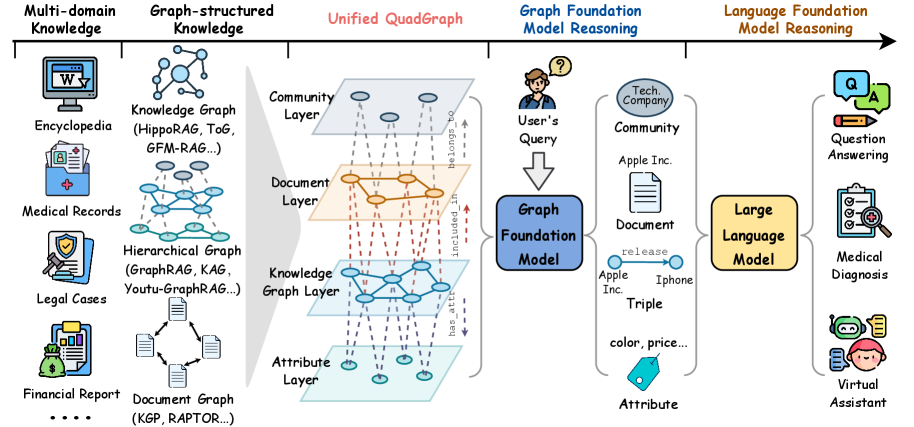
Figure 1: The overall framework of G-reasoner. First, G-reasoner provides a unified graph interface, QuadGraph, that integrates diverse graph-structured knowledge from different domains into a standard format. Then, it adopts a GNN-powered foundation model to jointly reason over the graph-structured knowledge and make versatile predictions. Last, we enhance the LLMs with the graph reasoning results to improve the performance on downstream applications.
In this paper, we propose G-reasoner, which integrates graph and language foundation models to enable unified reasoning over diverse graph-structured knowledge, as shown in Figure 1. To reason over diverse graph structures, we first define a novel 4-layer graph structure, QuadGraph, which unifies heterogeneous graph-structured knowledge into a standardized format. This allows G-reasoner to flexibly adapt to various graph structures. With the unified QuadGraph, we further unleash the power of graph foundation models (GFM) powered by GNNs to jointly reason over the topology and text semantics of the graph. To support large-scale training and reasoning, we implement a mixed-precision training and propose a distributed message-passing mechanism, allowing G-reasoner to scale effectively across multiple GPUs and datasets.
Finally, we derive a 34M-parameter GFM that efficiently captures complex relationships and dependencies within the knowledge to make versatile predictions on graphs. The graph reasoning results can be flexibly integrated with LLMs to enhance their reasoning in downstream applications. Experiments on six benchmark datasets demonstrate that G-reasoner achieves superior performance over state-of-the-art baselines and significantly boosts the performance of LLMs on complex reasoning tasks. Moreover, G-reasoner exhibits strong efficiency and generalization capabilities across various graph structures, making it a versatile solution for real-world applications.
The main contributions of this work are summarized as follows:
- We propose G-reasoner, a novel framework that integrates graph and language foundation models to enable unified reasoning over diverse graph-structured knowledge.
- We develop a 34M parameters graph foundation model that jointly reasons over the graph topology and text semantics, and implement a distributed message-passing mechanism to support large-scale training and reasoning.
- We conduct extensive experiments on six benchmark datasets, demonstrating that G-reasoner achieves superior performance over state-of-the-art baselines and exhibits strong efficiency and generalization capabilities across various graph structures and domains.
2 Related Work
Graph Construction. Graph construction is key for graph-based reasoning. Early methods like KGP (Wang et al., 2024) use hyperlinks and KNN similarity, but miss semantic associations. RAPTOR (Sarthi et al., 2024) builds hierarchical trees via recursive summarization. GraphRAG (MS) (Edge et al., 2024) use LLMs to extract entities and relations, forming hierarchical graphs with community detection and summarization. LightRAG (Guo et al., 2024), ArchRAG (Wang et al., 2025) and Youtu-GraphRAG (Dong et al., 2025) further enrich graph structures with attributes and documents. HippoRAG 1 & 2 (Jimenez Gutierrez et al., 2024; Gutiérrez et al., 2025) apply OpenIE to induce knowledge graphs capturing factual relationships. Despite their achievements, these methods are typically tailored for specific graph structures, and thus exhibit limited generalizability across different types of graphs. For example, the hierarchical graphs constructed by GraphRAG (MS) (Edge et al., 2024) and LightRAG (Guo et al., 2024) are primarily designed for summarization tasks, and may not be suitable for multi-hop reasoning tasks compared to the knowledge graphs used in HippoRAG (Jimenez Gutierrez et al., 2024).
Graph-enhanced Reasoning. Graph-enhanced reasoning seeks to enable LLMs to reason on the graph-structured knowledge and improve their performance on knowledge-intensive applications. HippoRAG (Jimenez Gutierrez et al., 2024) adopts personalized PageRank to support efficient retrieval on knowledge graphs. LightRAG (Guo et al., 2024) employs a dual-level retrieval strategy with both the embedding-based retrieval and graph-based neighborhood expansion. However, these graph search-based methods still fall short of fully exploiting the power of foundation models for reasoning. Agent-based methods, such as ToG (Sun et al., 2024), KAG (Liang et al., 2025), and Youtu-GraphRAG (Dong et al., 2025) employ LLM agents to iteratively interact with graphs to conduct reasoning. Despite the effectiveness, these methods often incur substantial computational costs and suffer from high latency due to the multiple invocations of LLMs. More recent efforts leverage graph neural network (GNNs) to reason over graphs and enhance LLMs Mavromatis & Karypis (2025b); He et al. (2024); Li et al. (2025a). For example, GFM-RAG (Luo et al., 2025) proposes a graph foundation model powered by GNNs designed to enable reasoning over different knowledge graphs. However, these approaches remain tailored for specific graphs and cannot generalize well across diverse types of graph structure. More detailed related work can be found in Appendix A.
3 Preliminary
In this section, we formally define the problem of reasoning over graph-structured knowledge with LLMs, which can be unified into a two-stage framework: (1) graph structure construction and (2) graph-enhanced retrieval and LLM reasoning. Specifically, given a set of documents ${\mathcal{D}}$ , we first extract the knowledge and construct a structured graph ${\mathcal{G}}=({\mathcal{V}},{\mathcal{E}})$ , such as knowledge graph (Jimenez Gutierrez et al., 2024) and document graph (Wang et al., 2024). The ${\mathcal{V}}$ denotes the set of nodes (e.g., entity and document) and ${\mathcal{E}}$ denotes the edges that model the connection between knowledge, facilitating efficient retrieval and reasoning. Based on the constructed graph ${\mathcal{G}}$ and a user query $q$ , we aim to retrieve the relevant knowledge from ${\mathcal{G}}$ and reason the final answer $a$ with LLMs. The general pipeline can be formulated as:
$$
\displaystyle{\mathcal{G}} \displaystyle=\texttt{GraphConstructor}({\mathcal{D}}), \displaystyle a \displaystyle=\texttt{LLM}(\texttt{Retriever}(q,{\mathcal{G}})). \tag{1}
$$
4 Approach
The proposed G-reasoner aims to design a foundation model that unifies the reasoning on diverse graph structures, enabling more effective and efficient reasoning over graph-structured knowledge with LLMs. The overall framework of G-reasoner is illustrated in Figure 1, which consists of three main components: (1) a unified graph interface, QuadGraph, that standardizes diverse graph-structured knowledge from different domains into a unified format; (2) a GNN-powered foundation model that jointly reasons over the graph-structured knowledge and makes versatile predictions; and (3) an LLM-enhanced reasoning that incorporates the graph reasoning results to improve performance on downstream applications. In the following, we will introduce each component in detail.
4.1 Unified Graph Interface: QuadGraph
The real-world knowledge is often complex and multi-relational, which can be naturally represented as graph structures (Hogan et al., 2021; Safavi & Koutra, 2021). To effectively leverage graph-structured knowledge for reasoning, existing methods typically construct different types of graphs based on the specific characteristics of knowledge and requirements of downstream tasks. For example, knowledge graphs (Jimenez Gutierrez et al., 2024) are often used to represent factual information between entities, while document graphs (Wang et al., 2024) are used to capture the relationships between documents based on their content similarity or citation links. However, these methods usually focus on a specific type of graph structure, which limits their applicability to other types of graph-structured knowledge and hinders the generalization of reasoning models.
<details>
<summary>x2.png Details</summary>
### Visual Description
## Diagram: Unified QuadGraph
### Overview
The image is a diagram titled "Unified QuadGraph". It's a 2x2 grid, dividing the space into four layers: Knowledge Graph Layer, Document Layer, Community Layer, and Attribute Layer. Each layer contains several components, represented as rounded rectangles or shapes, indicating different modules or systems. The diagram illustrates the relationships and categorization of these components within the QuadGraph framework.
### Components/Axes
* **Title:** Unified QuadGraph (located at the top center)
* **Layers (Grid Sections):**
* Top-Left: Knowledge Graph Layer
* Top-Right: Document Layer
* Bottom-Left: Community Layer
* Bottom-Right: Attribute Layer
* **Components (Rounded Rectangles/Shapes):**
* HippoRAG 1 (Knowledge Graph Layer)
* HippoRAG 2 (Knowledge Graph Layer)
* GFM-RAG (Knowledge Graph Layer)
* LightRAG (Knowledge Graph Layer)
* Graph RAG (MS) (Knowledge Graph Layer)
* RAPTOR (Document Layer)
* KGP (Document Layer)
* KAG (Spans Knowledge Graph and Document Layers)
* ArchRAG (Spans Community and Attribute Layers)
* Youtu-Graphrag (Community Layer)
### Detailed Analysis
* **Knowledge Graph Layer (Top-Left):** Contains "HippoRAG 1", "HippoRAG 2", "GFM-RAG", "LightRAG", and "Graph RAG (MS)". All components are in a light blue box with rounded corners.
* **Document Layer (Top-Right):** Contains "RAPTOR" and "KGP". Both components are in a light orange box with rounded corners.
* **Community Layer (Bottom-Left):** Contains "Youtu-Graphrag". The component is in a light blue box with rounded corners.
* **Attribute Layer (Bottom-Right):** Contains "ArchRAG". The component is in a light blue box with rounded corners.
* **Overlapping Components:** "KAG" spans both the Knowledge Graph Layer and the Document Layer. "ArchRAG" spans both the Community Layer and the Attribute Layer. Both components are in a light blue box with rounded corners.
### Key Observations
* The diagram categorizes different modules or systems into four distinct layers.
* Some components span multiple layers, indicating a relationship or interaction between those layers.
* The use of rounded rectangles suggests that these are individual modules or components.
### Interpretation
The "Unified QuadGraph" diagram provides a high-level overview of the architecture or organization of a system. The four layers (Knowledge Graph, Document, Community, and Attribute) represent different aspects or functionalities of the system. The components within each layer are specific modules or systems that contribute to that layer's functionality. The overlapping components ("KAG" and "ArchRAG") suggest that these modules interact with or utilize resources from multiple layers, indicating a more complex or integrated role within the overall system. The diagram is useful for understanding the relationships between different components and their roles within the QuadGraph framework.
</details>
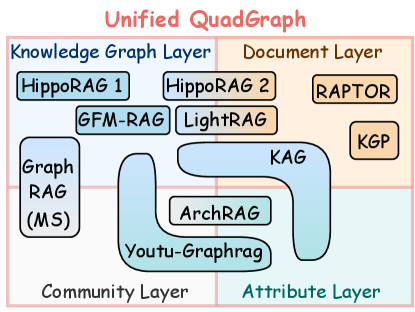
Figure 2: Illustration of QuadGraph for unifying existing graph-structured knowledge.
To address this limitation, G-reasoner proposes a unified graph interface called QuadGraph that standardizes diverse graph-structured knowledge from different domains into a unified format. Specifically, we design a 4-layer graph structure that consists of the following layers: (1) attribute layer that captures the common attributes of the nodes; (2) knowledge graph layer that represents the entities and their relationships as triples, which stores the structured factual knowledge; (3) document layer that contains the unstructured textual information, such as documents and passages; and (4) community layer that groups related nodes into communities based on their semantic similarity or structural connectivity to provide global level information. As shown in Figure 2, the QuadGraph can effectively unify various types of graph-structured knowledge, such as knowledge graphs (Jimenez Gutierrez et al., 2024), document graphs (Wang et al., 2024), and hierarchical graphs (Edge et al., 2024; Liang et al., 2025; Dong et al., 2025), into a standard format, facilitating the design of generalizable reasoning models.
Definition. The QuadGraph is defined as ${\mathcal{G}}=({\mathcal{V}},{\mathcal{E}},{\mathcal{R}},{\mathcal{T}},{\mathcal{S}})$ , where ${\mathcal{T}}=\{\texttt{attribute},\texttt{entity},\texttt{document},\texttt{community}\}$ denotes the set of node types, ${\mathcal{R}}$ denotes the set of edge types that model the relations between nodes, (e.g., $\texttt{born\_in},\texttt{city\_of}$ ) and special relations across layers, (e.g., $\texttt{has\_attribute},\texttt{included\_in},\texttt{belongs\_to}$ ). The edges in the graph are formulated as ${\mathcal{E}}=\{(v,r,v^{\prime})|\{t_{v},t_{v^{\prime}}\}∈{\mathcal{T}},r∈{\mathcal{R}}\}$ , where $t_{v}$ denotes the type of node $v$ . The ${\mathcal{S}}$ denotes the set of node semantic features, such as the name of an entity or the text content of a document.
4.2 Graph Foundation Model Reasoning
To effectively reason over the unified graph-structured knowledge, G-reasoner proposes a GNN-powered foundation model that jointly reasons over the QuadGraph and makes versatile predictions. Graph neural networks (GNNs) (Mavromatis & Karypis, 2025a; He et al., 2024) have shown great success in reasoning over graph-structured data due to their ability of capturing complex relationships and dependencies between nodes. Recently, GFM-RAG (Luo et al., 2025) proposes a graph foundation model (GFM) for reasoning over knowledge graphs, which demonstrates the effectiveness of GNNs in enhancing LLMs with structured knowledge.
However, GFM-RAG is specifically designed for knowledge graphs and cannot be directly applied to other types of graph-structured knowledge with versatile node types and rich text semantics, such as document graphs or hierarchical graphs. To address this limitation, G-reasoner further unleashes the power of GNNs by designing a more generalizable GFM that (1) synergizes graph topology and text semantics for reasoning and (2) enables versatile predictions on arbitrary node types.
Synergized Reasoning over Structure and Semantics. G-reasoner adopts the query-dependent GNN (Galkin et al., 2024; Luo et al., 2025) as the backbone of the GFM, which can capture the complex relationships and dependencies between query and knowledge on the graph. Unlike GFM-RAG (Luo et al., 2025) that only considers the semantics of relations, G-reasoner further incorporates the rich text semantics of nodes ${\mathcal{S}}$ into the reasoning process.
Given a graph ${\mathcal{G}}$ , we first encode the text features of each node $s_{v}∈{\mathcal{S}}$ into node embeddings ${\bm{h}}_{v}∈{\mathbb{R}}^{d}$ using a pre-trained text embedding model (e.g., BGE (Chen et al., 2024), Qwen3 Embedding model (Zhang et al., 2025b)). The relation embeddings ${\bm{h}}_{r}∈{\mathbb{R}}^{d}$ are also initialized using the same text embedding model to encode the text description of each relation $r∈{\mathcal{R}}$ . With the help of text embeddings, we can effectively capture the semantic information in the graph and unify them into the same embedding space, facilitating the following reasoning.
During the reasoning, the graph ${\mathcal{G}}$ together with the user’s query $q$ are input into the GFM. The model first encodes the query into a query embedding ${\bm{h}}_{q}∈{\mathbb{R}}^{d}$ using the same text embedding model to understand the user’s intent and align it with the graph knowledge. Then, a $L$ -layer query-dependent GNN is applied to jointly reason over the graph topology and text semantics via message-passing and make versatile predictions of each node type, which can be formulated as:
$$
\displaystyle{\bm{h}}_{v}^{0} \displaystyle=\texttt{Init}({\bm{h}}_{v},\bm{1}_{v\in{\mathcal{V}}_{q}}*{\bm{h}}_{q}),v\in{\mathcal{V}}, \displaystyle{\bm{h}}_{v}^{l} \displaystyle=\texttt{Update}\left({\bm{h}}_{v}^{l-1},\texttt{Agg}\left(\{\texttt{Msg}({\bm{h}}_{v}^{l-1},{\bm{h}}_{r}^{l},{\bm{h}}^{l-1}_{v^{\prime}})|(v,r,v^{\prime})\in{\mathcal{E}}\}\right)\right),l\in[1,L], \displaystyle p(v) \displaystyle=\texttt{Predictor}_{t_{v}}({\bm{h}}_{v}^{L},{\bm{h}}_{v},{\bm{h}}_{q}), \tag{3}
$$
where ${\bm{h}}_{v}^{l}$ denotes the embedding of node $v$ at the $l$ -th GNN layer, the Init function initializes the node embedding by combining the original node embedding ${\bm{h}}_{v}$ and the query embedding ${\bm{h}}_{q}$ if the node $v$ is in the query-related nodes ${\mathcal{V}}_{q}$ with a single MLP layer.
At each GNN layer, the Msg function uses DistMult (Yang et al., 2015) to generate the message from the neighbors based on their nodes embeddings ${\bm{h}}^{l-1}_{v}$ , ${\bm{h}}^{l-1}_{v^{\prime}}$ and relation embedding ${\bm{h}}^{l}_{r}$ , which are then aggregated by the Agg function (e.g., sum). The Update function updates the target node embedding ${\bm{h}}_{v}^{l}$ by combining its previous embedding and the aggregated messages using another MLP, and relation embeddings are also updated with a layer-specific MLP, i.e., ${\bm{h}}^{l}_{r}=g^{l}({\bm{h}}_{r})$ .
Finally, a type-specific predictor $\texttt{Predictor}_{t_{v}}$ is applied to make versatile predictions for each node based on its final embedding ${\bm{h}}_{v}^{L}$ , original text embedding ${\bm{h}}_{v}$ , and query embedding ${\bm{h}}_{q}$ . The predictor can be designed as a binary classifier for arbitrary node types $t∈{\mathcal{T}}$ , such as entity nodes in the knowledge graph layer or document nodes in the document layer, to predict whether the node is relevant to the query.
Optimization. The GFM conducts unified reasoning by integrating the graph topology $({\mathcal{V}},{\mathcal{E}})$ and text semantics ${\mathcal{S}}$ in ${\mathcal{G}}$ to predict the relevance of nodes to the query. The GFM $\theta$ is optimized by maximizing the likelihood of the ground-truth relevant nodes ${\mathcal{V}}^{+}_{q}$ , which can be formulated as:
$$
{\mathcal{O}}(\theta)=\sum_{v\in{\mathcal{V}}^{+}_{q}}\log p_{\theta}(v|q,{\mathcal{G}}), \tag{6}
$$
where the ${\mathcal{V}}^{+}_{q}$ denotes the set of labeled relevant nodes for the query $q$ that can be of arbitrary types $t∈{\mathcal{T}}$ . However, the scarcity of labeled nodes $|{\mathcal{V}}^{+}_{q}|\ll|{\mathcal{V}}|$ makes it difficult to capture the complex relationships between the query and knowledge on the graph.
To mitigate this challenges, we propose to train the GFM on large-scale datasets with weak supervision by leveraging the abundant unlabeled nodes on the graph. The pre-trained text embedding models (Devlin et al., 2019) have shown strong semantic understanding and can effectively capture the relevance between the query and nodes based on their text features ${\mathcal{S}}$ . Therefore, we propose to leverage the pre-trained text embedding model as a teacher to provide pseudo-labels for all nodes on the graph, which can be formulated as:
$$
p_{\phi}({\mathcal{V}}|q,{\mathcal{S}})=\texttt{Sigmoid}({\bm{H}}_{\mathcal{V}}^{\top}{\bm{h}}_{q}), \tag{7}
$$
where ${\bm{h}}_{q}$ denotes the query embedding and ${\bm{h}}_{v}∈{\bm{H}}_{\mathcal{V}}$ denotes the text embeddings of all nodes encoded by the pre-trained text encoder $\phi$ , which is frozen during training.
Following the knowledge distillation (Hinton et al., 2015), we train the GFM $\theta$ as a student to minimize the KL divergence between the pseudo-label distribution $p_{\phi}({\mathcal{V}}|q,{\mathcal{S}})$ and the prediction distribution $p_{\theta}({\mathcal{V}}|q,{\mathcal{G}})$ over all nodes. As they both follow the Bernoulli distribution, the KL divergence can be efficiently calculated as:
$$
D_{\mathrm{KL}}(p_{\phi}({\mathcal{V}}|q,{\mathcal{S}})||p_{\theta}({\mathcal{V}}|q,{\mathcal{G}}))=\sum_{v\in{\mathcal{V}}}=p_{\phi}(v)\log\frac{p_{\phi}(v)}{p_{\theta}(v)}+(1-p_{\phi}(v))\frac{1-p_{\phi}(v)}{1-p_{\theta}(v)}, \tag{8}
$$
where $p_{\phi}(v)=p_{\phi}(v|q,{\bm{h}}_{v})$ and $p_{\theta}(v)=p_{\theta}(v|q,{\mathcal{G}})$ .
The final unified objective of the GFM training can be formulated as:
$$
{\mathcal{O}}(\theta)=\sum_{v\in{\mathcal{V}}^{+}_{q}}\log p_{\theta}(v|q,{\mathcal{G}})-\lambda D_{\mathrm{KL}}(p_{\phi}({\mathcal{V}}|q,{\mathcal{S}})||p_{\theta}({\mathcal{V}}|q,{\mathcal{G}})), \tag{9}
$$
where $\lambda$ is a hyper-parameter that balances the two terms. The unified objective not only distill the semantic understanding from the pre-trained text encoder into the GFM but also alleviate the issue of scarce labeled data by leveraging the pseudo-label distribution over the graph. Empirical experiments in Section 5.4 demonstrate the effectiveness of the proposed objectives.
Large-scale Training and Reasoning. To enable the generalizable reasoning ability over diverse graph-structured knowledge, G-reasoner is trained on large-scale datasets with weak supervision. Specifically, we collect a large number of query-graph pairs $\{(q_{i},{\mathcal{V}}^{+}_{q_{i}},{\mathcal{G}}_{i})\}_{i=1}^{N}$ from various domains (Luo et al., 2025), where graphs ${\mathcal{G}}$ are constructed with diverse graph constructors (e.g., knowledge graphs (Jimenez Gutierrez et al., 2024), document graphs (Gutiérrez et al., 2025), hierarchical graphs (Dong et al., 2025)) and unified into the QuadGraph interface introduced in Section 4.1. The weak supervision ${\mathcal{V}}^{+}_{q_{i}}$ is obtained by labeling the relevant nodes for each query $q_{i}$ , such as answer entities or supporting documents. The GFM is then trained by optimizing the unified objective in eq. 9 over the collected dataset, which can effectively capture the complex relationships between the query and knowledge on the graph and generalize to various types of graph-structured knowledge.
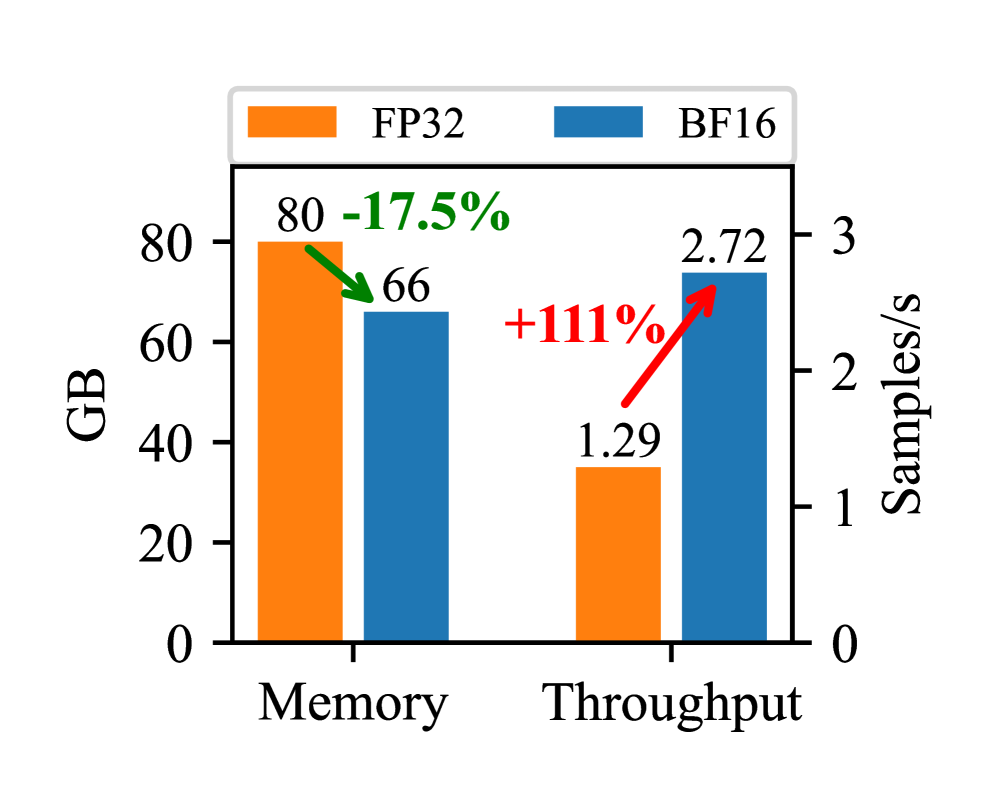
To support large-scale training and reasoning, we first enable mixed precision training, yielding an 2.1 times increase in training throughput and a 17.5% reduction in GPU memory. To further scale up the model and graph size, we implement a distributed message-passing mechanism that enables distributed training and reasoning across multiple GPUs. Specifically, we partition the full graph into balanced subgraphs using the METIS algorithm (Karypis & Kumar, 1997), with each device storing only a subset of the graph in memory. During the message-passing, each device first aggregates information locally and then exchanges messages with other devices to finalize the node embedding updates. Thus, the memory complexity of G-reasoner per device is $O((|{\mathcal{V}}|/N)*d)$ , where $N$ denotes the number of devices and $d$ denotes the latent dimension. This design allows G-reasoner to scale effectively to larger graphs and model size by leveraging more GPUs. Detailed implementation and efficiency analysis are provided in Sections C.2 and C.3 and Section 5.5.
4.3 Language Foundation Model Reasoning
With the unified QuadGraph and GNN-powered foundation model, G-reasoner can efficiently reason over the graph-structured knowledge and provide versatile predictions for arbitrary node types, such as attributes, entities, documents, and communities. This enables G-reasoner to flexibly select the most relevant information from different layers of the graph at varying granularities, enhancing LLM reasoning and boosting performance in downstream applications.
Specifically, given a user’s query $q$ , the GFM first reasons over the QuadGraph ${\mathcal{G}}$ and predicts the relevance score $p(v)$ for each node $v∈{\mathcal{V}}$ . Then, the top- $k$ relevant nodes of each type ${\mathcal{V}}^{k}_{q}=\{{\mathcal{V}}_{q,t}^{k}|t∈{\mathcal{T}}\}$ are selected based on the predicted scores to provide the most relevant information and enhance LLM reasoning, which can be formulated as:
$$
\displaystyle{\mathcal{V}}^{k}_{q,t}=\texttt{Top-k}\{(p(v)|v\in{\mathcal{V}},t_{v}=t)\}, \displaystyle a=\texttt{LLM}(\texttt{Prompt}(q,{\mathcal{V}}^{k}_{q})),{\mathcal{V}}^{k}_{q}=\{{\mathcal{V}}_{q,t}^{k}|t\in{\mathcal{T}}\}. \tag{10}
$$
where $\texttt{Prompt}(·)$ denotes the prompt template that formats the query and information from the selected nodes ${\mathcal{V}}^{k}_{q}$ into a prompt, which is then input into the LLM (e.g., GPT-4 (Achiam et al., 2023), DeepSeek (Liu et al., 2024)) to generate the final answer $a$ . Detailed prompt templates are provided in Figure 7.
5 Experiment
In experiments, we aim to answer the following research questions: RQ1: Can G-reasoner achieve state-of-the-art performance on reasoning over graph-structured knowledge? RQ2: Can G-reasoner effectively generalize across different graph structures? RQ3: How do the key components of G-reasoner contribute to its overall performance? RQ4: How efficient is G-reasoner in terms of training and inference?
Table 1: Statistics of the evaluation datasets.
| Dataset | # Query | # Document |
| --- | --- | --- |
| HotpotQA (Yang et al., 2018) | 1,000 | 9,221 |
| MuSiQue (Trivedi et al., 2022) | 1,000 | 6,119 |
| 2Wiki (Ho et al., 2020) | 1,000 | 11,656 |
| G-bench (Novel) (Xiang et al., 2025) | 2,010 | 461 |
| G-bench (Medical) (Xiang et al., 2025) | 2,062 | 2,406 |
| G-bench (CS) (Xiao et al., 2025) | 1,018 | 24,534 |
5.1 Experimental Setup
Datasets. We first evaluate the effectiveness of G-reasoner on three widely-used multi-hop QA datasets, including HotpotQA (Yang et al., 2018), MuSiQue (Trivedi et al., 2022), and 2WikiMultiHopQA (2Wiki) (Ho et al., 2020), following the settings used in Jimenez Gutierrez et al. (2024); Gutiérrez et al. (2025); Luo et al. (2025) for a fair comparison. To further assess the generalization ability of G-reasoner across domains, we employ three GraphRAG benchmarks: G-bench (Novel) (Xiang et al., 2025), G-bench (Medical) (Xiang et al., 2025), and G-bench (CS) (Xiao et al., 2025) to evaluate G-reasoner on complex reasoning across medical, novel, and computer science (CS) knowledge. The statistics of the datasets are summarized in Table 1. More details about datasets can be found in Appendix B.
Baselines. We compare with two groups of baselines: (1) Non-structure methods: BM25 (Robertson & Walker, 1994), ColBERTv2 (Santhanam et al., 2022), Qwen3-Emb-8B (Zhang et al., 2025b); (2) Graph-enhanced methods: RAPTOR (Sarthi et al., 2024), GraphRAG (MS) (Edge et al., 2024), LightRAG (Guo et al., 2024), KAG (Liang et al., 2025), HippoRAG 1 & 2 (Jimenez Gutierrez et al., 2024; Gutiérrez et al., 2025), SubgraphRAG (Li et al., 2025a), G-retriever (He et al., 2024), and GFM-RAG (Luo et al., 2025).
Metrics. For QA reasoning performance, we use the exact match (EM) and F1 score on multi-hop QA following previous works (Jimenez Gutierrez et al., 2024; Luo et al., 2025) and accuracy (ACC) on G-benchs following their settings (Xiang et al., 2025; Xiao et al., 2025). For retrieval performance, we use document recall@2 (R@2) and recall@5 (R@5) for multi-hop QA and evidence recall (Recall) for G-benchs (Xiang et al., 2025) as evaluation metrics.
Implementation Details. We gather the training data from Luo et al. (2025), which consists of 277,839 query samples and 2,972,931 documents, and we construct diverse graph structures using Jimenez Gutierrez et al. (2024); Gutiérrez et al. (2025); Guo et al. (2024); Dong et al. (2025) to train our GFM. We use GPT-4o-mini as the reasoning LLM. More training and implementation details can be found in Appendix C.
5.2 Main Results (RQ1)
Table 2: QA reasoning performance comparison. GPT-4o-mini is used as the LLM for reasoning.
| | HotpotQA | MuSiQue | 2Wiki | G-bench (Novel) | G-bench (Medical) | G-bench (CS) | | | |
| --- | --- | --- | --- | --- | --- | --- | --- | --- | --- |
| Method | EM | F1 | EM | F1 | EM | F1 | ACC | ACC | ACC |
| Non-structure Methods | | | | | | | | | |
| None (GPT-4o-mini) (OpenAI, 2024) | 28.6 | 41.0 | 11.2 | 36.3 | 30.2 | 36.3 | 51.4 | 67.1 | 70.7 |
| BM25 (Robertson & Walker, 1994) | 52.0 | 63.4 | 20.3 | 28.8 | 47.9 | 51.2 | 56.5 | 68.7 | 71.7 |
| ColBERTv2 (Santhanam et al., 2022) | 43.4 | 57.7 | 15.5 | 26.4 | 33.4 | 43.3 | 56.2 | 71.8 | 71.9 |
| Qwen3-Emb (8B) (Zhang et al., 2025b) | 53.4 | 67.6 | 31.9 | 44.1 | 57.2 | 63.2 | 56.2 | 70.4 | 73.5 |
| Graph-enhanced Methods | | | | | | | | | |
| RAPTOR (Sarthi et al., 2024) | 50.6 | 64.7 | 27.7 | 39.2 | 39.7 | 48.4 | 43.2 | 57.1 | 73.6 |
| GraphRAG (MS) (Edge et al., 2024) | 51.4 | 67.6 | 27.0 | 42.0 | 34.7 | 61.0 | 50.9 | 45.2 | 72.5 |
| LightRAG (Guo et al., 2024) | 9.9 | 20.2 | 2.0 | 9.3 | 2.5 | 12.1 | 45.1 | 63.9 | 71.2 |
| KAG (Liang et al., 2025) | 59.5 | 72.2 | 33.8 | 46.0 | 67.3 | 75.1 | - | - | - |
| HippoRAG (Jimenez Gutierrez et al., 2024) | 46.3 | 60.0 | 24.0 | 35.9 | 59.4 | 67.3 | 44.8 | 59.1 | 72.6 |
| HippoRAG 2 (Gutiérrez et al., 2025) | 56.3 | 71.1 | 35.0 | 49.3 | 60.5 | 69.7 | 56.5 | 64.9 | - |
| SubgraphRAG (Li et al., 2025a) | 44.5 | 57.0 | 25.1 | 35.7 | 62.7 | 69.0 | - | - | - |
| G-retriever (He et al., 2024) | 41.4 | 53.4 | 23.6 | 34.3 | 33.5 | 39.6 | - | - | 69.8 |
| GFM-RAG (Luo et al., 2025) | 56.2 | 69.5 | 30.2 | 49.2 | 69.8 | 77.7 | - | - | 72.1 |
| G-reasoner | 61.4 | 76.0 | 38.5 | 52.5 | 74.9 | 82.1 | 58.9 | 73.3 | 73.9 |
QA Reasoning Results. Table 2 shows QA results on six datasets requiring complex reasoning. G-reasoner consistently outperforms all baselines across these datasets, proving its effectiveness in reasoning over graph-structured knowledge in various domains. Non-structure methods (e.g., BM25, ColBERTv2, Qwen3-Emb) perform poorly on multi-hop QA due to their inability to capture knowledge structure. Graph-enhanced methods (e.g., HippoRAG) generally outperform non-structure methods by leveraging graph structures. However, some approaches relying on specifically designed graphs and heuristic searches (e.g., GraphRAG, LightRAG) struggle to generalize across different datasets and tasks (e.g., G-bench). While the GNN-based GFM-RAG performs well on multi-hop QA, it also underperforms on G-bench datasets, likely due to limited generalization of GNNs across diverse graph structures. In contrast, G-reasoner achieves the best performance across all datasets, demonstrating superior reasoning and generalization capabilities.
Retrieval Results. Table 3 shows retrieval results on multi-hop QA and G-bench datasets. G-reasoner consistently delivers the best performance across all datasets, demonstrating its effectiveness in retrieving relevant information from graph-structured knowledge. Although advanced embedding-based methods (e.g., Qwen3-Emb) perform well by leveraging large-scale pre-training to capture semantic similarity, they still fall short of graph-enhanced approaches on some datasets. This underscores the importance of utilizing graph topology for effective retrieval in complex reasoning tasks beyond text semantics. Notably, G-reasoner significantly outperforms existing methods, highlighting the superior ability of our GFM to integrate graph topology and text semantics for efficient retrieval.
Table 3: Retrieval performance comparison. Recall@ $k$ (R@ $k$ ) is used for multi-hop QA datasets, and evidence recall (Recall) is used for G-bench (Xiang et al., 2025).
| | HotpotQA | MuSiQue | 2Wiki | G-bench (Novel) | G-bench (Medical) | | | |
| --- | --- | --- | --- | --- | --- | --- | --- | --- |
| Method | R@2 | R@5 | R@2 | R@5 | R@2 | R@5 | Recall | Recall |
| Non-structure Methods | | | | | | | | |
| BM25 (Robertson & Walker, 1994) | 55.4 | 72.2 | 32.3 | 41.2 | 51.8 | 61.9 | 82.1 | 87.9 |
| ColBERTv2 (Santhanam et al., 2022) | 64.7 | 79.3 | 37.9 | 49.2 | 59.2 | 68.2 | 82.4 | 89.5 |
| Qwen3-Emb (8B) (Zhang et al., 2025b) | 74.1 | 88.8 | 46.8 | 62.1 | 66.2 | 74.1 | 82.6 | 92.7 |
| Graph-enhanced Methods | | | | | | | | |
| RAPTOR (Sarthi et al., 2024) | 58.1 | 71.2 | 35.7 | 45.3 | 46.3 | 53.8 | 66.1 | 84.2 |
| GraphRAG (MS) (Edge et al., 2024) | 58.3 | 76.6 | 35.4 | 49.3 | 61.6 | 77.3 | 67.4 | 56.4 |
| LightRAG (Guo et al., 2024) | 38.8 | 54.7 | 24.8 | 34.7 | 45.1 | 59.1 | 79.6 | 82.6 |
| KAG (Liang et al., 2025) | 59.4 | 86.1 | 42.2 | 62.4 | 61.4 | 88.3 | - | - |
| HippoRAG (Jimenez Gutierrez et al., 2024) | 60.1 | 78.5 | 41.2 | 53.2 | 68.4 | 87.0 | 81.2 | 84.0 |
| HippoRAG 2 (Gutiérrez et al., 2025) | 80.5 | 95.7 | 53.5 | 74.2 | 80.5 | 95.7 | 66.2 | 73.6 |
| SubgraphRAG (Li et al., 2025a) | 58.1 | 71.7 | 40.6 | 48.1 | 70.2 | 85.3 | - | - |
| G-retriever (He et al., 2024) | 51.8 | 63.6 | 35.6 | 43.5 | 60.9 | 66.5 | - | - |
| GFM-RAG (Luo et al., 2025) | 75.6 | 89.6 | 43.5 | 57.6 | 79.1 | 92.4 | - | - |
| G-reasoner | 85.9 | 97.7 | 54.8 | 74.9 | 81.2 | 98.2 | 87.7 | 93.8 |
Table 4: Generalization of G-reasoner across different graph structures.
| Retriever | Graph Structure | QuadGraph Layer | HotpotQA | MuSiQue | 2Wiki | | | | | | |
| --- | --- | --- | --- | --- | --- | --- | --- | --- | --- | --- | --- |
| KG | Doc. | Attr. | Com. | EM | F1 | EM | F1 | EM | F1 | | |
| Personalized PageRank | HippoRAG | ✓ | - | - | - | 46.3 | 60.0 | 24.0 | 35.9 | 59.4 | 67.3 |
| Embedding+ Graph Search | LightRAG | ✓ | ✓ | - | - | 9.9 | 20.2 | 2.0 | 9.3 | 2.5 | 12.1 |
| G-reasoner | HippoRAG | ✓ | - | - | - | 54.0 | 68.3 | 28.9 | 41.0 | 72.0 | 80.0 |
| LightRAG | ✓ | ✓ | - | - | 49.7 | 62.0 | 25.3 | 35.9 | 59.4 | 64.4 | |
| Youtu-GraphRAG | ✓ | ✓ | ✓ | ✓ | 52.3 | 65.9 | 30.3 | 42.5 | 69.7 | 77.7 | |
5.3 Generalization Across Graph Structures (RQ2)
To evaluate the generalization ability of G-reasoner across different graph structures, we conduct experiments using various graph constructors, including HippoRAG (Jimenez Gutierrez et al., 2024), LightRAG (Guo et al., 2024), and Youtu-GraphRAG (Dong et al., 2025), whose statistics are presented in Table 8. The G-reasoner is directly tested on graphs generated by each constructor without further fine-tuning. As shown in Table 4, G-reasoner shows strong generalization ability across different graph structures, consistently outperforming the retrievers specifically designed for each graph type. This demonstrates the robustness and adaptability of G-reasoner in handling diverse graph-structured knowledge for reasoning tasks.
Table 5: Ablation studies of G-reasoner.
| Variant | HotpotQA | MuSiQue | 2Wiki | | | |
| --- | --- | --- | --- | --- | --- | --- |
| R@2 | R@5 | R@2 | R@5 | R@2 | R@5 | |
| G-reasoner | 81.1 | 96.9 | 52.1 | 72.4 | 75.6 | 96.1 |
| $w/o$ Distill | 77.4 | 96.1 | 50.7 | 71.9 | 75.9 | 96.0 |
| $w/o$ Text | 79.4 | 96.3 | 50.0 | 71.9 | 74.6 | 95.2 |
| $w/o$ GFM | 11.6 | 19.7 | 3.8 | 7.1 | 4.9 | 9.0 |
5.4 Ablation Study (RQ3)
In this section, we conduct an ablation study to assess the contributions of key components in G-reasoner. We evaluate the impact of (1) distillation loss (Distill), (2) node text semantics (Text), and (3) graph foundation model (GFM) on the performance of G-reasoner. The results are presented in Table 5. Removing the distillation loss leads to the performance drops on all datasets, indicating its importance in enhancing the GFM’s ability under weak supervision. Excluding node text semantics also results in performance degradation, highlighting the crucial role of textual information in reasoning tasks. Notably, removing the GFM causes a drastic drop in performance, underscoring its essential role in effectively integrating graph topology and text semantics for reasoning over graph-structured knowledge.
5.5 Efficiency Analysis (RQ4)
Table 6: Efficiency and performance comparison on G-bench (CS) (Xiao et al., 2025).
| | G-bench (CS) | |
| --- | --- | --- |
| Method | Time (s) | ACC |
| Agent-based Methods | | |
| KGP (Wang et al., 2024) | 89.4 | 71.9 |
| ToG (Sun et al., 2024) | 70.5 | 71.7 |
| DALK (Li et al., 2024) | 26.8 | 69.3 |
| Graph Search Methods | | |
| GraphRAG (MS) (Edge et al., 2024) | 44.9 | 72.5 |
| LightRAG (Guo et al., 2024) | 14.0 | 71.2 |
| HippoRAG (Jimenez Gutierrez et al., 2024) | 2.4 | 72.6 |
| GNN-based Methods | | |
| G-retriever (He et al., 2024) | 23.8 | 69.8 |
| GFM-RAG (Luo et al., 2025) | 2.0 | 72.1 |
| G-reasoner | 0.2 | 73.9 |
Inference Efficiency. We compare the inference efficiency (time per sample) of G-reasoner on G-bench (CS) (Xiao et al., 2025) with (1) agent-based, (2) graph search, and (3) GNN-based methods. As shown in Table 6, G-reasoner achieves the lowest latency and highest performance among all methods. This demonstrates the efficiency of our method for reasoning over graph-structured knowledge.
Training Efficiency. Mixed precision training enables G-reasoner to significantly reduce memory usage and improve training throughput. As shown in Figure 4, mixed precision training reduces memory consumption from 80GB to 66GB (-17.5%) and increases throughput from 1.29 to 2.72 samples/s (+111%) on a single A100 GPU. This allows G-reasoner to be trained efficiently on large-scale graph-structured knowledge with limited computational resources.
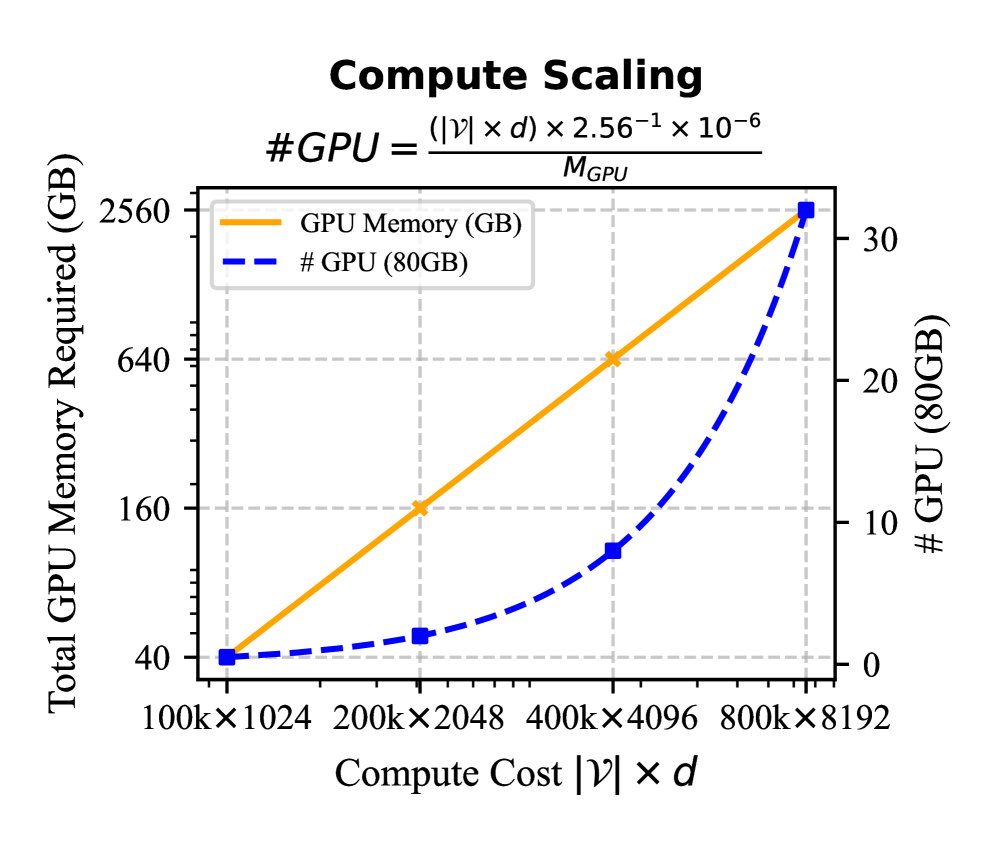
Compute Scaling. The compute cost of G-reasoner is defined as $|\mathcal{G}|× d$ which linearly grows with both the graph size $|\mathcal{G}|$ and the model’s hidden dimension $d$ . Thanks to the distributed message-passing mechanism, as shown in Figure 4, G-reasoner can efficiently scale to large graphs and larger model sizes with more computational resources. Detailed analysis of compute scaling can be found in Section D.2.
<details>
<summary>x3.png Details</summary>
### Visual Description
## Bar Chart: Memory and Throughput Comparison of FP32 vs BF16
### Overview
The image is a bar chart comparing the memory (GB) and throughput (Samples/s) performance of FP32 and BF16. The chart displays two sets of paired bars, one for memory and one for throughput, with FP32 represented in orange and BF16 in blue. Percentage changes are indicated with arrows and text.
### Components/Axes
* **Title:** (Implicit) Memory and Throughput Comparison of FP32 vs BF16
* **X-axis:** Categorical axis with two categories: "Memory" and "Throughput".
* **Left Y-axis:** Numerical axis labeled "GB" (Gigabytes), ranging from 0 to 80 in increments of 20.
* **Right Y-axis:** Numerical axis labeled "Samples/s", ranging from 0 to 3 in increments of 1.
* **Legend:** Located at the top of the chart, indicating "FP32" in orange and "BF16" in blue.
### Detailed Analysis
* **Memory (GB):**
* FP32 (orange bar): Value of 80 GB.
* BF16 (blue bar): Value of 66 GB.
* Change: A green arrow points downwards from the top of the FP32 bar to the top of the BF16 bar, indicating a -17.5% change.
* **Throughput (Samples/s):**
* FP32 (orange bar): Value of 1.29 Samples/s.
* BF16 (blue bar): Value of 2.72 Samples/s.
* Change: A red arrow points upwards from the top of the FP32 bar to the top of the BF16 bar, indicating a +111% change.
### Key Observations
* For Memory, FP32 (80 GB) is higher than BF16 (66 GB), with a decrease of 17.5% from FP32 to BF16.
* For Throughput, BF16 (2.72 Samples/s) is significantly higher than FP32 (1.29 Samples/s), with an increase of 111% from FP32 to BF16.
### Interpretation
The chart demonstrates a trade-off between memory usage and throughput when comparing FP32 and BF16. While FP32 requires more memory, BF16 offers significantly higher throughput. The -17.5% change in memory usage from FP32 to BF16 is accompanied by a +111% change in throughput, suggesting that BF16 is more efficient in terms of processing speed for the same memory footprint. This information is valuable for selecting the appropriate data type based on the specific application's requirements and resource constraints.
</details>
Figure 3: Memory and throughput gain brought by mixed precision training.
<details>
<summary>x4.png Details</summary>
### Visual Description
## Chart: Compute Scaling
### Overview
The image is a chart illustrating the compute scaling relationship between compute cost (|V| x d), total GPU memory required (GB), and the number of GPUs (80GB). The chart presents two data series: GPU Memory (GB) and # GPU (80GB), plotted against the compute cost.
### Components/Axes
* **Title:** Compute Scaling
* **Formula:** #GPU = ((|V| x d) x 2.56^-1 x 10^-6) / M\_GPU
* **X-axis:** Compute Cost |V| x d
* Scale: 100k x 1024, 200k x 2048, 400k x 4096, 800k x 8192
* **Left Y-axis:** Total GPU Memory Required (GB)
* Scale: 40, 160, 640, 2560
* **Right Y-axis:** # GPU (80GB)
* Scale: 0, 10, 20, 30
* **Legend:** Located in the top-left corner of the chart.
* Orange Line: GPU Memory (GB)
* Blue Dashed Line: # GPU (80GB)
### Detailed Analysis
* **GPU Memory (GB) - Orange Line:** The GPU Memory (GB) series exhibits a linear, upward trend.
* At Compute Cost 100k x 1024, GPU Memory is approximately 40 GB.
* At Compute Cost 200k x 2048, GPU Memory is approximately 160 GB.
* At Compute Cost 400k x 4096, GPU Memory is approximately 640 GB.
* At Compute Cost 800k x 8192, GPU Memory is approximately 2560 GB.
* **# GPU (80GB) - Blue Dashed Line:** The # GPU (80GB) series exhibits an exponential, upward trend.
* At Compute Cost 100k x 1024, # GPU is approximately 1.
* At Compute Cost 200k x 2048, # GPU is approximately 3.
* At Compute Cost 400k x 4096, # GPU is approximately 9.
* At Compute Cost 800k x 8192, # GPU is approximately 32.
### Key Observations
* The GPU Memory (GB) increases linearly with the Compute Cost.
* The # GPU (80GB) increases exponentially with the Compute Cost.
* The formula at the top of the chart defines the relationship between the number of GPUs, compute cost, and a constant factor.
### Interpretation
The chart demonstrates the scaling requirements for GPU memory and the number of GPUs as the compute cost increases. The linear increase in GPU memory suggests a direct proportionality, while the exponential increase in the number of GPUs indicates a more complex relationship, possibly due to parallelization or other architectural considerations. The formula provided gives the exact relationship between the variables. The chart is useful for estimating the hardware resources needed for different compute costs.
</details>
Figure 4: Compute scaling of G-reasoner.
6 Conclusion
In this paper, we present G-reasoner, a novel framework that synergizes graph foundation model and language foundation model for reasoning over graph-structured knowledge. With the proposed QuadGraph, G-reasoner unifies diverse graph types into a standardized four-layer graph structure. A GNN-powered graph foundation model is further developed to jointly reason over graph topology and text semantics, enabling versatile prediction on graphs and enhancing LLM reasoning. Extensive experiments on six complex reasoning benchmarks demonstrate that G-reasoner consistently outperforms state-of-the-art baselines, substantially improves LLM reasoning, and exhibits strong efficiency and cross-graph generalization. We believe G-reasoner would pave the road for future research in integrating graph and language foundation models for knowledge-intensive applications.
References
- Achiam et al. (2023) Josh Achiam, Steven Adler, Sandhini Agarwal, Lama Ahmad, Ilge Akkaya, Florencia Leoni Aleman, Diogo Almeida, Janko Altenschmidt, Sam Altman, Shyamal Anadkat, et al. Gpt-4 technical report. arXiv preprint arXiv:2303.08774, 2023.
- Chen et al. (2024) Jianlv Chen, Shitao Xiao, Peitian Zhang, Kun Luo, Defu Lian, and Zheng Liu. Bge m3-embedding: Multi-lingual, multi-functionality, multi-granularity text embeddings through self-knowledge distillation. arXiv preprint arXiv:2402.03216, 2024.
- Devlin et al. (2019) Jacob Devlin, Ming-Wei Chang, Kenton Lee, and Kristina Toutanova. Bert: Pre-training of deep bidirectional transformers for language understanding. In Proceedings of the 2019 conference of the North American chapter of the association for computational linguistics: human language technologies, volume 1 (long and short papers), pp. 4171–4186, 2019.
- Dong et al. (2025) Junnan Dong, Siyu An, Yifei Yu, Qian-Wen Zhang, Linhao Luo, Xiao Huang, Yunsheng Wu, Di Yin, and Xing Sun. Youtu-graphrag: Vertically unified agents for graph retrieval-augmented complex reasoning. arXiv preprint arXiv:2508.19855, 2025.
- Edge et al. (2024) Darren Edge, Ha Trinh, Newman Cheng, Joshua Bradley, Alex Chao, Apurva Mody, Steven Truitt, Dasha Metropolitansky, Robert Osazuwa Ness, and Jonathan Larson. From local to global: A graph rag approach to query-focused summarization. arXiv preprint arXiv:2404.16130, 2024.
- Fey et al. (2025) Matthias Fey, Jinu Sunil, Akihiro Nitta, Rishi Puri, Manan Shah, Blaz Stojanovic, Ramona Bendias, Barghi Alexandria, Vid Kocijan, Zecheng Zhang, Xinwei He, Jan E. Lenssen, and Jure Leskovec. Pyg 2.0: Scalable learning on real world graphs. In Temporal Graph Learning Workshop @ KDD, 2025.
- Galkin et al. (2024) Mikhail Galkin, Xinyu Yuan, Hesham Mostafa, Jian Tang, and Zhaocheng Zhu. Towards foundation models for knowledge graph reasoning. In The Twelfth International Conference on Learning Representations, 2024.
- Gao et al. (2023) Yunfan Gao, Yun Xiong, Xinyu Gao, Kangxiang Jia, Jinliu Pan, Yuxi Bi, Yi Dai, Jiawei Sun, and Haofen Wang. Retrieval-augmented generation for large language models: A survey. arXiv preprint arXiv:2312.10997, 2023.
- Guo et al. (2023) Jiayan Guo, Lun Du, Hengyu Liu, Mengyu Zhou, Xinyi He, and Shi Han. Gpt4graph: Can large language models understand graph structured data? an empirical evaluation and benchmarking. arXiv preprint arXiv:2305.15066, 2023.
- Guo et al. (2024) Zirui Guo, Lianghao Xia, Yanhua Yu, Tu Ao, and Chao Huang. Lightrag: Simple and fast retrieval-augmented generation. 2024.
- Gutiérrez et al. (2025) Bernal Jiménez Gutiérrez, Yiheng Shu, Weijian Qi, Sizhe Zhou, and Yu Su. From rag to memory: Non-parametric continual learning for large language models, 2025. URL https://arxiv.org/abs/2502.14802.
- Han et al. (2024) Haoyu Han, Yu Wang, Harry Shomer, Kai Guo, Jiayuan Ding, Yongjia Lei, Mahantesh Halappanavar, Ryan A Rossi, Subhabrata Mukherjee, Xianfeng Tang, et al. Retrieval-augmented generation with graphs (graphrag). arXiv preprint arXiv:2501.00309, 2024.
- He et al. (2024) Xiaoxin He, Yijun Tian, Yifei Sun, Nitesh Chawla, Thomas Laurent, Yann LeCun, Xavier Bresson, and Bryan Hooi. G-retriever: Retrieval-augmented generation for textual graph understanding and question answering. Advances in Neural Information Processing Systems, 37:132876–132907, 2024.
- Hinton et al. (2015) Geoffrey Hinton, Oriol Vinyals, and Jeff Dean. Distilling the knowledge in a neural network. arXiv preprint arXiv:1503.02531, 2015.
- Ho et al. (2020) Xanh Ho, Anh-Khoa Duong Nguyen, Saku Sugawara, and Akiko Aizawa. Constructing a multi-hop qa dataset for comprehensive evaluation of reasoning steps. In Proceedings of the 28th International Conference on Computational Linguistics, pp. 6609–6625, 2020.
- Hogan et al. (2021) Aidan Hogan, Eva Blomqvist, Michael Cochez, Claudia d’Amato, Gerard De Melo, Claudio Gutierrez, Sabrina Kirrane, José Emilio Labra Gayo, Roberto Navigli, Sebastian Neumaier, et al. Knowledge graphs. ACM Computing Surveys (Csur), 54(4):1–37, 2021.
- Jiang et al. (2025) Pengcheng Jiang, Siru Ouyang, Yizhu Jiao, Ming Zhong, Runchu Tian, and Jiawei Han. Retrieval and structuring augmented generation with large language models. In Proceedings of the 31st ACM SIGKDD Conference on Knowledge Discovery and Data Mining V. 2, pp. 6032–6042, 2025.
- Jimenez Gutierrez et al. (2024) Bernal Jimenez Gutierrez, Yiheng Shu, Yu Gu, Michihiro Yasunaga, and Yu Su. Hipporag: Neurobiologically inspired long-term memory for large language models. Advances in Neural Information Processing Systems, 37:59532–59569, 2024.
- Jin et al. (2024) Bowen Jin, Gang Liu, Chi Han, Meng Jiang, Heng Ji, and Jiawei Han. Large language models on graphs: A comprehensive survey. IEEE Transactions on Knowledge and Data Engineering, 2024.
- Jin et al. (2019) Qiao Jin, Bhuwan Dhingra, Zhengping Liu, William Cohen, and Xinghua Lu. PubMedQA: A dataset for biomedical research question answering. In Kentaro Inui, Jing Jiang, Vincent Ng, and Xiaojun Wan (eds.), Proceedings of the 2019 Conference on Empirical Methods in Natural Language Processing and the 9th International Joint Conference on Natural Language Processing (EMNLP-IJCNLP), pp. 2567–2577, Hong Kong, China, November 2019. Association for Computational Linguistics. doi: 10.18653/v1/D19-1259. URL https://aclanthology.org/D19-1259/.
- Kang et al. (2024) Xiaoxi Kang, Lizhen Qu, Lay-Ki Soon, Zhuang Li, and Adnan Trakic. Bridging law and data: Augmenting reasoning via a semi-structured dataset with irac methodology. arXiv preprint arXiv:2406.13217, 2024.
- Karypis & Kumar (1997) George Karypis and Vipin Kumar. Metis: A software package for partitioning unstructured graphs, partitioning meshes, and computing fill-reducing orderings of sparse matrices. 1997.
- Li et al. (2024) Dawei Li, Shu Yang, Zhen Tan, Jae Baik, Sukwon Yun, Joseph Lee, Aaron Chacko, Bojian Hou, Duy Duong-Tran, Ying Ding, et al. Dalk: Dynamic co-augmentation of llms and kg to answer alzheimer’s disease questions with scientific literature. In Findings of the Association for Computational Linguistics: EMNLP 2024, pp. 2187–2205, 2024.
- Li et al. (2025a) Mufei Li, Siqi Miao, and Pan Li. Simple is effective: The roles of graphs and large language models in knowledge-graph-based retrieval-augmented generation. In The Thirteenth International Conference on Learning Representations, 2025a.
- Li et al. (2025b) Zhuoqun Li, Xuanang Chen, Haiyang Yu, Hongyu Lin, Yaojie Lu, Qiaoyu Tang, Fei Huang, Xianpei Han, Le Sun, and Yongbin Li. Structrag: Boosting knowledge intensive reasoning of llms via inference-time hybrid information structurization. In The Thirteenth International Conference on Learning Representations, 2025b.
- Liang et al. (2025) Lei Liang, Zhongpu Bo, Zhengke Gui, Zhongshu Zhu, Ling Zhong, Peilong Zhao, Mengshu Sun, Zhiqiang Zhang, Jun Zhou, Wenguang Chen, Wen Zhang, and Huajun Chen. Kag: Boosting llms in professional domains via knowledge augmented generation. In Companion Proceedings of the ACM on Web Conference 2025, WWW ’25, pp. 334–343, New York, NY, USA, 2025. Association for Computing Machinery. ISBN 9798400713316. doi: 10.1145/3701716.3715240. URL https://doi.org/10.1145/3701716.3715240.
- Liu et al. (2024) Aixin Liu, Bei Feng, Bing Xue, Bingxuan Wang, Bochao Wu, Chengda Lu, Chenggang Zhao, Chengqi Deng, Chenyu Zhang, Chong Ruan, et al. Deepseek-v3 technical report. arXiv preprint arXiv:2412.19437, 2024.
- Luo et al. (2025) Linhao Luo, Zicheng Zhao, Gholamreza Haffari, Dinh Phung, Chen Gong, and Shirui Pan. Gfm-rag: graph foundation model for retrieval augmented generation. NeurIPS, 2025.
- Ma et al. (2025) Shengjie Ma, Chengjin Xu, Xuhui Jiang, Muzhi Li, Huaren Qu, Cehao Yang, Jiaxin Mao, and Jian Guo. Think-on-graph 2.0: Deep and faithful large language model reasoning with knowledge-guided retrieval augmented generation. In The Thirteenth International Conference on Learning Representations, 2025.
- Mavromatis & Karypis (2025a) Costas Mavromatis and George Karypis. GNN-RAG: Graph neural retrieval for efficient large language model reasoning on knowledge graphs. In Wanxiang Che, Joyce Nabende, Ekaterina Shutova, and Mohammad Taher Pilehvar (eds.), Findings of the Association for Computational Linguistics: ACL 2025, pp. 16682–16699, Vienna, Austria, July 2025a. Association for Computational Linguistics. ISBN 979-8-89176-256-5. doi: 10.18653/v1/2025.findings-acl.856. URL https://aclanthology.org/2025.findings-acl.856/.
- Mavromatis & Karypis (2025b) Costas Mavromatis and George Karypis. Gnn-rag: Graph neural retrieval for efficient large language model reasoning on knowledge graphs. In Findings of the Association for Computational Linguistics: ACL 2025, pp. 16682–16699, 2025b.
- Mousavi et al. (2024) Seyed Mahed Mousavi, Simone Alghisi, and Giuseppe Riccardi. Dyknow: dynamically verifying time-sensitive factual knowledge in llms. arXiv preprint arXiv:2404.08700, 2024.
- OpenAI (2024) OpenAI. Hello gpt-4o, 2024. URL https://openai.com/index/hello-gpt-4o/.
- Peng et al. (2024) Boci Peng, Yun Zhu, Yongchao Liu, Xiaohe Bo, Haizhou Shi, Chuntao Hong, Yan Zhang, and Siliang Tang. Graph retrieval-augmented generation: A survey. arXiv preprint arXiv:2408.08921, 2024.
- Robertson & Walker (1994) Stephen E Robertson and Steve Walker. Some simple effective approximations to the 2-poisson model for probabilistic weighted retrieval. In SIGIR’94: Proceedings of the Seventeenth Annual International ACM-SIGIR Conference on Research and Development in Information Retrieval, organised by Dublin City University, pp. 232–241. Springer, 1994.
- Safavi & Koutra (2021) Tara Safavi and Danai Koutra. Relational world knowledge representation in contextual language models: A review. In Proceedings of the 2021 Conference on Empirical Methods in Natural Language Processing, pp. 1053–1067, 2021.
- Santhanam et al. (2022) Keshav Santhanam, Omar Khattab, Jon Saad-Falcon, Christopher Potts, and Matei Zaharia. Colbertv2: Effective and efficient retrieval via lightweight late interaction. In Proceedings of the 2022 Conference of the North American Chapter of the Association for Computational Linguistics: Human Language Technologies, pp. 3715–3734, 2022.
- Sarthi et al. (2024) Parth Sarthi, Salman Abdullah, Aditi Tuli, Shubh Khanna, Anna Goldie, and Christopher D Manning. Raptor: Recursive abstractive processing for tree-organized retrieval. In The Twelfth International Conference on Learning Representations, 2024.
- Song et al. (2025) Zirui Song, Bin Yan, Yuhan Liu, Miao Fang, Mingzhe Li, Rui Yan, and Xiuying Chen. Injecting domain-specific knowledge into large language models: a comprehensive survey. arXiv preprint arXiv:2502.10708, 2025.
- Sun et al. (2024) Jiashuo Sun, Chengjin Xu, Lumingyuan Tang, Saizhuo Wang, Chen Lin, Yeyun Gong, Lionel Ni, Heung-Yeung Shum, and Jian Guo. Think-on-graph: Deep and responsible reasoning of large language model on knowledge graph. In The Twelfth International Conference on Learning Representations, 2024.
- Trivedi et al. (2022) Harsh Trivedi, Niranjan Balasubramanian, Tushar Khot, and Ashish Sabharwal. Musique: Multihop questions via single-hop question composition. Transactions of the Association for Computational Linguistics, 10:539–554, 2022.
- Wang et al. (2019) Minjie Wang, Da Zheng, Zihao Ye, Quan Gan, Mufei Li, Xiang Song, Jinjing Zhou, Chao Ma, Lingfan Yu, Yu Gai, Tianjun Xiao, Tong He, George Karypis, Jinyang Li, and Zheng Zhang. Deep graph library: A graph-centric, highly-performant package for graph neural networks. arXiv preprint arXiv:1909.01315, 2019.
- Wang et al. (2025) Shu Wang, Yixiang Fang, Yingli Zhou, Xilin Liu, and Yuchi Ma. Archrag: Attributed community-based hierarchical retrieval-augmented generation. arXiv preprint arXiv:2502.09891, 2025.
- Wang et al. (2024) Yu Wang, Nedim Lipka, Ryan A Rossi, Alexa Siu, Ruiyi Zhang, and Tyler Derr. Knowledge graph prompting for multi-document question answering. In Proceedings of the AAAI conference on artificial intelligence, volume 38, pp. 19206–19214, 2024.
- Wu et al. (2020) Zonghan Wu, Shirui Pan, Fengwen Chen, Guodong Long, Chengqi Zhang, and Philip S Yu. A comprehensive survey on graph neural networks. IEEE transactions on neural networks and learning systems, 32(1):4–24, 2020.
- Xiang et al. (2025) Zhishang Xiang, Chuanjie Wu, Qinggang Zhang, Shengyuan Chen, Zijin Hong, Xiao Huang, and Jinsong Su. When to use graphs in rag: A comprehensive analysis for graph retrieval-augmented generation. arXiv preprint arXiv:2506.05690, 2025.
- Xiao et al. (2025) Yilin Xiao, Junnan Dong, Chuang Zhou, Su Dong, Qian-wen Zhang, Di Yin, Xing Sun, and Xiao Huang. Graphrag-bench: Challenging domain-specific reasoning for evaluating graph retrieval-augmented generation. arXiv preprint arXiv:2506.02404, 2025.
- Yang et al. (2025) An Yang, Anfeng Li, Baosong Yang, Beichen Zhang, Binyuan Hui, Bo Zheng, Bowen Yu, Chang Gao, Chengen Huang, Chenxu Lv, et al. Qwen3 technical report. arXiv preprint arXiv:2505.09388, 2025.
- Yang et al. (2015) Bishan Yang, Scott Wen-tau Yih, Xiaodong He, Jianfeng Gao, and Li Deng. Embedding entities and relations for learning and inference in knowledge bases. In Proceedings of the International Conference on Learning Representations (ICLR) 2015, 2015.
- Yang et al. (2018) Zhilin Yang, Peng Qi, Saizheng Zhang, Yoshua Bengio, William Cohen, Ruslan Salakhutdinov, and Christopher D Manning. Hotpotqa: A dataset for diverse, explainable multi-hop question answering. In Proceedings of the 2018 Conference on Empirical Methods in Natural Language Processing, pp. 2369–2380, 2018.
- Zhang et al. (2025a) Nan Zhang, Prafulla Kumar Choubey, Alexander Fabbri, Gabriel Bernadett-Shapiro, Rui Zhang, Prasenjit Mitra, Caiming Xiong, and Chien-Sheng Wu. Sirerag: Indexing similar and related information for multihop reasoning. In The Thirteenth International Conference on Learning Representations, 2025a.
- Zhang et al. (2025b) Yanzhao Zhang, Mingxin Li, Dingkun Long, Xin Zhang, Huan Lin, Baosong Yang, Pengjun Xie, An Yang, Dayiheng Liu, Junyang Lin, et al. Qwen3 embedding: Advancing text embedding and reranking through foundation models. arXiv preprint arXiv:2506.05176, 2025b.
- Zhu et al. (2021) Zhaocheng Zhu, Zuobai Zhang, Louis-Pascal Xhonneux, and Jian Tang. Neural bellman-ford networks: A general graph neural network framework for link prediction. Advances in Neural Information Processing Systems, 34:29476–29490, 2021.
Appendix
Appendix A Detailed Related Work
A.1 Graph Construction
Recently, graph retrieval-augmented generation (GraphRAG) has emerged as a promising approach to leverage structured knowledge to enhance the reasoning capabilities of large language models (LLMs). Nevertheless, suitable graphs are often unavailable for supporting complex multi-hop reasoning task that span across scattered documents. To address this limitation, prior work has explored diverse graph construction strategies tailored to different types of reasoning tasks.
Document Graph. KGP (Wang et al., 2024) constructs document graphs using existing hyperlinks and KNN-based similarity, yet the resulting graphs fail to capture the nuanced semantic associations. RAPTOR (Sarthi et al., 2024) builds a hierarchical tree through recursive summarization based on similarities of documents, and SiReRAG (Zhang et al., 2025a) further integrates relatedness with similarity to build tree-like indexing structures for documents.
Hierarchical Graph. To better model hierarchical structure, Microsoft GraphRAG (GraphRAG (MS)) (Edge et al., 2024) utilizes LLMs to extract entities and relations from raw texts, and further incorporates community detection with summarization to generate hierarchical graph structure. Building on this line of work, LightRAG (Guo et al., 2024) employs dual-level graph indexing process to facilitate efficient retrieval, whereas Youtu-GraphRAG (Dong et al., 2025) introduces a vertically unified framework that exploits the graph schema to guide the graph construction. Similarly, ArchRAG (Wang et al., 2025) leverages attributed communities (ACs) and introduces an efficient hierarchical retrieval strategy.
Knowledge Graph. Beyond document graphs and hierarchical graphs, HippoRAG (Jimenez Gutierrez et al., 2024) and HippoRAG 2 (Gutiérrez et al., 2025) leverage OpenIE techniques to induce knowledge graphs (KGs) that capture the relationships among factual knowledge. To mitigate the noise induced by OpenIE, KAG (Liang et al., 2025) introduces the conceptual semantic reasoning and human-annotated schemas to curate domain expert knowledge.
Despite their achievements, these methods are typically tailored for specific graph structures, and thus exhibit limited generalizability across different types of graphs. For example, the hierarchical graphs constructed by GraphRAG (MS) (Edge et al., 2024) and LightRAG (Guo et al., 2024) are primarily designed for summarization tasks, and may not be suitable for multi-hop reasoning tasks compared to the knowledge graphs used in HippoRAG (Jimenez Gutierrez et al., 2024).
A.2 Graph-enhanced Reasoning
Graph-enhanced reasoning seeks enable LLMs to reason on the graph-structured knowledge to improve their performance on knowledge-intensive applications.
Graph Search. Inspired by hippocampal memory indexing theory, HippoRAG (Jimenez Gutierrez et al., 2024) combines open knowledge graphs with personalized PageRank to support efficient knowledge retrieval on knowledge graphs. Extending on this, HippoRAG2 (Gutiérrez et al., 2025) further incorporates documents into the knowledge graphs, thereby enabling deeper contextual understanding. LightRAG (Guo et al., 2024) employs a dual-level retrieval strategy with both the embedding-based retrieval and graph-based neighborhood expansion to enhance the retrieval performance. However, these graph search-based methods still fall short of fully exploiting the power of foundation models for reasoning.
Agent-based Reasoning. Another line of research explores the agent-driven graph reasoning and retrieval. For example, ToG (Sun et al., 2024) employs LLM agents to sequentially interact with graphs and expands relevant reasoning paths for given queries, while ToG2 (Ma et al., 2025) enhances this process by interactively retrieving from both knowledge graphs and documents, thereby achieving context-aware retrieval for reasoning. KAG (Liang et al., 2025) integrates the logical query solver during the agent-based reasoning, which will be called with the query generated by LLMs to perform symbolic reasoning on knowledge graphs. Youtu-GraphRAG (Dong et al., 2025) further proposes an agentic framework that leverages graph schema to guide the LLMs to interact with the graph for reasoning. Despite the effectiveness, these methods often incur substantial computational costs and suffer from high latency due to the multiple invocations of LLMs.
GNN-based Reasoning. More recent efforts leverage graph neural network (GNNs) Wu et al. (2020) to reasoning over graph and enhance LLMs. GNN-RAG (Mavromatis & Karypis, 2025b) firstly applies a GNN-based retriever to identify candidate entities for a given question, and then verbalizes entities-induced reasoning paths to support LLMs reasoning. G-retriever (He et al., 2024) combines GNNs with LLMs to enhance the structure understanding of LLMs for reasoning over knowledge graphs. SubgraphRAG (Li et al., 2025a) employs GNNs to encode the graph structure into the node representations, which are then used to retrieve relevant information for LLMs. More recently, GFM-RAG (Luo et al., 2025) proposes a graph foundation model designed to enable reasoning over different knowledge graphs. However, these approaches remain tailored for specific graphs and cannot generalize well across diverse types of graph structure.
Appendix B Datasets Details
We first evaluate the effectiveness of G-reasoner on three widely-used multi-hop QA datasets, including HotpotQA (Yang et al., 2018), MuSiQue (Trivedi et al., 2022), and 2WikiMultiHopQA (2Wiki) (Ho et al., 2020) and three GraphRAG benchmarks: G-bench (Novel) (Xiang et al., 2025), G-bench (Medical) (Xiang et al., 2025), and G-bench (CS) (Xiao et al., 2025). We provide a brief description of each dataset below.
- HotpotQA (Yang et al., 2018) is a multi-hop QA dataset that requires reasoning over multiple documents to answer questions. The dataset consists of 97k question-answer pairs, where each question is associated with up to 2 supporting and several distracting documents. The questions are designed to be answerable using multiple pieces of information from the supporting documents.
- MuSiQue (Trivedi et al., 2022) is a challenging multi-hop QA dataset with 25k 2-4 hop questions. It requires coherent multi-step reasoning to answer questions that span multiple documents.
- 2WikiMultiHopQA (2Wiki) (Ho et al., 2020) is a multi-hop QA dataset that requires reasoning over multiple Wikipedia articles to answer questions. The dataset consists of 192k questions, which are designed to be answerable using information from 2 or 4 articles.
- G-bench (Novel) & G-bench (Medical) (Xiang et al., 2025) are two domain-specific datasets that are specially designed to evaluate GraphRAG models on both hierarchical knowledge retrieval and deep contextual reasoning. They feature comprehensive datasets with tasks of increasing difficulty, covering fact retrieval, complex reasoning, contextual summarization, and creative generation. G-bench (Medical) collects both domain data from NCCN medical guidelines to provide dense conceptual relationships (e.g., treatment protocols linking symptoms, drugs, and outcomes). G-bench (Novel) collects novels from Gutenberg library to simulate real-world documents with implicit, non-linear narratives.
- G-bench (CS) (Xiao et al., 2025) is a dataset that focuses on college-level, domain-specific questions that demand multi-hop reasoning. G-bench (CS) provides comprehensive assessment across the entire GraphRAG pipeline, knowledge retrieval, answer generation, and logical coherence of the reasoning process. It contains 1018 questions in 5 question types spanning 16 topics and a corpus of 7 million words from 20 computer science (CS) textbooks.
In experiments, for multi-hop QA datasets, we adhere existing methods (Jimenez Gutierrez et al., 2024; Luo et al., 2025) to use the same 1,000 samples from each validation set to avoid data leakage. We merge the candidate passages as the document corpus for graph construction. For G-bench datasets, we follow (Xiang et al., 2025; Xiao et al., 2025) to use the provided test sets and document corpus for evaluation. The statistics of the datasets are summarized in Table 1.
Appendix C Implementation Details
C.1 Training Details
Training Data. We gather the training data from Luo et al. (2025), which is based on the training sets of HotpotQA, MuSiQue, and 2Wiki, and construct diverse graph structures to train our GFM. Specifically, the training data consists of 277,839 query samples and 2,972,931 document corpus. Each query is labeled with 2-4 supporting documents. We construct three types of graphs from documents, including knowledge graphs (KG) using HippoRAG 2 (Gutiérrez et al., 2025), knowledge graph + document graph using LightRAG (Guo et al., 2024), and hierarchical graphs using Youtu-GraphRAG (Dong et al., 2025). To ensure efficiency, we split large graphs into smaller subgraphs with around 100k nodes and group the relevant queries for each subgraph during training. The statistics of the training data are summarized in Table 7.
Table 7: Statistics of the training datasets.
| # Query | # Document | # Node | # Relation | # Edge |
| --- | --- | --- | --- | --- |
| 277,839 | 2,972,931 | 18,785,120 | 3,920,541 | 77,336,005 |
Table 8: Statistics of graphs constructed by different graph constructor.
| Graph Constructor | HippoRAG | LightRAG | Youtu-GraphRAG | |
| --- | --- | --- | --- | --- |
| HotpotQA | # Node | 105,256 | 85,130 | 200,533 |
| # Relation | 24,117 | 54,725 | 7,317 | |
| # Edge | 447,131 | 186,922 | 556,055 | |
| MusiQue | # Node | 112,504 | 92,637 | 219,408 |
| # Relation | 27,973 | 65,404 | 8,471 | |
| # Edge | 464,638 | 210,456 | 636,276 | |
| 2Wiki | # Node | 54,898 | 47,361 | 90,258 |
| # Relation | 10,375 | 101,987 | 2,259 | |
| # Edge | 227,628 | 25,237 | 265,287 | |
| G-bench (Novel) | # Node | 29,825 | - | - |
| # Relation | 11,244 | - | - | |
| # Edge | 108,221 | - | - | |
| G-bench (Medical) | # Node | 10,515 | - | - |
| # Relation | 3,373 | - | - | |
| # Edge | 61,056 | - | - | |
| G-bench (CS) | # Node | 217,071 | - | - |
| # Relation | 36,797 | - | - | |
| # Edge | 1,750,491 | - | - | |
Model Settings. The GFM used in G-reasoner is implemented with a 6-layer query-dependent GNN with a hidden dimension of 1024, DistMult message function, and sum aggregation. The relation update function $g^{l}(·)$ is implemented as a 2-layer MLP. We use the Qwen3-Embedding-0.6B as the sentence embedding model with a dimension of 1024. The total training parameters of the GFM is 34M.
Training Settings. The GFM is trained with 16 A100 GPUs (80G) for 10 epochs with a batch size of 2. We use AdamW optimizer with learning rate set to 5e-4. The $\lambda$ for KL divergence is set to 0.01. We also include the ranking loss used in GFM-RAG (Luo et al., 2025) to improve training stability. We apply BFloat16 mixed precision training to reduce memory usage and improve training throughput. The training takes around 7 days to complete. The detailed hyperparameter settings are summarized in Table 9.
Evaluation Settings. During the evaluation, we use the trained GFM to predict the relevance scores of nodes for each query and select the top-k nodes from each node type to construct the prompt for LLMs. We set $k=5$ for multi-hop QA datasets, and $k=10$ for G-bench datasets for fair comparison with existing results. To test the generalizability of G-reasoner across different graph structures, we evaluate G-reasoner on three graph constructors (HippoRAG, LightRAG, Youtu-GraphRAG) for each evaluation dataset. The statistics of the constructed graphs are summarized in Table 8. The results reported in Table 2 and Table 3 are obtained with the graph constructed by HippoRAG.
Table 9: The detailed implementation and training settings of G-reasoner.
| GFM | # Layer | 6 |
| --- | --- | --- |
| Hidden dim | 1024 | |
| Message | DistMult | |
| Aggregation | Sum | |
| $g^{l}(·)$ | 2-layer MLP | |
| Sentence embedding model | Qwen3-Embedding-0.6B | |
| Training | $\lambda$ | 0.01 |
| Optimizer | AdamW | |
| Learning rate | 5e-4 | |
| Batch size | 3 | |
| Precision | BFloat16 | |
| Training epochs | 10 | |
C.2 Mixed Precision Training
We apply BFloat16 mixed-precision training to reduce memory usage and improve throughput. Mixed precision runs compute-heavy operations (e.g., message-passing) in lower precision while keeping numerically sensitive operations (e.g., reductions) in float32, which typically boosts throughput and reduces memory footprint. This enables training larger models or using larger batch sizes without exhausting GPU memory. However, enabling mixed precision for graph foundation models is non-trivial: we must carefully manage numerical stability during gradient computation in message passing. To address this and fully exploit hardware acceleration, we implemented custom CUDA backward kernels for our custom relational message-passing that accumulate gradients in float32, mitigating precision loss while preserving the speed benefits of lower-precision compute.
C.3 Distributed Message-passing
With the customized message-passing CUDA kernels, the memory complexity of GFM is reduced to $O(|{\mathcal{V}}|*d)$ (Zhu et al., 2021). According to the neural scaling law observed for GFM (Luo et al., 2025) the performance of GFM improves as we increase the model size (i.e., hidden dimension) and the training data size (i.e., number of nodes in graphs). However, the memory consumption of GFM still grows linearly with the number of nodes and hidden dimension, which limits the scalability of GFM on a single GPU. To address this, we implement a distributed message-passing algorithm that partitions the graph across multiple GPUs and performs message-passing in parallel. As shown in Figure 5, we partition the nodes of the graph into $N$ disjoint sets using the METIS algorithm (Karypis & Kumar, 1997) and assign each set to a different GPU. During the message-passing, each GPU computes the messages for its assigned nodes and exchanges the messages with other GPUs as needed. This allows us to scale GFM to larger graphs and model sizes by leveraging more GPU resources. Different from the existing distributed GNN training methods (e.g., PyG (Fey et al., 2025), DGL (Wang et al., 2019)) that use graph sampling, our distributed message-passing algorithm enables full-graph training. This is crucial for preserving the graph structure and ensuring effective reasoning with GFM by passing messages across the entire graph.
<details>
<summary>x5.png Details</summary>
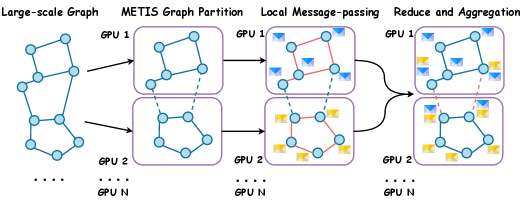
### Visual Description
## Diagram: Distributed Graph Processing Pipeline
### Overview
The image illustrates a distributed graph processing pipeline, showing how a large-scale graph is partitioned and processed across multiple GPUs. The pipeline consists of four stages: Large-scale Graph, METIS Graph Partition, Local Message-passing, and Reduce and Aggregation. The graph is initially partitioned using METIS, and each partition is assigned to a GPU. Local message-passing occurs within each GPU, and finally, the results are aggregated across all GPUs.
### Components/Axes
* **Stages (Top):**
* Large-scale Graph
* METIS Graph Partition
* Local Message-passing
* Reduce and Aggregation
* **GPUs (Left):** GPU 1, GPU 2, ..., GPU N. These labels indicate that the process is distributed across multiple GPUs, from GPU 1 to GPU N.
* **Graph Representation:** The graph is represented as nodes (blue circles) connected by edges (lines).
* **Messages:** Messages are represented as envelope icons, colored blue and yellow.
* **Partition Boundaries:** Dashed lines indicate partition boundaries between GPUs.
### Detailed Analysis
1. **Large-scale Graph:**
* A complex graph structure is shown on the left. It consists of approximately 12 nodes connected by edges.
* The graph is not partitioned at this stage.
* Below the graph, the label "GPU N" is present, with ellipsis (...) indicating that there are multiple GPUs involved in the process.
2. **METIS Graph Partition:**
* The large-scale graph is partitioned into two subgraphs.
* GPU 1 contains one partition, and GPU 2 contains the other.
* A dashed line connects nodes between the two partitions, indicating inter-GPU communication.
* The partitions appear to be roughly equal in size, with each containing approximately 6 nodes.
3. **Local Message-passing:**
* Within each GPU, nodes exchange messages (represented by envelope icons).
* Red lines indicate the paths of message passing between nodes within each partition.
* GPU 1 and GPU 2 each have several messages being passed between their nodes.
4. **Reduce and Aggregation:**
* The results from each GPU are aggregated.
* Messages are exchanged between the GPUs to combine the results. This is indicated by the dashed red line between the two GPU partitions.
* The final graph structure in each GPU reflects the aggregated results.
* The number of messages (envelope icons) appears to be reduced compared to the previous stage.
### Key Observations
* The diagram illustrates a common pattern in distributed graph processing: partitioning, local computation, and aggregation.
* The use of METIS suggests an attempt to balance the workload across GPUs and minimize inter-GPU communication.
* Message-passing is a key component of the pipeline, enabling nodes within and across GPUs to exchange information.
### Interpretation
The diagram demonstrates a distributed graph processing pipeline designed to handle large-scale graphs by partitioning them across multiple GPUs. The METIS graph partition aims to optimize the distribution of the graph, while local message-passing allows for efficient computation within each GPU. The final reduce and aggregation step combines the results from each GPU to produce a global result. This approach is commonly used in graph analytics and machine learning applications where the graph is too large to fit into the memory of a single machine. The diagram highlights the importance of minimizing inter-GPU communication to improve performance.
</details>
Figure 5: The illustration of distributed message passing in G-reasoner.
Appendix D Additional Experiment
Table 10: Comparison of reasoning explanation on G-bench (CS) (Xiao et al., 2025).
| Method | Avg R | Avg AR |
| --- | --- | --- |
| GPT-4o-mini (OpenAI, 2024) | 55.5 | 39.8 |
| BM-25 (Robertson & Walker, 1994) | 59.2 | 44.2 |
| DALK (Li et al., 2024) | 58.9 | 42.1 |
| KGP (Wang et al., 2024) | 58.7 | 43.3 |
| GraphRAG (Edge et al., 2024) | 59.4 | 43.3 |
| ToG (Sun et al., 2024) | 60.1 | 44.0 |
| G-reasoner | 60.2 | 44.7 |
D.1 Reasoning Explanation
In addition to achieving high accuracy in final answers, G-reasoner also excels at generating reasoning explanations, as shown in Table 10. Following Xiao et al. (2025), we evaluate each method’s reasoning explanations using the reasoning score (Avg R) to measure semantic alignment and consistency with ground-truth explanations, along with the Avg AR metric to assess whether the model provides correct reasoning when it answers questions accurately.
The results in Table 10 demonstrate that G-reasoner outperforms existing methods in both Avg R and Avg AR, indicating its superior ability to generate coherent and accurate reasoning explanations, reducing the hallucination of LLMs and enhancing the interpretability of the reasoning process. The case studies of the generated reasoning explanations are presented in Table 11.
Table 11: Case studies for reasoning explanation of G-reasoner on G-bench (CS) (Xiao et al., 2025).
| Query | An upper ontology is named for its position at the top of hierarchical graphs, where it includes general concepts, with more specific concepts placed below. |
| --- | --- |
| Answer | True |
| Ground-truth Rational | An upper ontology is a framework for general concepts placed at the top of hierarchical graphs, with more specific concepts arranged beneath it. |
| Retrieved Document | The general framework of concepts is called an upper ontology because of the convention of drawing graphs with the general concepts at the top and the more specific concepts below them. |
| Generated Rational | The statement describes the structure of an upper ontology accurately. An upper ontology is indeed characterized by its hierarchical organization, where general concepts are positioned at the top, and more specific concepts are placed below them. This aligns with the provided context, which explains that the upper ontology serves as a framework for categorizing knowledge. The use of hierarchical graphs to represent these relationships further supports the truth of the statement. ANSWER: True |
| Query | Which methods are effective for preventing SQL Injection? A: Parameterized queries B: Input sanitization C: Disabling HTTP methods D: Web Application Firewalls (WAF) |
| Answer | ABD |
| Ground-truth Rational | Parameterized queries, input sanitization, and WAFs are effective strategies to prevent SQL Injection by ensuring safe data handling and filtering malicious requests. |
| Retrieved Document | 1. Use of a prepared statement would prevent this problem because the input string would have escape characters inserted. 2. To avoid this kind of SQL injection, the application should ensure that the orderAttribute variable value is one of the allowed values. 3. Programmers must pass user-input strings to the database only through parameters of prepared statements; creating SQL queries by concatenating strings with user-input values is an extremely serious security risk and should never be done in any program. |
| Generated Rational | To determine the effective methods for preventing SQL Injection, we can analyze each option: A: Parameterized queries — This is a well-known and effective method for preventing SQL injection. By using parameterized queries (or prepared statements), user input is treated as data rather than executable code, which prevents attackers from injecting malicious SQL. B: Input sanitization — This method involves cleaning and validating user input to ensure it does not contain harmful characters or patterns. While it can help reduce the risk of SQL injection, it is not foolproof on its own, as it can be difficult to cover all edge cases. However, it is still a useful practice when combined with other methods C: Disabling HTTP methods — This option is not directly related to preventing SQL injection. Disabling certain HTTP methods (like PUT or DELETE) can enhance security in general but does not specifically address SQL injection vulnerabilities. D: Web Application Firewalls (WAF) — A WAF can help detect and block SQL injection attempts by filtering out malicious requests before they reach the application. While it is not a substitute for secure coding practices, it is an effective layer of defense against SQL injection attacks. Based on this analysis, the correct answers are A, B, and D. C is not relevant to SQL injection prevention. ANSWER: ABD |
D.2 Model Scaling Case Study
With the implemented mixed precision training and distributed message-passing, G-reasoner can efficiently scale to larger graphs and model sizes with more computational resources. The number of required GPUs can be empirically estimated as
$$
\#\text{GPU}=\frac{(|{\mathcal{V}}|*d)*2.56^{-1}*10^{-6}}{\text{GPU Memory}}, \tag{12}
$$
where $|{\mathcal{V}}|$ is the number of nodes in the graph, $d$ is the hidden dimension of GFM. It can be helpful to estimate the required GPUs for using G-reasoner on different graph sizes and model sizes.
We illustrate some example configurations in Figure 6. From the results, with 32 A100 GPUs (80G), G-reasoner can scale to graphs with 800k nodes and a hidden dimension of 8192, which is around 2B parameters. With more GPUs, G-reasoner can further scale to larger graphs and model sizes and achieve better performance as suggested by the neural scaling law (Luo et al., 2025).
<details>
<summary>x6.png Details</summary>
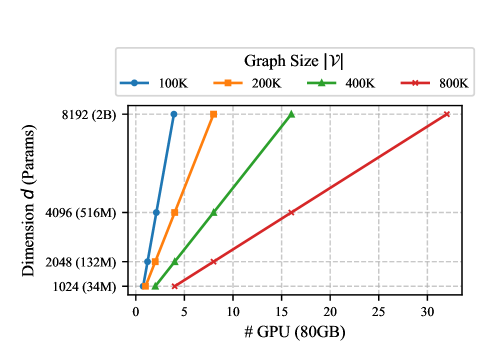
### Visual Description
## Line Chart: Dimension vs. # GPU for Different Graph Sizes
### Overview
The image is a line chart that plots the relationship between the dimension *d* (number of parameters) and the number of GPUs (80GB each) required for different graph sizes. The graph sizes are 100K, 200K, 400K, and 800K. The chart shows how the dimension *d* increases with the number of GPUs for each graph size.
### Components/Axes
* **X-axis:** "# GPU (80GB)" - Represents the number of GPUs used, ranging from 0 to 30.
* **Y-axis:** "Dimension *d* (Params)" - Represents the dimension *d* in terms of the number of parameters, with values 1024 (34M), 2048 (132M), 4096 (516M), and 8192 (2B).
* **Legend (top):** "Graph Size |V|" - Indicates the different graph sizes represented by different colored lines:
* Blue: 100K
* Orange: 200K
* Green: 400K
* Red: 800K
### Detailed Analysis
* **Blue Line (100K):** This line represents the graph size of 100K. It starts at approximately 1024 (34M) dimension with 0 GPUs and increases sharply to 8192 (2B) dimension with approximately 4 GPUs.
* **Orange Line (200K):** This line represents the graph size of 200K. It starts at approximately 1024 (34M) dimension with 0 GPUs and increases sharply to 8192 (2B) dimension with approximately 7 GPUs.
* **Green Line (400K):** This line represents the graph size of 400K. It starts at approximately 1024 (34M) dimension with 0 GPUs and increases sharply to 8192 (2B) dimension with approximately 15 GPUs.
* **Red Line (800K):** This line represents the graph size of 800K. It starts at approximately 1024 (34M) dimension with 0 GPUs and increases linearly to 8192 (2B) dimension with approximately 32 GPUs.
### Key Observations
* All lines start at the same point on the y-axis, indicating that all graph sizes have the same initial dimension when no GPUs are used.
* The slopes of the lines vary, indicating that the dimension increases at different rates for different graph sizes as the number of GPUs increases.
* The red line (800K) has the shallowest slope, indicating that it requires the most GPUs to reach the maximum dimension.
* The blue line (100K) has the steepest slope, indicating that it requires the fewest GPUs to reach the maximum dimension.
### Interpretation
The chart demonstrates the relationship between graph size, dimension (number of parameters), and the number of GPUs required. It suggests that as the graph size increases, the number of GPUs required to achieve a certain dimension also increases. The different slopes of the lines indicate that the relationship is not linear and that larger graphs require a disproportionately larger number of GPUs to scale their dimensions. This information is crucial for resource allocation and optimization when working with large graphs in distributed computing environments.
</details>
Figure 6: Scaling of G-reasoner with different model sizes and graph sizes.
D.3 G-reasoner Case Study
In this section, we illustrate the versatile prediction results of G-reasoner. As shown in Table 12, given a query, G-reasoner can not only retrieve relevant documents to support the reasoning of LLMs, but also predict relevant entities that can be used to guide the reasoning process of LLMs.
Table 12: Case studies for versatile prediction of G-reasoner. Relevant predictions are highlighted in bold.
| Query | In which county is the town in which Raymond Robertsen was born ? |
| --- | --- |
| Answer | Finnmark county, |
| Supporting Documents (Title) | 1. Raymond Robertsen 2. Hammerfest |
| Entity Prediction (Top-3) | 1. cumberland county 2. finnmark 3. pacific county |
| Document Prediction (Top-3) | 1. Raymond Robertsen 2. Hammerfest 3. Raymond, Maine |
| Query | Who is the president of the newly declared independent country that formed the Timor Leste Commission of Truth and Friendship with the country where Pantar is found? |
| Answer | Francisco Guterres |
| Supporting Documents (Title) | 1. Blagar language 2. Indonesia Timor Leste Commission of Truth and Friendship 3. East Timor |
| Entity Prediction (Top-3) | 1. indonesia timor leste commission of truth and friendship 2. francisco guterres 3. democratic republic of timor leste |
| Document Prediction (Top-3) | 1. Indonesia Timor Leste Commission of Truth and Friendship 2. East Timor 3. Blagar language |
Appendix E Prompts
The prompts used in our experiments are presented in Figure 7. We feed the versatile predictions of G-reasoner (i.e., supporting documents and entities) to the LLMs to guide the reasoning process.
LLM Reasoning Prompt
⬇ As an advanced reading comprehension assistant, your task is to analyze text passages and corresponding questions meticulously. Your response start after " Thought: ", where you will methodically break down the reasoning process, illustrating how you arrive at conclusions. Conclude with " Answer: " to present a concise, definitive response, devoid of additional elaborations.’ ### Document: < Document 1> < Document 2> ... < Document n > ### Entity: < Entity 1> < Entity 2> ... < Entity m > ### Question: < Question > Thought:
Figure 7: The prompt template for LLM Reasoning .