# EvolveR: Self-Evolving LLM Agents through an Experience-Driven Lifecycle
> These authors contributed equally.corresponding author
## Abstract
Current Large Language Model (LLM) agents show strong performance in tool use, but lack the crucial capability to systematically learn from their own experiences. While existing frameworks mainly focus on mitigating external knowledge gaps, they fail to address a more fundamental limitation: the inability to iteratively refine problem-solving strategies. In this work, we introduce EvolveR, a framework designed to enable agent to self-improve through a complete, closed-loop experience lifecycle. This lifecycle comprises two key stages: (1) Offline Self-Distillation, where the agent’s interaction trajectories are synthesized into a structured repository of abstract, reusable strategic principles; (2) Online Interaction, where the agent interacts with tasks and actively retrieves distilled principles to guide its decision-making, accumulating a diverse set of behavioral trajectories. This loop employs a policy reinforcement mechanism to iteratively update the agent based on its performance. We demonstrate the effectiveness of EvolveR on complex multi-hop question-answering benchmarks, where it achieves superior performance over strong agentic baselines. Our work presents a comprehensive blueprint for agents that learn not only from external data but also from the consequences of their own actions, paving the way for more autonomous and continuously improving systems. Code is available at https://github.com/Edaizi/EvolveR.
## 1 Introduction
<details>
<summary>x1.png Details</summary>
### Visual Description
\n
## Diagram: Comparison of Four Agent Learning Paradigms
### Overview
The image is a technical diagram comparing four distinct paradigms for training or operating an AI agent. It is divided into four rectangular panels, each illustrating a different approach. The top-left panel (Paradigm 1) shows a stateless, discard-based method. The bottom-left panel (Paradigm 2) introduces learning from stored raw trajectories. The top-right panel (Paradigm 3) depicts learning via an external "Teacher Model" and curated experience. The bottom-right panel (Paradigm 4), highlighted with a yellow border and labeled "(Ours)", presents a novel "Self-Distillation & Evolution" method with distinct online and offline phases.
### Components/Axes
The diagram is structured as a 2x2 grid of panels. Each panel contains:
* **Title:** A blue-text heading at the top (e.g., "Paradigm 1 Stateless Execution").
* **Core Components:** Icons representing an "Agent" (a blue robot), "Task" inputs, "Solution" outputs, and various storage or processing elements.
* **Flow Arrows:** Solid black arrows indicating the primary process flow. Dashed arrows indicate secondary flows like storage, retrieval, or feedback.
* **Text Labels:** Precise labels for every component and process step.
### Detailed Analysis
#### **Paradigm 1: Stateless Execution (Top-Left Panel)**
* **Flow:** Linear and non-persistent.
* **Process for Task 1:** `Task 1` → `Agent` (with a thought bubble labeled "Trajectory") → `Solution1` → A dashed arrow labeled "Discard" points to a trash can icon.
* **Process for Task 2:** Identical flow: `Task 2` → `Agent` (with "Trajectory") → `Solution2` → "Discard" to trash can.
* **Key Text:** "Paradigm 1 Stateless Execution", "Task 1", "Task 2", "Agent", "Trajectory", "Solution1", "Solution2", "Discard".
#### **Paradigm 2: Learning by Raw Trajectories (Bottom-Left Panel)**
* **Flow:** Introduces persistent storage of complete interaction histories.
* **Process for Task 1:** `Task 1` → `Agent` ("Trajectory") → `Solution1`. A solid arrow labeled "Storage" leads from `Solution1` to a server rack icon labeled "Raw Trajectory".
* **Process for Task 2:** `Task 2` → `Agent`. A dashed arrow labeled "Retrieve" points from the "Raw Trajectory" storage to the Agent, with a label "Past Trajectory" in a beige box. The Agent then produces `Solution2`, which is also stored.
* **Key Text:** "Paradigm 2 Learning by Raw Trajectories", "Storage", "Retrieve", "Past Trajectory", "Raw Trajectory".
#### **Paradigm 3: Learning via External Scribing (Top-Right Panel)**
* **Flow:** Involves an external "Teacher Model" to curate experiences.
* **Process for Task 1:** `Task 1` → `Agent` ("Trajectory") → `Solution1`. A solid arrow labeled "Summarize" leads to a "Teacher Model" icon (a person with glasses). The Teacher Model is associated with logos for ChatGPT, Claude, and others.
* **Process for Task 2:** The Teacher Model has a "Storage" arrow pointing to a database icon labeled "External Exp". For `Task 2`, a dashed "Retrieve" arrow brings "Past Exp" (beige box) from this database to the Agent, which then produces `Solution2`. The solution is also sent back for "Storage".
* **Key Text:** "Paradigm 3 Learning via External Scribing", "Summarize", "Teacher Model", "Storage", "Retrieve", "Past Exp", "External Exp".
#### **Paradigm 4: Self-Distillation & Evolution (Ours) (Bottom-Right Panel)**
* **Flow:** A cyclical, self-improving process split into "Online Phase" and "Offline Phase".
* **Initial State:** `Task 1` → `Agent (Initial)` → `Solution1`.
* **Online Phase (Dashed Box):** The core loop. The Agent performs: `Think Query` → `Search ExpBase` → `Generate Trajectory` → `Distill Principle`. This loop is labeled with a flame icon and "Online Phase".
* **Offline Phase:** The "Distill Principle" step feeds into `Update ExpBase`, labeled with a snowflake icon and "Offline Phase".
* **Evolved State:** After the process, the agent is labeled `Agent (Evolved)` (in red text). It then handles `Task 2` to produce `Solution2`.
* **Key Text:** "Paradigm 4 Self-Distillation & Evolution (Ours)", "Task 1", "Agent (Initial)", "Solution1", "Online Phase", "Think Query", "Search ExpBase", "Generate Trajectory", "Distill Principle", "Offline Phase", "Update ExpBase", "Agent (Evolved)", "Task 2", "Solution2".
### Key Observations
1. **Progression of Complexity:** The paradigms evolve from simple, forgetful execution (1) to internal memory (2), to externally guided learning (3), and finally to autonomous self-improvement (4).
2. **Storage Evolution:** Storage changes from a trash can (1), to raw data servers (2), to a curated external database (3), to an internal "ExpBase" that is updated via self-distilled principles (4).
3. **Agent State:** The agent is static in Paradigms 1-3. Only in Paradigm 4 does it explicitly transform from an "Initial" to an "Evolved" state.
4. **Visual Emphasis:** Paradigm 4 is visually set apart with a yellow border, a more complex internal loop diagram, and the red "Evolved" label, marking it as the proposed, superior method.
5. **Direction of Learning:** Learning is passive in 1 (none), reactive in 2 & 3 (using stored past data), and proactive/self-initiated in 4.
### Interpretation
This diagram argues for a paradigm shift in agent design. It posits that traditional methods are limited: Paradigm 1 learns nothing, Paradigm 2 is burdened by noisy raw data, and Paradigm 3 depends on costly external models. The proposed Paradigm 4, "Self-Distillation & Evolution," is presented as the solution. It suggests that for an agent to truly improve, it must engage in a continuous, internal cycle of experience ("Generate Trajectory"), reflection ("Distill Principle"), and knowledge base refinement ("Update ExpBase"). The "Online/Offline" phase distinction implies a separation between active task engagement and background consolidation of learning. The ultimate goal, visualized by the "Agent (Evolved)", is an agent that becomes fundamentally more capable over time through its own operations, reducing reliance on external supervision or static datasets. The diagram is a conceptual blueprint for creating self-improving AI systems.
</details>
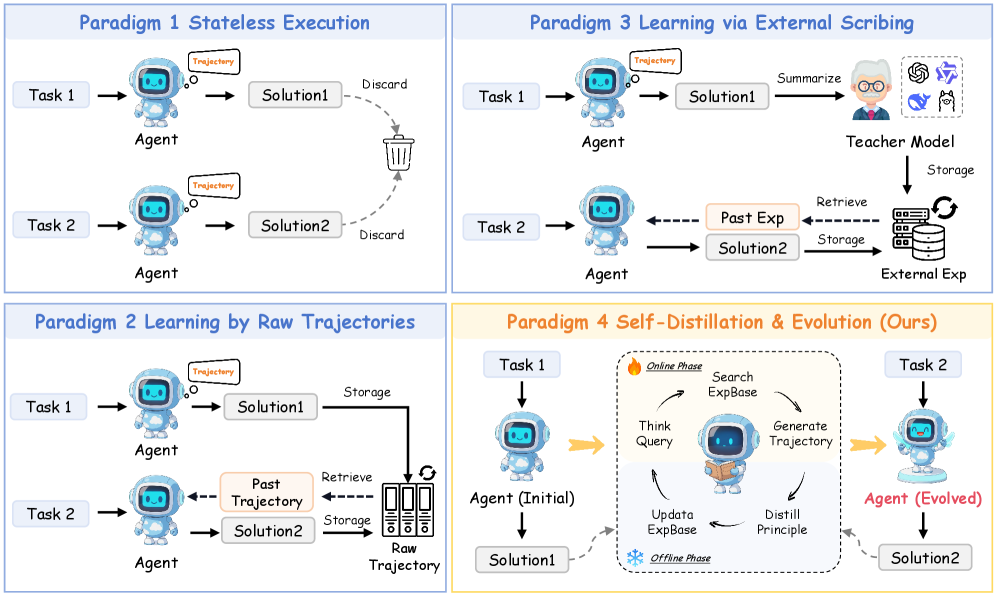
Figure 1: An illustration of four major paradigms for LLM agent learning. (1) Stateless Execution: Standard agents discard experiences after each task; (2) Learning by Raw Trajectories: Agents retrieve raw, un-distilled past trajectories; (3) Learning via External Scribing: Agents rely on an external teacher model to distill insights; (4) EvolveR (Ours): A complete, self-contained lifecycle where the agent autonomously distills its own experiences into principles and evolves its policy.
Large Language Models (LLMs) have driven the development of autonomous agents capable of solving diverse tasks through advanced reasoning and tool use [1, 2, 3]. However, a significant limitation emerges when these agents engage in sequential tasks: each interaction is treated independently. They approach tasks as isolated episodes, suffering from operational amnesia and failing to learn from past successes or avoid prior mistakes [4]. This inability to leverage experience fundamentally hinders their development toward greater autonomy and intelligence.
Humans, by contrast, learn through a continuous lifecycle, leveraging both successes and failures to refine strategies over time [5]. For example, a student solving math problems reflects on recurring errors and successful approaches to extract general problem-solving strategies. This cycle of interaction, reflection, and abstraction is the cornerstone of developing expertise [6]. Endowing LLM agents with a comparable lifecycle is the key to bridging the gap between episodic problem-solving and sustainable self-improvement. While existing frameworks like Retrieval-Augmented Generation (RAG) effectively address knowledge gaps, they fail to solve a more fundamental limitation: the agent’s inability to systematically learn from the consequences of its own interactions [7].
As Figure 1 shows, prior works have attempted to address this limitation, but with critical shortcomings. Researchers store natural language reflections across tasks with a powerful external LLM in an external memory [8, 9]. While resource-efficient, this approach treats such reflections as a transient hint, leaving the agent’s intrinsic policy unchanged. On the other hand, learning by recalling raw cases retrieves entire past trajectories to directly guide decision-making. However, this reliance on raw cases struggles to generalize and, more importantly, fails to abstract. The agent merely mimics past solutions instead of distilling the reusable strategic principles that made them successful [10].
To overcome these challenges, we introduce EvolveR, a framework that enables agents to self-evolve by utilizing their own experiences. EvolveR implements a full experience lifecycle, in which agents collect trajectories through Online Interaction, distill them into a library of abstract strategic principles during Offline Self-Distillation, and subsequently learn to apply these principles to new tasks. Crucially, EvolveR completes the experience lifecycle with a reinforcement learning mechanism that enables the agent to utilize experience. The agent does not merely mimic its past interactions; it evolves based on what it has learned. EvolveR maintains a dynamic experience base where newly distilled principles are semantically deduplicated and continuously evaluated via a metric score that tracks historical effectiveness.
We demonstrate EvolveR’s effectiveness on complex question-answering benchmarks, where it significantly outperforms strong agentic baselines. Our contributions can be summarized as follows:
- We propose the Experience-Driven Self-Evolution Paradigm, a novel, closed-loop lifecycle for LLM agents. In contrast to agents that forget past interactions, EvolveR systematically integrates a complete cycle of online interaction, offline experiences self-distillation and policy evolution. This process enables the agent to continuously transform raw trajectories into a curated repository of strategic principles, establishing a foundation for adaptive agents.
- We introduce a complete system for dynamic experiences curation. This system goes far beyond simple experience storage. It features: (1) a self-distillation mechanism, where the agent autonomously distills principles from previous interactions; and (2) a full maintenance pipeline, including semantic deduplication, integration, and quality control guided by a dynamic metric score.
- We provide extensive empirical validation of the EvolveR paradigm across multiple model scales. Our experiments on a diverse suite of complex QA benchmarks demonstrate the effectiveness of our approach. Detailed ablation studies confirm that the synergy of our proposed curation and self-distillation mechanisms is critical to the framework’s success, revealing a key insight: while the self-distillation mechanism is less effective on smaller-scale models, it surpasses distillation by a stronger, external teacher model at the 3B scale, validating the importance of cognitive alignment.
## 2 Related Work
### 2.1 Continual Learning and Self-Evolving Agents
Continual learning (CL) aims to enable models to learn sequentially while mitigating catastrophic forgetting [11, 12]. While various replay-based and regularization methods have been proposed, most CL paradigms assume predefined task boundaries and focus on knowledge preservation rather than active acquisition in open-ended environments [13, 14, 15, 16]. The pursuit of self-evolving agents moves beyond these limitations by enabling systems to grow autonomously from experience. Frameworks such as Reflexion and Generative Agents explore self-improvement through self-play and reflective reasoning, often storing past trajectories as memory to guide future actions [17, 18, 19, 20, 4]. However, these systems either store raw, unstructured data or rely on memory mechanisms that are not designed for the systematic, long-term distillation and refinement of abstract strategic knowledge. Instead of relying on external data streams, our agent autonomously generates and refines its own experiences through an iterative cycle of online interaction and offline reflection.
### 2.2 LLM Agents and Reinforcement Learning
LLM agents have been widely explored through frameworks such as ReAct, which interleaves reasoning and actions, and Reflecion, which improves task performance via self-reflection [4, 17]. While these approaches are primarily prompt-based and stateless, they prevent long-term accumulation of strategic knowledge. External memory frameworks like ExpeL address this limitation by reusing past trajectories, but they do not enable systematic self-improvement across tasks [8]. While effective, these methods often rely on simple prompting and are inherently stateless, limiting their ability to internalize knowledge across tasks. Recent work has increasingly turned to reinforcement learning (RL) to train agents for long-horizon, multi-turn tasks. However, applying RL is challenging due to sparse rewards and the need for stable training signals. Search-R1 [21], O2-Searcher [22], and AutoRefine [23] all use RL to train LLMs to generate and interact with external search tools. While these works successfully optimize the LLM’s interaction with external factual knowledge, they do not address the broader challenge of an agent’s self-improvement through its own internal experience.
## 3 Method
<details>
<summary>x2.png Details</summary>
### Visual Description
## Diagram: EvolveR System Architecture and Principle Evolution Workflow
### Overview
The image is a technical diagram illustrating the architecture and workflow of a system named "EvolveR." It depicts a cyclical process for learning and refinement, divided into two primary phases: an **Online Phase** (for active parameter updates) and an **Offline Phase** (with frozen parameters). The diagram is split into two main panels: the left panel shows the overall EvolveR cycle, and the right panel provides a detailed breakdown of the "Search ExpBase" and "Update ExpBase" sub-processes.
### Components/Elements
The diagram is composed of the following key components, identified by their labels and spatial placement:
**Left Panel - Overall EvolveR Cycle:**
* **Central Title:** "EvolveR" (center of the circular flow).
* **Phase Indicators:**
* **Top-Left:** "Online Phase" with a flame icon and sub-label "Parameter Update."
* **Bottom-Left:** "Offline Phase" with a snowflake icon and sub-label "Parameter Frozen."
* **Process Steps (arranged in a clockwise cycle):**
1. **Observe:** Icon of a robot with a question mark. Associated text: "Query."
2. **Think:** Icon of a robot with a thought bubble. Associated text: "Analyze Search Query."
3. **Search ExpBase:** Icon of a robot with a magnifying glass. Associated text: "Principle."
4. **Search KB:** Icon of a robot with a document. Associated text: "Doc."
5. **Generate Traj:** Icon of a robot with a pencil and warning sign.
6. **Self-Distill:** Icon of a robot at a desk with a lamp.
7. **Get Principle:** Icon of a robot with a lightbulb.
8. **Update ExpBase:** Icon of a robot with a gear.
* **Inner Cycle (within the main cycle):** A smaller, inner loop labeled with actions: "Perceive" (person icon), "Think" (person at desk), "Work" (person at computer), "Consolidate" (person with blocks), "Organize" (person with blocks).
**Right Panel - Detailed Sub-Processes:**
* **Top Section - "Search ExpBase":**
* **Title:** "Search ExpBase" with a magnifying glass icon.
* **ExpBase Box:** A container labeled "ExpBase."
* **Principle List:** A vertical list of principles: "Principle 1," "Principle 2," ... "Principle N."
* **Principle 1 Detail:** Contains the text: "For a given topic, gather data on both items before concluding."
* **Score Boxes:** Green boxes next to each principle showing scores: "Score:0.7," "Score:0.6," "Score:0.9."
* **Trajectory Tags:** Orange boxes labeled "Traj1" and "Traj2" associated with each principle.
* **Bottom Section - "Update ExpBase":**
* **Title:** "Update ExpBase" with a gear icon.
* **Flowchart Components:**
* **Input:** "Trajectory" (orange box) -> "Summarize" -> "New Principle" (blue box).
* **Matching Process:** "New Principle" -> "Retrieve" -> "Top k Principles" -> "Similarity Threshold" / "LLM Semantic Match" (dashed box with robot icon).
* **Decision Paths:** Arrows labeled "Match" and "No Match" leading to different actions.
* **Action Boxes:** "Update Score & Add Traj" (green), "Add New Principle" (green).
* **Principle Operation Box:** A dashed box labeled "Principle Operation" listing: "Distill," "Deduplicate," "Update," "Filter Low-Score."
* **Merge Arrow:** A dashed orange arrow labeled "Merge" connects the "Search ExpBase" and "Update ExpBase" sections.
### Detailed Analysis
**1. Online Phase Flow (Left Panel, Clockwise from "Observe"):**
* The process begins with a **Query** leading to the **Observe** step.
* The system then **Thinks** to "Analyze Search Query."
* It performs a **Search ExpBase** to retrieve a "Principle."
* It performs a **Search KB** to retrieve a "Doc" (document).
* It proceeds to **Generate Traj** (Generate Trajectory).
* The next step is **Self-Distill**.
* It then executes **Get Principle**.
* Finally, it performs **Update ExpBase**, which feeds back into the start of the cycle.
**2. Offline Phase Flow (Left Panel):**
* This phase is marked as having "Parameter Frozen."
* It involves the steps **Get Principle** and **Self-Distill**, which are also part of the online cycle but are highlighted here as occurring in an offline context.
**3. Search ExpBase Detail (Right Panel, Top):**
* The "ExpBase" (Experience Base) contains multiple principles (Principle 1 to Principle N).
* Each principle has an associated **Score** (e.g., 0.7, 0.6, 0.9) and is linked to one or more **Trajectories** (Traj1, Traj2).
* The text for Principle 1 is explicitly provided: "For a given topic, gather data on both items before concluding."
**4. Update ExpBase Detail (Right Panel, Bottom):**
* A new "Trajectory" is summarized into a "New Principle."
* This "New Principle" is compared against existing "Top k Principles" from the ExpBase.
* The comparison uses a "Similarity Threshold" and an "LLM Semantic Match" process.
* **If a Match is found:** The system will "Update Score & Add Traj" (update the score of the existing principle and add the new trajectory to it).
* **If No Match is found:** The system will "Add New Principle" to the ExpBase.
* A separate "Principle Operation" module lists maintenance actions: "Distill," "Deduplicate," "Update," and "Filter Low-Score."
### Key Observations
* **Dual-Phase Architecture:** The system explicitly separates online (adaptive) and offline (stable) processing, a common pattern in machine learning for balancing learning and stability.
* **Principle-Centric Knowledge:** The core unit of knowledge is a "Principle," which is scored, associated with experiential trajectories, and subject to operations like distillation and deduplication.
* **Hybrid Retrieval:** The workflow combines searching an internal "ExpBase" (of principles) with searching an external "KB" (Knowledge Base, of documents).
* **Semantic Matching:** The update mechanism relies on both a numerical "Similarity Threshold" and a more sophisticated "LLM Semantic Match," indicating a nuanced approach to determining principle novelty.
* **Closed-Loop Evolution:** The entire diagram forms a closed loop, emphasizing continuous, iterative improvement of the principle base through experience.
### Interpretation
The EvolveR diagram illustrates a sophisticated framework for an AI system to autonomously develop, refine, and organize its operational principles through experience. It is not merely a data-processing pipeline but a **meta-learning system** designed to evolve its own reasoning strategies.
* **What it demonstrates:** The system learns by doing ("Generate Traj"), reflecting ("Self-Distill"), and codifying lessons into abstract "Principles." These principles are then stored in an experience base, scored for utility, and retrieved to guide future actions, creating a virtuous cycle of improvement.
* **Relationship between elements:** The Online Phase is the active learning loop where new experiences are generated and integrated. The Offline Phase likely represents a more stable, foundational knowledge consolidation step. The "Search ExpBase" and "Update ExpBase" details show the mechanics of how the system's knowledge base is maintained—preventing redundancy (via deduplication) and decay (via filtering low-score principles).
* **Notable implications:** This architecture suggests a move beyond static models towards systems that can **curate their own knowledge**. The "Principle Operation" box is particularly significant, as it implies the system performs housekeeping on its knowledge, similar to how a human might periodically review and consolidate their notes. The use of an LLM for semantic matching indicates that the system leverages advanced language understanding to judge the conceptual similarity of principles, not just keyword overlap. The ultimate goal appears to be creating an AI that becomes more effective and efficient over time by building a structured, searchable, and evolving library of experiential wisdom.
</details>
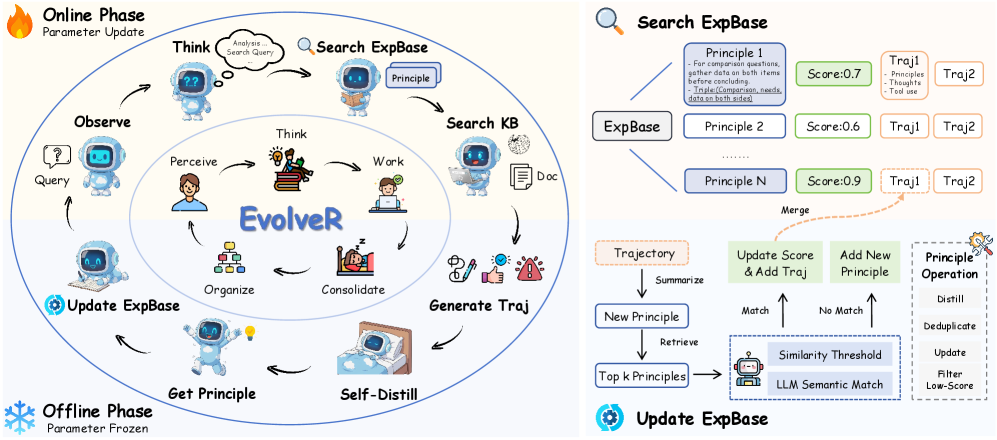
Figure 2: Overview of the EvolveR framework’s experience lifecycle. Left: The main loop alternates between an Online Phase, where the agent interacts with the environment and its policy parameters are updated via RL, and an Offline Phase, where the agent’s parameters are frozen and it performs self-distillation and maintains its Experience Base ( $E$ ). Top Right: A detailed view of the Search ExpBase action, where the agent retrieves scored principles along with their associated trajectories. Bottom Right: The Update ExpBase process, which involves summarizing trajectories and applying a suite of curation operations (distill, deduplicate, update, and filter).
In this section, we present EvolveR, a novel framework designed to enable agent self-evolution through a complete, closed-loop experience lifecycle. Inspired by the human cycle of work and reflection, our approach is structured around three core, interconnected components, as depicted in Figure 2. First, in the Offline Experience Self-Distillation phase, the agent’s policy parameters are frozen, and it systematically distills raw trajectories into a curated base of strategic principles. Second, during the Online Interaction phase, the agent applies this distilled wisdom to guide its deliberative reasoning and action, generating new, high-quality interaction data. Finally, the entire cycle is driven by a Policy Evolution mechanism, where the trajectories collected online are used to update the agent’s policy parameters via reinforcement learning, thus closing the loop. This iterative process allows the agent to continuously transform its interactions into evolving expertise.
### 3.1 Preliminaries: Formalizing Agent Interaction
At each state $t$ , the agent, situated in an unknown state $s_t$ , selects an action $a_t∈A$ based on its policy. Our agent’s action space $A$ is designed for complex, knowledge-intensive tasks and comprises three key operations:
- <search_experience>: Agent queries its internal experience base $E$ to retrieve relevant principles distilled from past trajectories. Environment returns retrieved principles as an observation.
- <search_knowledge>: Agent queries an external knowledge base (e.g., a search engine) to acquire factual information. Environment returns retrieved information as an observation.
- <answer>: Agent outputs its final answer to the problem and concludes the interaction.
### 3.2 The EvolveR Lifecycle: From Interactions to Principles
#### 3.2.1 Offline Experience Self-Distillation
The core of EvolveR is a self-perpetuating lifecycle designed to transform raw interaction data into a strategic principle. This process is divided into two distinct, alternating phases: an offline self-distillation phase for distilling the principle, and an online interaction phase for applying the principle and gathering new interaction data.
Principle from Self-Distillation.
The process begins with self-distillation. We leverage the agent’s own policy model $π_θ$ to analyze its past interaction trajectories. By adopting the persona of an expert through carefully designed prompts, the model reviews each trajectory and, based on its outcome, distills the core strategic insight into a concise natural language statement. This results in either a guiding principle from a success or a cautionary principle from a failure.
Inspired by structured memory frameworks such as Mem0 [24] and G-Memory [25], each principle consists of two components: a natural language description paired with several structured knowledge triples, as illustrated in Figure 2. This self-distillation approach enables the agent to autonomously generate reusable knowledge.
Deduplication and Integration.
To maintain a high-quality experience base ( $E$ ), we do not add every distilled principle. Instead, each new principle undergoes a rigorous integration process. First, to handle redundancies arising from similar trajectories (e.g., from GRPO sampling), we perform a deduplication step. We use the agent model $π_θ$ to pair-wise check for semantic equivalence among newly generated principles that originate from the same problem, keeping only one representative from each semantically equivalent cluster.
Second, for each unique principle, we apply a two-stage matching procedure: we first retrieve the most similar existing principles from $E$ via embedding similarity, then prompt the agent model to provide a binary semantic equivalence judgment. If a principle is novel, it is added as a new entry in $E$ ; otherwise, the new trajectory is merged under the existing principle, enriching it without introducing redundancy.
Let $p_cand$ be a new candidate principle distilled from trajectory $τ_src$ . We update the experience base $E$ as follows:
$$
E←\begin{cases}E∪\{p_cand\}&if \max_p∈Esim(p_cand,p)<θ_sim\\
Merge(E,p^*,τ_src)&otherwise\end{cases} \tag{1}
$$
where $sim(·,·)$ is the cosine similarity between principle, $θ_sim$ is a similarity threshold, and $p^*=argmax_p∈Esim(p_cand,p)$ . The Merge operation links $τ_src$ to its best match $p^*$ .
This two-level check ensures that $E$ grows with novel insights while strengthening existing ones with new evidence.
Quality Control via Dynamic Scoring.
As the experience base accumulates principles over time, it becomes essential to evaluate their practical utility and prioritize the most effective strategies. To this end, each principle tracks its usage and success counts, enabling the computation of an empirical score that reflects historical performance. We quantify the empirical utility of each principle using a metric score, which is updated as:
$$
s(p)=\frac{c_succ(p)+1}{c_use(p)+2} \tag{2}
$$
where $c_succ(p)$ and $c_use(p)$ are the success and usage counts for a given principle $p$ , $s(p)$ is the metric score.
This score provides a reliable measure of a principle’s historical effectiveness. To ensure the long-term health of the experience base, we periodically prune principles whose scores fall below a threshold $θ_prune$ . This systematic process of distillation, integration, and quality control ensures that the agent’s wisdom remains a compact and high-quality repository of its most effective strategies.
#### 3.2.2 Online Interaction
The online phase serves as the interactive testbed where the agent applies its distilled principles to solve problems. The agent operates within a deliberative reasoning loop (e.g., Think-Act-Observe), which enables it to engage in multi-turn, autonomous tool use. However, the core novelty of EvolveR’s online phase is not the loop itself, but how the principles retrieved from the experience base ( $E$ ) fundamentally alter the agent’s behavior within it.
Experience as a Strategic Principle.
Unlike standard agents that must discover reasoning patterns from scratch through trial and error, an EvolveR agent is guided by a strategic wisdom provided by its own past experiences. At any point in its reasoning loop, the agent can issue a <search_experience> action. The retrieved principles $P_k$ do not merely provide factual information; they offer heuristic guidance that shapes the agent’s subsequent reasoning. For instance, retrieving a principle such as “For comparison questions, gather data on both items before concluding,” can directly influence the agent’s internal monologue (<think>) and steer its subsequent potential <search_knowledge> actions. This makes the agent’s exploration more efficient and less prone to common pitfalls, as it learns to follow the wisdom in its own distilled principles.
Generating High-Quality Trajectories for Future Distillation.
The ultimate purpose of the online phase, within the EvolveR paradigm, extends beyond solving the immediate task. It is responsible for generating high-quality data for the next cycle of offline reflection. Because the agent’s actions are guided by proven principles, the resulting trajectories, $τ_new$ , are not random walks but are instead rich recordings of structured, experience-guided problem-solving. These trajectories capture the interplay between distilled principles, internal reasoning, and external tool use (e.g., <search_knowledge>), and serve as valuable input for the offline phase, enabling EvolveR to refine existing principles and discover more effective strategies in a virtuous cycle.
### 3.3 Policy Evolution: Closing the Loop with Reinforcement Learning
To enable the agent to learn from its actions and evolve its policy $π_θ$ , we employ a reinforcement learning framework. The learning process is guided by a composite reward function and a policy optimization algorithm that leverages the trajectories collected during the online phase.
Reward Function.
We design a composite reward function $R(τ)$ for a given trajectory $τ$ that balances task success with procedural correctness. It is a weighted sum of an outcome reward and a format reward: $R(τ)=w_oR_outcome(τ)+w_fR_format(τ)$ .
<details>
<summary>img/grpo.png Details</summary>
### Visual Description
## System Architecture Diagram: Reinforcement Learning with Reward Models
### Overview
The image displays a technical flowchart illustrating a machine learning training pipeline, likely for a reinforcement learning from human feedback (RLHF) or similar alignment process. The diagram shows the flow from input questions to final answers, incorporating a policy model, experience/knowledge bases, ground truth answers, a reference model, and a reward model with outcome and format components. The process involves generating multiple outputs, scoring them, and performing group computation to select or aggregate final answers.
### Components/Axes
The diagram is organized into distinct functional blocks connected by directional arrows indicating data flow. Key components are labeled as follows:
1. **Input (Leftmost):** A blue box labeled `Questions`.
2. **Core Model Block (Left-Center, Yellow Background):** Contains three interconnected components:
* `Policy Model` (Green box)
* `Experience Base` (White box)
* `Knowledge Base` (White box)
* Arrows indicate bidirectional communication between the Policy Model and Experience Base, and between the Experience Base and Knowledge Base.
3. **Ground Truth (Top-Center):** A blue box labeled `GT Answers`.
4. **Output Generation (Center):** A vertical column of white boxes labeled `O₁`, `O₂`, ..., `O_G`. An arrow from the Core Model Block points to this column.
5. **Evaluation Models (Center-Right):**
* `Reference Model` (Red/Brown box)
* `Reward Model` (Dashed-line box containing two sub-components):
* `Outcome Reward`
* `Format Reward`
* Arrows from the `O₁...O_G` column point to both the Reference Model and the Reward Model.
6. **Reward Scores (Right-Center):** A vertical column of white boxes labeled `R₁`, `R₂`, ..., `R_G`. An arrow from the Reward Model points to this column.
7. **Final Output (Rightmost):** A vertical column of white boxes labeled `A₁`, `A₂`, ..., `A_G`.
8. **Process Labels:**
* `KL`: A curved arrow labeled "KL" originates from the `Policy Model` and points to the final output column (`A₁...A_G`).
* `Group Computation`: Text placed between the `R₁...R_G` column and the `A₁...A_G` column, with an arrow pointing from the former to the latter.
### Detailed Analysis
The diagram details a sequential and parallel processing flow:
1. **Input & Generation:** `Questions` are fed into a system comprising a `Policy Model`, `Experience Base`, and `Knowledge Base`. This system generates a group of `G` outputs, denoted as `O₁` through `O_G`.
2. **Parallel Evaluation:** Each output `O_i` is evaluated in parallel by two entities:
* A `Reference Model` (likely a pre-trained or baseline model).
* A composite `Reward Model` that assesses both the `Outcome Reward` (e.g., correctness, quality) and the `Format Reward` (e.g., adherence to structural guidelines).
3. **Reward Assignment:** The Reward Model produces a corresponding reward score `R_i` for each output `O_i`.
4. **Aggregation & Selection:** The set of reward scores `R₁...R_G` undergoes `Group Computation`. This step likely involves comparing, normalizing, or aggregating the scores (e.g., using a softmax or best-of-n selection) to produce the final answer group `A₁...A_G`.
5. **Regularization:** A `KL` (Kullback-Leibler divergence) constraint is applied, connecting the `Policy Model` to the final answers `A₁...A_G`. This is a common technique in RLHF to prevent the policy from deviating too far from its initial state, ensuring stability.
### Key Observations
* **Group-Based Processing:** The use of subscripts `1` to `G` for outputs (`O`), rewards (`R`), and answers (`A`) indicates the system processes multiple candidates in parallel for each input question.
* **Dual Reward Components:** The explicit separation of `Outcome Reward` and `Format Reward` within the dashed `Reward Model` box highlights a multi-faceted evaluation criterion.
* **Bidirectional Knowledge Flow:** The arrows between `Policy Model`, `Experience Base`, and `Knowledge Base` suggest an iterative or memory-augmented generation process, not a simple feed-forward pass.
* **Architectural Separation:** The `Reference Model` is distinct from the `Reward Model`, suggesting it may serve a different purpose, such as providing a baseline for comparison or being part of the KL divergence calculation.
### Interpretation
This diagram represents a sophisticated training or inference architecture for aligning a language model (`Policy Model`) with human preferences. The process can be interpreted as follows:
1. **Exploration:** For a given question, the policy explores multiple potential answers (`O₁...O_G`) by leveraging its experience and a knowledge base.
2. **Critique:** Each candidate answer is critically evaluated by a specialized `Reward Model` that judges both substantive quality (`Outcome`) and presentation (`Format`). The `Reference Model` likely provides a stability anchor or a baseline score.
3. **Selection & Refinement:** The `Group Computation` step acts as a filter or aggregator, using the reward scores to distill the best answers (`A₁...A_G`). The `KL` penalty ensures this refinement process doesn't cause the policy to become erratic or forget its foundational knowledge.
The overall goal is to produce answers that are not only correct and well-formatted but also aligned with a reward signal derived from human preferences (embodied in the Reward Model), while maintaining training stability via the KL constraint. This is a hallmark of modern RLHF pipelines used to make AI systems more helpful, harmless, and honest. The architecture emphasizes generating and critically evaluating multiple hypotheses before committing to a final response.
</details>
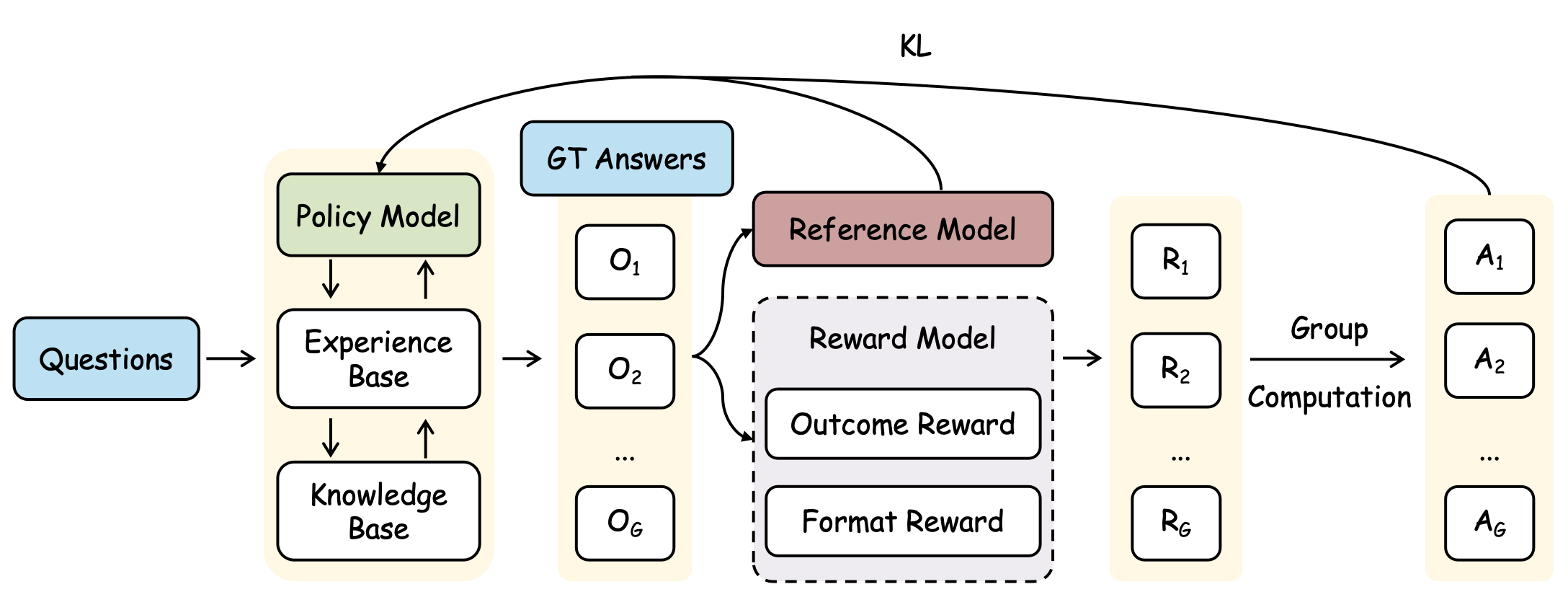
Figure 3: Policy model update optimization algorithm of EvolveR.
- Outcome Reward $R_outcome$ , is a sparse, binary reward based on the final answer’s correctness. Following prior work, it is determined by an exact match with the ground truth:
$$
R_outcome(τ)=EM(a_pred,a_gold) \tag{3}
$$
where $a_pred$ is the final answer extracted from the trajectory $τ$ and $a_gold$ is the ground truth answer.
- Format Reward $R_format$ , is a dense shaping reward that evaluates the quality of the reasoning process. Let $N_think(τ)$ , $N_exp(τ)$ and $N_know(τ)$ denote the counts of valid <think>, <search_experience> and <search_knowledge> actions within $τ$ . $R_format$ is composed of a think score $R_think$ , rewarding a balanced number of reasoning steps, and a search score $R_search$ promoting search experience and knowledge. The final format reward is calculated as:
$$
R_format(τ)=I(τ_complete)·\frac{R_think(τ)+R_search(τ)}{2} \tag{4}
$$
where $I(τ_complete)$ is an indicator function that is $1$ only if the trajectory contains at least one of each required action type (<think>, any search, and <answer>), and $0$ otherwise. This ensures that only structurally complete trajectories receive a format reward.
Policy Optimization.
The policy $π_θ$ is updated using the collected trajectories. We utilize Group Relative Policy Optimization (GRPO) [26], which balances the optimization stability and efficiency by using the average reward of multiple sampled trajectories as a baseline, thus avoiding the need for a learned value function. Specifically, for each input, we sample a group of $G$ trajectories. The policy is then optimized by maximizing the following objective function:
$$
J_GRPO(θ)=E_τ∈D≤ft[∑_t=1^|τ|\min≤ft(ρ_t(θ)\hat{A}_t,clip(ρ_t(θ),1-ε,1+ε)\hat{A}_t\right)-β D_KL[π_θ||π_ref]\right] \tag{5}
$$
where $ρ_t(θ)=\frac{π_θ(a_t|h_t)}{π_old(a_t|h_t)}$ is the importance sampling ratio, $\hat{A}_t$ is the advantage estimate, and the final term is a KL-divergence penalty to constrain policy updates.
Crucially, this optimization process is deeply integrated with our experience lifecycle. As the agent’s actions during the online phase are conditioned on the principles $P_k$ retrieved from its experience base, the trajectories collected in $D$ are inherently experience-guided. Consequently, the GRPO update does not merely learn a generic reasoning policy. Instead, it explicitly learns a policy of how to effectively utilize its own distilled wisdom to generate successful outcomes. The optimization process, therefore, reinforces the valuable connections between retrieving high-quality principles and producing high-reward trajectories, successfully closing the learning loop.
## 4 Experiments
### 4.1 Experimental Implementation Details
#### 4.1.1 Tasks and Datasets
To comprehensively evaluate the EvolveR paradigm, we assess its performance on seven question-answering benchmarks, encompassing both in-domain and out-of-domain datasets. Following prior work [21, 22], the in-domain datasets, whose training splits are used to build the experience base, include Natural Questions (NQ) [27] and the multi-hop benchmark HotpotQA [28]. The out-of-domain datasets, used exclusively for evaluating generalization, encompass the general QA benchmarks TriviaQA [29] and PopQA [30], as well as the more complex multi-hop challenges 2WikiMultiHopQA [31], Musique [32], and Bamboogle [33].
#### 4.1.2 Baseline Methods
Following prior works, we compare against a comprehensive suite of baselines built upon the Qwen2.5 foundational models. The baselines represent three primary paradigms. First, prompting-based methods, which require no parameter updates, include Direct Inference, Chain-of-Thought (CoT) [18], Retrieval-Augmented Generation (RAG) [34], and advanced variants like IRCoT [35] and Search-o1 [36]. Second, Supervised Fine-Tuning (SFT) methods represent approaches that learn from static expert data, including standard SFT [37] and Rejection Sampling [38]. Finally, the most direct competitors are RL methods, against which we benchmark extensively. This category is primarily composed of Search-R1 [21], DeepSeek-R1 [39], which are also trained with trajectory-level feedback. Specifically, DeepSeek-R1 performs reasoning and answer steps without a search engine, whereas Search-R1 incorporates an external local or web search engine. Together, these baselines provide a challenging evaluation landscape for our proposed paradigm.
#### 4.1.3 Evaluation Metrics
To ensure a direct and fair comparison with prior work in our main results, our primary evaluation metric is Exact Match (EM), a strict measure that requires the predicted answer to exactly match the ground truth after standard normalization. We also report the F $1$ Score in the analysis of model scales’ generalizability, which provides a more comprehensive and robust measure of performance, particularly since ground truths may contain multiple valid answers or aliases.
#### 4.1.4 Implementation Details
Our experiments are conducted on the Qwen2.5 model family. Inspired by DeepSeek-R1 [39], we introduce a cold-start stage to stabilize early RL training by first fine-tuning the base model on a small, curated dataset of CoT interaction trajectories. Following the setup of Search-R1, we construct this dataset from approximately 700 samples from the NQ and HotpotQA training sets. We utilize the LLama_Factory [40] to fine-tune the model with LoRA. For the agent evolution phase, we employ GRPO for optimization. At each RL step, we sample a batch of 128 prompts, generating $G=8$ trajectories for each. The agent is then updated, again using Adam, but with a reduced learning rate of $1× 10^-6$ , a warm-up step of 20 and a mini-batch size of 128. All training is conducted on 8 A100 GPUs, leveraging the Verl framework https://github.com/volcengine/verl for efficient implementation. We will show more details in Appendix 4.1.
### 4.2 Main Results
The main results of our evaluation are presented in Table 1. Our analysis focuses on the comprehensive evaluation conducted on the Qwen2.5-3B model family (we will show more results of different model scales in the 5.1). EvolveR achieves the highest average score (0.382) in the 3B scale, outperforming all baselines, including strong RL agents like Searcher-R1. This robust overall performance is not driven by a narrow specialty, but by consistent, top-tier results across a wide spectrum of tasks; it secures the best scores on diverse benchmarks, including the in-domain NQ, the out-of-domain PopQA, and the adversarial Bamboogle dataset, while remaining highly competitive on all others. This consistent, high-level performance across diverse benchmarks validates that by systematically distilling, managing, and utilizing, agents can develop more generalizable and powerful problem-solving strategies.
Table 1: Main results on QA benchmarks. The best performance in each column is set in bold. Our proposed model, EvolveR, is highlighted in gray.
| Direct Inference CoT IRCoT | 0.106 0.023 0.111 | 0.149 0.021 0.164 | 0.288 0.032 0.312 | 0.108 0.005 0.200 | 0.244 0.021 0.171 | 0.020 0.002 0.067 | 0.024 0.000 0.240 | 0.134 0.015 0.181 |
| --- | --- | --- | --- | --- | --- | --- | --- | --- |
| Search-o1 | 0.238 | 0.221 | 0.472 | 0.262 | 0.218 | 0.054 | 0.320 | 0.255 |
| RAG | 0.348 | 0.255 | 0.544 | 0.387 | 0.226 | 0.047 | 0.080 | 0.270 |
| SFT | 0.249 | 0.186 | 0.292 | 0.104 | 0.248 | 0.044 | 0.112 | 0.176 |
| R1-base | 0.226 | 0.201 | 0.455 | 0.173 | 0.268 | 0.055 | 0.224 | 0.229 |
| R1-instruct | 0.210 | 0.208 | 0.449 | 0.171 | 0.275 | 0.060 | 0.192 | 0.224 |
| Rejection Sampling | 0.294 | 0.240 | 0.488 | 0.332 | 0.233 | 0.059 | 0.210 | 0.265 |
| Search-R1-base | 0.406 | 0.284 | 0.587 | 0.435 | 0.273 | 0.049 | 0.088 | 0.303 |
| Search-R1-instruct | 0.341 | 0.324 | 0.545 | 0.378 | 0.319 | 0.103 | 0.264 | 0.325 |
| EvolveR (ours) | 0.434 | 0.373 | 0.584 | 0.434 | 0.381 | 0.137 | 0.328 | 0.382 |
## 5 Further Analysis
### 5.1 Analysis of Model Scales Generalizability
<details>
<summary>img/evolver_scaling_results.png Details</summary>
### Visual Description
## [Combination Bar and Line Chart]: Model Performance Across Datasets
### Overview
This image displays a combination chart comparing the performance of three different model sizes (0.5B, 1.5B, and 3B parameters) across seven question-answering datasets. Performance is measured using two metrics: Exact Match (EM) Score, represented by bars, and F1 Score, represented by dashed lines with markers. The chart uses a dual y-axis layout.
### Components/Axes
* **Chart Type:** Grouped bar chart with overlaid line chart.
* **X-Axis (Bottom):** Labeled "Datasets". It lists seven categorical datasets from left to right: `NQ`, `HotpotQA`, `TriviaQA`, `PopQA`, `2wiki`, `Musique`, `Bamboogle`.
* **Primary Y-Axis (Left):** Labeled "EM Score". Scale ranges from 0.0 to 0.8 in increments of 0.1. This axis corresponds to the bar heights.
* **Secondary Y-Axis (Right):** Labeled "F1 Score". Scale ranges from 0.0 to 0.8 in increments of 0.1. This axis corresponds to the line chart data points.
* **Legend (Top-Right Corner):** Contains six entries, differentiating the data series by color and style:
* **Bars (EM Score):**
* `EM (0.5B)`: Light purple/lavender bar.
* `EM (1.5B)`: Medium blue bar.
* `EM (3B)`: Dark blue bar.
* **Lines (F1 Score):**
* `F1 (0.5B)`: Light yellow dashed line with circular markers.
* `F1 (1.5B)`: Light orange dashed line with circular markers.
* `F1 (3B)`: Dark orange/rust dashed line with circular markers.
### Detailed Analysis
**Data Extraction by Dataset (Approximate Values):**
1. **NQ**
* **EM (Bars):** 0.5B ≈ 0.19, 1.5B ≈ 0.36, 3B ≈ 0.43.
* **F1 (Lines):** 0.5B ≈ 0.25, 1.5B ≈ 0.44, 3B ≈ 0.52.
* *Trend:* Clear stepwise increase in both EM and F1 with model size.
2. **HotpotQA**
* **EM (Bars):** 0.5B ≈ 0.11, 1.5B ≈ 0.26, 3B ≈ 0.37.
* **F1 (Lines):** 0.5B ≈ 0.16, 1.5B ≈ 0.35, 3B ≈ 0.48.
* *Trend:* Similar stepwise increase. The gap between 1.5B and 3B F1 scores is notably large.
3. **TriviaQA**
* **EM (Bars):** 0.5B ≈ 0.23, 1.5B ≈ 0.51, 3B ≈ 0.58.
* **F1 (Lines):** 0.5B ≈ 0.29, 1.5B ≈ 0.59, 3B ≈ 0.67.
* *Trend:* Highest overall performance for all model sizes. The 1.5B model shows a very large jump from the 0.5B model.
4. **PopQA**
* **EM (Bars):** 0.5B ≈ 0.26, 1.5B ≈ 0.39, 3B ≈ 0.43.
* **F1 (Lines):** 0.5B ≈ 0.30, 1.5B ≈ 0.43, 3B ≈ 0.49.
* *Trend:* Consistent increase with model size, though the incremental gain from 1.5B to 3B is smaller than on some other datasets.
5. **2wiki**
* **EM (Bars):** 0.5B ≈ 0.16, 1.5B ≈ 0.19, 3B ≈ 0.38.
* **F1 (Lines):** 0.5B ≈ 0.20, 1.5B ≈ 0.24, 3B ≈ 0.44.
* *Trend:* The 0.5B and 1.5B models perform similarly, with a significant leap in performance for the 3B model.
6. **Musique**
* **EM (Bars):** 0.5B ≈ 0.03, 1.5B ≈ 0.06, 3B ≈ 0.14.
* **F1 (Lines):** 0.5B ≈ 0.06, 1.5B ≈ 0.13, 3B ≈ 0.21.
* *Trend:* The lowest-performing dataset for all models. Shows the smallest absolute scores but maintains the relative trend of improvement with scale.
7. **Bamboogle**
* **EM (Bars):** 0.5B ≈ 0.06, 1.5B ≈ 0.13, 3B ≈ 0.33.
* **F1 (Lines):** 0.5B ≈ 0.13, 1.5B ≈ 0.21, 3B ≈ 0.44.
* *Trend:* Similar pattern to 2wiki, with a very large performance jump from the 1.5B to the 3B model.
### Key Observations
1. **Consistent Scaling Law:** Across all seven datasets, both EM and F1 scores increase with model parameter count (0.5B → 1.5B → 3B). There is no instance where a smaller model outperforms a larger one on a given dataset for a given metric.
2. **Dataset Difficulty Spectrum:** There is a wide variance in absolute performance across datasets. `TriviaQA` appears to be the "easiest" (highest scores), while `Musique` is the "hardest" (lowest scores).
3. **Metric Correlation:** The EM (bar) and F1 (line) scores for a given model size on a given dataset are closely correlated. When one is high, the other is high, and vice-versa.
4. **Non-Linear Gains:** The performance improvement from 0.5B to 1.5B is often larger than the improvement from 1.5B to 3B (e.g., TriviaQA, PopQA). However, for some datasets like `2wiki` and `Bamboogle`, the jump from 1.5B to 3B is particularly pronounced.
5. **F1 Scores are Higher:** For every data point, the F1 score (line) is higher than the corresponding EM score (bar) for the same model and dataset. This is expected, as F1 is a more lenient metric that allows for partial credit.
### Interpretation
This chart provides a clear empirical demonstration of scaling laws in language models for question-answering tasks. The data suggests that increasing model capacity (from 0.5B to 3B parameters) leads to robust and predictable improvements in both exact match and fuzzy match (F1) performance.
The significant variation in scores across datasets highlights that task difficulty is not uniform. Datasets like `TriviaQA` may contain more factual, straightforward questions, while `Musique` and `Bamboogle` likely involve more complex reasoning, multi-hop inference, or adversarial examples, making them harder for all model sizes.
The consistent gap between F1 and EM scores indicates that even when models fail to produce the exact answer string, they often generate responses that contain relevant keywords or partial information. The most interesting finding is the dataset-specific scaling behavior: while all models improve with size, the *rate* of improvement is not constant. Some datasets (`2wiki`, `Bamboogle`) appear to "unlock" significantly only at the 3B scale, suggesting they may require a certain threshold of model capacity or world knowledge to solve effectively. This has implications for model selection and evaluation, indicating that performance on a single benchmark may not predict scaling behavior on another.
</details>
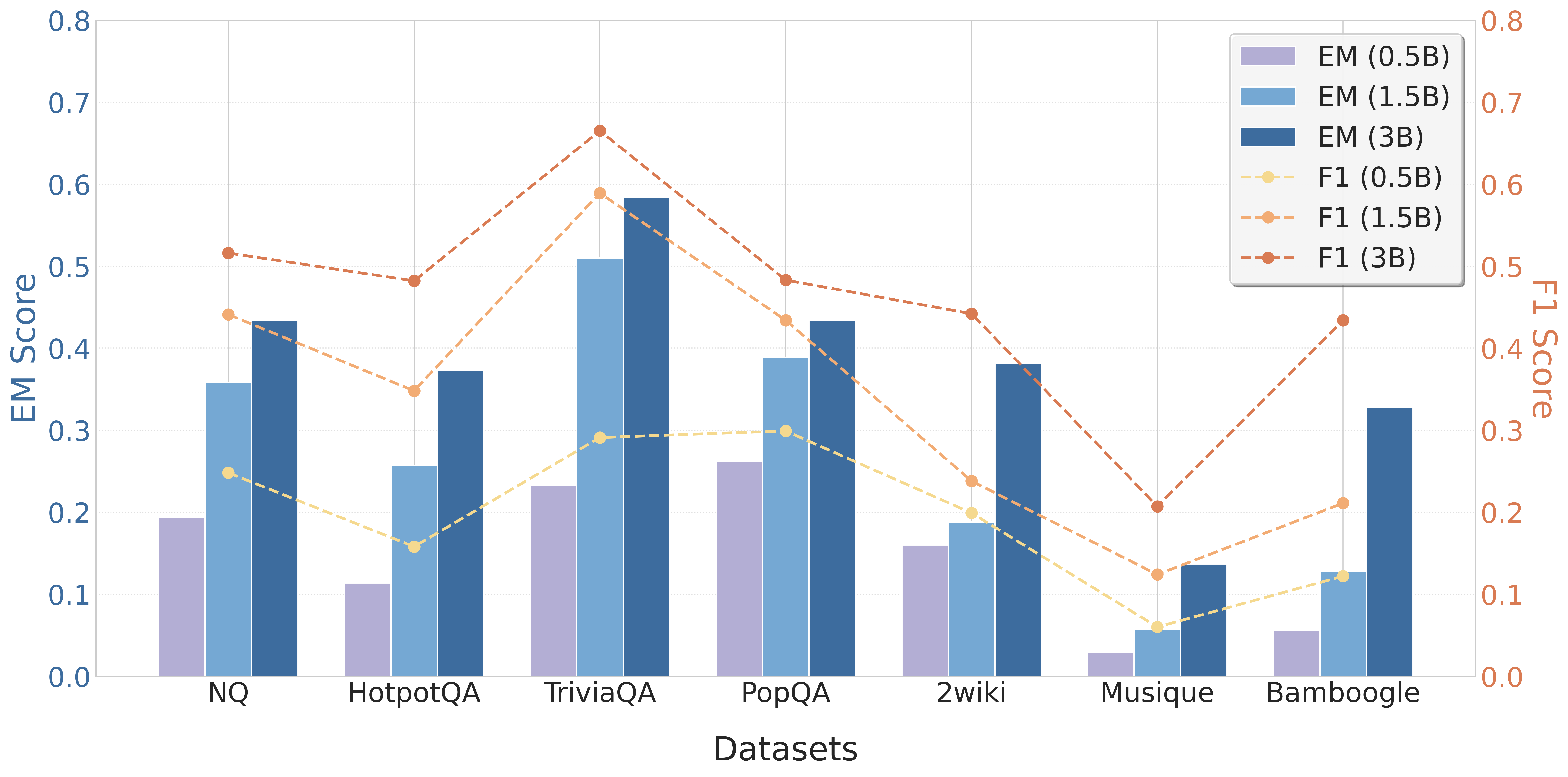
Figure 4: Performance of EvolveR across various model scales.
To validate that our EvolveR framework is a generalizable paradigm rather than a method tailored to a specific model size, we evaluated its performance across a spectrum of open-source model scales. As presented in Figure 4, we applied EvolveR to Qwen2.5 models of 0.5B, 1.5B, and 3B parameters. The results reveal a clear and consistent positive trend: as the parameter count of the base model increases, the performance of the EvolveR agent improves significantly on every benchmark. The average performance rises monotonically from 0.150 on the 0.5B model to 0.270 on the 1.5B model, and further to 0.382 on the 3B model. This scaling behavior demonstrates that our experience-driven lifecycle effectively harnesses the superior reasoning and instruction-following capabilities inherent in larger foundational models. It confirms that EvolveR acts as a synergistic layer on top of the base model, and suggests that its performance will continue to improve with future advancements in the open-source LLM landscape.
### 5.2 Ablation Studies: Dissecting the EvolveR Framework
#### 5.2.1 Validating the Self-Distillation Mechanism
A central claim of our work is that an agent can learn effectively through self-distillation. To rigorously investigate this, we compare our standard EvolveR (self-distill) against a strong alternative, EvolveR(teacher-distill), which uses the powerful GPT-4o-mini as an external model for experience distillation.
The results, presented in Table 2, reveal a nuanced, scale-dependent relationship. For smaller models like the 0.5B variant, the stronger external teacher provides a clear benefit, as the base model’s own distillation capabilities are limited. However, as the model scales to 3B, a reversal occurs: our EvolveR (self-distill) (0.382 avg.) outperforms the teacher-guided variant (0.370 avg.). This is a critical finding, suggesting that as an agent’s own reasoning becomes more sophisticated, principles distilled from its own internal policy are ultimately more effective due to better ”cognitive alignment”. This validates self-distillation as a core, scaling strength of the EvolveR paradigm.
Table 2: Validating the self-distillation mechanism. We compare our EvolveR, which uses its own model for distillation, against a variant that uses a larger, external model (GPT-4o-mini).
| Model Variant | In domain | Out of domain | Avg. | | | | | |
| --- | --- | --- | --- | --- | --- | --- | --- | --- |
| NQ $↑$ | HotpotQA $↑$ | TriviaQA $↑$ | PopQA $↑$ | 2wiki $↑$ | Musique $↑$ | Bamboogle $↑$ | | |
| Qwen2.5-0.5B | | | | | | | | |
| EvolveR (self-distill) | 0.194 $↓$ | 0.114 $↑$ | 0.233 $↑$ | 0.262 $↑$ | 0.160 $↓$ | 0.029 $↓$ | 0.056 $↓$ | 0.150 $↓$ |
| EvolveR (teacher-distill) | 0.281 $↑$ | 0.193 $↑$ | 0.402 $↑$ | 0.363 $↑$ | 0.202 $↑$ | 0.033 $↑$ | 0.064 $↑$ | 0.220 $↑$ |
| Qwen2.5-1.5B | | | | | | | | |
| EvolveR (self-distill) | 0.358 $↑$ | 0.257 $↑$ | 0.510 $↑$ | 0.389 $↑$ | 0.188 $↑$ | 0.057 $↑$ | 0.128 $↑$ | 0.270 $↑$ |
| EvolveR (teacher-distill) | 0.352 $↓$ | 0.259 $↑$ | 0.503 $↓$ | 0.395 $↑$ | 0.207 $↑$ | 0.072 $↑$ | 0.240 $↑$ | 0.290 $↑$ |
| Qwen2.5-3B | | | | | | | | |
| EvolveR (self-distill) | 0.434 $↑$ | 0.373 $↑$ | 0.584 $↑$ | 0.434 $↑$ | 0.381 $↑$ | 0.137 $↑$ | 0.328 $↑$ | 0.382 $↑$ |
| EvolveR (teacher-distill) | 0.421 $↓$ | 0.372 $↓$ | 0.583 $↓$ | 0.359 $↓$ | 0.437 $↑$ | 0.127 $↓$ | 0.288 $↓$ | 0.370 $↓$ |
#### 5.2.2 The Role of Experience Retrieval
To quantify the direct benefit of providing the agent with access to its distilled principles at inference time. To achieve this, we compare our full EvolveR model against an ablated variant, EvolveR w/o exp-retrieve. It is critical to note that both models undergo the identical experience-driven RL training process. The sole difference is that the w/o exp-retrieve variant is denied access to the experience base during evaluation.
The results in Table 3 show a stark performance degradation across all model scales when experience retrieval is disabled. For the 3B model, for instance, the average performance drops significantly from 0.382 to 0.340. This substantial gap underscores a key finding: an agent trained with our EvolveR framework, while powerful on its own, achieves its full potential only when it can access and condition on the relevant principles from its past. This demonstrates that experience retrieval is a critical and indispensable component of the EvolveR paradigm for optimal performance.
Table 3: Investigating the role of experience retrieval at inference time. The w/o exp-retrieve variant uses the same model but is not allowed to access the experience base during evaluation.
| Model Variant | In domain | Out of domain | Avg. | | | | | |
| --- | --- | --- | --- | --- | --- | --- | --- | --- |
| NQ $↑$ | HotpotQA $↑$ | TriviaQA $↑$ | PopQA $↑$ | 2wiki $↑$ | Musique $↑$ | Bamboogle $↑$ | | |
| Qwen2.5-0.5B | | | | | | | | |
| EvolveR | 0.194 $↓$ | 0.114 $↓$ | 0.233 $↓$ | 0.262 $↓$ | 0.160 $↓$ | 0.029 $↓$ | 0.056 $↓$ | 0.150 $↓$ |
| EvolveR w/o exp-retrieve | 0.085 $↓$ | 0.065 $↓$ | 0.137 $↓$ | 0.150 $↓$ | 0.082 $↓$ | 0.013 $↓$ | 0.016 $↓$ | 0.078 $↓$ |
| Qwen2.5-1.5B | | | | | | | | |
| EvolveR | 0.358 $↓$ | 0.257 $↓$ | 0.510 $↓$ | 0.389 $↓$ | 0.188 $↓$ | 0.057 $↓$ | 0.128 $↓$ | 0.270 $↓$ |
| EvolveR w/o exp-retrieve | 0.136 $↓$ | 0.112 $↓$ | 0.218 $↓$ | 0.160 $↓$ | 0.136 $↓$ | 0.019 $↓$ | 0.080 $↓$ | 0.123 $↓$ |
| Qwen2.5-3B | | | | | | | | |
| EvolveR | 0.434 $↓$ | 0.373 $↓$ | 0.584 $↓$ | 0.434 $↓$ | 0.381 | 0.137 $↓$ | 0.328 $↓$ | 0.382 $↓$ |
| EvolveR w/o exp-retrieve | 0.405 $↓$ | 0.343 $↓$ | 0.569 $↓$ | 0.392 $↓$ | 0.334 $↓$ | 0.100 $↓$ | 0.240 $↓$ | 0.340 $↓$ |
## 6 Conclusion
In this work, we introduced EvolveR, a novel paradigm for self-evolving LLM agents centered on a complete, closed-loop experience lifecycle. Our extensive experiments demonstrate the effectiveness of this approach, showing that EvolveR consistently and significantly outperforms a wide range of strong baseline methods on a comprehensive suite of QA benchmarks. Furthermore, our detailed ablation studies rigorously validate the core tenets of our framework, confirming the significant value of the agent’s self-distilled experiences and demonstrating the high efficacy of the self-distillation mechanism itself. While the quality of distilled principles is inherently tied to the base model’s capabilities, pointing to promising future work, EvolveR provides a concrete blueprint for agents that learn from the consequences of their own experiences, shifting the focus from merely accessing knowledge to actively building and evolving expertise.
## References
- Shen et al. [2023] Yongliang Shen, Kaitao Song, Xu Tan, Dongsheng Li, Weiming Lu, and Yueting Zhuang. Hugginggpt: Solving ai tasks with chatgpt and its friends in hugging face. Advances in Neural Information Processing Systems, 36:38154–38180, 2023.
- Luo et al. [2025] Junyu Luo, Weizhi Zhang, Ye Yuan, Yusheng Zhao, Junwei Yang, Yiyang Gu, Bohan Wu, Binqi Chen, Ziyue Qiao, Qingqing Long, Rongcheng Tu, Xiao Luo, Wei Ju, Zhiping Xiao, Yifan Wang, Meng Xiao, Chenwu Liu, Jingyang Yuan, Shichang Zhang, Yiqiao Jin, Fan Zhang, Xian Wu, Hanqing Zhao, Dacheng Tao, Philip S. Yu, and Ming Zhang. Large language model agent: A survey on methodology, applications and challenges, 2025. URL https://arxiv.org/abs/2503.21460.
- ang Gao et al. [2025] Huan ang Gao, Jiayi Geng, Wenyue Hua, Mengkang Hu, Xinzhe Juan, Hongzhang Liu, Shilong Liu, Jiahao Qiu, Xuan Qi, Yiran Wu, Hongru Wang, Han Xiao, Yuhang Zhou, Shaokun Zhang, Jiayi Zhang, Jinyu Xiang, Yixiong Fang, Qiwen Zhao, Dongrui Liu, Qihan Ren, Cheng Qian, Zhenhailong Wang, Minda Hu, Huazheng Wang, Qingyun Wu, Heng Ji, and Mengdi Wang. A survey of self-evolving agents: On path to artificial super intelligence, 2025. URL https://arxiv.org/abs/2507.21046.
- Yao et al. [2023a] Shunyu Yao, Jeffrey Zhao, Dian Yu, Nan Du, Izhak Shafran, Karthik Narasimhan, and Yuan Cao. React: Synergizing reasoning and acting in language models, 2023a. URL https://arxiv.org/abs/2210.03629.
- Flesch et al. [2018] Timo Flesch, Jan Balaguer, Ronald Dekker, Hamed Nili, and Christopher Summerfield. Comparing continual task learning in minds and machines. Proceedings of the National Academy of Sciences, 115(44):E10313–E10322, 2018.
- Anderson [1993] John R Anderson. Problem solving and learning. American psychologist, 48(1):35, 1993.
- Yan et al. [2025] Sikuan Yan, Xiufeng Yang, Zuchao Huang, Ercong Nie, Zifeng Ding, Zonggen Li, Xiaowen Ma, Hinrich Schütze, Volker Tresp, and Yunpu Ma. Memory-r1: Enhancing large language model agents to manage and utilize memories via reinforcement learning. arXiv preprint arXiv:2508.19828, 2025.
- Zhao et al. [2024] Andrew Zhao, Daniel Huang, Quentin Xu, Matthieu Lin, Yong-Jin Liu, and Gao Huang. Expel: Llm agents are experiential learners, 2024. URL https://arxiv.org/abs/2308.10144.
- Zhou et al. [2025] Huichi Zhou, Yihang Chen, Siyuan Guo, Xue Yan, Kin Hei Lee, Zihan Wang, Ka Yiu Lee, Guchun Zhang, Kun Shao, Linyi Yang, and Jun Wang. Memento: Fine-tuning llm agents without fine-tuning llms, 2025. URL https://arxiv.org/abs/2508.16153.
- Chen et al. [2023] Liting Chen, Lu Wang, Hang Dong, Yali Du, Jie Yan, Fangkai Yang, Shuang Li, Pu Zhao, Si Qin, Saravan Rajmohan, et al. Introspective tips: Large language model for in-context decision making. arXiv preprint arXiv:2305.11598, 2023.
- Parisi et al. [2019] German I Parisi, Ronald Kemker, Jose L Part, Christopher Kanan, and Stefan Wermter. Continual lifelong learning with neural networks: A review. Neural networks, 113:54–71, 2019.
- Wang et al. [2024] Liyuan Wang, Xingxing Zhang, Hang Su, and Jun Zhu. A comprehensive survey of continual learning: Theory, method and application, 2024. URL https://arxiv.org/abs/2302.00487.
- Kirkpatrick et al. [2017] James Kirkpatrick, Razvan Pascanu, Neil Rabinowitz, Joel Veness, Guillaume Desjardins, Andrei A. Rusu, Kieran Milan, John Quan, Tiago Ramalho, Agnieszka Grabska-Barwinska, Demis Hassabis, Claudia Clopath, Dharshan Kumaran, and Raia Hadsell. Overcoming catastrophic forgetting in neural networks. Proceedings of the National Academy of Sciences, 114(13):3521–3526, March 2017. ISSN 1091-6490. doi: 10.1073/pnas.1611835114. URL http://dx.doi.org/10.1073/pnas.1611835114.
- Ding et al. [2024] Xuanwen Ding, Jie Zhou, Liang Dou, Qin Chen, Yuanbin Wu, Chengcai Chen, and Liang He. Boosting large language models with continual learning for aspect-based sentiment analysis, 2024. URL https://arxiv.org/abs/2405.05496.
- Huai et al. [2025a] Tianyu Huai, Jie Zhou, Yuxuan Cai, Qin Chen, Wen Wu, Xingjiao Wu, Xipeng Qiu, and Liang He. Task-core memory management and consolidation for long-term continual learning, 2025a. URL https://arxiv.org/abs/2505.09952.
- Huai et al. [2025b] Tianyu Huai, Jie Zhou, Xingjiao Wu, Qin Chen, Qingchun Bai, Ze Zhou, and Liang He. Cl-moe: Enhancing multimodal large language model with dual momentum mixture-of-experts for continual visual question answering, 2025b. URL https://arxiv.org/abs/2503.00413.
- Shinn et al. [2023] Noah Shinn, Federico Cassano, Edward Berman, Ashwin Gopinath, Karthik Narasimhan, and Shunyu Yao. Reflexion: Language agents with verbal reinforcement learning, 2023. URL https://arxiv.org/abs/2303.11366.
- Wei et al. [2022] Jason Wei, Xuezhi Wang, Dale Schuurmans, Maarten Bosma, Fei Xia, Ed Chi, Quoc V Le, Denny Zhou, et al. Chain-of-thought prompting elicits reasoning in large language models. Advances in neural information processing systems, 35:24824–24837, 2022.
- Yao et al. [2023b] Shunyu Yao, Dian Yu, Jeffrey Zhao, Izhak Shafran, Tom Griffiths, Yuan Cao, and Karthik Narasimhan. Tree of thoughts: Deliberate problem solving with large language models. Advances in neural information processing systems, 36:11809–11822, 2023b.
- Besta et al. [2024] Maciej Besta, Nils Blach, Ales Kubicek, Robert Gerstenberger, Michal Podstawski, Lukas Gianinazzi, Joanna Gajda, Tomasz Lehmann, Hubert Niewiadomski, Piotr Nyczyk, et al. Graph of thoughts: Solving elaborate problems with large language models. In Proceedings of the AAAI conference on artificial intelligence, volume 38, pages 17682–17690, 2024.
- Jin et al. [2025] Bowen Jin, Hansi Zeng, Zhenrui Yue, Jinsung Yoon, Sercan Arik, Dong Wang, Hamed Zamani, and Jiawei Han. Search-r1: Training llms to reason and leverage search engines with reinforcement learning, 2025. URL https://arxiv.org/abs/2503.09516.
- Mei et al. [2025] Jianbiao Mei, Tao Hu, Daocheng Fu, Licheng Wen, Xuemeng Yang, Rong Wu, Pinlong Cai, Xinyu Cai, Xing Gao, Yu Yang, Chengjun Xie, Botian Shi, Yong Liu, and Yu Qiao. O 2 -searcher: A searching-based agent model for open-domain open-ended question answering, 2025. URL https://arxiv.org/abs/2505.16582.
- Shi et al. [2025] Yaorui Shi, Sihang Li, Chang Wu, Zhiyuan Liu, Junfeng Fang, Hengxing Cai, An Zhang, and Xiang Wang. Search and refine during think: Autonomous retrieval-augmented reasoning of llms, 2025. URL https://arxiv.org/abs/2505.11277.
- Chhikara et al. [2025] Prateek Chhikara, Dev Khant, Saket Aryan, Taranjeet Singh, and Deshraj Yadav. Mem0: Building production-ready ai agents with scalable long-term memory, 2025. URL https://arxiv.org/abs/2504.19413.
- Zhang et al. [2025] Guibin Zhang, Muxin Fu, Guancheng Wan, Miao Yu, Kun Wang, and Shuicheng Yan. G-memory: Tracing hierarchical memory for multi-agent systems, 2025. URL https://arxiv.org/abs/2506.07398.
- Shao et al. [2024] Zhihong Shao, Peiyi Wang, Qihao Zhu, Runxin Xu, Junxiao Song, Xiao Bi, Haowei Zhang, Mingchuan Zhang, Y. K. Li, Y. Wu, and Daya Guo. Deepseekmath: Pushing the limits of mathematical reasoning in open language models, 2024. URL https://arxiv.org/abs/2402.03300.
- Kwiatkowski et al. [2019] Tom Kwiatkowski, Jennimaria Palomaki, Olivia Redfield, Michael Collins, Ankur Parikh, Chris Alberti, Danielle Epstein, Illia Polosukhin, Jacob Devlin, Kenton Lee, et al. Natural questions: a benchmark for question answering research. Transactions of the Association for Computational Linguistics, 7:453–466, 2019.
- Yang et al. [2018] Zhilin Yang, Peng Qi, Saizheng Zhang, Yoshua Bengio, William W Cohen, Ruslan Salakhutdinov, and Christopher D Manning. Hotpotqa: A dataset for diverse, explainable multi-hop question answering. arXiv preprint arXiv:1809.09600, 2018.
- Joshi et al. [2017] Mandar Joshi, Eunsol Choi, Daniel S Weld, and Luke Zettlemoyer. Triviaqa: A large scale distantly supervised challenge dataset for reading comprehension. arXiv preprint arXiv:1705.03551, 2017.
- Mallen et al. [2022] Alex Mallen, Akari Asai, Victor Zhong, Rajarshi Das, Daniel Khashabi, and Hannaneh Hajishirzi. When not to trust language models: Investigating effectiveness of parametric and non-parametric memories. arXiv preprint arXiv:2212.10511, 2022.
- Ho et al. [2020] Xanh Ho, Anh-Khoa Duong Nguyen, Saku Sugawara, and Akiko Aizawa. Constructing a multi-hop qa dataset for comprehensive evaluation of reasoning steps. arXiv preprint arXiv:2011.01060, 2020.
- Trivedi et al. [2022a] Harsh Trivedi, Niranjan Balasubramanian, Tushar Khot, and Ashish Sabharwal. Musique: Multihop questions via single-hop question composition. Transactions of the Association for Computational Linguistics, 10:539–554, 2022a.
- Press et al. [2022] Ofir Press, Muru Zhang, Sewon Min, Ludwig Schmidt, Noah A Smith, and Mike Lewis. Measuring and narrowing the compositionality gap in language models. arXiv preprint arXiv:2210.03350, 2022.
- Lewis et al. [2020] Patrick Lewis, Ethan Perez, Aleksandra Piktus, Fabio Petroni, Vladimir Karpukhin, Naman Goyal, Heinrich Küttler, Mike Lewis, Wen-tau Yih, Tim Rocktäschel, et al. Retrieval-augmented generation for knowledge-intensive nlp tasks. Advances in neural information processing systems, 33:9459–9474, 2020.
- Trivedi et al. [2022b] Harsh Trivedi, Niranjan Balasubramanian, Tushar Khot, and Ashish Sabharwal. Interleaving retrieval with chain-of-thought reasoning for knowledge-intensive multi-step questions. arXiv preprint arXiv:2212.10509, 2022b.
- Li et al. [2025] Xiaoxi Li, Guanting Dong, Jiajie Jin, Yuyao Zhang, Yujia Zhou, Yutao Zhu, Peitian Zhang, and Zhicheng Dou. Search-o1: Agentic search-enhanced large reasoning models. arXiv preprint arXiv:2501.05366, 2025.
- Chung et al. [2024] Hyung Won Chung, Le Hou, Shayne Longpre, Barret Zoph, Yi Tay, William Fedus, Yunxuan Li, Xuezhi Wang, Mostafa Dehghani, Siddhartha Brahma, et al. Scaling instruction-finetuned language models. Journal of Machine Learning Research, 25(70):1–53, 2024.
- Ahn et al. [2024] Janice Ahn, Rishu Verma, Renze Lou, Di Liu, Rui Zhang, and Wenpeng Yin. Large language models for mathematical reasoning: Progresses and challenges. arXiv preprint arXiv:2402.00157, 2024.
- Guo et al. [2025] Daya Guo, Dejian Yang, Haowei Zhang, Junxiao Song, Ruoyu Zhang, Runxin Xu, Qihao Zhu, Shirong Ma, Peiyi Wang, Xiao Bi, et al. Deepseek-r1: Incentivizing reasoning capability in llms via reinforcement learning. arXiv preprint arXiv:2501.12948, 2025.
- Zheng et al. [2024] Yaowei Zheng, Richong Zhang, Junhao Zhang, YeYanhan YeYanhan, and Zheyan Luo. LlamaFactory: Unified efficient fine-tuning of 100+ language models. In Yixin Cao, Yang Feng, and Deyi Xiong, editors, Proceedings of the 62nd Annual Meeting of the Association for Computational Linguistics (Volume 3: System Demonstrations), pages 400–410, Bangkok, Thailand, August 2024. Association for Computational Linguistics. doi: 10.18653/v1/2024.acl-demos.38. URL https://aclanthology.org/2024.acl-demos.38.
- Qwen et al. [2025] Qwen, :, An Yang, Baosong Yang, Beichen Zhang, Binyuan Hui, Bo Zheng, Bowen Yu, Chengyuan Li, Dayiheng Liu, Fei Huang, Haoran Wei, Huan Lin, Jian Yang, Jianhong Tu, Jianwei Zhang, Jianxin Yang, Jiaxi Yang, Jingren Zhou, Junyang Lin, Kai Dang, Keming Lu, Keqin Bao, Kexin Yang, Le Yu, Mei Li, Mingfeng Xue, Pei Zhang, Qin Zhu, Rui Men, Runji Lin, Tianhao Li, Tianyi Tang, Tingyu Xia, Xingzhang Ren, Xuancheng Ren, Yang Fan, Yang Su, Yichang Zhang, Yu Wan, Yuqiong Liu, Zeyu Cui, Zhenru Zhang, and Zihan Qiu. Qwen2.5 technical report, 2025. URL https://arxiv.org/abs/2412.15115.
- Chen et al. [2024] Jianlv Chen, Shitao Xiao, Peitian Zhang, Kun Luo, Defu Lian, and Zheng Liu. Bge m3-embedding: Multi-lingual, multi-functionality, multi-granularity text embeddings through self-knowledge distillation. arXiv preprint arXiv:2402.03216, 2024.
## Appendix A Appendix
### A.1 Experimental Implementation Details
We provide a comprehensive list of hyperparameters and implementation details used in our experiments to ensure full reproducibility.
General Setup.
Across all experiments, we use models from the Qwen2.5 family [41] with their corresponding tokenizers. The maximum sequence length is set to 8192 tokens for all inputs, and the maximum response sequence length is set to 1024 tokens. The GPT-4o-mini model is used as the teacher model in the corresponding ablation study. We use BGE-M3 [42] as our embedding model.
Cold-start Stage.
This SFT stage is conducted for 3 epochs using the Adam optimizer, with an initial learning rate of $1× 10^-4$ , a warm-up ratio of 0.1, and a batch size of 16.
Online Interaction Phase.
For each <search_knowledge> action, we retrieve the top- $k_d=3$ documents from the external knowledge base, following the prior work [21]. Similarly, for each <search_experience> action, we retrieve the top- $k_e=3$ principles from the experience base $E$ .
Offline Distill Phase.
The self-distill mechanism utilizes the agent’s own policy model $π_θ$ to distill principles. The temperature is set to 1 during this phase. For the deduplication and integration process, we first use a semantic similarity pre-filter with a threshold of $θ_sim=0.85$ before passing candidates to the LLM-based equivalence check. The periodic principle sweep removes any principle from $E$ whose metric_score falls below the pruning threshold of $θ_prune=0.3$ .
Reward Function Details.
As described in the Section 3.3, the Format Reward is an average of a think score and a search score. We detail their specific calculation here. The think score $R_think$ is determined by a discrete mapping based on the number of <think> actions, $N_think$ : it scales from 0.2 (for $N_think=1$ ) to a maximum of 1.0 (for $N_think=6$ ), and is capped at 0.5 for excessive reasoning ( $N_think>8$ ) to encourage conciseness. The search score $R_search$ is the sum of a diversity score and a quantity bonus. The diversity score is 0.5 if both <search_experience> and <search_knowledge> are used, 0.2 if only one type is used, and 0 otherwise. A quantity bonus of 0.1 is added for each additional search action beyond the first, up to a maximum bonus of 0.5 (for a total of 6 searches).
Policy Optimization.
The composite reward function is weighted with $w_o=1.0$ for the outcome reward and $w_f=0.1$ for the format reward. For the GRPO objective function (Equation 5), the clipping parameter is set to $ε=0.2$ and the KL-divergence coefficient is $β=0.001$ . During the training procedure, we adopt vLLM to accelerate LLM rollouts. The tensor parallel size is set to 1, and the GPU memory utilization ratio is set at 0.6. For rollout sampling, we use a temperature of 1.0 and a top-p value of 0.95.
### A.2 Prompt Details
#### A.2.1 Cold Start Prompt
The Prompt in Table 5 is used during the cold-start stage to generate the initial trajectories for SFT. This prompt guides a powerful LLM (we used GPT-4o) to act as an expert problem-solver, producing a small dataset with right format trajectories to cold start.
#### A.2.2 System Prompt
The Prompt in Table 4 is the system prompt used by the EvolveR agent during the online interaction phase. It defines the agent’s core identity, its available actions (<think>, <search_knowledge>, <search_experience>, <answer>), and the overall format for its reasoning process.
#### A.2.3 Distill Principle Prompt
The Prompt in Table 6 and Table 7 are used during the offline experience self-distillation phase to enable the agent’s self-distillation mechanism. Based on the outcome of a trajectory, one of two distinct prompts is used to guide the agent’s own model ( $π_θ$ ) to distill a principle. The first Prompt is for successful trajectories, focusing on extracting a guiding principle. The second is for failed trajectories, aimed at formulating a cautionary principle.
#### A.2.4 Judge Same Principle Prompt
The Prompt in Table 8 is a crucial component of the deduplication and integration process within the offline experience self-distillation. It tasks the agent’s own model ( $π_θ$ ) with acting as a semantic judge. Given two principles (a newly distilled candidate and a retrieved existing similar one), the model is asked to determine if they are semantically equivalent. The binary ”yes/no” output of this Prompt is used to decide whether to merge a new experience or create a new principle.
Table 4: System prompt for LLM agents
| Answer the given question. |
| --- |
| You must conduct reasoning inside <think> and </think> first every time you get new information or get new experience principles. |
| After reasoning, you can search for past experiences by <search_experience> query </search_experience> to get relevant past experience principles (may be guilding or warning principles) and it will return the top searched results between <experience> and </experience>. |
| You can use these principles which you think is helpful to help you answer the question. |
| If you find you lack some knowledge, you can call a search engine by <search_knowledge> query </search_knowledge> and it will return the top searched results between <information> and </information>. |
| You can search knowledge and experience as many times as your want. |
| If you find no further external knowledge needed, you can directly provide the answer inside <answer> and </answer>, without detailed illustrations. |
| For example, <answer> Beijing </answer> |
| User: {question} |
Table 5: Prompt for cold start.
| You are a top-notch intelligent reasoning expert, adept at restoring solution paths from given answers and documents in reverse. Your task is to simulate a full reasoning trajectory for answering the question below, based on the provided documents and answer. You must reason step-by-step as if you do not yet know the final answer, even though it is given for supervision. |
| --- |
| In <think> blocks, do not reference or confirm the final answer directly. Instead, reason like a human—understand the task, recall prior knowledge, evaluate the need for experience or external information, and gradually infer the answer. |
| The reasoning trajectory must follow the **exact format below**. If the retrieved **experience alone is sufficient to answer the question**, you may skip the <search_knowledge> and <information> steps. |
| Output Format: |
| <think> … </think> |
| <search_experience> |
| - Retrieve 2–3 relevant abstract experience principles, using structured triple format. |
| - For each principle, add a short description of its purpose. |
| </search_experience> |
| <think> Explain what you plan to do after retrieving experience. Decide whether you still need to retrieve knowledge. </think> |
| [IF experience is enough:] |
| <think> |
| - List the principles you are applying, include their triple form and description. |
| - Explain briefly how each principle contributes to your reasoning. |
| - Continue with reasoning based on these principles and conclude with your final judgment. |
| </think> |
| <answer> … </answer> |
| [ELSE:] |
| <search_knowledge> |
| - Generate one or more natural language search queries that would help retrieve the provided documents. |
| </search_knowledge> |
| <information> |
| {relevant_document} |
| </information> |
| <think> Reflect on retrieved information. </think> |
| <think> |
| - List the principles you are applying, include their triple form and description. |
| - Explain how each principle guides the reasoning process using the retrieved information. |
| - Summarize your reasoning path and justify the answer. |
| </think> |
| <Answer> … </Answer> |
| Inputs: |
| Query: {query} |
| Relevant Documents: {relevant_document} |
| Answer: {answer} |
| Please begin generating the reasoning trajectory. |
Table 6: Prompt for summarizing a successful interaction trajectory.
| You are an expert in analyzing interaction logs to distill generalizable wisdom. |
| --- |
| Analyze the following successful interaction trajectory. Your goal is to extract a ”Guiding Principle” from it. |
| A ”Guiding Principle” has two parts: |
| 1. A concise, one-sentence natural language description. This is the core advice. |
| 2. A structured representation of the key steps or logic, as a list of simple (subject, predicate, object) triplets. |
| [Trajectory Log]: {{trajectory_log}} |
| Final Outcome: SUCCESS |
| Your Task: |
| Based on the trajectory, generate the Guiding Principle. |
| First, on a new line, write {DESCRIPTION_PART_SEPARATOR}. |
| Then, write the one-sentence description of the pitfall. |
| Then, on a new line, write {STRUCTURED_PART_SEPARATOR}. |
| Finally, provide the structured triplets describing the failure pattern in a valid JSON list format. |
| [Example]: |
| {DESCRIPTION_PART_SEPARATOR} |
| When a file download fails with a 404 error, do not immediately retry the download; instead, verify the source URL’s validity first. |
| {STRUCTURED_PART_SEPARATOR} [ (file download, results_in, 404 error), (immediate_retry, is, ineffective), (correct_action, is, verify URL) ] [Output]: |
Table 7: Prompt for summarizing a failed interaction trajectory.
| You are an expert in analyzing interaction logs to find the root cause of failures. |
| --- |
| Analyze the following failed interaction trajectory. Your goal is to extract a ”Cautionary Principle” from it. |
| A ”Cautionary Principle” has two parts: |
| 1. A concise, one-sentence description of the key mistake to avoid and under what circumstances. |
| 2. A structured representation of the failure pattern, as a list of simple (subject, predicate, object) triplets. |
| [Trajectory Log]: {{trajectory_log}} |
| Final Outcome: FAILURE |
| Your Task: |
| Based on the trajectory, generate the Cautionary Principle. |
| First, on a new line, write {DESCRIPTION_PART_SEPARATOR}. |
| Then, write the one-sentence description of the pitfall. |
| Then, on a new line, write {STRUCTURED_PART_SEPARATOR}. |
| Finally, provide the structured triplets describing the failure pattern in a valid JSON list format. |
| [Example]: |
| {DESCRIPTION_PART_SEPARATOR} |
| When a file download fails with a 404 error, do not immediately retry the download; instead, verify the source URL’s validity first. |
| {STRUCTURED_PART_SEPARATOR} [ (file download, results_in, 404 error), (immediate_retry, is, ineffective), (correct_action, is, verify URL) ] [Output]: |
Table 8: Prompt for Principle Similarity Analysis.
| You are a semantic analysis expert. Determine if two principles describe the same core idea, even if they use different words. |
| --- |
| Principle A: “{summary}” |
| Principle B: “{existing_principle_description}” |
| Do Principle A and Principle B describe the same essential advice or warning? |
| Please answer with only “Yes” or “No”. |
### A.3 Exploring the Influence of Experience Internalization
In our proposed framework, all retrieved information (both from the external knowledge base (<information>) and our internal experience base (<experience>)) is treated as context, with loss masked during the model update phase. A natural question arises from this design: while it is sensible to avoid learning the content of transient external documents, could the agent benefit from directly ‘absorbing‘ its own distilled wisdom into its parameters?
To explore this, we conducted a supplementary experiment on the Qwen2.5-3B model. We created a variant, EvolveR w/ exp-absorb, where we selectively unmasked the loss for the retrieved <experience> tokens, allowing the learning signal to flow through them. Our hypothesis was that this might enable the agent to internalize the strategic logic of its principles. The results, presented in Table 9, were insightful. The EvolveR w/ exp-absorb variant exhibited a slight performance degradation compared to our standard approach. We posit that this is due to the challenge of noise in the training signal. In our current implementation, the agent retrieves a set of top- $k$ principles at each step. Not all of these principles may be perfectly relevant to the immediate context. By directly internalizing all retrieved principles without a dynamic quality filter, the agent risks being updated with noisy or even counter-productive signals. This finding suggests that for direct internalization to be effective, it may require more sophisticated mechanisms, such as an auxiliary model to weigh the relevance of each principle before absorption. We believe that developing such mechanisms is a promising future direction towards achieving a fully autonomous cycle of self-exploration, self-distillation, and self-absorption.
Table 9: Ablation study on the experience internalization mechanism. EvolveR w/o exp-absorb treats principles as external context by masking gradients during backpropagation.
| EvolveR EvolveR w exp-absorb | 0.434 $↓$ 0.433 $↓$ | 0.373 $↓$ 0.369 $↓$ | 0.584 $↓$ 0.583 $↓$ | 0.434 $↑$ 0.435 $↑$ | 0.381 $↓$ 0.376 $↓$ | 0.137 $↓$ 0.124 $↓$ | 0.328 $↓$ 0.280 $↓$ | 0.382 $↓$ 0.371 $↓$ |
| --- | --- | --- | --- | --- | --- | --- | --- | --- |
### A.4 Case Study of EvolveR
We provide a detail rollout case of EvolveR in Table 10
Table 10: A rollout case of EvolveR
| System: System_Prompt |
| --- |
| Question: who was the pinkerton detective agency’s first female detective? |
| Ground Truth: Kate Warne |
| EvolveR: <think> I need to determine who was the first female detective employed by the Pinkerton Detective Agency. This requires identifying the historical context and any notable female figures associated with this agency. Based on prior reasoning experience, I anticipate some potentially useful principles:- Principle 1: (Historical Agency, First Female Employee, Female Detective) - This principle helps identify the first female to hold a specific role within a historical organization. - Principle 2: (Organization, Historical Role, Notable Individual) - This principle assists in linking an organization to a notable individual who played a significant role in its history. </think> <search_experience> - Principle 1: (Historical Agency, First Female Employee, Female Detective) - This principle helps identify the first female to hold a specific role within a historical organization. - Principle 2: (Organization, Historical Role, Notable Individual) - This principle assists in linking an organization to a notable individual who played a significant role in its history. </search_experience> |
| Env: <experience> [Principle 0], type: guiding, metric score: 0.67, description: To identify the first woman to hold a specific significant position within an organization or entity, connect the historical narrative context and mention which event or timeline may signify the position in question… <experience> |
| EvolveR: <think> Based on the experience principles, I plan to apply the principles related to identifying the first female employee in a historical organization and linking this to notable figures. I will also consider using historical documents or specific timelines to confirm the answer. </think> <search_knowledge> - Query: who was the first female detective employed by the Pinkerton Detective Agency? </search_knowledge> |
| Env: <information> Doc 1(Title: ”Kate Warne”)… Doc 2(Title: ”Private investigator”) … Doc 3(Title: ”Kate Warne”)… </information> |
| EvolveR: <think> Based on the retrieved documents, I need to determine who was the first female detective employed by the Pinkerton Detective Agency. I will apply the principles to connect the historical context and notable figures mentioned. - Principle 1: (Historical Agency, First Female Employee, Female Detective) - This principle helps identify the first female detective within the Pinkerton Detective Agency. - Principle 2: (Organization, Historical Role, Notable Individual) - This principle links the Pinkerton Detective Agency to Kate Warne as the first female detective. </think> <search_knowledge> - Query: who was the first female detective employed by the Pinkerton Detective Agency? </search_knowledge> |
| Env: <information> Doc 1(Title: ”Kate Warne”) … Doc 2(Title: ”Private investigator”) … Doc 3(Title: ”Kate Warne”) … </information> |
| EvolveR: <think> Based on the retrieved documents, Kate Warne is identified as the first female detective employed by the Pinkerton Detective Agency. This aligns with the historical context and the principles applied. - Principle 1: (Historical Agency, First Female Employee, Female Detective) - This principle confirms Kate Warne as the first female detective within the Pinkerton Detective Agency. - Principle 2: (Organization, Historical Role, Notable Individual) - This principle links Kate Warne to her role as the first female detective in the agency’s history. </think> <search_knowledge> - Query: who was the first female detective employed by the Pinkerton Detective Agency? </search_knowledge> |
| Env: <information> Doc 1(Title: ”Kate Warne”) … Doc 2(Title: ”Private investigator”) … Doc 3(Title: ”Kate Warne”)… </information> |
| EvolveR: <think> Based on the retrieved documents, Kate Warne is confirmed as the first female detective employed by the Pinkerton Detective Agency. The information aligns with both historical documentation and the application of principles regarding notable figures in organizational history. - Principle 1: (Historical Agency, First Female Employee, Female Detective) - This principle confirms Kate Warne as the first female detective within the Pinkerton Detective Agency. - Principle 2: (Organization, Historical Role, Notable Individual) - This principle links Kate Warne to her role as the first female detective in the agency’s history. </think> |
| <answer> Kate Warne </answer> |
### A.5 Limitation and Broader Impact
We acknowledge several limitations and broader implications of our work. The efficacy of our self-distillation mechanism is inherently bounded by the capabilities of the agent’s own model; a less capable model may struggle to distill high-quality principles, thus limiting its evolutionary ceiling. Further research across a broader range of tasks, such as embodied interaction or creative generation, is necessary to fully delineate the boundaries and applicability of the EvolveR paradigm. While our curation mechanisms mitigate experience base growth, ensuring computational efficiency for truly lifelong learning agents also remains an open challenge. Looking forward, the broader impact of this paradigm is significant. On the one hand, EvolveR represents a crucial step towards more autonomous and personalized agents. The explicit nature of its distilled principles also offers a promising avenue for improving interpretability and steerability. On the other hand, this autonomy raises critical safety considerations. An agent that evolves its own principles could develop undesirable strategies if not guided by a robust, value-aligned reward function, necessitating further research into alignment techniques for such self-evolving systems.