# Understanding AI Trustworthiness: A Scoping Review of AIES & FAccT Articles
**Authors**: Siddharth Mehrotra, Jin Huang, Xuelong Fu, Roel Dobbe, Clara I. Sánchez, Maarten de Rijke
> University of Amsterdam & Delft University of TechnologyThe NetherlandsTBS
> University of CambridgeUnited KingdomXXX
> Delft University of TechnologyThe NetherlandsXX
> University of AmsterdamThe NetherlandsXXX
\keepXColumns \JAIRAE
Min-Yen Kan \JAIRTrack Survey Articles
(2025)
Abstract.
Background: Trustworthy AI serves as a foundational pillar for two major AI ethics conferences: AIES and FAccT. However, current research often adopts techno-centric approaches, focusing primarily on technical attributes such as reliability, robustness, and fairness, while overlooking the sociotechnical dimensions critical to understanding AI trustworthiness in real-world contexts.
Objectives: This scoping review aims to examine how the AIES and FAccT communities conceptualize, measure, and validate AI trustworthiness, identifying major gaps and opportunities for advancing a holistic understanding of trustworthy AI systems.
Methods: We conduct a scoping review of AIES and FAccT conference proceedings to date, systematically analyzing how trustworthiness is defined, operationalized, and applied across different research domains. Our analysis focuses on conceptualization approaches, measurement methods, verification and validation techniques, application areas, and underlying values.
Results: While significant progress has been made in defining technical attributes such as transparency, accountability, and robustness, our findings reveal critical gaps. Current research often predominantly emphasizes technical precision at the expense of social and ethical considerations. The sociotechnical nature of AI systems remains less explored and trustworthiness emerges as a contested concept shaped by those with the power to define it.
Conclusions: An interdisciplinary approach combining technical rigor with social, cultural, and institutional considerations is essential for advancing trustworthy AI. We propose actionable measures for the AI ethics community to adopt holistic frameworks that genuinely address the complex interplay between AI systems and society, ultimately promoting responsible technological development that benefits all stakeholders. copyright: cc doi: 10.1613/jair.1.xxxxx publicationmonth: 10 journalyear: 2025
1. Introduction
The rapid advancement and widespread adoption of artificial intelligence (AI) have ushered in a new era of technological innovation, bringing both immense potential and significant challenges. As AI increasingly permeates aspects of our lives, from healthcare to criminal justice, the need for trustworthy AI has become paramount. Trustworthy AI, as a concept, encompasses a multifaceted approach to AI systems that prioritizes safety, transparency, and ethical considerations for all stakeholders (10.1145/3555803, 85). It extends beyond technical proficiency, embracing principles like reliability, fairness, explainability, and accountability. This has given rise to dedicated academic venues like the AAAI/ACM Conference on AI, Ethics, and Society (AIES) and ACM Conference on Fairness, Accountability, and Transparency (FAccT), fostering interdisciplinary discourse on AI ethics. It is now clear that a purely technology-centric view of trustworthiness is not enough. Trustworthy AI requires an interdisciplinary perspective that views AI systems as sociotechnical systems.
The sociotechnical nature of AI systems demands a holistic approach to trustworthiness, one that considers not only the technical aspects but also the complex interplay between AI and the broader social, cultural, and institutional contexts in which it operates. (betram, 95) lays out five elements of trustworthiness as competent, reliable, transparent, benevolent, and having ethical integrity – and calls out to study these elements in a broader sociotechnical setting. This expanded perspective is particularly crucial for the AI ethics community which aims to bridge the gap between computer science and other disciplines in addressing AI’s ethical challenges.
In a study by (laufer, 82), when asked about what values 36 self-selecting FAccT affiliates believe FAccT scholarship should address in the near future, participants reflected on the need for broader conceptions for trustworthiness. Central to this discourse is the recognition that the concept of trustworthiness is fundamental to understanding and predicting trust levels in AI systems. It becomes imperative to critically examine how the AIES & FAccT communities conceptualize and communicate trustworthiness, and to what ends these efforts are directed. This examination raises important questions about the commitments that trustworthy AI research in these venues signifies, or should signify, in the broader context of AI ethics and societal impact.
The study of the trustworthiness of AI systems has been a topic of interest for many years, even before the existence of the AIES & FAccT conferences. Scholars from various disciplines have identified values that determine the attribution of trustworthiness, revealing both similarities and differences across fields. For example, in interpersonal trust, competence, predictability, benevolence, and integrity have been highlighted as crucial values (lahusen2024trust, 79). For public institutions, the list extends to competence and reliability, procedures like transparency and accountability, and results including effectiveness and general welfare (polemi2024challenges, 115). In the context of AI systems, properties such as reliability, robustness, safety, interpretability, explainability, fairness, transparency, and accountability have been identified as trust-relevant (kaur2021requirements, 70, 84).
Trustworthiness has been used to refer to two sides of a coin (e.g., lee2004trust, 84, 86, 98, 146, 122). On the one hand, trustworthiness has been referred to as an objective attribute of the trustee (e.g., zerilli2022transparency, 152, 52, 71, 65, 47). On the other hand, trustworthiness has been referred to as a trustor’s subjective perception of a trustee’s attributes (e.g., mayer1995integrative, 98, 122, 84). Overall, trustworthiness is multifaceted, comprising several elements regardless of whether it is viewed as an inherent quality of the trusted party or as a subjective assessment made by those extending trust (baer2018people, 9, 31, 65, 84). Therefore, by concentrating on trustworthiness, we can assess the qualities and behaviors of AI systems that contribute to their reliability, safety, and ethical alignment.
Despite the extensive research on trustworthy AI (toney, 141), there remains a critical gap in understanding the sociotechnical nature of these systems. Few studies have adequately addressed the complex interplay between technical capabilities and social contexts in which AI operates. This paper aims to address these gaps by conducting a comprehensive scoping review of articles published in AIES & FAccT conferences to date. Through our analysis, we seek to answer several key questions:
1. How is trustworthiness conceptualized in the context of AI systems within AIES & FAccT proceedings?
1. What methodologies are employed to measure, verify, and validate trustworthiness?
1. Which application areas are most prominently represented?
1. What underlying values and ethical considerations drive this body of work?
We explicitly focus on values because an account of value embodiment in AI aids in assessing whether designed AI systems indeed embody a range of moral values (mehrotraaies, 101), e.g., those articulated by the EU High-Level Expert Group (EU_AI_Ethics_Guidelines, 42). To this end, we examine three key dimensions: intended, embodied and realized values following the framework of (van2020embedding, 114) to do a thematic analysis on our corpus. Our motivation to use this framework is that it helps us overcome the limitations of focusing solely on intentions (which may not manifest in the system) or outcomes (which may be influenced by external factors) by emphasizing embodied values—those intentionally and successfully embedded in the system.
Overall, our core contributions are:
1. A systematic analysis of how trustworthiness is conceptualized, measured, and validated within the AIES & FAccT community.
1. Identification of major gaps in current research, particularly regarding the sociotechnical aspects of AI systems.
1. A critical examination of the values and ethical considerations underpinning trustworthy AI research.
1. A discussion of the intellectual and broader impact of AIES & FAccT conferences in studying AI trustworthiness.
2. Related Work
Trust is a much-discussed topic in algorithmic decision-making, especially in the area of AI (mehrotrareview, 99). In the development of trust, the process by which a human assesses the trustworthiness of a system, leading to their perception of trustworthiness, is crucial. Only with an accurate trustworthiness assessment can people base their trust on adequate expectations about a system’s capabilities and limitations and make informed decisions. Trustworthiness of AI systems has been studied from multiple disciplines such as computer science (liu2023trustworthy, 89), psychology (schlicker2022calibrated, 124), public administration (lahusen2024trust, 79), and medicine (zhang2023ethics, 154). Below, we provide a background on studying trustworthiness in four subject areas, namely: computer science, law, social sciences, and humanities. These areas are common in the AIES & FAccT conferences. AIES includes experts from various disciplines such as ethics, philosophy, economics, sociology, psychology, law, history, and politics (AIES2018, 50), while FAccT brings together scholars from computer science, law, social sciences, and humanities (Facct2018, 48). These areas serve as the foundation for our interdisciplinary approach to understanding the multifaceted nature of AI trustworthiness.
2.1. Computer Science
Computer science has predominantly focused on technical perspectives for trustworthy AI applications, emphasizing three characteristics, (i) robustness, fortifying AI models against malicious attacks such as adversarial attacks; (ii) generalization, ensuring maintaining performance on unseen out-of-distribution (OOD) data; and (iii) interpretability, improving understanding of AI model predictions (wang2023trustworthy, 148, 104). (mucsanyi2023trustworthy, 104) list common pitfalls in evaluating trustworthy machine learning models, e.g., inconsistent coding for evaluation metrics despite being the same mathematically, confounding multiple factors in method comparisons, training and test samples overlap, and lack of validation set. Building on the foundational principles of trustworthy machine learning, recent research has begun to investigate the characteristics that apply to large language models and mechanisms for evaluating their trustworthiness. (liu2023trustworthy, 89) survey key dimensions for assessing LLM trustworthiness. These include reliability, safety, fairness, resistance to misuse, explainability and reasoning, adherence to social norms, and robustness. (liu2023trustworthy, 89) highlight that a key principle for evaluating an LLM ’s trustworthiness is the generation of proper test data across the aforementioned dimensions. Finally, (toney, 141) review similarities and differences between governments’ and researchers’ definitions and frameworks on trustworthy AI. The authors find inconsistencies between policy and research term frequencies, highlighting the different focuses of each group on trustworthy AI, distinct from our work focusing on AI trustworthiness rather than the use of the terminology within the AIES & FAccT community.
Studies in computer science are often tech-centred, focusing primarily on technical methodologies but overlooking socio-cultural, ethical, and legal dimensions of trustworthiness. But achieving trustworthiness demands interdisciplinary collaboration. Thus, we consider AI systems as socio-technical and explore how the AIES & FAccT community is deepening our insight into trustworthiness of AI.
2.2. Social Sciences
Social science provides a broad perspective on AI trustworthiness focusing on its societal, institutional, economic, and political implications and dynamics. E.g., (dacon2023you, 28) investigates the impact of AI trustworthiness on various aspects of society, like the environment, human society, and societal values. These implications are abstracted into three social principles: (i) harm prevention, which focuses on ensuring safety, security, reliability, and privacy; (ii) explicability, which emphasizes explainability and transparency of the system; and (iii) fairness, which consists of accountability and the well-being of society and environment. (thiebes2021trustworthy, 138) evaluate AI trustworthiness frameworks and synthesize the recurring themes in five principles: beneficence, non-maleficence, autonomy, justice, and explicability. They also conceptualize the DaRe4TAI framework, which structures and directs data-driven research in trustworthy AI while addressing tensions between the five principles. Similar framework-oriented approaches are pursued by other social science scholars, as they form a crucial connection with policymaking (polemi2024challenges, 115, 78). We adopt a similar lens in this review as (polemi2024challenges, 115, 78) to discuss the results of our corpus analysis with a socio-technical focus by thinking about the entire ecosystem in which our AI systems operate.
2.3. Law
The question of AI trustworthiness is crucial in the legal domain, where even minor inaccuracies can have significant consequences for individuals navigating the complexities of legal processes. Studies have demonstrated the capabilities of LLMs in understanding and responding to natural language queries. However, the tendency of LLMs to generate inaccurate and incomplete information raises serious concerns about their trustworthiness in providing legal guidance (kattnig2024assessing, 69). E.g., (tan2023chatgpt, 134) investigate ChatGPT’s ability to provide legal information using several simulated cases and compared with the performance to that of and find that often leads laypeople to over-trust it. More generally looking at use of AI systems in law, (steenhuis2024ai, 130) raises important questions of exploring trustworthiness of such systems for methods of service delivery, replacement of routine legal tasks and essential legal assistance to those who might otherwise go without. Potential answers to these explorations can be derived from (hagan2020legal, 55) ’s work who provides legal design testing metrics to explore trustworthiness of AI systems plus methodology and “design deliverables” based on these metrics with California state courts’ Self Help Centers (hagan2018human, 54). Overall, AI systems hold significant promise for improving accessibility and efficiency in the legal domain but face challenges related to inaccuracies, hallucinations, and over-reliance, raising concerns about trustworthiness.
2.4. Humanities
The study of AI trustworthiness within the humanities emphasizes ethical, philosophical, and cultural aspects, addressing critical issues such as moral agency, responsibility, and the societal impact of AI decision-making (noller2024extended, 107, 117, 25). (balmer2023sociological, 10) critically examines AI’s role in society through creative methodologies, while others explore how AI reshapes creativity, authorship, and cultural interpretation (lim2018ai, 87). Historical and philosophical analyses (coeckelbergh2022political, 26, e.g.,) provide valuable context for understanding contemporary AI technologies, alongside inquiries into AI consciousness and religious perspectives that highlight cultural and ethical considerations (IsDeweys, 46, 2, 59). These diverse approaches underline the importance of contextualizing AI systems within broader humanistic and historical frameworks to assess their trustworthiness effectively. The integration of ethical, cultural, and philosophical dimensions in evaluating AI trustworthiness offers a more comprehensive understanding of its implications, enabling more informed and responsible development of AI systems.
3. Methodology and Corpus Overview
3.1. Methodology
We employ a Scoping Literature Review (SLR) following the guidelines by (arksey2005scoping, 8) to identify articles studying trustworthiness of AI systems. SLRs guide the gathering and identification of papers in a topic area for scrutiny (kastner2012most, 68), which enables us to perform our thematic investigation of AIES & FAccT scholarship. We use qualitative manual coding and computational corpus analysis, including topic modeling, to extract themes and patterns from the data.
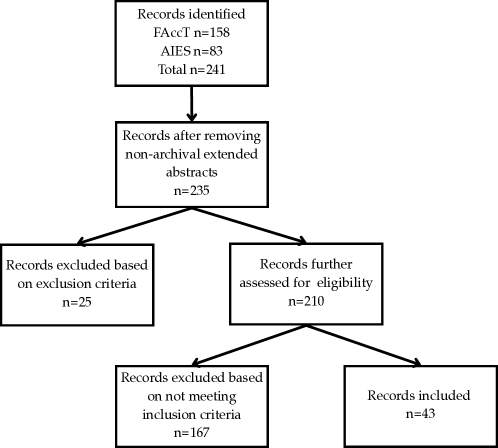
Data Collection. The data consists of peer-reviewed articles published by the AIES & FAccT conferences between 2018–2025, downloaded from the ACM website on September 05, 2025 Note that the proceedings of AIES 2025 are not available when we have submitted this manuscript, hence AIES 2025 articles are excluded from this review.. In total, 241 articles (83 AIES, 158 FAccT) are obtained that include the keyword “trustworthiness” in the full-text excluding references; 6 non-archival extended abstracts are excluded, leaving us 235 articles for screening.
Screening and Selection Criteria. We note several challenges in reviewing the AIES & FAccT papers. The concept of trustworthiness is often embedded throughout papers instead of being the core theme. For example, auditing algorithmic systems or exploring potential biases in AI systems eventually help in understanding their trustworthiness, but this is often a point of discussion rather than the core contribution. Therefore, it is difficult to conclude that these articles engage with the core concept. Hence, we aim for a balanced approach studying trustworthiness, by including two types of article in our analysis: (i) articles that directly address trustworthiness as a central theme, like (liao2022designing, 86, 45, 65, 44), and (ii) articles where trustworthiness is not the main focus, but the authors explain how their findings contribute to a broader understanding of system trustworthiness and, ultimately, user trust.
Therefore, keeping our balanced approach, following prior literature reviews on trust (mehrotrareview, 99, 145, 12) and best research practices to study a particular topic (ajmani, 1, 116), we define our inclusion criteria as:
1. One of the contributions of the article is linked to understanding trustworthiness of an algorithmic system.
1. The article engages with trustworthiness as a component of their measure, directly influenced by the results, or as a key discussion theme.
Our exclusion criteria are:
1. The article discusses the need for AI trustworthiness without directly defining, measuring, or modeling it.
1. The article is classified as a survey, scoping review, or literature review.
The final corpus consists of 43 papers after applying our inclusion and exclusion criteria. An overview of our review process following the PRISMA protocol (page2021prisma, 110) is shown in Figure 1.
<details>
<summary>x1.png Details</summary>
### Visual Description
\n
## Diagram: Process Flowchart
### Overview
The image depicts a flowchart illustrating a hierarchical process with five stages. The flowchart is presented in a top-down manner, with each stage represented by a rectangular box and connected by arrows indicating the flow of the process. The text within each box appears to be in English, but is somewhat obscured and difficult to read with high precision.
### Components/Axes
The diagram consists of:
* **Boxes:** Five rectangular boxes representing process stages.
* **Arrows:** Lines with arrowheads indicating the direction of the process flow.
* **Text:** Labels within each box describing the process stage.
### Detailed Analysis or Content Details
Due to the image quality, the text is difficult to decipher with absolute certainty. However, I will attempt to transcribe the text within each box to the best of my ability, noting the uncertainty.
1. **Top Box:** "Development of the initial model and data collection"
2. **Second Box:** "Development of the model and data collection"
3. **Third Box (Left Branch):** "Model evaluation and refinement"
4. **Third Box (Right Branch):** "Model application and validation"
5. **Bottom Boxes (Branching from Right Branch):**
* **Left Bottom Box:** "Model implementation and deployment"
* **Right Bottom Box:** "Documentation and reporting"
The arrows indicate a sequential flow:
* From "Development of the initial model and data collection" to "Development of the model and data collection".
* From "Development of the model and data collection" to both "Model evaluation and refinement" and "Model application and validation".
* From "Model application and validation" to both "Model implementation and deployment" and "Documentation and reporting".
### Key Observations
The diagram illustrates a typical iterative process in model development. The branching at the third stage suggests that the process can either focus on refining the model or applying and validating it. The final stage involves both implementation and documentation, indicating a complete process lifecycle.
### Interpretation
This flowchart likely represents a simplified overview of a model development lifecycle, potentially in a scientific or engineering context. The initial stages focus on building the model and gathering data. The subsequent branching suggests a decision point: either refine the model based on evaluation or proceed with application and validation. The final stages emphasize practical implementation and thorough documentation, crucial for reproducibility and knowledge sharing. The diagram highlights the iterative nature of model development, where evaluation and refinement can lead to improvements and better performance. The diagram does not provide any quantitative data or specific details about the model itself, but it effectively communicates the overall process flow.
</details>
Figure 1. Flowchart of the articles reviewing process following the PRISMA protocol (page2021prisma, 110).
Free-form Questions. Following the Goal-Question-Metric (GQM) approach (caldiera1994goal, 11), we analyze the articles along the GQM dimensions that are phrased as questions: (i) what is the goal of the paper, (ii) what are different research questions related to this goal, and (iii) what are metrics to measure some aspects/factors of this goal? This framework provides us with a way to categorize the understanding of trustworthiness in the AIES & FAccT community in the form of generic free-form questions closely tied to the research questions from Section 1.
We employ a thematic analysis to analyze the 43 articles and address our research questions. First, we develop a coding scheme to extract relevant information from each paper. For defining trustworthiness (RQ1), we identify key terms, phrases, and concepts used across papers to formulate common definitional themes. We further link the identified themes with the International Organization for Standardization (ISO) standard 5723 on trustworthiness (ISO_Trustworthiness_Vocabulary_2022, 63), allowing us to track frequency and depth of coverage. The ISO standard is chosen as a reference framework as it represents an internationally recognized benchmark for trustworthiness in technical systems (toney, 141). Furthermore, to understand the drivers of studying trustworthiness, we use both inductive and deductive coding approaches, first allowing themes to emerge naturally from the text then mapping these against common clusters.
For trustworthiness measures (RQ2), we develop a hierarchical coding structure to categorize assessment methods and validation & verification techniques. For application scenarios (RQ3), we employ open coding to identify emerging categories of use cases, followed by axial coding to establish relationships between different application contexts. Finally, to better understand the role of values in AI trustworthiness (RQ4), we analyze intended, embodied, and realized values. We followed (van2020embedding, 114) ’s work to study the role of values. According to his work, intended values refer to the ethical principles and societal benefits that AI systems aim to achieve, embodied values are those integrated into their design and implementation, and realized values are the actual outcomes observed in practice. We use a two-stage coding process where we first identify explicitly stated intended values related to trustworthiness and then compare these against realized outcomes and embodied values. This involves creating pairs of intended-realized values and analyzing any gaps or alignments between them.
Our coding process is iterative, with initial codes refined over multiple analysis rounds. To ensure reliability, three researchers independently code a subset of papers (25%) and calculate an average Cohen’s Kappa coefficient ( $\kappa=0.62$ ). Through iterative discussions, they update their understanding, recode previous papers to include emergent concepts, include new papers in small batche of five and achieve improved reliability. The team collaborated for about two months to discuss findings and potential discrepancies in coding of the articles. Through multiple discussions, discrepancies were reevaluated and corrected, resulting in the final coefficient of $\kappa=0.91$ .
3.2. Corpus Overview
First, we perform a metadata analysis on the final corpus of 43 articles, focusing on understanding the trustor’s background, the object of trustworthiness, variables, and study type. Our meta analysis reveals that there are six interlinked trustors: users of a specific AI system (20), The number in brackets denote the count of articles corresponding to a specific dimension. citizens (12), developers (4), designers (3), practitioners (2), and public administrators (2). As to the object of trustworthiness, the corpus revolves around studying trustworthiness of AI linked with data sources (19) and institutions developing the AI system (12). The role of trustworthiness as a study variable is almost equally divided among the papers as independent variable (21) and dependent variable (22). Finally, trustworthiness is studied normatively in only 1/3rd of the studies while the remaining 2/3rd studies it in empirical study design.
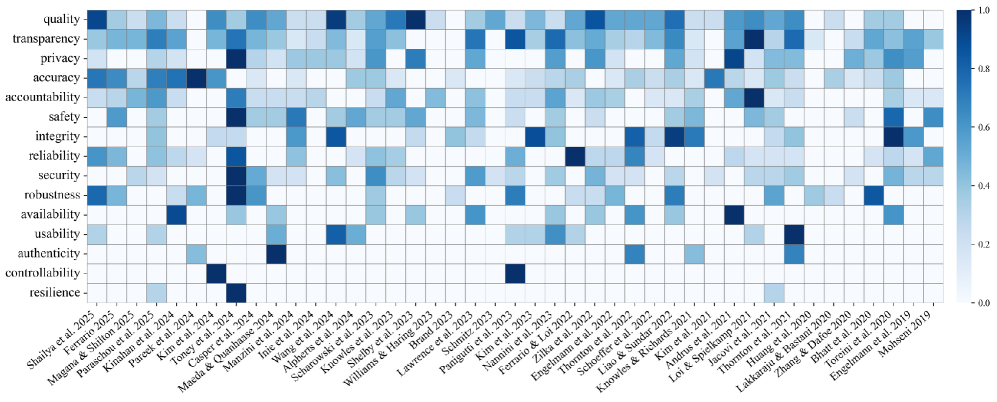
Second, Figure 2 shows a heatmap of the log-normalized, min-max scaled word occurrences of trustworthiness dimensions by (ISO_Trustworthiness_Vocabulary_2022, 63), in the full texts of the included corpus. Dimensions like quality, transparency, and accuracy occur frequently throughout the full texts, while authenticity, controllability, and resilience are mentioned relatively less. Some articles, like (paraschou2025ties, 112) and (toney, 141), refer to a wide array of dimensions.
<details>
<summary>x2.png Details</summary>
### Visual Description
\n
## Heatmap: Ethical Considerations in AI Research (2019-2025)
### Overview
This image presents a heatmap visualizing the consideration of various ethical factors across a range of AI research papers published between 2019 and 2025. The heatmap uses a color gradient to represent the degree to which each ethical consideration is addressed in the respective papers, with darker shades of red indicating higher consideration and lighter shades of blue indicating lower consideration.
### Components/Axes
* **Y-axis (Vertical):** Lists 16 ethical considerations: quality, transparency, privacy, accuracy, accountability, reliability, safety, integrity, security, robustness, availability, usability, authenticity, controllability, and resilience.
* **X-axis (Horizontal):** Lists AI research papers, identified by author(s) and year of publication, ranging from "Shalia et al. 2025" to "Mohsen 2019".
* **Color Scale (Legend):** Located on the right side of the heatmap, ranging from 0.0 (light blue) to 1.0 (dark red). The scale indicates the level of ethical consideration, with higher values representing greater consideration.
* **Grid Lines:** Horizontal and vertical lines delineate the cells of the heatmap, corresponding to the intersection of ethical considerations and research papers.
### Detailed Analysis
The heatmap displays a matrix of color-coded cells, each representing the ethical consideration score for a specific research paper. The values are approximate, based on visual estimation of the color gradient.
Here's a breakdown of trends and approximate values, reading across the X-axis (papers) for each ethical consideration (Y-axis):
* **Quality:** Generally low consideration across all papers, ranging from approximately 0.05 to 0.3. A slight increase is observed towards the middle of the timeline (2022-2023).
* **Transparency:** Starts low (around 0.1-0.2 in 2019-2021), peaks around 0.6-0.7 for papers in 2023-2024, and then declines slightly.
* **Privacy:** Similar trend to transparency, with a peak around 0.6-0.7 in 2023-2024.
* **Accuracy:** Generally moderate consideration, fluctuating between 0.3 and 0.6.
* **Accountability:** Low to moderate consideration, with a slight increase towards 2023-2024 (0.4-0.6).
* **Reliability:** Similar to accountability, with values ranging from 0.2 to 0.5.
* **Safety:** Moderate consideration, generally between 0.4 and 0.7, with a peak around 2023.
* **Integrity:** Low to moderate consideration, similar to reliability.
* **Security:** Low consideration across most papers, generally below 0.3.
* **Robustness:** Low consideration, similar to security.
* **Availability:** Very low consideration, consistently below 0.2.
* **Usability:** Low consideration, generally below 0.3.
* **Authenticity:** Low consideration, similar to usability.
* **Controllability:** Low consideration, consistently below 0.3.
* **Resilience:** Very low consideration, consistently below 0.2.
**Specific Data Points (Approximate):**
* **Mohsen et al. 2019:** All ethical considerations are very low (0.0-0.2).
* **Engelmann et al. 2020:** Slightly higher consideration for transparency (around 0.3) and accuracy (around 0.3).
* **Tseng et al. 2021:** Moderate consideration for safety (around 0.5).
* **Kim et al. 2023:** High consideration for transparency, privacy, and safety (around 0.7-0.8).
* **Paeguit et al. 2023:** High consideration for transparency and privacy (around 0.7).
* **Shalia et al. 2025:** Moderate consideration for transparency and accuracy (around 0.5-0.6).
### Key Observations
* **Peak in 2023-2024:** There's a noticeable peak in the consideration of transparency, privacy, and safety around 2023-2024. This suggests a growing awareness of these ethical issues during that period.
* **Low Consideration for Availability, Usability, Authenticity, Controllability, and Resilience:** These ethical considerations consistently receive the lowest scores, indicating they are often overlooked in AI research.
* **Variability:** There is significant variability in ethical consideration across different research papers, even within the same year.
* **Quality is consistently low:** Quality is consistently the lowest considered ethical factor.
### Interpretation
The heatmap suggests that while ethical considerations are becoming increasingly important in AI research, the focus is primarily on transparency, privacy, and safety. Other crucial ethical aspects, such as availability, usability, and resilience, are often neglected. The peak in consideration around 2023-2024 could be attributed to increased public awareness of AI ethics, the release of ethical guidelines by organizations, or a growing emphasis on responsible AI development within the research community.
The data highlights a potential imbalance in ethical focus. While addressing transparency, privacy, and safety is essential, a holistic approach to AI ethics requires considering a broader range of factors to ensure the responsible and beneficial deployment of AI technologies. The consistent low scores for availability, usability, and resilience suggest a need for more research and discussion on these often-overlooked ethical dimensions.
The heatmap provides a valuable snapshot of the ethical landscape in AI research, revealing both progress and areas for improvement. It can inform researchers, policymakers, and stakeholders about the current state of ethical consideration and guide future efforts towards more responsible AI development.
</details>
Figure 2. Heatmap of the normalized frequencies of trustworthiness dimensions in each paper of the final corpus ( $N=43$ ).
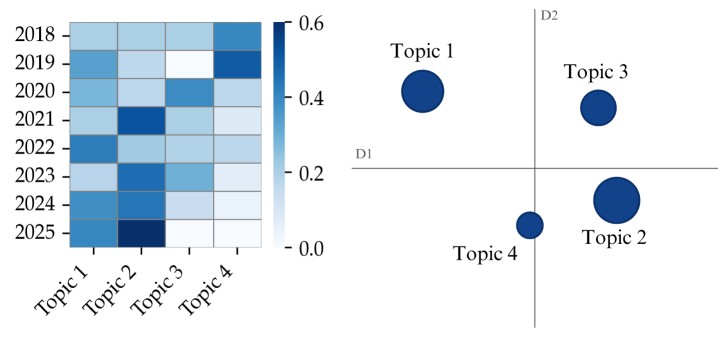
Third, we broaden the analysis and discover themes across the initial keyword-based selection of 235 articles, without extended abstracts, through topic modeling. We apply BERTopic (grootendorst2022bertopic, 53), which leverages c-TF-IDF and the capabilities of the transformer-based language model BERT (devlin2018bert, 29), to analyze topics that are both coherent and contextually meaningful. The generated topics are analyzed using two visualizations as shown in Figure 3. On the one hand, we present the normalized topic distributions over time using a heatmap to capture trends and shifts across publication years. We observe a consistent prevalence and recent increase of topics relating to “explanations” and “accountability”, while there is a relative decline in topics referring to ethics and norms. On the other hand, we visualize the representations and relative distance of the topics in a 2D plot. Notably, topics surrounding “fairness,” “transparency,” and “ethics” lie in closer proximity to each other, while they are more distanced from the topic around “explanations.” Also, we find that although fairness and bias are key ethical concerns, the considerable distance between fairness-related topics and ethical themes suggests that papers tend to emphasize one while giving limited attention to the other.
Topic 1 (72): explanations, human, decision, language, study
Topic 2 (85): transparency, accountability, public, human, technologies
Topic 3 (49): fairness, bias, algorithmic, fair, discrimination
Topic 4 (29): ethics, ethical, moral, responsible, norms
<details>
<summary>x3.png Details</summary>
### Visual Description
## Heatmap & Scatter Plot: Topic Dynamics Over Time
### Overview
The image presents two visualizations: a heatmap on the left showing the intensity of four topics (Topic 1, Topic 2, Topic 3, Topic 4) over the years 2018-2025, and a scatter plot on the right representing the topics in a two-dimensional space defined by dimensions D1 and D2. The heatmap uses a blue color gradient to indicate intensity, with darker blues representing higher values. The scatter plot uses circle size to represent relative importance or magnitude.
### Components/Axes
**Heatmap:**
* **X-axis:** Topics - Topic 1, Topic 2, Topic 3, Topic 4
* **Y-axis:** Years - 2018, 2019, 2020, 2021, 2022, 2023, 2024, 2025
* **Color Scale:** Ranges from 0.0 (lightest blue) to 0.6 (darkest blue).
* **Data Values:** Represent the intensity or prevalence of each topic in each year.
**Scatter Plot:**
* **X-axis:** Dimension D1
* **Y-axis:** Dimension D2
* **Points:** Represent Topics 1, 2, 3, and 4. The size of the circle appears to be proportional to some value.
* **Labels:** Topic 1, Topic 2, Topic 3, Topic 4 are labeled next to their respective points.
### Detailed Analysis or Content Details
**Heatmap Data (Approximate Values):**
| Year | Topic 1 | Topic 2 | Topic 3 | Topic 4 |
|---|---|---|---|---|
| 2018 | 0.5 | 0.3 | 0.2 | 0.4 |
| 2019 | 0.5 | 0.3 | 0.3 | 0.4 |
| 2020 | 0.4 | 0.4 | 0.3 | 0.3 |
| 2021 | 0.3 | 0.5 | 0.4 | 0.2 |
| 2022 | 0.2 | 0.4 | 0.5 | 0.2 |
| 2023 | 0.2 | 0.3 | 0.6 | 0.2 |
| 2024 | 0.2 | 0.2 | 0.5 | 0.3 |
| 2025 | 0.2 | 0.1 | 0.4 | 0.3 |
**Trends in Heatmap:**
* **Topic 1:** Declines steadily from 0.5 in 2018 to 0.2 in 2025.
* **Topic 2:** Initially stable, then declines from 0.4 in 2021 to 0.1 in 2025.
* **Topic 3:** Increases from 0.2 in 2018 to a peak of 0.6 in 2023, then decreases to 0.4 in 2025.
* **Topic 4:** Remains relatively low and stable around 0.2-0.4 throughout the period.
**Scatter Plot Data (Approximate):**
* **Topic 1:** Located at approximately (0.2, 0.5). Medium circle size.
* **Topic 2:** Located at approximately (0.1, -0.3). Largest circle size.
* **Topic 3:** Located at approximately (0.4, 0.4). Medium circle size.
* **Topic 4:** Located at approximately (0.0, -0.1). Smallest circle size.
### Key Observations
* Topic 1 and Topic 2 show a clear decreasing trend in prevalence over time.
* Topic 3 experiences a rise in prevalence, peaking in 2023, then declining.
* Topic 4 remains consistently low in prevalence.
* In the scatter plot, Topic 2 has the largest circle, suggesting it is the most significant or prominent topic based on the dimensions D1 and D2. Topic 4 has the smallest circle.
* Topic 1 and Topic 3 are positioned in the positive quadrant of the scatter plot, while Topic 2 and Topic 4 are in the negative quadrant.
### Interpretation
The visualizations suggest a dynamic shift in topic prevalence over the years 2018-2025. Topics 1 and 2 are losing relevance, while Topic 3 gains prominence before experiencing a decline. Topic 4 remains a minor topic throughout the period.
The scatter plot provides a different perspective, showing the relationships between the topics based on dimensions D1 and D2. These dimensions could represent various characteristics, such as sentiment, complexity, or source. The positioning of the topics suggests that Topic 2 and Topic 4 are distinct from Topic 1 and Topic 3. The circle sizes indicate that Topic 2 is the most significant topic based on these dimensions.
The combination of the heatmap and scatter plot provides a comprehensive view of the topic dynamics. The heatmap shows *how* the topics change over time, while the scatter plot shows *where* they stand in relation to each other. The peak in Topic 3 around 2023 could represent a significant event or trend that drove its increased prevalence. The decline of Topic 1 and Topic 2 could be due to changing interests or the emergence of new topics. The dimensions D1 and D2 likely represent underlying factors that influence the relationships between the topics.
</details>
Figure 3. Visualizations of topics generated using BERTopic applied to the initial keyword-based selection of articles ( $N=235$ ). First, the heatmap (left) shows normalized topic distributions, grouped by year. Values refer to the proportion of documents associated with the topic. Second, the intertopic distance plot (right) shows the relative positions of topics in a 2D space. The representations of topics are reduced to two dimensions using the uniform manifold approximation and projection dimensionality reduction technique, enabling the generation of a 2D plot to visualize the topics.
4. Understanding of AI Trustworthiness in the AIES & FAccT Community
4.1. Definition or Conceptualization
To understand how to understand an AI system’s trustworthiness, it is crucial to examine how we define or conceptualize it. Definition refers to how trustworthiness is formally described and articulated in the selected papers and conceptualization encompasses the broader understanding of trustworthiness, e.g., considering its role in systems.
First, the AIES & FAccT community presents a rich and multifaceted understanding of AI trustworthiness, as evidenced across numerous studies. Through our coding and thematic analysis, we identify seven key conceptualization themes, summarized in Table 1.
Analysis of the conceptual landscape reveals several critical insights about how AI trustworthiness is understood in contemporary scholarship. First, there exists a fundamental tension between transparency-focused approaches (T1) and technical robustness perspectives (T6), suggesting competing philosophies about whether trustworthiness derives primarily from system interpretability or from demonstrated reliability regardless of internal opacity. Second, the prominence of anthropomorphization themes (T3) alongside ethical considerations (T4) indicates growing recognition that trust in AI cannot be divorced from human psychological tendencies to perceive social relationships with technology, a finding that challenges purely technical or procedural definitions. Third, the emphasis on broader societal implications (T5) and regulatory ecosystems signals an important shift from treating trustworthiness as an individual system property to understanding it as embedded within institutional contexts where harms, accountability, and public opinion are distributed unevenly across populations. Finally, the reliance on established frameworks like Mayer’s model and NIST/ISO definitions (T7) alongside emerging concepts of perceived parasocial relationships suggests the field is simultaneously borrowing from organizational trust theory while grappling with AI-specific phenomena that existing models may not adequately capture. These insights collectively reveal that AI trustworthiness is conceptualized not as a unified construct but as a contested terrain where technical, psychological, ethical, and societal dimensions intersect and sometimes conflict.
Table 1. Understanding of AI Trustworthiness: Key themes in definitions and conceptualizations.
| T1: Emphasis on transparency as a foundational aspect of trustworthiness | Trustworthiness cues (liao2022designing, 86), Good explanation (rayyan-64504518, 105), Open communication (brandj, 16), Transparency, Provenance & connections between them (rayyan-64504562, 139), Computational reliabilism & anti-monitoring (Ferrario, 45), Expressing Uncertainty (Sunnie2024a, 73), Transparency with human oversight (rayyan-64504523, 111), Explanation Trustworthiness (rayyan-64504630, 103, 128), Transparency of algorithmic tools deployed in the criminal justice system (rayyan-64504664, 155) |
| --- | --- |
| T2: The importance of benchmarks, rigorous auditing and compliance mechanisms | White- and outside-the box audits (Stephen2024, 21), Certification Labels (nicolas, 121), Performance benchmarks and evaluation measures (rayyan-64504620, 83), Mapping regulatory guidelines to philosophical account of accountability (rayyan-64504624, 90) |
| T3: Perceived Anthropomorphization | (de)Anthropomorphized description of AI system (Nanna2024, 62), Perceived Parasocial Relationships (rayyan-64504506, 92), Facial AI inferences (Severin2022, 40) |
| T4: Ethical considerations, including fairness and respect for user intent | Inclusive & intersectional algorithms (kime, 72), Data leakage & reproducibility (Sean2024, 75), Model interpretability (rayyan-64504617, 81), Understanding of harms and how (and by whom) this has been informed (Bran2023, 76), Interaction between risks and the dispositions of the trustee (rayyan-64504660, 151), Informational fairness (10.1145/3531146.3533218, 126), Achieving fairness (rayyan-64504644, 125), Fairness by design (rayyan-64504611, 61), Fair data procurement (mckane, 4) |
| T5: Broader societal implications: Regulatory Ecosystem and Accountability caused by harms | Social trustworthiness score (Severin2019, 39), Trustworthiness criteria for policy-making (rayyan-64504432, 3), Public trust in AI & institutional trust (Bran2021, 77), AI Assistant design & Organizational practices and third-party governance (rayyan-64504509, 97), sociotechnical harms (rayyan-64504649, 129), Public opinion (rayyan-64504662, 153), Safe, reliable, and acceptable to users and public (magana2025frameworks, 93) |
| T6: Justified reliance on AI’s reliability and technical robustness | Reasonable trust in model’s output (Umang2020, 13), Warranted Trust (jacovi, 65), AI system must maintain to function correctly within its context of application (ferrario2025trustworthiness, 44) |
| T7: Mayer’s (mayer1995integrative, 98) and Lee & See’s model (lee2004trust, 84) & NIST/ISO definition | Ability, Benevolence & Integrity (Sunnie2023, 74, 86, 73, 149, 140, 113, 112), ABI+ (ABI, Predictability) framework (toreini, 142), NIST & ISO Definition (toney, 141) |
We also study the trustworthiness dimensions defined by the ISO trustworthiness standard (ISO_Trustworthiness_Vocabulary_2022, 63) to ensure that our analysis is based on internationally recognized standards. ‘Transparency’ is the most frequently mentioned ISO dimension, appearing in 21 out of 43 papers, followed by ‘accountability’ and ‘explainability’ in 12 papers. The less frequently mentioned ISO dimensions are ‘controllability’ (5), ‘resilience’ (4), ‘robustness’ (4), ‘security’ (4), ‘safety’ (3), ‘reliability’ (3), ‘usability’ (3), and ‘provenance’ (2).
While many studies implicitly link trustworthiness to accuracy, reliability, transparency, and fairness, increasing attention is being given to more nuanced conceptualizations, such as stakeholder-centric approaches and systemic perspectives. Frequent references to ISO dimensions, particularly transparency, accountability, and explainability, underscore their importance in building trustworthy AI systems. However, a more comprehensive and standardized approach to defining and measuring AI trustworthiness is needed for the responsible development and deployment of AI systems.
4.2. Drivers
(anjomshoae2019explainable, 7) have underlined the importance of considering the intended purpose when studying the trustworthiness of AI systems. To this end, this scoping review seeks to understand why the reviewed studies focus on understanding trustworthiness. Most of these works stated their motivation or intended purpose for studying trustworthiness. Table 1 lists the drivers of the 43 papers included in the review, with some papers having more than one driver.
Table 1. The drivers of AI trustworthiness of the primary studies covered by the review.
| D1: Conformity with regulations & Guidelines and ethical considerations | (Stephen2024, 21, 40, 75, 105, 111, 126, 121, 141, 16, 61, 83, 90, 125, 129, 139, 5, 77, 103, 61, 155, 141, 4, 128, 44) |
| --- | --- |
| D2: Promoting honesty | (Severin2019, 39, 151, 3) |
| D3: Trust | (Umang2020, 13, 45, 62, 65, 73, 74, 86, 92, 97, 139, 126, 113, 140, 149, 81, 103, 76, 65, 151, 3, 77, 142, 153, 93, 112) |
| D4: Economic growth & Cultural values | (Severin2019, 39, 16) |
| D5: Reproducibility | (Sean2024, 75) |
| D6: Accuracy | (Aida2023, 94, 72, 3) |
Increasing users’ trust in the system, ethical considerations, and conformity with regulations such as those of (EU_AI_Ethics_Guidelines, 42, 127, 136, 137, 66, 144, 43, 147), and accuracy are among the listed motivations for the explanations. The table reveals that trust and ethical considerations are the most prominent drivers of studying AI trustworthiness. Naturally, trust and trustworthiness go hand in hand to increase users’ confidence in the system by understanding how its reasoning mechanism works (anjomshoae2019explainable, 7). In applications requiring human-AI interaction, honesty and accuracy are among the main drivers for trustworthiness to ensure that AI’s decision-making is reliable and fair (10.1145/3531146.3533218, 126, 113). For public AI systems, trustworthiness drivers are often linked with conformity with regulations and guidelines, and economic growth and cultural values (Severin2019, 39, 16, 77, 90, 153). Finally, (Sean2024, 75) identify reproducibility of their results as a driver for studying trustworthiness for their system. Overall, these studies provide a holistic overview of the key drivers for studying AI trustworthiness.
4.3. Measurement and Verification & Validation
(jacobs2021measurement, 64) have introduce measurement theory for AI/ML systems, where validation and verification are key to ensure we are measuring what we are trying to measure. In the context of AI trustworthiness, measurement refers to quantifying specific attributes or characteristics of the AI system, typically aligned with ISO trustworthiness dimensions. Following ISO 9001 (dnv2015iso, 32), verification involves confirming through examination and provision of objective evidence that the specified trustworthiness dimensions are fulfilled. Validation is similar to verification, but must be confirmed under real-world usage conditions.
Measurement. To analyze the measurement techniques for AI trustworthiness, we follow (schlicker2025we, 122) ’s distinction of actual and perceived trustworthiness. (schlicker2025we, 122) define a system’s actual trustworthiness as a latent construct that indicates the true value of a system’s trustworthiness (in alignment with Realistic Accuracy Model (funder1995accuracy, 49)), e.g., benevolence, integrity, and ability (mehrotrareview, 99, 84, 98). Similarly, perceived trustworthiness reflects the result of a trustor’s assessment of the trustee’s actual trustworthiness.
Table 1. The measurement of AI trustworthiness of the primary studies covered by the review.
| Likert scale | McKnight et al.[(HARRISONMCKNIGHT2002297, 58)] (Sunnie2024a, 73), Jian et al. [(Jian01032000, 67)] (rayyan-64504525, 113), Perceived trustworthiness (Own scale) (10.1145/3531146.3533218, 126) |
| --- | --- |
| Reliance behavior | Change in people’s trust judgment (liao2022designing, 86), Agreement between a participant’s answer and that of the AI system (Sunnie2024a, 73, 74, 93) (rayyan-64504525, 113, 149, 83) |
| Actual cues (e.g., precision, recall, and f1-scores) | Positive predictive value (kime, 72), LDA topic modelling (Severin2019, 39), Stochastic model with surrogates (rayyan-64504518, 105), (Aida2023, 94, 142, 75, 21, 111), Metrics for plausibility and faithfulness scores (shailya2025lext, 128) |
| Assessment of impact and alignment with values and concerns | Ethical charters & internal review bodies (rayyan-64504509, 97), sociotechnical harms taxonomy, Moral groundings for public transparency (rayyan-64504624, 90) (rayyan-64504649, 129) |
| Levels of monitoring activities | Monitoring-avoiding relation between trustor & trustee (Ferrario, 45) (toreini, 142), Trustworthiness level across system accuracy ranges (ferrario2025trustworthiness, 44) |
| Communication style and anthropomorphic features | Roleplaying & reciprocal engagement (rayyan-64504506, 92) |
| Qualitative assessment | Interviews & Surveys (nicolas, 121, 13, 139, 62, 81, 149, 3, 153, 40, 4), User satisfaction (rayyan-64504664, 155) |
| Model Cards and AI Assessment Catalog | Information about data leakage & selective inference for EEG (Sean2024, 75), AI Assessment Catalog (rayyan-64504644, 125), NIST AI Risk Management Framework & other national frameworks (toney, 141) |
| Mediator & Trustee role | Social, Institutional and Temporal Embeddedness, Situational Normality, Structural Assurance, Motivation and ABI (lauren, 140) |
Analysis of measurement strategies reveals several important insights about the operationalization of AI trustworthiness. First, the field exhibits a problematic conflation between measuring trust (a psychological state) and measuring trustworthiness (system properties that warrant trust). Reliance behavior and Likert scales capture user perceptions while technical metrics assess objective capabilities, yet the relationship between these remains theoretically underdeveloped. Second, the diversity of approaches, from LDA topic modeling to ethical charters to role-playing exercises, suggests that trustworthiness is inherently multi-faceted and resists reduction to single metrics, yet this proliferation also indicates a lack of consensus on what actually constitutes valid measurement. Third, the emergence of documentation artifacts like model cards (Sean2024, 75) and AI assessment catalogs (rayyan-64504644, 125) represents an important shift toward longitudinal, context-aware evaluation rather than snapshot assessments, implicitly acknowledging that trustworthiness is not static but emerges through ongoing scrutiny. Finally, the inclusion of mediator and trustee role factors (social embeddedness, situational normality, structural assurance) indicates growing sophistication in recognizing that measurement must account for the relational and contextual dimensions of trust rather than treating it as residing solely in the AI system. Together, these developments suggest the field is moving toward more holistic measurement paradigms, though integration across approaches remains elusive.
Verification and/or Validation. More than half (34 out of 43) of the papers did not (explicitly) provide or adopt verification or validation approaches. Among the remaining 9 papers, surveys are the most widely used verification methodology, appearing in 5 papers (Severin2022, 40, 62, 126, 113, 153). E.g., (rayyan-64504525, 113) conduct a survey-based between-subject experiments involving 300 participants to investigate trust development, erosion, and recovery during AI-assisted decision-making. Additionally, (rayyan-64504662, 153) pre-register their experiments to ensure methodological rigor and transparency. (rayyan-64504617, 81) and (rayyan-64504432, 3) verify trustworthiness measurement through user studies with domain experts. Finally, only one paper employs a mixed method consisting of qualitative interviews and a subsequent survey to collect quantitative data (nicolas, 121).
The gap in current research, i.e., the insufficient attention to validation under real-world constraints and the lack of alignment between verification practice and trustworthiness dimensions, can be attributed to two primary factors: the lack of real-world data or representative scenarios (rayyan-64504434, 5) and the absence of multi-disciplinary collaboration (brundage2020toward, 17). The 9 papers that do so represent important but limited work in controlled settings, not diverse real-world environments. Our thoughts resonate with (rayyan-64504434, 5) and (brandj, 16) who have demonstrated challenges in obtaining representative datasets and how siloed approaches can miss critical sociotechnical dimensions for verification or validation.
4.4. Application Scenarios
AI techniques are applied across domains, including high-stakes ones, making trustworthiness vital to their success. The AIES & FAccT community demonstrates a comprehensive and diverse exploration of trustworthiness across various application scenarios; see Table 2. High-stake domains, including healthcare and medical applications, financial and economic systems, human resources, governance, law, and justice, are the most prominent application scenarios of studying trustworthiness of AI systems (22 out of 43). 12 out of 43 papers do not centre on a specific application scenario but rather generally discuss AI applications and their impact on society. Additionally, (rayyan-64504518, 105) and (rayyan-64504523, 111) examine AI policies with a focus on explainability of AI systems. (rayyan-64504518, 105) perform a thematic and gap analysis of policies and standards on explainability in EU, US, and UK and provide a set of recommendations on how to address explainability in regulations for AI systems. (rayyan-64504523, 111) analyze the EU AI Act (european2021proposal, 41) and argue that it neither mandates explainable AI nor bans the use of black-box AI systems; instead, it seeks to achieve its stated policy objectives with a focus on transparency and human oversight.
Table 2. The application scenarios of AI trustworthiness of the primary studies covered by the review.
| Healthcare and medical applications | (liao2022designing, 86, 121, 142, 73, 75, 80, 5, 4) |
| --- | --- |
| Financial and economic systems | (Umang2020, 13, 16, 5, 126, 121, 4) |
| Human resource | (Severin2022, 40, 121, 103, 5, 4) |
| Governance, law, and justice | (rayyan-64504620, 83, 90, 103, 153, 61, 81, 39, 155, 151, 125, 77) |
| Content moderation and information systems | (Umang2020, 13, 91) |
| Personal assistance and interaction | (Lydia2024, 96, 97, 121) |
| Environmental science | (rayyan-64504432, 3, 74, 139) |
| Domain agnostic | (Stephen2024, 21, 62, 65, 76, 77, 113, 141, 72, 129, 92, 140, 142, 103, 40) |
| AI policies and standards | (rayyan-64504518, 105, 111) |
| Facial recognition | (kime, 72) |
| Software engineering and programming | (wangr, 149) |
4.5. Intended, Embedded, and Realized Values
Our analysis reveals a significant gap between the intended, embodied, and realized values of AI systems. While many are developed with good intentions, e.g., promoting transparency, fairness, and accountability, these values are not always reflected in the final product or its impact on society.
Intended Values. The most frequently cited intended values were transparency (26), fairness (19), and accountability (12) 39 articles had more than one intended value for studying AI trustworthiness.. Other important values included privacy (8), security (5), and human oversight (5). E.g., (Umang2020, 13) emphasize the importance of transparency and trustworthiness as the intended values of explainable AI. Similarly, (Stephen2024, 21) highlight the role of AI audits in identifying risks and improving transparency, and (Severin2019, 39) examine the intended value of the social credit system to promote honesty and trust in Chinese society. In abidance with the AI act, (rayyan-64504523, 111) examine the role of explainable AI and state the intended value to ensure AI is trustworthy by focusing on transparency and human oversight. This includes enabling users to interpret outputs and manage risks associated with AI systems.
Embodied Values. The embodied values in studying AI trustworthiness are often shaped by the techniques used, the stakeholders involved, and the context of deployment. (rayyan-64504518, 105) examine the embodied value of explainable AI, which is determined by how well it can fulfill its intended purpose without compromising other desiderata, such as accuracy and privacy. (nicolas, 121) examine the embodied value of certification labels, which is determined by how well they can fulfill their intended purpose by reflecting the AI system’s compliance with trustworthiness criteria. (rayyan-64504432, 3) examine the embodied value of AI models, determined by how well they can generate explanations that help understand the relations between visual elements in street view imagery and socio-economic variables such as housing pricing.
Realized Values. The realized values of AI systems can differ significantly from their intended values due to various factors, including design flaws, unintended consequences, and societal biases. Some examples of how realized values can deviate from intended values: (Ferrario, 45) find that the realized value of explainability in AI systems may differ from its intended value, particularly when explainability does not lead to a reduction in monitoring or when it fosters an unjustified belief in the AI’s trustworthiness and (Sunnie2023, 74) find that the realized value of AI systems may differ from their intended value due to factors such as malicious manipulation of trustworthiness cues or ill-designed cues that mislead users.
The gap between intended, embodied, and realized values in AI systems raises important questions about the effectiveness of current approaches to embedding values in AI design for studying AI trustworthiness. It highlights the need for more robust methods to evaluate AI’s societal impact.
5. Discussion: Challenges, Open Questions, and Future Directions
This review has examined the multifaceted nature of AI trustworthiness as articulated within the AIES & FAccT community. This section examines the challenges, open questions, and future directions that arise from our analysis.
5.1. Why Do We Need to Rethink AI Trustworthiness?
Several critical gaps and limitations emerge from our analysis in Section 4.1. Despite this rich conceptual terrain, the current literature inadequately address: who defines trustworthiness criteria, whose harms count as significant, and how user intent is interpreted remain largely unexamined despite ethical considerations being prominent. Additionally, while there is convergence around components like accuracy and fairness linking to ISO dimensions, the literature largely neglects the power dynamics and structural inequalities that fundamentally shape trust relationships in AI systems (dobbe2021hard, 33).
Additionally, while benchmarks and auditing mechanisms (T2) are emphasized, there is insufficient attention to how compliance-focused approaches might incentivize “ethics washing” where organizations meet procedural requirements without substantively addressing underlying trust deficits. The conceptualizations also struggle with context-dependency: trustworthiness defined through computational reliability may be necessary but insufficient in domains like criminal justice (as noted in T1) where procedural justice and legitimacy matter as much as accuracy, yet the frameworks provide limited guidance on how to weight these competing demands situationally.
Current conceptualizations, despite their evolution from purely technical metrics to sociotechnical constructs, fail to fully account for how trust can erode or strengthen over time, particularly in response to system failures or successful interventions (dzhelyova2012temporal, 37). An emphasis on system-level characteristics and user perceptions, while important, has come at the expense of examining broader institutional and systemic factors that influence trustworthiness, such as regulatory frameworks, corporate governance structures, and market incentives. Without addressing these gaps, current approaches to building trustworthy AI risk perpetuating existing biases and power imbalances while failing to establish sustainable trust relationships across user communities (osasona2024reviewing, 109).
Based on our analysis of the corpus, we propose the following measures:
1. Future research must implement longitudinal studies that track trust dynamics over time, and design systems with mechanisms to rebuild trust after failures rather than focusing solely on initial trust establishment.
1. At the heart of AI trustworthiness lies a fundamental distinction between perceived and actual trustworthiness (schlicker2022calibrated, 124). Future research should clearly distinguish them to foster a more unified understanding of AI trustworthiness.
1. Develop comprehensive trustworthiness frameworks that explicitly incorporate institutional accountability measures, regulatory compliance mechanisms, and transparent corporate governance structures.
5.2. Is AI Trustworthiness Just a Checklist?
A critical analysis of the drivers of AI trustworthiness revealed oversights in how the field currently conceptualizes motivations for studying this crucial aspect. While the reviewed literature identifies several key drivers (see Section 4.2), the understanding appears superficial and fails to address several fundamental concerns.
First, the heavy emphasis on regulatory compliance and ethical guidelines, while important, suggests a potentially reactive rather than proactive approach to trustworthiness (tyler2001trust, 143). Many studies treat regulations as a checklist (see representative articles for D3 in Table 1) rather than engaging with the deeper philosophical and societal implications of AI trustworthiness. This compliance-driven approach risks creating a false sense of security while potentially missing emerging challenges not yet addressed by current regulations, such as the evolving nature of biases in dynamic systems, the challenge of ensuring explainability in complex models (saeed2023explainable, 118), attributing accountability in autonomous decision-making (busuioc2021accountable, 18), and impacts on human agency and societal power structures (santoni, 119). In real-world industry settings, compliance requirements often act as crucial entry points and motivators for responsible AI work (diaz2023connecting, 30). When organizational resources and attention are limited, framing trustworthiness as a compliance issue can secure support and budget allocations (caldwell2003organizational, 19).
Second, the classification of drivers reveals a bias toward accuracy and promotion of trust in AI, with a limited focus on end-user needs and societal impacts. While “trust” is frequently cited as a driver, there is an inadequate exploration of building an appropriate level of trust in AI, resulting in avoidance of over- and under-trust (10.1145/3610578, 102, 99).
Third, we found vagueness in debates about the safety behavior of AI systems and identifying & diagnosing safety risks in complex social contexts. Safety has been designated as a key component of AI trustworthiness both in the EU AI Act (european2021proposal, 41) and ISO (ISO_Trustworthiness_Vocabulary_2022, 63) & NIST (NIST_AI_Risk_Management_Framework, 106) guidelines. However, in our analysis, system safety does not appear as a prominent measure for trustworthiness except for the mathematical formalism (toney, 141). This raises two key questions: (i) Is safety marred by an underlying vagueness where it is hard to establish whether a system is safe or not (dobbe2021hard, 33)? And (ii) does it even make sense to study trustworthiness of an AI system without exploring its safety especially from a sociotechnical lens?
Finally, drivers related to long-term sustainability, environmental impact, and social justice are limited in our analyzed papers. While accuracy is listed as a driver, there is limited attention to the complex relationship between technical accuracy and real-world effectiveness. This limited understanding of drivers profoundly impacts how trustworthiness is studied and implemented in AI systems. Without a more nuanced understanding of why trustworthiness matters, the field risks producing solutions that address surface concerns while failing to engage with deeper systemic challenges. Hence, we propose the following measures:
1. The ideal approach could involve using compliance frameworks as practical starting points while simultaneously cultivating organizational cultures that recognize the broader societal implications of AI systems beyond regulatory requirements.
1. Develop frameworks and metrics that address the appropriateness of trust, ensuring users understand both the capabilities and limitations of AI systems they interact with.
1. Future research must expand beyond these conventional drivers of trustworthiness to include societal concerns, power dynamics, and long-term implications for human-AI interaction.
5.3. Measurement Problem in AI Trustworthiness
The critical analysis of measurement, verification, and validation approaches in AI trustworthiness research in Section 4.3 reveals gaps and methodological shortcomings to establish robust frameworks for evaluating trustworthiness of AI systems and build appropriate level of trust. More precisely, this necessitates: (i) conducting evaluations of both actual and perceived trustworthiness, i.e., establishing valid and reliable measurements, (ii) identifying methods to make valid comparisons between these two dimensions, and also (iii) to achieve alignment between them.
First, current research presents a significant gap concerning evaluation of trustworthiness. Prior studies have described the general challenge of aligning actual and perceived trustworthiness (mehrotrareview, 99, 86). They have also identified relevant components that constitute actual and perceived trustworthiness (schlicker_trustworthy_2025, 123). Additionally, previous work has emphasized the necessity for a communication process that conveys information about an AI system and its actual trustworthiness to shape and align trustworthiness perceptions (liao2022designing, 86). However, we still lack understanding of how the evaluation of actual trustworthiness and the successful alignment of this actual trustworthiness with perceived trustworthiness would manifest in practice, based on concrete measures and quantitative values for trustworthiness characteristics both for the AI system and user perceptions.
Second, when trustworthiness is measured using only questionnaires or reliance behaviour, there is still uncertainty about the trustee’s actual trustworthiness (schlicker2025we, 122). Robust methodologies that incorporate objective measures of trustworthiness alongside subjective assessments are essential for developing a comprehensive understanding of trustworthiness in human-AI interaction. However, it is still complex to consider that actual and perceived trustworthiness combined together provides a clear overview of the AI system’s overall trustworthiness, perhaps the $2+2=4$ analogy is not a fit here. We believe the issue is there is no single correct way of doing this, i.e., making individual characteristics commensurable. There is no ground truth to questions like what is the objective trustworthiness value for a given performance or explainability score of an AI system (Aida2023, 94).
The third problem differs from the first two in a fundamental way. Rather than dealing with how to combine or compare trustworthiness measures and individual traits, it addresses a more basic question: which specific characteristics should be evaluated when assessing trustworthiness in the first place? The challenge here isn’t about creating compatible measurement scales. Instead, it involves establishing comparable sets of characteristics between two sides—the AI system itself and the users who perceive it. Critical questions arise from this challenge: Which performance metrics should be considered? What aspects of transparency matter? How should explainability be evaluated? What privacy measures and safety standards should factor into the assessment of AI system trustworthiness? These questions are all fundamentally connected to this obstacle.
The verification and validation issues are even more concerning, with nearly half of the papers failing to address these crucial aspects. For example, what is the source of cues that inform users about an AI system’s trustworthiness and how can we verify or validate it? One perspective holds that these cues should originate directly from the systems and their creators. Some researchers advocate for defining good cues that technology developers should implement (liao2022designing, 86). These same scholars acknowledge that such indicators must be accurate and honest to be effective. When examining practical applications, they assume this honesty requirement is already met by creators and focus their analysis on additional necessary conditions. This assumption proves problematic in real-world scenarios. System providers cannot simply be expected to present entirely accurate cues about their products’ limitations. Commercial entities operate with sales objectives as their primary driver. When users place excessive confidence in a product beyond what’s justified, achieving proper confidence calibration would require the provider to communicate information that reduces trust. Yet commercial logic creates a strong disincentive for broadcasting unfavorable information; doing so would directly harm revenue and competitive positioning. It seems unlikely, therefore, that providers would intentionally engineer their systems to broadcast cues indicating mediocre or poor trustworthiness to potential users.
We propose the following measures for effective measurement, validation and verification:
1. Our analysis suggests a pressing need for AI system designers and developers to must explain their rationale for choosing particular trustworthiness attributes and specific metrics to measure those attributes. They also need to justify their methodology for prioritizing and combining these elements to generate a composite trustworthiness score. In doing so, they should be required to acknowledge their inherent perspectives and the criteria they apply when judging an AI system’s trustworthiness.
1. Greater focus on trustworthiness assessment mechanisms within the trust development process would likely enhance future research efforts to clarify how perceived trustworthiness transforms into actual trust and subsequent trusting behaviors.
1. Those who provide the cues to the AI system users need to elaborate on and give reasons why certain characteristics of the AI system and trustworthiness cues warrant trust. Also, focus on understanding how cues are relevant for the users, how they detect and utlize it forms a key element for verification and validation of the trustworthiness assessment.
5.4. Values Gap in AI Trustworthiness
Our critical examination of the values in AI trustworthiness research reveals significant oversights and problematic assumptions that limit our understanding of how values materialize in practice. The analysis of intended values demonstrates a concerning preoccupation with surface-level technical attributes such as transparency and fairness, while giving insufficient attention to deeper systemic values such as social justice, environmental sustainability, and cultural preservation. This narrow focus reflects a persistent bias toward engineering solutions rather than addressing fundamental societal challenges (olteanu2019social, 108). The heavy emphasis on transparency risks becoming a performative gesture rather than a meaningful commitment to openness and accountability, thereby risking to entrench problematic capture of the institutions that are meant to support public values (10.1145/3531146.3533241, 51, 150).
The discussion of embodied values highlights weaknesses in current research. The literature often oversimplifies how values are embedded in technical systems, reducing complex social and ethical considerations to fit technical implementations. This simplification risks a false sense of progress while neglecting the deeper challenges of value implementation (stern2002eva, 131). Particularly concerning is the treatment of realized values, where the analysis lacks a systematic framework for understanding value divergence. The literature notes discrepancies between intended and realized values but inadequately theorizes these gaps, attributing them to superficial issues like “design flaws” or “unintended consequences” without addressing structural barriers that hinder the realization of intended values.
The conclusion that a “more holistic approach” is required appears insufficient given the complexity of the challenges at hand. We need rigorous, dynamic frameworks reflecting the contested and evolving nature of values in AI systems. Such frameworks must move beyond static, universal notions of values to address how they are negotiated, implemented, and evaluated in real-world contexts, confronting structures of power. E.g., these power structures manifest in multiple dimensions that trustworthiness research must address: (i) corporate concentrations of AI development capacity that privilege certain stakeholders’ definitions of “trustworthiness,” (ii) institutional hierarchies within organizations that determine whose values and concerns shape AI systems, (iii) socio-economic disparities that affect who benefits from or bears risks of AI deployment, and (iv) geopolitical imbalances that enable dominant nations to set global AI governance norms; and professional authority structures that privilege technical expertise over lived experience.
We recommend the following measures to reduce the values gap in AI trustworthiness:
1. Implementing participatory design methodologies that meaningfully involve marginalized communities in defining trustworthiness criteria as informed by (harrington2019deconstructing, 57).
1. Developing evaluation frameworks that assess differential impacts across diverse populations rather than assuming universal benefits (carey2017glossary, 20).
1. Establishing transparency mechanisms that reveal how power influences AI system development decisions and provide mechanisms to contest them as showcased by (ehsan2021expanding, 38, 100).
1. Creating accountability structures that redistribute decision-making authority beyond technical experts (busuioc2021accountable, 18) and recognizing that trustworthiness is a contested concept shaped by those with the power to define it (hardin2002trust, 56).
5.5. Operationalizing Recommendations: Use Cases and Transformations
In the above four subsections, we propose general recommendations and measures for future directions from a sociotechnical perspective. Concretely, these recommendations can be deployed across multiple AI application domains. To make them more actionable for researchers working from technical perspectives, such as machine learning practitioners, we provide several illustrative examples across diverse applications: AI-powered clinical decision support systems and conversational agents for caregiver mental well-being support (AI in healthcare), AI-powered hiring/recruitment systems (AI in recruitment), criminal risk assessment algorithms (AI in criminal justice), and AI-powered adaptive learning platforms and automated assessment systems (AI in education). Table 2 demonstrates how current AI systems are defined, built, and evaluated in these use cases, and illustrates the transformative changes that our proposed recommendations and measures would bring to each domain.
Table 2. Comparison of current AI system practices and practices informed by our proposed recommendations: Illustrative use cases shows how our recommendations address limitations in current practices.
| AI-powered clinical decision support system | Evaluate overall accuracy metrics (sensitivity/specificity) on aggregated test datasets (hicks2022evaluation, 60); Measure trust through post-deployment user surveys with general practitioners (chen2022acceptance, 22); Apply fairness metrics (e.g., demographic parity, equalized odds) to measure performance disparities across protected attributes like race and gender (chen2023algorithmic, 23); Assess system performance using standardized benchmark datasets primarily from well-resourced healthcare settings (blagec2023benchmark, 15). | Participatory measurement design: Co-develop trustworthiness criteria with patients from underserved communities (e.g., rural populations, minorities with higher disease prevalence) to identify what ”trustworthy screening” means beyond accuracy—including accessibility, cultural sensitivity, and explanation comprehensibility; Differential impact evaluation: Stratify performance metrics across race, socioeconomic status, age, and geographic location to reveal disparities (e.g., higher false negative rates in darker skin tones due to training data bias); Power-aware transparency: Document and disclose how decisions about training data selection, feature prioritization, and deployment locations were made, revealing potential bias toward well-resourced hospitals; Redistributed evaluation authority: Include community health workers, patients, and advocacy groups in defining evaluation success criteria alongside ophthalmologists and data scientists; Context-sensitive trustworthiness: Recognize that trustworthiness criteria differ—rural clinic practitioners may prioritize offline functionality and low-bandwidth operation, while medical centers focus on integration with their existing systems. |
| --- | --- | --- |
| Conversational agents for caregiver mental well-being support | Maintain system safety mainly through content moderation filters (sarkar2023review, 120); Measure user engagement metrics (session duration, return rate, sentiment scores) (limpanopparat2024user, 88); Assess conversational quality using expert annotations and standardized mental health screening tools (dosovitsky2021psychometric, 34); Conduct one-time user satisfaction surveys post-interaction (limpanopparat2024user, 88); Focus on clinical efficacy benchmarks and harm prevention protocols (sarkar2023review, 120). | Longitudinal trust dynamics: Track how caregiver trust evolves across crisis moments (e.g., after receiving unhelpful advice during acute stress) and design explicit trust repair mechanisms, such as human handoff protocols when the system fails to provide adequate support; Perceived vs. actual trustworthiness: Distinguish between caregivers’ confidence in the system (perceived) and its actual clinical appropriateness—measuring whether users over-rely on the agent; Institutional accountability frameworks: Establish clear governance structures defining who is responsible when the system provides harmful advice—including regulatory compliance mechanisms, clinical oversight boards, and transparent corporate policies on data usage and care escalation; Appropriateness of trust calibration: Develop frameworks that help caregivers understand when to trust the AI (e.g., emotional validation, stress management techniques) versus when to seek human professionals (e.g., suicidal ideation, severe depression), with explicit system boundaries |
| AI-powered hiring/recruitment systems | Evaluate prediction accuracy by measuring how well AI selections match historical hiring decisions and subsequent employee performance (black2020ai, 14); Assess system efficiency in filtering large applicant pools (chen2023collaboration, 24); Apply minimal fairness audits primarily to meet legal compliance requirements (equal2023assessing, 27). | Participatory measurement design: Co-develop trustworthiness criteria with job seekers from underrepresented groups to identify what ”fair screening” means beyond demographic parity; Power-aware transparency: Document and disclose whose definition of ”qualified candidate” is encoded in the system—revealing whether criteria reflect genuine job requirements or historical biases of previous hiring managers, and how employer preferences versus candidate needs are balanced; Context-sensitive trustworthiness: Recognize that trustworthiness criteria differ by stakeholder—employers may prioritize efficiency and cultural fit, while candidates prioritize fairness and transparency in rejection reasons, and marginalized communities may prioritize systems that challenge rather than perpetuate historical exclusion patterns. |
| Criminal risk assessment algorithms | Evaluate prediction accuracy by measuring how well risk scores correlate with actual re-arrest or re-offense rates (dressel2018accuracy, 35); Conduct post-hoc bias and fairness audits when systems face legal challenges or public scrutiny (angwin2022machine, 6); Measure system adoption rates and judicial satisfaction with decision support (stevenson2024algorithmic, 132). | Differential impact evaluation: Assess not just classification accuracy but downstream consequences across racial and socioeconomic groups—including cumulative disadvantage from pretrial detention, access to rehabilitation programs, employment prospects post-release, and intergenerational community impacts of mass incarceration; Power-aware transparency: Document and disclose whose conception of ”risk” and ”public safety” is embedded in the system—revealing whether models perpetuate historical policing patterns that over-surveilled marginalized communities, how feature selection reflects prosecutorial versus defense perspectives, and which stakeholder interests (law enforcement efficiency vs. defendant rights) dominate design decisions; Redistributed evaluation authority: Include criminal justice reform advocates, affected community members, defense attorneys, and social workers in defining evaluation success criteria alongside prosecutors. |
| AI-powered adaptive learning platforms and automated assessment systems | Assess prediction accuracy of student performance and dropout risk models; Measure engagement metrics (time-on-task, interaction frequency, content completion) (tan2025artificial, 135); Conduct user satisfaction surveys with teachers and administrators (strielkowski2025ai, 133); Optimize for institutional metrics like pass rates and graduation rates (du2024personalized, 36). | Longitudinal trust dynamics: Track how student and teacher trust in the system evolves across academic failures or successes—designing trust repair mechanisms when the system provides ineffective learning paths or inaccurate assessments; Differential impact evaluation: Assess not just average learning gains but stratify outcomes across socioeconomic status, disability status, language background, and prior educational opportunity—revealing whether the system narrows or widens achievement gaps, and whether it channels certain populations toward vocational tracks while others receive enrichment; Power-aware transparency: Document and disclose whose pedagogical philosophy is embedded in the system—revealing whether learning objectives reflect standardized testing priorities versus holistic education; Appropriateness of trust calibration: Develop frameworks helping students and teachers understand when to trust AI recommendations (e.g., practice problem selection, pacing suggestions) versus when to override them (e.g., when algorithms misinterpret struggle as inability rather than productive challenge, or when standardized paths ignore individual passions and strengths). |
Our proposed recommendations represent the first step rather than the end of achieving trustworthiness of AI systems in real-world applications. Realizing this vision requires sustained, collaborative efforts from researchers, practitioners, and stakeholders across multiple disciplines.
5.6. Limitations
First, our focus on AIES & FAccT conferences reflects a particular scholarly perspective. To address this and build a more comprehensive understanding of how trustworthiness is conceptualized across AI research landscape, we propose extending our analysis to major technical AI conferences such as NeurIPS, ICML, IJCAI, and AAAI. This expanded corpus would enable comparison between how trustworthiness is framed in technically-focused venues versus interdisciplinary ones, potentially revealing important differences in priorities, metrics, evaluation methods, and theoretical frameworks.
Second, our focus on academic discourse may not adequately represent how trustworthiness is understood by other key stakeholders, including industry practitioners, policymakers, and diverse user communities. These groups may prioritize different aspects of trustworthiness based on their contexts and concerns.
Finally, cultural and geographical limitations exist in our analysis, as both AIES & FAccT have historically featured stronger representation from Western institutions. This may result in overlooking important cultural variations in how trustworthiness is conceptualized across societies and knowledge traditions.
6. Conclusion
This study underscores the growing importance of trustworthiness in AI systems as a foundation for ethical and reliable technology. Through a review of AIES & FAccT conference proceedings, we analyzed how trustworthiness is conceptualized, measured, and validated. While progress has been made in defining attributes such as transparency, accountability, and robustness, significant gaps remain, particularly in addressing the sociotechnical nature of AI and integrating safety into trustworthiness discussions.
Our findings highlight the need for an interdisciplinary approach that combines technical precision with social and ethical considerations. Current research often prioritizes technical attributes, overlooking the complex interplay between AI systems and the broader social, cultural, and institutional contexts in which they operate. Addressing these gaps is crucial for the AIES & FAccT community to drive a paradigm shift, advancing holistic approaches to trustworthy AI that genuinely benefit society and promote responsible technological development.
Acknowledgements. This research was (partially) supported by the Dutch Research Council (NWO), under project numbers 024.004.022, NWA.1389.20.183, and KICH3.LTP.20.006, and the European Union under grant agreements No. 101070212 (FINDHR) and No. 101201510 (UNITE). Views and opinions expressed are those of the author(s) only and do not necessarily reflect those of their respective employers, funders and/or granting authorities.
References
- (1) Leah Hope Ajmani et al. “A Systematic Review of Ethics Disclosures in Predictive Mental Health Research” In Proceedings of the 2023 ACM Conference on Fairness, Accountability, and Transparency, FAccT ’23 Chicago, IL, USA: Association for Computing Machinery, 2023, pp. 1311–1323 DOI: 10.1145/3593013.3594082
- (2) Khader I Alkhouri “The Role of Artificial Intelligence in the Study of the Psychology of Religion” In Religions 15.3 MDPI, 2024, pp. 290
- (3) Tim Alpherts, Sennay Ghebreab, Yen-Chia Hsu and Nanne Noord “Perceptive Visual Urban Analytics is Not (Yet) Suitable for Municipalities” In Proceedings of the 2024 ACM Conference on Fairness, Accountability, and Transparency Rio de Janeiro, Brazil: Association for Computing Machinery, 2024, pp. 1341–1354 DOI: 10.1145/3630106.3658976
- (4) McKane Andrus, Elena Spitzer, Jeffrey Brown and Alice Xiang “What We Can’t Measure, We Can’t Understand: Challenges to Demographic Data Procurement in the Pursuit of Fairness” In Proceedings of the 2021 ACM Conference on Fairness, Accountability, and Transparency, FAccT ’21 Virtual Event, Canada: Association for Computing Machinery, 2021, pp. 249–260 DOI: 10.1145/3442188.3445888
- (5) McKane Andrus, Elena Spitzer, Jeffrey Brown and Alice Xiang “What We Can’t Measure, We Can’t Understand: Challenges to Demographic Data Procurement in the Pursuit of Fairness” In Proceedings of the 2021 ACM Conference on Fairness, Accountability, and Transparency Virtual Event, Canada: Association for Computing Machinery, 2021, pp. 249–260 DOI: 10.1145/3442188.3445888
- (6) Julia Angwin, Jeff Larson, Surya Mattu and Lauren Kirchner “Machine bias” In Ethics of data and analytics Auerbach Publications, 2022, pp. 254–264
- (7) Sule Anjomshoae, Amro Najjar, Davide Calvaresi and Kary Främling “Explainable Agents and Robots: Results from a Systematic Literature Review” In 18th International Conference on Autonomous Agents and Multiagent Systems (AAMAS 2019), Montreal, Canada, May 13–17, 2019, 2019, pp. 1078–1088 International Foundation for Autonomous AgentsMultiagent Systems
- (8) Hilary Arksey and Lisa O’Malley “Scoping Studies: Towards a Methodological Framework” In International journal of social research methodology 8.1 Taylor & Francis, 2005, pp. 19–32
- (9) Michael D Baer and Jason A Colquitt “Why Do People Trust?: Moving toward a More Comprehensive Consideration of the Antecedents of Trust” In The Routledge companion to trust Routledge, 2018, pp. 163–182
- (10) Andrew Balmer “A Sociological Conversation with ChatGPT about AI Ethics, Affect and Reflexivity” In Sociology 57.5 SAGE Publications Sage UK: London, England, 2023, pp. 1249–1258
- (11) Victor R. Basili, Gianluigi Caldiera and H. Rombach “The Goal Question Metric Approach” In Encyclopedia of Software Engineering, 1994, pp. 528–532
- (12) Michaela Benk, Sophie Kerstan, Florian Wangenheim and Andrea Ferrario “Twenty-four Years of Empirical Research on Trust in AI: A Bibliometric Review of Trends, Overlooked Issues, and Future Directions” In AI & society Springer, 2024, pp. 1–24
- (13) Umang Bhatt et al. “Explainable Machine Learning in Deployment” In Proceedings of the 2020 Conference on Fairness, Accountability, and Transparency Barcelona, Spain: Association for Computing Machinery, 2020, pp. 648–657 DOI: 10.1145/3351095.3375624
- (14) J Stewart Black and Patrick Esch “AI-enabled recruiting: What is it and how should a manager use it?” In Business horizons 63.2 Elsevier, 2020, pp. 215–226
- (15) Kathrin Blagec, Jakob Kraiger, Wolfgang Frühwirt and Matthias Samwald “Benchmark datasets driving artificial intelligence development fail to capture the needs of medical professionals” In Journal of Biomedical Informatics 137 Elsevier, 2023, pp. 104274
- (16) Joshua Brand “Exploring the Moral Value of Explainable Artificial Intelligence Through Public Service Postal Banks” In Proceedings of the 2023 AAAI/ACM Conference on AI, Ethics, and Society, AIES ’23 Montréal, QC, Canada: Association for Computing Machinery, 2023, pp. 990–992 DOI: 10.1145/3600211.3604741
- (17) Miles Brundage et al. “Toward Trustworthy AI Development: Mechanisms for Supporting Verifiable Claims” In arXiv preprint arXiv:2004.07213, 2020
- (18) Madalina Busuioc “Accountable Artificial Intelligence: Holding Algorithms to Account” In Public administration review 81.5 Wiley Online Library, 2021, pp. 825–836
- (19) Cam Caldwell and Stephen E Clapham “Organizational Trustworthiness: An International Perspective” In Journal of business ethics 47 Springer, 2003, pp. 349–364
- (20) Gemma Carey and Brad Crammond “A glossary of Policy Frameworks: The Many Forms of ‘Universalism’and Policy ‘Targeting”’ In J Epidemiol Community Health 71.3 BMJ Publishing Group Ltd, 2017, pp. 303–307
- (21) Stephen Casper et al. “Black-Box Access is Insufficient for Rigorous AI Audits” In Proceedings of the 2024 ACM Conference on Fairness, Accountability, and Transparency Rio de Janeiro, Brazil: Association for Computing Machinery, 2024, pp. 2254–2272 DOI: 10.1145/3630106.3659037
- (22) Mingyang Chen et al. “Acceptance of clinical artificial intelligence among physicians and medical students: a systematic review with cross-sectional survey” In Frontiers in medicine 9 Frontiers Media SA, 2022, pp. 990604
- (23) Richard J Chen et al. “Algorithmic fairness in artificial intelligence for medicine and healthcare” In Nature biomedical engineering 7.6 Nature Publishing Group UK London, 2023, pp. 719–742
- (24) Zhisheng Chen “Collaboration among recruiters and artificial intelligence: removing human prejudices in employment” In Cognition, Technology & Work 25.1 Springer, 2023, pp. 135–149
- (25) Jon Chun and Katherine Elkins “The Crisis of Artificial Intelligence: A New Digital Humanities Curriculum for Human-Centred AI” In International Journal of Humanities and Arts Computing 17.2 Edinburgh University Press, 2023, pp. 147–167
- (26) Mark Coeckelbergh “The Political Philosophy of AI: An Introduction” John Wiley & Sons, 2022
- (27) Equal Employment Opportunity Commission “Assessing Adverse Impact in Software, Algorithms, and Artificial Intelligence Used in Employment Selection Procedures Under Title VII of the Civil Rights Act of 1964.(2023)” L, 2023
- (28) Jamell Dacon “Are You Worthy of My Trust?: A Socioethical Perspective on the Impacts of Trustworthy AI Systems on the Environment and Human Society” In arXiv preprint arXiv:2309.09450, 2023
- (29) Jacob Devlin, Ming-Wei Chang, Kenton Lee and Kristina Toutanova “BERT: Pre-training of Deep Bidirectional Transformers for Language Understanding” In arXiv preprint arXiv:1810.04805, 2018
- (30) Natalia Díaz-Rodríguez et al. “Connecting the Dots in Trustworthy Artificial Intelligence: From AI Principles, Ethics, and Key Requirements to Responsible AI Systems and Regulation” In Information Fusion 99 Elsevier, 2023, pp. 101896
- (31) Graham Dietz and Deanne N Den Hartog “Measuring Trust inside Organisations” In Personnel Review 35.5 Emerald Group Publishing Limited, 2006, pp. 557–588
- (32) GL DNV “ISO 9001: 2015 Quality Management Systems-Requirements” In Guidance Document, 2015
- (33) Roel Dobbe, Thomas Krendl Gilbert and Yonatan Mintz “Hard Choices in Artificial Intelligence” In Artificial Intelligence 300 Elsevier, 2021, pp. 103555
- (34) Gilly Dosovitsky, Erick Kim and Eduardo L Bunge “Psychometric properties of a chatbot version of the PHQ-9 with adults and older adults” In Frontiers in Digital Health 3 Frontiers Media SA, 2021, pp. 645805
- (35) Julia Dressel and Hany Farid “The accuracy, fairness, and limits of predicting recidivism” In Science advances 4.1 American Association for the Advancement of Science, 2018, pp. eaao5580
- (36) Eileen Du Plooy, Daleen Casteleijn and Denise Franzsen “Personalized adaptive learning in higher education: A scoping review of key characteristics and impact on academic performance and engagement” In Heliyon 10.21 Elsevier, 2024
- (37) Milena Dzhelyova, David I Perrett and Ines Jentzsch “Temporal Dynamics of Trustworthiness Perception” In Brain research 1435 Elsevier, 2012, pp. 81–90
- (38) Upol Ehsan et al. “Expanding Explainability: Towards Social Transparency in AI Systems” In Proceedings of the 2021 CHI conference on human factors in computing systems, 2021, pp. 1–19
- (39) Severin Engelmann et al. “Clear Sanctions, Vague Rewards: How China’s Social Credit System Currently Defines ”Good” and ”Bad” Behavior” In Proceedings of the Conference on Fairness, Accountability, and Transparency Atlanta, GA, USA: Association for Computing Machinery, 2019, pp. 69–78 DOI: 10.1145/3287560.3287585
- (40) Severin Engelmann, Chiara Ullstein, Orestis Papakyriakopoulos and Jens Grossklags “What People Think AI Should Infer From Faces” In Proceedings of the 2022 ACM Conference on Fairness, Accountability, and Transparency Seoul, Republic of Korea: Association for Computing Machinery, 2022, pp. 128–141 DOI: 10.1145/3531146.3533080
- (41) European Commission “Proposal for a Regulation Laying Down Harmonised Rules on Artificial Intelligence (Artificial Intelligence Act) and Amending Certain Union Legislative Acts” ESO-European Sources Online, 2021 URL: https://eur-lex.europa.eu/legal-content/EN/TXT/?uri=celex%3A52021PC0206
- (42) European Union HLEG “Ethics Guidelines for Trustworthy Artificial Intelligence (AI)” Accessed: 2024-01-11, 2019 URL: https://ec.europa.eu/newsroom/dae/document.cfm?doc_id=60419
- (43) Executive Office of the President “Presidential Executive Order 13960” Accessed: 2024-01-11, 2020 URL: https://www.federalregister.gov/documents/2020/02/14/2020-02544/e-o-13960-maintaining-american-leadership-in-artificial-intelligence
- (44) Andrea Ferrario “A Trustworthiness-based Metaphysics of Artificial Intelligence Systems” In Proceedings of the 2025 ACM Conference on Fairness, Accountability, and Transparency, 2025, pp. 1360–1370
- (45) Andrea Ferrario and Michele Loi “How Explainability Contributes to Trust in AI” In Proceedings of the 2022 ACM Conference on Fairness, Accountability, and Transparency, FAccT ’22 Seoul, Republic of Korea: Association for Computing Machinery, 2022, pp. 1457–1466 DOI: 10.1145/3531146.3533202
- (46) Andrea Fiore “Is Dewey’s Aesthetics Critical? A Reflection on the Relationship Between Artificial Intelligence and Art from a Deweyan Perspective” In Contemporary Pragmatism 21.4 Leiden, The Netherlands: Brill, 2024, pp. 381–398 DOI: 10.1163/18758185-bja10096
- (47) Luciano Floridi et al. “AI4People—An Ethical Framework for a Good AI Society: Opportunities, Risks, Principles, and Recommendations” In Minds and Machines 28 Springer, 2018, pp. 689–707
- (48) “FAT* ’18: Proceedings of the Conference on Fairness, Accountability, and Transparency” New York, NY, USA: Association for Computing Machinery, 2018 URL: https://facctconference.org/2018/
- (49) David C. Funder “On the Accuracy of Personality Judgment: A Realistic Approach.” In Psychological Review 102.4 American Psychological Association, 1995, pp. 652
- (50) “AIES ’18: Proceedings of the 2018 AAAI/ACM Conference on AI, Ethics, and Society” New York, NY, USA: Association for Computing Machinery, 2018 URL: https://dl.acm.org/doi/proceedings/10.1145/3278721
- (51) Ben Gansky and Sean McDonald “CounterFAccTual: How FAccT Undermines Its Organizing Principles” In Proceedings of the 2022 ACM Conference on Fairness, Accountability, and Transparency, FAccT ’22 Seoul, Republic of Korea: Association for Computing Machinery, 2022, pp. 1982–1992 DOI: 10.1145/3531146.3533241
- (52) Rory Gillis, Johann Laux and Brent Mittelstadt “Trust and Trustworthiness in Artificial Intelligence” In Handbook on Public Policy and Artificial Intelligence Edward Elgar Publishing, 2024, pp. 181–193
- (53) Maarten Grootendorst “BERTopic: Neural Topic Modeling with a Class-based TF-IDF Procedure” In arXiv preprint arXiv:2203.05794, 2022
- (54) Margaret Hagan “A Human-centered Design Approach to Access to Justice: Generating New Prototypes and Hypotheses for Interventions to Make Courts User-friendly” In ndiana Journal of Law and Social Equality 6 HeinOnline, 2018, pp. 199
- (55) Margaret Hagan “Legal Design as a Thing: A Theory of Change and a Set of Methods to Craft a Human-centered Legal System” In Design Issues 36.3 MIT Press One Rogers Street, Cambridge, MA 02142-1209, USA journals-info …, 2020, pp. 3–15
- (56) Russell Hardin “Trust and Trustworthiness” Russell Sage Foundation, 2002
- (57) Christina Harrington, Sheena Erete and Anne Marie Piper “Deconstructing Community-based Collaborative Design: Towards More Equitable Participatory Design Engagements” In Proceedings of the ACM on Human-Computer Interaction 3.CSCW ACM New York, NY, USA, 2019, pp. 1–25
- (58) D. Harrison McKnight, Vivek Choudhury and Charles Kacmar “The impact of initial consumer trust on intentions to transact with a web site: a trust building model” In The Journal of Strategic Information Systems 11.3, 2002, pp. 297–323 DOI: https://doi.org/10.1016/S0963-8687(02)00020-3
- (59) Yugang He “Artificial Intelligence and Socioeconomic Forces: Transforming the Landscape of Religion” In Humanities and Social Sciences Communications 11.1 Palgrave, 2024, pp. 1–10
- (60) Steven A Hicks et al. “On evaluation metrics for medical applications of artificial intelligence” In Scientific reports 12.1 Nature Publishing Group UK London, 2022, pp. 5979
- (61) Lingxiao Huang, Julia Wei and Elisa Celis “Towards Just, Fair and Interpretable Methods for Judicial Subset Selection” In Proceedings of the AAAI/ACM Conference on AI, Ethics, and Society New York, NY, USA: Association for Computing Machinery, 2020, pp. 293–299 DOI: 10.1145/3375627.3375848
- (62) Nanna Inie, Stefania Druga, Peter Zukerman and Emily M. Bender “From ”AI” to Probabilistic Automation: How Does Anthropomorphization of Technical Systems Descriptions Influence Trust?” In Proceedings of the 2024 ACM Conference on Fairness, Accountability, and Transparency Rio de Janeiro, Brazil: Association for Computing Machinery, 2024, pp. 2322–2347 DOI: 10.1145/3630106.3659040
- (63) ISO “Trustworthiness — Vocabulary” Accessed 2023-11-20, 2022 URL: https://www.iso.org/obp/ui/##iso:std:iso-iec:ts:5723:ed-1:v1:en
- (64) Abigail Z Jacobs and Hanna Wallach “Measurement and Fairness” In Proceedings of the 2021 ACM Conference on Fairness, Accountability, and Transparency, 2021, pp. 375–385
- (65) Alon Jacovi, Ana Marasović, Tim Miller and Yoav Goldberg “Formalizing Trust in Artificial Intelligence: Prerequisites, Causes and Goals of Human Trust in AI” In Proceedings of the 2021 ACM conference on fairness, accountability, and transparency, 2021, pp. 624–635
- (66) Japan Expert Group on How AI Principles Should be Implemented “Governance Guidelines for Implementation of AI Principles” Accessed: 2024-01-11, 2022 URL: https://www.meti.go.jp/shingikai/mono_info_service/ai_shakai_jisso/pdf/20220128_2.pdf
- (67) Jiun-Yin Jian, Ann M. Bisantz and Colin G. Drury “Foundations for an Empirically Determined Scale of Trust in Automated Systems” In International Journal of Cognitive Ergonomics 4.1 Routledge, 2000, pp. 53–71 DOI: 10.1207/S15327566IJCE0401“˙04
- (68) Monika Kastner et al. “What is the Most Appropriate Knowledge Synthesis Method to Conduct a Review? Protocol for a Scoping Review” In BMC medical research methodology 12 Springer, 2012, pp. 1–10
- (69) Markus Kattnig, Alessa Angerschmid, Thomas Reichel and Roman Kern “Assessing Trustworthy AI: Technical and Legal Perspectives of Fairness in AI” In Computer Law & Security Review 55 Elsevier, 2024, pp. 106053
- (70) Davinder Kaur, Suleyman Uslu and Arjan Durresi “Requirements for Trustworthy Artificial Intelligence–A Review” In Advances in Networked-Based Information Systems: The 23rd International Conference on Network-Based Information Systems (NBiS-2020) 23, 2021, pp. 105–115 Springer
- (71) Christoph Kelp and Mona Simion “What is Trustworthiness?” In Noûs 57.3 Wiley Online Library, 2023, pp. 667–683
- (72) Eugenia Kim, De’Aira Bryant, Deepak Srikanth and Ayanna Howard “Age Bias in Emotion Detection: An Analysis of Facial Emotion Recognition Performance on Young, Middle-Aged, and Older Adults” In Proceedings of the 2021 AAAI/ACM Conference on AI, Ethics, and Society, AIES ’21 Virtual Event, USA: Association for Computing Machinery, 2021, pp. 638–644 DOI: 10.1145/3461702.3462609
- (73) Sunnie S.. Kim et al. ““I’m Not Sure, But…”: Examining the Impact of Large Language Models’ Uncertainty Expression on User Reliance and Trust” In Proceedings of the 2024 ACM Conference on Fairness, Accountability, and Transparency Rio de Janeiro, Brazil: Association for Computing Machinery, 2024, pp. 822–835 DOI: 10.1145/3630106.3658941
- (74) Sunnie S.. Kim et al. “Humans, AI, and Context: Understanding End-Users’ Trust in a Real-World Computer Vision Application” In Proceedings of the 2023 ACM Conference on Fairness, Accountability, and Transparency Chicago, IL, USA: Association for Computing Machinery, 2023, pp. 77–88 DOI: 10.1145/3593013.3593978
- (75) Sean Kinahan et al. “Achieving Reproducibility in EEG-Based Machine Learning” In Proceedings of the 2024 ACM Conference on Fairness, Accountability, and Transparency Rio de Janeiro, Brazil: Association for Computing Machinery, 2024, pp. 1464–1474 DOI: 10.1145/3630106.3658983
- (76) Bran Knowles, Jasmine Fledderjohann, John T. Richards and Kush R. Varshney “Trustworthy AI and the Logics of Intersectional Resistance” In Proceedings of the 2023 ACM Conference on Fairness, Accountability, and Transparency Chicago, IL, USA: Association for Computing Machinery, 2023, pp. 172–182 DOI: 10.1145/3593013.3593986
- (77) Bran Knowles and John T. Richards “The Sanction of Authority: Promoting Public Trust in AI” In Proceedings of the 2021 ACM Conference on Fairness, Accountability, and Transparency Virtual Event, Canada: Association for Computing Machinery, 2021, pp. 262–271 DOI: 10.1145/3442188.3445890
- (78) Isabel Kusche “Possible Harms of Artificial Intelligence and the EU AI act: Fundamental Rights and Risk” In Journal of Risk Research Routledge, 2024, pp. 1–14 DOI: 10.1080/13669877.2024.2350720
- (79) Christian Lahusen, Martino Maggetti and Marija Slavkovik “Trust, Trustworthiness and AI Governance” In Scientific Reports 14.1 Nature Publishing Group UK London, 2024, pp. 20752
- (80) Vivian Lai et al. “Towards a Science of Human-AI Decision Making: An Overview of Design Space in Empirical Human-Subject Studies” In Proceedings of the 2023 ACM Conference on Fairness, Accountability, and Transparency Chicago, IL, USA: Association for Computing Machinery, 2023, pp. 1369–1385 DOI: 10.1145/3593013.3594087
- (81) Himabindu Lakkaraju and Osbert Bastani “”How do I fool you?”: Manipulating User Trust via Misleading Black Box Explanations” In Proceedings of the AAAI/ACM Conference on AI, Ethics, and Society New York, NY, USA: Association for Computing Machinery, 2020, pp. 79–85 DOI: 10.1145/3375627.3375833
- (82) Benjamin Laufer et al. “Four Years of FAccT: A Reflexive, Mixed-Methods Analysis of Research Contributions, Shortcomings, and Future Prospects” In Proceedings of the 2022 ACM Conference on Fairness, Accountability, and Transparency, FAccT ’22, 2022, pp. 401–426
- (83) Christie Lawrence, Isaac Cui and Daniel Ho “The Bureaucratic Challenge to AI Governance: An Empirical Assessment of Implementation at U.S. Federal Agencies” In Proceedings of the 2023 AAAI/ACM Conference on AI, Ethics, and Society Montréal, QC, Canada: Association for Computing Machinery, 2023, pp. 606–652 DOI: 10.1145/3600211.3604701
- (84) John D Lee and Katrina A See “Trust in Automation: Designing for Appropriate Reliance” In Human Factors 46.1 SAGE Publications Sage UK: London, England, 2004, pp. 50–80
- (85) Bo Li et al. “Trustworthy AI: From Principles to Practices” In ACM Comput. Surv. 55.9 New York, NY, USA: Association for Computing Machinery, 2023 DOI: 10.1145/3555803
- (86) Q.Vera Liao and S. Sundar “Designing for Responsible Trust in AI Systems: A Communication Perspective” In 2022 ACM Conference on Fairness, Accountability, and Transparency, FAccT ’22 Seoul, Republic of Korea: Association for Computing Machinery, 2022, pp. 1257–1268 DOI: 10.1145/3531146.3533182
- (87) Daryl Lim “AI & IP: Innovation & Creativity in an Age of Accelerated Change” In Akron Law Review 52 HeinOnline, 2018, pp. 813
- (88) Sucharat Limpanopparat, Erin Gibson and Andrew Harris “User engagement, attitudes, and the effectiveness of chatbots as a mental health intervention: A systematic review” In Computers in Human Behavior: Artificial Humans 2.2 Elsevier, 2024, pp. 100081
- (89) Yang Liu et al. “Trustworthy LLMs: A Survey and Guideline for Evaluating Large Language Models’ Alignment” In arXiv preprint arXiv:2308.05374, 2023
- (90) Michele Loi and Matthias Spielkamp “Towards Accountability in the Use of Artificial Intelligence for Public Administrations” In Proceedings of the 2021 AAAI/ACM Conference on AI, Ethics, and Society Virtual Event, USA: Association for Computing Machinery, 2021, pp. 757–766 DOI: 10.1145/3461702.3462631
- (91) Chiara Longoni, Andrey Fradkin, Luca Cian and Gordon Pennycook “News from Generative Artificial Intelligence Is Believed Less” In Proceedings of the 2022 ACM Conference on Fairness, Accountability, and Transparency Seoul, Republic of Korea: Association for Computing Machinery, 2022, pp. 97–106 DOI: 10.1145/3531146.3533077
- (92) Takuya Maeda and Anabel Quan-Haase “When Human-AI Interactions Become Parasocial: Agency and Anthropomorphism in Affective Design” In Proceedings of the 2024 ACM Conference on Fairness, Accountability, and Transparency Rio de Janeiro, Brazil: Association for Computing Machinery, 2024, pp. 1068–1077 DOI: 10.1145/3630106.3658956
- (93) Maria Isabel Magaña and Katie Shilton “Frameworks, Methods and Shared Tasks: Connecting Participatory AI to Trustworthy AI Through a Systematic Review of Global Projects” In Proceedings of the 2025 ACM Conference on Fairness, Accountability, and Transparency, 2025, pp. 2166–2179
- (94) Jakob Mainz, Lauritz Munch and Jens Christian Bjerring “Two Reasons for Subjecting Medical AI Systems to Lower Standards than Humans” In Proceedings of the 2023 ACM Conference on Fairness, Accountability, and Transparency Chicago, IL, USA: Association for Computing Machinery, 2023, pp. 44–49 DOI: 10.1145/3593013.3593975
- (95) Bertram F. Malle “Beyond Fairness and Explanation: Foundations of Trustworthiness of Artificial Agents” In Proceedings of the 2022 AAAI/ACM Conference on AI, Ethics, and Society, AIES ’22 Oxford, United Kingdom: Association for Computing Machinery, 2022, pp. 4 DOI: 10.1145/3514094.3539570
- (96) Lydia Manikonda, Christopher Fosco and Eric Gilbert “When Human-AI Interactions Become Parasocial: Agency and Anthropomorphism in Affective Design” In Proceedings of the 2024 ACM Conference on Fairness, Accountability, and Transparency Rio de Janeiro, Brazil: Association for Computing Machinery, 2024, pp. 1068–1081 DOI: 10.1145/3630106.3658956
- (97) Arianna Manzini et al. “Should Users Trust Advanced AI Assistants? Justified Trust As a Function of Competence and Alignment” In Proceedings of the 2024 ACM Conference on Fairness, Accountability, and Transparency Rio de Janeiro, Brazil: Association for Computing Machinery, 2024, pp. 1174–1186 URL: https://doi.org/10.1145/3630106.3658964
- (98) Roger C. Mayer, James H. Davis and F. Schoorman “An Integrative Model of Organizational Trust” In Academy of Management Review 20.3, 1995, pp. 709–734
- (99) Siddharth Mehrotra et al. “A Systematic Review on Fostering Appropriate Trust in Human-AI Interaction: Trends, Opportunities and Challenges” In ACM J. Responsib. Comput. 1.4 New York, NY, USA: Association for Computing Machinery, 2024 DOI: 10.1145/3696449
- (100) Siddharth Mehrotra et al. ““Even explanations will not help in trusting [this] fundamentally biased system”: A Predictive Policing Case-Study” In Proceedings of the 33rd ACM Conference on User Modeling, Adaptation and Personalization, UMAP ’25 NY, USA: Association for Computing Machinery, 2025, pp. 51–62 DOI: 10.1145/3699682.3728343
- (101) Siddharth Mehrotra, Catholijn M. Jonker and Myrthe L. Tielman “More Similar Values, More Trust? - the Effect of Value Similarity on Trust in Human-Agent Interaction” In Proceedings of the 2021 AAAI/ACM Conference on AI, Ethics, and Society, AIES ’21 Virtual Event, USA: Association for Computing Machinery, 2021, pp. 777–783 DOI: 10.1145/3461702.3462576
- (102) Siddharth Mehrotra, Carolina Centeio Jorge, Catholijn M. Jonker and Myrthe L. Tielman “Integrity-based Explanations for Fostering Appropriate Trust in AI Agents” In ACM Trans. Interact. Intell. Syst. 14.1 New York, NY, USA: Association for Computing Machinery, 2024 DOI: 10.1145/3610578
- (103) Sina Mohseni “Toward Design and Evaluation Framework for Interpretable Machine Learning Systems” In Proceedings of the 2019 AAAI/ACM Conference on AI, Ethics, and Society Honolulu, HI, USA: Association for Computing Machinery, 2019, pp. 553–554 DOI: 10.1145/3306618.3314322
- (104) Bálint Mucsányi et al. “Trustworthy Machine Learning” In arXiv preprint arXiv:2310.08215, 2023
- (105) Luca Nannini, Agathe Balayn and Adam Leon Smith “Explainability in AI Policies: A Critical Review of Communications, Reports, Regulations, and Standards in the EU, US, and UK” In Proceedings of the 2023 ACM Conference on Fairness, Accountability, and Transparency Chicago, IL, USA: Association for Computing Machinery, 2023, pp. 1198–1212 DOI: 10.1145/3593013.3594074
- (106) National Institute of Standards and Technology “Artificial Intelligence Risk Management Framework (AI RMF 1.0)”, https://csrc.nist.gov/publications/detail/sp/1270/final, 2023
- (107) Jörg Noller “Extended Human Agency: Towards a Teleological Account of AI” In Humanities and Social Sciences Communications 11.1 Palgrave, 2024, pp. 1–7
- (108) Alexandra Olteanu, Carlos Castillo, Fernando Diaz and Emre Kıcıman “Social Data: Biases, Methodological pitfalls, and Ethical Boundaries” In Frontiers in big data 2 Frontiers Media SA, 2019, pp. 13
- (109) Femi Osasona et al. “Reviewing the Ethical Implications of AI in Decision Making Processes” In International Journal of Management & Entrepreneurship Research 6.2, 2024, pp. 322–335
- (110) Matthew J Page et al. “The PRISMA 2020 Statement: An Updated Guideline for Reporting Systematic Reviews” In BMJ 372 British Medical Journal Publishing Group, 2021
- (111) Cecilia Panigutti et al. “The Role of Explainable AI in the Context of the AI Act” In Proceedings of the 2023 ACM Conference on Fairness, Accountability, and Transparency Chicago, IL, USA: Association for Computing Machinery, 2023, pp. 1139–1150 DOI: 10.1145/3593013.3594069
- (112) Eva Paraschou et al. “Ties of Trust: a bowtie model to uncover trustor-trustee relationships in LLMs” In Proceedings of the 2025 ACM Conference on Fairness, Accountability, and Transparency, 2025, pp. 1715–1728
- (113) Saumya Pareek, Eduardo Velloso and Jorge Goncalves “Trust Development and Repair in AI-Assisted Decision-Making during Complementary Expertise” In Proceedings of the 2024 ACM Conference on Fairness, Accountability, and Transparency Rio de Janeiro, Brazil: Association for Computing Machinery, 2024, pp. 546–561 DOI: 10.1145/3630106.3658924
- (114) Ibo Poel “Embedding Values in Artificial Intelligence (AI) Systems” In Minds and Machines 30.3 Springer, 2020, pp. 385–409
- (115) Nineta Polemi, Isabel Praça, Kitty Kioskli and Adrien Bécue “Challenges and Efforts in Managing AI Trustworthiness Risks: A State of Knowledge” In Frontiers in Big Data 7 Frontiers Media SA, 2024, pp. 1381163
- (116) Nicholas Proferes et al. “Studying Reddit: A Systematic Overview of Disciplines, Approaches, Methods, and Ethics” In Social Media+ Society 7.2 SAGE Publications Sage UK: London, England, 2021, pp. 20563051211019004
- (117) Soha Rawas “AI: The Future of Humanity” In Discover Artificial Intelligence 4.1 Springer, 2024, pp. 25
- (118) Waddah Saeed and Christian Omlin “Explainable AI (XAI): A Systematic Meta-survey of Current Challenges and Future Opportunities” In Knowledge-Based Systems 263 Elsevier, 2023, pp. 110273
- (119) Filippo Santoni de Sio and Giulio Mecacci “Four Responsibility Gaps with Artificial Intelligence: Why They Matter and How to Address Them” In Philosophy & Technology 34.4 Springer, 2021, pp. 1057–1084
- (120) Surjodeep Sarkar et al. “A review of the explainability and safety of conversational agents for mental health to identify avenues for improvement” In Frontiers in Artificial Intelligence 6 Frontiers Media SA, 2023, pp. 1229805
- (121) Nicolas Scharowski et al. “Certification Labels for Trustworthy AI: Insights From an Empirical Mixed-Method Study” In Proceedings of the 2023 ACM Conference on Fairness, Accountability, and Transparency, FAccT ’23, 2023, pp. 248–260
- (122) Nadine Schlicker et al. “How Do We Assess the Trustworthiness of AI? Introducing the Trustworthiness Assessment Model (TrAM)” In Computers in Human Behavior Elsevier, 2025, pp. 108671
- (123) Nadine Schlicker et al. “Trustworthy enough? Examining trustworthiness assessments of large language model-based medical agents.” In Technology, Mind, and Behavior 6.2, 2025, pp. 1–29 DOI: 10.1037/tmb0000164
- (124) Nadine Schlicker et al. “Calibrated Trust as a Result of Accurate Trustworthiness Assessment–Introducing the Trustworthiness Assessment Model” In PsyArXiv PPR:PPR547033, 2022
- (125) Anna Schmitz “Towards Formalizing and Assessing AI Fairness” In Proceedings of the 2023 AAAI/ACM Conference on AI, Ethics, and Society Montréal, QC, Canada: Association for Computing Machinery, 2023, pp. 999–1001 DOI: 10.1145/3600211.3604762
- (126) Jakob Schoeffer, Niklas Kuehl and Yvette Machowski ““There Is Not Enough Information”: On the Effects of Explanations on Perceptions of Informational Fairness and Trustworthiness in Automated Decision-Making” In Proceedings of the 2022 ACM Conference on Fairness, Accountability, and Transparency, FAccT ’22, 2022, pp. 1616–1628
- (127) Science Australia Department of Industry and Resources “AI Ethics Principles” Accessed: 2024-01-11, https://legalinstruments.oecd.org/en/instruments/oecd-legal0449, 2023
- (128) Krithi Shailya, Shreya Rajpal, Gokul S Krishnan and Balaraman Ravindran “LExT: Towards Evaluating Trustworthiness of Natural Language Explanations” In Proceedings of the 2025 ACM Conference on Fairness, Accountability, and Transparency, 2025, pp. 1565–1587
- (129) Renee Shelby et al. “Sociotechnical Harms of Algorithmic Systems: Scoping a Taxonomy for Harm Reduction” In Proceedings of the 2023 AAAI/ACM Conference on AI, Ethics, and Society Montréal, QC, Canada: Association for Computing Machinery, 2023, pp. 723–741 DOI: 10.1145/3600211.3604673
- (130) Quinten Steenhuis “AI and Tools for Expanding Access to Justice” In SSRN 4876633, 2024
- (131) Joel M Stern, John S Shiely and Irwin Ross “The EVA Challenge: Implementing Value-added Change in an Organization” John Wiley & Sons, 2002
- (132) Megan T Stevenson and Jennifer L Doleac “Algorithmic risk assessment in the hands of humans” In American Economic Journal: Economic Policy 16.4 American Economic Association 2014 Broadway, Suite 305, Nashville, TN 37203-2425, 2024, pp. 382–414
- (133) Wadim Strielkowski et al. “AI-driven adaptive learning for sustainable educational transformation” In Sustainable Development 33.2 Wiley Online Library, 2025, pp. 1921–1947
- (134) Jinzhe Tan, Hannes Westermann and Karim Benyekhlef “ChatGPT as an Artificial Lawyer?” In AI4AJ@ ICAIL, 2023
- (135) Le Ying Tan, Shiyu Hu, Darren J Yeo and Kang Hao Cheong “Artificial Intelligence-Enabled Adaptive Learning Platforms: A Review” In Computers and Education: Artificial Intelligence Elsevier, 2025, pp. 100429
- (136) The Government of Canada “Directive on Automated Decision-Making” Accessed: 2024-01-11, https://www.tbs-sct.canada.ca/pol/doc-eng.aspx?id=32592, 2023
- (137) The Government of Canada “Responsible Use of Artificial Intelligence Guiding Principles” Accessed: 2024-01-11, https://www.canada.ca/en/government/system/digital-government/digital-government-innovations/responsible-use-ai.html, 2023
- (138) Scott Thiebes, Sebastian Lins and Ali Sunyaev “Trustworthy Artificial Intelligence” In Electronic Markets 31 Springer, 2021, pp. 447–464
- (139) Lauren Thornton, Bran Knowles and Gordon Blair “Fifty Shades of Grey: In Praise of a Nuanced Approach Towards Trustworthy Design” In Proceedings of the 2021 ACM Conference on Fairness, Accountability, and Transparency Virtual Event, Canada: Association for Computing Machinery, 2021, pp. 64–76 DOI: 10.1145/3442188.3445871
- (140) Lauren Thornton, Bran Knowles and Gordon Blair “The Alchemy of Trust: The Creative Act of Designing Trustworthy Socio-Technical Systems” In Proceedings of the 2022 ACM Conference on Fairness, Accountability, and Transparency, FAccT ’22, 2022, pp. 1387–1398
- (141) Autumn Toney, Kathleen Curlee and Emelia Probasco “Trust Issues: Discrepancies in Trustworthy AI Keywords Use in Policy and Research” In Proceedings of the 2024 ACM Conference on Fairness, Accountability, and Transparency, FAccT ’24, 2024, pp. 2222–2233
- (142) Ehsan Toreini et al. “The Relationship between Trust in AI and Trustworthy Machine Learning Technologies” In Proceedings of the 2020 Conference on Fairness, Accountability, and Transparency, FAT* ’20, 2020, pp. 272–283
- (143) Tom R Tyler “Trust and Law Abidingness: A Proactive Model of Social Regulation” In Boston University Law Review 81 HeinOnline, 2001, pp. 361
- (144) United Kingdom Information Commissioner’s Office “Guidance on AI and Data Protection” Accessed: 2024-01-11, 2023 URL: https://ico.org.uk/for-organisations/uk-gdpr-guidance-and-resources/artificial-intelligence/guidance-on-ai-and-data-protection/
- (145) Oleksandra Vereschak, Gilles Bailly and Baptiste Caramiaux “How to Evaluate Trust in AI-assisted Decision Making? A Survey of Empirical Methodologies” In Proceedings of the ACM on Human-Computer Interaction 5.CSCW2 ACM New York, NY, USA, 2021, pp. 1–39
- (146) Ewart J Visser, Marvin Cohen, Amos Freedy and Raja Parasuraman “A Design Methodology for Trust Cue Calibration in Cognitive Agents” In Virtual, Augmented and Mixed Reality. Designing and Developing Virtual and Augmented Environments: 6th International Conference, VAMR 2014, Held as Part of HCI International 2014, Heraklion, Crete, Greece, June 22-27, 2014, Proceedings, Part I 6, 2014, pp. 251–262 Springer
- (147) T. Vought “OMB Memorandum M-21-06: Guidance for Regulation of Artificial Intelligence Applications” Accessed: 2024-01-11, 2020 URL: https://www.whitehouse.gov/wp-content/uploads/2020/11/M-21-06.pdf
- (148) Jindong Wang et al. “Trustworthy Machine Learning: Robustness, Generalization, and Interpretability” In Proceedings of the 29th ACM SIGKDD Conference on Knowledge Discovery and Data Mining, 2023, pp. 5827–5828
- (149) Ruotong Wang, Ruijia Cheng, Denae Ford and Thomas Zimmermann “Investigating and Designing for Trust in AI-powered Code Generation Tools” In Proceedings of the 2024 ACM Conference on Fairness, Accountability, and Transparency, FAccT ’24, 2024, pp. 1475–1493
- (150) Meredith Whittaker “The Steep Cost of Capture” In Interactions 28.6 New York, NY, USA: Association for Computing Machinery, 2021, pp. 50–55 DOI: 10.1145/3488666
- (151) Tom Williams and Kerstin Sophie Haring “No Justice, No Robots: From the Dispositions of Policing to an Abolitionist Robotics” In Proceedings of the 2023 AAAI/ACM Conference on AI, Ethics, and Society Montréal, QC, Canada: Association for Computing Machinery, 2023, pp. 566–575 DOI: 10.1145/3600211.3604663
- (152) John Zerilli, Umang Bhatt and Adrian Weller “How Transparency Modulates Trust in Artificial Intelligence” In Patterns 3.4 Elsevier, 2022
- (153) Baobao Zhang and Allan Dafoe “U.S. Public Opinion on the Governance of Artificial Intelligence” In Proceedings of the AAAI/ACM Conference on AI, Ethics, and Society New York, NY, USA: Association for Computing Machinery, 2020, pp. 187–193 DOI: 10.1145/3375627.3375827
- (154) Jie Zhang and Zong-ming Zhang “Ethics and Governance of Trustworthy Medical Artificial Intelligence” In BMC Medical Informatics and Decision Making 23.1 Springer, 2023, pp. 7
- (155) Miri Zilka, Holli Sargeant and Adrian Weller “Transparency, Governance and Regulation of Algorithmic Tools Deployed in the Criminal Justice System: a UK Case Study” In Proceedings of the 2022 AAAI/ACM Conference on AI, Ethics, and Society Oxford, United Kingdom: Association for Computing Machinery, 2022, pp. 880–889 DOI: 10.1145/3514094.3534200
Appendix
Appendix A List of included articles in the final corpus for analysis
1. [FAccT] Alpherts et al., Perceptive Visual Urban Analytics is Not (Yet) Suitable for Municipalities, Proceedings of the 2024 ACM Conference on Fairness, Accountability, and Transparency.
1. [FAccT] Andrus et al., What We Can’t Measure, We Can’t Understand: Challenges to Demographic Data Procurement in the Pursuit of Fairness. Proceedings of the 2021 ACM Conference on Fairness, Accountability, and Transparency.
1. [FAccT] Bhatt et al., Explainable machine learning in deployment. Proceedings of the 2020 Conference on Fairness, Accountability, and Transparency.
1. [FAccT] Casper et al., Black-Box Access is Insufficient for Rigorous AI Audits. Proceedings of the 2024 ACM Conference on Fairness, Accountability, and Transparency.
1. [FAccT] Engelmann et al., Clear Sanctions, Vague Rewards: How China’s Social Credit System Currently Defines “Good” and “Bad” Behavior. Proceedings of the Conference on Fairness, Accountability, and Transparency, FAT* 2019.
1. [FAccT] Engelmann et al., What People Think AI Should Infer From Faces. Proceedings of the 2022 ACM Conference on Fairness, Accountability, and Transparency.
1. [FAccT] Ferrario et al., How Explainability Contributes to Trust in AI. Proceedings of the 2022 ACM Conference on Fairness, Accountability, and Transparency.
1. [FAccT] Ferrario, A. A Trustworthiness-based Metaphysics of Artificial Intelligence Systems. Proceedings of the 2025 ACM Conference on Fairness, Accountability, and Transparency.
1. [FAccT] Inie et al., From “AI” to Probabilistic Automation: How Does Anthropomorphization of Technical Systems Descriptions Influence Trust? Proceedings of the 2024 ACM Conference on Fairness, Accountability, and Transparency.
1. [FAccT] Jacovi et al., Formalizing Trust in Artificial Intelligence: Prerequisites, Causes and Goals of Human Trust in AI. Proceedings of the 2021 ACM Conference on Fairness, Accountability, and Transparency.
1. [FAccT] Kim et al., “I’m Not Sure, But…”: Examining the Impact of Large Language Models’ Uncertainty Expression on User Reliance and Trust. Proceedings of the 2024 ACM Conference on Fairness, Accountability, and Transparency.
1. [FAccT] Kim et al., Humans, AI, and Context: Understanding End-Users Trust in a Real-World Computer Vision Application. Proceedings of the 2023 ACM Conference on Fairness, Accountability, and Transparency.
1. [FAccT] Kinahan et al., Achieving Reproducibility in EEG-Based Machine Learning. Proceedings of the 2024 ACM Conference on Fairness, Accountability, and Transparency.
1. [FAccT] Knowles et al., Trustworthy AI and the Logics of Intersectional Resistance. Proceedings of the 2023 ACM Conference on Fairness, Accountability, and Transparency.
1. [FAccT] Knowles et al., The Sanction of Authority: Promoting Public Trust in AI. Proceedings of the 2021 ACM Conference on Fairness, Accountability, and Transparency.
1. [FAccT] Liao et al., Designing for Responsible Trust in AI Systems: A Communication Perspective. Proceedings of the 2022 ACM Conference on Fairness, Accountability, and Transparency.
1. [FAccT] Maeda et al., When Human-AI Interactions Become Parasocial: Agency and Anthropomorphism in Affective Design. Proceedings of the 2024 ACM Conference on Fairness, Accountability, and Transparency.
1. [FAccT] Magaña et al., Frameworks, Methods and Shared Tasks: Connecting Participatory AI to Trustworthy AI Through a Systematic Review of Global Projects. Proceedings of the 2025 ACM Conference on Fairness, Accountability, and Transparency.
1. [FAccT] Manzini et al., Should Users Trust Advanced AI Assistants? Justified Trust As a Function of Competence and Alignment. Proceedings of the 2024 ACM Conference on Fairness, Accountability, and Transparency.
1. [FAccT] Nannini et al., Explainability in AI Policies: A Critical Review of Communications, Reports, Regulations, and Standards in the EU, US, and UK. Proceedings of the 2023 ACM Conference on Fairness, Accountability, and Transparency.
1. [FAccT] Panigutti et al., The Role of Explainable AI in the Context of the AI Act. Proceedings of the 2023 ACM Conference on Fairness, Accountability, and Transparency.
1. [FAccT] Paraschou et al., Ties of Trust: A Bowtie Model to Uncover Trustor-Trustee Relationships in LLMs. Proceedings of the 2025 ACM Conference on Fairness, Accountability, and Transparency.
1. [FAccT] Pareek et al., Trust Development and Repair in AI-Assisted Decision-Making during Complementary Expertise. Proceedings of the 2024 ACM Conference on Fairness, Accountability, and Transparency.
1. [FAccT] Scharowski et al., Certification Labels for Trustworthy AI: Insights From an Empirical Mixed-Method Study. Proceedings of the 2023 ACM Conference on Fairness, Accountability, and Transparency.
1. [FAccT] Schoeffer et al., There Is Not Enough Information: On the Effects of Explanations on Perceptions of Informational Fairness and Trustworthiness in Automated Decision-Making. Proceedings of the 2022 ACM Conference on Fairness, Accountability, and Transparency.
1. [FAccT] Shailya et al., LExT: Towards Evaluating Trustworthiness of Natural Language Explanations. Proceedings of the 2025 ACM Conference on Fairness, Accountability, and Transparency.
1. [FAccT] Thornton et al., Fifty Shades of Grey: In Praise of a Nuanced Approach Towards Trustworthy Design. Proceedings of the 2021 ACM Conference on Fairness, Accountability, and Transparency.
1. [FAccT] Thornton et al., The Alchemy of Trust: The Creative Act of Designing Trustworthy Socio-Technical Systems. Proceedings of the 2022 ACM Conference on Fairness, Accountability, and Transparency.
1. [FAccT] Toney et al., Trust Issues: Discrepancies in Trustworthy AI Keywords Use in Policy and Research. Proceedings of the 2024 ACM Conference on Fairness, Accountability, and Transparency.
1. [FAccT] Toreini et al., The Relationship between Trust in AI and Trustworthy Machine Learning Technologies. Proceedings of the 2020 Conference on Fairness, Accountability, and Transparency.
1. [FAccT] Wang et al., Investigating and Designing for Trust in AI-powered Code Generation Tools. Proceedings of the 2024 ACM Conference on Fairness, Accountability, and Transparency
1. [AIES] Brand et al., Exploring the Moral Value of Explainable Artificial Intelligence Through Public Service Postal Banks. Proceedings of the 2023 AAAI/ACM Conference on AI, Ethics, and Society.
1. [AIES] Huang et al., Towards Just, Fair and Interpretable Methods for Judicial Subset Selection. Proceedings of the AAAI/ACM Conference on AI, Ethics, and Society.
1. [AIES] Kim et al., Age Bias in Emotion Detection: An Analysis of Facial Emotion Recognition Performance on Young, Middle-Aged, and Older Adults. Proceedings of the 2021 AAAI/ACM Conference on AI, Ethics, and Society.
1. [AIES] Lakkaraju et al., “How do I fool you?”: Manipulating User Trust via Misleading Black Box Explanations. Proceedings of the AAAI/ACM Conference on AI, Ethics, and Society.
1. [AIES] Lawrence et al., The Bureaucratic Challenge to AI Governance: An Empirical Assessment of Implementation at U.S. Federal Agencies. Proceedings of the 2023 AAAI/ACM Conference on AI, Ethics, and Society.
1. [AIES] Loi et al., Towards Accountability in the Use of Artificial Intelligence for Public Administrations. Proceedings of the 2021 AAAI/ACM Conference on AI, Ethics, and Society.
1. [AIES] Mohseni et al., Toward Design and Evaluation Framework for Interpretable Machine Learning Systems. Proceedings of the 2019 AAAI/ACM Conference on AI, Ethics, and Society.
1. [AIES] Schmitz et al., Towards Formalizing and Assessing AI Fairness. Proceedings of the 2023 AAAI/ACM Conference on AI, Ethics, and Society.
1. [AIES] Shelby et al., Sociotechnical Harms of Algorithmic Systems: Scoping a Taxonomy for Harm Reduction. Proceedings of the 2023 AAAI/ACM Conference on AI, Ethics, and Society
1. [AIES] Williams et al., No Justice, No Robots: From the Dispositions of Policing to an Abolitionist Robotics. Proceedings of the 2023 AAAI/ACM Conference on AI, Ethics, and Society.
1. [AIES] Zhang et al., U.S. Public Opinion on the Governance of Artificial Intelligence. Proceedings of the AAAI/ACM Conference on AI, Ethics, and Society.
1. [AIES] Zilka et al., Transparency, Governance and Regulation of Algorithmic Tools Deployed in the Criminal Justice System: A UK Case Study. Proceedings of the 2022 AAAI/ACM Conference on AI, Ethics, and Society.
Appendix B Research Ethics and Social Impact
B.1. Ethical considerations statement
This paper is primarily a literature review and theoretical contribution, thus we did not engage in any human subjects research, systems development or deployment. Our work has been guided by considerable efforts of the AIES & FAccT community in the ethical ramifications of AI systems and their impact on human societies. This scoping review aims to contribute to a better understanding of AI trustworthiness, acknowledging the potential biases and limitations. We are committed to fostering responsible AI development and deployment, and this research is intended to support that goal.
B.2. Adverse impact statement
With this work, we seek to spark conversations across disciplines about the social and technical inequalities being seen in the literature while studying AI trustworthiness. Rather than “calling out” specific articles, we hope this critique serves as a “call in” other scholars to join together and work collectively towards critically understanding the trustworthiness of AI systems.
B.3. Social impact
One of the primary impacts of AIES & FAccT scholarship is the enhancement of public literacy regarding AI technologies. By critically examining the articles focusing on understanding trustworthiness of AI systems, we hope to have fostered a greater understanding of the complexities involved in trustworthy AI deployment, particularly concerning issues of comprehensive measurement frameworks, socio-technical integration and contribution to SDGs.
Appendix C Reproducibility Checklist for JAIR
All articles:
1. All claims investigated in this work are clearly stated. [yes]
1. Clear explanations are given how the work reported substantiates the claims. [yes]
1. Limitations or technical assumptions are stated clearly and explicitly. [yes]
1. Conceptual outlines and/or pseudo-code descriptions of the AI methods introduced in this work are provided, and important implementation details are discussed. [NA]
1. Motivation is provided for all design choices, including algorithms, implementation choices, parameters, data sets and experimental protocols beyond metrics. [yes]