# Neuro-Logic Lifelong Learning
**Authors**: Bowen He, Xiaoan Xu, Alper Kamil Bozkurt, Vahid Tarokh, Juncheng Dong
## Abstract
Solving Inductive Logic Programming (ILP) problems with neural networks is a key challenge in Neural-Symbolic Artificial Intelligence (AI). While most research has focused on designing novel network architectures for individual problems, less effort has been devoted to exploring new learning paradigms involving a sequence of problems. In this work, we investigate lifelong learning ILP, which leverages the compositional and transferable nature of logic rules for efficient learning of new problems. We introduce a compositional framework, demonstrating how logic rules acquired from earlier tasks can be efficiently reused in subsequent ones, leading to improved scalability and performance. We formalize our approach and empirically evaluate it on sequences of tasks. Experimental results validate the feasibility and advantages of this paradigm, opening new directions for continual learning in Neural-Symbolic AI.
Keywords: Neuro-Symbolic AI, ILP, Lifelong Learning
## 1 Introduction
Neuro-Symbolic Artificial Intelligence (Santoro et al. 2017; Manhaeve et al. 2018; Dai et al. 2019; d’Avila Garcez and Lamb 2020; Amizadeh et al. 2020) has emerged as a promising research direction that combines modern neural networks with classic symbolic methods, thereby leveraging the strengths of both. At a high level, neural networks offer the expressivity and end-to-end learning capabilities needed to tackle complex problems where traditional symbolic methods can fall short. Meanwhile, symbolic approaches contribute advantages such as explicit representation of knowledge and reasoning, in which neural networks often underperform (Valmeekam et al. 2023; Li et al. 2024; Sheth, Roy, and Gaur 2023). Although the term Neuro-Symbolic Artificial Intelligence spans a wide range of problems, paradigms, and methodologies, this work focuses specifically on tasks within the field of inductive logic programming (ILP) (Cropper and Dumančić 2022). Unlike standard logic programming, which draws conclusions from a given set of rules, ILP seeks to learn first-order logic rules that best explain observed examples from given relevant background knowledge.
To solve ILP problems using neural networks, researchers have introduced a variety of methods and compared them against traditional ILP solvers (Evans and Grefenstette 2018; Glanois et al. 2021; Payani and Fekri 2019; Dong et al. 2019; Badreddine et al. 2022; Sen et al. 2022; Zimmer et al. 2023), demonstrating that neural network-based methods are both robust to noisy data and more efficient for large-scale tasks.
However, most existing works primarily focus on designing new model architectures, dedicating relatively little attention to investigate learning paradigms beyond the conventional individual tasks setting. To this end, this work takes the first step to investigate the transferability of knowledge between ILP problems. Our insight is that logic rules, by their nature, are compositional and reusable. Specifically, a logic rule learned from one task can be naturally reused for another task within the same domain. Moreover, cognitive scientists have argued that humans learn, think, and reason in a symbolic manner, i.e., “symbolic models of cognition were the dominant computational approaches of cognition” (Castro et al. 2025; Besold and Kühnberger 2023). Thus, to achieve the remarkable capabilities of lifelong learning and meta-learning observed in human intelligence, we envision that the interplay of neural network and symbolic method presents a promising new direction for lifelong learning.
We instantiate the aforementioned insight by introducing a novel lifelong learning problem for ILP. We introduce a compositional structure for neural logic models and evaluate their performance across sequences of tasks. By leveraging rules acquired from previous tasks, the neural logic models achieve significantly improved learning efficiency on new tasks. In comparison to the existing works that primarily focus on the perspective of model parameter optimization—such as regularization-based (Kirkpatrick et al. 2017; Zenke, Poole, and Ganguli 2017), experience replay-based (Rolnick et al. 2019; Buzzega et al. 2020), and architecture-based approaches (Rusu et al. 2016; von Oswald et al. 2020; Li et al. 2019) —lifelong learning for logic rules requires identifying which rules are beneficial for reuse and efficiently constructing new rules based on those already acquired. We take the first step in demonstrating the feasibility of this direction, paving the way for future research. Our empirical results confirm the enhanced learning efficiency achieved through lifelong learning. Furthermore, by simply incorporating experience replay, the model effectively retains its performance across tasks. Additionally, in certain experiments, we observe a backward transfer effect, where training on later tasks further improves performance on earlier tasks.
Contribution Statement. We summarize our contributions as follows:
- We formally introduce lifelong learning in ILP, framing it as a sequential optimization problem.
- We propose a neuro-symbolic approach that leverages the compositionality of logic rules to enable knowledge transfer across tasks.
- We validate on challenging logic reasoning tasks how logic rule transfer improves learning efficiency and the acquisition of a common knowledge base during sequential learning.
Manuscript Organization. We frist briefly review related works in Section 2. We introduce the definition of lifelong ILP problems in Section 3. We elaborate on our implementation in Section 4. After presenting our experiment results in Section 5, we conclude with a discussion for future directions.
## 2 Related Works
We provide review for both inductive logic programming, extending the discussion to more recent neural network based approcach, and lifelong learning that aims to build AI systems that accumulate knowledge in a seuquence of tasks.
### 2.1 Inductive Logic Programming
Inductive Logic Programming (ILP) (Cropper and Dumančić 2022) is a longstanding and still unresolved challenge in artificial intelligence, characterized by its aim to solve problems through logical reasoning. Unlike statistical machine learning, where predications are based on statistical inference, ILP relies on logic inference and learns a logic program that could be used further to solve problems. Its integration with reinforcement learning (RL) further leads to the field of relational RL (Džeroski, De Raedt, and Driessens 2001), where the policy comprises logical rules and decisions are made through logical inference. The goal of ILP is to design AI systems that not only solve problems but do so through logical reasoning, which recent literature shows is lacking in purely neural network-based approaches (Valmeekam et al. 2023; Li et al. 2024). This raises a critical question: can we develop neural-symbolic methods that leverage the scalability of neural networks while also solving tasks through sound logical reasoning? (Evans and Grefenstette 2018) made a pioneering step towards this objective by introducing $\partial$ ILP, which integrates neural networks with inductive logic programming (ILP) and addresses 20 ILP tasks sourced from previous literature or designed by the authors themselves. They showed that, compared to traditional ILP methods, $\partial$ ILP is more robust against mislabeled targets that typically impair the performance of conventional approaches, reflecting the generalization capabilities of neural networks. Furthermore, (Jiang and Luo 2019) extends $\partial$ ILP to the reinforcement learning setting by incorporating logic predicates into the state and action spaces. They evaluate its performance on two tasks, Blocksworld and Gridworld, comparing it against MLP neural networks. Their results demonstrate that MLPs are prone to failure on these tasks represented with logic predicates.
Neural logic machine (NLM) (Dong et al. 2019) represents another line of research that aims to design better neural network architectures for logic reasoning. They proposed a forward chaining approach to represent logical rules, effectively addressing the memory cost issues associated with handling a large number of objects, a challenge previously encountered by the $\partial$ ILP method. Despite the fact that the logic rules learned by NLMs are not explicitly extractable for human readers, they continue to be the most widely used benchmark in further applications (Wang et al. 2025) and related works. Differentiable Logic Machines (Zimmer et al. 2023) builds upon NLM to replace MLPs used by NLM with soft logic operator, providing more interpretability in the cost more computational requirement. (Campero et al. 2018) proposes to learning vector embeddings for both logic predicates and logic rules. It’s further expended by (Glanois et al. 2021) using the forward-chaining perspective as in NLM.
Logic rules, by its nature, provide the property of compositionality, a new logic rule could be always built by composing rules that have been acquired before (Lin et al. 2014). Moreover, logic rules that are learned in a task could be naturally transferred to be used in another task from the same domain. This ability of knowledge transfer and lifelong learing has been considered as essential for human-like AI (Lake et al. 2016). Building on this insight, we investigate the lifelong learning ability of neural logic programming.
### 2.2 Lifelong Learning
Lifelong learning or continual learning, has been proposed as a research direction for developing artificial intelligence systems capable of learning a sequence of tasks continuously (Wang et al. 2024). Ideally, a lifelong learning agent should achieve both forward transfer, where knowledge from earlier tasks benefits subsequent ones, and backward transfer, where learning newer tasks enhances performance on previous ones. At the very least, it should mitigate catastrophic forgetting, a phenomenon where learning later tasks causes the model to lose knowledge acquired from earlier tasks.
Classic lifelong learning methods typically fall into four categories: (i) Regularization-based approaches, which constrain parameter updates within a certain range to mitigate forgetting (Kirkpatrick et al. 2017; Zenke, Poole, and Ganguli 2017; Li and Hoiem 2017)); (ii) Replay-based approaches, which store or generate data samples from past tasks and replay them during training on newer tasks (Rebuffi et al. 2017; Shin et al. 2017; Lopez-Paz and Ranzato 2017; Chaudhry et al. 2018); (iii) Optimization-based methods, which manipulate gradients to preserve previously acquired knowledge (Zeng et al. 2019; Farajtabar et al. 2020; Saha, Garg, and Roy 2021)); and (iv) Architecture-based methods, which expand or reconfigure model architectures to accommodate new tasks or transfer knowledge (Rusu et al. 2016; Yoon et al. 2017). In all cases, these methods are mainly rooted in neural networks and can be broadly categorized as strategies for optimizing model parameters or architectures. In contrast, approaching lifelong learning from a neuro-symbolic perspective offers additional opportunities by leveraging the properties of symbolic methods. Our work, therefore, falls within this emerging paradigm.
One work highly relevant to our study is (Mendez 2022). They propose incorporating compositionality into lifelong training, enabling new tasks to benefit from previously learned neural modules. However, their formulation remains within the domain of pure neural networks and can be categorized as an architecture-based method for lifelong learning. In contrast, we emphasize that logic rules inherently provide compositionality, which can be leveraged for learning. Thus, our work serves as a strong instance of lifelong learning with compositionality, facilitating the systematic reuse and adaptation of learned knowledge across tasks. Another work that explores lifelong learning from a neuro-symbolic perspective is (Marconato et al. 2023). However, their focus is on extracting reusable concepts from sub-symbolic inputs while preventing reasoning shortcuts that could lead to incorrect symbolic knowledge. In contrast, our work centers on the transfer of logic rules, where learning and reusing these rules play a fundamental role.
## 3 Neural Logic Lifelong Learning
### 3.1 Problem Formulation
We introduce our problem definition of ILP. We first define objects and their corresponding types within the domain of interest. Next, we define predicates and operations. Finally, we frame ILP as an optimization problem.
#### Object Sets.
We denote the set of objects in a given domain as $\mathcal{O}$ , while another set $\Lambda=\{\lambda_{1},\lambda_{2},...,\lambda_{n}\}$ defines all possible types that these objects can take, namely, $\forall o\in\mathcal{O},type(o)\in\Lambda$ . A partition of $\mathcal{O}$ is thus induced by grouping objects of the same type into a subset. Formally, we partition the set of objects $\mathcal{O}$ into subsets $\{\mathcal{O}_{\lambda}\}_{\lambda\in\Lambda}$ , where
- Each subset is nonempty: $\mathcal{O}_{\lambda}\neq\varnothing$ ;
- Subsets are pairwise disjoint: $\mathcal{O}_{\lambda}\cap\mathcal{O}_{\lambda^{\prime}}=\varnothing$ for all $\lambda\neq\lambda^{\prime}$ ;
- Their union forms the entire set: $\cup_{\lambda\in\Lambda}\mathcal{O}_{\lambda}=\mathcal{O}$ ;
- Objects within a single subset share the same type: $\forall\lambda\in\Lambda,\forall o_{i},o_{j}\in\mathcal{O}_{\lambda},\ type(o_{i})=type(o_{j})$ .
#### Predicates.
Next we define predicates, which are the cores of ILP programs. Consider $N\in\mathbb{Z}_{\geq 0}$ . A $N$ -ary predicate $\mathcal{P}$ is a binary-valued function $\mathcal{P}:\mathcal{O}(\mathcal{P})\rightarrow\{0,1\}$ where $\mathcal{O}(\mathcal{P})$ is the Cartesian product of $N$ elements, each of which arbitrarily selected from $\{\mathcal{O}_{\lambda_{1}},\mathcal{O}_{\lambda_{2}},\dots,\mathcal{O}_{\lambda_{n}}\}$ , that is,
$$
\mathcal{O}(\mathcal{P})=\mathcal{O}_{\lambda_{i_{1}}}\times\mathcal{O}_{\lambda_{i_{2}}}\times\dots\times\mathcal{O}_{\lambda_{i_{N}}},
$$
where $\lambda_{i_{k}}\in\Lambda$ for all $1\leq k\leq N$ . Any set of $N$ -ary predicates $\{\mathcal{P}_{1},\mathcal{P}_{2},\dots,\mathcal{P}_{m}\}$ can be composed to form a new predicate $\widetilde{\mathcal{P}}=F(\mathcal{P}_{1},\mathcal{P}_{2},\dots,\mathcal{P}_{m})$ with a logic rule $F$ .
Consider an example with the object set $\mathcal{O}=\{o_{1},o_{2}\}$ where $type(o_{1})=type(o_{2})$ . We define two $1$ -ary predicates $\mathcal{P}_{1}$ and $\mathcal{P}_{2}$ over $\mathcal{O}$ as $\mathcal{P}_{1}(o_{1})=0,\mathcal{P}_{1}(o_{2})=1$ ; $\mathcal{P}_{2}(o_{1})=1,\mathcal{P}_{2}(o_{2})=1.$ With $\mathcal{P}_{1}$ and $\mathcal{P}_{2}$ defined above, we can compose a new predicate $\mathcal{P}_{3}$ defined as $\mathcal{P}_{3}(X)\leftarrow\mathcal{P}_{1}(X)\land\mathcal{P}_{2}(X)$ . Here, the applied logic rule $F(\mathcal{P}_{1},\mathcal{P}_{2})$ is $\mathcal{P}_{1}(X)\land\mathcal{P}_{2}(X)$ , leading to the valuation of $\mathcal{P}_{3}$ as
$$
\mathcal{P}_{3}(o_{1})=0,\mathcal{P}_{3}(o_{2})=1.
$$
#### ILP Problems.
Based on the definitions above, we are now ready to define ILPs. An ILP takes a set of background knowledge $B$ as input. Here, $B$ is a set of $m$ predicates $B=\{\mathcal{P}_{1},\mathcal{P}_{2},...,\mathcal{P}_{m}\}$ . Given a known target predicate $\mathcal{P}^{\star}$ , the goal of an ILP program is to learn a logic rule $F^{\star}$ such that $F^{\star}(B)=\mathcal{P}^{\star}$ . We follow the conventions to assume complete knowledge of $B$ , that is, each $\mathcal{P}_{i}$ from $B$ can be valuated on all possible inputs $o\in\mathcal{O}(\mathcal{P}_{i})$ , where $\mathcal{O}(\mathcal{P}_{i})$ is the input space of $\mathcal{P}_{i}$ . We denote the space of all logic rules in consideration as $\mathcal{F}$ . An instance of the ILP problem is defined by a tuple $(\mathcal{O},\Lambda,B,E)$ , where $(\mathcal{O}$ , $\Lambda$ , $B)$ follow the previous definitions and $E=\{(o,y=\mathcal{P}^{\star}(o))|o\in\mathcal{O}(\mathcal{P}^{\star}),y\in\{0,1\}\}$ describes the knowledge about the target predicate $\mathcal{P}^{\star}$ . The solution to the problem is a logic rule $\widehat{F}$ such that
$$
\displaystyle\widehat{F}\in\operatorname*{arg\,max}_{F\in\mathcal{F}}\sum_{o,y\in E}\mathbb{1}(\widehat{\mathcal{P}}(o)=y)\quad\mathrm{s.t.}\quad\widehat{\mathcal{P}}=F(B) \tag{1}
$$
### 3.2 Lifelong Learning ILP
Now we define the lifelong learning ILP problem (L2ILP). Consider a sequence of target predicates $\{\mathcal{P}_{1}^{\star},\mathcal{P}^{\star}_{2}\,\dots\}$ sharing the same background knowledge $B$ . Intuitively, this means that we observe a common set of foundational knowledge from which different target conclusions are to be inferred. For example, in a medical diagnosis setting, the background knowledge $B$ could include general medical facts such as symptoms and their possible causes. Each target predicate $\mathcal{P}^{\star}_{i}$ could represent a different diagnostic task, such as fever, infection or other specific disease. We note that a naive approach to the above problem is to independently search for the optimal logic rule $\widehat{F}_{t}$ for each target predicate $\mathcal{P}_{t}^{\star}$ . Yet, this method would largely overlook the potentially shared structure of the predicates among target predicates and result in significant computational inefficiency. To this end, the goal of L2ILP is to efficiently find the logic rule $\widehat{F}_{t}$ for target predicate $\mathcal{P}_{t}^{\star}$ , using knowledge of the previously learned logic rules $\{\widehat{F}_{1},\dots,\widehat{F}_{t-1}\}$ for composing the previous target predicates $\{\mathcal{P}_{1}^{\star},\dots,\mathcal{P}^{\star}_{t-1}\}$ . While there may exist multiple approaches for this purpose, we propose to utilize the compositionality of logic rules and predicates by reusing the intermediate predicates composed during the learning of previous target predicates, thereby efficiently composing new predicates.
#### Motivating Example.
Consider an example of learning two target predicates on a graph reasoning task. A graph is described by a binary predicate $IsConnected(X,Y)$ , additionally, several unary predicates are used to describe the colors of the nodes, such as $Red(X)$ , $Yellow(X)$ , $Blue(X)$ , etc. A target predicate $AdjacentToRed(X)$ could be defined from a rule
$$
AdjacentToRed(X)\leftarrow\exists YIsConnected(X,Y)\land Red(Y)
$$
Another target predicate $MultipleRed(X)$ could be similarly defined as
$$
\begin{array}[]{rl}\textit{MultiRed}(X)\leftarrow\exists Y\exists Z\hskip-10.00002pt&IsConnected(X,Y)\land Red(Y))\land\\
&IsConnected(X,Z)\land Red(Z))\land\\
&Is\_Not(Y,Z)\end{array}
$$
Learning these two predicates separately is computationally wasteful because the two rules share a common structure. Following this observation, we propose to solve the optimization problem through the reuse of logic rules across predicate functions, thus achieving forward transfer of knowledge required by lifelong learning.
#### Problem Formulation.
Specifically, recall that $\mathcal{F}$ is the set of all possible logic rules in considerable. The goal of L2ILP to find a shared knowledge base $B_{S}\subset H(B)$ where $H(B)=\{F(B)|F\in\mathcal{F}\}$ is the set of all possible predicates that can composed from the background knowledge $B$ . At time step $t$ where the goal is to find a logic rule $\widehat{F}_{t}$ for $\mathcal{P}_{t}^{\star}$ , we can jointly find $B_{S}$ and $\widehat{F}_{t}$ through the following optimization problem,
$$
\begin{array}[]{rl}\displaystyle\operatorname*{arg\,max}_{B_{S},\widehat{F}_{t}}&\displaystyle\sum_{t^{\prime}=1}^{t}\sum_{o,y\in E_{i}}\mathbb{1}(\widehat{P}_{t^{\prime}}(o)=y)\\[5.0pt]
\text{s.t.}&\widehat{P}_{t^{\prime}}=\widehat{F}_{t^{\prime}}(B_{S}),\quad t^{\prime}\in\{1,\dots,t-1\};\\
&\widehat{P}_{t}=\widehat{F}_{t}(B_{S}),\quad\widehat{F}_{t}\in\widetilde{\mathcal{F}}_{t},\end{array} \tag{2}
$$
where $\widehat{F}_{t^{\prime}}$ for $\{1,\dots,t-1\}$ are the learned logic rules for the target predicates previous to $t$ . Problem (2) tries to identify a shared knowledge base $B_{S}$ that can be (i) used by previously learned logical rules $\widehat{F}_{t^{\prime}}$ for previous target predicts and (ii) used to find the logical rule $\widehat{F}_{t}$ for the current target predicate $\mathcal{P}_{t}^{\star}$ . Notably, since L2ILP uses a shared knowledge base $B_{S}$ to employ the compositionality of logic rules for efficient learning, the search space for $\widehat{F}_{t}$ (i.e., $\widetilde{\mathcal{F}}_{t}$ ) can be chosen to be a much smaller space than the space of all possible logic rules in consideration $\mathcal{F}$ , i.e, $|\widetilde{\mathcal{F}}_{t}|\ll|\mathcal{F}|$ . This can significantly increase the efficiency of learning.
## 4 Compositional Neuro-Logic Model
#### Knowledge Base.
We implement L2ILP using Neural Logic Machine (NLM) (Dong et al. 2019). NLM chains together a sequence of logic layers (i.e., neural network layers with predicates as inputs and outputs), where each layer can be viewed as learning logical rules over the immediate input predicates. In our formulation, each NLM layer can be interpreted as a search space for logical rules, denoted as $\mathcal{F}_{\mathrm{NLM}}$ . Rules in $\mathcal{F}_{\mathrm{NLM}}$ are applied to the input predicates $B$ to construct the output predicate space, i.e., $H_{\mathrm{NLM}}(B)=\{F(B):F\in\mathcal{F}_{\mathrm{NLM}}\}$ . Note that here the search space represented a NLM layer $\mathcal{F}_{\mathrm{NLM}}$ is much smaller than the whole search space $\mathcal{F}$ . While one layer of NLM only generates target predicates with limited variation, chaining multiple layers lead to a complex and expressive target predicate space. Specifically, the target predicate space with $n$ NLM layers can be defined recursively as
$$
\begin{array}[]{rl}H_{\mathrm{NLM}}^{n}(B)=\hskip-8.99994pt&\{F(B\cup H_{\mathrm{NLM}}^{n-1}(B))\mid F\in\mathcal{F}\},\\
\text{where}\hskip-8.99994pt\quad&H_{\mathrm{NLM}}^{1}(B)=H_{\mathrm{NLM}}(B)\end{array}
$$
to represent the predicate space induced by iteratively applying logic rules from $\mathcal{F}_{\mathrm{NLM}}$ .
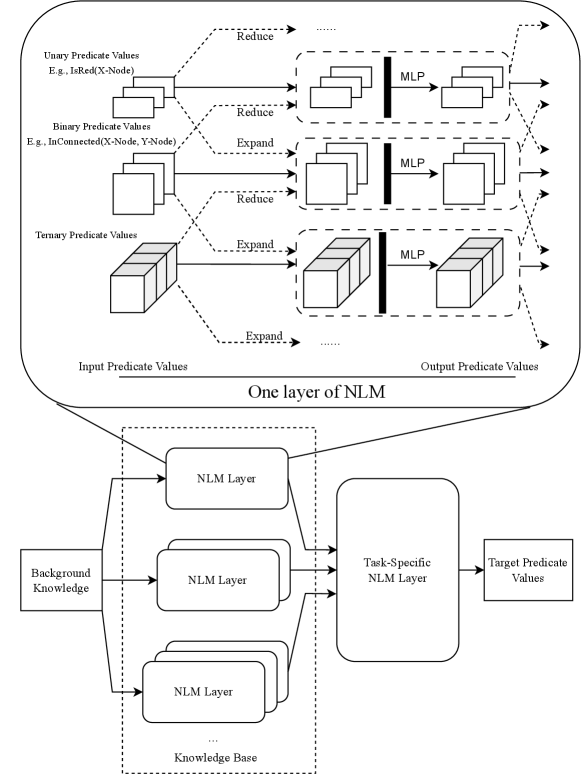
We choose to construct the shared knowledge base $B_{S}\subset\bigcup_{i=1}^{n}H_{\mathrm{NLM}}^{i}(B)$ with the union of target predicates of increasing complexity $i\in\{1,\dots,n\}$ where $n$ is a hyperparameter to control the trade-off between the model complexity and target predicate expressiveness. In particular, by constructing the knowledge base with predicates of varying complexity, we achieve fine-grained predicate composition, reminiscent of the success of multi-scale representation-learning methods in the field of computer vision (Fan et al. 2021). Figure 1 illustrates this concept, where the knowledge base $B_{S}$ is constructed by incorporating NLM layers of varying depths.
<details>
<summary>x1.png Details</summary>
### Visual Description
## Diagram: Neural Logic Machine (NLM) Architecture
### Overview
The image illustrates the architecture of a Neural Logic Machine (NLM). It shows how different types of predicate values (Unary, Binary, Ternary) are processed through NLM layers, ultimately leading to target predicate values. The diagram is divided into two main sections: a detailed view of "One layer of NLM" and a broader view showing how multiple NLM layers are organized within a knowledge base.
### Components/Axes
* **Top Section (One layer of NLM):**
* **Input Predicate Values:** Located on the left side.
* Unary Predicate Values (E.g., IsRed(X-Node))
* Binary Predicate Values (E.g., InConnected(X-Node, Y-Node))
* Ternary Predicate Values
* **Operations:** "Reduce" and "Expand" operations are shown as arrows connecting the input predicate values to the subsequent layers.
* **MLP Blocks:** Represent Multi-Layer Perceptrons, which process the predicate values.
* **Output Predicate Values:** Located on the right side.
* **Bottom Section (Knowledge Base):**
* **Background Knowledge:** Input to the NLM layers.
* **NLM Layer:** Multiple NLM layers are stacked within the "Knowledge Base".
* **Knowledge Base:** A dashed rectangle containing multiple NLM layers.
* **Task-Specific NLM Layer:** A single NLM layer that processes the output from the Knowledge Base.
* **Target Predicate Values:** The final output of the architecture.
### Detailed Analysis
* **Unary Predicate Values:** These values are processed through a "Reduce" operation, then passed through an MLP.
* **Binary Predicate Values:** These values are processed through "Reduce" and "Expand" operations, then passed through an MLP.
* **Ternary Predicate Values:** These values are processed through an "Expand" operation, then passed through an MLP.
* **NLM Layers:** The bottom section shows multiple NLM layers within a "Knowledge Base". These layers receive input from "Background Knowledge".
* **Task-Specific NLM Layer:** The output from the "Knowledge Base" is fed into a "Task-Specific NLM Layer", which produces the "Target Predicate Values".
### Key Observations
* The diagram highlights the flow of information from input predicate values through various NLM layers to produce target predicate values.
* The "Reduce" and "Expand" operations suggest different ways of aggregating or distributing predicate information.
* The use of MLPs indicates that the NLM layers involve non-linear transformations of the predicate values.
* The separation of NLM layers into a "Knowledge Base" and a "Task-Specific NLM Layer" suggests a modular architecture where knowledge representation is separated from task-specific processing.
### Interpretation
The diagram illustrates a Neural Logic Machine (NLM) architecture designed to process predicate values and generate target predicate values. The architecture leverages multiple NLM layers organized within a knowledge base, allowing for complex reasoning and inference. The use of MLPs within the NLM layers enables non-linear transformations of the predicate values, potentially capturing intricate relationships between different predicates. The separation of the architecture into a "Knowledge Base" and a "Task-Specific NLM Layer" suggests a design that promotes modularity and reusability, where the knowledge representation can be adapted to different tasks by simply swapping out the task-specific layer. The "Reduce" and "Expand" operations likely play a crucial role in aggregating and distributing predicate information, enabling the NLM to reason about complex relationships between different entities and concepts.
</details>
Figure 1: An illustration of Compositional Logic Model. Compositional Logic Model takes object properties and relations as input and outputs relations of the objects.
#### Task Specific Module.
With the shared knowledge base $B_{S}$ , the task specific module $\widetilde{\mathcal{F}}_{i}$ for $i\in\{1,...,t\}$ is also a NLM layer to take as input all predicates from the knowledge base $B_{S}$ and compose the target predicates for each corresponding task $\mathcal{P}_{i}^{\star}$ . Figure 1 illustrates this concept, showing how a NLM layer utilizes predicates from the knowledge base to compose the target predicates for each task.
#### Training Protocol.
We facilitate the transfer of the knowledge base across tasks while ensuring that task-specific modules remain distinct and independent from one another. This means that the knowledge base is reused from task to task, while task-specific modules are initialized randomly and trained from scratch.
## 5 Experiments
We note that the transfer of logic rules is beneficial to both supervised learning setting (i.e., ILP) and reinforcement learning setting (i.e., Relational RL). To this end, we present experimental results for both settings to comprehensively demonstrate the value of L2ILP. For supervised learning, we build on insights from the experiments conducted by (Dong et al. 2019), (Zimmer et al. 2023), (Glanois et al. 2021), and (Li et al. 2024), proposing task sequences for ILP across three domains: arithmetic, tree, and graph. For reinforcement learning, PDDLGym (Silver and Chitnis 2020) serves as an off-the-shelf tool in which the state and action spaces are represented using logical predicates. We therefore select BlocksWorld from PDDLGym as the testbed, as it is a commonly used benchmark for complex logic reasoning tasks (Džeroski, De Raedt, and Driessens 2001; Glanois et al. 2021; Valmeekam et al. 2023). We provide the code we used for experiments in the supplementary material.
### 5.1 Forward Transfer of Logic Rules
#### ILP Experiments.
The key question regarding the proposed approach is whether the transfer of logical rules is genuinely beneficial. We address this by comparing the learning curves of lifelong learning with those of models trained on tasks individually, while keeping model architectures the same. We provide a detailed description of the sequences of target predicates for each domain in the appendix, and present here the designs for two specific domains: Graph and Tree.
In the Graph domain, $IsConnected(X\text{-}Node,Y\text{-}Node)$ and $IsRed(X\text{-}Node)$ , fully describe all possible graphs. The first predicate defines the connectivity between nodes, while the second specifies node properties—in this case, the color of the nodes. The four target predicates are learned sequentially in the following order:
- $AdjacentToRed(X\text{-Node})$ ,
- $ExactConnectivity2(X\text{-Node},Y\text{-Node})$ ,
- $ExactConnectivity2Red(X\text{-Node})$ ,
- $ExactConnectivity2MultipleRed(X\text{-Node})$ .
The first target predicate determines whether a given node has at least one neighboring node that is red. The second predicate identifies whether the shortest path between two nodes consists of exactly two edges. Building upon this, $ExactConnectivity2Red(X\text{-Node})$ refines the notion of connectivity by verifying whether a node at an exact distance of two from the query node is red. Finally, $ExactConnectivity2MultipleRed(X\text{-Node})$ extends this concept by determining whether there exist multiple such red nodes at the specified distance. We design the tasks in a way that ensures relevance and allows them to share common structures when learning logical rules.
In the Tree domain, $IsParent(X\text{-}Node,Y\text{-}Node)$ is sufficient to specify the structure of any tree. We further define four target predicates to be learned sequentially, following the order below:
- $IsRoot(X\text{-}Node)$
- $HasOddEdges(X\text{-}Node,Y\text{-}Node)$
- $HasEvenEdges(X\text{-}Node,Y\text{-}Node)$
- $IsAncestor(X\text{-}Node,Y\text{-}Node)$
The first predicate identifies the root node of the tree and serves as the foundational predicate. The second and the third predicates determine whether two nodes in the tree are connected by an odd or even number of edges, respectively. Finally, $IsAncestor(X\text{-}Node,Y\text{-}Node)$ checks whether one node is an ancestor of another, based on their relative depths in the tree.
<details>
<summary>x2.png Details</summary>
### Visual Description
## Line Graph: Loss Value vs. Epoch for Individual and Lifelong Training
### Overview
The image is a line graph comparing the loss value over epochs for two training methods: Individual Training (blue line) and Lifelong Training (orange line). The graph shows the performance across four tasks, separated by vertical dashed lines. The x-axis represents the epoch, and the y-axis represents the loss value.
### Components/Axes
* **Title:** Implicit, but the graph compares "Individual Training" and "Lifelong Training" in terms of "Loss Value" over "Epoch".
* **X-axis:** Epoch, ranging from 0 to 400. Tick marks are present at intervals of 50 epochs. The tasks are labeled along the x-axis as Task 0, Task 1, Task 2, and Task 3.
* **Y-axis:** Loss Value, ranging from 0.0 to 1.0. Tick marks are present at intervals of 0.2.
* **Legend:** Located in the top-right corner.
* Blue line: Individual Training
* Orange line: Lifelong Training
* **Vertical Dashed Lines:** These lines separate the different tasks. They are located at approximately epoch 100, 200, and 300.
### Detailed Analysis
**Task 0 (Epoch 0-100):**
* **Individual Training (Blue):** Starts at a loss value of approximately 0.8 and rapidly decreases to approximately 0.0 by epoch 50. It remains near 0.0 for the rest of the task.
* **Lifelong Training (Orange):** Starts at a loss value of approximately 0.8 and rapidly decreases to approximately 0.0 by epoch 50. It remains near 0.0 for the rest of the task.
**Task 1 (Epoch 100-200):**
* **Individual Training (Blue):** The loss value jumps to approximately 0.8 at epoch 100 and rapidly decreases to approximately 0.0 by epoch 150. It remains near 0.0 for the rest of the task.
* **Lifelong Training (Orange):** The loss value jumps to approximately 0.8 at epoch 100 and rapidly decreases to approximately 0.0 by epoch 150. It remains near 0.0 for the rest of the task.
**Task 2 (Epoch 200-300):**
* **Individual Training (Blue):** The loss value jumps to approximately 0.7 at epoch 200 and rapidly decreases to approximately 0.0 by epoch 250. It remains near 0.0 for the rest of the task.
* **Lifelong Training (Orange):** The loss value jumps to approximately 0.7 at epoch 200 and rapidly decreases to approximately 0.0 by epoch 250. It remains near 0.0 for the rest of the task.
**Task 3 (Epoch 300-400):**
* **Individual Training (Blue):** The loss value jumps to approximately 0.25 at epoch 300 and remains relatively stable around 0.25 for the rest of the task.
* **Lifelong Training (Orange):** The loss value jumps to approximately 0.25 at epoch 300 and remains relatively stable around 0.25 for the rest of the task.
### Key Observations
* For the first three tasks (Task 0, Task 1, and Task 2), both Individual Training and Lifelong Training exhibit similar performance, with a rapid decrease in loss value after each task begins.
* In Task 3, both training methods show a higher final loss value compared to the previous tasks.
* The performance of Individual Training and Lifelong Training is nearly identical across all tasks.
### Interpretation
The graph suggests that for the first three tasks, both Individual Training and Lifelong Training are equally effective in reducing the loss value. The rapid decrease in loss indicates that the models quickly learn the tasks. However, Task 3 presents a challenge, as both training methods result in a higher final loss value, suggesting that this task is more difficult or requires a different approach. The near-identical performance of the two training methods implies that, in this scenario, lifelong learning does not provide a significant advantage over individual training for these specific tasks. The consistent pattern of loss increase at the start of each task followed by a rapid decrease indicates a need for re-learning or adaptation at the beginning of each new task.
</details>
(a) Training dynamics for Arithmetic
<details>
<summary>x3.png Details</summary>
### Visual Description
## Line Chart: Loss Value vs. Epoch for Multiple Tasks
### Overview
The image is a line chart displaying the loss value of a model over epochs for four different tasks (Task 0, Task 1, Task 2, and Task 3). There are two lines plotted on the chart: one in orange and one in blue, representing different aspects of the model's performance. The chart is divided into sections by vertical dashed lines, each section corresponding to a different task.
### Components/Axes
* **X-axis:** Epoch, ranging from 0 to 400 in increments of 50.
* **Y-axis:** Loss Value, ranging from 0.0 to 0.7 in increments of 0.1.
* **Lines:**
* Orange line: Represents one aspect of the model's performance.
* Blue line: Represents another aspect of the model's performance.
* **Task Labels:** "Task 0", "Task 1", "Task 2", "Task 3" are placed near the bottom of the chart, indicating the task associated with each section.
* **Vertical Dashed Lines:** Separate the tasks, located approximately at Epoch = 100, 200, and 300.
### Detailed Analysis
**Task 0 (Epoch 0-100):**
* **Orange Line:** Starts at approximately 0.65 and rapidly decreases to approximately 0.1 between Epoch 0 and Epoch 20. It then remains relatively constant at approximately 0.1 until Epoch 100.
* **Blue Line:** Not present in this section.
**Task 1 (Epoch 100-200):**
* **Orange Line:** Starts at approximately 0.23 and gradually decreases to approximately 0.15 by Epoch 200.
* **Blue Line:** Starts at approximately 0.7 and rapidly decreases to approximately 0.23 between Epoch 100 and Epoch 110. It then gradually decreases to approximately 0.2 by Epoch 200.
**Task 2 (Epoch 200-300):**
* **Orange Line:** Starts at approximately 0.25 and gradually decreases to approximately 0.1 by Epoch 300.
* **Blue Line:** Starts at approximately 0.7 and rapidly decreases to approximately 0.25 between Epoch 200 and Epoch 210. It then remains relatively constant at approximately 0.18 until Epoch 300.
**Task 3 (Epoch 300-400):**
* **Orange Line:** Starts at approximately 0.35 and gradually decreases to approximately 0.05 by Epoch 400.
* **Blue Line:** Starts at approximately 0.7 and rapidly decreases to approximately 0.35 between Epoch 300 and Epoch 310. It then gradually decreases to approximately 0.15 by Epoch 400.
### Key Observations
* The orange line consistently shows a decreasing loss value across all tasks.
* The blue line shows a rapid initial decrease in loss value at the beginning of each task, followed by a more gradual decrease or stabilization.
* The initial loss value for the blue line at the start of each task is consistently high (approximately 0.7).
* The orange line's initial loss value at the start of tasks 1, 2, and 3 is significantly lower than the blue line's.
### Interpretation
The chart illustrates the learning process of a model across multiple tasks. The orange line likely represents the loss on the current task, while the blue line may represent the loss on a previous task or a combined loss. The rapid initial decrease in the blue line's loss value at the beginning of each task suggests that the model is quickly adapting to the new task. The lower and decreasing loss value of the orange line indicates that the model is effectively learning and improving its performance on the current task. The consistent high initial loss of the blue line at the start of each task could indicate that the model is experiencing some forgetting of previous tasks or that the combined loss is heavily influenced by the new task.
</details>
(b) Training dynamics for Tree
<details>
<summary>x4.png Details</summary>
### Visual Description
## Line Chart: Loss Value vs. Epoch for Multiple Tasks
### Overview
The image is a line chart displaying the loss value over epochs for two different models (represented by blue and orange lines) across four tasks. The chart is divided into four sections by vertical dashed lines, each representing a different task. The x-axis represents the epoch number, and the y-axis represents the loss value. Shaded regions around each line indicate the uncertainty or variance in the loss value.
### Components/Axes
* **X-axis:** Epoch, labeled from 0 to 400 in increments of 50.
* **Y-axis:** Loss Value, labeled from 0.0 to 0.8 in increments of 0.1.
* **Vertical dashed lines:** Separate the tasks. These lines are located at approximately Epoch 100, 200, and 300.
* **Task Labels:** Task 0, Task 1, Task 2, Task 3 are labeled at approximately Epoch 50, 150, 250, and 350 respectively.
* **Data Series:**
* **Blue Line:** Represents one model's performance.
* **Orange Line:** Represents another model's performance.
* **Shaded Regions:** Light blue and light orange regions around the lines represent the standard deviation or confidence interval of the loss value.
### Detailed Analysis
**Task 0 (Epoch 0-100):**
* **Orange Line:** Starts at approximately 0.7 and decreases steadily to approximately 0.05 by Epoch 100.
* **Blue Line:** Starts at approximately 0.7 and decreases slightly to approximately 0.65 before decreasing rapidly to approximately 0.55 by Epoch 100.
**Task 1 (Epoch 100-200):**
* **Orange Line:** Starts at approximately 0.55 and decreases steadily to approximately 0.01 by Epoch 200.
* **Blue Line:** Starts at approximately 0.55 and decreases rapidly to approximately 0.01 by Epoch 200.
**Task 2 (Epoch 200-300):**
* **Orange Line:** Starts at approximately 0.6 and decreases steadily to approximately 0.4 by Epoch 300.
* **Blue Line:** Starts at approximately 0.7 and decreases slightly to approximately 0.6 by Epoch 300.
**Task 3 (Epoch 300-400):**
* **Orange Line:** Starts at approximately 0.45 and fluctuates around 0.4 by Epoch 400.
* **Blue Line:** Starts at approximately 0.7 and fluctuates around 0.6 by Epoch 400.
### Key Observations
* Both models show a decrease in loss value over time, indicating learning.
* The orange model appears to learn faster in Task 0 and Task 1, achieving lower loss values more quickly.
* In Task 2 and Task 3, the blue model consistently maintains a lower loss value than the orange model.
* The shaded regions indicate the variability in the loss value, with wider regions suggesting greater instability or uncertainty.
### Interpretation
The chart compares the performance of two models across four different tasks. The initial tasks (0 and 1) show a clear learning curve for both models, with the orange model initially performing better. However, in later tasks (2 and 3), the blue model demonstrates superior performance, maintaining a lower loss value. This suggests that the blue model may have better generalization capabilities or is better suited for the later tasks. The shaded regions highlight the stability of the models, with narrower regions indicating more consistent performance. The vertical lines indicate the transition between tasks, and the change in loss value at these points may indicate the models' ability to adapt to new tasks.
</details>
(c) Training dynamics for Graph
Figure 2: Epoch training dynamics for individual learning and lifelong learning
<details>
<summary>x5.png Details</summary>
### Visual Description
## Line Chart: Evaluation Steps vs. Epoch for Individual and Lifelong Training
### Overview
The image is a line chart comparing the performance of "Individual Training" and "Lifelong Training" across multiple tasks (Task 0 to Task 4). The chart plots "Evaluation Steps" (y-axis) against "Epoch" (x-axis). The performance is shown over 1000 epochs, with vertical dashed lines indicating the transition between tasks. Shaded regions around the lines represent the uncertainty or variance in the data.
### Components/Axes
* **X-axis:** Epoch, ranging from 0 to 1000. Markers are present at 0, 200, 400, 600, 800, and 1000.
* **Y-axis:** Evaluation Steps, ranging from 0 to 350. Markers are present at 0, 50, 100, 150, 200, 250, 300, and 350.
* **Legend (Top-Right):**
* Blue line: Individual Training
* Orange line: Lifelong Training
* **Vertical Dashed Lines:** Indicate the start of a new task. These lines are located at approximately Epoch 200, 400, 600, and 800.
* **Task Labels:** "Task 0", "Task 1", "Task 2", "Task 3", "Task 4" are positioned below the x-axis, centered between the vertical dashed lines.
### Detailed Analysis
**Task 0 (Epoch 0-200):**
* **Individual Training (Blue):** Stays relatively constant at a low value, approximately 5-10 Evaluation Steps.
* **Lifelong Training (Orange):** Stays relatively constant at a low value, approximately 5-10 Evaluation Steps.
**Task 1 (Epoch 200-400):**
* **Individual Training (Blue):** Starts at approximately 300 Evaluation Steps and decreases rapidly to approximately 25-50 Evaluation Steps.
* **Lifelong Training (Orange):** Starts at approximately 300 Evaluation Steps and decreases rapidly to approximately 25-50 Evaluation Steps.
**Task 2 (Epoch 400-600):**
* **Individual Training (Blue):** Fluctuates between approximately 50 and 150 Evaluation Steps.
* **Lifelong Training (Orange):** Fluctuates between approximately 25 and 75 Evaluation Steps.
**Task 3 (Epoch 600-800):**
* **Individual Training (Blue):** Starts at approximately 250 Evaluation Steps and increases to approximately 300 Evaluation Steps.
* **Lifelong Training (Orange):** Starts at approximately 150 Evaluation Steps and decreases rapidly to approximately 25 Evaluation Steps.
**Task 4 (Epoch 800-1000):**
* **Individual Training (Blue):** Starts at approximately 300 Evaluation Steps and decreases to approximately 100-200 Evaluation Steps.
* **Lifelong Training (Orange):** Starts at approximately 150 Evaluation Steps and decreases to approximately 50-100 Evaluation Steps.
### Key Observations
* Both Individual and Lifelong Training perform similarly on Task 0, with very low Evaluation Steps.
* Both training methods experience a significant drop in Evaluation Steps when transitioning to Task 1.
* Lifelong Training generally has lower Evaluation Steps than Individual Training, especially in later tasks.
* The variance (shaded region) is generally larger for Individual Training than for Lifelong Training.
### Interpretation
The chart suggests that Lifelong Training adapts more effectively to new tasks compared to Individual Training. While both methods initially struggle with Task 1, Lifelong Training consistently achieves lower Evaluation Steps in subsequent tasks, indicating better performance. The larger variance in Individual Training suggests that its performance is less stable and more sensitive to the specific task. The initial low performance on Task 0 indicates a period of initial learning or exploration for both methods. The sharp drops at the beginning of each new task suggest that both training methods need to re-learn or adapt to the new task environment.
</details>
Figure 3: Evaluation steps for BlocksWorld tasks
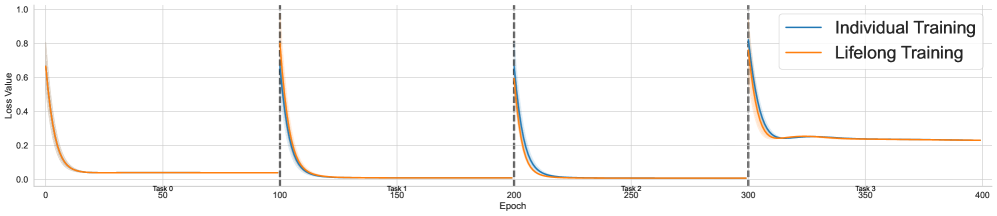
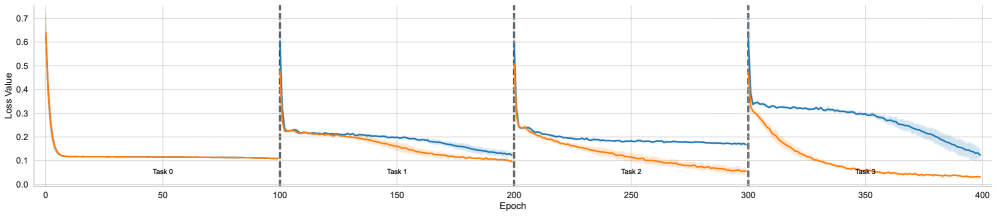
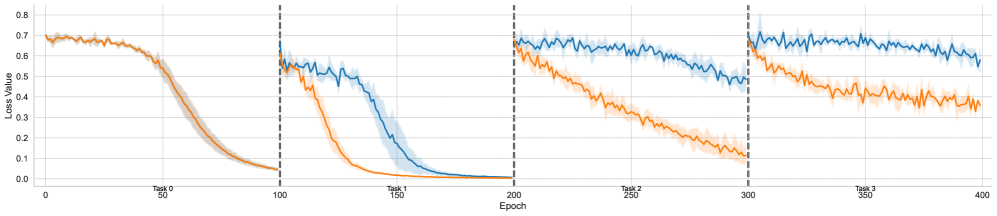
Figure 2 illustrates the training dynamics for each task across all domains. For each task, we conducted experiments with four different seeds and plotted the mean, along with the standard deviation for each data point. From top to bottom, the domains are ordered as arithmetic, tree, and graph, while from left to right, the plots are arranged sequentially for tasks 0 to 3. The tasks in the arithmetic domain are relatively simple, allowing both individual and lifelong learning to converge to optimal performance within a short period. However, we observe that the loss curves in lifelong learning decrease more rapidly, as indicated by a small but noticeable gap. In contrast, for the tree and graph domains, the gaps become more pronounced, with no overlap observed between the paired curves. Notably, for the curves corresponding to the first task across all domains, lifelong learning completely overlaps with individual learning. This is expected, as the first task in lifelong learning does not incorporate any previously acquired knowledge, making it equivalent to its individual learning counterpart.
This result shows that by leveraging the knowledge base acquired in earlier tasks, we could achieve higher learning efficiency on subsequence tasks, demonstrating the forward transfer effect that is essential in lifelong learning setting.
#### Relational RL Experiments.
For the BlocksWorld task from PDDLGym, Table 1 summarizes the predicates used to describe the state and action spaces. Since the number of ground predicates depends on the number of objects in a task, the total number of possible actions can be as high as $2x^{2}+2x$ , where $x$ represents the number of blocks. However, not all of these actions are valid in every state. Additionally, the number of possible states grows factorially with the number of blocks in the environment, making the task increasingly complex as more blocks are added. We note that previous works (Jiang and Luo 2019; Zimmer et al. 2023; Valmeekam et al. 2023) typically use 5 blocks, whereas we extend our experiments to 6 blocks. Furthermore, We set the tasks to follow a sparse reward scheme, where a penalty of -0.1 is given for every step taken, while a reward of 100 is granted upon achieving the desired block configuration. To define the sequence of tasks for BlocksWorld, we assign different desired configurations to each task, progressively increasing the difficulty by making the target configurations more challenging to reach. Refer to Appendix for a detailed discussion.
| Predicates | Arity | Description |
| --- | --- | --- |
| $On(X\text{-}Block,Y\text{-}Block)$ | 2 | Block $X$ is on Block $Y$ |
| $OnTable(X\text{-}Block)$ | 1 | Block $X$ is on the table |
| $Clear(X\text{-}Block)$ | 1 | Block $X$ could be picked up |
| $HandEmpty()$ | 0 | Hand is empty |
| $HandFull()$ | 0 | Hand is full |
| $Holding(X\text{-}Block)$ | 1 | Hand is holding Block $X$ |
| Action Space | | |
| Predicates | Arity | Description |
| $PickUp(X\text{-}Block)$ | 1 | Pick up Block $X$ from the table |
| $PutDown(X\text{-}Block)$ | 1 | Put down Block $X$ onto the table |
| $Stack(X\text{-}Block,Y\text{-}Block)$ | 2 | Stack Block $X$ onto Block $Y$ |
| $Unstack(X\text{-}Block,Y\text{-}Block)$ | 2 | Unstack Block $X$ from Block $Y$ |
Table 1: State and action spaces for BlocksWorld from PDDLGym
Large state and action spaces pose significant challenges for exploration to RL agents, particularly when rewards are sparse and only provided upon goal completion. As a result, our experiments show that training tasks individually fails to yield sufficient exploration to positive rewards, let alone facilitate the learning of any meaningful policies. To address this issue, we adopt an offline reinforcement learning approach, where a replay buffer is collected in advance to ensure that both lifelong learning and individual training have access to data of the same quality. In BlocksWorld tasks, we use a planner to generate optimal actions at each step while incorporating random exploration to ensure adequate coverage of the state and action spaces. Specifically, we set the exploration rate to 0.8 and collect 50,000 transitions for each task.
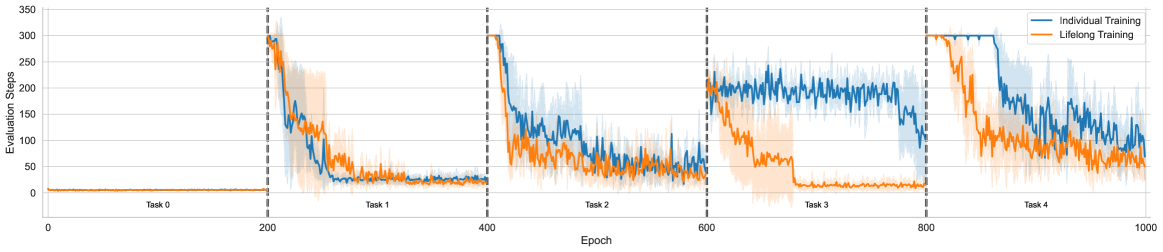
Figure 3 illustrates the evaluation steps for each task, as the number of steps directly reflects the quality of the learned policy. We ran each experiment using four different seeds and evaluated the policy periodically. For tasks 0–2, lifelong training does not show superior performance compared to individual training, as these tasks are relatively simple. However, for the more challenging tasks 3 and 4, clear gaps emerge: lifelong training converges much faster, while individual training occasionally fails to converge to the optimal policy. This result highlights that forward transfer is not only observed in the relatively straightforward supervised learning setting but also extends to the more complex reinforcement learning paradigm, where effective knowledge transfer accelerates policy learning in later tasks.
### 5.2 Forgetting of Logic Rules
#### Forgetting Experiments.
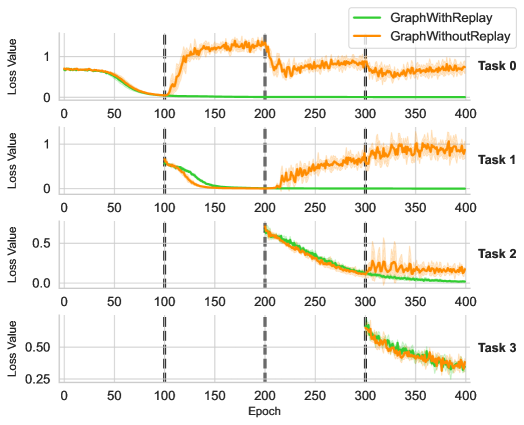
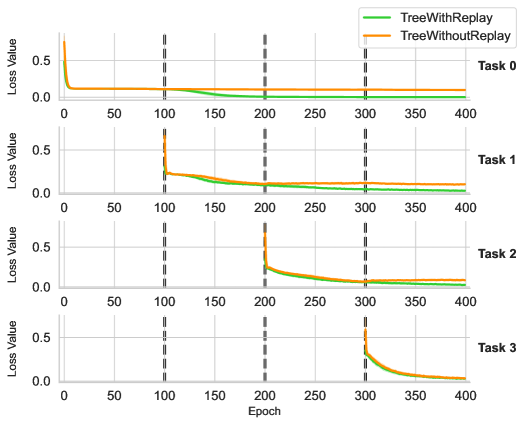
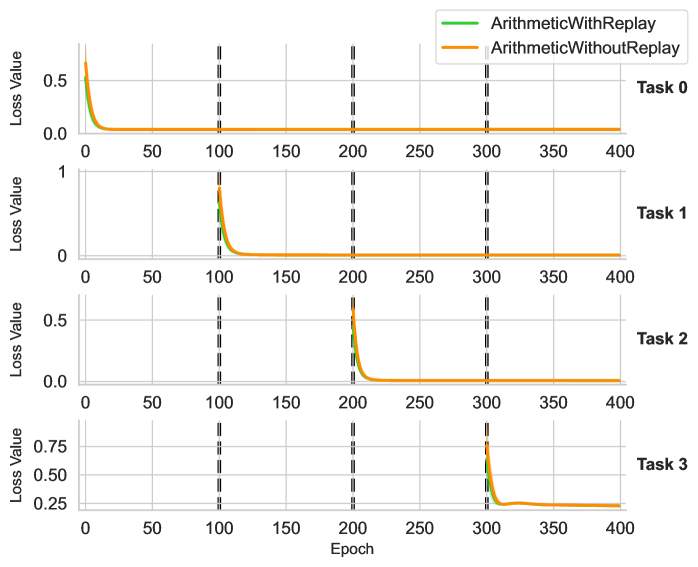
Another fundamental challenge in lifelong learning is assessing the extent to which a model forgets previously acquired knowledge (i.e. catastrophic forgetting) and identifying effective strategies to mitigate this issue. In our case, the knowledge base is continuously updated, which may cause task-specific modules for earlier tasks to fail, as they rely on outdated knowledge representations. To investigate this phenomenon, we track the loss values throughout the entire training process and visualize the corresponding curves for each task. Specifically, in the supervised learning setting, we adhere to the training protocol described in the previous section while recording the tested loss values for each task at every epoch whenever feasible. Figure 4 and Figure 5 illustrate the results for the graph and tree domains, respectively, with each plot representing tasks 0 through 3. For results on arithemetic, please refer to appendix for a detailed description.
<details>
<summary>x6.png Details</summary>
### Visual Description
## Chart: Loss Value vs. Epoch for Different Tasks
### Overview
The image presents a series of four line graphs, each depicting the loss value over epochs for a specific task (Task 0 to Task 3). Each graph compares two scenarios: "GraphWithReplay" (green line) and "GraphWithoutReplay" (orange line). The x-axis represents the epoch number, ranging from 0 to 400. The y-axis represents the loss value, with different scales for each task. Vertical dashed lines indicate significant points in the training process, likely task transitions or interventions.
### Components/Axes
* **X-axis:** Epoch (0 to 400)
* **Y-axis:** Loss Value (scale varies for each task)
* Task 0: 0 to 1
* Task 1: 0 to 1
* Task 2: 0.0 to 0.5
* Task 3: 0.25 to 0.50
* **Legend:** Located at the top-right of the entire figure.
* Green Line: GraphWithReplay
* Orange Line: GraphWithoutReplay
* **Tasks:** Four separate graphs, labeled Task 0, Task 1, Task 2, and Task 3, stacked vertically.
* **Vertical Dashed Lines:** Located at approximately Epoch 100, 200, and 300.
### Detailed Analysis
**Task 0:**
* **GraphWithReplay (Green):** The loss value starts around 0.9, decreases to approximately 0 around epoch 100, and remains at 0 for the rest of the epochs.
* **GraphWithoutReplay (Orange):** The loss value starts around 0.9, decreases to approximately 0 around epoch 100, then increases sharply to approximately 1 around epoch 150, remains high until epoch 200, then decreases to approximately 0.9 and remains relatively stable.
**Task 1:**
* **GraphWithReplay (Green):** The loss value starts around 0.9, decreases to approximately 0 around epoch 100, and remains at 0 for the rest of the epochs.
* **GraphWithoutReplay (Orange):** The loss value starts around 0.9, decreases to approximately 0 around epoch 100, then increases sharply to approximately 1 around epoch 200, and remains high until epoch 300, then decreases to approximately 0.9 and remains relatively stable.
**Task 2:**
* **GraphWithReplay (Green):** The loss value starts around 0.5, decreases gradually to approximately 0.1 around epoch 300, and remains relatively stable.
* **GraphWithoutReplay (Orange):** The loss value starts around 0.5, decreases gradually to approximately 0.1 around epoch 300, and remains relatively stable.
**Task 3:**
* **GraphWithReplay (Green):** The loss value starts around 0.5, decreases gradually to approximately 0.3 around epoch 300, and remains relatively stable.
* **GraphWithoutReplay (Orange):** The loss value starts around 0.5, decreases gradually to approximately 0.3 around epoch 300, and remains relatively stable.
### Key Observations
* For Tasks 0 and 1, "GraphWithReplay" maintains a consistently low loss value after the initial drop, while "GraphWithoutReplay" experiences a significant increase in loss value after epoch 100 and 200, respectively.
* For Tasks 2 and 3, both "GraphWithReplay" and "GraphWithoutReplay" exhibit similar decreasing trends in loss value.
* The vertical dashed lines at epochs 100, 200, and 300 seem to mark significant changes or transitions in the training process, particularly affecting the "GraphWithoutReplay" scenario in Tasks 0 and 1.
### Interpretation
The data suggests that using replay (GraphWithReplay) is beneficial for maintaining low loss values in Tasks 0 and 1, especially after the initial training phase. The "GraphWithoutReplay" scenario experiences a significant increase in loss, indicating a potential issue with forgetting or instability in the model. For Tasks 2 and 3, the replay mechanism doesn't seem to have a significant impact, as both scenarios perform similarly. The vertical dashed lines likely represent points where new tasks are introduced or where the training regime is altered. The difference in performance between "GraphWithReplay" and "GraphWithoutReplay" in the initial tasks suggests that replay helps the model retain knowledge from previous tasks when learning new ones, mitigating catastrophic forgetting.
</details>
Figure 4: Training dynamics of Graph for each task
In particular, the orange curves illustrate the loss values as described above. As expected, the loss values for earlier tasks increase as training progresses on later tasks, indicating the occurrence of catastrophic forgetting in the model.
#### Replay Experiments.
A straightforward approach to addressing catastrophic forgetting is to replay experience from earlier tasks while training on later ones. We adopt this strategy by replaying data from all previously learned tasks when training on a new task. This approach is particularly beneficial in our case, as we aim to build a shared knowledge base that can be effectively leveraged across multiple tasks. To ensure a fair comparison, we align the curves by recording each data point in terms of the training epoch of the current task. This alignment allows us to directly compare the performance of models trained with and without experience replay, providing deeper insights into its effectiveness in mitigating forgetting and preserving previously acquired knowledge.
<details>
<summary>x7.png Details</summary>
### Visual Description
## Line Chart: Loss Value vs. Epoch for Different Tasks
### Overview
The image presents a series of four line charts, each displaying the loss value over epochs for two different training methods: "TreeWithReplay" and "TreeWithoutReplay." Each chart corresponds to a different task (Task 0, Task 1, Task 2, and Task 3). The x-axis represents the epoch number, ranging from 0 to 400. The y-axis represents the loss value, ranging from 0.0 to 0.5. Vertical dashed lines are present at Epoch 100, 200, and 300.
### Components/Axes
* **Title:** Loss Value vs. Epoch for Different Tasks (inferred)
* **Y-axis Label:** Loss Value
* **X-axis Label:** Epoch
* **X-axis Scale:** 0, 50, 100, 150, 200, 250, 300, 350, 400
* **Y-axis Scale:** 0.0, 0.5
* **Legend (Top-Right):**
* Green Line: TreeWithReplay
* Orange Line: TreeWithoutReplay
* **Tasks:** Task 0, Task 1, Task 2, Task 3
* **Vertical Dashed Lines:** Epoch 100, Epoch 200, Epoch 300
### Detailed Analysis
**Task 0:**
* **TreeWithReplay (Green):** Starts at approximately 0.5 and rapidly decreases to approximately 0.05 by epoch 50, then remains relatively constant.
* **TreeWithoutReplay (Orange):** Starts at approximately 0.1 and remains relatively constant throughout the epochs.
**Task 1:**
* **TreeWithReplay (Green):** Starts at approximately 0.5, rapidly decreases to approximately 0.1 by epoch 100, then decreases further to approximately 0.05 by epoch 200, and remains relatively constant.
* **TreeWithoutReplay (Orange):** Starts at approximately 0.6, rapidly decreases to approximately 0.2 by epoch 100, then decreases further to approximately 0.1 by epoch 200, and remains relatively constant.
**Task 2:**
* **TreeWithReplay (Green):** Starts at approximately 0.5, rapidly decreases to approximately 0.1 by epoch 200, then decreases further to approximately 0.05 by epoch 300, and remains relatively constant.
* **TreeWithoutReplay (Orange):** Starts at approximately 0.6, rapidly decreases to approximately 0.2 by epoch 200, then decreases further to approximately 0.1 by epoch 300, and remains relatively constant.
**Task 3:**
* **TreeWithReplay (Green):** Starts at approximately 0.5, rapidly decreases to approximately 0.1 by epoch 300, then decreases further to approximately 0.05 by epoch 400.
* **TreeWithoutReplay (Orange):** Starts at approximately 0.6, rapidly decreases to approximately 0.2 by epoch 300, then decreases further to approximately 0.1 by epoch 400.
### Key Observations
* The loss value generally decreases as the epoch number increases for both methods across all tasks.
* The "TreeWithReplay" method generally achieves a lower loss value than the "TreeWithoutReplay" method, especially in later tasks.
* The rate of decrease in loss value slows down as the epoch number increases.
* The vertical dashed lines at Epoch 100, 200, and 300 seem to indicate significant points in the training process, possibly marking the end of a training phase or the introduction of a new task.
* The initial loss values for both methods are higher in later tasks (Task 1, Task 2, Task 3) compared to Task 0.
### Interpretation
The charts demonstrate the learning process of two different training methods ("TreeWithReplay" and "TreeWithoutReplay") across multiple tasks. The decreasing loss values indicate that both methods are learning and improving their performance as the training progresses. The "TreeWithReplay" method appears to be more effective in reducing the loss value, suggesting that the replay mechanism contributes to better learning. The increasing initial loss values in later tasks may indicate that the model is facing more challenging problems or that the tasks are becoming more complex. The vertical dashed lines could represent milestones in the training process, such as the introduction of new data or changes in the training parameters. The data suggests that "TreeWithReplay" is a superior method for this type of learning task.
</details>
Figure 5: Training dynamics of Tree for each task
The green curves in Figure 4 and Figure 5 illustrate the loss values when experience replay is applied. As the results indicate, during the training phase for each individual task, replaying experience does not significantly interfere with the learning of the current task. The loss curves for training without replay closely align with those for training with replay, indicating that incorporating past experiences does not disrupt the optimization of the current task. More importantly, experience replay effectively mitigates catastrophic forgetting, as evidenced by the green curves maintaining low loss values throughout the entire training process. This suggests that the model successfully constructs retains previously acquired knowledge, leading to the formation of a robust and reusable knowledge base across all tasks.
Surprisingly, we also observe a backward transfer effect in our experiments. The first plot in Figure 5 corresponds to the loss curve for task 0 in the tree domain. Notably, the loss curve plateaus before training on task 1. However, once training on task 1 begins, the loss for task 0 further decreases to zero, indicating that learning task 1 enhances the model’s performance on task 0. This suggests the potential of L2ILP that training on the current task may further improves the performance on previous tasks, as a better knowledge base is acquired during the sequential training.
## 6 Conclusion
Neuro-Symbolic Artificial Intelligence introduces a new research paradigm by integrating neural networks with symbolic methods, which were traditionally studied as separate approaches. This integration opens new research opportunities by enabling the formulation of novel problems and providing solutions to challenges that were previously difficult to address using either approach alone. In this work, we take a step toward studying the lifelong learning problem in this domain and demonstrate that by leveraging the compositionality and transferability of logic rules, it becomes straightforward to construct models that achieve higher learning efficiency on later tasks while preserving performance on earlier ones. However, this problem remains far from solved. As discussed, a key challenge is how to efficiently construct logic rules that are meaningful for tasks within a given domain and how to systematically generate new rules from an evolving knowledge base. Our work represents a small step in this direction, demonstrating its feasibility but leaving many open opportunities for future research. We hope this study inspires further research into more effective methods for representing and constructing logic rules—particularly those that support the dynamic addition and removal of rules from a knowledge base—ultimately enabling more efficient and scalable neuro-symbolic lifelong learning systems.
## References
- Amizadeh et al. (2020) Amizadeh, S.; Palangi, H.; Polozov, A.; Huang, Y.; and Koishida, K. 2020. Neuro-symbolic visual reasoning: Disentangling. In International Conference on Machine Learning, 279–290. Pmlr.
- Badreddine et al. (2022) Badreddine, S.; d’Avila Garcez, A.; Serafini, L.; and Spranger, M. 2022. Logic Tensor Networks. Artificial Intelligence, 303: 103649.
- Besold and Kühnberger (2023) Besold, T. R.; and Kühnberger, K.-U. 2023. Symbolic and Hybrid Models of Cognition, 139–172. Cambridge Handbooks in Psychology. Cambridge University Press.
- Buzzega et al. (2020) Buzzega, P.; Boschini, M.; Porrello, A.; Abati, D.; and Calderara, S. 2020. Dark experience for general continual learning: a strong, simple baseline. In Advances in Neural Information Processing Systems, volume 33, 15920–15930.
- Campero et al. (2018) Campero, A.; Pareja, A.; Klinger, T.; Tenenbaum, J.; and Riedel, S. 2018. Logical rule induction and theory learning using neural theorem proving. arXiv preprint arXiv:1809.02193.
- Castro et al. (2025) Castro, P. S.; Tomasev, N.; Anand, A.; Sharma, N.; Mohanta, R.; Dev, A.; Perlin, K.; Jain, S.; Levin, K.; Éltető, N.; Dabney, W.; Novikov, A.; Turner, G. C.; Eckstein, M. K.; Daw, N. D.; Miller, K. J.; and Stachenfeld, K. L. 2025. Discovering Symbolic Cognitive Models from Human and Animal Behavior. bioRxiv.
- Chaudhry et al. (2018) Chaudhry, A.; Ranzato, M.; Rohrbach, M.; and Elhoseiny, M. 2018. Efficient lifelong learning with a-gem. arXiv preprint arXiv:1812.00420.
- Cropper and Dumančić (2022) Cropper, A.; and Dumančić, S. 2022. Inductive logic programming at 30: a new introduction. arXiv:2008.07912.
- Dai et al. (2019) Dai, W.-Z.; Xu, Q.; Yu, Y.; and Zhou, Z.-H. 2019. Bridging machine learning and logical reasoning by abductive learning. Advances in Neural Information Processing Systems, 32.
- d’Avila Garcez and Lamb (2020) d’Avila Garcez, A.; and Lamb, L. C. 2020. Neurosymbolic AI: The 3rd Wave. arXiv:2012.05876.
- Dong et al. (2019) Dong, H.; Mao, J.; Lin, T.; Wang, C.; Li, L.; and Zhou, D. 2019. Neural Logic Machines. arXiv:1904.11694.
- Džeroski, De Raedt, and Driessens (2001) Džeroski, S.; De Raedt, L.; and Driessens, K. 2001. Relational reinforcement learning. Machine learning, 43: 7–52.
- Evans and Grefenstette (2018) Evans, R.; and Grefenstette, E. 2018. Learning Explanatory Rules from Noisy Data. arXiv:1711.04574.
- Fan et al. (2021) Fan, H.; Xiong, B.; Mangalam, K.; Li, Y.; Yan, Z.; Malik, J.; and Feichtenhofer, C. 2021. Multiscale Vision Transformers. arXiv:2104.11227.
- Farajtabar et al. (2020) Farajtabar, M.; Azizan, N.; Mott, A.; and Li, A. 2020. Orthogonal gradient descent for continual learning. In International conference on artificial intelligence and statistics, 3762–3773. PMLR.
- Glanois et al. (2021) Glanois, C.; Feng, X.; Jiang, Z.; Weng, P.; Zimmer, M.; Li, D.; and Liu, W. 2021. Neuro-Symbolic Hierarchical Rule Induction. arXiv:2112.13418.
- Jiang and Luo (2019) Jiang, Z.; and Luo, S. 2019. Neural Logic Reinforcement Learning. arXiv:1904.10729.
- Kirkpatrick et al. (2017) Kirkpatrick, J.; Pascanu, R.; Rabinowitz, N.; Veness, J.; Desjardins, G.; Rusu, A. A.; Milan, K.; Quan, J.; Ramalho, T.; Grabska-Barwinska, A.; et al. 2017. Overcoming catastrophic forgetting in neural networks. Proceedings of the National Academy of Sciences, 114(13): 3521–3526.
- Lake et al. (2016) Lake, B. M.; Ullman, T. D.; Tenenbaum, J. B.; and Gershman, S. J. 2016. Building Machines That Learn and Think Like People. arXiv:1604.00289.
- Li et al. (2019) Li, X.; Zhou, Y.; Wu, T.; Socher, R.; and Xiong, C. 2019. Learn to grow: A continual structure learning framework for overcoming catastrophic forgetting. In International Conference on Machine Learning, 3925–3934. PMLR.
- Li et al. (2024) Li, Z.; Cao, Y.; Xu, X.; Jiang, J.; Liu, X.; Teo, Y. S.; wei Lin, S.; and Liu, Y. 2024. LLMs for Relational Reasoning: How Far are We? arXiv:2401.09042.
- Li and Hoiem (2017) Li, Z.; and Hoiem, D. 2017. Learning without forgetting. IEEE transactions on pattern analysis and machine intelligence, 40(12): 2935–2947.
- Lin et al. (2014) Lin, D.; Dechter, E.; Ellis, K.; Tenenbaum, J.; and Muggleton, S. 2014. Bias reformulation for one-shot function induction. In ECAI 2014, 525–530. IOS Press.
- Lopez-Paz and Ranzato (2017) Lopez-Paz, D.; and Ranzato, M. 2017. Gradient episodic memory for continual learning. Advances in neural information processing systems, 30.
- Manhaeve et al. (2018) Manhaeve, R.; Dumančić, S.; Kimmig, A.; Demeester, T.; and Raedt, L. D. 2018. DeepProbLog: Neural Probabilistic Logic Programming. arXiv:1805.10872.
- Marconato et al. (2023) Marconato, E.; Bontempo, G.; Ficarra, E.; Calderara, S.; Passerini, A.; and Teso, S. 2023. Neuro-symbolic continual learning: Knowledge, reasoning shortcuts and concept rehearsal. arXiv preprint arXiv:2302.01242.
- Mendez (2022) Mendez, J. A. 2022. Lifelong Machine Learning of Functionally Compositional Structures. arXiv:2207.12256.
- Payani and Fekri (2019) Payani, A.; and Fekri, F. 2019. Inductive Logic Programming via Differentiable Deep Neural Logic Networks. arXiv:1906.03523.
- Rebuffi et al. (2017) Rebuffi, S.-A.; Kolesnikov, A.; Sperl, G.; and Lampert, C. H. 2017. icarl: Incremental classifier and representation learning. In Proceedings of the IEEE conference on Computer Vision and Pattern Recognition, 2001–2010.
- Rolnick et al. (2019) Rolnick, D.; Ahuja, A.; Schwarz, J.; Lillicrap, T.; and Wayne, G. 2019. Experience replay for continual learning. In Advances in Neural Information Processing Systems, 350–360.
- Rusu et al. (2016) Rusu, A. A.; Rabinowitz, N. C.; Desjardins, G.; Soyer, H.; Kirkpatrick, J.; Kavukcuoglu, K.; Pascanu, R.; and Hadsell, R. 2016. Progressive neural networks. In arXiv preprint arXiv:1606.04671.
- Saha, Garg, and Roy (2021) Saha, G.; Garg, I.; and Roy, K. 2021. Gradient projection memory for continual learning. arXiv preprint arXiv:2103.09762.
- Santoro et al. (2017) Santoro, A.; Raposo, D.; Barrett, D. G.; Malinowski, M.; Pascanu, R.; Battaglia, P.; and Lillicrap, T. 2017. A simple neural network module for relational reasoning. Advances in neural information processing systems, 30.
- Sen et al. (2022) Sen, P.; de Carvalho, B. W.; Riegel, R.; and Gray, A. 2022. Neuro-symbolic inductive logic programming with logical neural networks. In Proceedings of the AAAI conference on artificial intelligence, volume 36, 8212–8219.
- Sheth, Roy, and Gaur (2023) Sheth, A.; Roy, K.; and Gaur, M. 2023. Neurosymbolic AI – Why, What, and How. arXiv:2305.00813.
- Shin et al. (2017) Shin, H.; Lee, J. K.; Kim, J.; and Kim, J. 2017. Continual learning with deep generative replay. Advances in neural information processing systems, 30.
- Silver and Chitnis (2020) Silver, T.; and Chitnis, R. 2020. PDDLGym: Gym Environments from PDDL Problems. arXiv:2002.06432.
- Valmeekam et al. (2023) Valmeekam, K.; Marquez, M.; Sreedharan, S.; and Kambhampati, S. 2023. On the Planning Abilities of Large Language Models : A Critical Investigation. arXiv:2305.15771.
- von Oswald et al. (2020) von Oswald, J.; Henning, C.; Sacramento, J.; and Grewe, B. F. 2020. Continual learning with hypernetworks. In International Conference on Learning Representations.
- Wang et al. (2025) Wang, C.; Ji, K.; Geng, J.; Ren, Z.; Fu, T.; Yang, F.; Guo, Y.; He, H.; Chen, X.; Zhan, Z.; Du, Q.; Su, S.; Li, B.; Qiu, Y.; Du, Y.; Li, Q.; Yang, Y.; Lin, X.; and Zhao, Z. 2025. Imperative Learning: A Self-supervised Neuro-Symbolic Learning Framework for Robot Autonomy. arXiv:2406.16087.
- Wang et al. (2024) Wang, L.; Zhang, X.; Su, H.; and Zhu, J. 2024. A comprehensive survey of continual learning: Theory, method and application. IEEE Transactions on Pattern Analysis and Machine Intelligence.
- Yoon et al. (2017) Yoon, J.; Yang, E.; Lee, J.; and Hwang, S. J. 2017. Lifelong learning with dynamically expandable networks. arXiv preprint arXiv:1708.01547.
- Zeng et al. (2019) Zeng, G.; Chen, Y.; Cui, B.; and Yu, S. 2019. Continual learning of context-dependent processing in neural networks. Nature Machine Intelligence, 1(8): 364–372.
- Zenke, Poole, and Ganguli (2017) Zenke, F.; Poole, B.; and Ganguli, S. 2017. Continual learning through synaptic intelligence. In International Conference on Machine Learning, 3987–3995. PMLR.
- Zimmer et al. (2023) Zimmer, M.; Feng, X.; Glanois, C.; Jiang, Z.; Zhang, J.; Weng, P.; Li, D.; Hao, J.; and Liu, W. 2023. Differentiable Logic Machines. arXiv:2102.11529.
## Appendix A Design for the Supervised Learning Tasks
### A.1 Arithmetic
Input Predicates:
| | | $\displaystyle$ | | True if number $X$ is zero | |
| --- | --- | --- | --- | --- | --- |
Target Predicates:
| | | 1. $Plus(X\text{-}Number,Y\text{-}Number,Z\text{-}Number)$ | | True if $X+Y=Z$ | |
| --- | --- | --- | --- | --- | --- |
### A.2 Tree
Input Predicates:
| | | $\displaystyle$ | | True if $X$ is the parent of $Y$ | |
| --- | --- | --- | --- | --- | --- |
Target Predicates:
| | | 1. $IsRoot(X\text{-}Node)$ | | True if $X$ is the root node | |
| --- | --- | --- | --- | --- | --- |
### A.3 Graph
Input Predicates:
| | | $\displaystyle$ | | True if there is an edge between $X$ and $Y$ | |
| --- | --- | --- | --- | --- | --- |
Target Predicates:
| | | 1. $AdjacentToRed(X\text{-}Node)$ | | True if node $X$ is connected to a red node | |
| --- | --- | --- | --- | --- | --- |
## Appendix B Design for the reinforcement learning tasks
The sequence of tasks in reinforcement learning varies based on their target configurations. For each task, we define specific configurations without considering the order of the blocks and sample a target configuration at the beginning of each episode. For example, if a task’s target configuration requires three blocks to be on the table, two blocks to be stacked on others, and one block to be freely placed anywhere, we first generate possible configurations that meet this requirement and then sample a target configuration accordingly. This task design provides the flexibility to configure the target configuration space, allowing us to adjust the difficulty of the tasks as needed. Thus, we define the five tasks in the following order:
- 5 blocks are on table, 1 block is free
- 3 blocks on table, 2 blocks are stacked, 1 block is free
- 2 blocks on table, 1 block is stacked, 1 block is free
- 4 blocks on table, 1 block is stacked, 1 block is free
- 1 block is on table, 4 blocks are stacked, 1 block is free
The order of the tasks are determined by the performance of the model trained on those tasks individually.
## Appendix C curves for forgetting experiments on arithmetic
<details>
<summary>x8.png Details</summary>
### Visual Description
## Line Chart: Loss Value vs. Epoch for Arithmetic Tasks with and without Replay
### Overview
The image presents a series of line charts comparing the loss value over epochs for arithmetic tasks, with and without replay. There are four subplots, each representing a different task (Task 0 to Task 3). Each subplot displays two lines: one for "ArithmeticWithReplay" (green) and another for "ArithmeticWithoutReplay" (orange). Vertical dashed lines are present at Epochs 100, 200, and 300.
### Components/Axes
* **X-axis:** Epoch, ranging from 0 to 400.
* **Y-axis:** Loss Value. The range varies for each task:
* Task 0: 0.0 to 0.5
* Task 1: 0 to 1
* Task 2: 0.0 to 0.5
* Task 3: 0.25 to 0.75
* **Legend:** Located at the top-left of the entire figure.
* Green line: ArithmeticWithReplay
* Orange line: ArithmeticWithoutReplay
* **Task Labels:** Located on the right side of each subplot (Task 0, Task 1, Task 2, Task 3).
* **Vertical Dashed Lines:** Located at Epoch = 100, 200, and 300.
### Detailed Analysis
**Task 0:**
* **ArithmeticWithReplay (Green):** The loss value starts high and rapidly decreases to near zero within the first few epochs. It remains near zero for the rest of the epochs.
* Epoch 0: Loss Value ~ 0.6
* Epoch 10: Loss Value ~ 0.0
* Epoch 400: Loss Value ~ 0.0
* **ArithmeticWithoutReplay (Orange):** Similar to the green line, the loss value quickly drops to near zero and stays there.
* Epoch 0: Loss Value ~ 0.6
* Epoch 10: Loss Value ~ 0.0
* Epoch 400: Loss Value ~ 0.0
**Task 1:**
* **ArithmeticWithReplay (Green):** The loss value starts high and rapidly decreases to near zero within the first few epochs. It remains near zero for the rest of the epochs.
* Epoch 0: Loss Value ~ 1.0
* Epoch 10: Loss Value ~ 0.0
* Epoch 400: Loss Value ~ 0.0
* **ArithmeticWithoutReplay (Orange):** Similar to the green line, the loss value quickly drops to near zero and stays there.
* Epoch 0: Loss Value ~ 1.0
* Epoch 10: Loss Value ~ 0.0
* Epoch 400: Loss Value ~ 0.0
**Task 2:**
* **ArithmeticWithReplay (Green):** The loss value starts high and rapidly decreases to near zero within the first few epochs. It remains near zero until Epoch 200, where it spikes up before rapidly decreasing again to near zero.
* Epoch 0: Loss Value ~ 0.6
* Epoch 10: Loss Value ~ 0.0
* Epoch 200: Loss Value ~ 0.5
* Epoch 210: Loss Value ~ 0.0
* Epoch 400: Loss Value ~ 0.0
* **ArithmeticWithoutReplay (Orange):** Similar to the green line, the loss value quickly drops to near zero and stays there until Epoch 200, where it spikes up before rapidly decreasing again to near zero.
* Epoch 0: Loss Value ~ 0.6
* Epoch 10: Loss Value ~ 0.0
* Epoch 200: Loss Value ~ 0.5
* Epoch 210: Loss Value ~ 0.0
* Epoch 400: Loss Value ~ 0.0
**Task 3:**
* **ArithmeticWithReplay (Green):** The loss value starts high and rapidly decreases to near zero within the first few epochs. It remains near zero until Epoch 100 and Epoch 300, where it spikes up before rapidly decreasing again to near zero.
* Epoch 0: Loss Value ~ 0.75
* Epoch 10: Loss Value ~ 0.25
* Epoch 100: Loss Value ~ 0.75
* Epoch 110: Loss Value ~ 0.25
* Epoch 300: Loss Value ~ 0.75
* Epoch 310: Loss Value ~ 0.25
* Epoch 400: Loss Value ~ 0.25
* **ArithmeticWithoutReplay (Orange):** Similar to the green line, the loss value quickly drops to near zero and stays there until Epoch 100 and Epoch 300, where it spikes up before rapidly decreasing again to near zero.
* Epoch 0: Loss Value ~ 0.75
* Epoch 10: Loss Value ~ 0.25
* Epoch 100: Loss Value ~ 0.75
* Epoch 110: Loss Value ~ 0.25
* Epoch 300: Loss Value ~ 0.75
* Epoch 310: Loss Value ~ 0.25
* Epoch 400: Loss Value ~ 0.25
### Key Observations
* For Task 0 and Task 1, both "ArithmeticWithReplay" and "ArithmeticWithoutReplay" converge quickly to a low loss value and remain stable.
* For Task 2, both methods experience a spike in loss value around Epoch 200.
* For Task 3, both methods experience spikes in loss value around Epochs 100 and 300.
* The performance of "ArithmeticWithReplay" and "ArithmeticWithoutReplay" is very similar across all tasks.
### Interpretation
The data suggests that for simple arithmetic tasks, using replay does not significantly impact the loss value compared to not using replay. The spikes in loss value for Tasks 2 and 3 at specific epochs indicate potential "forgetting" or interference when learning new tasks. The vertical dashed lines at Epochs 100, 200, and 300 likely represent the introduction of new tasks or changes in the training process. The model seems to recover quickly after these disruptions, indicating some level of adaptability. The similarity in performance between the "WithReplay" and "WithoutReplay" methods suggests that replay may not be necessary for these specific tasks or that the replay mechanism is not effectively utilized.
</details>
Figure 6: Loss Curves of Arithmetic for each task
## Appendix D Task Hyper parameter setting
The choice of task generation hyper parameters impacts the experimental results. Hyper parameters that make the tasks too easy may lead to trivial performance differences, while excessively difficult tasks can hinder learning altogether. We thus report the choice of task generation hyper parameters we selected in the experiments.
### D.1 Arithmetic
- Range of Numbers: 0 to 79
### D.2 Tree
- Number of Nodes: 40
- Maximum Children per Node: 3
- Minimum Children per Node: 2
### D.3 Graph
- Number of Nodes: 30
- Maximum Edge Generation Probability: 0.1
- Minimum Edge Generation Probability: 0.01
## Appendix E Model Hyper parameters
### E.1 ILP
- Knowledge Base Settings:
- $[[8,8,8,8]]$ – 8 predicates of arity 0 through 3, 1 layer
- $[[8,8,8,8],[8,8,8,8]]$ – 8 predicates of arity 0 through 3, 2 layers
- $[[8,8,8,8],[8,8,8,8],[8,8,8,8]]$ – 8 predicates of arity 0 through 3, 3 layers
- $[[8,8,8,8],[8,8,8,8],[8,8,8,8],[8,8,8,8]]$ – 8 predicates of arity 0 through 3, 4 layers
- Task-Specific Module Setting:
- $[[8,8,8,8]]$ – 8 predicates for arity 0 to 3 for composing the target predicate
- Learning Rate: 0.001
### E.2 RL
- Knowledge Base Settings:
- $[[4,4,4,4]]$ – 4 predicates of arity 0 through 3, 1 layer
- $[[4,4,4,4],[4,4,4,4]]$ – 4 predicates of arity 0 through 3, 2 layers
- $[[4,4,4,4],[4,4,4,4],[4,4,4,4]]$ – 4 predicates of arity 0 through 3, 3 layers
- $[[4,4,4,4],[4,4,4,4],[4,4,4,4],[4,4,4,4]]$ – 4 predicates of arity 0 through 3, 4 layers
- Task-Specific Module Setting:
- $[[8,8,8,8]]$ – 8 predicates of arity 0 to 3 for composing the action predicates
- Actor Learning Rate: 0.003
- Critic Learning Rate: 0.003
- Target Network Copy Rate: 0.05
- Actor Update Delay: 0.05
- Temperature for Generating Action Distribution: 1.5
- Activation for generating Action Logits: tanh
- Collected Buffer Size: 50,000
- Random Exploration Rate when Collecting Transitions: 0.8
## Appendix F Background for Logic Programming and ILP
This section includes some background information about logic programming, followed by its learning counterpart, inductive logic programming. Note that the material is primarily adapted from existing sources and can be readily obtained from other resources such as (Cropper and Dumančić 2022).
### F.1 Logic Programming
Logic programming is a programming paradigm that execute based on formal logic sentences, rather than commands or functions typical of conventional programming. Knowledge about a domain is typically represented using logic facts and rules in first-order logic, with computation performed by iteratively applying these rules to deduce new facts. Here we include the definitions and concepts that are commonly used in logic programming.
Predicate A predicate $p$ characterizes a property of an object or describes a relationship among multiple objects. It functions as a Boolean operator, returning either $True$ or $False$ based on its inputs. Consequently, a predicate can be represented as $p(t)$ in the case of a single-variable predicate or $p(t_{1},t_{2},...)$ for predicates involving multiple variables.
Atoms An atom is formed by expressing a predicate along with its terms, which can be either constants or variables. It becomes grounded when all its inputs are replaced by specific constants (objects) within a domain, thereby establishing a definite relationship among these objects, and can be evaluated as $True$ or $False$ . As the fundamental unit in logical expressions, it is aptly termed ”atom”.
Literal A literal is an atom or its negation, representing an atomic formula that contains no other logical connectives such as $\land$ , $\lor$ .
Clauses A clause is constructed using a finite set of literals and connectives. The most commonly used form of clause is the definite clause, which represents a disjunction of literals with exactly one positive literal included. It is expressed as
$$
p_{1}\lor\neg p_{2}\lor\neg p_{3}...\lor\neg p_{n}
$$
The truth value of the expression above is equivalent to that of an implication, allowing it to be rewritten in the form of an implication as follows:
$$
p_{1}\leftarrow p_{2}\land p_{3}...\land p_{n}
$$
The part to the left of the implication arrow is typically referred to as the head of the clause, while the part to the right is known as the body. A clause is read from right to left as the head is entailed by the conjunction of the body. A clause is grounded when all its literals are instantiated with constants from a domain. A ground clause without a body constitutes a fact about the domain, defined by the specific predicate and associated objects. A clause that includes variables is often treated as a rule about a domain.
Logic programming involves defining a set of clauses $R$ including both rules and facts. The consequences of the set $R$ is computed by repeatedly applying the rules in $R$ until no more facts could be derived, where a convergence is considered to have been reached. We take the example from (Evans and Grefenstette 2018) to give an illustration on logic programming. Consider the program R as
| | $\displaystyle edge(a,b)$ | $\displaystyle\quad edge(b,c)\quad edge(c,a)$ | |
| --- | --- | --- | --- |
where $\{a,b,c,d\}$ represents the set of objects considered in the domain, while $\{X,Y,Z\}$ are variables in each predicate rule. Thus, $\{edge(a.b),edge(b,c),edge(c,d\}$ are considered ground facts while the other clauses are considered logic rules that could be applied to derived new facts about a domain.
The computation of consequences of the program could be summarized as
| | $\displaystyle C_{R,1}$ | $\displaystyle=\{edge(a,b),edge(b,c),edge(c,a)\}$ | |
| --- | --- | --- | --- |
Thus, from the single-direction edge predicate and the rules defining the connection between two nodes, we deduce that all nodes are connected, including self-connections. $C_{R,5}$ constitutes the final conclusions of the program, as no additional facts are added beyond $C_{R,4}$ .
### F.2 Inductive Logic Programming
Inductive logic programming(ILP) aims for the opposite goal of logic programming: given a set of facts, it seeks to derive the rules that best explain those facts. We include several more definitions here to better explain the topic.
Background and Target Predicates We categorize the predicates involved in a problem into two sets: background predicates, which provide the foundational facts for logical deductions, and target predicates, which represent the conclusions derived from these deductions.
Extensional and Intentional Predicates In the context of clauses, extensional predicates never appear in the heads of clauses, whereas intentional predicates can. Background predicates, often the starting points for logical deduction, are typically extensional. In contrast, target predicates, which result from logical deductions, are usually intentional. The concept of intentional predicates is crucial, as ILP often requires inventing intermediary intentional predicates to facilitate program solving.
An inductive logic programming problem is defined by a tuple $\{B,E^{+},E^{-}\}$ of ground atoms, where $B$ specifies the background knowledge, which consists of ground atoms formed from the set of background predicates. $E^{+}$ and $E^{-}$ denote the positive and negative targets, respectively, which are ground atoms formed from the set of target predicates.
The solution to an ILP involves finding a set of lifted rules $U$ such that,
| | $\displaystyle\forall e\in E^{+},B\cup U|\hskip-5.0pt=e$ | |
| --- | --- | --- |
where $|\hskip-6.99997pt=$ denotes logic entailment. More intuitively, this means that ground atoms from $E^{+}$ are included in the deduction consequences, while ground atoms from $E^{-}$ are excluded.
We take an example from (Evans and Grefenstette 2018) to illustrate the idea. Suppose a ILP problem represented as
$$
\displaystyle B \displaystyle=\{zero(0),succ(0,1),succ(1,2),.\} \displaystyle E^{+} \displaystyle=\{even(0),even(2),even(4),.\} \displaystyle E^{-} \displaystyle=\{even(1),even(3),even(5),.\} \tag{0}
$$
where the predicates $zero()$ and $succ()$ serve as background predicates that facilitate the definition of the knowledge base, while the predicate $even()$ defines the learning target as the target predicate. A possible solution $R$ for the ILP could be
| | $\displaystyle even(X)$ | $\displaystyle\leftarrow zero(X)$ | |
| --- | --- | --- | --- |
An obvious deduction process would be
$$
\displaystyle C_{R,1} \displaystyle=B \displaystyle C_{R,2} \displaystyle=C_{R,1}\cup\{even(0),succ2(0,2),succ2(2,4),succ2(4,6),.\} \displaystyle C_{R,3} \displaystyle=C_{R,2}\cup\{even(2),even(4),even(6),.\} \displaystyle C_{R,4} \displaystyle=C_{R,2}=con(R) \tag{0}
$$
Clearly, it is satisfied that $\forall e\in E^{+},e\in con(R)$ and $\forall e\in E^{-},e\notin con(R)$ , thus the solution is accepted. The above example is not totally trivial, as it illustrates the concept of predicate invention: $succ2()$ is synthesised to facilitate logic deduction. To connect the example with the concepts defined in the beginning of the section, predicates $zero()$ and $succ()$ are extensional predicates as they never have to be deduced from the rules while $succ2()$ and $even()$ are intentional as they appear in the deduction heads of the rules.