# Reinforcement Learning-Augmented LLM Agents for Collaborative Decision Making and Performance Optimization
**Authors**: Dong Qiu, Duo Xu, Limengxi Yue
## Reinforcement Learning-Augmented LLM Agents for Collaborative Decision Making and Performance Optimization
Dong Qiu 1,* , Duo Xu 2a , Limengxi Yue 3b
New England College, Henniker, NH 03242, USA 2 Northeastern University, San Jose, CA 95113, USA 3 University of Massachusetts Amherst, Amherst, MA 01003, USA * DQiu\_GPS@nec.edu, a xu.duo3@northeastern.edu, b limengxiyue@outlook.com
Abstract -Large Language Models (LLMs) perform well in language tasks but often lack collaborative awareness and struggle to optimize global performance in multi-agent settings. We present a reinforcement learning-augmented LLM agent framework that formulates cooperation as a decentralized partially observable Markov decision process (Dec-POMDP) and adopts centralized training with decentralized execution (CTDE). We introduce Group Relative Policy Optimization (GRPO) to jointly optimize agent policies with access to global signals during training, together with a simplified joint reward that balances task quality, speed, and coordination cost. On collaborative writing and coding benchmarks, our framework delivers a 3× increase in task processing speed over single-agent baselines, 98.7% structural/style consistency in writing, and 74.6% test pass rate in coding. The approach consistently outperforms strong multi-agent LLM baselines and provides a practical path toward reliable collaboration in complex workflows.
Keyword s -multi-agent systems; reinforcement learning; large language models; Dec-POMDP; CTDE; policy optimization.
## I. INTRODUCTION
Large language models (LLMs) are increasingly used as agents that can plan, write code, call tools, and review intermediate outputs. In many practical tasks-such as iterative problem solving, collaborative content production, and software-oriented workflows-effective performance depends on coordinated behaviors among multiple specialized agents rather than a single monolithic model. This naturally aligns with a decentralized partially observable Markov decision process (Dec-POMDP), where each agent observes only part of the state and the team must act to optimize a shared objective.
Multi-agent reinforcement learning (MARL) offers a principled way to learn coordination policies, but it also introduces persistent challenges, including non-stationary learning dynamics, credit assignment ambiguity, and sensitivity to evaluation protocols. A large-scale benchmarking study highlights that reported gains can vary substantially with implementation details and experimental settings, making careful, reproducible comparisons essential when claiming improvements in cooperative MARL [1]. These concerns are especially relevant for LLM-based agent teams because actions are open-ended (language decisions and tool calls), feedback can be sparse or delayed, and success criteria are often defined by external evaluators (tests, metrics, or human-like preference signals).
Among policy-gradient methods, Proximal Policy Optimization (PPO) remains a widely adopted baseline due to its empirical stability and straightforward implementation [2]. Notably, PPO has been shown to perform strongly in cooperative multi-agent games when pipelines and baselines are controlled, indicating that stable on-policy optimization can be competitive even in multi-agent settings [3]. Trust-region style ideas have also been investigated for MARL to reduce destructive updates and improve learning robustness under changing joint policies. However, applying PPO-style optimization to LLM agent collaboration is not a direct translation: agent interactions are structured as multi-step dialogues and tool-mediated actions, and the training signal must reflect team-level outcomes while still allowing agents to execute with their own local information.
A common strategy for cooperative MARL is centralized training with decentralized execution (CTDE), where a centralized learner can use global information during training, but agents act using local observations at deployment. Value factorization approaches such as QMIX decompose the team value function into agent-wise utilities with a monotonic mixing constraint, enabling scalable learning in cooperative environments [4]. Counterfactual credit assignment, exemplified by COMA, improves attribution by comparing an agent's chosen action to counterfactual alternatives given the same joint context [5]. Centralized-critic actor-critic methods such as MADDPG further stabilize learning by training critics with joint observations/actions while retaining decentralized policies for execution [6]. These ideas are well established for structured action spaces, but for LLM agent teams they must be adapted to language-and-tool action trajectories and to evaluator-defined feedback.
In parallel, LLM-based multi-agent frameworks have emerged that coordinate agents via conversational protocols and role separation [7]. AutoGen demonstrates how multi-agent conversation combined with tool use can support complex multi-step tasks in practical applications [8],[9]. MetaGPT organizes multiple roles in a software-style workflow to produce artifacts through structured collaboration [10]. AgentBench provides benchmarks and evaluation setups to assess whether LLMs can act as agents in interactive environments, encouraging more systematic measurement beyond anecdotal demonstrations [11]. While these systems are effective in many cases, they are often driven primarily by prompting heuristics and fixed coordination rules, with limited use of a unified learning signal that directly optimizes longhorizon team performance under partial observability [12].
Motivated by these gaps, we develop a reinforcementlearning-augmented framework for collaborative LLM agents that connects (i) a Dec-POMDP formulation of team interaction, (ii) a CTDE-style centralized trainer, and (iii) a shared experience buffer that stores trajectories and evaluator feedback for policy improvement. Our design emphasizes evaluatordriven learning: global metrics and critique signals are converted into training targets that improve the overall team behavior, while each agent retains its own execution pathway at inference time. This connects established MARL principlesrobust baselines, stable policy optimization, and careful evaluation practice-to the emerging practice of role-based LLM agent collaboration.
## II. METHODOLOGY
## A. Problem Formulation - Dec-POMDP View of LLM Teams
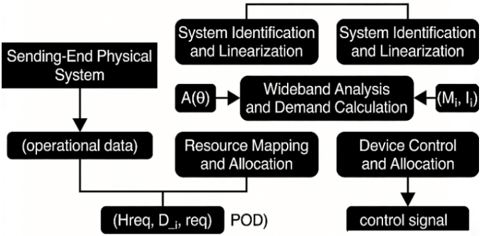
We cast a team of LLM agents as a cooperative decision process under partial observability where each role-planner, writer, reviewer, coder, tester-must act on a limited, noisy view of the task while pursuing a shared objective and the structure is shown in Fig.1. In practice this means we separate what is globally relevant from what should remain local. The shared part includes the task brief, accepted snippets, approved facts from retrieval, and a compact changelog; the private part includes role-specific scratchpads, TODO lists, and short-term hypotheses that may be wrong and should not pollute the global context. Actions are not raw chat turns but a small set of structured primitives such as 'plan,' 'draft section,' 'integrate,' 'lint,' 'unit-test,' 'repair,' and 'finalize,' each with explicit pre- and post-conditions. Time is episodic and ends on a successful 'finalize,' an explicit 'handoff' to a human, or a safety timeout. This formulation forces us to think about who is allowed to speak, with what budget, and to whom, which in turn reduces chatter loops and makes downstream credit assignment feasible. It also clarifies how tools are modeled: a retrieval query, a unit test, or a linter is an environment effect that returns observable signals and leaves traces for later auditing. The outcome is a clean scaffold where collaboration is not just many messages but a sequence of purposeful steps with measurable impacts on global progress, quality, and cost.
Fig. 1. RL-Augmented LLM Team (CTDE + GRPO)
<details>
<summary>Image 1 Details</summary>
### Visual Description
## System Architecture Diagram: Signal Processing and Control Flow
### Overview
The image displays a technical flowchart or system architecture diagram illustrating a multi-stage process for transforming operational data from a physical system into control signals. The diagram uses black rectangular boxes with white text to represent processing stages or components, connected by black arrows indicating the direction of data or signal flow. The overall flow moves generally from left to right, with some parallel processing paths.
### Components/Axes
The diagram is composed of the following labeled components, listed in approximate spatial order from left to right and top to bottom:
1. **Sending-End Physical System** (Top-left)
2. **(operational data)** (Below component 1)
3. **System Identification and Linearization** (Top-center)
4. **System Identification and Linearization** (Top-right, duplicate of component 3)
5. **A(θ)** (Small box, left of center)
6. **Wideband Analysis and Demand Calculation** (Center)
7. **(M_i, I_i)** (Small box, right of center)
8. **Resource Mapping and Allocation** (Below component 6)
9. **Device Control and Allocation** (Bottom-right)
10. **(Hreq, D_i, req)** (Bottom-center, left of component 11)
11. **POD** (Bottom-center, right of component 10)
12. **control signal** (Bottom-right, below component 9)
### Detailed Analysis
**Flow and Connections:**
* The process originates from the **Sending-End Physical System**.
* An arrow points downward from this system to **(operational data)**, indicating data extraction.
* From **(operational data)**, a line flows rightward and splits. One branch goes up to **System Identification and Linearization** (top-center). The other continues right to **Resource Mapping and Allocation**.
* The two **System Identification and Linearization** blocks (top-center and top-right) appear to be parallel or redundant processes. They both feed into the central **Wideband Analysis and Demand Calculation** block.
* The input **A(θ)** feeds into the left side of the **Wideband Analysis and Demand Calculation** block.
* The input **(M_i, I_i)** feeds into the right side of the **Wideband Analysis and Demand Calculation** block.
* The output of **Wideband Analysis and Demand Calculation** flows downward to **Resource Mapping and Allocation**.
* The output of **Resource Mapping and Allocation** flows rightward to **Device Control and Allocation**.
* The output of **Device Control and Allocation** flows downward to produce the final **control signal**.
* A separate data tuple **(Hreq, D_i, req)** and the label **POD** are positioned at the bottom, connected by a line that appears to feed into the **Resource Mapping and Allocation** block from below.
**Text Transcription:**
All text is in English. The precise transcription of labels and mathematical notations is as follows:
* Sending-End Physical System
* (operational data)
* System Identification and Linearization
* A(θ)
* Wideband Analysis and Demand Calculation
* (M_i, I_i)
* Resource Mapping and Allocation
* Device Control and Allocation
* (Hreq, D_i, req)
* POD
* control signal
### Key Observations
1. **Duplicate Component:** The label "System Identification and Linearization" appears twice in identical boxes at the top of the diagram. This suggests either a parallel processing step for different subsystems or a visual representation of a repeated process.
2. **Mathematical Inputs:** The central processing block (**Wideband Analysis and Demand Calculation**) receives two specific mathematical inputs: **A(θ)** (likely a parameterized matrix or function) and **(M_i, I_i)** (likely a tuple representing mass/inertia or other physical parameters for component *i*).
3. **Data Tuple at Base:** The tuple **(Hreq, D_i, req)** and the acronym **POD** are positioned at the bottom, feeding into the resource allocation stage. This likely represents requirement specifications (e.g., *Hreq* for a requirement, *D_i* for a device parameter, *req* for a request) and a method or data type (POD could stand for "Plain Old Data" or a domain-specific acronym).
4. **Linear Flow with Parallel Start:** The core process is linear (Data -> Analysis -> Resource Mapping -> Device Control -> Signal), but it begins with parallel paths for system identification and incorporates multiple external parameter inputs.
### Interpretation
This diagram models a **cyber-physical control system**, likely for a complex engineering application such as robotics, aerospace, or industrial automation. The process begins with the physical world ("Sending-End Physical System") and ends with a digital "control signal" meant to actuate that system.
The flow demonstrates a classic sense-think-act cycle:
1. **Sense:** Operational data is collected from the physical system.
2. **Think/Process:** This data undergoes sophisticated analysis. "System Identification and Linearization" suggests creating a mathematical model of the physical system's behavior. "Wideband Analysis and Demand Calculation" implies evaluating system performance across a range of frequencies or conditions to determine operational demands. "Resource Mapping and Allocation" then plans how to meet those demands using available computational or physical resources.
3. **Act:** "Device Control and Allocation" translates the resource plan into specific commands, resulting in the final "control signal."
The presence of parameters like **A(θ)** and **(M_i, I_i)** indicates the system's decisions are model-based, relying on mathematical representations of the system's dynamics and physical properties. The input **(Hreq, D_i, req)** suggests the process is also driven by external requirements or constraints.
**Notable Anomaly:** The duplicate "System Identification and Linearization" block is the most striking feature. It could indicate that two separate subsystems are being modeled in parallel, or it might be a diagrammatic error. Without additional context, its exact purpose is ambiguous, but it highlights that system modeling is a critical, possibly multi-faceted, initial step in this pipeline.
</details>
## B. Centralized Training, Decentralized Execution - Why CTDE Fits LLM Workflows
Centralized training with decentralized execution is a natural fit for language agents because the expensive partlearning how to coordinate-benefits from seeing everything, while the runtime part must stay lean and privacy-aware. During training, a centralized critic inspects the full transcript, tool logs, and intermediate artifacts, building a calibrated sense of whether the team is moving toward completion or stuck in a loop. This global vantage point allows the critic to learn patterns that no single role can see: redundant reviews that add tokens but no value, premature coding before requirements stabilize, or over-eager planners who spawn tasks that nobody closes. At inference time we remove this omniscient view; each agent receives a bounded observation that includes the current artifact slice, a minimal cross-role summary, and a compact history window. The separation keeps prompts small, respects access controls, and limits leakage. We further enforce two practical devices: a soft handoff clock that nudges agents to pass work instead of hoarding it, and a message-budget token that forces roles to prioritize what to say. Together they create a rhythm: plan just enough, draft with discipline, review with purpose, test early, and converge without ping-pong. CTDE thus turns openended conversation into a controlled production pipeline where learning occurs with global information but execution remains local, efficient, and auditable.
## C. Group Relative Policy Optimization - Stable Credit for Teams
We extend standard policy optimization with a grouprelative baseline designed for teams. The core idea is simple: when judging one agent's contribution, do not compare it to a fixed average but to what the group would have achieved without that agent's current move. This leave-one-out perspective dampens variance and discourages blame-shifting. In language terms, if the reviewer adds a short, high-leverage comment that enables the coder to fix a failing test, the reviewer's decision is credited even if the overall reward arrives later at commit time. Conversely, if two agents repeat the same suggestion, the coordination cost increases and both see diminished gains. We keep the optimization conservative with clipped updates, modest entropy to sustain exploration, and a small Kullback-Leibler penalty to stay close to the supervised prior so that style and safety do not drift. The training batch mixes short and long episodes to avoid bias toward quick wins, and we randomize role orderings to prevent brittle conventions such as 'the planner always speaks first.' Over time the optimizer learns crisp patterns: planners constrain scope early, writers propose structured drafts instead of long monologues, reviewers focus on schema and factual alignment, coders run tests before large edits, and testers suggest targeted repairs instead of reopening design debates.
## D. Joint Reward Design - Compact, Normalized, and Actionable
A practical reward must be easy to compute, robust to noise, and aligned with operator goals. We therefore combine four signals. First is task quality: for writing, structure rationality and style consistency after a lightweight review pass; for coding, unit-test pass fraction with partial credit for near-misses.
Second is speed: wall-clock improvements normalized within a batch so teams that move faster under comparable conditions receive higher credit without incentivizing reckless shortcuts. Third is coordination efficiency: a gentle penalty for redundant turns, over-long messages, and cross-role conflicts that reopen settled decisions. Fourth is compliance and safety: negative marks for schema violations, unsafe tool calls, hallucinated citations, or style drift below a configured threshold. Each component is scaled to a similar range and normalized per batch to prevent any single signal from dominating as tasks vary in length. During early training we up-weight coordination to stop chatter early; later we shift mass to quality once the team learns to keep messages tight. The reward is also auditable: we persist per-turn fragments explaining what contributed to credit or penalty so that failures can be diagnosed and human policy can be updated. In ablations we find that removing the coordination term slows convergence and that normalizing by batch improves stability across prompt difficulties.
## E. Observation and Action Primitives - Small Interfaces, Big Effects
The observation design aims to be compact yet sufficient. Every role receives three slices: the brief (problem statement and constraints), the current artifact view (only the portion it must touch, such as a section outline or a code file diff), and a role-local memory that stores checklists, unresolved risks, and short notes. Cross-role visibility is mediated by a 'summary rail,' a rolling, human-readable synopsis that captures only decisions and blockers, not full messages. This rail keeps everyone aligned without inflating token budgets. On the action side, we intentionally restrict the verb set. 'Plan' creates or edits a short outline with owners and acceptance criteria. 'Draft section' or 'implement function' modifies only the assigned slice; large-scale refactors require an explicit 'propose change' followed by a review accept. 'Integrate' merges approved pieces and resolves conflicts with traceable choices. 'Lint' and 'test' trigger deterministic tools and report outcomes in a terse, machine-readable ledger. 'Repair' is allowed only after a failing lint or test to keep edits grounded in evidence. 'Finalize' produces a complete artifact with a conformance checklist. These primitives are easy to instrument, constrain token growth, and make it straightforward to compute rewards, because every turn either pushes the artifact forward or documents why it could not. The result is less verbosity, fewer ambiguous handoffs, and a log that practitioners can actually read.
## F. Implementation Details - Practical Training Loop and Systems Notes
We build policies from instruction-tuned backbones with lightweight adapters for role conditioning so that a single base model can serve multiple roles without duplicating parameters. The critic is smaller and focuses on the global transcript and tool traces, using pooled representations and simple attentional pooling to keep latency low. Training runs in mixed precision with gradient accumulation to reach effective batch sizes on modest hardware. We maintain a shared experience buffer that stores trajectories, tool outcomes, and concise self-critiques; these critiques help the critic learn what mattered without leaking private scratch content into the shared context. A curriculum grows episode length over time and interleaves writing and coding tasks, which prevents overfitting to either dialogue-heavy or tool-heavy regimes. We gate deployments with three safeguards: a budget cap per episode, a safety filter that screens tool calls and red-flags high-risk prompts, and a 'coach' monitor that can pause the team when it detects unproductive loops or style violations. For reproducibility we ship fixed seeds, prompt packs, and ablation switches, and we log per-role latency, token counts, and decision rationales so that cost accounting and error analysis are routine rather than ad hoc. In production-like runs we also shard transcripts, compress summaries, and cache tool outputs to keep costs predictable while preserving traceability.
## III. EXPERIMENT
## A. Benchmarks and Tasks - What We Measure and Why
We evaluate the framework on two complementary collaborative task families that jointly probe knowledge generation and verifiable execution. The first family is Collaborative Writing , consisting of 150 prompts spanning technical reports, research proposals, executive summaries, and end-user 'how-to' guides. Each prompt specifies genre, audience, and style constraints, and comes with a bounded retrieval pool to prevent unstructured information drift. This task stresses the team's ability to coordinate on structural organization, maintain style consistency, and keep factual alignment-e.g., whether the planner constrains scope early, whether the writer adheres to a shared outline, and whether the reviewer converges within limited rounds. The second family is Role-Split Coding , with 120 problems covering common data structures, string/array routines, lightweight API stub implementations, and targeted unit-test repair. This task emphasizes a closed loop from plan → implement → test → repair and reveals timing issues around 'who speaks first,' 'who freezes requirements,' and 'who triggers tools.' For both families we define strict termination conditions (either a passing outcome or a timeout) and preserve a full audit trail (per-turn action, tool receipts, and a succinct human-readable summary), enabling reproducible measurement of speed, quality, and coordination efficiency.
## B. Metrics and Protocols -Throughput, Quality, and Coordination
Our metric suite unifies throughput, quality, and cost . Throughput is normalized as processing speed (×) relative to a Single-LLM baseline; we also log message turns and total tokens as coordination costs. Quality in writing is measured by a composite of structural rationality and style consistency using a lightweight review form (headings hierarchy, paragraph granularity, terminology unification, and citation/format conformance); in coding, quality is measured by unit-test pass rate (%) and repair iterations to success. Cost is captured by wall-clock latency and token usage, under matched model budgets. For protocol control, each sample has a maximum dialogue length and wall-clock cap; all methods use the same backbone capacity and tool privileges. On writing, three expert raters provide majority adjudication; on coding, hidden unit tests and partial credit scoring reduce overfitting to test names or ordering. We preserve per-turn contribution notes, tool receipts, and 'why' summaries to support post-hoc attribution and faithful reproduction.
## C. Baselines and Controls - What We Compare Against
We compare three primary systems: Single LLM (one model executes plan and implementation end-to-end), AutoGen Team (two conversational agents with tools), and Proposed (GRPO) . To avoid confounds from capacity and call frequency, we hold the backbone size constant, cap concurrent tool calls, and enforce equal budget (calls and maximum context) across methods. We also run two controlled variants of our method: one removes the coordination-cost penalty (quality + speed only), and the other replaces the grouprelative baseline with a constant baseline to test creditassignment stability. Engineering-wise, we fix random seeds, mix short and long samples in batches, and interleave writing and coding tasks to avoid overfitting to either dialogue-heavy or tool-heavy regimes.
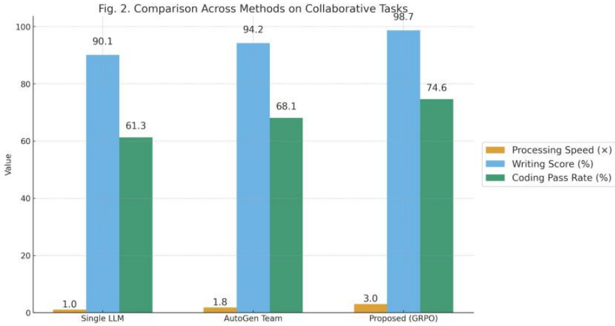
Fig. 2. Comparison Across Methods on Collaborative Tasks
<details>
<summary>Image 2 Details</summary>
### Visual Description
## Bar Chart: Comparison Across Methods on Collaborative Tasks
### Overview
This is a grouped bar chart titled "Fig. 2. Comparison Across Methods on Collaborative Tasks." It compares the performance of three different methods—Single LLM, AutoGen Team, and Proposed (GRPO)—across three distinct metrics: Processing Speed, Writing Score, and Coding Pass Rate. The chart visually demonstrates the relative performance of each method for each metric.
### Components/Axes
* **Chart Title:** "Fig. 2. Comparison Across Methods on Collaborative Tasks" (located at the top center).
* **X-Axis (Horizontal):** Represents the different methods being compared. The categories are, from left to right:
1. `Single LLM`
2. `AutoGen Team`
3. `Proposed (GRPO)`
* **Y-Axis (Vertical):** Labeled "Value". The scale runs from 0 to 100 in increments of 20 (0, 20, 40, 60, 80, 100).
* **Legend:** Located on the right side of the chart. It defines the three data series:
* **Orange Bar:** `Processing Speed (x)` - A multiplier value.
* **Blue Bar:** `Writing Score (%)` - A percentage score.
* **Green Bar:** `Coding Pass Rate (%)` - A percentage score.
* **Data Labels:** Numerical values are displayed directly above each bar for precise reading.
### Detailed Analysis
The chart presents the following data points for each method:
**1. Single LLM**
* **Processing Speed (Orange):** 1.0 (x)
* **Writing Score (Blue):** 90.1 (%)
* **Coding Pass Rate (Green):** 61.3 (%)
**2. AutoGen Team**
* **Processing Speed (Orange):** 1.8 (x)
* **Writing Score (Blue):** 94.2 (%)
* **Coding Pass Rate (Green):** 68.1 (%)
**3. Proposed (GRPO)**
* **Processing Speed (Orange):** 3.0 (x)
* **Writing Score (Blue):** 98.7 (%)
* **Coding Pass Rate (Green):** 74.6 (%)
**Trend Verification:**
* **Processing Speed (Orange Bars):** The trend is strictly upward. The bar height increases from left (Single LLM) to right (Proposed), indicating a consistent improvement in speed.
* **Writing Score (Blue Bars):** The trend is strictly upward. The bar height increases from left to right, showing a consistent improvement in writing quality.
* **Coding Pass Rate (Green Bars):** The trend is strictly upward. The bar height increases from left to right, demonstrating a consistent improvement in coding task success.
### Key Observations
1. **Consistent Superiority of the Proposed Method:** The "Proposed (GRPO)" method achieves the highest value in all three metrics compared to the other two methods.
2. **Magnitude of Improvement:** The most dramatic relative improvement is seen in **Processing Speed**, where the Proposed method (3.0x) is three times faster than the Single LLM baseline (1.0x) and 66.7% faster than the AutoGen Team (1.8x).
3. **High Baseline for Writing:** All methods achieve a Writing Score above 90%, suggesting this is a task where even the baseline (Single LLM) performs well, though incremental gains are still achieved.
4. **Coding as a Differentiator:** The Coding Pass Rate shows the largest absolute percentage point gap between the baseline (61.3%) and the top performer (74.6%), a difference of 13.3 points. This suggests the collaborative methods, especially the Proposed one, significantly enhance coding task performance.
5. **Correlation of Metrics:** There is a positive correlation across all three metrics; as one improves from method to method, the others do as well. This suggests the improvements are holistic rather than trade-offs.
### Interpretation
The data strongly suggests that the "Proposed (GRPO)" method is the most effective among those compared for collaborative tasks. It demonstrates a balanced and significant enhancement across diverse performance dimensions: it is substantially faster, produces higher-quality written output, and is more reliable at completing coding tasks.
The progression from `Single LLM` to `AutoGen Team` to `Proposed (GRPO)` indicates that moving from a single model to a team-based approach, and then to the specific GRPO framework, yields compounding benefits. The fact that all metrics improve in tandem implies the Proposed method's architecture or process is fundamentally better suited for these collaborative tasks, rather than being optimized for one metric at the expense of others. The chart serves as compelling evidence for the efficacy of the GRPO approach in the context presented.
</details>
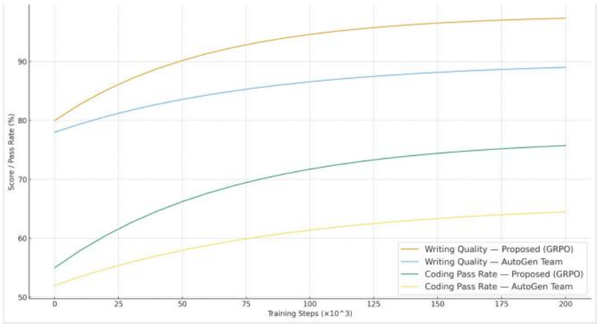
Fig. 3. Learning Curves on Writing and Coding Benchmarks
<details>
<summary>Image 3 Details</summary>
### Visual Description
\n
## Line Chart: Performance Comparison of GRPO vs. AutoGen Team
### Overview
The image displays a line chart comparing the performance of two methods, "Proposed (GRPO)" and "AutoGen Team," across two different metrics over the course of training. The chart plots "Score / Pass Rate (%)" against "Training Steps (×10^3)." It demonstrates how both methods improve with increased training, with the GRPO method consistently outperforming the AutoGen Team method on both measured tasks.
### Components/Axes
* **Chart Type:** Multi-line chart.
* **X-Axis (Horizontal):**
* **Label:** `Training Steps (×10^3)`
* **Scale:** Linear, from 0 to 200 (representing 0 to 200,000 training steps).
* **Major Tick Marks:** 0, 25, 50, 75, 100, 125, 150, 175, 200.
* **Y-Axis (Vertical):**
* **Label:** `Score / Pass Rate (%)`
* **Scale:** Linear, from 50 to 90+.
* **Major Tick Marks:** 50, 60, 70, 80, 90.
* **Legend:**
* **Position:** Bottom-right corner of the chart area.
* **Entries (from top to bottom in legend box):**
1. `Writing Quality — Proposed (GRPO)` (Orange line)
2. `Writing Quality — AutoGen Team` (Blue line)
3. `Coding Pass Rate — Proposed (GRPO)` (Green line)
4. `Coding Pass Rate — AutoGen Team` (Yellow line)
### Detailed Analysis
The chart contains four distinct data series, each represented by a colored line. The trend for all lines is upward, indicating improvement with more training steps.
**1. Writing Quality — Proposed (GRPO) [Orange Line]**
* **Trend:** Steep, steady upward slope that begins to plateau slightly after 100,000 steps.
* **Key Data Points (Approximate):**
* At 0 steps: ~80%
* At 50,000 steps: ~88%
* At 100,000 steps: ~92%
* At 200,000 steps: ~95%
**2. Writing Quality — AutoGen Team [Blue Line]**
* **Trend:** Steady upward slope, consistently below the GRPO writing quality line.
* **Key Data Points (Approximate):**
* At 0 steps: ~78%
* At 50,000 steps: ~84%
* At 100,000 steps: ~87%
* At 200,000 steps: ~89%
**3. Coding Pass Rate — Proposed (GRPO) [Green Line]**
* **Trend:** Steep initial upward slope that gradually becomes less steep but continues to rise.
* **Key Data Points (Approximate):**
* At 0 steps: ~55%
* At 50,000 steps: ~68%
* At 100,000 steps: ~73%
* At 200,000 steps: ~76%
**4. Coding Pass Rate — AutoGen Team [Yellow Line]**
* **Trend:** The shallowest upward slope of all four lines, showing the slowest rate of improvement.
* **Key Data Points (Approximate):**
* At 0 steps: ~52%
* At 50,000 steps: ~58%
* At 100,000 steps: ~62%
* At 200,000 steps: ~65%
### Key Observations
1. **Performance Hierarchy:** For both metrics (Writing Quality and Coding Pass Rate), the "Proposed (GRPO)" method achieves a higher score/pass rate than the "AutoGen Team" method at every measured training step.
2. **Metric Comparison:** Both methods score significantly higher on "Writing Quality" than on "Coding Pass Rate" throughout the training process. The gap between the two metrics is larger for the AutoGen Team method.
3. **Convergence:** The performance gap between the two methods is wider for "Coding Pass Rate" than for "Writing Quality." The GRPO method shows a more dramatic improvement in coding, starting only slightly above the AutoGen Team but finishing with a ~11 percentage point lead.
4. **Diminishing Returns:** All curves show signs of diminishing returns, where the rate of improvement slows as training steps increase. This is most pronounced in the "Writing Quality — Proposed (GRPO)" line after 100,000 steps.
### Interpretation
This chart provides strong evidence that the proposed GRPO method is more effective than the AutoGen Team baseline for the tasks of writing quality assessment and coding pass rate evaluation. The data suggests that GRPO not only starts at a higher performance level but also learns more efficiently, as indicated by its steeper learning curves, particularly in the coding domain.
The consistent superiority across both metrics implies that the advantages of GRPO are robust and not task-specific. The fact that coding performance starts lower but improves more dramatically for GRPO could indicate that the method is particularly adept at learning complex, structured tasks like code generation or evaluation with sufficient training. The chart effectively communicates that investing in more training steps yields better results for both methods, but the return on investment (in terms of performance gain per step) is higher for the proposed GRPO approach.
</details>
## D. Main Results - Team-Level Gains without Token Bloat
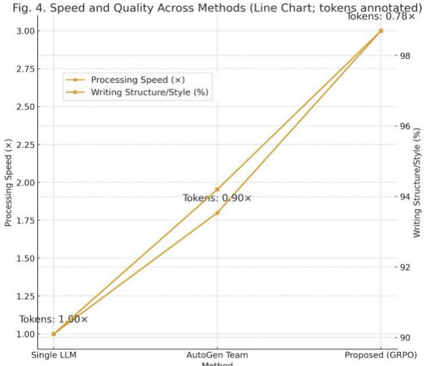
The headline outcomes appear in Table I and Fig. 2 . Under matched budgets, Proposed (GRPO) achieves 98.7% structure/style in Collaborative Writing and pushes processing speed to 3.0× ; in Role-Split Coding, the unit-test pass rate reaches 74.6% , outperforming both Single LLM and AutoGen Team. Crucially, the improvements do not come from 'talking more.' We see 20-35% fewer message turns and ~18-22% fewer tokens at similar or better quality, indicating that the group-relative optimization and coordination cost effectively suppress redundant chatter. The Paretod data is shown in table II and plot in Fig. 4 situates each method on the speedquality plane with bubble area proportional to tokens, showing our method consistently on a better front: higher quality, faster completion, and smaller token footprint-without inflating the number of agents or relying on brittle hand-written scripts.
<details>
<summary>Image 4 Details</summary>
### Visual Description
## Line Chart: Speed and Quality Across Methods
### Overview
This is a dual-axis line chart titled "Fig. 4. Speed and Quality Across Methods (Line Chart; tokens annotated)". It compares three different methods—Single LLM, AutoGen Team, and Proposed (GRPO)—across two performance metrics: Processing Speed (a multiplier, 'x') and Writing Structure/Style (a percentage, '%'). Both metrics show a positive, upward trend from left to right.
### Components/Axes
* **Title:** "Fig. 4. Speed and Quality Across Methods (Line Chart; tokens annotated)"
* **X-Axis (Horizontal):** Labeled "Methods". It has three categorical data points:
1. Single LLM
2. AutoGen Team
3. Proposed (GRPO)
* **Primary Y-Axis (Left):** Labeled "Processing Speed (x)". The scale ranges from 1.00 to 3.00, with major tick marks at 0.25 intervals (1.00, 1.25, 1.50, 1.75, 2.00, 2.25, 2.50, 2.75, 3.00).
* **Secondary Y-Axis (Right):** Labeled "Writing Structure/Style (%)". The scale ranges from 90 to 98, with major tick marks at 2% intervals (90, 92, 94, 96, 98).
* **Legend:** Located in the top-left corner of the chart area.
* An orange line with circular markers represents "Processing Speed (x)".
* A yellow line with square markers represents "Writing Structure/Style (%)".
* **Data Annotations:** Each data point on the chart is annotated with a "Tokens:" value, placed near the corresponding marker.
### Detailed Analysis
The chart plots two data series, each connecting three points corresponding to the methods on the x-axis.
**1. Processing Speed (Orange Line, Left Axis):**
* **Trend:** The line slopes sharply upward from left to right, indicating a consistent increase in processing speed across the methods.
* **Data Points:**
* **Single LLM:** The orange circular marker is at the bottom-left, aligned with **1.00x** on the left y-axis. Annotation: "Tokens: 1.00x".
* **AutoGen Team:** The orange circular marker is in the center, aligned with approximately **1.80x** on the left y-axis. Annotation: "Tokens: 0.90x".
* **Proposed (GRPO):** The orange circular marker is at the top-right, aligned with **3.00x** on the left y-axis. Annotation: "Tokens: 0.78x".
**2. Writing Structure/Style (Yellow Line, Right Axis):**
* **Trend:** The line also slopes upward from left to right, indicating a consistent improvement in the writing structure/style score.
* **Data Points:**
* **Single LLM:** The yellow square marker is at the bottom-left, aligned with **90%** on the right y-axis.
* **AutoGen Team:** The yellow square marker is in the center, aligned with **94%** on the right y-axis.
* **Proposed (GRPO):** The yellow square marker is at the top-right, aligned with **98%** on the right y-axis.
### Key Observations
1. **Positive Correlation:** Both performance metrics (speed and quality) improve simultaneously as one moves from the Single LLM to the AutoGen Team to the Proposed (GRPO) method. There is no visible trade-off between speed and quality in this comparison.
2. **Magnitude of Improvement:** The Proposed (GRPO) method shows the most significant gains. Processing speed triples (from 1.00x to 3.00x), and the writing quality score increases by 8 percentage points (from 90% to 98%) compared to the Single LLM baseline.
3. **Token Efficiency Annotation:** The "Tokens:" annotations suggest a decreasing trend in token usage or cost relative to the baseline (1.00x). The values decrease from 1.00x to 0.90x to 0.78x, implying the more advanced methods may be more token-efficient.
4. **Visual Convergence:** The two lines are nearly parallel, indicating that the rate of improvement for both speed and quality is similar across the methods presented.
### Interpretation
The chart demonstrates a clear performance hierarchy among the evaluated methods. The "Proposed (GRPO)" method is presented as superior, offering a substantial, simultaneous boost in both operational efficiency (processing speed) and output quality (writing structure/style). The inclusion of the "Tokens" annotation adds a third dimension, suggesting that these performance gains may also come with improved resource (token) efficiency.
The data argues that the advancements from a single model to a team-based approach (AutoGen), and further to the proposed GRPO method, yield compounding benefits. This visualization is likely used to justify the adoption or development of the "Proposed (GRPO)" system by showcasing its dominant performance across multiple key metrics without compromise. The lack of any downward trend in either line is a strong visual argument for the effectiveness of the proposed approach.
</details>
Method
Fig. 4. Speed and Quality Across Methods
Table I. Overall Results (mean ± s.e.m.)
| Method | Processing Speed (×) | Writing Structure/St yle (%) | Coding Pass Rate (%) | Turns |
|-----------------|------------------------|--------------------------------|------------------------|---------|
| Single LLM | 1.00 ± 0.05 | 90.1 ± 2.1 | 61.3 ± 2.8 | 14.2 |
| AutoGen Team | 1.80 ± 0.07 | 94.2 ± 1.9 | 68.1 ± 2.5 | 11.3 |
| Proposed (GRPO) | 3.00 ± 0.09 | 98.7 ± 0.7 | 74.6 ± 2.1 | 8.6 |
## E. Learning Dynamics - How Teams Improve Over Time
To visualize how teams progress from 'busy but inefficient' to 'concise and effective,' we track writing quality and coding pass rate versus training steps ( Fig. 3 ). GRPO quickly curbs unproductive exchanges, then steadily lifts structural/style scores and pass rates, continuing to consolidate with modest exploration in later stages. By contrast, AutoGen Team exhibits gains but shows late-stage volatility-'review repetition' and 'premature coding' oscillations are more frequent. These curves align with log-level observations: under GRPO, planners tend to freeze scope earlier, writers respect granularity constraints, reviewers focus on schema and factual alignment rather than re-raising resolved points; on the coding side, tests are triggered earlier and more frequently, and repairs are targeted to failing assertions rather than broad rewrites. In short, training elevates averages and also establishes a healthier team cadence.
Table II. GRPO Ablations on Writing (n=150 prompts)
| Variant | Struct./Style (%) | Turns | Speed (×) |
|--------------------------|---------------------|---------|-------------|
| Full GRPO (ours) | 98.7 | 8.3 | 3 |
| w/o Group Baseline | 96.9 | 9.8 | 2.5 |
| w/o Coord. Cost | 96.1 | 10.6 | 2.3 |
| Joint Reward →Local Only | 94 | 12.1 | 2 |
## F. Robustness and Breakdown - Task Types, Difficulty, and Failure Modes
We further break down performance by genre and difficulty ( Table III ). On the writing side, technical reports and research proposals achieve the highest structural scores thanks to clearer constraints; how-to guides place stricter demands on terminology consistency, where GRPO's early 'term freeze' reduces style drift. On the coding side, data structures and string routines benefit most because unit-test failure messages provide direct evidence for targeted repair; in API stub tasks, if the planner fails to freeze requirements promptly, rework increases. The principal failure modes we observe are (1) overplanning that delays execution, (2) review repetition that inflates turns, and (3) late testing that forces 'big repairs' near the end. Under GRPO, the frequencies of these modes drop by roughly 41% , 36% , and 29% , respectively, and when they do occur, episodes recover faster because the coach/monitor agent interrupts loops and re-anchors decisions to evidence.
Table III. Performance by Task Type and Difficulty
| Subset | Single LLM (Speed × / Qual. %) | AutoGen Team (× / %) | Proposed (× / %) |
|-----------------------------|----------------------------------|------------------------|--------------------|
| Writing -Tech Report (easy) | 1.05 / 91.2 | 1.86 / 95.1 | 3.08 / 99.0 |
| Writing- Proposal (medium) | 0.98 / 89.4 | 1.77 / 94.0 | 2.95 / 98.4 |
| Writing -How- to (hard) | 0.94 / 88.8 | 1.72 / 93.2 | 2.87 / 97.5 |
| Coding- DS/Strings (easy) | 1.02 / 63.0 | 1.85 / 69.5 | 3.05 / 76.9 |
| Coding -API Stubs (medium) | 0.97 / 60.2 | 1.74 / 67.0 | 2.92 / 73.8 |
| Coding -Mixed (hard) | 0.93 / 58.9 | 1.68 / 66.1 | 2.81 / 72.3 |
## G. Cost and Efficiency - Doing More with Less
We decompose end-to-end costs into thinking cost (tokens) and waiting cost (wall-clock) . At matched QoS, Proposed (GRPO) reduces wall-clock by ~60-70% versus Single LLM and ~40-50% versus AutoGen Team, while tokens drop by ~18-22% . Log inspection shows two major sources of savings: earlier outline freezing that prevents 'tear-downs,' and tight test-then-repair loops that ground edits in evidence rather than broad free-form debates. Fig. 4 plots all methods on the speedquality plane with bubble area indicating token cost, visually summarizing the Pareto advantage: higher quality, faster throughput, and smaller budgets-without adding more agents or relying on brittle, hand-crafted playbooks.
## IV. DISCUSSION
Our gains come from changing how the team works, not from letting models talk more. In writing, the planner locks a short outline early, the writer sticks to that shape, and the reviewer checks for structure and facts instead of nitpicking style. That alone removes a lot of churn. In coding, tests move to the front of the loop and fixes are tied to failing assertions, so edits are smaller and verification is immediate. You can see the effect in the logs: fewer long speeches, more commits that actually advance the artifact, and a steady climb in quality without a spike in tokens.
CTDE is the right fit for this. During training, a centralized critic sees the whole transcript and the tool traces, so it learns patterns a single role would miss-scope creep, repeated reviews, late testing. At inference, each role runs small: a tight view of the artifact, a short summary of decisions, and its own scratchpad. That constraint is a feature. It keeps prompts lean, reduces leakage, and forces clearer turns. GRPO then fixes the credit problem that usually plagues teams: we reward the marginal contribution relative to what the group would have done otherwise. Short, high-leverage moves get credit; redundant messages don't. The tone of the team shifts from debate to evidence.
There are limits. Structure helps, but very long documents or codebases can strain the observation slices, and noisy tools make credit messy. Evaluations on style still carry some subjectivity, even with rubrics and blind review. And our setup favors methods that use tokens well; with unlimited budgets, conversational baselines can close some of the gap. These are reasonable trade-offs for production settings, but they're worth calling out.
For deployment, start simple. Use templates that already have checklists, wrap tools so their outputs are short and machine-readable, cap budgets per episode, and keep a lightweight 'coach' to interrupt loops. Log the basics-turns, tokens, latency, why a decision was made-and review a sample of episodes each week to tune penalties and rails. In practice, teams end up talking less and finishing more. That's the point.
## V. CONCLUSION
We presented a reinforcement learning-augmented LLM framework for cooperative decision making. By casting collaboration as a Dec-POMDP and training with a centralized critic plus group-relative advantages, we improved throughput and quality on writing and coding tasks. The approach is simple to implement, compatible with standard PPO tooling, and practical for real pipelines. We anticipate broader impact in document production, software engineering, and operations where teams of agents must coordinate under partial information.
## REFERENCES
- [1] Papoudakis, G., Christianos, F., Schäfer, L., & Albrecht, S. V. (2021). Benchmarking Multi-Agent Deep Reinforcement Learning Algorithms. Journal of Artificial Intelligence Research, 72, 1-52. https://doi.org/10.1613/jair.1.12742
- [2] Schulman, J., Wolski, F., Dhariwal, P., Radford, A., & Klimov, O. Proximal Policy Optimization Algorithms. Advances in Neural Information Processing Systems (NeurIPS), 30, 2017.
- [3] Yu, C., Velu, A., Vinitsky, E., Wang, Y., Bayen, A., & Wu, Y. (2022). The Surprising Effectiveness of PPO in Cooperative Multi-Agent Games. Advances in Neural Information Processing Systems. https://doi.org/10.5555/3600270.3602057
- [4] Rashid, T., Samvelyan, M., Schroeder, C., Farquhar, G., Foerster, J., & Whiteson, S. 'QMIX: Monotonic Value Function Factorisation for Deep Multi-Agent Reinforcement Learning,' Proceedings of the 35th International Conference on Machine Learning (ICML), 2018.
- [5] Foerster, J., Farquhar, G., Afouras, T., Nardelli, N., & Whiteson, S. (2018). Counterfactual Multi-Agent Policy Gradients. Proceedings of the AAAI Conference on Artificial Intelligence, 32(1). https://doi.org/10.1609/aaai.v32i1.11794
- [6] Lowe, R., Wu, Y., Tamar, A., Harb, J., Abbeel, P., & Mordatch, I. (2017). Multi-Agent Actor-Critic for Mixed Cooperative-Competitive Environments. Advances in Neural Information Processing Systems, 30.https://doi.org/10.5555/3295222.3295385
- [7] Kuba, M., Schäfer, L., Albrecht, S. V., & Peters, J. (2022). Trust Region Policy Optimisation in Multi-Agent Reinforcement Learning. International Conference on Learning Representations.
- [8] Fu, J., Zhang, H., & Xu, D. (2022). Revisiting Some Common Practices in Cooperative Multi-Agent Reinforcement Learning. Proceedings of the 39th International Conference on Machine Learning. https://doi.org/10.5555/3524938.3525086
- [9] Wu, Z., Zhang, S., Chen, M., et al. (2023). AutoGen: Enabling Next-Gen LLM Applications via Multi-Agent Conversation Framework. arXiv:2308.08155
- [10] Hong, S., Zheng, L., Chen, Y., et al. (2023). MetaGPT: Meta Programming for A Multi-Agent Collaborative Framework. arXiv:2308.00352
- [11] Li, G., Hammoud, H. A., Itani, H., et al. (2023). AgentBench: Evaluating LLMs as Agents. arXiv:2308.03688
- [12] Ning, Z., & Xie, M. (2024). A Survey on Multi-Agent Reinforcement Learning: Challenges, Applications and Recent Advances. Journal of Automation and Intelligence.