## Imandra CodeLogician: Neuro-Symbolic Reasoning for Precise Analysis of Software Logic
Hongyu Lin 1 , Samer Abdallah 1 , Makar Valentinov 1 , Paul Brennan 1 , Elijah Kagan 1 , Christoph M. Wintersteiger 1 , Denis Ignatovich 1 , and Grant Passmore ∗ 1,2
1 Imandra Inc.
2 Clare Hall, University of Cambridge
{ hongyu,samer,makar,paul,elijah,christoph,denis,grant } @imandra.ai
February 10, 2026
## Abstract
Large Language Models (LLMs) have shown strong performance on code understanding and software engineering tasks, yet they fundamentally lack the ability to perform precise, exhaustive mathematical reasoning about program behavior. Existing benchmarks either focus on mathematical proof automation, largely disconnected from real-world software, or on engineering tasks that do not require semantic rigor.
We present CodeLogician 1 , a neurosymbolic agent and framework for precise analysis of software logic, and its integration with ImandraX 2 , an industrial automated reasoning engine successfully deployed in financial markets, safety-critical systems and government applications. Unlike prior approaches that use formal methods primarily to validate or filter LLM outputs, CodeLogician uses LLMs to help construct explicit formal models ('mental models') of software systems, enabling automated reasoning to answer rich semantic questions beyond binary verification outcomes. While the current implementation builds on ImandraX and benefits from its unique features designed for large-scale industrial formal verification and software understanding, the framework is explicitly designed to be reasoner-agnostic and can support additional formal reasoning backends.
To rigorously evaluate mathematical reasoning about software logic, we introduce a new benchmark dataset code-logic-bench 3 targeting the previously unaddressed middle ground between theorem proving and software engineering benchmarks. The benchmark measures correctness and efficacy of reasoning about program state spaces, control flow, coverage constraints, decision boundaries, and edge cases, with ground truth defined via formal modeling and automated decomposition.
Using this benchmark set, we compare LLM-only reasoning against LLMs augmented with CodeLogician . Across all evaluated models, formal augmentation with CodeLogician yields substantial and consistent improvements, closing a 41-47 percentage point gap in reasoning accuracy and achieving complete coverage while LLM-only approaches remain approximate or incorrect. These results demonstrate that the neurosymbolic integration of LLMs with formal reasoning engines is essential for scaling program analysis beyond heuristic reasoning toward rigorous, autonomous software understanding and formal verification.
∗ The author would like to thank the Isaac Newton Institute for Mathematical Sciences, Cambridge, for support and hospitality during the programme Big Proof: Formalizing Mathematics at Scale , where some of the work on this paper was undertaken. This work was supported by EPSRC grant EP/Z000580/1.
1 https://www.codelogician.dev
2 https://www.imandra.ai/core
3 https://github.com/imandra-ai/code-logic-bench
## Contents
| Introduction | Introduction | 4 |
|---------------------------------------------------------------------------------------------------------------------------------|---------------------------------------------------------------------------------------------------------------------------------|----------------------------------------------------------------------|
| 1.1 Beyond Verification-as-Filtering | . . . . . . | . . . . . . . . . . 4 |
| | . . . . | . . . . . . . . . . 4 |
| 1.2 | Neuro-Symbolic Complementarity IML Agent . . . . . . | . . . . . . . . . . 5 . . . . . . . . . . . . . . . . . . . . 7 |
| 1.3 ImandraX and Reasoner-Agnostic Design | 1.3 ImandraX and Reasoner-Agnostic Design | . . . . . . . . . . 4 |
| 1.4 The Missing Benchmark: Mathematical Reasoning About . | 1.4 The Missing Benchmark: Mathematical Reasoning About . | . . . . . . . . . . 5 |
| 1.5 Contributions . . . . . . . . . . . . . . . . . . . . . . . | 1.5 Contributions . . . . . . . . . . . . . . . . . . . . . . . | 5 |
| CodeLogician overview | CodeLogician overview | CodeLogician overview |
| 2.1 Positioning 2.2 Extensible | and Scope . . . . . . . . . . . Reasoner-Oriented Design . . . | . . . . . . . . . . 5 . . . . . . . . . . 6 |
| 2.3 Modes of Operation . . . 2.4 Governance and Feedback | . . . . . . . . . . . . . . . . . . | . . . . . . . . . . 6 . . . . . . . . . . 7 |
| 2.5 Relationship to the CodeLogician 2.6 Summary . . . . . . . . . . . . | 2.5 Relationship to the CodeLogician 2.6 Summary . . . . . . . . . . . . | 7 |
| Overview of ImandraX | Overview of ImandraX | Overview of ImandraX |
| | | 7 |
| 3 | 3 | 3 |
| | Language | . . . . . . . . . . 8 |
| 3.1 Formal Models in the Imandra Modeling 3.2 Verification Goals . . . . . . . . . . . . . | . | . . . . . . . . . . 8 |
| 3.3 Region | Decomposition . . . . . . . . . . . | . . . . . . . . . . 9 |
| 3.4 Focusing Decomposition: Side | Conditions | . . . . . . . . . . 10 |
| 3.5 Test Generation from Regions . . . . 3.6 Summary . . . . . . . . . . . . . . . | . . . . . . | . . . . . . . . . . 11 . . . . . . . . . . 11 |
| | | 11 |
| Autoformalization of source code | Autoformalization of source code | Autoformalization of source code |
| | | 12 |
| 4.3 Abstraction Levels . . . . . . . 4.4 Dealing with Unknowns . . . | . . . . . . | . . . . . . . . . . |
| | . . . . | . . . . . . . . . . 13 |
| . . . | . . . . | . . . . . . . . . . 13 |
| 4.4.1 Opaque Functions . . . . . . | . . . . | . . . . . . . . . . 13 |
| 4.4.2 Axioms and Assumptions | 4.4.2 Axioms and Assumptions | 4.4.2 Axioms and Assumptions |
| 4.4.3 Approximation Functions 4.5 Summary . . . . . . . . . . . . | . . . . . . . . . | . . . . . . . . . . 13 . . . . . . . . . . 13 |
| CodeLogician IML Agent | CodeLogician IML Agent | CodeLogician IML Agent |
| . | . | . |
| . 5.1 From 5.2 Verification | Source Code to Formal Models . . . Goals and Logical Properties | . . . . . . . . . . 14 . . . . . . . . . . 14 |
| | . . . . . . . | . . . . . . . . . . 14 |
| 5.3 Beyond Yes/No Verification . 5.4 Agent Architecture and State | . . . . . . | . . . . . . . . . . 14 |
| . 5.5 Model Refinement and | . . | . . . . . . . . . . 15 |
| Executability . . . . . | . . | . . . . . . . . . . 15 |
| 5.6 Assessing Model Correctness . | 5.6 Assessing Model Correctness . | . . . . . . . . . . 15 |
| 5.7 Region decomposition, test case generation, and refinement 5.8 Interfaces . . . . . . . . . . . . . . . . . . . . . . . . . | 5.7 Region decomposition, test case generation, and refinement 5.8 Interfaces . . . . . . . . . . . . . . . . . . . . . . . . . | . . . . . . . . . . 16 |
| 5.8.1 Programmatic Access via python RemoteGraph . . | 5.8.1 Programmatic Access via python RemoteGraph . . | . . . . . . . . . . 17 |
| 5.8.2 VS Code Extension . . . . . . . . . . . . . 5.9 Summary . . . . . . . . . . . . . . . . . . . . . . | 5.8.2 VS Code Extension . . . . . . . . . . . . . 5.9 Summary . . . . . . . . . . . . . . . . . . . . . . | . . . . . . . . . . 17 |
| Server | Server | Server |
| CodeLogician | CodeLogician | CodeLogician |
| 6 | 6 | 17 |
| 6.1 Server | Responsibilities . . . . . . . . . . . Formalization via | . . . . . . . . . . 19 . . . . . . . . . . 19 |
| | . . . . . | . . . . . . . . . . |
| 6.2 Strategies: Project-Wide | 6.2 Strategies: Project-Wide | 19 |
| 6.3 Metamodel-Based Formalization 6.4 Core Definitions . | . . . . . . . . . . . . | . . . . . . . . . . |
| . | . | 19 20 |
| 6.5 Formalization Levels . . . . . . . . . 6.6 Conditions Triggering | 6.5 Formalization Levels . . . . . . . . . 6.6 Conditions Triggering | 6.5 Formalization Levels . . . . . . . . . 6.6 Conditions Triggering |
| Re-Formalization . | Re-Formalization . | 20 |
| 6.7 . . . | 6.7 . . . | 6.7 . . . |
| | Autoformalization Workflow . . . . | |
| . | . | . |
| . | . | . |
| . | . | . |
| . | . | . |
| . | . | . |
| . | . | |
| | . . . 20 | . . . 20 |
| | . . . . . | . . . . . |
| | . . . | . . . |
| | . . . . . . . . . . . . . . . . . . . . . . . . . . . . . . . . | . . . . . . . . . . . . . . . . . . . . . . . . . . . . . . . . |
| | | . . . . . . . . . . . . . . . . . |
| | 6.8 Minimal Re-Formalization | Strategy . . . . . | 21 |
|-----|-------------------------------------------------------------------------------------------------|-------------------------------------------------------------------------------------------------|------|
| | 6.9 Summary and Error Resilience . | . . . . . . | 21 |
| 7 | Performance | Performance | 23 |
| | Dataset . . . . . . . . . | . . . . . . . . . . . | 23 |
| | Metrics . . . . . . . . . . . . . | . . . . . . . | 24 |
| | 7.2.1 | State Space Estimation Accuracy . . | 24 |
| | 7.2.2 | Outcome Precision . . . . . . . . . . | 24 |
| | 7.2.3 | Direction Accuracy . . . . . . . . . . | 25 |
| | 7.2.4 | Coverage Completeness . . . . . . . | 25 |
| | 7.2.5 | Control Flow Understanding . . . . | 25 |
| | 7.2.6 | Edge Case Detection . . . . . . . . . | 26 |
| | 7.2.7 | Decision Boundary Clarity . . . . . | 26 |
| 7.3 | Evaluation . . . . . . . . . . . | . . . . . . . . | 27 |
| | 7.3.1 | Answer Generation . . . . . . . . . . | 27 |
| | 7.3.2 | Answer Evaluation (LLM-as-a-Judge) | 27 |
| | 7.4 Results . . . . . . . . . . . . . . . . . . . . . . . . . . . . . . . . . . . . . . . . . . | 7.4 Results . . . . . . . . . . . . . . . . . . . . . . . . . . . . . . . . . . . . . . . . . . | 27 |
| | 7.4.1 | Overall Performance . . . . . . . . . | 27 |
| | 7.4.2 | Model Comparison by Metric . . . . | 29 |
| 8 | | | 32 |
| | Case Studies | Case Studies | |
| | 8.1 LSE GTT Order Expiry | . . . . . . . . . . . | 32 |
| | 8.1.1 Verification . . . | . . . . . . . . . . . | 34 |
| | 8.2 London Stock Exchange Fee Schedule | . . . | 34 |
| | 8.2.1 | Verified Invariants . . . . . . . . . . | 34 |
| | 8.2.2 | Region Decomposition . . . . . . . . | 35 |
| | Multilateral Netting Engine . | . . . . . . . . | 35 |
| | 8.3.1 Input Validation . | . . . . . . . . . . | 36 |
| | 8.3.2 | Floating Point Precision . . . . . . . | 36 |
| 9 | Conclusion and Future Work | Conclusion and Future Work | 36 |
| A | LSE GTT Order Expiry | LSE GTT Order Expiry | 38 |
| | A.1 Python model . . . . . . . | . . . . . . . . . . | 38 |
| | A.2 Sequence diagram . . | . . . . . . . . . . . . . | 45 |
| B | Multilateral Netting Engine | Multilateral Netting Engine | 46 |
| | B.1 Python model . . . . . | . . . . . . . . . . . . | 46 |
| | B.2 Evaluation | Example: Transportation Risk Manager | 48 |
| | B.2.1 | The Three Questions . . . . . . . . . | 48 |
| | B.2.2 | Question 1: State Space Estimation | 48 |
| | B.2.3 | Question 2: Conditional Analysis . . | 49 |
| | B.2.4 | Question 3: Property Verification . . | 50 |
| | B.2.5 | Summary . . . . . . . . . . . . . . . | 51 |
## 1 Introduction
The rapid adoption of Large Language Models (LLMs) in software development has brought the notion of 'reasoning about code' into the mainstream. LLMs are now widely used for tasks such as code completion, refactoring, documentation, and test generation, and have demonstrated strong capabilities in understanding control flow and translating between programming languages. However, despite these advances, LLMs remain fundamentally limited in their ability to perform precise, exhaustive mathematical reasoning about program behavior.
In parallel, the field of automated reasoning-often referred to as symbolic AI or formal methodshas long focused on mathematically precise analysis of programs expressed as formal models. Decades of research and industrial deployment have produced powerful techniques for verifying correctness, exhaustively exploring program behaviors, and identifying subtle edge cases. Yet these techniques have historically required specialized expertise, limiting their accessibility and integration into everyday software development workflows.
This paper introduces CodeLogician , a neuro-symbolic framework that bridges these two paradigms. CodeLogician combines LLM-driven agents with ImandraX , an automated reasoning engine that has been successfully applied in financial markets, safety-critical systems, and government agencies. With CodeLogician , LLMs are used to translate source code into executable formal models and to interpret reasoning results, while automated reasoning engines perform exhaustive mathematical analysis of those models.
## 1.1 Beyond Verification-as-Filtering
Much of the existing work that combines LLMs with formal methods treats symbolic systems as external 'validators'. In these approaches, LLMs generate code, specifications, or proofs, and automated reasoning tools are applied post hoc to check consistency or correctness, typically yielding a binary yes/no outcome. While such verification-as-filtering is valuable for enforcing correctness constraints, it does not fundamentally expand the reasoning capabilities of LLMs.
In particular, verification-as-filtering does not help LLMs construct accurate internal models of program behavior, reason about large or infinite state spaces, or answer rich semantic questions involving constraints, decision boundaries, and edge cases. As a result, LLMs remain confined to approximate and heuristic reasoning, even when formal tools are present in the pipeline.
CodeLogician adopts a different perspective. Rather than using formal methods to police LLM outputs, we use LLMs to construct explicit formal mental models of software systems expressed in mathematical logic. Automated reasoning engines are then applied directly to these models to answer questions that go far beyond satisfiability or validity, including exhaustive behavioral coverage, precise boundary identification, and systematic test generation. In this setting, LLMs act as translators and orchestrators, while mathematical reasoning is delegated to tools designed explicitly for that purpose.
## 1.2 Neuro-Symbolic Complementarity
The strengths and weaknesses of LLMs closely mirror those of symbolic reasoning systems. LLMs excel at translation, abstraction, and working with incomplete information, but struggle with precise logical reasoning. Symbolic systems, by contrast, require strict formalization and domain discipline, but excel at exhaustive and exact reasoning once a model is available.
CodeLogician embraces this neuro-symbolic complementarity. LLMs bridge the gap between informal source code and formal logic, while automated reasoning engines provide mathematical guarantees about program behavior. This separation of concerns enables a scalable and principled approach to reasoning about real-world software systems.
## 1.3 ImandraX and Reasoner-Agnostic Design
At the core of CodeLogician lies ImandraX , an automated reasoning engine operating over the Imandra Modeling Language (IML), a pure functional language based on a subset of OCaml with extensions for specification and verification [14]. Beyond traditional theorem proving and formal verification, ImandraX supports advanced analysis techniques such as region decomposition, enabling systematic exploration of program state spaces and automated generation of high-coverage test suites.
While CodeLogician currently integrates ImandraX as its primary reasoning backend, the framework is explicitly designed to be reasoner-agnostic . Additional formal reasoning tools can be incorporated without architectural changes, allowing CodeLogician to evolve alongside advances in automated reasoning.
## 1.4 The Missing Benchmark: Mathematical Reasoning About Software
Despite rapid progress in evaluating LLMs, existing benchmarks fall into two largely disconnected categories. Mathematical proof benchmarks evaluate abstract symbolic reasoning over mathematical domains, but do not address reasoning about real-world software behavior. Engineering benchmarks, such as those focused on debugging or patch generation, evaluate practical development skills but do not require precise or exhaustive semantic reasoning.
What is missing is a benchmark that evaluates an LLM's ability to apply mathematical reasoning to executable software logic . To address this gap, we introduce a new benchmark dataset code-logicbench [9] designed to measure reasoning about program state spaces, constraints, decision boundaries, and edge cases. Ground truth is defined via formal modeling and automated reasoning, enabling objective evaluation of correctness, coverage, and boundary precision. The benchmark supports principled comparison between LLM-only reasoning and LLMs augmented with formal reasoning via CodeLogician .
## 1.5 Contributions
This paper makes the following contributions:
- We present CodeLogician , a neuro-symbolic framework that teaches LLM-driven agents to construct formal models of software systems and reason about them using automated reasoning engines.
- We introduce a new benchmark dataset targeting mathematical reasoning about software logic, filling a critical gap between existing mathematical and engineering-oriented benchmarks.
- We provide a rigorous empirical evaluation demonstrating substantial improvements when LLMs are augmented with formal reasoning, compared to LLM-only approaches.
## 2 CodeLogician overview
CodeLogician is a neuro-symbolic, agentic governance framework for AI-assisted software development. It provides a uniform orchestration layer that exposes formal reasoning engines (called 'reasoners'), autoformalization agents, and analysis workflows through consistent interfaces. It supports multiple modes of use, including direct invocation of reasoners, agent-driven auto-formalization, and LLM-assisted utilities for documentation and analysis. It is available as both CLI and server-based workflows-with an interactive TUI that can invoke agents over entire directories-making formal reasoning, verification, and test-case generation accessible across development pipelines.
Rather than competing with LLM-based coding tools, CodeLogician is designed to augment and guide them by supplying mathematically grounded feedback, proofs, counterexamples, and exhaustive behavioral analyses.
At its core, CodeLogician serves as a source of mathematical ground truth . Where LLM-based tools operate probabilistically, CodeLogician anchors reasoning about software behavior in formal logic, ensuring that conclusions are derived from explicit models and automated reasoning rather than statistical inference.
## 2.1 Positioning and Scope
CodeLogician targets reasoning tasks that arise above the level of individual lines of code, where system behavior emerges from the interaction of components, requirements, and environments. Typical application areas include architectural reasoning, multi-system integration, protocol and workflow validation, and functional correctness of critical business logic.
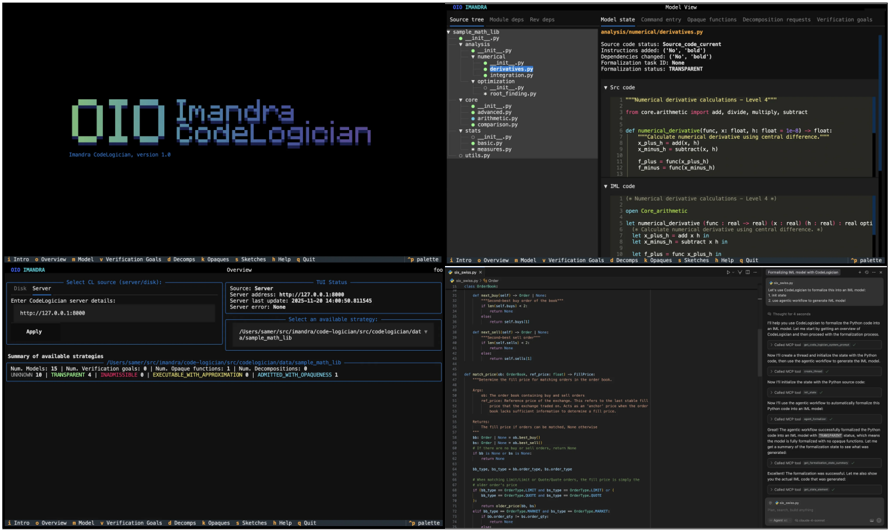
Figure 1: Imandra CodeLogician , neurosymbolic agent and framework for precise reasoning about software logic, with CLI, MCP and VS Code interfaces. Available from www.codelogician.dev .
<details>
<summary>Image 1 Details</summary>
### Visual Description
## Screenshot: Code Editor Interface for "IOI Imandra CodeLogician" Project
### Overview
The image shows a code editor interface with three open tabs, displaying project files, directory structures, and code snippets. The project appears to be a code logician tool named "IOI Imandra CodeLogician," version 1.0, with configuration files, OCaml code, and CML (Coq) code visible.
---
### Components/Axes
1. **Tabs**:
- **Tab 1**: Project title and version (`IOI Imandra CodeLogician`, version 1.0).
- **Tab 2**: Directory structure of the project.
- **Tab 3**: Code snippets and configuration settings.
2. **Directory Structure (Tab 2)**:
- Files listed include:
- `sample_math.mllib`
- `analysis.ml`
- `derivatives.ml`
- `integration.ml`
- `optimization.ml`
- `root_finding.ml`
- `numerical_derivative.ml`
- `basic.ml`
- `measures.ml`
- `utils.ml`
3. **Code Snippets (Tab 3)**:
- **OCaml Code**:
```ocaml
(* Numerical derivative calculations *)
let numerical_derivative_func f x h =
let x_plus_h = x +. h in
let x_minus_h = x -. h in
(f x_plus_h -. f x_minus_h) /. (2. *. h)
```
- **CML Code**:
```coq
(* Numerical derivative in Coq *)
Definition numerical_derivative (f : real -> real) (x : real) (h : real) : real :=
(f (x + h) - f (x - h)) / (2 * h).
```
- **Configuration**:
- Server details: `http://127.0.0.1:8000`
- Server last update: `2025-11-28 14:00:50.81545`
- Available strategies: `TRANSPARENT`, `EXECUTABLE_WITH_APPROXIMATION`, `ADMITTED_WITH_OPAQUENESS`.
---
### Detailed Analysis
1. **Directory Structure**:
- The project includes modules for mathematical operations (`sample_math.mllib`), analysis, derivatives, integration, optimization, and root finding.
- Files like `numerical_derivative.ml` and `basic.ml` suggest core functionality for numerical computations.
2. **Code Snippets**:
- The OCaml code defines a numerical derivative function using central difference.
- The CML code mirrors this logic in Coq, indicating formal verification or theorem proving.
- Configuration settings include a local server address and timestamps for updates.
3. **Tabs**:
- The interface uses a dark theme with syntax highlighting for code files.
- Navigation elements (e.g., "Intro," "Model," "Verification Goals") suggest a structured workflow for code analysis.
---
### Key Observations
- **No Charts/Graphs**: The image contains no visual data representations (e.g., heatmaps, line charts).
- **Code Logic**: The numerical derivative implementation is consistent across OCaml and CML, emphasizing cross-language verification.
- **Server Configuration**: The project is set up to interact with a local server, possibly for distributed computation or verification.
---
### Interpretation
The project "IOI Imandra CodeLogician" appears to be a tool for formal verification or numerical analysis, leveraging OCaml and Coq for code correctness. The directory structure and code snippets indicate a focus on mathematical computations (e.g., derivatives, integration) and their formal proofs. The server configuration suggests integration with a remote system for processing or validation. The absence of visual data implies the tool prioritizes textual/code-based analysis over graphical output.
</details>
While CodeLogician can, in principle, reason about low-level implementation details, its primary value lies in governing system-level behavior. Domains such as memory safety, SQL injection detection, or hardware-adjacent concerns are already well served by specialized static analyzers and runtime tools. CodeLogician complements these point solutions by providing a framework for validating architectural intent, invariants, and cross-component interactions with mathematical completeness.
## 2.2 Extensible Reasoner-Oriented Design
CodeLogician is explicitly designed as a multi-reasoner framework. Its first release integrates the ImandraX automated reasoning engine, which supports executable formal models, proof-oriented verification, and exhaustive state-space analysis. However, the framework is intentionally reasoner-agnostic and is architected to host additional formal tools (e.g., temporal logic model checkers such as TLA+) under the same orchestration and governance layer.
This design allows CodeLogician to evolve alongside advances in formal methods without coupling its user-facing workflows to a single solver, logic, or verification paradigm.
## 2.3 Modes of Operation
CodeLogician exposes its capabilities through several complementary modes of operation, all backed by the same underlying orchestration and reasoning infrastructure.
Direct invocation. In direct mode, users or external tools invoke reasoning engines and agents explicitly. This mode supports fine-grained control over formalization, verification, and analysis steps and is particularly useful for expert users and debugging complex models.
Agent-mediated workflows. In agentic modes, CodeLogician coordinates LLM-driven agents that automatically formalize source code, refine models, generate verification goals, and invoke reasoning backends. These workflows enable end-to-end analysis with minimal human intervention while retaining the ability to request feedback when ambiguities or inconsistencies arise.
Bring-Your-Own-Agent (BYOA). CodeLogician can be used as a reasoning backend for externally hosted LLM agents. In this mode, an LLM interacts with CodeLogician through structured commands, receives formal feedback, and iteratively improves its own formalization behavior. This enables tight integration with existing LLM-based coding assistants while preserving a clear separation between statistical generation and logical reasoning.
Server-based operation. For large-scale or continuous analysis, CodeLogician can be deployed in a server mode that monitors codebases or projects and incrementally updates formal models and analyses in response to changes. This supports use cases such as continuous verification, regression analysis, and long-running agentic workflows.
## 2.4 Governance and Feedback
A central contribution of CodeLogician is its role as a governance layer for AI-assisted development. Rather than merely accepting or rejecting LLM outputs, CodeLogician provides structured, semantically rich feedback grounded in formal reasoning. This includes:
- proofs of correctness when properties hold,
- counterexamples when properties fail,
- explicit characterization of decision boundaries and edge cases,
- quantitative coverage information derived from exhaustive analysis.
This feedback can be consumed by humans, external agents, or LLMs themselves, enabling iterative improvement and learning. In this sense, CodeLogician does not merely analyze code-it shapes how AI systems reason about software over time.
## 2.5 Relationship to the CodeLogician IML Agent
The CodeLogician IML Agent described in Section 5 is one concrete realization of the framework's capabilities. It implements an end-to-end autoformalization pipeline that translates source code into executable formal models and invokes ImandraX for analysis.
More generally, the framework supports multiple agents, reasoning engines, and workflows operating over shared representations and governed by the same orchestration logic. This separation between framework and agents allows CodeLogician to scale across domains, reasoning techniques, and modes of interaction.
## 2.6 Summary
CodeLogician is a unifying framework for integrating LLMs with formal reasoning engines in a principled, extensible manner. By providing orchestration, governance, and structured feedback around automated reasoning, it enables AI-assisted software development to move beyond heuristic reasoning toward mathematically grounded analysis. The framework establishes a firm foundation upon which multiple agents and reasoners can coexist, evolve, and collaborate in the service of rigorous software engineering.
## 3 Overview of ImandraX
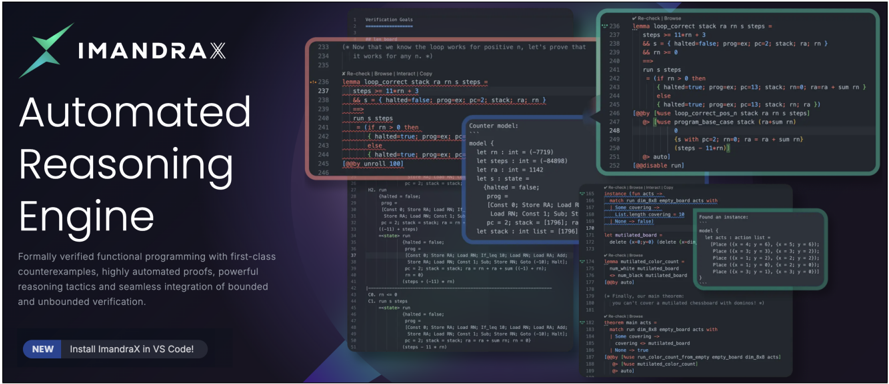
ImandraX (cf. Fig 2) is an automated reasoning engine for analyzing executable mathematical models of software systems. Its input language is the Imandra Modeling Language (IML), a pure functional subset of OCaml augmented with directives for specification and reasoning (e.g., verify , lemma and instance ) [14]. IML models are ordinary programs, but they are also formal models : ImandraX contains a mechanized formal semantics for IML, and thus IML code is both executable code and rigorous mathematical logic to which ImandraX applies automated reasoning.
Figure 2: The ImandraX automated reasoning engine and theorem prover. Interfaces are available for both humans (VS Code) and AI assistants (MCP and CLI), and may be installed from www.imandra.ai/core .
<details>
<summary>Image 2 Details</summary>
### Visual Description
## Screenshot: ImandraX Automated Reasoning Engine Promotion
### Overview
The image is a promotional screenshot for **ImandraX**, an automated reasoning engine. It features a dark-themed interface with technical text, code snippets, and a call-to-action button. The design emphasizes formal verification, automation, and integration with VS Code.
---
### Components/Axes
1. **Logo**:
- Top-left corner: "IMANDRAX" in white uppercase letters with a green geometric "X" icon.
2. **Main Text**:
- Left-aligned headline: "Automated Reasoning Engine" (large white font).
- Subtext: "Formally verified functional programming with first-class counterexamples, highly automated proofs, powerful reasoning tactics and seamless integration of bounded and unbounded verification." (smaller white font).
3. **Code Snippets**:
- Multiple overlapping code blocks with syntax highlighting:
- **Red-highlighted code**: Contains loops, conditionals (`if-then-else`), and variable declarations (e.g., `let s : int = 142`).
- **Blue-highlighted code**: Includes function definitions (e.g., `let rec loop_correct...`) and verification goals.
- **Green-highlighted code**: Shows verification steps (e.g., `let s = { halted=false; ... }`).
- Line numbers visible (e.g., 233–246, 248–252).
4. **Call-to-Action Button**:
- Bottom-left: Blue button with "NEW" in white, followed by "Install ImandraX in VS Code!" (white text on dark background).
---
### Detailed Analysis
- **Code Snippets**:
- The code appears to demonstrate formal verification of loops and functions, with annotations like `verification_goals` and `halted=false`.
- Variables (e.g., `rn`, `steps`, `pc`) and constructs (e.g., `let rec`, `let s = ...`) suggest functional programming with automated proof generation.
- **Color Coding**:
- Red: Keywords/control structures (e.g., `if`, `else`, `then`).
- Blue: Function definitions and verification logic.
- Green: Variable assignments and state declarations.
- **Layout**:
- Code snippets overlap diagonally, creating a layered effect to emphasize complexity.
- Text and code are left-aligned, with the button anchored to the bottom-left.
---
### Key Observations
1. **Promotional Focus**:
- The image prioritizes technical credibility over aesthetics, using code examples to showcase capabilities.
2. **Automation Emphasis**:
- Phrases like "highly automated proofs" and "first-class counterexamples" highlight the engine's efficiency.
3. **Integration**:
- The VS Code installation prompt underscores seamless developer workflow integration.
---
### Interpretation
The image positions ImandraX as a tool for developers requiring **formally verified code** with minimal manual proofwork. The overlapping code snippets suggest the engine handles complex verification tasks (e.g., loop correctness, state transitions) across bounded and unbounded contexts. The use of syntax highlighting in the code blocks implies the tool supports multiple programming paradigms, while the VS Code integration targets a broad audience of developers. The absence of numerical data or charts reinforces its focus on textual and logical reasoning rather than statistical analysis.
**Notable Outlier**: The "NEW" label on the button suggests a recent release or feature update, likely a key selling point.
</details>
CodeLogician relies on ImandraX as its primary reasoning backend 4 . In the autoformalization workflow (cf. Section 4), LLM-driven agents translate source code into executable IML models, make abstraction choices explicit, and introduce assumptions where required. ImandraX then performs the mathematical analysis of these models, enabling both proof-oriented verification and richer forms of behavioral understanding.
This section summarizes the two ImandraX capabilities most heavily used by CodeLogician : verification goals and state-space region decomposition. As in Section 4, we emphasize that LLMs are used to construct explicit formal mental models, while ImandraX is used to reason about them.
## 3.1 Formal Models in the Imandra Modeling Language (IML)
IML inherits the modeling discipline discussed in Section 4: models are pure (no side effects), statically typed functional programs in ImandraX 's fragment of OCaml, structured to support inductive reasoning modulo decision procedures. Imperative constructs such as loops are represented via recursion, and systems with mutable state are modeled as state machines in which the evolving state is carried explicitly through function inputs and outputs.
The question is therefore not whether a system can be modeled, but at what level of abstraction it should be modeled (Section 4). ImandraX provides analysis capabilities that remain meaningful across these abstraction levels, provided the model is executable and its assumptions are made explicit.
## 3.2 Verification Goals
Formal verification in ImandraX is performed via the statement and analysis of verification goals (VGs): boolean-valued IML functions that encode properties of the system being analyzed. VGs are (typically) implicitly universally quantified: when one proves a theorem in ImandraX , one establishes that a boolean-valued VG is true for all possible inputs. Unlike testing, which evaluates finitely many concrete executions, VGs quantify over (typically) infinite input spaces and yield either: (i) a proof that the property holds universally, or (ii) a counterexample witness demonstrating failure.
As programs and datatypes may involve recursion over structures of arbitrary depth, these proofs may involve induction. A unique feature of ImandraX is its seamless integration of bounded and unbounded verification. Every goal may be subjected to both bounded model checking and full inductive theorem proving. Bounded proofs are automatic based on ImandraX 's recursive function unrolling modulo decision procedures, and typically take place in a setting for which they are complete
4 https://www.imandra.ai/core
```
order1 = { order2 = { order3 = {
peg = NEAR; peg = NEAR; order_type = PEGGED_CI; qty = 8400;
order_type = PEGGED; order_type = PEGGED_CI; qty = 8400;
qty = 1800; qty = 8400; price = 10.0;
price = 10.5; price = 12.0; time = 236;
time = 237; time = 237; ...
... ... };
}; };
```
Figure 3: Counterexample for Order Ranking Transitivity
for counterexamples. ImandraX contains deep automation for constructing inductive proofs, including a lifting of the Boyer-Moore inductive waterfall to ImandraX 's typed, higher-order setting [14]. Moreover, ImandraX contains a rich tactic language for the interactive construction of proofs and counterexamples, and for more general system and state-space exploration.
For example, consider the transitivity of an order ranking function for a trading venue [16]. This may naturally be conjectured as a lemma, which may then be subjected to verification:
```
lemma rank_transitivity side order1 order2 order3 mkt =
order_higher_ranked(side,order1,order2,mkt) &&
order_higher_ranked(side,order2,order3,mkt)
==>
order_higher_ranked(side,order1,order3,mkt)
```
In practice, verification is iterative: counterexamples often reveal missing preconditions, modeling gaps, or specification errors. For example, in Fig. 3 we see a (truncated version of) an ImandraXsynthesized counterexample for rank transitivity of a real-world trading venue [16].
In ImandraX , all counterexamples are 'first-class' objects which may be reflected in the runtime and computed with directly via ImandraX 's eval directive. This unified computational environment for programs, conjectures, counterexamples and proofs is important for the analysis of real-world software. Verification goals should immediately be amenable to automated analysis, counterexamples for false goals should be synthesized efficiently, and these counterexamples should be available for direct execution through the system under analysis, enabling rapid triage and understanding for goal violations and false conjectures. This use of counterexamples aligns with the autoformalization perspective: constructing a good formal model is a refinement process in which assumptions and intended semantics are progressively made explicit, and counterexamples to conjectures can rapidly help one to fix faulty logic and recognize missing assumptions.
## 3.3 Region Decomposition
Many questions central to program understanding are not naturally expressed as binary VGs. To support richer semantic analysis, ImandraX provides region decomposition , which partitions a function's input space into finitely many symbolic regions corresponding to distinct behaviors.
Each region comprises:
- constraints over inputs that characterize when execution enters the region,
- an invariant result describing the output (or a symbolic characterization of it) for all inputs satisfying the constraints, and
- sample points witnessing satisfiable instances of the constraints.
Region decomposition provides a mathematically precise notion of 'edge cases' and directly supports the systematic test generation goals described in Section 4.
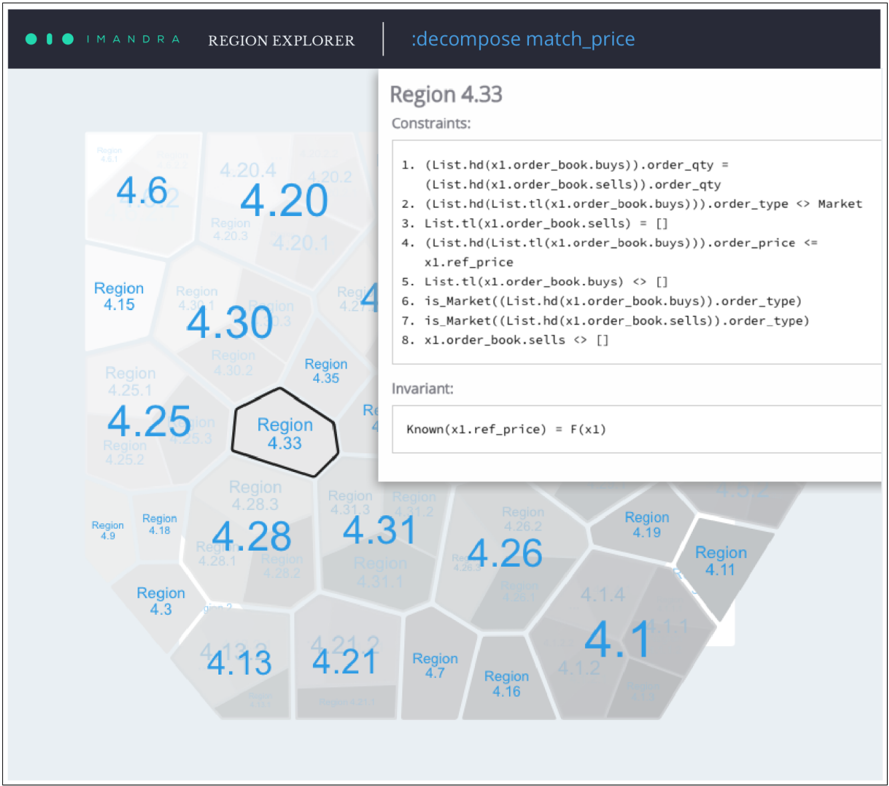
ImandraX decomposes function into regions corresponding to the distinct path conditions induced by their control flow, each with explicit constraints and invariant outputs. These decompositions may be performed relative to logical side-conditions and configurable abstraction boundaries called basis functions to tailor state-space exploration for a particular goal. In real software systems, small
Figure 4: A principal region decomposition of a trading venue pricing function
<details>
<summary>Image 3 Details</summary>
### Visual Description
## Screenshot: Region Explorer - Decompose Match Price
### Overview
The image displays a hexagonal map visualization titled "Region Explorer" with a focus on decomposing price matching logic. A highlighted region labeled "Region 4.33" is shown with a pop-up containing constraints and invariants related to order data. The map contains multiple regions with numerical labels (e.g., 4.6, 4.20, 4.35), suggesting a metric or score system.
### Components/Axes
- **Header**:
- Title: "REGION EXPLORER" (upper-left)
- Subtitle: "decompose match_price" (upper-right)
- **Main Map**:
- Hexagonal regions with numerical labels (e.g., 4.6, 4.20, 4.35)
- Highlighted region: "Region 4.33" (center)
- **Pop-up Panel**:
- **Constraints** (7 items):
1. `(List.hd(x1.order_book.buys)).order_qty = (List.hd(x1.order_book.sells)).order_qty`
2. `(List.hd(x1.order_book.buys)).order_type <> Market`
3. `(List.hd(x1.order_book.sells)) = []`
4. `(List.hd(x1.order_book.buys)).order_price <= x1.ref_price`
5. `(List.hd(x1.order_book.buys)) = []`
6. `is_Market((List.hd(x1.order_book.buys)).order_type)`
7. `is_Market((List.hd(x1.order_book.sells)).order_type)`
- **Invariant** (1 item):
`Known(x1.ref_price) = F(x1)`
- **Legend**: Not explicitly visible in the image.
### Detailed Analysis
- **Map Values**:
- Region 4.33 (highlighted): 4.33
- Neighboring regions: 4.35 (north), 4.28.3 (southwest), 4.25 (northwest), 4.26 (east), 4.19 (southeast)
- Other regions: 4.6 (top-left), 4.20 (top-center), 4.13 (bottom-left), 4.1 (bottom-center)
- **Pop-up Content**:
- Constraints define order matching rules (e.g., quantity equality, non-market orders, price limits).
- Invariant enforces a functional relationship between reference price and `x1`.
### Key Observations
1. **Regional Metrics**: The highlighted region (4.33) has a lower value than its northern neighbor (4.35) but higher than its southeastern neighbor (4.19).
2. **Order Constraints**: The constraints suggest a focus on validating order book parity (buy/sell quantities) and filtering market orders.
3. **Invariant Logic**: The equation `Known(x1.ref_price) = F(x1)` implies a deterministic relationship between reference price and an unknown function `F(x1)`.
### Interpretation
The visualization appears to analyze regional order book dynamics, with the highlighted region (4.33) serving as a case study for price matching logic. The constraints and invariant likely represent rules for ensuring valid order matches (e.g., equal quantities, non-market orders, price caps). The lower metric value in region 4.33 compared to its neighbors might indicate fewer valid order matches or stricter constraints in that region. The system seems to use these rules to decompose pricing strategies, possibly for arbitrage or market-making purposes. The absence of a legend suggests the numerical labels directly represent the metric of interest (e.g., match quality score).
</details>
boundary differences (e.g., a flipped inequality) often lead to qualitatively different outcomes; region decomposition isolates these differences and makes the boundaries of logically invariant behavior explicit and auditable.
## 3.4 Focusing Decomposition: Side Conditions and Basis
Autoformalization often produces models whose full state spaces are too large-or simply too broadfor a given analysis objective. ImandraX provides two complementary mechanisms to focus decomposition, mirroring the abstraction discipline in Section 4.
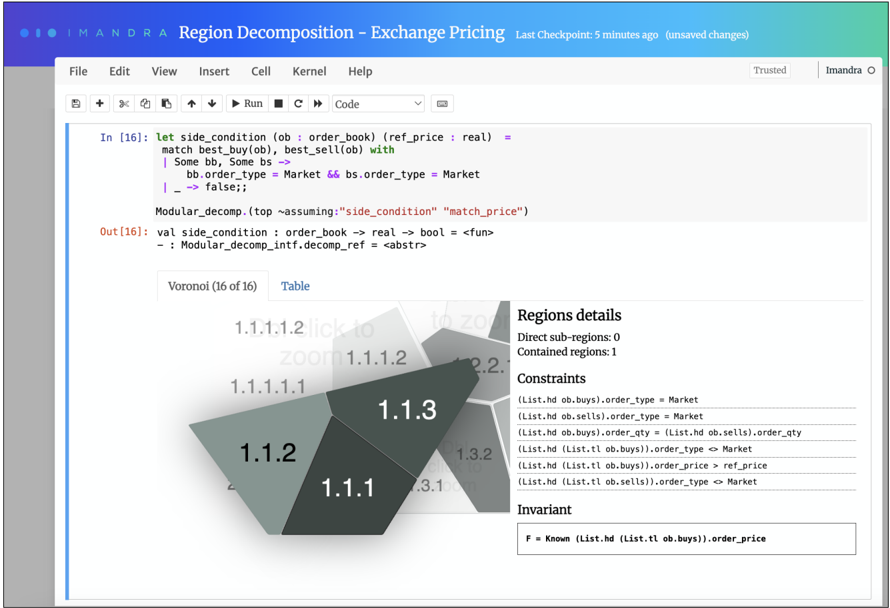
Side conditions. A side condition is a boolean predicate with the same signature as the decomposed function. When supplied, ImandraX explores only regions for which the side condition holds. This is useful for restricting analysis to scenarios of operational or regulatory interest. Figure 5 illustrates a region decomposition query augmented with a side-condition.
Basis functions. A basis specifies functions to be treated as atomic during decomposition. ImandraX will not explore their internal branching structure, reducing the number of regions and improving interpretability. Basis selection provides a principled way to 'abstract away' auxiliary computations while retaining their influence on the surrounding model.
Figure 5: A refined decomposition of the venue pricing function with a side-condition
<details>
<summary>Image 4 Details</summary>
### Visual Description
## Screenshot: Region Decomposition - Exchange Pricing
### Overview
The image shows a code editor interface with a region decomposition diagram and associated code for exchange pricing logic. The interface includes a Voronoi diagram with labeled regions, code snippets, and textual constraints/invariants. The title bar indicates unsaved changes from 5 minutes ago.
### Components/Axes
1. **Code Editor Interface**:
- Menu bar: File, Edit, View, Insert, Cell, Kernel, Help
- Status bar: "Trusted" indicator, user "Imandra", and "Code" dropdown
- Code syntax highlighting: Purple (keywords), green (strings), red (comments), black (variables)
2. **Voronoi Diagram**:
- Labeled regions: 1.1.1, 1.1.2, 1.1.3, 1.2.1, 1.3.1, 1.3.2
- Color gradient: Dark gray (1.1.1) → Light gray (1.3.2)
- Overlay text: "Regions details", "Constraints", "Invariant"
3. **Textual Elements**:
- Code section: Function `Modular_decomp` with parameters `side_condition`, `order_book`, `ref_price`
- Constraints list: 6 bullet points with logical conditions
- Invariant: `F = Known (List.hd (List.tl ob.buys)).order_price`
### Detailed Analysis
**Code Section**:
```python
In [16]: let side_condition (ob : order_book) (ref_price : real) =
match best_buy(ob), best_sell(ob) with
| Some bb, Some bs ->
bb.order_type = Market && bs.order_type = Market
| _ -> false;
Modular_decomp.(top (assuming:"side_condition" "match_price"))
Out[16]: val side_condition : order_book -> real -> bool =
fun ob ref_price ->
match best_buy(ob) with
| Some bb -> match best_sell(ob) with
| Some bs -> bb.order_type = Market && bs.order_type = Market
| _ -> false
| _ -> false
- : Modular_decomp_intf.decomp_ref = <abstr>
```
**Voronoi Diagram**:
- Region hierarchy:
- Parent: 1.1
- Children: 1.1.1, 1.1.2, 1.1.3
- Parent: 1.2
- Children: 1.2.1
- Parent: 1.3
- Children: 1.3.1, 1.3.2
**Constraints**:
1. `(List.hd ob.buys).order_type = Market`
2. `(List.hd ob.sells).order_type = Market`
3. `(List.hd ob.buys).order_qty = (List.hd ob.sells).order_qty`
4. `(List.hd (List.tl ob.buys)).order_type <> Market`
5. `(List.hd (List.tl ob.buys)).order_price > ref_price`
6. `(List.hd (List.tl ob.sells)).order_type <> Market`
**Invariant**:
`F = Known (List.hd (List.tl ob.buys)).order_price`
### Key Observations
1. The Voronoi regions show a hierarchical structure with three main branches (1.1, 1.2, 1.3)
2. Constraints enforce market order types and price relationships
3. The invariant specifies a known price condition for the second buy order
4. Code implements region decomposition logic with pattern matching
### Interpretation
This appears to be a formal verification system for exchange pricing algorithms. The Voronoi diagram likely represents different market states or order book configurations. The constraints ensure:
- Market orders dominate the top of order books
- Price relationships between buy/sell orders are maintained
- Non-market orders appear only after the first level
The invariant suggests the system tracks the price of the second buy order as a known quantity. The code implements this logic through recursive pattern matching on order book structures. The unsaved changes indicate ongoing development or refinement of the pricing model.
</details>
Together, side-conditions and basis functions provide a rich query language for targeting the analysis of system state spaces towards particular classes of behaviors [11, 12].
## 3.5 Test Generation from Regions
Each region produced by decomposition includes sample points satisfying its constraints. These witnesses can be extracted to generate tests that correspond directly to semantic distinctions in program behavior, rather than to ad hoc input distributions. In CodeLogician , this capability underpins automated test generation: agents use regions to produce tests that cover all behavioral cases discovered by decomposition, consistent with the 'exhaustive coverage' objective motivating autoformalization.
## 3.6 Summary
ImandraX provides the formal reasoning substrate for CodeLogician . Verification goals support prooforiented analysis, while region decomposition exposes the structure of program state spaces, makes decision boundaries explicit, and enables systematic test-case generation. Together with the autoformalization process (Section 4), these capabilities allow LLM-driven agents to construct formal mental models of software and to answer rich semantic questions beyond binary verification outcomes.
## 4 Autoformalization of source code
Autoformalization is the process of translating executable source code into precise, mathematical models suitable for automated reasoning. While this translation is partially automated by CodeLogician, it relies on a particular way of thinking about software-one that emphasizes explicit state, clear abstraction boundaries, and well-defined assumptions. Just as developers strive to write clear code , effective automated reasoning depends on writing or synthesizing clear formal models .
## 4.1 Pure Functional Modeling
All formal models produced by CodeLogician are expressed in the Imandra Modeling Language (IML), a pure functional subset of OCaml. Purity here means the absence of side effects: functions cannot mutate global state or influence values outside their scope. Instead, all state changes must be made explicit via function arguments and return values.
This restriction is not a fundamental limitation. Programs with side effects can be systematically transformed into state-machine models in which the evolving program state is explicitly carried through computations. Such techniques are well established in the literature and trace back to foundational work by Boyer and Moore [4, 3]. For example, this (infinite) state-machine model approach underlies successful formal verification of highly complex industrial systems, including large-scale financial market infrastructure [16, 15], complex hardware models [17], robotic controllers integrating deep neural networks [6], and high-frequency communication protocols [10].
## 4.2 Key Modeling Constructs
Several structural features of IML are particularly important for automated reasoning:
Static Types IML is a statically typed functional language. All variable types are determined before execution and cannot change dynamically. This eliminates entire classes of ambiguity present in dynamically typed languages. During autoformalization, CodeLogician extracts type information from source programs-using static annotations where available and inference otherwise-and enforces type consistency in the generated models. Type errors detected by ImandraX often correspond directly to logical inconsistencies in the original program.
Recursion and Induction Loops in imperative source code are rewritten as recursive functions. Both for and while constructs are mapped to structurally recursive definitions. This transformation is essential because reasoning about unbounded iteration requires inductive reasoning, which is naturally expressed over recursive functions.
State Machines Many real-world programs are best modeled as state machines. These machines are typically infinite-state, as the state may include complex data structures such as lists, maps, or trees in addition to numeric values. State-machine modeling is particularly effective for representing code with side effects and for capturing the behavior of complex reactive systems, such as trading platforms or protocol handlers.
## 4.3 Abstraction Levels
A central question in autoformalization is not merely whether a program can be modeled, but at what level of abstraction it should be modeled . The appropriate abstraction depends on the properties one wishes to analyze.
We distinguish three broad abstraction levels:
High-Level Models High-level models typically arise from domain-specific languages (DSLs) designed to describe complex systems concisely. In such cases, direct use of CodeLogician is often unnecessary. Instead, the DSL itself is translated into IML. For example, the Imandra Protocol Language (IPL) provides a compact notation for symbolic state-transition systems and compiles into IML with significant structural expansion. Reasoning at this level focuses on system-wide invariants and high-level behavioral properties.
Mid-Level Models Application-level software represents the primary target for CodeLogician. At this level, source programs can be translated directly into IML without introducing an intermediate DSL. This category includes most business logic, data-processing pipelines, and control-heavy application code.
Low-Level Models Low-level code, such as instruction sequences or hardware-near implementations, can also be modeled in ImandraX, but doing so requires an explicit formalization of the execution environment (e.g., memory model, virtual machine, or instruction semantics). Such models are outside the intended scope of CodeLogician, which assumes access to semantic abstractions of the underlying execution platform.
## 4.4 Dealing with Unknowns
Real-world programs inevitably rely on external libraries, services, or system calls. Autoformalization therefore requires explicit handling of unknown or partially specified behavior. CodeLogician adopts techniques analogous to mocking in software testing, but within a formal reasoning framework.
## 4.4.1 Opaque Functions
IML supports opaque functions , which declare a function's type without specifying its implementation. Opaque functions allow models to type-check and support reasoning without making any assumptions about the function's internal behavior.
For example, calls to external libraries such as pseudo-random number generators are introduced as opaque functions during autoformalization. Reasoning about code that depends on such functions remains sound, but necessarily conservative.
## 4.4.2 Axioms and Assumptions
To refine reasoning about opaque functions, users (or agents) may introduce axioms that constrain their behavior. These axioms encode assumptions about external components, such as value ranges or monotonicity properties. Introducing axioms narrows the set of possible behaviors considered during reasoning and can significantly strengthen the conclusions that can be drawn.
Importantly, axioms are explicit and local: reasoning results are valid only under the stated assumptions, making the modeling process auditable and transparent.
## 4.4.3 Approximation Functions
In many cases, opaque functions can be replaced with sound approximations. For common mathematical functions, CodeLogician provides libraries of approximation functions, such as bounded Taylorseries expansions for trigonometric operations. These approximations allow models to remain executable and enable test generation, while still supporting rigorous reasoning within known bounds.
## 4.5 Summary
Autoformalization is not merely a syntactic translation process. It is a disciplined approach to modeling software behavior in which state, control flow, assumptions, and abstraction boundaries are made explicit. By combining LLM-driven translation with principled formal modeling techniques, CodeLogician enables automated reasoning engines to answer deep semantic questions about software behavior that are inaccessible to LLMs alone.
## 5 CodeLogician IML Agent
CodeLogician is a neuro-symbolic agent framework designed to enable Large Language Models (LLMs) to reason rigorously about software systems. Rather than asking LLMs to reason directly about source code, CodeLogician teaches LLM-driven agents to construct explicit formal models in mathematical logic and to delegate semantic reasoning to automated reasoning engines.
The current implementation integrates the ImandraX automated reasoning engine together with static analysis tools and auxiliary knowledge sources within an agentic architecture built on LangGraph. CodeLogician exposes both low-level programmatic commands and high-level agentic workflows, allowing users and external agents to flexibly combine automated reasoning with guided interaction. When required information is missing or inconsistencies are detected, the agent can request human
feedback, enabling mixed-initiative refinement. The framework can also be embedded into external agent systems via a remote graph API.
## 5.1 From Source Code to Formal Models
At the core of CodeLogician lies the process of autoformalization (Section 4). Given a source program written in a conventional programming language (e.g., Python), the agent incrementally constructs an executable formal model in the Imandra Modeling Language (IML).
Autoformalization is not a single translation step, but a structured refinement process that involves:
- extracting structural, control-flow, and type information from the source program,
- refactoring imperative constructs into pure functional representations,
- making implicit assumptions explicit (e.g., about external libraries or partial functions),
- synthesizing an IML model that is admissible to the reasoning engine.
The resulting model is functionally equivalent to the source program at the chosen level of abstraction and suitable for mathematical analysis by ImandraX.
## 5.2 Verification Goals and Logical Properties
Once a formal model has been constructed, CodeLogician assists in formulating verification goals (VGs). A verification goal is a boolean-valued predicate over the model that expresses a property expected to hold for all possible inputs. Unlike traditional testing, verification goals quantify symbolically over infinite input spaces and admit mathematical proof or counterexample.
For example, consider a ranking function used in a financial trading system. A fundamental correctness requirement is transitivity: if one order ranks above a second, and the second ranks above a third, then the first must rank above the third. Such properties are expressed directly as verification goals in IML and discharged by ImandraX.
When a verification goal does not hold, ImandraX produces a counterexample witness. These counterexamples are concrete executions that violate the property and often expose subtle logical flaws that are difficult to detect through testing or informal inspection. In industrial case studies, this approach has uncovered violations of core invariants in production systems that would otherwise remain hidden.
## 5.3 Beyond Yes/No Verification
While the proof or refutation of a verification goal determines whether or not a property is true , many forms of program understanding require richer, non-binary kinds of semantic information. CodeLogician therefore relies not only on formal verification, but also on exhaustive behavioral analysis techniques provided by ImandraX.
In particular, CodeLogician uses state-space exploration to identify decision boundaries, semantic edge cases, and invariant behaviors. These capabilities enable explanations, documentation, and test generation that go far beyond yes/no verification and are central to CodeLogician's value proposition.
## 5.4 Agent Architecture and State
CodeLogician is implemented as a stateful agent whose execution is organized around an explicit agent state . This state captures all artifacts relevant to the reasoning process and evolves as the agent performs analysis and refinement.
The agent state includes:
- the original source program,
- extracted formalization metadata (types, control flow, assumptions),
- the generated IML model,
- the model's admission and executability status,
- verification goals, decomposition requests, and related artifacts.
Agent operations fall into three broad categories:
- State transformations , which update the agent state explicitly (e.g., modifying the source program or model);
- Agentic workflows , which orchestrate multi-step processes such as end-to-end autoformalization and analysis;
- Low-level commands , which perform individual actions such as model admission, verification, or decomposition.
This separation allows users and external agents to mix automated and guided reasoning as appropriate.
## 5.5 Model Refinement and Executability
Autoformalization proceeds as an iterative refinement process. The immediate objective is to produce a model that is admissible to ImandraX, meaning that it is well-typed and free of missing definitions. A further objective is to make the model executable , eliminating opaque functions either by implementation or by sound approximation.
These two stages correspond to:
- Admitted models , which can be verified but may contain unresolved abstractions;
- Executable models , which support full behavioral analysis and test generation.
This refinement process mirrors established practices in model-based software engineering and digital twinning. By working with an executable mathematical model, CodeLogician enables rigorous reasoning about systems whose direct analysis in the source language would be impractical.
## 5.6 Assessing Model Correctness
A natural question arises when constructing formal models: how do we know the model is correct? CodeLogician adopts a notion of correctness based on functional equivalence at the chosen abstraction level. Two programs are considered equivalent if they produce the same observable outputs for the same inputs within the modeled domain.
Exhaustive behavioral analysis plays a central role in this assessment. By enumerating all distinct behavioral regions of the model, CodeLogician provides a structured and auditable view of program behavior. This makes mismatches between intended and modeled semantics explicit and actionable.
## 5.7 Region decomposition, test case generation, and refinement
The final stage is where Imandra shows its power. We perform region decomposition on the IML code to obtain a finite number of symbolically described regions such that (a) the union of all regions covers the entire state-space, and (b) in each region, the behavior of the system is invariant.
Consider the following IML code that models order discount logic:
```
type priority = Standard | Premium
type order = { amount: int; customer: priority }
let discount = fun o ->
match o.customer with
| Premium -> if o.amount > 100 then 20 else 10
| Standard -> if o.amount > 100 then 10 else 0
```
Region decomposition partitions the input space into four distinct regions based on customer type and order amount. For each region, ImandraX provides concrete witness values that satisfy the region's constraints. To bridge the gap between these symbolic results and executable test cases, we developed imandrax-codegen , an open-source code generation tool. Given the decomposition artifacts, the tool automatically generates code including type definitions and test cases. We use Python as the target language in this example; support for additional languages is planned:
```
@dataclass
class order:
amount: int
customer: priority
@dataclass
class Standard:
pass
@dataclass
class Premium:
pass
priority = Standard | Premium
def test_1():
"""test_1
- invariant: 0
- constraints:
- not (o.customer = Premium)
- o.amount <= 100
"""
result: int = discount(o=order(0, Standard()))
expected: int = 0
assert result == expected
def test_2():
"""test_2
- invariant: 10
- constraints:
- not (o.customer = Premium)
- o.amount >= 101
"""
result: int = discount(o=order(101, Standard()))
expected: int = 10
assert result == expected
# ... test_3, test_4 are omitted for brevity
```
This workflow ensures that we have test cases that cover all possible behavioral regions of the system-in this example, all four combinations of customer priority and order amount threshold.
The entire pipeline is configurable, allowing for a balance between automation and human intervention. For example, the user can choose to double-check refactored code in intermediate steps, provide additional human feedback on error messages or let the agent handle it by itself, etc. And as mentioned in the previous section, FDB provides critical RAG support in all stages of the pipeline.
## 5.8 Interfaces
CodeLogician exposes both input and output interfaces designed to be simultaneously user-friendly and programmatically accessible. The interfaces follow a simple input schema paired with a rich, structured output format, enabling use in interactive development environments as well as integration into larger agent-based systems.
The input interface accepts source programs (currently Python) as textual input, together with optional configuration parameters that control the autoformalization and reasoning process. This minimal input design allows CodeLogician to be invoked uniformly from command-line tools, IDEs, or external agents.
The output interface is structured using Pydantic models, providing strong validation, typing, and serialization guarantees. The output schema captures detailed artifacts produced during each reasoning
attempt, including:
- generated IML models,
- compilation and admission results,
- verification outcomes and counterexamples,
- region decomposition results and associated metadata.
This structured representation makes CodeLogician suitable both for standalone use and as a component within larger neuro-symbolic pipelines.
CodeLogician also exposes configuration parameters that control the degree of automation and human intervention. Parameters such as confirm\_refactor , decomp , max\_attempts , and max\_attempts\_wo\_human\_feedback allow users to trade off full automation against mixed-initiative interaction, depending on the complexity and criticality of the target code.
## 5.8.1 Programmatic Access via python RemoteGraph
CodeLogician can be directly integrated with other LangGraph agents using the RemoteGraph interface. By specifying the agent's URI within Imandra Universe and supplying an API key, external agents can invoke CodeLogician as a remote reasoning component. This enables composition with other agentic workflows, including multi-agent systems and tool-augmented LLM pipelines. In addition to programmatic access, CodeLogician is also available through a web-based chat interface in Imandra Universe.
## 5.8.2 VS Code Extension
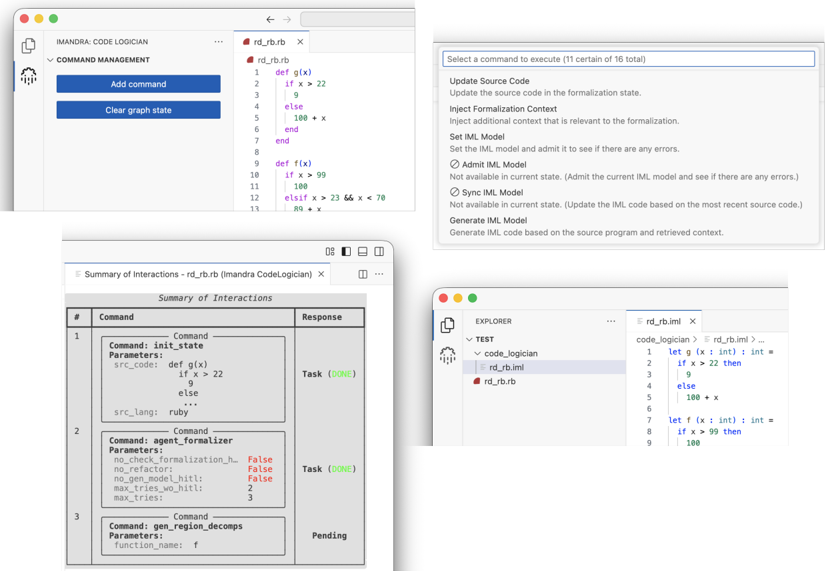
CodeLogician is distributed with a free Visual Studio Code (VS Code) extension [8], providing a lightweight and accessible interface for interactive use. The extension communicates with the CodeLogician agent via the RemoteGraph interface and exposes core commands through the VS Code command palette.
The extension is built around a command-queue abstraction that allows users to sequence multiple operations-such as autoformalization, verification, and decomposition-before execution. It supports simultaneous formalization of multiple source files and provides visibility into the agent's internal state, including generated models and reasoning artifacts.
Figure 6 illustrates the VS Code extension's command management system, state viewer, and an example IML model produced by CodeLogician.
## 5.9 Summary
The CodeLogician IML agent operationalizes the neuro-symbolic approach advocated in this paper. LLMs are used to construct formal mental models of software systems, while automated reasoning engines provide mathematically precise analysis. By combining autoformalization, verification goals, and exhaustive behavioral analysis within an agentic framework, CodeLogician enables rigorous reasoning about real-world software systems beyond the capabilities of LLM-only approaches.
## 6 CodeLogician Server
The CodeLogician server provides a persistent backend for project-wide formalization and analysis. It manages formalization tasks, maintains analysis state across sessions, and serves multiple client interfaces (TUI and CLI). Unlike one-shot invocation modes, the server is designed for continuous and incremental operation: it caches results, reacts to code changes, and recomputes only the minimal set of affected artifacts required to keep formal models consistent with the underlying code base.
Figure 6: CodeLogician VS Code extension, showing command management, agent state visualization, and a generated IML model.
<details>
<summary>Image 5 Details</summary>
### Visual Description
## Screenshot: Code Logician Interface
### Overview
The image shows a technical interface for a code logician tool, featuring multiple panels with code snippets, command management, and interaction summaries. The interface uses syntax highlighting (red, blue, purple) and includes buttons, tables, and code execution options. The layout is divided into four distinct panels with technical annotations.
### Components/Axes
1. **Top-Left Panel**:
- Title: "IMANDRA: CODE LOGICIAN"
- Section: "COMMAND MANAGEMENT"
- Buttons: "Add command" (blue), "Clear graph state" (blue)
- Code snippet with line numbers (1-13) and syntax highlighting:
```python
def g(x):
if x > 22:
return 9
else:
return 100 + x
def f(x):
if x > 99:
return 100
else:
return 89 + x
```
2. **Bottom-Left Panel**:
- Table titled "Summary of Interactions - rd_rb.rb (Imandra CodeLogician)"
- Columns: `#`, `Command`, `Parameters`, `Response`
- Rows:
- Row 1: `Command: init_state`, `Parameters: src_code: def g(x)...`, `Response: Task (DONE)`
- Row 2: `Command: agent_formalizer`, `Parameters: no_check_formalization_h: False`, `Response: Task (DONE)`
- Row 3: `Command: gen_region_decomps`, `Parameters: function_name: f`, `Response: Pending`
3. **Top-Right Panel**:
- Dropdown titled "Select a command to execute (11 certain of 16 total)"
- Options:
- Update Source Code
- Inject Formalization Context
- Set IML Model
- Admit IML Model
- Sync IML Model
- Generate IML Model
4. **Bottom-Right Panel**:
- Code snippet with syntax highlighting:
```python
let g (x : int) : int =
if x > 22 then
9
else
100 + x
let f (x : int) : int =
if x > 99 then
100
else
89 + x
```
### Detailed Analysis
- **Code Snippets**: Functions `g(x)` and `f(x)` are defined with conditional logic. `g(x)` returns 9 if `x > 22`, else `100 + x`. `f(x)` returns 100 if `x > 99`, else `89 + x`.
- **Command Table**: Tracks interactions with commands like `init_state` (initializes state with `g(x)`), `agent_formalizer` (formalization parameters), and `gen_region_decomps` (region decomposition for function `f`).
- **Explorer Panel**: Provides code execution options, including formalization context injection and IML model generation.
### Key Observations
- The interface integrates code analysis with formal verification (IML model generation).
- The "Pending" status for `gen_region_decomps` suggests incomplete processing.
- Color coding (red for keywords, blue for function names, purple for operators) follows standard syntax highlighting conventions.
### Interpretation
This tool appears designed for developers to analyze and formalize code logic, particularly for verification or debugging purposes. The structured panels suggest a workflow where code is first defined (`g(x)`, `f(x)`), then commands are executed to analyze interactions (`init_state`, `agent_formalizer`), and finally formal models are generated. The "Pending" status indicates asynchronous processing, while the Explorer panel's options imply iterative refinement of code and models. The integration of IML (Intermediate Language Model) suggests support for formal methods, enabling developers to verify code correctness against specified properties.
</details>
## 6.1 Server Responsibilities
At a high level, the server is responsible for:
- Persistent analysis state : storing formalization artifacts and their status across sessions;
- Project management : tracking multiple repositories, configurations, and formalization strategies;
- Incremental updates : monitoring file and dependency changes and triggering minimal reformalization;
- Caching : avoiding redundant computation by reusing results for unchanged modules;
- Interface multiplexing : serving requests from interactive and programmatic clients via a shared backend.
These responsibilities enable a workflow in which developers and agents can repeatedly query and refine formal models while the server maintains a coherent, up-to-date view of the formalized state of the project.
## 6.2 Strategies: Project-Wide Formalization via PyIML
The server executes strategies , configureable pipelines that formalize a code base and manage dependencies between its components. For Python projects, CodeLogician provides the PyIML strategy , which translates Python source code into IML models suitable for reasoning in ImandraX .
Given a project directory, the PyIML strategy:
1. Analyzes Python modules and infers their dependency structure from imports;
2. Translates source constructs (functions, classes, types) into corresponding IML artifacts;
3. Manages formalization across the codebase in dependency-consistent order;
4. Maintains a project metamodel capturing modules, dependencies, and formalization status.
The strategy also handles opaque functions (Section 4) by preserving type information while abstracting implementation details when direct translation is not possible. This allows the system to admit models and begin formal reasoning even in the presence of external libraries or currently-unknown semantics, while making the loss of executability explicit.
## 6.3 Metamodel-Based Formalization
Formalizing large software systems requires reasoning not only about individual source files, but also about their interdependencies. To support scalable project-wide analysis, the CodeLogician server maintains an explicit metamodel that captures the structure, dependencies, and formalization status of a collection of models corresponding to a repository.
## 6.4 Core Definitions
Model A model represents the formalization state of a single source file or module. Each model contains:
- src code : the source code of the corresponding file or module;
- formalization status : the current level of formalization achieved;
- dependencies : references to other models on which this model depends;
- dependency context : an aggregated formal representation (in IML) of available dependencies, used during formalization.
Metamodel A metamodel is a container for all models associated with a given project directory (repository). It provides operations for model insertion, deletion, update, and dependency management, and serves as the authoritative representation of the project's formalization state.
Interdependence By interdependence, we mean that models import symbols (e.g., functions, classes, constants) from other project files or third-party libraries. By default, a model can be formalized even when referenced symbols lack formal implementations; however, such symbols must be treated as opaque , which limits the strength of reasoning that can be performed.
Autoformalization Autoformalization is the process by which the CodeLogician agent translates source code, together with its dependency context, into an IML model and submits it to the reasoning engine. This process may produce artifacts such as verification goals, counterexamples, and test cases.
## 6.5 Formalization Levels
Each model is assigned a formalization level reflecting how much semantic information is available:
- Unknown : no formalization has been performed;
- Error during validation : admission failed due to issues such as inconsistent types, missing symbols, or non-termination;
- Admitted with opaqueness : the model has been admitted but contains opaque symbols;
- Admitted transparent : the model has been admitted and contains no opaque elements.
The dependency context is computed by aggregating all available IML models of dependencies and injecting this context alongside the model's own source code during formalization.
Objective. The objective of the server is to maximize the number of models that are formalized, and to achieve the highest possible level of formalization for each model, while ensuring that the most up-to-date source code, dependency context, and human input are reflected.
## 6.6 Conditions Triggering Re-Formalization
A model requires re-formalization when:
- its underlying source code has changed or has never been formalized; or
- the source code or formalization status of one or more dependencies (direct or indirect) has changed.
## 6.7 Autoformalization Workflow
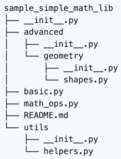
Initial state. Figure 7 shows an example repository with a hierarchical structure in which modules import symbols from one another.
Figure 7: Example project structure.
<details>
<summary>Image 6 Details</summary>
### Visual Description
## Directory Structure: sample_simple_math_lib
### Overview
The image depicts a hierarchical directory structure for a Python project named `sample_simple_math_lib`. The structure includes source code files, configuration files, and documentation, organized into logical modules.
### Components/Axes
- **Root Directory**: `sample_simple_math_lib`
- **Key Directories/Files**:
- `__init__.py` (root level)
- `advanced/` (subdirectory)
- `__init__.py` (subdirectory level)
- `geometry` (file or subdirectory? Unclear from image)
- `shapes.py`
- `basic.py`
- `math_ops.py`
- `README.md`
- `utils/` (subdirectory)
- `__init__.py` (subdirectory level)
- `helpers.py`
### Detailed Analysis
1. **Root Level Files**:
- `__init__.py`: Standard Python module initializer.
- `basic.py`: Likely contains foundational mathematical functions.
- `math_ops.py`: Possibly implements mathematical operations.
- `README.md`: Markdown file for project documentation.
- `utils/`: Utility functions or helper modules.
2. **Advanced Module**:
- `advanced/`: Subdirectory for advanced mathematical functionality.
- `__init__.py`: Initializes the advanced module.
- `geometry`: Could be a subdirectory or file (ambiguous in image).
- `shapes.py`: Likely defines geometric shape-related logic.
3. **Utils Module**:
- `utils/`: Contains reusable helper functions.
- `__init__.py`: Initializes the utils module.
- `helpers.py`: Implements auxiliary functions.
### Key Observations
- **Modular Design**: The project separates basic and advanced functionality, suggesting scalability.
- **Ambiguity**: The `geometry` entry under `advanced/` lacks clarity (file vs. subdirectory).
- **Documentation**: Presence of `README.md` indicates emphasis on project transparency.
- **Helper Functions**: `utils/helpers.py` suggests reusable code for cross-module use.
### Interpretation
The directory structure reflects a modular Python project designed for mathematical operations. The separation of `basic` and `advanced` modules implies a layered approach to complexity, with utilities centralized for shared functionality. The ambiguous `geometry` entry could indicate either a subdirectory (for geometric algorithms) or a standalone file (e.g., a data structure definition). The inclusion of `README.md` and `__init__.py` files aligns with Python best practices for maintainability and discoverability. The structure prioritizes clarity, though the lack of explicit version control or testing directories (e.g., `tests/`) might suggest an early-stage project.
</details>
The dependency graph inferred from imports is shown in Figure 8. An edge from a source node to a target node indicates that the source imports symbols from the target.
Figure 8: Dependency graph inferred from imports.
<details>
<summary>Image 7 Details</summary>

### Visual Description
## Python Module Dependency Diagram: Module Relationships
### Overview
The diagram illustrates the hierarchical and interdependent structure of Python modules within a project. It shows how modules import and rely on one another, with directional arrows indicating dependency flows. The central module "utils.helpers" acts as a hub connecting multiple sub-modules.
### Components/Axes
- **Nodes**: Represent Python modules with labels containing:
- `name`: Module identifier (e.g., `utils.helpers`)
- `path`: File path relative to the module (e.g., `utils/helpers.py`)
- **Edges**: Arrows showing import/dependency relationships between modules.
### Detailed Analysis
1. **Root Modules**:
- `PythonModule(name='__init__', path='__init__.py')`
- `PythonModule(name='advanced.__init__', path='advanced/__init__.py')`
- `PythonModule(name='utils.__init__', path='utils/__init__.py')`
- `PythonModule(name='advanced.geometry.shapes', path='advanced/geometry/shapes.py')`
- `PythonModule(name='advanced.geometry.__init__', path='advanced/geometry/__init__.py')`
2. **Utility Modules**:
- `PythonModule(name='utils.helpers', path='utils/helpers.py')`
- Depends on: `math_ops` and `basic`
- `PythonModule(name='math_ops', path='math_ops.py')`
- `PythonModule(name='basic', path='basic.py')`
3. **Geometry Subsystem**:
- `advanced.geometry.shapes` → `basic`
- `advanced.geometry.__init__` → `basic`
### Key Observations
- **Central Hub**: `utils.helpers` is the most connected module, importing both `math_ops` and `basic`.
- **Geometry Dependency**: Both `advanced.geometry.shapes` and `advanced.geometry.__init__` depend on `basic`, suggesting `basic` provides foundational functionality.
- **Circular Dependency Risk**: `basic` is imported by multiple modules but has no outgoing dependencies, potentially creating a one-way flow.
- **Naming Convention**: Double underscores (`__init__`) indicate standard Python initialization modules.
### Interpretation
This diagram reveals a modular architecture where:
1. **Utility Layer**: `utils.helpers` serves as a service layer, aggregating functionality from `math_ops` and `basic`.
2. **Geometry Subsystem**: The `advanced.geometry` package relies entirely on `basic`, implying `basic` contains core geometric operations or data structures.
3. **Initialization Structure**: The presence of `__init__.py` files in multiple directories confirms these are Python packages, enabling namespace management and relative imports.
The absence of feedback loops suggests a linear dependency flow, which simplifies maintenance but may limit flexibility. The `basic` module's central role indicates it should be prioritized for stability and testing.
</details>
## CodeLogician(SourceCode, DependencyContext) : Model.
Figure 9: Topological formalization order.
Autoformalization proceeds bottom-up along a topological ordering of the dependency graph (Figure 9).
Suppose we wish to reason about functions in utils/helpers.py . To do so, CodeLogician formalizes that module and all of its dependencies in dependency order (Figure 10).
```
1. CodeLogician(basic.py, []) = Model(basic.py)
2. CodeLogician(math_ops.py, [Model(basic.py)]) = Model(math_ops.py)
3. CodeLogician(utils/helpers.py, [Model(basic.py), Model(math_ops.py)]) = Model(utils/helpers.py)
```
Figure 10: Formalization sequence for a target module.
After completion, formalized models appear highlighted, while unformalized modules remain unchanged (Figures 11.
## 6.8 Minimal Re-Formalization Strategy
When source code changes, the server computes precise diffs to identify the minimal set of models that require re-formalization, ensuring consistency while avoiding unnecessary recomputation.
Case 1: Source modified, dependencies unchanged. If math ops.py is modified without altering dependency relations (Figure 12), the modified module is marked as source modified , and only downstream formalized dependencies are updated.
- Case 2: New dependency added. If a new module is introduced (Figure 13), formalization proceeds in dependency order to restore consistency.
- Case 3: Dependencies merged. When multiple modules are merged, the server recomputes formalization only for affected nodes (Figure 14).
- Case 4: Upstream dependency removed. If a dependency is removed from an unformalized module, no re-formalization is required for already formalized nodes (Figure 15).
## 6.9 Summary and Error Resilience
In response to file updates, CodeLogician :
1. updates the dependency graph;
2. computes the minimal set of required re-formalization tasks;
3. avoids unnecessary re-formalization by targeting only affected models.
<details>
<summary>Image 8 Details</summary>
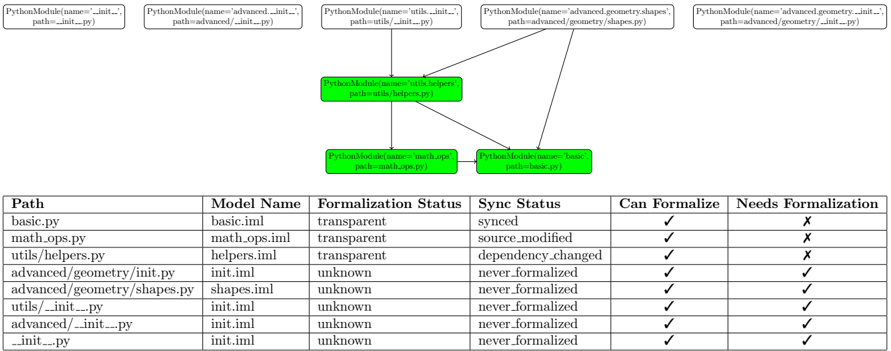
### Visual Description
## Dependency Diagram and Formalization Status Table: Python Module Structure
### Overview
The image contains two primary components:
1. A **dependency diagram** showing Python module relationships and imports
2. A **data table** detailing formalization status, synchronization status, and actionable metadata for each module
### Components/Axes
#### Diagram Elements
- **Nodes**:
- Labeled with Python module paths (e.g., `basic.py`, `advanced/geometry/shapes.py`)
- Green boxes highlight core modules:
- `utils/helpers.py`
- `math_ops.py`
- `basic.py`
- **Edges**:
- Arrows indicate import dependencies (e.g., `utils/helpers.py` → `basic.py`)
- No explicit legend for edge types, but color consistency suggests uniform dependency relationships
#### Table Structure
| Path | Model Name | Formalization Status | Sync Status | Can Formalize | Needs Formalization |
|-----------------------|------------------|----------------------|----------------------|---------------|---------------------|
| `basic.py` | `basic.iml` | transparent | synced | ✓ | ✗ |
| `math_ops.py` | `math_ops.iml` | transparent | source_modified | ✓ | ✗ |
| `utils/helpers.py` | `helpers.iml` | transparent | dependency_changed | ✓ | ✗ |
| `advanced/geometry/init.py` | `init.iml` | unknown | never_formalized | ✓ | ✓ |
| `advanced/geometry/shapes.py` | `shapes.iml` | unknown | never_formalized | ✓ | ✓ |
| `utils/__init__.py` | `init.iml` | unknown | never_formalized | ✓ | ✓ |
| `advanced/__init__.py`| `init.iml` | unknown | never_formalized | ✓ | ✓ |
| `__init__.py` | `init.iml` | unknown | never_formalized | ✓ | ✓ |
### Detailed Analysis
#### Diagram Flow
1. **Central Hub**: `utils/helpers.py` acts as a dependency hub, imported by:
- `basic.py`
- `advanced/geometry/shapes.py`
2. **Module Hierarchy**:
- `advanced/geometry` contains submodules `init.py` and `shapes.py`
- `__init__.py` files exist at multiple levels (root, `utils`, `advanced`, `advanced/geometry`)
#### Table Insights
1. **Formalization Status**:
- 3 modules (`basic`, `math_ops`, `helpers`) have transparent formalization status and are synced
- 5 modules (`init.iml` variants) have unknown formalization status and are never formalized
2. **Actionable Metadata**:
- All modules can be formalized (`✓` in "Can Formalize")
- 6 modules require formalization (`✓` in "Needs Formalization"), including critical dependencies like `utils/__init__.py`
### Key Observations
1. **Dependency Risks**:
- `utils/helpers.py` (a core dependency) has a "dependency_changed" sync status, suggesting potential instability
- Unformalized modules (`init.iml` variants) depend on unstable or evolving codebases
2. **Formalization Gaps**:
- Geometry-related modules (`shapes.py`, `advanced/geometry/init.py`) remain unformalized despite being part of advanced functionality
- Root `__init__.py` and `utils/__init__.py` lack formalization despite being foundational
### Interpretation
This visualization reveals a Python codebase in transition:
- **Stable Core**: The `basic`, `math_ops`, and `helpers` modules form a formalized, synced foundation
- **Evolving Dependencies**: The `utils/helpers.py` module’s "dependency_changed" status indicates active development, risking downstream modules
- **Formalization Priorities**:
- Immediate action needed for `utils/__init__.py` and `advanced/geometry/init.py` to stabilize dependencies
- Geometry modules (`shapes.py`) require formalization to ensure advanced functionality reliability
- **Structural Redundancy**: Multiple `__init__.py` files suggest potential code duplication or inconsistent initialization logic
The data underscores a need to prioritize formalization of dependency-critical modules while monitoring the stability of core components like `utils/helpers.py`.
</details>
Figure 11: Summary of formalization status, formalized modules highlighted.
Figure 12: Source modification without dependency changes.
<details>
<summary>Image 9 Details</summary>
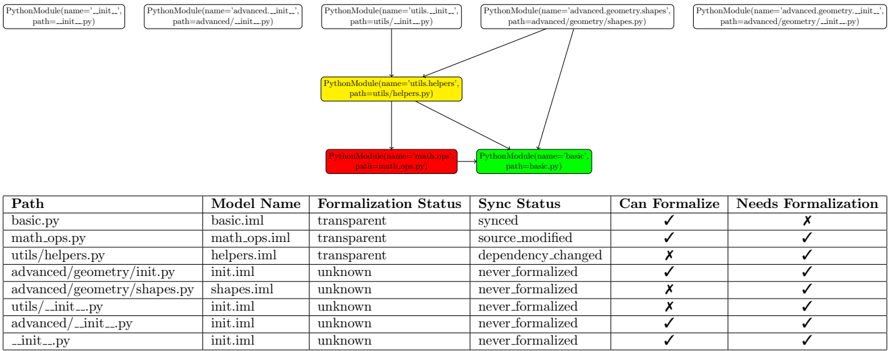
### Visual Description
## Diagram: Python Module Dependency and Formalization Status
### Overview
The image depicts a dependency graph of Python modules with associated formalization and synchronization statuses. It includes a table detailing module paths, model names, and metadata. The diagram uses color-coded nodes (yellow, red, green) to represent different modules, with arrows indicating dependencies. The table provides granular status information for each module.
### Components/Axes
**Diagram Elements:**
- **Nodes**: Labeled as `PythonModule(name='...', path='...')` with colors:
- Yellow: `utils/helpers.py`
- Red: `math_ops.py`
- Green: `basic.py`
- **Arrows**: Directed edges showing dependencies between modules.
- **Table Columns**:
- **Path**: File paths (e.g., `basic.py`, `advanced/geometry/shapes.py`).
- **Model Name**: Derived from paths (e.g., `basic.iml`, `math_ops.iml`).
- **Formalization Status**: `transparent`, `unknown`, or `source_modified`.
- **Sync Status**: `synced`, `dependency_changed`, or `never_formalized`.
- **Can Formalize**: ✅ (yes) or ❌ (no).
- **Needs Formalization**: ✅ (yes) or ❌ (no).
**Legend**:
- Colors map to modules but lack explicit labels. Inferred meanings:
- Yellow: Core utility modules (`utils/helpers.py`).
- Red: Math operations module (`math_ops.py`).
- Green: Basic module (`basic.py`).
### Detailed Analysis
**Diagram Flow**:
1. **Dependencies**:
- `utils/helpers.py` depends on `basic.py`, `math_ops.py`, and `advanced/geometry/shapes.py`.
- `advanced/geometry/shapes.py` depends on `basic.py`.
- `advanced/geometry/init.py` and `utils/__init__.py` depend on `basic.py`.
- `advanced/__init__.py` and `__init__.py` depend on `utils/__init__.py`.
2. **Table Data**:
| Path | Model Name | Formalization Status | Sync Status | Can Formalize | Needs Formalization |
|-------------------------------|------------------|----------------------|----------------------|---------------|---------------------|
| basic.py | basic.iml | transparent | synced | ✅ | ❌ |
| math_ops.py | math_ops.iml | transparent | source_modified | ✅ | ✅ |
| utils/helpers.py | helpers.iml | transparent | dependency_changed | ❌ | ✅ |
| advanced/geometry/init.py | init.iml | unknown | never_formalized | ✅ | ✅ |
| advanced/geometry/shapes.py | shapes.iml | unknown | never_formalized | ❌ | ✅ |
| utils/__init__.py | init.iml | unknown | never_formalized | ❌ | ✅ |
| advanced/__init__.py | init.iml | unknown | never_formalized | ✅ | ✅ |
| __init__.py | init.iml | unknown | never_formalized | ✅ | ✅ |
**Spatial Grounding**:
- Diagram nodes are positioned to reflect dependency hierarchy (e.g., `basic.py` at the base, `utils/helpers.py` at the top).
- Table rows align with diagram nodes via `Path` and `Model Name`.
### Key Observations
1. **Formalization Gaps**:
- 5/8 modules (`math_ops.py`, `init.iml` variants, `helpers.iml`) require formalization.
- `shapes.iml` cannot be formalized but still needs it, indicating a critical issue.
2. **Sync Status Anomalies**:
- `math_ops.iml` is `source_modified` but marked as `transparent`, suggesting unresolved changes.
- `helpers.iml` has a `dependency_changed` status but cannot be formalized.
3. **Color Consistency**:
- Yellow (`utils/helpers.py`) is the only module with `transparent` status and no formalization needs.
- Red (`math_ops.py`) and green (`basic.py`) nodes have mixed statuses.
### Interpretation
The diagram highlights a fragmented formalization pipeline:
- **Critical Paths**: The `basic.py` module is fully synced and formalized, serving as the foundation. However, its dependencies (`math_ops.py`, `helpers.iml`) have unresolved issues.
- **Bottlenecks**: `shapes.iml` cannot be formalized despite needing it, potentially blocking downstream modules like `utils/helpers.py`.
- **Unresolved Dependencies**: Modules with `unknown` formalization status (e.g., `init.iml` variants) suggest incomplete processing or missing metadata.
- **Action Items**: Prioritize formalizing `math_ops.iml` (source-modified) and resolving `shapes.iml`’s formalization blockage. The `helpers.iml` dependency change requires investigation to prevent cascading failures.
This analysis underscores the need for a systematic review of module dependencies and formalization workflows to ensure consistency and reliability.
</details>
Figure 13: Addition of a new dependency
<details>
<summary>Image 10 Details</summary>
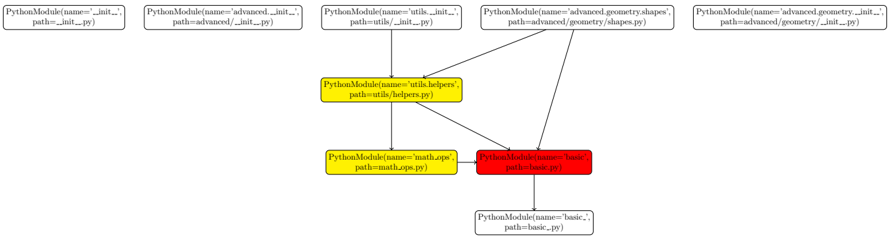
### Visual Description
## Dependency Diagram: Python Module Structure
### Overview
The diagram illustrates the hierarchical and interdependent structure of Python modules within a project. It visualizes module names, file paths, and dependencies through labeled nodes and directional arrows. Key modules include `basic`, `utils.helpers`, `math_ops`, and `advanced.geometry.shapes`, with dependencies flowing from higher-level modules to foundational ones.
### Components/Axes
- **Nodes**: Represent Python modules with labels containing:
- `name`: Module identifier (e.g., `PythonModule(name='basic')`).
- `path`: File system path (e.g., `path=basic.py`).
- **Arrows**: Indicate dependencies, pointing from dependent modules to their dependencies.
- **Colors**:
- **Yellow**: Highlighted modules (`utils.helpers`, `math_ops`).
- **Red**: Critical module (`basic`).
- **Legend**: Not explicitly visible in the diagram, but colors likely denote module criticality or role.
### Detailed Analysis
1. **Module Dependencies**:
- `utils.helpers` (path: `utils/helpers.py`) depends on `basic` (path: `basic.py`).
- `math_ops` (path: `math_ops.py`) depends on `basic`.
- `advanced.geometry.shapes` (path: `advanced/geometry/shapes.py`) depends on `utils.helpers`.
- `advanced.geometry.init` (path: `advanced/geometry/__init__.py`) and `advanced.init` (path: `advanced/__init__.py`) are top-level modules with no shown dependencies.
2. **Spatial Layout**:
- **Bottom**: `basic.py` (red) is centrally positioned, acting as a foundational dependency.
- **Middle**: `utils/helpers.py` (yellow) bridges `basic` and `math_ops`.
- **Top**: `advanced/geometry/shapes.py` (yellow) and `advanced/__init__.py` (white) are higher-level modules.
3. **Textual Labels**:
- All modules include `PythonModule(name='...', path='...')` syntax in their labels.
- Example: `PythonModule(name='utils.helpers', path=utils/helpers.py)`.
### Key Observations
- **Central Role of `basic`**: The red-highlighted `basic` module is a dependency for three other modules, suggesting it contains core functionality.
- **Modular Hierarchy**:
- `utils.helpers` and `math_ops` depend directly on `basic`.
- `advanced.geometry.shapes` depends indirectly on `basic` via `utils.helpers`.
- **Redundancy**: Two modules (`advanced.geometry.init` and `advanced.init`) share the same path structure but differ in naming, possibly indicating initialization logic.
### Interpretation
The diagram reflects a modular design pattern where:
- **`basic`** serves as the foundational layer, providing essential functions for other modules.
- **`utils.helpers`** acts as a utility layer, abstracting common operations used by both `basic` and `math_ops`.
- **`advanced`** modules build on these layers, demonstrating a top-down dependency flow. The use of colors (red for `basic`) emphasizes its criticality, while yellow highlights intermediate modules. The absence of a legend leaves the exact rationale for color choices ambiguous, but the spatial and dependency structure clearly prioritizes `basic` as the project’s core.
</details>
<details>
<summary>Image 11 Details</summary>

### Visual Description
## Data Table: File Formalization and Synchronization Status
### Overview
The table presents a structured overview of file paths, associated model names, formalization statuses, synchronization statuses, and flags indicating whether formalization is possible or required. It includes 9 rows of data with categorical and boolean values.
### Components/Axes
- **Columns**:
1. **Path**: File path (e.g., `basic__.py`, `advanced/geometry/init.py`).
2. **Model Name**: Associated model name (e.g., `basic__.iml`, `helpers.iml`).
3. **Formalization Status**: Status of formalization (e.g., `unknown`, `transparent`).
4. **Sync Status**: Synchronization status (e.g., `never_formalized`, `source_modified`).
5. **Can Formalize**: Boolean flag (`✅` for yes, `❌` for no).
6. **Needs Formalization**: Boolean flag (`✅` for yes, `❌` for no).
### Detailed Analysis
| Path | Model Name | Formalization Status | Sync Status | Can Formalize | Needs Formalization |
|-------------------------------|------------------|----------------------|----------------------|---------------|---------------------|
| basic__.py | basic__.iml | unknown | never_formalized | ✅ | ✅ |
| basic.py | basic.iml | transparent | source_modified | ❌ | ✅ |
| math_ops.py | math_ops.iml | transparent | dependency_changed | ❌ | ✅ |
| utils/helpers.py | helpers.iml | transparent | dependency_changed | ❌ | ✅ |
| advanced/geometry/init.py | init.iml | unknown | never_formalized | ✅ | ✅ |
| advanced/geometry/shapes.py | shapes.iml | unknown | never_formalized | ❌ | ✅ |
| utils/__init__.py | init.iml | unknown | never_formalized | ❌ | ✅ |
| advanced/__init__.py | init.iml | unknown | never_formalized | ✅ | ✅ |
| __init__.py | init.iml | unknown | never_formalized | ✅ | ✅ |
### Key Observations
1. **Formalization Status**:
- 6/9 entries have `unknown` formalization status.
- 3/9 entries have `transparent` status, indicating partial or conditional formalization.
2. **Sync Status**:
- 7/9 entries have `never_formalized` sync status.
- 2/9 entries show `source_modified` or `dependency_changed`, suggesting active changes.
3. **Formalization Flags**:
- `Can Formalize`: 5/9 entries can be formalized (`✅`), while 4 cannot (`❌`).
- `Needs Formalization`: All 9 entries require formalization (`✅`), indicating a universal need despite varying capabilities.
### Interpretation
The data highlights a critical gap in the formalization process:
- **Uncertainty in Status**: The prevalence of `unknown` formalization statuses suggests incomplete tracking or documentation of formalization efforts.
- **Dependency-Driven Barriers**: Files with `dependency_changed` sync status (e.g., `math_ops.py`, `helpers.iml`) cannot be formalized, implying that unresolved dependencies block progress.
- **Universal Need**: Despite some files being formalizable (`Can Formalize`), all files are flagged as needing formalization. This could indicate either:
- A proactive requirement to formalize all files regardless of current status.
- A systemic issue where formalization is incomplete but deemed necessary for downstream processes.
- **Partial Formalization**: Files with `transparent` status (e.g., `basic.py`, `math_ops.py`) may represent intermediate steps where formalization is partially achieved but not finalized.
This table underscores the need for a systematic audit to resolve unknown statuses, address dependency conflicts, and prioritize formalization efforts based on technical feasibility and project requirements.
</details>
Figure 15: Removal of an upstream dependency.
<details>
<summary>Image 12 Details</summary>
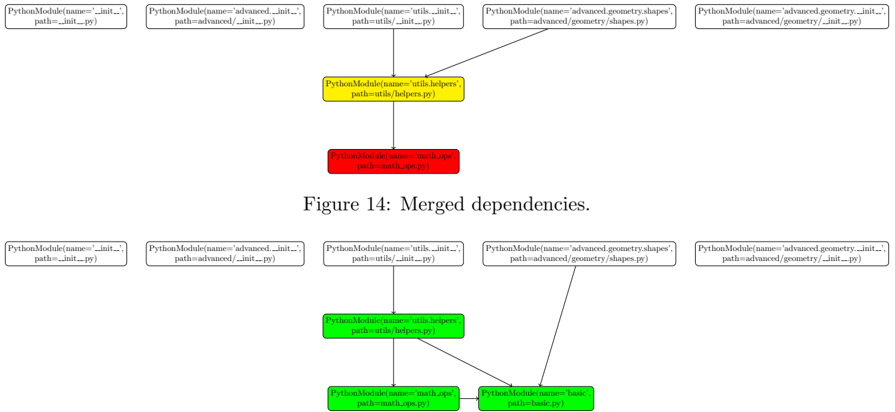
### Visual Description
## Dependency Diagram: Python Module Relationships
### Overview
The diagram illustrates merged dependencies between Python modules, represented as colored boxes connected by arrows. It shows hierarchical relationships between core utilities, helper modules, and mathematical functions, with color-coded categorization.
### Components/Axes
- **Top Section**:
- Yellow box: `PythonModule(name='utils.helpers', path=utils/helpers.py)`
- Red box: `PythonModule(name='math.py', path=math/math.py)`
- Arrows indicate dependency flow from yellow to red box
- **Bottom Section**:
- Green box: `PythonModule(name='utils.helpers', path=utils/helpers.py)`
- Green box: `PythonModule(name='math.py', path=math/math.py)`
- Green box: `PythonModule(name='basic.py', path=basic/basic.py)`
- Arrows show bidirectional dependencies between green boxes
### Detailed Analysis
1. **Color Coding**:
- Yellow: Core helper utilities
- Red: Mathematical functions
- Green: Basic/core modules
2. **Dependency Flow**:
- Top: `utils.helpers` → `math.py` (one-way dependency)
- Bottom:
- `utils.helpers` ↔ `math.py` (bidirectional)
- `utils.helpers` ↔ `basic.py` (bidirectional)
3. **Path Structure**:
- All modules follow `path=module_name.py` format
- Top section uses `utils/helpers.py` and `math/math.py`
- Bottom section uses `utils/helpers.py`, `math/math.py`, and `basic/basic.py`
### Key Observations
- The diagram shows two distinct dependency clusters:
1. A simple linear dependency in the top section
2. A more complex network in the bottom section with mutual dependencies
- Color coding suggests different module categories:
- Yellow (helpers) and Red (math) in top cluster
- Green (helpers, math, basic) in bottom cluster
- The bottom cluster demonstrates more complex interdependencies than the top
### Interpretation
This diagram reveals:
1. **Modular Architecture**: Clear separation between helper utilities (yellow) and mathematical functions (red)
2. **Dependency Patterns**:
- Top cluster shows one-way dependencies typical of utility modules
- Bottom cluster demonstrates mutual dependencies common in core modules
3. **Code Organization**:
- `utils.helpers` acts as a central hub connecting different modules
- `math.py` appears in both clusters, suggesting it's a shared dependency
4. **Potential Implications**:
- The bottom cluster's bidirectional dependencies might indicate tighter coupling
- Color coding helps visualize module categorization at a glance
- The diagram suggests a need for careful maintenance of interdependent modules
The visualization effectively communicates module relationships through spatial arrangement and color coding, though the bidirectional dependencies in the bottom cluster might warrant architectural review for potential simplification.
</details>
To ensure robustness during active development, the server uses graceful degradation. If parsing or dependency errors occur, it preserves the last known-good dependency graph and formal models, tracks errors for debugging, and automatically recovers once inconsistencies are resolved.
## 7 Performance
## 7.1 Dataset
We have created 50 models that have the following characteristics:
## · State Machine Architecture
Each model defines explicit states and manages transitions between those states via step functions.
## · Complex Multi-Entity Systems
All models represent systems with multiple interacting components, for example:
- -BGP path vector routing: speakers, neighbors, routes
- -NPC pathfinding: characters, obstacles, terrain
- -Smart warehouse auto-controller: robots, inventory, orders, zones
- -Options market maker: options, positions, hedges
- -Nuclear reactor safety system: control rods, safety systems, parameters
- -TLS handshake protocol: client, server, certificates, sessions
## · Temporal Evolution
Models explicitly track state changes over time using counters and/or timestamps, and evolve via simulation step functions.
## · Decision Logic
Each model implements complex decision-making based on current state and parameters (e.g. routing decisions, pathfinding, task assignment, hedging, safety checks, protocol steps). This logic often exhibits characteristic interaction patterns, including:
- Override patterns , where special conditions trump normal logic except in specific subcases
- Dead-zone patterns , where integer boundary combinations create gaps leading to undefined behavior or unexpected fallback states
## · Safety and Correctness Properties
Many models include explicit invariants or constraints that must always hold, such as safety limits, risk limits, or convergence conditions.
All models are rooted in real-world systems that exist in production environments. Each model includes three questions that probe different aspects of state machine understanding, such as enumerating distinct behavioral scenarios, identifying conditions under which specific behaviors occur, and determining whether safety or correctness properties can be violated.
We evaluate two approaches to answering these questions:
- LLM-only: The LLM analyzes the Python source code directly and answers the questions based on its own reasoning over the code.
- CodeLogician (LLM + ImandraX ): The model is translated into IML (Imandra Modeling Language), and ImandraX performs formal region decomposition and verification. The LLM then synthesizes answers from these formal analysis results.
## 7.2 Metrics
We design 7 metrics to evaluate the performance of LLM-only reasoning compared to CodeLogician . Each metric is designed to assess a specific aspect of reasoning about complex state machines and decision logic.
## 7.2.1 State Space Estimation Accuracy
This metric measures how accurately the LLM estimates the number of distinct behavioral scenarios or regions in the state space. The ground truth comes from the exact region count produced by CodeLogician's decomposition analysis.
$$F o r m u l a \colon \, s c o r e = \frac { 1 } { 1 + \log _ { 2 } ( d i f f + 1 ) } , \quad w h e r e \, d i f f = | n _ { l l m } - n _ { d e c o m p } |$$
Design rationale: The logarithmic penalty reflects that being off by orders of magnitude (e.g., estimating 10 scenarios when there are 1000) is fundamentally more problematic than small absolute differences. The formula yields: perfect match (diff=0) → score=1.0, off by 1 → score=0.5, off by 3 → score=0.33, and converges to 0 as the difference grows. When the LLM provides only qualitative descriptions without any quantification, we assign score=0.0. For extraction, we use the following rules: (a) explicit numbers are used directly, (b) ranges use the midpoint, (c) approximations extract the implicit number, (d) qualitative descriptions with implicit combinatorial reasoning (e.g., '4 × 5 × 3 combinations') are computed, and (e) pure qualitative statements with no extractable quantity are marked as unknown.
## 7.2.2 Outcome Precision
This metric evaluates the precision of constraints and conditions in the LLM's answer compared to qualitative descriptions. It measures whether the LLM identifies exact constraints that determine system behavior.
## Scoring Rubric:
- 1.0 : Exact match (both value and operator are correct).
- 0.8 : Value is correct, but the operator is approximately equivalent (e.g., ≥ 20 vs. > 19).
- 0.5 : Value is approximately correct within a reasonable range (e.g., ≥ 20 vs. ≥ 18).
- 0.2 : Qualitative but directionally correct (e.g., 'high' when the correct constraint is > 620).
- 0.0 : Incorrect or missing.
Design rationale: This metric distinguishes between responses that capture exact conditions versus vague qualitative descriptions. The graduated scoring recognizes that approximate answers are more useful than purely qualitative ones, even if not perfectly precise.
## 7.2.3 Direction Accuracy
This metric assesses whether the LLM reaches conclusions in the correct direction, particularly for yes/no questions about system properties or behaviors. For example, does the LLM correctly identify that certain scenarios can violate a safety property, or does it incorrectly claim the property always holds?
## Scoring Rubric:
- 1.0 : Completely correct conclusion with sound reasoning.
- 0.75 : Correct conclusion but with flawed or incomplete reasoning.
- 0.5 : Partially correct.
- 0.25 : Incorrect conclusion but identifies some relevant factors.
- 0.0 : Completely incorrect.
Design rationale: Getting the fundamental direction of an answer wrong (e.g., claiming a system is safe when it has critical vulnerabilities) is a severe error in code understanding. This metric prioritizes correctness of the conclusion while also rewarding sound reasoning processes.
## 7.2.4 Coverage Completeness
This metric measures the proportion of actual decision scenarios or behavioral regions that the LLM identifies in its analysis. It evaluates how thoroughly the LLM explores the state space.
## Scoring Approach (Highest Applicable Method).
- (a) If the LLM provides explicit scenario counts, compare them directly to the decomposition count.
- (b) If the LLM enumerates specific scenarios, count the number of scenarios enumerated.
- (c) If the LLM categorizes outcomes, compute the score as
# categories identified # categories in decomposition .
- (d) If there is only a qualitative acknowledgment of multiplicity, assign a score of 0 . 25.
- (e) If there is no meaningful coverage, assign a score of 0 . 0.
Design rationale: Complete coverage is essential for sound verification. Missing scenarios can hide critical bugs or edge cases. We use multiple scoring methods to accommodate different response styles, always choosing the method most favorable to the LLM to avoid penalizing valid reasoning approaches.
## 7.2.5 Control Flow Understanding
This metric assesses whether the LLM correctly captures the structure of control flow, including branches, guards, overrides, and short-circuit behavior. We evaluate the following four aspects:
- Precedence of conditions : Correct handling of logical precedence (e.g., AND before OR , explicit priority ordering).
- Branching structure : Correct identification of control structures such as if--else--if chains versus independent conditional checks.
- Short-circuit behavior : Recognition of early returns, guard clauses, or other forms of shortcircuit evaluation.
- Override logic : Identification of safety or exception-handling logic that supersedes normal operation.
Scoring Formula. The score is computed as:
$$s c o r e = { \frac { \# c o r r e c t + 0 . 5 \times \# p a r t i a l } { 4 } } .$$
Design Rationale. Control flow structure is fundamental to program behavior. Misunderstanding whether conditions are evaluated sequentially (with short-circuiting) versus independently, or misinterpreting logical precedence, leads to incorrect analysis. Each aspect is therefore assessed independently and aggregated into a single score, with partial credit awarded to reflect nuanced but incomplete understanding.
## 7.2.6 Edge Case Detection
This metric evaluates how many rare or unexpected edge cases the LLM identifies in its analysis. An edge case is defined as any behavioral region exhibiting at least one of the following properties:
- Complex conjunctive conditions : Three or more conjunctive constraints combined in a single condition.
- Exact boundary conditions : Equality constraints at precise thresholds (e.g., x = 10 rather than x > 10).
- Negation of the common case : Scenarios such as sensor failure, timeout, or other exceptional modes.
- Counterintuitive outcomes : Behaviors that contradict naive or intuitive expectations.
- Safety-critical violations : Invariant violations, error states, or other safety-relevant failures.
Scoring Formula. The score is computed as:
$$s c o r e = \frac { \# e d g e \, c a s e s \, i n d e f i t i e d \, b y \, t h e \, L L M } { \# t o t a l \, e d g e \, c a s e s \, i n \, t h e \, d e c o m p o s i t i o n } .$$
Design Rationale. Edge cases are where defects most commonly occur. Real-world systems tend to fail at boundary conditions, under rare combinations of constraints, or in situations that violate designer assumptions. This metric therefore rewards systematic identification of such cases. The definition is intentionally broad in order to capture multiple forms of non-obvious or unexpected behavior.
## 7.2.7 Decision Boundary Clarity
Decision Boundary Identification Metric. This metric measures whether the LLM identifies the exact constraints that determine decision boundaries in the system. Each region produced by decomposition is defined by Boolean constraints-conditions on inputs such as:
- deviation ≥ 80 cm,
- state of charge < 20%,
- connection count ≥ 3,
- temperature > 100 ◦ C.
These constraints may take the form of inequalities, equalities, or logical combinations thereof.
Scoring Formula. The score is computed as:
| score = | #constraints identified by the LLM |
|-----------|--------------------------------------|
| score = | #constraints in the decomposition |
Design Rationale. Decision boundaries represent critical points in the state space at which system behavior changes qualitatively. Accurately identifying these constraints is essential for precise reasoning about when different behaviors occur. Qualitative descriptions such as 'low battery' or 'high temperature' are insufficient for formal analysis and are therefore penalized by this metric.
Applicability Note. If a metric is not applicable or irrelevant to a specific question (e.g., decision boundaries are requested for a system that has none), that metric is excluded from the evaluation for that question.
Overall Evaluation Context. Collectively, these seven metrics capture complementary dimensions of how LLM deviates from CodeLogician's formally-grounded analysis. Together, they provide a multifaceted assessment of the value added by formal methods tools. A perfect score of 1 . 0 across all metrics would indicate that an LLM can achieve the same level of rigor and completeness as formal analysis without assistance. The gaps revealed by these metrics quantify the specific ways in which formal decomposition and verification extend beyond unaided code reading and natural-language reasoning.
## 7.3 Evaluation
Our evaluation proceeds in two stages: answer generation and answer evaluation.
## 7.3.1 Answer Generation
We obtain answers from five frontier models: GPT-5.2, Grok Code Fast 1, Claude Sonnet 4.5, Claude Opus 4.5, and Gemini 3 Pro. For the LLM-only condition, each model analyzes the Python source code directly and answers the three questions per model based on its own reasoning. For the CodeLogician condition, answers are derived from ImandraX's formal region decomposition and verification results, which provide exact scenario counts, precise constraint boundaries, and proof outcomes (proven or refuted with counterexamples). The CodeLogician answers serve as ground truth for evaluation.
## 7.3.2 Answer Evaluation (LLM-as-a-Judge)
We employ the LLM-as-a-judge methodology to evaluate how well LLM-only answers align with CodeLogician answers. Four evaluator models-Gemini 2.5 Flash, Claude Haiku 4.5, GPT-4o Mini, and Grok 4 Fast-independently score each LLM response according to the seven metric definitions, providing detailed reasoning for each score. We aggregate these evaluations by averaging across the four evaluators to reduce bias from any single judge. While LLM-based evaluation introduces some variability, we plan to complement these results with deterministic methods such as test case generation from region decomposition result in the future.
All data, code, and scripts to reproduce these results are publicly available at https://github. com/imandra-ai/code-logic-bench .
## 7.4 Results
## 7.4.1 Overall Performance
State Space Estimation Accuracy (0.186). This metric reveals the most dramatic performance gap. The low scores reflect both severe underestimation-when LLMs attempt quantification but miss combinatorial explosion by orders of magnitude-and complete inability to quantify, where models resort to vague statements such as 'many scenarios' without attempting enumeration. This failure to grasp state space size has direct consequences: it leads to underestimation of verification effort, inadequate test budgets, and false confidence that manual analysis has covered sufficient ground. In
safety-critical systems, such miscalibration can mean the difference between rigorous validation and deploying systems with untested corner cases.
In one environmental monitoring system, when asked to enumerate distinct response scenarios, the model focused on high-level alert categories. In contrast, formal decomposition revealed a combinatorial explosion arising from Boolean constraint boundaries, where different combinations of sensor drift conditions, timing windows, measurement ranges, and pollutant-specific limits produce orders of magnitude more behavioral regions than surface-level structure suggests.
Outcome Precision (0.613). This metric exposes substantial imprecision in how LLMs specify constraints. Mean scores indicate frequent reliance on qualitative descriptions or approximate values rather than exact specifications. Such imprecision introduces ambiguity into requirements documentation, test case generation, and safety audits. For example, stating 'temperature must not be too high' instead of 'temperature < 620 ◦ C' prevents consistent implementation, hinders compliance verification, and leaves boundary conditions untested.
Direction Accuracy (0.635). Direction Accuracy measures whether LLMs reach correct conclusions, particularly for safety-critical properties where errors have real-world consequences. This metric uses graduated scoring from 0 . 0 (completely incorrect) to 1 . 0 (correct with sound reasoning), with partial credit awarded for identifying relevant factors despite an incorrect conclusion.
A mean score of 0 . 635 indicates that while LLMs often identify relevant aspects of system behavior, they frequently reach flawed conclusions or provide incomplete reasoning. The most severe failures occur when LLMs categorically misidentify whether safety properties hold. In one data protection system, formal verification proved that a critical privacy property always holds, yet the LLM incorrectly concluded that the property could be violated, misinterpreting how boundary conditions propagate through compliance checks. Similarly, in an autonomous driving system, the LLM claimed that a sensor reliability property could be violated under specific conditions, when verification showed it always holds.
These failures represent fundamental errors about system guarantees-the difference between confidently deploying a system and discovering critical vulnerabilities only after incidents occur.
Coverage Completeness (0.490). Coverage Completeness highlights a weak performance area, with LLMs identifying fewer than half of the actual decision scenarios. This systematic undercounting creates blind spots where critical bugs tend to hide. The gap arises because LLMs reason at categorical levels while missing how combinations of constraints multiply scenarios.
When asked to enumerate scenarios, models typically identify only the obvious, top-level categories visible in code structure. However, each category subdivides along Boolean constraint boundaries, where combinations of comparisons, timing windows, and state checks produce distinct behavioral regions. The resulting combinatorial interaction creates orders of magnitude more scenarios than surface-level reasoning suggests. This mirrors a common developer pitfall: believing that 'all cases' have been tested when only the obvious paths have been exercised.
Control Flow Understanding (0.746). Control Flow Understanding represents the strongest area of LLM performance. Models demonstrate relatively strong capability in interpreting branching logic, condition precedence, and short-circuit behavior. This is the only metric where mean performance exceeds 0 . 7, suggesting that LLMs can effectively infer common control-flow idioms through code analysis.
Nevertheless, complex override patterns and deeply nested conditionals remain challenging. Formal methods retain a key advantage by providing deterministic analysis that is independent of surface-level code structure or stylistic variation.
Edge Case Detection (0.597). Edge Case Detection shows that LLMs identify fewer than 60% of edge cases. Models tend to focus on obvious scenarios while missing counterintuitive behaviors. In monitoring systems, LLMs typically recognize high-level operational modes but overlook scenarios in which subsystems in non-standard states can still trigger critical actions through indirect pathways, such as quorum voting.
These counterintuitive interactions-where naive reasoning predicts one outcome but complex logical dependencies produce another-are precisely where production bugs most often emerge. Failing to identify such cases leaves test suites weakest exactly where failures are most likely to occur in the field.
Decision Boundary Clarity (0.695). Decision Boundary Clarity shows moderate performance. LLMs partially succeed in identifying constraints that influence system behavior but struggle to extract precise boundary conditions. Models often recognize that factors such as 'weather adjustments' or 'sensor drift' matter, yet fail to identify the exact constraint expressions where behavior changes-such as specific comparisons ( ≥ vs. > ), threshold values (79 vs. 80), or logical combinations.
LLMs also miss narrow 'dead zones' where small ranges of inputs trigger different logic, and how constraints vary across operational modes. This limitation is critical because implementations require exact Boolean conditions. Developers need precise constraint expressions to implement, test boundary behavior, and verify correctness. Region decomposition exhaustively enumerates these constraints, enabling precise implementation and comprehensive test case generation.
These data are presented in Figures 17 and Figures 18.
## Mean Score by Model
Figure 16: Mean score by model across seven metrics, relative to the scores when models were augmented with CodeLogician. Claude Opus 4.5 achieves the highest score (0.601), followed by GPT-5.2 (0.589). Despite these differences, all models perform substantially below the level achieved when augmented with formal methods.
<details>
<summary>Image 13 Details</summary>
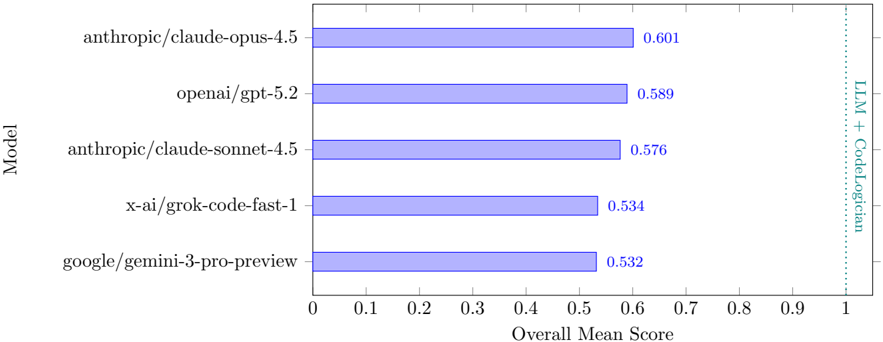
### Visual Description
## Bar Chart: AI Model Performance Comparison
### Overview
The chart compares the overall mean scores of five AI models against a benchmark labeled "LLM + CodeLogician" (dashed vertical line at ~0.9). Models are ranked by performance, with scores ranging from 0.532 to 0.601.
### Components/Axes
- **Y-Axis (Model)**: Lists AI models in descending order of performance:
1. anthropic/claude-opus-4.5
2. openai/gpt-5.2
3. anthropic/claude-sonnet-4.5
4. x-ai/grok-code-fast-1
5. google/gemini-3-pro-preview
- **X-Axis (Overall Mean Score)**: Scale from 0 to 1, with a vertical dashed line at 0.9 labeled "LLM + CodeLogician."
- **Legend**: Located on the right, associating teal color with "LLM + CodeLogician" and blue for model bars.
### Detailed Analysis
- **anthropic/claude-opus-4.5**: Score = 0.601 (highest, bar extends to ~0.6).
- **openai/gpt-5.2**: Score = 0.589 (second-highest, bar at ~0.59).
- **anthropic/claude-sonnet-4.5**: Score = 0.576 (third, bar at ~0.58).
- **x-ai/grok-code-fast-1**: Score = 0.534 (fourth, bar at ~0.53).
- **google/gemini-3-pro-preview**: Score = 0.532 (lowest, bar at ~0.53).
- **LLM + CodeLogician**: Dashed line at 0.9, far exceeding all model scores.
### Key Observations
1. **Performance Gap**: All models score below the "LLM + CodeLogician" benchmark (0.9), with the closest being claude-opus-4.5 (0.601).
2. **Model Hierarchy**: Anthropic models dominate, with claude-opus-4.5 outperforming claude-sonnet-4.5 by ~0.025.
3. **OpenAI vs. Others**: GPT-5.2 (0.589) outperforms x-ai and google models by ~0.055 and ~0.057, respectively.
4. **x-ai and Google**: Lowest performers, with scores nearly identical (0.534 vs. 0.532).
### Interpretation
The data suggests that while current AI models demonstrate varying levels of competence, none approach the hypothetical "LLM + CodeLogician" standard. Anthropic's claude-opus-4.5 leads the pack, but even its score (0.601) represents a 39.9% deficit from the benchmark. This gap highlights potential limitations in existing models' ability to integrate logical reasoning with language processing. The minimal difference between x-ai and google models (0.002) implies competitive parity in this specific evaluation metric. The chart underscores the need for advancements in AI architectures to bridge the performance gap with theoretical benchmarks.
</details>
## 7.4.2 Model Comparison by Metric
Figures 20 and 21 show how each model performed on individual metrics: Claude Opus 4.5 achieves the highest overall performance (0 . 601), leading in State Space Estimation Accuracy (0 . 222), Decision Boundary Clarity (0 . 763), Edge Case Detection (0 . 640), and Coverage Completeness (0 . 524). GPT5.2 achieves the strongest performance in Control Flow Understanding (0 . 810) and Outcome Precision (0 . 659), indicating effective pattern recognition for common control-flow structures and relatively precise constraint specification.
Shared Limitations Across Models. Despite these relative differences, all evaluated models perform similarly on State Space Estimation Accuracy , with scores clustered in the 0 . 164-0 . 222 range. Even Claude Opus 4.5, which achieves the highest score on this metric, still falls far short of the precision achievable through formal decomposition. This variance on the most challenging metric indicates that fundamental architectural limitations affect current LLMs in a broadly similar manner when operating without formal reasoning tools.
## Mean Score by Metric
Figure 17: Mean score by metric, relative to performance once augmented with CodeLogician.
<details>
<summary>Image 14 Details</summary>
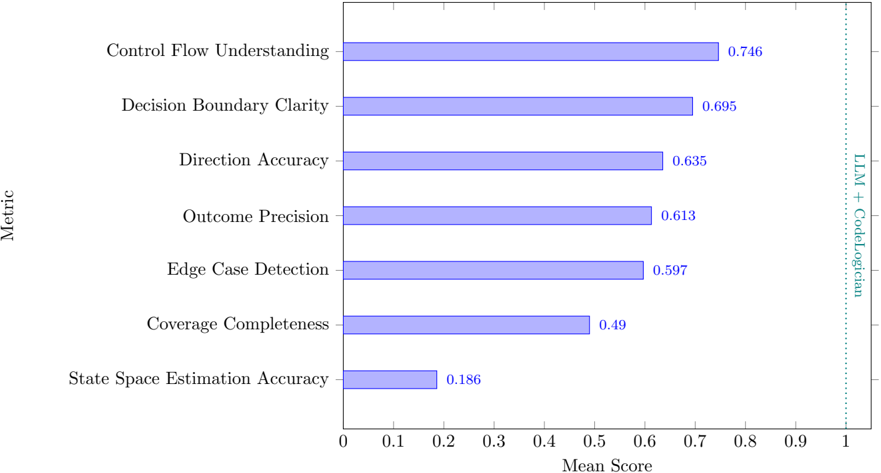
### Visual Description
## Horizontal Bar Chart: LLM + CodeLogician Performance Metrics
### Overview
The chart compares seven technical metrics related to code understanding and generation, measured by mean scores between 0 and 1. A vertical dotted line at 0.8 serves as a benchmark reference labeled "LLM + CodeLogician". All metrics fall below this threshold, with scores ranging from 0.186 to 0.746.
### Components/Axes
- **Y-Axis (Metric)**: Lists seven evaluation criteria in descending order of performance:
1. Control Flow Understanding
2. Decision Boundary Clarity
3. Direction Accuracy
4. Outcome Precision
5. Edge Case Detection
6. Coverage Completeness
7. State Space Estimation Accuracy
- **X-Axis (Mean Score)**: Numerical scale from 0 to 1, with a vertical reference line at 0.8.
- **Legend**: Positioned on the right side, uses blue bars to represent all data series (no explicit legend labels provided in the image).
### Detailed Analysis
- **Control Flow Understanding**: Highest score at 0.746, closest to the 0.8 benchmark.
- **Decision Boundary Clarity**: 0.695, second-highest performance.
- **Direction Accuracy**: 0.635, third-highest.
- **Outcome Precision**: 0.613, fourth-highest.
- **Edge Case Detection**: 0.597, fifth-highest.
- **Coverage Completeness**: 0.49, sixth-highest.
- **State Space Estimation Accuracy**: Lowest score at 0.186, significantly below all others.
### Key Observations
1. **Performance Gradient**: Scores decrease progressively from top to bottom, with a steep drop between Edge Case Detection (0.597) and Coverage Completeness (0.49).
2. **Benchmark Gap**: No metric reaches the 0.8 "LLM + CodeLogician" threshold, though Control Flow Understanding (0.746) comes closest.
3. **Outlier**: State Space Estimation Accuracy (0.186) is an extreme outlier, performing 75% worse than the next-lowest metric (Coverage Completeness at 0.49).
### Interpretation
The data suggests that while the system demonstrates strong performance in understanding code structure (Control Flow Understanding) and logical decision-making (Decision Boundary Clarity), it struggles significantly with state space estimation—a critical component for complex code reasoning. The consistent underperformance relative to the 0.8 benchmark indicates room for improvement across all metrics, with particular emphasis needed on state space modeling. The gradual decline in scores from top to bottom metrics may reflect increasing complexity in the evaluated tasks, suggesting that simpler code understanding tasks are handled better than more abstract or comprehensive reasoning challenges.
</details>
Figure 18: Mean score by metric, relative to performance once augmented with CodeLogician.
<details>
<summary>Image 15 Details</summary>
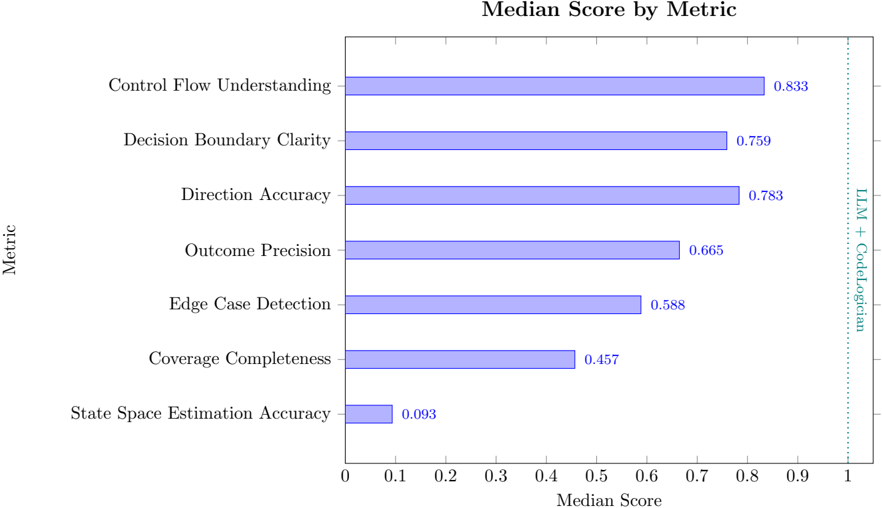
### Visual Description
## Bar Chart: Median Score by Metric
### Overview
The chart displays median scores for seven technical metrics related to code understanding and analysis. A vertical dotted line at 0.9 (labeled "LLM + CodeLogician") serves as a reference benchmark. All bars are colored blue, with numerical values explicitly labeled at the end of each bar.
### Components/Axes
- **Y-Axis (Metric)**:
- Control Flow Understanding
- Decision Boundary Clarity
- Direction Accuracy
- Outcome Precision
- Edge Case Detection
- Coverage Completeness
- State Space Estimation Accuracy
- **X-Axis (Median Score)**:
- Scale from 0 to 1.0 in increments of 0.1
- Dotted reference line at 0.9 labeled "LLM + CodeLogician"
- **Legend**:
- Single entry: "LLM + CodeLogician" (blue dotted line)
### Detailed Analysis
1. **Control Flow Understanding**: 0.833 (highest score, closest to 0.9 benchmark)
2. **Decision Boundary Clarity**: 0.759
3. **Direction Accuracy**: 0.783
4. **Outcome Precision**: 0.665
5. **Edge Case Detection**: 0.588
6. **Coverage Completeness**: 0.457
7. **State Space Estimation Accuracy**: 0.093 (lowest score, farthest from benchmark)
### Key Observations
- **Top Performers**: Control Flow Understanding (0.833), Direction Accuracy (0.783), and Decision Boundary Clarity (0.759) cluster near the 0.9 benchmark.
- **Mid-Range Metrics**: Outcome Precision (0.665) and Edge Case Detection (0.588) show moderate performance.
- **Weakness**: State Space Estimation Accuracy (0.093) is an extreme outlier, performing 10x worse than the next lowest metric.
- **Benchmark Gap**: No metric reaches the 0.9 "LLM + CodeLogician" threshold, with the closest being 0.833 (Control Flow Understanding).
### Interpretation
The chart reveals a clear hierarchy of strengths and weaknesses in code analysis capabilities:
1. **Strengths**: Control Flow Understanding and Direction Accuracy demonstrate robust performance, suggesting effective handling of code structure and navigation.
2. **Critical Weakness**: State Space Estimation Accuracy (0.093) indicates a fundamental gap in modeling complex code state transitions, which could severely impact tasks requiring deep code comprehension.
3. **Benchmark Proximity**: While top metrics approach the 0.9 threshold, the gap suggests room for improvement in aligning with advanced code logician capabilities.
4. **Anomaly**: The extreme outlier (State Space Estimation) warrants investigation into whether this reflects data collection issues, metric design flaws, or inherent technical challenges.
This analysis highlights prioritization opportunities: addressing State Space Estimation Accuracy could yield disproportionate improvements in overall code analysis capabilities.
</details>
Figure 19: Score distributions across the seven metrics.
<details>
<summary>Image 16 Details</summary>
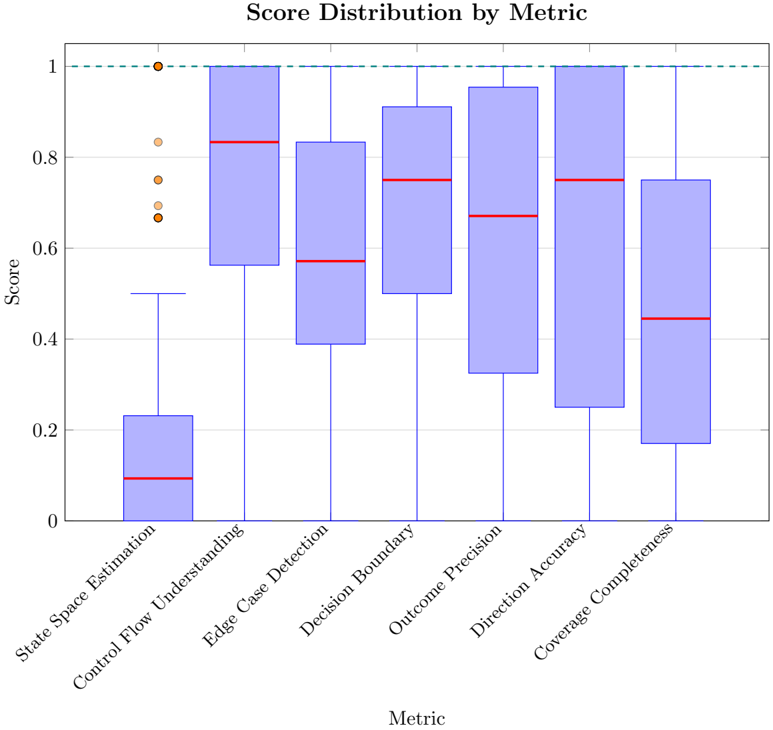
### Visual Description
## Box Plot: Score Distribution by Metric
### Overview
The image displays a box plot visualizing the distribution of scores across seven technical metrics. The y-axis represents scores ranging from 0 to 1, while the x-axis lists seven distinct metrics. Each metric is represented by a blue box plot with a red median line, and outliers are marked with orange and light orange dots. A horizontal dashed line at y=1 indicates a perfect score threshold.
### Components/Axes
- **X-Axis (Metrics)**:
1. State Space Estimation
2. Control Flow Understanding
3. Edge Case Detection
4. Decision Boundary
5. Outcome Precision
6. Direction Accuracy
7. Coverage Completeness
- **Y-Axis (Score)**:
- Scale: 0 to 1 (continuous)
- Labels: Numerical increments at 0.2, 0.4, 0.6, 0.8, 1.0
- **Legend**:
- Located at the top-right corner (position: top-right).
- Contains two entries:
- **Blue**: Box plots (likely representing interquartile ranges).
- **Red**: Median lines.
- *Note*: The legend does not explicitly define outlier markers (orange/light orange dots).
### Detailed Analysis
1. **State Space Estimation**:
- Median: ~0.1 (lowest among all metrics).
- Range: ~0.05 to ~0.5 (narrowest box plot).
- Outliers: Two orange dots at ~0.7 and ~0.8 (highest outliers in the dataset).
2. **Control Flow Understanding**:
- Median: ~0.8 (highest median).
- Range: ~0.6 to ~0.95.
- Outliers: None.
3. **Edge Case Detection**:
- Median: ~0.6.
- Range: ~0.4 to ~0.9.
- Outliers: One light orange dot at ~0.95.
4. **Decision Boundary**:
- Median: ~0.75.
- Range: ~0.5 to ~0.9.
- Outliers: None.
5. **Outcome Precision**:
- Median: ~0.7.
- Range: ~0.4 to ~0.95.
- Outliers: None.
6. **Direction Accuracy**:
- Median: ~0.75.
- Range: ~0.3 to ~1.0.
- Outliers: None.
7. **Coverage Completeness**:
- Median: ~0.45.
- Range: ~0.2 to ~0.8.
- Outliers: None.
### Key Observations
- **Highest Median**: Control Flow Understanding (~0.8) and Direction Accuracy (~0.75) show the strongest central tendencies.
- **Lowest Median**: State Space Estimation (~0.1) is significantly underperforming compared to others.
- **Widest Spread**: Direction Accuracy has the largest interquartile range (~0.3 to ~1.0), indicating high variability.
- **Outliers**:
- State Space Estimation has two high outliers (~0.7, ~0.8), suggesting rare exceptional cases.
- Edge Case Detection has one high outlier (~0.95).
- **Perfect Scores**: Two orange dots at y=1.0 (top of the plot) are present but not explicitly tied to specific metrics.
### Interpretation
The data suggests significant variability in performance across metrics. Control Flow Understanding and Direction Accuracy demonstrate robust central performance, while State Space Estimation struggles consistently. The presence of high outliers in State Space Estimation and Edge Case Detection implies that while most scores are low, there are rare instances of exceptional performance. The lack of a clear legend for outlier markers leaves ambiguity about their significance (e.g., whether they represent errors, edge cases, or data anomalies). The perfect score threshold (y=1.0) is unattained by any metric’s median, highlighting room for improvement across all categories.
</details>
Impact of Formal Methods Augmentation. The overall performance gap of 40-47 percentage points-comparing LLM-only performance (0 . 53-0 . 60) against perfect scores (1 . 0) achieved with region decomposition and verification-quantifies the value added by formal methods tools such as ImandraX when augmenting LLM-based code analysis.
Reproducibility. All raw data and scripts to reproduce these results are available at https:// github.com/imandra-ai/code-logic-bench .
Figure 20: Radar chart showing model performance in the seven metrics tested. Claude Opus 4.5 leads in State Space Estimation and Decision Boundary, while GPT 5.2 outperforms the others on Control Flow Understanding. Despite these variations, all models perform significantly worse than when augmented with CodeLogician.
<details>
<summary>Image 17 Details</summary>
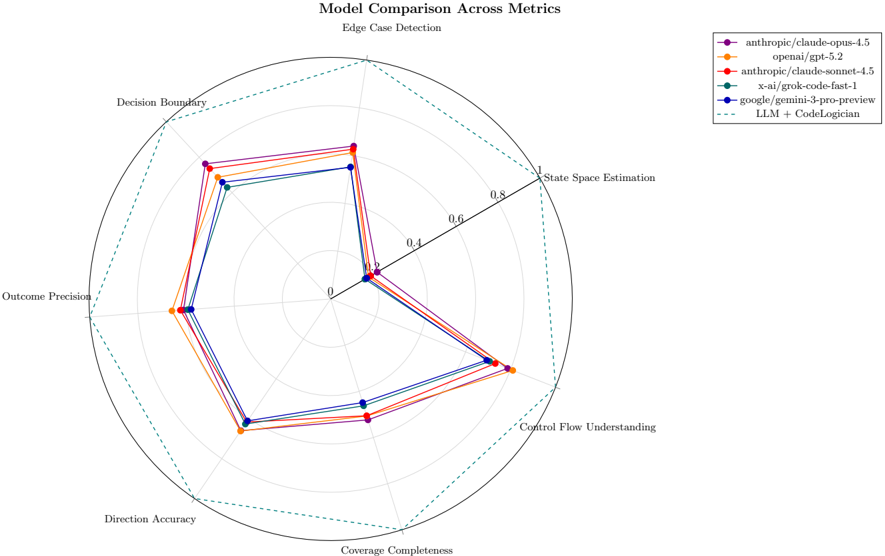
### Visual Description
## Radar Chart: Model Comparison Across Metrics
### Overview
The chart compares six AI models across seven technical metrics using a radar chart format. Models are represented by colored lines, with a dashed benchmark line (LLM + CodeLogician) for reference. The circular layout shows performance distribution across metrics, with radial distance indicating metric strength (0-1.0 scale).
### Components/Axes
- **Axes (clockwise from top):**
1. Edge Case Detection
2. Decision Boundary
3. Outcome Precision
4. Direction Accuracy
5. Coverage Completeness
6. Control Flow Understanding
7. State Space Estimation
- **Radial Scale:** 0.0 (center) to 1.0 (outer edge) in 0.2 increments
- **Legend (top-right):**
- Purple: anthropic/claude-opus-4.5
- Orange: openai/gpt-5.2
- Red: anthropic/claude-sonnet-4.5
- Teal: x-ai/grok-code-fast-1
- Blue: google/gemini-3-pro-preview
- Dashed: LLM + CodeLogician (benchmark)
### Detailed Analysis
1. **anthropic/claude-opus-4.5 (Purple):**
- Peaks at 0.85 in Edge Case Detection
- Strong in Decision Boundary (0.78) and Outcome Precision (0.72)
- Weakest in State Space Estimation (0.35)
2. **openai/gpt-5.2 (Orange):**
- Highest in Control Flow Understanding (0.92)
- Strong in Direction Accuracy (0.81) and Coverage Completeness (0.76)
- Moderate in Edge Case Detection (0.68)
3. **anthropic/claude-sonnet-4.5 (Red):**
- Matches Opus in Edge Case Detection (0.85)
- Strong in State Space Estimation (0.78)
- Weakest in Direction Accuracy (0.42)
4. **x-ai/grok-code-fast-1 (Teal):**
- Balanced performance (0.65-0.75 range)
- Weakest in State Space Estimation (0.48)
5. **google/gemini-3-pro-preview (Blue):**
- Most consistent performance (0.58-0.72 range)
- Strongest in Coverage Completeness (0.72)
6. **LLM + CodeLogician (Dashed):**
- Benchmark line at 0.65-0.80 range
- No model consistently exceeds this across all metrics
### Key Observations
- **Specialization vs. Generalization:** Models show clear specialization:
- Opus and Sonnet excel in Edge Case Detection
- GPT-5.2 dominates Control Flow Understanding
- Gemini shows balanced but unspectacular performance
- **Benchmark Gap:** All models fall short of the LLM + CodeLogician benchmark in at least one metric
- **State Space Estimation Weakness:** All models score below 0.8 in this metric
- **Direction Accuracy Variance:** Ranges from 0.42 (Sonnet) to 0.81 (GPT-5.2)
### Interpretation
The chart reveals fundamental trade-offs in AI model capabilities:
1. **Edge Case Masters (Opus/Sonnet):** Prioritize robustness in unusual scenarios but struggle with state space modeling
2. **Control Flow Specialists (GPT-5.2):** Excel at code structure analysis but lag in precision metrics
3. **Balanced Performers (Gemini):** Offer moderate capability across metrics but lack standout strengths
4. **Benchmark Significance:** The LLM + CodeLogician line suggests that combining models could potentially achieve more balanced performance, though current implementations show diminishing returns in certain areas.
Notably, the State Space Estimation metric appears to be a universal weakness, possibly indicating a fundamental challenge in current AI architectures for modeling complex state transitions. The Direction Accuracy variance suggests differing approaches to code navigation tasks between model architectures.
</details>
## 8 Case Studies
## 8.1 LSE GTT Order Expiry
This example concerns itself with an extended (by Imandra) version of the London Stock Exchange trading system specification. The Guide to the Trading System (MIT201) [13] specifies:
'Any GTT [Good Till Time] orders with an expiry time during any auction call phase will not be expired until after uncrossing has completed and are therefore eligible to participate in that uncrossing.'
The model implements a state machine with two trading modes (Continuous and Auction Call), GTT order lifecycle management, and an auction protection mechanism. The auction protection logic is implemented in the following Python function, with the full program available in Appendix A.
```
def maybe_expire_gtt_order_v2(state: State) -> State:
"""
Handle GTT order expiry with auction protection.
"""
```
## Model Comparison Across All Metrics
Figure 21: Chart showing model performance in the seven metrics tested. Scores are relative to those of the LLMs when augmented with CodeLogician.
<details>
<summary>Image 18 Details</summary>
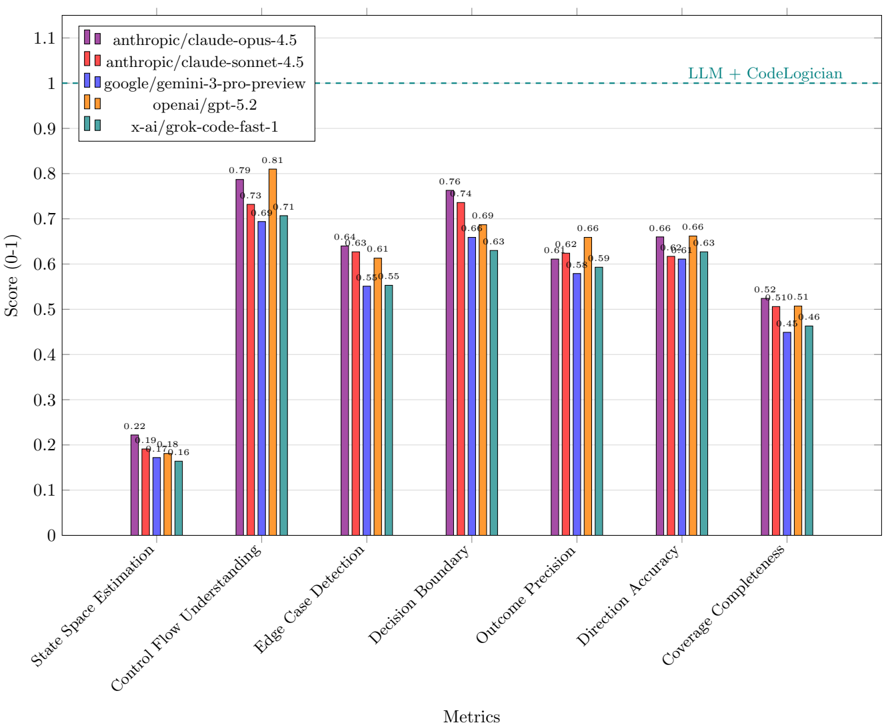
### Visual Description
## Bar Chart: Model Performance Across Technical Metrics
### Overview
The chart compares the performance of five AI models (anthropic/claude-opus-4.5, anthropic/claude-sonnet-4.5, google/gemini-3-pro-preview, openai/gpt-5.2, x-ai/grok-code-fast-1) across seven technical metrics. Scores range from 0 to 1.1, with a dashed reference line at 1.0 labeled "LLM + CodeLogician." The chart uses color-coded bars to represent each model's performance.
### Components/Axes
- **X-axis (Metrics)**: State Space Estimation, Control Flow Understanding, Edge Case Detection, Decision Boundary, Outcome Precision, Direction Accuracy, Coverage Completeness.
- **Y-axis (Score)**: 0 to 1.1, with increments of 0.1.
- **Legend**: Located in the top-left, mapping colors to models:
- Purple: anthropic/claude-opus-4.5
- Red: anthropic/claude-sonnet-4.5
- Blue: google/gemini-3-pro-preview
- Orange: openai/gpt-5.2
- Teal: x-ai/grok-code-fast-1
- **Dashed Line**: Horizontal line at 1.0 (LLM + CodeLogician benchmark).
### Detailed Analysis
1. **State Space Estimation**:
- anthropic/claude-opus-4.5: ~0.22
- anthropic/claude-sonnet-4.5: ~0.19
- google/gemini-3-pro-preview: ~0.18
- openai/gpt-5.2: ~0.18
- x-ai/grok-code-fast-1: ~0.16
2. **Control Flow Understanding**:
- anthropic/claude-opus-4.5: ~0.79
- anthropic/claude-sonnet-4.5: ~0.73
- google/gemini-3-pro-preview: ~0.71
- openai/gpt-5.2: ~0.81
- x-ai/grok-code-fast-1: ~0.73
3. **Edge Case Detection**:
- anthropic/claude-opus-4.5: ~0.63
- anthropic/claude-sonnet-4.5: ~0.61
- google/gemini-3-pro-preview: ~0.55
- openai/gpt-5.2: ~0.64
- x-ai/grok-code-fast-1: ~0.55
4. **Decision Boundary**:
- anthropic/claude-opus-4.5: ~0.76
- anthropic/claude-sonnet-4.5: ~0.69
- google/gemini-3-pro-preview: ~0.66
- openai/gpt-5.2: ~0.63
- x-ai/grok-code-fast-1: ~0.63
5. **Outcome Precision**:
- anthropic/claude-opus-4.5: ~0.62
- anthropic/claude-sonnet-4.5: ~0.61
- google/gemini-3-pro-preview: ~0.58
- openai/gpt-5.2: ~0.66
- x-ai/grok-code-fast-1: ~0.59
6. **Direction Accuracy**:
- anthropic/claude-opus-4.5: ~0.66
- anthropic/claude-sonnet-4.5: ~0.62
- google/gemini-3-pro-preview: ~0.61
- openai/gpt-5.2: ~0.63
- x-ai/grok-code-fast-1: ~0.61
7. **Coverage Completeness**:
- anthropic/claude-opus-4.5: ~0.52
- anthropic/claude-sonnet-4.5: ~0.51
- google/gemini-3-pro-preview: ~0.45
- openai/gpt-5.2: ~0.51
- x-ai/grok-code-fast-1: ~0.46
### Key Observations
- **Highest Scores**:
- **Control Flow Understanding**: openai/gpt-5.2 (0.81) and anthropic/claude-opus-4.5 (0.79) lead.
- **Edge Case Detection**: anthropic/claude-opus-4.5 (0.63) and openai/gpt-5.2 (0.64) perform best.
- **Lowest Scores**:
- **State Space Estimation**: x-ai/grok-code-fast-1 (0.16) and google/gemini-3-pro-preview (0.18) lag.
- **Benchmark Comparison**: All models fall below the "LLM + CodeLogician" benchmark (1.0), with the closest being openai/gpt-5.2 in Control Flow Understanding (0.81).
### Interpretation
The data reveals significant variability in model performance across metrics. While anthropic/claude-opus-4.5 and openai/gpt-5.2 consistently outperform others in critical areas like Control Flow Understanding and Edge Case Detection, no model reaches the "LLM + CodeLogician" benchmark. This suggests that combining models (e.g., LLM + CodeLogician) could yield superior results, though the chart does not explicitly test such combinations. The x-ai/grok-code-fast-1 model underperforms in most metrics, indicating potential limitations in its design or training data. The dashed line at 1.0 serves as a critical reference point, highlighting the gap between current models and the idealized performance threshold.
</details>
```
if state.gtt_order is None:
return state
expires_at = state.gtt_order.expires_at
if isinstance(state.mode, AuctionCallMode):
expires_at = max(expires_at, state.mode.uncross_at + 1)
if state.time >= expires_at:
return expire_order(state)
else:
return state
```
## 8.1.1 Verification
The critical property to verify is that auction uncross and order expiry events can never occur simultaneously. CodeLogician expressed this as a conflict detection predicate in IML:
```
let conflict_reachable msgs state k =
let final_state = run state (List.take k msgs) in
final_state.auction_event = Uncrossed && final_state.order_event = Expired
```
The verification goal asserts that for all valid initial states and message sequences, conflict\_reachable should return false . CodeLogician refuted the verification goal, producing a concrete counterexample:
```
let msgs = [Tick; Tick]
let state = {
time = 2699;
mode = AuctionCallMode {uncross_at = 2700};
gtt_order = Some {expires_at = 2700};
market_order_present_after_uncross = true;
market_order_extension_period = 1
}
```
This sequence of events is illustrated in Figure 22 (Appendix A).
The counterexample reveals a subtle interaction between two features: the auction protection logic extends order expiry to uncross\_at + 1 , while the market order extension feature delays the actual uncross to uncross\_at + extension\_period . When extension\_period = 1 , both events occur at the same tick.
This case demonstrates formal verification's ability to catch feature interaction bugs: the auction protection and market order extension features each work correctly in isolation, but their interaction was not properly considered. Traditional testing would likely miss this edge case, as it requires specific timing conditions that are difficult to anticipate manually.
## 8.2 London Stock Exchange Fee Schedule
This case study applies CodeLogician to the London Stock Exchange Trading Services Price List, verifying fee calculation logic with mathematical certainty. For algorithmic trading firms, accurate fee prediction is essential: a fraction of a basis point can determine whether a strategy is profitable, and errors across millions of daily orders compound into significant revenue leakage or unexpected costs. Exchange fee schedules present challenges: tiered pricing, minimum floors, rebates, and surcharges can interact in complex ways, and specifications are published as prose documents rather than machinereadable formats. Traditional testing struggles to cover all combinations exhaustively.
## 8.2.1 Verified Invariants
CodeLogician formally verified two invariants against all possible inputs.
The first invariant, 'Non-Persistent Order Charge Isolation,' establishes that an Immediate or Cancel (IOC) or Fill or Kill (FOK) order costs exactly £ 0.01 more than an identical Day (DAY) order, due to the order entry charge. CodeLogician expressed this property in IML as:
```
fun (price : real) (quantity : int) (is_aggressive : bool) (is_hidden : bool)
(package : package_type) (lps_tier : lps_tier_type) (security_type : security_type)
(cumulative_value : real) ->
calculate_total_cost price quantity true is_aggressive is_hidden package lps_tier
security_type cumulative_value
= calculate_total_cost price quantity false is_aggressive is_hidden package lps_tier security_type cumulative_value +. 0.01
```
CodeLogician proved this property holds for all combinations of inputs, demonstrating that the order entry charge logic is completely isolated from all other fee components.
The second invariant, 'LPS Zero-Fee Execution,' guarantees that when the rate equals 0.00bp and the minimum charge equals £ 0.00, the execution fee is exactly zero:
```
fun (notional_value : real) ->
calculate_execution_fee notional_value 0.0 0.0 false = 0.0
```
This ensures that liquidity providers-who receive a 0.00bp rate with no minimum-are never accidentally charged due to floating-point errors or logic edge cases.
## 8.2.2 Region Decomposition
Region decomposition revealed 6 distinct behavioral regions in the execution fee function, arising from the combinatorial interaction of factors including hidden order premiums, minimum charge floors, and negative rebate rates. The regions are partitioned by whether the order is hidden (triggering the +0.25bp premium), whether the rate is non-negative, and whether the minimum charge floor dominates the calculated fee.
The analysis identified 'crossover notionals'-trade sizes below which the minimum charge dominates the calculated fee. For example, a £ 1,000 trade at the standard 0.45bp rate yields a calculated fee of £ 0.045, but the minimum floor of £ 0.11 applies, resulting in an effective rate of 11bp-24 times the stated rate. Such boundaries vary by pricing scheme: the crossover for Standard Tier 1 (0.45bp, 11p minimum) is £ 2,444.44, while Package 1 (0.15bp, 5p minimum) crosses over at £ 3,333.33.
Negative rates (LPS rebates) bypass the minimum charge logic entirely-a design decision that prevents floors from being applied to rebates. CodeLogician verified an edge case where a large hidden order with LPS FTSE100 Top Tier (-0.15bp rebate + 0.25bp hidden premium) pays a net 0.10bp, not zero.
While this particular example may seem straightforward, the same analysis, when applied to complex fee schedules, can reveal hidden complexity and compliance risks, and provide a mathematical foundation for trust in the system.
## 8.3 Multilateral Netting Engine
In this example, CodeLogician analyzes a simple multilateral netting engine to find two critical bugs. The system has two critical invariants:
1. Zero-sum Conservation - the sum of all net positions must equal zero
2. Netting Efficiency - no party's exposure must increase as a result of netting.
Formal methods found issues pertaining to both of these requirements in the code. Bugs were found before any testing, concrete counterexamples presented, and once the code was corrected, CodeLogician proved the code mathematically correct. An excerpt of the code is exhibited below, with the full program available in Appendix B.
```
def calculate_net_obligations(trades: List[Trade]) -> Dict[str, float]:
"""
Calculate net obligations for all participants in a multilateral netting cycle.
"""
net_positions: Dict[str, float] = {}
for trade in trades:
```
```
net_positions[trade.payer_id] = \
net_positions.get(trade.payer_id, 0.0) - trade.amount
net_positions[trade.receiver_id] = \
net_positions.get(trade.receiver_id, 0.0) + trade.amount
return net_positions
```
## 8.3.1 Input Validation
The first bug to be found was an input validation problem where negative values were accepted, causing a violation of the netting efficiency requirement. CodeLogician found the counterexample
```
Trade(payer_id="", receiver_id="", amount=-10834.0)
```
In this case, Net Exposure, | 10834 | + |-10834 | = 21668, is greater than Gross Exposure, |-10834 | = 10834.
## 8.3.2 Floating Point Precision
The second issue found was with the use of floating-point arithmetic. CodeLogician identified that floating-point errors would cause the zero-sum conservation requirement to be violated. IEEE 754 [5] binary representation cannot exactly represent most decimal values; accumulated errors compound with each operation.
Consider the classic demonstration: summing 0.1 ten times in floating-point yields 0.9999999999999999, not 1.0. In high-frequency clearing with thousands of trades per second, such errors accumulate to material discrepancies. CodeLogician's counterexample demonstrated a scenario where {sum(net\_positions.values()) != 0.0 , violating the zero-sum invariant despite mathematically balanced trades.
The fix required migrating from Python's float to Decimal [2] for arbitrary-precision arithmetic, combined with defense-in-depth validation within the core algorithm. After applying the fix, CodeLogician re-verified the implementation, proving all three verification goals: exact zero-sum conservation, tolerance-based zero-sum, and netting efficiency. The corrected implementation provides mathematical certainty of correctness-a requirement for systems subject to EMIR [7] and Dodd-Frank Title VII [1].
## 9 Conclusion and Future Work
We have introduced CodeLogician , a neuro-symbolic agent and framework for rigorous reasoning about software systems that integrates Large Language Models (LLMs) with automated reasoning engines. We argue that while LLMs excel at translation, abstraction, and interaction, they fundamentally lack the capacity for precise, exhaustive reasoning about program behavior. CodeLogician addresses this limitation by teaching LLM-driven agents to construct explicit formal models of software and by delegating semantic reasoning to formal tools such as ImandraX .
A central contribution of this work is the demonstration that formal augmentation fundamentally changes the reasoning capabilities of LLM-based systems. Using a newly introduced benchmark targeting mathematical reasoning about software logic, we showed that LLM-only approaches systematically fail on tasks requiring exact boundary identification, combinatorial reasoning, and exhaustive coverage. By contrast, LLMs augmented with CodeLogician achieve complete and precise analysis, closing a 41-47 percentage point gap across multiple rigorously defined metrics. These results provide empirical evidence that rigorous program analysis cannot be achieved by statistical reasoning alone and that formal reasoning engines are essential for scaling AI-assisted software development beyond heuristic methods.
Beyond empirical results, we presented CodeLogician as a general framework rather than a single agent or solver. Its reasoner-agnostic architecture, agentic orchestration layer, and support for continuous, project-scale autoformalization enable principled integration of multiple reasoning tools and workflows. The CodeLogician server and PyIML strategies demonstrate how formalization can be
performed incrementally and persistently over evolving codebases, making formal reasoning practical in real-world development environments.
Future Work. Applying LLMs to formal reasoning about software presents both substantial challenges and exceptional opportunities. LLMs remain imperfect at maintaining global consistency, respecting strict semantic constraints, and scaling reasoning across large, interdependent codebases. At the same time, their strengths in translation, abstraction, and interaction make them uniquely well suited to act as interfaces between informal software artifacts and formal mathematical models.
Our ongoing work in this direction is embodied in SpecLogician , a complementary project focused on scalable, data-driven formal specification and refinement for large software systems. SpecLogician extends the ideas introduced in this paper by shifting the emphasis from individual code fragments to collections of specifications, traces, tests, logs, and other real-world artifacts. By combining LLMs with automated reasoning, SpecLogician aims to incrementally synthesize, refine, and validate formal specifications at scale, even in settings where complete or authoritative specifications do not exist upfront.
Looking forward, we plan to deepen the integration between CodeLogician and SpecLogician , enabling closed-loop workflows in which specifications, implementations, and empirical artifacts co-evolve under formal constraints. Additional future directions include extending support to new source languages and reasoning backends, improving dependency-aware and incremental formalization strategies, and using formal counterexamples, region decompositions, and proofs to actively guide LLM behavior during development.
Ultimately, we view CodeLogician and SpecLogician as steps toward a new class of AI-assisted software engineering systems in which LLMs and formal reasoning engines operate symbiotically. By grounding AI-assisted development in explicit formal models and mathematically sound analysis, such systems can move beyond probabilistic correctness toward rigorous, auditable, and scalable reasoning about complex software systems.
## A LSE GTT Order Expiry
## A.1 Python model
```
A LSE GTT Order Expiry
A.1 Python model
```
```
class State:
"""The complete state of the trading venue."""
time: Time
auction_call_duration: Time
auction_interval: Time
mode: Mode
gtt_order: Optional[GTTOrder]
auction_event: Optional[AuctionEvent]
order_event: Optional[OrderEvent]
# Extended state for market order feature
market_order_present_after_uncross: bool
market_order_extension_period: Time
class Message(Enum):
"""Messages that can be processed by the venue."""
TICK = "tick"
@dataclass
class CreateGTTOrder:
"""Message to create a GTT order."""
expires_at: Time
# Helper functions
def is_valid_state(state: State) -> bool:
"""
Check if a state is valid according to business invariants.
VG: State validity invariants should always hold:
- Time is non-negative
- Durations are positive
- Scheduled times are in the future
- GTT order expiry is in the future
"""
if state.time < 0:
return False
if state.auction_call_duration <= 0:
return False
if state.auction_interval <= 0:
return False
if state.market_order_extension_period <= 0:
return False
# Check mode-specific invariants
if isinstance(state.mode, ContinuousMode):
if state.mode.start_auction_call_at <= state.time:
return False
elif isinstance(state.mode, AuctionCallMode):
if state.mode.uncross_at <= state.time:
return False
# GTT order expiry must be in the future
if state.gtt_order is not None:
if state.gtt_order.expires_at <= state.time:
return False
return True
```
```
def events_none(state: State) -> bool:
"""Check if no events are set (used for initial states)."""
return state.auction_event is None and state.order_event is None
# Core business logic functions
def maybe_create_gtt_order(expires_at: Time, state: State) -> State:
"""
Handle an incoming GTT order.
VG: Orders with expiry <= current time should be rejected
"""
if expires_at <= state.time:
# Reject order - no state change
return state
else:
# Accept order
return State(
time=state.time,
auction_call_duration=state.auction_call_duration,
auction_interval=state.auction_interval,
mode=state.mode,
gtt_order=GTTOrder(expires_at=expires_at),
auction_event=state.auction_event,
order_event=OrderEvent.CREATED,
market_order_present_after_uncross=state.market_order_present_after_uncross,
market_order_extension_period=state.market_order_extension_period
)
def start_auction(state: State) -> State:
"""
Start an auction call phase.
Sets mode to AuctionCall, schedules uncross, emits event.
"""
return State(
time=state.time,
auction_call_duration=state.auction_call_duration,
auction_interval=state.auction_interval,
mode=AuctionCallMode(uncross_at=state.time + state.auction_call_duration),
gtt_order=state.gtt_order,
auction_event=AuctionEvent.AUCTION_CALL_STARTED,
order_event=state.order_event,
market_order_present_after_uncross=state.market_order_present_after_uncross,
market_order_extension_period=state.market_order_extension_period
)
def uncross(state: State) -> State:
"""
Complete the auction uncross.
Sets mode to Continuous, schedules next auction, emits event.
"""
return State(
time=state.time,
auction_call_duration=state.auction_call_duration,
auction_interval=state.auction_interval,
mode=ContinuousMode(start_auction_call_at=state.time + state.auction_interval),
gtt_order=state.gtt_order,
```
```
auction_event=AuctionEvent.UNCROSSED,
order_event=state.order_event,
market_order_present_after_uncross=state.market_order_present_after_uncross,
market_order_extension_period=state.market_order_extension_period
)
def maybe_uncross(uncross_at: Time, state: State) -> State:
"""
Handle uncrossing with market order extension logic.
VG: If market orders remain, auction is extended by extension_period
"""
if state.market_order_present_after_uncross:
# Market orders remain - check if extension period has elapsed
if state.time >= uncross_at + state.market_order_extension_period:
# Extension period complete - uncross and clear market order flag
new_state = State(
time=state.time,
auction_call_duration=state.auction_call_duration,
auction_interval=state.auction_interval,
mode=state.mode,
gtt_order=state.gtt_order,
auction_event=state.auction_event,
order_event=state.order_event,
market_order_present_after_uncross=False,
market_order_extension_period=state.market_order_extension_period
)
return uncross(new_state)
else:
# Still in extension period
return state
else:
# No market orders - uncross immediately
return uncross(state)
def maybe_change_mode(state: State) -> State:
"""
Handle timed mode changes (auction start or uncross).
VG: Mode changes occur at scheduled times
"""
if isinstance(state.mode, ContinuousMode):
if state.time >= state.mode.start_auction_call_at:
return start_auction(state)
elif isinstance(state.mode, AuctionCallMode):
if state.time >= state.mode.uncross_at:
return maybe_uncross(state.mode.uncross_at, state)
return state
def maybe_expire_gtt_order_v2(state: State) -> State:
"""
Handle GTT order expiry with auction protection.
CRITICAL FIX: Per MIT201, GTT orders expiring during auction call
should not expire until AFTER uncross completes.
VG: GTT orders with expiry during auction call must not expire
until after uncross (expires_at is extended to uncross_at + 1)
```
```
"""
if state.gtt_order is None:
return state
expires_at = state.gtt_order.expires_at
# Key fix: Delay expiry if we're in auction call mode
if isinstance(state.mode, AuctionCallMode):
# Extend expiry to after uncross
expires_at = max(expires_at, state.mode.uncross_at + 1)
if state.time >= expires_at:
# Expire the order
return State(
time=state.time,
auction_call_duration=state.auction_call_duration,
auction_interval=state.auction_interval,
mode=state.mode,
gtt_order=None,
auction_event=state.auction_event,
order_event=OrderEvent.EXPIRED,
market_order_present_after_uncross=state.market_order_present_after_uncross,
market_order_extension_period=state.market_order_extension_period
)
else:
return state
def tick(state: State) -> State:
"""
Process a clock tick - advance time and handle timed events.
Order of operations matters:
1. Advance time
2. Check for order expiry
3. Check for mode changes
VG: Time advances monotonically
"""
# Advance time
state = State(
time=state.time + 1,
auction_call_duration=state.auction_call_duration,
auction_interval=state.auction_interval,
mode=state.mode,
gtt_order=state.gtt_order,
auction_event=state.auction_event,
order_event=state.order_event,
market_order_present_after_uncross=state.market_order_present_after_uncross,
market_order_extension_period=state.market_order_extension_period
)
# Check for order expiry
state = maybe_expire_gtt_order_v2(state)
# Check for mode changes
state = maybe_change_mode(state)
return state
def step(msg: Message | CreateGTTOrder, state: State) -> State:
```
```
"""
Process a single message and return the new state.
VG: Each message type should transition state correctly
"""
if msg == Message.TICK:
return tick(state)
elif isinstance(msg, CreateGTTOrder):
return maybe_create_gtt_order(msg.expires_at, state)
else:
return state
def run(state: State, msgs: List[Message | CreateGTTOrder]) -> State:
"""
Process a sequence of messages.
VG: Event fields are cleared before processing each message
VG: Message sequence processing is deterministic
"""
for msg in msgs:
# Clear events before processing each message
state = State(
time=state.time,
auction_call_duration=state.auction_call_duration,
auction_interval=state.auction_interval,
mode=state.mode,
gtt_order=state.gtt_order,
auction_event=None,
order_event=None,
market_order_present_after_uncross=state.market_order_present_after_uncross,
market_order_extension_period=state.market_order_extension_period
)
state = step(msg, state)
return state
def conflict_reachable(msgs: List[Message | CreateGTTOrder], state: State, k: int = 5) -> bool:
"""
CRITICAL VERIFICATION GOAL:
Check if it's possible to reach a state where BOTH:
- An uncross event occurs AND
- A GTT order expires
at the same time.
Per MIT201, this should NEVER happen - GTT orders expiring during
auction call must wait until after uncross.
VG: verify that NOT conflict_reachable for all valid initial states
and message sequences
"""
# Limit message sequence length
limited_msgs = msgs[:k]
# Run the model
final_state = run(state, limited_msgs)
# Check for the conflict
return (final_state.auction_event == AuctionEvent.UNCROSSED and
```
```
final_state.order_event == OrderEvent.EXPIRED)
# Verification Goals (VGs) explained in comments above each function
# These are the properties the author was verifying:
# VG1: State validity invariants (is_valid_state)
# VG2: Order rejection logic (maybe_create_gtt_order)
# VG3: Auction timing correctness (start_auction, uncross)
# VG4: Market order extension logic (maybe_uncross)
# VG5: Mode transition correctness (maybe_change_mode)
# VG6: GTT order expiry protection during auction (maybe_expire_gtt_order_v2)
# VG7: Time monotonicity (tick)
# VG8: Message processing determinism (step, run)
# VG9: CRITICAL - No simultaneous uncross and expiry (conflict_reachable)
```
## A.2 Sequence diagram
Figure 22: Sequence diagram illustrating how the initial conditions found by CodeLogician cause a violation of the MIT201 specification.
<details>
<summary>Image 19 Details</summary>
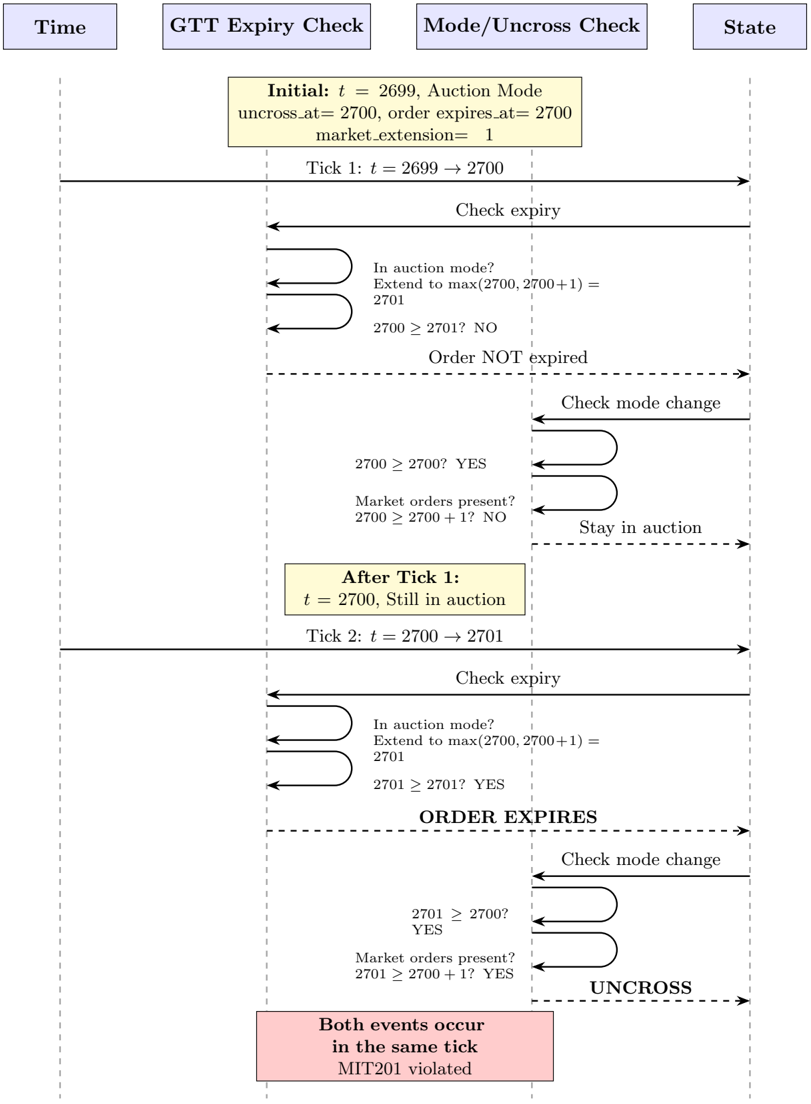
### Visual Description
## Flowchart: Order Expiry and Mode Check Process
### Overview
This flowchart illustrates a multi-step process for checking order expiry and mode changes over time, with specific conditions triggering state transitions. It includes two primary ticks (time intervals) and highlights critical violations of a rule labeled "MIT201" when conflicting events occur simultaneously.
---
### Components/Axes
1. **Header Section**:
- **Time**: Vertical axis labeled with timestamps (e.g., `t = 2699`, `t = 2700`, `t = 2701`).
- **GTT Expiry Check**: Boxes for expiry validation.
- **Mode/Uncross Check**: Boxes for mode validation and uncross detection.
- **State**: Final outcomes (e.g., "Order NOT expired," "ORDER EXPIRES," "UNCROSS").
2. **Main Flow**:
- **Initial State**: `t = 2699`, Auction Mode, `uncross.at = 2700`, `order.expires.at = 2700`, `market_extension = 1`.
- **Tick 1**: Transition from `t = 2699 → 2700`.
- **Tick 2**: Transition from `t = 2700 → 2701`.
3. **Decision Nodes**:
- **Check expiry**: Validates if `t >= order.expires.at`.
- **In auction mode?**: Conditional check for mode.
- **Extend to max(2700, 2700+1) = 2701**: Adjusts expiry time.
- **Market orders present?**: Checks for market orders at `t + 1`.
4. **Outcomes**:
- **Order NOT expired**: Path when expiry conditions fail.
- **ORDER EXPIRES**: Path when expiry conditions pass.
- **UNCROSS**: Path when uncross conditions pass.
- **MIT201 violated**: Highlighted box indicating simultaneous expiry and uncross events.
---
### Detailed Analysis
1. **Initial State**:
- `t = 2699`: Auction Mode active.
- `uncross.at = 2700`: Uncross event scheduled at `t = 2700`.
- `order.expires.at = 2700`: Order expiry scheduled at `t = 2700`.
- `market_extension = 1`: Market orders allowed until `t + 1`.
2. **Tick 1 (`t = 2699 → 2700`)**:
- **Check expiry**: `2700 >= 2700` (YES).
- **In auction mode?**: YES → Extend expiry to `max(2700, 2701) = 2701`.
- **Market orders present?**: `2700 >= 2700 + 1` (NO) → Stay in auction.
- **After Tick 1**: `t = 2700`, Still in auction.
3. **Tick 2 (`t = 2700 → 2701`)**:
- **Check expiry**: `2701 >= 2701` (YES) → ORDER EXPIRES.
- **Check mode change**: `2701 >= 2700` (YES).
- **Market orders present?**: `2701 >= 2700 + 1` (YES) → UNCROSS.
- **Both events occur in the same tick**: MIT201 violated (highlighted in pink).
---
### Key Observations
1. **MIT201 Violation**: Occurs when both expiry and uncross events are triggered in the same tick (`t = 2701`), indicating a conflict in state transitions.
2. **Expiry Logic**: Orders expire at `t = 2701` after extension, but market orders at `t + 1` trigger uncross checks.
3. **Mode Persistence**: The system remains in auction mode until conflicting events occur.
---
### Interpretation
This flowchart models a time-sensitive order management system where:
- **Expiry and uncross events** are interdependent, with expiry checks extending deadlines under certain conditions.
- The **MIT201 violation** highlights a critical edge case where simultaneous events (`ORDER EXPIRES` and `UNCROSS`) at `t = 2701` create ambiguity, requiring resolution to avoid state inconsistency.
- The process emphasizes **temporal sequencing** (e.g., `market_extension = 1` delaying market order checks until `t + 1`), ensuring orderly state transitions.
The diagram underscores the importance of precise timing and conditional logic in systems managing auction modes and order lifecycles.
</details>
## B Multilateral Netting Engine
## B.1 Python model
```
B Multilateral Netting Engine
B.1 Python model
```
```
Invariants Maintained:
1. Zero-Sum: sum(net_positions.values()) == 0.0
2. Netting Efficiency: sum(|net|) <= sum(|gross|)
Example:
>>> trades = [
... Trade("A", "B", 100.0),
... Trade("B", "C", 50.0),
... Trade("C", "A", 30.0)
... ]
>>> net = calculate_net_obligations(trades)
>>> net
{'A': -70.0, 'B': 50.0, 'C': 20.0}
>>> sum(net.values()) # Zero-sum check
0.0
"""
net_positions: Dict[str, float] = {}
for trade in trades:
# Payer: outgoing payment (negative)
net_positions[trade.payer_id] = net_positions.get(trade.payer_id, 0.0) - trade.amount
# Receiver: incoming payment (positive)
net_positions[trade.receiver_id] = net_positions.get(trade.receiver_id, 0.0) + trade.amount
return net_positions
def verify_zero_sum(net_positions: Dict[str, float], tolerance: float = 1e-10) -> bool:
"""
Verify the Zero-Sum invariant (Conservation of Cash).
Args:
net_positions: Dictionary of participant net positions
tolerance: Floating-point tolerance for zero comparison
Returns:
True if sum of all positions is within tolerance of zero
"""
total = sum(net_positions.values())
return abs(total) < tolerance
def verify_netting_efficiency(
trades: List[Trade],
net_positions: Dict[str, float]
) -> bool:
"""
Verify the Netting Efficiency invariant.
The sum of absolute net positions should never exceed the sum of
absolute gross trade amounts. Netting should reduce exposure.
Args:
trades: Original bilateral trades
net_positions: Computed net positions
Returns:
True if netting reduces or maintains total exposure
"""
gross_exposure = sum(trade.amount for trade in trades)
net_exposure = sum(abs(position) for position in net_positions.values())
```
```
return net_exposure <= gross_exposure
def calculate_netting_benefit(
trades: List[Trade],
net_positions: Dict[str, float]
) -> float:
"""
Calculate the reduction in cash flows achieved by netting.
Returns:
Percentage reduction in gross obligations (0.0 to 100.0)
"""
if not trades:
return 0.0
gross_exposure = sum(trade.amount for trade in trades)
net_exposure = sum(abs(position) for position in net_positions.values())
if gross_exposure == 0.0:
return 0.0
reduction = ((gross_exposure - net_exposure) / gross_exposure) * 100.0
return reduction
```
## B.2 Evaluation Example: Transportation Risk Manager
To illustrate the patterns observed across the 50-model evaluation, we present a detailed analysis of the transportation risk manager model. This system evaluates route decisions based on transport mode (Truck, Rail, Air, Sea), cargo type (Standard, Fragile, Hazardous, Perishable), weather conditions, and geopolitical risks, determining whether routes are approved and whether emergency routing should be activated.
## B.2.1 The Three Questions
The model was evaluated using three questions designed to test different aspects of code reasoning:
1. State Space Estimation (Q1): 'How many distinct routing scenarios exist for Sea transport when operating under geopolitical tensions (Tensions, Sanctions, or WarZone)?'
2. Conditional Analysis (Q2): 'Can Air transport ever be rejected for Standard (non-Hazardous) cargo? If yes, under what conditions?'
3. Property Verification (Q3): 'For Air transport specifically, does having both cargo value > 100000 AND time critical < 24 always activate emergency routing when the route is approved?'
## B.2.2 Question 1: State Space Estimation
CodeLogician Result. Region decomposition identified 117 distinct scenarios for Sea transport under geopolitical tensions. These scenarios arise from the interaction of:
- 3 geopolitical risk levels (Tensions, Sanctions, WarZone)
- 5 weather conditions (Clear, Rain, Snow, Storm, Hurricane)
- 4 cargo types (Standard, Fragile, Hazardous, Perishable)
- Numeric threshold boundaries for cargo value and time critical
Critically, the decomposition reveals that numeric parameters create additional scenario boundaries. For example, one region is defined by:
```
mode = Sea
geopolitical = Sanctions
cargo = Hazardous
weather = Clear
time_critical <= 23
cargo_value >= 100001
```
This scenario results in emergency routing = true because three of the four emergency conditions are satisfied. A different region with cargo value <= 100000 produces emergency routing = false -a behaviorally distinct scenario that categorical analysis misses.
LLM Estimates. Table 1 summarizes the LLM estimates. All models significantly underestimated the scenario count, with errors ranging from 2 × to 39 × .
Table 1: Q1 state space estimates by model. All LLMs underestimated the scenario count, consistent with the 0.186 mean State Space Estimation Accuracy reported in the main evaluation.
| Model | Estimate | Actual | Error Factor |
|----------------------|------------|----------|----------------|
| grok-code-fast-1 | 15 | 117 | 7.8 × |
| claude-sonnet-4.5 | 14 | 117 | 8.4 × |
| claude-opus-4.5 | 15 | 117 | 7.8 × |
| gemini-3-pro-preview | 60 | 117 | 2.0 × |
| gpt-5.2 | 3 | 117 | 39 × |
Analysis. The LLMs applied simple categorical reasoning: 3 (geopolitical) × 5 (weather) = 15 scenarios, or variations thereof. This approach correctly counts the categorical combinations but fails to account for how numeric thresholds ( cargo value > 100000 , time critical < 24 , route cost < 1000 , route time < 72 ) partition the state space further. The emergency routing logic alone creates multiple behavioral regions within each categorical combination.
GPT-5.2's estimate of 3 scenarios (counting only the geopolitical risk levels) represents an extreme case of categorical oversimplification. Gemini-3-pro's estimate of 60 came closest by attempting to include cargo types (3 × 5 × 4 = 60), but still missed the numeric threshold boundaries.
## B.2.3 Question 2: Conditional Analysis
CodeLogician Result. Decomposition confirmed that Air transport can be rejected for Standard cargo under exactly 2 scenarios :
1. weather = Hurricane AND geopolitical = WarZone
2. weather = Hurricane AND geopolitical = Sanctions (air grounded)
```
(extreme risk)
```
LLM Results. All five models correctly identified both rejection scenarios. For example, Claude Opus 4.5 reasoned:
'Air transport can still be rejected via the is route viable check. The air grounded condition triggers when: mode=AIR AND weather=HURRICANE AND geopolitical=SANCTIONS . The extreme risk condition triggers when: weather=HURRICANE AND geopolitical=WAR ZONE (applies to all modes including Air).'
Analysis. This question tests explicit boolean logic that is directly visible in the code:
```
def _is_route_viable(mode, weather, geopolitical):
extreme_risk = (weather == HURRICANE
and geopolitical == WAR_ZONE)
air_grounded = (mode == AIR
and weather == HURRICANE
and geopolitical == SANCTIONS)
return not (extreme_risk or air_grounded)
```
The conditions are explicit, categorical, and do not involve numeric thresholds or complex interactions. This explains the 100% success rate: LLMs excel at tracing explicit control flow when conditions are directly stated in the code. This result is consistent with the relatively higher Control Flow Understanding score (0.746) reported in the main evaluation.
## B.2.4 Question 3: Property Verification
The Property. The question asks whether, for approved Air routes, the conjunction of cargo value > 100000 AND time critical < 24 is sufficient to guarantee emergency routing activation.
CodeLogician Result. ImandraX proved the property always holds. The intuition behind why this property holds can be understood as follows:
## Why the Property Holds
Emergency routing activates when at least 3 of 4 conditions are true:
- c1 : cargo value > 100000 - given as true by the property premise
- c2 : time critical < 24 - given as true by the property premise
- c3 : route cost < 1000 - varies depending on weather and geopolitical factors
- c4 : route time < 72 - for Air: base time = 8, max multiplier = 3, so max time = 24 < 72
Since c4 is always true for Air transport (route time cannot exceed 24 hours), and c1 and c2 are given by the premise, we have at least 3 conditions satisfied regardless of c3 .
LLM Results. The models produced mixed results:
- Correct: GPT-5.2, Gemini-3-pro-preview correctly concluded the property holds.
- Incorrect: Grok-code-fast-1 concluded 'No,' claiming that route cost = 1000 (exactly) would make c3 false, leaving only 2 conditions met.
- Self-corrected: Claude Opus 4.5 initially answered 'No' but corrected itself mid-reasoning.
Anatomy of Self-Correction. Claude Opus 4.5's reasoning demonstrates the challenge of discovering numeric invariants without formal analysis:
'Air route cost can exceed 1000: e.g., AIR + STORM + WAR ZONE = 500 × 3 × 4 = 6000 ¿ 1000. In scenarios where cost ≥ 1000 (c3 false) and route time ≥ 72 (never happens for Air, max is 24), emergency would fail... Wait, re-checking: Air + HURRICANE scenarios are limited. Let me verify c4 is always true: max Air time = 8 × 3 = 24 ¡ 72, so yes c4 is always true for Air. Correction: With cargo value ¿ 100000 (c1=true), time critical ¡ 24 (c2=true), and route time always ¡ 72 for Air (c4=true), we have 3 conditions, so emergency IS always activated.'
The model eventually discovered the invariant through explicit arithmetic verification, but only after initially reaching the wrong conclusion. Grok-code-fast-1 made a similar initial error but did not self-correct, focusing on the boundary case route cost = 1000 without recognizing that c4 compensates.
Analysis. This question tests the ability to reason about numeric constraints that determine behavior. The key insight (Air's route time is bounded at 24 hours) requires:
1. Recognizing that route time depends on base time and weather multipliers
2. Computing the maximum possible value for Air specifically
3. Connecting this bound to the emergency threshold (72 hours)
ImandraX establishes this property through logical deduction. LLMs may arrive at the same conclusion through explicit arithmetic (as Claude Opus eventually did), but this process is unreliablesome models self-correct while others do not, as demonstrated by Grok's failure to recognize that c4 compensates for any value of c3 .
## B.2.5 Summary
This case study illustrates the patterns observed across the full evaluation:
1. State Space Estimation : LLMs systematically underestimate scenario counts by treating numeric parameters as irrelevant. The 2-39 × error range in Q1 is consistent with the 0.186 mean accuracy reported in the main section.
2. Explicit Control Flow : When conditions are directly visible as boolean expressions (Q2), LLMs perform well, achieving 100% accuracy on the conditional analysis task.
3. Numeric Invariants : Properties requiring discovery of domain-specific bounds (Q3) challenge LLMs. While self-correction is possible, it is unreliable-some models correct themselves, others do not.
While different LLMs exhibit varying performance levels-with some models like Claude Opus 4.5 demonstrating self-correction capabilities that others lack-all models share inherent limitations when reasoning about code without formal methods support. Region decomposition provides exhaustive state space analysis that no LLM achieved, and theorem proving establishes properties with logical certainty that LLMs can only approximate through heuristic reasoning. These limitations are fundamental to current LLM architectures rather than artifacts of any particular model.
## References
- [1] 111th United States Congress. Dodd-Frank Wall Street Reform and Consumer Protection Act. https://www.congress.gov/bill/111th-congress/house-bill/4173 , 2010.
- [2] F. Batista. PEP 327 - Decimal Data Type. https://peps.python.org/pep-0327/ , 2003.
- [3] W. R. Bevier, W. A. Hunt, J. S. Moore, and W. D. Young. Special Issue on System Verification. Journal of Automated Reasoning , 5(4):409-530, 1989.
- [4] R. S. Boyer and J. S. Moore. A Computational Logic . Academic Press Professional, Inc., USA, 1979.
- [5] I. S. Committee. IEEE standard for floating-point arithmetic. IEEE Std 754-2008 , pages 1-70, 2008. doi: 10.1109/IEEESTD.2008.4610935.
- [6] R. Desmartin, O. Isac, G. Passmore, E. Komendantskaya, K. Stark, and G. Katz. A Certified Proof Checker for Deep Neural Network Verification in Imandra. In Y. Forster and C. Keller, editors, 16th International Conference on Interactive Theorem Proving (ITP 2025) , volume 352 of Leibniz International Proceedings in Informatics (LIPIcs) , pages 1:1-1:21, Dagstuhl, Germany, 2025. Schloss Dagstuhl - Leibniz-Zentrum f¨ ur Informatik. ISBN 978-3-95977-396-6. doi: 10.4230/ LIPIcs.ITP.2025.1. URL https://drops.dagstuhl.de/entities/document/10.4230/LIPIcs. ITP.2025.1 .
- [7] European Parliament and Council of the European Union. Regulation (EU) No 648/2012 on OTC derivatives, central counterparties and trade repositories (EMIR). https://eur-lex.europa.eu/ legal-content/EN/TXT/?uri=CELEX:32012R0648 , 2012.
- [8] Imandra, Inc. CodeLogician IML Agent. https://marketplace.visualstudio.com/items? itemName=imandra.imandra-code-logician , 2025.
- [9] Imandra Inc. Code Logic Bench: A Benchmark for Evaluating Program Reasoning. https: //github.com/imandra-ai/code-logic-bench , 2026. GitHub repository.
- [10] Imandra Inc. Imandra protocol language (IPL) documentation. https://docs.imandra.ai/ipl/ , 2026. Accessed: 2026-01-16.
- [11] Imandra Inc. Region decomposition: Stock exchange trade pricing. https://docs.imandra.ai/ imandra-docs/notebooks/six-swiss-exchange-pricing/ , 2026. Accessed: 2026-01-16.
- [12] Imandra Inc. Supervised learning with imandra. https://docs.imandra.ai/imandra-docs/ notebooks/supervised-learning/ , 2026. Accessed: 2026-01-16.
- [13] London Stock Exchange. MIT201 -Guide to the trading system. https://docs.londonstockexchange.com/sites/default/files/documents/ mit201-guide-to-the-trading-system-15\_6\_20240429.pdf , 2024.
- [14] G. Passmore, S. Cruanes, D. Ignatovich, D. Aitken, M. Bray, E. Kagan, K. Kanishev, E. Maclean, and N. Mometto. The Imandra Automated Reasoning System (System Description). In Proc. 10th Int. Joint Conf. Automated Reasoning (IJCAR) , pages 464-471, 2020.
- [15] G. O. Passmore. Some Lessons Learned in the Industrialization of Formal Methods for Financial Algorithms. In Proc. 24th Int. Symposium on Formal Methods (FM) , pages 717-721, 2021.
- [16] G. O. Passmore and D. Ignatovich. Formal verification of financial algorithms. In L. de Moura, editor, Automated Deduction CADE 26 - 26th International Conference on Automated Deduction, Gothenburg, Sweden, August 6-11, 2017, Proceedings , volume 10395 of Lecture Notes in Computer Science , pages 26-41. Springer, 2017. doi: 10.1007/978-3-319-63046-5 \ 3. URL https://doi.org/10.1007/978-3-319-63046-5\_3 .
- [17] C. M. Wintersteiger. Formal verification of the IEEE P3109 standard for binary floating-point formats for machine learning. In 2025 IEEE 32nd Symposium on Computer Arithmetic (ARITH) , pages 157-160, 2025. doi: 10.1109/ARITH64983.2025.00032.