# The Orchestration of Multi-Agent Systems: Architectures, Protocols, and Enterprise Adoption
**Authors**: Apoorva Adimulam, Rajesh Gupta, Sumit Kumar
Abstract
Orchestrated multi-agent systems represent the next stage in the evolution of artificial intelligence, where autonomous agents collaborate through structured coordination and communication to achieve complex, shared objectives. This paper consolidates and formalizes the technical composition of such systems, presenting a unified architectural framework that integrates planning, policy enforcement, state management, and quality operations into a coherent orchestration layer. Another primary contribution of this work is the in-depth technical delineation of two complementary communication protocols—the Model Context Protocol, which standardizes how agents access external tools and contextual data, and the Agent-to-Agent protocol, which governs peer coordination, negotiation, and delegation. Together, these protocols establish an interoperable communication substrate that enables scalable, auditable, and policy-compliant reasoning across distributed agent collectives. Beyond protocol design, the paper details how orchestration logic, governance frameworks, and observability mechanisms collectively sustain system coherence, transparency, and accountability. By synthesizing these elements into a cohesive technical blueprint, this paper provides comprehensive treatments of orchestrated multi-agent systems—bridging conceptual architectures with implementation-ready design principles for enterprise-scale AI ecosystems.
I Introduction
The landscape of LLM-powered agents has undergone a marked transformation. Early deployments prioritized isolated, task-specific agents, highly specialized systems with narrow operating scopes. However, contemporary trends point toward ecosystems of collaborating agents. This transition mirrors broader developments in distributed computing, where value emerges less from individual capabilities and more from orchestrated interactions within a collective.
Several technical drivers explain why the pivot to multi-agent architectures is emerging now including:
- scalability limits of LLMs, where context length and reasoning bottlenecks constrain performance
- the need for specialization versus generalization, enabling modular agents optimized for specific domains to be composed dynamically
- advances in communication protocols, with message-passing abstractions and nascent standards for inter-agent APIs
- economic efficiency, as distributed collectives of smaller agents often outperform costly all-purpose deployments as demonstrated in [1], [2]
Recent industry signals underscore the momentum of this transition. At the enterprise level, PwC has positioned its Agent OS [3] as a switchboard for multi-agent coordination, emphasizing composability and interoperability across enterprise functions. Similarly, Accenture’s Trusted Agent Huddle [4] introduces governance mechanisms for secure, cross-organizational workflows and aligns with the emerging Agent-to-Agent (A2A) protocol. At the same time, research and development within the technical ecosystem has accelerated with frameworks such as LangChain, AutoGen, IBM Watsonx Orchestrate, and Google’s Agent Development Kit providing modular infrastructure for coordination, negotiation, and role-based task delegation. Collectively, these initiatives signal rapid movement toward standardization and operational readiness.
The remainder of this paper progresses from conceptual foundations to practical realization. Section II traces the evolution of agentic systems toward orchestrated collectives, while Section III establishes the architectural composition of multi-agent systems and outlines their essential components. Sections IV–VII expand on these components in depth, examining how specialized agent roles, orchestration logic, communication protocols, and governance mechanisms together form the technical backbone of orchestrated intelligence. Section VIII presents real-world case studies that demonstrate the practical impact of these architectures across industries. Section IX discusses the challenges and risks associated with scaling multi-agent systems, and the future research directions aimed at improving efficiency, reliability, and interoperability. Finally, Section X concludes with key insights on how orchestrated multi-agent systems can serve as a foundation for enterprise-scale AI ecosystems.
II Evolution of Agentic Systems
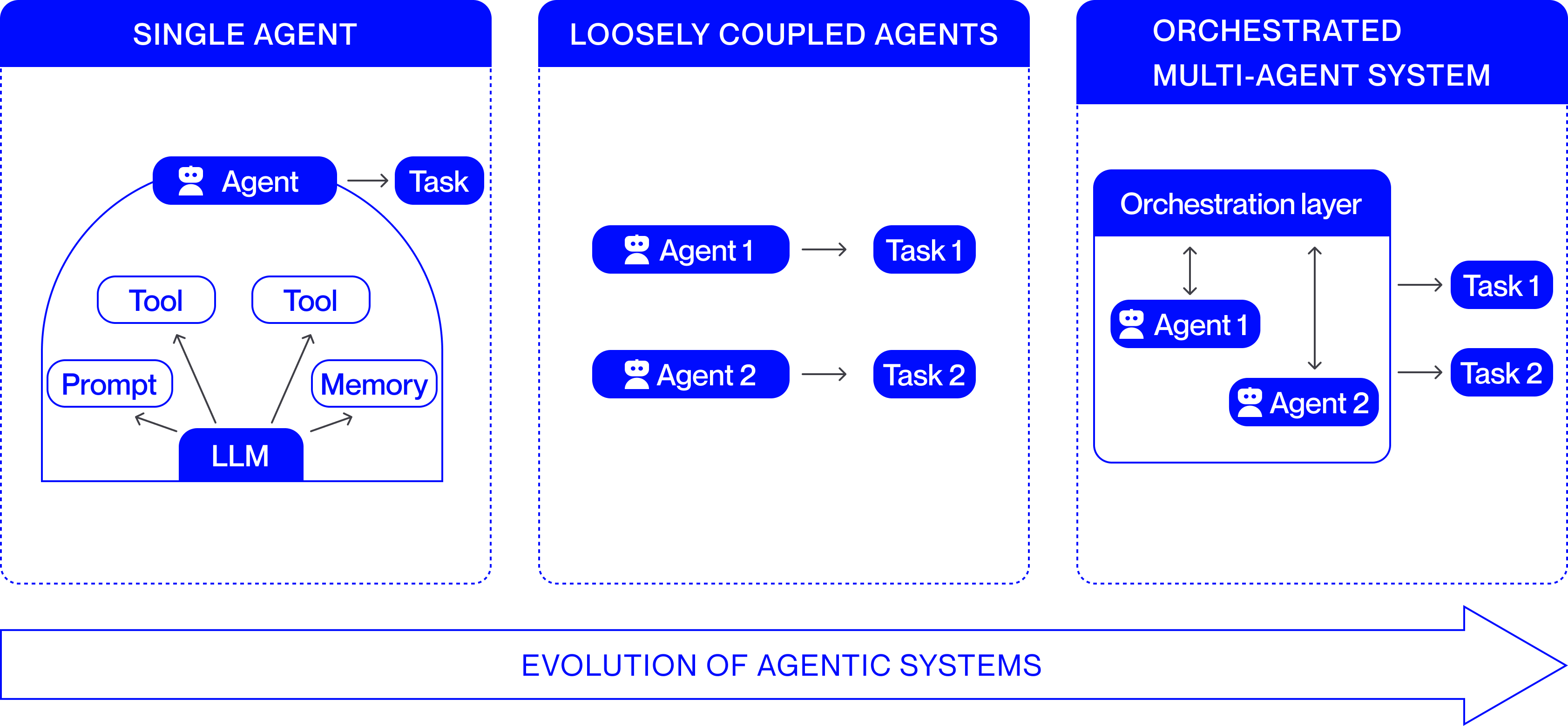
Agentic systems are founded on the principle of autonomous entities that can perceive their environment, make decisions, and take actions to achieve specific goals. Defined by autonomy, reactivity, proactivity, and social ability, they extend beyond scripted automation to operate adaptively.
Early deployments relied on single agents. These monolithic systems, with no coordination overhead, were well-suited to narrow tasks such as customer support chatbots that resolve FAQs, financial bots generating daily reports, or personal productivity assistants handling email and calendar management. Their reliability made them effective in bounded contexts, but they lacked scalability and adaptability for complex or dynamic environments.
To address these limitations, research and practice shifted toward loosely coupled agentic systems. In such systems, multiple agents operate in parallel with relative independence, and minimal interaction. This architecture enables specialization and the emergence of collective behaviors that a single agent cannot achieve. Recent examples include scientific research assistants [5] where literature-retrieval, reasoning, and validation agents collaborate to accelerate discovery; collaborative AI coding environments [6] where distinct agents write, review, and test code; news pipelines [7] where aggregation, fact-checking, and synthesis are distributed across agents; and autonomous driving ecosystems [8] where perception, navigation, and coordination agents cooperate loosely to ensure safe operation. Fig. 1 represents the discussed evolution of agentic systems.
<details>
<summary>EvolutionAgenticSystems.png Details</summary>
### Visual Description
\n
## Diagram: Evolution of Agentic Systems
### Overview
The image is a diagram illustrating the evolution of agentic systems, progressing from a single agent to loosely coupled agents, and finally to an orchestrated multi-agent system. It visually represents the increasing complexity and coordination within these systems. The diagram is divided into three distinct sections, each representing a stage in this evolution.
### Components/Axes
The diagram consists of three main sections, arranged horizontally:
1. **Single Agent:** Depicted in a blue rectangle.
2. **Loosely Coupled Agents:** Depicted in a light gray rectangle.
3. **Orchestrated Multi-Agent System:** Depicted in a blue rectangle.
Each section contains visual elements representing the components of the agentic system at that stage. These include:
* **Agent:** Represented by a robot head icon.
* **Task:** Represented by a rectangular box.
* **Tool:** Represented by a wrench icon.
* **Prompt:** Represented by a speech bubble icon.
* **Memory:** Represented by a memory chip icon.
* **LLM:** Represented by a rectangular box labeled "LLM".
* **Orchestration Layer:** Represented by a rectangular box labeled "Orchestration layer".
Arrows indicate the flow of information or interaction between these components. The entire diagram is labeled "EVOLUTION OF AGENTIC SYSTEMS" at the bottom.
### Detailed Analysis or Content Details
**1. Single Agent:**
* A single "Agent" is connected to a "Task" via an arrow.
* The "Agent" interacts with two "Tool" components.
* The "Agent" receives a "Prompt".
* The "Agent" utilizes "Memory".
* All these components are connected to and powered by an "LLM" (Large Language Model).
**2. Loosely Coupled Agents:**
* Two "Agent 1" and "Agent 2" are present.
* "Agent 1" is connected to "Task 1" via an arrow.
* "Agent 2" is connected to "Task 2" via an arrow.
* There is no direct interaction between the agents or a central coordinating component.
**3. Orchestrated Multi-Agent System:**
* Two "Agent 1" and "Agent 2" are present.
* "Agent 1" is connected to "Task 1" via an arrow.
* "Agent 2" is connected to "Task 2" via an arrow.
* Both agents are connected to an "Orchestration layer" via bidirectional arrows, indicating communication and control.
* The "Orchestration layer" manages the interaction between the agents and their respective tasks.
The diagram uses arrows to show the direction of influence or interaction. The arrows are gray and white. The overall flow is from left to right, representing the evolution of the system.
### Key Observations
* The complexity of the system increases from left to right.
* The single agent system is self-contained, relying on internal components.
* The loosely coupled system lacks central coordination.
* The orchestrated system introduces a central "Orchestration layer" for managing interactions.
* The use of color (blue for the single agent and orchestrated systems, gray for the loosely coupled system) may indicate a distinction in functionality or maturity.
### Interpretation
The diagram illustrates a progression in agentic system design. It suggests that as systems become more complex, the need for coordination and management increases. The evolution from a single agent to a multi-agent system highlights the benefits of distributing tasks among multiple agents, but also emphasizes the importance of a central orchestration layer to ensure effective collaboration and achieve desired outcomes. The diagram implies that the "Orchestration layer" is crucial for harnessing the power of multiple agents, preventing chaos and maximizing efficiency. The LLM is the core component in the single agent system, and its role is not explicitly shown in the later stages, suggesting that the orchestration layer takes over some of its functions in the multi-agent context. The diagram is a conceptual representation and does not provide specific data or numerical values, but rather a qualitative overview of the evolution of agentic systems.
</details>
Figure 1: Evolution of Agentic Systems
III Architectural Composition of Multi-Agent Systems
Building an orchestrated multi-agent system (MAS) involves more than simply connecting multiple autonomous agents. It requires designing specialized roles, establishing a coordination layer that governs their interactions, and defining clear communication protocols that allow agents to exchange information effectively.
Specialized agents operate as autonomous components that execute well-defined tasks within the system, each contributing a distinct capability toward the collective objective. Their interactions are coordinated through an orchestration layer that determines execution order, manages dependencies, and aligns individual outputs into a coherent operational flow. The exchanges rely on communication protocols that standardize how information is represented and transferred across agents, ensuring semantic consistency and enabling the orchestration layer to maintain synchronized and interpretable system behavior. When these foundational components are applied in practice, they collectively enable complex, domain-specific workflows that require coordinated intelligence across multiple decision points.
The following sections examine these technical elements in greater depth, focusing on agent specialization, orchestration mechanisms, and communication strategies as the foundational components of multi-agent architectures.
IV Specialized Agents
In a multi-agent system, specialized agents are autonomous components designed to perform narrowly scoped, role-specific tasks within the broader architecture. Each agent typically incorporates a large language model as its cognitive core, enabling it to perceive inputs, reason about them, and act within clearly defined operational boundaries. By assigning distinct roles such as retrieval, reasoning, validation, or monitoring, the system decomposes complex objectives into smaller, coordinated subtasks. This division of labor promotes modularity and collaboration, allowing agents to complement one another’s capabilities, reduce redundancy, and achieve outcomes that surpass those of a single, general-purpose agent. Through such specialization, a multi-agent system attains higher precision, scalability, and robustness while preserving clarity of function and accountability across its components.
Below are the key categories of specialized agents:
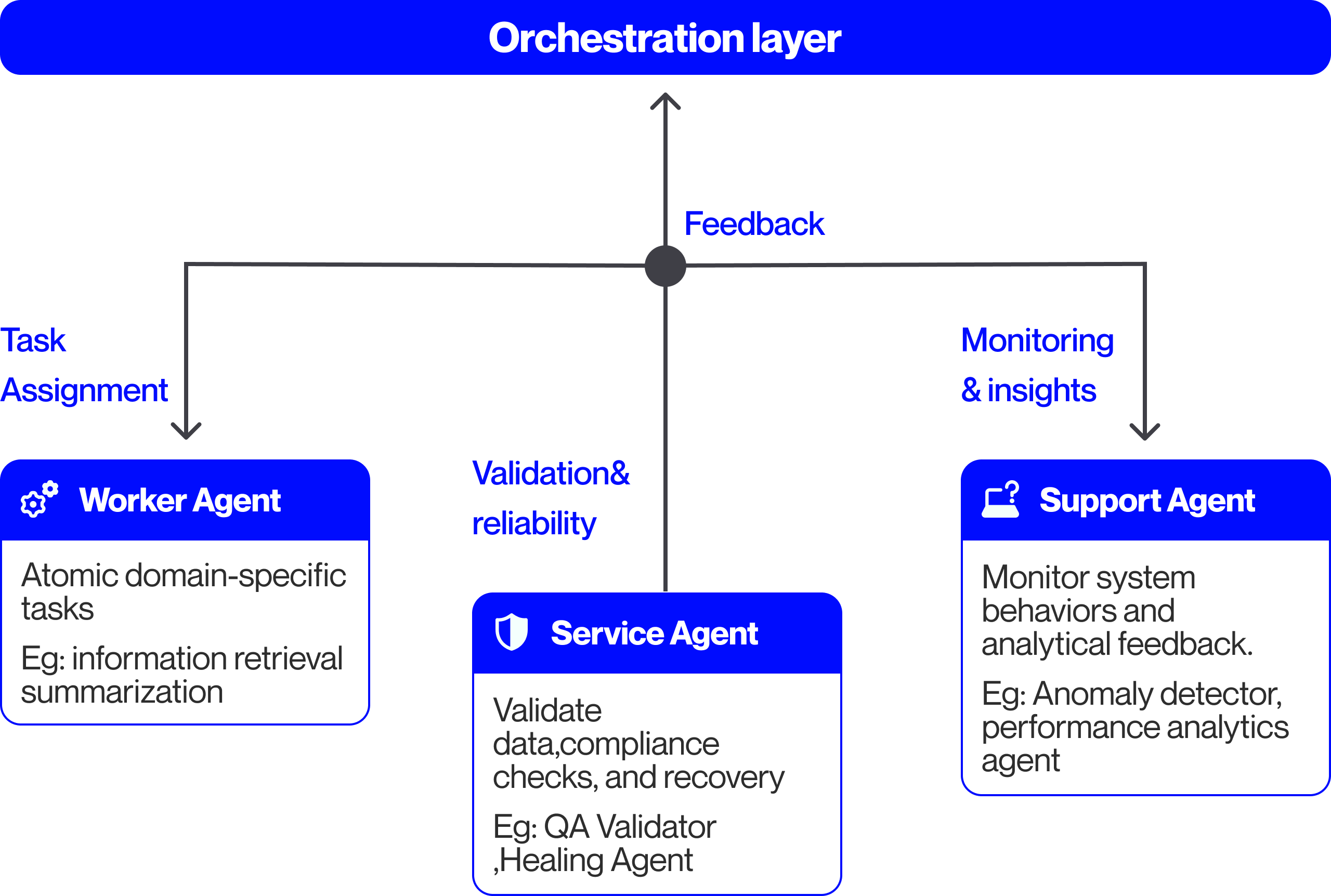
- Worker Agents - Worker agents represent the most basic but essential type. They are responsible for carrying out well-defined tasks such as a Retrieval-augmented generation (RAG) pipeline. In practice, some worker agents are stateless, handling each request independently without retaining context, while others are stateful, tracking progress across multiple steps in a workflow. In large systems, worker agents often operate in parallel, with each specializing in a narrow sub-domain. In a financial underwriting workflow, individual worker agents may extract applicant data from loan documents, compute preliminary credit scores, or generate draft risk assessments that downstream agents validate and consolidate. These agents form the execution layer of the system, performing domain-specific computations that feed subsequent validation and oversight processes.
- Service Agents - Service agents provide shared operational capabilities that other agents depend on during workflow execution. They act as reusable utilities within the multi-agent ecosystem, performing tasks such as quality assurance, compliance enforcement, diagnostics, or automated recovery.
In the context of financial underwriting, quality assurance agents can verify extracted customer data and cross-check it against compliance requirements. Diagnostic agents can inspect inconsistencies or missing data, trace the issues to the responsible module, and generate a structured error report that informs corrective actions. Healing agents can extend this capability by rerunning failed extractions or resetting workflow states to restore normal operation. While healing agents focus on the active system state, upgrade scheduler agents manage version transitions of scoring components and related workflows, ensuring that updates are deployed seamlessly without disrupting ongoing operations.
- Support Agents - Complementing the service agents, support agents operate at a supervisory and analytical level. While service agents provide in-line operational utilities during workflow execution, support agents focus on meta-level oversight by monitoring system behavior, analyzing outcomes, and managing data flows that inform orchestration and optimization. Their function is to maintain the overall health, transparency, and adaptability of the system under varying operational conditions. In the financial underwriting scenario, monitoring agents track decision latency, detect risk model drift, and visualize overall portfolio health for both AI orchestrators and human supervisors. Analytics agents evaluate approval-rate patterns and compliance anomalies, while data agents refresh applicant datasets to maintain currency and accuracy.
<details>
<summary>Specializedagents.png Details</summary>
### Visual Description
\n
## Diagram: Agent Orchestration Layer
### Overview
The image is a diagram illustrating an agent orchestration layer, depicting the interaction between different types of agents (Worker, Service, and Support) and an orchestration layer. The diagram shows a flow of tasks and feedback between these components. It's a high-level architectural overview, not a data-rich chart.
### Components/Axes
The diagram consists of four main components:
* **Orchestration Layer:** Located at the top, represented by a light blue rectangle labeled "Orchestration layer".
* **Worker Agent:** Located on the left, represented by a dark blue rectangle labeled "Worker Agent". It includes the text: "Atomic domain-specific tasks. Eg: information retrieval summarization".
* **Service Agent:** Located in the center, represented by a dark blue rectangle labeled "Service Agent". It includes the text: "Validate data, compliance checks, and recovery. Eg: QA Validator ,Healing Agent".
* **Support Agent:** Located on the right, represented by a dark blue rectangle labeled "Support Agent". It includes the text: "Monitor system behaviors and analytical feedback. Eg: Anomaly detector, performance analytics agent".
* **Feedback Loop:** A gray arrow labeled "Feedback" connects the Support Agent and the Orchestration Layer.
* **Task Assignment:** A gray arrow labeled "Task Assignment" connects the Orchestration Layer and the Worker Agent.
* **Validation & Reliability:** A gray label connecting the Worker Agent and the Service Agent.
* **Monitoring & Insights:** A gray label connecting the Service Agent and the Support Agent.
### Detailed Analysis or Content Details
The diagram illustrates a workflow:
1. The Orchestration Layer assigns tasks to the Worker Agent.
2. The Worker Agent performs atomic, domain-specific tasks (e.g., information retrieval, summarization).
3. The output from the Worker Agent is passed to the Service Agent for validation and reliability checks.
4. The Service Agent validates data, performs compliance checks, and handles recovery (e.g., QA validation, healing).
5. The Service Agent provides insights to the Support Agent.
6. The Support Agent monitors system behaviors and provides analytical feedback.
7. The Support Agent sends feedback to the Orchestration Layer, completing the loop.
The diagram does not contain numerical data or precise measurements. It is a conceptual representation of a system architecture.
### Key Observations
The diagram emphasizes a layered approach to agent orchestration, with each agent type having a specific role. The feedback loop suggests a continuous improvement process. The use of icons (gear for Worker Agent, shield for Service Agent, question mark for Support Agent) visually reinforces the function of each agent.
### Interpretation
This diagram represents a system designed for robust and reliable task execution. The orchestration layer acts as a central control point, distributing work and collecting feedback. The separation of concerns into distinct agent types (Worker, Service, Support) promotes modularity and maintainability. The validation and reliability step, handled by the Service Agent, is crucial for ensuring data quality and system stability. The Support Agent's monitoring and analytical feedback provide valuable insights for optimizing the system's performance. The feedback loop indicates a system that learns and adapts over time. The diagram suggests a complex system, likely used in a production environment where reliability and accuracy are paramount.
</details>
Figure 2: Specialized agents in a Multi-Agent System
Fig. 2 summarizes the discussed categories of specialized agents in a multi-agent systems. Across these categories of specialized agents, recent research [9] and enterprise applications demonstrate that coordinated role differentiation significantly enhances the reliability and scalability of multi-agent systems.
V Orchestration Layer for Coordinated Multi-Agent Operations
The agent orchestration layer forms the control plane of a multi-agent system, transforming autonomous components into a coherent, goal-directed collective. Without orchestration, even highly capable agents risk duplication of effort, logical inconsistency, or unbounded autonomy that diverges from the system’s objectives. It interprets system-level objectives, decomposes them into actionable subtasks, coordinates their execution, and ensures that every output produced aligns with policy, context, and quality requirements.
V-A Planning and Policy Management
At the heart of the orchestration layer are the planning and policy units, which convert high-level objectives into a structured execution plan.
Their purpose is twofold: the planning unit operates as a goal-decomposition engine that determines what tasks need to be done and in what order, while the policy unit embeds domain and governance constraints to define how these tasks are performed. In a financial underwriting workflow, the planning unit assigns tasks such as data extraction and credit scoring to the corresponding worker agents. The policy unit defines operational and governance constraints and coordinates with the control unit (described in the following subsection) to ensure service agents enforce them throughout execution
Together, they translate abstract goals into a directed execution model that defines who performs which task, in what sequence, under what rules, and with what oversight.
V-B Execution and Control Management
Once tasks are planned and assigned, the orchestration layer operates as a distributed control system that transitions specialized agents through phases of initialization, execution, validation, and completion.
Here, the execution unit ensures the smooth operation of the designated tasks performed by worker agents and manages telemetry data collection by support agents. The telemetry data is relayed to the control unit, which may delegate remediation or verification tasks to service agents to maintain operational stability. The control unit also manages concurrency and dependency across workflows, allowing parallel execution and synchronization at key checkpoints to preserve consistency. Additionally, it handles task prioritization and dynamic resource allocation to balance throughput, cost, and determinism across varying workloads.
V-C State and Knowledge Management
For the control unit to achieve synchronization and maintain continuity across workflows, the orchestration layer relies on the state and knowledge management component. This component functions both as a data bus and a knowledge repository.
The state unit manages checkpoints, workflow progress, agent states, and activity logs. Support agents monitor state changes and performance anomalies, while service agents may be invoked to restore checkpoints from the state unit to preserve workflow integrity. The knowledge unit manages contextual and domain-specific information by connecting to external data sources and exposing them as a retrievable context. This ensures that worker agents and orchestration components operate with accurate and aligned information.
This separation of operational state from knowledge state preserves modularity, contextual consistency, and system coherence.
V-D Quality and Operations Management
Using telemetry, state updates, and contextual data generated by other orchestration units, the quality and operations management component evaluates system performance, validates outcomes, and ensures that orchestrated activities remain compliant and continually optimized. While the control unit focuses on execution stability and the policy unit defines and enforces operational constraints during execution, this component governs verification and optimization of results after execution across the orchestration layer.
The component validates aggregated outputs against defined schemas before integrating them into the shared state, preventing invalid data from propagating through workflows. When inconsistencies or violations are detected, it updates the state accordingly and may invoke service agents to perform diagnostic or remediation actions, ensuring sustained integrity and compliance.
The subsystem also monitors metrics such as latency, throughput, and success rate, using anomaly detection to identify deviations and trigger preemptive interventions. It also supports controlled deployment, testing, and sandboxing new components to maintain stability as agents evolve. Together, these mechanisms ensure resilient, auditable, and continuously improving multi-agent operations.
V-E Closing Discussion
The orchestration model is exemplified in a financial institution’s credit-risk and fraud detection workflow, where specialized agents are coordinated to ensure consistency and compliance. Incoming loan applications are decomposed by the planning unit into subtasks such as data extraction, risk assessment, compliance review, and fraud screening, while the policy unit embeds governance constraints, including lending regulations and institutional risk thresholds. The execution and control component manages concurrent task execution, collects telemetry, and invokes service agents for recovery when needed. The state and knowledge management component maintains applicant states, historical records, and regulatory references for contextual continuity, while the quality and operations component validates results against policy criteria and applies performance insights to optimize future workflows.
Collectively, these mechanisms show that reliability in multi-agent systems arises not only from intelligent agents but from the orchestration layer that governs planning, execution, and validation, enabling scalable and policy-compliant performance.
VI Communication Protocols in Orchestrated Systems
Building on the orchestration framework, the agent communication layer operationalizes coordination by enabling agents and external tools to exchange information, control signals, and shared context. While orchestration defines who acts and when, communication ensures those actions remain synchronized and interpretable. Traditional protocols relied on static request–response exchanges and lacked mechanisms for context sharing or policy enforcement. To address these limitations, two emerging standards—the Model Context Protocol (MCP) and Agent-to-Agent (A2A) protocol—establish structured, interoperable communication for tool interaction and peer specialized agentic collaboration. Later subsections explore these protocols in more detail.
VI-A Model Context Protocol
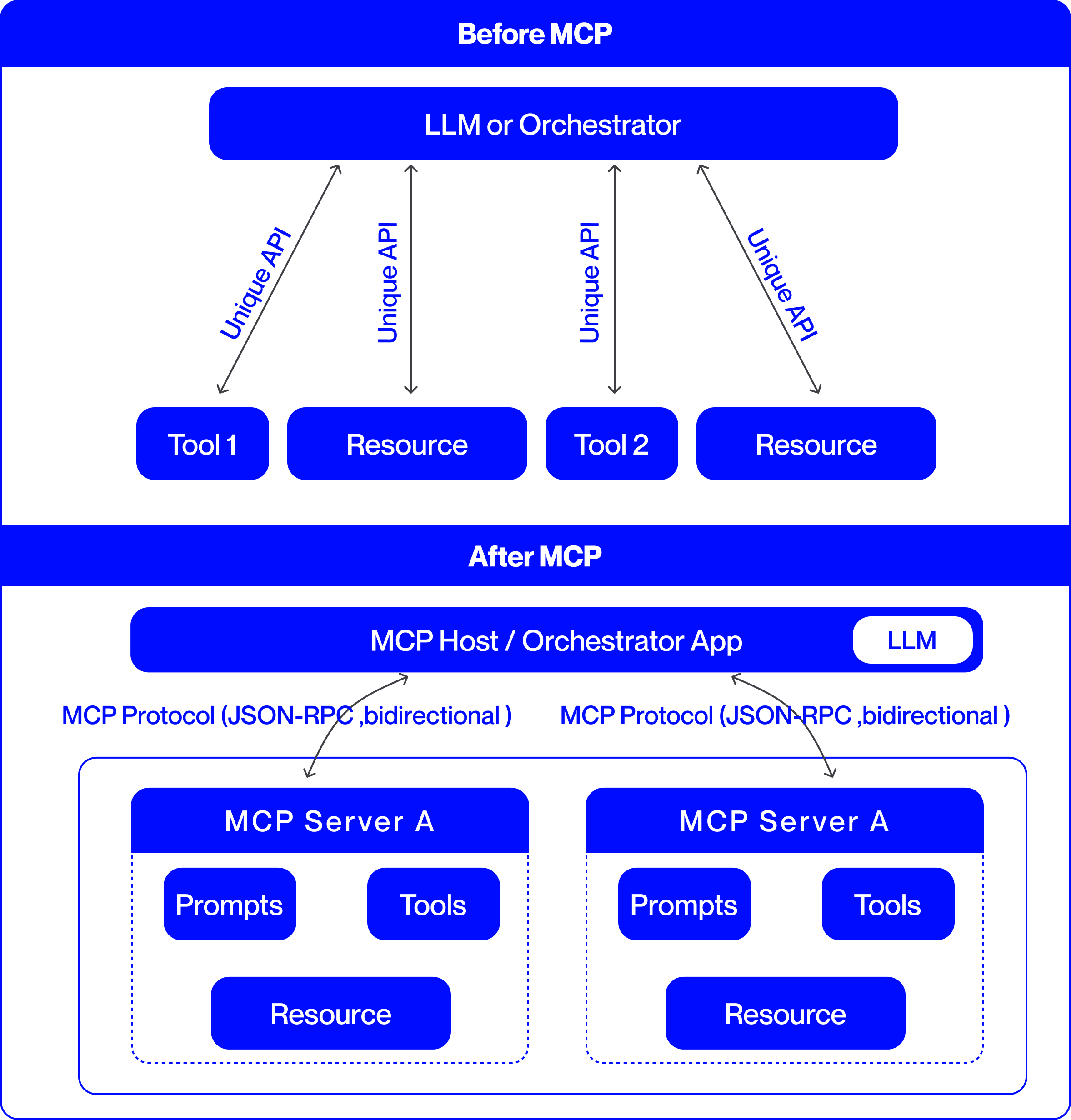
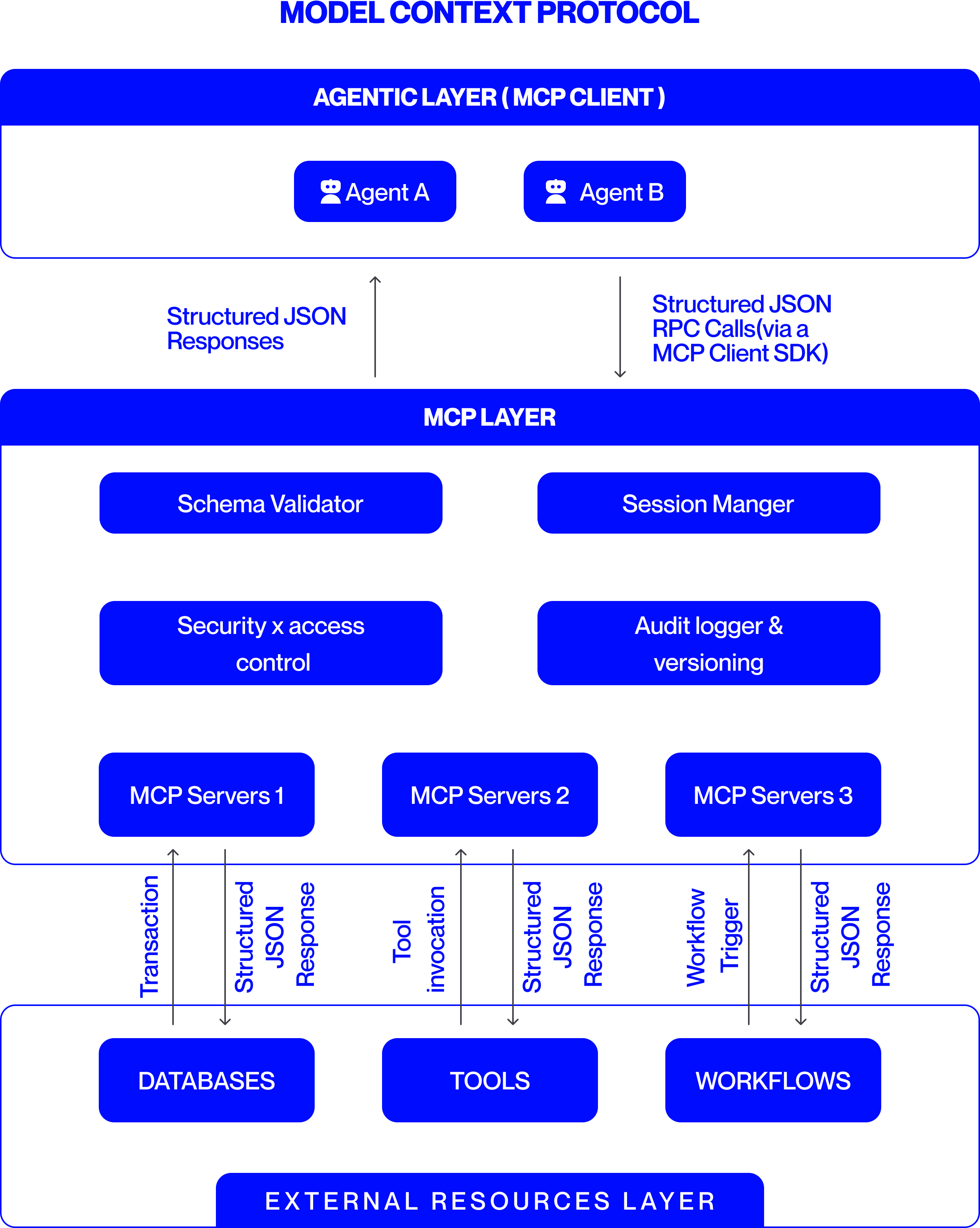
The Model Context Protocol (MCP) [10] provides the standardized communication interface that operationalizes the previously described orchestration flow between agents and external systems like tools, data services, and contextual repositories. As illustrated in Fig. 3, MCP mediates every external invocation through a defined interface that enforces schema consistency, access control, and auditability. This allows the execution unit to dispatch tasks confidently, ensuring that each agent’s external interactions conform to orchestration policies and operational rules.
<details>
<summary>BeforeVSAfter_v3.png Details</summary>
### Visual Description
\n
## Diagram: Before and After MCP Architecture
### Overview
This diagram illustrates a system architecture comparison, showing the structure "Before MCP" (Multi-tool Communication Protocol) and "After MCP". The diagram highlights how the introduction of MCP streamlines communication between a Large Language Model (LLM) or Orchestrator and various tools and resources.
### Components/Axes
The diagram is divided into two main sections: "Before MCP" (top) and "After MCP" (bottom).
**Before MCP:**
* **LLM or Orchestrator:** A rectangular box at the top center, labeled "LLM or Orchestrator".
* **Tool 1 & Tool 2:** Two rectangular boxes labeled "Tool 1" and "Tool 2" respectively.
* **Resource:** Two rectangular boxes labeled "Resource".
* **Unique API:** Arrows labeled "Unique API" connecting the LLM/Orchestrator to each Tool and Resource.
**After MCP:**
* **MCP Host / Orchestrator App:** A rectangular box at the top center, labeled "MCP Host / Orchestrator App".
* **LLM:** A rectangular box to the right of the MCP Host, labeled "LLM".
* **MCP Server A (x2):** Two identical rectangular boxes labeled "MCP Server A".
* **Prompts:** Rectangular boxes within each MCP Server A, labeled "Prompts".
* **Tools:** Rectangular boxes within each MCP Server A, labeled "Tools".
* **Resource:** Rectangular boxes below each MCP Server A, labeled "Resource".
* **MCP Protocol (JSON-RPC, bidirectional):** Arrows labeled "MCP Protocol (JSON-RPC, bidirectional)" connecting the MCP Host to each MCP Server A.
### Detailed Analysis or Content Details
**Before MCP:**
The LLM or Orchestrator directly interacts with each Tool and Resource via a "Unique API". This implies a separate communication channel and protocol for each interaction. There are four distinct connections.
**After MCP:**
The LLM interacts with the "MCP Host / Orchestrator App". The MCP Host then communicates with two "MCP Server A" instances using the "MCP Protocol (JSON-RPC, bidirectional)". Each MCP Server A manages "Prompts", "Tools", and a "Resource". This suggests a centralized communication layer. Each MCP Server A has its own "Prompts", "Tools", and "Resource". The MCP Protocol is bidirectional.
### Key Observations
* The "After MCP" architecture introduces a layer of abstraction with the MCP Host and Servers.
* The "Before MCP" architecture shows a direct connection between the LLM and each tool, while the "After MCP" architecture uses a standardized protocol (MCP) for communication.
* The "After MCP" architecture appears to be scalable, with the potential to add more MCP Servers as needed.
* The "After MCP" architecture uses two instances of "MCP Server A", suggesting redundancy or parallel processing.
### Interpretation
The diagram demonstrates a shift from a point-to-point communication model ("Before MCP") to a centralized, protocol-driven model ("After MCP"). This likely aims to simplify integration, improve scalability, and standardize communication between the LLM and various tools. The use of JSON-RPC suggests a lightweight and widely supported protocol. The bidirectional nature of the protocol allows for both requests and responses to flow seamlessly. The duplication of "MCP Server A" suggests a design focused on reliability and potentially increased throughput. The diagram highlights a move towards a more manageable and efficient system for orchestrating LLM interactions with external tools and resources. The diagram does not provide any quantitative data, but rather a qualitative comparison of two architectural approaches.
</details>
Figure 3: Comparison of agent communication without MCP and with MCP
<details>
<summary>MCP.png Details</summary>
### Visual Description
\n
## Diagram: Model Context Protocol
### Overview
The image is a diagram illustrating the "Model Context Protocol" (MCP). It depicts a layered architecture with four main layers: Agentic Layer (MCP Client), MCP Layer, MCP Servers, and External Resources Layer. The diagram shows the flow of information and interactions between these layers. It's a high-level architectural overview, focusing on components and data exchange rather than specific numerical data.
### Components/Axes
The diagram is structured into layers, each represented by a colored block. The layers are:
* **Agentic Layer (MCP Client):** Located at the top, colored light orange. Contains "Agent A" and "Agent B" represented by person icons.
* **MCP Layer:** Located below the Agentic Layer, colored dark blue. Contains four components: "Schema Validator", "Session Manager", "Security x access control", and "Audit logger & versioning".
* **MCP Servers Layer:** Located below the MCP Layer, colored purple. Contains three servers: "MCP Servers 1", "MCP Servers 2", and "MCP Servers 3".
* **External Resources Layer:** Located at the bottom, colored yellow. Contains three components: "Databases", "Tools", and "Workflows".
Arrows indicate the direction of data flow. Text labels on the arrows describe the type of data being exchanged, such as "Structured JSON Responses", "Structured JSON RPC Calls (via a MCP Client SDK)", "Transaction", "Tool invocation", and "Workflow Trigger".
### Detailed Analysis or Content Details
The diagram illustrates the following interactions:
1. **Agentic Layer to MCP Layer:**
* Agent A sends "Structured JSON Responses" to the MCP Layer.
* Agent B sends "Structured JSON RPC Calls (via a MCP Client SDK)" to the MCP Layer.
2. **MCP Layer to MCP Servers Layer:**
* MCP Servers 1 receives a "Transaction" and sends a "Structured JSON Response" to the External Resources Layer (Databases).
* MCP Servers 2 receives a "Tool invocation" and sends a "Structured JSON Response" to the External Resources Layer (Tools).
* MCP Servers 3 receives a "Workflow Trigger" and sends a "Structured JSON Response" to the External Resources Layer (Workflows).
3. **MCP Servers Layer to External Resources Layer:**
* MCP Servers 1 interacts with "Databases".
* MCP Servers 2 interacts with "Tools".
* MCP Servers 3 interacts with "Workflows".
The diagram does not contain any numerical data or specific values. It focuses on the logical flow and components of the system.
### Key Observations
* The architecture is layered, suggesting a separation of concerns.
* The MCP Layer acts as a central point of control and validation.
* The External Resources Layer provides access to underlying data and functionality.
* The Agents interact with the system through the MCP Layer.
* The use of "Structured JSON" indicates a standardized data format for communication.
### Interpretation
The diagram represents a robust and well-defined protocol for managing interactions between agents and external resources. The layered architecture promotes modularity and scalability. The MCP Layer's components (Schema Validator, Session Manager, Security, Audit Logger) suggest a strong emphasis on data integrity, security, and traceability. The use of JSON as the data format implies interoperability and ease of integration with various systems.
The diagram highlights a system designed for complex interactions, likely involving multiple agents and a variety of external resources. The protocol aims to provide a secure, reliable, and auditable framework for these interactions. The separation of concerns into distinct layers allows for independent development and maintenance of each component. The diagram doesn't reveal the specific purpose of the agents or the nature of the external resources, but it clearly outlines the infrastructure that supports their interaction. The diagram is a conceptual overview, and further details would be needed to understand the specific implementation and functionality of each component.
</details>
Figure 4: Integration of the MCP within the orchestration architecture
Within the orchestration architecture, MCP follows a client–server design in which agents or orchestrators act as clients that request external capabilities such as tools, resources, or prompts, while connected systems expose these as standardized, callable services. Through MCP, the planning and control units translate defined tasks into executable tool calls and govern how and when agents access these resources in compliance with policy constraints. MCP’s session management supports both stateless and stateful exchanges, allowing context continuity across multi-step workflows. These exchanges are logged and synchronized with orchestration state, enabling the state and knowledge management component to maintain consistency and allowing the quality and operations component to verify compliance and alignment with expected results.
As shown in Fig. 4, MCP functions as the operational bridge between high-level orchestration plans and low-level tool execution. It converts planned objectives into structured, policy-aligned invocations and feeds execution data back into orchestration memory and quality loops. Extensions such as ScaleMCP [11] dynamically synchronize tool inventories across agents, while AgentMaster [12] integrates MCP with inter-agent communication frameworks such as A2A to support multimodal collaboration and information retrieval within orchestrated multi-agent systems.
VI-B Agent-to-Agent Protocol
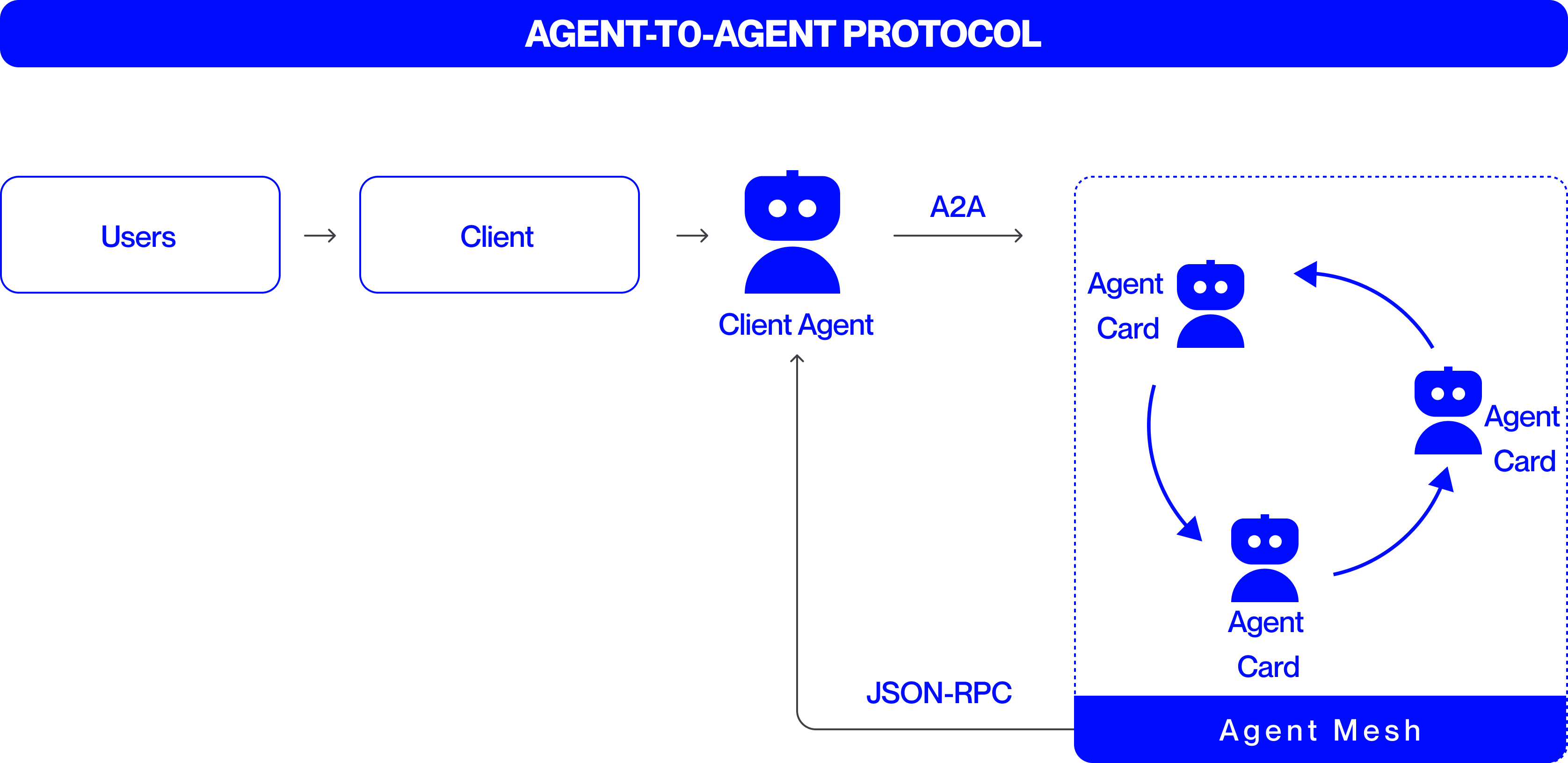
While MCP governs how agents interact with tools and data, the Agent-to-Agent (A2A) protocol [13] defines standardized communication amongst specialized agents themselves. It supports negotiation, delegation, and coordination across distributed ecosystems while maintaining interoperability, traceability, and security [14]. Together, MCP and A2A form the dual foundation of agent communication—MCP for tool access and A2A for peer collaboration (Fig. 5).
<details>
<summary>A2A.png Details</summary>
### Visual Description
\n
## Diagram: Agent-to-Agent Protocol
### Overview
The image is a diagram illustrating an agent-to-agent protocol. It depicts the flow of communication between users, a client, a client agent, and an agent mesh consisting of agent cards. The diagram uses arrows to indicate the direction of communication and labels to identify the components.
### Components/Axes
The diagram consists of the following components:
* **Users:** Represented by a peach-colored rounded rectangle on the left.
* **Client:** A light blue rectangle connected to "Users" by an arrow.
* **Client Agent:** A blue figure with a green halo, connected to "Client" by an arrow. Labeled "Client Agent".
* **A2A:** Text label indicating Agent-to-Agent communication, positioned above the arrow connecting "Client Agent" to the "Agent Mesh".
* **Agent Mesh:** A dotted light blue rectangle containing multiple "Agent Cards". Labeled "Agent Mesh".
* **Agent Card:** Blue figures with green halos within the "Agent Mesh". Labeled "Agent Card".
* **JSON-RPC:** Text label positioned below the arrow connecting "Client Agent" to the "Agent Mesh".
### Detailed Analysis or Content Details
The diagram shows a unidirectional flow from "Users" to "Client", then to "Client Agent". The "Client Agent" communicates with the "Agent Mesh" via "A2A" (Agent-to-Agent) and receives data back via "JSON-RPC". The "Agent Mesh" consists of at least three "Agent Cards", with arrows indicating communication between them. The arrows within the "Agent Mesh" suggest a network or mesh-like communication pattern among the "Agent Cards".
### Key Observations
The diagram highlights a layered architecture where users interact with a client, which then utilizes a client agent to communicate with a network of agents. The use of "A2A" and "JSON-RPC" suggests specific communication protocols employed within the system. The mesh network of "Agent Cards" implies a distributed and potentially scalable architecture.
### Interpretation
This diagram illustrates a system designed for agent-based interactions. The "Agent-to-Agent Protocol" suggests that agents can communicate directly with each other, bypassing the need for a central server. The "Client Agent" acts as an intermediary between the user and the agent network. The use of "JSON-RPC" indicates a standardized method for remote procedure calls between the client agent and the agent mesh. The mesh network of agents suggests a robust and flexible system capable of handling complex interactions and potentially adapting to changing conditions. The diagram emphasizes a decentralized approach to communication and processing, which could offer benefits in terms of scalability, resilience, and efficiency. The diagram does not provide any quantitative data or specific details about the agents' functionalities or the nature of their interactions. It is a high-level architectural overview.
</details>
Figure 5: Agent-to-Agent Protocol
Through A2A, worker agents can delegate subtasks or share intermediate results, service agents can communicate diagnostic information or recovery status, and support agents can broadcast telemetry or performance insights that inform collective progress. This peer-level exchange ensures that task dependencies are dynamically managed and that agents can resolve interdependencies without requiring centralized intervention. The control unit supervises these interactions to ensure policy alignment and to maintain synchronization with the broader orchestration plan, while communication records are captured within the state and knowledge management component for traceability and recovery.
A2A employs a peer communication model either direct or mediated through the orchestrator, enabling reliable, authenticated message exchange. Each message carries structured metadata and standardized payloads, ensuring consistency across heterogeneous implementation. Robust security controls, including cryptographic signing and role-based routing, guarantee message integrity and policy compliance.
Although peer-oriented, A2A remains supervised by the orchestration layer, which validates and synchronizes exchanges to maintain coherence with global workflows. Emerging research explores scalable and hybrid architectures that combine A2A and MCP for multimodal, adaptive coordination in enterprise-grade agentic systems.
VII Safety, Governance and Observability
Ensuring the reliability of multi-agent systems depends on safeguards embedded within orchestration and communication mechanisms. Within the orchestration layer, the control and quality and operations management units enforce safety and governance through validation, monitoring, and recovery mechanisms that maintain compliance and operational integrity. Similarly, MCP and A2A protocols embed protective measures such as schema validation, authenticated exchanges, and access control to ensure secure and interpretable communication. Core guardrails mitigate hallucinations and enforce consistency checks to prevent agents from producing unsafe or conflicting outputs. These protections are reinforced by internal audits, event logging, and least-privilege policies that promote transparency, accountability, and traceability across the system. Privacy constraints restrict agents to sharing only task-relevant information. Continuous monitoring, carried out through support agents and the quality and operations management unit, tracks latency, throughput, and correctness to evaluate performance and detect drift. Together, these practices transform multi-agent systems from experimental collectives into dependable, auditable, and continually improving infrastructures that balance autonomy with control.
<details>
<summary>MASArchitecture.png Details</summary>
### Visual Description
\n
## Diagram: Multi-Agent System Architecture
### Overview
The image depicts a diagram illustrating the architecture of a multi-agent system. It showcases the interaction between agents, an orchestration layer, and supporting components like toolkits and shared memory. The diagram emphasizes the flow of information and control within the system.
### Components/Axes
The diagram is structured into three main layers:
* **Orchestration Layer:** Located at the top, consisting of five components: "Planning & Policies", "Runtime & Resources", "State & Knowledge Mgmt", "Quality & Operations", and "Observability Tools".
* **Agent Layer:** The central layer, containing three agents: "Agent 1 (Worker)", "Agent 2 (Service)", and "Agent 3 (Helper)".
* **Supporting Components Layer:** Located on the right side, including "Toolkit", "Shared Memory & Database", and "External APIs".
* **Bottom Layer:** "Agent Studio", "Audits Traceability", and "Guard Rails".
Connections between components are indicated by arrows, with labels like "A2A" (Agent to Agent) and "MCP" (likely representing a communication protocol or mechanism).
### Detailed Analysis or Content Details
The diagram shows the following relationships:
* **Orchestration Layer to Agents:** Each component in the orchestration layer has a downward arrow connecting it to all three agents. This suggests that the orchestration layer provides control and information to each agent.
* **Agent 1 to Agent 2:** A curved, dashed arrow labeled "A2A" connects Agent 1 (Worker) to Agent 2 (Service).
* **Agent 2 to Agent 3:** A curved, dashed arrow labeled "A2A" connects Agent 2 (Service) to Agent 3 (Helper).
* **Agents to MCP:** Each agent has a bidirectional arrow connecting it to "MCP".
* **MCP to Supporting Components:** Each "MCP" has a bidirectional arrow connecting it to "Toolkit", "Shared Memory & Database", and "External APIs".
* **Agent Studio to Bottom Layer:** Agent Studio has downward arrows connecting it to "Audits Traceability" and "Guard Rails".
Each agent has an icon associated with it:
* Agent 1: A person icon labeled "Worker".
* Agent 2: A gear icon labeled "Service".
* Agent 3: A speech bubble icon labeled "Helper".
The "Toolkit" component contains two boxes labeled "Tool".
### Key Observations
* The orchestration layer appears to be a central control point for all agents.
* Agents communicate directly with each other via "A2A" connections.
* "MCP" acts as a bridge between agents and supporting components.
* The "Agent Studio" provides access to auditing and security features.
* The diagram is highly conceptual and does not contain specific numerical data.
### Interpretation
This diagram illustrates a distributed system architecture where multiple agents collaborate to achieve a common goal. The orchestration layer provides high-level control and coordination, while the agents perform specific tasks. The "MCP" facilitates communication and access to shared resources. The "A2A" connections suggest a degree of autonomy and direct interaction between agents. The inclusion of "Audits Traceability" and "Guard Rails" highlights the importance of security and accountability in the system.
The diagram suggests a flexible and scalable architecture, as new agents and components can be added without disrupting the overall system. The use of a toolkit indicates that agents can leverage pre-built functionalities to simplify their tasks. The "Shared Memory & Database" component enables agents to share information and coordinate their actions. The "External APIs" allow the system to interact with external services and data sources.
The diagram is a high-level overview and does not provide details about the specific algorithms or protocols used within the system. It focuses on the overall structure and relationships between components.
</details>
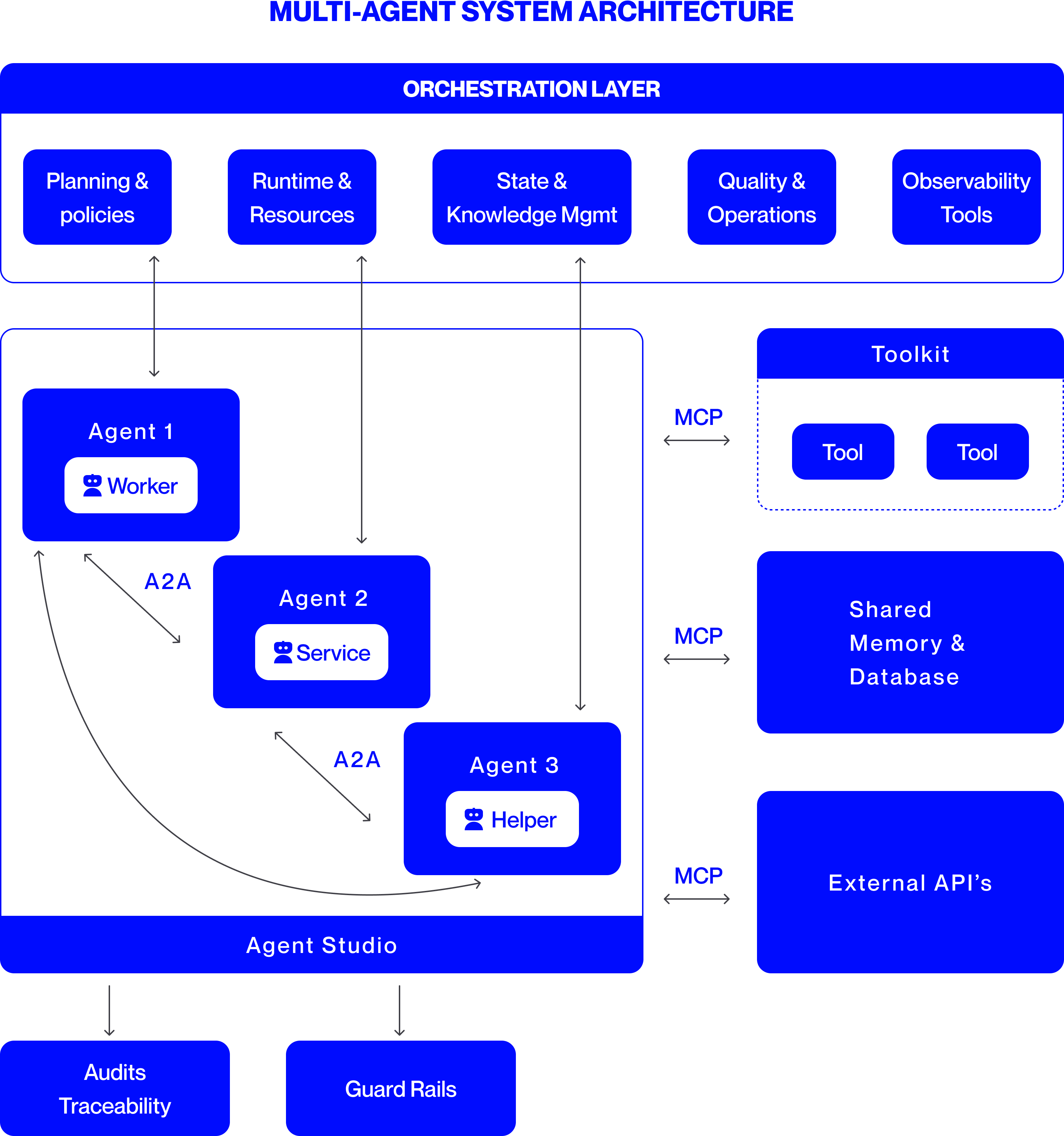
Figure 6: Orchestrated Multi-Agent System Architecture
To summarize, the overall architecture of an orchestrated multi-agent system is shown in Fig. 6. The architecture integrates all core components that enable coordination, communication, and governance across distributed agents. At its foundation are specialized agent types, interacting through standardized protocols such as MCP for tool and data access and A2A for inter-agent collaboration. The orchestration layer oversees planning, execution, and quality control, while observability and governance modules ensure reliability, compliance, and transparency. Together, these elements form a cohesive, scalable framework that operationalizes autonomous intelligence under structured orchestration.
VIII Case Studies
VIII-A Banking, Financial Services and Insurance
Multi-agent AI systems are revolutionizing Banking, Financial Services, and Insurance (BFSI) industry by delivering dramatic efficiency gains and ROI. Insurers are deploying networks of specialized AI agents to automate the labor-intensive underwriting process. For example, autonomous agents studied in [15] now parse insurance applications and supporting documents with over 95% accuracy, enabling much faster policy issuance. In another use-case explored in [15], a mortgage lender integrated Document AI and Decision AI agents to handle loan paperwork, achieving a 20× faster approval process while cutting processing costs by 80%. Similarly, [16] presents a multi-agent automation framework for property claims underwriting, where specialized agents collaborate to evaluate claim documents, assess damage estimates, and validate policy conditions. Such multi-agent systems clearly outperform both manual processes and single-agent automation, delivering a strong value proposition in BFSI.
VIII-B Software Engineering and IT Modernization
Multi-agent systems are also proving their worth in software engineering. A large bank recently applied an agentic AI “digital factory” [17] to modernize its legacy core software, which comprised hundreds of applications. Different agents took on specialized coding tasks: one agent automatically documented existing legacy code, another generated new code modules, others reviewed code written by their peers, and additional agents integrated and tested these modules. This multi-agent architecture allows parallel execution and continuous code quality checks, reducing the coordination burdens that slowed the purely human teams. In practice, this approach led to over a 50% reduction in development time and effort for early-adopter teams at the bank.
VIII-C Cross Industry Adoption
The success of multi-agent AI is spurring widespread adoption across industries. In customer service, companies are reimagining call centers with agentic AI: instead of just assisting human representatives, agents autonomously handle routine inquiries and issues. Studies suggest that up to 80% of common support incidents could be resolved by AI agents without human intervention, cutting resolution times by 60–90% in fully agent-driven workflows. Meanwhile, sectors like healthcare are exploring multi-agent setups where one agent analyzes patient symptoms or medical literature and another suggests treatment plans, all under a doctor’s supervision. From finance and insurance to software development, legal research, and healthcare, multi-agent systems are being rapidly embraced as organizations recognize their measurable performance advantages over manual or single-agent approaches.
IX Challenges, Risks and Future Research
As multi-agent systems scale, key challenges emerge around efficiency, cost, and governance. Coordination among numerous agents can create communication overhead, message congestion, and performance bottlenecks unless workflows are carefully managed. The cost of adoption remains significant, enterprises must invest in orchestration software, skilled engineering teams, and continuous monitoring infrastructure to ensure reliability and compliance. Governance presents another difficulty, as decentralized autonomy complicates oversight and accountability. Risks inherited from large language models, such as hallucination, bias, and data leakage, are magnified when agents interact, raising safety, ethical, and privacy concerns that demand rigorous evaluation and control frameworks.
Future research focuses on making orchestration smarter, safer, and more adaptive. Hybrid and federated designs aim to balance centralized control with decentralized flexibility, while semantic orchestration seeks to match tasks dynamically with the most capable agents. Advances in federated learning and cross-domain collaboration promise secure knowledge sharing without exposing raw data. Standardized benchmarks, simulation testbeds, and open-source orchestration frameworks will further enable transparent performance comparison and lower entry barriers. Together, these directions move multi-agent systems toward scalable, accountable, and trustworthy deployment across enterprise and societal domains.
X Conclusion
Agentic systems have evolved from single agents that perform narrow tasks, to loosely coupled multi-agent setups, and now to orchestrated collectives where coordination ensures consistency, scale, and reliability. Recent advances show that orchestrated systems are not only viable but already delivering value in real deployments, from BFSI claims processing and fraud detection to healthcare diagnostics and software engineering. Benchmarks and case studies demonstrate measurable gains in productivity, error reduction, and scalability compared with manual or single-agent approaches.
Looking forward, enterprises are moving toward dynamic ecosystems where agents can form, dissolve, and reorganize in response to tasks, much like human teams. To realize this vision, the community must invest in open protocols for interoperability, standardized benchmarks, and shared research infrastructure. With these foundations, orchestrated multi-agent systems can mature into a reliable and adaptable backbone for enterprise intelligence at scale.
References
- [1] Z. Hou, J. Tang, and Y. Wang, “HALO: Hierarchical Autonomous Logic-Oriented Orchestration for Multi-Agent LLM Systems,” arXiv:2505.13516, 2025. [Online]. Available: https://arxiv.org/abs/2505.13516.
- [2] Y. Dang, C. Qian, X. Luo, J. Fan, Z. Xie, R. Shi, W. Chen, C. Yang, X. Che, Y. Tian, X. Xiong, L. Han, Z. Liu, and M. Sun, “Multi-Agent Collaboration via Evolving Orchestration,” arXiv:2505.19591, 2025. [Online]. Available: https://arxiv.org/abs/2505.19591.
- [3] PwC, “PwC launches AI Agent Operating System for enterprises,” PwC US Newsroom, Press Release, Mar. 18, 2025. [Online]. Available: https://www.pwc.com/us/en/about-us/newsroom/press-releases/pwc-launches-ai-agent-operating-system-enterprises.html. Accessed: Oct. 9, 2025.
- [4] Accenture, “Accenture Introduces Trusted Agent Huddle to Allow Seamless, First-of-its-Kind, Multi-System AI Agent Collaboration Across the Enterprise,” Accenture Newsroom, Jan. 21, 2025. [Online]. .
- [5] R. Deng, M. Zhao, X. Zheng, H. Guo, and Z. Jin, “Agent Laboratory: Using LLM Agents as Research Assistants,” arXiv:2501.04227, 2025. doi: 10.48550/arXiv.2501.04227. [Online]. Available: https://arxiv.org/abs/2501.04227.
- [6] S. Luo, Y. Xu, H. Zhang, and K. Zhang, “AgentCoder: Multi-Agent Code Generation with Effective Testing and Self-optimisation,” arXiv:2312.13010, 2023. doi: 10.48550/arXiv.2312.13010. [Online]. Available: https://arxiv.org/abs/2312.13010.
- [7] Y. Lin, J. Park, X. Li, and S. Zhang, “Multi-Agent Fact Checking,” arXiv:2503.02116, 2025. doi: 10.48550/arXiv.2503.02116. [Online]. Available: https://arxiv.org/abs/2503.02116.
- [8] Z. Zhao, Y. Sun, H. Wu, L. Zhang, and Y. Li, “KoMA: Knowledge-driven Multi-agent Framework for Autonomous Driving with Large Language Models,” arXiv:2407.14239, 2024. doi: 10.48550/arXiv.2407.14239. [Online]. Available: https://arxiv.org/abs/2407.14239.
- [9] Y. Fu, H. Sun, Y. Song, J. Liu, X. Chen, Z. Zhang, J. Tang, and T.-S. Chua, “A Survey on Agentic Large Language Models: Architecture, Capabilities, and Applications,” arXiv preprint arXiv:2402.01680, 2024. [Online]. Available: https://arxiv.org/abs/2402.01680. Accessed: Nov. 17, 2025.
- [10] Model Context Protocol, “What is the Model Context Protocol (MCP)?,” Documentation, 2025. [Online]. Available: https://modelcontextprotocol.io/docs/getting-started/intro. Accessed: Oct. 9, 2025.
- [11] E. Lumer, A. Gulati, V. K. Subbiah, P. H. Basavaraju, and J. A. Burke, “ScaleMCP: Dynamic and Auto-Synchronizing Model Context Protocol Tools for LLM Agents,” arXiv:2505.06416, 2025. doi: 10.48550/arXiv.2505.06416. [Online]. Available: https://arxiv.org/abs/2505.06416.
- [12] C. C. Liao, D. Liao, and S. S. Gadiraju, “AgentMaster: A Multi-Agent Conversational Framework Using A2A and MCP Protocols for Multimodal Information Retrieval and Analysis,” arXiv:2507.21105, 2025. doi: 10.48550/arXiv.2507.21105. [Online]. Available: https://arxiv.org/abs/2507.21105.
- [13] A. Chawla, “A Visual Guide to Agent2Agent (A2A) Protocol,” Daily Dose of Data Science (Substack), Apr. 16, 2025. [Online]. Available: https://blog.dailydoseofds.com/p/a-visual-guide-to-agent2agent-a2a. Accessed: Oct. 9, 2025.
- [14] The Linux Foundation (A2A Project), “Agent2Agent (A2A) Protocol — Latest Documentation,” 2025. [Online]. Available: https://a2a-protocol.org/latest/. Accessed: Oct. 9, 2025.
- [15] B. Pazur, “17 Useful AI Agent Case Studies,” Multimodal.dev (blog), May 14, 2025. [Online]. Available: https://www.multimodal.dev/post/useful-ai-agent-case-studies. Accessed: Oct. 9, 2025.
- [16] M. I. Sajid, “Multi-Agentic Automation for Evaluating Property Claims in Underwriting,” Open Journal of Applied Sciences, vol. 15, no. 4, pp. 819–833, Apr. 2025. doi: 10.4236/ojapps.2025.154055. [Online]. Available: https://www.scirp.org/journal/paperinformation?paperid=141685.
- [17] A. Sukharevsky, D. Kerr, K. Hjartar, L. Hämäläinen, S. Bout, and V. Di Leo, “Seizing the agentic AI advantage,” McKinsey & Company (QuantumBlack) report, Jun. 13, 2025. [Online]. Available: https://www.mckinsey.com/capabilities/quantumblack/our-insights/seizing-the-agentic-ai-advantage. Accessed: Oct. 9, 2025.