# Immersion in the GitHub Universe: Scaling Coding Agents to Mastery
**Authors**: Jiale Zhao, Guoxin Chen, Fanzhe Meng, Minghao Li, Jie Chen, Hui Xu, Yongshuai Sun, Wayne Xin Zhao, Ruihua Song, Yuan Zhang, Peng Wang, Cheng Chen, Ji-Rong Wen, Kai Jia
{marshmallowzjl, gx.chen.chn, mengfanzhe16, batmanfly}@gmail.com, songruihua_bloon@outlook.com, jiakai@bytedance.com
## Abstract
Achieving mastery in real-world software engineering tasks is fundamentally bottlenecked by the scarcity of large-scale, high-quality training data. Scaling such data has been limited by the complexity of environment setup, unit-test generation, and problem statement curation. In this paper, we propose Scale‑SWE, an automated, sandboxed multi‑agent workflow designed to construct high‑quality SWE data at scale. The system coordinates three specialized agents—for environment setup, test creation, and problem description synthesis—to process 6 million pull requests across 5.2k repositories, producing Scale‑SWE‑Data: 100k verified SWE instances, the largest such dataset to date. It substantially surpasses existing real‑world datasets in repository diversity and reflects realistic task complexity. We further demonstrate the dataset’s utility for training by distilling 71,498 high‑quality trajectories and fine‑tuning Qwen‑30B-A3B-Instruct to produce Scale‑SWE‑Agent. Our agent achieves a 64% resolve rate on SWE‑Bench‑Verified—a nearly three‑fold improvement over the base model. Scale‑SWE provides a scalable, reproducible approach for data construction to advance LLM‑based software engineering.
<details>
<summary>x1.png Details</summary>

### Visual Description
Icon/Small Image (24x24)
</details>
Model
<details>
<summary>x2.png Details</summary>

### Visual Description
Icon/Small Image (24x24)
</details>
Dataset
<details>
<summary>x3.png Details</summary>

### Visual Description
Icon/Small Image (24x24)
</details>
Code
## 1 Introduction
<details>
<summary>figures/performance.drawio.png Details</summary>
### Visual Description
## Scatter Plot: SWE-Bench Verified (%) vs. Activated Model Size (B)
### Overview
The image is a scatter plot comparing the percentage of SWE-Bench verified results against the activated model size (in billions of parameters). Data points are labeled with model names and their corresponding verification percentages. A red star marks "Scale-SWE(64%)" as the highest-performing model, while blue dots represent other models with varying sizes and verification rates.
### Components/Axes
- **X-axis**: "Activated Model Size (B)" ranging from 3 to 70 (in billions of parameters).
- **Y-axis**: "SWE-Bench Verified (%)" ranging from 10% to 70%.
- **Legend**:
- Red star: **Scale-SWE(64%)** (top-left corner).
- Blue dots: Other models (e.g., GLM-4.7-Flash, Qwen3-Coder-30A3B, etc.).
### Detailed Analysis
- **Model Sizes and Verification Rates**:
- **Scale-SWE(64%)**: Red star at (3B, 64%).
- **KAT-Dev-32B(62.4%)**: Blue dot at (32B, 62.4%).
- **SWE-Lego-32B(52.6%)**: Blue dot at (32B, 52.6%).
- **SWE-Mirror-32B(52.2%)**: Blue dot at (32B, 52.2%).
- **GLM-4.7-Flash(59.2%)**: Blue dot at (7B, 59.2%).
- **Qwen3-Coder-30A3B(52.2%)**: Blue dot at (30A3B, 52.2%).
- **SWE-Lego-8B(42.2%)**: Blue dot at (8B, 42.2%).
- **SWE-Smith(40.2%)**: Blue dot at (32B, 40.2%).
- **R2E-Gym(34.4%)**: Blue dot at (32B, 34.4%).
- **Llama3-SWE-RL(41%)**: Blue dot at (70B, 41%).
- **SWE-Fixer(32.8%)**: Blue dot at (32B, 32.8%).
- **SWE-Gym(20.6%)**: Blue dot at (32B, 20.6%).
- **Qwen3-30A3B-Instruct(22%)**: Blue dot at (30A3B, 22%).
- **SWE-Mirror-7B(22.8%)**: Blue dot at (7B, 22.8%).
### Key Observations
1. **Scale-SWE(64%)** is the highest-performing model, despite being the smallest (3B).
2. **KAT-Dev-32B(62.4%)** is the second-highest, with a larger model size (32B).
3. **Larger models (70B)** like **Llama3-SWE-RL(41%)** and **SWE-Fixer(32.8%)** show lower verification rates compared to mid-sized models.
4. **Mid-sized models (32B)** exhibit a mix of high (e.g., KAT-Dev-32B) and low (e.g., SWE-Gym) performance.
5. **Smaller models (3B–8B)** like **Scale-SWE** and **GLM-4.7-Flash** achieve higher verification rates than some larger models.
### Interpretation
The data suggests that **model size does not directly correlate with SWE-Bench verification performance**. While larger models (e.g., 70B) generally underperform compared to mid-sized models (e.g., 32B), exceptions like **Scale-SWE(64%)** demonstrate that architectural efficiency or optimization can outweigh size. The presence of high-performing smaller models (e.g., **GLM-4.7-Flash(59.2%)**) highlights the importance of model design over sheer scale. This implies that **verification efficiency** may depend on factors like training data quality, task-specific tuning, or algorithmic innovation rather than just parameter count.
</details>
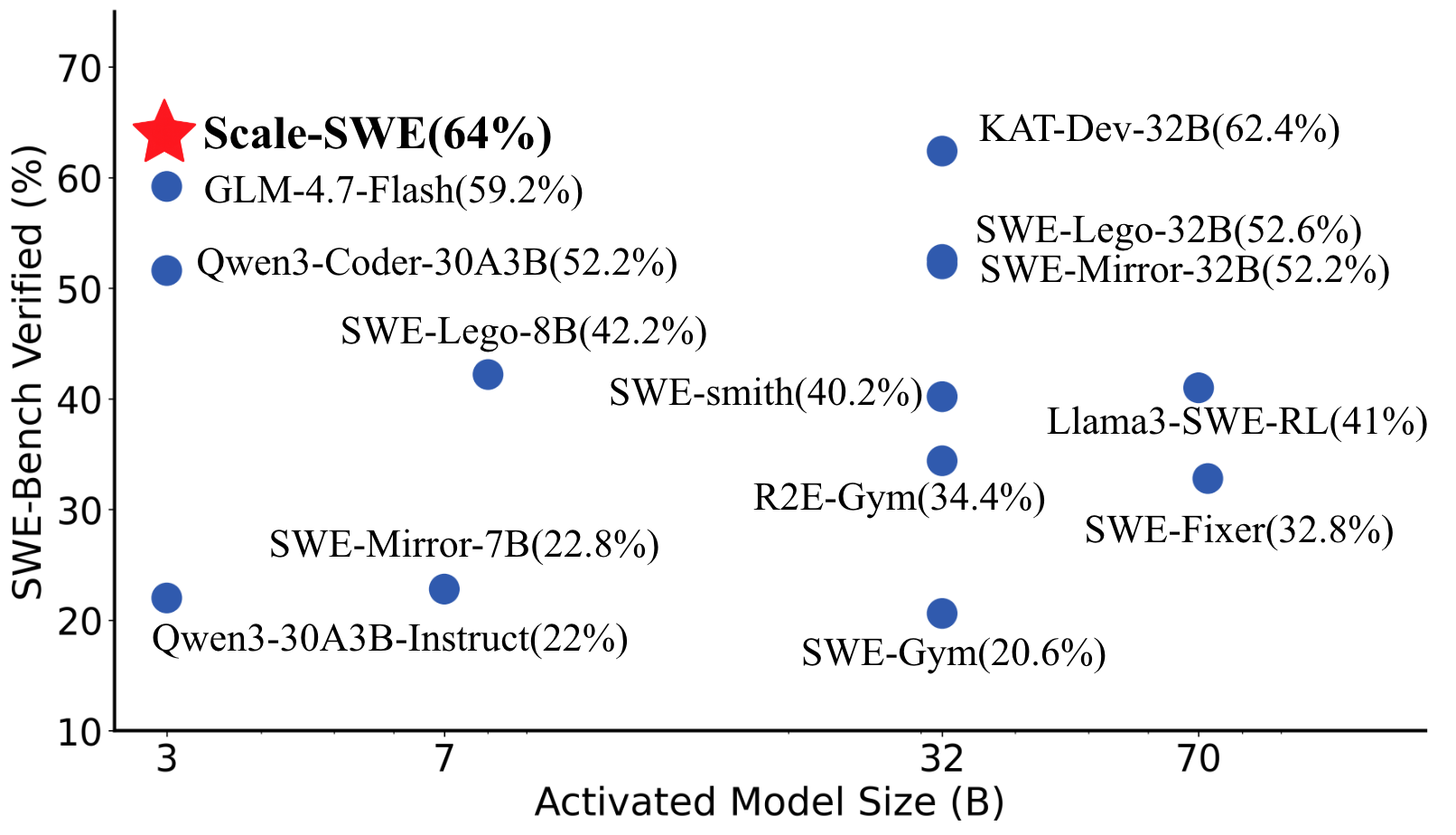
Figure 1: Resolved rate vs. activated model size on SWE-bench Verified. The vertical axis denotes the percentage of resolved issues on the SWE-bench Verified benchmark. The horizontal axis represents the number of activated parameters in billions (B).
Recently, LLM-based code agents have garnered significant attention for their demonstrated potential in tackling complex software engineering (SWE) tasks [Anthropic, 2025a, Google, 2025, OpenAI, 2025], as reflected in benchmarks like SWE-bench [Jimenez et al., 2023] and its successors [Zhang et al., 2025]. Yet the advancement of these agents is fundamentally constrained by the scarcity of high-quality training data. Unlike conventional code generation, SWE tasks necessitate operation within executable environments, requiring agents to navigate existing codebases, manage dependencies, and satisfy test suites. These inherent complexities render the systematic curation and validation of appropriate data a significant challenge.
Current methodologies for constructing SWE-style datasets predominantly rely on labor-intensive manual curation [Pan et al., 2024] or on simplistic LLM-based [Badertdinov et al., 2025] and rule-based synthesis [Guo et al., 2025b]. Consequently, existing datasets are often limited in scale, diversity, and difficulty, or lack the executable environments and comprehensive test suites. This limitation persists despite the wealth of available real-world software artifacts, including code repositories, issue trackers, and commit histories, which remain largely untapped for building a scalable, realistic dataset. The absence of systematic, automated mining techniques has thus produced a clear disconnect between these raw software resources and the creation of robust, large-scale training data. This compelling need drives our work to develop an automated and reproducible approach for dataset construction.
However, the automatic construction of SWE datasets presents unique and significant challenges. First, environment configuration becomes a major hurdle as repository diversity increases, leading to highly heterogeneous and often fragile build processes [Froger et al., 2025], which can be challenging even for experienced developers to set up correctly. Second, real-world repositories frequently lack sufficient, well-defined unit tests. While incorporating these repositories is essential to reduce data bias and achieve scale, generating comprehensive unit tests itself is a complex problem that demands interactive agentic execution and self-correction. Finally, a substantial portion of real-world pull requests either lack informative descriptions or are inherently unsuitable for SWE tasks. Therefore, generating high-quality, self-contained problem descriptions is challenging and requires agents to infer task intent by acquiring deep repository context through iterative sandbox exploration.
To overcome these challenges, in this paper, we introduce Scale-SWE, an automated, sandboxed multi-agent workflow designed for scalable, high-quality software engineering dataset construction. Our system coordinates three specialized agents: an environment builder agent that sets up isolated Docker environments, a unit-test creator agent that generates robust Pass-to-Pass (P2P) and Fail-to-Pass (F2P) test cases, and a problem statement agent that crafts self-contained task descriptions grounded in pull request content. By processing 6 million pull requests across 5,200 repositories, this workflow produces 100,000 verified instances, yielding the largest SWE dataset to date, which we call Scale-SWE-Data. This dataset surpasses prior real-world datasets in repository diversity and reflects realistic software engineering complexity, both in the number of file modifications required and the robustness of its unit tests.
To further demonstrate the utility of Scale-SWE-Data for model training, we distill 71,498 high-quality trajectories from a subset of 25,000 instances using DeepSeek-V3.2. Fine-tuning Qwen3-30A3B-Instruct on this distilled data yields our Scale-SWE-Agent, which achieves a substantial performance boost on SWE-Bench-Verified, increasing the resolve rate from 22% to 60%. This result underscores the effectiveness of our dataset for training and enhancing LLM-based code agents.
To summarize, our contributions are as follows:
- We introduce Scale-SWE, an automated, sandboxed multi-agent workflow for scalable, high-quality software engineering dataset construction. It systematically coordinates three specialized agents for environment setup, unit-test generation, and problem description synthesis.
- We construct Scale-SWE-Data, the largest verified SWE dataset to date, comprising 100,000 real-world instances. It surpasses prior benchmarks in repository diversity and task complexity, supporting both evaluation and training for LLM-based code agents.
- We distill 71,498 high-quality trajectories from Scale-SWE-Data and fine-tune Qwen-30A3B-Instruct to create Scale-SWE-Agent. The agent substantially boosts performance on SWE-Bench-Verified, achieving a 64% resolve rate—a nearly three-fold improvement over the original backbone.
## 2 Scale-SWE: Software Task Scaling
<details>
<summary>figures/scale_swe.drawio.png Details</summary>
### Visual Description
## Flowchart: Automated GitHub Pull Request Processing Pipeline
### Overview
The flowchart depicts a multi-agent system for processing GitHub pull requests, featuring three specialized agents: Environment Builder Agent, Unit-test Creator Agent, and Problem Statement Writer Agent. The system handles 23,000 repositories with 6 million pull requests, focusing on high-quality code validation through automated testing and problem identification.
### Components/Axes
1. **Environment Builder Agent** (Left Section)
- Auto-explore repository
- Agent-based package installation (apt-get, pip, shell)
- Docker image build status
- Unit-test execution with pass/fail indicators
- Package version fixing loop
2. **Unit-test Creator Agent** (Middle Section)
- Pull request meta info analysis
- Repository auto-exploration
- Unit-test writing/fixing workflow
- Feedback loop for failed tests
3. **Problem Statement Writer Agent** (Right Section)
- Pull request meta info analysis
- Fail-to-pass data interpretation
- Problem statement generation
- Repository auto-exploration
### Detailed Analysis
1. **Environment Builder Agent Workflow**
- Starts with repository auto-exploration
- Installs packages using multiple package managers
- Builds Docker images (success indicator shown)
- Executes unit tests with visual pass/fail indicators
- Implements iterative fix cycle for failed tests:
- Install additional packages
- Fix package versions
- Re-run tests until success
2. **Unit-test Creator Agent Process**
- Reads pull request metadata
- Auto-explores repository structure
- Writes unit tests when initial attempts fail
- Maintains feedback loop with Environment Builder
3. **Problem Statement Writer Agent Function**
- Analyzes pull request metadata
- Processes fail-to-pass test data
- Generates problem statements
- Auto-explores repository context
### Key Observations
- All agents share repository auto-exploration capability
- Unit-test execution shows clear pass/fail differentiation
- Iterative testing/fixing loops exist in both Environment Builder and Unit-test Creator agents
- Problem statements are generated only after test failures
- Docker image building is a prerequisite for testing
### Interpretation
This system demonstrates a sophisticated CI/CD pipeline with:
1. **Autonomous Environment Setup**: The Environment Builder Agent handles complex package management and containerization
2. **Adaptive Testing**: Unit-test Creator Agent dynamically generates tests based on pull request content
3. **Root Cause Analysis**: Problem Statement Writer Agent identifies issues through fail-to-pass data correlation
4. **Iterative Improvement**: Multiple feedback loops ensure continuous refinement of testing and problem identification
The pipeline's structure suggests a focus on:
- Reducing false positives through intelligent test generation
- Minimizing manual intervention via automated problem diagnosis
- Ensuring code quality at scale through Docker-based testing environments
- Maintaining repository context awareness across all processing stages
The "Immersion in the GitHub Universe" visualization reinforces the system's comprehensive approach to repository analysis, with the robot figure symbolizing the AI-driven nature of the processing.
</details>
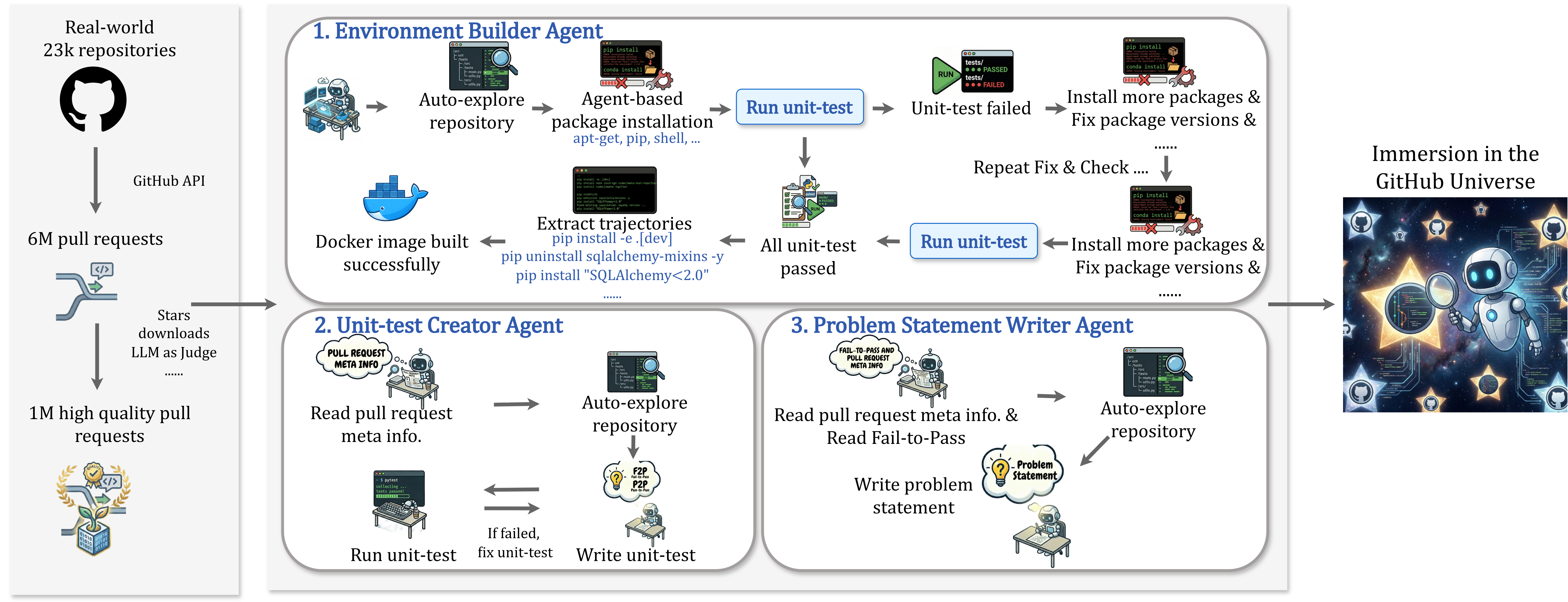
Figure 2: The Sandboxed multi-agent system for Scale-SWE dataset construction. Starting from millions of raw GitHub pull requests, the pipeline employs a series of autonomous agents to transform high-quality PRs into executable software engineering tasks. The framework automates environment setup, unit test generation (Fail-to-Pass/Pass-to-Pass), and formal problem statement synthesis, ensuring the scalability and reproducibility of the distilled trajectories.
The core philosophy of Scale-SWE is to make use of a sandboxed multi-agent system to autonomously explore codebases and complete SWE data construction. Each SWE data instance encapsulates the necessary components: a docker image, a problem statement, and the validation unit tests (consisting of F2P and P2P unit tests). Our sandboxed multi-agent system offers significantly greater flexibility compared to prior rule-based construction methods. By shifting the construction burden to the agent, Scale-SWE enables the scaling of interactive environments while minimizing the heuristic bias inherent in rigid filtering pipelines. In what follows, we firstly introduce our sandboxed multi-agent system (Section 2.1), and then detail by the data processing pipeline (Section 2.2).
### 2.1 Sandboxed Multi-agent System
To scale the automated construction of software engineering tasks, we develop a sandboxed multi-agent system. This framework leverages collaborative agents to produce a large volume of SWE data with fully integrated, executable environments.
#### 2.1.1 The Overall Workflow
As illustrated in Figure 2, our sandboxed multi-agent system automates the construction of software engineering tasks through the coordinated execution of three specialized agents: the Environment Builder Agent (EBA), the Unit-test Creator Agent (UCA), and the Problem Statement Writer Agent (PSWA). Within this framework, the EBA generates reproducible, Docker-based execution environments from target repositories, providing the isolated and consistent runtime needed for scalable task validation. The UCA synthesizes comprehensive, executable test suites—including both Fail-to-Pass (F2P) and Pass-to-Pass (P2P) test cases—from pull requests and repository context, ensuring robust evaluation criteria. Finally, the PSWA produces high-quality, self-contained problem descriptions grounded in the executable test suites, guaranteeing semantic alignment between the problem statement and the validation requirements. The system is built upon SWE-agent [Yang et al., 2024a] and powered by the DeepSeek language model family [Liu et al., 2025] and Gemini3-Pro [Google, 2025], with task instances generated using both DeepSeek v3.1 or DeepSeek v3.2, with the exception of PSWA, which utilizes Gemini3-Pro.
#### 2.1.2 Environment builder agent
The EBA is designed to automatically generate a reproducible, Docker-based execution environment from a target source code repository. By providing an isolated and executable sandbox, the EBA enables the scalable construction and validation of test samples for automated software engineering workflows.
Role Formulation. We define the core function of the EBA as the transformation of an initial, generic Docker environment into a specialized runtime container tailored to a specific repository. This process can be expressed as:
$$
\mathcal{D}_{\text{final}}=\text{EBA}(\mathcal{R},\mathcal{D}_{\text{init}}), \tag{1}
$$
where $\mathcal{R}$ denotes the input repository that the agent analyzes to infer dependencies and configuration logic, $\mathcal{D}_{\text{init}}$ is the base Docker image, and $\mathcal{D}_{\text{final}}$ is the resulting functional, ready-to-use container image.
Construction Process. In implementation, the EBA is initialized within a base Docker container containing the cloned repository. It begins by autonomously exploring the repository’s structure and analyzing configuration files—such as setup.py, pyproject.toml, and README.md —to infer project dependencies. Since Python projects lack a universal setup protocol, a standardized installation approach is insufficient. The agent must therefore interpret project-specific documentation and interactively resolve dependency conflicts by parsing terminal feedback. This feedback-driven, autonomous process enables flexible environment configuration, circumventing the limitations of static, rule-based methods (e.g., predefined pip install commands). Finally, we extract all executed commands from the agent’s trajectory and use an LLM to synthesize them into a reproducible Dockerfile.
Efficiently Scaling Environmental Diversity. While constructing a dedicated environment per pull request (PR) is straightforward, it is computationally prohibitive for large-scale evaluation. To scale across a diverse set of repositories, we sample at most ten PRs per repository for full environment construction via the EBA. This sampling strategy enables broader repository coverage while controlling resource costs. Note that ten PRs do not yield only ten task samples; multiple PRs can share the same environment if they originate from a similar runtime state, resulting in significantly more test samples than uniquely built environments. Specifically, for the remaining PRs, we execute tests in the “nearest” available Docker environment, determined by proximity in PR ID (as a proxy for repository timeline). If a PR fails the unit tests within its nearest available environment, it is discarded from the final dataset. Otherwise, the PR and its associated pre-established environment are retained as a valid test instance. On average, each repository contributes 19 test instances (see Table 2), dramatically improving environment reuse and overall dataset diversity.
#### 2.1.3 Unit-test creator agent
The unit-test creator agent (UCA) is designed to automatically generate comprehensive and executable test suites from target source code repositories and their associated pull requests. By synthesizing semantic PR information with dynamic repository context, the UCA enables the scalable construction of validated Fail-to-Pass (F2P) and Pass-to-Pass (P2P) test cases, which are essential for robust software engineering task evaluation.
Role Formulation. The core function of the UCA is to transform the provided pull request metadata and its associated code context into a comprehensive suite of executable unit tests. This process can be expressed as:
$$
\mathcal{U}=\text{UCA}(\mathcal{M},\mathcal{R},\mathcal{D}_{\text{final}}), \tag{2}
$$
where $\mathcal{M}$ denotes the input pull request metadata—including the title, description, and diff patches—that provides the semantic specification for test generation, $\mathcal{R}$ is the associated source repository that the agent analyzes to understand code structure and logic, $\mathcal{D}_{\text{final}}$ is the functional Docker environment built by the EBA, and $\mathcal{U}$ is the resulting set of executable test cases. In this work, we adopt the SWE-bench protocol for unit tests, categorizing them into two types: Fail-to-Pass (F2P) tests, which initially fail on the original codebase and must pass after the bug-fixing patch to verify correctness; and Pass-to-Pass (P2P) tests, which are pre-existing passing tests that must continue to pass to ensure no regression is introduced.
Construction Process. A large proportion of GitHub repositories lack comprehensive unit tests, making the automated construction of both Fail-to-Pass (F2P) and Pass-to-Pass (P2P) test cases essential for creating valid Software Engineering (SWE) task instances. The UCA begins by analyzing structured metadata from a target PR, including its title, description, and diff patches. This input provides the necessary semantic grounding for the agent to comprehend the intent and scope of the proposed code changes. Building on this foundation, the agent performs an autonomous traversal of the associated repository to map its directory structure, identify key modules, and infer the underlying program logic and dependencies. However, generating effective unit tests presents a complex, stateful challenge that requires not only static code understanding but also dynamic behavioral validation. The agent must reason about cross-file interactions, data flow, exception handling, and edge cases—tasks that are difficult to accomplish through static analysis alone. To address this, the UCA is deployed within a secure, sandboxed execution environment (specifically, the Docker container $\mathcal{D}_{\text{final}}$ produced by the EBA). This sandbox grants the agent direct, real-time code execution privileges, enabling an interactive execute-analyze-refine loop. The agent can thus dynamically run its proposed tests, observe their outcomes, and iteratively revise the test logic, assertions, and fixtures. This closed-loop, feedback-driven methodology allows the UCA to produce robust, executable test suites.
#### 2.1.4 Problem Statement Writer Agent
The problem statement writer agent (PSWA) is designed to automatically synthesize high-quality, self-contained task descriptions from raw pull requests and their associated test suites. By grounding the narrative in executable unit tests, the PSWA ensures semantic alignment between the problem specification and unit tests, thereby producing well-posed and tractable software engineering tasks.
Role Formulation. The core function of the PSWA is to generate a formal problem statement free of solution leakage according to pull request metadata and its corresponding test suite. This process can be expressed as:
$$
\mathcal{S}=\text{PSWA}(\mathcal{M},\mathcal{U},\mathcal{R},\mathcal{D}_{\text{final}}), \tag{3}
$$
where $\mathcal{M}$ denotes the input PR metadata—including its title, description, and diff patches—that provides initial contextual grounding; $\mathcal{U}$ is the executable unit-test suite generated by the UCA, which ensures the problem statement aligns with the actual validation requirements; $\mathcal{R}$ is the associated source repository; $\mathcal{D}_{\text{final}}$ is the functional Docker environment built by the EBA; and $\mathcal{S}$ is the resulting formal problem description that articulates the issue without exposing implementation details and consistent with unit-test at the same time.
Construction Process. Relying solely on raw PR descriptions as problem statements is fundamentally flawed due to their retrospective nature—they are often written after the fix is implemented and may leak solution details or reference internal artifacts. Moreover, a significant portion of high-quality PRs lack descriptions or are disconnected from original issue reports. To overcome these limitations, the PSWA is initialized with both the PR metadata and the executable unit tests produced by the UCA. Integrating the test suite into the prompt is critical because F2P tests may invoke functions or classes that do not exist in the original codebase; the generated problem statement must explicitly articulate these requirements to make the task tractable. Without this alignment, descriptions derived only from PR metadata often diverge from the actual failures captured by the tests. The agent thus synthesizes a coherent, self-contained narrative that specifies the expected behavior, any new interfaces required by the tests, and the context necessary for an external solver—all while deliberately omitting hints about the implementation. This process ensures that each synthesized task instance is both semantically precise and evaluation-ready, scaling the creation of SWE-bench-style problems from raw repository data.
For PSWA, we employ Gemini3-Pro, as our experiments indicate that it generates more consistent and rigorous problem statements while significantly minimizing information leakage.
Table 1: Detailed statistics of the Scale-SWE dataset. We report the mean and percentiles (P50, P75, P95) for code modification metrics and test case distributions.
| Metric | Mean | P50 | P75 | P95 |
| --- | --- | --- | --- | --- |
| Modified Files | 6.4 | 3.0 | 6.0 | 18.0 |
| Deleted Lines | 54.9 | 1.0 | 10.0 | 119.0 |
| Added Lines | 220.8 | 43.0 | 120.0 | 595.0 |
| Edited Lines | 37.0 | 6.0 | 20.0 | 108.0 |
| Total Changes | 312.7 | 63.0 | 167.0 | 867.0 |
| Fail-to-Pass | 5.7 | 2.0 | 5.0 | 15.0 |
| Pass-to-Pass | 209.0 | 68.0 | 178.0 | 793.0 |
| Total tests | 214.7 | 72.0 | 185.0 | 801.7 |
### 2.2 Data Processing
Ensuring high data quality is the foremost priority in building a reliable dataset. This section details our curation methodology to achieve this goal.
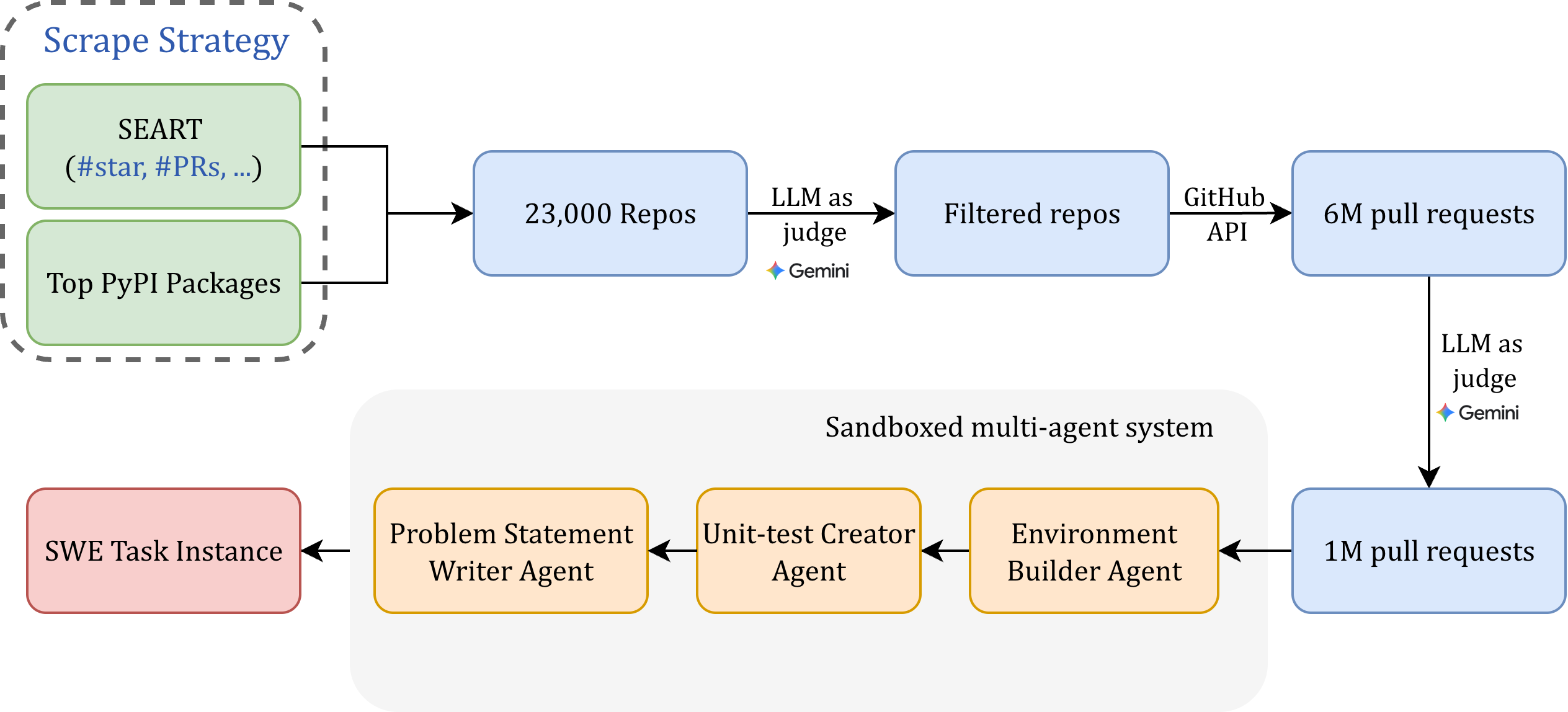
Repository Selection. To assemble a comprehensive and high-quality corpus, we sourced repositories from two primary channels, illustrated in Figure 5. First, we identified the repositories corresponding to the top 15,000 most-downloaded packages on the Python Package Index (PyPI), using data from Top PyPI Packages. Second, to capture notable projects beyond PyPI, we queried the SEART search engine with the following criteria: primary language as Python, a minimum of 5 contributors, at least 500 stars, and a creation date between January 1, 2015, and October 29, 2025. This query returned 9,062 repositories. The initial union of these two sources yielded approximately 23,000 candidate repositories. We then applied a multi-stage filtering pipeline. First, to prevent data leakage from the evaluation benchmark, we excluded all PRs originating from repositories listed in SWE-Bench Verified. Second, we filtered to include only repositories with permissive open-source licenses. Finally, recognizing that a subset of repositories might be GPU-dependent, tutorial-based, or contain minimal source code, we performed a content-based filter. We extracted the README files from all remaining candidates and employed an LLM-as-a-judge approach to automatically exclude repositories deemed unsuitable for training.
Pull Request Filtering. We next extracted all pull requests merged into the “main” or “master” branches of the filtered repositories, resulting in a preliminary set of 6 million entries. To ensure quality, we utilized an LLM-as-a-judge to filter low-quality instances based on the available metadata: the git diff, the pull request description, and the merge commit message.
Cheating Prevention. During the evaluation phase, it is imperative to prevent the model from exploiting git commands (e.g., git log --all) to access ground truth solutions [Xiao et al., 2026]. To address this, we execute a sanitization script immediately after initializing the task environment. This process, systematically removes metadata that follows the task’s parent commit. It performs a hard reset, deletes all remote references and tags, and purges internal git files (e.g., logs/, packed-refs, and various HEAD files), thereby eliminating any trace of future solution history.
<details>
<summary>figures/dataset_comparison_icml.png Details</summary>
### Visual Description
## Bar Chart: Error Type Distribution Across Software Evaluation Frameworks
### Overview
The chart compares the percentage distribution of various error types across four software evaluation frameworks: SWE-Bench-Verified, SWE-Gym, SWE-smith, and Scale-SWE. Error types are categorized into 10 distinct types, with percentages ranging from 0% to 60% on the y-axis.
### Components/Axes
- **X-axis**: Frameworks (SWE-Bench-Verified, SWE-Gym, SWE-smith, Scale-SWE)
- **Y-axis**: Percentage (%) from 0% to 60%
- **Legend**:
- Blue: API Mismatch
- Orange: Logic Error
- Green: Input/Boundary
- Purple: Import Error
- Pink: Mutability
- Yellow: I/O Resource
- Brown: State Sync
- Gray: Spec Violation
- Cyan: Security
- Red: Constructor
### Detailed Analysis
1. **SWE-Bench-Verified**:
- Logic Error (orange): ~42%
- API Mismatch (blue): ~12%
- Input/Boundary (green): ~18%
- State Sync (brown): ~8%
- Spec Violation (gray): ~7%
- Import Error (purple): ~4%
- Constructor (red): ~3%
- Mutability (pink): ~2%
- I/O Resource (yellow): ~1%
- Security (cyan): ~0.5%
2. **SWE-Gym**:
- Logic Error (orange): ~36%
- API Mismatch (blue): ~20%
- Input/Boundary (green): ~21%
- State Sync (brown): ~8%
- Spec Violation (gray): ~6%
- Import Error (purple): ~4%
- Constructor (red): ~3%
- Mutability (pink): ~2%
- I/O Resource (yellow): ~1%
- Security (cyan): ~0.5%
3. **SWE-smith**:
- Logic Error (orange): ~62%
- API Mismatch (blue): ~9%
- Input/Boundary (green): ~7%
- State Sync (brown): ~4%
- Spec Violation (gray): ~3%
- Import Error (purple): ~2%
- Constructor (red): ~5%
- Mutability (pink): ~1%
- I/O Resource (yellow): ~0.5%
- Security (cyan): ~0.5%
4. **Scale-SWE**:
- API Mismatch (blue): ~26%
- Logic Error (orange): ~24%
- Input/Boundary (green): ~19%
- State Sync (brown): ~6%
- Spec Violation (gray): ~8%
- Import Error (purple): ~12%
- Constructor (red): ~3%
- Mutability (pink): ~2%
- I/O Resource (yellow): ~2%
- Security (cyan): ~0.5%
### Key Observations
- **Dominant Error Types**:
- Logic Error consistently dominates in SWE-Bench-Verified (~42%) and SWE-smith (~62%).
- API Mismatch peaks in Scale-SWE (~26%).
- Input/Boundary errors are significant in SWE-Gym (~21%) and Scale-SWE (~19%).
- **Low-Frequency Errors**:
- Mutability, I/O Resource, and Security errors remain below 3% across all frameworks.
- Security errors are nearly negligible (<1%) in all cases.
- **Framework-Specific Trends**:
- SWE-smith shows the highest Logic Error rate (62%) and lowest API Mismatch (9%).
- Scale-SWE has the highest API Mismatch (26%) and Import Error (12%).
### Interpretation
The data suggests that **Logic Errors** are the most prevalent issue across all frameworks, particularly in SWE-smith, which may indicate challenges in code correctness or algorithmic implementation. The rise of **API Mismatch** in Scale-SWE implies scalability or integration challenges in larger systems. **Input/Boundary errors** are consistently significant, highlighting potential issues with data handling or interface design.
The low frequency of **Security** and **Mutability** errors suggests these are either well-managed or less critical in current evaluations. The spike in **Import Error** in Scale-SWE could point to dependency management or library compatibility issues in scaled environments. Overall, the chart emphasizes the need for targeted improvements in error handling, particularly for Logic and API-related issues in scalable systems.
</details>
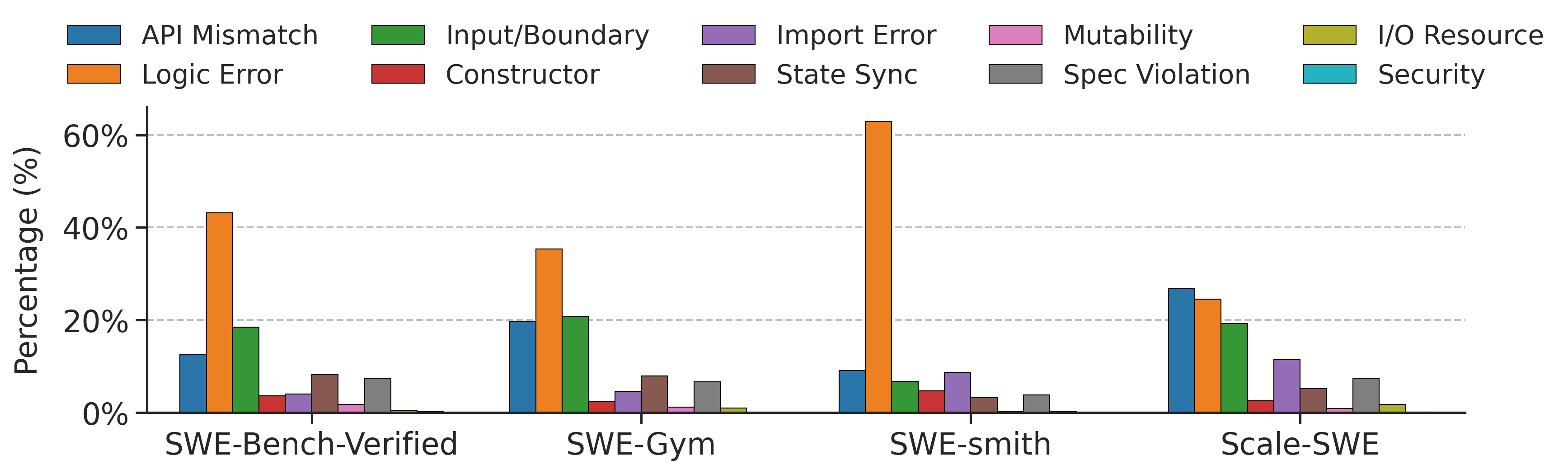
Figure 3: Distribution of bug categories across different datasets. The bar chart compares the percentage of ten bug types within SWE-bench Verified, SWE-Gym, SWE-smith, and Scale-SWE. The categories are defined as: API Mismatch (incompatible signatures or parameter errors); Logic Error (flawed conditionals or control flow); Input/Boundary (edge case mishandling or validation failures); Constructor (object initialization errors); Import Error (missing modules or undefined symbols); State Sync (inconsistent internal state); Mutability (unintended side effects); Spec Violation (non-compliance with protocols); I/O Resource (file system or stream errors); and Security (improper scoping or access control).
### 2.3 Dataset Quality Assurance
Rule-based Check. We implemented a rigorous filtering protocol based on test outcomes. We retained only those instances where: (1) all P2P tests pass and F2P tests fail on the original buggy codebase; and (2) all P2P and F2P tests pass upon application of the golden patch.
Expert Check. We engaged four senior Ph.D. students to manually audit 100 randomly sampled instances employing a cross-validation protocol. The audit confirmed that 94 instances were valid, featuring correct environments, unit tests, and problem statements. We attribute this high quality to three key factors: (1) We leveraged state-of-the-art models (e.g., Gemini 3 Pro) to synthesize accurate problem statements; (2) We employed an LLM-as-a-Judge approach to preemptively discard low-quality repositories and pull requests; and (3) We enforced a fixed execution order for P2P and F2P tests to prevent test pollution, where varying execution orders could otherwise lead to inconsistent results due to environment contamination.
### 2.4 Dataset Statistics and Trajectory Distillation
Ultimately, our agent-based construction pipeline yielded 100k successfully verified instances—the largest verified SWE benchmark to date. Leveraging our extensive collection of GitHub repositories, the resulting dataset achieves substantially greater repository diversity than existing SWE benchmarks, as detailed in Table 2. Unlike previous datasets that typically rely on synthetic generation or limited real-world sources, Scale-SWE is constructed entirely from 5.2k real repositories. This represents a 50% increase in repository count over the next largest real-world benchmark (SWE-rebench with 3.5k repositories). This scale and diversity ensure that our benchmark better reflects the complexity and variety of real-world software engineering tasks.
The statistical characteristics of Scale-SWE are presented in Table 1. The dataset presents non-trivial software engineering challenges. The median instance requires modifications to at least 3 files and the addition of 43 lines of code, reflecting the task complexity. For evaluation robustness, instances contain an average of over 200 Pass-to-Pass (P2P) tests (median: 68), providing strong protection against regression, while an average of 5.69 Fail-to-Pass (F2P) tests per instance validates whether the LLM successfully resolves the specific issue.
To construct the training corpus, we distilled agent trajectories from a subset of 25k instances using the high-performance expert model DeepSeek-V3.2. For each instance, we conducted five independent sampling trials with a temperature of 0.95 and a maximum budget of 100 interaction turns. A trajectory was considered valid only if it culminated in a submission that passed all unit tests. This pipeline produced 71k high-quality trajectories totaling approximately 3.5 billion tokens. To ensure a fair comparison, we applied the identical pipeline to collect trajectories for SWE-Smith and SWE-Gym.
Figure 3 highlights the superior diversity of Scale-SWE. Synthetic datasets like SWE-smith exhibit a strong bias towards Logic Errors, failing to capture the intricacies of API Mismatches or State Synchronization issues common in large codebases. Similarly, SWE-Gym, despite being real-world sourced, suffers from low variety due to its restriction to only 11 repositories.
Conversely, Scale-SWE achieves a highly balanced distribution across all ten bug categories. By leveraging 5.2k real-world repositories and an automated environment-building pipeline, Scale-SWE effectively captures a wide array of defect types—from Constructor errors to Security flaws. This validates that scaling the source repositories and automating the execution pipeline are critical for synthesizing training data that faithfully represents real-world software evolution.
We adopt the bug taxonomy proposed in BugPilot [Sonwane et al., 2025] and employ DeepSeek v3.2 to automatically annotate the training instances.
Table 2: Comparison of Scale-SWE with existing software engineering (SWE) benchmarks. We contrast datasets across key dimensions: the number of executable instances—defined as those equipped with a Dockerized environment and validated via Fail-to-Pass (F2P) and Pass-to-Pass (P2P) tests—primary data source, repository diversity, and trajectory count.
| Dataset | Exec. instances | Primary Source | Repo. | Traj. |
| --- | --- | --- | --- | --- |
| R2E-Gym [Jain et al., 2025] | 4.6k | Synthetic | 10 | 3.3k |
| SWE-Gym [Pan et al., 2024] | 2.4k | Real | 11 | 491 |
| SWE-smith [Yang et al., 2025a] | 50k | Synthetic | 128 | 5k |
| SWE-Mirror [Wang et al., 2025a] | 60k | Synthetic | 40 | 12k |
| SWE-rebench [Badertdinov et al., 2025] | 7.5k | Real | 3.5k | N/A |
| Scale-SWE | 100k | Real | 5.2k | 71k |
Table 3: Performance comparison on SWE-bench Verified. We categorize models into proprietary systems, open-source methods, and size-matched baselines.
| Models | Base Model | SWE-bench (V) |
| --- | --- | --- |
| Proprietary Models | | |
| GPT-5.2 Thinking [OpenAI, 2025] | - | 80.0 |
| Claude Sonnet 4.5 [Anthropic, 2025b] | - | 77.2 |
| Gemini 3 Pro [Google, 2025] | - | 76.2 |
| MiniMax-M2.1 [MiniMax AI, 2025] | - | 74.0 |
| GLM-4.7 [Zhipu AI, 2025] | - | 73.8 |
| DeepSeek-V3.2 [Liu et al., 2025] | - | 73.1 |
| Kimi K2 Thinking [Team et al., 2025a] | - | 71.3 |
| Open Source Methods | | |
| SWE-Gym-32B [Pan et al., 2024] | Qwen-2.5 coder | 20.6 |
| SWE-Fixer-72B [Xie et al., 2025] | Qwen2.5-72B | 32.8 |
| R2E-Gym-32B [Jain et al., 2025] | Qwen-2.5-Coder | 34.4 |
| SWE-rebench-72B [Golubev et al., 2025] | Qwen2.5-72B-Instruct | 39.0 |
| SWE-smith-32B [Yang et al., 2025a] | Qwen2.5-32B | 40.2 |
| SWE-RL [Wei et al., 2025] | Llama3-70B | 41.0 |
| Skywork-SWE-32B [Zeng et al., 2025] | Qwen2.5-Coder-32B-Instruct | 47.9 |
| SWE-Mirror-LM-32B [Wang et al., 2025a] | Qwen2.5-Coder-32B-Instruct | 52.2 |
| SWE-Lego-32B [Tao et al., 2026] | Qwen3-32B | 52.6 |
| KAT-Dev-32B [Zhan et al., 2025] | - | 62.4 |
| Models of the same size | | |
| Qwen3-30B-A3B-Instruct [Team, 2025] | - | 22.0 |
| Qwen3-Coder-30B-A3B-Instruct [Team, 2025] | - | 51.6 |
| GLM-4.7-Flash-30A3B [Zhipu AI, 2026] | - | 59.2 |
| Our Model | | |
| Scale-SWE-Agent | Qwen3-30B-A3B-Instruct | 64.0 |
## 3 Experiments
### 3.1 Experiment Setup
Agent Scaffolding. We employed OpenHands [Wang et al., 2025b], an open-source, event-driven platform, as the unified agent framework for all experiments. OpenHands facilitates LLM agents to iteratively edit files, execute shell commands, and browse the web within sandboxed containers. We selected this framework due to its proven ability to establish robust and reproducible baselines on benchmarks such as SWE-Bench.
Agent Post-training. We perform post-training on the Qwen3-30B-A3B-Instruct [Team, 2025] base model. The training process is configured with a learning rate of 1e-5, a batch size of 128, and a warmup ratio of 0.05, supporting a maximum context length of 131,072. Also, we apply loss masking to restrict loss computation solely to assistant turns that result in well-formed actions [Team et al., 2025b, Chen et al., 2025].
Evaluation Benchmarks and Metrics Our evaluation is conducted on SWE-bench Verified [Chowdhury et al., 2024], a benchmark comprising 500 high-quality, human-curated Python software issues. We report the Resolved Rate (%), representing the proportion of instances for which the model generates a correct solution. Notably, although the models were trained with a sequence length of 131,072, we extended the context limit to 262,144 during inference to handle larger inputs.
### 3.2 Experiment Results
As shown in Table 3, the Scale-SWE Agent demonstrates superior performance on the SWE-bench Verified. First, regarding the impact of our scaling strategy, Scale-SWE Agent achieves a remarkable 42.0% absolute improvement over its base model, Qwen3-30B-A3B-Instruct, boosting the pass rate from 22.0% to 64.0%. Second, in comparison to models of the same size, our method significantly outperforms strong competitors, including Qwen3-Coder (51.6%) and GLM-4.7-Flash (59.2%). Furthermore, Scale-SWE Agent exhibits exceptional efficiency, surpassing models with significantly larger parameter counts, such as SWE-RL (Llama3-70B) and SWE-Fixer-72B. Notably, it also exceeds the previous state-of-the-art open-source method, KAT-Dev-32B (62.4%), and outperforms recent specialist models like SWE-Mirror and SWE-Lego by a margin of over 11%. These results validate the effectiveness of scaling up SWE-style data for enhancing software engineering capabilities.
<details>
<summary>figures/merge_traj_stat.drawio.png Details</summary>
### Visual Description
## Line Chart: Comparative Density Distributions of SWE Models
### Overview
The image contains two overlaid density distribution charts comparing three software engineering workflow (SWE) models: SWE-Gym (blue), SWE-smith (orange), and Scale-SWE (green). The top subplot visualizes token count distributions, while the bottom subplot shows turn distributions (tool calls). Both charts use density curves with shaded areas representing probability distributions.
### Components/Axes
**Top Subplot (Token Count):**
- X-axis: Token Count (0 to 120k, linear scale)
- Y-axis: Density (0 to 3×10⁻⁵, linear scale)
- Legend: Top-right corner with color-coded labels
- Axis markers: Numerical ticks at 20k, 40k, 60k, 80k, 100k, 120k
**Bottom Subplot (Turns):**
- X-axis: Turns (tool call) (0 to 100, linear scale)
- Y-axis: Density (0 to 2×10⁻², linear scale)
- Legend: Same as top subplot
- Axis markers: Numerical ticks at 20, 40, 60, 80, 100
### Detailed Analysis
**Token Count Distribution:**
1. **SWE-Gym (blue):**
- Peak density at ~20k tokens (3.2×10⁻⁵)
- Sharp decline after peak, near-zero beyond 40k
- Narrowest distribution (σ ≈ 5k tokens)
2. **SWE-smith (orange):**
- Peak density at ~30k tokens (2.8×10⁻⁵)
- Broader distribution than SWE-Gym (σ ≈ 8k tokens)
- Longer tail extending to 60k tokens
3. **Scale-SWE (green):**
- Bimodal distribution with peaks at ~25k and ~50k tokens
- Highest overall density (3.5×10⁻⁵ at 50k)
- Widest distribution (σ ≈ 15k tokens)
**Turn Distribution:**
1. **SWE-Gym (blue):**
- Peak density at 20 turns (1.8×10⁻²)
- Rapid decline after peak, near-zero beyond 40 turns
- Narrowest distribution (σ ≈ 5 turns)
2. **SWE-smith (orange):**
- Peak density at 30 turns (1.6×10⁻²)
- Broader distribution than SWE-Gym (σ ≈ 7 turns)
- Longer tail extending to 60 turns
3. **Scale-SWE (green):**
- Bimodal distribution with peaks at ~25 and ~50 turns
- Highest overall density (2.0×10⁻² at 50 turns)
- Widest distribution (σ ≈ 12 turns)
### Key Observations
1. **Consistency vs. Complexity Tradeoff:**
- SWE-Gym shows the most consistent performance (narrowest distributions)
- Scale-SWE demonstrates highest complexity handling (widest distributions)
- SWE-smith represents intermediate behavior
2. **Bimodal Patterns:**
- Scale-SWE's bimodal distributions suggest two distinct operational modes
- Secondary peaks at ~50k tokens/turns indicate specialized task handling
3. **Scale Relationships:**
- Token count distributions are 100-1000x wider than turn distributions
- Density scales differ by 1000x between subplots (1e-5 vs 1e-2)
### Interpretation
The data reveals fundamental differences in model behavior:
- **SWE-Gym** prioritizes efficiency with minimal token/turn usage but limited complexity handling
- **Scale-SWE** sacrifices efficiency for broader capability, showing variable performance across task complexities
- **SWE-smith** balances these factors, offering moderate efficiency with improved complexity handling
The bimodal patterns in Scale-SWE suggest adaptive behavior, potentially switching between different processing strategies. The consistent peak positions across models (20-30k tokens/turns) indicate common operational thresholds in SWE workflows. The density scale differences emphasize that token distributions are inherently more variable than turn counts in these models.
</details>

Figure 4: Comparison of distillation data statistics across different datasets. We show the probability density functions for (top) total token count and (bottom) the number of tool-call turns.
To evaluate the efficacy of our data compared to existing alternatives, we conducted controlled experiments by performing distillation and SFT on SWE-Gym and SWE-smith using an identical pipeline. As shown in Table 4, Scale-SWE significantly outperforms both baselines. Notably, despite SWE-smith possessing a considerably larger volume of instances than SWE-Gym, it yields slightly inferior performance. This performance gap suggests a diminishing return on purely synthetic data and underscores a critical insight: high-fidelity, real-world data is inherently more effective than massive-scale synthetic alternatives. This finding reinforces the importance of our large-scale “real-data” construction approach.
The distributions of interaction turns and token counts are presented in Figure 4. As illustrated in these figures, Scale-SWE tasks necessitate a greater number of turns for repository exploration and iterative debugging. This observation underscores the high complexity and difficulty inherent in the Scale-SWE dataset.
Table 4: SFT performance comparison on SWE-bench Verified. All models are fine-tuned using the same distillation pipeline to ensure a fair comparison.
| Dataset Name | SWE-bench Verified |
| --- | --- |
| SWE-Gym | 54.8 |
| SWE-smith | 54.6 |
| Scale-SWE | 64.0 |
## 4 Related Work
SWE Benchmark. Since the introduction of the prevailing software engineering benchmark, SWE-bench [Jimenez et al., 2023] and SWE-bench-Verified [Chowdhury et al., 2024], many other benchmarks have emerged to assess multi-modal [Yang et al., 2024b], multi-language [Zan et al., 2025b, Rashid et al., 2025, Guo et al., 2025a], and long-horizon capabilities [Deng et al., 2025]. These new benchmarks also evaluate whole repository generation [Ding et al., 2025], scientific domain knowledge [Duston et al., 2025], and other specialized abilities [Ma et al., 2025, Shetty et al., 2025]. Collectively, these benchmarks constitute a comprehensive evaluation ecosystem, establishing rigorous standards that assess the multifaceted capabilities required for autonomous software engineering.
SWE Datasets. High-quality data is pivotal for enhancing the programming capabilities of Large Language Models (LLMs). Recently, there has been a surge in repository-level software engineering datasets aimed at addressing complex coding tasks. Efforts to scale up SWE task instances generally fall into two categories. One line of work, including R2E-Gym [Jain et al., 2025], SWE-smith [Yang et al., 2025a], and SWE-Mirror [Wang et al., 2025a], attempts to scale up training data through synthetic generation. Conversely, other works focus on mining real-world issues; for instance, SWE-Gym [Pan et al., 2024] constructed 2,400 executable instances restricted to 11 repositories, while SWE-rebench [Badertdinov et al., 2025] further expanded this collection to 7,500 executable instances.
SWE Models and Agents. Recent advancements have introduced powerful models specialized for SWE tasks, including SWE-RL [Wei et al., 2025], SWE-Swiss [He et al., 2025], Kimi-Dev [Yang et al., 2025b], and KAT-Coder [Zhan et al., 2025]. In parallel, frameworks such as SWE-agent [Yang et al., 2024a], Mini-SWE-Agent [Yang et al., 2024a], OpenHands [Wang et al., 2025b], and MOpenHands [Zan et al., 2025a] serve as effective scaffolds to streamline interactions with development environments.
## 5 Conclusion
In this work, we introduced Scale-SWE, a sandboxed multi‑agent framework that automates the construction of large‑scale, high‑quality software engineering data along with executable environments. By orchestrating specialized agents for environment setup, unit‑test generation, and task description synthesis, we processed six million real‑world pull requests to produce Scale-SWE-Data—a dataset of 100,000 instances that surpasses existing datasets in both scale and repository diversity. We further demonstrated the practical value of the dataset by distilling high‑quality trajectories and fine‑tuning Qwen3‑30B-A3B-Instruct to create Scale-SWE-Agent, which achieves substantial improvements on SWE‑Bench‑Verified—increasing the resolve rate from 22% to 64%. This advancement underscores the quality and utility of our data for training more capable code agents. We believe Scale-SWE opens new avenues for scalable SWE‑style dataset construction and provides a rich, open‑access resource to support the development of more capable LLM‑based software engineering agents. In future work, we aim to not only increase the volume of training data to fully leverage the potential of Scale-SWE-Data but also significantly broaden its linguistic scope. Specifically, we plan to extend our pipeline to support other major programming languages—such as Java, C, C++, and Rust—thereby fostering the development of truly language-agnostic software engineering agents.
## References
- Anthropic [2025a] Anthropic. Introducing Claude Sonnet 4.5, Sept. 2025a. URL https://www.anthropic.com/news/claude-sonnet-4-5.
- Anthropic [2025b] Anthropic. Announcing Claude Sonnet 4.5, 2025b. URL https://www.anthropic.com/news/claude-sonnet-4-5. Accessed: 2025-09-30.
- Badertdinov et al. [2025] I. Badertdinov, A. Golubev, M. Nekrashevich, A. Shevtsov, S. Karasik, A. Andriushchenko, M. Trofimova, D. Litvintseva, and B. Yangel. Swe-rebench: An automated pipeline for task collection and decontaminated evaluation of software engineering agents. arXiv preprint arXiv:2505.20411, 2025.
- Chen et al. [2025] G. Chen, Z. Qiao, X. Chen, D. Yu, H. Xu, W. X. Zhao, R. Song, W. Yin, H. Yin, L. Zhang, et al. Iterresearch: Rethinking long-horizon agents via markovian state reconstruction. arXiv preprint arXiv:2511.07327, 2025.
- Chowdhury et al. [2024] N. Chowdhury, J. Aung, C. J. Shern, O. Jaffe, D. Sherburn, G. Starace, E. Mays, R. Dias, M. Aljubeh, M. Glaese, C. E. Jimenez, J. Yang, L. Ho, T. Patwardhan, K. Liu, and A. Madry. Introducing SWE-bench verified, 2024. URL https://openai.com/index/introducing-swe-bench-verified/. OpenAI Blog Post.
- Deng et al. [2025] X. Deng, J. Da, E. Pan, Y. Y. He, C. Ide, K. Garg, N. Lauffer, A. Park, N. Pasari, C. Rane, et al. Swe-bench pro: Can ai agents solve long-horizon software engineering tasks? arXiv preprint arXiv:2509.16941, 2025.
- Ding et al. [2025] J. Ding, S. Long, C. Pu, H. Zhou, H. Gao, X. Gao, C. He, Y. Hou, F. Hu, Z. Li, et al. Nl2repo-bench: Towards long-horizon repository generation evaluation of coding agents. arXiv preprint arXiv:2512.12730, 2025.
- Duston et al. [2025] T. Duston, S. Xin, Y. Sun, D. Zan, A. Li, S. Xin, K. Shen, Y. Chen, Q. Sun, G. Zhang, et al. Ainsteinbench: Benchmarking coding agents on scientific repositories. arXiv preprint arXiv:2512.21373, 2025.
- Froger et al. [2025] R. Froger, P. Andrews, M. Bettini, A. Budhiraja, R. S. Cabral, V. Do, E. Garreau, J.-B. Gaya, H. Laurençon, M. Lecanu, et al. Are: Scaling up agent environments and evaluations. arXiv preprint arXiv:2509.17158, 2025.
- Golubev et al. [2025] A. Golubev, M. Trofimova, S. Polezhaev, I. Badertdinov, M. Nekrashevich, A. Shevtsov, S. Karasik, S. Abramov, A. Andriushchenko, F. Fisin, et al. Training long-context, multi-turn software engineering agents with reinforcement learning. arXiv preprint arXiv:2508.03501, 2025.
- Google [2025] Google. Gemini 3 pro, 2025. URL https://deepmind.google/models/gemini/pro/.
- Guo et al. [2025a] L. Guo, W. Tao, R. Jiang, Y. Wang, J. Chen, X. Liu, Y. Ma, M. Mao, H. Zhang, and Z. Zheng. Omnigirl: A multilingual and multimodal benchmark for github issue resolution. Proceedings of the ACM on Software Engineering, 2(ISSTA):24–46, 2025a.
- Guo et al. [2025b] L. Guo, Y. Wang, C. Li, P. Yang, J. Chen, W. Tao, Y. Zou, D. Tang, and Z. Zheng. Swe-factory: Your automated factory for issue resolution training data and evaluation benchmarks. arXiv preprint arXiv:2506.10954, 2025b. URL https://arxiv.org/abs/2506.10954.
- He et al. [2025] Z. He, Q. Yang, W. Sheng, X. Zhong, K. Zhang, C. An, W. Shi, T. Cai, D. He, J. Chen, and J. Xu. Swe-swiss: A multi-task fine-tuning and rl recipe for high-performance issue resolution, 2025. Notion Blog.
- Jain et al. [2025] N. Jain, J. Singh, M. Shetty, L. Zheng, K. Sen, and I. Stoica. R2e-gym: Procedural environments and hybrid verifiers for scaling open-weights swe agents. arXiv preprint arXiv:2504.07164, 2025.
- Jimenez et al. [2023] C. E. Jimenez, J. Yang, A. Wettig, S. Yao, K. Pei, O. Press, and K. Narasimhan. Swe-bench: Can language models resolve real-world github issues? arXiv preprint arXiv:2310.06770, 2023.
- Liu et al. [2025] A. Liu, A. Mei, B. Lin, B. Xue, B. Wang, B. Xu, B. Wu, B. Zhang, C. Lin, C. Dong, et al. Deepseek-v3. 2: Pushing the frontier of open large language models. arXiv preprint arXiv:2512.02556, 2025.
- Ma et al. [2025] J. J. Ma, M. Hashemi, A. Yazdanbakhsh, K. Swersky, O. Press, E. Li, V. J. Reddi, and P. Ranganathan. Swe-fficiency: Can language models optimize real-world repositories on real workloads? arXiv preprint arXiv:2511.06090, 2025.
- MiniMax AI [2025] MiniMax AI. Multilingual and Multi-Task Coding with Strong Generalization: A Look at MiniMax-M2.1. Hugging Face Blog, 2025. URL https://huggingface.co/blog/MiniMaxAI/multilingual-and-multi-task-coding-with-strong-gen. Accessed: 2025-12-23.
- OpenAI [2025] OpenAI. Introducing GPT-5.2, Dec. 2025. URL https://openai.com/index/introducing-gpt-5-2/.
- Pan et al. [2024] J. Pan, X. Wang, G. Neubig, N. Jaitly, H. Ji, A. Suhr, and Y. Zhang. Training software engineering agents and verifiers with swe-gym. arXiv preprint arXiv:2412.21139, 2024.
- Rashid et al. [2025] M. S. Rashid, C. Bock, Y. Zhuang, A. Buchholz, T. Esler, S. Valentin, L. Franceschi, M. Wistuba, P. T. Sivaprasad, W. J. Kim, et al. Swe-polybench: A multi-language benchmark for repository level evaluation of coding agents. arXiv preprint arXiv:2504.08703, 2025.
- Shetty et al. [2025] M. Shetty, N. Jain, J. Liu, V. Kethanaboyina, K. Sen, and I. Stoica. Gso: Challenging software optimization tasks for evaluating swe-agents. arXiv preprint arXiv:2505.23671, 2025.
- Sonwane et al. [2025] A. Sonwane, I. White, H. Lee, M. Pereira, L. Caccia, M. Kim, Z. Shi, C. Singh, A. Sordoni, M.-A. Côté, et al. Bugpilot: Complex bug generation for efficient learning of swe skills. arXiv preprint arXiv:2510.19898, 2025.
- Tao et al. [2026] C. Tao, J. Chen, Y. Jiang, K. Kou, S. Wang, R. Wang, X. Li, S. Yang, Y. Du, J. Dai, et al. Swe-lego: Pushing the limits of supervised fine-tuning for software issue resolving. arXiv preprint arXiv:2601.01426, 2026.
- Team et al. [2025a] K. Team, Y. Bai, Y. Bao, G. Chen, J. Chen, N. Chen, R. Chen, Y. Chen, Y. Chen, Y. Chen, et al. Kimi k2: Open agentic intelligence. arXiv preprint arXiv:2507.20534, 2025a.
- Team [2025] Q. Team. Qwen3 technical report, 2025. URL https://arxiv.org/abs/2505.09388.
- Team et al. [2025b] T. D. Team, B. Li, B. Zhang, D. Zhang, F. Huang, G. Li, G. Chen, H. Yin, J. Wu, J. Zhou, et al. Tongyi deepresearch technical report. arXiv preprint arXiv:2510.24701, 2025b.
- Wang et al. [2025a] J. Wang, D. Zan, S. Xin, S. Liu, Y. Wu, and K. Shen. Swe-mirror: Scaling issue-resolving datasets by mirroring issues across repositories. arXiv preprint arXiv:2509.08724, 2025a.
- Wang et al. [2025b] X. Wang, S. Rosenberg, J. Michelini, C. Smith, H. Tran, E. Nyst, R. Malhotra, X. Zhou, V. Chen, R. Brennan, et al. The openhands software agent sdk: A composable and extensible foundation for production agents. arXiv preprint arXiv:2511.03690, 2025b.
- Wei et al. [2025] Y. Wei, O. Duchenne, J. Copet, Q. Carbonneaux, L. Zhang, D. Fried, G. Synnaeve, R. Singh, and S. I. Wang. Swe-rl: Advancing llm reasoning via reinforcement learning on open software evolution. arXiv preprint arXiv:2502.18449, 2025.
- Xiao et al. [2026] B. Xiao, B. Xia, B. Yang, B. Gao, B. Shen, C. Zhang, C. He, C. Lou, F. Luo, G. Wang, et al. Mimo-v2-flash technical report. arXiv preprint arXiv:2601.02780, 2026.
- Xie et al. [2025] C. Xie, B. Li, C. Gao, H. Du, W. Lam, D. Zou, and K. Chen. Swe-fixer: Training open-source llms for effective and efficient github issue resolution. arXiv preprint arXiv:2501.05040, 2025.
- Yang et al. [2024a] J. Yang, C. E. Jimenez, A. Wettig, K. Lieret, S. Yao, K. Narasimhan, and O. Press. Swe-agent: Agent-computer interfaces enable automated software engineering. Advances in Neural Information Processing Systems, 37:50528–50652, 2024a.
- Yang et al. [2024b] J. Yang, C. E. Jimenez, A. L. Zhang, K. Lieret, J. Yang, X. Wu, O. Press, N. Muennighoff, G. Synnaeve, K. R. Narasimhan, et al. Swe-bench multimodal: Do ai systems generalize to visual software domains? arXiv preprint arXiv:2410.03859, 2024b.
- Yang et al. [2025a] J. Yang, K. Lieret, C. E. Jimenez, A. Wettig, K. Khandpur, Y. Zhang, B. Hui, O. Press, L. Schmidt, and D. Yang. Swe-smith: Scaling data for software engineering agents. arXiv preprint arXiv:2504.21798, 2025a.
- Yang et al. [2025b] Z. Yang, S. Wang, K. Fu, W. He, W. Xiong, Y. Liu, Y. Miao, B. Gao, Y. Wang, Y. Ma, et al. Kimi-dev: Agentless training as skill prior for swe-agents. arXiv preprint arXiv:2509.23045, 2025b.
- Zan et al. [2025a] D. Zan, Z. Huang, W. Liu, H. Chen, L. Zhang, S. Xin, L. Chen, Q. Liu, X. Zhong, A. Li, S. Liu, Y. Xiao, L. Chen, Y. Zhang, J. Su, T. Liu, R. Long, K. Shen, and L. Xiang. Multi-swe-bench: A multilingual benchmark for issue resolving, 2025a. URL https://arxiv.org/abs/2504.02605.
- Zan et al. [2025b] D. Zan, Z. Huang, W. Liu, H. Chen, L. Zhang, S. Xin, L. Chen, Q. Liu, X. Zhong, A. Li, et al. Multi-swe-bench: A multilingual benchmark for issue resolving. arXiv preprint arXiv:2504.02605, 2025b.
- Zeng et al. [2025] L. Zeng, Y. Li, Y. Xiao, C. Li, C. Y. Liu, R. Yan, T. Wei, J. He, X. Song, Y. Liu, et al. Skywork-swe: Unveiling data scaling laws for software engineering in llms. arXiv preprint arXiv:2506.19290, 2025.
- Zhan et al. [2025] Z. Zhan, K. Deng, J. Wang, X. Zhang, H. Tang, M. Zhang, Z. Lai, H. Huang, W. Xiang, K. Wu, et al. Kat-coder technical report. arXiv preprint arXiv:2510.18779, 2025.
- Zhang et al. [2025] L. Zhang, S. He, C. Zhang, Y. Kang, B. Li, C. Xie, J. Wang, M. Wang, Y. Huang, S. Fu, et al. Swe-bench goes live! arXiv preprint arXiv:2505.23419, 2025.
- Zhipu AI [2025] Zhipu AI. GLM-4.7: Technical Blog. Zhipu AI Blog, 2025. URL https://z.ai/blog/glm-4.7. Accessed: 2025-12-22.
- Zhipu AI [2026] Zhipu AI. GLM-4.7-Flash: Model Repository. Hugging Face, 2026. URL https://huggingface.co/zai-org/GLM-4.7-Flash. Accessed: 2026-01-19.
## Appendix A Scale-SWE workflow details.
### A.1 Scale-SWE workflow Overview.
<details>
<summary>figures/DataEngineWorkflow.drawio.png Details</summary>
### Visual Description
## Flowchart: Software Development Evaluation Pipeline
### Overview
The diagram illustrates a multi-stage pipeline for evaluating software repositories and pull requests using a combination of automated scraping, filtering, and sandboxed multi-agent systems. The process begins with data collection from public repositories and PyPI packages, followed by iterative filtering and evaluation through large language models (LLMs) and specialized agents.
### Components/Axes
1. **Scrape Strategy** (Top-left box):
- Contains two data sources:
- **SEART** (`#star`, `#PRs`, ...)
- **Top PyPI Packages**
- Output: **23,000 Repos** (blue box)
2. **Filtering Stage**:
- **LLM as Judge (Gemini)** filters **23,000 Repos** into **Filtered Repos** (blue box)
- **GitHub API** connects **Filtered Repos** to **6M Pull Requests** (blue box)
3. **Sandboxed Multi-Agent System** (Bottom section):
- **SWE Task Instance** (red box) feeds into:
- **Problem Statement Writer Agent** (orange box)
- **Unit-test Creator Agent** (orange box)
- **Environment Builder Agent** (orange box)
- Output: **1M Pull Requests** (blue box)
4. **Final Evaluation**:
- **LLM as Judge (Gemini)** evaluates **6M Pull Requests** and **1M Pull Requests** (blue box)
### Detailed Analysis
- **Data Flow**:
- Scrape Strategy → 23,000 Repos → Filtered Repos → 6M Pull Requests
- SWE Task Instance → Problem Statement Writer Agent → Unit-test Creator Agent → Environment Builder Agent → 1M Pull Requests
- **Key Nodes**:
- **LLM as Judge (Gemini)** appears twice, indicating its role in both repository filtering and pull request evaluation.
- **GitHub API** acts as a bridge between filtered repositories and pull request data.
- **Quantitative Values**:
- 23,000 repositories initially scraped
- 6 million pull requests processed via GitHub API
- 1 million pull requests processed through the sandboxed system
### Key Observations
1. **Scalability Challenges**:
- The pipeline handles massive datasets (23k → 6M → 1M), suggesting distributed computing or incremental processing.
2. **Automation**:
- Gemini LLM is used for both repository filtering and pull request evaluation, emphasizing automated quality control.
3. **Modular Design**:
- The sandboxed multi-agent system isolates specific tasks (problem statements, unit tests, environment building), enabling parallel processing.
4. **Reduction Ratio**:
- 23,000 repositories → 1M pull requests (43x reduction), highlighting aggressive filtering at multiple stages.
### Interpretation
This pipeline demonstrates a hybrid approach combining:
1. **Data Scraping**: Initial collection from public sources (SEART, PyPI)
2. **Automated Filtering**: LLM-based quality assessment to reduce noise
3. **Sandboxed Evaluation**: Isolated environments for safe code execution and testing
4. **Multi-Agent Collaboration**: Specialized agents handle distinct aspects of software evaluation
The use of Gemini as a judge in both stages suggests a focus on consistency in evaluation criteria. The 43x reduction ratio indicates that only ~2.2% of initial repositories survive the filtering process, implying stringent quality thresholds. The sandboxed system's contribution to 1M pull requests shows its critical role in handling complex evaluation tasks that require isolated environments.
</details>
Figure 5: Schematic workflow for automated Scale-SWE task synthesis. From an initial pool of 23k repositories and 6M pull requests, the pipeline utilizes LLM-as-a-judge to filter for quality and relevance. The selected 1M pull requests are then transformed into formal software engineering task instances via a sandboxed orchestration of specialized agents responsible for environment building, test creation, and statement writing.
## Appendix B Scale-SWE Task Instance Structure
The structure of a Scale-SWE task instance closely adheres to the SWE-bench standard, with a necessary adaptation to accommodate synthetic data. Specifically, since original developer-written “fail-to-pass” (F2P) tests are not available for all mined instances, we include a field for F2P scripts generated by our unit-test creator agent. A Scale-SWE task instance consists of the following fields:
- instance_id: A unique identifier formatted as {user}_{repo}_pr{id}.
- user: The owner of the GitHub repository.
- repo: The name of the GitHub repository.
- language: The programming language of the codebase (currently Python).
- workdir: The working directory path within the environment.
- image_url: The URL of the pre-built Docker image for the task.
- patch: The ground-truth patch (Golden Patch) from the corresponding pull request.
- pr_commit: The commit hash of the pull request.
- parent_commit: The commit hash of the parent commit (base state).
- problem_statement: The issue description conveying the bug, provided to the model as input.
- f2p_patch: The developer-written test patch containing tests that fail before the fix (if available).
- f2p_script: The synthetic reproduction script generated by our unit-test creator agent (used when f2p_patch is absent).
- FAIL_TO_PASS: A list of unit tests that fail when applied to the buggy version but pass after the fix.
- PASS_TO_PASS: A list of unit tests that pass in both the buggy and fixed versions (regression tests).
- github_url: The URL of the original GitHub repository.
- pre_commands: Commands executed immediately upon entering the container to revert future commit information and prevent data leakage.
## Appendix C Implementation Details
The hyperparameters for SFT are detailed in Table 5.
Table 5: Key hyperparameters in the SFT phase.
| Hyperparameter | Value |
| --- | --- |
| Learning Rate | 1e-5 |
| Base model | Qwen3-30B-A3B |
| Batch size | 128 |
| Maximum Context Length | 131,072 |
| Warmup ratio | 0.05 |
| LR scheduler type | Cosine |
| Epoch | 3 |
## Appendix D Anti-hack Strategy
To ensure the integrity of the SWE-bench evaluation, we implement an anti-leak strategy to prevent the LLM from accessing ground truth solutions via Git history (e.g., using commands like git log --all). The following sanitization script is executed immediately after initializing the environment container:
⬇
1
2 git clean - fd - e ’*.egg-info’ - e ’.tox’ - e ’.venv’ && git checkout {parent_commit}
3 NEW_BRANCH = "swe_bench_clean_main"
4 CURRENT_HEAD = $ (git rev - parse HEAD)
5 git stash - a
6 git clean - fd
7 git reset -- hard $CURRENT_HEAD
8 git stash pop || echo "No ␣ stash ␣ to ␣ apply ␣ or ␣ conflict ␣ occurred"
9
10 git config user. email "pre-agent@swalm.local" && git config user. name "Pre-Agent" && git add . && git commit - m "pre-agent ␣ commit"
11
12
13 CURRENT_3_PRIME = $ (git rev - parse HEAD)
14
15 git for - each - ref -- format = "%(refname)" refs / remotes / | xargs - I {} git update - ref - d {}
16 git tag - l | xargs - r git tag - d
17
18 rm - f . git / packed - refs
19 rm - f . git / ORIG_HEAD . git / FETCH_HEAD . git / MERGE_HEAD . git / CHERRY_PICK_HEAD . git / refs / stash
20 rm - rf . git / logs /
21
22 git update - ref refs / heads / $ {NEW_BRANCH} $CURRENT_3_PRIME
23 git symbolic - ref HEAD refs / heads / $ {NEW_BRANCH}
24
25 git for - each - ref -- format = "%(refname)" refs / heads / | grep - v "refs/heads/${NEW_BRANCH}" | xargs - I {} git update - ref - d {}
26
27 git gc -- prune = now -- aggressive
## Appendix E Prompts in Scale-SWE workflow
Repository filtering prompt
Pull request filtering prompt
Environment builder agent agent
Unit-test creater agent prompt
Problem statement writer agent prompt
Bug type categorization prompt