# Verifying Provenance of Digital Media: Why the C2PA Specifications Fall Short
**Authors**: Enis Golaszewski, Neal Krawetz, Alan T. Sherman, Edward Zieglar, Sai K. Matukumalli, Roberto Yus, Carson L. Kegley, Michael Barthel, William Bowman, Bharg Barot, Kaur Kullman
institutetext: Cyber Defense Lab, University of Maryland, Baltimore County (UMBC), Baltimore, MD 21250 email: {golaszewski, sherman, smatuku1, ryus, ckegley1, mbarthe1, wbowman4, bhargvb1}@umbc.edu institutetext: Hacker Factor, Fort Collins, Colorado, email: krawetz26@hackerfactor.com institutetext: National Security Agency, Fort George G. Meade, Maryland, email: evziegl@uwe.nsa.gov
April 23, 2026
## Executive Summary
The rapid rise of generative AI has made it easy to create convincing fake media at scale. In response, an industrial coalition has developed the Coalition for Content Provenance and Authenticity (C2PA), a system intended to provide verifiable provenance for digital content. Our research team [2] conducted the first comprehensive, independent security analysis of C2PA. Our study includes the first formal-methods analysis of C2PA’s core protocols. We find that the current C2PA specifications fail to achieve their claimed security goals. Furthermore, they also fail to achieve key additional goals, which all such provenance systems require for trustworthy deployment. As a result, C2PA may mislead users, platforms, and policymakers if relied upon prematurely. C2PA is a promising idea, but it should not yet be relied upon for high-stakes uses such as financial disclosures, journalism, or legal evidence.
## The Problem of Misinformation
The ubiquity of AI has rapidly lowered the cost of producing persuasive, high-quality synthetic media. A single actor can fabricate images that appear to depict real events, real people, and real documents, at a scale and fidelity that strains human judgment and existing forensic tools. The harms are well understood: fraud enabled by counterfeit evidence, reputation attacks, and political manipulation through fabricated content.
## What is C2PA?
C2PA aims to provide provenance signals about how digital media were created and modified. C2PA attaches machine-verifiable metadata intended to help audiences and platforms determine where, when, and how an asset was created or edited. Such provenance signals are an achievable useful partial step toward helping consumers assess the authenticity of digital objects (e.g., “Is the image real versus fake?”). Provenance describes the history of a file, whereas authenticity concerns, for example, whether the content truthfully represents real-world events. C2PA provides provenance signals, not proof of authenticity.
C2PA is not a government or international standard. It is an industry-led effort consisting of the C2PA coalition, a set of technical specifications, a broader ecosystem with tools (e.g., claim generators) and services (e.g., timestamping), and a conformance program intended to certify products (e.g., validators). Major companies including Adobe, Google, Microsoft, Meta, and Amazon participate and have endorsed its adoption.
## What C2PA Claims to Do
C2PA attaches “ content credentials” (Crs) to digital media. These credentials can describe: who or what created the content (e.g., a camera or AI system), when and where it was created, and whether it is original or edited. These credentials are protected using cryptographic digital signatures, similar to those used in secure web communications. However, C2PA was not designed to determine authenticity. Despite this limitation, misleading promotional materials (e.g., [1]) and public statements by C2PA advocates have sometimes overstated what the technology delivers, creating a risk that policymakers and the public will place more trust in C2PA signals than is warranted.
The C2PA specifications make only two security claims:
1. Claim integrity: Conforming validators can detect tampering of the Crs.
1. Weak file integrity: Conforming validators can detect if certain bits of the digital asset were modified.
This second claim is very limited in that it applies only to the bits outside of the “exclusion range” (a set of bit positions) and does not apply to the bits in the exclusion range.
As we point out in our study, any such provenance system should also include the following three additional essential security goals:
1. Timestamp agreement: The claim generator (e.g., camera) and validator should agree on the timestamp.
1. Validator consistency: Conforming validators (sharing the same specification version and trust lists) should agree on the validity of any given claim.
1. Strong file integrity: Conforming validators should detect if any bits of the digital asset were modified (including non-C2PA metadata).
## C2PA Fails to Deliver on Its Claims
Due to vulnerabilities in the specifications (Versions 2.2–2.4), weaknesses in the cryptographic engineering, and limitations of the conformance program, the C2PA specifications and implementations do not achieve any of their claimed security goals or any of the essential security goals:
- Conforming validators are not required to check for revoked certificates, allowing adversaries to use compromised keys without detection, defeating all five security goals.
- Exploiting inadequate cryptographic bindings, adversaries can replace timestamps without detection.
- Missing information (e.g., version number), overly liberal policies, and certification failing to check source code results in conforming validators that sometimes give contradictory results when assessing the provenance of a digital asset.
Although the underlying cryptography in C2PA is battle tested, its integration in the specifications is not and has failed our tests.
## Key Findings
Our study evaluated the C2PA specifications, real-world implementations, the conformance program, and validation tools. We identified several systemic weaknesses. Figures 1 – 4 present four concrete examples that illustrate how adversaries can exploit vulnerabilities in the C2PA specifications to create forgeries and sow confusion.
### 1. Timestamps Can Be Forged or Altered
<details>
<summary>2604.24890v1/images/ts-onion.png Details</summary>
### Visual Description
## Circular Diagram: Media Integrity Workflow
### Overview
The image depicts a circular workflow diagram illustrating the process of securing, modifying, and managing digital media. The diagram uses concentric layers and directional arrows to represent sequential steps and actions.
### Components/Axes
1. **Outermost Layer**:
- **Label**: "Trusted Timestamp"
- **Icon**: Clock (top-left of the layer)
- **Position**: Encircles the entire diagram.
2. **Middle Layer**:
- **Label**: "C2PA Signature"
- **Icon**: Lock (left side of the layer)
- **Position**: Encircles the "Media" core.
3. **Innermost Core**:
- **Label**: "Media"
- **Icon**: Mountain and sun (center of the diagram)
- **Position**: Central focus of the workflow.
4. **Right-Side Arrows**:
- **Labels**: "Remove" (top) and "Replace" (bottom)
- **Connectors**: Dashed lines linking the arrows to the "Media" core.
- **Position**: Right side of the diagram, outside the circular layers.
### Detailed Analysis
- **Hierarchical Structure**:
- The "Trusted Timestamp" layer is the outermost, suggesting it is the first step in the workflow.
- The "C2PA Signature" layer is nested inside, indicating it secures the media after timestamping.
- The "Media" core represents the central content being protected.
- **Actionable Elements**:
- The "Remove" and "Replace" arrows on the right side imply post-processing actions.
- Dashed lines connecting these arrows to the "Media" core suggest these actions are reversible or modifiable.
### Key Observations
- The diagram emphasizes **security** (lock icon) and **temporal integrity** (clock icon) as foundational to the media workflow.
- The "Remove" and "Replace" actions are positioned outside the core layers, indicating they are secondary to the primary security steps.
- No numerical data or quantitative values are present; the diagram focuses on **process flow** and **component relationships**.
### Interpretation
This diagram likely represents a technical workflow for digital media authentication and management. The "Trusted Timestamp" ensures the media's creation or modification time is verifiable, while the "C2PA Signature" (Content Provenance and Authenticity) provides cryptographic proof of origin. The "Media" core is the protected content, and the "Remove" and "Replace" actions suggest mechanisms for modifying or deleting the media while maintaining auditability.
The absence of numerical data implies this is a conceptual or procedural diagram rather than a statistical representation. The use of icons (clock, lock, mountain/sun) reinforces the diagram's focus on **security**, **authenticity**, and **content integrity**.
</details>
(a) Layers of C2PA protection.
<details>
<summary>2604.24890v1/images/timestamp-screenshot-big-annotated.png Details</summary>
### Visual Description
## Screenshot: Content Credentials Metadata Panel
### Overview
The image is a screenshot of a content credential metadata panel from Microsoft, displaying details about a generated image of a black SUV. The panel includes technical metadata, annotations, and UI elements to verify the image's origin and creation process.
### Components/Axes
- **Header**: "Content Credentials" with a back arrow.
- **Main Image**: A black SUV (Photoshopped or AI-generated) with a timestamp "Mar 20, 2026" in the top-left corner.
- **Metadata Panel**:
- **Title**: "Untitled asset" with a car icon.
- **Issuer**: "Issued by Microsoft Corporation" with a Microsoft logo.
- **Sections**:
1. **Process**:
- App/device: "Microsoft Responsible AI Image Pr ovementance 1.0"
- AI tool: "Azure OpenAI ImageGen"
- Action: "Created" (new file/content).
2. **About this Content Credential**:
- Issued by: "Microsoft Corporation"
- Issued on: "Mar 20, 2026 at 8:28 AM MDT"
- **Annotations**:
- Red arrow pointing to the image's timestamp ("Mar 20, 2026").
- Red arrow pointing to the "Issued on" timestamp in the metadata panel.
### Detailed Analysis
- **Image Metadata**:
- The SUV image is labeled with a date ("Mar 20, 2026"), likely indicating the creation or generation date.
- The metadata panel confirms the image was created using Microsoft's Responsible AI Image Pr 1.0 and Azure OpenAI ImageGen.
- **Annotations**:
- The red arrows emphasize the timestamps, suggesting their importance in verifying the image's provenance.
- **UI Structure**:
- The panel is divided into sections ("Process," "Actions," "About") for clarity.
- The "Created" action indicates the image was newly generated.
### Key Observations
- The image and metadata are tightly linked, with timestamps serving as critical verification points.
- The use of Microsoft's Responsible AI tools implies ethical or technical safeguards in the image generation process.
- The "Untitled asset" label suggests the image may not yet be finalized or cataloged.
### Interpretation
This content credential demonstrates Microsoft's effort to ensure transparency in AI-generated media. By embedding metadata (e.g., tools used, issuance details) and visually annotating timestamps, the system aims to combat misinformation and verify authenticity. The red arrows highlight the timestamps as key trust indicators, reinforcing the importance of date-based verification in digital content. The lack of a descriptive title ("Untitled asset") may indicate a placeholder or incomplete workflow.
</details>
(b) Image with altered timestamp.
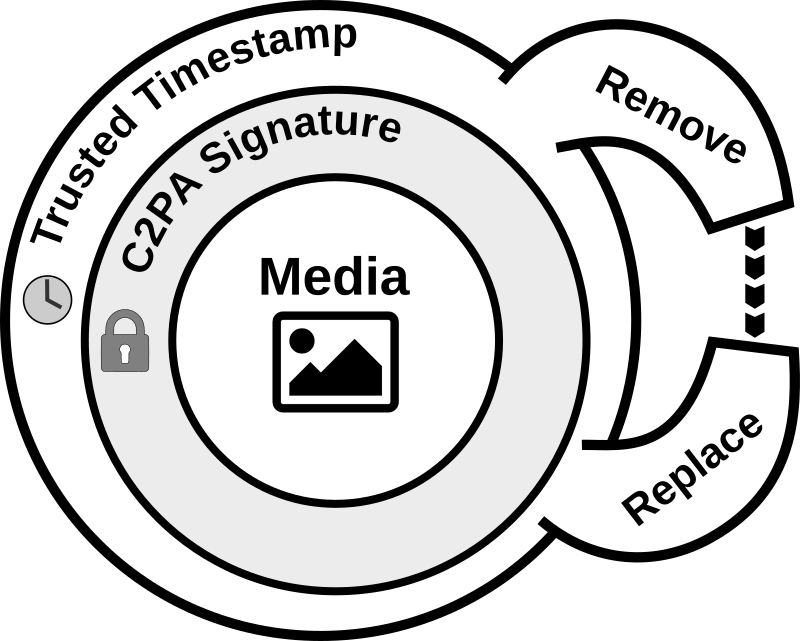
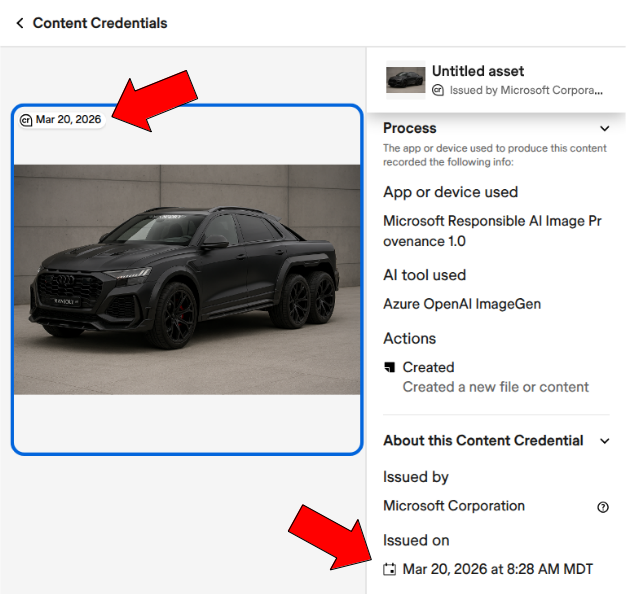
Figure 1: Timestamps can be replaced without detection. C2PA uses a layered security approach: the signature protects the media and the optional trusted timestamp protects the signature. Nothing in the signed data references the timestamp, allowing removal and replacement without detection. We altered the timestamp in this image. C2PA validators display the date without noting that it may not be original. The arrows point to where the CAI Verify validator displays altered dates.
C2PA relies on trusted timestamp authorities to indicate when content was signed. However, through our formal-methods analysis, we found that these timestamps can be replaced or modified without detection. Furthermore, conforming validators may accept conflicting timestamps as valid (Figure 1). This vulnerability undermines trust in determining when content was created—an essential factor in journalism and legal contexts.
In our study, we suggest ways using signed timestamped assertions to provide evidence when the content was created or signed. Our suggestion is not vulnerable to the aforementioned timestamp manipulation.
### 2. Revoked or Compromised Credentials Are Still Accepted
<details>
<summary>2604.24890v1/images/adam-horshack-2-screenshot.png Details</summary>
### Visual Description
## Screenshot: Content Credentials Interface
### Overview
The image displays a user interface for viewing content credentials of a digital asset. The left panel shows a thumbnail image of a pug dog in a pilot's uniform, while the right panel contains metadata and technical details about the file.
### Components/Axes
- **Thumbnail**:
- Image of a pug dog in a pilot's uniform, seated in an aircraft cockpit.
- Text overlay: "C2PA Signed by Horshack's Nikon Z6 III" (bottom-left corner).
- **Metadata Panel**:
- **Filename**: `DSC_0334.JPG`
- **Recorded by**: Nikon Corporation
- **Model**: Z6 3
- **Actions**:
- "Created" (icon: document with arrow)
- Description: "Created a new file or content"
- **Camera Capture Details**:
- "Additional data sourced from the camera used to take an image or video. EXIF data can be edited by the content producer."
- **Creator**: Horshack
- **Capture Date**: Sep 11, 2025 at 10:08 AM MDT
- **Camera Model**: NIKKOR Z 50mm f/1.8 S
### Detailed Analysis
- **Thumbnail**:
- The pug dog is anthropomorphized, wearing a pilot's uniform with a patch labeled "Z6 3."
- The cockpit includes flight instruments and a view of another aircraft outside the window.
- **Metadata**:
- The file is attributed to Nikon Corporation, with the model Z6 3.
- The creator is identified as "Horshack," and the capture date is explicitly stated.
- The camera model (NIKKOR Z 50mm f/1.8 S) indicates a prime lens optimized for low-light photography.
### Key Observations
1. **Future Capture Date**: The capture date (Sep 11, 2025) is in the future relative to the current date (2023), suggesting either a placeholder, error, or intentional fictional context.
2. **C2PA Signature**: The presence of "C2PA Signed" implies the image is part of a certified content provenance system, ensuring authenticity and traceability.
3. **Anthropomorphic Subject**: The pug in a pilot's uniform is likely a creative or humorous representation, possibly for branding or illustrative purposes.
### Interpretation
This interface demonstrates a system for managing digital content metadata, emphasizing transparency and accountability. The C2PA signature and Nikon branding suggest a focus on professional-grade imaging and verification. The future capture date may indicate a test scenario or a fictional example. The anthropomorphic subject highlights the interface's ability to handle diverse or creative content.
**Note**: No numerical data, charts, or diagrams are present. All textual information has been extracted as described.
</details>
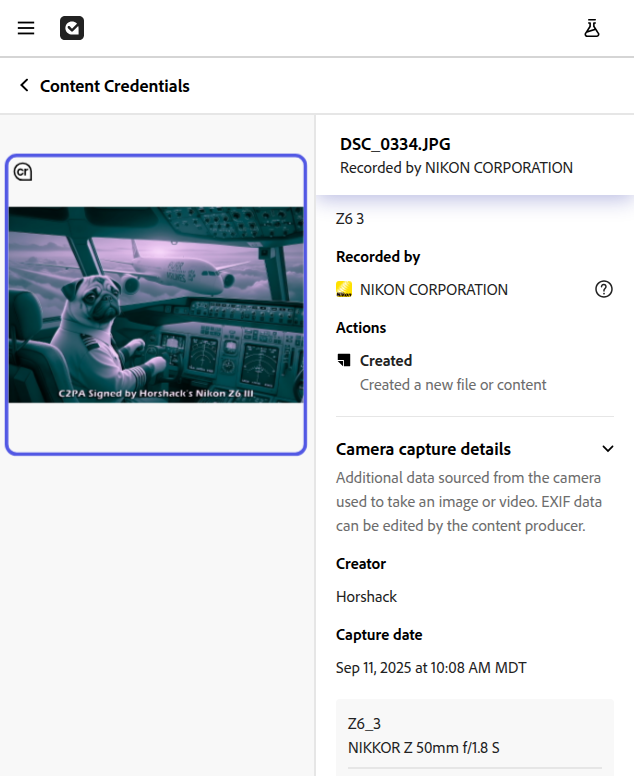
Figure 2: Validators accept revoked certificates and conforming validators present contradictory results, permitting forgeries without detection. Using a Nikon Z6 III, Adam Horshack demonstrated how to use the camera to sign an AI image. In November 2025, Nikon revoked the camera’s certificate. Over six months later, Adobe Inspect (pictured here) reports the signature as valid, while Verifieddit reports it as invalid. Neither conforming validator reports the revocation.
If a signing key is compromised, it should be revoked. However, (a) many conforming validators fail to check revocation properly, and (b) some conforming validators continue to accept known compromised credentials. This vulnerability allows attackers to create forged content that appears legitimate (Figure 2).
Out of concern for privacy, the C2PA specifications intentionally make checking for revoked certificates optional, and when done, permit such checking only via the Online Certificate Status Protocol (OCSP), expressly forbidding certificate revocation lists (CRLs). This design choice is flawed in two ways. First, to achieve the security goals, it is essential to check for revoked certificates. Second, CRLs offer much better privacy properties than OCSP provides.
### 3. Different Tools Produce Contradictory Results
We tested multiple widely used validators and found that (a) the same image can be labeled valid by one tool and invalid by another, and (b) users may receive conflicting conclusions about the same media, including concerning whether it was AI-generated. This inconsistency creates confusion and undermines trust (Figure 2).
<details>
<summary>2604.24890v1/images/example5-proofmode-annotated.png Details</summary>
### Visual Description
## Screenshot: Verification Interface
### Overview
The image depicts a digital verification interface titled "Proofmode VERIFY," designed to validate the authenticity and metadata of a file. Key sections include **Verification Details**, **Thumbnail**, **Metadata Summary**, and **Actions**. A red arrow highlights the location field in the metadata summary.
### Components/Axes
1. **Verification Details**
- **Filename**: `EXAMPLE5.JPG`
- **Hash**: `f0474fbd201d3f1150d31bd2 4261bbc4d85474ccaae7f5 4f3e5d4e01ec6b73`
- **Status Indicators**:
- **PGP Signed** (orange circle with checkmark)
- **Proof Data Present** (orange circle with checkmark)
- **OpenTimestamps Verified** (orange circle with checkmark)
- **C2PA Present** (green checkmark)
- **EXIF** (green checkmark)
2. **Thumbnail**
- A small preview of a projector screen displaying a "Stopwatch" interface with a timer (`00:00:00`).
3. **Metadata Summary**
- **Location**: San Francisco, United States (highlighted by a red arrow)
- **Camera**: Google Pixel 10 Pro
- **Timestamp**: Nov 7, 2025, 11:59 AM
- **Flags**:
- **Media Edited**: NO (green circle)
- **AI Generated**: NO (green circle)
4. **Actions**
- **Download Media** button (grayed out).
### Detailed Analysis
- **Verification Details**:
- The file `EXAMPLE5.JPG` is cryptographically signed (PGP) and includes proof data, OpenTimestamps verification, C2PA metadata, and EXIF data.
- The hash string ensures file integrity.
- **Thumbnail**:
- The projector screen shows a "Stopwatch" UI, suggesting the file may be related to timed events or presentations.
- **Metadata Summary**:
- The location is explicitly marked with a red arrow, emphasizing its importance.
- The camera model and timestamp confirm the file’s origin and creation time.
- Both "Media Edited" and "AI Generated" flags are marked **NO**, indicating the file is unaltered and not AI-generated.
- **Actions**:
- The "Download Media" button is inactive, possibly requiring verification completion first.
### Key Observations
- The red arrow draws attention to the location field, suggesting it is a critical piece of metadata.
- All verification statuses (PGP, Proof Data, OpenTimestamps, C2PA, EXIF) are confirmed, ensuring the file’s authenticity.
- The absence of edits or AI generation implies the file is original and trustworthy.
### Interpretation
This interface is used to verify digital files, likely for forensic or archival purposes. The combination of cryptographic signatures (PGP), timestamping (OpenTimestamps), and metadata standards (C2PA, EXIF) ensures the file’s integrity and provenance. The highlighted location and unaltered status suggest the file is a verified, original capture from a Google Pixel 10 Pro in San Francisco. The inactive "Download Media" button implies the verification process must be finalized before access.
</details>
(a) Image with altered GPS location. The arrow points to the modified GPS location.
<details>
<summary>2604.24890v1/images/exclusion.png Details</summary>
### Visual Description
## Circular Diagram: C2PA Signature Protection Model
### Overview
The image depicts a concentric circular diagram illustrating the relationship between digital media metadata and security mechanisms. The design uses nested rings with labeled components and symbolic icons to represent data protection layers.
### Components/Axes
1. **Outer Ring**:
- Text: "Unprotected Manifest" (positioned at 12 o'clock)
2. **Middle Ring**:
- Text: "C2PA Signature" (positioned at 12 o'clock)
- Icon: Lock symbol (positioned at 9 o'clock)
3. **Inner Circle**:
- Text: "Media" (positioned at 12 o'clock)
- Icon: Mountain landscape (positioned at 6 o'clock)
- Text: "EXIF" (positioned at 3 o'clock)
- Text: "XMP" (positioned at 9 o'clock)
4. **Bottom Section**:
- Text: "GPS" (positioned at 6 o'clock)
- Icon: Hand symbol (positioned at 6 o'clock)
### Content Details
- No numerical values or quantitative data present
- Textual labels and symbolic icons only
- Spatial relationships:
- "Unprotected Manifest" encloses all inner elements
- "C2PA Signature" acts as a protective layer around media metadata
- "Media" (landscape icon) represents core content
- "EXIF" and "XMP" flank the media content horizontally
- "GPS" with hand icon anchors the bottom of the diagram
### Key Observations
1. The lock icon's placement at 9 o'clock suggests encryption/protection mechanisms
2. The hand icon at 6 o'clock implies human interaction with GPS data
3. EXIF and XMP metadata are positioned symmetrically around the media content
4. No explicit connections shown between components (e.g., arrows or flow indicators)
### Interpretation
This diagram appears to represent a conceptual model of digital media protection using C2PA (Content Provenance and Authenticity) standards. The "Unprotected Manifest" represents raw data exposure, while the "C2PA Signature" acts as a security wrapper. The inner circle shows protected metadata elements:
- Media content (landscape icon)
- EXIF data (technical metadata standard)
- XMP data (metadata extension protocol)
- GPS coordinates (geolocation data)
The hand icon near GPS suggests manual verification or tampering risks. The absence of connecting elements implies these components exist in isolation rather than a continuous protection flow. The model emphasizes that C2PA signatures specifically protect media metadata rather than providing holistic data security. The diagram's simplicity suggests it's meant for high-level conceptual understanding rather than technical implementation details.
</details>
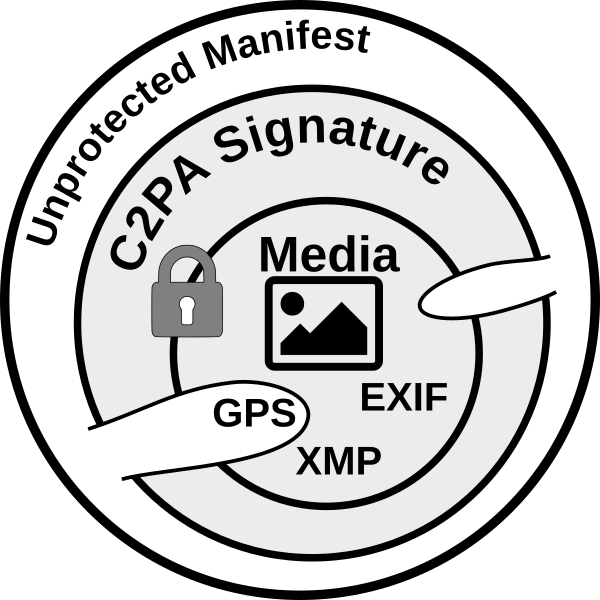
(b) Bytes in the exclusion range can be modified without detection.
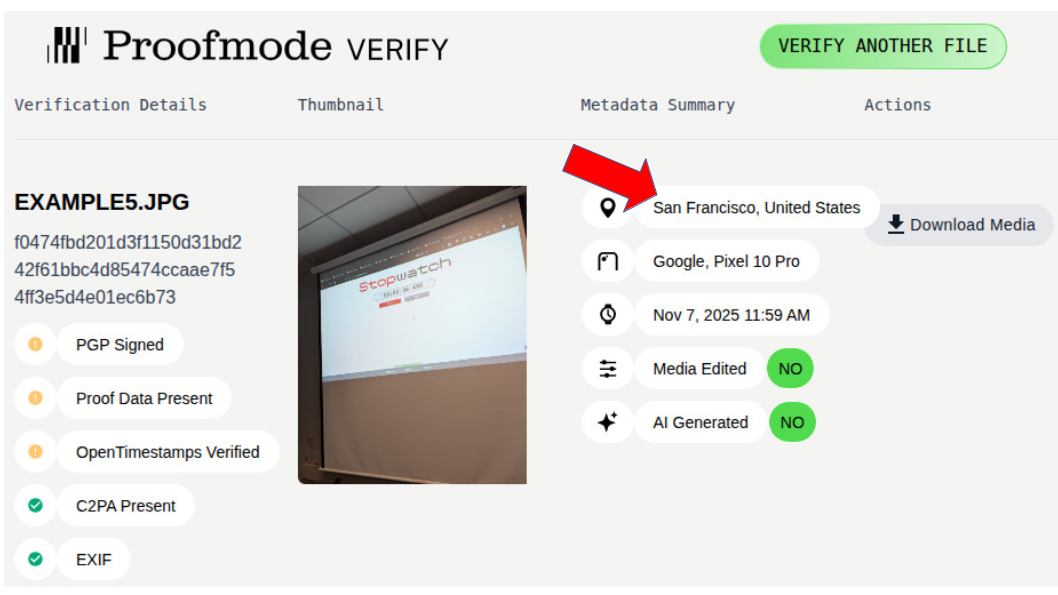
Figure 3: Google’s conforming Pixel 10 Pro camera places GPS information in an exclusion range, enabling an attacker to insert a false GPS location. In this image taken by a Pixel 10 Pro, we modified the GPS location. The conforming Proofmode Verify validator does not detect our alteration and displays the false GPS location.
### 4. Parts of Files Can Be Modified Without Detection
The C2PA specifications allow certain parts of a file (such as metadata) to be excluded from protection (Figure 3). (a) These regions can be altered without invalidating the signature, and (b) important information (e.g., location data) can be changed undetected. This vulnerability undermines trust.
To address privacy concerns, the C2PA specifications support an exclusion range so that certain data (e.g., GPS location) may be redacted after the media were created. In our study, we suggest a better way (involving additional signatures) to handle such redactions.
### 5. Credentials Expire and Become Unverifiable
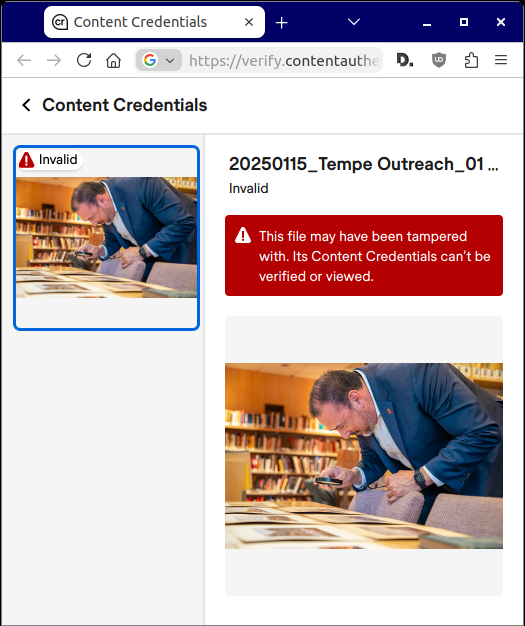
Due in part to expired certificates, some C2PA-signed media have already become unverifiable—sometimes within months (Figure 4). This situation is incompatible with legal requirements for election record retention (22 months under 52 U.S.C. § 20701), financial records (25 months, 12 C.F.R. § 1002.12), political ads (2 years, 47 C.F.R. § 73.3526), and other archival needs.
### 6. Certification Does Not Ensure Compliance with the Specifications
C2PA provides a “conformance program” to certify products. However, the conformance program does not define security requirements for conforming validators. Certification is based largely on self-reported compliance with no examination of the product’s functionality or source code. As a result, “conforming” products do not necessarily comply with the specifications. Furthermore, because the specifications have vulnerabilities, a product that complies with the specifications does not necessarily satisfy the claimed security goals.
## Why Our Findings Matter for Policy
C2PA is already being promoted as part of a solution for high-stake applications including: combating misinformation, disclosing financial information, supporting journalism, and providing legal evidence of digital media. If the underlying system is unreliable: false content may be mistakenly trusted, legitimate content may be wrongly dismissed, and public confidence may erode further. Premature adoption of C2PA could worsen the misinformation problem rather than solve it.
<details>
<summary>2604.24890v1/images/azsos.png Details</summary>
### Visual Description
## Screenshot: Content Credentials Verification Interface
### Overview
The image depicts a browser window displaying a webpage titled "Content Credentials" with a URL `https://verify.contentauth...`. The interface includes a red warning banner indicating invalid content credentials, a photograph of a man in a library, and browser UI elements (navigation buttons, address bar, etc.).
### Components/Axes
- **Browser UI Elements**:
- Tabs: "Content Credentials" (active tab) with a "cr" icon.
- Navigation: Back, forward, refresh, and home buttons.
- Address bar: Google search dropdown, URL `https://verify.contentauth...`, and icons (shield, puzzle piece, menu).
- **Webpage Content**:
- Title: "Content Credentials" (bold, left-aligned).
- Red warning banner: "This file may have been tampered with. Its Content Credentials can't be verified or viewed."
- Image: A photograph of a man in a blue suit leaning over a table in a library, labeled "Invalid" with a red triangle.
- File identifier: `20250115_Tempe Outreach_01...` (truncated).
### Detailed Analysis
- **Textual Content**:
- The red warning banner explicitly states the file's credentials are unverifiable.
- The image is marked "Invalid," suggesting automated validation failure.
- The URL implies a content authentication service, though the domain is truncated.
- **Visual Elements**:
- The photograph shows a man in a professional setting (library), but its purpose is unclear.
- The red triangle and "Invalid" label are spatially aligned with the image, emphasizing its status.
### Key Observations
1. The red warning banner dominates the interface, prioritizing security alerts.
2. The "Invalid" label on the image suggests a binary validation outcome (valid/invalid).
3. The truncated file identifier (`20250115_Tempe Outreach_01...`) hints at a structured naming convention.
### Interpretation
This interface appears to be part of a content verification system, likely used to authenticate digital files. The red warning indicates a critical failure in credential validation, possibly due to tampering or corruption. The photograph of the man in the library may represent the content being verified, but its inclusion here is ambiguous—it could be a placeholder, an example, or unrelated media. The truncated URL and lack of additional context (e.g., file type, source) limit diagnostic clarity. The system’s design emphasizes immediate alerts over detailed explanations, prioritizing user awareness of compromised content.
## Notes
- No numerical data, charts, or diagrams are present.
- All text is in English; no foreign languages detected.
- Spatial grounding confirms the warning banner and image are the focal points, with browser UI elements providing contextual framing.
</details>
Figure 4: C2PA-signed media can expire and become unverifiable. The image is part of the Arizona Secretary of State’s C2PA pilot program. It validated in January 2025, but fails to validate a year later (e.g., by CAI’s Verify and Adobe’s Content Authenticity Inspect), even though the file has not changed.
## Key Recommendations
Before relying on C2PA in policy or regulation, several improvements are essential:
- Require strict certificate revocation checking (including via privacy-preserving methods).
- Ensure timestamps are securely bound to content and cannot be altered without detection.
- Mandate consistency across validation tools.
- Protect the entire file (including non-C2PA metadata), not just selected portions.
- Establish independent security audits for certified products.
- Clarify claims and limitations in public communications about C2PA.
Our study offers concrete ways to implement these improvements. Beyond C2PA, it would be useful to integrate C2PA with services for reputation, fact-checking, and directing users to the original sources of digital assets.
The Pixel 10 Pro and Version 2.3 (January 2026) of the specifications incorporated some of our suggestions. Version 2.4 (April 2026) does not address any of our concerns. We hope our remaining recommendations will be implemented by later specification versions and future validators. C2PA could eventually be positioned to become a widely adopted useful tool for helping people to assess the provenance of digital assets. We hope that our study and recommendations will accelerate this process and strengthen C2PA.
## Conclusion
C2PA represents an important step toward addressing the growing problem of digital misinformation. However, the specifications are currently flawed, incomplete, inconsistent, and vulnerable to misuse. Policymakers should view C2PA as an emerging technology, not a mature solution. Careful cybersecurity engineering, stronger safeguards, and independent scrutiny are essential before widespread adoption.
## References
- [1] Adobe (2025) Content credentials. Note: https://lion.app.box.com/s/rang889q86q1jb80i3phxiww6mzlwcyj 3 min video promotion. Cited by: What C2PA Claims to Do.
- [2] E. Golaszewski, N. Krawetz, A. T. Sherman, E. Zieglar, S. K. Matukumalli, R. Yus, C. L. Kegley, M. Barthel, W. Bowman, B. Barot, and K. Kullman (2026-April 23,) Verifying provenance of digital media: security analysis of C2PA and its implementation. Note: https://eprint.iacr.org/2026/804 Cited by: Executive Summary.