## Heatmap Visualization: Token-Level vs Step-Level Analysis of Chemical Problem Solving
### Overview
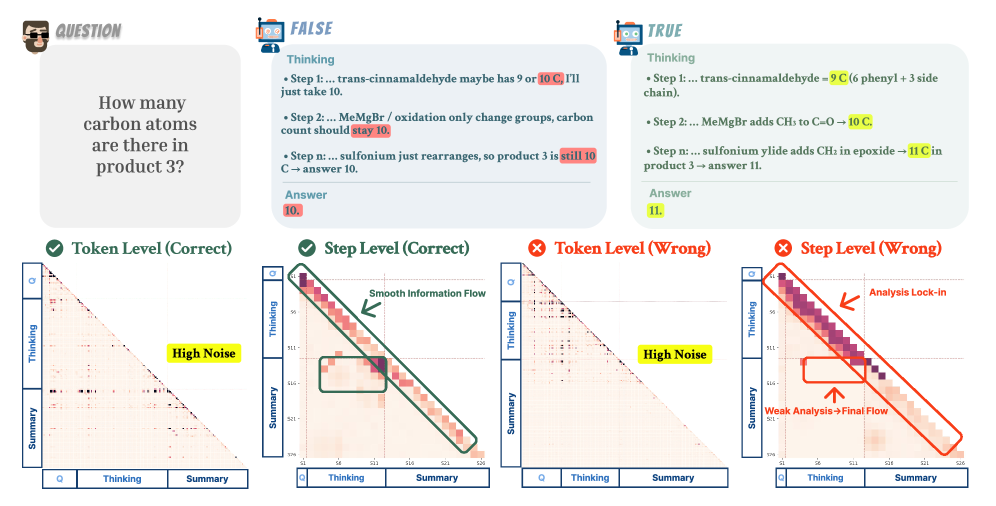
The image presents a comparative analysis of two solution paths (False and True) to a chemistry problem about carbon atom counting in a chemical product. It includes four heatmaps visualizing the relationship between "Thinking" and "Summary" components at both token-level and step-level analysis, with color-coded correctness indicators.
### Components/Axes
**Heatmap Structure:**
- **X-axis (Horizontal):** "Thinking" component (0-150 scale)
- **Y-axis (Vertical):** "Summary" component (0-150 scale)
- **Legend:**
- Green = Correct analysis
- Red = Incorrect analysis
- **Annotations:**
- "High Noise" labels
- Arrows indicating information flow/analysis lock-in
- Text boxes highlighting key steps
**Spatial Positioning:**
- Top-left: Question box with chemistry problem
- Middle: Two solution paths (False/True) with step-by-step reasoning
- Bottom: Four heatmaps arranged in 2x2 grid:
- Top-left: Token Level (Correct)
- Top-right: Token Level (Wrong)
- Bottom-left: Step Level (Correct)
- Bottom-right: Step Level (Wrong)
### Detailed Analysis
**Token Level Heatmaps:**
1. **Correct (Green):**
- Diagonal green band from (0,0) to (150,150)
- Indicates strong correlation between thinking and summary components
- "High Noise" annotation in bottom-right quadrant
2. **Incorrect (Red):**
- Red band concentrated in bottom-left quadrant
- "High Noise" annotation in top-right quadrant
- Weak diagonal correlation compared to correct version
**Step Level Heatmaps:**
1. **Correct (Green):**
- Smooth green gradient from top-left to bottom-right
- Clear information flow from thinking to summary
- No noise annotations
2. **Incorrect (Red):**
- Red band with "Analysis Lock-in" annotation
- Steeper diagonal than correct version
- Weak final flow indicated by red arrow
### Key Observations
1. Token-level analysis shows higher noise in incorrect solutions
2. Step-level correct solutions demonstrate smoother information flow
3. Incorrect step-level analysis exhibits "lock-in" effects
4. Correct solutions maintain stronger thinking-summary correlation
5. Noise patterns differ between token and step-level evaluations
### Interpretation
The visualization demonstrates that step-level analysis provides more reliable chemical problem-solving than token-level analysis. The "Analysis Lock-in" phenomenon in incorrect step-level solutions suggests cognitive biases persisting through reasoning steps. The "High Noise" annotations in token-level incorrect solutions indicate greater variability in surface-level processing errors. The smooth information flow in correct step-level solutions aligns with the True solution path's systematic approach to molecular counting, while the False path's abrupt carbon count change (10→11) correlates with the analysis lock-in pattern. This supports the conclusion that structured reasoning steps outperform superficial token analysis in complex chemical calculations.