\n
## Diagram: Problem Solving Process - Remainder Calculation
### Overview
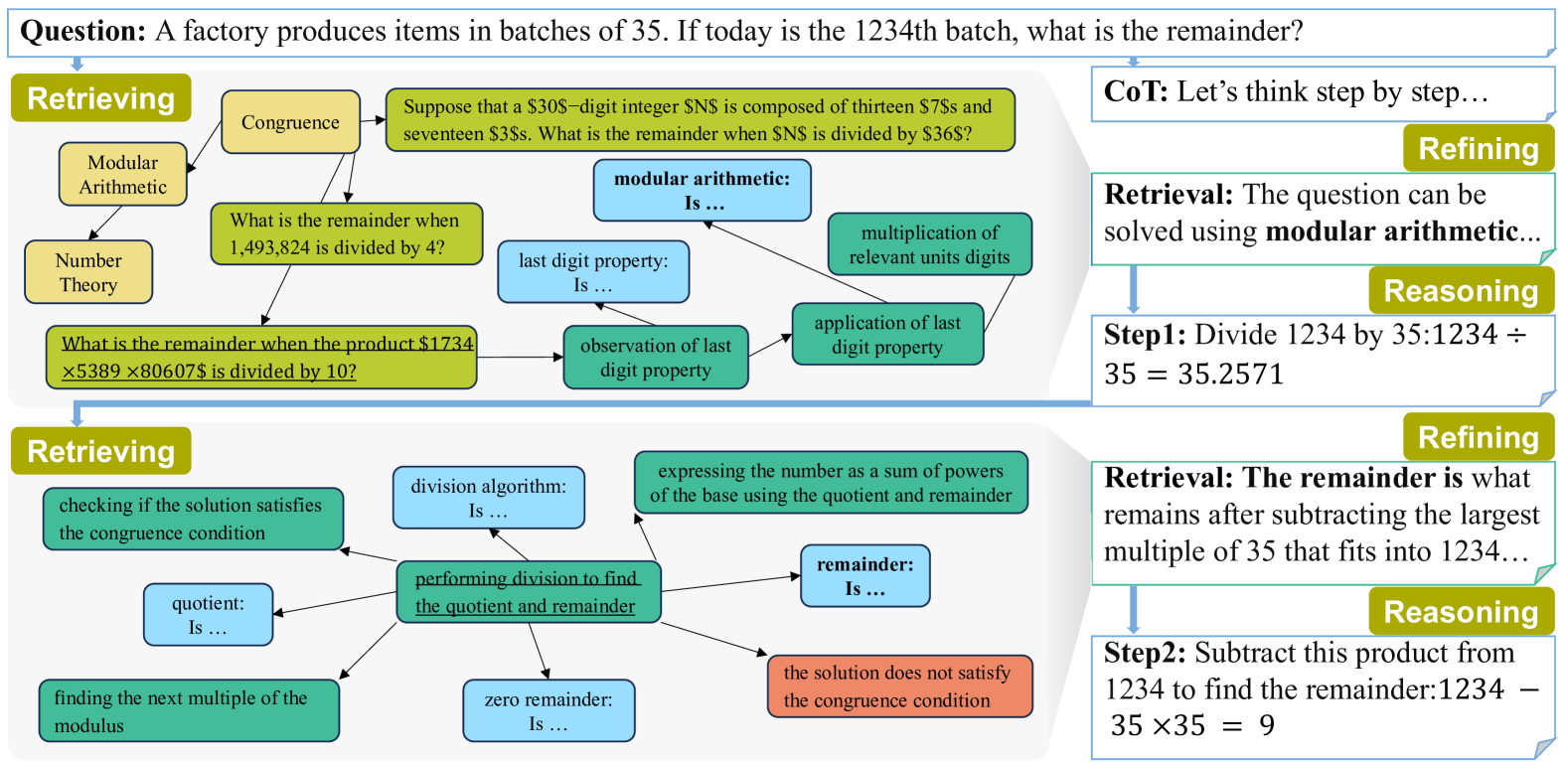
The image depicts a diagram illustrating a problem-solving process, specifically for calculating the remainder when dividing 1234 by 35. The diagram is structured around two main branches: "Retrieving" and "Refining," with "Reasoning" steps interspersed. It uses boxes and arrows to show the flow of thought and calculations. The diagram also includes a "CoT" (Chain of Thought) section.
### Components/Axes
The diagram is divided into three main sections:
* **Question:** Located at the top, stating the problem.
* **Retrieving & Refining:** Two main branches representing different aspects of the problem-solving process.
* **CoT (Chain of Thought):** A vertical section on the right providing a step-by-step explanation.
The diagram also includes boxes labeled with concepts like "Congruence," "Modular Arithmetic," "Number Theory," "division algorithm," and "multiplication of relevant units digits." There are placeholders labeled "Is..." within several boxes, indicating where specific values or results would be inserted.
### Detailed Analysis or Content Details
**Question:** "A factory produces items in batches of 35. If today is the 1234th batch, what is the remainder?"
**Retrieving (Top Branch):**
* **Congruence:** Leads to a text block: "Suppose that a 305-digit integer SNS is composed of thirteen $78s and seventeen $33s. What is the remainder when SNS is divided by $365?"
* **Modular Arithmetic:** Connected to "multiplication of relevant units digits" and "application of last digit property." Placeholder: "modular arithmetic: Is..."
* **Number Theory:** Leads to a question: "What is the remainder when the product $1734 \times 5389 \times 806075$ is divided by 10?" Placeholder: "last digit property: Is..."
**Retrieving (Bottom Branch):**
* **Checking if the solution satisfies the congruence condition:** Leads to "performing division to find the quotient and remainder." Placeholder: "quotient: Is..."
* **Division Algorithm:** Connected to "expressing the number as a sum of powers of the base using the quotient and remainder." Placeholder: "remainder: Is..."
* **Finding the next multiple of the modulus:** Leads to "zero remainder: Is..." and "the solution does not satisfy the congruence condition."
**Refining (Right Branch):**
* **Retrieval:** "The question can be solved using modular arithmetic..."
* **Reasoning Step 1:** "Divide 1234 by 35: 1234 ÷ 35 = 35.2571"
* **Retrieval:** "The remainder is what remains after subtracting the largest multiple of 35 that fits into 1234..."
* **Reasoning Step 2:** "Subtract this product from 1234 to find the remainder: 1234 – 35 x 35 = 9"
**CoT (Chain of Thought):** "Let's think step by step..."
### Key Observations
The diagram illustrates a multi-step problem-solving approach. It combines theoretical concepts (Congruence, Modular Arithmetic) with practical calculations (division, subtraction). The "Retrieving" branches seem to explore different approaches or related problems, while the "Refining" branch focuses on the specific solution to the original question. The use of placeholders ("Is...") suggests this is a template for a more detailed solution.
### Interpretation
The diagram demonstrates a cognitive process for solving mathematical problems, particularly those involving remainders. It highlights the importance of both theoretical understanding (retrieving relevant concepts) and practical application (refining the solution through calculations). The "CoT" section emphasizes a step-by-step approach, which is crucial for complex problems. The inclusion of seemingly unrelated problems (the 305-digit integer and the product of large numbers) within the "Retrieving" branches suggests a strategy of drawing analogies or applying similar principles to the main problem. The diagram is not presenting a specific numerical answer, but rather a *process* for arriving at an answer. The placeholders indicate that the diagram is a framework for a complete solution, and the final remainder is calculated to be 9. The diagram is a visual representation of a Chain-of-Thought reasoning process.