## Diagram: Problem-Solving Flowchart for a Modular Arithmetic Question
### Overview
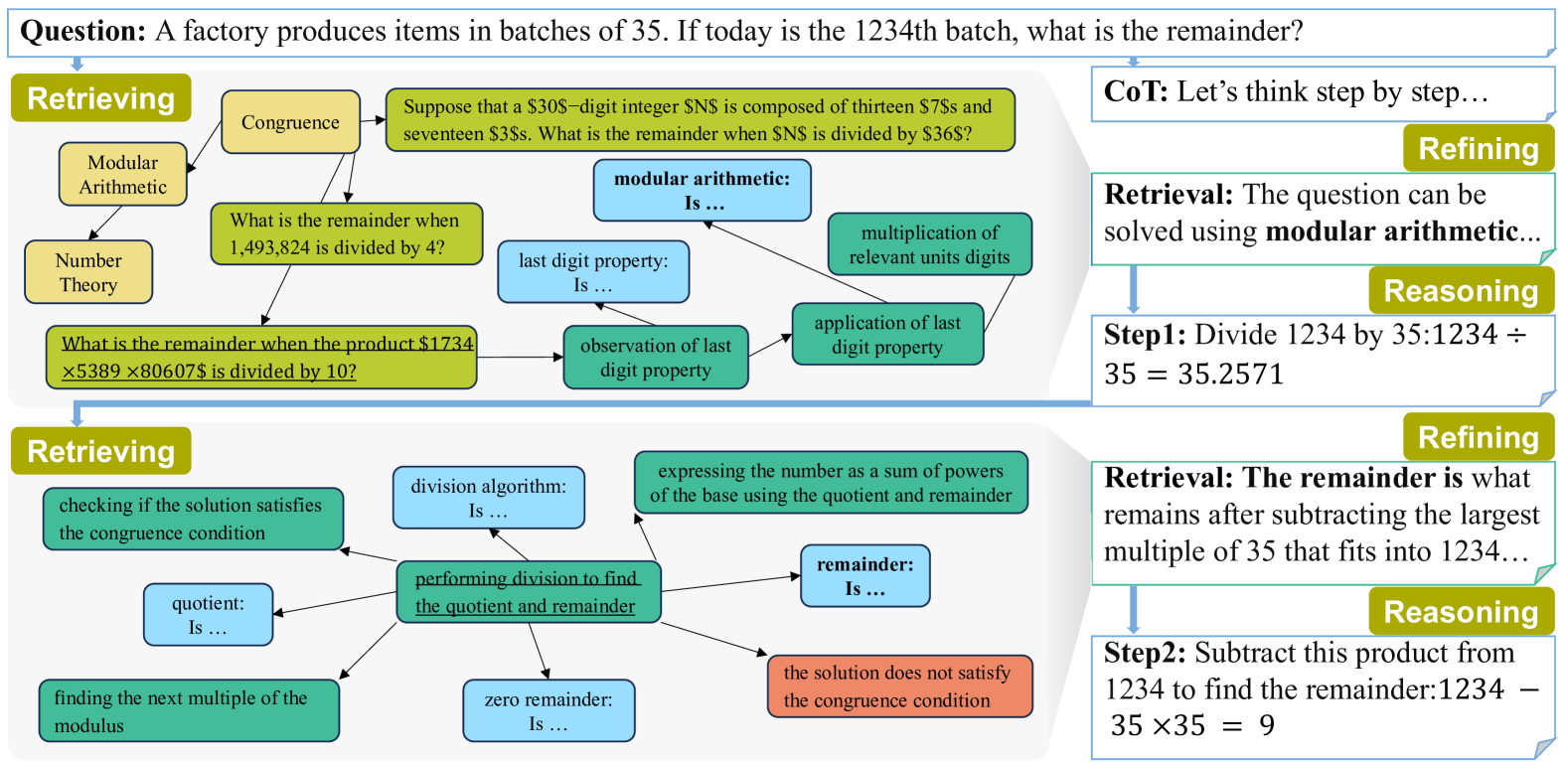
The image is a detailed flowchart illustrating the cognitive process of solving a mathematical word problem. It visually maps out the retrieval of relevant knowledge and the step-by-step reasoning required to find the remainder when the 1234th batch is divided by a batch size of 35. The diagram is structured into two main vertical panels: a left panel showing a network of retrieved concepts and examples, and a right panel showing the sequential reasoning steps (Chain-of-Thought or CoT).
### Components/Axes
The diagram is organized into distinct regions and uses color-coded boxes and directional arrows to indicate flow and relationships.
**1. Header (Top):**
* **Question Text:** "Question: A factory produces items in batches of 35. If today is the 1234th batch, what is the remainder?"
**2. Left Panel - "Retrieving" Network:**
This panel is a concept map showing the knowledge activated to solve the problem.
* **Primary Stage Labels (Yellow Boxes):** "Retrieving" (appears twice, top and bottom left).
* **Core Mathematical Concepts (Yellow Boxes):**
* "Modular Arithmetic"
* "Number Theory"
* "Congruence"
* **Specific Example Problems (Green Boxes):**
* "Suppose that a $30$-digit integer $N$ is composed of thirteen $7$s and seventeen $3$s. What is the remainder when $N$ is divided by $36$?"
* "What is the remainder when 1,493,824 is divided by 4?"
* "What is the remainder when the product $1734 \times 5389 \times 80607$ is divided by 10?"
* **Sub-Concepts & Methods (Blue Boxes):**
* "modular arithmetic: Is ..."
* "last digit property: Is ..."
* "division algorithm: Is ..."
* "quotient: Is ..."
* "remainder: Is ..."
* "zero remainder: Is ..."
* **Procedural Steps (Green Boxes):**
* "multiplication of relevant units digits"
* "application of last digit property"
* "observation of last digit property"
* "expressing the number as a sum of powers of the base using the quotient and remainder"
* "performing division to find the quotient and remainder"
* "finding the next multiple of the modulus"
* "checking if the solution satisfies the congruence condition"
* **Outcome (Orange Box):** "the solution does not satisfy the congruence condition"
**3. Right Panel - "Reasoning" Steps:**
This panel shows the linear, step-by-step solution process.
* **Initial Prompt (Top Right):** "CoT: Let's think step by step..."
* **Stage Labels (Yellow Boxes):** "Refining" and "Reasoning" (each appears twice).
* **Retrieval Summary (White Box with Bold Text):**
* First Instance: "Retrieval: The question can be solved using **modular arithmetic**..."
* Second Instance: "Retrieval: **The remainder** is what remains after subtracting the largest multiple of 35 that fits into 1234..."
* **Solution Steps (White Boxes):**
* **Step1:** "Divide 1234 by 35: 1234 ÷ 35 = 35.2571"
* **Step2:** "Subtract this product from 1234 to find the remainder: 1234 - 35 × 35 = 9"
### Detailed Analysis
The diagram meticulously deconstructs the problem-solving act.
* **Flow and Connections:** Arrows originate from the main "Retrieving" stage, branching out to core concepts (Modular Arithmetic, Number Theory). From these concepts, arrows point to specific, analogous example problems (green boxes). These examples then connect to finer-grained sub-concepts (blue boxes) and procedural steps (green boxes), illustrating how prior knowledge is activated and applied. The final orange box indicates a potential pitfall or verification step.
* **Spatial Grounding:** The "Retrieving" network occupies the left ~60% of the image. The "Reasoning" steps are in a column on the right ~40%. The initial question spans the top. Arrows generally flow from left to right and top to bottom within each panel.
* **Text Transcription:** All text has been extracted as listed in the Components section. The mathematical notation (e.g., $30$-digit, $N$, $36$) is transcribed precisely.
### Key Observations
1. **Dual-Process Model:** The diagram explicitly separates knowledge retrieval (left) from sequential reasoning (right), suggesting a model of cognition where relevant information is gathered before execution.
2. **Use of Analogies:** The retrieval network heavily relies on analogous problems (e.g., finding remainders for other numbers) to activate the correct mathematical framework.
3. **Hierarchical Decomposition:** The problem is broken down from a high-level question into core theories, then into specific techniques (like "last digit property"), and finally into arithmetic operations.
4. **Verification Step:** The inclusion of "checking if the solution satisfies the congruence condition" and the orange "does not satisfy" box highlights the importance of validating the answer within the logical framework.
### Interpretation
This diagram is more than a solution; it's a **meta-cognitive map** of how to approach a modular arithmetic problem. It demonstrates that solving such a problem isn't just about performing division.
* **What it Suggests:** The process begins by recognizing the problem type ("remainder") and retrieving the associated field ("Modular Arithmetic"). The mind then searches for familiar patterns or solved examples (the green problem boxes) to guide the approach. The right panel shows the application of this retrieved knowledge: interpreting the problem in terms of division with remainder, performing the calculation, and stating the result.
* **Relationships:** The left panel provides the **"why" and "how"**—the theoretical foundation and toolkit. The right panel provides the **"what"**—the specific actions taken. The arrows connecting concepts like "division algorithm" to "performing division" explicitly link theory to practice.
* **Notable Insight:** The diagram implies that a robust solution requires both a broad network of related knowledge (to correctly categorize and approach the problem) and a precise, linear procedure to execute the solution. The final answer, **9**, is the output of this integrated process. The diagram serves as an educational tool to make this often-invisible thinking process explicit.