## Line Graphs: Llama Model Answer Accuracy vs. Layer
### Overview
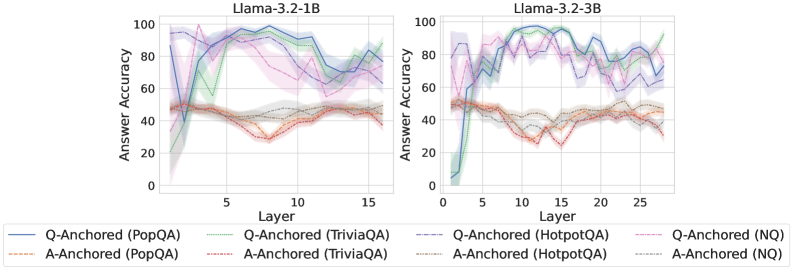
The image presents two line graphs comparing the answer accuracy of Llama models (3.2-1B and 3.2-3B) across different layers for various question-answering datasets. Each graph plots the answer accuracy (y-axis) against the layer number (x-axis) for both question-anchored (Q-Anchored) and answer-anchored (A-Anchored) approaches on PopQA, TriviaQA, HotpotQA, and NQ datasets. The shaded regions around each line represent the uncertainty or variance in the accuracy.
### Components/Axes
**Left Graph (Llama-3.2-1B):**
* **Title:** Llama-3.2-1B
* **Y-axis:** Answer Accuracy, ranging from 0 to 100.
* **X-axis:** Layer, ranging from 0 to 15.
* **Data Series:**
* Q-Anchored (PopQA): Solid blue line.
* A-Anchored (PopQA): Dashed brown line.
* Q-Anchored (TriviaQA): Dotted green line.
* A-Anchored (TriviaQA): Dotted-dashed light green line.
* Q-Anchored (HotpotQA): Dashed-dotted red line.
* A-Anchored (HotpotQA): Dotted-dotted-dashed light red line.
* Q-Anchored (NQ): Dashed purple line.
* A-Anchored (NQ): Dotted-dashed gray line.
**Right Graph (Llama-3.2-3B):**
* **Title:** Llama-3.2-3B
* **Y-axis:** Answer Accuracy, ranging from 0 to 100.
* **X-axis:** Layer, ranging from 0 to 25.
* **Data Series:**
* Q-Anchored (PopQA): Solid blue line.
* A-Anchored (PopQA): Dashed brown line.
* Q-Anchored (TriviaQA): Dotted green line.
* A-Anchored (TriviaQA): Dotted-dashed light green line.
* Q-Anchored (HotpotQA): Dashed-dotted red line.
* A-Anchored (HotpotQA): Dotted-dotted-dashed light red line.
* Q-Anchored (NQ): Dashed purple line.
* A-Anchored (NQ): Dotted-dashed gray line.
**Legend:** Located below the graphs, mapping line styles and colors to the corresponding data series.
### Detailed Analysis
**Llama-3.2-1B:**
* **Q-Anchored (PopQA):** The blue line starts at approximately 10% accuracy at layer 0, rapidly increases to around 95% by layer 4, and then fluctuates between 80% and 95% for the remaining layers.
* **A-Anchored (PopQA):** The brown dashed line starts at approximately 50% accuracy and remains relatively stable between 40% and 50% across all layers.
* **Q-Anchored (TriviaQA):** The green dotted line starts at approximately 10% accuracy at layer 0, increases to around 80% by layer 5, and then fluctuates between 70% and 80% for the remaining layers.
* **A-Anchored (TriviaQA):** The light green dotted-dashed line starts at approximately 50% accuracy and remains relatively stable between 40% and 50% across all layers.
* **Q-Anchored (HotpotQA):** The red dashed-dotted line starts at approximately 50% accuracy, decreases to around 30% by layer 3, and then increases to around 45% by layer 15.
* **A-Anchored (HotpotQA):** The light red dotted-dotted-dashed line starts at approximately 50% accuracy and remains relatively stable between 30% and 50% across all layers.
* **Q-Anchored (NQ):** The purple dashed line starts at approximately 50% accuracy, increases to around 90% by layer 4, and then fluctuates between 70% and 90% for the remaining layers.
* **A-Anchored (NQ):** The gray dotted-dashed line starts at approximately 50% accuracy and remains relatively stable between 40% and 50% across all layers.
**Llama-3.2-3B:**
* **Q-Anchored (PopQA):** The blue line starts at approximately 10% accuracy at layer 0, rapidly increases to around 90% by layer 4, and then fluctuates between 70% and 95% for the remaining layers.
* **A-Anchored (PopQA):** The brown dashed line starts at approximately 50% accuracy and remains relatively stable between 35% and 50% across all layers.
* **Q-Anchored (TriviaQA):** The green dotted line starts at approximately 10% accuracy at layer 0, increases to around 80% by layer 5, and then fluctuates between 70% and 90% for the remaining layers.
* **A-Anchored (TriviaQA):** The light green dotted-dashed line starts at approximately 50% accuracy and remains relatively stable between 35% and 50% across all layers.
* **Q-Anchored (HotpotQA):** The red dashed-dotted line starts at approximately 50% accuracy, decreases to around 25% by layer 3, and then increases to around 45% by layer 25.
* **A-Anchored (HotpotQA):** The light red dotted-dotted-dashed line starts at approximately 50% accuracy and remains relatively stable between 30% and 50% across all layers.
* **Q-Anchored (NQ):** The purple dashed line starts at approximately 50% accuracy, increases to around 90% by layer 4, and then fluctuates between 70% and 95% for the remaining layers.
* **A-Anchored (NQ):** The gray dotted-dashed line starts at approximately 50% accuracy and remains relatively stable between 35% and 50% across all layers.
### Key Observations
* For both models, Q-Anchored approaches on PopQA, TriviaQA, and NQ datasets show a significant increase in accuracy within the first few layers.
* A-Anchored approaches generally maintain a relatively stable accuracy across all layers, hovering around 40-50%.
* Q-Anchored (HotpotQA) shows a dip in accuracy in the initial layers before gradually increasing.
* The Llama-3.2-3B model has a longer x-axis (more layers) than the Llama-3.2-1B model.
### Interpretation
The data suggests that question-anchoring (Q-Anchored) is more effective than answer-anchoring (A-Anchored) for PopQA, TriviaQA, and NQ datasets, as it leads to a substantial increase in answer accuracy as the model processes more layers. The stable accuracy of A-Anchored approaches indicates that they might rely more on initial information and do not benefit significantly from deeper processing. The initial dip in Q-Anchored (HotpotQA) could indicate that the model requires more layers to understand the complex reasoning involved in HotpotQA. The longer x-axis for Llama-3.2-3B suggests that it has a deeper architecture, potentially allowing for more complex reasoning and learning, although the accuracy trends are broadly similar to the smaller Llama-3.2-1B model. The shaded regions indicate the variance in the accuracy, which is generally higher in the initial layers and decreases as the model processes more layers, suggesting that the model becomes more stable and consistent in its predictions as it goes deeper.