## Directed Network Diagram: Node Dependency Graph
### Overview
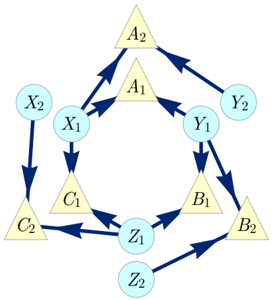
The image displays a directed graph (network diagram) consisting of 12 nodes connected by directional arrows. The nodes are of two distinct types: six triangular nodes (labeled with letters A, B, C and subscripts 1, 2) and six circular nodes (labeled with letters X, Y, Z and subscripts 1, 2). The arrows indicate directed relationships or flows from one node to another. The overall structure is symmetrical and arranged in a layered, roughly hexagonal pattern.
### Components/Axes
**Node Types & Labels:**
* **Triangular Nodes (Yellow fill, dark border):** A₁, A₂, B₁, B₂, C₁, C₂
* **Circular Nodes (Light blue fill, dark border):** X₁, X₂, Y₁, Y₂, Z₁, Z₂
**Spatial Layout (Relative Positioning):**
* **Top Center:** A₂ (triangle)
* **Upper Left:** X₂ (circle)
* **Upper Right:** Y₂ (circle)
* **Center:** A₁ (triangle)
* **Mid-Left:** X₁ (circle), C₁ (triangle)
* **Mid-Right:** Y₁ (circle), B₁ (triangle)
* **Bottom Center:** Z₁ (circle), Z₂ (circle)
* **Bottom Left:** C₂ (triangle)
* **Bottom Right:** B₂ (triangle)
**Connections (Directed Arrows):**
The flow is primarily from circular nodes to triangular nodes, with some interconnections. All connections are represented by dark blue arrows.
### Detailed Analysis: Connection Map
Below is a complete list of all directed connections observed in the diagram, grouped by source node:
* **From X₂:** Points to **X₁** and **C₁**.
* **From X₁:** Points to **A₁** and **C₁**.
* **From Y₁:** Points to **A₁** and **B₁**.
* **From Y₂:** Points to **A₂** and **B₂**.
* **From Z₁:** Points to **B₁** and **C₂**.
* **From Z₂:** Points to **B₂** and **C₁**.
* **From C₂:** Points to **B₁**.
* **From A₁:** Points to **A₂**.
**Summary of Inputs per Node:**
* **A₂:** Receives input from **A₁** and **Y₂**.
* **A₁:** Receives input from **X₁** and **Y₁**.
* **B₁:** Receives input from **Y₁**, **Z₁**, and **C₂**.
* **B₂:** Receives input from **Y₂** and **Z₂**.
* **C₁:** Receives input from **X₂**, **X₁**, and **Z₂**.
* **C₂:** Receives input from **Z₁**. (Outputs to B₁).
* **X₁:** Receives input from **X₂**. (Outputs to A₁, C₁).
* **X₂:** No incoming arrows shown. (Outputs to X₁, C₁).
* **Y₁:** No incoming arrows shown. (Outputs to A₁, B₁).
* **Y₂:** No incoming arrows shown. (Outputs to A₂, B₂).
* **Z₁:** No incoming arrows shown. (Outputs to B₁, C₂).
* **Z₂:** No incoming arrows shown. (Outputs to B₂, C₁).
### Key Observations
1. **Symmetry:** The graph exhibits strong bilateral symmetry. The left side (X and C nodes) mirrors the right side (Y and B nodes) in structure, with Z nodes acting as a central base.
2. **Hierarchy:** There is a clear hierarchical flow. The "X", "Y", and "Z" circular nodes appear to be primary input or source nodes (no incoming arrows). The "A", "B", and "C" triangular nodes are intermediary or output nodes that receive multiple inputs.
3. **Convergence Points:** Nodes **A₁**, **B₁**, and **C₁** are key convergence points, each receiving three incoming connections. **A₂** and **B₂** are secondary convergence points.
4. **Unique Path:** The connection from **C₂** to **B₁** is the only link between the left (C) and right (B) subsystems, aside from the central A₁→A₂ link.
5. **Visual Coding:** The use of distinct shapes (triangle vs. circle) and colors (yellow vs. blue) effectively categorizes the nodes, suggesting a functional difference between the two groups.
### Interpretation
This diagram represents a **structured dependency network or a system architecture**. The triangular nodes likely represent **aggregate states, outcomes, or processing units**, while the circular nodes represent **input variables, foundational components, or data sources**.
* **System Function:** The graph models how foundational elements (X, Y, Z) combine and flow through intermediate stages (C, B) to produce higher-level results (A). For instance, the final output **A₂** depends on a chain starting from **X₁/Y₁** (forming **A₁**) and **Y₂**.
* **Robustness & Redundancy:** Key outputs like **B₁** and **C₁** have multiple input pathways, suggesting system robustness. If one input fails, others can compensate.
* **Investigative Lens (Peircean):** The diagram is an **iconic sign**—it resembles the structure of the system it represents. It allows an observer to **deduce relationships** (e.g., "A₂ is the ultimate dependent variable") and **induce system properties** (e.g., "The system is modular and symmetric"). The missing inputs to X, Y, and Z nodes imply they are exogenous to this specific model.
* **Potential Application:** This could model anything from a software module dependency chart, a causal loop in an ecological or economic system, a neural network architecture, or a project workflow where tasks (triangles) depend on resources (circles).