## Diagram: Knowledge Graph Task Resolution (KGoT) Process Flow
### Overview
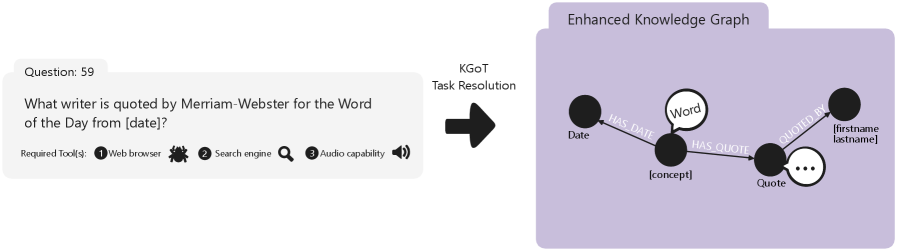
The image illustrates a conceptual workflow for resolving a natural language question using a Knowledge Graph Task Resolution (KGoT) system. It depicts the transformation of a user's question into a structured query against an "Enhanced Knowledge Graph." The diagram is composed of three main sections: a question input panel on the left, a central process arrow, and a knowledge graph schema on the right.
### Components & Flow
The diagram is segmented into three distinct regions:
1. **Left Panel (Question Input):**
* A white card with a light gray header labeled **"Question: 59"**.
* The main question text reads: **"What writer is quoted by Merriam-Webster for the Word of the Day from [date]?"**
* Below the question, a line specifies: **"Required Tool(s): 1 Web browser, 2 Search engine, 3 Audio capability."** Each tool number is accompanied by a small icon (a globe, a magnifying glass, and a speaker, respectively).
2. **Center (Process Indicator):**
* A thick, black arrow points from the left panel to the right panel.
* Above the arrow, the text **"KGoT Task Resolution"** is displayed, indicating the process that transforms the question into a graph query.
3. **Right Panel (Enhanced Knowledge Graph Schema):**
* A light purple box with the title **"Enhanced Knowledge Graph"** at the top.
* Inside the box is a node-and-edge diagram representing the graph structure needed to answer the question.
* **Nodes (Entities):**
* **Date** (black circle, leftmost)
* **Word** (white circle with black outline, center-top)
* **[concept]** (black circle, center)
* **Quote** (black circle, center-right)
* **[firstname lastname]** (black circle, rightmost)
* An additional small node with three dots **"..."** is connected to the "Quote" node, suggesting expandable or additional properties.
* **Edges (Relationships):**
* An arrow labeled **"HAS DATE"** points from the **Word** node to the **Date** node.
* An arrow labeled **"HAS QUOTE"** points from the **Word** node to the **Quote** node.
* An arrow labeled **"QUOTED BY"** points from the **Quote** node to the **[firstname lastname]** node.
* The **[concept]** node is connected to the **Word** node by an unlabeled edge, implying a "is a" or "represents" relationship.
### Detailed Analysis
* **Spatial Grounding:** The legend/title "Enhanced Knowledge Graph" is positioned at the top-center of the right purple panel. The graph nodes are arranged in a left-to-right flow that mirrors the logical dependency of the answer: a specific `Word` (for a given `Date`) has a `Quote`, which is `QUOTED BY` a specific writer (`[firstname lastname]`).
* **Component Isolation:** The diagram clearly isolates the input (question with required tools), the processing engine (KGoT), and the target data structure (knowledge graph). The knowledge graph itself is a sub-component showing the precise schema needed.
* **Trend Verification:** Not applicable, as this is a structural diagram, not a data chart.
### Key Observations
1. **Question Specificity:** The question is highly structured, asking for a specific writer associated with a specific lexical item ("Word of the Day") from a specific source (Merriam-Webster) on a specific date.
2. **Tool Requirement:** The inclusion of "Audio capability" as a required tool is notable. It suggests the system may need to process audio pronunciations or other audio data from the source, or that the KGoT system itself has multimodal capabilities.
3. **Graph Schema:** The knowledge graph schema is minimal but precise. It defines the exact path of relationships (`Word -> HAS QUOTE -> Quote -> QUOTED BY -> Writer`) needed to resolve the question. The `[concept]` node indicates that the "Word" is linked to an underlying lexical concept.
4. **Placeholder Notation:** The use of brackets in `[date]` and `[firstname lastname]` indicates these are variable slots to be filled by the system during query execution.
### Interpretation
This diagram demonstrates a **symbolic AI or neuro-symbolic AI approach** to question answering. Instead of relying solely on a neural network to generate an answer, the system first parses the natural language question into a formal query structure (the knowledge graph pattern).
* **What it suggests:** The KGoT system acts as a translator, converting human language into a precise, machine-readable query that can be executed against a structured knowledge base (the Enhanced Knowledge Graph). This method promotes accuracy, explainability, and the ability to handle complex, multi-hop questions.
* **How elements relate:** The question defines the *goal*. The required tools define the *means* to gather raw data. The KGoT process is the *reasoning engine* that structures the goal. The knowledge graph schema is the *blueprint* for the information retrieval and assembly process.
* **Notable implication:** The presence of the "Audio capability" tool hints that the "Enhanced Knowledge Graph" may contain or be linked to multimodal data (like word pronunciations), moving beyond purely textual relationships. The diagram argues for a hybrid system where flexible natural language understanding is grounded in rigid, logical data structures.