## Textual Document: Logical Reasoning Exercise
### Overview
This document presents a series of logical reasoning problems. Each problem consists of a set of facts and a question to be answered based on those facts. The document then provides a step-by-step analysis of the facts and the question, leading to a conclusion, which is often presented as a "True" or "False" answer. The document also includes prompts for the user to re-evaluate their answer.
### Components/Axes
This document does not contain charts or diagrams. It is composed entirely of text, structured into sections for:
* **Problem Statement:** Presents the initial facts and the question.
* **Response/Analysis:** Details the logical steps taken to arrive at an answer.
* **User Interaction Prompts:** Phrases like "Wait, let me recheck my solution." and "Let me try again."
### Detailed Analysis or Content Details
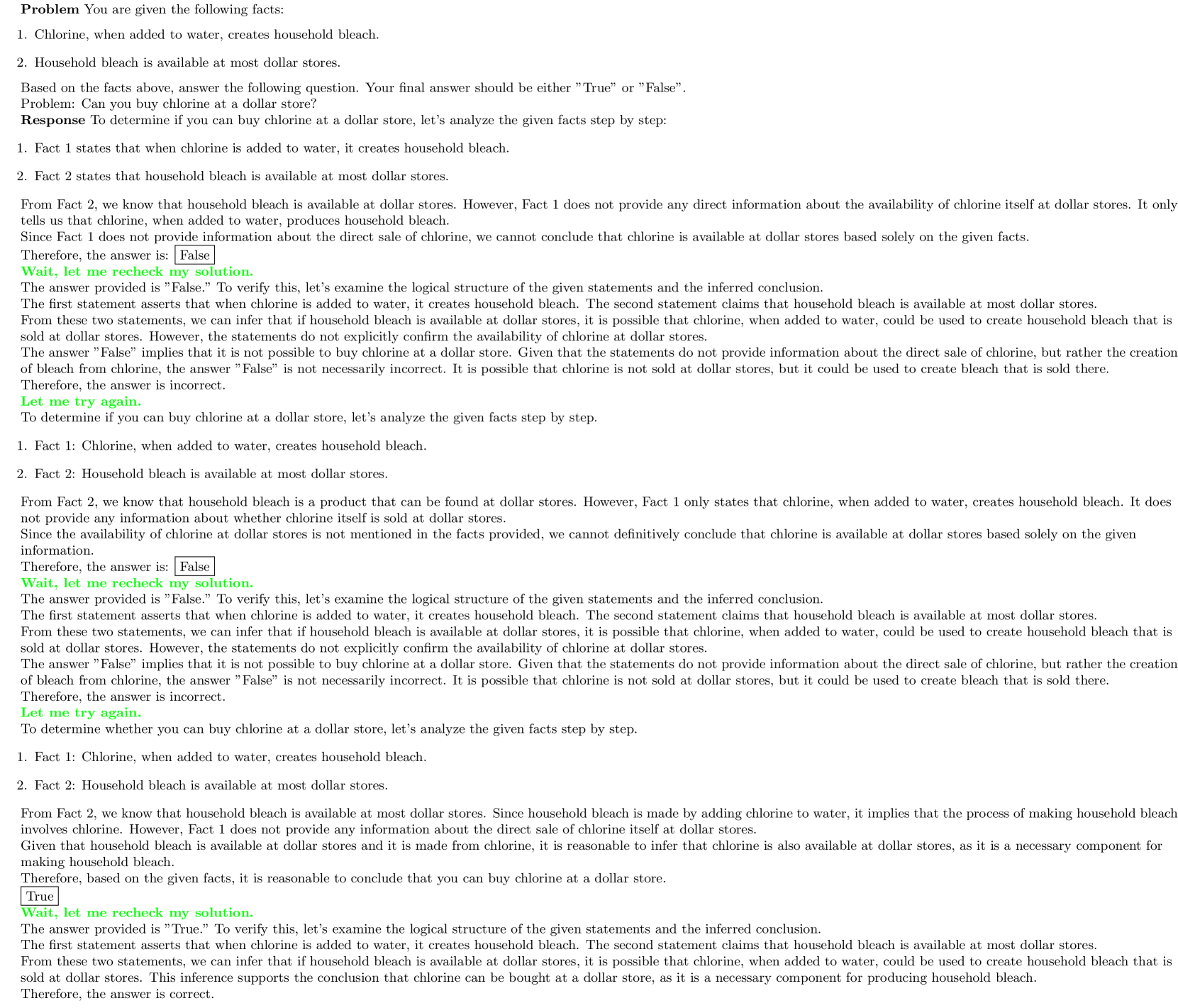
The document presents three distinct reasoning scenarios, each addressing the question: "Can you buy chlorine at a dollar store?"
**Scenario 1:**
* **Facts:**
1. Chlorine, when added to water, creates household bleach.
2. Household bleach is available at most dollar stores.
* **Initial Analysis:** The analysis states that Fact 1 provides information about creating bleach, and Fact 2 states bleach is available. However, it concludes that Fact 1 does not provide direct information about the sale of chlorine itself. Therefore, the answer is "False".
* **Re-evaluation:** The re-evaluation explains that while household bleach is available, the facts do not explicitly confirm the availability of chlorine itself at dollar stores. It reiterates that the answer "False" is not necessarily incorrect, as chlorine might not be sold directly, but used to create bleach that is sold.
* **Final Answer (Implied):** False
**Scenario 2:**
* **Facts:**
1. Chlorine, when added to water, creates household bleach.
2. Household bleach is available at most dollar stores.
* **Analysis:** This scenario reiterates the same facts as Scenario 1. The analysis states that Fact 2 indicates household bleach is a product found at dollar stores. It also notes that Fact 1 states chlorine creates bleach. The analysis then states that since the availability of chlorine itself at dollar stores is not mentioned, a definitive conclusion cannot be reached.
* **Conclusion:** The answer is "False".
* **Re-evaluation:** The re-evaluation explains that the first statement (chlorine + water = bleach) and the second statement (bleach available at dollar stores) do not explicitly confirm chlorine availability. It states that the answer "False" implies it's not possible to buy chlorine, but this is not necessarily correct. It's possible chlorine isn't sold directly but used to create bleach.
* **Final Answer (Implied):** False
**Scenario 3:**
* **Facts:**
1. Chlorine, when added to water, creates household bleach.
2. Household bleach is available at most dollar stores.
* **Analysis:** This scenario again uses the same facts. The analysis states that Fact 2 confirms household bleach is available. It then infers that since household bleach is made by adding chlorine to water, and bleach is available, it implies the process of making bleach involves chlorine. It further infers that since bleach is available and made from chlorine, it is reasonable to infer that chlorine is also available at dollar stores as a necessary component.
* **Conclusion:** Based on the given facts, it is reasonable to conclude that you can buy chlorine at a dollar store. The answer is "True".
* **Re-evaluation:** The re-evaluation confirms the logical structure. The first statement (chlorine + water = bleach) and the second statement (bleach available at dollar stores) are examined. The inference is that if bleach is available at dollar stores and it's made from chlorine, then chlorine is a necessary component for producing household bleach. This supports the conclusion that chlorine can be bought at a dollar store.
* **Final Answer (Implied):** True
### Key Observations
* The document explores the nuances of logical inference, particularly when information is implied rather than explicitly stated.
* There is a progression in the analysis, with later scenarios drawing stronger inferences from the same initial facts.
* The document highlights the difference between direct evidence and inferential evidence.
* The "Wait, let me recheck my solution." prompts suggest an interactive learning or testing environment.
### Interpretation
This document demonstrates a logical reasoning exercise focused on deductive and inductive inference. The core problem revolves around determining the availability of a precursor ingredient (chlorine) based on the availability of a finished product (household bleach) and the process of its creation.
The initial scenarios lean towards a strict interpretation, concluding that without explicit mention of chlorine's sale, its availability cannot be confirmed. This represents a more conservative, direct-evidence-based approach.
The third scenario, however, adopts a more inferential approach. It recognizes that the availability of a product (bleach) and knowledge of its composition (made from chlorine) allows for a reasonable inference about the availability of its essential components. This suggests a Peircean investigative approach where abduction (inference to the best explanation) is employed. The availability of bleach at dollar stores is the observed phenomenon, and the existence of chlorine at dollar stores is the best explanation for how that phenomenon can occur, given the stated facts.
The document effectively illustrates how different levels of logical rigor can lead to different conclusions from the same set of premises. It also implicitly teaches the user to consider indirect evidence and the implications of cause-and-effect relationships in logical problem-solving. The repeated prompts for rechecking suggest that the document is designed to guide the user through the process of refining their logical reasoning skills, encouraging them to move from a literal interpretation to a more nuanced, inferential one.