\n
## Histograms: OpenAI o3 Reasoning Data Token Length Distributions
### Overview
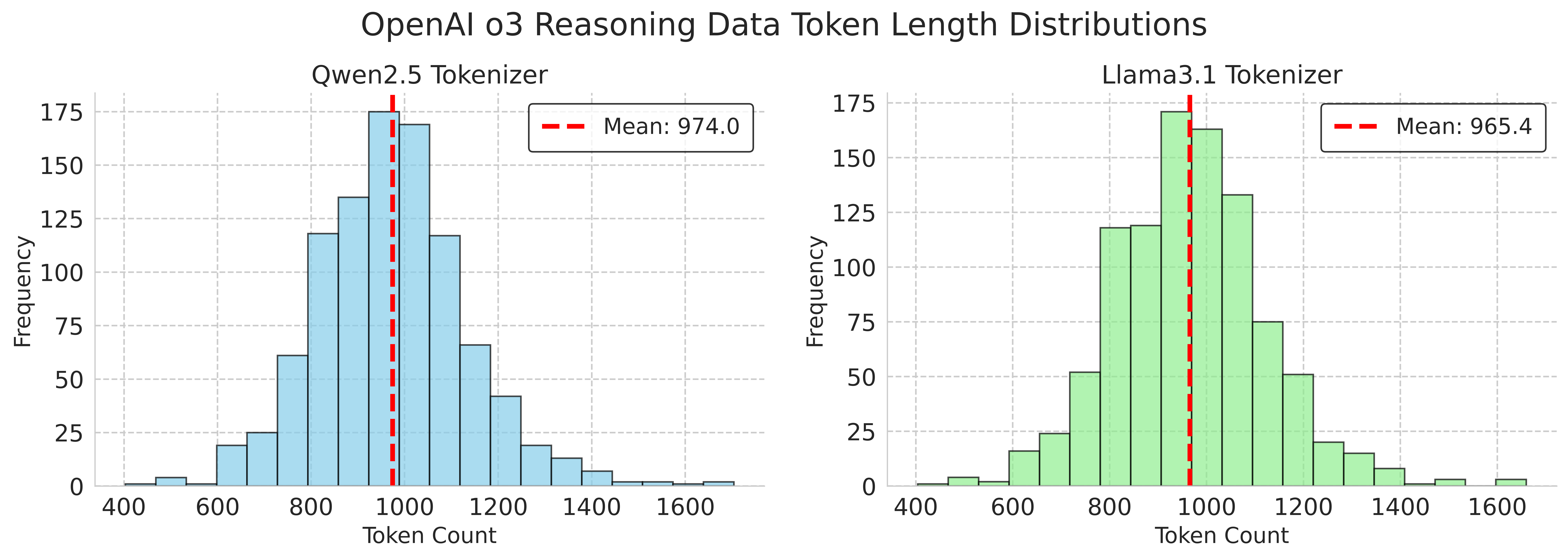
The image presents two histograms comparing the distributions of token lengths for the OpenAI o3 reasoning data, using two different tokenizers: Owen2.5 and Llama3.1. Both histograms share the same x and y axes, allowing for a direct visual comparison of the token length distributions.
### Components/Axes
* **Title:** OpenAI o3 Reasoning Data Token Length Distributions (centered at the top)
* **X-axis Label:** Token Count (present on both histograms, bottom-center)
* Scale: 400 to 1600, with increments of 200.
* **Y-axis Label:** Frequency (present on both histograms, left-center)
* Scale: 0 to 175, with increments of 25.
* **Legend:** Located in the top-right corner of each histogram.
* Owen2.5 Tokenizer: A solid red dashed line labeled "Mean: 974.0"
* Llama3.1 Tokenizer: A solid red dashed line labeled "Mean: 965.4"
### Detailed Analysis or Content Details
**Histogram 1: Owen2.5 Tokenizer (Left)**
* The histogram is filled with light blue bars.
* The distribution appears approximately normal, but slightly skewed to the right.
* The highest frequency occurs between 800 and 1000 token counts, with a frequency of approximately 130.
* The frequency decreases as the token count moves away from this peak in both directions.
* The mean is indicated by a vertical red dashed line at approximately 974 token count.
* Approximate data points (reading from the histogram):
* 400-600: Frequency ~ 10
* 600-800: Frequency ~ 50
* 800-1000: Frequency ~ 130
* 1000-1200: Frequency ~ 70
* 1200-1400: Frequency ~ 30
* 1400-1600: Frequency ~ 5
**Histogram 2: Llama3.1 Tokenizer (Right)**
* The histogram is filled with light green bars.
* The distribution is also approximately normal, but appears more symmetrical than the Owen2.5 distribution.
* The highest frequency occurs between 1000 and 1200 token counts, with a frequency of approximately 150.
* The frequency decreases as the token count moves away from this peak in both directions.
* The mean is indicated by a vertical red dashed line at approximately 965 token count.
* Approximate data points (reading from the histogram):
* 400-600: Frequency ~ 5
* 600-800: Frequency ~ 40
* 800-1000: Frequency ~ 100
* 1000-1200: Frequency ~ 150
* 1200-1400: Frequency ~ 60
* 1400-1600: Frequency ~ 10
### Key Observations
* Both tokenizers produce distributions centered around a similar mean token count (974.0 vs. 965.4).
* The Owen2.5 tokenizer has a slightly higher mean token count.
* The Llama3.1 tokenizer's distribution is more concentrated around the mean, suggesting less variability in token lengths.
* The Owen2.5 tokenizer's distribution is slightly right-skewed, indicating a higher frequency of longer token sequences.
### Interpretation
The histograms demonstrate the distribution of token lengths in the OpenAI o3 reasoning data when processed by two different tokenizers. The similarity in means suggests that both tokenizers are generally effective at representing the data. However, the differences in distribution shape and variability indicate that the tokenizers handle tokenization differently. The Llama3.1 tokenizer appears to produce more consistent token lengths, while the Owen2.5 tokenizer allows for more variation, potentially capturing more nuanced linguistic information but also potentially leading to longer sequences. This information is crucial for understanding the computational cost and efficiency of using each tokenizer with this dataset, as longer sequences require more processing power. The slight right skew in the Owen2.5 tokenizer could indicate a tendency to break down complex phrases into more tokens, while the Llama3.1 tokenizer might be more aggressive in combining words into fewer tokens.