\n
## Diagram: Collection of Hook-Like Tools
### Overview
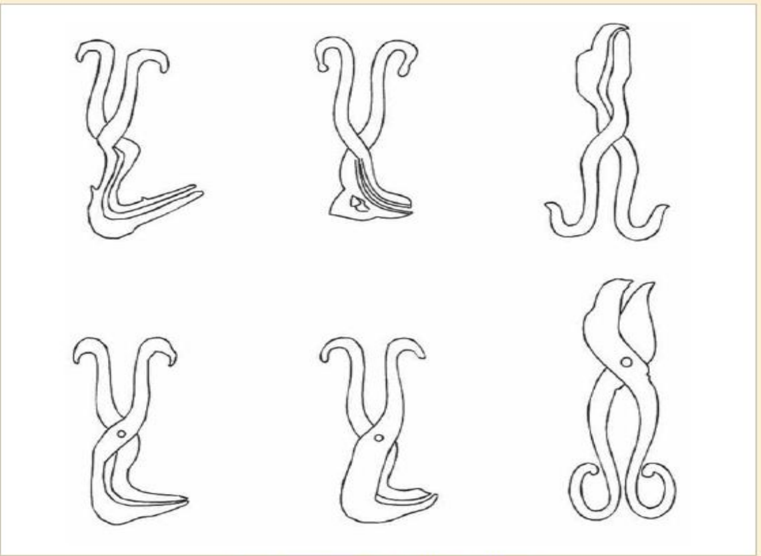
The image presents a 2x3 grid arrangement of line drawings depicting six different hook-like tools. These tools appear to be variations of a grappling hook or similar device, potentially used for lifting or securing objects. There are no labels, axes, or legends present. The image is purely visual, lacking quantitative data.
### Components/Axes
There are no axes or legends. The components are the six individual hook-like tools. Each tool is a single, continuous line drawing.
### Detailed Analysis or Content Details
The tools can be described individually, noting key features:
1. **Top-Left:** A hook with a curved body and a single, prominent curved hook at the end. The body has a slight "S" shape.
2. **Top-Center:** A hook with a more angular body and a smaller, more sharply curved hook. It has a small circular feature near the base of the hook.
3. **Top-Right:** A hook with a highly twisted, almost braided body, culminating in two curved hooks.
4. **Bottom-Left:** A hook with a curved body and a single, curved hook. It features a circular hole near the base of the hook.
5. **Bottom-Center:** A hook similar to the bottom-left, with a curved body and a single, curved hook, and a circular hole near the base.
6. **Bottom-Right:** A hook with a twisted body and two curved hooks. It features two circular holes near the base of the hooks.
All tools are depicted in a black line drawing on a white background. The line thickness appears consistent across all tools.
### Key Observations
The tools share a common theme of having a curved body and at least one hook. The variations lie in the complexity of the body (straight, curved, twisted) and the number of hooks (one or two). The presence of circular holes in some of the tools suggests a potential attachment point for a rope or chain.
### Interpretation
The image likely represents a collection of different designs for a grappling hook or similar tool. The variations could reflect different intended uses, load capacities, or manufacturing techniques. The absence of scale or context makes it difficult to determine the precise purpose of each tool. The image could be part of a historical catalog, a design study, or an illustration for a technical manual. The tools appear to be manually drawn, suggesting they are not modern, mass-produced items. The variations in design suggest an iterative process of improvement or adaptation to specific needs. The circular holes are a consistent feature in some designs, indicating a need for secure attachment. Without additional information, the image remains descriptive rather than analytical. It presents a visual inventory of hook-like tools without providing any data or insights into their function or history.