## Chart: Zoomed-in ROC Curve (Log-scaled FPR)
### Overview
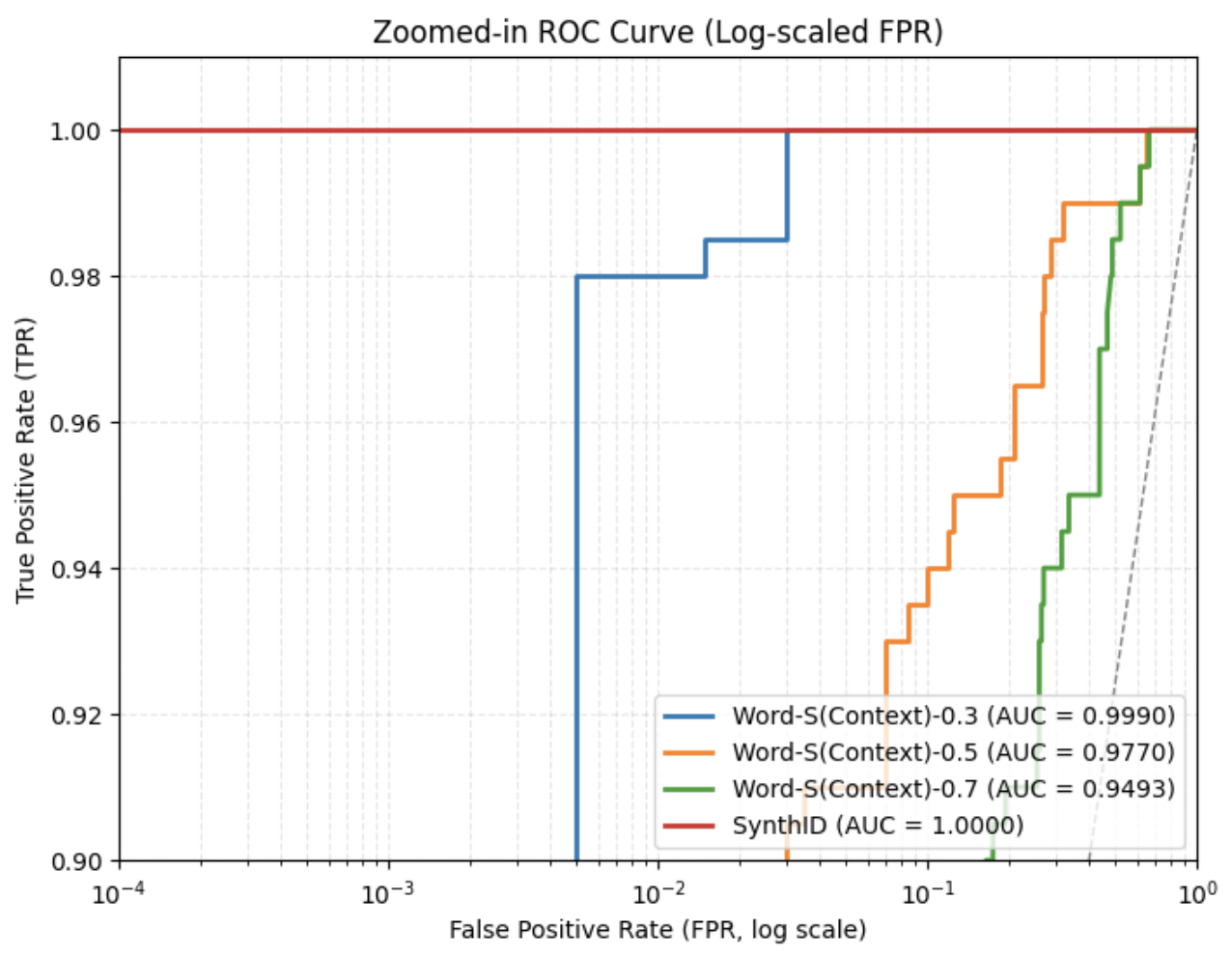
The image presents a Receiver Operating Characteristic (ROC) curve, specifically a zoomed-in view with the False Positive Rate (FPR) plotted on a logarithmic scale. The chart compares the performance of four different models or configurations, labeled "Word-S(Context)-0.3", "Word-S(Context)-0.5", "Word-S(Context)-0.7", and "SynthID". The curves illustrate the trade-off between the True Positive Rate (TPR) and the FPR for each model.
### Components/Axes
* **Title:** "Zoomed-in ROC Curve (Log-scaled FPR)" - positioned at the top-center of the chart.
* **X-axis:** "False Positive Rate (FPR, log scale)" - ranging from 10<sup>-4</sup> to 10<sup>0</sup> (i.e., 0.0001 to 1). The scale is logarithmic.
* **Y-axis:** "True Positive Rate (TPR)" - ranging from 0.90 to 1.00.
* **Legend:** Located in the top-right corner of the chart. It identifies each line with its corresponding model name and Area Under the Curve (AUC) value.
* "Word-S(Context)-0.3" (AUC = 0.9990) - Blue line
* "Word-S(Context)-0.5" (AUC = 0.9770) - Orange line
* "Word-S(Context)-0.7" (AUC = 0.9493) - Green line
* "SynthID" (AUC = 1.0000) - Red line
* **Grid:** A light gray grid is present, aiding in the reading of values.
### Detailed Analysis
The chart displays four ROC curves. Let's analyze each one:
* **Word-S(Context)-0.3 (Blue):** This line exhibits a very steep initial rise, quickly reaching a TPR of approximately 0.98 at an FPR of around 0.001 (10<sup>-3</sup>). It remains at a TPR of nearly 1.0 for the rest of the FPR range.
* **Word-S(Context)-0.5 (Orange):** This line starts lower than the blue line, with a TPR of approximately 0.94 at an FPR of around 0.001. It gradually increases, reaching a TPR of approximately 0.98 at an FPR of around 0.01 (10<sup>-2</sup>).
* **Word-S(Context)-0.7 (Green):** This line has the lowest initial TPR, starting at approximately 0.90 at an FPR of around 0.001. It shows a more gradual increase, reaching a TPR of approximately 0.95 at an FPR of around 0.1 (10<sup>-1</sup>).
* **SynthID (Red):** This line maintains a TPR of 1.0 across the entire FPR range, indicating perfect classification performance.
The AUC values provided in the legend quantify the overall performance of each model.
### Key Observations
* The "SynthID" model has a perfect AUC score of 1.0, indicating flawless performance.
* "Word-S(Context)-0.3" performs the best among the Word-S models, with an AUC of 0.9990.
* As the context value increases from 0.3 to 0.7, the AUC score decreases, suggesting that increasing the context negatively impacts performance.
* The curves demonstrate that all models achieve high TPR values, but at varying FPR levels.
### Interpretation
This ROC curve analysis suggests that the "SynthID" model is the most effective at distinguishing between positive and negative cases. The "Word-S(Context)" models show a trade-off between TPR and FPR, with lower context values (0.3) leading to better performance. The decreasing AUC scores with increasing context values indicate that incorporating more context may introduce noise or irrelevant information, hindering the model's ability to accurately classify instances. The logarithmic scale on the FPR axis emphasizes the performance of the models at low false positive rates, which is often crucial in applications where minimizing false alarms is paramount. The steep initial rise of the blue line suggests that the "Word-S(Context)-0.3" model can achieve high accuracy with a very low rate of false positives. The chart provides a visual and quantitative comparison of the models' performance, allowing for informed decision-making regarding model selection and parameter tuning.