## Line Charts: Performance Metrics vs. Backtracking Steps
### Overview
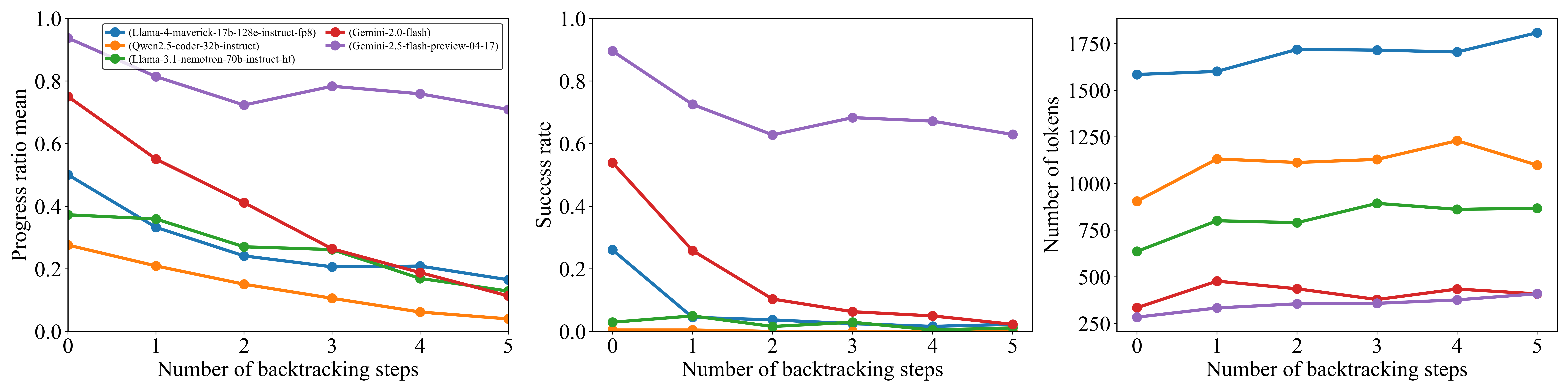
The image displays three horizontally aligned line charts comparing the performance of five different Large Language Models (LLMs) across varying numbers of backtracking steps (0 to 5). The charts measure three distinct metrics: Progress Ratio Mean, Success Rate, and Number of Tokens. A shared legend is present in the first chart.
### Components/Axes
* **Common X-Axis (All Charts):** "Number of backtracking steps" with integer markers from 0 to 5.
* **Chart 1 (Left):**
* **Y-Axis:** "Progress ratio mean" with a scale from 0.0 to 1.0.
* **Legend (Top-Left):** Contains five entries, each with a colored line and marker:
* Blue circle: `(Llama-4-maverick-17b-128e-instruct-fp8)`
* Orange circle: `(Qwen2.5-coder-32b-instruct)`
* Green circle: `(Llama-3.1-nemotron-70b-instruct-hf)`
* Red circle: `(Gemini-2.0-flash)`
* Purple circle: `(Gemini-2.5-flash-preview-04-17)`
* **Chart 2 (Middle):**
* **Y-Axis:** "Success rate" with a scale from 0.0 to 1.0.
* **Chart 3 (Right):**
* **Y-Axis:** "Number of tokens" with a scale from 250 to 1750.
### Detailed Analysis
**Chart 1: Progress Ratio Mean**
* **Trend Verification:** All models show a general downward trend in progress ratio as backtracking steps increase.
* **Data Points (Approximate):**
* **Purple (Gemini-2.5-flash-preview-04-17):** Starts highest at ~0.95 (step 0), declines to ~0.72 (step 5). It remains the top performer throughout.
* **Red (Gemini-2.0-flash):** Starts at ~0.75 (step 0), declines steadily to ~0.12 (step 5).
* **Blue (Llama-4-maverick):** Starts at ~0.50 (step 0), declines to ~0.18 (step 5).
* **Green (Llama-3.1-nemotron):** Starts at ~0.38 (step 0), declines to ~0.14 (step 5).
* **Orange (Qwen2.5-coder):** Starts lowest at ~0.29 (step 0), declines to ~0.04 (step 5).
**Chart 2: Success Rate**
* **Trend Verification:** Most models show a sharp decline in success rate with increased backtracking, except for the purple line which maintains a relatively high rate.
* **Data Points (Approximate):**
* **Purple (Gemini-2.5-flash-preview-04-17):** Starts highest at ~0.90 (step 0), dips to ~0.63 (step 2), and stabilizes around ~0.65-0.63 (steps 3-5).
* **Red (Gemini-2.0-flash):** Starts at ~0.54 (step 0), drops sharply to ~0.02 (step 5).
* **Blue (Llama-4-maverick):** Starts at ~0.26 (step 0), drops to near zero by step 2 and remains there.
* **Green (Llama-3.1-nemotron):** Starts very low at ~0.03 (step 0), remains near zero throughout.
* **Orange (Qwen2.5-coder):** Starts at 0.0 (step 0) and remains at 0.0 for all steps.
**Chart 3: Number of Tokens**
* **Trend Verification:** Token usage shows varied trends. The blue line increases, the orange and green lines show moderate increases, while the red and purple lines remain relatively low and stable.
* **Data Points (Approximate):**
* **Blue (Llama-4-maverick):** Shows a clear upward trend, starting at ~1580 (step 0) and rising to ~1820 (step 5). It uses the most tokens.
* **Orange (Qwen2.5-coder):** Starts at ~900 (step 0), peaks at ~1240 (step 4), and ends at ~1100 (step 5).
* **Green (Llama-3.1-nemotron):** Starts at ~640 (step 0), rises to ~880 (step 3), and stabilizes around ~870 (steps 4-5).
* **Red (Gemini-2.0-flash):** Starts at ~340 (step 0), fluctuates slightly, and ends at ~410 (step 5).
* **Purple (Gemini-2.5-flash-preview-04-17):** Starts lowest at ~280 (step 0), rises slowly to ~410 (step 5). It uses the fewest tokens overall.
### Key Observations
1. **Performance Hierarchy:** The `Gemini-2.5-flash-preview-04-17` (purple) model consistently outperforms the others in both progress ratio and success rate across all backtracking steps, while also using the fewest tokens.
2. **Backtracking Impact:** Increasing backtracking steps generally degrades performance (progress and success) for all models, but the magnitude of degradation varies significantly.
3. **Token Efficiency:** There is a clear inverse relationship between performance and token usage for the top-performing model (purple). The model with the highest token usage (blue, Llama-4-maverick) shows middling progress and poor success rates.
4. **Model Grouping:** The two Gemini models (red and purple) start with the highest progress and success rates. The Llama and Qwen models start lower and decline. The `Qwen2.5-coder` (orange) has a 0% success rate regardless of backtracking steps.
### Interpretation
The data suggests a significant performance advantage for the `Gemini-2.5-flash-preview-04-17` model in this specific evaluation context. It demonstrates superior robustness, maintaining high success rates even as backtracking steps increase, and does so with remarkable token efficiency.
The stark contrast between the purple and red lines (both Gemini models) indicates that the "preview-04-17" version likely incorporates substantial architectural or training improvements over the "2.0-flash" version, particularly in handling backtracking or complex reasoning tasks.
The general decline in success rate with more backtracking steps for most models is counter-intuitive, as backtracking is typically a strategy to improve correctness. This could imply that the backtracking mechanism itself is poorly implemented or that the models struggle to effectively utilize the additional steps, potentially getting "stuck" in unproductive loops. The anomaly is the purple line, which resists this trend, suggesting it has a more effective backtracking or recovery strategy.
The token usage chart reveals different operational strategies. The high token consumption of the Llama-4-maverick model (blue) without commensurate performance gains suggests inefficiency. Conversely, the Gemini-2.5-flash model's low token count combined with high performance points to a highly optimized and effective inference process for this task.