## Diagram: Probability Problem Solving Flowchart
### Overview
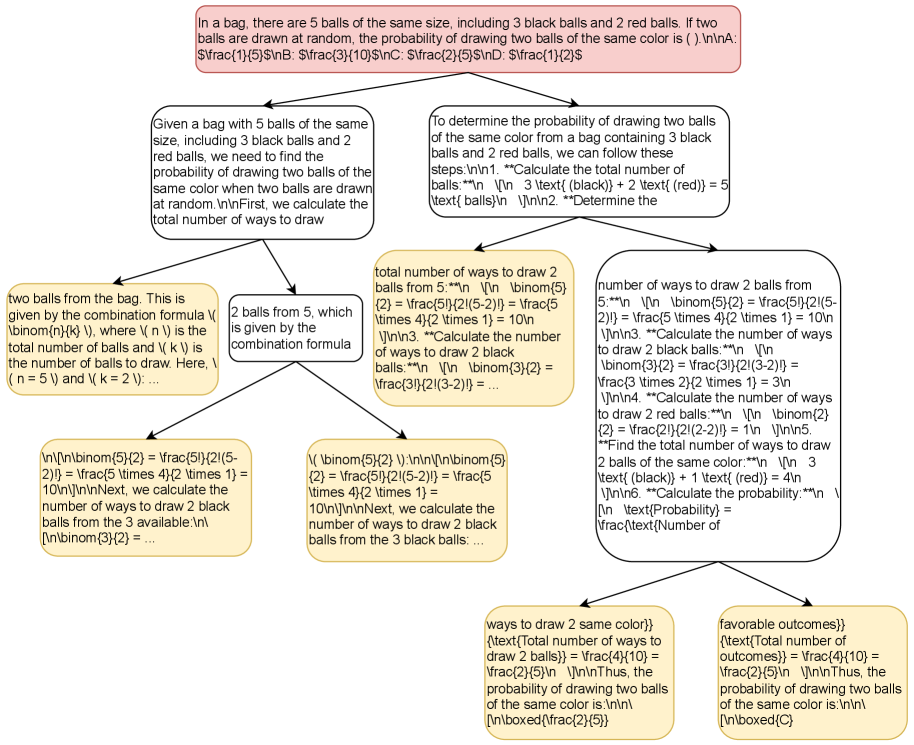
The image is a hierarchical flowchart illustrating the step-by-step solution to a probability problem involving combinatorics. The problem asks for the probability of drawing two balls of the same color from a bag containing 3 black balls and 2 red balls. The diagram branches into two distinct, though largely redundant, pedagogical paths to reach the final solution.
### Components/Axes
* **Structure:** The diagram flows from a single root node at the top, branching into two main paths (left and right), which further subdivide into calculation steps.
* **Node Types:**
* **White Boxes:** Contain problem statements, conceptual explanations, and logical steps.
* **Light Yellow/Tan Boxes:** Contain specific mathematical calculations, formulas, and final results.
* **Flow:** Arrows indicate the logical progression from the problem statement to the final calculation.
### Detailed Analysis
#### Root Node (Top)
* **Text:** "In a bag, there are 5 balls of the same size, including 3 black balls and 2 red balls. If two balls are drawn at random, the probability of drawing two balls of the same color is ( ).
A: 1/5
B: 3/10
C: 2/5
D: 1/2"
#### Left Branch
* **Node 1 (White):** "Given a bag with 5 balls of the same size, including 3 black balls and 2 red balls, we need to find the probability of drawing two balls of the same color when two balls are drawn at random. First, we calculate the total number of ways to draw"
* **Node 2 (Yellow):** "two balls from the bag. This is given by the combination formula $\binom{n}{k}$, where n is the total number of balls and k is the number of balls to draw. Here, n = 5 and k = 2: ..."
* **Node 3 (Yellow):** "$\binom{5}{2} = \frac{5!}{2!(5-2)!} = \frac{5 \times 4}{2 \times 1} = 10$. Next, we calculate the number of ways to draw 2 black balls from the 3 available: $\binom{3}{2} = ...$"
* **Node 4 (Yellow):** "$\binom{5}{2} = \frac{5!}{2!(5-2)!} = \frac{5 \times 4}{2 \times 1} = 10$. Next, we calculate the number of ways to draw 2 black balls from the 3 black balls: ..."
* **Node 5 (Yellow - Bottom Left):** "$\frac{\text{ways to draw 2 same color}}{\text{Total number of ways to draw 2 balls}} = \frac{4}{10} = \frac{2}{5}$. Thus, the probability of drawing two balls of the same color is: $\boxed{\frac{2}{5}}$"
#### Right Branch
* **Node 1 (White):** "To determine the probability of drawing two balls of the same color from a bag containing 3 black balls and 2 red balls, we can follow these steps: 1. Calculate the total number of balls: 3 (black) + 2 (red) = 5 balls. 2. Determine the"
* **Node 2 (Yellow):** "total number of ways to draw 2 balls from 5: $\binom{5}{2} = \frac{5!}{2!(5-2)!} = \frac{5 \times 4}{2 \times 1} = 10$. 3. Calculate the number of ways to draw 2 black balls: $\binom{3}{2} = \frac{3!}{2!(3-2)!} = \frac{3 \times 2}{2 \times 1} = 3$"
* **Node 3 (Yellow):** "number of ways to draw 2 balls from 5: $\binom{5}{2} = \frac{5!}{2!(5-2)!} = \frac{5 \times 4}{2 \times 1} = 10$. 3. Calculate the number of ways to draw 2 black balls: $\binom{3}{2} = \frac{3!}{2!(3-2)!} = \frac{3 \times 2}{2 \times 1} = 3$. 4. Calculate the number of ways to draw 2 red balls: $\binom{2}{2} = \frac{2!}{2!(2-2)!} = 1$. 5. Find the total number of ways to draw 2 balls of the same color: 3 (black) + 1 (red) = 4. 6. Calculate the probability: $\text{Probability} = \frac{\text{Number of"
* **Node 4 (Yellow - Bottom Right):** "favorable outcomes}}{\text{Total number of outcomes}} = \frac{4}{10} = \frac{2}{5}$. Thus, the probability of drawing two balls of the same color is: $\boxed{C}$"
### Key Observations
* **Redundancy:** The diagram presents two paths that essentially calculate the same mathematical problem. The right path is more comprehensive, explicitly calculating both black and red ball combinations, whereas the left path is fragmented and repetitive.
* **Formatting Errors:** The text contains several LaTeX rendering artifacts (e.g., `\text{}`, `\binom`) that suggest this diagram was generated by a script or software that did not fully render the mathematical notation.
* **Consistency:** Despite the messy formatting, the mathematical logic is consistent across both branches, arriving at the correct probability of 2/5.
* **Final Answer:** The right branch explicitly maps the result to the multiple-choice option "C".
### Interpretation
The data demonstrates a standard combinatorics approach to probability:
1. **Total Outcomes:** Calculated using the combination formula $\binom{5}{2} = 10$.
2. **Favorable Outcomes:**
* Drawing 2 black balls from 3: $\binom{3}{2} = 3$.
* Drawing 2 red balls from 2: $\binom{2}{2} = 1$.
* Total favorable outcomes: $3 + 1 = 4$.
3. **Probability:** $\frac{\text{Favorable}}{\text{Total}} = \frac{4}{10} = \frac{2}{5}$.
The diagram acts as a pedagogical tool, likely generated by an AI or automated tutoring system, attempting to break down the problem into logical steps. The presence of two branches suggests an attempt to provide alternative explanations or a "show your work" feature, though the execution is visually cluttered and contains rendering errors. The final answer, 2/5, corresponds to option C in the original problem statement.