\n
## Diagram: Movie Attribute Graph
### Overview
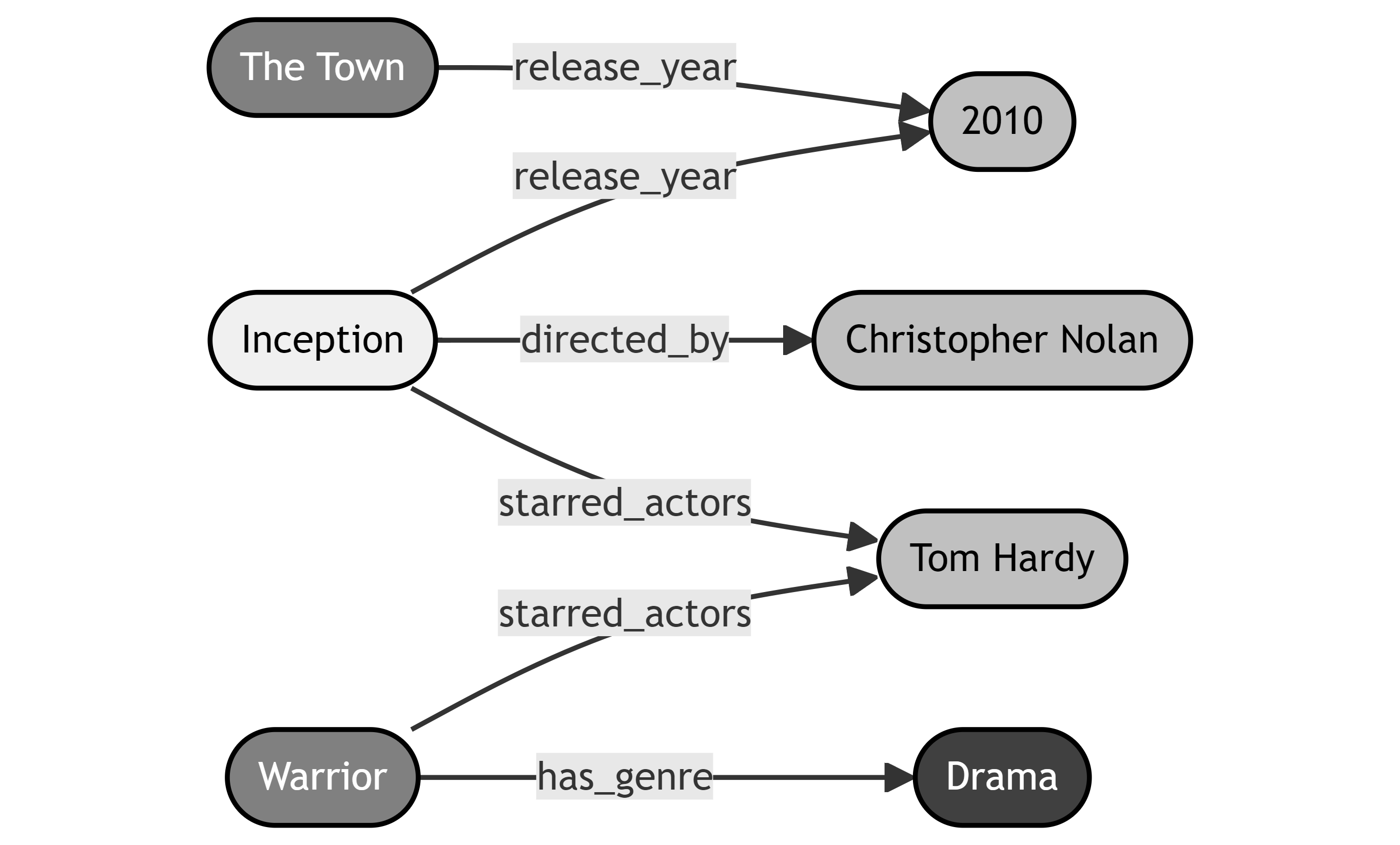
The image presents a directed graph illustrating relationships between movies and their attributes. Nodes represent movies or attributes, and directed edges indicate the type of relationship between them. The graph appears to be a simplified knowledge representation of movie data.
### Components/Axes
The diagram consists of nodes (rounded rectangles) and directed edges (lines with arrowheads). The nodes contain text labels representing movie titles, attribute names, or attribute values. The edges are labeled with the relationship type.
### Detailed Analysis or Content Details
The diagram shows the following relationships:
1. **The Town** – *release_year* → **2010**
* The movie "The Town" has a release year of 2010.
2. **The Town** – *release_year* → **2010**
* The movie "The Town" has a release year of 2010. (Duplicate entry)
3. **Inception** – *directed_by* → **Christopher Nolan**
* The movie "Inception" was directed by Christopher Nolan.
4. **Inception** – *starred_actors* → **Tom Hardy**
* The movie "Inception" starred Tom Hardy.
5. **Inception** – *starred_actors* → **Tom Hardy**
* The movie "Inception" starred Tom Hardy. (Duplicate entry)
6. **Warrior** – *has_genre* → **Drama**
* The movie "Warrior" has the genre "Drama".
The nodes are positioned vertically, with the relationships flowing generally from left to right. The nodes are white with black text, and the edges are black.
### Key Observations
* There are duplicate relationships for "The Town" release year and "Inception" starred actors. This could indicate redundancy in the data or a deliberate representation of multiple instances.
* The graph is relatively small, representing only a limited subset of movie data.
* The relationships are simple and direct, focusing on single attributes or values.
### Interpretation
The diagram demonstrates a basic knowledge graph structure for representing movie information. It shows how movies can be linked to their attributes (director, actors, genre, release year) through specific relationship types. The duplication of relationships suggests that the data might be representing multiple instances of the same attribute, or it could be an artifact of the data representation. This type of graph could be used for querying movie data, recommending movies based on attributes, or building a more comprehensive knowledge base of movies and their characteristics. The simplicity of the graph suggests it's a conceptual model rather than a detailed database representation.