\n
## Diagram: Numbered Tile Puzzle Layout
### Overview
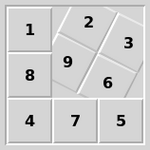
The image displays a 3x3 grid containing nine numbered tiles. The tiles are a mix of square and diamond (rotated square) shapes, arranged in a specific pattern. The numbers 1 through 9 are present, but they are not in sequential order from left-to-right, top-to-bottom. The background is a uniform light gray, and the tiles have a subtle bevel and shadow effect, giving them a slightly raised, three-dimensional appearance.
### Components/Axes
* **Grid Structure:** A 3x3 matrix.
* **Tile Shapes:** Two distinct shapes are used:
* **Square Tiles:** Oriented normally.
* **Diamond Tiles:** Rotated 45 degrees.
* **Tile Content:** Each tile contains a single, centered numeral in a dark, sans-serif font.
* **Spatial Layout:**
* **Top Row (Left to Right):** Square (1), Diamond (2), Diamond (3).
* **Middle Row (Left to Right):** Square (8), Diamond (9), Diamond (6).
* **Bottom Row (Left to Right):** Square (4), Square (7), Square (5).
### Detailed Analysis
The arrangement of numbers and tile shapes creates a non-sequential pattern.
* **Numerical Sequence:** The numbers are placed as follows:
* Position (1,1): 1 (Square)
* Position (1,2): 2 (Diamond)
* Position (1,3): 3 (Diamond)
* Position (2,1): 8 (Square)
* Position (2,2): 9 (Diamond)
* Position (2,3): 6 (Diamond)
* Position (3,1): 4 (Square)
* Position (3,2): 7 (Square)
* Position (3,3): 5 (Square)
* **Shape Distribution:** The diamond-shaped tiles form a connected diagonal cluster from the top-center (2) to the middle-right (6), passing through the center (9). All other tiles (1, 8, 4, 7, 5) are squares and occupy the left column and the entire bottom row.
### Key Observations
1. **Non-Sequential Order:** The numbers do not follow a standard reading order (e.g., 1,2,3 / 4,5,6 / 7,8,9). The sequence jumps significantly (e.g., from 3 to 8, from 6 to 4).
2. **Shape-Number Correlation:** There is a clear correlation between tile shape and numerical value in this specific configuration. All numbers greater than or equal to 6 (6, 7, 8, 9) are present, but only 6 and 9 are on diamond tiles. The diamond tiles exclusively hold the numbers 2, 3, 6, and 9.
3. **Visual Grouping:** The diamond tiles create a distinct visual group in the upper-right quadrant of the grid, contrasting with the square tiles that frame them on the left and bottom.
### Interpretation
This image most likely represents a specific state or configuration of a **sliding tile puzzle** (like the classic 8-puzzle, but with numbers 1-9). In such puzzles, tiles slide into an empty space, and the goal is to arrange them in sequential order.
* **Puzzle State:** The arrangement shown is a scrambled or intermediate state. The diamond shape may indicate tiles that are "active," "movable," or part of a specific subgroup within the puzzle's logic. Alternatively, it could simply be a stylistic choice to differentiate certain tiles.
* **Pattern Analysis:** The clustering of higher numbers (6, 8, 9) in the center and upper-right, with lower numbers (1, 2, 3, 4, 5) on the periphery, suggests a configuration that is far from the solved state (which would typically be 1,2,3 / 4,5,6 / 7,8,9). The presence of the number 9 in the center is notable, as in many puzzles the central tile is fixed or has special significance.
* **Functional Clue:** The shape differentiation is the most critical piece of information beyond the numbers themselves. It implies a rule or property that applies to the diamond tiles (2, 3, 6, 9) that does not apply to the square tiles. This could relate to movement rules, scoring, or a secondary objective within the puzzle.