\n
## Image Series: Novel View Synthesis Comparison
### Overview
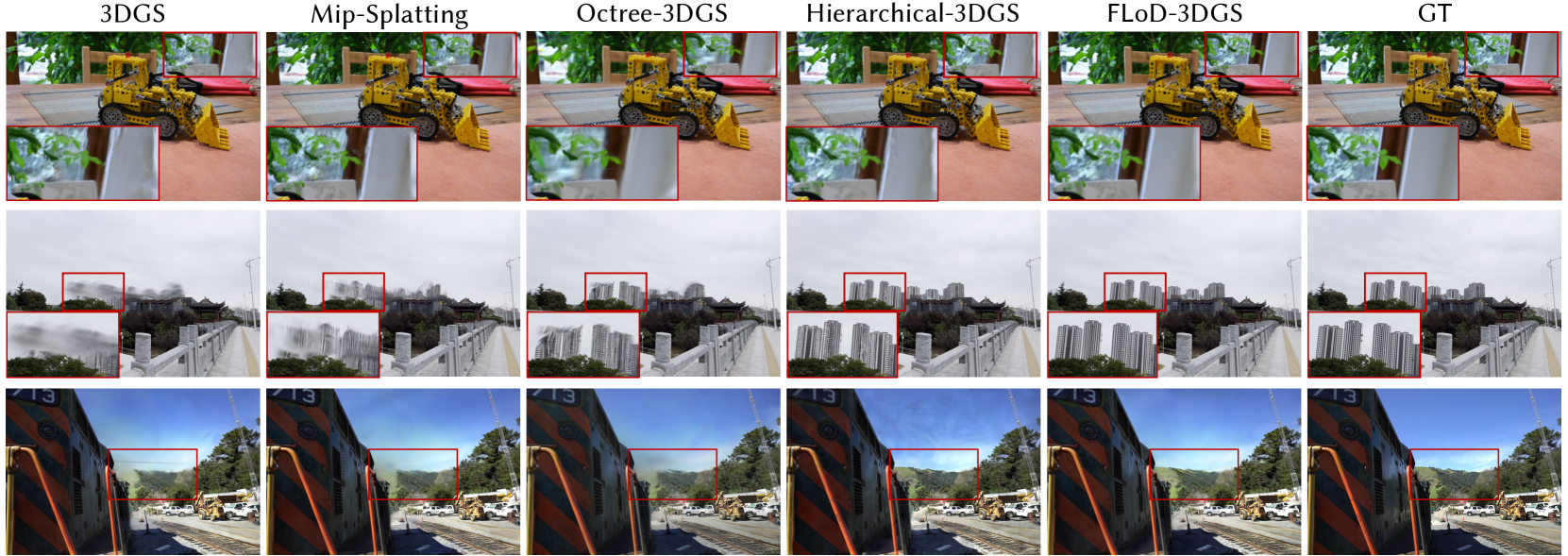
The image presents a comparative visual analysis of different novel view synthesis techniques. Six columns display renderings of three distinct scenes, each processed by a different method: 3DGS, MIP-Splatting, Octree-3DGS, Hierarchical-3DGS, FLoD-3DGS, and GT (Ground Truth). Each scene is shown in three rows, representing different viewpoints or camera angles. The purpose is to visually assess the quality and fidelity of each method in reconstructing 3D scenes from limited views.
### Components/Axes
The image does not contain explicit axes or numerical data. It is a qualitative comparison based on visual inspection. The columns represent different algorithms, and the rows represent different viewpoints. The labels for each column are positioned at the top: "3DGS", "Mip-Splatting", "Octree-3DGS", "Hierarchical-3DGS", "FLoD-3DGS", and "GT". There are no legends or scales.
### Detailed Analysis or Content Details
The image consists of 3 rows and 6 columns, totaling 18 individual images.
**Row 1: Construction Site Scene**
* **3DGS:** Shows a yellow construction vehicle (excavator) on a road with buildings in the background. Some artifacts and blurring are visible.
* **Mip-Splatting:** Similar scene, but with more pronounced blurring and ghosting artifacts around the excavator.
* **Octree-3DGS:** Improved clarity compared to 3DGS and MIP-Splatting, with fewer artifacts.
* **Hierarchical-3DGS:** Further improvement in clarity and detail, approaching the quality of the ground truth.
* **FLoD-3DGS:** Very similar to Hierarchical-3DGS, with high fidelity and minimal artifacts.
* **GT:** The ground truth rendering, serving as the benchmark for visual quality. It exhibits the highest level of detail and realism.
**Row 2: Forbidden City Scene**
* **3DGS:** Shows a view of the Forbidden City with a blurred and distorted appearance. Details are significantly lost.
* **Mip-Splatting:** Similar to 3DGS, with substantial blurring and artifacts. The architectural details are poorly defined.
* **Octree-3DGS:** Noticeable improvement in clarity, but still exhibits some blurring and distortion.
* **Hierarchical-3DGS:** Significant improvement in detail and sharpness, with a more recognizable representation of the Forbidden City.
* **FLoD-3DGS:** Very high fidelity, closely resembling the ground truth.
* **GT:** The ground truth rendering, displaying sharp details and accurate representation of the Forbidden City architecture.
**Row 3: Train Track Scene**
* **3DGS:** Shows a train track with a train and surrounding landscape. The image is blurry and lacks detail.
* **Mip-Splatting:** Similar to 3DGS, with significant blurring and artifacts.
* **Octree-3DGS:** Improved clarity compared to 3DGS and MIP-Splatting, but still exhibits some blurring.
* **Hierarchical-3DGS:** Significant improvement in detail and sharpness, with a more realistic representation of the scene.
* **FLoD-3DGS:** Very high fidelity, closely resembling the ground truth.
* **GT:** The ground truth rendering, displaying sharp details and accurate representation of the train and landscape.
### Key Observations
* **GT consistently provides the highest visual quality.** It serves as the ideal benchmark.
* **Mip-Splatting generally performs the worst**, exhibiting the most significant blurring and artifacts across all scenes.
* **3DGS performs better than MIP-Splatting but still suffers from noticeable artifacts and blurring.**
* **Octree-3DGS shows improvement over 3DGS and MIP-Splatting**, but still falls short of the higher-performing methods.
* **Hierarchical-3DGS and FLoD-3DGS achieve comparable results**, both demonstrating high fidelity and minimal artifacts. They are the closest in quality to the ground truth.
* The improvement in visual quality generally follows the order: MIP-Splatting < 3DGS < Octree-3DGS < Hierarchical-3DGS ≈ FLoD-3DGS < GT.
### Interpretation
This image demonstrates a comparative evaluation of different novel view synthesis algorithms. The results suggest that Hierarchical-3DGS and FLoD-3DGS are the most effective methods for reconstructing 3D scenes with high fidelity, closely matching the quality of the ground truth. MIP-Splatting appears to be the least effective, struggling to produce clear and artifact-free renderings. The performance differences likely stem from the underlying techniques used by each algorithm to represent and render the 3D scene. For example, MIP-Splatting's reliance on splatting may introduce blurring, while Hierarchical-3DGS and FLoD-3DGS's hierarchical representations may allow for more efficient and accurate rendering. The consistent performance of GT highlights its role as the ideal reference point for evaluating the accuracy and realism of these novel view synthesis methods. The scenes chosen (construction site, Forbidden City, train track) represent diverse environments with varying levels of complexity, providing a comprehensive assessment of the algorithms' capabilities. The image is a qualitative demonstration of the strengths and weaknesses of each method, providing valuable insights for researchers and practitioners in the field of 3D reconstruction and rendering.