TECHNICAL ASSET FINGERPRINT
0544742475f8f3790a2e42da
Click to view fullscreen
Press ESC or click to close
FOUND IN PAPERS
EXPERT: healer-alpha-free VERSION 1
RUNTIME: free/openrouter/healer-alpha
INTEL_VERIFIED
## Comparative Visualization: 3D Gaussian Splatting (3DGS) Method Reconstruction Quality
### Overview
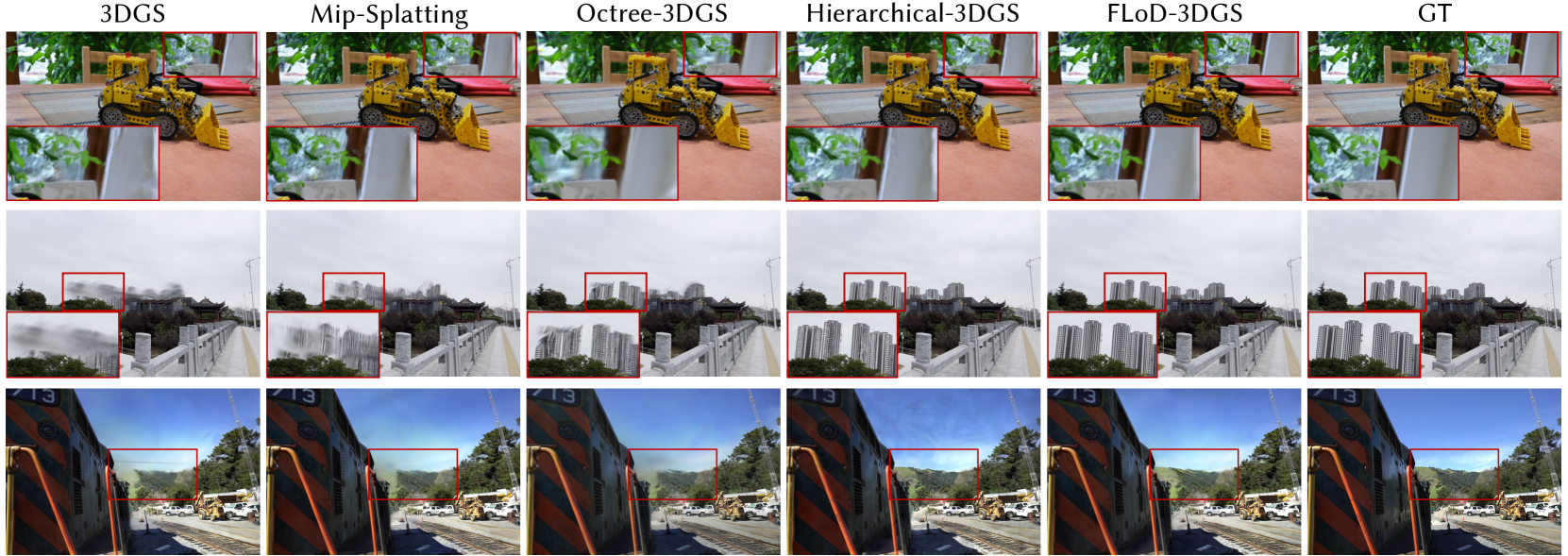
The image is a comparative visualization grid from a technical paper or report, evaluating the visual output quality of five different 3D Gaussian Splatting (3DGS) reconstruction methods against a Ground Truth (GT) reference. It displays three distinct scenes (rows) rendered by each method (columns). Red bounding boxes highlight specific regions of interest, with corresponding zoomed-in insets provided in the bottom-left corner of each image panel for detailed comparison.
### Components/Axes
* **Structure:** A 3-row by 6-column grid.
* **Column Headers (Top Labels):** The six columns are labeled from left to right as:
1. `3DGS`
2. `Mip-Splatting`
3. `Octree-3DGS`
4. `Hierarchical-3DGS`
5. `FLoD-3DGS`
6. `GT` (Ground Truth)
* **Row Content (Scenes):**
* **Row 1:** An indoor scene featuring a yellow toy bulldozer on a wooden surface with a red object in the background.
* **Row 2:** An outdoor cityscape view from a bridge or walkway, showing traditional Chinese-style rooftops in the mid-ground and modern high-rise buildings in the background under an overcast sky.
* **Row 3:** A close-up view of the side of a train car (marked with "13") on a track, with trees, a road, and construction vehicles visible in the background.
* **Visual Annotations:**
* **Red Bounding Boxes:** Each image panel contains a red rectangular box outlining a specific region for detailed comparison.
* **Zoomed Insets:** A smaller, magnified view of the area inside the red box is overlaid in the bottom-left corner of each panel.
### Detailed Analysis
**Scene 1 (Toy Bulldozer):**
* **Trend:** All methods reconstruct the main subject (bulldozer) recognizably. The key differentiator is the clarity of fine details and textures in the background and on surfaces.
* **Data Points (Visual Quality in Inset):**
* `3DGS`: Shows significant blurring and loss of detail in the zoomed region (appears to be foliage/texture).
* `Mip-Splatting`: Slightly improved over 3DGS but still blurry.
* `Octree-3DGS`: Noticeably sharper than the previous two.
* `Hierarchical-3DGS`: Similar sharpness to Octree-3DGS.
* `FLoD-3DGS`: Appears very sharp, with clear definition of edges and textures.
* `GT`: The reference image, showing the highest level of detail and clarity.
**Scene 2 (Cityscape):**
* **Trend:** The primary challenge is the accurate reconstruction of distant, complex geometry (building facades) and handling atmospheric haze.
* **Data Points (Visual Quality in Inset):**
* `3DGS`: The buildings in the inset are extremely blurry and lack any structural definition.
* `Mip-Splatting`: Shows some structural hints but remains very blurry and "smudged."
* `Octree-3DGS`: Buildings are recognizable with defined edges, but textures are somewhat noisy or incomplete.
* `Hierarchical-3DGS`: Similar to Octree-3DGS, with perhaps slightly better structural coherence.
* `FLoD-3DGS`: Renders the buildings with high clarity, sharp edges, and clear window patterns, closely matching the GT.
* `GT`: The reference, showing crisp, detailed buildings.
**Scene 3 (Train):**
* **Trend:** This scene tests the reconstruction of large, planar surfaces with text/numbers (the train side) and complex background elements.
* **Data Points (Visual Quality in Inset):**
* `3DGS`: The background area in the inset (trees/sky) is very blurry and lacks detail.
* `Mip-Splatting`: Marginally better than 3DGS but still heavily blurred.
* `Octree-3DGS`: Background details become more discernible.
* `Hierarchical-3DGS`: Good clarity in the background.
* `FLoD-3DGS`: Very clear reconstruction of both the train's edge and the background scenery.
* `GT`: The reference image.
### Key Observations
1. **Performance Gradient:** There is a clear visual progression in reconstruction quality from left to right across the methods. `3DGS` and `Mip-Splatting` consistently produce the blurriest results, especially in detailed or distant regions. `Octree-3DGS` and `Hierarchical-3DGS` show significant improvement. `FLoD-3DGS` consistently produces results that are visually closest to the `GT` reference.
2. **Failure Modes:** The baseline `3DGS` method exhibits severe high-frequency detail loss, appearing as pervasive blurring. `Mip-Splatting` mitigates this slightly but does not resolve it.
3. **Strength of FLoD-3DGS:** The `FLoD-3DGS` method demonstrates a notable ability to preserve sharp edges (building outlines, train edges) and fine textures (building windows, foliage) that other methods smooth out.
4. **Consistency:** The relative performance ranking of the methods is consistent across all three diverse scenes (indoor object, outdoor cityscape, vehicle close-up), suggesting the observed advantages are robust.
### Interpretation
This image serves as qualitative evidence in a research context, likely from a paper introducing or evaluating the `FLoD-3DGS` method. The visual comparison is designed to demonstrate that `FLoD-3DGS` achieves superior rendering fidelity compared to prior 3DGS variants.
* **What the Data Suggests:** The data (visual results) suggests that the `FLoD-3DGS` algorithm incorporates improvements that better preserve high-frequency spatial information and geometric detail. This could be due to more efficient data structures, improved splatting primitives, or better optimization strategies that prevent over-smoothing.
* **Relationship Between Elements:** The columns represent a chronological or complexity-based evolution of techniques, with `GT` as the ideal target. The rows prove the methods' generalizability. The red boxes and insets are critical, directing the viewer's attention to the exact regions where algorithmic differences are most pronounced, preventing assessment based on easy-to-reconstruct areas.
* **Notable Anomalies/Outliers:** The most striking "outlier" is the dramatic failure of the baseline `3DGS` in the cityscape scene (Row 2), where distant buildings become unrecognizable blurs. This starkly highlights the problem the other methods aim to solve. Conversely, `FLoD-3DGS` is an outlier in the positive direction, consistently matching `GT` quality.
* **Underlying Message:** The investigation implied by this chart is: "How can we improve 3D Gaussian Splatting to avoid detail loss?" The presented evidence argues that `FLoD-3DGS` is a successful answer, offering a significant leap in visual quality that brings synthetic reconstructions to a level nearly indistinguishable from ground truth photography in these examples. This has implications for applications requiring high-fidelity 3D capture, such as virtual reality, digital twins, and visual effects.
DECODING INTELLIGENCE...