## Bar Charts: Final Answer Accuracy vs. Reasoning Process Analysis
### Overview
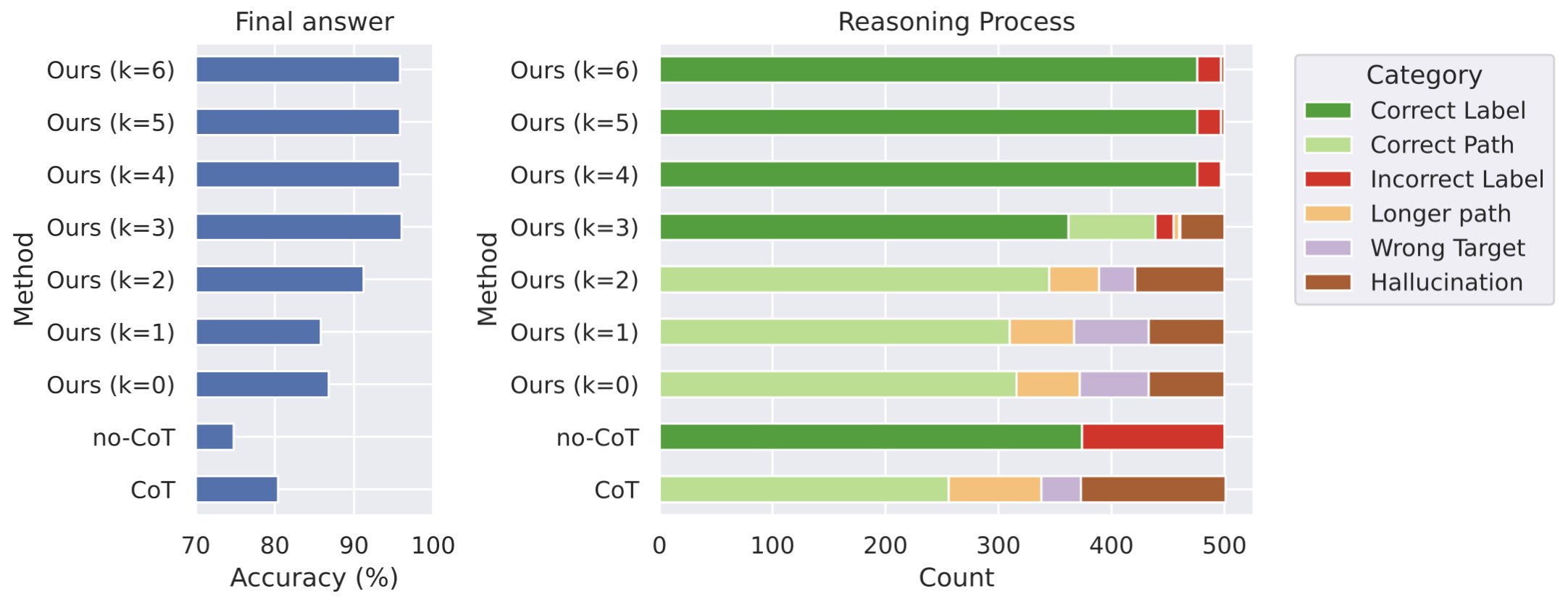
The image presents two horizontal bar charts comparing different methods for a task. The left chart, titled "Final answer," displays the accuracy (%) of each method. The right chart, titled "Reasoning Process," breaks down the counts of different categories (Correct Label, Correct Path, Incorrect Label, Longer Path, Wrong Target, Hallucination) for each method. The methods include "CoT," "no-CoT," and "Ours" with varying parameters (k=0 to k=6).
### Components/Axes
**Left Chart (Final answer):**
* **Title:** Final answer
* **X-axis:** Accuracy (%)
* Scale: 70 to 100, with tick marks at 70, 80, 90, and 100.
* **Y-axis:** Method
* Categories: CoT, no-CoT, Ours (k=0), Ours (k=1), Ours (k=2), Ours (k=3), Ours (k=4), Ours (k=5), Ours (k=6)
**Right Chart (Reasoning Process):**
* **Title:** Reasoning Process
* **X-axis:** Count
* Scale: 0 to 500, with tick marks at 0, 100, 200, 300, 400, and 500.
* **Y-axis:** Method
* Categories: CoT, no-CoT, Ours (k=0), Ours (k=1), Ours (k=2), Ours (k=3), Ours (k=4), Ours (k=5), Ours (k=6)
**Legend (Located on the top-right):**
* **Category:**
* Correct Label (Green)
* Correct Path (Light Green)
* Incorrect Label (Red)
* Longer Path (Orange)
* Wrong Target (Light Purple)
* Hallucination (Brown)
### Detailed Analysis
**Left Chart (Final answer):**
* **CoT:** Accuracy approximately 75%.
* **no-CoT:** Accuracy approximately 72%.
* **Ours (k=0):** Accuracy approximately 82%.
* **Ours (k=1):** Accuracy approximately 85%.
* **Ours (k=2):** Accuracy approximately 90%.
* **Ours (k=3):** Accuracy approximately 95%.
* **Ours (k=4):** Accuracy approximately 97%.
* **Ours (k=5):** Accuracy approximately 98%.
* **Ours (k=6):** Accuracy approximately 99%.
**Trend:** The accuracy generally increases as the value of 'k' increases in the "Ours" method.
**Right Chart (Reasoning Process):**
* **CoT:** Dominated by "Correct Path" (light green), with significant "Hallucination" (brown) and a small amount of "Longer Path" (orange).
* **no-CoT:** Dominated by "Correct Label" (green), with a significant portion of "Incorrect Label" (red).
* **Ours (k=0):** Mostly "Correct Path" (light green), with some "Longer Path" (orange) and "Wrong Target" (light purple), and "Hallucination" (brown).
* **Ours (k=1):** Mostly "Correct Path" (light green), with some "Longer Path" (orange) and "Wrong Target" (light purple), and "Hallucination" (brown).
* **Ours (k=2):** Mostly "Correct Path" (light green), with some "Longer Path" (orange) and "Wrong Target" (light purple), and "Hallucination" (brown).
* **Ours (k=3):** Mostly "Correct Label" (green), with a small amount of "Correct Path" (light green), "Longer Path" (orange), and "Hallucination" (brown).
* **Ours (k=4):** Almost entirely "Correct Label" (green), with a very small amount of "Incorrect Label" (red).
* **Ours (k=5):** Almost entirely "Correct Label" (green), with a very small amount of "Incorrect Label" (red).
* **Ours (k=6):** Almost entirely "Correct Label" (green), with a very small amount of "Incorrect Label" (red).
**Trends:**
* As 'k' increases in the "Ours" method, the "Correct Label" (green) count increases significantly, while "Correct Path" (light green), "Longer Path" (orange), "Wrong Target" (light purple), and "Hallucination" (brown) counts decrease.
* "no-CoT" has a high count of "Incorrect Label" (red).
### Key Observations
* The "Ours" method with higher 'k' values (k=4, k=5, k=6) achieves significantly higher accuracy than "CoT" and "no-CoT."
* The "Reasoning Process" chart reveals that the improved accuracy of "Ours" with higher 'k' values is associated with a higher count of "Correct Label" and a lower count of other categories like "Longer Path," "Wrong Target," and "Hallucination."
* "no-CoT" has the lowest accuracy and a high count of "Incorrect Label," suggesting it struggles with providing correct labels.
* "CoT" relies more on "Correct Path" but suffers from a significant amount of "Hallucination."
### Interpretation
The data suggests that the "Ours" method, particularly with higher 'k' values, is more effective in achieving accurate final answers. The "Reasoning Process" chart indicates that this is because the method is better at identifying the "Correct Label" and avoiding issues like "Longer Path," "Wrong Target," and "Hallucination." The "no-CoT" method's low accuracy and high "Incorrect Label" count suggest it lacks a robust mechanism for label correction. The "CoT" method, while utilizing "Correct Path," is prone to "Hallucination," which negatively impacts its overall accuracy. The parameter 'k' in the "Ours" method seems to control the balance between exploring different reasoning paths and converging on the correct label, with higher values leading to better accuracy.