## Flowchart: Accuracy Assessment Decision Tree
### Overview
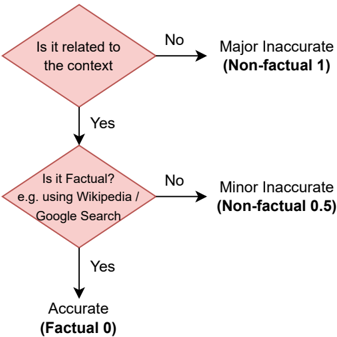
The image depicts a decision tree flowchart for evaluating the accuracy of information. It uses two sequential binary questions to classify outcomes into three categories: "Major Inaccurate," "Minor Inaccurate," and "Accurate," each with associated numerical scores.
### Components/Axes
- **Decision Nodes (Diamonds)**:
1. Top node: *"Is it related to the context?"*
- **Yes** branch leads to the second decision node.
- **No** branch leads directly to the outcome "Major Inaccurate (Non-factual 1)."
2. Bottom node: *"Is it Factual? e.g. using Wikipedia / Google Search"*
- **Yes** branch leads to "Accurate (Factual 0)."
- **No** branch leads to "Minor Inaccurate (Non-factual 0.5)."
- **Outcome Labels (Rectangles)**:
- **Major Inaccurate (Non-factual 1)**: Score = 1.
- **Minor Inaccurate (Non-factual 0.5)**: Score = 0.5.
- **Accurate (Factual 0)**: Score = 0.
### Detailed Analysis
- **Flow Logic**:
1. The process begins by assessing whether the information is **contextually relevant**.
- If **not related to context**, it is immediately classified as "Major Inaccurate" with a score of 1.
2. If **related to context**, the next step evaluates **factual accuracy** using external verification (e.g., Wikipedia, Google Search).
- If **factual**, the outcome is "Accurate" with a score of 0.
- If **not factual**, the outcome is "Minor Inaccurate" with a score of 0.5.
- **Numerical Scores**:
- Scores range from 0 (perfect accuracy) to 1 (maximum inaccuracy).
- The scores are explicitly labeled next to each outcome.
### Key Observations
- The flowchart prioritizes **contextual relevance** as the first filter.
- Factual verification is only applied if the information is contextually relevant.
- The scoring system quantifies inaccuracy, with "Major Inaccurate" being the most severe.
### Interpretation
This decision tree formalizes a two-step evaluation process for information accuracy:
1. **Contextual Relevance**: Ensures the information aligns with the intended use case or domain.
2. **Factual Verification**: Cross-checks claims against authoritative sources to confirm truthfulness.
The numerical scores provide a quantifiable measure of inaccuracy, enabling gradations between "Major" and "Minor" errors. The absence of a score for "Accurate" (0) implies perfection, while non-zero scores reflect varying degrees of factual deviation. The flowchart emphasizes that even contextually relevant information must be factually validated to avoid inaccuracies.
No additional languages or hidden data were detected. The diagram focuses solely on logical flow and categorical classification.