## Line Charts: Model Layer Underflow and Distortion Analysis
### Overview
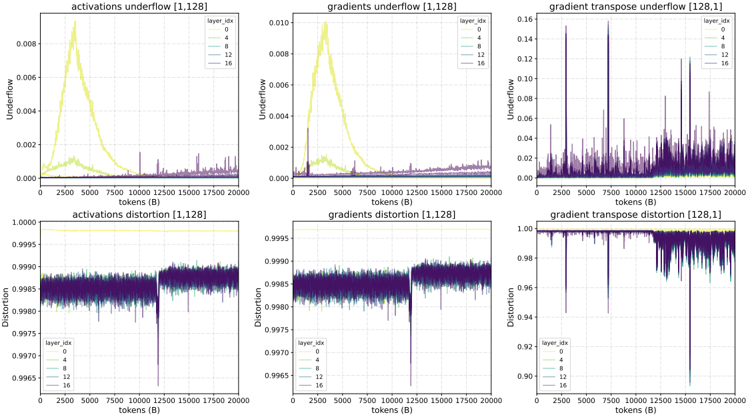
The image contains six line charts comparing numerical metrics across model layers (0, 4, 8, 12, 16) for different computational properties. Three charts focus on "underflow" phenomena, while three examine "distortion" metrics. All charts share a common x-axis representing token positions (0-20,000) and y-axes with logarithmic or normalized scales.
### Components/Axes
1. **X-Axis**: "tokens (B)" spanning 0-20,000 in increments of 2,500
2. **Y-Axes**:
- Underflow charts: 0-0.0006 (linear scale)
- Distortion charts: 0.9975-0.9999 (activations), 0.985-0.9995 (gradients), 0.9-1.0 (gradient transpose)
3. **Legends**:
- Colors: Yellow (layer 0), Green (layer 4), Blue (layer 8), Purple (layer 12), Dark Blue (layer 16)
- Positioned in top-left corner of each plot
4. **Plot Titles**:
- Top row: "activations underflow (1,128)", "gradients underflow (1,128)", "gradient transpose underflow (128,1)"
- Bottom row: "activations distortion (1,128)", "gradients distortion (1,128)", "gradient transpose distortion (128,1)"
### Detailed Analysis
#### Top Row (Underflow)
1. **Activations Underflow (1,128)**:
- Layer 0 (yellow): Sharp peak at ~2,500 tokens (0.00055)
- Layers 4-16: Flat near-zero values
2. **Gradients Underflow (1,128)**:
- Layer 0 (yellow): Peak at ~2,500 tokens (0.0005)
- Layers 4-16: Flat near-zero values
3. **Gradient Transpose Underflow (128,1)**:
- All layers show sporadic spikes (max ~0.12)
- Layer 16 (dark blue) has highest magnitude spikes
#### Bottom Row (Distortion)
1. **Activations Distortion (1,128)**:
- Layers 0-12: Stable ~0.9998
- Layer 16 (dark blue): Sharp dip to 0.9975 at ~12,500 tokens
2. **Gradients Distortion (1,128)**:
- Layers 0-12: Stable ~0.9997
- Layer 16 (dark blue): Sharp dip to 0.9975 at ~12,500 tokens
3. **Gradient Transpose Distortion (128,1)**:
- Layers 0-12: Stable ~0.999
- Layer 16 (dark blue): Sharp dip to 0.9 at ~12,500 tokens
### Key Observations
1. **Underflow Patterns**:
- Early-layer (layer 0) activations/gradients show consistent underflow at ~2,500 tokens
- Gradient transpose underflow affects all layers but is most severe in layer 16
2. **Distortion Anomalies**:
- Layer 16 consistently shows significant distortion spikes at ~12,500 tokens across all metrics
- Distortion magnitude increases with model depth (16 > 12 > 8 > 4 > 0)
### Interpretation
The data suggests:
1. **Numerical Stability Issues**:
- Early-layer underflow indicates potential precision limitations in initial transformer layers
- Gradient transpose underflow in deeper layers (128,1 configuration) suggests architectural sensitivity to layer count
2. **Layer-Specific Vulnerabilities**:
- Layer 16's consistent distortion spikes point to architectural bottlenecks in deepest layers
- The 12,500-token position appears critical across multiple metrics, possibly correlating with specific input patterns
3. **Scale Sensitivity**:
- Underflow metrics use linear scales showing absolute values, while distortion uses normalized scales emphasizing relative deviations
The patterns indicate that deeper layers (particularly layer 16) experience compounded numerical instability and distortion issues, which could impact model reliability during training or inference. The 12,500-token position emerges as a critical failure point across multiple dimensions.