## Mathematical Commutative Diagram: Stability and Transformation Relationships
### Overview
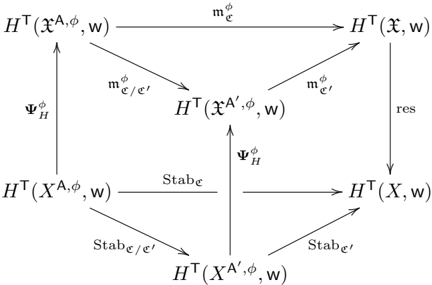
The image displays a commutative diagram from advanced mathematics, likely within the fields of homotopy theory, category theory, or algebraic topology. It illustrates the relationships and transformations between several mathematical objects denoted by `H^T` with various arguments. The diagram is structured as a network of nodes connected by labeled arrows, indicating mappings or operations that commute.
### Components/Axes
The diagram is composed of **nodes** (mathematical objects) and **directed edges** (arrows representing mappings). There are no traditional axes, as this is not a data chart.
**Nodes (Objects):**
The objects are all of the form `H^T(·, w)`, where the first argument varies. The distinct nodes are:
1. `H^T(x^{A,φ}, w)` (Top-left)
2. `H^T(x, w)` (Top-right)
3. `H^T(x^{A',φ}, w)` (Center)
4. `H^T(X^{A,φ}, w)` (Middle-left)
5. `H^T(X, w)` (Middle-right)
6. `H^T(X^{A',φ}, w)` (Bottom-center)
**Edges (Mappings/Arrows):**
Each arrow is labeled with a specific mathematical operation or map. The labels are:
* `m_ε^φ`
* `m_{ε/ε'}^φ`
* `m_{ε'}^φ`
* `Ψ_H^φ` (appears twice)
* `Stab_ε`
* `Stab_{ε/ε'}`
* `Stab_{ε'}`
* `res`
### Detailed Analysis
The diagram is organized into three approximate horizontal layers or rows, with vertical and diagonal connections.
**Top Row (Objects with lowercase 'x'):**
* From `H^T(x^{A,φ}, w)` (top-left), a horizontal arrow labeled `m_ε^φ` points right to `H^T(x, w)` (top-right).
* From `H^T(x^{A,φ}, w)` (top-left), a diagonal arrow labeled `m_{ε/ε'}^φ` points down-right to `H^T(x^{A',φ}, w)` (center).
* From `H^T(x^{A',φ}, w)` (center), a diagonal arrow labeled `m_{ε'}^φ` points up-right to `H^T(x, w)` (top-right).
**Middle/Bottom Rows (Objects with uppercase 'X'):**
* A vertical arrow labeled `Ψ_H^φ` points **up** from `H^T(X^{A,φ}, w)` (middle-left) to `H^T(x^{A,φ}, w)` (top-left).
* A horizontal arrow labeled `Stab_ε` points right from `H^T(X^{A,φ}, w)` (middle-left) to `H^T(X, w)` (middle-right).
* A vertical arrow labeled `Stab_{ε/ε'}` points **up** from `H^T(X^{A',φ}, w)` (bottom-center) to `H^T(X^{A,φ}, w)` (middle-left).
* A diagonal arrow labeled `Stab_{ε'}` points up-right from `H^T(X^{A',φ}, w)` (bottom-center) to `H^T(X, w)` (middle-right).
* A vertical arrow labeled `Ψ_H^φ` points **up** from `H^T(X^{A',φ}, w)` (bottom-center) to `H^T(x^{A',φ}, w)` (center).
**Right-Side Connection:**
* A vertical arrow labeled `res` points **down** from `H^T(x, w)` (top-right) to `H^T(X, w)` (middle-right).
### Key Observations
1. **Commutative Structure:** The diagram is designed to be commutative. This means that following any two paths of arrows from one node to another should yield the same result. For example, the path from `H^T(x^{A,φ}, w)` to `H^T(x, w)` can be taken directly via `m_ε^φ` or indirectly via `m_{ε/ε'}^φ` followed by `m_{ε'}^φ`.
2. **Dual Families of Maps:** There appear to be two parallel families of operations:
* **`m` maps:** These connect the objects with lowercase `x` arguments (top row and center).
* **`Stab` maps:** These connect the objects with uppercase `X` arguments (middle and bottom rows). The names `Stab_ε`, `Stab_{ε/ε'}`, and `Stab_{ε'}` strongly suggest these are "stability" maps parameterized by `ε` and `ε'`.
3. **Connecting Morphisms (`Ψ_H^φ` and `res`):** The maps `Ψ_H^φ` act as bridges between the `X`-family and the `x`-family of objects. The `res` (likely "restriction") map connects the final objects of the two families, `H^T(x, w)` and `H^T(X, w)`.
4. **Parameterization:** The objects and maps are heavily parameterized by symbols `A`, `A'`, `φ`, `ε`, and `ε'`, indicating a complex structure where properties depend on these choices. The notation `x^{A,φ}` suggests `x` is being modified or acted upon by `A` and `φ`.
### Interpretation
This diagram is a formal representation of relationships in a mathematical theory involving stability conditions. It likely demonstrates how different "stabilization" procedures (`Stab` maps) on objects `X` (perhaps spaces or spectra) relate to corresponding operations (`m` maps) on related objects `x` (perhaps their "underlying" or "linearized" versions).
The core message is one of **coherence**: the process of stabilizing an object and then relating it to another is equivalent to first relating the objects and then stabilizing. The `Ψ_H^φ` maps ensure that the operations on the `X` level are compatible with those on the `x` level. The `res` map provides a final link, possibly showing that the stabilized version of the related object is a restriction of the related stabilized object.
The presence of primed and unprimed parameters (`A`/`A'`, `ε`/`ε'`) suggests the diagram is proving a property that holds under a change of parameters or a refinement of the structure. It is a classic "chase the diagram" proof structure, where the commutativity asserts the consistency of the entire algebraic or topological system being studied.