## Flowchart Diagram: Grammatical Dependency Model
### Overview
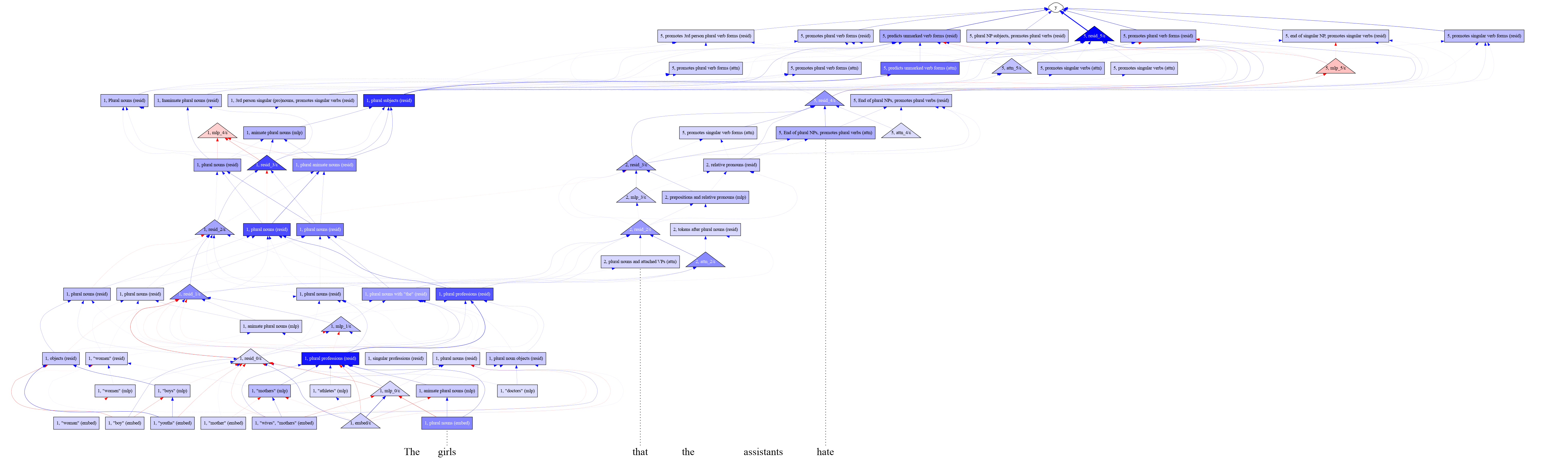
The image depicts a complex flowchart illustrating grammatical dependencies and transformations in a computational linguistic model. Nodes represent grammatical elements (e.g., plural nouns, verb forms), while arrows show relationships like promotion, prediction, and animation. The diagram includes color-coded categories (blue, red, pink) and an example sentence at the bottom.
---
### Components/Axes
- **Nodes**: Labeled with grammatical elements and processing stages (e.g., "1. plural nouns (resid)", "5. promotes singular verb forms (resid)").
- **Arrows**: Labeled with actions (e.g., "promotes", "predicts") and categories (e.g., "(resid)", "(mlp)", "(emb)").
- **Legend**:
- **Blue**: Residual processing ("resid").
- **Red**: Machine learning ("mlp").
- **Pink**: Embedding ("emb").
- **Example Sentence**: "The girls that the assistants hate" with underlined words.
---
### Detailed Analysis
1. **Top-Level Node ("y")**:
- Connects to multiple nodes, including:
- "5. promotes plural verb forms (resid)"
- "5. predicts unmarked verb forms (resid)"
- "5. promotes singular verb forms (resid)"
2. **Blue Nodes ("resid")**:
- Represent residual processing stages.
- Examples:
- "1. plural nouns (resid)"
- "5. promotes singular verb forms (resid)"
3. **Red Nodes ("mlp")**:
- Machine learning-driven transformations.
- Examples:
- "1. animate plural nouns (mlp)"
- "3. mlp_5c"
4. **Pink Nodes ("emb")**:
- Embedding-related operations.
- Examples:
- "1. "women" (embed)"
- "1. "boy" (embed)"
5. **Example Sentence**:
- "The girls that the assistants hate" with underlined words:
- "girls" (plural noun)
- "assistants" (plural noun)
- "hate" (verb)
---
### Key Observations
- **Hierarchical Structure**: Nodes are organized in layers, with top-level nodes ("y") branching into intermediate and terminal nodes.
- **Color-Coded Logic**: Blue nodes dominate, suggesting residual processing is central. Red and pink nodes represent specialized sub-processes.
- **Cyclical Connections**: Some nodes loop back to earlier stages (e.g., "1. plural nouns (resid)" connects to itself via red arrows).
- **Ambiguity in Labels**: Some node labels (e.g., "mlp_5c") lack explicit explanations, requiring inference from context.
---
### Interpretation
This flowchart likely models how a computational system (e.g., NLP model) processes grammatical dependencies. Key insights:
1. **Residual Processing Dominance**: Blue nodes ("resid") form the backbone, handling core grammatical rules (e.g., pluralization, verb promotion).
2. **Machine Learning Integration**: Red nodes ("mlp") introduce adaptive transformations, such as animating nouns or predicting verb forms.
3. **Embedding Role**: Pink nodes ("emb") handle lexical embeddings, grounding abstract rules in concrete examples (e.g., "women", "boy").
4. **Example Application**: The underlined sentence demonstrates how the model applies rules to real-world text, highlighting dependencies between nouns and verbs.
The diagram emphasizes modularity, with distinct pathways for residual, machine learning, and embedding processes. However, the lack of explicit explanations for some labels (e.g., "mlp_5c") suggests gaps in documentation or domain-specific jargon.