TECHNICAL ASSET FINGERPRINT
08ecb4c31030d41aa406b5b4
Click to view fullscreen
Press ESC or click to close
FOUND IN PAPERS
EXPERT: healer-alpha-free VERSION 1
RUNTIME: free/openrouter/healer-alpha
INTEL_VERIFIED
## System Architecture Diagram: Knowledge Graph of Thoughts (KGoT)
### Overview
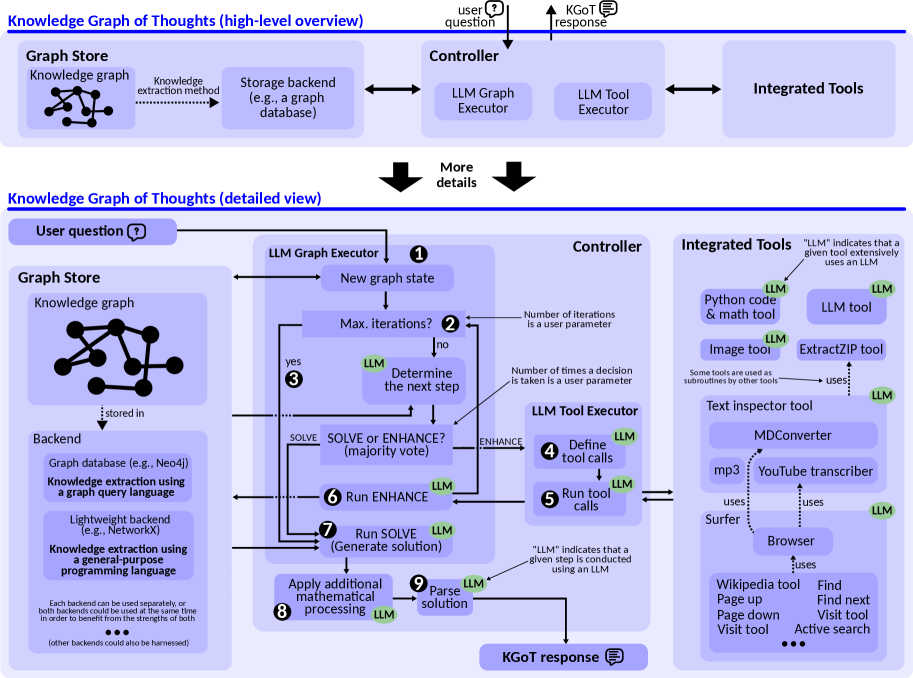
The image is a technical system architecture diagram illustrating the "Knowledge Graph of Thoughts" (KGoT) framework. It is divided into two primary sections: a **high-level overview** at the top and a **detailed view** below, connected by arrows labeled "More details." The diagram describes a system that uses a knowledge graph, a controller powered by Large Language Models (LLMs), and a suite of integrated tools to process a user question and generate a structured response.
### Components/Flow
The system is organized into three main vertical columns in both views, with the Controller being the central processing unit.
**High-Level Overview (Top Section):**
* **Left Column - Graph Store:** Contains a "Knowledge graph" (visualized as a network of nodes and edges). A "Knowledge extraction method" arrow points to a "Storage backend (e.g., a graph database)."
* **Center Column - Controller:** Receives the "user question" and outputs the "KGoT response." It contains two sub-components: "LLM Graph Executor" and "LLM Tool Executor."
* **Right Column - Integrated Tools:** A single block representing the available tools.
* **Flow:** Arrows indicate bidirectional communication between the Graph Store and Controller, and between the Controller and Integrated Tools.
**Detailed View (Bottom Section):**
This section expands the Controller and provides a step-by-step workflow.
* **Left Column - Graph Store & Backend:**
* **Graph Store:** Same "Knowledge graph" visualization.
* **Backend:** Two options are detailed:
1. "Graph database (e.g., Neo4j)" using "Knowledge extraction using a graph query language."
2. "Lightweight backend (e.g., NetworkX)" using "Knowledge extraction using a general-purpose programming language."
* A note states: "Each backend can be used separately, or both can be used in tandem in order to benefit from the strengths of both... (other backends could also be harnessed)."
* **Center Column - Controller (Expanded):** This is the core processing loop, with numbered steps (1-9).
* **LLM Graph Executor:** Manages the graph state.
* **Step 1:** "New graph state" is created from the user question.
* **Step 2:** Checks "Max. iterations?" (a user parameter). If "no," proceeds.
* **Step 3:** Uses an LLM to "Determine the next step."
* **Decision Point:** A diamond labeled "SOLVE or ENHANCE? (majority vote)" directs the flow.
* **LLM Tool Executor:** Handles tool interactions.
* **Step 4:** "Define tool calls" (using an LLM).
* **Step 5:** "Run tool calls" (using an LLM).
* **Action Paths:**
* **ENHANCE Path:** From the decision, goes to Step 4 (Define tool calls) -> Step 5 (Run tool calls) -> Step 6 "Run ENHANCE" (using an LLM) -> loops back to the "New graph state."
* **SOLVE Path:** From the decision, goes to Step 7 "Run SOLVE (Generate solution)" (using an LLM).
* **Post-Processing:**
* **Step 8:** "Apply additional mathematical processing" (using an LLM).
* **Step 9:** "Parse solution" (using an LLM).
* **Output:** The parsed solution becomes the "KGoT response."
* **Right Column - Integrated Tools (Expanded):** Lists specific tools, with green "LLM" badges indicating extensive LLM use.
* **Top Group:** "Python code & math tool," "LLM tool," "Image tool," "ExtractZIP tool."
* **Middle Group:** "Text inspector tool," "MDConverter," "mp3," "YouTube transcriber."
* **Bottom Group:** "Surfer," "Browser," "Wikipedia tool," "Page up," "Page down," "Visit tool," "Find," "Find next," "Visit tool," "Active search."
* **Annotations:**
* "LLM indicates that a given tool extensively uses an LLM."
* "Some tools are used as subroutines by other tools." (e.g., arrows show "Surfer" uses "Browser," which uses "Wikipedia tool," "Find," etc.).
* "LLM indicates that a given step is conducted using an LLM." (pointing to steps in the Controller).
### Detailed Analysis
The diagram meticulously maps the flow of information and control:
1. **Input:** A "user question" initiates the process.
2. **Graph Initialization:** The question is used to create an initial "New graph state" within the Graph Store.
3. **Iterative Enhancement Loop:** The system enters a loop (bounded by "Max. iterations") where it uses an LLM to decide the next action. The majority vote determines if it should "ENHANCE" the graph or "SOLVE" the problem.
* If **ENHANCE**, the LLM Tool Executor is engaged to call external tools (e.g., run Python code, inspect text, browse the web). The results are used to "Run ENHANCE," updating the graph state, and the loop continues.
4. **Solution Generation:** When the decision is "SOLVE," the system generates a solution using the LLM.
5. **Final Processing:** The solution undergoes "additional mathematical processing" and is "parsed" before being output as the final "KGoT response."
6. **Tool Integration:** The "Integrated Tools" column shows a rich ecosystem. Tools can be primary or used as subroutines (e.g., the "Browser" tool is a subroutine for "Surfer" and "Wikipedia tool"). The pervasive "LLM" badges highlight that tool definition, execution, and many processing steps are LLM-driven.
### Key Observations
* **Hybrid Backend Strategy:** The system explicitly supports both dedicated graph databases (Neo4j) and lightweight general-purpose libraries (NetworkX), allowing flexibility based on the task's complexity.
* **LLM-Centric Control:** Nearly every decision-making and processing step (steps 3, 4, 5, 6, 7, 8, 9) is annotated as being conducted by an LLM, indicating the framework's heavy reliance on language models for reasoning and orchestration.
* **Tool Subroutine Hierarchy:** The diagram reveals a layered tool architecture where high-level tools (like "Surfer") are built upon lower-level utilities (like "Browser" and "Find").
* **Majority Vote Mechanism:** The core control flow hinges on a "majority vote" to decide between enhancing knowledge or solving, suggesting an ensemble or multi-agent approach within the LLM.
### Interpretation
This diagram presents a sophisticated architecture for augmented reasoning. The KGoT framework is designed to move beyond simple question-answering by:
1. **Grounding Reasoning in a Knowledge Graph:** It externalizes information into a graph structure, which can be iteratively refined and queried, providing a persistent and structured "memory" for the problem-solving process.
2. **Creating a Deliberative Loop:** The "ENHANCE vs. SOLVE" decision introduces a metacognitive layer. The system can autonomously decide it needs more information (enhance) before committing to an answer (solve), mimicking a human's research process.
3. **Orchestrating a Tool Ecosystem:** It acts as a central controller that can dynamically invoke a wide array of specialized tools (code execution, web browsing, document parsing) to gather information and perform actions, with LLMs serving as the universal interface to these tools.
4. **Peircean Investigative Lens:** From a semiotic perspective, the system embodies a pragmatic investigative cycle. The "user question" is the *sign* that triggers an inquiry. The "Knowledge Graph" is the evolving *interpretant*—a structured representation of understanding. The "Integrated Tools" are the *objects* in the world the system interacts with to test and refine its interpretant. The iterative loop represents the ongoing process of semiosis, where meaning (the final response) is derived through action and interpretation within a structured framework. The "majority vote" is a mechanism for resolving competing interpretations before committing to a final sign (the answer).
DECODING INTELLIGENCE...