## Diagram: Cognitive Architecture
### Overview
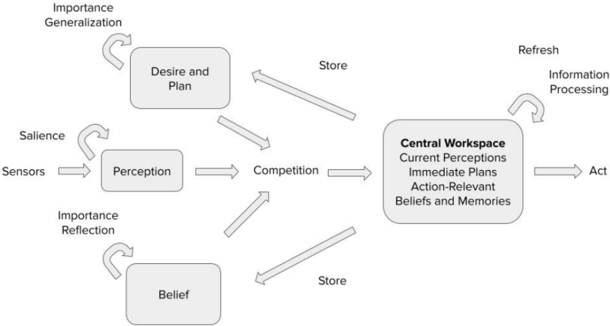
The image is a diagram illustrating a cognitive architecture. It depicts the flow of information and processes between different cognitive components such as perception, belief, desire and plan, and a central workspace. The diagram uses arrows to show the direction of information flow and feedback loops to represent iterative processes.
### Components/Axes
* **Nodes:** The diagram contains four primary nodes, represented as rounded rectangles:
* Desire and Plan (top)
* Perception (middle)
* Belief (bottom)
* Central Workspace (right)
* **Inputs:**
* Sensors (input to Perception)
* **Outputs:**
* Act (output from Central Workspace)
* **Processes/Connections:**
* Salience (feedback loop from Perception)
* Importance Generalization (feedback loop from Desire and Plan)
* Importance Reflection (feedback loop from Belief)
* Competition (connection from Perception and Belief to Central Workspace)
* Store (connection from Desire and Plan and Belief to Central Workspace)
* Refresh (feedback loop from Central Workspace)
* Information Processing (feedback loop from Central Workspace)
* **Central Workspace Contents:**
* Current Perceptions
* Immediate Plans
* Action-Relevant
* Beliefs and Memories
### Detailed Analysis or ### Content Details
The diagram illustrates the flow of information and processes within a cognitive system.
1. **Sensors** provide input to **Perception**.
2. **Perception** processes sensory information and has a feedback loop labeled **Salience**.
3. **Belief** represents the system's beliefs and has a feedback loop labeled **Importance Reflection**.
4. **Desire and Plan** represents the system's goals and plans and has a feedback loop labeled **Importance Generalization**.
5. **Perception** and **Belief** both send information to the **Central Workspace** through a process labeled **Competition**.
6. **Desire and Plan** and **Belief** both send information to the **Central Workspace** through a process labeled **Store**.
7. The **Central Workspace** contains:
* Current Perceptions
* Immediate Plans
* Action-Relevant information
* Beliefs and Memories
8. The **Central Workspace** has a feedback loop labeled **Refresh** and **Information Processing**.
9. The **Central Workspace** outputs an **Act**.
### Key Observations
* The diagram emphasizes the interaction and competition between different cognitive components.
* The Central Workspace acts as a central hub for integrating information and generating actions.
* Feedback loops play a crucial role in refining and updating the information within each component.
### Interpretation
The diagram represents a simplified model of cognitive architecture, illustrating how different cognitive processes interact to produce behavior. The flow of information from sensors to perception, belief, and desire, and their integration in the central workspace, highlights the complex interplay between sensory input, prior knowledge, and goals. The feedback loops suggest that these processes are iterative and adaptive, allowing the system to learn and refine its understanding of the world. The "Competition" process suggests that different perceptions and beliefs compete for attention and influence within the central workspace. The "Store" process suggests that desires, plans, and beliefs are stored in the central workspace. The model suggests that the system's actions are based on the integration of current perceptions, immediate plans, action-relevant information, and beliefs and memories.