## Network Graph: Interconnected Nodes
### Overview
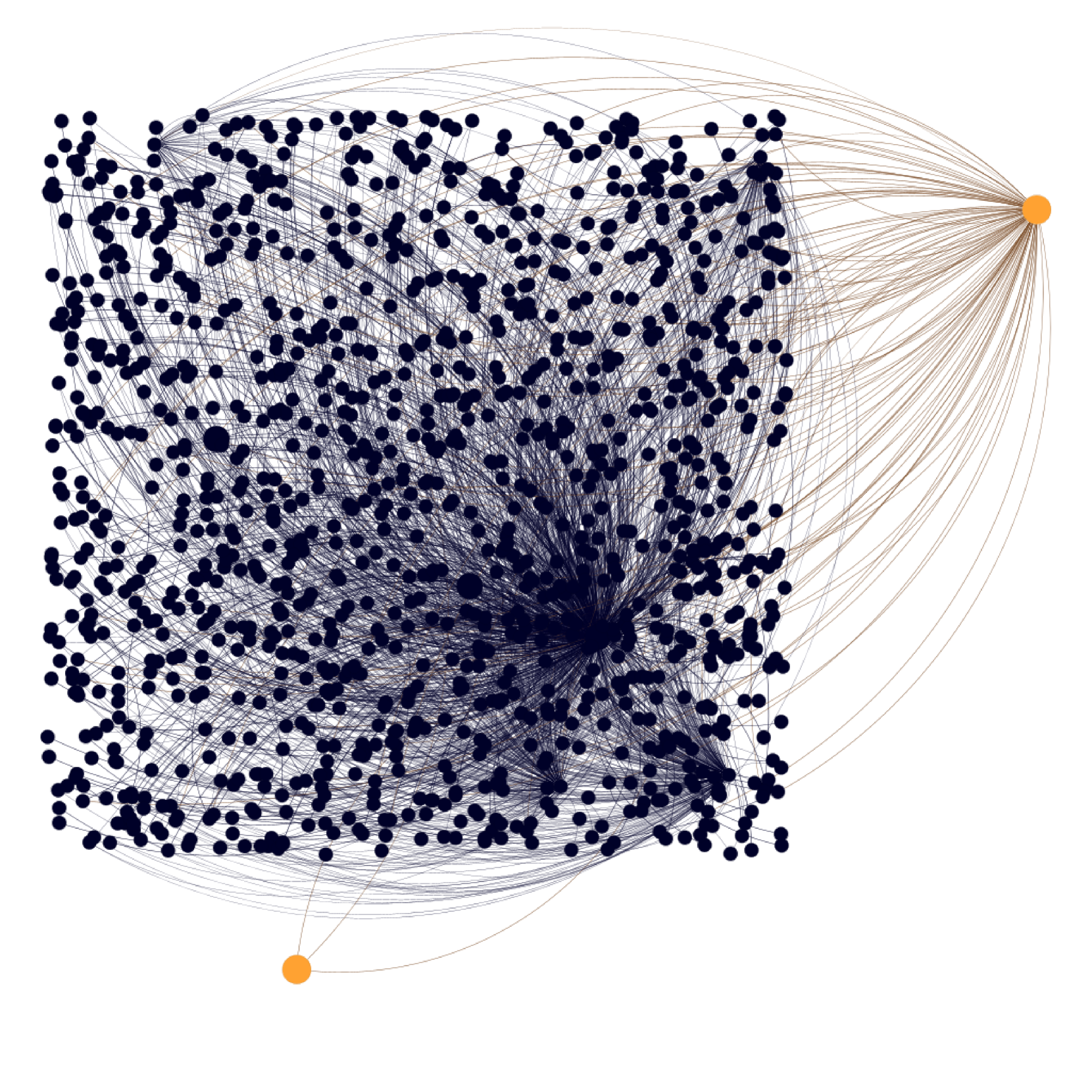
The image displays a network graph consisting of numerous nodes and edges. The majority of nodes are represented by small, dark blue circles, densely clustered in the left and central portions of the image. Two larger, orange circles are positioned on the right and bottom-left edges of the graph. The edges, which connect the nodes, are predominantly thin, dark blue lines, suggesting connections within the main cluster. However, a significant number of thin, light brown lines emanate from the two orange nodes, connecting them to many of the dark blue nodes.
### Components/Axes
This image is a network graph and does not have traditional axes or legends with numerical scales. The components are:
* **Nodes:**
* **Dark Blue Circles:** These are the most numerous nodes, appearing as small, dark blue dots. They are densely packed in the left and central areas, with a particularly high concentration in the center-left, forming a radial pattern.
* **Orange Circles:** Two larger, distinct orange circles are present. One is located on the far right side of the graph, and the other is on the bottom-left edge.
* **Edges (Connections):**
* **Dark Blue Lines:** These are thin lines connecting many of the dark blue nodes to each other. They form a dense web within the main cluster of dark blue nodes.
* **Light Brown Lines:** These are also thin lines, but they are distinctly lighter in color. They originate from the two orange nodes and extend outwards to connect with a large number of the dark blue nodes.
### Detailed Analysis or Content Details
* **Dark Blue Nodes:** There are approximately 1000-1200 dark blue nodes visible. Their distribution is not uniform; they are heavily concentrated in the left and central regions, with a clear radial structure emanating from a central point within this cluster.
* **Orange Nodes:** There are exactly 2 orange nodes.
* **Dark Blue Edges:** The dark blue edges form a complex network among the dark blue nodes. Many nodes appear to have multiple connections to other dark blue nodes. The density of these connections is highest in the central part of the dark blue cluster.
* **Light Brown Edges:** The light brown edges originate from the two orange nodes.
* The orange node on the right appears to be connected to approximately 100-150 dark blue nodes. These connections fan out from the orange node.
* The orange node on the bottom-left appears to be connected to a smaller number of dark blue nodes, estimated to be around 20-30. These connections are more spread out.
### Key Observations
* **Centralized Clustering:** The dark blue nodes form a dense cluster, with a noticeable hub-like structure in the center-left, suggesting a core group with many internal connections.
* **External Influence/Connection:** The two orange nodes act as distinct points of connection to the larger cluster of dark blue nodes. The orange node on the right has a significantly higher number of connections to the dark blue nodes compared to the orange node on the bottom-left.
* **Divergent Connection Patterns:** The light brown lines originating from the orange nodes suggest a different type of relationship or influence compared to the internal connections of the dark blue nodes. The radial fanning of these lines from the orange nodes indicates they are acting as sources or hubs for these connections.
### Interpretation
This network graph visually represents a system with two distinct types of entities or states. The large cluster of dark blue nodes likely represents a primary group or set of elements that are highly interconnected among themselves. The radial pattern within this cluster suggests a potential hierarchy or a central core from which connections spread.
The two orange nodes appear to be external entities or special nodes that interact with the main cluster. The significantly higher number of connections from the orange node on the right suggests it plays a more prominent role in influencing or connecting to the dark blue nodes compared to the orange node on the bottom-left. This could represent:
* **Hubs and Spokes:** The orange nodes could be central hubs, and the dark blue nodes are spokes, with the light brown lines representing the connections. The right orange node is a much larger hub.
* **Categorization:** The dark blue nodes might represent one category of items, and the orange nodes represent another, with specific interaction patterns between them.
* **Influence or Flow:** The light brown lines could represent a flow of information, resources, or influence originating from the orange nodes and directed towards the dark blue nodes. The asymmetry in connections suggests a directional or preferential interaction.
The overall structure implies a system where a large, internally connected component is influenced or connected to by two external points, one of which is a much stronger connector than the other. The visual density of connections suggests a complex and potentially dynamic system.