## Bar Chart: BBH Sub-tasks Performance Comparison
### Overview
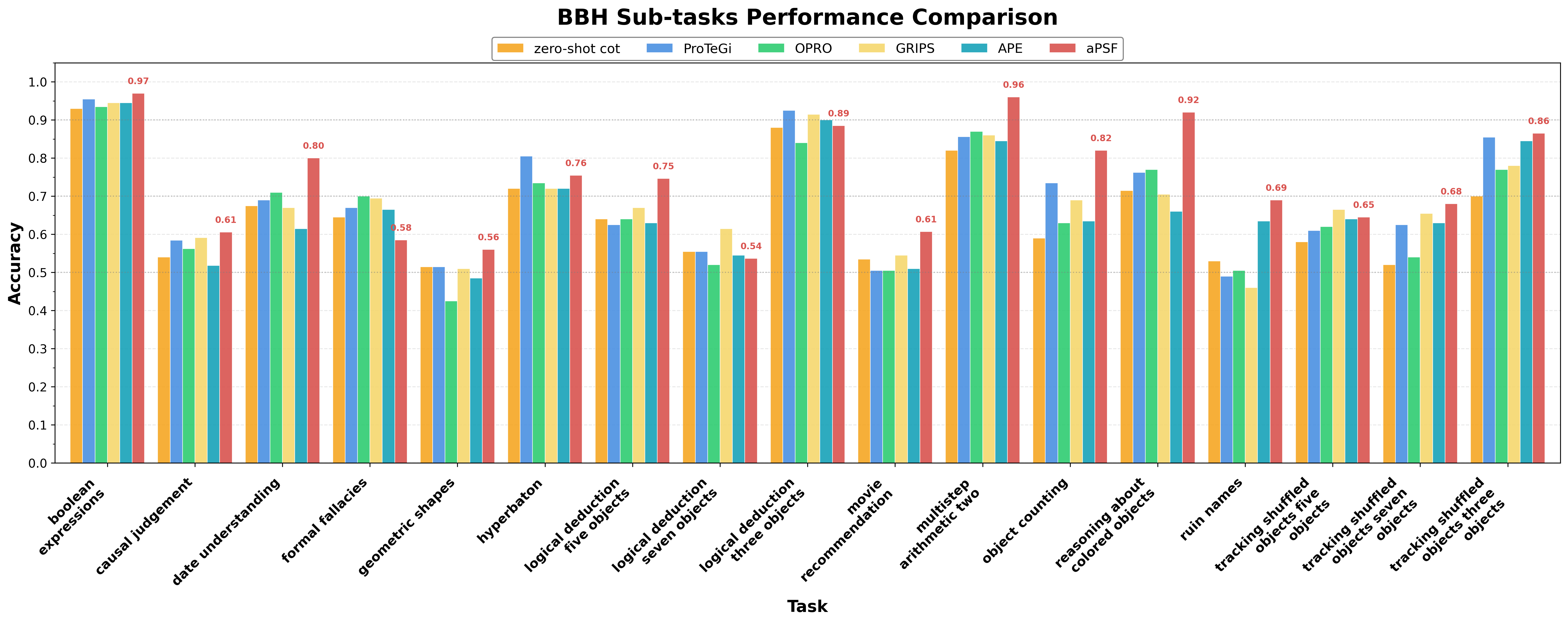
The chart compares the accuracy of six AI models across 18 sub-tasks in the BBH (Big Bench Hard) benchmark. Models include zero-shot cot, ProTeGi, OPRO, GRIPS, APE, and aPSF. Accuracy values range from 0 to 1, with higher values indicating better performance.
### Components/Axes
- **X-axis (Tasks)**: 18 sub-tasks, including "boolean expressions," "causal judgement," "date understanding," "formal fallacies," "geometric shapes," "hyperbaton," "logical deduction five objects," "logical deduction seven objects," "logical deduction three objects," "movie recommendation," "multistep arithmetic two," "object counting," "reasoning about colored objects," "ruin names," "arithmetic shuffled five objects," "tracking shuffled seven objects," and "tracking shuffled three objects".
- **Y-axis (Accuracy)**: Scale from 0 to 1, with increments of 0.1.
- **Legend**: Located in the top-right corner, mapping colors to models:
- Orange: zero-shot cot
- Blue: ProTeGi
- Green: OPRO
- Yellow: GRIPS
- Cyan: APE
- Red: aPSF
### Detailed Analysis
- **Task Groups**: Each task has six grouped bars, one per model. Bars are ordered according to the legend (left to right: orange, blue, green, yellow, cyan, red).
- **Accuracy Values**: Labeled on top of each bar. For example:
- "boolean expressions": aPSF (0.97), ProTeGi (0.95), GRIPS (0.94), OPRO (0.93), APE (0.94), zero-shot cot (0.92).
- "geometric shapes": aPSF (0.56), ProTeGi (0.42), OPRO (0.42), GRIPS (0.42), APE (0.42), zero-shot cot (0.42).
- "logical deduction three objects": aPSF (0.89), ProTeGi (0.94), GRIPS (0.92), OPRO (0.85), APE (0.88), zero-shot cot (0.87).
### Key Observations
1. **aPSF Dominance**: Consistently achieves the highest accuracy across most tasks (e.g., 0.97 in "boolean expressions," 0.96 in "logical deduction seven objects").
2. **Zero-shot cot Lag**: Generally underperforms other models (e.g., 0.42 in "geometric shapes," 0.54 in "logical deduction seven objects").
3. **Model-Specific Strengths**:
- ProTeGi excels in "logical deduction three objects" (0.94) and "tracking shuffled three objects" (0.86).
- OPRO performs well in "reasoning about colored objects" (0.82) and "arithmetic shuffled five objects" (0.69).
- GRIPS shows strength in "object counting" (0.70) and "tracking shuffled seven objects" (0.68).
4. **Low-Performance Tasks**: "Geometric shapes" and "ruin names" are challenging for most models, with accuracies below 0.6.
### Interpretation
The data highlights **aPSF** as the most robust model, achieving near-perfect accuracy in foundational tasks like "boolean expressions" and maintaining high performance in complex reasoning tasks. In contrast, **zero-shot cot** struggles across nearly all tasks, suggesting limitations in zero-shot learning without additional context. Models like **ProTeGi** and **OPRO** demonstrate competitive performance in specific sub-tasks, indicating specialized strengths. The disparity in accuracy between models underscores the importance of architectural design and training strategies for handling diverse reasoning challenges. Outliers like "geometric shapes" (lowest accuracy: 0.42 for zero-shot cot) and "logical deduction three objects" (highest accuracy: 0.94 for ProTeGi) reveal task-specific bottlenecks and opportunities for improvement.