## Flowchart: FFI-based E2E Verifier Workflow
### Overview
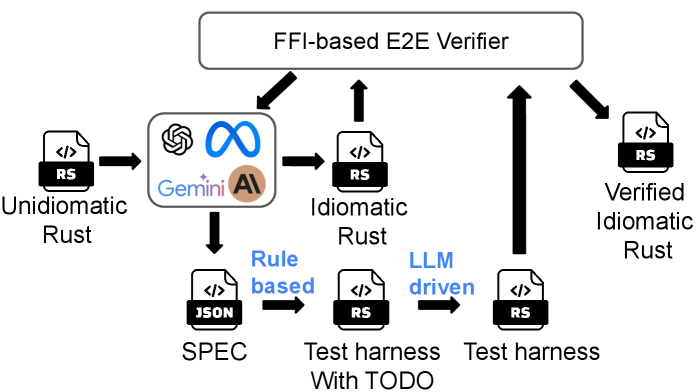
The diagram illustrates a technical workflow for transforming and verifying Rust code using a combination of AI-driven tools, rule-based systems, and formal verification. It emphasizes iterative refinement from "Unidiomatic Rust" to "Verified Idiomatic Rust" through multiple stages.
### Components/Axes
1. **Key Elements**:
- **Unidiomatic Rust**: Starting point (leftmost box).
- **Gemini AI**: Central processing node (labeled with Gemini logo and "AI").
- **Idiomatic Rust**: Intermediate output (center-right box).
- **FFI-based E2E Verifier**: Topmost box, acting as the overarching process.
- **Verified Idiomatic Rust**: Final output (rightmost box).
- **Rule-based**: Subprocess under Gemini AI (labeled "Rule based" with JSON spec).
- **LMM driven**: Subprocess under Gemini AI (labeled "LMM driven" with test harness using TODD).
2. **Flow Arrows**:
- Unidiomatic Rust → Gemini AI → Idiomatic Rust.
- Idiomatic Rust → FFI-based E2E Verifier → Verified Idiomatic Rust.
- Feedback loop: Verified Idiomatic Rust → Idiomatic Rust (iterative refinement).
3. **Subcomponents**:
- **JSON Spec**: Output of the "Rule based" subprocess.
- **Test harness with TODD**: Output of the "LMM driven" subprocess.
### Detailed Analysis
- **Unidiomatic Rust** is processed by **Gemini AI** to produce **Idiomatic Rust**, suggesting AI-assisted code refactoring.
- **Idiomatic Rust** undergoes verification via two parallel paths:
1. **Rule-based**: Generates a JSON specification (likely formal rules for validation).
2. **LMM driven**: Uses a test harness with TODD (possibly a testing framework or LLM-based tool).
- Both paths converge to produce **Verified Idiomatic Rust**, which feeds back into the loop for further refinement.
### Key Observations
1. **Iterative Verification**: The feedback loop indicates continuous improvement, where verified code is re-evaluated for further idiomatic adjustments.
2. **Hybrid Verification**: Combines rule-based (deterministic) and LLM-driven (probabilistic) methods for robustness.
3. **TODD Integration**: The test harness with TODD implies a specialized toolchain for LLM-driven validation, possibly handling edge cases or complex scenarios.
### Interpretation
This workflow demonstrates a **formal verification pipeline** for Rust code, leveraging AI (Gemini) for initial refactoring and hybrid methods (rules + LLM) for validation. The FFI-based E2E Verifier acts as the central authority, ensuring cross-platform compatibility (via FFI) and end-to-end correctness. The use of TODD in the LMM-driven path suggests a focus on test-driven development, while the JSON spec output from the rule-based path provides auditability. The cyclical nature emphasizes that "idiomatic" code is context-dependent and requires ongoing validation, likely to address evolving language standards or project requirements.