## Control Flow Diagram: Program Logic
### Overview
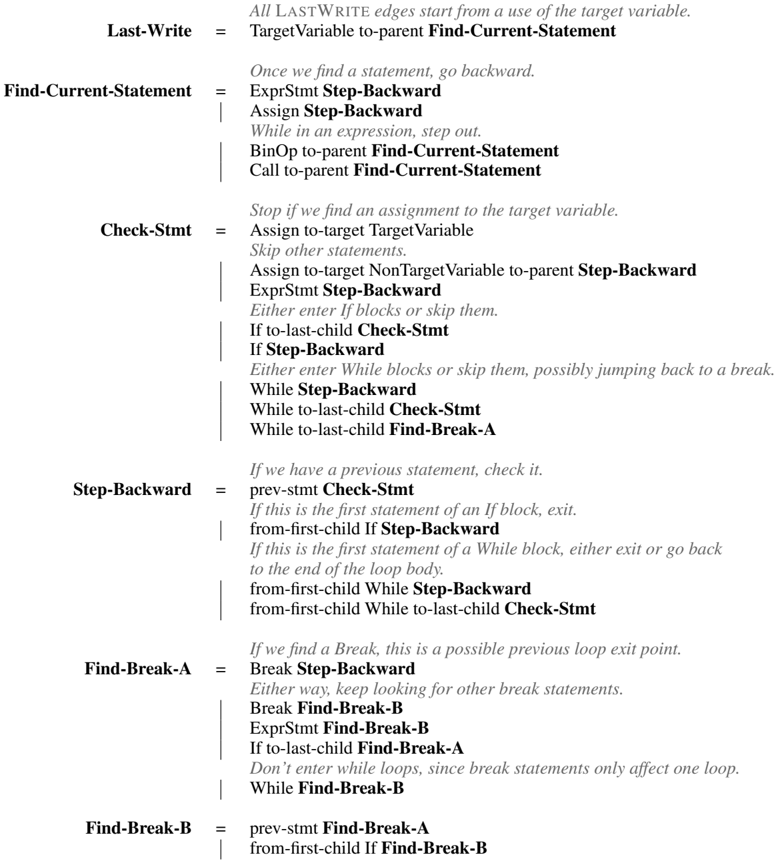
The image presents a control flow diagram outlining the logic for several functions: `Last-Write`, `Find-Current-Statement`, `Check-Stmt`, `Step-Backward`, `Find-Break-A`, and `Find-Break-B`. The diagram uses a combination of assignment statements, conditional checks, and recursive calls to define the behavior of each function.
### Components/Axes
The diagram consists of a series of function definitions, each followed by a set of rules or steps. The rules are expressed using assignment operators (=), conditional statements (implied by "If"), and function calls. The diagram also uses indentation and vertical lines to indicate the flow of control.
* **Function Definitions:** `Last-Write`, `Find-Current-Statement`, `Check-Stmt`, `Step-Backward`, `Find-Break-A`, `Find-Break-B`.
* **Operators:** `=` (assignment), implied conditional operators (If).
* **Keywords/Phrases:** `TargetVariable`, `ExprStmt`, `Assign`, `BinOp`, `NonTargetVariable`, `prev-stmt`, `Break`, `While`, `to-parent`, `to-last-child`, `from-first-child`.
### Detailed Analysis or ### Content Details
**1. Last-Write:**
* `Last-Write = All LASTWRITE edges start from a use of the target variable.`
* `TargetVariable to-parent Find-Current-Statement`
**2. Find-Current-Statement:**
* `Find-Current-Statement = Once we find a statement, go backward.`
* `ExprStmt Step-Backward`
* `Assign Step-Backward`
* `While in an expression, step out.`
* `BinOp to-parent Find-Current-Statement`
* `Call to-parent Find-Current-Statement`
**3. Check-Stmt:**
* `Check-Stmt = Stop if we find an assignment to the target variable.`
* `Assign to-target TargetVariable`
* `Skip other statements.`
* `Assign to-target NonTargetVariable to-parent Step-Backward`
* `ExprStmt Step-Backward`
* `Either enter If blocks or skip them.`
* `If to-last-child Check-Stmt`
* `If Step-Backward`
* `Either enter While blocks or skip them, possibly jumping back to a break.`
* `While Step-Backward`
* `While to-last-child Check-Stmt`
* `While to-last-child Find-Break-A`
**4. Step-Backward:**
* `Step-Backward = If we have a previous statement, check it.`
* `prev-stmt Check-Stmt`
* `If this is the first statement of an If block, exit.`
* `from-first-child If Step-Backward`
* `If this is the first statement of a While block, either exit or go back to the end of the loop body.`
* `from-first-child While Step-Backward`
* `from-first-child While to-last-child Check-Stmt`
**5. Find-Break-A:**
* `Find-Break-A = If we find a Break, this is a possible previous loop exit point.`
* `Break Step-Backward`
* `Either way, keep looking for other break statements.`
* `Break Find-Break-B`
* `ExprStmt Find-Break-B`
* `If to-last-child Find-Break-A`
* `Don't enter while loops, since break statements only affect one loop.`
* `While Find-Break-B`
**6. Find-Break-B:**
* `Find-Break-B = prev-stmt Find-Break-A`
* `from-first-child If Find-Break-B`
### Key Observations
* The diagram uses recursion extensively, with functions calling themselves or other functions in the chain.
* Conditional statements (`If`) play a crucial role in controlling the flow of execution.
* The functions appear to be related to traversing a program's abstract syntax tree (AST) or control flow graph, likely for purposes of data flow analysis or optimization.
* The "to-parent", "to-last-child", and "from-first-child" keywords suggest a tree-like data structure is being traversed.
* The presence of "Break" related functions indicates the handling of loop exit conditions.
### Interpretation
The diagram describes a set of algorithms for analyzing program code. The functions seem to be designed to trace the flow of data and control within a program, identifying assignments, conditional branches, and loop structures. The `Last-Write` function likely identifies the last point where a variable is modified. The `Find-Current-Statement` function appears to move backward through the code, potentially searching for the definition of a variable or the start of a block. The `Check-Stmt` function probably checks the type or properties of a statement. The `Step-Backward` function moves backward through the code, handling different control flow structures. The `Find-Break-A` and `Find-Break-B` functions are related to finding break statements and their potential exit points. The overall system is likely part of a larger compiler or static analysis tool.