## Diagram: XAI Techniques Classification
### Overview
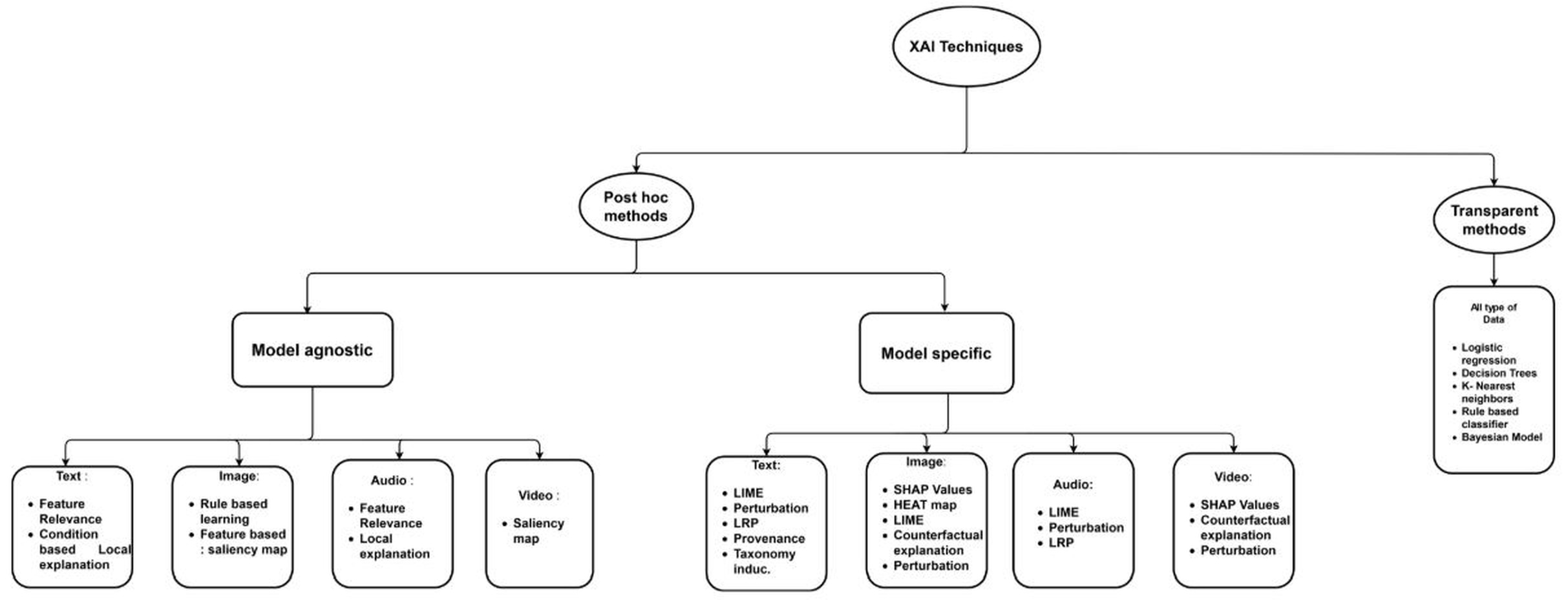
The image is a flowchart illustrating a classification of Explainable Artificial Intelligence (XAI) techniques. It categorizes XAI techniques into "Post hoc methods" and "Transparent methods." "Post hoc methods" are further divided into "Model agnostic" and "Model specific" approaches. Each of these categories is then broken down by data type: Text, Image, Audio, and Video, with specific techniques listed for each.
### Components/Axes
* **Main Title:** XAI Techniques (located at the top-center of the diagram)
* **First Level Categories:**
* Post hoc methods (located in the center of the diagram)
* Transparent methods (located on the right side of the diagram)
* **Second Level Categories (under Post hoc methods):**
* Model agnostic (located on the left side of the diagram)
* Model specific (located on the right side of the diagram)
* **Data Types:** Text, Image, Audio, Video (listed under both "Model agnostic" and "Model specific")
* **Techniques:** Lists of specific XAI techniques under each data type.
### Detailed Analysis or ### Content Details
**1. XAI Techniques (Top-Level Category):**
* This is the root of the diagram, representing the overall subject.
**2. Post hoc methods:**
* **Definition:** Methods applied after the model has been trained.
* **Sub-categories:**
* **Model agnostic:** Techniques that can be applied to any machine learning model.
* **Text:**
* Feature Relevance
* Condition based Local explanation
* **Image:**
* Rule based learning
* Feature based: saliency map
* **Audio:**
* Feature Relevance
* Local explanation
* **Video:**
* Saliency map
* **Model specific:** Techniques tailored to specific types of models.
* **Text:**
* LIME
* Perturbation
* LRP
* Provenance
* Taxonomy induc.
* **Image:**
* SHAP Values
* HEAT map
* LIME
* Counterfactual explanation
* Perturbation
* **Audio:**
* LIME
* Perturbation
* LRP
* **Video:**
* SHAP Values
* Counterfactual explanation
* Perturbation
**3. Transparent methods:**
* **Definition:** Models that are inherently interpretable.
* **Data Type:** All type of Data
* **Techniques:**
* Logistic regression
* Decision Trees
* K-Nearest neighbors
* Rule based classifier
* Bayesian Model
### Key Observations
* The diagram provides a structured overview of XAI techniques, categorizing them based on their applicability (Post hoc vs. Transparent) and model dependence (Model agnostic vs. Model specific).
* The "Post hoc methods" category is further divided by data type, indicating which techniques are suitable for different types of data.
* "Transparent methods" are presented as inherently interpretable models, applicable to all data types.
### Interpretation
The diagram serves as a taxonomy of XAI techniques, offering a framework for understanding the different approaches to model interpretability. It highlights the distinction between methods that are applied after model training (Post hoc) and models that are inherently interpretable (Transparent). The categorization by data type within "Post hoc methods" suggests that the choice of XAI technique may depend on the nature of the data being analyzed. The diagram is useful for researchers and practitioners in the field of AI to navigate the landscape of XAI techniques and select the most appropriate methods for their specific needs.