## Diagram: Audio Signal Processing Pipeline with Neural Network Architecture
### Overview
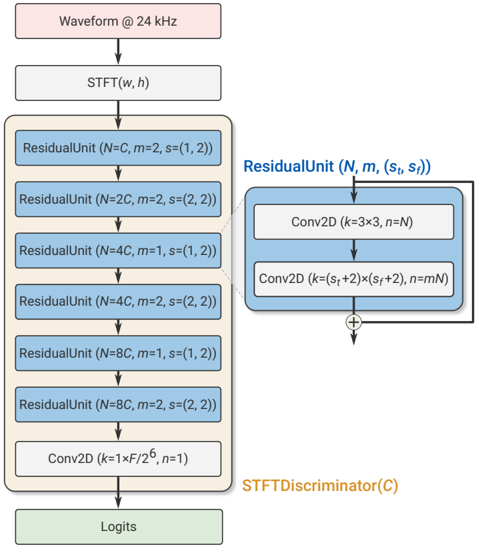
The diagram illustrates a neural network architecture for audio signal processing, starting with a 24 kHz waveform input. It includes a Short-Time Fourier Transform (STFT) for time-frequency representation, followed by a series of residual units and convolutional layers, culminating in logits for classification or regression. The architecture incorporates residual connections and a discriminator component, suggesting potential use in generative or discriminative tasks.
### Components/Axes
1. **Input**: Waveform @ 24 kHz (time-domain audio signal).
2. **STFT (w, h)**: Converts the waveform into a time-frequency representation (spectrogram).
3. **Residual Units**: Stacked layers with parameters:
- `N`: Number of channels/filters (e.g., 2, 4, 8, 16).
- `C`: Input channels (e.g., 2, 2, 2, 2).
- `m`: Scale factor (e.g., 1, 2).
- `s`: Stride (e.g., 1, 2).
- `t`: Kernel size (e.g., 2, 2).
4. **Conv2D Layers**:
- `k=3×3`, `n=N`: Standard convolution with kernel size 3×3.
- `k=(s_i+2)×(s_f+2)`, `n=mN`: Adaptive kernel size based on stride and scale.
5. **STFT Discriminator (C)**: Likely a discriminator network for evaluating audio quality (e.g., in a GAN).
6. **Logits**: Final output layer for classification/regression.
### Detailed Analysis
- **Residual Units**:
- The first unit (`N=2, C=2, s=1, t=2`) processes the STFT output with minimal downsampling.
- Subsequent units increase `N` (e.g., 4, 8, 16) and adjust `s`/`t` to control feature extraction granularity.
- Parameters like `m=1` (no scaling) and `m=2` (doubling channels) suggest dynamic channel adjustment.
- **Conv2D Layers**:
- Early layers use fixed `k=3×3` for local feature extraction.
- Later layers adapt kernel sizes (`k=(s_i+2)×(s_f+2)`) to match stride and scale, enabling hierarchical feature learning.
- **STFT Discriminator (C)**: Positioned after the residual units, it likely evaluates the processed audio's fidelity or authenticity.
- **Logits**: Output layer with no activation function, indicating raw scores for downstream tasks (e.g., softmax for classification).
### Key Observations
- **Hierarchical Feature Learning**: Residual units and adaptive Conv2D layers enable multi-scale feature extraction.
- **Residual Connections**: Facilitate gradient flow, critical for training deep networks.
- **STFT Integration**: Time-frequency domain processing is central to audio tasks.
- **Discriminator Role**: Suggests a generative component (e.g., GAN) for audio synthesis or enhancement.
### Interpretation
This architecture is designed for audio processing tasks such as classification, denoising, or generation. The STFT converts raw audio into a spectrogram, which is then processed through residual blocks to capture temporal and spectral features. The increasing `N` values in residual units indicate progressive feature complexity, while the discriminator implies a focus on audio quality or authenticity. The logits output suggests the model is tailored for supervised learning, though the absence of an activation function leaves the final task ambiguous (e.g., regression vs. classification). The use of adaptive kernel sizes in Conv2D layers highlights flexibility in handling varying input resolutions.