\n
## Diagram: Task and Format Generalization for Sequence Transformation
### Overview
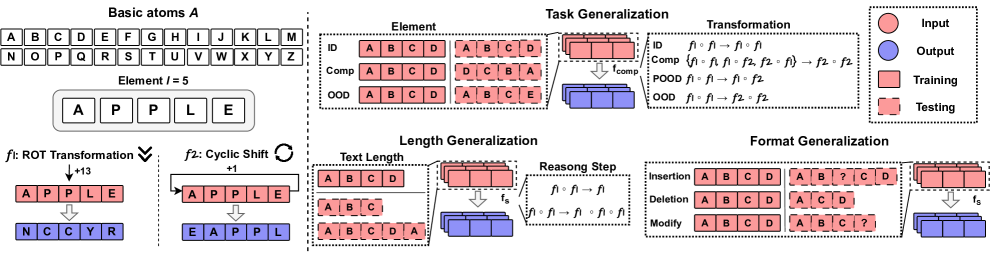
This diagram illustrates a framework for generalizing sequence transformation tasks. It breaks down the generalization process into four key areas: Task Generalization, Length Generalization, and Format Generalization, building upon a foundation of "Basic atoms A". The diagram uses visual representations of sequences (represented as blocks with letters) and transformations to explain the concepts.
### Components/Axes
The diagram is divided into four main sections, arranged horizontally:
1. **Basic atoms A:** A grid of letters from A to Z.
2. **Task Generalization:** Illustrates generalization across different task types (ID, Comp, POOD, OOD).
3. **Length Generalization:** Demonstrates generalization across varying sequence lengths.
4. **Format Generalization:** Shows generalization across different sequence formats (Insertion, Deletion, Modify).
A legend on the top-right defines color-coding:
* **Red:** Input
* **Blue:** Output
* **Light Red:** Training
* **Light Blue:** Testing
Additionally, the diagram includes labels for transformations (f1, f2, f3, f6) and arrows indicating the direction of transformations.
### Detailed Analysis or Content Details
**1. Basic atoms A:**
* A 26-letter grid, representing the alphabet.
* Label: "Element / = 5" is positioned below the sequence "APPLE", indicating the element number is 5.
**2. Task Generalization:**
* **ID (Identity):** Input sequence "ABCD" transforms to "ABCD". Transformation: f1 -> f1.
* **Comp (Composition):** Input sequence "ABCD" transforms to "DCBA". Transformation: f1 -> f2, f2 -> f1.
* **POOD (Partial Out-of-Distribution):** Input sequence "ABCD" transforms to "ABCE". Transformation: f1 -> f2, f2 -> f2.
* **OOD (Out-of-Distribution):** Input sequence "ABCD" transforms to "ABCE". Transformation: f1 -> f2, f2 -> f2.
* The input sequences are represented by red blocks, and the output sequences by blue blocks. Training data is light red, and testing data is light blue.
**3. Length Generalization:**
* Demonstrates transformations on sequences of varying lengths.
* Sequence 1: "ABCD" transforms to "ABCDA". Transformation: f6.
* Sequence 2: "ABC" transforms to "ABCDA". Transformation: f6.
* Sequence 3: "ABCA" transforms to "ABCDA". Transformation: f6.
* The transformation f6 is shown as a series of blocks, with the input sequence on top and the output sequence below.
**4. Format Generalization:**
* Illustrates generalization across different sequence formats.
* **Insertion:** "ABCD" transforms to "ABC?CD".
* **Deletion:** "ABCD" transforms to "ACD".
* **Modify:** "ABCD" transforms to "ABC?".
* The question mark (?) indicates a modified or unknown element.
**Transformations:**
* **f1:** ROT Transformation +13 (shown with a circular arrow).
* **f2:** Cyclic Shift +1 (shown with a circular arrow).
* **f6:** A more complex transformation represented by a series of blocks.
### Key Observations
* The diagram emphasizes the modularity of sequence transformations, showing how different transformations can be combined and generalized.
* The color-coding clearly distinguishes between input, output, training, and testing data.
* The use of visual representations of sequences makes the concepts more intuitive.
* The diagram highlights the importance of generalizing across different task types, sequence lengths, and sequence formats.
### Interpretation
The diagram presents a framework for building robust sequence transformation models. It suggests that by explicitly addressing task, length, and format generalization, models can be made more adaptable to unseen data and real-world scenarios. The use of transformations like ROT and Cyclic Shift provides concrete examples of how sequences can be manipulated. The distinction between training and testing data emphasizes the importance of evaluating generalization performance. The diagram implies that a successful model should be able to perform well on tasks, lengths, and formats that were not explicitly seen during training. The use of "Basic atoms A" suggests a foundational approach, building up complexity from simple elements. The diagram is a conceptual illustration, and does not provide specific numerical data or performance metrics. It is a high-level overview of a research approach to sequence transformation.