## Scatter Plot: Musical Artist Genre Clustering
### Overview
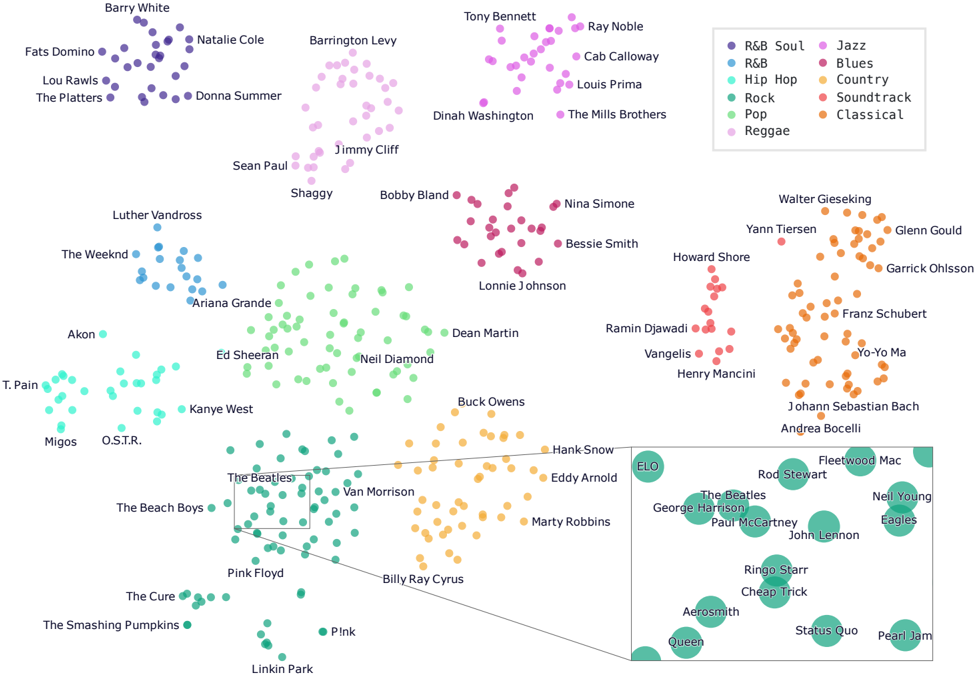
The image is a two-dimensional scatter plot visualizing the relationships between various musical artists based on genre similarity. The plot uses color-coded clusters to represent ten distinct musical genres. A zoomed-in inset box at the bottom right provides a detailed view of the "Rock" cluster, highlighting specific artists within that group.
### Components/Axes
* **Axes:** The plot does not have labeled axes, which is characteristic of dimensionality reduction visualizations (such as t-SNE or UMAP), where the X and Y coordinates represent relative similarity rather than specific quantitative metrics.
* **Legend (Top Right):**
* **R&B Soul:** Purple
* **R&B:** Blue
* **Hip Hop:** Teal
* **Rock:** Green
* **Reggae:** Light Purple
* **Jazz:** Light Pink
* **Blues:** Dark Pink
* **Country:** Yellow/Orange
* **Soundtrack:** Red
* **Classical:** Orange
* **Inset (Bottom Right):** A rectangular callout box magnifying a dense region of the "Rock" (Green) cluster.
### Detailed Analysis
#### Cluster Distribution
* **Top-Left (Purple - R&B Soul):** Contains Barry White, Natalie Cole, Fats Domino, Lou Rawls, The Platters, and Donna Summer.
* **Top-Middle (Light Purple - Reggae):** Contains Barrington Levy, Sean Paul, Jimmy Cliff, and Shaggy.
* **Top-Middle (Light Pink - Jazz):** Contains Tony Bennett, Ray Noble, Cab Calloway, Louis Prima, Dinah Washington, and The Mills Brothers.
* **Middle-Left (Blue - R&B):** Contains Luther Vandross, The Weeknd, Ariana Grande, Akon, T. Pain, Migos, and O.S.T.R.
* **Center/Bottom (Green - Rock):** A large, sprawling cluster containing Ed Sheeran, Neil Diamond, Dean Martin, The Beatles, Van Morrison, The Beach Boys, Pink Floyd, The Cure, The Smashing Pumpkins, P!nk, and Linkin Park.
* **Middle (Dark Pink - Blues):** Contains Bobby Bland, Nina Simone, Bessie Smith, and Lonnie Johnson.
* **Right (Red - Soundtrack):** Contains Howard Shore, Ramin Djawadi, Vangelis, and Henry Mancini.
* **Right (Orange - Classical):** Contains Walter Gieseking, Yann Tiersen, Glenn Gould, Garrick Ohlsson, Franz Schubert, Yo-Yo Ma, Johann Sebastian Bach, and Andrea Bocelli.
* **Bottom-Middle (Yellow/Orange - Country):** Contains Buck Owens, Hank Snow, Eddy Arnold, Marty Robbins, and Billy Ray Cyrus.
#### Inset Analysis (Bottom Right)
The inset provides a magnified view of the "Rock" cluster. It reveals that the model distinguishes between individual members of bands and the bands themselves.
* **Artists/Bands identified:** ELO, Rod Stewart, Fleetwood Mac, Neil Young, Eagles, George Harrison, Paul McCartney, John Lennon, The Beatles, Ringo Starr, Cheap Trick, Aerosmith, Queen, Status Quo, Pearl Jam.
### Key Observations
* **Genre Proximity:** The spatial arrangement reflects musical lineage. For example, the "Soundtrack" (Red) cluster is positioned directly adjacent to the "Classical" (Orange) cluster, likely due to shared orchestral instrumentation. Similarly, "R&B" (Blue) and "Hip Hop" (Teal) are clustered closely together.
* **Granularity:** The inclusion of individual Beatles members (John Lennon, Paul McCartney, George Harrison, Ringo Starr) alongside the band "The Beatles" suggests the underlying data model is sensitive to individual artist discography versus group discography.
* **Outliers:** Some placements are unconventional based on traditional genre definitions. For example, Dean Martin is placed within the "Rock" cluster, despite being primarily known for traditional pop and jazz standards. This suggests the model may be clustering based on specific features (e.g., production era, popularity, or collaborative networks) rather than strict genre labels.
### Interpretation
This visualization is a classic example of a dimensionality reduction technique (likely t-SNE) applied to music metadata. The data demonstrates that musical genres are not isolated silos but exist on a continuous spectrum of similarity.
The "gravity" of the clusters suggests that artists are positioned based on the "distance" between their musical styles. The proximity of the "Classical" and "Soundtrack" clusters indicates a high degree of overlap in their acoustic profiles. The inset highlights the model's ability to resolve high-density areas, showing that it can differentiate between the collective output of a band and the solo careers of its members, placing them in close proximity but as distinct data points. This suggests the model is likely trained on features derived from audio analysis or collaborative filtering (user listening habits) rather than manually assigned genre tags.